


 Скачать презентацию CSC 4320 6320 Operating Systems Lecture 1 Introduction to
279f1c307f2082c6c4ff8f94b345622b.ppt
- Количество слайдов: 70
 CSC 4320/6320 Operating Systems Lecture 1 Introduction to Operating Systems Saurav Karmakar
 What do we want to know at first ? n What is an Operating System? l And – what is it not? n Examples of Operating Systems design n Why study Operating Systems?
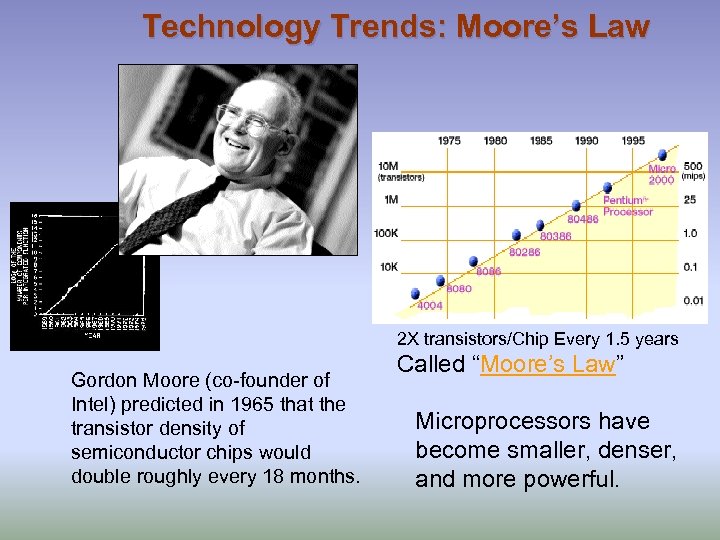 Technology Trends: Moore’s Law 2 X transistors/Chip Every 1. 5 years Gordon Moore (co-founder of Intel) predicted in 1965 that the transistor density of semiconductor chips would double roughly every 18 months. Called “Moore’s Law” Microprocessors have become smaller, denser, and more powerful.
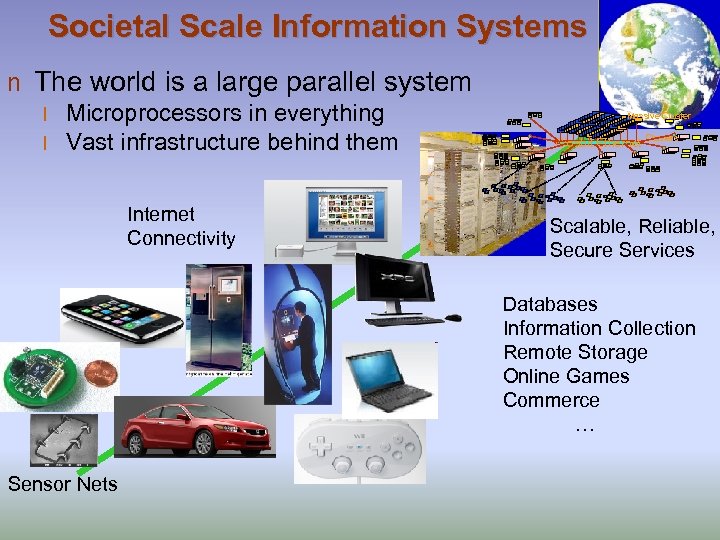 Societal Scale Information Systems n The world is a large parallel system l l Microprocessors in everything Vast infrastructure behind them Internet Connectivity Massive Cluster Gigabit Ethernet Clusters Scalable, Reliable, Secure Services Databases Information Collection Remote Storage Online Games Commerce … Sensor Nets
 People-to-Computer Ratio Over Time Culler Produced n Today: Multiple CPUs/person! l Approaching 100 s?
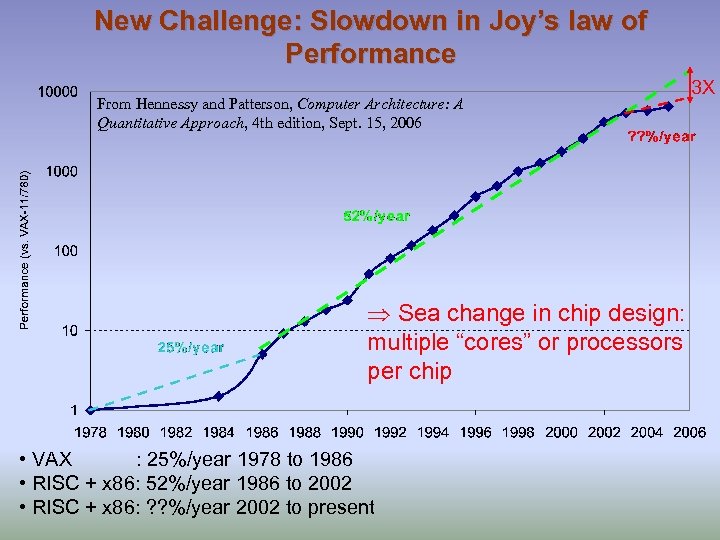 New Challenge: Slowdown in Joy’s law of Performance From Hennessy and Patterson, Computer Architecture: A Quantitative Approach, 4 th edition, Sept. 15, 2006 Sea change in chip design: multiple “cores” or processors per chip • VAX : 25%/year 1978 to 1986 • RISC + x 86: 52%/year 1986 to 2002 • RISC + x 86: ? ? %/year 2002 to present 3 X
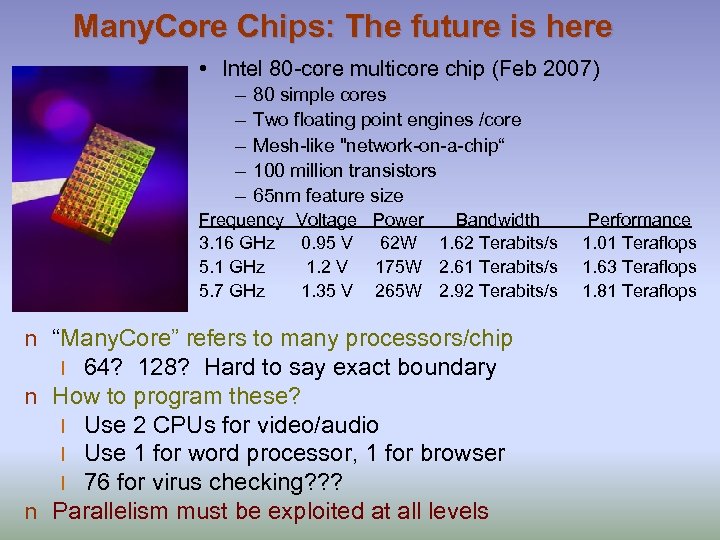 Many. Core Chips: The future is here • Intel 80 -core multicore chip (Feb 2007) – – – 80 simple cores Two floating point engines /core Mesh-like "network-on-a-chip“ 100 million transistors 65 nm feature size Frequency Voltage Power Bandwidth 3. 16 GHz 0. 95 V 62 W 1. 62 Terabits/s 5. 1 GHz 1. 2 V 175 W 2. 61 Terabits/s 5. 7 GHz 1. 35 V 265 W 2. 92 Terabits/s n “Many. Core” refers to many processors/chip 64? 128? Hard to say exact boundary n How to program these? l Use 2 CPUs for video/audio l Use 1 for word processor, 1 for browser l 76 for virus checking? ? ? n Parallelism must be exploited at all levels l Performance 1. 01 Teraflops 1. 63 Teraflops 1. 81 Teraflops
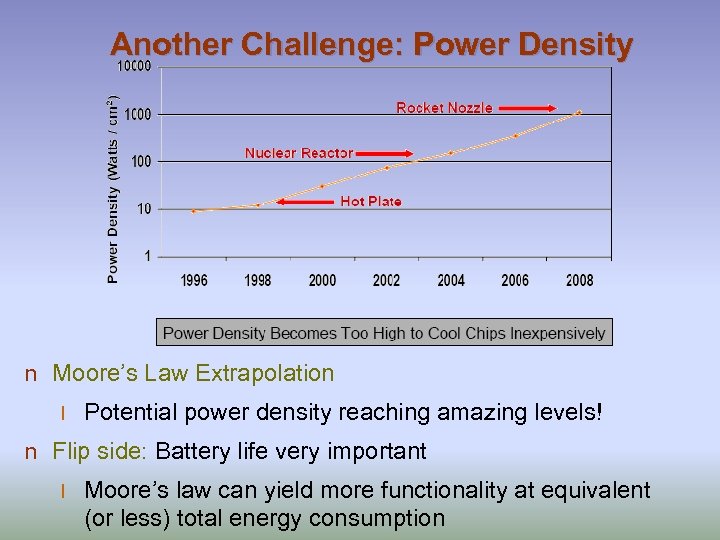 Another Challenge: Power Density n Moore’s Law Extrapolation l Potential power density reaching amazing levels! n Flip side: Battery life very important l Moore’s law can yield more functionality at equivalent (or less) total energy consumption
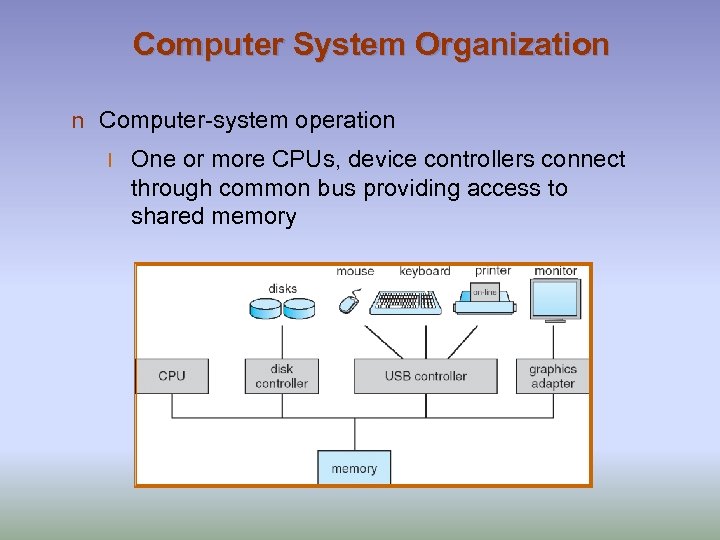 Computer System Organization n Computer-system operation l One or more CPUs, device controllers connect through common bus providing access to shared memory
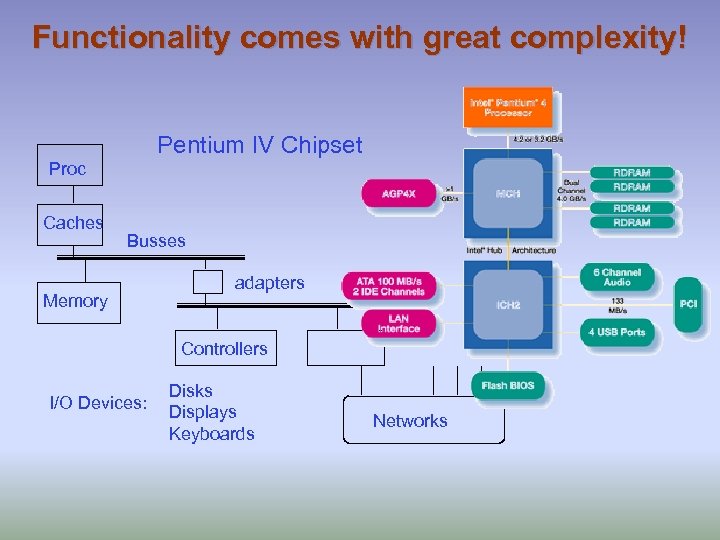 Functionality comes with great complexity! Pentium IV Chipset Proc Caches Busses Memory adapters Controllers I/O Devices: Disks Displays Keyboards Networks
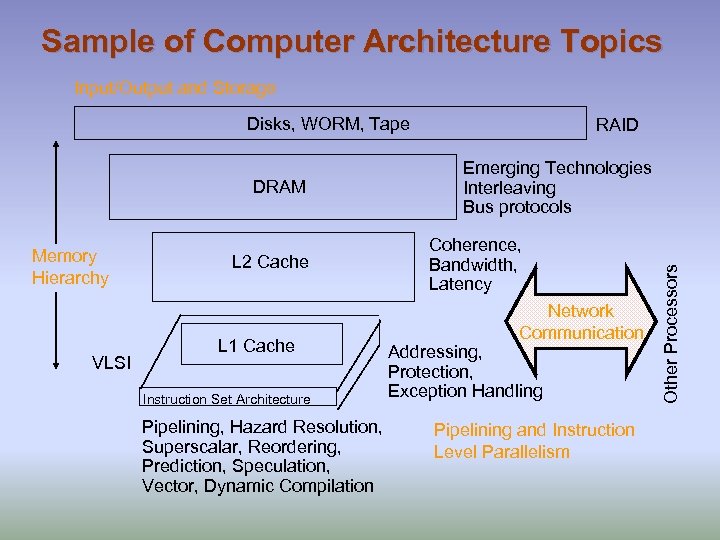 Sample of Computer Architecture Topics Input/Output and Storage Disks, WORM, Tape Memory Hierarchy VLSI L 2 Cache L 1 Cache Instruction Set Architecture Pipelining, Hazard Resolution, Superscalar, Reordering, Prediction, Speculation, Vector, Dynamic Compilation Emerging Technologies Interleaving Bus protocols Coherence, Bandwidth, Latency Network Communication Addressing, Protection, Exception Handling Pipelining and Instruction Level Parallelism Other Processors DRAM RAID
 Increasing Software Complexity From MIT
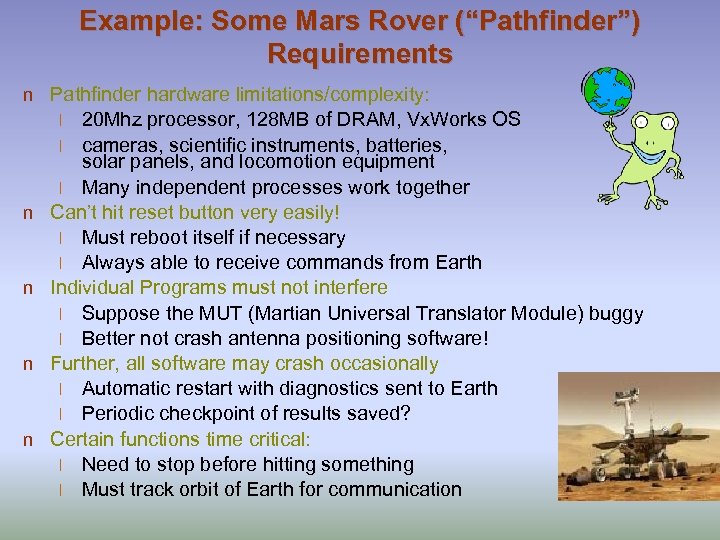 Example: Some Mars Rover (“Pathfinder”) Requirements n Pathfinder hardware limitations/complexity: 20 Mhz processor, 128 MB of DRAM, Vx. Works OS l cameras, scientific instruments, batteries, solar panels, and locomotion equipment l Many independent processes work together Can’t hit reset button very easily! l Must reboot itself if necessary l Always able to receive commands from Earth Individual Programs must not interfere l Suppose the MUT (Martian Universal Translator Module) buggy l Better not crash antenna positioning software! Further, all software may crash occasionally l Automatic restart with diagnostics sent to Earth l Periodic checkpoint of results saved? Certain functions time critical: l Need to stop before hitting something l Must track orbit of Earth for communication l n n
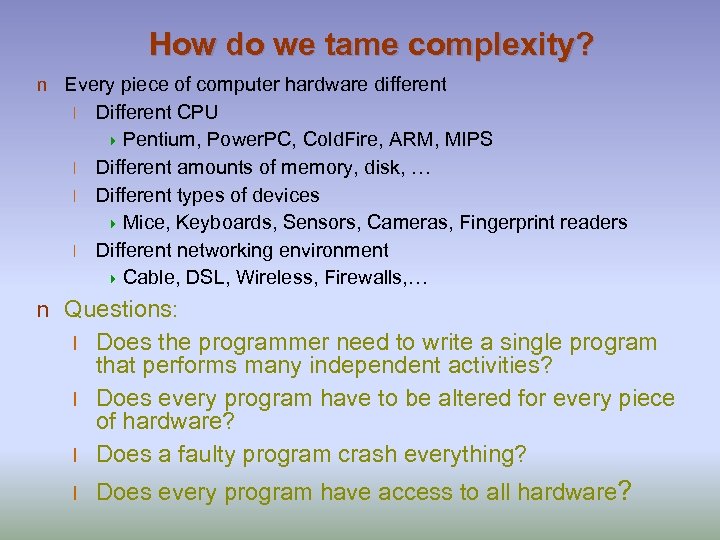 How do we tame complexity? n Every piece of computer hardware different Different CPU 4 Pentium, Power. PC, Cold. Fire, ARM, MIPS l Different amounts of memory, disk, … l Different types of devices 4 Mice, Keyboards, Sensors, Cameras, Fingerprint readers l Different networking environment 4 Cable, DSL, Wireless, Firewalls, … l n Questions: Does the programmer need to write a single program that performs many independent activities? l Does every program have to be altered for every piece of hardware? l Does a faulty program crash everything? l l Does every program have access to all hardware?
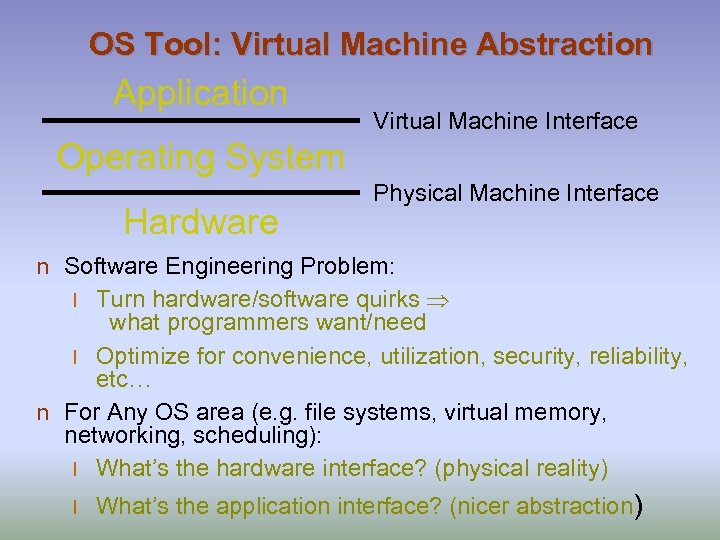 OS Tool: Virtual Machine Abstraction Application Virtual Machine Interface Operating System Hardware Physical Machine Interface n Software Engineering Problem: Turn hardware/software quirks what programmers want/need l Optimize for convenience, utilization, security, reliability, etc… n For Any OS area (e. g. file systems, virtual memory, networking, scheduling): l What’s the hardware interface? (physical reality) l l What’s the application interface? (nicer abstraction)
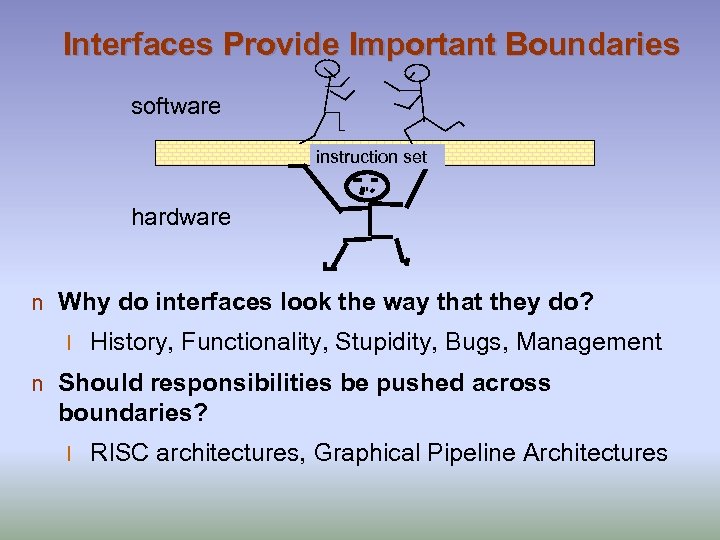 Interfaces Provide Important Boundaries software instruction set hardware n Why do interfaces look the way that they do? l History, Functionality, Stupidity, Bugs, Management n Should responsibilities be pushed across boundaries? l RISC architectures, Graphical Pipeline Architectures
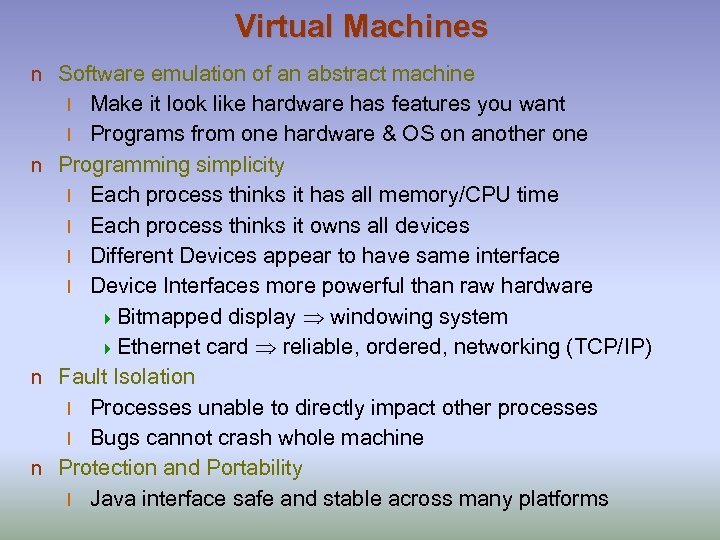 Virtual Machines n Software emulation of an abstract machine Make it look like hardware has features you want l Programs from one hardware & OS on another one n Programming simplicity l Each process thinks it has all memory/CPU time l Each process thinks it owns all devices l Different Devices appear to have same interface l Device Interfaces more powerful than raw hardware 4 Bitmapped display windowing system 4 Ethernet card reliable, ordered, networking (TCP/IP) n Fault Isolation l Processes unable to directly impact other processes l Bugs cannot crash whole machine n Protection and Portability l Java interface safe and stable across many platforms l
 Syllabus
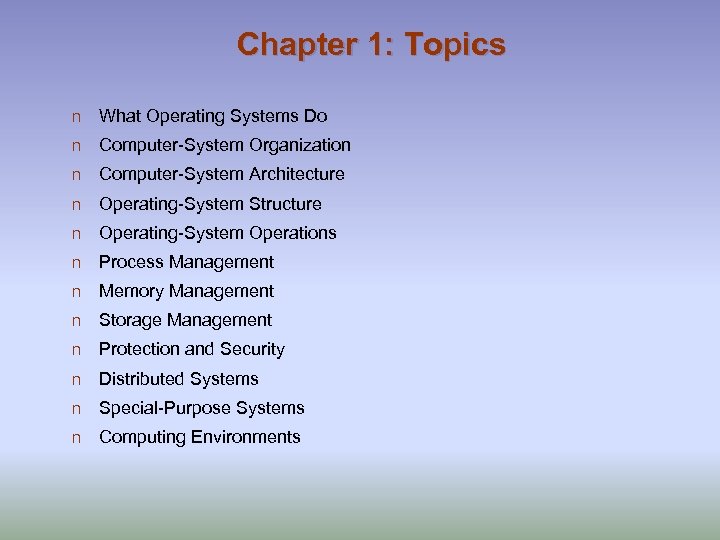 Chapter 1: Topics n What Operating Systems Do n Computer-System Organization n Computer-System Architecture n Operating-System Structure n Operating-System Operations n Process Management n Memory Management n Storage Management n Protection and Security n Distributed Systems n Special-Purpose Systems n Computing Environments
 Objectives n To provide a grand tour of the major operating systems components n To provide coverage of basic computer system organization
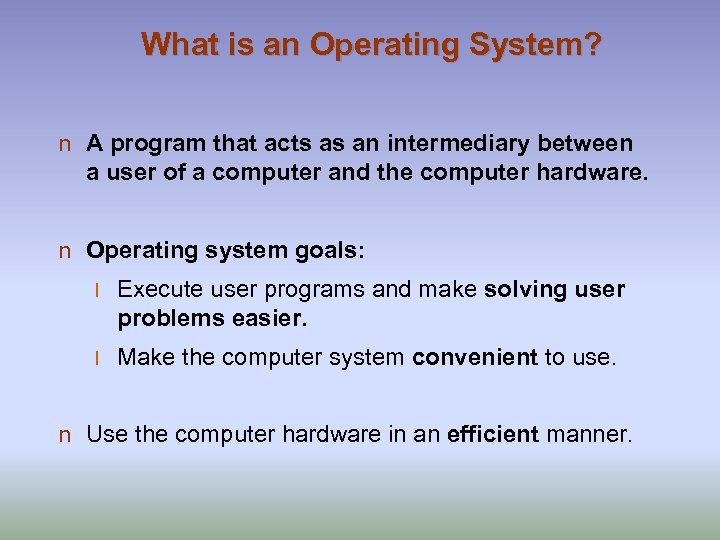 What is an Operating System? n A program that acts as an intermediary between a user of a computer and the computer hardware. n Operating system goals: l Execute user programs and make solving user problems easier. l Make the computer system convenient to use. n Use the computer hardware in an efficient manner.
 What does an Operating System do? n Silerschatz and Gavin: “An OS is Similar to a government” l Begs the question: does a government do anything useful by itself? n Coordinator and Traffic Cop: l Manages all resources l Settles conflicting requests for resources l Prevent errors and improper use of the computer n Facilitator: l Provides facilities that everyone needs l Standard Libraries, Windowing systems l Make application programming easier, faster, less error-prone n Some features reflect both tasks: l E. g. File system is needed by everyone (Facilitator) l But File system must be Protected (Traffic Cop)
 What is an Operating System, … Really? n Most Likely: l Memory Management l I/O Management l CPU Scheduling l Communications? (Does Email belong in OS? ) l Multitasking/multiprogramming? n What about? l File System? l Multimedia Support? l User Interface? l Internet Browser? n Is this only interesting to Academics? ?
 Operating System Definition (Cont. ) n No universally accepted definition n “Everything a vendor ships when you order an operating system” is good approximation l But varies wildly n “The one program running at all times on the computer” is the kernel. l Everything else is either a system program (ships with the operating system) or an application program
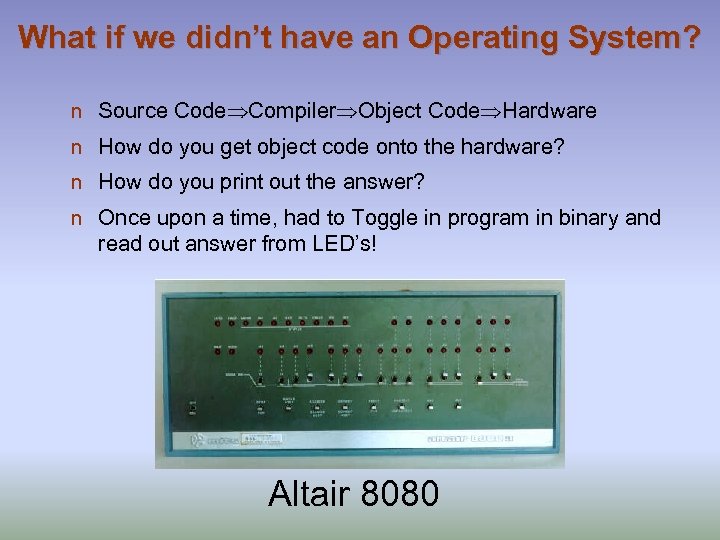 What if we didn’t have an Operating System? n Source Code Compiler Object Code Hardware n How do you get object code onto the hardware? n How do you print out the answer? n Once upon a time, had to Toggle in program in binary and read out answer from LED’s! Altair 8080
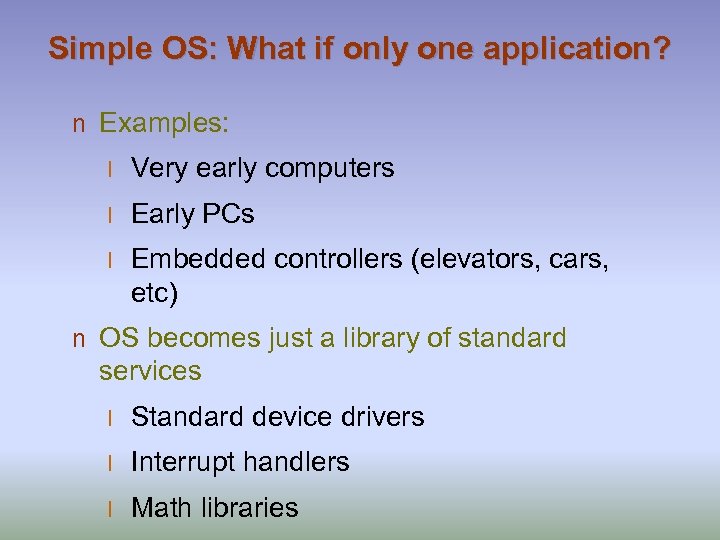 Simple OS: What if only one application? n Examples: l Very early computers l Early PCs l Embedded controllers (elevators, cars, etc) n OS becomes just a library of standard services l Standard device drivers l Interrupt handlers l Math libraries
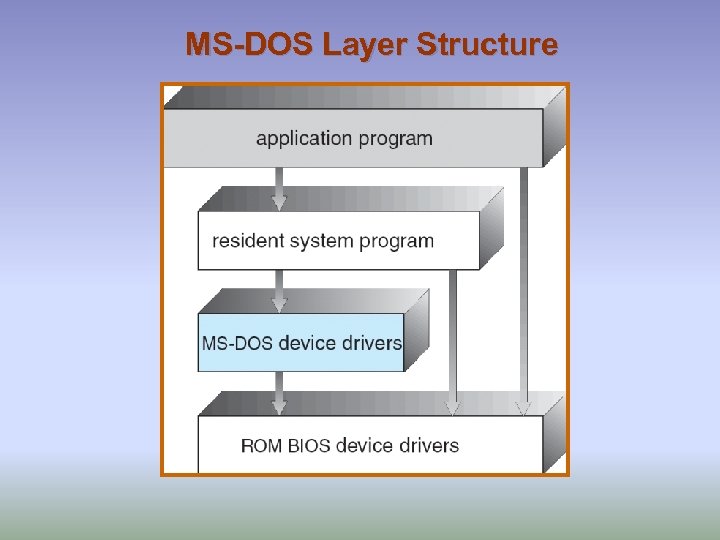 MS-DOS Layer Structure
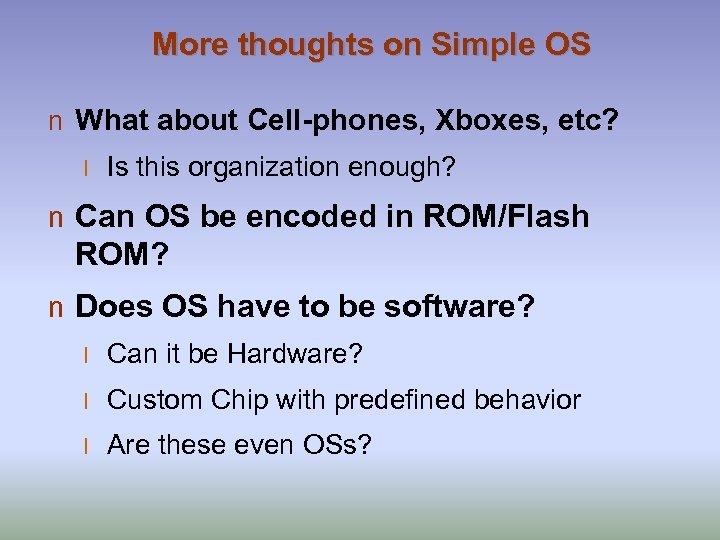 More thoughts on Simple OS n What about Cell-phones, Xboxes, etc? l Is this organization enough? n Can OS be encoded in ROM/Flash ROM? n Does OS have to be software? l Can it be Hardware? l Custom Chip with predefined behavior l Are these even OSs?
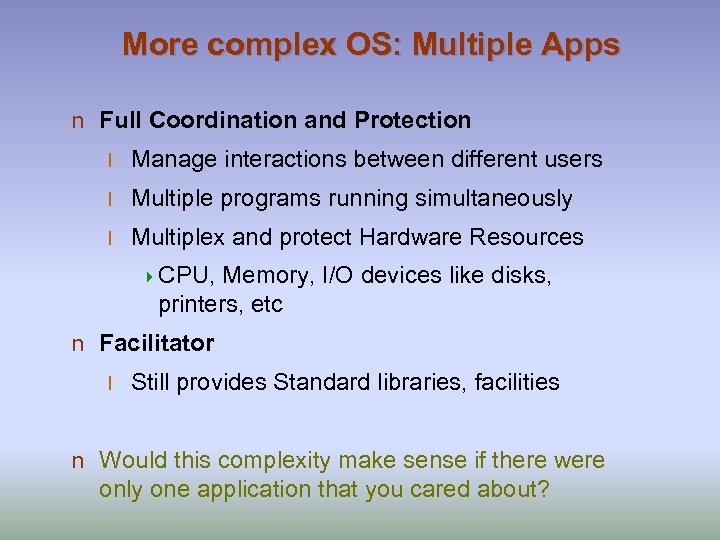 More complex OS: Multiple Apps n Full Coordination and Protection l Manage interactions between different users l Multiple programs running simultaneously l Multiplex and protect Hardware Resources 4 CPU, Memory, I/O devices like disks, printers, etc n Facilitator l Still provides Standard libraries, facilities n Would this complexity make sense if there were only one application that you cared about?
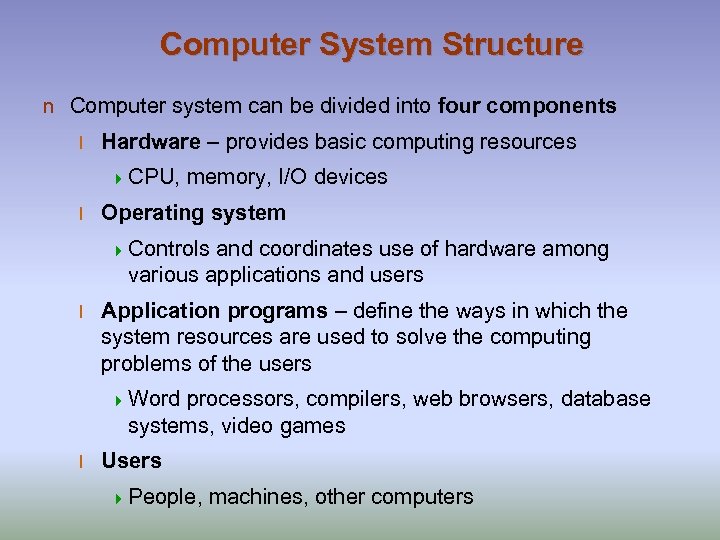 Computer System Structure n Computer system can be divided into four components l Hardware – provides basic computing resources 4 CPU, l memory, I/O devices Operating system 4 Controls and coordinates use of hardware among various applications and users l Application programs – define the ways in which the system resources are used to solve the computing problems of the users 4 Word processors, compilers, web browsers, database systems, video games l Users 4 People, machines, other computers
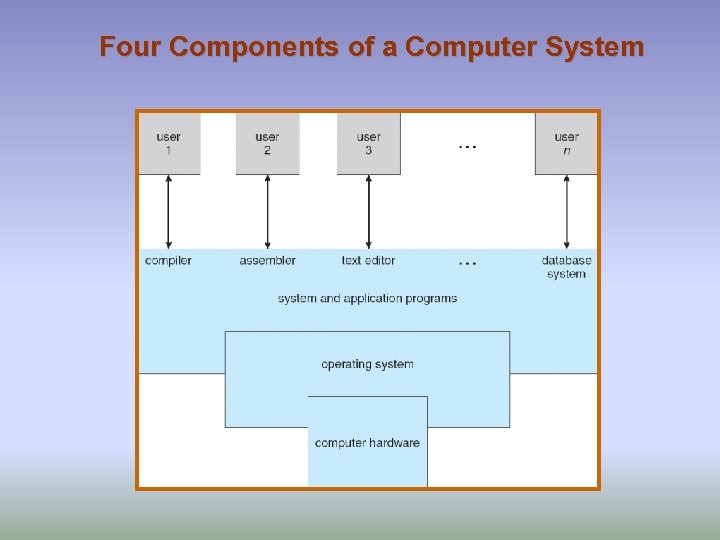 Four Components of a Computer System
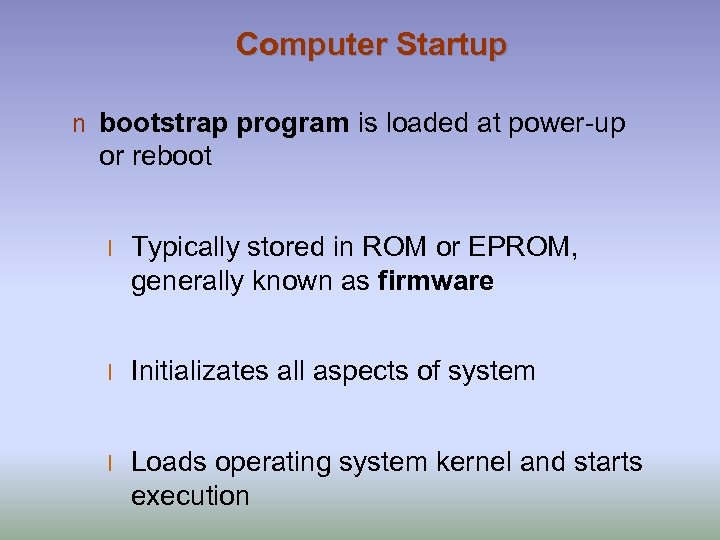 Computer Startup n bootstrap program is loaded at power-up or reboot l Typically stored in ROM or EPROM, generally known as firmware l Initializates all aspects of system l Loads operating system kernel and starts execution
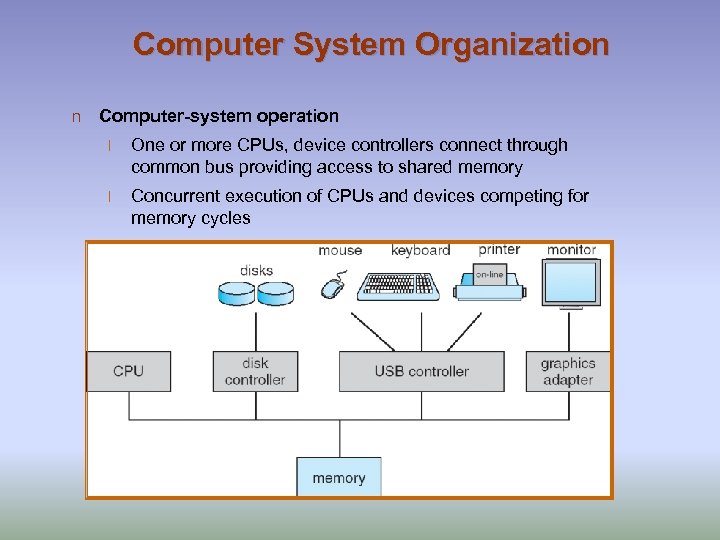 Computer System Organization n Computer-system operation l One or more CPUs, device controllers connect through common bus providing access to shared memory l Concurrent execution of CPUs and devices competing for memory cycles
 Computer-System Operation n I/O devices and the CPU can execute concurrently. n Each device controller is in charge of a particular device type. n Each device controller has a local buffer. n CPU moves data from/to main memory to/from local buffers n I/O is from the device to local buffer of controller. n Device controller informs CPU that it has finished its operation by causing an interrupt.
 Common Functions of Interrupts n Interrupt transfers control to the interrupt service routine generally, through the interrupt vector, which contains the addresses of all the service routines n Interrupt architecture must save the address of the interrupted instruction n Incoming interrupts are disabled while another interrupt is being processed to prevent a lost interrupt n A trap is a software-generated interrupt caused either by an error or a user request n An operating system is interrupt driven
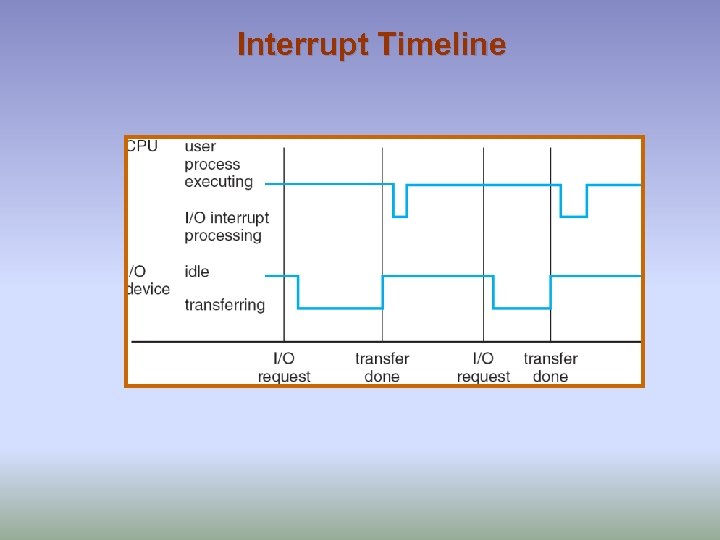 Interrupt Timeline
 Interrupt Handling n The operating system preserves the state of the CPU by storing registers and the program counter n Determines which type of interrupt has occurred: l polling l vectored interrupt system n Separate segments of code determine what action should be taken for each type of interrupt
 I/O Structure n After I/O starts, control returns to user program only upon I/O completion l Wait instruction idles the CPU until the next interrupt l Wait loop (contention for memory access) l At most one I/O request is outstanding at a time, no simultaneous I/O processing n After I/O starts, control returns to user program without waiting for I/O completion l System call – request to the operating system to allow user to wait for I/O completion l Device-status table contains entry for each I/O device indicating its type, address, and state l Operating system indexes into I/O device table to determine device status and to modify table entry to include interrupt
 Direct Memory Access Structure n Used for high-speed I/O devices able to transmit information at close to memory speeds n Device controller transfers blocks of data from buffer storage directly to main memory without CPU intervention n Only one interrupt is generated per block, rather than the one interrupt per byte
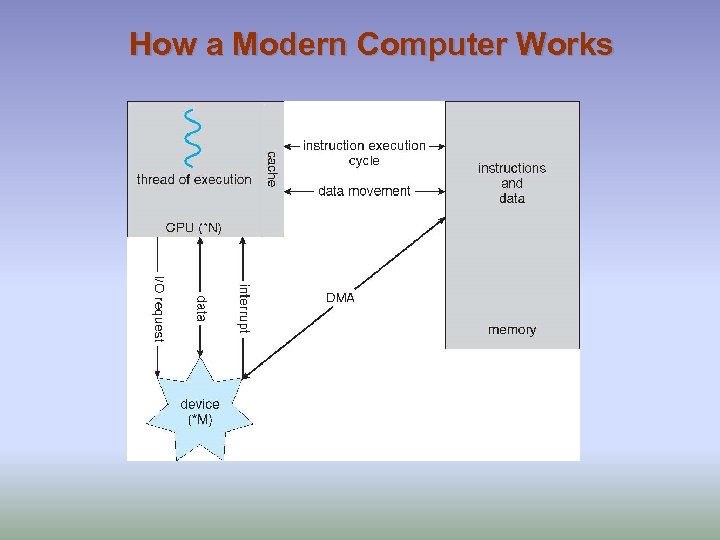 How a Modern Computer Works
 Storage Structure n Main memory – only large storage media that the CPU can access directly n Secondary storage – extension of main memory that provides large nonvolatile storage capacity n Magnetic disks – rigid metal or glass platters covered with magnetic recording material l Disk surface is logically divided into tracks, which are subdivided into sectors l The disk controller determines the logical interaction between the device and the computer
 Storage Hierarchy n Storage systems organized in hierarchy l Speed l Cost l Volatility n Caching – copying information into faster storage system; main memory can be viewed as a last cache for secondary storage
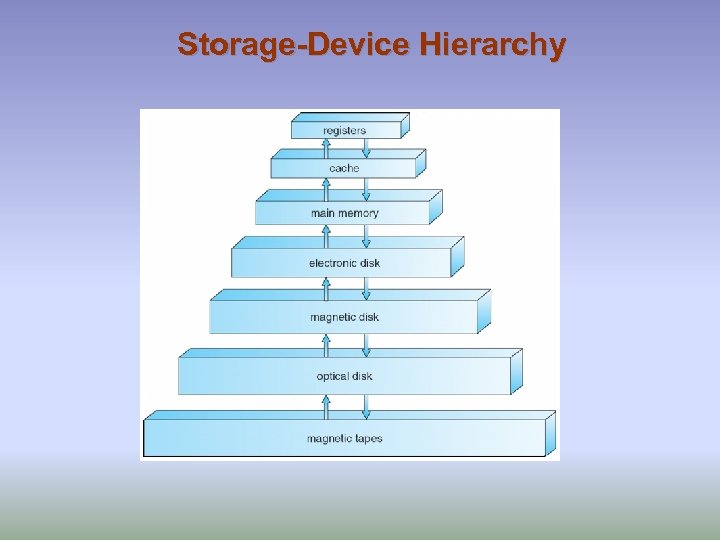 Storage-Device Hierarchy
 Caching n Important principle, performed at many levels in a computer (in hardware, operating system, software) n Information in use copied from slower to faster storage temporarily n Faster storage (cache) checked first to determine if information is there l If it is, information used directly from the cache (fast) l If not, data copied to cache and used there n Cache smaller than storage being cached l Cache management important design problem l Cache size and replacement policy
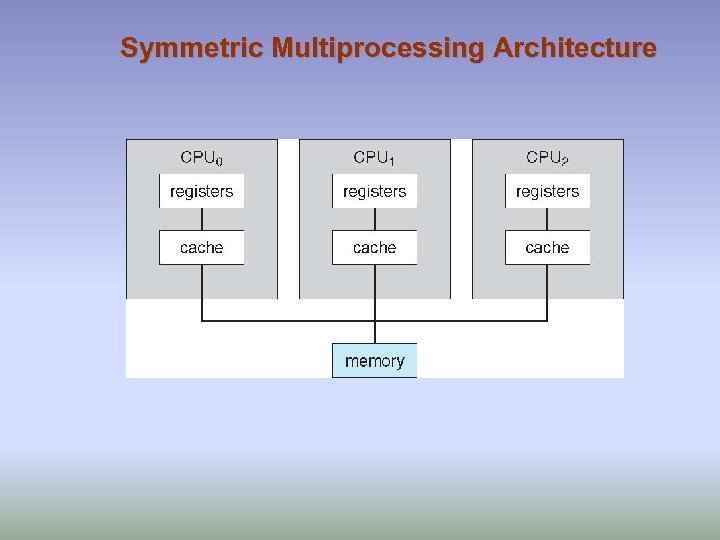
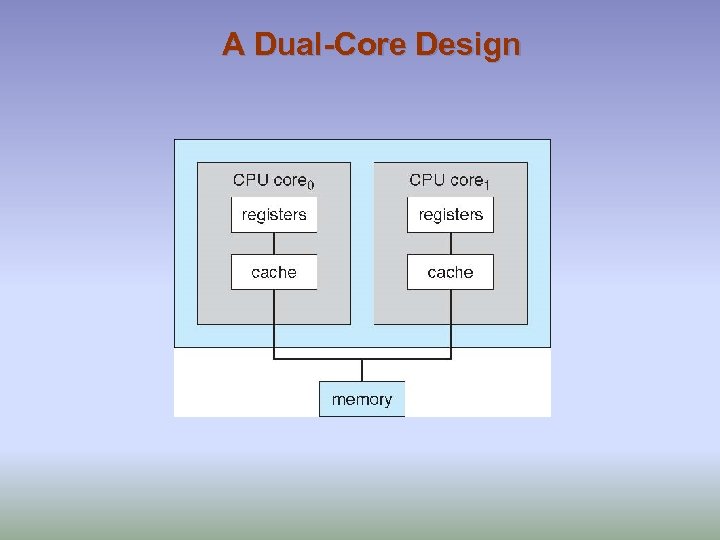
 Computer-System Architecture n Most systems use a single general-purpose processor (PDAs through mainframes) l Most systems have special-purpose processors as well n Multiprocessors systems growing in use and importance l Also known as parallel systems, tightly-coupled systems l Advantages include 1. 2. Economy of scale 3. l Increased throughput Increased reliability – graceful degradation or fault tolerance Two types 1. Asymmetric Multiprocessing 2. Symmetric Multiprocessing
 Symmetric Multiprocessing Architecture
 A Dual-Core Design
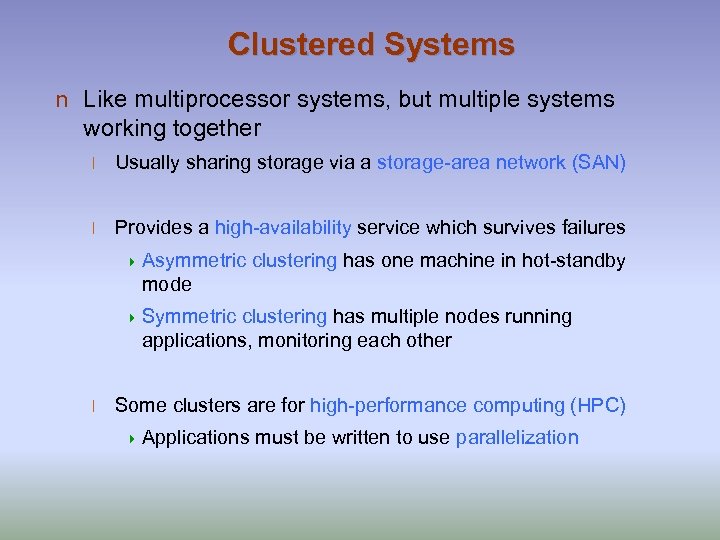 Clustered Systems n Like multiprocessor systems, but multiple systems working together l Usually sharing storage via a storage-area network (SAN) l Provides a high-availability service which survives failures 4 Asymmetric clustering has one machine in hot-standby mode 4 Symmetric clustering has multiple nodes running applications, monitoring each other l Some clusters are for high-performance computing (HPC) 4 Applications must be written to use parallelization
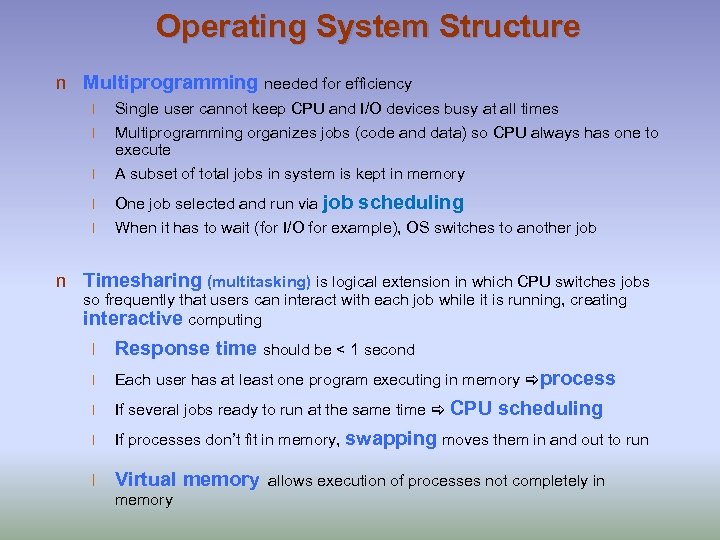 Operating System Structure n Multiprogramming needed for efficiency l Single user cannot keep CPU and I/O devices busy at all times l l Multiprogramming organizes jobs (code and data) so CPU always has one to execute A subset of total jobs in system is kept in memory l One job selected and run via job l When it has to wait (for I/O for example), OS switches to another job scheduling n Timesharing (multitasking) is logical extension in which CPU switches jobs so frequently that users can interact with each job while it is running, creating interactive computing l Response time should be < 1 second l Each user has at least one program executing in memory process l If several jobs ready to run at the same time CPU l If processes don’t fit in memory, swapping moves them in and out to run l Virtual memory scheduling allows execution of processes not completely in
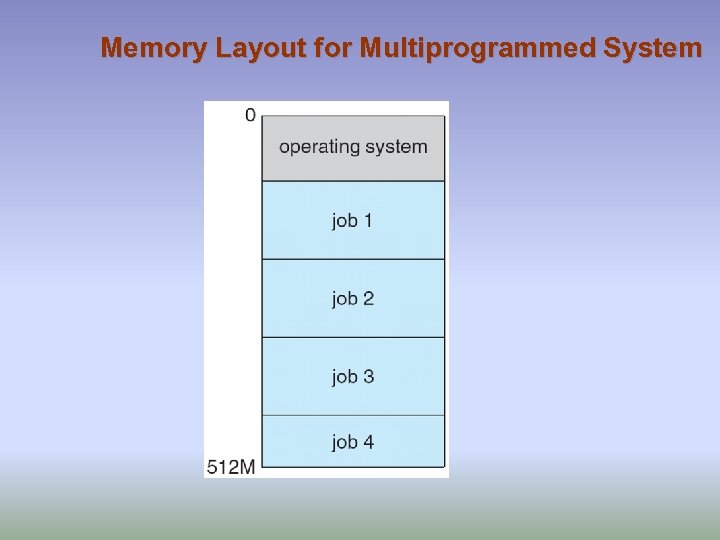 Memory Layout for Multiprogrammed System
 Operating-System Operations n Interrupt driven by hardware n Software error or request creates exception or trap l Division by zero, request for operating system service n Other process problems include infinite loop, processes modifying each other or the operating system n Dual-mode operation allows OS to protect itself and other system components l User mode and kernel mode l Mode bit provided by hardware 4 Provides ability to distinguish when system is running user code or kernel code 4 Some instructions designated as privileged, only executable in kernel mode 4 System call changes mode to kernel, return from call resets it to user
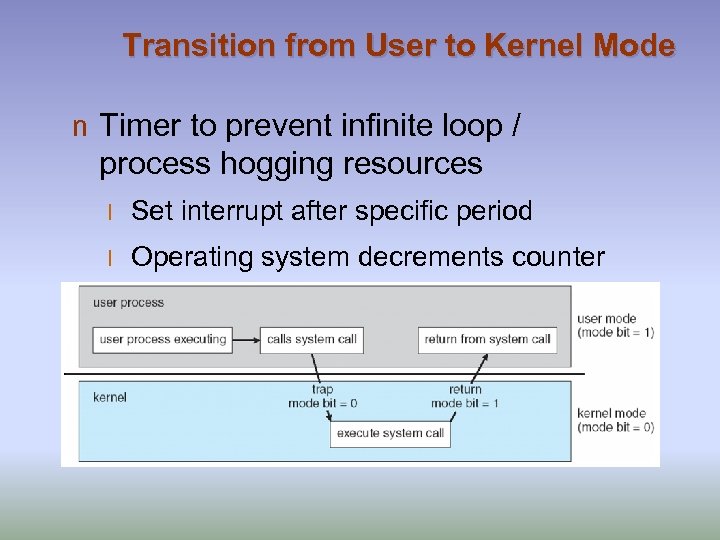 Transition from User to Kernel Mode n Timer to prevent infinite loop / process hogging resources l Set interrupt after specific period l Operating system decrements counter l When counter zero generate an interrupt l Set up before scheduling process to regain control or terminate program that exceeds allotted time
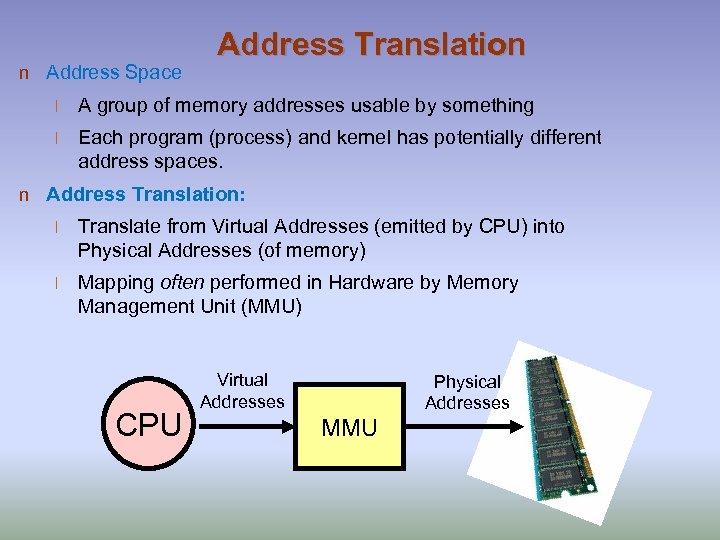 n Address Space Address Translation l A group of memory addresses usable by something l Each program (process) and kernel has potentially different address spaces. n Address Translation: l Translate from Virtual Addresses (emitted by CPU) into Physical Addresses (of memory) l Mapping often performed in Hardware by Memory Management Unit (MMU) CPU Virtual Addresses Physical Addresses MMU
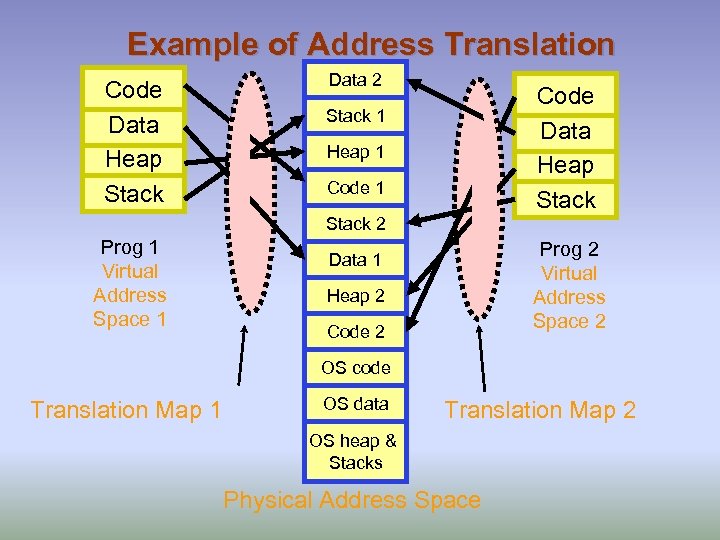 Example of Address Translation Code Data Heap Stack Data 2 Code Data Heap Stack 1 Heap 1 Code 1 Stack 2 Prog 1 Virtual Address Space 1 Prog 2 Virtual Address Space 2 Data 1 Heap 2 Code 2 OS code Translation Map 1 OS data Translation Map 2 OS heap & Stacks Physical Address Space
 Process Management n A process is a program in execution. It is a unit of work within the system. Program is a passive entity, process is an active entity. n Process needs resources to accomplish its task l CPU, memory, I/O, files l Initialization data n Process termination requires reclaim of any reusable resources n Single-threaded process has one program counter specifying location of next instruction to execute l Process executes instructions sequentially, one at a time, until completion n Multi-threaded process has one program counter per thread n Typically system has many processes, some user, some operating system running concurrently on one or more CPUs l Concurrency by multiplexing the CPUs among the processes / threads
 Process Management Activities The operating system is responsible for the following activities in connection with process management: n Creating and deleting both user and system processes n Suspending and resuming processes n Providing mechanisms for process synchronization n Providing mechanisms for process communication n Providing mechanisms for deadlock handling
 Memory Management n All data in memory before and after processing n All instructions in memory in order to execute n Memory management determines what is in memory when l Optimizing CPU utilization and computer response to users n Memory management activities l Keeping track of which parts of memory are currently being used and by whom l Deciding which processes (or parts thereof) and data to move into and out of memory l Allocating and deallocating memory space as needed
 Storage Management n OS provides uniform, logical view of information storage Abstracts physical properties to logical storage unit - file l Each medium is controlled by device (i. e. , disk drive, tape drive) 4 Varying properties include access speed, capacity, datatransfer rate, access method (sequential or random) l n File-System management Files usually organized into directories l Access control on most systems to determine who can access what l OS activities include 4 Creating and deleting files and directories 4 Primitives to manipulate files and dirs 4 Mapping files onto secondary storage 4 Backup files onto stable (non-volatile) storage media l
 Mass-Storage Management n Usually disks used to store data that does not fit in main memory or data that must be kept for a “long” period of time n Proper management is of central importance n Entire speed of computer operation hinges on disk subsystem and its algorithms n OS activities l Free-space management l Storage allocation l Disk scheduling n Some storage need not be fast l Tertiary storage includes optical storage, magnetic tape l Still must be managed l Varies between WORM (write-once, read-many-times) and RW (read-write)
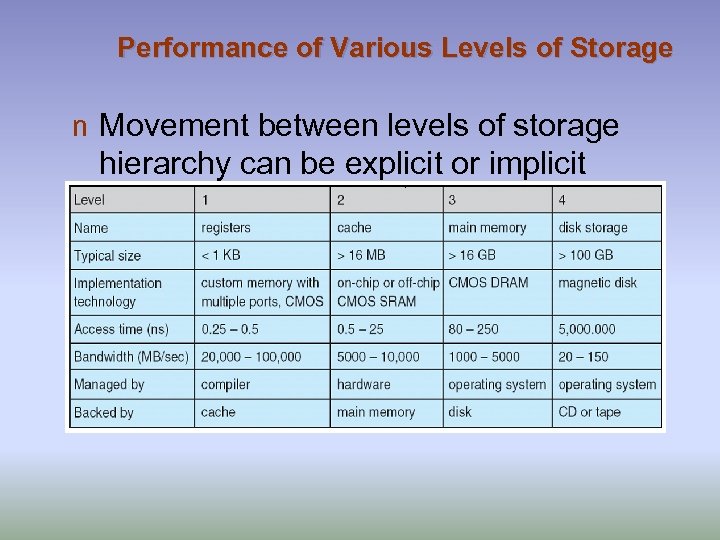 Performance of Various Levels of Storage n Movement between levels of storage hierarchy can be explicit or implicit
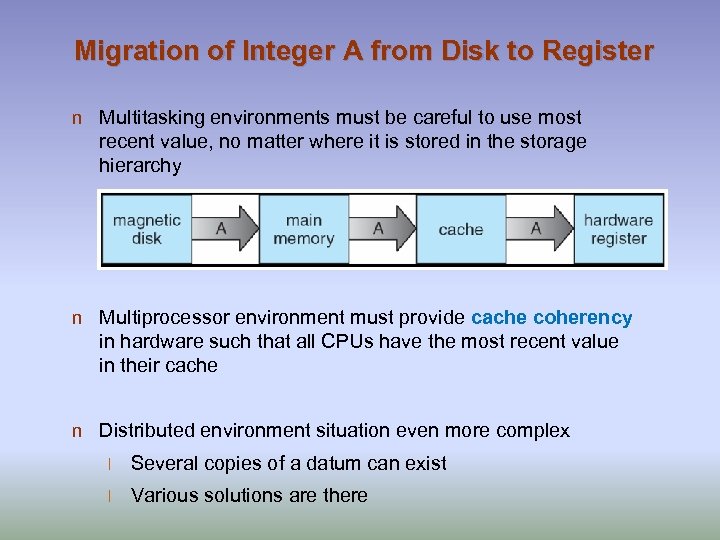 Migration of Integer A from Disk to Register n Multitasking environments must be careful to use most recent value, no matter where it is stored in the storage hierarchy n Multiprocessor environment must provide cache coherency in hardware such that all CPUs have the most recent value in their cache n Distributed environment situation even more complex l Several copies of a datum can exist l Various solutions are there
 I/O Subsystem n One purpose of OS is to hide peculiarities of hardware devices from the user n I/O subsystem responsible for l Memory management of I/O including buffering (storing data temporarily while it is being transferred), caching (storing parts of data in faster storage for performance), spooling (the overlapping of output of one job with input of other jobs) l General device-driver interface l Drivers for specific hardware devices
 Protection and Security n Protection – any mechanism for controlling access of processes or users to resources defined by the OS n Security – defense of the system against internal and external attacks l Huge range, including denial-of-service, worms, viruses, identity theft, theft of service n Systems generally first distinguish among users, to determine who can do what l User identities (user IDs, security IDs) include name and associated number, one per user l User ID then associated with all files, processes of that user to determine access control l Group identifier (group ID) allows set of users to be defined and controls managed, then also associated with each process, file l Privilege escalation allows user to change to effective ID with more rights
 Computing Environments n Traditional computer l Blurring over time l Office environment 4 PCs connected to a network, terminals attached to mainframe or minicomputers providing batch and timesharing 4 Now portals allowing networked and remote systems access to same resources l Home networks 4 Used 4 Now to be single system, then modems firewalled, networked
 Computing Environments (Cont) n Client-Server Computing Dumb terminals supplanted by smart PCs l Many systems now servers, responding to requests generated by clients 4 Compute-server provides an interface to client to request services (i. e. database) 4 File-server provides interface for clients to store and retrieve files l
 Peer-to-Peer Computing n Another model of distributed system n P 2 P does not distinguish clients and servers l Instead all nodes are considered peers l May each act as client, server or both l Node must join P 2 P network 4 Registers its service with central lookup service on network, or 4 Broadcast request for service and respond to requests for service via discovery protocol l Examples include Napster and Gnutella
 Web-Based Computing n Web has become ubiquitous n PCs most prevalent devices n More devices becoming networked to allow web access n New category of devices to manage web traffic among similar servers: load balancers n Use of operating systems like Windows 95, client-side, have evolved into Linux and Windows XP, which can be clients and servers
 Open-Source Operating Systems n Operating systems made available in source-code format rather than just binary closed-source n Counter to the copy protection and Digital Rights Management (DRM) movement n Started by Free Software Foundation (FSF), which has “copyleft” GNU Public License (GPL) n Examples include GNU/Linux, BSD UNIX (including core of Mac OS X), and Sun Solaris
 Why Study Operating Systems? n Learn how to build complex systems: How can you manage complexity for future projects? Engineering issues: l Why is the web so slow sometimes? Can you fix it? l What features should be in the next mars Rover? l How do large distributed systems work? (Kazaa, etc) Buying and using a personal computer: l Why different PCs with same CPU behave differently l How to choose a processor (Opteron, Itanium, Celeron, Pentium, Hexium)? [ Ok, made last one up ] l Should you get Windows XP, 2000, Linux, Mac OS …? l Why does Microsoft have such a bad name? Business issues: l Should your division buy thin-clients vs PC? Security, viruses, and worms l What exposure do you have to worry about? l n n
 End of Lecture 1