


 Скачать презентацию CSc 375 SOCIAL ISSUES IN COMPUTING Department of
03b53f40c57590095fcd4467e7237898.ppt
- Количество слайдов: 25
 CSc 375 SOCIAL ISSUES IN COMPUTING Department of Computer Science City College of New York Spring 2006 Copyright © 2006 by Abbe Mowshowitz
 TOPIC 14. HUMAN MACHINES A. Intellectual Challenge to Human Identity 1. “Man is nothing but a meat machine. ” - Marvin Minsky
 HUMAN MACHINES A. Intellectual Challenge to Human Identity 2. Strong form of Church’s Thesis: Any effective procedure can be programmed on a computer. AND Everything humans can do can be expressed as effective procedures.
 HUMAN MACHINES A. Intellectual Challenge to Human Identity 3. Turing Test (Alan Turing. “Computing machinery and intelligence, 1950. ): reformulation of the question “can machines think? ”
 HUMAN MACHINES A. 3. Turing Test Based on the “Imitation Game” in which Human interrogator converses by means of a tele-typewriter with two unidentified respondents - one a machine - one a person Object: distinguish between person and
 HUMAN MACHINES A. 3. Turing Test If in repeated trials with different human subjects, the interrogator cannot distinguish with better than 50% accuracy, the machine is said to simulate human intelligence.
 Japanese scientists have unveiled a "female" android called Repliee Q 1. Source: BBCNews, July 28, 2005 “Professor Hiroshi Ishiguro of Osaka University says one day robots could fool us into believing they are human. ”
 HUMAN MACHINES A. Intellectual Challenge to Human Identity 4. Information processing model (Simon and Newell, 1964) a. Science of information processing (IP) can be independent of particular IP mechanisms b. Thinking can be explained in IP terms c. IP theories can be formulated in programming languages and simulated on
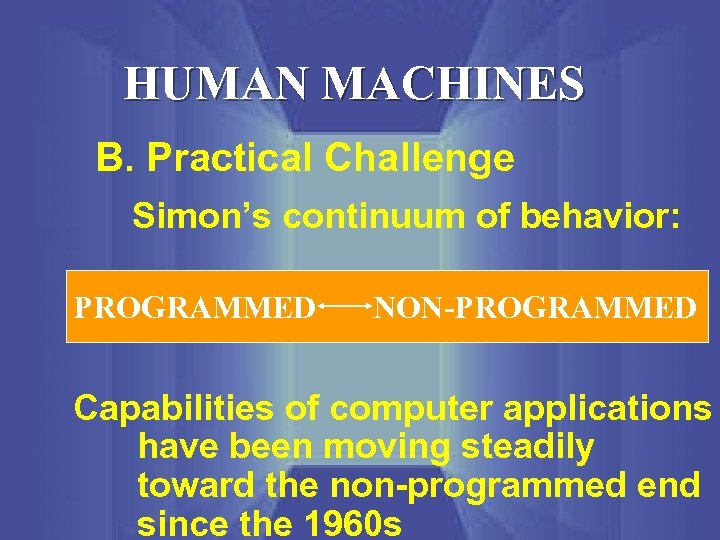 HUMAN MACHINES B. Practical Challenge Simon’s continuum of behavior: PROGRAMMED NON-PROGRAMMED Capabilities of computer applications have been moving steadily toward the non-programmed end since the 1960 s
 HUMAN MACHINES C. Historical Perspective – – Earth pushed from center stage by the heliocentric theory of Copernicus Humans linked to apes by Darwin Denied conscious control by Freud Now AI would turn us into machines without free will
 HUMAN MACHINES D. Challenge Posed by AI 1. Until 1980 s AI was an obscure academic discipline 2. Support for research came mostly from government (Do. D in the US) • • • Intelligent command control Guidance for automatic weapons Spying, reconnaissance
 HUMAN MACHINES D. 2. Support spying/reconnaissance calls for: • • • Natural language processing Speech recognition Image processing Examples: unmanned, armored tank; automated co-pilot
 HUMAN MACHINES D. Challenge Posed by AI 4. AI in the spotlight • Japan Fifth Generation Computer Project – Announced 1980 by MITI – Projected as 10 year $500 m. program – Proposed to develop revolutionary computer systems incorporating AI concepts: problem solving functions, intelligent interfaces,
 HUMAN MACHINES D. 4. AI in the spotlight • U. S. answer to Fifth Generation Project – DARPA’s Strategic Computing Program – $600 m. funding – Envisioned developing AI systems and advanced computer technology
 HUMAN MACHINES D. Commercial Developments in AI 1. Emergence of start-up firms marketing expert systems with • • Knowledge base containing rules of thumb Inference engine that makes decisions based on rules in a specialized domain Major challenge: capturing knowledge of human expert and embedding in system (knowledge engineering)
 HUMAN MACHINES D. Commercial Developments in AI 2. Expert system applications are now widespread (e. g. , authorizer’s assistant) 3. Motivation: reduce labor costs, provide consistent performance
 HUMAN MACHINES D. Differences in Cognitive Capabilities of Humans and Machines? 1. Affirmative answer calls for rejection of Church’s Thesis (e. g. , Dreyfus’ argument based on need for a body) 2. What cannot be done today may be realized tomorrow?
 HUMAN MACHINES E. Ethical Implications of AI 1. Robots and ‘ethical brakes’ (e. g. , Asimov’s three laws of robotics) 2. Are there areas of application that should be off limits to machines? • Judgment in criminal cases?
 HUMAN MACHINES F. Literary Perspectives 1. Background • • • Early Post WW II period Stimulated by the first computers Themes echo those in science fiction and futuristic literature
 HUMAN MACHINES F. 2. Central Figures • Robots – Capek’s R. U. R. (Rossum’s Universal Robots), 1923 – Czech word “robota” means work – Robots limited in action by design – Usually obedient servants
 HUMAN MACHINES F. 2. Central Figures • Androids (or humanoids): living beings not created by human birth • Computers: based loosely on contemporary machines • Hybrids (cyborgs): mixed organic and computer components Distinctions hard to maintain in practice.
 HUMAN MACHINES F. 3. Major Themes • Dehumanization – Over-reliance on machines – Disregard of human needs – Excessive standardization and inflexibility • Identity crisis – Superfluity (nothing to do) – Myth of regeneration
 HUMAN MACHINES F. 3. Major Themes • Persistence of human impulses (especially in negative utopias) • Unanticipated consequences (Pandora’s Box) • Knowledge and power (cosmic mind, computer as God) – Forbidden knowledge and the Word of God – Sorcerer’s apprentice, Golem – Computers as adjunct to social
 HUMAN MACHINES F. 3. Major Themes • Partnership – Human-robot interaction – Synthesis of man and machine into higher entity
 HUMAN MACHINES F. Literary Perspectives 4. Views and attitudes • • Ambivalence towards technology Machine take-over of human functions Anxiety over role of humans in society Fear of diminished human worth and dignity