 Скачать презентацию CSc-340 Intro to Databases Dave Hannay hannayd union edu
e06efe8e2150d7e933d51e78c42eede4.ppt
- Количество слайдов: 48



![CSc-340 Intro. to Databases Dave Hannay <hannayd@union. edu> Steinmetz 201 [388 -6318] http: //cs.](https://present5.com/presentation/e06efe8e2150d7e933d51e78c42eede4/image-1.jpg "CSc-340 Intro. to Databases Dave Hannay <hannayd@union. edu> Steinmetz 201 [388 -6318] http: //cs.")
CSc-340 Intro. to Databases Dave Hannay <hannayd@union. edu> Steinmetz 201 [388 -6318] http: //cs. union. edu/csc 340/ CSc 340 1 a 1

Course Logistics n Introductions n Please send E-Mail <Hannay. D@Union. edu> n n n Course Outline Handout n n When you took CSc-150 Background in Databases Note Dates of Tests and Project Reports Schedule n Tue & Thu 10: 55 am-12: 40 pm CSc 340 1 a 2
Office Hours Tuesdays Thursdays 9: 10 -10: 40 am or see me in class or contact me via email for a specific appointment to be sure that I don't have a meeting, etc. or just stop in if you're in the neighborhood… CSc 340 1 a 3

Course Requirements n Tests (20%/20%) n n Open book, 4 sheets of notes Project (28%) n 3 Project Reports n Final Project Presentation n n Plus turn in completed project at end of term Homework (12%) n HW due before class Each Day n No late HW accepted n turn in early if you must miss class CSc 340 1 a 4
Textbook Database System Concepts 6 th Edition by Silberschatz, Korth, Sudarshan (Mc. Graw-Hill, © 2011) CSc 340 1 a 5
Practical Experience n n n Textbook Examples: University DB Made-Up Examples "Reel Life" Examples Hands-On Practice during class Your Own Project Other Student Projects CSc 340 1 a 6
Introduction Chapter 1 n n n n Database Systems Applications Purpose of Database Systems View of Database Languages Relational Databases Database Design Data Storage & Querying n n n CSc 340 1 a Transaction Management Database Architecture Data Mining & Information Retrieval Specialty Databases Database Users & Administrators History of Database Systems 7
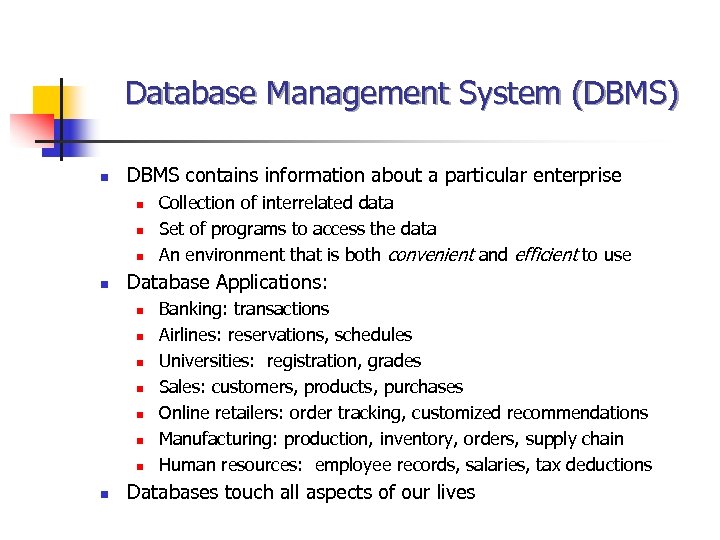
Database Management System (DBMS) n DBMS contains information about a particular enterprise n n Database Applications: n n n n Collection of interrelated data Set of programs to access the data An environment that is both convenient and efficient to use Banking: transactions Airlines: reservations, schedules Universities: registration, grades Sales: customers, products, purchases Online retailers: order tracking, customized recommendations Manufacturing: production, inventory, orders, supply chain Human resources: employee records, salaries, tax deductions Databases touch all aspects of our lives
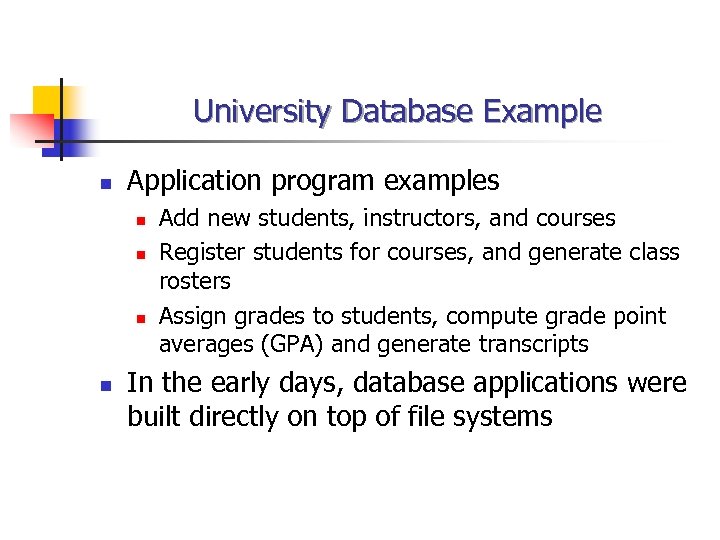
University Database Example n Application program examples n n Add new students, instructors, and courses Register students for courses, and generate class rosters Assign grades to students, compute grade point averages (GPA) and generate transcripts In the early days, database applications were built directly on top of file systems
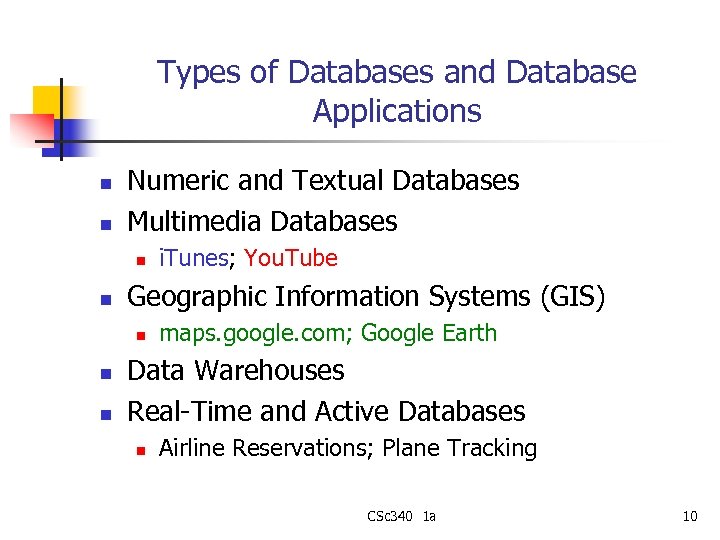
Types of Databases and Database Applications n n Numeric and Textual Databases Multimedia Databases n n Geographic Information Systems (GIS) n n n i. Tunes; You. Tube maps. google. com; Google Earth Data Warehouses Real-Time and Active Databases n Airline Reservations; Plane Tracking CSc 340 1 a 10
Database Experience? n n Hannay Reels Student database usage? n n n Was the database useful? Was the interface user friendly? Anyone with advanced DB Experience? n n administrator? designer? CSc 340 1 a 11
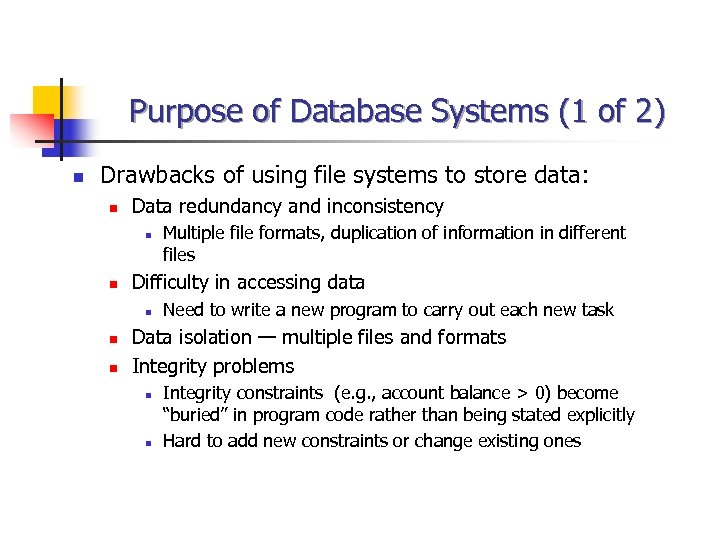
Purpose of Database Systems (1 of 2) n Drawbacks of using file systems to store data: n Data redundancy and inconsistency n n Difficulty in accessing data n n n Multiple file formats, duplication of information in different files Need to write a new program to carry out each new task Data isolation — multiple files and formats Integrity problems n n Integrity constraints (e. g. , account balance > 0) become “buried” in program code rather than being stated explicitly Hard to add new constraints or change existing ones
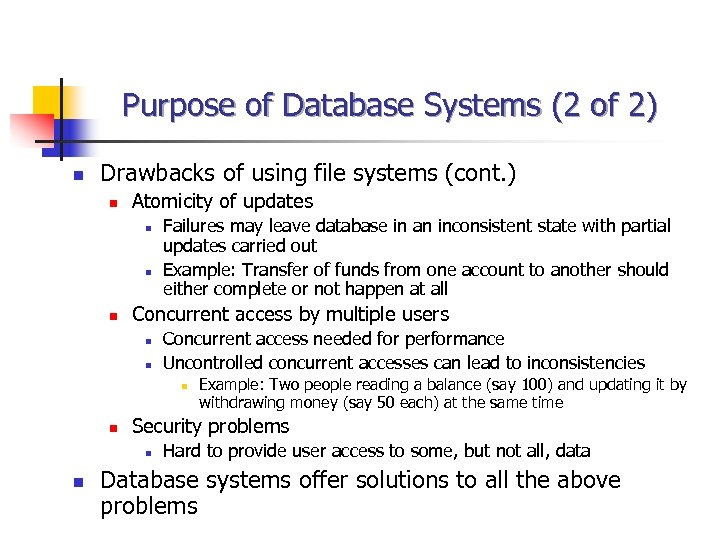
Purpose of Database Systems (2 of 2) n Drawbacks of using file systems (cont. ) n Atomicity of updates n n n Failures may leave database in an inconsistent state with partial updates carried out Example: Transfer of funds from one account to another should either complete or not happen at all Concurrent access by multiple users n n Concurrent access needed for performance Uncontrolled concurrent accesses can lead to inconsistencies n n Security problems n n Example: Two people reading a balance (say 100) and updating it by withdrawing money (say 50 each) at the same time Hard to provide user access to some, but not all, data Database systems offer solutions to all the above problems
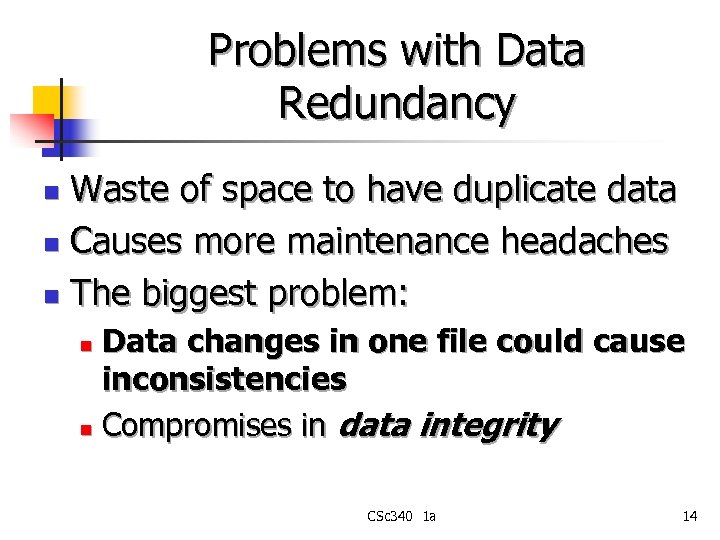
Problems with Data Redundancy Waste of space to have duplicate data n Causes more maintenance headaches n The biggest problem: n Data changes in one file could cause inconsistencies n Compromises in data integrity n CSc 340 1 a 14
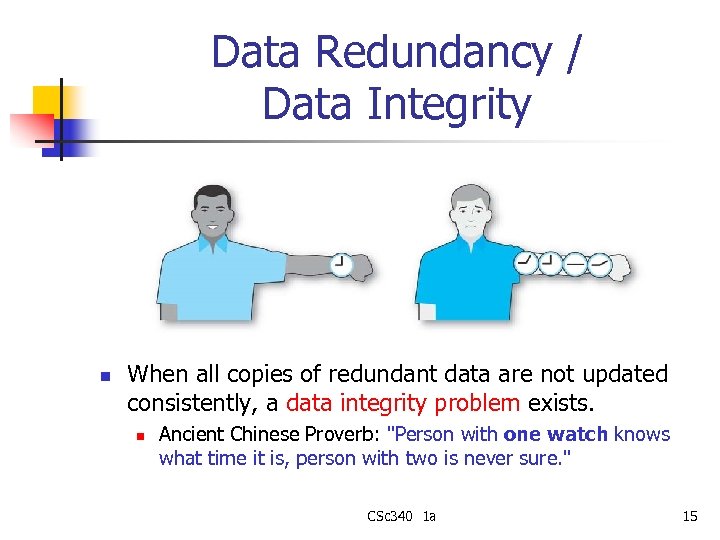
Data Redundancy / Data Integrity n When all copies of redundant data are not updated consistently, a data integrity problem exists. n Ancient Chinese Proverb: "Person with one watch knows what time it is, person with two is never sure. " CSc 340 1 a 15
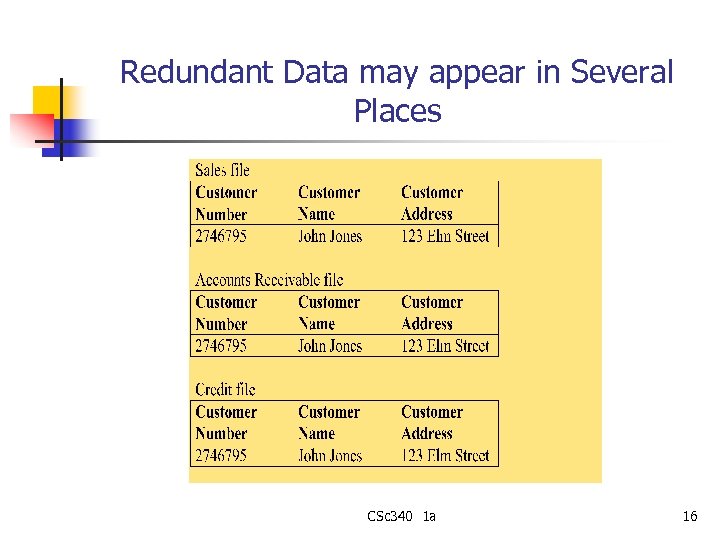
Redundant Data may appear in Several Places CSc 340 1 a 16
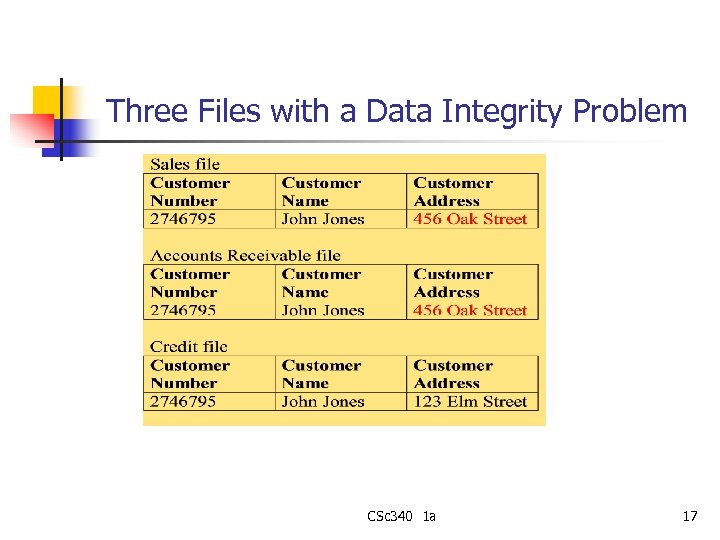
Three Files with a Data Integrity Problem CSc 340 1 a 17
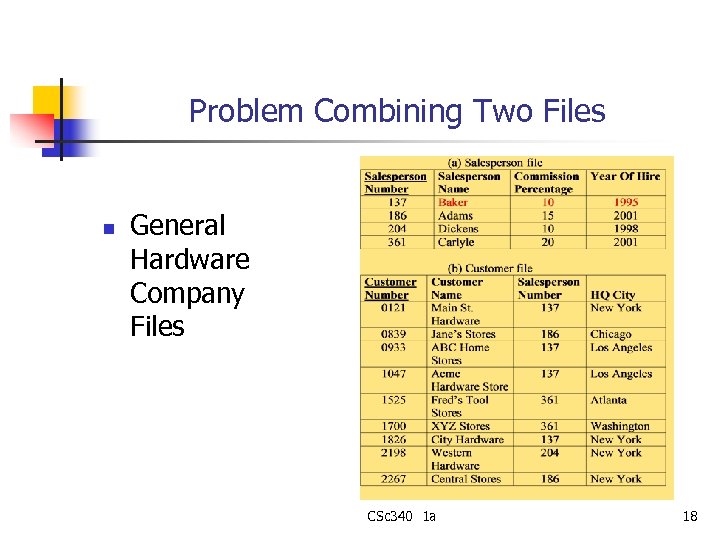
Problem Combining Two Files n General Hardware Company Files CSc 340 1 a 18
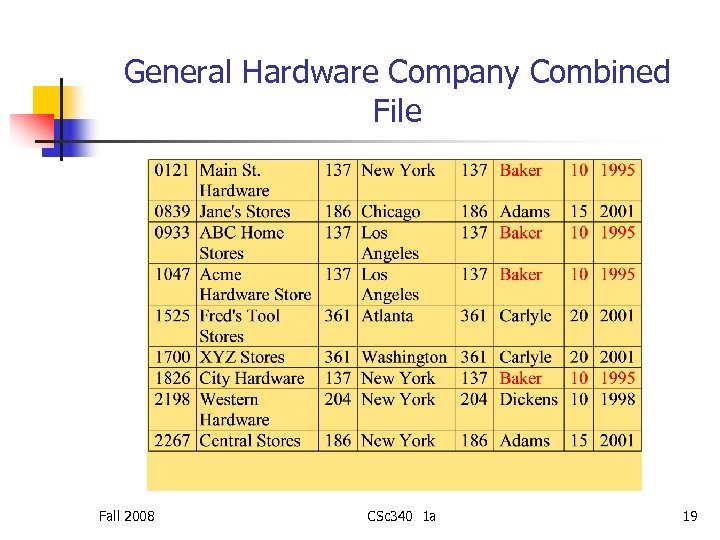
General Hardware Company Combined File Fall 2008 CSc 340 1 a 19
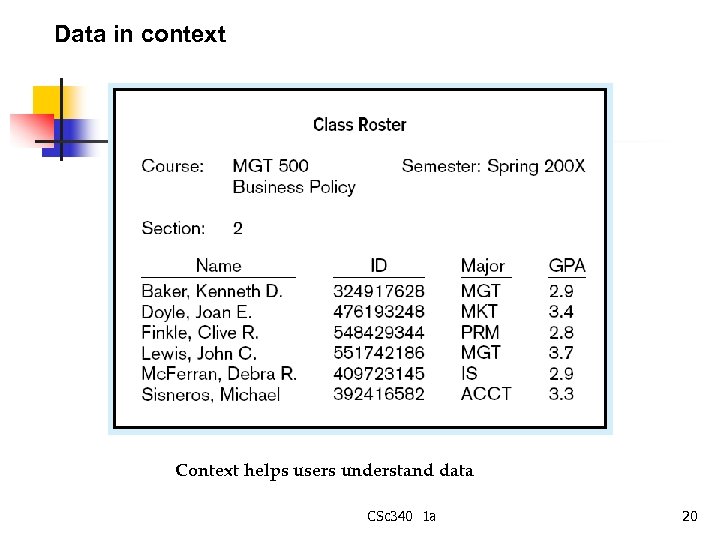
Data in context Context helps users understand data CSc 340 1 a 20
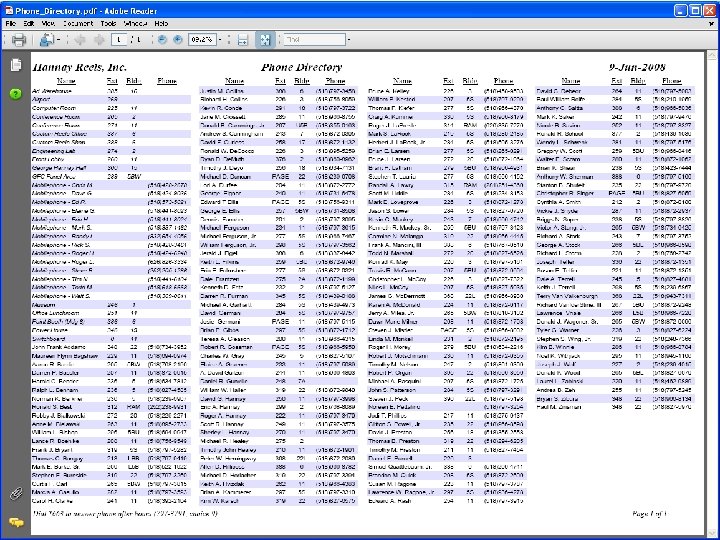
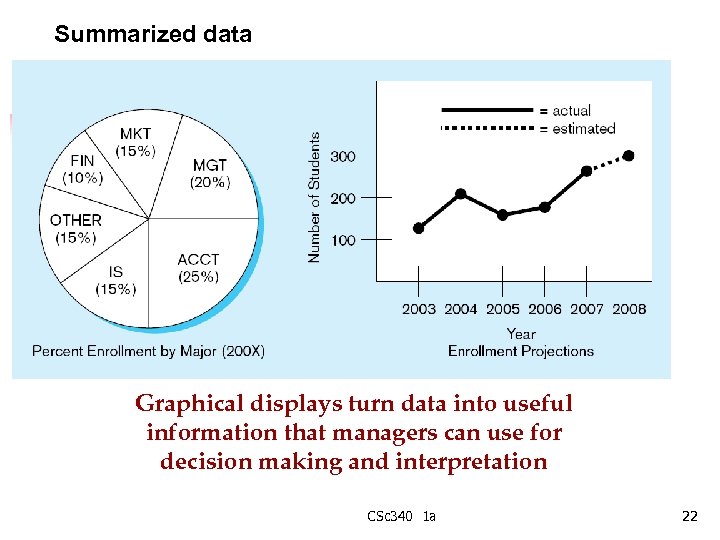
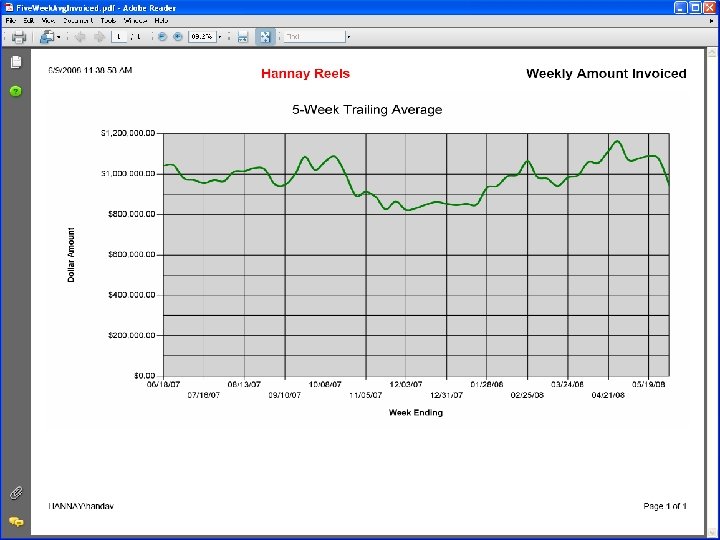
Summarized data Graphical displays turn data into useful information that managers can use for decision making and interpretation CSc 340 1 a 22
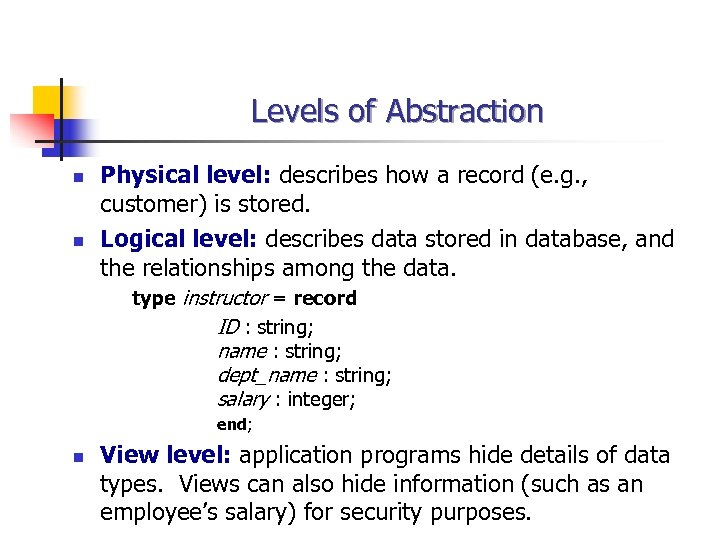
Levels of Abstraction n n Physical level: describes how a record (e. g. , customer) is stored. Logical level: describes data stored in database, and the relationships among the data. type instructor = record ID : string; name : string; dept_name : string; salary : integer; end; n View level: application programs hide details of data types. Views can also hide information (such as an employee’s salary) for security purposes.
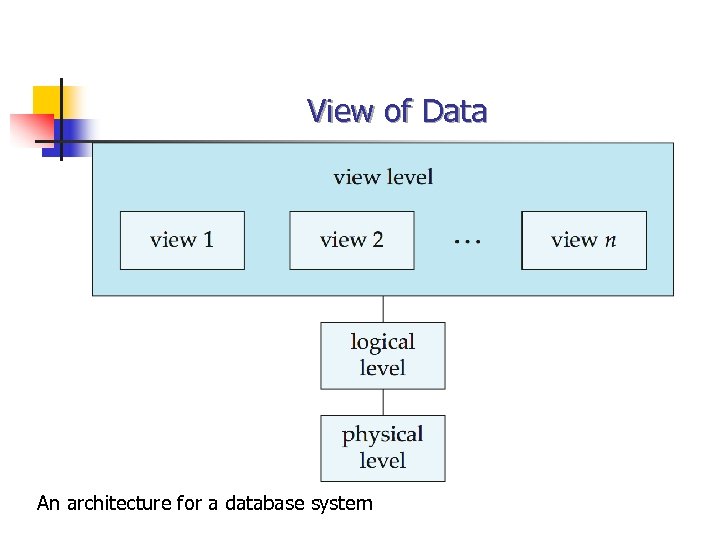
View of Data An architecture for a database system
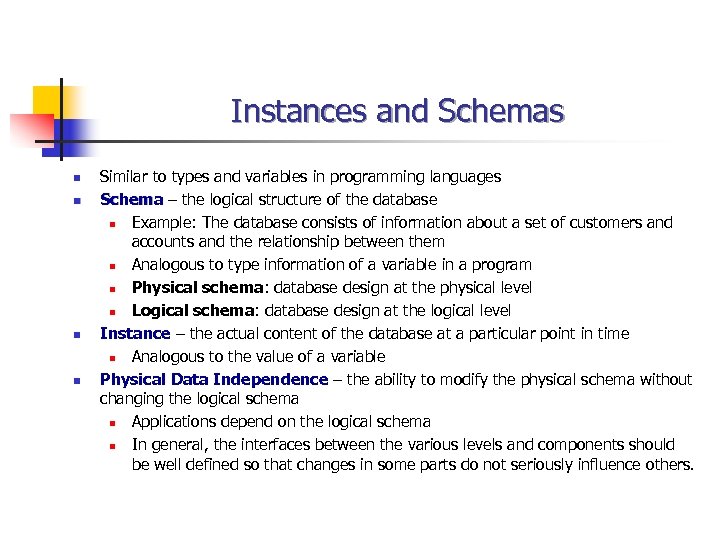
Instances and Schemas n n Similar to types and variables in programming languages Schema – the logical structure of the database n Example: The database consists of information about a set of customers and accounts and the relationship between them n Analogous to type information of a variable in a program n Physical schema: database design at the physical level n Logical schema: database design at the logical level Instance – the actual content of the database at a particular point in time n Analogous to the value of a variable Physical Data Independence – the ability to modify the physical schema without changing the logical schema n Applications depend on the logical schema n In general, the interfaces between the various levels and components should be well defined so that changes in some parts do not seriously influence others.
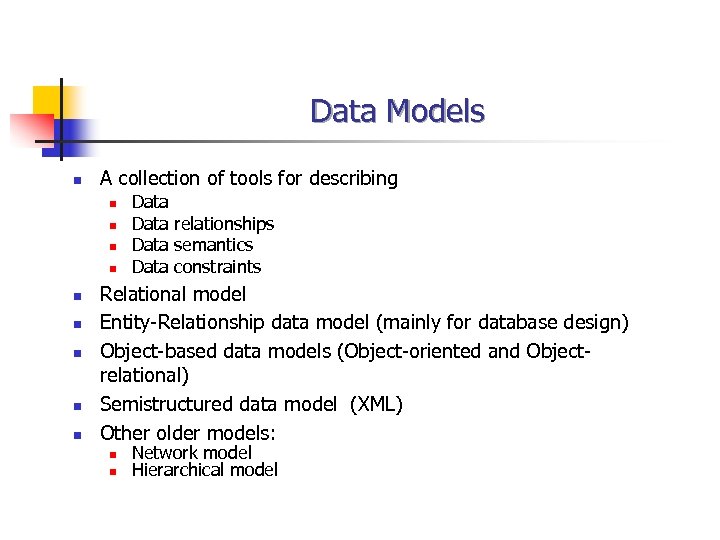
Data Models n A collection of tools for describing n n n n n Data relationships Data semantics Data constraints Relational model Entity-Relationship data model (mainly for database design) Object-based data models (Object-oriented and Objectrelational) Semistructured data model (XML) Other older models: n n Network model Hierarchical model
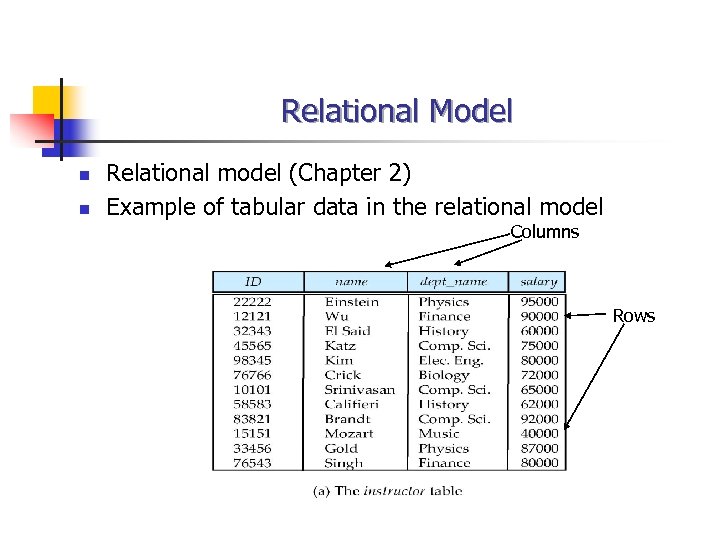
Relational Model n n Relational model (Chapter 2) Example of tabular data in the relational model Columns Rows
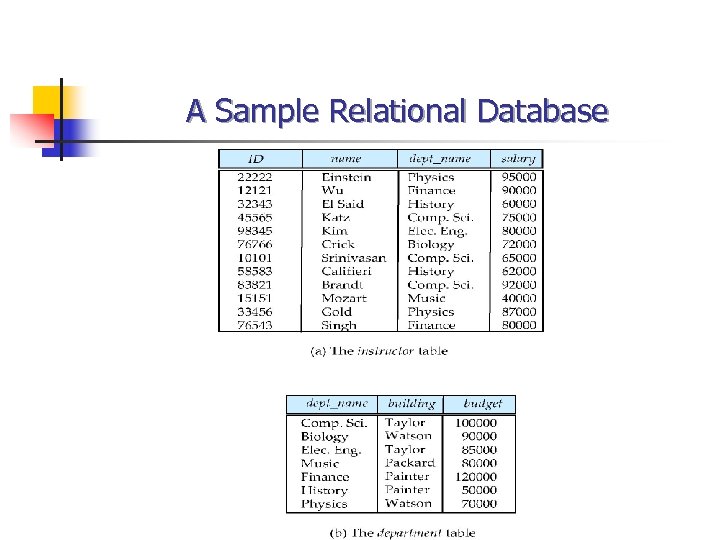
A Sample Relational Database
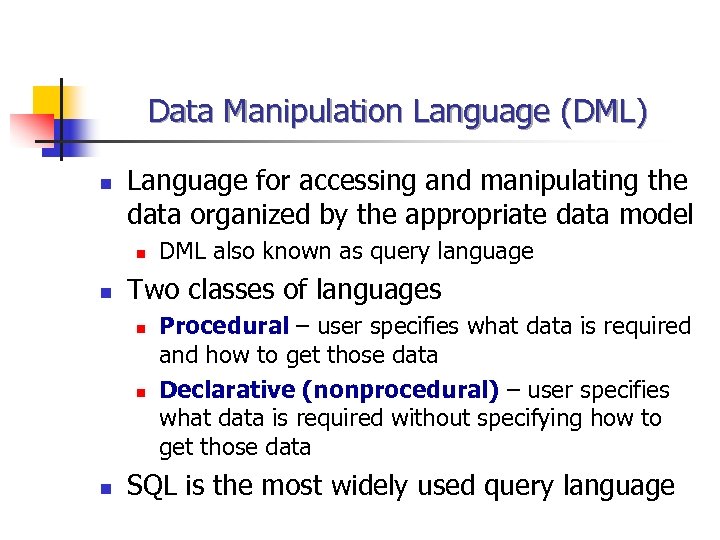
Data Manipulation Language (DML) n Language for accessing and manipulating the data organized by the appropriate data model n n Two classes of languages n n n DML also known as query language Procedural – user specifies what data is required and how to get those data Declarative (nonprocedural) – user specifies what data is required without specifying how to get those data SQL is the most widely used query language
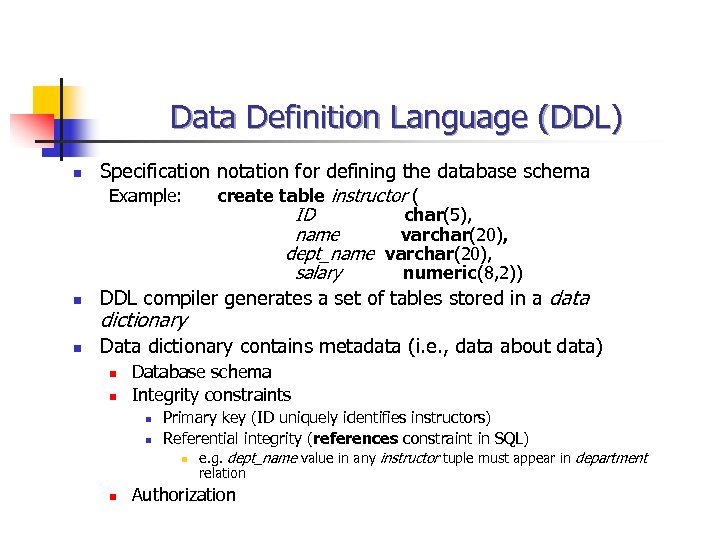
Data Definition Language (DDL) n Specification notation for defining the database schema Example: create table instructor ( ID char(5), name varchar(20), dept_name varchar(20), salary numeric(8, 2)) DDL compiler generates a set of tables stored in a data n Data dictionary contains metadata (i. e. , data about data) n dictionary n n Database schema Integrity constraints n n Primary key (ID uniquely identifies instructors) Referential integrity (references constraint in SQL) n n e. g. dept_name value in any instructor tuple must appear in department relation Authorization
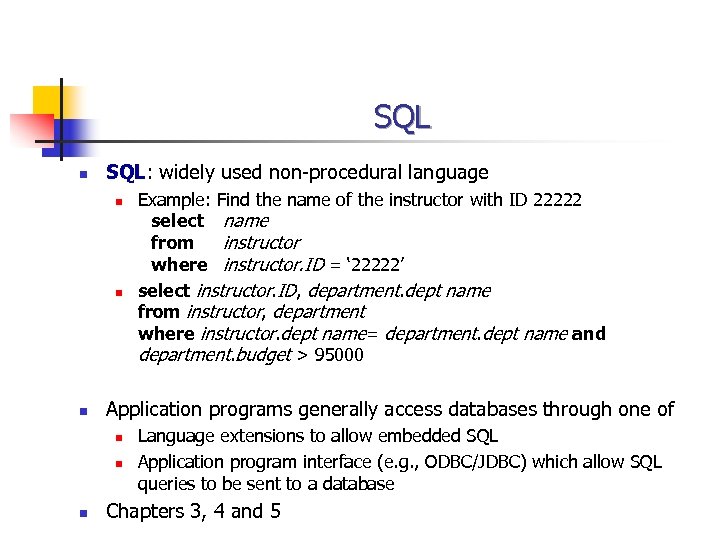
SQL n SQL: widely used non-procedural language n n n Application programs generally access databases through one of n n n Example: Find the name of the instructor with ID 22222 select name from instructor where instructor. ID = ‘ 22222’ select instructor. ID, department. dept name from instructor, department where instructor. dept name= department. dept name and department. budget > 95000 Language extensions to allow embedded SQL Application program interface (e. g. , ODBC/JDBC) which allow SQL queries to be sent to a database Chapters 3, 4 and 5
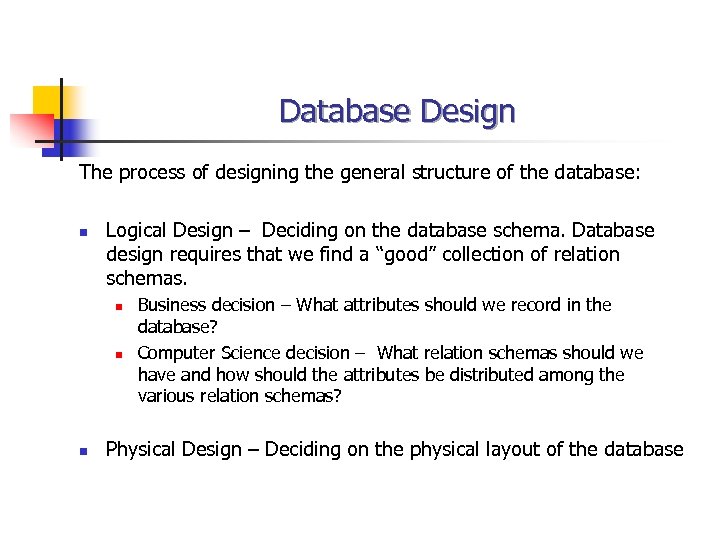
Database Design The process of designing the general structure of the database: n Logical Design – Deciding on the database schema. Database design requires that we find a “good” collection of relation schemas. n n n Business decision – What attributes should we record in the database? Computer Science decision – What relation schemas should we have and how should the attributes be distributed among the various relation schemas? Physical Design – Deciding on the physical layout of the database
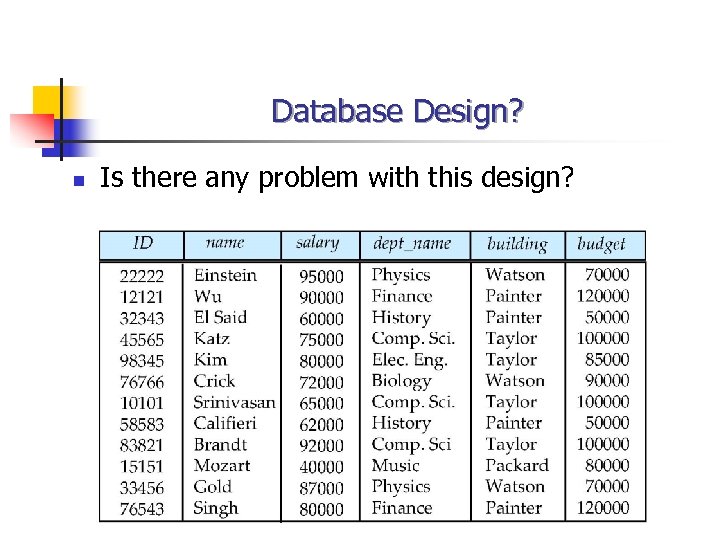
Database Design? n Is there any problem with this design?
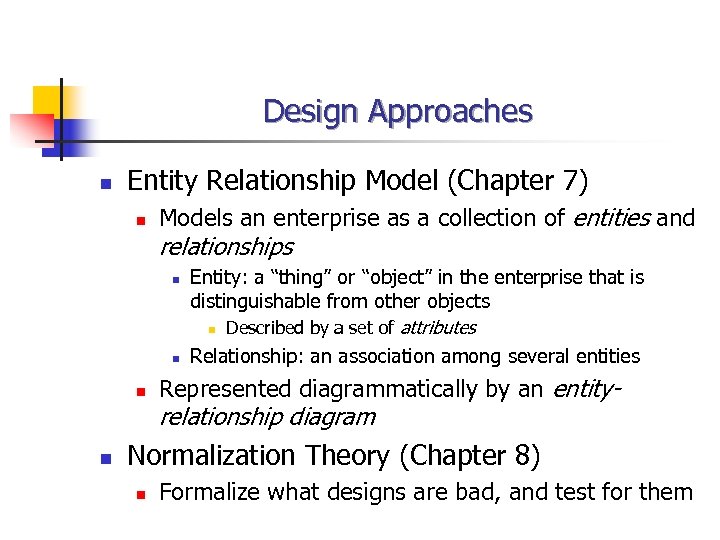
Design Approaches n Entity Relationship Model (Chapter 7) n Models an enterprise as a collection of entities and relationships n n n Entity: a “thing” or “object” in the enterprise that is distinguishable from other objects n Described by a set of attributes Relationship: an association among several entities Represented diagrammatically by an entity- relationship diagram n Normalization Theory (Chapter 8) n Formalize what designs are bad, and test for them
Object-Relational Data Models n n Relational model: flat, “atomic” values Object Relational Data Models n n Extend the relational data model by including object orientation and constructs to deal with added data types. Allow attributes of tuples to have complex types, including non-atomic values such as nested relations. Preserve relational foundations, in particular the declarative access to data, while extending modeling power. Provide upward compatibility with existing relational languages.
XML: Extensible Markup Language n n n Defined by the WWW Consortium (W 3 C) Originally intended as a document markup language not a database language The ability to specify new tags, and to create nested tag structures made XML a great way to exchange data, not just documents XML has become the basis for all new generation data interchange formats. A wide variety of tools is available for parsing, browsing and querying XML documents/data
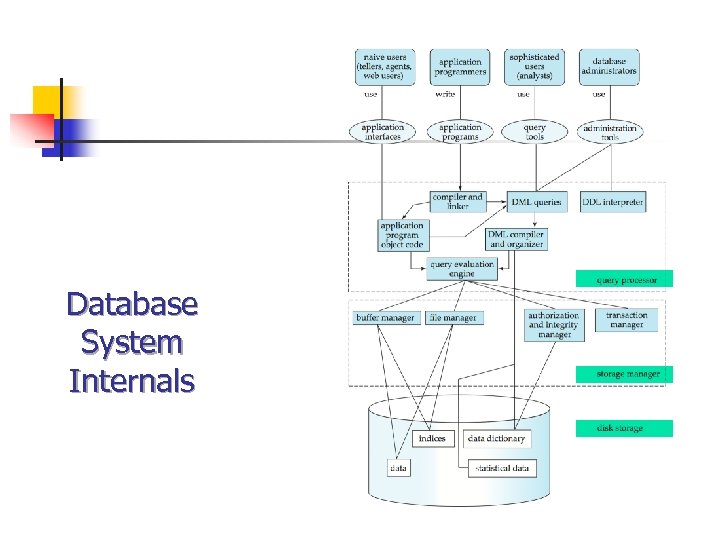
Database System Internals
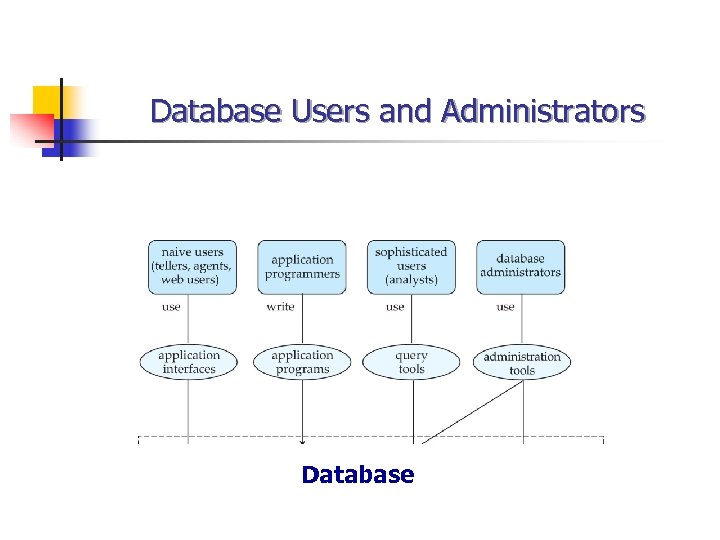
Database Users and Administrators Database
Storage Management n n Storage manager is a program module that provides the interface between the low-level data stored in the database and the application programs and queries submitted to the system. The storage manager is responsible to the following tasks: n n n Interaction with the file manager Efficient storing, retrieving and updating of data Issues: n n n Storage access File organization Indexing and hashing
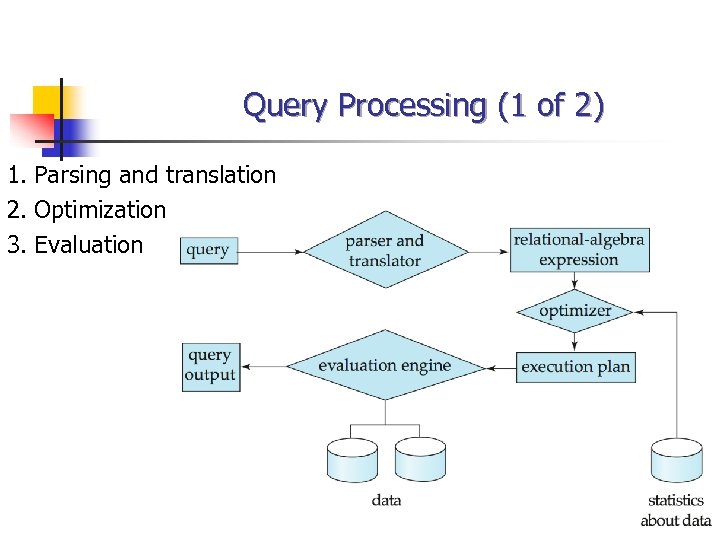
Query Processing (1 of 2) 1. Parsing and translation 2. Optimization 3. Evaluation
Query Processing (2 of 2) n Alternative ways of evaluating a given query n n Equivalent expressions Different algorithms for each operation Cost difference between a good and a bad way of evaluating a query can be enormous Need to estimate the cost of operations n n Depends critically on statistical information about relations which the database must maintain Need to estimate statistics for intermediate results to compute cost of complex expressions
Transaction Management n n n What if the system fails? What if more than one user is concurrently updating the same data? A transaction is a collection of operations that performs a single logical function in a database application Transaction-management component ensures that the database remains in a consistent (correct) state despite system failures (e. g. , power failures and operating system crashes) and transaction failures. Concurrency-control manager controls the interaction among the concurrent transactions, to ensure the consistency of the database.
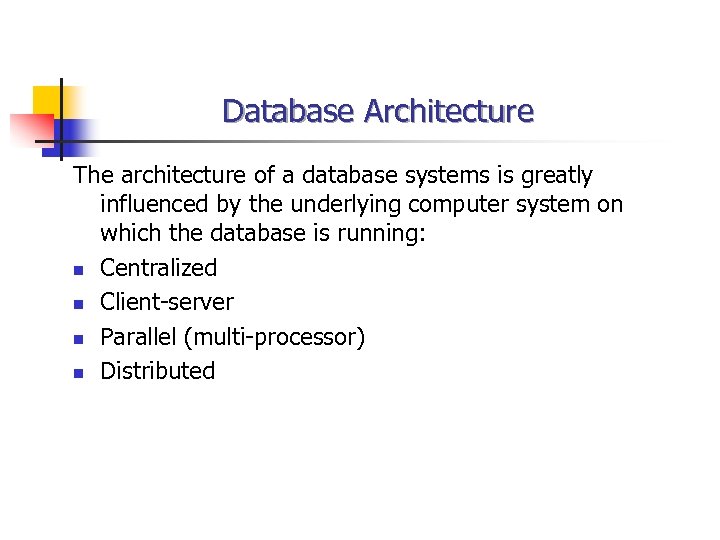
Database Architecture The architecture of a database systems is greatly influenced by the underlying computer system on which the database is running: n Centralized n Client-server n Parallel (multi-processor) n Distributed
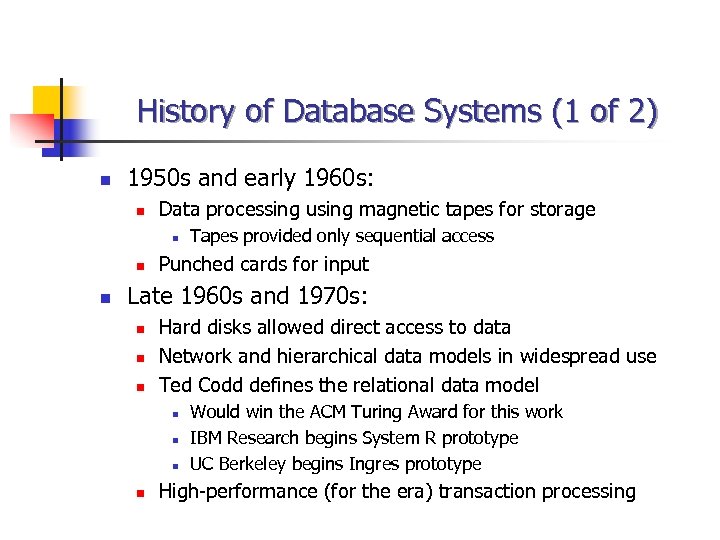
History of Database Systems (1 of 2) n 1950 s and early 1960 s: n Data processing using magnetic tapes for storage n n n Tapes provided only sequential access Punched cards for input Late 1960 s and 1970 s: n n n Hard disks allowed direct access to data Network and hierarchical data models in widespread use Ted Codd defines the relational data model n n Would win the ACM Turing Award for this work IBM Research begins System R prototype UC Berkeley begins Ingres prototype High-performance (for the era) transaction processing
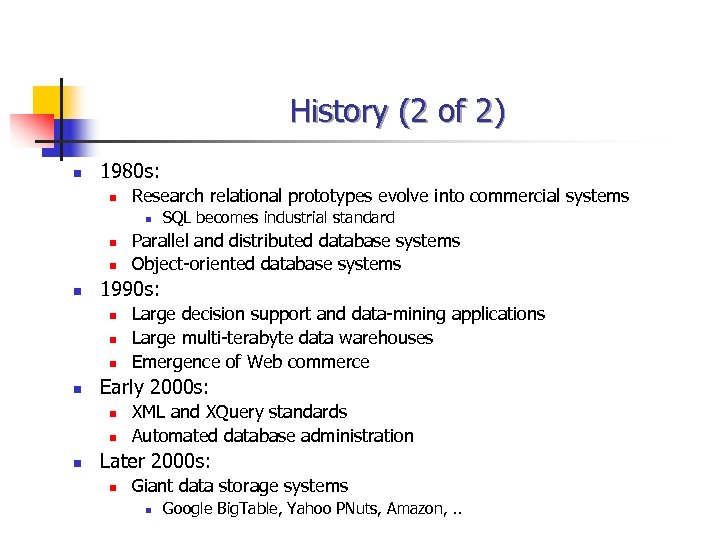
History (2 of 2) n 1980 s: n Research relational prototypes evolve into commercial systems n n n Large decision support and data-mining applications Large multi-terabyte data warehouses Emergence of Web commerce Early 2000 s: n n n Parallel and distributed database systems Object-oriented database systems 1990 s: n n SQL becomes industrial standard XML and XQuery standards Automated database administration Later 2000 s: n Giant data storage systems n Google Big. Table, Yahoo PNuts, Amazon, . .
Homework/Project n Homework Due before Next Class: n n (see Homework Handout) Homework Due in One Week: n n E-Mail your background to hannayd@union. edu 1. 1, 1. 3, 1. 5, 1. 6 Project Selection Due in One Week: n Name, General Description CSc 340 1 a 47

To the Computers n Check Out http: //www. hannay. com n n n Check out http: //cs. union. edu/csc 340 n n Try Dealer Locator: Fire Fighting Equip, your zip Try Dealer Login: 587566 Note Course Outline, Download area Compare Spreadsheet vs. Database n n Find File Distribution “download” directory on web site Download Hannay Reels DB. xls (59 K) Download Hannay Reels Customers. odb (21 K) Download Hannay Reels Customers. mdb (544 K) CSc 340 1 a 48
Скачать презентацию CSc-340 Intro to Databases Dave Hannay hannayd union edu
e06efe8e2150d7e933d51e78c42eede4.ppt