


 Скачать презентацию CSC 221 Introduction to Programming Fall 2011 Computer
c79246b8824e16c52d67653488899677.ppt
- Количество слайдов: 16
 CSC 221: Introduction to Programming Fall 2011 Computer basics and history § hardware vs. software § generations of computer technology § evolution of programming § why Python? 1
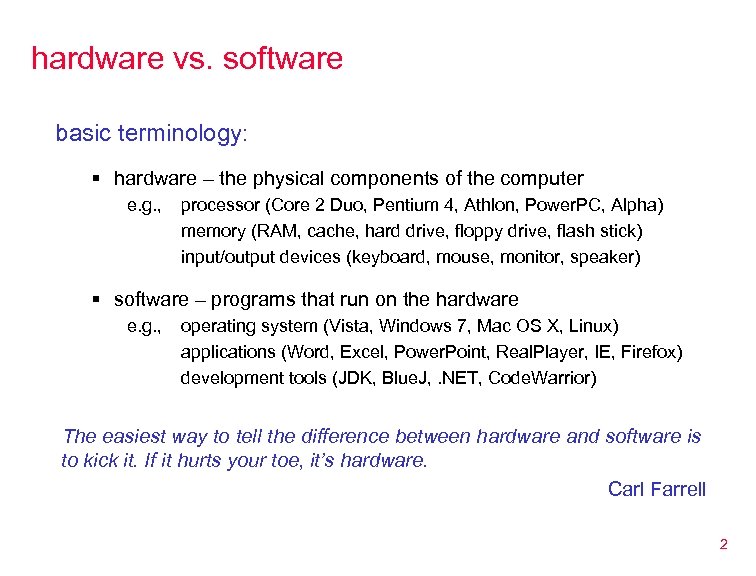 hardware vs. software basic terminology: § hardware – the physical components of the computer e. g. , processor (Core 2 Duo, Pentium 4, Athlon, Power. PC, Alpha) memory (RAM, cache, hard drive, floppy drive, flash stick) input/output devices (keyboard, mouse, monitor, speaker) § software – programs that run on the hardware e. g. , operating system (Vista, Windows 7, Mac OS X, Linux) applications (Word, Excel, Power. Point, Real. Player, IE, Firefox) development tools (JDK, Blue. J, . NET, Code. Warrior) The easiest way to tell the difference between hardware and software is to kick it. If it hurts your toe, it’s hardware. Carl Farrell 2
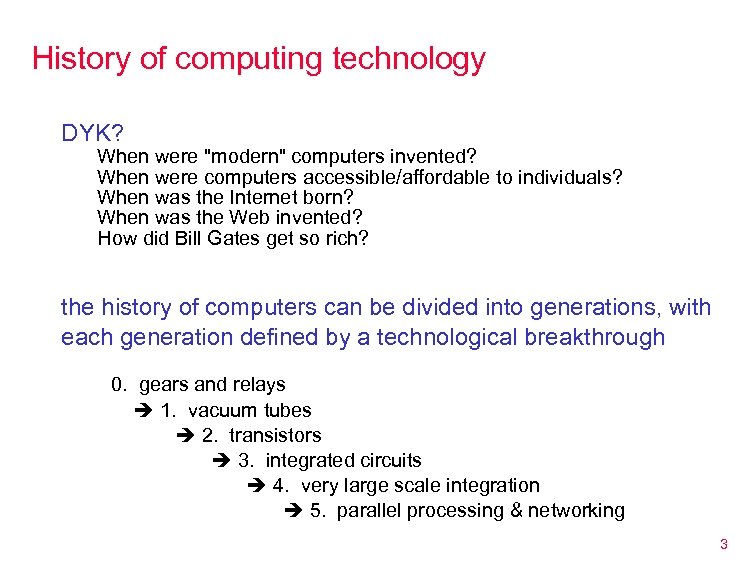 History of computing technology DYK? When were "modern" computers invented? When were computers accessible/affordable to individuals? When was the Internet born? When was the Web invented? How did Bill Gates get so rich? the history of computers can be divided into generations, with each generation defined by a technological breakthrough 0. gears and relays 1. vacuum tubes 2. transistors 3. integrated circuits 4. very large scale integration 5. parallel processing & networking 3
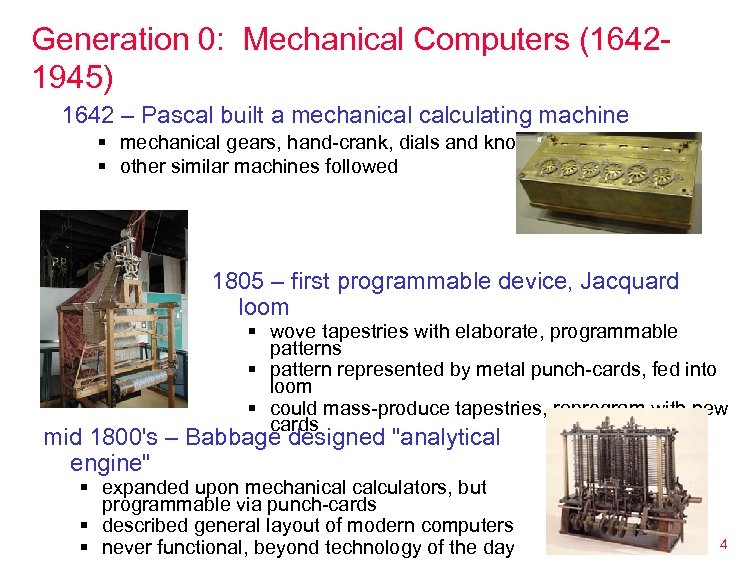 Generation 0: Mechanical Computers (16421945) 1642 – Pascal built a mechanical calculating machine § mechanical gears, hand-crank, dials and knobs § other similar machines followed 1805 – first programmable device, Jacquard loom § wove tapestries with elaborate, programmable patterns § pattern represented by metal punch-cards, fed into loom § could mass-produce tapestries, reprogram with new cards mid 1800's – Babbage designed "analytical engine" § expanded upon mechanical calculators, but programmable via punch-cards § described general layout of modern computers § never functional, beyond technology of the day 4
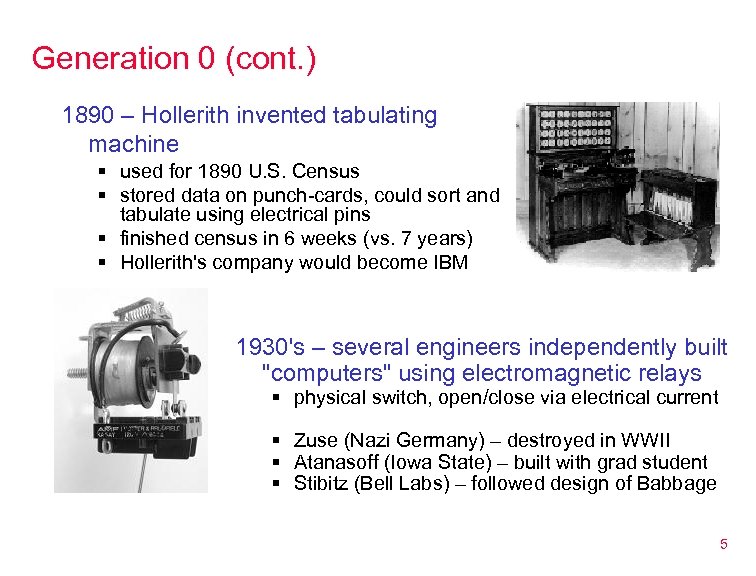 Generation 0 (cont. ) 1890 – Hollerith invented tabulating machine § used for 1890 U. S. Census § stored data on punch-cards, could sort and tabulate using electrical pins § finished census in 6 weeks (vs. 7 years) § Hollerith's company would become IBM 1930's – several engineers independently built "computers" using electromagnetic relays § physical switch, open/close via electrical current § Zuse (Nazi Germany) – destroyed in WWII § Atanasoff (Iowa State) – built with grad student § Stibitz (Bell Labs) – followed design of Babbage 5
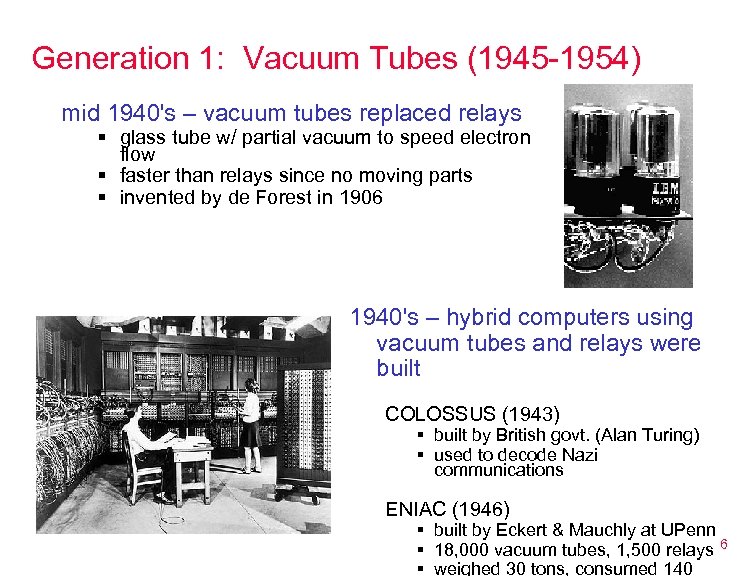 Generation 1: Vacuum Tubes (1945 -1954) mid 1940's – vacuum tubes replaced relays § glass tube w/ partial vacuum to speed electron flow § faster than relays since no moving parts § invented by de Forest in 1906 1940's – hybrid computers using vacuum tubes and relays were built COLOSSUS (1943) § built by British govt. (Alan Turing) § used to decode Nazi communications ENIAC (1946) § built by Eckert & Mauchly at UPenn § 18, 000 vacuum tubes, 1, 500 relays 6 § weighed 30 tons, consumed 140
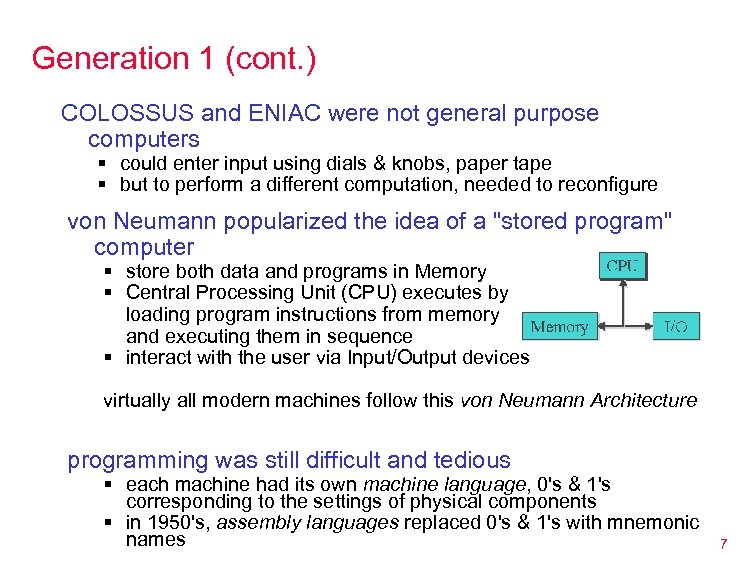 Generation 1 (cont. ) COLOSSUS and ENIAC were not general purpose computers § could enter input using dials & knobs, paper tape § but to perform a different computation, needed to reconfigure von Neumann popularized the idea of a "stored program" computer § store both data and programs in Memory § Central Processing Unit (CPU) executes by loading program instructions from memory and executing them in sequence § interact with the user via Input/Output devices virtually all modern machines follow this von Neumann Architecture programming was still difficult and tedious § each machine had its own machine language, 0's & 1's corresponding to the settings of physical components § in 1950's, assembly languages replaced 0's & 1's with mnemonic names 7
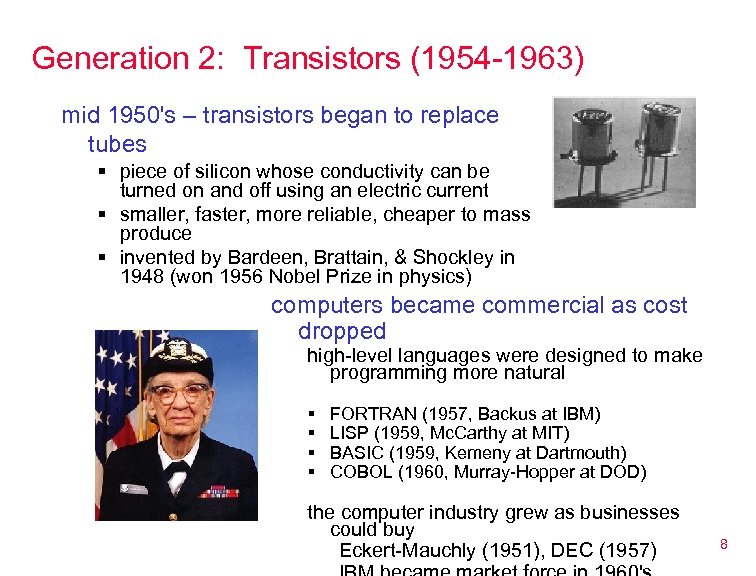 Generation 2: Transistors (1954 -1963) mid 1950's – transistors began to replace tubes § piece of silicon whose conductivity can be turned on and off using an electric current § smaller, faster, more reliable, cheaper to mass produce § invented by Bardeen, Brattain, & Shockley in 1948 (won 1956 Nobel Prize in physics) computers became commercial as cost dropped high-level languages were designed to make programming more natural § § FORTRAN (1957, Backus at IBM) LISP (1959, Mc. Carthy at MIT) BASIC (1959, Kemeny at Dartmouth) COBOL (1960, Murray-Hopper at DOD) the computer industry grew as businesses could buy Eckert-Mauchly (1951), DEC (1957) 8
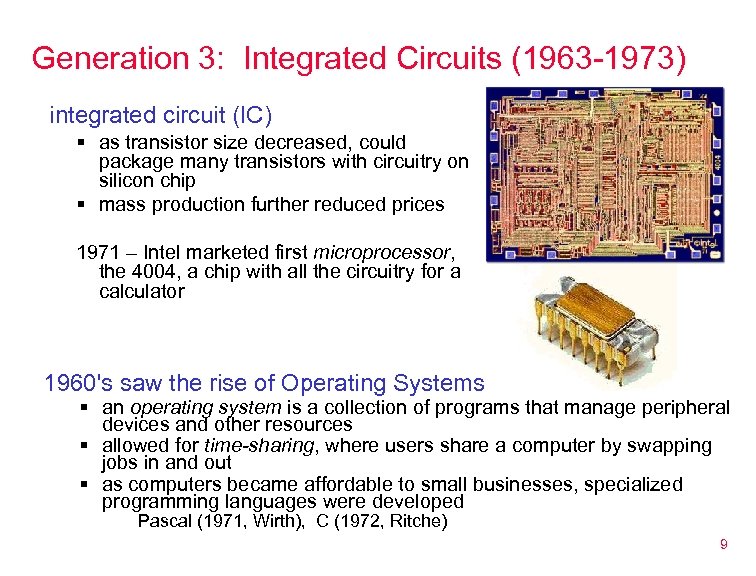 Generation 3: Integrated Circuits (1963 -1973) integrated circuit (IC) § as transistor size decreased, could package many transistors with circuitry on silicon chip § mass production further reduced prices 1971 – Intel marketed first microprocessor, the 4004, a chip with all the circuitry for a calculator 1960's saw the rise of Operating Systems § an operating system is a collection of programs that manage peripheral devices and other resources § allowed for time-sharing, where users share a computer by swapping jobs in and out § as computers became affordable to small businesses, specialized programming languages were developed Pascal (1971, Wirth), C (1972, Ritche) 9
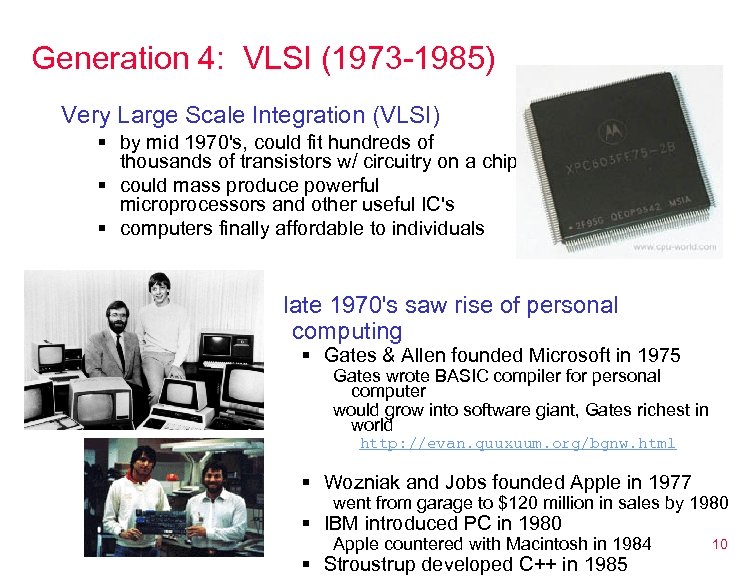 Generation 4: VLSI (1973 -1985) Very Large Scale Integration (VLSI) § by mid 1970's, could fit hundreds of thousands of transistors w/ circuitry on a chip § could mass produce powerful microprocessors and other useful IC's § computers finally affordable to individuals late 1970's saw rise of personal computing § Gates & Allen founded Microsoft in 1975 Gates wrote BASIC compiler for personal computer would grow into software giant, Gates richest in world http: //evan. quuxuum. org/bgnw. html § Wozniak and Jobs founded Apple in 1977 went from garage to $120 million in sales by 1980 § IBM introduced PC in 1980 Apple countered with Macintosh in 1984 § Stroustrup developed C++ in 1985 10
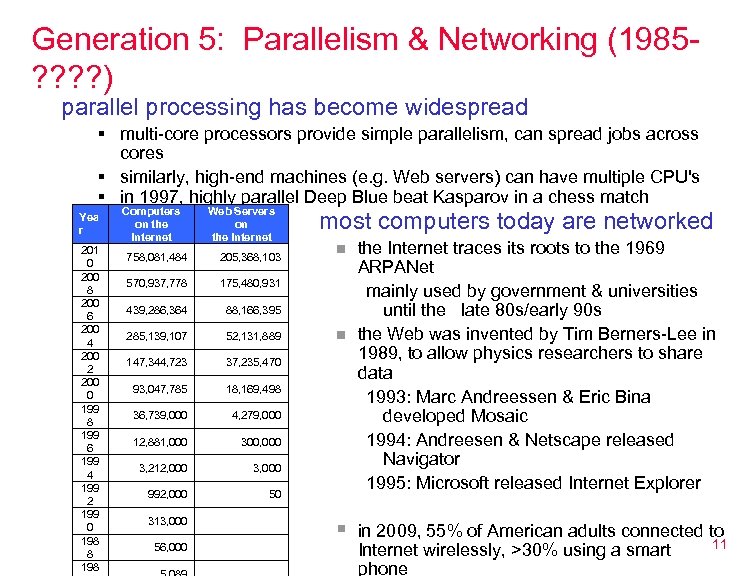 Generation 5: Parallelism & Networking (1985? ? ) parallel processing has become widespread § multi-core processors provide simple parallelism, can spread jobs across cores § similarly, high-end machines (e. g. Web servers) can have multiple CPU's § in 1997, highly parallel Deep Blue beat Kasparov in a chess match Yea r 201 0 200 8 200 6 200 4 200 2 200 0 199 8 199 6 199 4 199 2 199 0 198 8 198 Computers on the Internet Web Servers on the Internet 758, 081, 484 205, 368, 103 570, 937, 778 88, 166, 395 285, 139, 107 52, 131, 889 147, 344, 723 37, 235, 470 93, 047, 785 18, 169, 498 36, 739, 000 4, 279, 000 12, 881, 000 300, 000 3, 212, 000 3, 000 992, 000 n 175, 480, 931 439, 286, 364 most computers today are networked 50 313, 000 56, 000 n § the Internet traces its roots to the 1969 ARPANet mainly used by government & universities until the late 80 s/early 90 s the Web was invented by Tim Berners-Lee in 1989, to allow physics researchers to share data 1993: Marc Andreessen & Eric Bina developed Mosaic 1994: Andreesen & Netscape released Navigator 1995: Microsoft released Internet Explorer in 2009, 55% of American adults connected to 11 Internet wirelessly, >30% using a smart phone
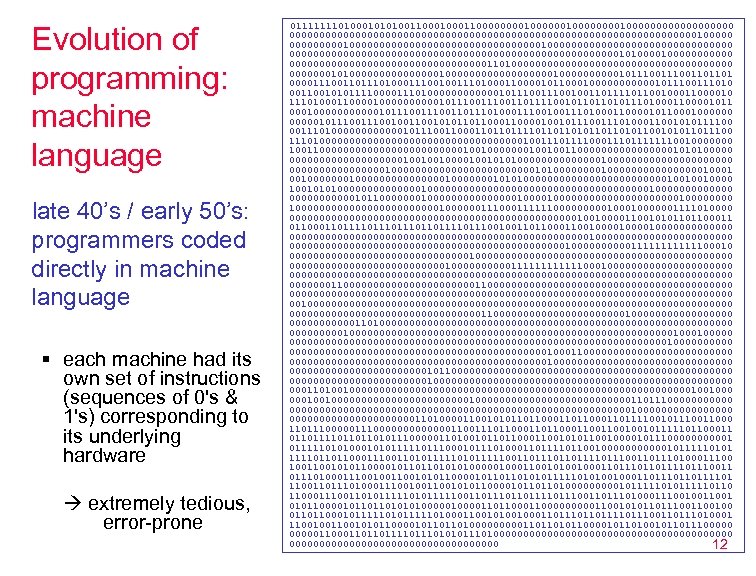 Evolution of programming: machine language late 40’s / early 50’s: programmers coded directly in machine language § each machine had its own set of instructions (sequences of 0's & 1's) corresponding to its underlying hardware extremely tedious, error-prone 01111111010001010100110001100000000100000000000000000000000000000000001000000000000000000000000000000000101000000000000000001101000000000000000000010100000000000000000010000010111001101101 000011100110100011100100111010001100001011000000010111010 0011001010111100001110100000010111001001101100100011000010 1110100011000000000010111001101111001011011010111010001100001011 0001000000101110011010001110010011101000110000101100000010111001001010110110000100101110100011001010111100 001110100000010111000110110110101101100101011011100 1110100000000000000000100111100011111110010000000 100110000000000001001000000010010011000000001010100000000001001001001010100000000000000000100000000000010100000000000010001 0010000000000100000001010100000000000010010010000 10010101000000000000000000000000010000000101100000000000100000000000001000000000000100000011111100000100000011110100000000000000000000000010010000110010101101100011011101101111001001101100100001000000000000000000000000010000000000000000000000010000011111100010 0000000000000001000000000000000000000010000011111100010000000000000000000000000000000000000110000000000000000000000000000000000000 00100000000000000000000000000000000000011000000000001000000000110100000000000000000000000000000010000000000000000000000000001000000000000000000000000000000001000000000000000000000010001100000000000000000000001000000000000000101100000000000000000000000010000000000000000000000000 0001101001000000000000000000000000000001001000000000000000000000000001101110000000000000000000000000000010000000000011010000110010101101100011011110010111000 11011100000000011001110110001100100101111101100011 01101101101011100000110100101101100101011001000010111000001 011111010100010101111100010111010001101100100000010111110101 1111011011000111001101011111001101111011100110100011100 10010101100001011011010000011001000110111101110011 011101000111001001010110000101101101010111110101001000110111101 110011010001110010010101100001011011010000010111110110 110001110011010111110011011110111001101000111001001 01011000010110110100000110110000000001100101011011100100 01101100010111110100011001000110111101110011010001 11001001010110000101101101000001101100001011011100000110110111010101110100000000000000000000 12
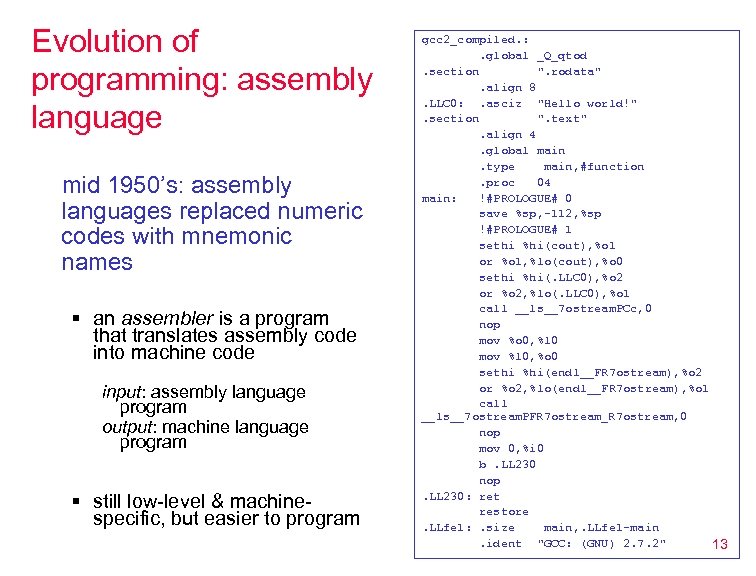 Evolution of programming: assembly language mid 1950’s: assembly languages replaced numeric codes with mnemonic names § an assembler is a program that translates assembly code into machine code input: assembly language program output: machine language program § still low-level & machinespecific, but easier to program gcc 2_compiled. : . global _Q_qtod. section ". rodata". align 8. LLC 0: . asciz "Hello world!". section ". text". align 4. global main. type main, #function. proc 04 main: !#PROLOGUE# 0 save %sp, -112, %sp !#PROLOGUE# 1 sethi %hi(cout), %o 1 or %o 1, %lo(cout), %o 0 sethi %hi(. LLC 0), %o 2 or %o 2, %lo(. LLC 0), %o 1 call __ls__7 ostream. PCc, 0 nop mov %o 0, %l 0 mov %l 0, %o 0 sethi %hi(endl__FR 7 ostream), %o 2 or %o 2, %lo(endl__FR 7 ostream), %o 1 call __ls__7 ostream. PFR 7 ostream_R 7 ostream, 0 nop mov 0, %i 0 b. LL 230 nop. LL 230: ret restore. LLfe 1: . size main, . LLfe 1 -main. ident "GCC: (GNU) 2. 7. 2" 13
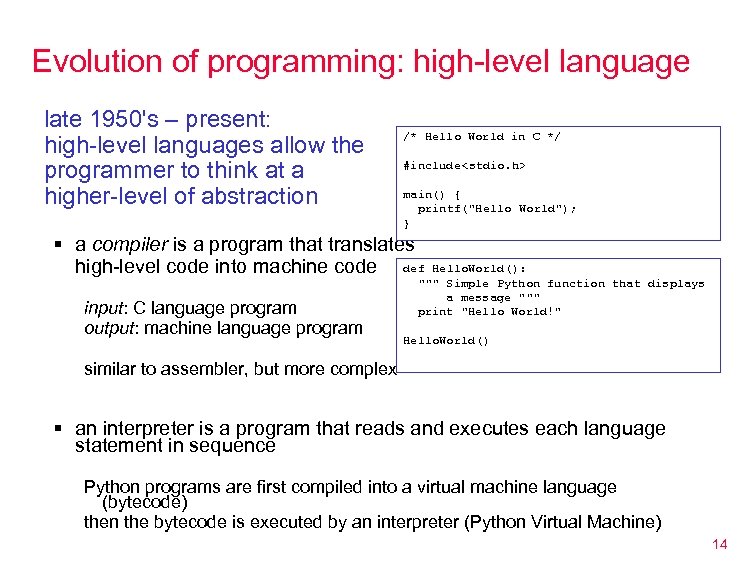 Evolution of programming: high-level language late 1950's – present: high-level languages allow the programmer to think at a higher-level of abstraction /* Hello World in C */ #include
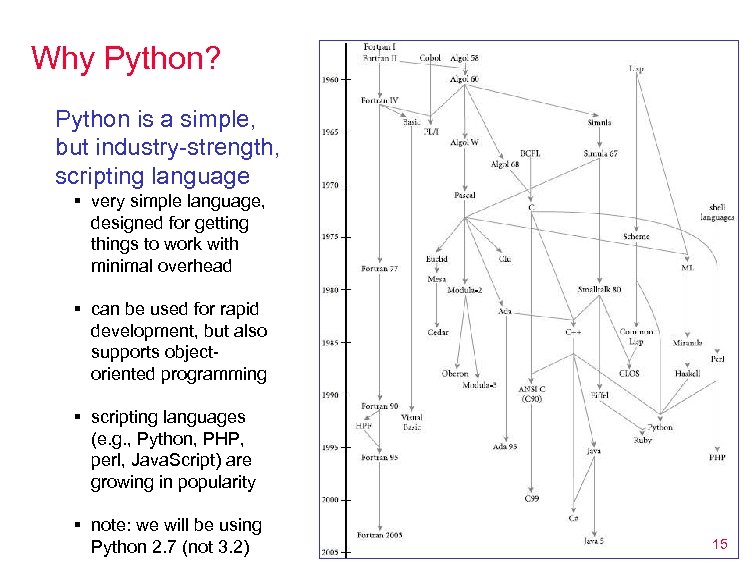 Why Python? Python is a simple, but industry-strength, scripting language § very simple language, designed for getting things to work with minimal overhead § can be used for rapid development, but also supports objectoriented programming § scripting languages (e. g. , Python, PHP, perl, Java. Script) are growing in popularity § note: we will be using Python 2. 7 (not 3. 2) 15
 If you want to know more… check out the following (purely optional) links Inventors: The History of Computers Computer Museum History Center Transistorized! from PBS. org Apple Computer Reading List The History of Microsoft Internet Pioneers: Tim Berners-Lee Internet Pioneers: Marc Andreessen Wikipedia entry on Programming Languages Webopedia entry on Programming Languages Python Official Website 16