


 Скачать презентацию CSC 170 — Introduction to Computers and Their
3899c35765aabea0f56b53348493301d.ppt
- Количество слайдов: 20
 CSC 170 - Introduction to Computers and Their Applications Information Lecture 2 – Evaluating Information Sources
 Evaluating Information Is Not Always Easy • Evaluating information is not always easy, especially when you find it on the Internet. – There is a lot of “garbage” available on the Internet with no one reviewing its content. – There is very little stopping anyone from publishing whatever they want on the Internet. – The rankings that search engines give to various sites reflect their popularity, but not always their accuracy. Source – Bob Baker (Pima Community College) Info Literacy 10. Evaluating Information Sources http: //www. youtube. com/watch? v=Vv. Vh. N 3_ex_8
 Authority • Authority deals with the ability of the author to speak knowledgably about the subject at head. • Evaluating the authority of an author of a web page can be difficult unless you either the author or can research his/her background. • It is easy to evaluate the authority of authors of more traditional sources (book, newspapers, magazines, journals, references sources such as traditional encyclopedias) because of editorial control.
 Is It Authoritative? • Articles appearing in a peer-reviewed scholarly journal or reputable reference or trade publisher can generally be used as a scholarly resource. – Ulrich’s web tells whether a journal is peer reviewed • Corporate, educational or government web sites do not have author names, but generally will provide trustworthy information.
 Evaluating the Author • In many cases, you can locate the name of the author on a web page and it may lead you to information about the author, such as educational credentials. • In other cases, you can look elsewhere to find out about the author, such as a library database, which may list his/her publications.
 Is the Web Site Authoritative? • Examining the domain name: – Web sites whose URL (web address) ends with. edu indicates an educational institution and increase the chance that the information is reliable.
 Timeliness (or Currency) • Writing on a current topic requires current information. • Materials in traditional sources (books and periodicals) are typically 6 months to a year older than the copyright date indicates because of the review process. • Articles in periodicals will be more current than books.
 Timeliness on the Web • It’s often difficult to determine the age of information on a web page. – Although sometimes the page will include a date of last revision, this may reflect a redesign of the web page and not a change in its content. • Just because information is on the Web doesn’t mean that it’s up to date.
 Bias • When you using information that you find on the web, you need to discern if there is a bias on the part of the site owners. – Domain names ending in. com indicate corporate sites are trying to encourage to buy their products. – Non-profit organizations whose domain names end in may be trying to solicit a contribution.
 Do They Have An “Axe to Grind” • Business seeking customers and charities seeking donations are not the only sites trying to present a point of view. • There are many web sites that are political and are trying to advance a political point of view. • There are facts and there are opinions based on these facts. Certain key words may indicate that this is an opinion.
 How To Spot Bias • Spotting this bias may not always be easy – it helps to start with a current issues reference site, such as CQ Press Researcher. (http: //www. cqpress. com/researcher)
 Accuracy • Accuracy can be determined based on the sources used and cited by the author. • Look through an author’s bibliography: are these published in reputable journals? • If there are links to other web sites, look at these other web sites. Are they credible? • Google’s advanced search has page-specific tools that can show if there are similar pages that are credible.
 CRAAP Test • The CRAAP provides an easy-to-remember mnemonic and a set of easy tests when evaluating materials. Source – Gettysburg College Library Web Site http: //www. gettysburg. edu/library/research/tips/webeval/index. dot
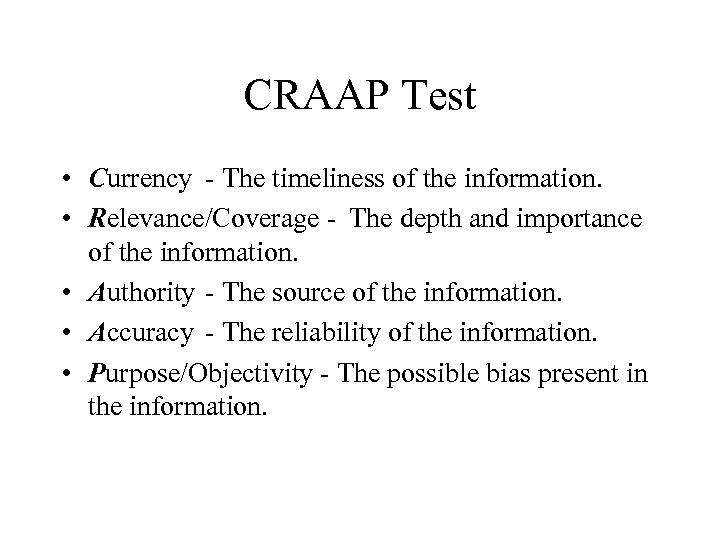 CRAAP Test • Currency - The timeliness of the information. • Relevance/Coverage - The depth and importance of the information. • Authority - The source of the information. • Accuracy - The reliability of the information. • Purpose/Objectivity - The possible bias present in the information.
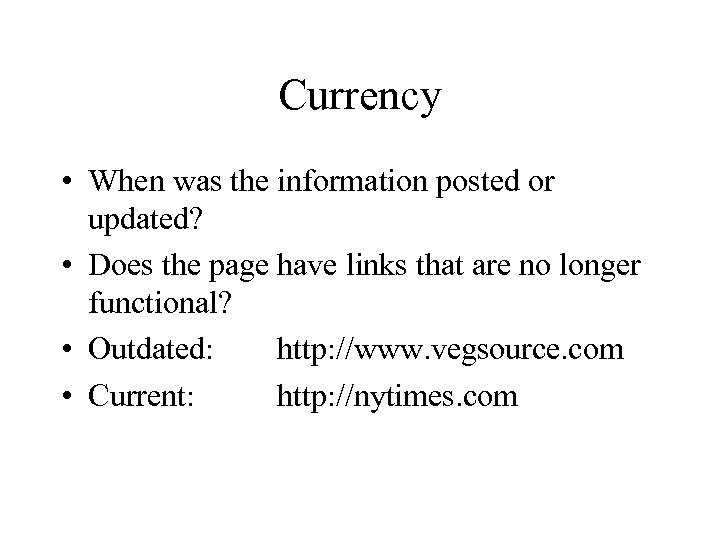 Currency • When was the information posted or updated? • Does the page have links that are no longer functional? • Outdated: http: //www. vegsource. com • Current: http: //nytimes. com
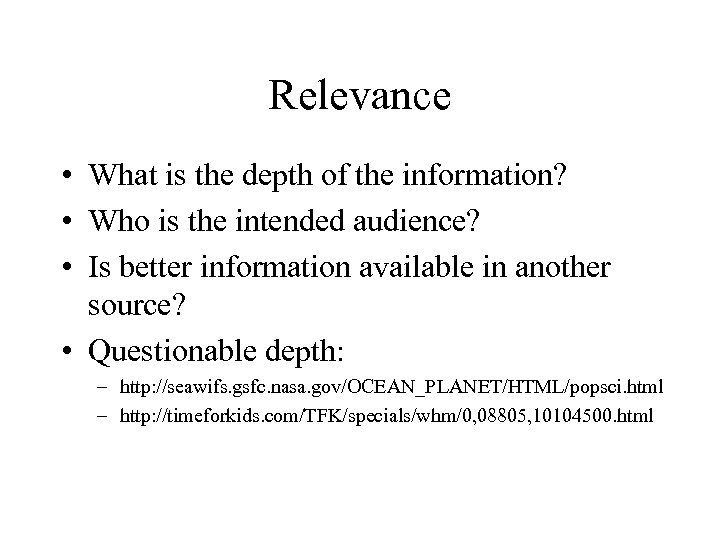 Relevance • What is the depth of the information? • Who is the intended audience? • Is better information available in another source? • Questionable depth: – http: //seawifs. gsfc. nasa. gov/OCEAN_PLANET/HTML/popsci. html – http: //timeforkids. com/TFK/specials/whm/0, 08805, 10104500. html
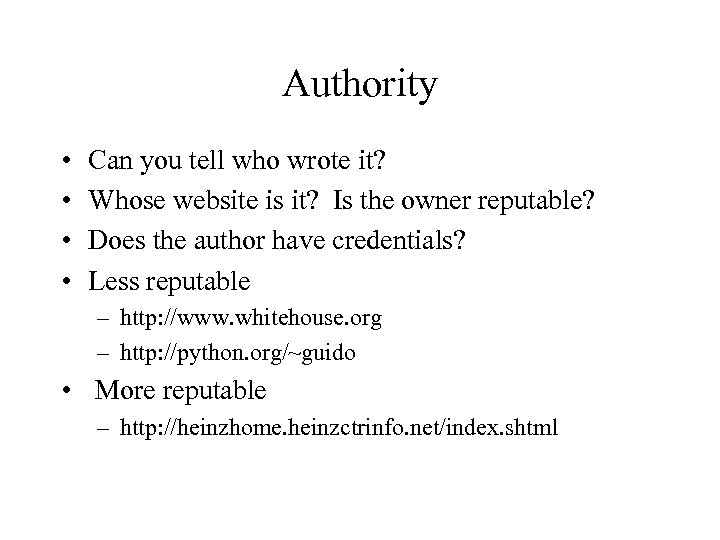 Authority • • Can you tell who wrote it? Whose website is it? Is the owner reputable? Does the author have credentials? Less reputable – http: //www. whitehouse. org – http: //python. org/~guido • More reputable – http: //heinzhome. heinzctrinfo. net/index. shtml
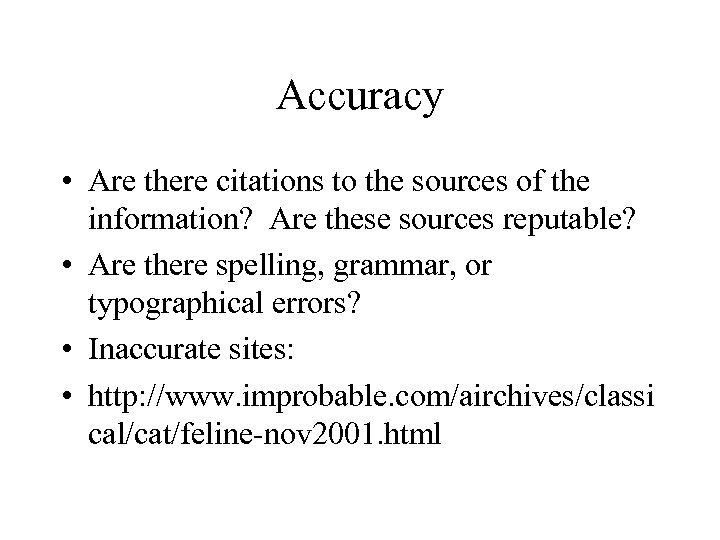 Accuracy • Are there citations to the sources of the information? Are these sources reputable? • Are there spelling, grammar, or typographical errors? • Inaccurate sites: • http: //www. improbable. com/airchives/classi cal/cat/feline-nov 2001. html
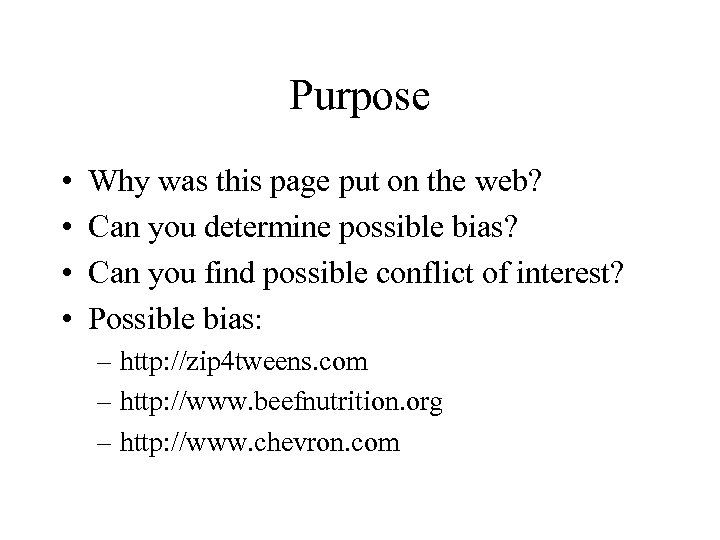 Purpose • • Why was this page put on the web? Can you determine possible bias? Can you find possible conflict of interest? Possible bias: – http: //zip 4 tweens. com – http: //www. beefnutrition. org – http: //www. chevron. com
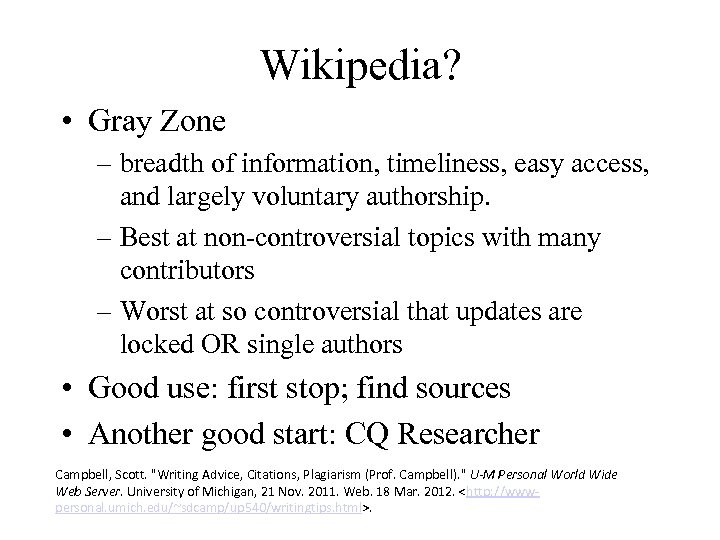 Wikipedia? • Gray Zone – breadth of information, timeliness, easy access, and largely voluntary authorship. – Best at non-controversial topics with many contributors – Worst at so controversial that updates are locked OR single authors • Good use: first stop; find sources • Another good start: CQ Researcher Campbell, Scott. "Writing Advice, Citations, Plagiarism (Prof. Campbell). " U-M Personal World Wide Web Server. University of Michigan, 21 Nov. 2011. Web. 18 Mar. 2012.