


 Скачать презентацию CSC 139 Operating Systems Lecture 6 Synchronization Adapted
e323654667c3de954c1bb90ee4d58317.ppt
- Количество слайдов: 30
 CSC 139 Operating Systems Lecture 6 Synchronization Adapted from Prof. John Kubiatowicz's lecture notes for CS 162 http: //inst. eecs. berkeley. edu/~cs 162 Copyright © 2006 UCB
 Review: Thread. Fork(): Create a New Thread • Thread. Fork() is a user-level procedure that creates a new thread and places it on ready queue • Arguments to Thread. Fork() – Pointer to application routine (fcn. Ptr) – Pointer to array of arguments (fcn. Arg. Ptr) – Size of stack to allocate • Implementation – – Sanity Check arguments Enter Kernel-mode and Sanity Check arguments again Allocate new Stack and TCB Initialize TCB and place on ready list (Runnable). Lec 6. 2
 Review: How does Thread get started? • Eventually, run_new_thread() will select this TCB and return into beginning of Thread. Root() – This really starts the new thread Lec 6. 3
 Review: What does Thread. Root() look like? • Thread. Root() is the root for the thread routine: Thread. Root() { Do. Startup. Housekeeping(); User. Mode. Switch(); /* enter user mode */ Call fcn. Ptr(fcn. Arg. Ptr); Thread. Finish(); } • Startup Housekeeping – Includes things like recording start time of thread – Other Statistics • Stack will grow and shrink with execution of thread • Final return from thread returns into Thread. Root() which calls Thread. Finish() – Thread. Finish() wake up sleeping threads Lec 6. 4
 Goals for Today • More concurrency examples • Need for synchronization • Examples of valid synchronization Note: Some slides and/or pictures in the following are adapted from slides © 2005 Silberschatz, Galvin, and Gagne. Many slides generated from my lecture notes by Kubiatowicz. Lec 6. 5
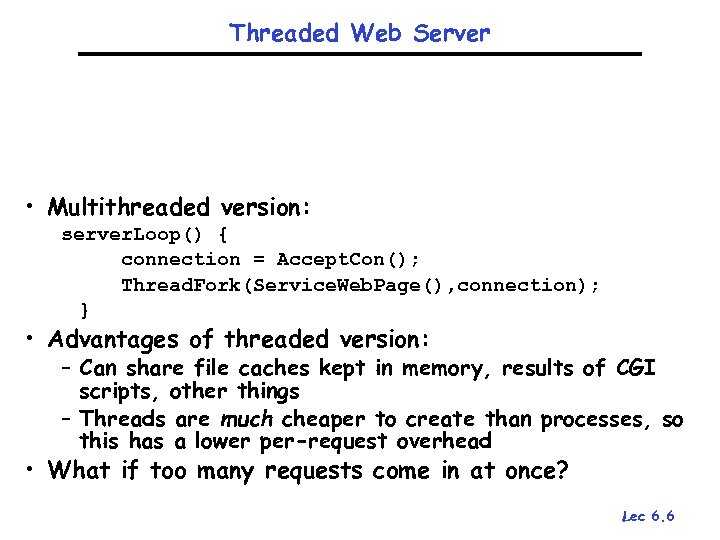 Threaded Web Server • Multithreaded version: server. Loop() { connection = Accept. Con(); Thread. Fork(Service. Web. Page(), connection); } • Advantages of threaded version: – Can share file caches kept in memory, results of CGI scripts, other things – Threads are much cheaper to create than processes, so this has a lower per-request overhead • What if too many requests come in at once? Lec 6. 6
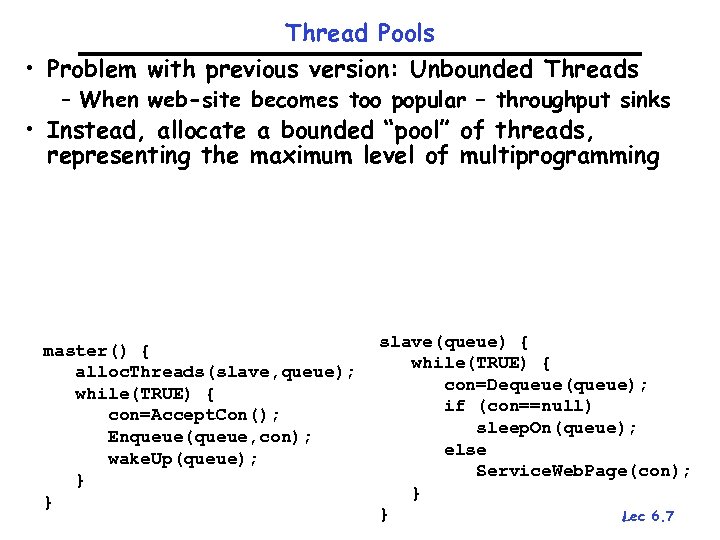 Thread Pools • Problem with previous version: Unbounded Threads – When web-site becomes too popular – throughput sinks • Instead, allocate a bounded “pool” of threads, representing the maximum level of multiprogramming master() { alloc. Threads(slave, queue); while(TRUE) { con=Accept. Con(); Enqueue(queue, con); wake. Up(queue); } } slave(queue) { while(TRUE) { con=Dequeue(queue); if (con==null) sleep. On(queue); else Service. Web. Page(con); } } Lec 6. 7
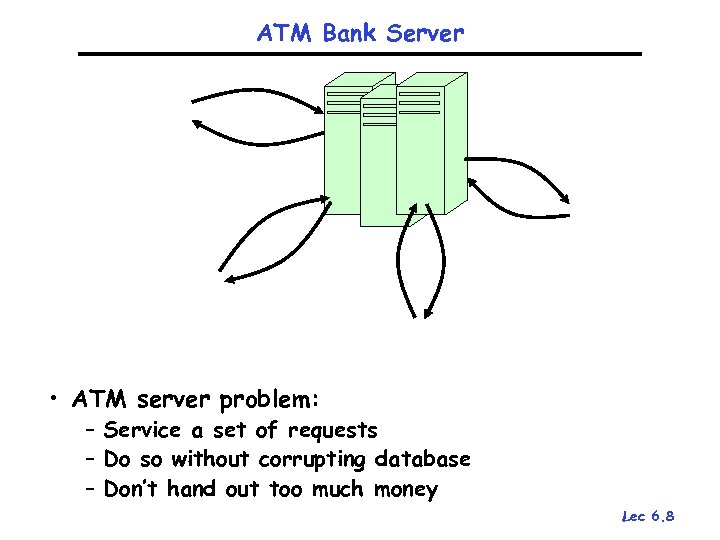 ATM Bank Server • ATM server problem: – Service a set of requests – Do so without corrupting database – Don’t hand out too much money Lec 6. 8
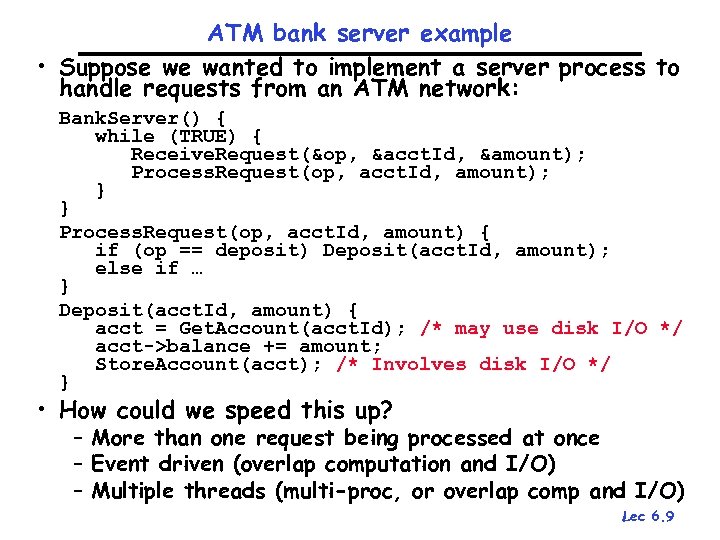 ATM bank server example • Suppose we wanted to implement a server process to handle requests from an ATM network: Bank. Server() { while (TRUE) { Receive. Request(&op, &acct. Id, &amount); Process. Request(op, acct. Id, amount); } } Process. Request(op, acct. Id, amount) { if (op == deposit) Deposit(acct. Id, amount); else if … } Deposit(acct. Id, amount) { acct = Get. Account(acct. Id); /* may use disk I/O */ acct->balance += amount; Store. Account(acct); /* Involves disk I/O */ } • How could we speed this up? – More than one request being processed at once – Event driven (overlap computation and I/O) – Multiple threads (multi-proc, or overlap comp and I/O) Lec 6. 9
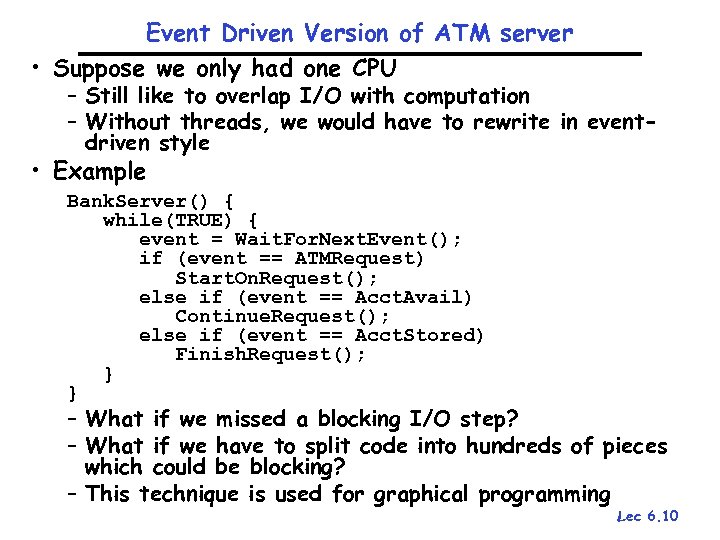 Event Driven Version of ATM server • Suppose we only had one CPU – Still like to overlap I/O with computation – Without threads, we would have to rewrite in eventdriven style • Example Bank. Server() { while(TRUE) { event = Wait. For. Next. Event(); if (event == ATMRequest) Start. On. Request(); else if (event == Acct. Avail) Continue. Request(); else if (event == Acct. Stored) Finish. Request(); } } – What if we missed a blocking I/O step? – What if we have to split code into hundreds of pieces which could be blocking? – This technique is used for graphical programming Lec 6. 10
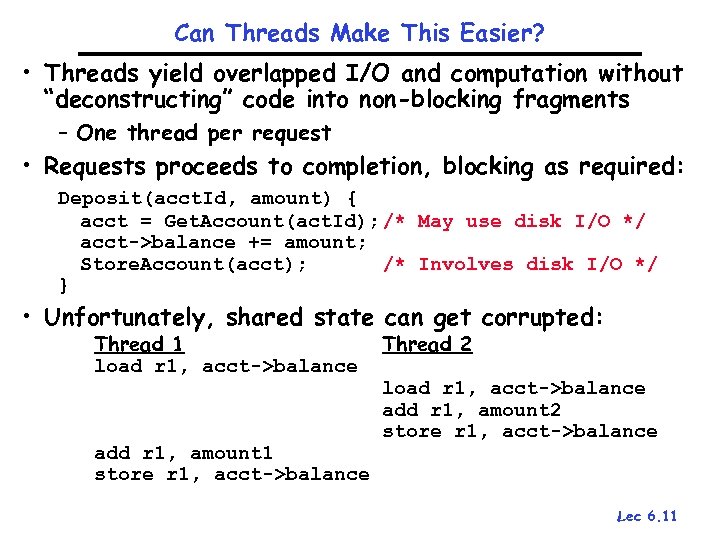 Can Threads Make This Easier? • Threads yield overlapped I/O and computation without “deconstructing” code into non-blocking fragments – One thread per request • Requests proceeds to completion, blocking as required: Deposit(acct. Id, amount) { acct = Get. Account(act. Id); /* May use disk I/O */ acct->balance += amount; Store. Account(acct); /* Involves disk I/O */ } • Unfortunately, shared state can get corrupted: Thread 1 load r 1, acct->balance add r 1, amount 1 store r 1, acct->balance Thread 2 load r 1, acct->balance add r 1, amount 2 store r 1, acct->balance Lec 6. 11
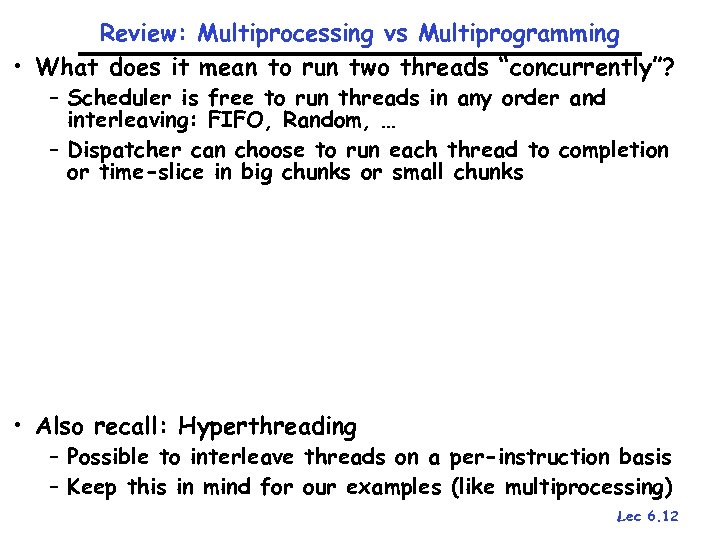 Review: Multiprocessing vs Multiprogramming • What does it mean to run two threads “concurrently”? – Scheduler is free to run threads in any order and interleaving: FIFO, Random, … – Dispatcher can choose to run each thread to completion or time-slice in big chunks or small chunks • Also recall: Hyperthreading – Possible to interleave threads on a per-instruction basis – Keep this in mind for our examples (like multiprocessing) Lec 6. 12
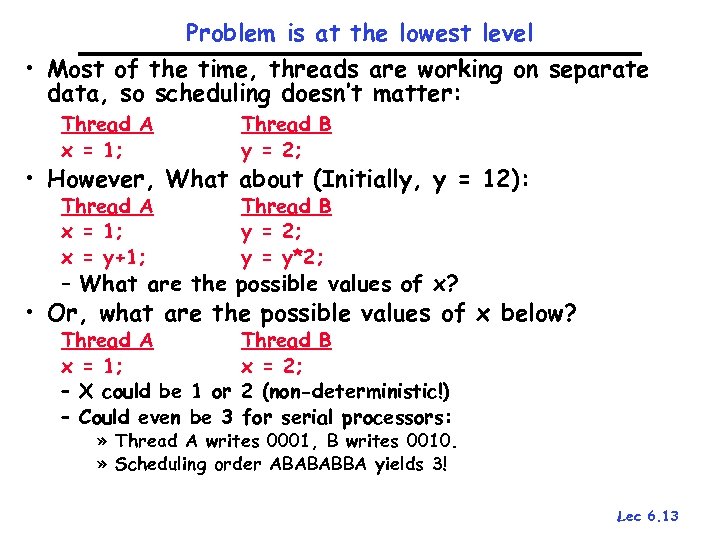 Problem is at the lowest level • Most of the time, threads are working on separate data, so scheduling doesn’t matter: Thread A x = 1; Thread B y = 2; Thread A x = 1; x = y+1; Thread B y = 2; y = y*2; • However, What about (Initially, y = 12): – What are the possible values of x? • Or, what are the possible values of x below? Thread A x = 1; – X could be 1 or – Could even be 3 Thread B x = 2; 2 (non-deterministic!) for serial processors: » Thread A writes 0001, B writes 0010. » Scheduling order ABABABBA yields 3! Lec 6. 13
 Atomic Operations • To understand a concurrent program, we need to know what the underlying indivisible operations are! • Atomic Operation: an operation that always runs to completion or not at all – It is indivisible: it cannot be stopped in the middle and state cannot be modified by someone else in the middle – Fundamental building block – if no atomic operations, then have no way for threads to work together • On most machines, memory references and assignments (i. e. loads and stores) of words are atomic • Many instructions are not atomic – Double-precision floating point store often not atomic – VAX and IBM 360 had an instruction to copy a whole array Lec 6. 14
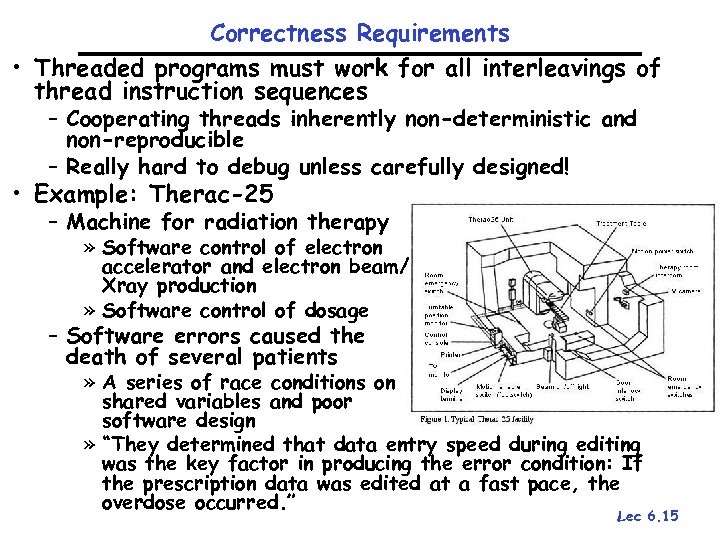 Correctness Requirements • Threaded programs must work for all interleavings of thread instruction sequences – Cooperating threads inherently non-deterministic and non-reproducible – Really hard to debug unless carefully designed! • Example: Therac-25 – Machine for radiation therapy » Software control of electron accelerator and electron beam/ Xray production » Software control of dosage – Software errors caused the death of several patients » A series of race conditions on shared variables and poor software design » “They determined that data entry speed during editing was the key factor in producing the error condition: If the prescription data was edited at a fast pace, the overdose occurred. ” Lec 6. 15
 Space Shuttle Example • Original Space Shuttle launch aborted 20 minutes before scheduled launch • Shuttle has five computers: – Four run the “Primary Avionics Software System” (PASS) » Asynchronous and real-time » Runs all of the control systems » Results synchronized and compared every 3 to 4 ms – The Fifth computer is the “Backup Flight System” (BFS) » stays synchronized in case it is needed » Written by completely different team than PASS • Countdown aborted because BFS disagreed with PASS – A 1/67 chance that PASS was out of sync one cycle – Bug due to modifications in initialization code of PASS » A delayed init request placed into timer queue » As a result, timer queue not empty at expected time to force use of hardware clock – Bug not found during extensive simulation Lec 6. 16
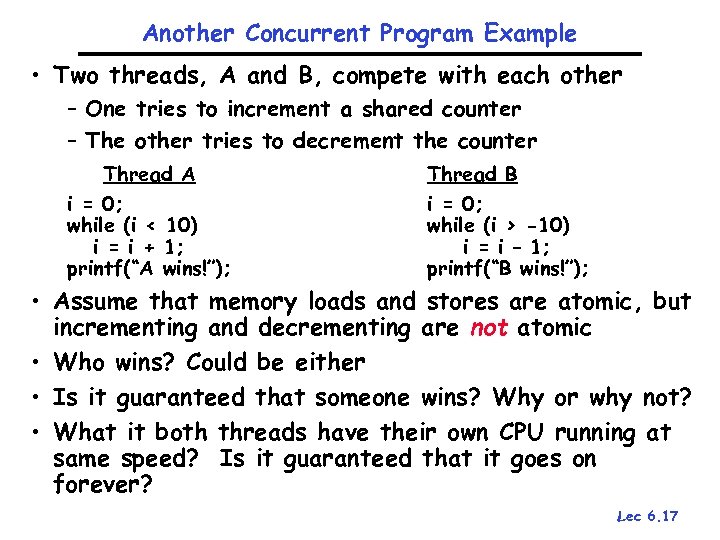 Another Concurrent Program Example • Two threads, A and B, compete with each other – One tries to increment a shared counter – The other tries to decrement the counter Thread A i = 0; while (i < 10) i = i + 1; printf(“A wins!”); Thread B i = 0; while (i > -10) i = i – 1; printf(“B wins!”); • Assume that memory loads and stores are atomic, but incrementing and decrementing are not atomic • Who wins? Could be either • Is it guaranteed that someone wins? Why or why not? • What it both threads have their own CPU running at same speed? Is it guaranteed that it goes on forever? Lec 6. 17
 Motivation: “Too much milk” • Great thing about OS’s – analogy between problems in OS and problems in real life – Help you understand real life problems better • Example: People need to coordinate: Lec 6. 18
 Definitions • Synchronization: using atomic operations to ensure cooperation between threads – For now, only loads and stores are atomic – We are going to show that its hard to build anything useful with only reads and writes • Mutual Exclusion: ensuring that only one thread does a particular thing at a time – One thread excludes the other while doing its task • Critical Section: piece of code that only one thread can execute at once. Only one thread at a time will get into this section of code. – Critical section is the result of mutual exclusion – Critical section and mutual exclusion are two ways of describing the same thing. Lec 6. 19
 More Definitions • Lock: prevents someone from doing something – Lock before entering critical section and before accessing shared data – Unlock when leaving, after accessing shared data – Wait if locked » Important idea: all synchronization involves waiting • For example: fix the milk problem by putting a key on the refrigerator – Lock it and take key if you are going to go buy milk – Fixes too much: roommate angry if only wants OJ – Of Course – We don’t know how to make a lock yet Lec 6. 20
 Too Much Milk: Correctness Properties • Need to be careful about correctness of concurrent programs, since non-deterministic – Always write down behavior first – Impulse is to start coding first, then when it doesn’t work, pull hair out – Instead, think first, then code • What are the correctness properties for the “Too much milk” problem? ? ? – Never more than one person buys – Someone buys if needed • Restrict ourselves to use only atomic load and store operations as building blocks Lec 6. 21
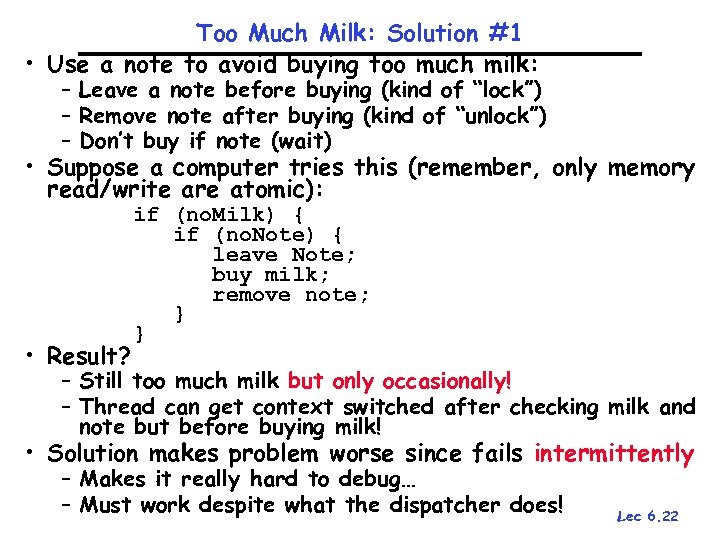 Too Much Milk: Solution #1 • Use a note to avoid buying too much milk: – Leave a note before buying (kind of “lock”) – Remove note after buying (kind of “unlock”) – Don’t buy if note (wait) • Suppose a computer tries this (remember, only memory read/write are atomic): • Result? if (no. Milk) { if (no. Note) { leave Note; buy milk; remove note; } } – Still too much milk but only occasionally! – Thread can get context switched after checking milk and note but before buying milk! • Solution makes problem worse since fails intermittently – Makes it really hard to debug… – Must work despite what the dispatcher does! Lec 6. 22
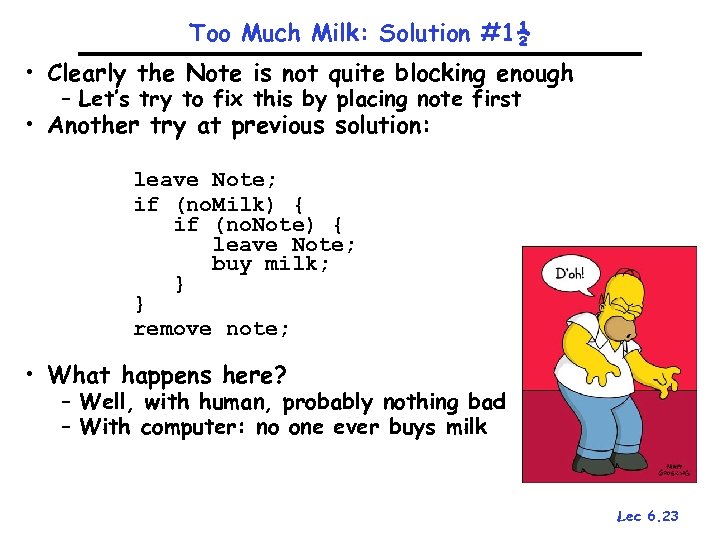 Too Much Milk: Solution #1½ • Clearly the Note is not quite blocking enough – Let’s try to fix this by placing note first • Another try at previous solution: leave Note; if (no. Milk) { if (no. Note) { leave Note; buy milk; } } remove note; • What happens here? – Well, with human, probably nothing bad – With computer: no one ever buys milk Lec 6. 23
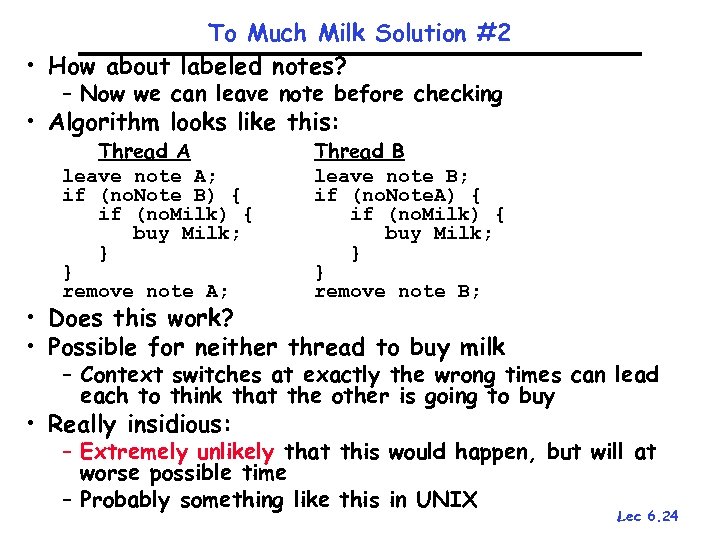 To Much Milk Solution #2 • How about labeled notes? – Now we can leave note before checking • Algorithm looks like this: Thread A leave note A; if (no. Note B) { if (no. Milk) { buy Milk; } } remove note A; Thread B leave note B; if (no. Note. A) { if (no. Milk) { buy Milk; } } remove note B; • Does this work? • Possible for neither thread to buy milk – Context switches at exactly the wrong times can lead each to think that the other is going to buy • Really insidious: – Extremely unlikely that this would happen, but will at worse possible time – Probably something like this in UNIX Lec 6. 24
 Too Much Milk Solution #2: problem! • I’m not getting milk, You’re getting milk • This kind of lockup is called “starvation!” Lec 6. 25
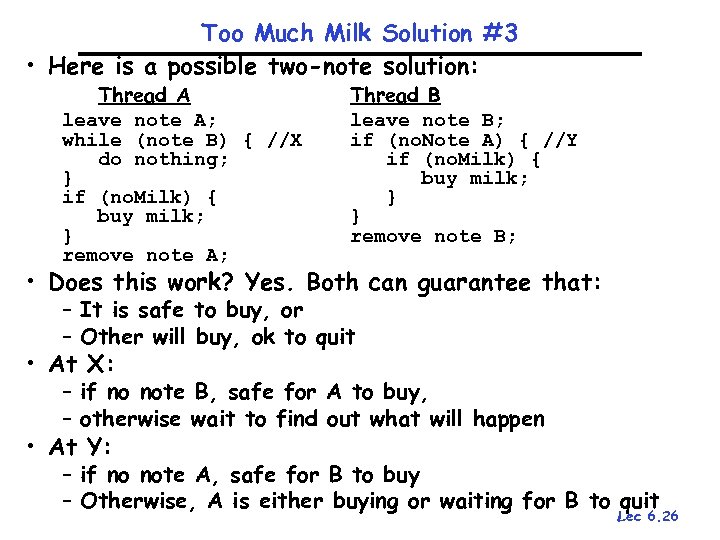 Too Much Milk Solution #3 • Here is a possible two-note solution: Thread A leave note A; while (note B) { //X do nothing; } if (no. Milk) { buy milk; } remove note A; Thread B leave note B; if (no. Note A) { //Y if (no. Milk) { buy milk; } } remove note B; • Does this work? Yes. Both can guarantee that: – It is safe to buy, or – Other will buy, ok to quit • At X: – if no note B, safe for A to buy, – otherwise wait to find out what will happen • At Y: – if no note A, safe for B to buy – Otherwise, A is either buying or waiting for B to quit Lec 6. 26
 Solution #3 discussion • Our solution protects a single “Critical-Section” piece of code for each thread: if (no. Milk) { buy milk; } • Solution #3 works, but it’s really unsatisfactory – Really complex – even for this simple an example » Hard to convince yourself that this really works – A’s code is different from B’s – what if lots of threads? » Code would have to be slightly different for each thread – While A is waiting, it is consuming CPU time » This is called “busy-waiting” • There’s a better way – Have hardware provide better (higher-level) primitives than atomic load and store – Build even higher-level programming abstractions on this new hardware support Lec 6. 27
 Too Much Milk: Solution #4 • Suppose we have some sort of implementation of a lock (more in a moment). – Lock. Acquire() – wait until lock is free, then grab – Lock. Release() – Unlock, waking up anyone waiting – These must be atomic operations – if two threads are waiting for the lock and both see it’s free, only one succeeds to grab the lock • Then, our milk problem is easy: milklock. Acquire(); if (nomilk) buy milk; milklock. Release(); • Once again, section of code between Acquire() and Release() called a “Critical Section” • Of course, you can make this even simpler: suppose you are out of ice cream instead of milk – Skip the test since you always need more ice cream. Lec 6. 28
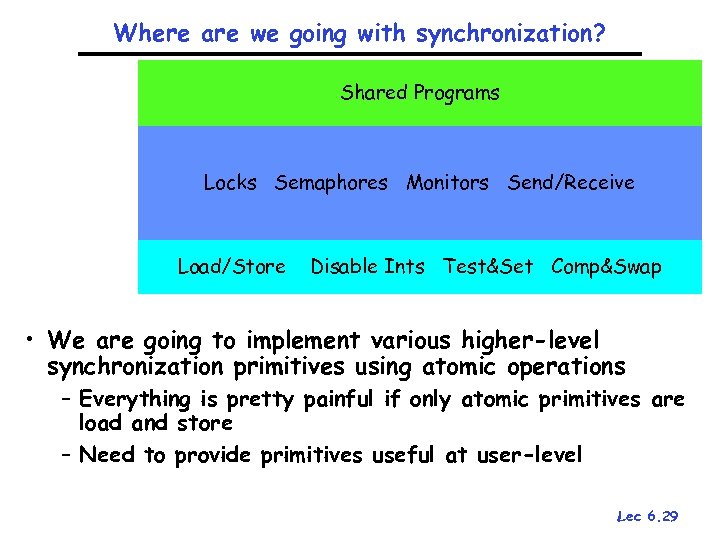 Where are we going with synchronization? Shared Programs Locks Semaphores Monitors Send/Receive Load/Store Disable Ints Test&Set Comp&Swap • We are going to implement various higher-level synchronization primitives using atomic operations – Everything is pretty painful if only atomic primitives are load and store – Need to provide primitives useful at user-level Lec 6. 29
 Summary • Concurrent threads are a very useful abstraction – Allow transparent overlapping of computation and I/O – Allow use of parallel processing when available • Concurrent threads introduce problems when accessing shared data – Programs must be insensitive to arbitrary interleavings – Without careful design, shared variables can become completely inconsistent • Important concept: Atomic Operations – An operation that runs to completion or not at all – These are the primitives on which to construct various synchronization primitives • Showed how to protect a critical section with only atomic load and store pretty complex! Lec 6. 30