


 Скачать презентацию CSA 4080 Adaptive Hypertext Systems II Topic 5
e483d0e9cacbda78dbf5063b578e55cd.ppt
- Количество слайдов: 52
 CSA 4080: Adaptive Hypertext Systems II Topic 5: Recommendation Techniques Dr. Christopher Staff Department of Computer Science & AI University of Malta CSA 4080: Topic 5 © 2004 - Chris Staff 1 of 52 cstaff@cs. um. edu. mt University of Malta
 Aims and Objectives • Global Reconnaissance Techniques – Power. Scout – Watson – Hyper. Context • Recommender Systems – Amazon – IMDB CSA 4080: Topic 5 © 2004 - Chris Staff 2 of 52 cstaff@cs. um. edu. mt University of Malta
 Aims and Objectives • User Modelling in IR • User Modelling in Recommender Systems CSA 4080: Topic 5 © 2004 - Chris Staff 3 of 52 cstaff@cs. um. edu. mt University of Malta
 Readings • recommender p 36 -soboroff. pdf • SOTA Recommender systems Lit Review. pdf (Chapter 8 - ) • recommender 0329_050103. pdf CSA 4080: Topic 5 © 2004 - Chris Staff 4 of 52 cstaff@cs. um. edu. mt University of Malta
 What is Recommendation? • Recommendations are suggestions • It could be a suggestion to watch a particular movie, or to buy a particular product, visit a restaurant (not fish!) • In hyperspace, this could be a suggestion to follow a path leading to a relevant document, or to visit a document directly CSA 4080: Topic 5 © 2004 - Chris Staff 5 of 52 cstaff@cs. um. edu. mt University of Malta
 What is Recommendation? • If the recommendation is to do with guidance, then this is related to adaptive navigation • If the recommendation is based mainly on recommending products, then it is a recommender system • The two are, or can be, closely related, but the literature tends to deal with them separately CSA 4080: Topic 5 © 2004 - Chris Staff 6 of 52 cstaff@cs. um. edu. mt University of Malta
 Examples. . . • Global Reconnaissance, Guidance, Personal Information Management Assistants. . . • As you browse a user model of your interests is automatically built • Paths are recommended, or other documents are collected for your perusal • Usually use IR systems to index, search for, and retrieve relevant documents CSA 4080: Topic 5 © 2004 - Chris Staff 7 of 52 cstaff@cs. um. edu. mt University of Malta
 Global Reconnaissance • Power. Scout (Lieberman, 2001) – Automatically builds user model from recently viewed pages, but based on user’s long-term interaction – Searches for relevant documents via 3 rd party search engine – Organises results by “Concept” Why-Surf-Alone. pdf CSA 4080: Topic 5 © 2004 - Chris Staff 8 of 52 cstaff@cs. um. edu. mt University of Malta
 Global Reconnaissance • Watson (Budzik et al, 1998) – Observes user interacting with several application to build model of user’s information goal – Anticipates that user is interested in documents similar to ones seen in recent past – Searches for documents (via 3 rd party search engine) and presents list to user – Short-term user model, with long-term support budzik 99 watson. pdf CSA 4080: Topic 5 © 2004 - Chris Staff 9 of 52 cstaff@cs. um. edu. mt University of Malta
 Global Reconnaissance • Hyper. Context (Staff, 2000) – Uses Adaptive Information Discovery (AID) techniques to find remote but relevant information – Short-term UM, with long-term UM support HCTCh 5. pdf CSA 4080: Topic 5 © 2004 - Chris Staff 10 of 52 cstaff@cs. um. edu. mt University of Malta
 More examples. . . • Recommender systems – Content recommendation – Collaborative recommendation CSA 4080: Topic 5 © 2004 - Chris Staff 11 of 52 cstaff@cs. um. edu. mt University of Malta
 Recommender Systems • “What did you think about. . . ? ” “Did you like. . . ? ” • Make recommendation based on past experience • Real world examples: food critic, movie critic, book/novel critic, lecture course critic : -) CSA 4080: Topic 5 © 2004 - Chris Staff 12 of 52 cstaff@cs. um. edu. mt University of Malta
 Recommender Systems • How do you know you can trust somebody’s recommendation? – Because experience has taught you? – Because critic is trusted source of info? – Because a friend/expert likes movies/novels/ food you like? – ? ? ? CSA 4080: Topic 5 © 2004 - Chris Staff 13 of 52 cstaff@cs. um. edu. mt University of Malta
 Recommender Systems • Generally two types of recommender system: – Content-based recommendation – Collaborative recommendation • burke-umuai 02. pdf • recommender 0329_050103. pdf CSA 4080: Topic 5 © 2004 - Chris Staff 14 of 52 cstaff@cs. um. edu. mt University of Malta
 Recommender Systems Collaborative Recommendation • Usually, ratings-based feedback • Users must indicate degree to which they like product, product is fit for purpose, etc • The recommendation is based on the weighted average utility of the product. . . • . . . of users with the same preferences! – preferences may also include demographics CSA 4080: Topic 5 © 2004 - Chris Staff 15 of 52 cstaff@cs. um. edu. mt University of Malta
 Recommender Systems Collaborative Recommendation • Do you want recommendations based on all users? • Or do you want recommendations from other people like you, with your tastes and preferences? • How can the system work out what you like/prefer/want? – Comparing interactions (purchases, queries, movies seen, etc. ) and identifying trends CSA 4080: Topic 5 © 2004 - Chris Staff 16 of 52 cstaff@cs. um. edu. mt University of Malta
 Recommender Systems Cold-Start Problem • Collaborative recommender systems suffer from the cold start problem • How do you recommend a new product with no ratings? • How do you recommend to a new user? • Content-based recommendation overcomes some problems CSA 4080: Topic 5 © 2004 - Chris Staff 17 of 52 cstaff@cs. um. edu. mt University of Malta
 Recommender Systems Content-based • Instead of using ratings, use product features • Identify features using eg. , kdd 96_quest. pdf – On what basis can products be compared? Genre, cost, dimensions, etc. • Recommendations can be based on userselected feature sets, or on prior interactions – Latter works for frequent recommendations of similar product (e. g. , movie) but not infrequent ones, e. g. , camera purchase CSA 4080: Topic 5 © 2004 - Chris Staff 18 of 52 cstaff@cs. um. edu. mt University of Malta
 Recommender Systems Cold-Start Problem Revisited • If user categorisation is automatic (i. e. , System believes user U belongs to group G based on past interactions) then cold-start problem for new users • New products are ok, though, because they will be recommended based on feature similarity • If user drives feature selection, then is system user-adaptive? CSA 4080: Topic 5 © 2004 - Chris Staff 19 of 52 cstaff@cs. um. edu. mt University of Malta
 Recommender Systems • Both collaborative and content-based recommendation utilise clustering techniques to identify patterns in users and/or products/items • Most common technique is the Vector Space Model (Topic 6) • Other IR techniques also used CSA 4080: Topic 5 © 2004 - Chris Staff 20 of 52 cstaff@cs. um. edu. mt University of Malta
 User Modelling in IR and Recommender Systems • User model is usually created and maintained for information retrieval and recommender systems CSA 4080: Topic 5 © 2004 - Chris Staff 21 of 52 cstaff@cs. um. edu. mt University of Malta
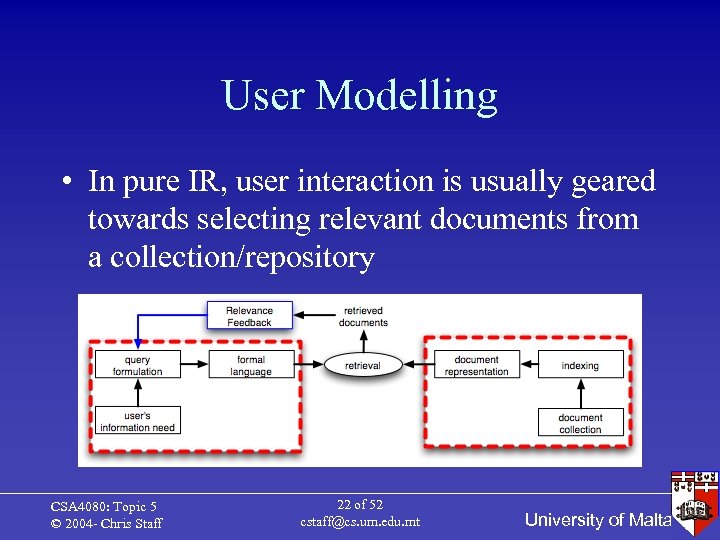 User Modelling • In pure IR, user interaction is usually geared towards selecting relevant documents from a collection/repository CSA 4080: Topic 5 © 2004 - Chris Staff 22 of 52 cstaff@cs. um. edu. mt University of Malta
 User Modelling • Is there a user model, even a simple one, in this model of IR? • If there is, is there a point at which adaptation might be said to take place? • More next topic. . . CSA 4080: Topic 5 © 2004 - Chris Staff 23 of 52 cstaff@cs. um. edu. mt University of Malta
 User Modelling in IR • This part based heavily on www. scils. rutgers. edu/~belkin/um 97 oh/ CSA 4080: Topic 5 © 2004 - Chris Staff 24 of 52 cstaff@cs. um. edu. mt University of Malta
 User Modelling in IR • In early IR (before automation!) human mediators (e. g. , librarians) construct queries on behalf of users – See also, evaluation of boolean model (p 289 blair. pdf) – Search intermediaries still used in some Webbased question-answering systems, e. g. , Ask. Jeeves CSA 4080: Topic 5 © 2004 - Chris Staff 25 of 52 cstaff@cs. um. edu. mt University of Malta
 User Modelling in IR • As query specification languages became complex (1950 s/60 s) intermediaries needed to construct queries • It became useful in systems like SDI to store representations of users’ long-term interests so that new information objects could be routed to them CSA 4080: Topic 5 © 2004 - Chris Staff 26 of 52 cstaff@cs. um. edu. mt University of Malta
 User Modelling in IR • Initially, user profiles were changed manually on basis of user’s evaluation of search results • Eventually, SDI could automatically modify profiles based on relevance judgements • This line of IR developed into information filtering (routing) CSA 4080: Topic 5 © 2004 - Chris Staff 27 of 52 cstaff@cs. um. edu. mt University of Malta
 User Modelling in IR • Ad hoc IR assumes that information need is just one-time – there is just one information seeking episode – a single query is compared to a static document collection • If there is a subsequent query that is submitted by the same user and that is related to a prior query, it is treated as a new episode CSA 4080: Topic 5 © 2004 - Chris Staff 28 of 52 cstaff@cs. um. edu. mt University of Malta
 User Modelling in IR • In ad hoc IR user may need support to: – Reformulate the query to get better results – Provide relevance feedback so that system can modify the query (Rocchio, 1966) • In “queryless” IR (Oddy, 1977) the user need not specify the information need: – user evaluates/rates features of retrieved info – system builds model of user’s interests CSA 4080: Topic 5 © 2004 - Chris Staff 29 of 52 cstaff@cs. um. edu. mt University of Malta
 User Modelling in IR • ASK-based IR (Belkin et al, 1982) – elicits and represents user’s Anomalous State of Knowledge rather than specific info need – Associative network represents ASK – Uses rules to compare ASK with document representations – User ratings of features can auto update ASK CSA 4080: Topic 5 © 2004 - Chris Staff 30 of 52 cstaff@cs. um. edu. mt University of Malta
 User Modelling in IR • Modelling user goals (Vickery, Vickery & Brooks, 1980 s) – to determine the comparison techniques to apply for different users – users direct elicitation + implication from user behaviour – long term modelling of user preferences and “typical” info problems CSA 4080: Topic 5 © 2004 - Chris Staff 31 of 52 cstaff@cs. um. edu. mt University of Malta
 User Modelling in IR • Models for identifying UM functions in IR – Abstract analysis of IR task. To identify: • goals of IR • problems in achieving goals • what’s necessary for other actors in the system to know of user to achieve goals/overcome problems Þquery as specification as modelling function CSA 4080: Topic 5 © 2004 - Chris Staff 32 of 52 cstaff@cs. um. edu. mt University of Malta
 User Modelling in IR – IR interaction as dialogue • what is needed to experience effective conversation (e. g. , Grice’s rules of conversational implicature) • how can these be modelling in an IR interaction? Þmodels of understanding that each actor has of the other (“I believe that you believe. . . ”, and see Kobsa’s BGP-MS) CSA 4080: Topic 5 © 2004 - Chris Staff 33 of 52 cstaff@cs. um. edu. mt University of Malta
 User Modelling in IR – Observing user behaviour in IR systems settings • cognitive task analysis • failure analysis • thinking aloud, etc. ÞStereotypical models of experience, expertise, search behaviours, “needs” CSA 4080: Topic 5 © 2004 - Chris Staff 34 of 52 cstaff@cs. um. edu. mt University of Malta
 User Modelling in IR • Overall goal (not Belkin’s words!) – Intelligent agents that can understand user needs/goals/tasks by observing user behaviour and that can find, retrieve, or even accomplish, what the user had set out to do, without the user necessarily expressing his or her intentions CSA 4080: Topic 5 © 2004 - Chris Staff 35 of 52 cstaff@cs. um. edu. mt University of Malta
 User Modelling in Recommender Systems • Recommender systems – Content-based (very similar to IR) – Collaborative • Aim is to make recommendations based on what other, similar, users liked or did recommender 0329_050103. pdf CSA 4080: Topic 5 © 2004 - Chris Staff 36 of 52 cstaff@cs. um. edu. mt University of Malta
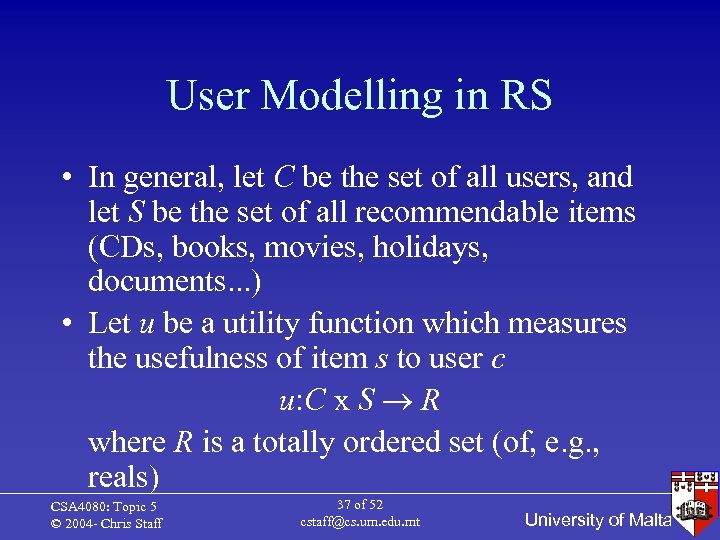 User Modelling in RS • In general, let C be the set of all users, and let S be the set of all recommendable items (CDs, books, movies, holidays, documents. . . ) • Let u be a utility function which measures the usefulness of item s to user c u: C x S R where R is a totally ordered set (of, e. g. , reals) CSA 4080: Topic 5 © 2004 - Chris Staff 37 of 52 cstaff@cs. um. edu. mt University of Malta
 User Modelling in RS • In RS, utility of an item to a user is usually represented as a rating, how much a particular user liked the item, but it can be any function • On what basis do we decide that two users are similar? CSA 4080: Topic 5 © 2004 - Chris Staff 38 of 52 cstaff@cs. um. edu. mt University of Malta
 User Modelling in RS • What information is retained about users? – Demographic information – Interaction history – Ratings given to items CSA 4080: Topic 5 © 2004 - Chris Staff 39 of 52 cstaff@cs. um. edu. mt University of Malta
 User Modelling in RS • Two main types of algorithm – Memory-based – Model-based CSA 4080: Topic 5 © 2004 - Chris Staff 40 of 52 cstaff@cs. um. edu. mt University of Malta
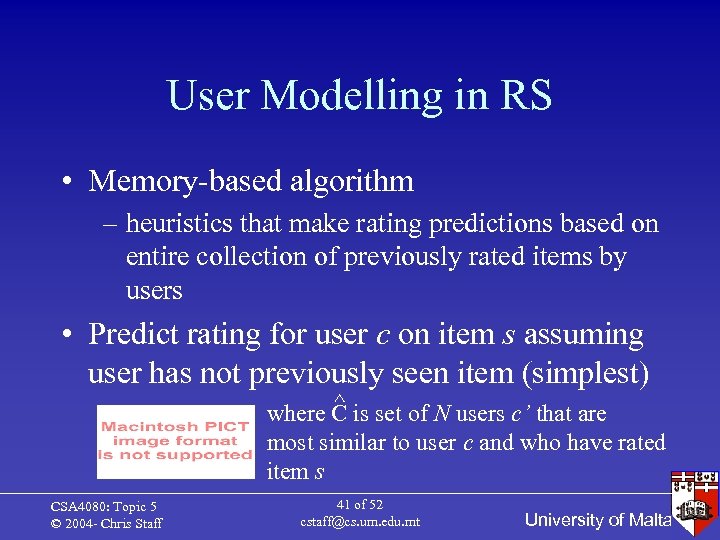 User Modelling in RS • Memory-based algorithm – heuristics that make rating predictions based on entire collection of previously rated items by users • Predict rating for user c on item s assuming user has not previously seen item (simplest) ^ where C is set of N users c’ that are most similar to user c and who have rated item s CSA 4080: Topic 5 © 2004 - Chris Staff 41 of 52 cstaff@cs. um. edu. mt University of Malta
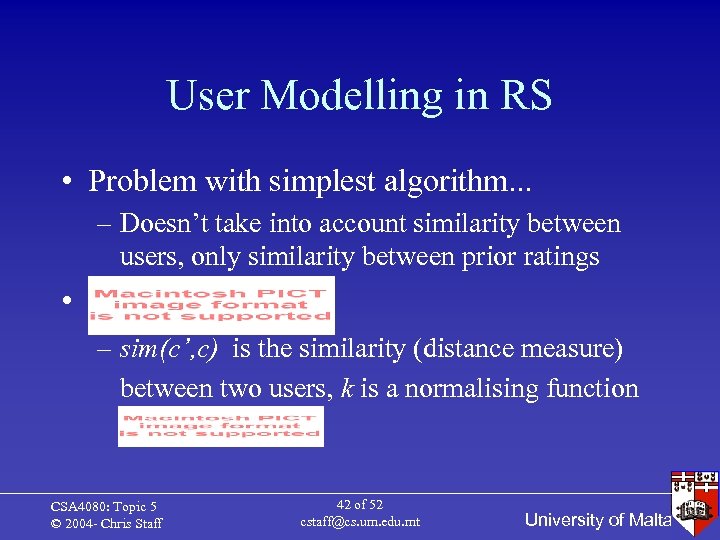 User Modelling in RS • Problem with simplest algorithm. . . – Doesn’t take into account similarity between users, only similarity between prior ratings • – sim(c’, c) is the similarity (distance measure) between two users, k is a normalising function CSA 4080: Topic 5 © 2004 - Chris Staff 42 of 52 cstaff@cs. um. edu. mt University of Malta
 User Modelling in RS • Many ways of deriving user similarity measure • Normally based on the set of items, Sxy, that both users, x and y, have rated • Two popular approaches – Cosine-based – Correlation-based CSA 4080: Topic 5 © 2004 - Chris Staff 43 of 52 cstaff@cs. um. edu. mt University of Malta
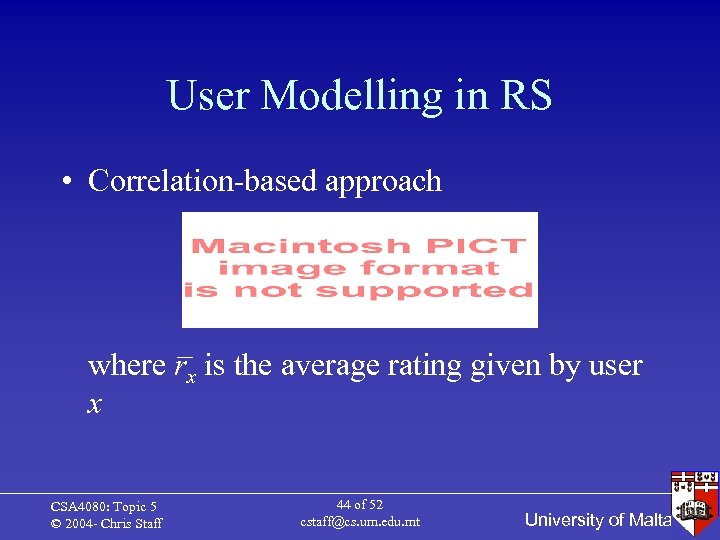 User Modelling in RS • Correlation-based approach _ where rx is the average rating given by user x CSA 4080: Topic 5 © 2004 - Chris Staff 44 of 52 cstaff@cs. um. edu. mt University of Malta
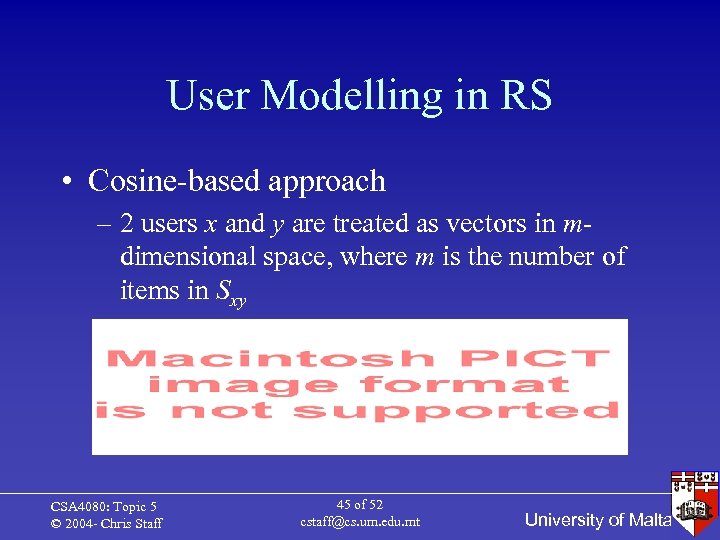 User Modelling in RS • Cosine-based approach – 2 users x and y are treated as vectors in mdimensional space, where m is the number of items in Sxy CSA 4080: Topic 5 © 2004 - Chris Staff 45 of 52 cstaff@cs. um. edu. mt University of Malta
 User Modelling in RS • Memory-based approaches need many ratings to work well • Default voting improves rating prediction accuracy CSA 4080: Topic 5 © 2004 - Chris Staff 46 of 52 cstaff@cs. um. edu. mt University of Malta
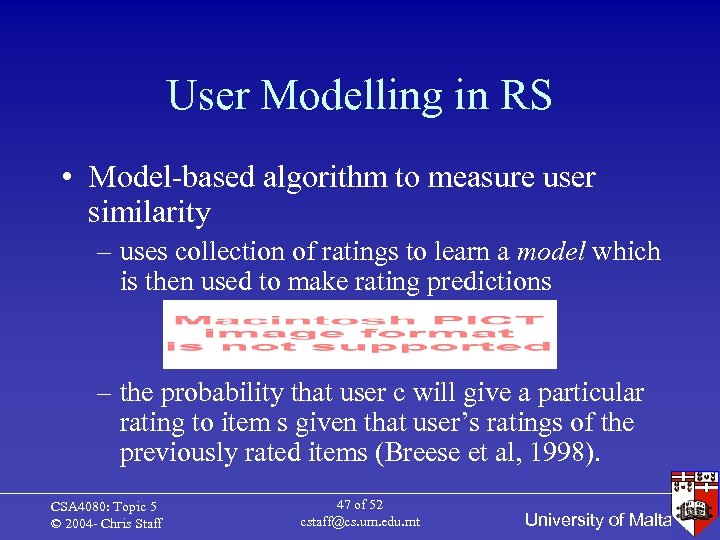 User Modelling in RS • Model-based algorithm to measure user similarity – uses collection of ratings to learn a model which is then used to make rating predictions – the probability that user c will give a particular rating to item s given that user’s ratings of the previously rated items (Breese et al, 1998). CSA 4080: Topic 5 © 2004 - Chris Staff 47 of 52 cstaff@cs. um. edu. mt University of Malta
 User Modelling in RS • Breese et al proposed two alternative probabilistic models to estimate the probability expression – Cluster model (Naive baysian) • Users are clustered into groups – Baysian networks • Each item is a node in the network, with states of each node represent possible rating values • Network and conditional probabilities are learned from data CSA 4080: Topic 5 © 2004 - Chris Staff 48 of 52 cstaff@cs. um. edu. mt University of Malta
 Collaborative System Shortcomings • New user problem • New item problem • Sparsity – Can initially be resolved using demographic data CSA 4080: Topic 5 © 2004 - Chris Staff 49 of 52 cstaff@cs. um. edu. mt University of Malta
 Conclusion • IR has users with both long- and short-term interests • RS has users with mainly long-term interests, although recommendations may be made to users with short-term interests – In which case, the method of interaction is usually different, and recommendations are based on content CSA 4080: Topic 5 © 2004 - Chris Staff 50 of 52 cstaff@cs. um. edu. mt University of Malta
 Conclusion • In IR, an explicit user model is maintained for long-term support, but a query is a reasonable ad hoc model of the user’s interest • In RS, users need to be distinguished in the collaborative model, but not in the content model CSA 4080: Topic 5 © 2004 - Chris Staff 51 of 52 cstaff@cs. um. edu. mt University of Malta
 Conclusion • In the next topic we will look at IR models and techniques – Vector-based model – Probabilistic model – Relevance Feedback – Query Reformulation • We will also look at knowledge and domain representation CSA 4080: Topic 5 © 2004 - Chris Staff 52 of 52 cstaff@cs. um. edu. mt University of Malta