 Скачать презентацию CS ECE 438 CSE 425 Communication Networks Nikita Borisov
a4ca487e116962bb16890792ef9e2611.ppt
- Количество слайдов: 49



CS/ECE 438, CSE 425 Communication Networks Nikita Borisov ECE Department, UIUC 8/25/06 UIUC - CS/ECE 438, Fall 2006
Course Information n Instructor n ¡ Monika Battala, battala 2@uiuc. edu Office hours TBA http: //www. cs. uiuc. edu/class/fa 06/cs 438 Newsgroup ¡ 8/25/06 10 -12 Tuesdays or by appointment Webpage ¡ n Office Hours: TA ¡ n Prof. Nikita Borisov 460 CSL, 244 -5385 nikita@uiuc. edu ¡ class. cs 438 on news. cs. uiuc. edu UIUC - CS/ECE 438, Fall 2006 2
Acknowledgments n n n 8/25/06 Slides are adapted from Prof. Kravets Some material contributed by Profs. Luo, Lumetta, Hajek, Vaidya Some material from Larry Peterson & James Kurose & Keith Ross UIUC - CS/ECE 438, Fall 2006 3
Prerequisites n C Programming (CS 241) ¡ n 8/25/06 Pre-req for ECE students is ECE 290, but ECE 391/398 SSL or C experience highly recommended Probability and Statistics (MATH 461, 463 or ECE 413) UIUC - CS/ECE 438, Fall 2006 4
Textbook n n Computer Networks: A Top-Down Approach Featuring the Internet, by Kurose & Ross, 3 rd Edition We will be covering this text out of order ¡ ¡ ¡ 8/25/06 Ch 1 Ch 5 + some of 6 Ch 4 Ch 3 Some of Ch 2 UIUC - CS/ECE 438, Fall 2006 5
Recommended Text n n UNIX Network Programming, Volume 1, by Stevens There are 3 editions ¡ ¡ 8/25/06 Second & third edition more up-to-date First edition (1990) contains more background on general UNIX programming UIUC - CS/ECE 438, Fall 2006 6
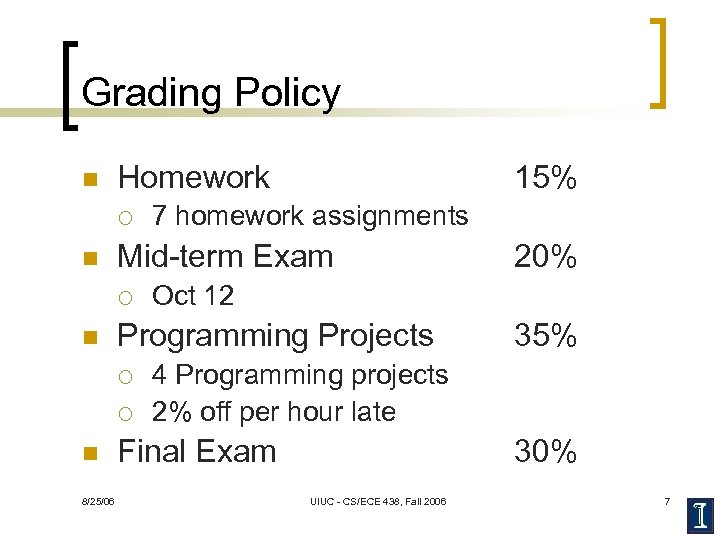
Grading Policy n Homework ¡ n ¡ 8/25/06 20% Oct 12 Programming Projects ¡ n 7 homework assignments Mid-term Exam ¡ n 15% 35% 4 Programming projects 2% off per hour late Final Exam 30% UIUC - CS/ECE 438, Fall 2006 7

Homework and Projects n Homeworks: ¡ ¡ ¡ n Projects: ¡ ¡ 8/25/06 Due Wednesdays at 2: 00 in class. General extension to Thursdays at 2: 00 pm (hard deadline). No questions to TA or on newsgroup after class on Tuesday. Project 1: 5%, Projects 2 - 4: 10% Due Fridays at 9: 00 pm. UIUC - CS/ECE 438, Fall 2006 8
Academic Honesty n n Your work in this class must be your own. Penalties for excessive collaboration and cheating are severe Sharing strategies and small code fragments (5 -10 lines) OK Sharing homework answers and large sections of code forbidden ¡ n 8/25/06 Don’t post these to newsgroup! If in doubt, ask the professor UIUC - CS/ECE 438, Fall 2006 9
One Unit Students n Graduate students MAY take an extra unit project in conjunction with this class ¡ Graduate students n n ¡ 8/25/06 Register for 4 credits Write a survey paper in a networking research area of your choice. Project proposal with list of 10+ academic references (no URL’s) due September 22 Paper due last day of class Undergraduates may not take this project course UIUC - CS/ECE 438, Fall 2006 10
Course Objectives n At the end of the semester, you should be able to: ¡ ¡ 8/25/06 Identify the problems that arise in networked communication Explain the advantages and disadvantages of existing solutions to these problems in the context of different networking regimes Understand the implications of a given solution for performance in various networking regimes Evaluate novel approaches to these problems UIUC - CS/ECE 438, Fall 2006 11
Programming Objectives n At the end of the semester, you should be able to ¡ ¡ ¡ 8/25/06 Identify and describe the purpose of each component of the TCP/IP protocol suite Develop solid client-server applications using TCP/IP Understand the impact of trends in network hardware on network software issues UIUC - CS/ECE 438, Fall 2006 12
Course Contents n n n n n 8/25/06 Overview UNIX Network Programming Direct Link Networks Multiple Access Packet Switched Networks Internetworking Reliable Transport Congestion Control, Qo. S & Fair Sharing Performance Analysis and Queueing Theory UIUC - CS/ECE 438, Fall 2006 13
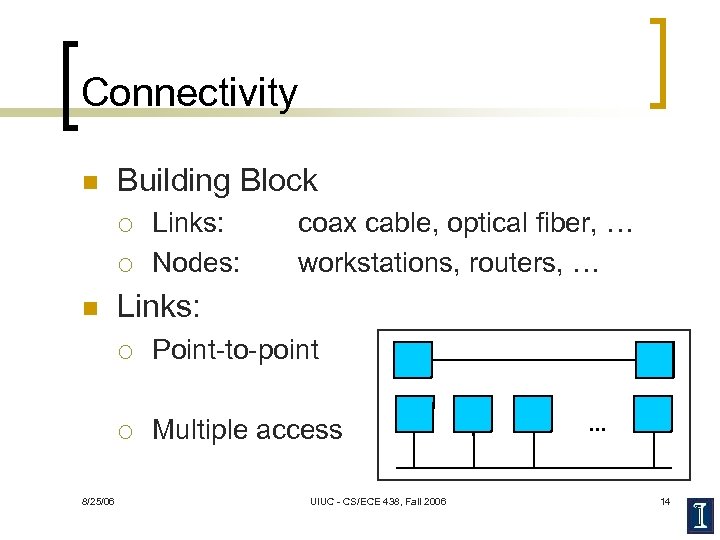
Connectivity n Building Block ¡ ¡ n Links: Nodes: coax cable, optical fiber, … workstations, routers, … Links: ¡ ¡ 8/25/06 Point-to-point Multiple access UIUC - CS/ECE 438, Fall 2006 … 14
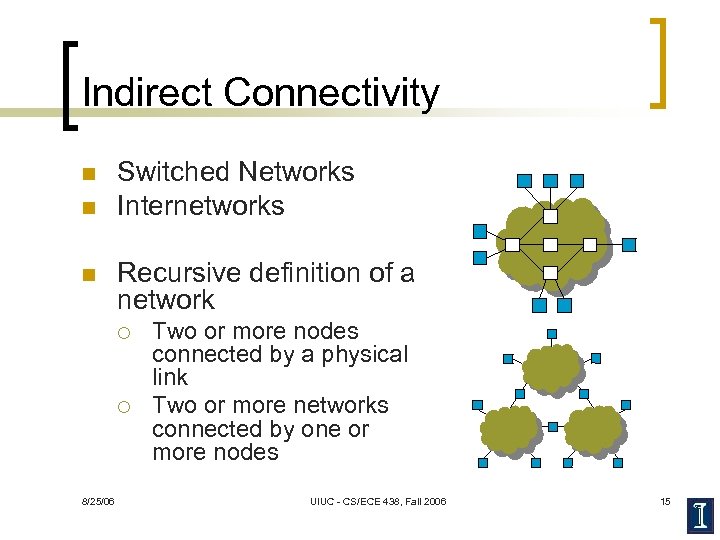
Indirect Connectivity n n n Switched Networks Internetworks Recursive definition of a network ¡ ¡ 8/25/06 Two or more nodes connected by a physical link Two or more networks connected by one or more nodes UIUC - CS/ECE 438, Fall 2006 15
Network Problems n What must a network provide? ¡ ¡ 8/25/06 Connectivity Cost-effective Resource Sharing Functionality Performance UIUC - CS/ECE 438, Fall 2006 16
Addressing n Addressing ¡ n Routing ¡ n The process of determining how to forward messages toward the destination node based on its address Types of Addresses ¡ ¡ ¡ 8/25/06 Unique byte-string used to indicate which node is the target of communication Unicast: Broadcast: Multicast: node-specific all nodes on the network subset of nodes on the network UIUC - CS/ECE 438, Fall 2006 17
Effects of Indirect Connectivity n Nodes receive data on one link and forward it onto the next -> switching network ¡ Circuit Switching n n ¡ Telephone Stream-based (dedicated circuit) Links reserved for use by communication channel Send/receive bit stream at constant rate Packet Switching Internet n Message-based (store-and-forward) n Links used dynamically n Admission policies and other traffic determine bandwidth n 8/25/06 UIUC - CS/ECE 438, Fall 2006 18
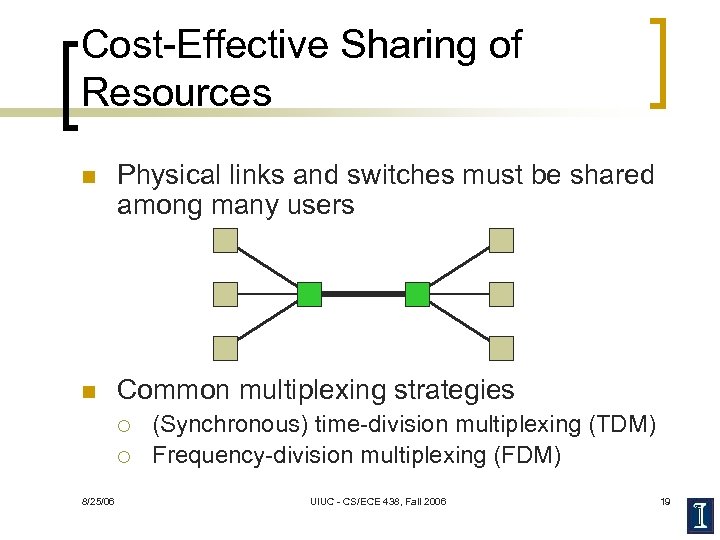
Cost-Effective Sharing of Resources n Physical links and switches must be shared among many users n Common multiplexing strategies ¡ ¡ 8/25/06 (Synchronous) time-division multiplexing (TDM) Frequency-division multiplexing (FDM) UIUC - CS/ECE 438, Fall 2006 19
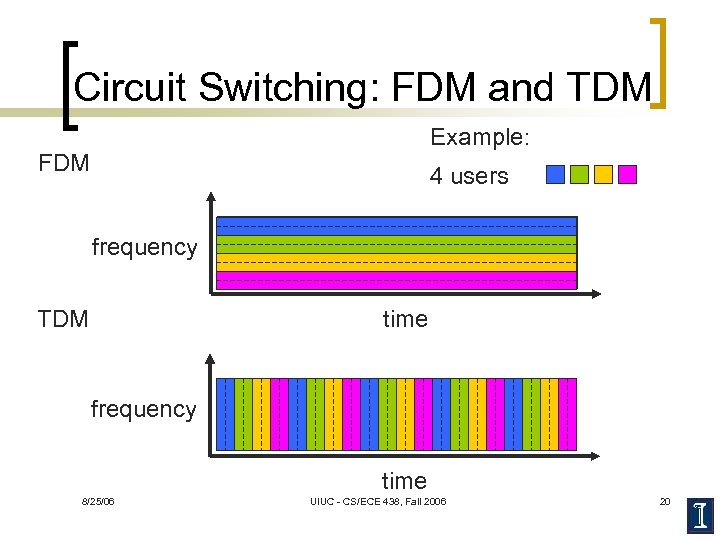
Circuit Switching: FDM and TDM Example: FDM 4 users frequency TDM time frequency time 8/25/06 UIUC - CS/ECE 438, Fall 2006 20
Statistical Multiplexing n Statistical Multiplexing (SM) ¡ ¡ On-demand time-division multiplexing Scheduled on a per-packet basis Packets from different sources are interleaved Uses upper bounds to limit transmission n 8/25/06 Queue size determines capacity per source UIUC - CS/ECE 438, Fall 2006 21
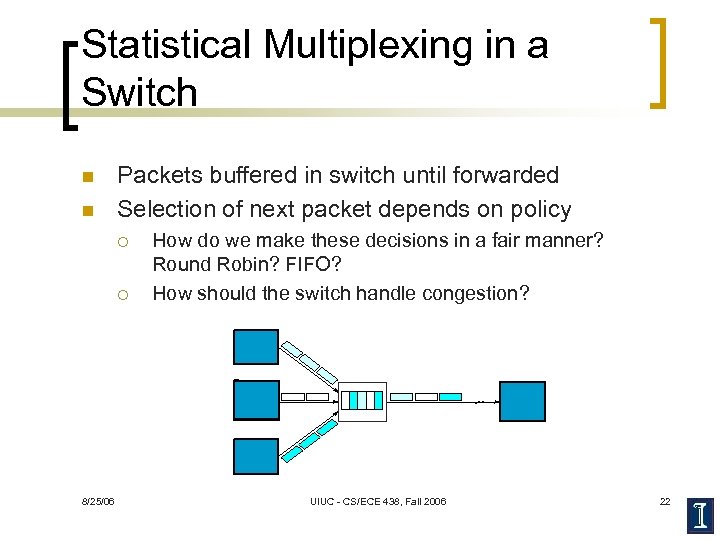
Statistical Multiplexing in a Switch n n Packets buffered in switch until forwarded Selection of next packet depends on policy ¡ ¡ How do we make these decisions in a fair manner? Round Robin? FIFO? How should the switch handle congestion? … 8/25/06 UIUC - CS/ECE 438, Fall 2006 22
Functionality n Support For Common Services ¡ Goal n ¡ Idea n n ¡ Common services simplify the role of applications Hide the complexity of the network without overly constraining the application designer Semantics and interface depend on applications n n 8/25/06 Meaningful communication between hosts on a network Request/reply: FTP, HTTP, DNS Message stream: video-on-demand, video conferencing UIUC - CS/ECE 438, Fall 2006 23
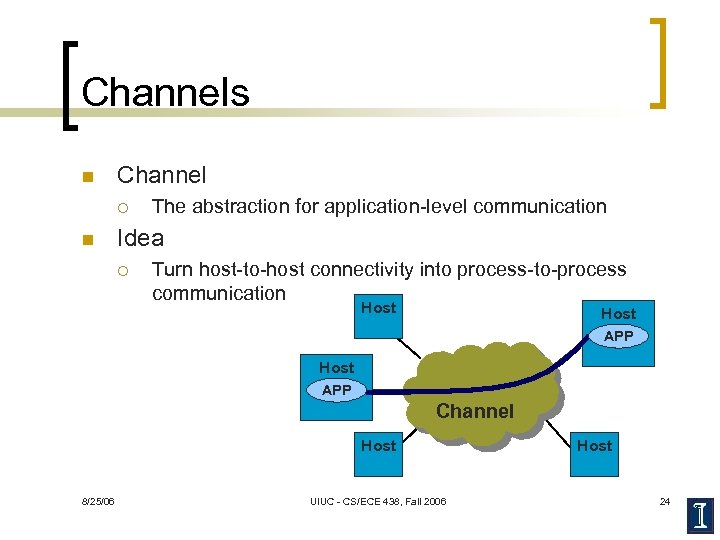
Channels n Channel ¡ n The abstraction for application-level communication Idea ¡ Turn host-to-host connectivity into process-to-process communication Host APP Host Channe l. Channel APP Host 8/25/06 UIUC - CS/ECE 438, Fall 2006 Host 24
Channel Implementation n Question ¡ Where does the functionality belong? n Middle (switches)? ¡ n Edges (end hosts)? ¡ 8/25/06 Telephone system Internet UIUC - CS/ECE 438, Fall 2006 25
Inter-process Communication n Problems typically masked by communication channel abstractions ¡ ¡ ¡ n Goal ¡ 8/25/06 Bit errors (electrical interference) Packet errors (congestion) Link/node failures Message delays Out-of-order delivery Eavesdropping Fill the gap between what applications expect and what the underlying technology provides UIUC - CS/ECE 438, Fall 2006 26
Performance. . . and to do so while delivering “good” performance. n Bandwidth/throughput ¡ ¡ Data transmitted per unit time Example: 10 Mbps Link bandwidth vs. end-to-end bandwidth Notation n n 8/25/06 KB = 210 bytes Mbps = 106 bits per second UIUC - CS/ECE 438, Fall 2006 27
Performance n Latency/delay ¡ ¡ Time from A to B Example: 30 msec (milliseconds) Many applications depend on round-trip time (RTT) Components n n 8/25/06 Transmission time Propagation delay over links Queueing delays Software processing overheads UIUC - CS/ECE 438, Fall 2006 28
Performance Notes n Speed of Light ¡ ¡ ¡ n Comments ¡ ¡ ¡ n No queueing delays in a direct link Bandwidth is not relevant if size = 1 bit Software overhead can dominate when distance is small Key Point ¡ ¡ 8/25/06 3. 0 x 108 meters/second in a vacuum 2. 3 x 10⁸ meters/second in a cable 2. 0 x 108 meters/second in a fiber Latency dominates small transmissions Bandwidth dominates large UIUC - CS/ECE 438, Fall 2006 29
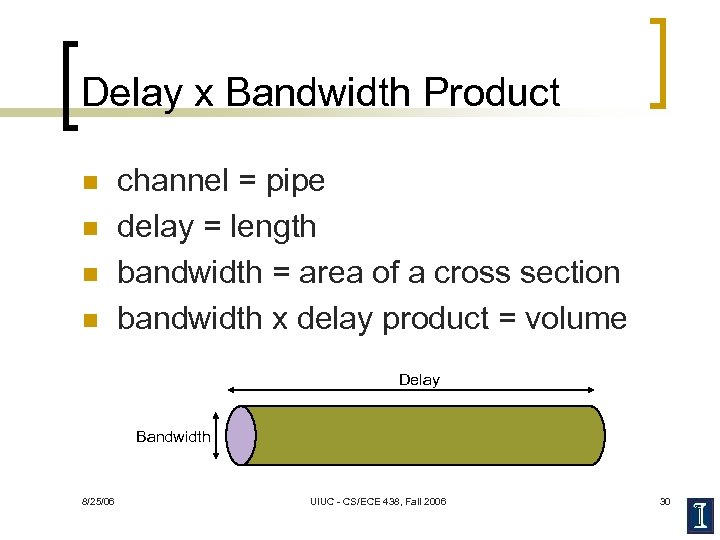
Delay x Bandwidth Product n n channel = pipe delay = length bandwidth = area of a cross section bandwidth x delay product = volume Delay Bandwidth 8/25/06 UIUC - CS/ECE 438, Fall 2006 30
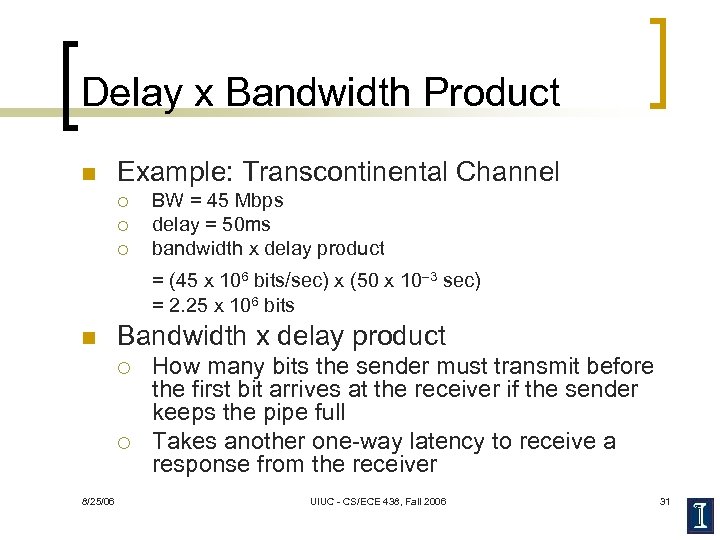
Delay x Bandwidth Product n Example: Transcontinental Channel ¡ ¡ ¡ BW = 45 Mbps delay = 50 ms bandwidth x delay product = (45 x 106 bits/sec) x (50 x 10– 3 sec) = 2. 25 x 106 bits n Bandwidth x delay product ¡ ¡ 8/25/06 How many bits the sender must transmit before the first bit arrives at the receiver if the sender keeps the pipe full Takes another one-way latency to receive a response from the receiver UIUC - CS/ECE 438, Fall 2006 31
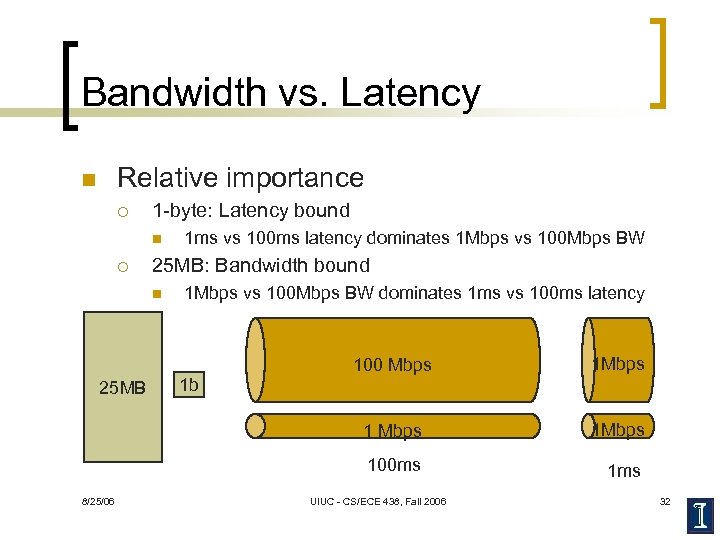
Bandwidth vs. Latency Relative importance n ¡ 1 -byte: Latency bound n ¡ 1 ms vs 100 ms latency dominates 1 Mbps vs 100 Mbps BW 25 MB: Bandwidth bound n 1 Mbps vs 100 Mbps BW dominates 1 ms vs 100 ms latency 8/25/06 1 Mbps 100 ms 1 b 1 Mbps 1 Mbps 25 MB 100 Mbps 1 ms UIUC - CS/ECE 438, Fall 2006 32
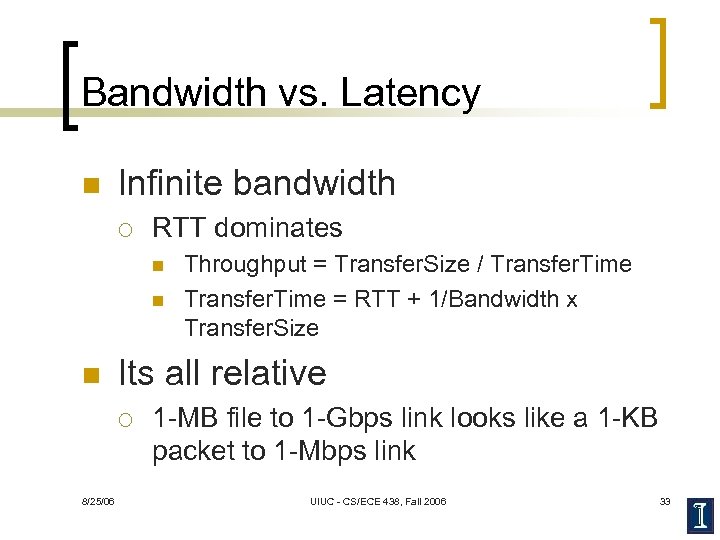
Bandwidth vs. Latency n Infinite bandwidth ¡ RTT dominates n n n Its all relative ¡ 8/25/06 Throughput = Transfer. Size / Transfer. Time = RTT + 1/Bandwidth x Transfer. Size 1 -MB file to 1 -Gbps link looks like a 1 -KB packet to 1 -Mbps link UIUC - CS/ECE 438, Fall 2006 33
Network Architecture n Challenge ¡ n n Hardware and expectations are moving targets. How do network designers cope with complexity? ¡ ¡ ¡ 8/25/06 Fill the gap between hardware capabilities and application expectations, and to do so while delivering “good” performance. Layering Protocols Standards UIUC - CS/ECE 438, Fall 2006 34
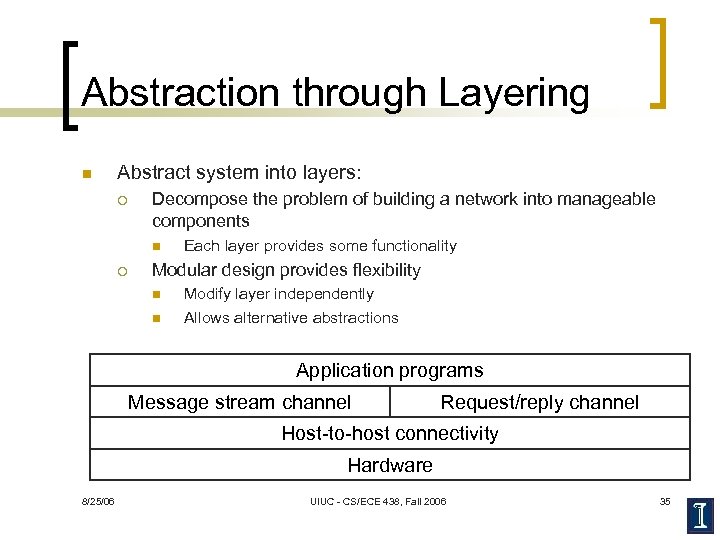
Abstraction through Layering n Abstract system into layers: ¡ Decompose the problem of building a network into manageable components n ¡ Each layer provides some functionality Modular design provides flexibility n n Modify layer independently Allows alternative abstractions Application programs Message stream channel Request/reply channel Host-to-host connectivity Hardware 8/25/06 UIUC - CS/ECE 438, Fall 2006 35
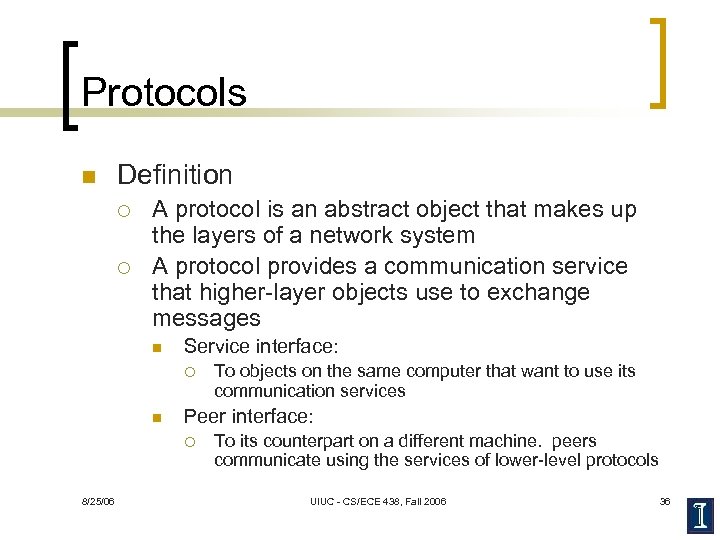
Protocols n Definition ¡ ¡ A protocol is an abstract object that makes up the layers of a network system A protocol provides a communication service that higher-layer objects use to exchange messages n Service interface: ¡ n Peer interface: ¡ 8/25/06 To objects on the same computer that want to use its communication services To its counterpart on a different machine. peers communicate using the services of lower-level protocols UIUC - CS/ECE 438, Fall 2006 36
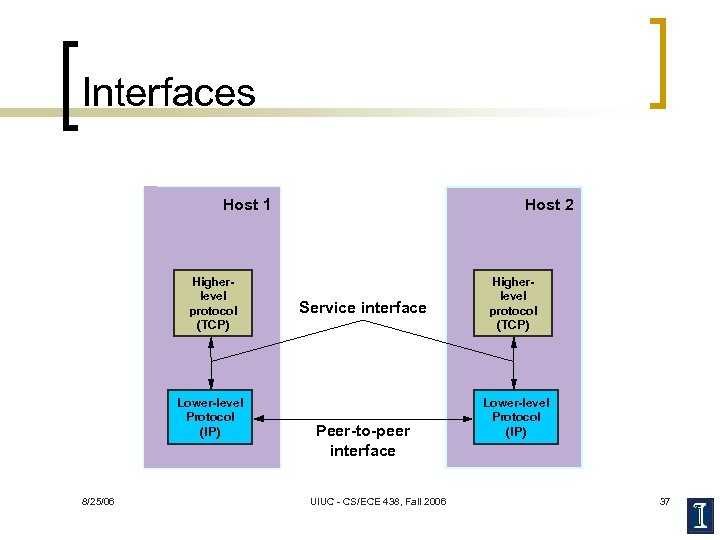
Interfaces Host 1 Higherlevel protocol (TCP) Lower-level Protocol (IP) 8/25/06 Host 2 Service interface Peer-to-peer interface UIUC - CS/ECE 438, Fall 2006 Higherlevel protocol (TCP) Lower-level Protocol (IP) 37
Terminology n Term “protocol” is overloaded ¡ ¡ 8/25/06 specification of peer-to-peer interface module that implements this interface UIUC - CS/ECE 438, Fall 2006 38
Layering Concepts n Encapsulation ¡ ¡ ¡ n Multiplexing and Demultiplexing ¡ 8/25/06 Higher layer protocols create messages and send them via the lower layer protocols These messages are treated as data by the lower-level protocol Higher-layer protocol adds its own control information in the form of headers or trailers Use protocol keys in the header to determine correct upper-layer protocol UIUC - CS/ECE 438, Fall 2006 39
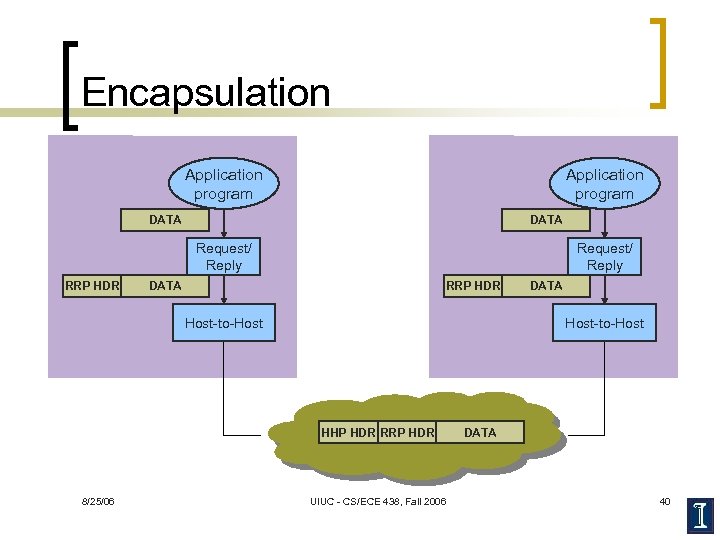
Encapsulation Application program DATA Request/ Reply RRP HDR Request/ Reply DATA RRP HDR Host-to-Host HHP HDR RRP HDR 8/25/06 DATA UIUC - CS/ECE 438, Fall 2006 DATA 40
OSI Architecture n Open Systems Interconnect (OSI) Architecture ¡ ¡ 8/25/06 International Standards Organization (ISO) International Telecommunications Union (ITU, formerly CCITT) “X dot” series: X. 25, X. 400, X. 500 Primarily a reference model UIUC - CS/ECE 438, Fall 2006 41
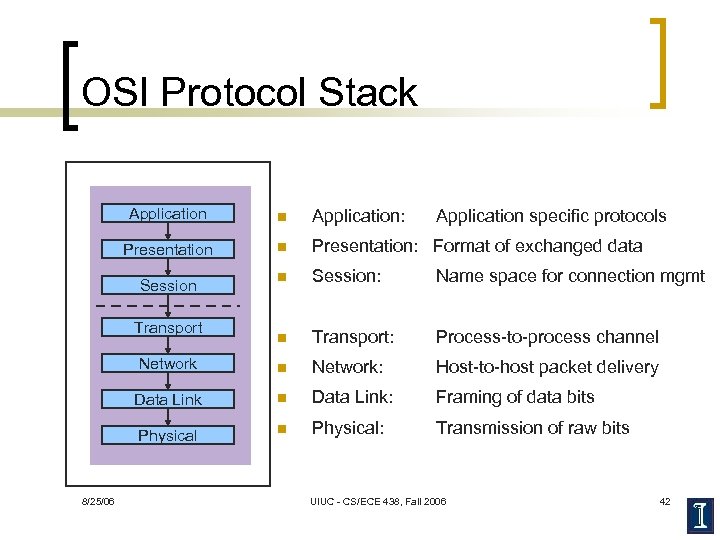
OSI Protocol Stack Application n Application: Application specific protocols Presentation n Presentation: Format of exchanged data Session n Session: Name space for connection mgmt n Transport: Process-to-process channel Network n Network: Host-to-host packet delivery Data Link n Data Link: Framing of data bits Physical n Physical: Transmission of raw bits Transport 8/25/06 UIUC - CS/ECE 438, Fall 2006 42
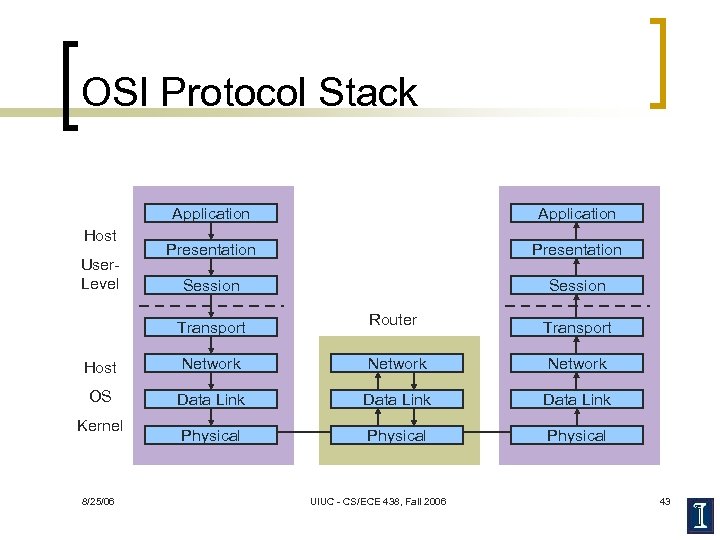
OSI Protocol Stack Application Host User. Level Application Presentation Session Transport Router Transport Host Network OS Data Link Physical Kernel 8/25/06 UIUC - CS/ECE 438, Fall 2006 43
Internet Architecture n Internet Architecture (TCP/IP) ¡ ¡ Developed with ARPANET and NSFNET Internet Engineering Task Force (IETF) n n ¡ ¡ Popular with release of Berkeley Software Distribution (BSD) Unix; i. e. , frees software Standard suggestions debated publicly through “requests for comments” (RFC’s) n 8/25/06 Culture: implement, then standardize OSI culture: standardize, then implement We reject kings, presidents, and voting. We believe in rough consensus and running code. – David Clark UIUC - CS/ECE 438, Fall 2006 44
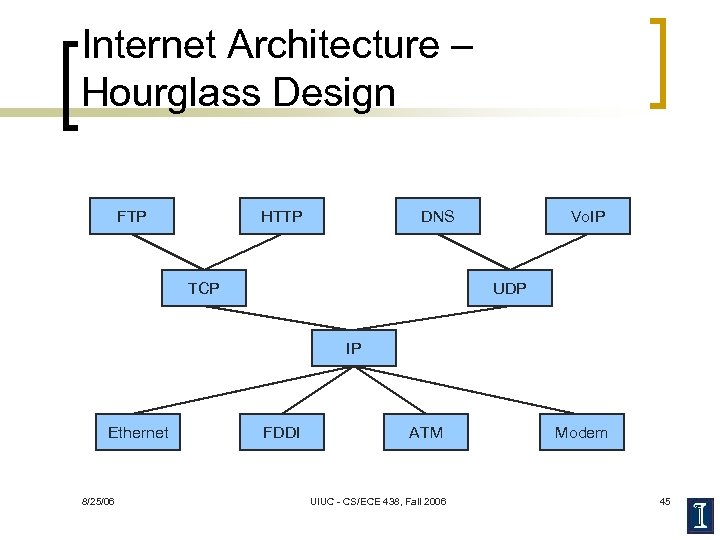
Internet Architecture – Hourglass Design FTP HTTP DNS TCP Vo. IP UDP IP Ethernet 8/25/06 FDDI ATM UIUC - CS/ECE 438, Fall 2006 Modem 45
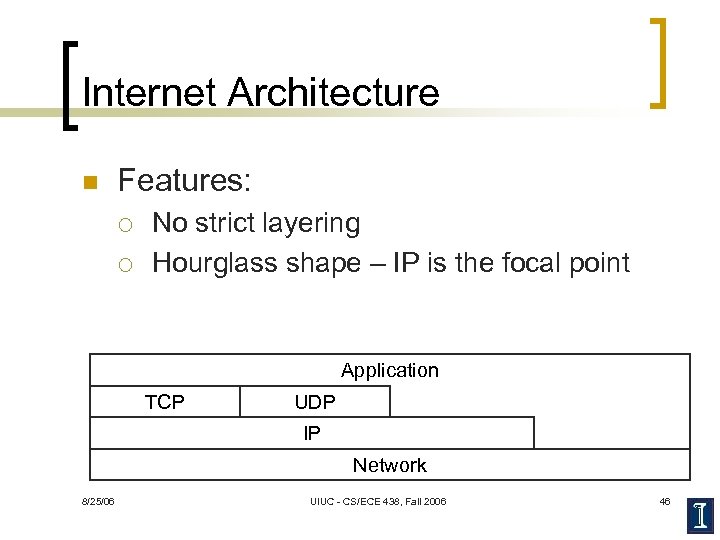
Internet Architecture n Features: ¡ ¡ No strict layering Hourglass shape – IP is the focal point Application TCP UDP IP Network 8/25/06 UIUC - CS/ECE 438, Fall 2006 46
Protocol Acronyms n n n n n 8/25/06 (T)FTP - HTTP - DNS - SMTP – NTP - TCP - UDP - IP - FDDI ATM - (Trivial) File Transfer Protocol Hyper. Text Transport Protocol Domain Name Service Simple Mail Transfer Protocol Network Time Protocol Transmission Control Protocol User Datagram Protocol Internet Protocol Fiber Distributed Data Interface Asynchronous Transfer Mode UIUC - CS/ECE 438, Fall 2006 47
Summary n Goal ¡ n Steps ¡ ¡ ¡ 8/25/06 Understanding of computer network functionality, with experience building and using computer networks Identify what concepts we expect from a network Define a layered architecture Implement network protocols and application programs UIUC - CS/ECE 438, Fall 2006 48

Assignments n Homework 1 ¡ n Project 1 ¡ n 8/25/06 Due Wednesday September 6 at 2: 00 pm. Due Friday September 8 at 9: 00 pm. Both will be on website by end of day today. UIUC - CS/ECE 438, Fall 2006 49
Скачать презентацию CS ECE 438 CSE 425 Communication Networks Nikita Borisov
a4ca487e116962bb16890792ef9e2611.ppt