


 Скачать презентацию CS 854 Virtualization AN OVERVIEW OF NETWORK VIRTUALIZATION
721eb15f30bc21e53cccaffee4b1c0b8.ppt
- Количество слайдов: 53
 CS 854: Virtualization AN OVERVIEW OF NETWORK VIRTUALIZATION 19 March 2018 Mosharaf Chowdhury 1
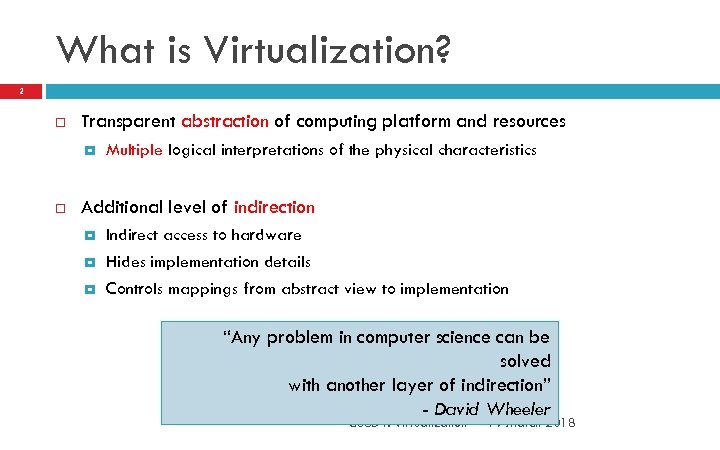 What is Virtualization? 2 Transparent abstraction of computing platform and resources Multiple logical interpretations of the physical characteristics Additional level of indirection Indirect access to hardware Hides implementation details Controls mappings from abstract view to implementation “Any problem in computer science can be solved with another layer of indirection” - David Wheeler CS 854: Virtualization 19 March 2018
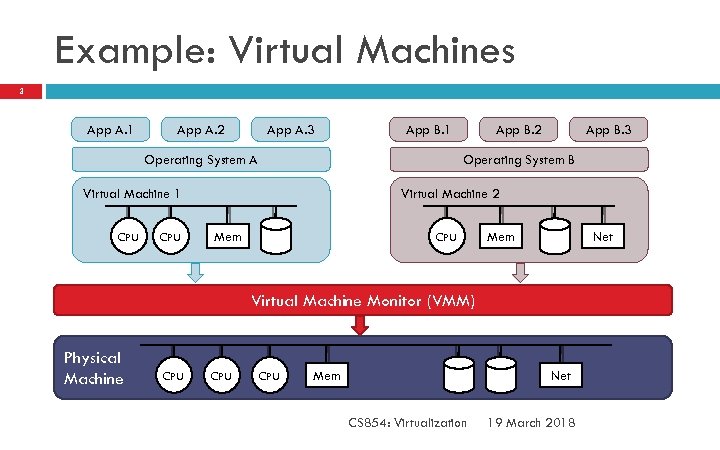 Example: Virtual Machines 3 App A. 1 App A. 2 App A. 3 App B. 1 Operating System A CPU App B. 3 Operating System B Virtual Machine 1 CPU App B. 2 Virtual Machine 2 Mem CPU Mem Net Virtual Machine Monitor (VMM) Physical Machine CPU CPU Mem Net CS 854: Virtualization 19 March 2018
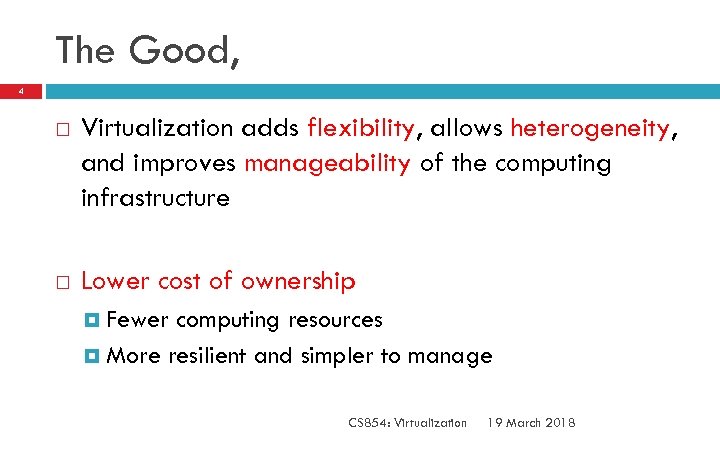 The Good, 4 Virtualization adds flexibility, allows heterogeneity, and improves manageability of the computing infrastructure Lower cost of ownership Fewer computing resources More resilient and simpler to manage CS 854: Virtualization 19 March 2018
 The Bad, 5 Performance penalty Overhead due to the indirection layer Too much abstraction Hidden details CS 854: Virtualization 19 March 2018
 And the Ugly? 6 CS 854: Virtualization 19 March 2018
 7 Historical Perspective CS 854: Virtualization 19 March 2018
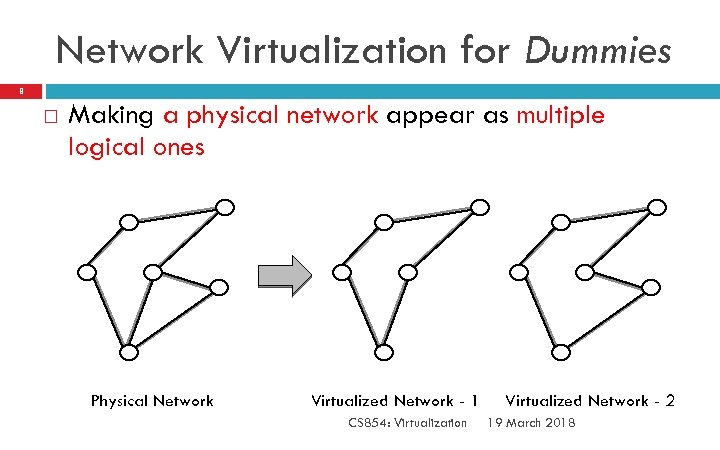 Network Virtualization for Dummies 8 Making a physical network appear as multiple logical ones Physical Network Virtualized Network - 1 CS 854: Virtualization Virtualized Network - 2 19 March 2018
 Related Concepts 9 1. 2. 3. 4. Virtual Local Area Networks (VLAN) Virtual Private Networks (VPN) Active and Programmable Networks Overlay Networks CS 854: Virtualization 19 March 2018
 Virtual Local Area Networks (VLAN) 10 Group of logically networked hosts Single broadcast domain Advantages Ease of network administration and management Elevated levels of trust, security, and isolation CS 854: Virtualization 19 March 2018
 Virtual Private Networks (VPN) 11 Virtual network connecting distributed sites Works over public communication networks VPN classification (based on the protocol used in the VPN data plane) 1. 2. 3. Layer 3 VPN Layer 2 VPN Layer 1 VPN CS 854: Virtualization 19 March 2018
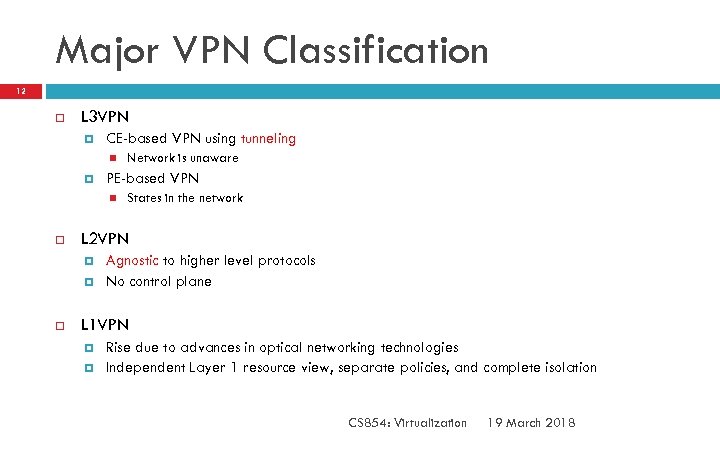 Major VPN Classification 12 L 3 VPN CE-based VPN using tunneling PE-based VPN States in the network L 2 VPN Network is unaware Agnostic to higher level protocols No control plane L 1 VPN Rise due to advances in optical networking technologies Independent Layer 1 resource view, separate policies, and complete isolation CS 854: Virtualization 19 March 2018
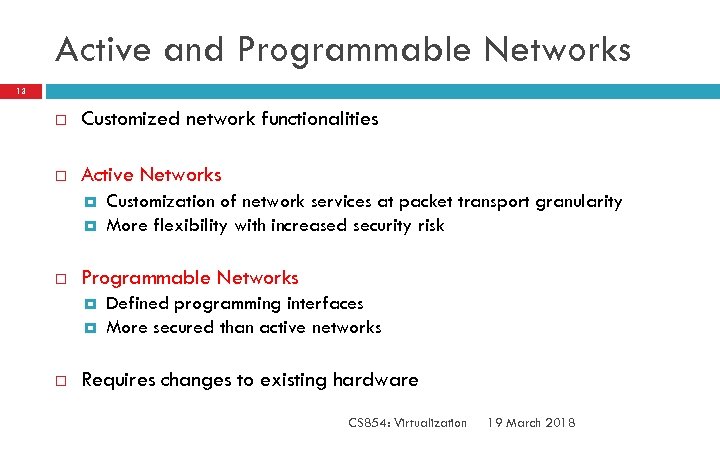 Active and Programmable Networks 13 Customized network functionalities Active Networks Programmable Networks Customization of network services at packet transport granularity More flexibility with increased security risk Defined programming interfaces More secured than active networks Requires changes to existing hardware CS 854: Virtualization 19 March 2018
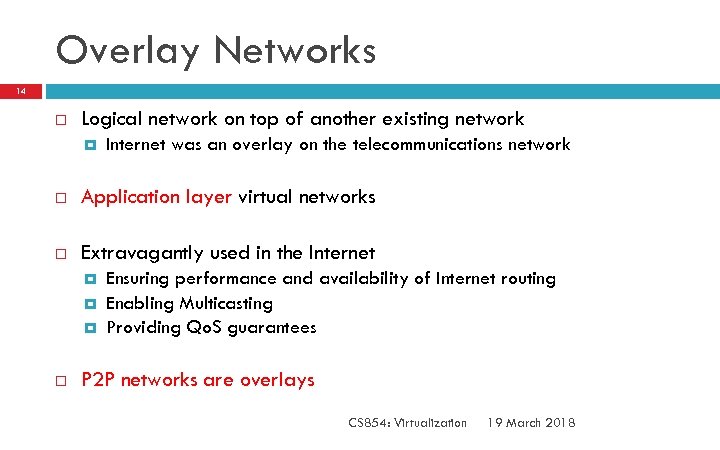 Overlay Networks 14 Logical network on top of another existing network Internet was an overlay on the telecommunications network Application layer virtual networks Extravagantly used in the Internet Ensuring performance and availability of Internet routing Enabling Multicasting Providing Qo. S guarantees P 2 P networks are overlays CS 854: Virtualization 19 March 2018
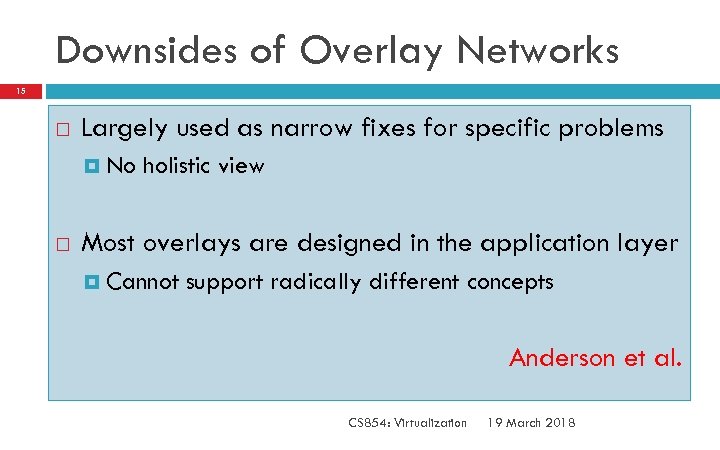 Downsides of Overlay Networks 15 Largely used as narrow fixes for specific problems No holistic view Most overlays are designed in the application layer Cannot support radically different concepts Anderson et al. CS 854: Virtualization 19 March 2018
 16 Network Virtualization Environment CS 854: Virtualization 19 March 2018
 What is Network Virtualization? 17 Transparent abstraction of networking platform and resources Additional level of indirection Multiple logical interpretations of the physical characteristics Indirect access to network resources Resource partitioning and isolation Physical and logical Dynamic provisioning and configuration CS 854: Virtualization 19 March 2018
 Why Virtualize the Network? 18 Internet is almost ossified Hard to come up with a one-size-fits-all architecture Lots of band-aids and makeshift solutions (e. g. , overlays) A new architecture (aka clean-slate) is needed Almost impossible to predict what future might unleash Why not create an all-sizes-fit-into-one instead! Open and expandable architecture Coexistence of heterogeneous architectures CS 854: Virtualization 19 March 2018
 Network Virtualization Environment (NVE) 19 Virtual Network Business Model Principles Architecture Design Goals CS 854: Virtualization 19 March 2018
 What is a Virtual Network (VN)? 20 A collection of virtual nodes and virtual links forming a virtual topology A virtual node is hosted on a particular physical node Subset of physical topology Basic entity of the NVE Multiple virtual nodes can coexist A virtual link spans over a physical path Includes a portion of the underlying physical resources CS 854: Virtualization 19 March 2018
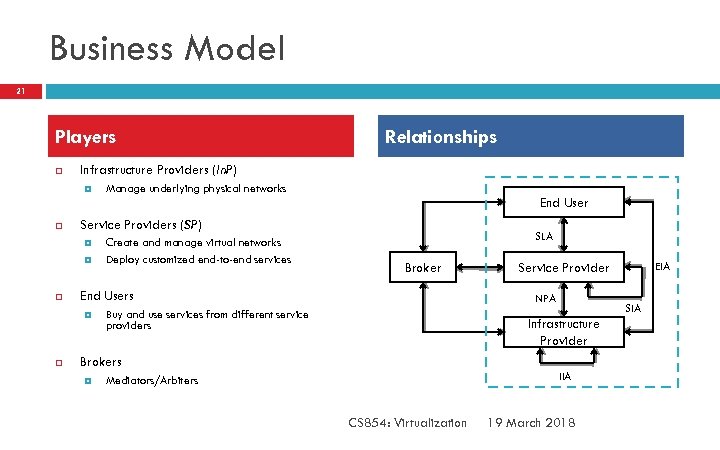 Business Model 21 Players Relationships Infrastructure Providers (In. P) Manage underlying physical networks End User Service Providers (SP) SLA Broker End Users Create and manage virtual networks Deploy customized end-to-end services NPA Buy and use services from different service providers SIA Infrastructure Provider Brokers IIA Mediators/Arbiters CS 854: Virtualization EIA Service Provider 19 March 2018
 Principles 22 Coexistence of multiple heterogeneous virtual networks Recursion of virtual networks Opens the door for network virtualization economics Inheritance of architectural attributes Introduces diversity Promotes value-addition Revisitation of virtual nodes Simplifies network operation and management CS 854: Virtualization 19 March 2018
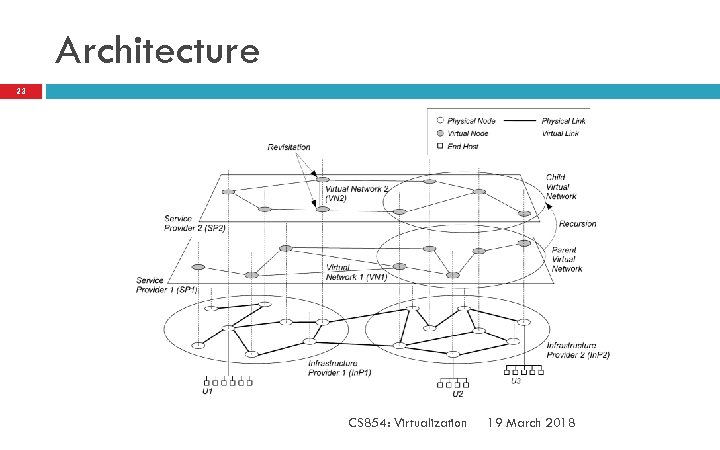 Architecture 23 CS 854: Virtualization 19 March 2018
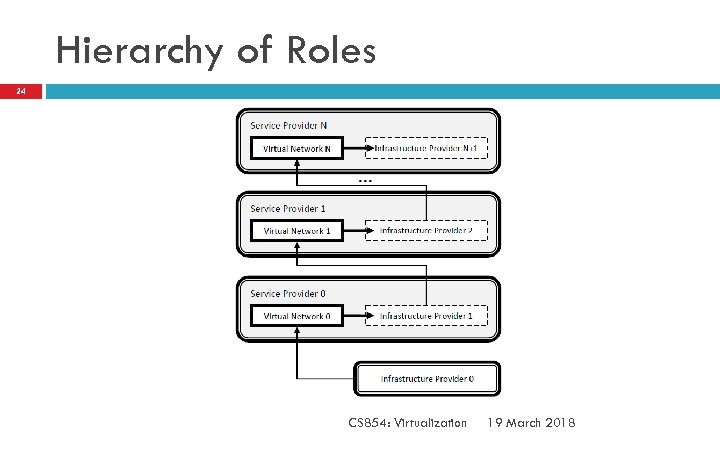 Hierarchy of Roles 24 CS 854: Virtualization 19 March 2018
 Design Goals 25 Flexibility Service providers can choose arbitrary network topology, routing and forwarding functionalities, customized control and data planes No need for co-ordination with others IPv 6 fiasco should never happen again CS 854: Virtualization 19 March 2018
 Design Goals (Cont. ) 26 Manageability Clear separation of policy from mechanism Defined accountability of infrastructure and service providers Modular management Scalability Maximize the number of co-existing virtual networks Increase resource utilization and amortize CAPEX and OPEX CS 854: Virtualization 19 March 2018
 Design Goals (Cont. ) 27 Isolation Complete isolation between virtual networks Logical and resource Isolate faults and misconfigurations Stability and Convergence Instability due to Errors and misconfigurations Instability in In. P algorithms Quick convergence to stable state CS 854: Virtualization 19 March 2018
 Design Goals (Cont. ) 28 Programmability Of network elements (e. g. , routers) Answer “How much” and “how” Easy and effective without being vulnerable to threats Heterogeneity Networking technologies Optical, sensor, wireless etc. Virtual networks End user devices CS 854: Virtualization 19 March 2018
 Design Goals (Cont. ) 29 Experimental and Deployment Facility Planet. Lab, GENI, VINI etc. Directly deploy services in real world from the testing phase Legacy Support Consider the existing Internet as a member of the collection of multiple virtual Internets Very important to keep all concerned parties satisfied CS 854: Virtualization 19 March 2018
 What is Network Virtualization? (Revisited) 30 Network virtualization is a networking environment that allows multiple service providers to dynamically compose multiple heterogeneous virtual networks that coexist together in isolation from each other, and to deploy customized end-to-end services on-the-fly as well as manage them on those virtual networks for the end-users by effectively sharing and utilizing underlying network resources leased from multiple infrastructure providers. CS 854: Virtualization 19 March 2018
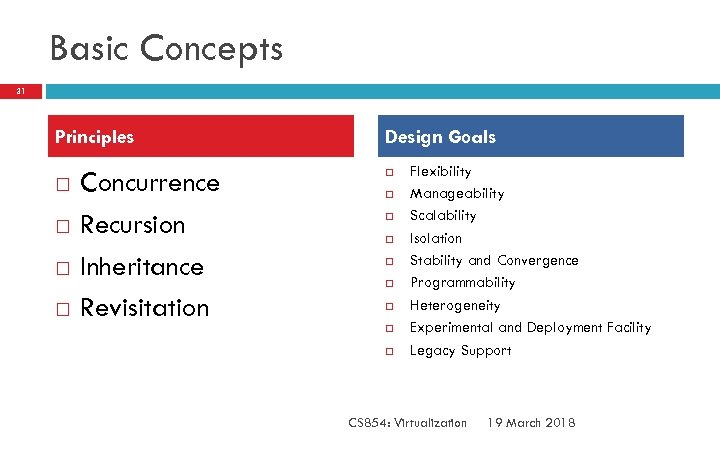 Basic Concepts 31 Principles Concurrence Recursion Inheritance Revisitation Design Goals Flexibility Manageability Scalability Isolation Stability and Convergence Programmability Heterogeneity Experimental and Deployment Facility Legacy Support CS 854: Virtualization 19 March 2018
 32 Existing Projects CS 854: Virtualization 19 March 2018
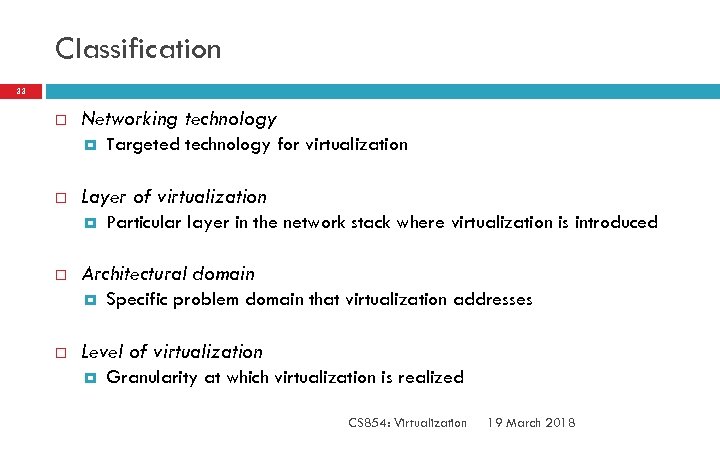 Classification 33 Networking technology Layer of virtualization Particular layer in the network stack where virtualization is introduced Architectural domain Targeted technology for virtualization Specific problem domain that virtualization addresses Level of virtualization Granularity at which virtualization is realized CS 854: Virtualization 19 March 2018
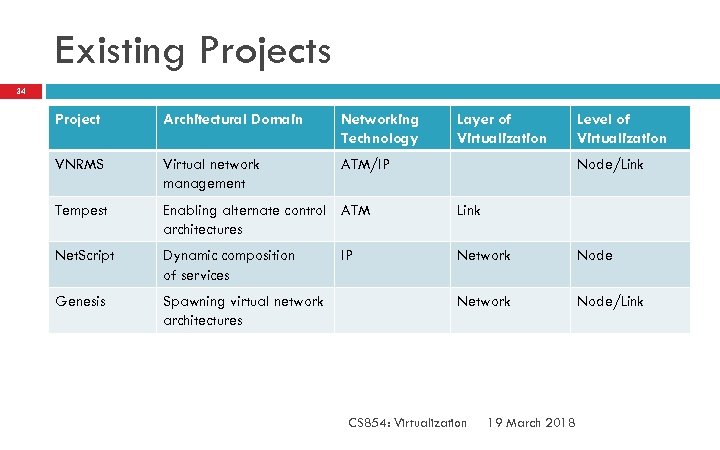 Existing Projects 34 Project Architectural Domain Networking Technology VNRMS Virtual network management ATM/IP Tempest Enabling alternate control ATM architectures Link Net. Script Dynamic composition of services Network Node Genesis Spawning virtual network architectures Network Node/Link IP Layer of Virtualization Level of Virtualization Node/Link CS 854: Virtualization 19 March 2018
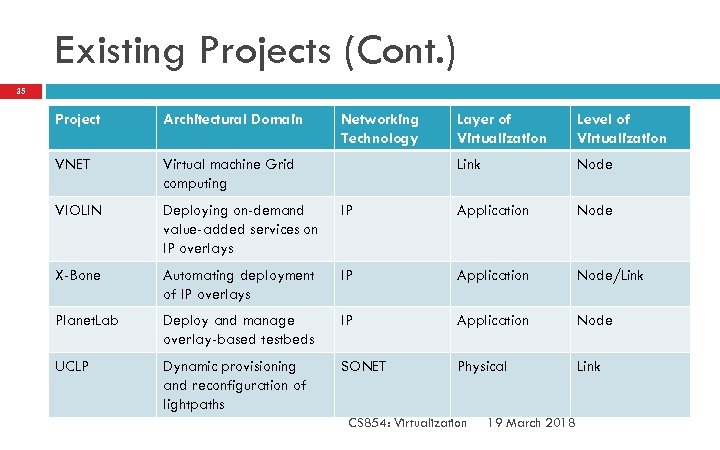 Existing Projects (Cont. ) 35 Project Architectural Domain VNET Virtual machine Grid computing VIOLIN Deploying on-demand value-added services on IP overlays X-Bone Networking Technology Layer of Virtualization Level of Virtualization Link Node IP Application Node Automating deployment of IP overlays IP Application Node/Link Planet. Lab Deploy and manage overlay-based testbeds IP Application Node UCLP Dynamic provisioning and reconfiguration of lightpaths SONET Physical Link CS 854: Virtualization 19 March 2018
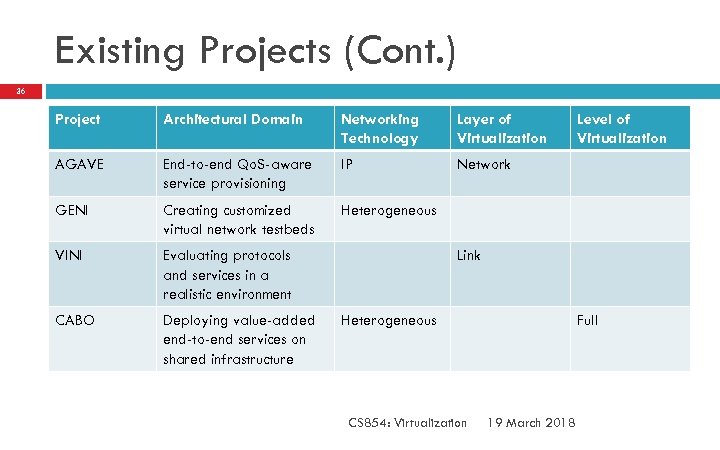 Existing Projects (Cont. ) 36 Project Architectural Domain Networking Technology Layer of Virtualization AGAVE End-to-end Qo. S-aware service provisioning IP Network GENI Creating customized virtual network testbeds Heterogeneous VINI Evaluating protocols and services in a realistic environment CABO Deploying value-added end-to-end services on shared infrastructure Level of Virtualization Link Heterogeneous CS 854: Virtualization Full 19 March 2018
 Insights 37 Shift toward a holistic and generalized network virtualization environment that is Completely virtualized Virtualization Highly of all network elements customizable Virtualization Technology Support at lower layers of the network stack agnostic for heterogeneity CS 854: Virtualization 19 March 2018
 38 Future Directions CS 854: Virtualization 19 March 2018
 Future Directions 39 Instantiation Logistics Deals with operations of virtual networks and virtual components Management Concerned with issues related to successful creation of virtual networks Manages co-existing virtual networks Interactions Handles interactions between players in the network virtualization environment CS 854: Virtualization 19 March 2018
 Instantiation 40 Interfacing Request format for a virtual network Make programmability of the network elements available Signaling and Bootstrapping Request for a virtual network Bootstrap the customized network onto the physical network elements Use a separate network (e. g. Genesis) or out-of-band communication mechanism CS 854: Virtualization 19 March 2018
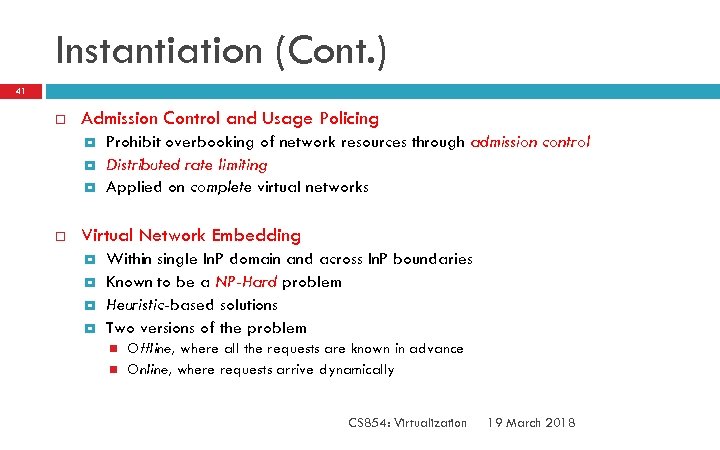 Instantiation (Cont. ) 41 Admission Control and Usage Policing Prohibit overbooking of network resources through admission control Distributed rate limiting Applied on complete virtual networks Virtual Network Embedding Within single In. P domain and across In. P boundaries Known to be a NP-Hard problem Heuristic-based solutions Two versions of the problem Offline, where all the requests are known in advance Online, where requests arrive dynamically CS 854: Virtualization 19 March 2018
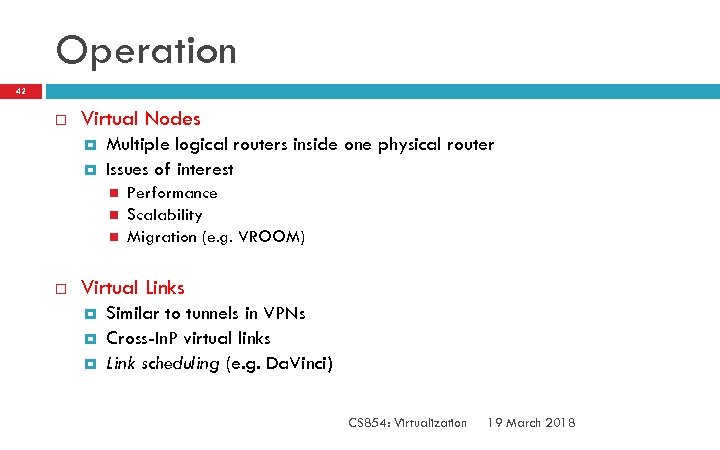 Operation 42 Virtual Nodes Multiple logical routers inside one physical router Issues of interest Performance Scalability Migration (e. g. VROOM) Virtual Links Similar to tunnels in VPNs Cross-In. P virtual links Link scheduling (e. g. Da. Vinci) CS 854: Virtualization 19 March 2018
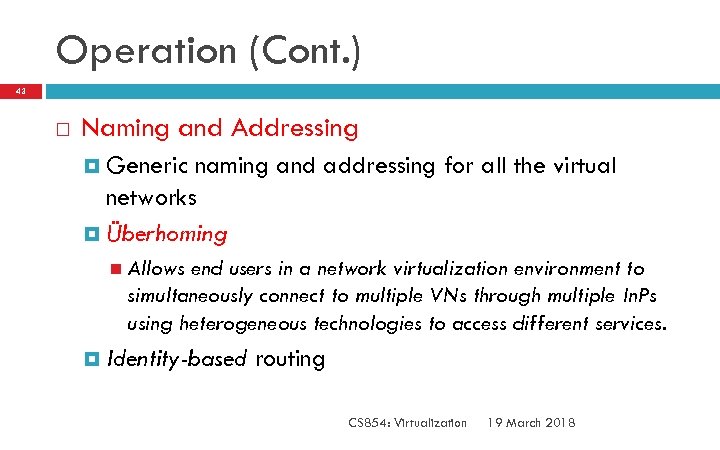 Operation (Cont. ) 43 Naming and Addressing Generic naming and addressing for all the virtual networks Überhoming Allows end users in a network virtualization environment to simultaneously connect to multiple VNs through multiple In. Ps using heterogeneous technologies to access different services. Identity-based routing CS 854: Virtualization 19 March 2018
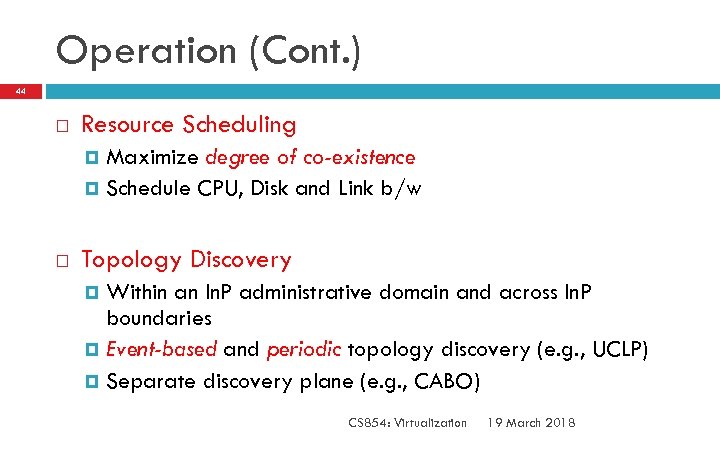 Operation (Cont. ) 44 Resource Scheduling Maximize degree of co-existence Schedule CPU, Disk and Link b/w Topology Discovery Within an In. P administrative domain and across In. P boundaries Event-based and periodic topology discovery (e. g. , UCLP) Separate discovery plane (e. g. , CABO) CS 854: Virtualization 19 March 2018
 Management 45 VN Configuration and Monitoring Enable virtualization from the level of NOCs to lower level network elements Concept of MIBlets (e. g. , VNRMS) Management Frameworks Generic management framework for the service providers Interface between multiple management paradigms Draw clear line between the management responsibilities of the In. Ps and the SPs CS 854: Virtualization 19 March 2018
 Management (Cont. ) 46 Mobility Management Geographic mobility of the end user devices Mobility of the virtual routers through migration techniques Logical mobility of the end users in different virtual networks Failure Handling Isolate failures Prevent cascading failures CS 854: Virtualization 19 March 2018
 Management (Cont. ) 47 Self-*/Autonomic Properties Self-configuration and self-optimization for maximizing virtual resource utilization Self-protection and self-healing to survive malicious attacks CS 854: Virtualization 19 March 2018
 Interactions 48 Networking Technology Agnostic Virtualization on and across optical, wireless, and sensor technology among other technologies Transparently create end-to-end virtual networks across heterogeneous technologies Inter-VN Communication Sharing of resources and information between multiple virtual networks Creating compound virtual networks CS 854: Virtualization 19 March 2018
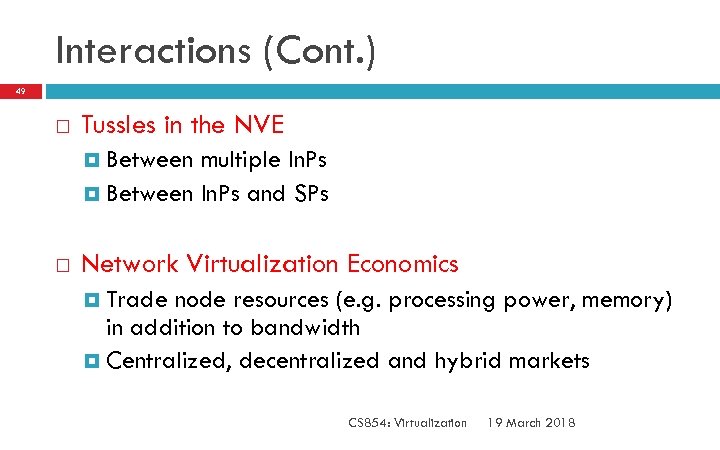 Interactions (Cont. ) 49 Tussles in the NVE Between multiple In. Ps Between In. Ps and SPs Network Virtualization Economics Trade node resources (e. g. processing power, memory) in addition to bandwidth Centralized, decentralized and hybrid markets CS 854: Virtualization 19 March 2018
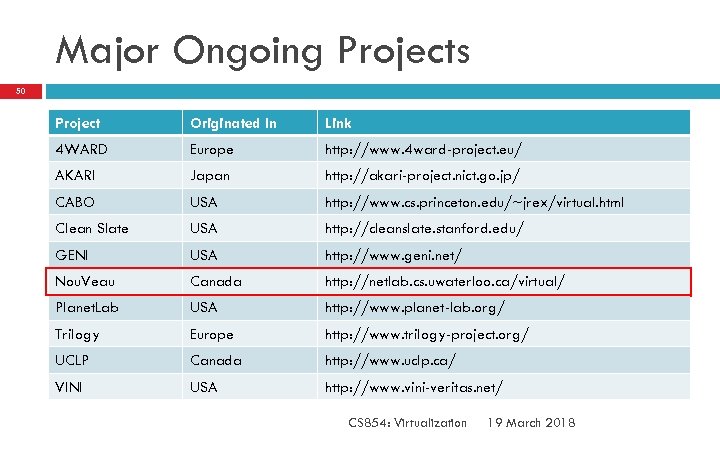 Major Ongoing Projects 50 Project Originated In Link 4 WARD Europe http: //www. 4 ward-project. eu/ AKARI Japan http: //akari-project. nict. go. jp/ CABO USA http: //www. cs. princeton. edu/~jrex/virtual. html Clean Slate USA http: //cleanslate. stanford. edu/ GENI USA http: //www. geni. net/ Nou. Veau Canada http: //netlab. cs. uwaterloo. ca/virtual/ Planet. Lab USA http: //www. planet-lab. org/ Trilogy Europe http: //www. trilogy-project. org/ UCLP Canada http: //www. uclp. ca/ VINI USA http: //www. vini-veritas. net/ CS 854: Virtualization 19 March 2018
 Reference 51 N. M. Mosharaf Kabir Chowdhury, Raouf Boutaba, “A Survey of Network Virtualization”, University of Waterloo Technical Report CS-2008 -25, Oct. 2008. CS 854: Virtualization 19 March 2018
 52 Questions ? Mosharaf Chowdhury http: // www. mosharaf. com/ CS 854: Virtualization 19 March 2018
 Open Invitation 53 “Identity Management and Resource Allocation in the Network Virtualization Environment” @ DC 2314 from 3 PM on Jan 21 st, 2009 CS 854: Virtualization 19 March 2018