


 Скачать презентацию CS 6670 Computer Vision Noah Snavely Lecture 6
b001dcc9597767e5e83246a2ccbcbb41.ppt
- Количество слайдов: 59
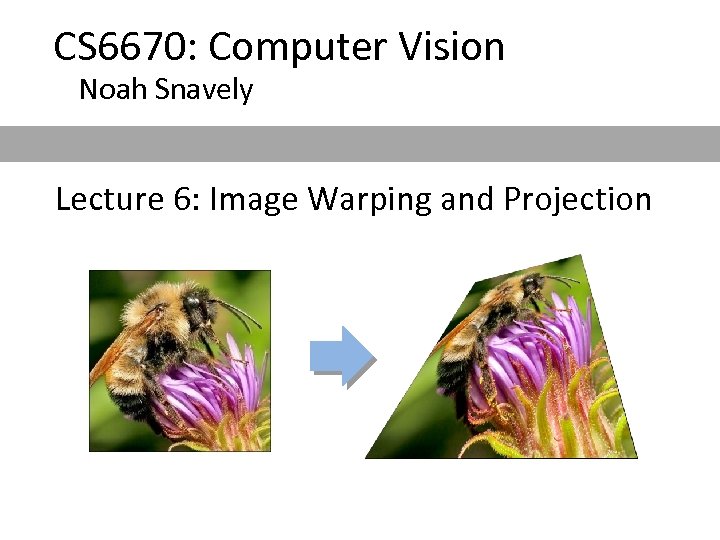 CS 6670: Computer Vision Noah Snavely Lecture 6: Image Warping and Projection
 Readings • Szeliski Chapter 3. 5 (image warping), 9. 1 (motion models)
 Announcements • Project 1 assigned, due next Friday 2/18
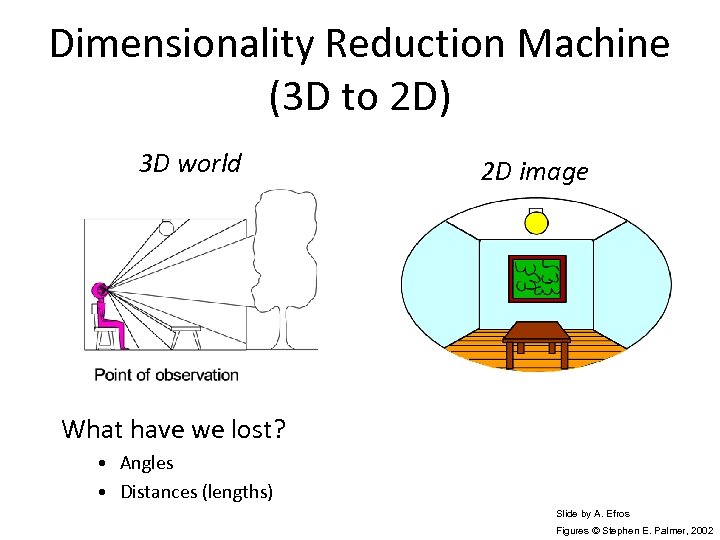 Dimensionality Reduction Machine (3 D to 2 D) 3 D world 2 D image What have we lost? • Angles • Distances (lengths) Slide by A. Efros Figures © Stephen E. Palmer, 2002
 Projection properties • Many-to-one: any points along same ray map to same point in image • Points → points • Lines → lines (collinearity is preserved) – But line through focal point projects to a point • Planes → planes (or half-planes) – But plane through focal point projects to line
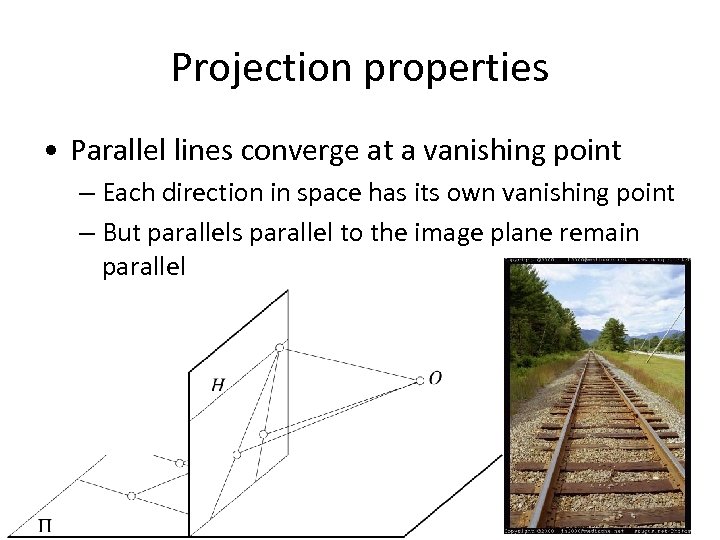 Projection properties • Parallel lines converge at a vanishing point – Each direction in space has its own vanishing point – But parallels parallel to the image plane remain parallel
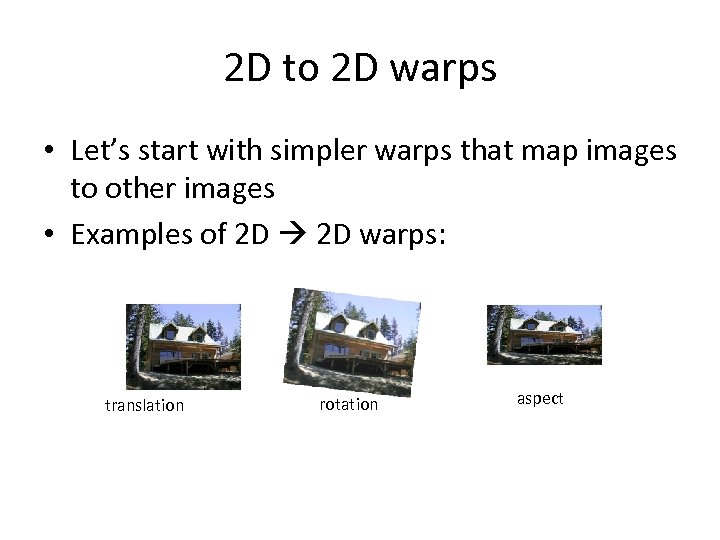 2 D to 2 D warps • Let’s start with simpler warps that map images to other images • Examples of 2 D warps: translation rotation aspect
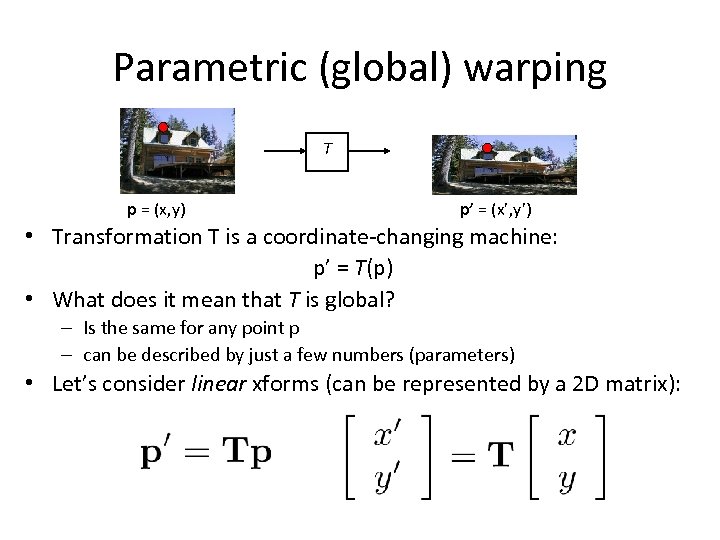 Parametric (global) warping T p = (x, y) p’ = (x’, y’) • Transformation T is a coordinate-changing machine: p’ = T(p) • What does it mean that T is global? – Is the same for any point p – can be described by just a few numbers (parameters) • Let’s consider linear xforms (can be represented by a 2 D matrix):
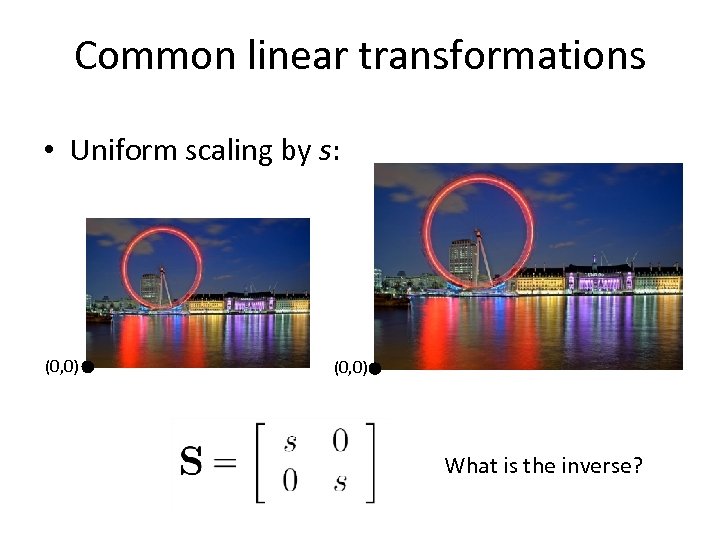 Common linear transformations • Uniform scaling by s: (0, 0) What is the inverse?
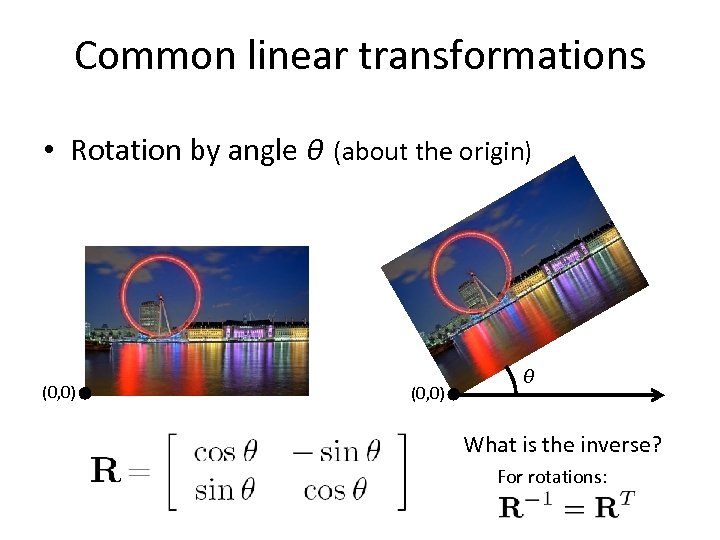 Common linear transformations • Rotation by angle θ (about the origin) (0, 0) θ What is the inverse? For rotations:
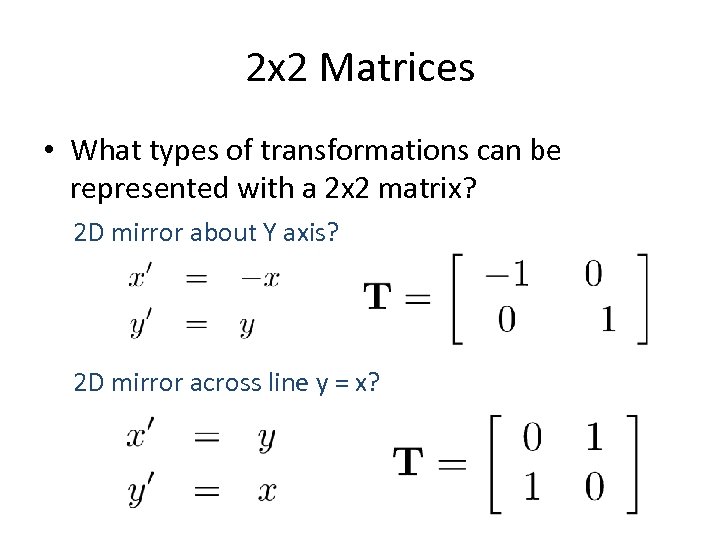 2 x 2 Matrices • What types of transformations can be represented with a 2 x 2 matrix? 2 D mirror about Y axis? 2 D mirror across line y = x?
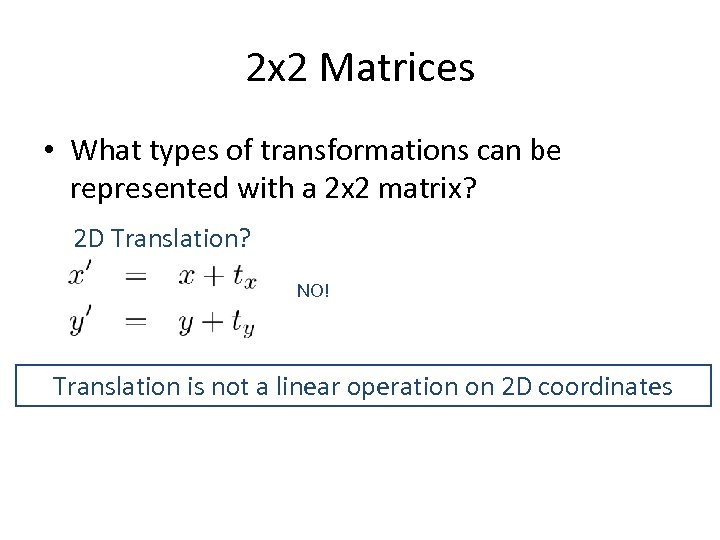 2 x 2 Matrices • What types of transformations can be represented with a 2 x 2 matrix? 2 D Translation? NO! Translation is not a linear operation on 2 D coordinates
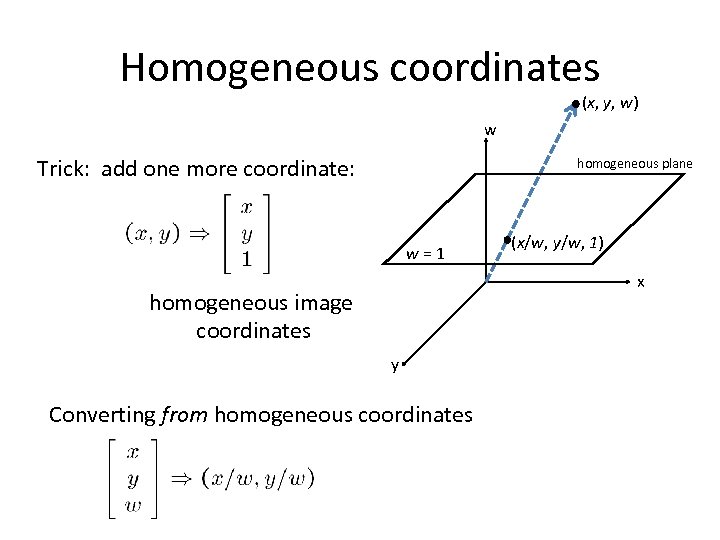 Homogeneous coordinates (x, y, w) w Trick: add one more coordinate: homogeneous plane w=1 (x/w, y/w, 1) x homogeneous image coordinates y Converting from homogeneous coordinates
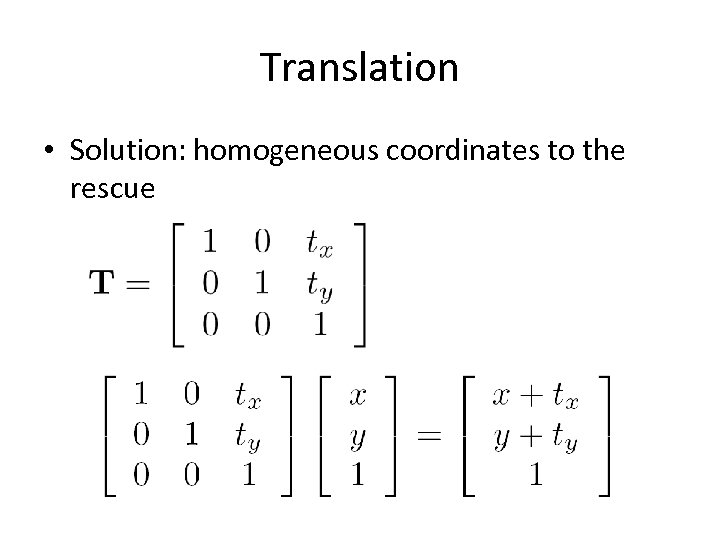 Translation • Solution: homogeneous coordinates to the rescue
![Affine transformations any transformation with last row [ 0 0 1 ] we call](https://present5.com/presentation/b001dcc9597767e5e83246a2ccbcbb41/image-15.jpg "Affine transformations any transformation with last row [ 0 0 1 ] we call") Affine transformations any transformation with last row [ 0 0 1 ] we call an affine transformation
Affine transformations any transformation with last row [ 0 0 1 ] we call an affine transformation
 Basic affine transformations Translate 2 D in-plane rotation Scale Shear
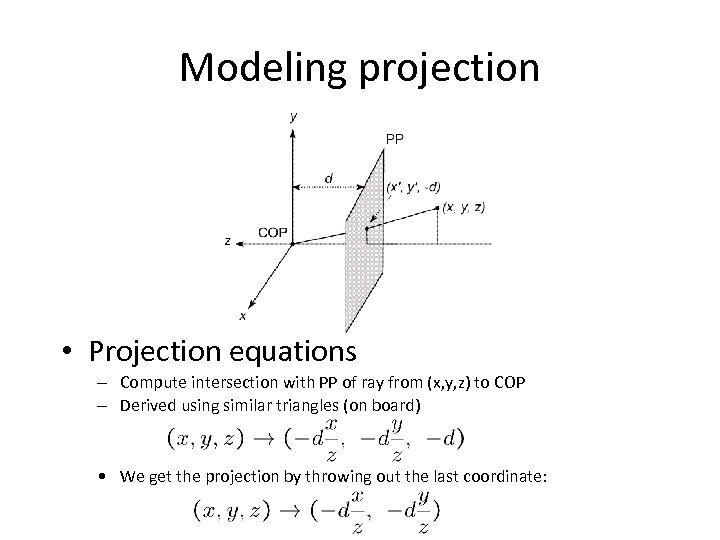 Modeling projection • Projection equations – Compute intersection with PP of ray from (x, y, z) to COP – Derived using similar triangles (on board) • We get the projection by throwing out the last coordinate:
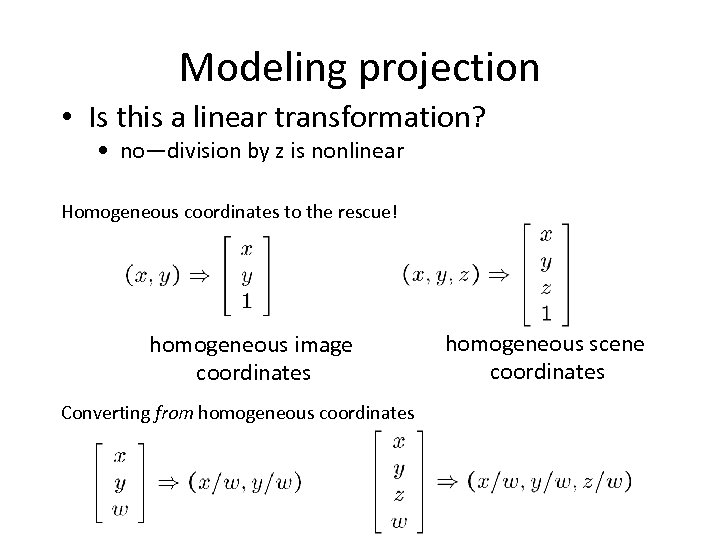 Modeling projection • Is this a linear transformation? • no—division by z is nonlinear Homogeneous coordinates to the rescue! homogeneous image coordinates Converting from homogeneous coordinates homogeneous scene coordinates
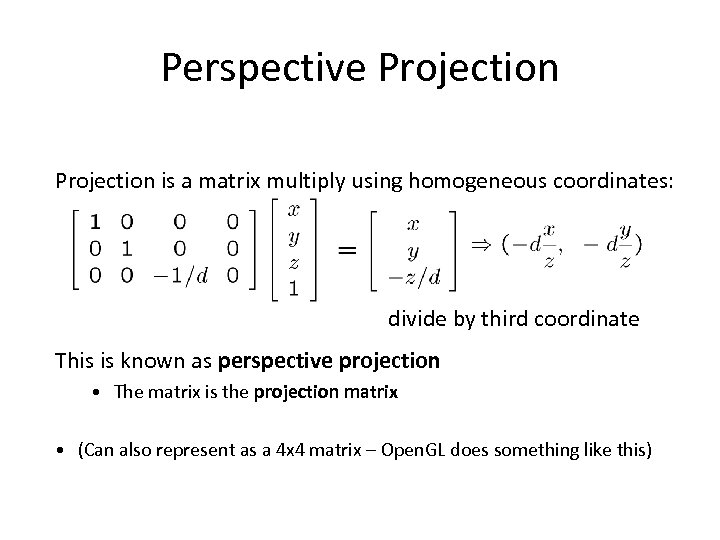 Perspective Projection is a matrix multiply using homogeneous coordinates: divide by third coordinate This is known as perspective projection • The matrix is the projection matrix • (Can also represent as a 4 x 4 matrix – Open. GL does something like this)
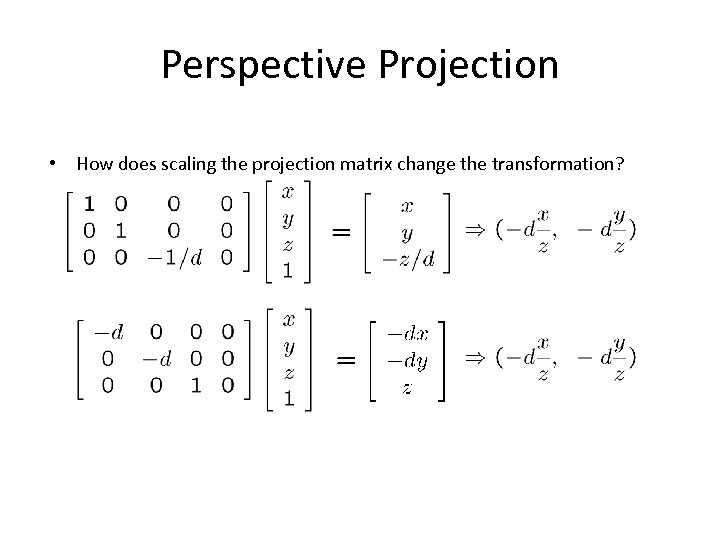 Perspective Projection • How does scaling the projection matrix change the transformation?
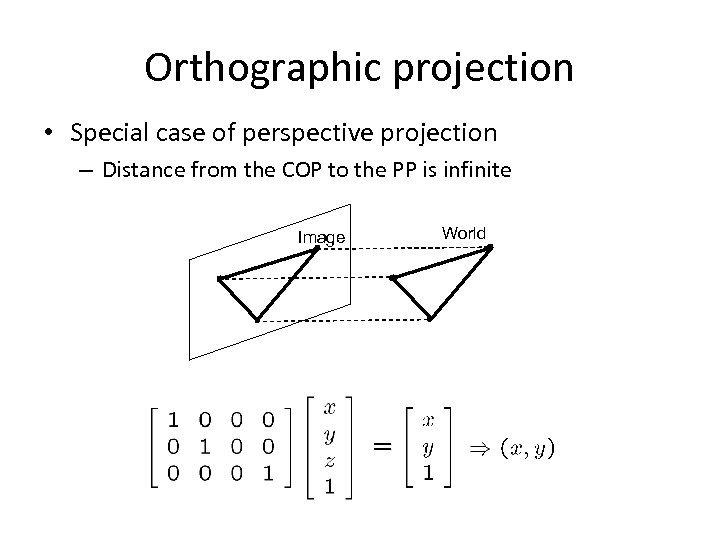 Orthographic projection • Special case of perspective projection – Distance from the COP to the PP is infinite Image World – Good approximation for telephoto optics – Also called “parallel projection”: (x, y, z) → (x, y) – What’s the projection matrix?
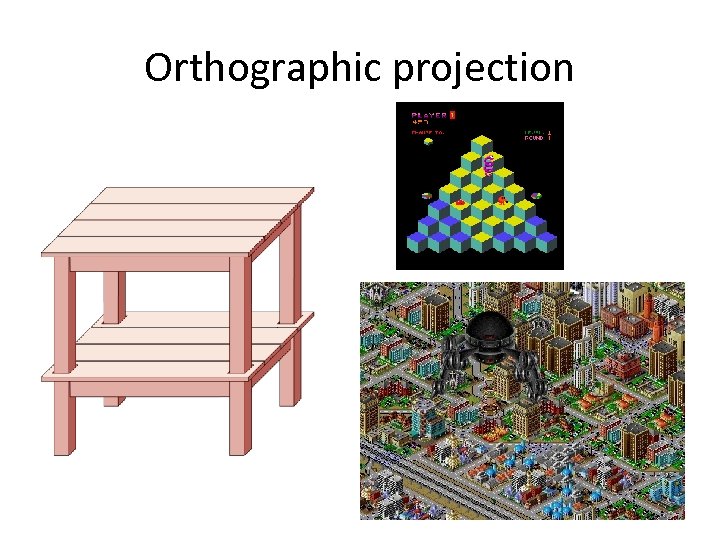 Orthographic projection
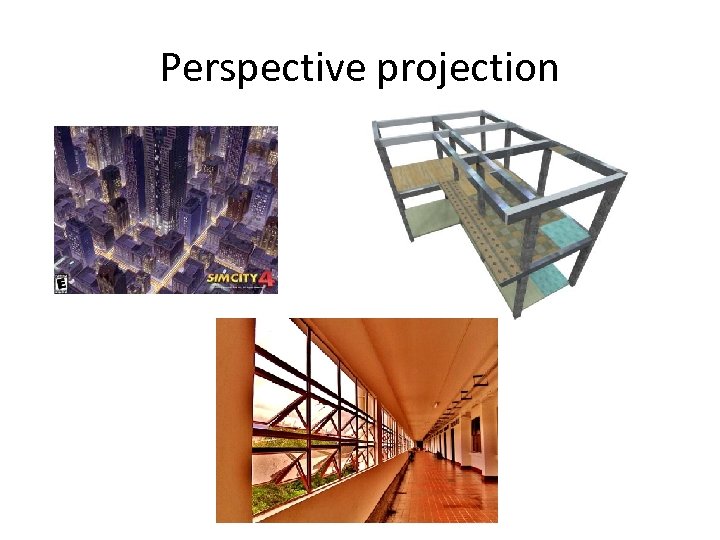 Perspective projection
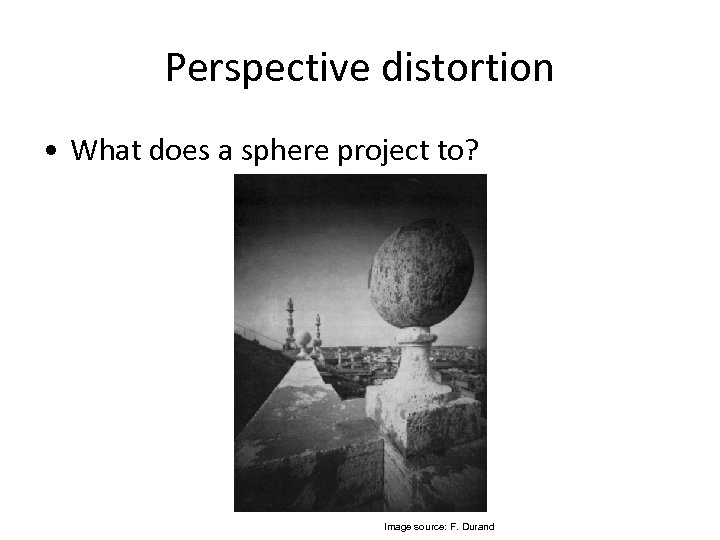 Perspective distortion • What does a sphere project to? Image source: F. Durand
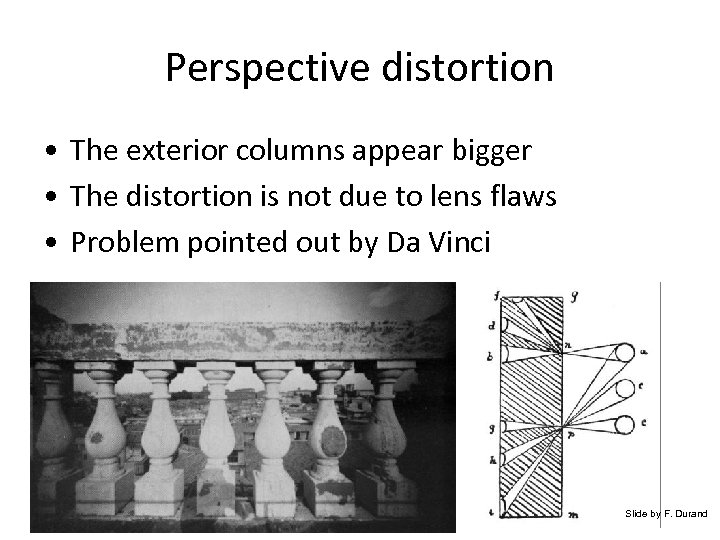 Perspective distortion • The exterior columns appear bigger • The distortion is not due to lens flaws • Problem pointed out by Da Vinci Slide by F. Durand
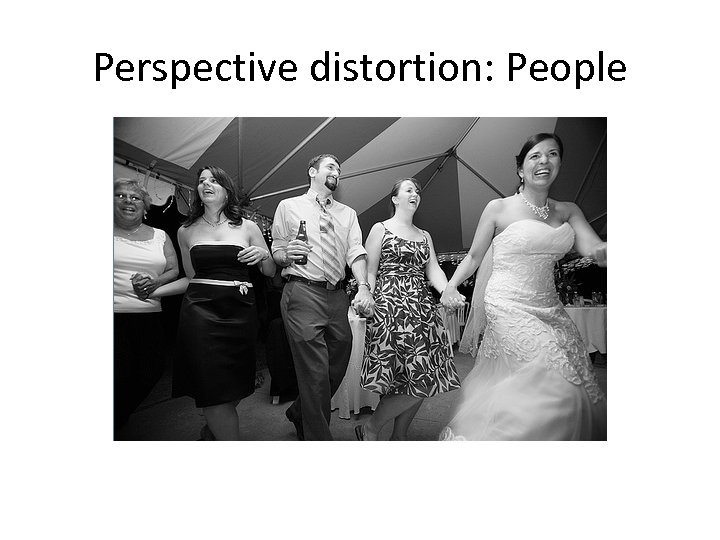 Perspective distortion: People
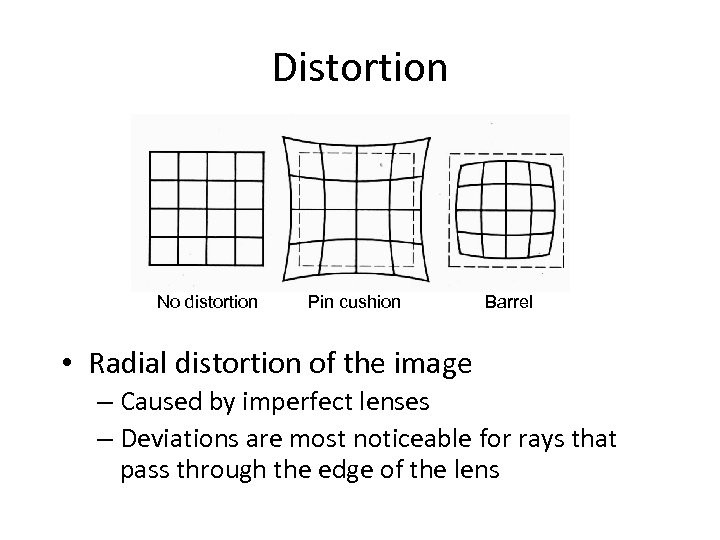 Distortion No distortion Pin cushion Barrel • Radial distortion of the image – Caused by imperfect lenses – Deviations are most noticeable for rays that pass through the edge of the lens
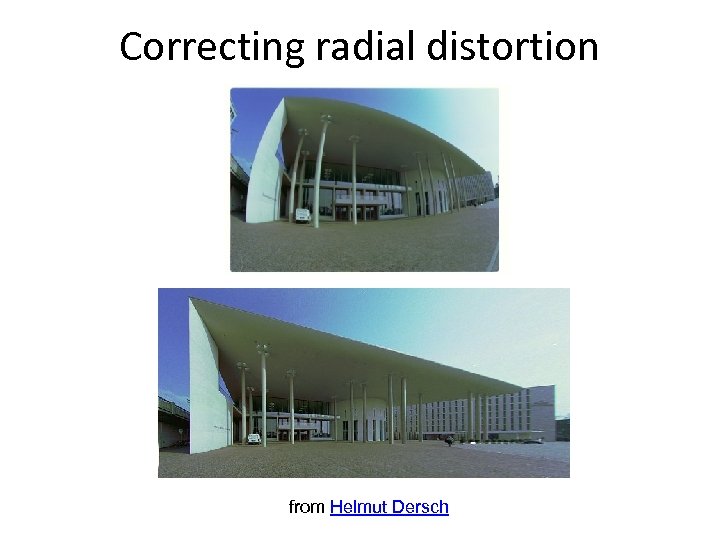 Correcting radial distortion from Helmut Dersch
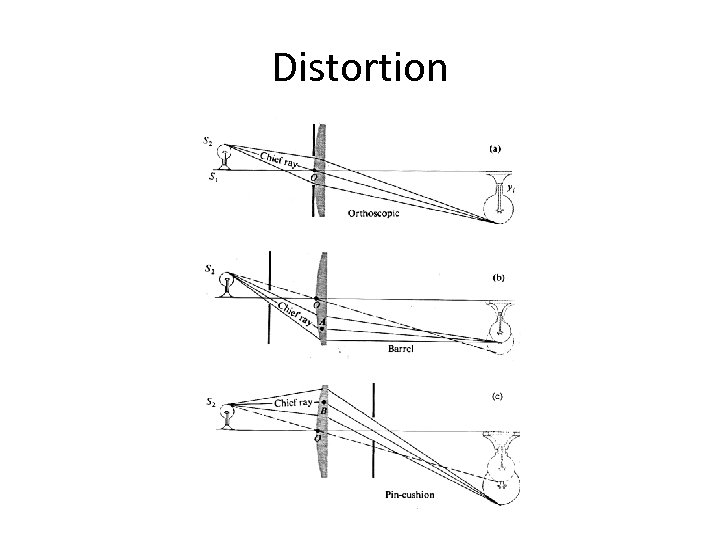 Distortion
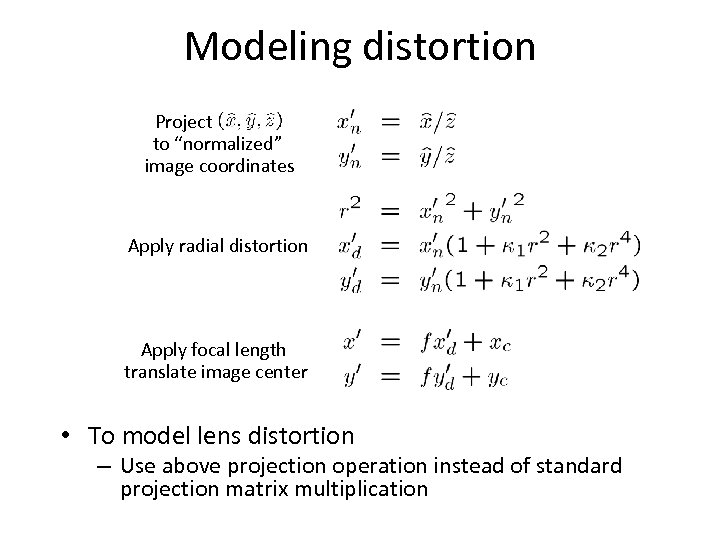 Modeling distortion Project to “normalized” image coordinates Apply radial distortion Apply focal length translate image center • To model lens distortion – Use above projection operation instead of standard projection matrix multiplication
 Other types of projection • Lots of intriguing variants… • (I’ll just mention a few fun ones)
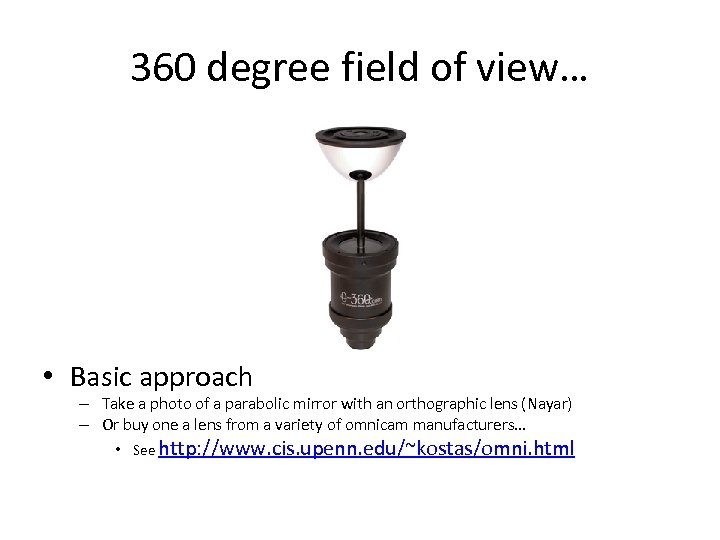 360 degree field of view… • Basic approach – Take a photo of a parabolic mirror with an orthographic lens (Nayar) – Or buy one a lens from a variety of omnicam manufacturers… • See http: //www. cis. upenn. edu/~kostas/omni. html
 Tilt-shift http: //www. northlight-images. co. uk/article_pages/tilt_and_shift_ts-e. html Titlt-shift images from Olivo Barbieri and Photoshop imitations
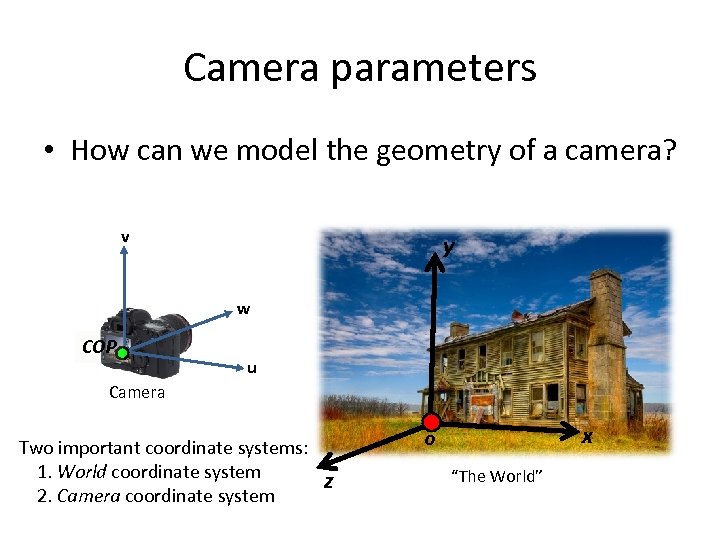 Camera parameters • How can we model the geometry of a camera? v y w COP u Camera Two important coordinate systems: 1. World coordinate system 2. Camera coordinate system x o z “The World”
 Camera parameters • To project a point (x, y, z) in world coordinates into a camera • First transform (x, y, z) into camera coordinates • Need to know – Camera position (in world coordinates) – Camera orientation (in world coordinates) • The project into the image plane – Need to know camera intrinsics
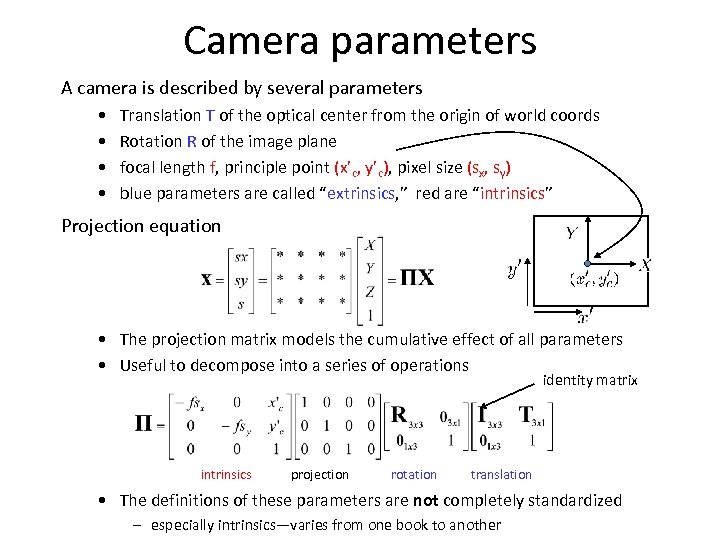 Camera parameters A camera is described by several parameters • • Translation T of the optical center from the origin of world coords Rotation R of the image plane focal length f, principle point (x’c, y’c), pixel size (sx, sy) blue parameters are called “extrinsics, ” red are “intrinsics” Projection equation • The projection matrix models the cumulative effect of all parameters • Useful to decompose into a series of operations identity matrix intrinsics projection rotation translation • The definitions of these parameters are not completely standardized – especially intrinsics—varies from one book to another
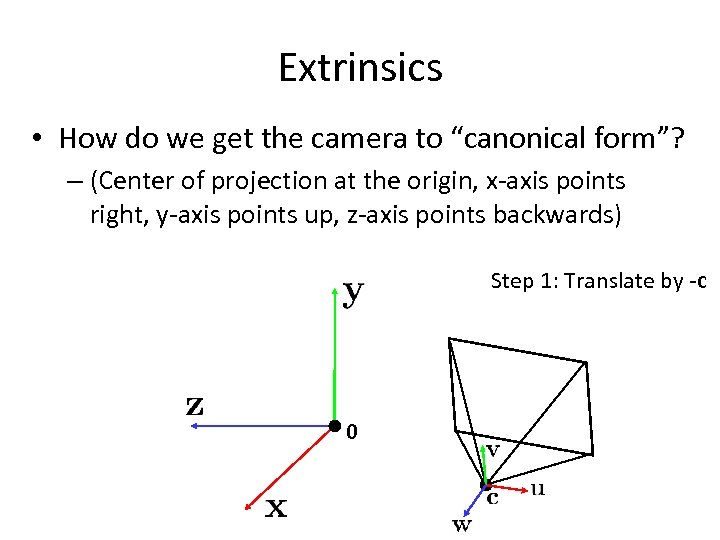 Extrinsics • How do we get the camera to “canonical form”? – (Center of projection at the origin, x-axis points right, y-axis points up, z-axis points backwards) Step 1: Translate by -c 0
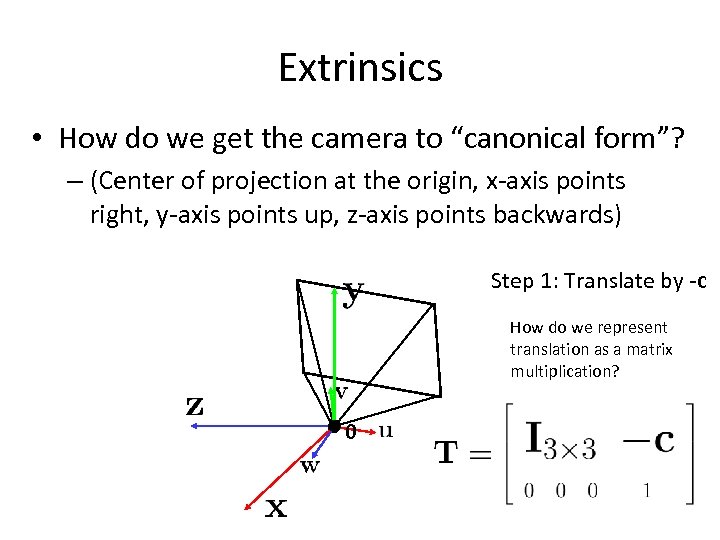 Extrinsics • How do we get the camera to “canonical form”? – (Center of projection at the origin, x-axis points right, y-axis points up, z-axis points backwards) Step 1: Translate by -c How do we represent translation as a matrix multiplication? 0
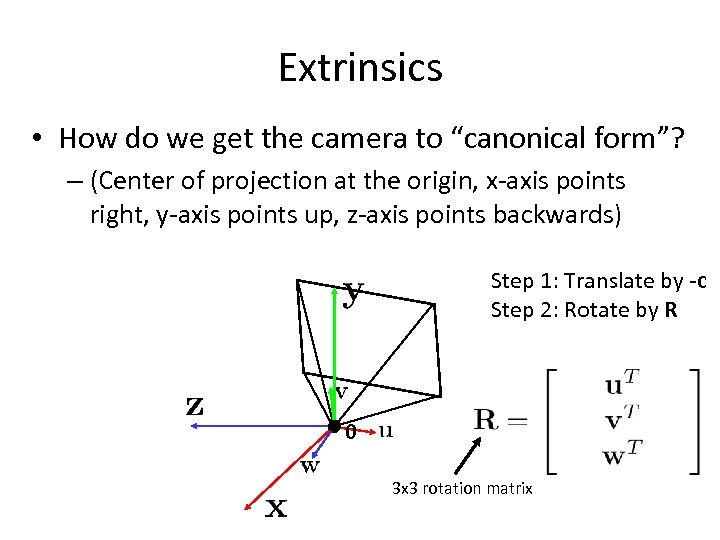 Extrinsics • How do we get the camera to “canonical form”? – (Center of projection at the origin, x-axis points right, y-axis points up, z-axis points backwards) Step 1: Translate by -c Step 2: Rotate by R 0 3 x 3 rotation matrix
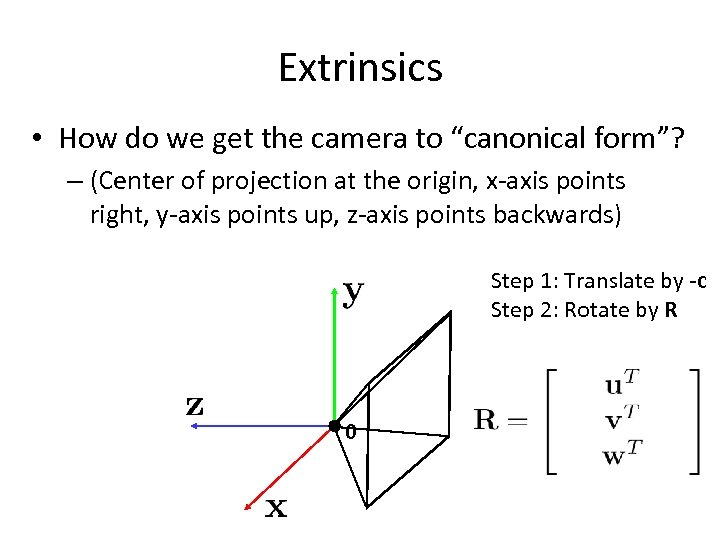 Extrinsics • How do we get the camera to “canonical form”? – (Center of projection at the origin, x-axis points right, y-axis points up, z-axis points backwards) Step 1: Translate by -c Step 2: Rotate by R 0
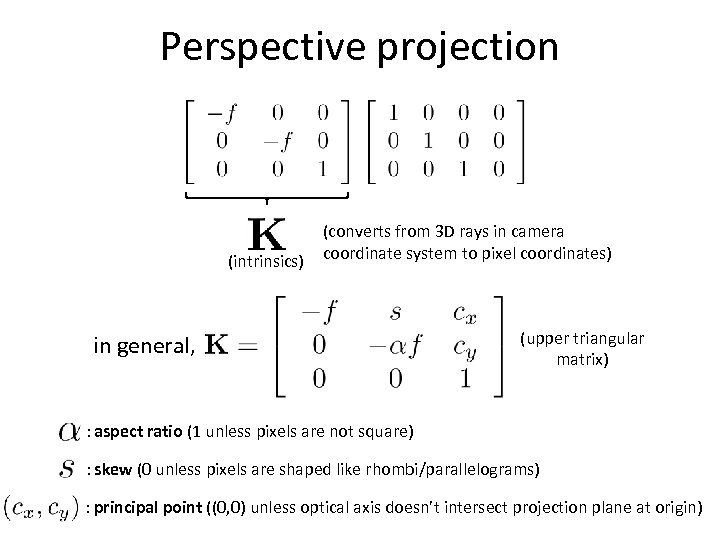 Perspective projection (intrinsics) (converts from 3 D rays in camera coordinate system to pixel coordinates) in general, (upper triangular matrix) : aspect ratio (1 unless pixels are not square) : skew (0 unless pixels are shaped like rhombi/parallelograms) : principal point ((0, 0) unless optical axis doesn’t intersect projection plane at origin)
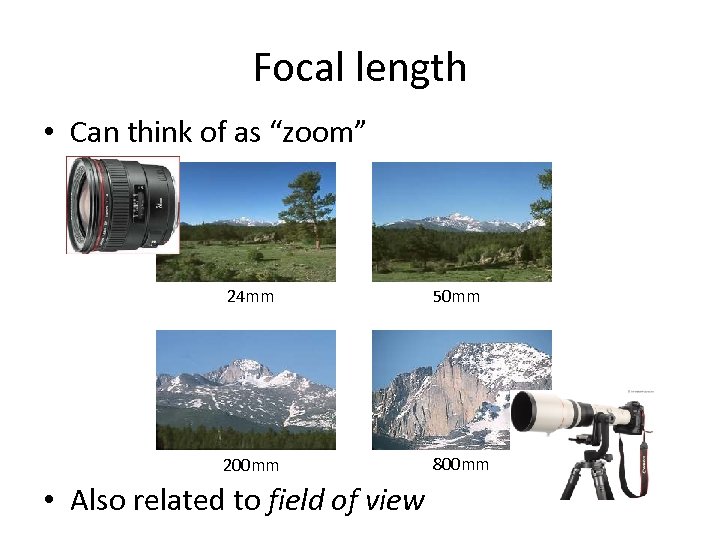 Focal length • Can think of as “zoom” 24 mm 50 mm 200 mm 800 mm • Also related to field of view
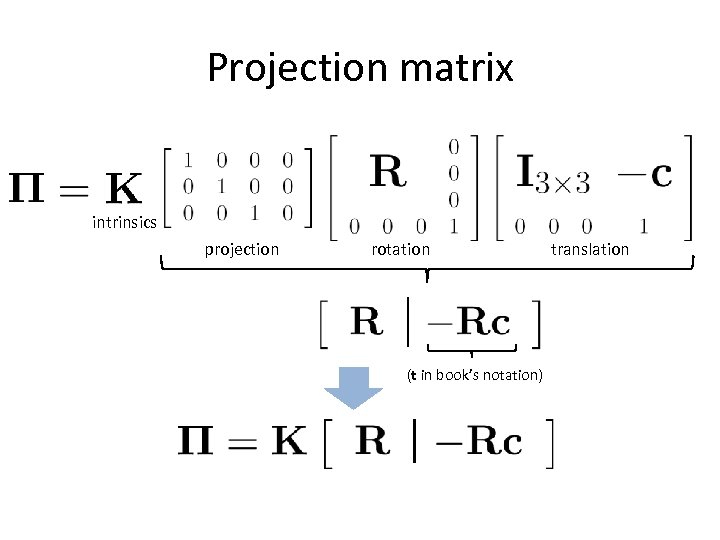 Projection matrix intrinsics projection rotation (t in book’s notation) translation
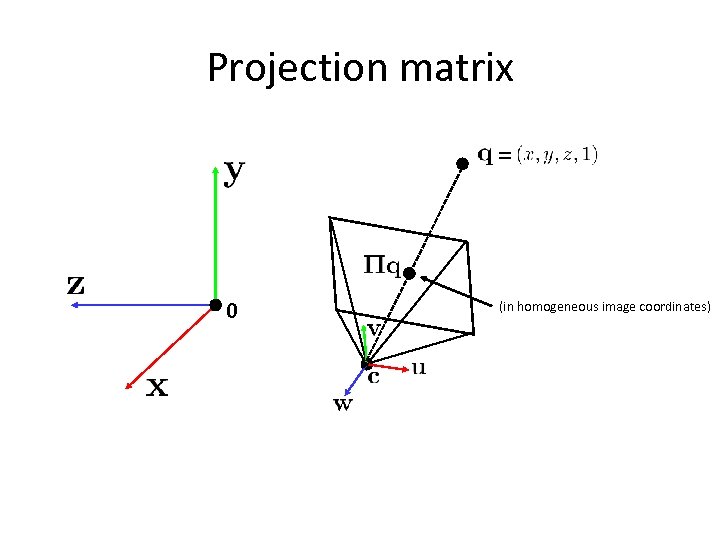 Projection matrix = 0 (in homogeneous image coordinates)
 Questions? • 3 -minute break
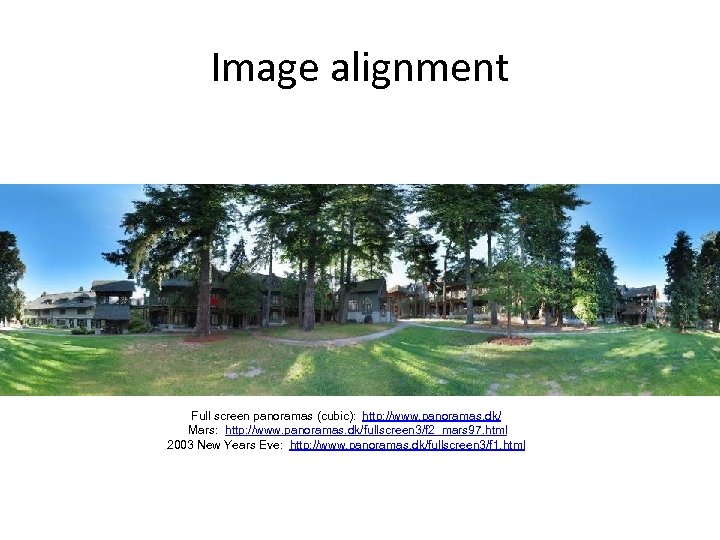 Image alignment Full screen panoramas (cubic): http: //www. panoramas. dk/ Mars: http: //www. panoramas. dk/fullscreen 3/f 2_mars 97. html 2003 New Years Eve: http: //www. panoramas. dk/fullscreen 3/f 1. html
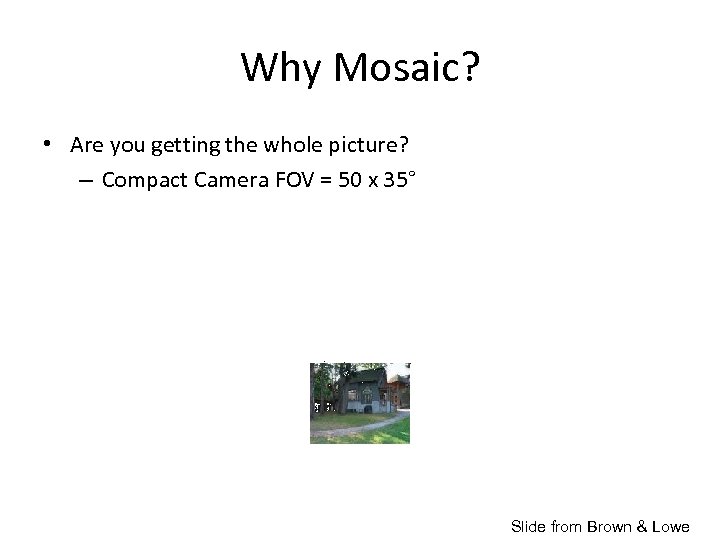 Why Mosaic? • Are you getting the whole picture? – Compact Camera FOV = 50 x 35° Slide from Brown & Lowe
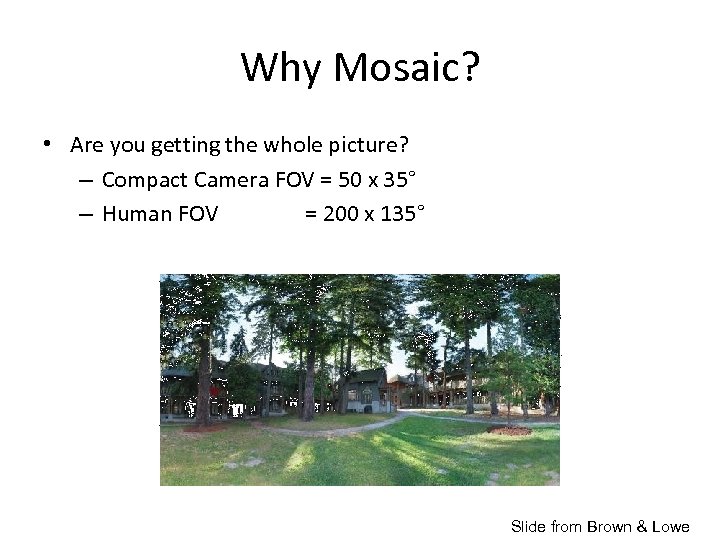 Why Mosaic? • Are you getting the whole picture? – Compact Camera FOV = 50 x 35° – Human FOV = 200 x 135° Slide from Brown & Lowe
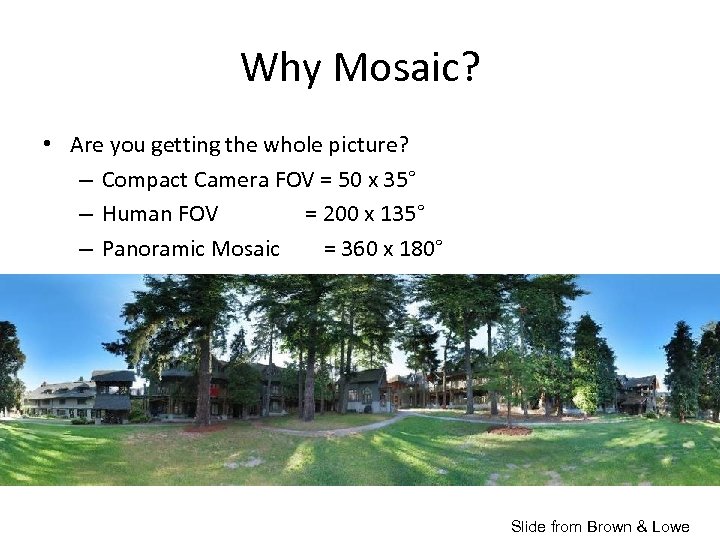 Why Mosaic? • Are you getting the whole picture? – Compact Camera FOV = 50 x 35° – Human FOV = 200 x 135° – Panoramic Mosaic = 360 x 180° Slide from Brown & Lowe
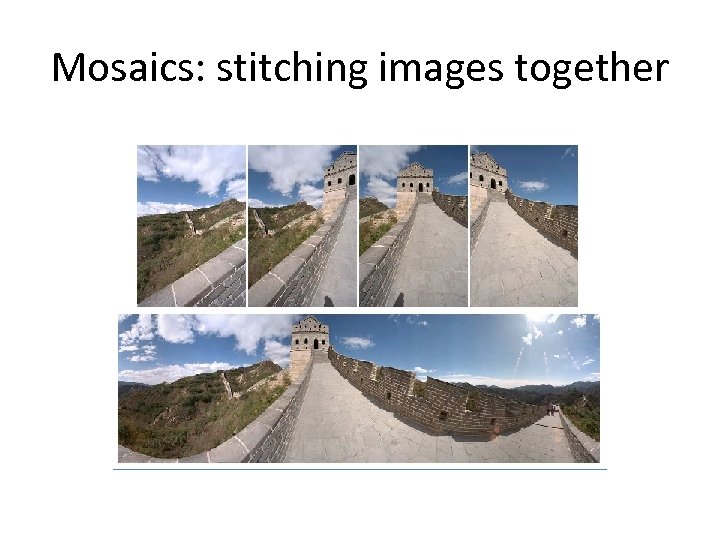 Mosaics: stitching images together
 Readings • Szeliski: – Chapter 3. 5: Image warping – Chapter 5. 1: Feature-based alignment – Chapter 8. 1: Motion models
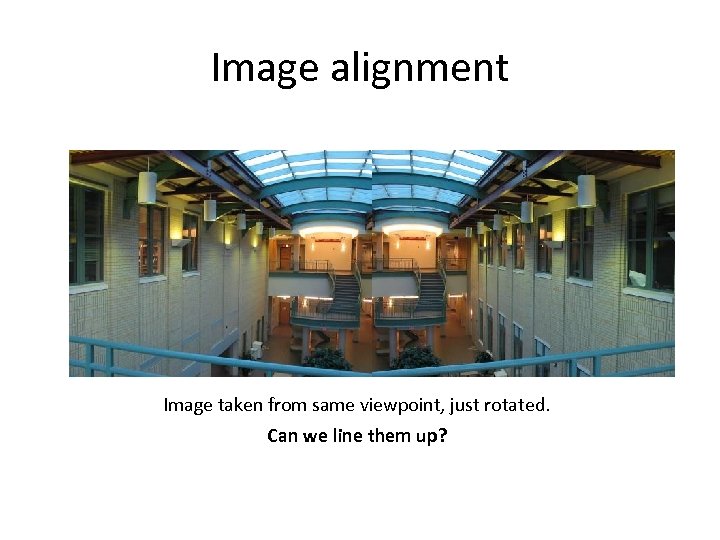 Image alignment Image taken from same viewpoint, just rotated. Can we line them up?
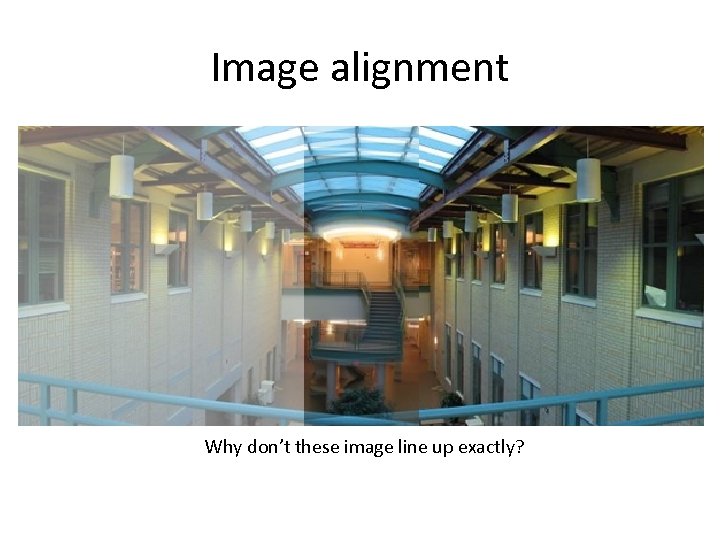 Image alignment Why don’t these image line up exactly?
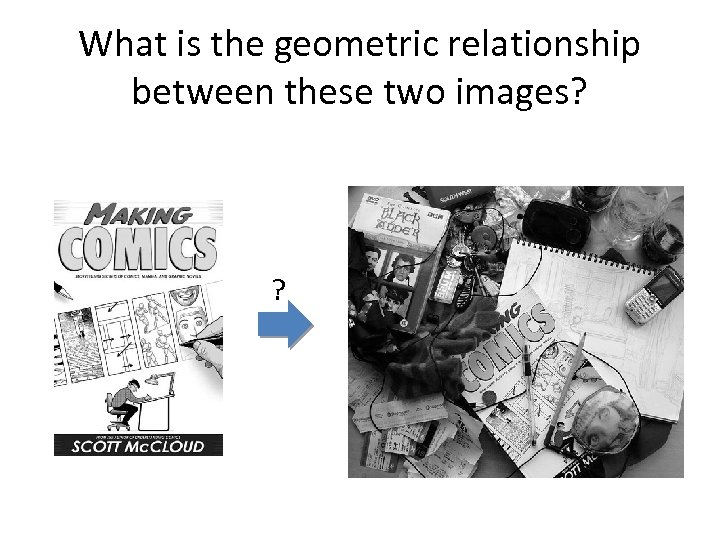 What is the geometric relationship between these two images? ?
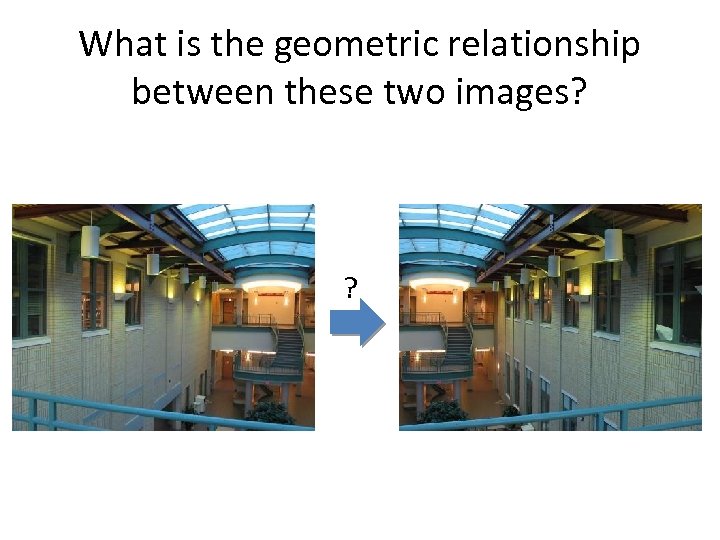 What is the geometric relationship between these two images? ?
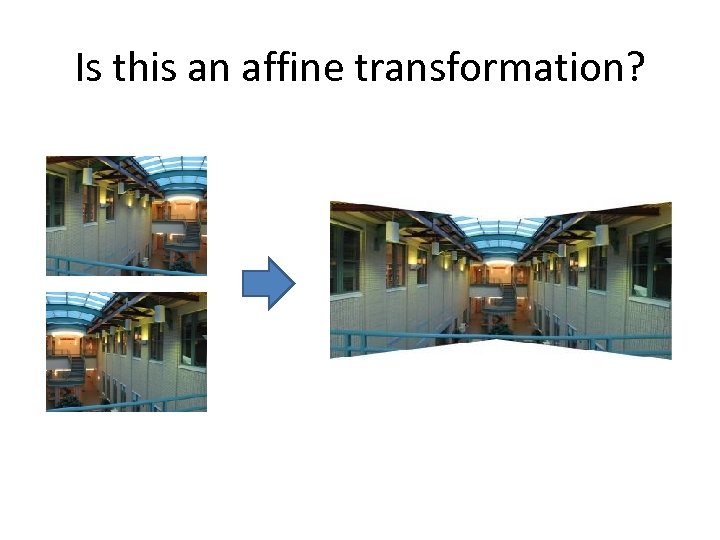 Is this an affine transformation?
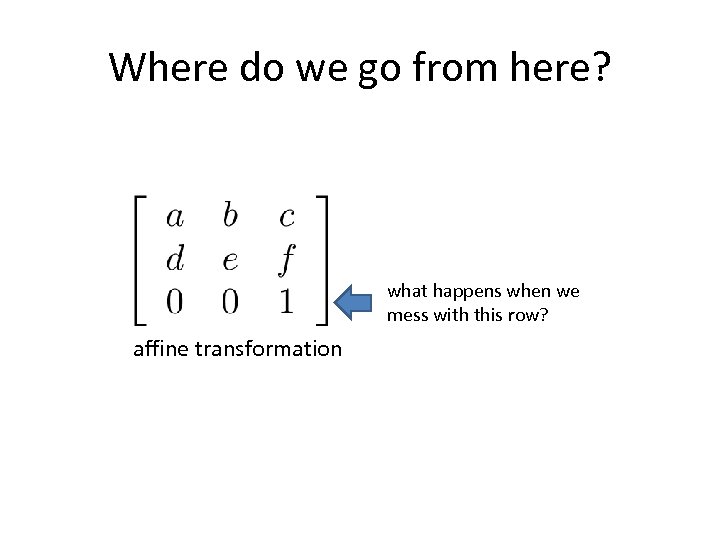 Where do we go from here? what happens when we mess with this row? affine transformation
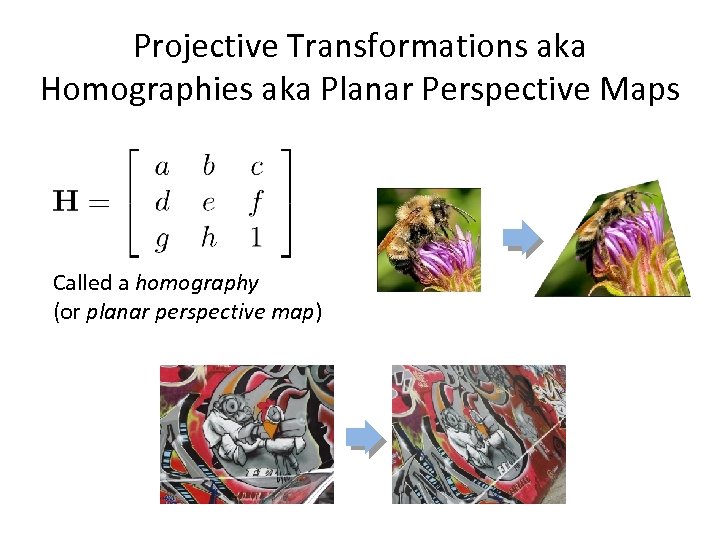 Projective Transformations aka Homographies aka Planar Perspective Maps Called a homography (or planar perspective map)
 Homographies • Example on board