


 Скачать презентацию CS 591 Introduction to Computer Security Lecture 4
dfc6d720f34ebe7413e2a1b4b8a25f9a.ppt
- Количество слайдов: 38
 CS 591: Introduction to Computer Security Lecture 4: Bell La. Padula James Hook
 Objectives • Introduce the Bell La. Padula framework for confidentiality policy • Discuss realizations of Bell La. Padula
 References: • Bell retrospective • Bishop Chapter 5 • Anderson
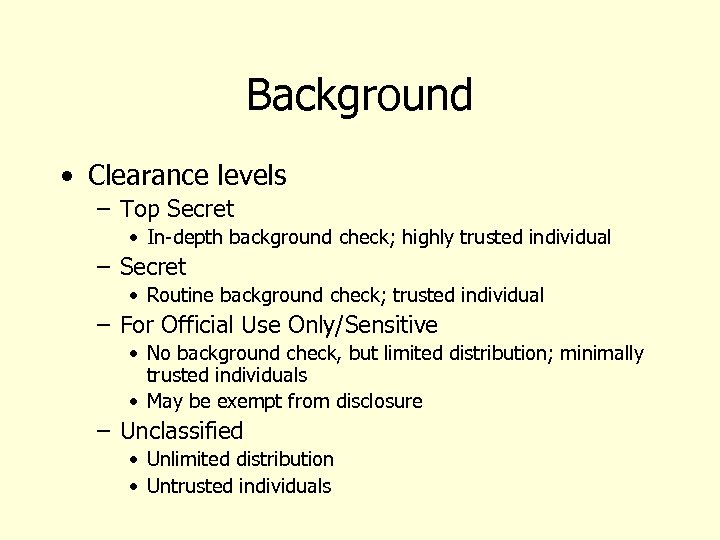 Background • Clearance levels – Top Secret • In-depth background check; highly trusted individual – Secret • Routine background check; trusted individual – For Official Use Only/Sensitive • No background check, but limited distribution; minimally trusted individuals • May be exempt from disclosure – Unclassified • Unlimited distribution • Untrusted individuals
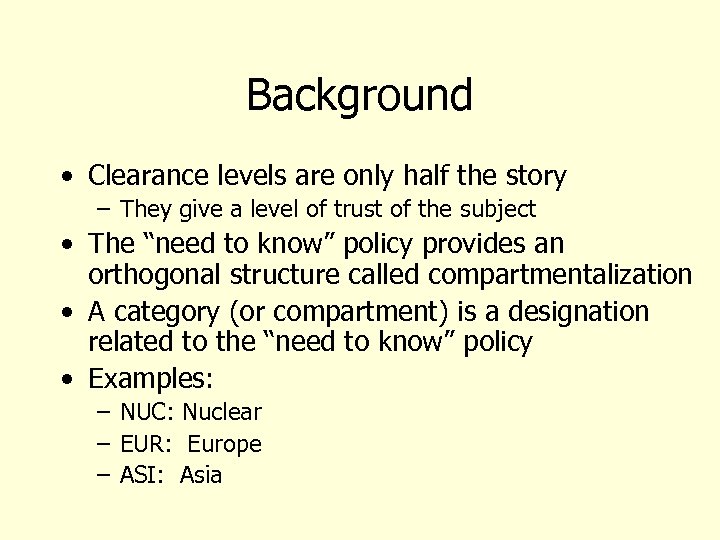 Background • Clearance levels are only half the story – They give a level of trust of the subject • The “need to know” policy provides an orthogonal structure called compartmentalization • A category (or compartment) is a designation related to the “need to know” policy • Examples: – NUC: Nuclear – EUR: Europe – ASI: Asia
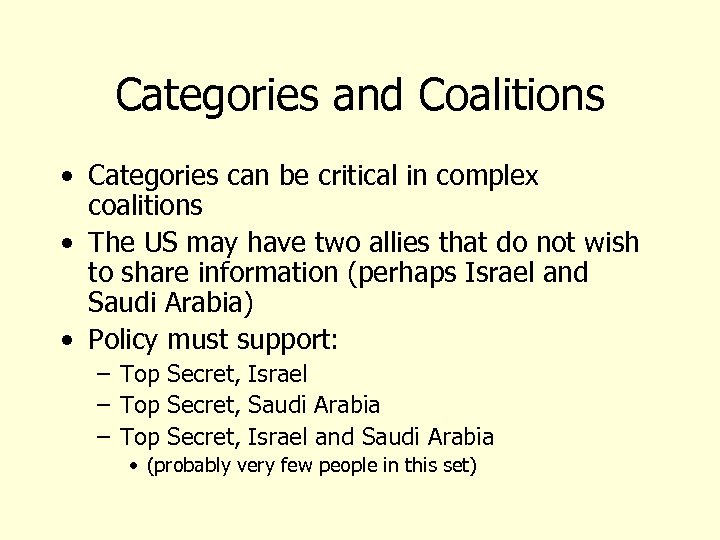 Categories and Coalitions • Categories can be critical in complex coalitions • The US may have two allies that do not wish to share information (perhaps Israel and Saudi Arabia) • Policy must support: – Top Secret, Israel – Top Secret, Saudi Arabia – Top Secret, Israel and Saudi Arabia • (probably very few people in this set)
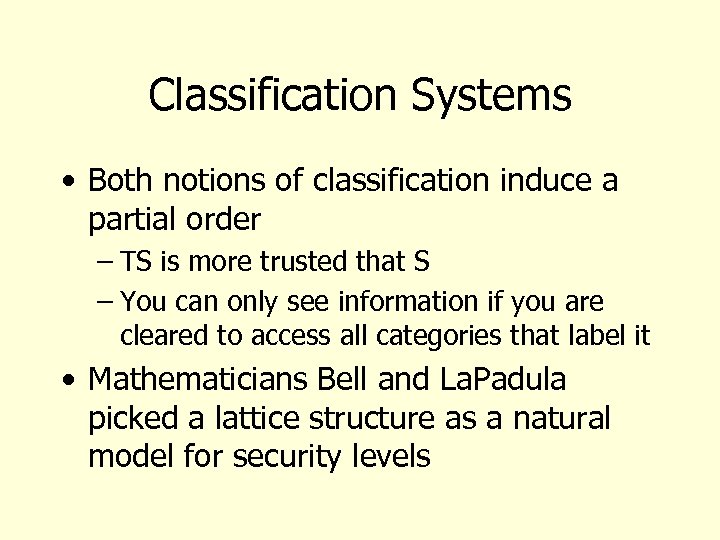 Classification Systems • Both notions of classification induce a partial order – TS is more trusted that S – You can only see information if you are cleared to access all categories that label it • Mathematicians Bell and La. Padula picked a lattice structure as a natural model for security levels
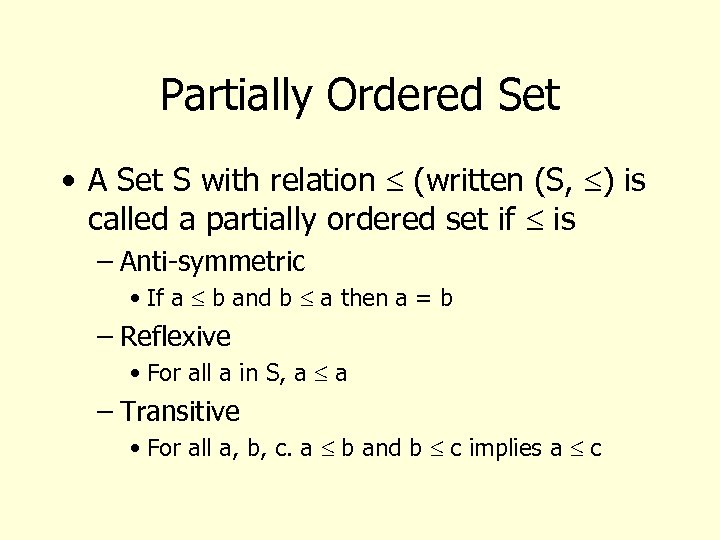 Partially Ordered Set • A Set S with relation (written (S, ) is called a partially ordered set if is – Anti-symmetric • If a b and b a then a = b – Reflexive • For all a in S, a a – Transitive • For all a, b, c. a b and b c implies a c
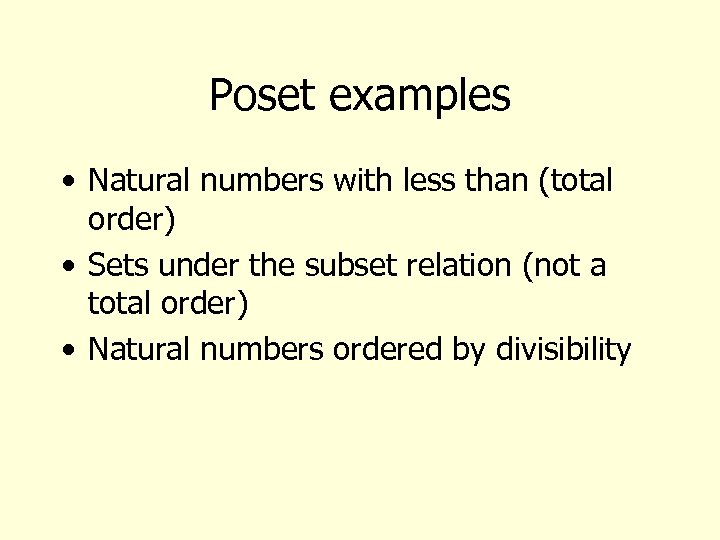 Poset examples • Natural numbers with less than (total order) • Sets under the subset relation (not a total order) • Natural numbers ordered by divisibility
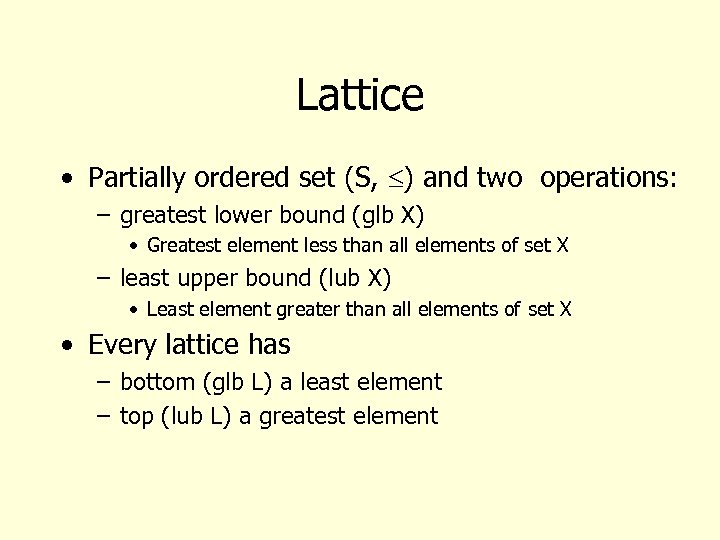 Lattice • Partially ordered set (S, ) and two operations: – greatest lower bound (glb X) • Greatest element less than all elements of set X – least upper bound (lub X) • Least element greater than all elements of set X • Every lattice has – bottom (glb L) a least element – top (lub L) a greatest element
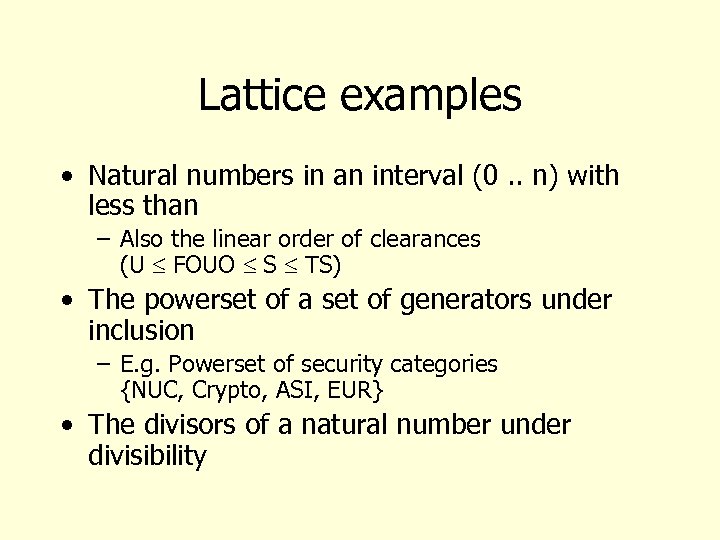 Lattice examples • Natural numbers in an interval (0. . n) with less than – Also the linear order of clearances (U FOUO S TS) • The powerset of a set of generators under inclusion – E. g. Powerset of security categories {NUC, Crypto, ASI, EUR} • The divisors of a natural number under divisibility
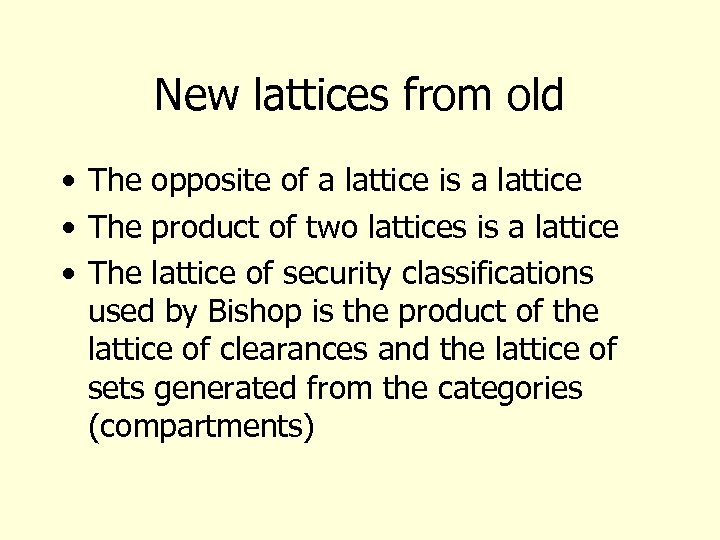 New lattices from old • The opposite of a lattice is a lattice • The product of two lattices is a lattice • The lattice of security classifications used by Bishop is the product of the lattice of clearances and the lattice of sets generated from the categories (compartments)
 Mandatory Access Control • In a MAC system all documents are assigned labels by a set of rules • Documents can only be relabeled under defined special circumstances • Violations of the policy are considered very serious offenses (criminal or treasonous acts)
 Bell La. Padula Context • Pre-Anderson report policy was not to mix data of different classifications on a single system • Still a good idea if it meets your needs • Anderson report identified “on-line multi -level secure operation” as a goal of computer security
 From Paper to Computers • How to apply MAC to computers? • Documents are analogous to objects in Lampson’s Access Control model – Every object can be labeled with a classification • Cleared personnel are analogous to subjects – Every subject can be labeled with a clearance • What about processes?
 Note on subject labels • A person is generally cleared “up to” a level • Cross level communication requires that a person be able to interact below their level of clearance • Subjects are given two labels: – The maximum level – The current level • Current never exceeds maximum • We will focus on static labelings – A subject will not dynamically change their current level
 Bell La. Padula • Task was to propose a theory of multilevel security – supported by a mechanism implemented in an Anderson-style reference monitor – prevents unwanted information flow
 BLP model • Adapt Lampson ACM • Characterize system as state machine • Characterize key actions, such as file system interaction, as transitions – Classify actions as • observation (reads) • alteration (writes) • [Aside: How to classify execute? ] • Show that only “safe states” are reachable
 Simple Security • The simple security property – The current level of a subject dominates the level of every object that it observes • This property strongly analogous to paper systems • It is referred to by the slogan “no read up”
 Problem Figure from Bell 2005
 Problem • Simple Security does not account for alterations (writes) • Another property is needed to characterize alterations
 * - Property Figure from Bell 2005
 *- Property • In any state, if a subject has simultaneous “observe” access to object -1 and “alter” access to object-2, then level (object-1) is dominated by level (object-2). – From BLP 1976, Unified Exposition • Slogan: “No write down”
 Discretionary • In addition to the MAC mechanisms of the simple security and *-properties, the BLP model also has a discretionary component – All accesses must be allowed by both the MAC and discretionary rules
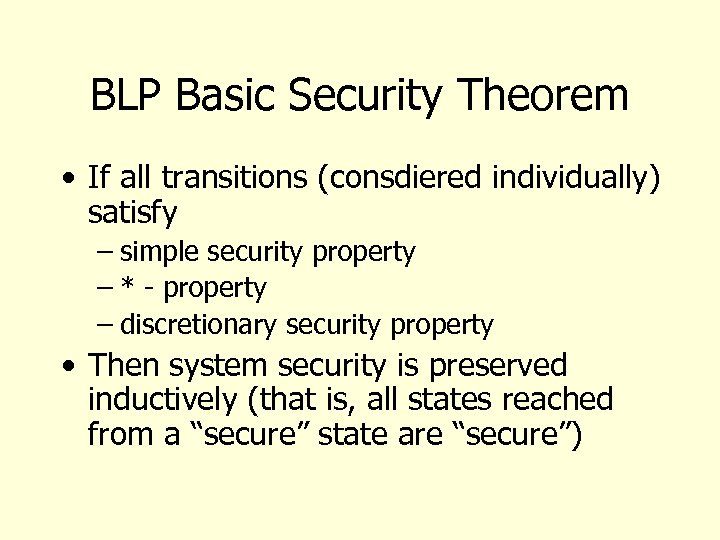 BLP Basic Security Theorem • If all transitions (consdiered individually) satisfy – simple security property – * - property – discretionary security property • Then system security is preserved inductively (that is, all states reached from a “secure” state are “secure”)
 Bell Retrospective • Note: This presentation and Bishop largely follow “unified exposition” • How did the *-property evolve? • Where did current security level come from?
 Bell Discussion • What was the motivating example of a “trusted subject” – Explain the concept – How must the BLP model be adapted? • Bell’s paper changes mode in Section 5 – transitions from description of BLP to reflections on impact – Will return to these topics periodically
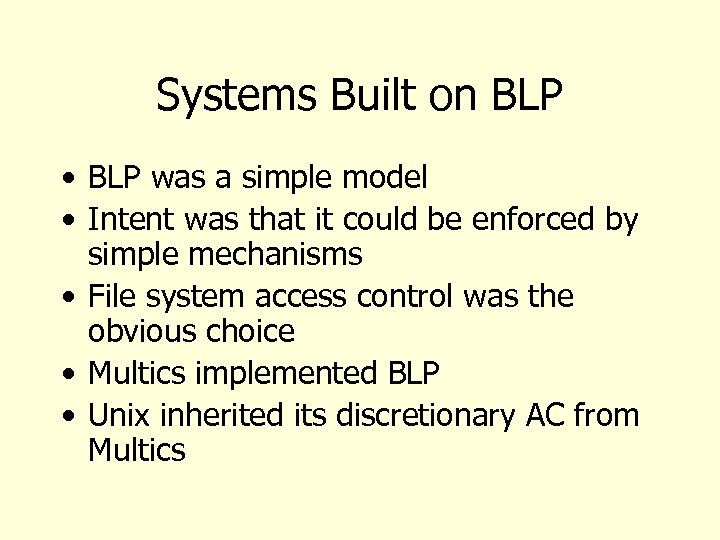 Systems Built on BLP • BLP was a simple model • Intent was that it could be enforced by simple mechanisms • File system access control was the obvious choice • Multics implemented BLP • Unix inherited its discretionary AC from Multics
 BLP in action • Bishop describes Data General B 2 UNIX system in detail – Treatment addresses: • Explicit and implicit labeling (applied to removable media) • Multilevel directory management – Consider challenges of a multilevel /tmp with traditional UNIX compilation tools • MAC Regions (intervals of levels)
 MAC Regions IMPL_HI is “maximum” (least upper bound) of all levels IMPL_LO is “minimum” (greatest lower bound) of all levels Slide from Bishop “ 05. ppt”
 Discussion • When would you choose to apply a model this restrictive?
 Further Reading • Ross Anderson’s Security Engineering, Chapter 7: Multilevel security – Standard Criticisms – Alternative formulations – Several more examples
 Criticisms of Bell La. Padula • BLP is straightforward, supports formal analysis • Is it enough? • Mc. Lean wrote a critical paper asserting BLP rules were insufficient
 Mc. Lean’s System Z • Proposed System Z = BLP + (request for downgrade) • User L gets file H by first requesting that H be downgraded to L and then doing a legal BLP read • Proposed fix: tranquility – Strong: Labels never change during operation – Weak: Labels never change in a manner that would violate a defined policy
 Alternatives • Goguen & Meseguer, 1982: Noninterference – Model computation as event systems – Interleaved or concurrent computation can produce interleaved traces – High actions have no effect on low actions • The trace of a “low trace” of a system is the same for all “high processes” that are added to the mix – Problem: Needs deterministic traces; does not scale to distributed systems
 Nondeducibility • Sutherland, 1986. – Low can not deduce anything about high with 100% certainty – Historically important, hopelessly weak – Addressed issue of nondeterminism in distributed systems
 Intranstitive non-interference • Rushby, 1992 – Updates Goguen & Meseguer to deal with the reality that some communication may be authorized (e. g. High can interefere with low if it is mediated by crypto)
 Looking forward • Chapter 6: Integrity Policies