


 Скачать презентацию CS 544 Lecture 4 Syntax and Compositional Semantics
9e9d6005463baa644406f68d579f466f.ppt
- Количество слайдов: 29
 CS 544: Lecture 4: Syntax and Compositional Semantics of Conjunctions February 16, 2010 Jerry R. Hobbs USC/ISI Marina del Rey, CA
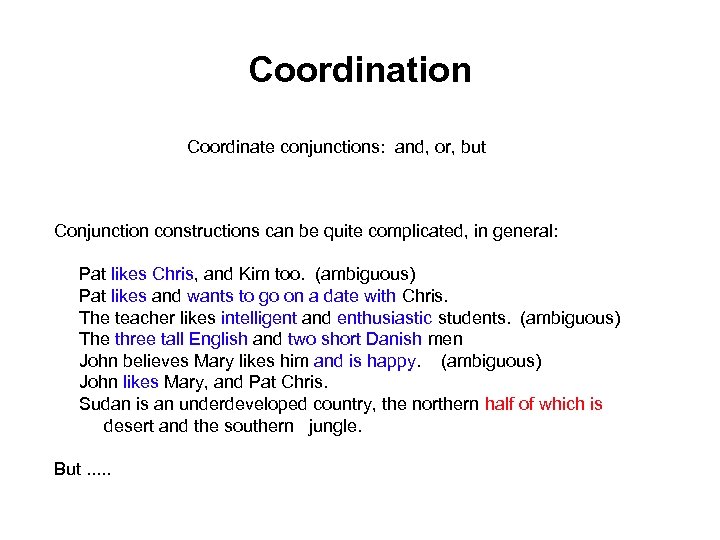 Coordination Coordinate conjunctions: and, or, but Conjunction constructions can be quite complicated, in general: Pat likes Chris, and Kim too. (ambiguous) Pat likes and wants to go on a date with Chris. The teacher likes intelligent and enthusiastic students. (ambiguous) The three tall English and two short Danish men John believes Mary likes him and is happy. (ambiguous) John likes Mary, and Pat Chris. Sudan is an underdeveloped country, the northern half of which is desert and the southern jungle. But. . .
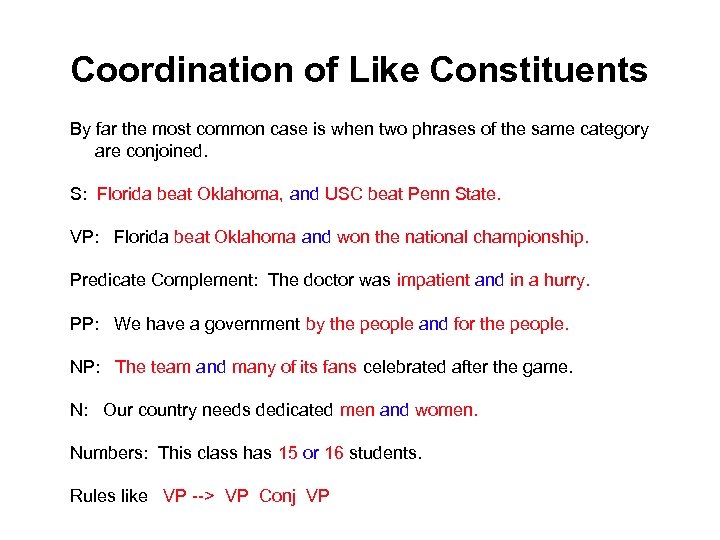 Coordination of Like Constituents By far the most common case is when two phrases of the same category are conjoined. S: Florida beat Oklahoma, and USC beat Penn State. VP: Florida beat Oklahoma and won the national championship. Predicate Complement: The doctor was impatient and in a hurry. PP: We have a government by the people and for the people. NP: The team and many of its fans celebrated after the game. N: Our country needs dedicated men and women. Numbers: This class has 15 or 16 students. Rules like VP --> VP Conj VP
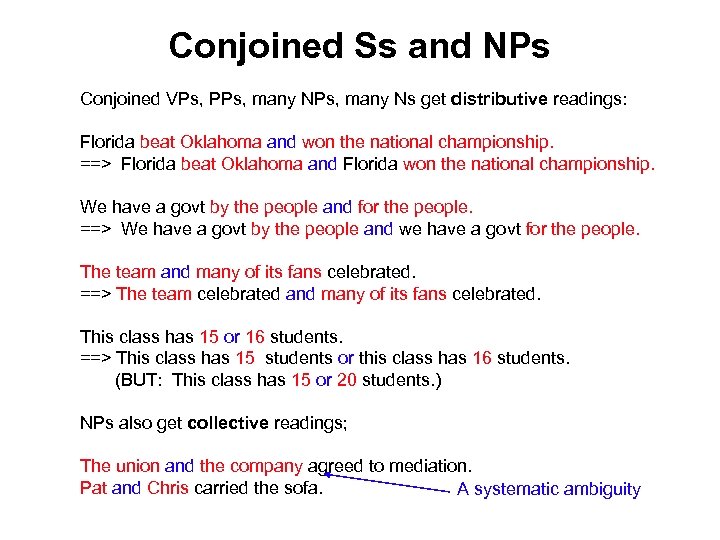 Conjoined Ss and NPs Conjoined VPs, PPs, many Ns get distributive readings: Florida beat Oklahoma and won the national championship. ==> Florida beat Oklahoma and Florida won the national championship. We have a govt by the people and for the people. ==> We have a govt by the people and we have a govt for the people. The team and many of its fans celebrated. ==> The team celebrated and many of its fans celebrated. This class has 15 or 16 students. ==> This class has 15 students or this class has 16 students. (BUT: This class has 15 or 20 students. ) NPs also get collective readings; The union and the company agreed to mediation. Pat and Chris carried the sofa. A systematic ambiguity
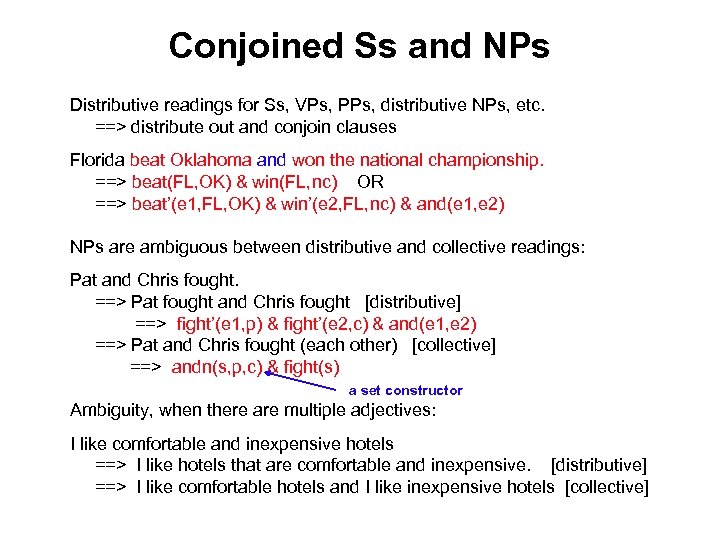 Conjoined Ss and NPs Distributive readings for Ss, VPs, PPs, distributive NPs, etc. ==> distribute out and conjoin clauses Florida beat Oklahoma and won the national championship. ==> beat(FL, OK) & win(FL, nc) OR ==> beat’(e 1, FL, OK) & win’(e 2, FL, nc) & and(e 1, e 2) NPs are ambiguous between distributive and collective readings: Pat and Chris fought. ==> Pat fought and Chris fought [distributive] ==> fight’(e 1, p) & fight’(e 2, c) & and(e 1, e 2) ==> Pat and Chris fought (each other) [collective] ==> andn(s, p, c) & fight(s) a set constructor Ambiguity, when there are multiple adjectives: I like comfortable and inexpensive hotels ==> I like hotels that are comfortable and inexpensive. [distributive] ==> I like comfortable hotels and I like inexpensive hotels [collective]
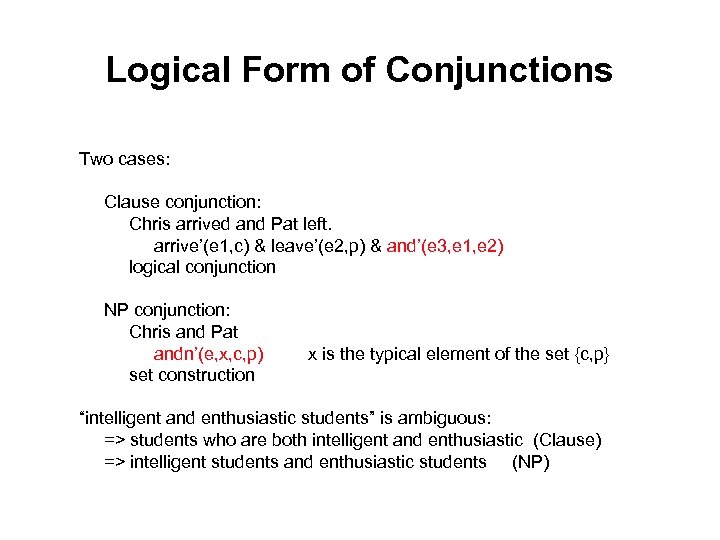 Logical Form of Conjunctions Two cases: Clause conjunction: Chris arrived and Pat left. arrive’(e 1, c) & leave’(e 2, p) & and’(e 3, e 1, e 2) logical conjunction NP conjunction: Chris and Pat andn’(e, x, c, p) set construction x is the typical element of the set {c, p} “intelligent and enthusiastic students” is ambiguous: => students who are both intelligent and enthusiastic (Clause) => intelligent students and enthusiastic students (NP)
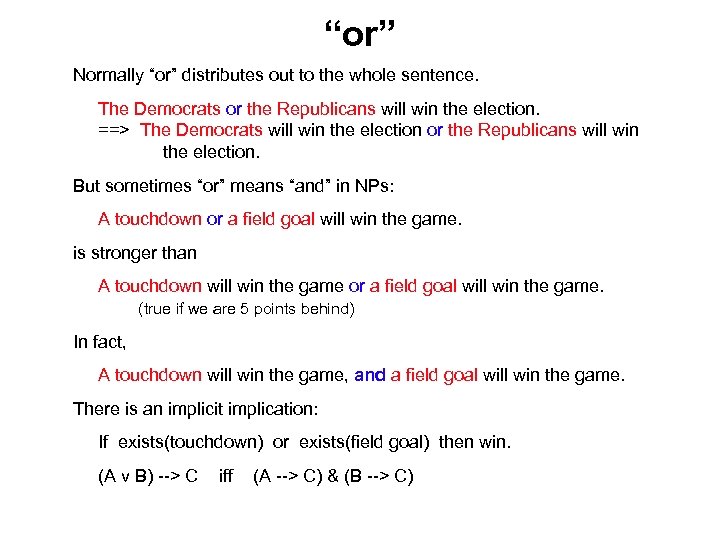 “or” Normally “or” distributes out to the whole sentence. The Democrats or the Republicans will win the election. ==> The Democrats will win the election or the Republicans will win the election. But sometimes “or” means “and” in NPs: A touchdown or a field goal will win the game. is stronger than A touchdown will win the game or a field goal will win the game. (true if we are 5 points behind) In fact, A touchdown will win the game, and a field goal will win the game. There is an implicit implication: If exists(touchdown) or exists(field goal) then win. (A v B) --> C iff (A --> C) & (B --> C)
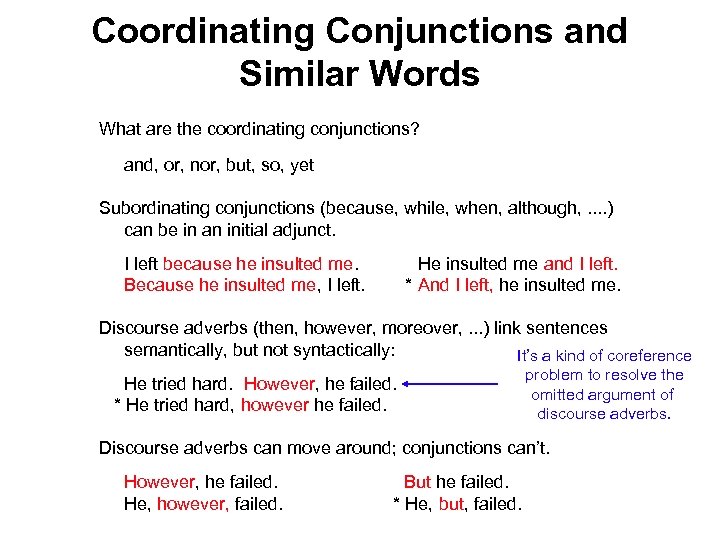 Coordinating Conjunctions and Similar Words What are the coordinating conjunctions? and, or, nor, but, so, yet Subordinating conjunctions (because, while, when, although, . . ) can be in an initial adjunct. I left because he insulted me. Because he insulted me, I left. He insulted me and I left. * And I left, he insulted me. Discourse adverbs (then, however, moreover, . . . ) link sentences semantically, but not syntactically: It’s a kind of coreference He tried hard. However, he failed. * He tried hard, however he failed. problem to resolve the omitted argument of discourse adverbs. Discourse adverbs can move around; conjunctions can’t. However, he failed. He, however, failed. But he failed. * He, but, failed.
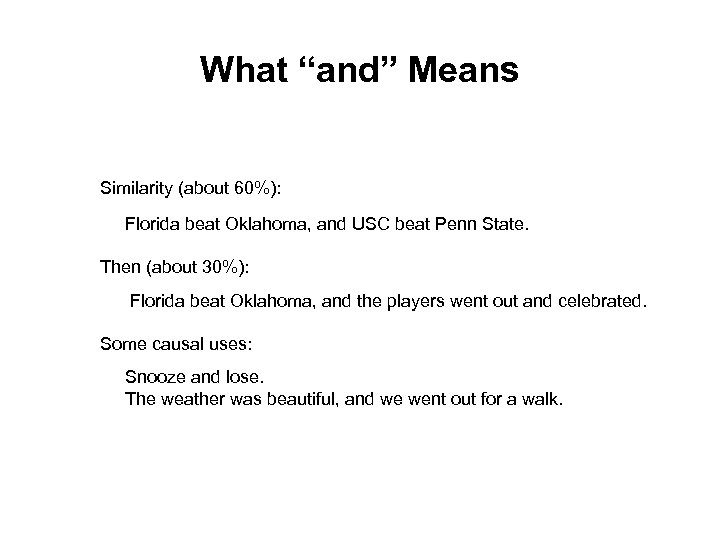 What “and” Means Similarity (about 60%): Florida beat Oklahoma, and USC beat Penn State. Then (about 30%): Florida beat Oklahoma, and the players went out and celebrated. Some causal uses: Snooze and lose. The weather was beautiful, and we went out for a walk.
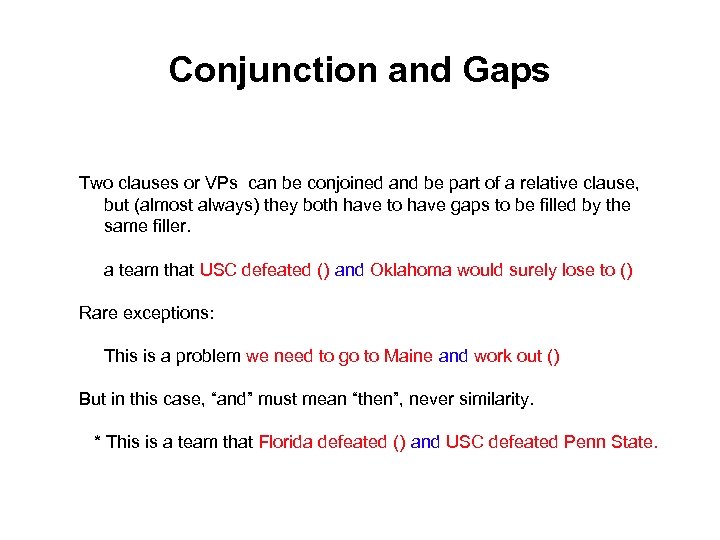 Conjunction and Gaps Two clauses or VPs can be conjoined and be part of a relative clause, but (almost always) they both have to have gaps to be filled by the same filler. a team that USC defeated () and Oklahoma would surely lose to () Rare exceptions: This is a problem we need to go to Maine and work out () But in this case, “and” must mean “then”, never similarity. * This is a team that Florida defeated () and USC defeated Penn State.
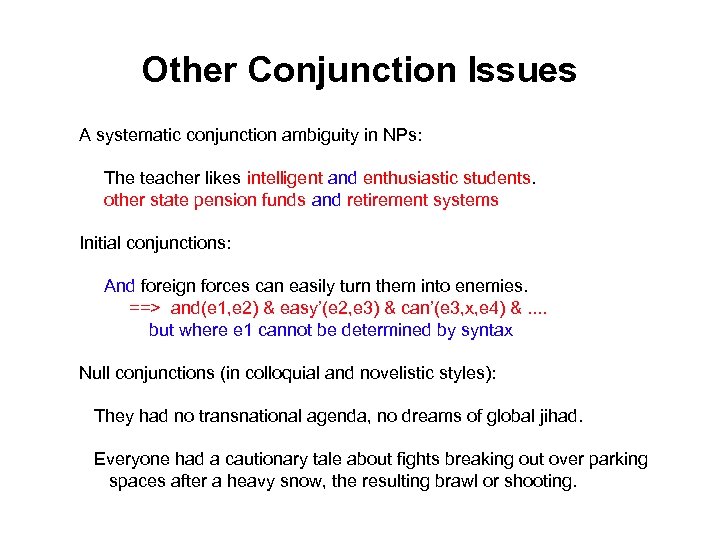 Other Conjunction Issues A systematic conjunction ambiguity in NPs: The teacher likes intelligent and enthusiastic students. other state pension funds and retirement systems Initial conjunctions: And foreign forces can easily turn them into enemies. ==> and(e 1, e 2) & easy’(e 2, e 3) & can’(e 3, x, e 4) &. . but where e 1 cannot be determined by syntax Null conjunctions (in colloquial and novelistic styles): They had no transnational agenda, no dreams of global jihad. Everyone had a cautionary tale about fights breaking out over parking spaces after a heavy snow, the resulting brawl or shooting.
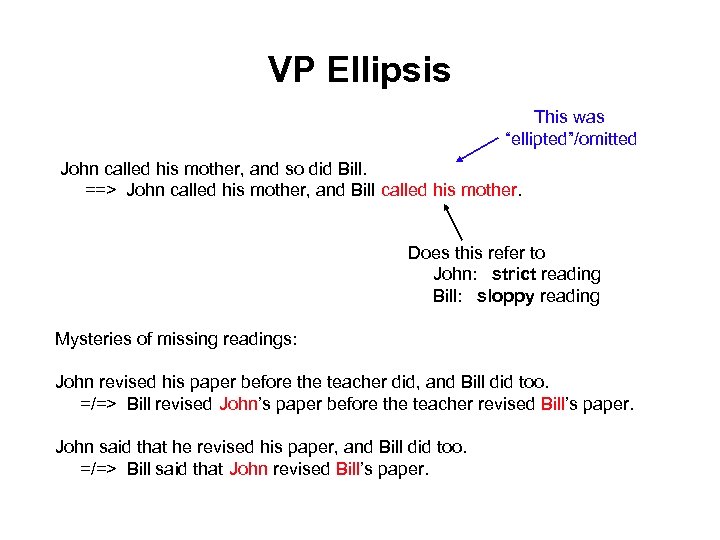 VP Ellipsis This was “ellipted”/omitted John called his mother, and so did Bill. ==> John called his mother, and Bill called his mother. Does this refer to John: strict reading Bill: sloppy reading Mysteries of missing readings: John revised his paper before the teacher did, and Bill did too. =/=> Bill revised John’s paper before the teacher revised Bill’s paper. John said that he revised his paper, and Bill did too. =/=> Bill said that John revised Bill’s paper.
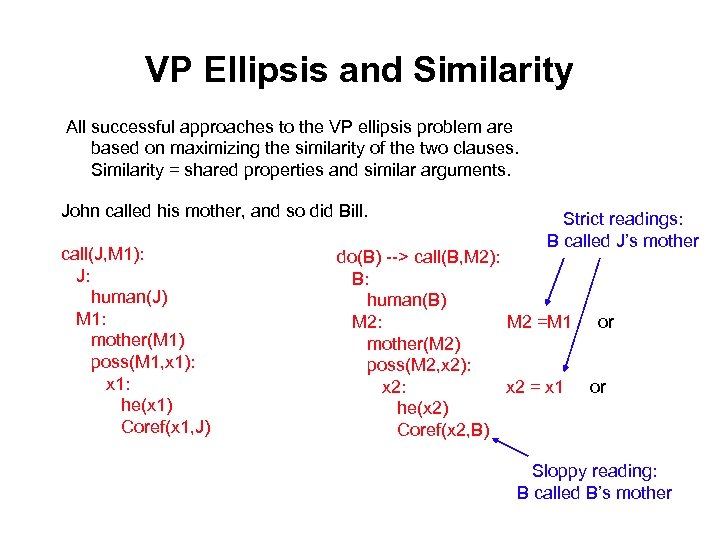 VP Ellipsis and Similarity All successful approaches to the VP ellipsis problem are based on maximizing the similarity of the two clauses. Similarity = shared properties and similar arguments. John called his mother, and so did Bill. call(J, M 1): J: human(J) M 1: mother(M 1) poss(M 1, x 1): x 1: he(x 1) Coref(x 1, J) Strict readings: B called J’s mother do(B) --> call(B, M 2): B: human(B) M 2: M 2 =M 1 or mother(M 2) poss(M 2, x 2): x 2 = x 1 or he(x 2) Coref(x 2, B) Sloppy reading: B called B’s mother
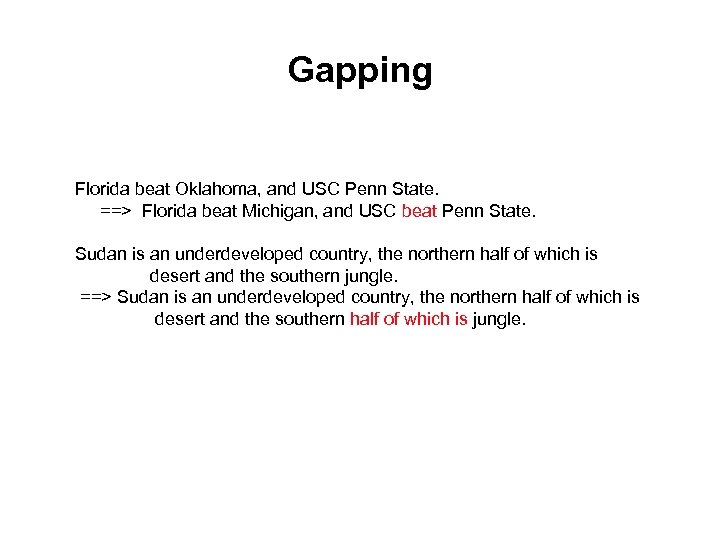 Gapping Florida beat Oklahoma, and USC Penn State. ==> Florida beat Michigan, and USC beat Penn State. Sudan is an underdeveloped country, the northern half of which is desert and the southern jungle. ==> Sudan is an underdeveloped country, the northern half of which is desert and the southern half of which is jungle.
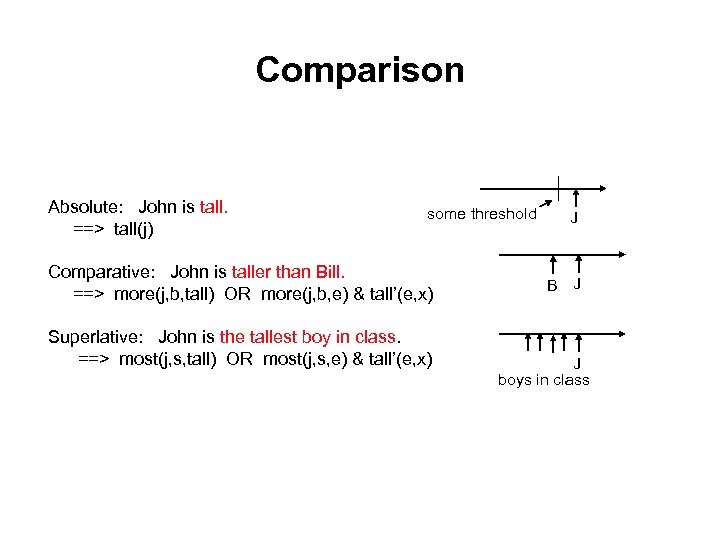 Comparison Absolute: John is tall. ==> tall(j) some threshold Comparative: John is taller than Bill. ==> more(j, b, tall) OR more(j, b, e) & tall’(e, x) Superlative: John is the tallest boy in class. ==> most(j, s, tall) OR most(j, s, e) & tall’(e, x) J B J J boys in class
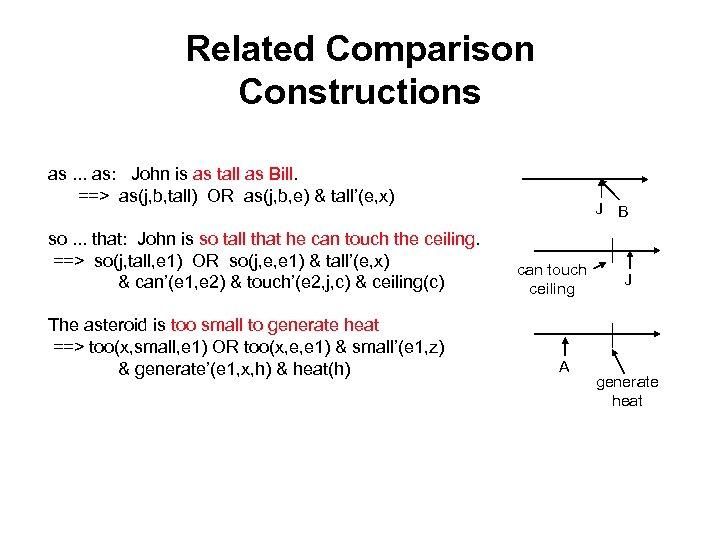 Related Comparison Constructions as. . . as: John is as tall as Bill. ==> as(j, b, tall) OR as(j, b, e) & tall’(e, x) so. . . that: John is so tall that he can touch the ceiling. ==> so(j, tall, e 1) OR so(j, e, e 1) & tall’(e, x) & can’(e 1, e 2) & touch’(e 2, j, c) & ceiling(c) The asteroid is too small to generate heat ==> too(x, small, e 1) OR too(x, e, e 1) & small’(e 1, z) & generate’(e 1, x, h) & heat(h) J B can touch ceiling A J generate heat
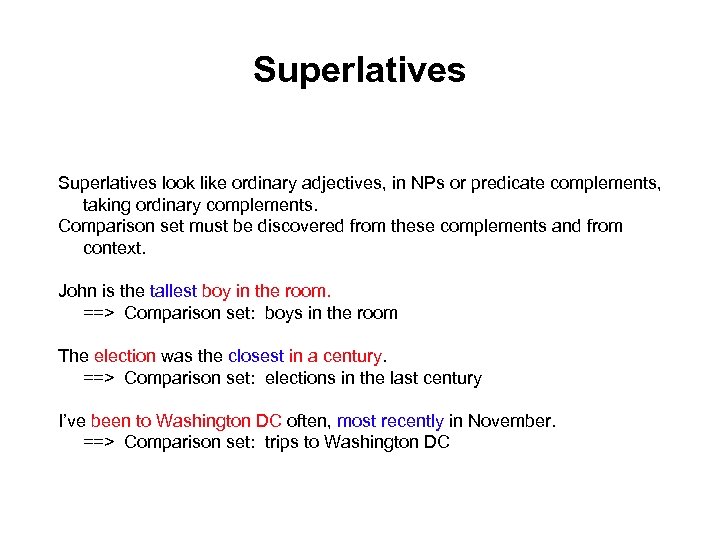 Superlatives look like ordinary adjectives, in NPs or predicate complements, taking ordinary complements. Comparison set must be discovered from these complements and from context. John is the tallest boy in the room. ==> Comparison set: boys in the room The election was the closest in a century. ==> Comparison set: elections in the last century I’ve been to Washington DC often, most recently in November. ==> Comparison set: trips to Washington DC
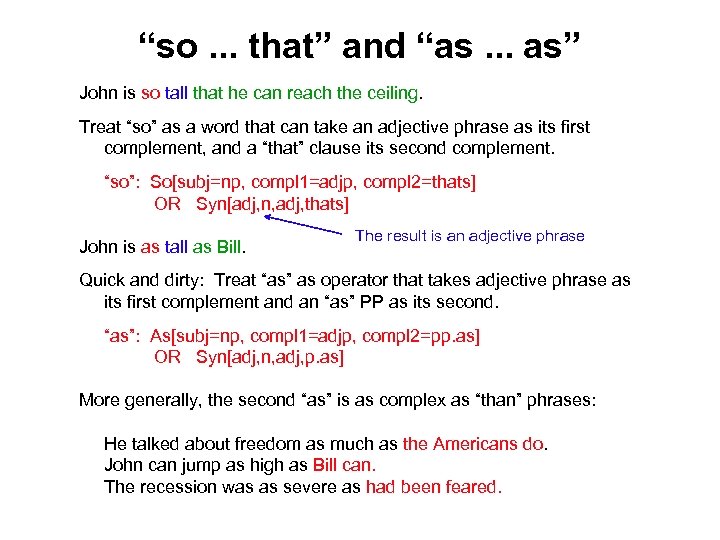 “so. . . that” and “as. . . as” John is so tall that he can reach the ceiling. Treat “so” as a word that can take an adjective phrase as its first complement, and a “that” clause its second complement. “so”: So[subj=np, compl 1=adjp, compl 2=thats] OR Syn[adj, n, adj, thats] John is as tall as Bill. The result is an adjective phrase Quick and dirty: Treat “as” as operator that takes adjective phrase as its first complement and an “as” PP as its second. “as”: As[subj=np, compl 1=adjp, compl 2=pp. as] OR Syn[adj, n, adj, p. as] More generally, the second “as” is as complex as “than” phrases: He talked about freedom as much as the Americans do. John can jump as high as Bill can. The recession was as severe as had been feared.
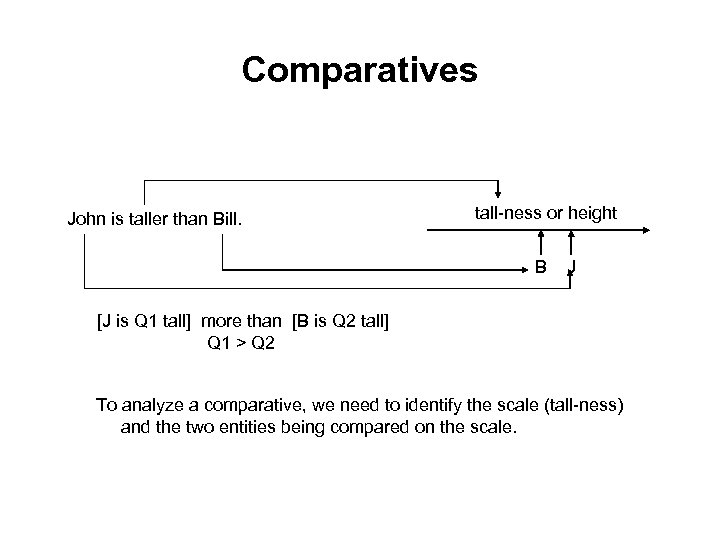 Comparatives John is taller than Bill. tall-ness or height B J [J is Q 1 tall] more than [B is Q 2 tall] Q 1 > Q 2 To analyze a comparative, we need to identify the scale (tall-ness) and the two entities being compared on the scale.
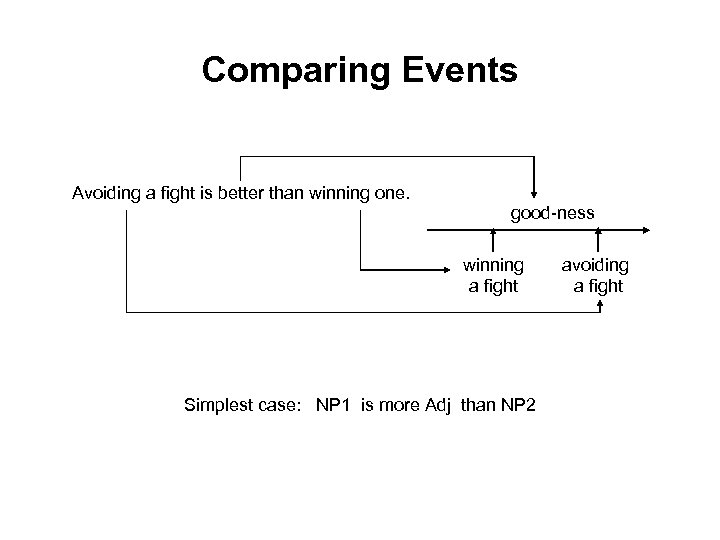 Comparing Events Avoiding a fight is better than winning one. good-ness winning a fight Simplest case: NP 1 is more Adj than NP 2 avoiding a fight
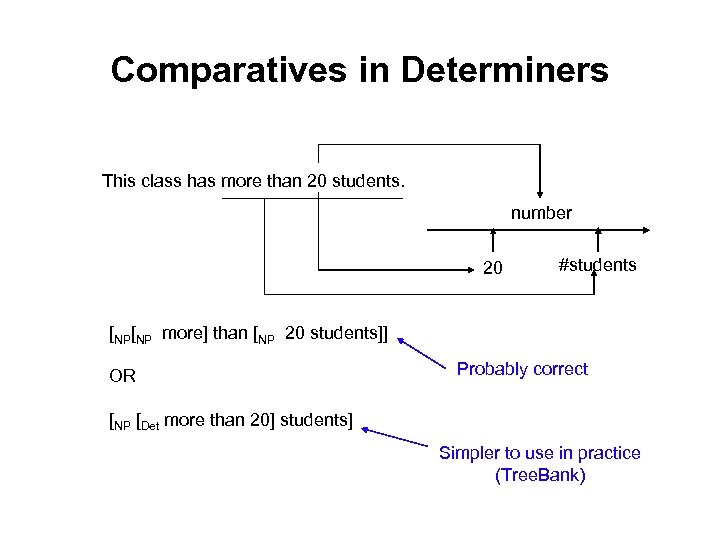 Comparatives in Determiners This class has more than 20 students. number 20 #students [NP[NP more] than [NP 20 students]] OR Probably correct [NP [Det more than 20] students] Simpler to use in practice (Tree. Bank)
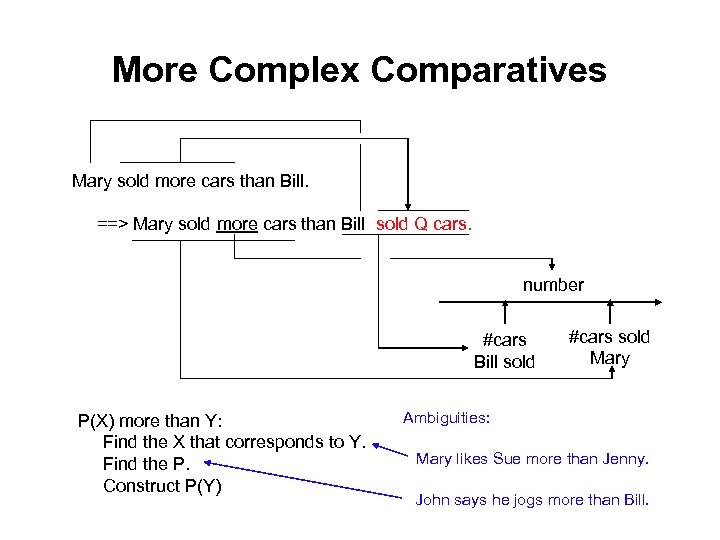 More Complex Comparatives Mary sold more cars than Bill. ==> Mary sold more cars than Bill sold Q cars. number #cars Bill sold P(X) more than Y: Find the X that corresponds to Y. Find the P. Construct P(Y) #cars sold Mary Ambiguities: Mary likes Sue more than Jenny. John says he jogs more than Bill.
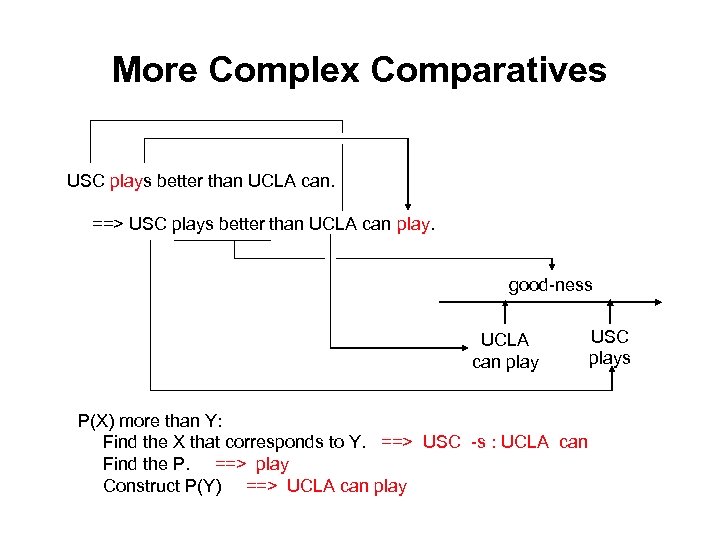 More Complex Comparatives USC plays better than UCLA can. ==> USC plays better than UCLA can play. good-ness UCLA can play P(X) more than Y: Find the X that corresponds to Y. ==> USC -s : UCLA can Find the P. ==> play Construct P(Y) ==> UCLA can play USC plays
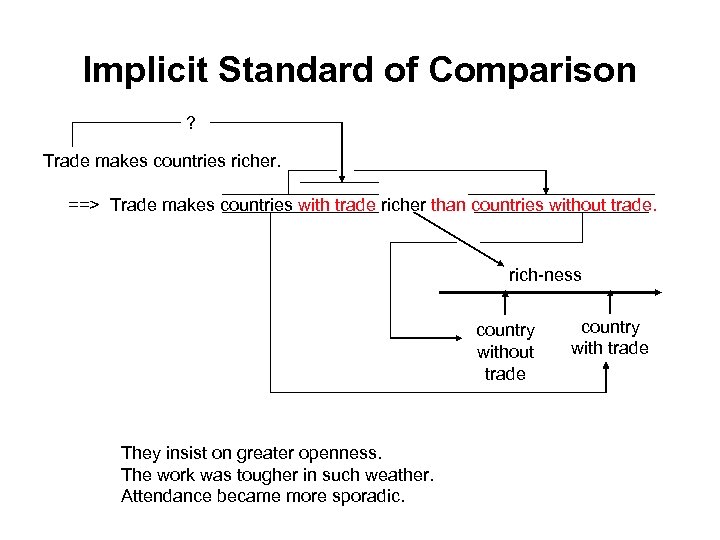 Implicit Standard of Comparison ? Trade makes countries richer. ==> Trade makes countries with trade richer than countries without trade. rich-ness country without trade They insist on greater openness. The work was tougher in such weather. Attendance became more sporadic. country with trade
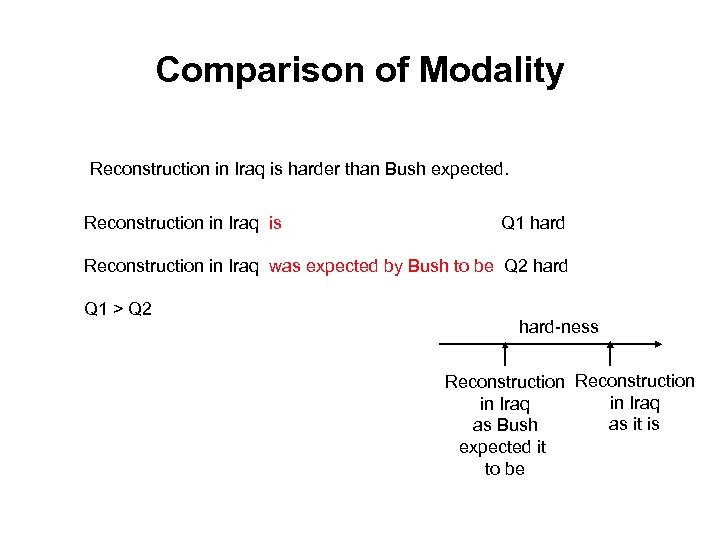 Comparison of Modality Reconstruction in Iraq is harder than Bush expected. Reconstruction in Iraq is Q 1 hard Reconstruction in Iraq was expected by Bush to be Q 2 hard Q 1 > Q 2 hard-ness Reconstruction in Iraq as it is as Bush expected it to be
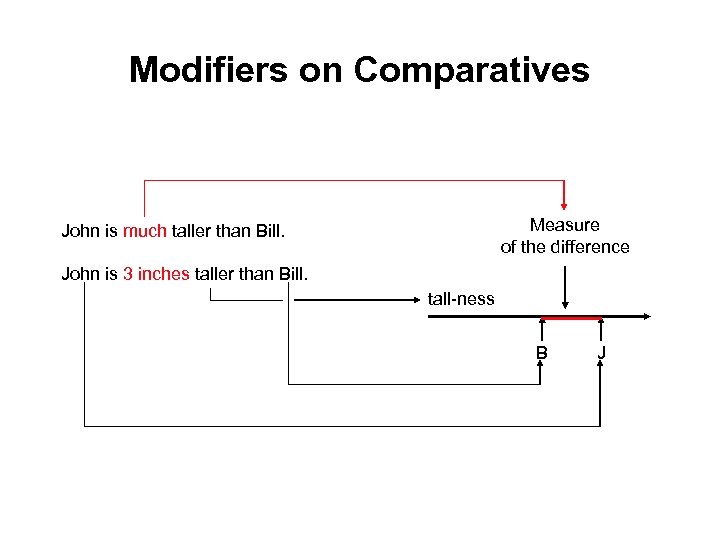 Modifiers on Comparatives Measure of the difference John is much taller than Bill. John is 3 inches taller than Bill. tall-ness B J
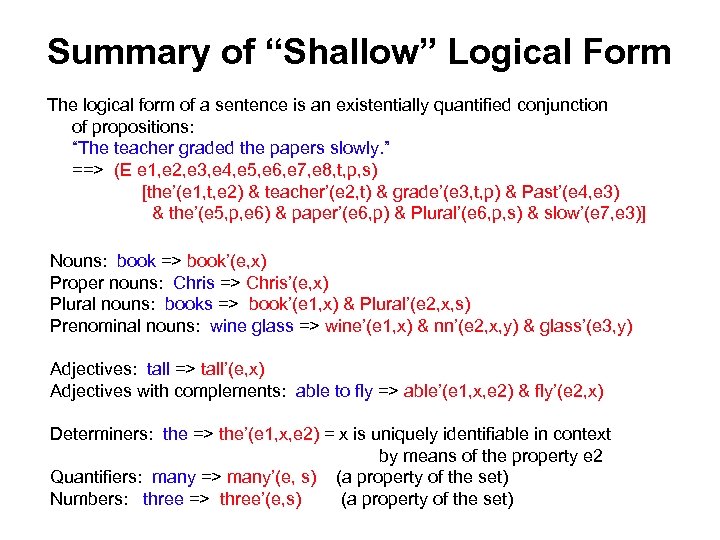 Summary of “Shallow” Logical Form The logical form of a sentence is an existentially quantified conjunction of propositions: “The teacher graded the papers slowly. ” ==> (E e 1, e 2, e 3, e 4, e 5, e 6, e 7, e 8, t, p, s) [the’(e 1, t, e 2) & teacher’(e 2, t) & grade’(e 3, t, p) & Past’(e 4, e 3) & the’(e 5, p, e 6) & paper’(e 6, p) & Plural’(e 6, p, s) & slow’(e 7, e 3)] Nouns: book => book’(e, x) Proper nouns: Chris => Chris’(e, x) Plural nouns: books => book’(e 1, x) & Plural’(e 2, x, s) Prenominal nouns: wine glass => wine’(e 1, x) & nn’(e 2, x, y) & glass’(e 3, y) Adjectives: tall => tall’(e, x) Adjectives with complements: able to fly => able’(e 1, x, e 2) & fly’(e 2, x) Determiners: the => the’(e 1, x, e 2) = x is uniquely identifiable in context by means of the property e 2 Quantifiers: many => many’(e, s) (a property of the set) Numbers: three => three’(e, s) (a property of the set)
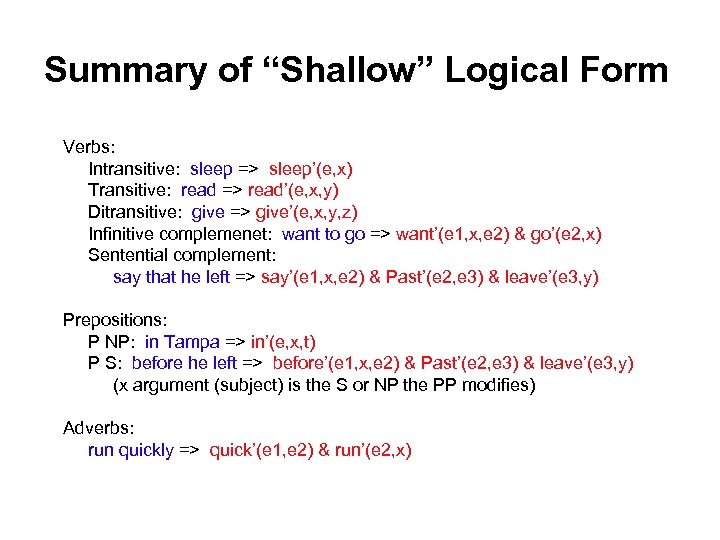 Summary of “Shallow” Logical Form Verbs: Intransitive: sleep => sleep’(e, x) Transitive: read => read’(e, x, y) Ditransitive: give => give’(e, x, y, z) Infinitive complemenet: want to go => want’(e 1, x, e 2) & go’(e 2, x) Sentential complement: say that he left => say’(e 1, x, e 2) & Past’(e 2, e 3) & leave’(e 3, y) Prepositions: P NP: in Tampa => in’(e, x, t) P S: before he left => before’(e 1, x, e 2) & Past’(e 2, e 3) & leave’(e 3, y) (x argument (subject) is the S or NP the PP modifies) Adverbs: run quickly => quick’(e 1, e 2) & run’(e 2, x)
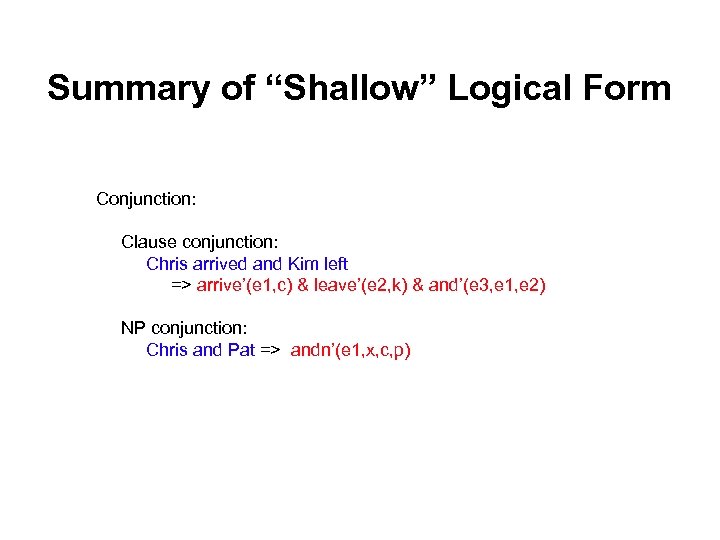 Summary of “Shallow” Logical Form Conjunction: Clause conjunction: Chris arrived and Kim left => arrive’(e 1, c) & leave’(e 2, k) & and’(e 3, e 1, e 2) NP conjunction: Chris and Pat => andn’(e 1, x, c, p)