


 Скачать презентацию CS 544 Lecture 3 5 Discourse Coherence Jerry
a9f9daa71481e457f2e39a880cd3b958.ppt
- Количество слайдов: 65
 CS 544: Lecture 3. 5 Discourse Coherence Jerry R. Hobbs USC/ISI Marina del Rey, CA
 Outline Interpreting Adjacency What Coherence Relations are there? Definitions and Examples of Specific Coherence Relations Discourse Structure
 Interpretation To understand our environment, we seek the best explanation of the observable facts. To understand a text, we seek the best explanation of the "observable facts" that the text presents.
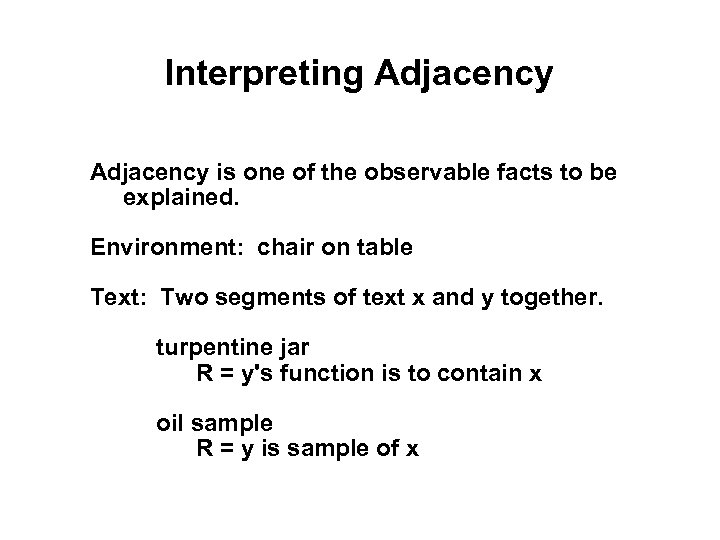 Interpreting Adjacency is one of the observable facts to be explained. Environment: chair on table Text: Two segments of text x and y together. turpentine jar R = y's function is to contain x oil sample R = y is sample of x
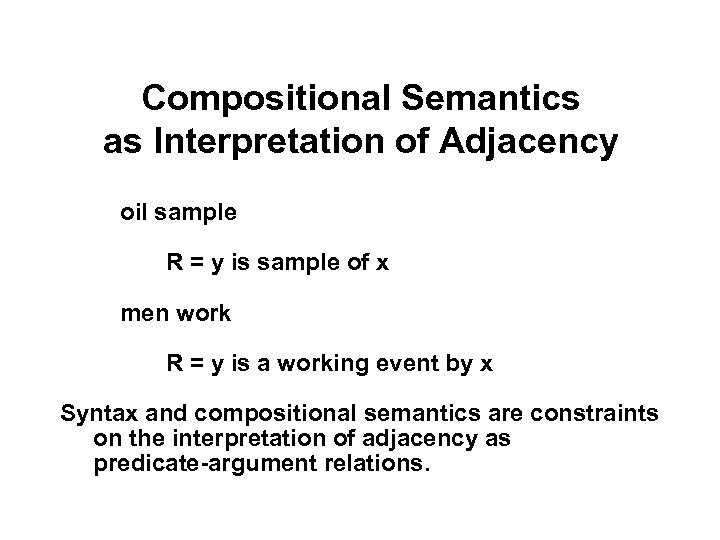 Compositional Semantics as Interpretation of Adjacency oil sample R = y is sample of x men work R = y is a working event by x Syntax and compositional semantics are constraints on the interpretation of adjacency as predicate-argument relations.
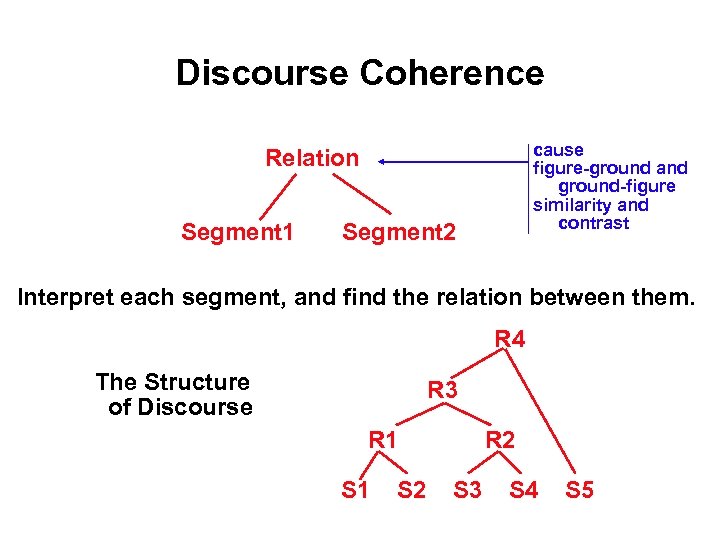
 Discourse Coherence John can open Bill's safe. He knows the combination. Interpreting text includes explaining the adjacency of clauses, sentences, and larger segments of discourse. = Finding relation between adjacent segments
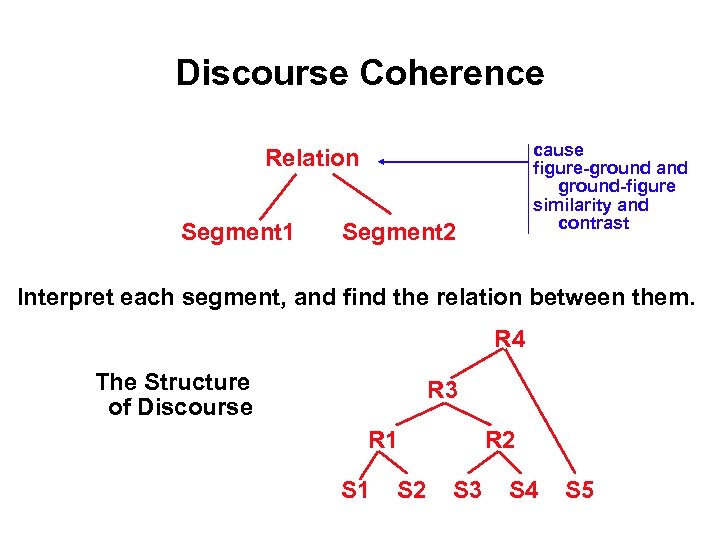 Discourse Coherence cause figure-ground and ground-figure similarity and contrast Relation Segment 1 Segment 2 Interpret each segment, and find the relation between them. R 4 The Structure of Discourse R 3 R 1 S 2 R 2 S 3 S 4 S 5
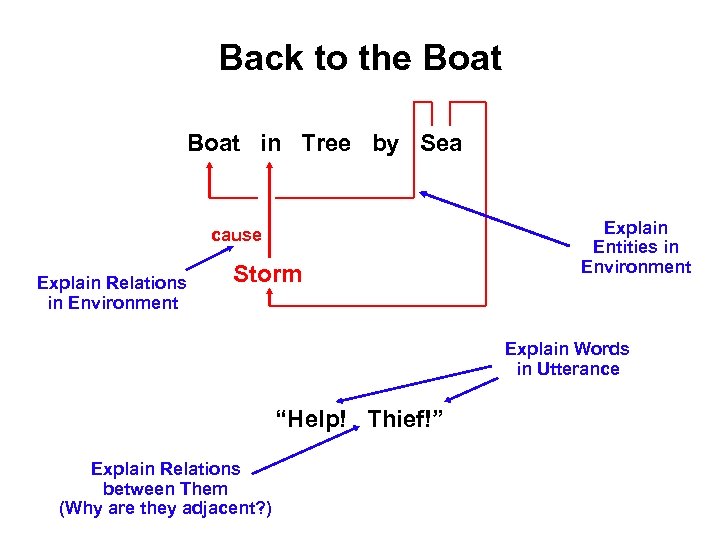 Back to the Boat in Tree by Sea cause Explain Relations in Environment Storm Explain Entities in Environment Explain Words in Utterance “Help! Thief!” Explain Relations between Them (Why are they adjacent? )
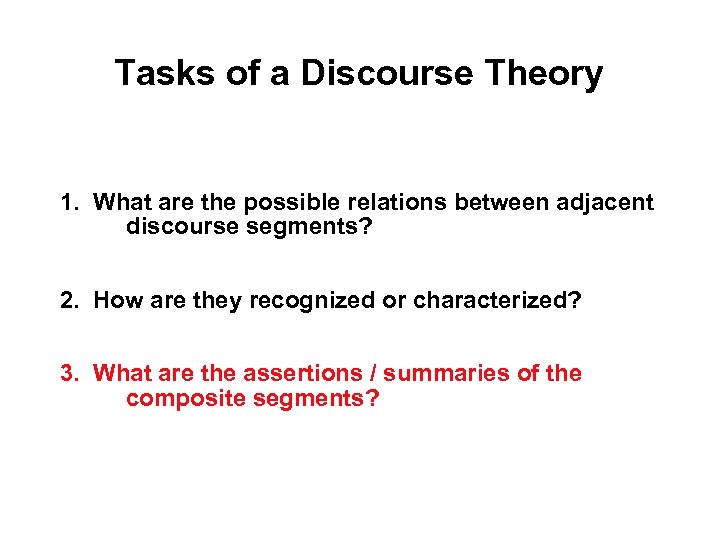
 Tasks of a Discourse Theory 1. What are the possible relations between adjacent discourse segments? 2. How are they recognized or characterized?
 Interpreting Adjacent Sentences Sentence-1 Sentence-2 Relation between Event Possible Relations: Cause Similarity Background. . . Coherence Relations
 Outline Interpreting Adjacency What Coherence Relations are there? Definitions and Examples of Specific Coherence Relations Discourse Structure
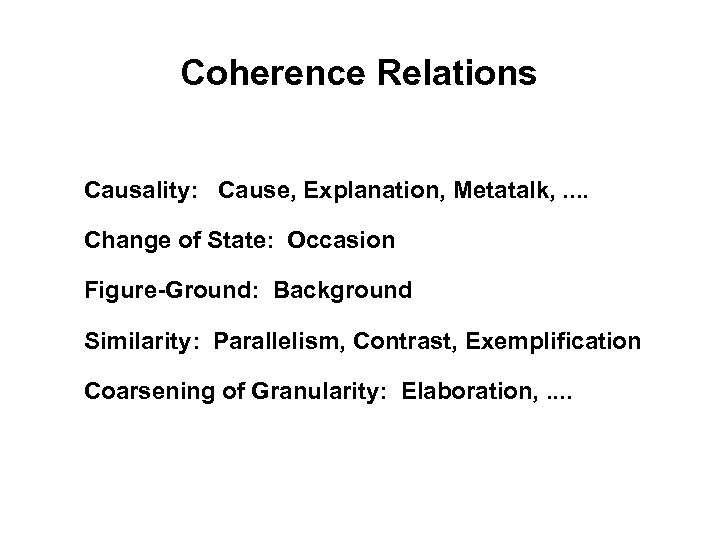 Coherence Relations Causality: Cause, Explanation, Metatalk, . . Change of State: Occasion Figure-Ground: Background Similarity: Parallelism, Contrast, Exemplification Coarsening of Granularity: Elaboration, . .
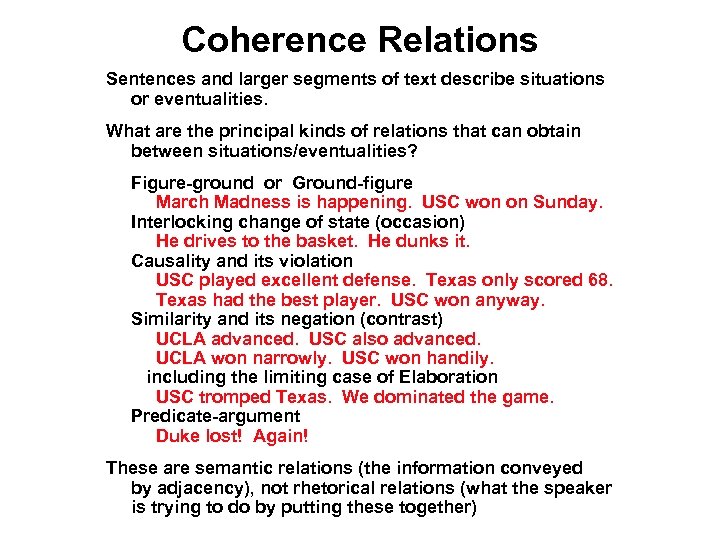 Coherence Relations Sentences and larger segments of text describe situations or eventualities. What are the principal kinds of relations that can obtain between situations/eventualities? Figure-ground or Ground-figure March Madness is happening. USC won on Sunday. Interlocking change of state (occasion) He drives to the basket. He dunks it. Causality and its violation USC played excellent defense. Texas only scored 68. Texas had the best player. USC won anyway. Similarity and its negation (contrast) UCLA advanced. USC also advanced. UCLA won narrowly. USC won handily. including the limiting case of Elaboration USC tromped Texas. We dominated the game. Predicate-argument Duke lost! Again! These are semantic relations (the information conveyed by adjacency), not rhetorical relations (what the speaker is trying to do by putting these together)
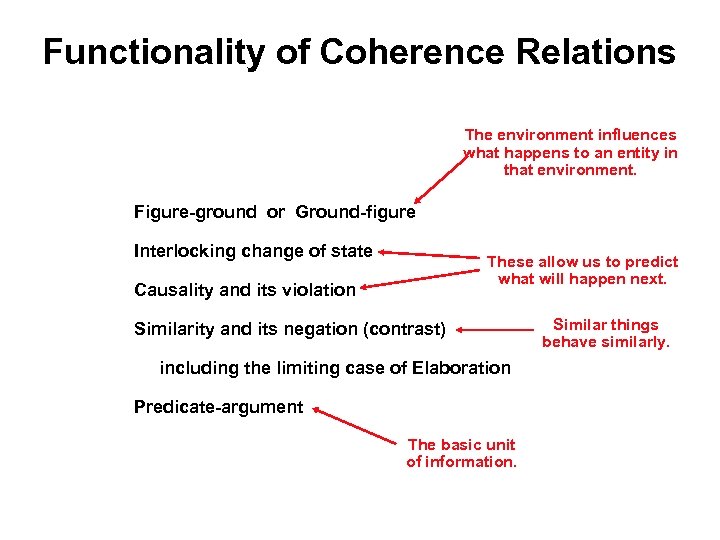 Functionality of Coherence Relations The environment influences what happens to an entity in that environment. Figure-ground or Ground-figure Interlocking change of state These allow us to predict what will happen next. Causality and its violation Similarity and its negation (contrast) including the limiting case of Elaboration Predicate-argument The basic unit of information. Similar things behave similarly.
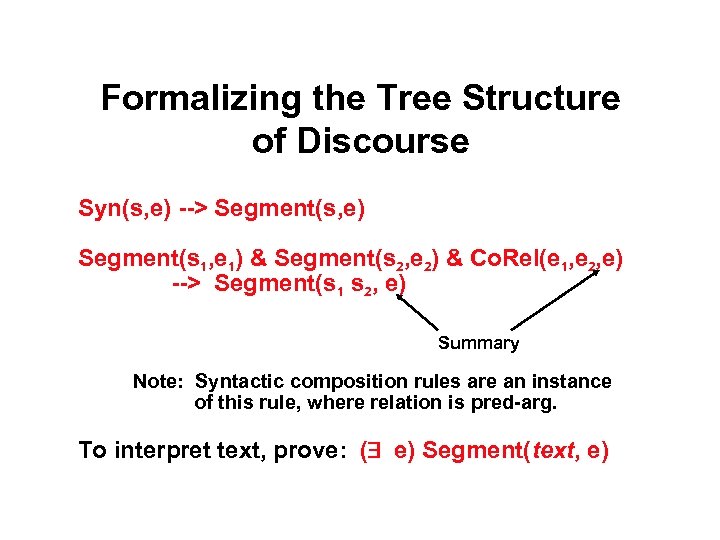
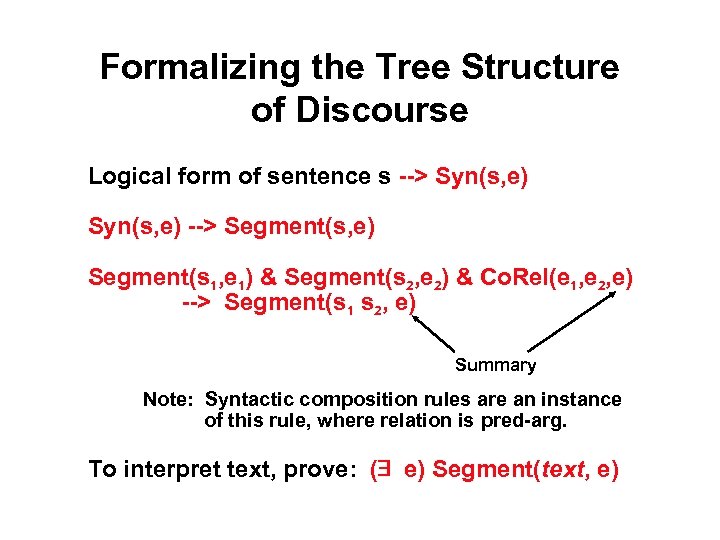 Formalizing the Tree Structure of Discourse Logical form of sentence s --> Syn(s, e) --> Segment(s, e) Segment(s 1, e 1) & Segment(s 2, e 2) & Co. Rel(e 1, e 2, e) --> Segment(s 1 s 2, e) Summary Note: Syntactic composition rules are an instance of this rule, where relation is pred-arg. To interpret text, prove: ( e) Segment(text, e)
 Outline Interpreting Adjacency What Coherence Relations are there? Definitions and Examples of Specific Coherence Relations Discourse Structure
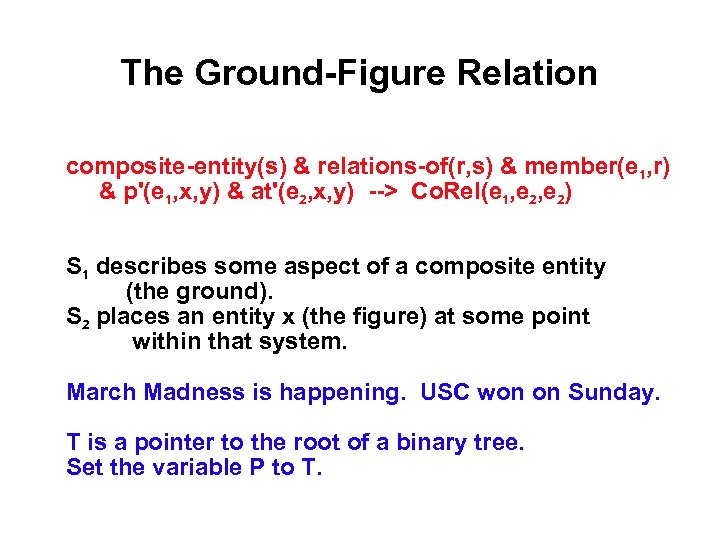 The Ground-Figure Relation composite-entity(s) & relations-of(r, s) & member(e 1, r) & p'(e 1, x, y) & at'(e 2, x, y) --> Co. Rel(e 1, e 2) S 1 describes some aspect of a composite entity (the ground). S 2 places an entity x (the figure) at some point within that system. March Madness is happening. USC won on Sunday. T is a pointer to the root of a binary tree. Set the variable P to T.
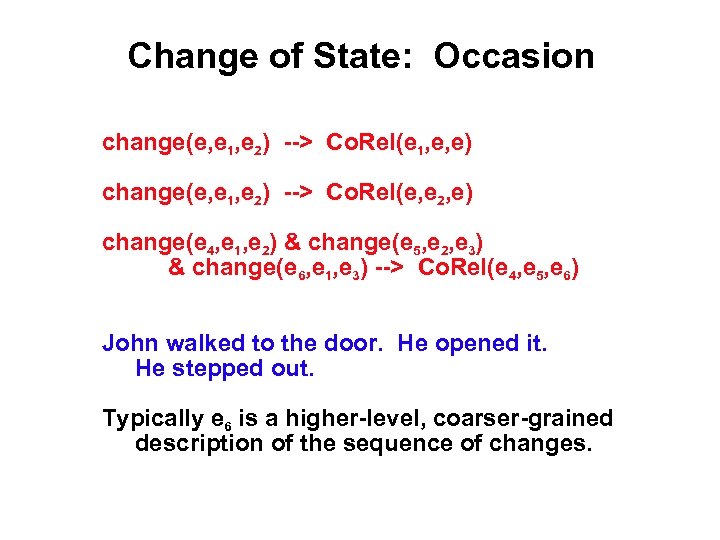 Change of State: Occasion change(e, e 1, e 2) --> Co. Rel(e 1, e, e) change(e, e 1, e 2) --> Co. Rel(e, e 2, e) change(e 4, e 1, e 2) & change(e 5, e 2, e 3) & change(e 6, e 1, e 3) --> Co. Rel(e 4, e 5, e 6) John walked to the door. He opened it. He stepped out. Typically e 6 is a higher-level, coarser-grained description of the sequence of changes.
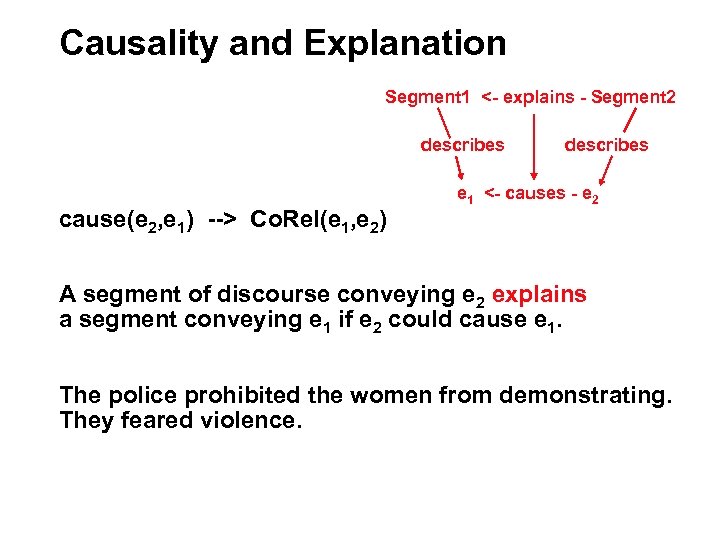 Causality and Explanation Segment 1 <- explains - Segment 2 describes cause(e 2, e 1) --> Co. Rel(e 1, e 2) describes e 1 <- causes - e 2 A segment of discourse conveying e 2 explains a segment conveying e 1 if e 2 could cause e 1. The police prohibited the women from demonstrating. They feared violence.
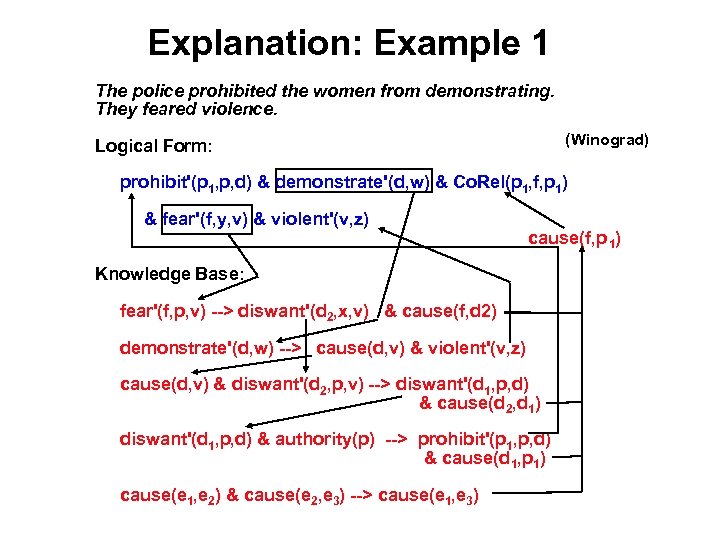 Explanation: Example 1 The police prohibited the women from demonstrating. They feared violence. (Winograd) Logical Form: prohibit'(p 1, p, d) & demonstrate'(d, w) & Co. Rel(p 1, f, p 1) & fear'(f, y, v) & violent'(v, z) cause(f, p 1) Knowledge Base: fear'(f, p, v) --> diswant'(d 2, x, v) & cause(f, d 2) demonstrate'(d, w) --> cause(d, v) & violent'(v, z) cause(d, v) & diswant'(d 2, p, v) --> diswant'(d 1, p, d) & cause(d 2, d 1) diswant'(d 1, p, d) & authority(p) --> prohibit'(p 1, p, d) & cause(d 1, p 1) cause(e 1, e 2) & cause(e 2, e 3) --> cause(e 1, e 3)
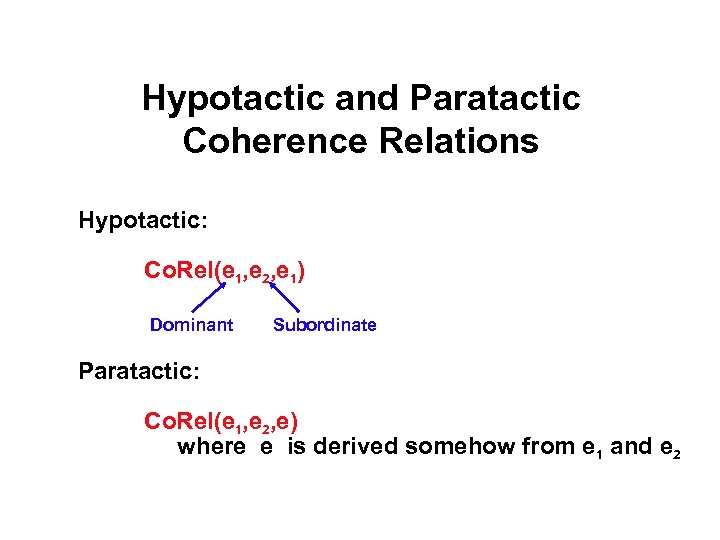
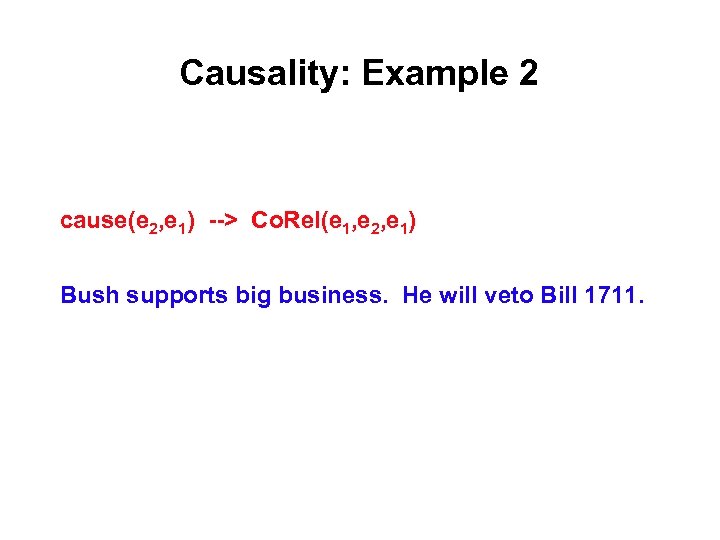 Causality: Example 2 cause(e 2, e 1) --> Co. Rel(e 1, e 2, e 1) Bush supports big business. He will veto Bill 1711.
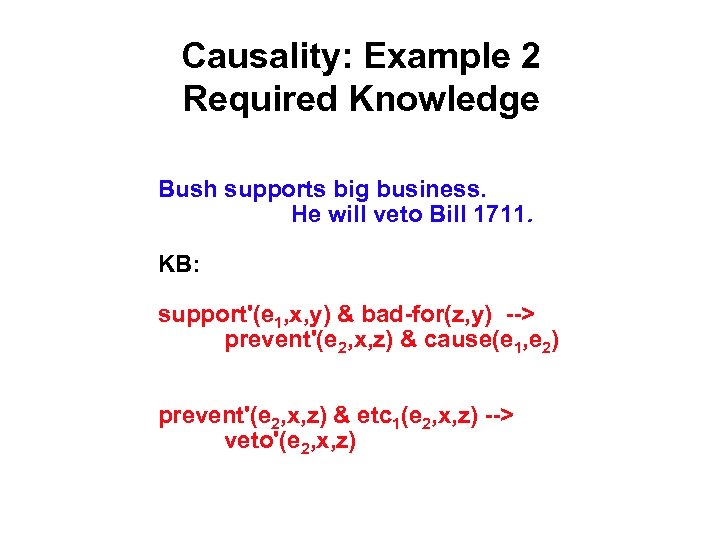 Causality: Example 2 Required Knowledge Bush supports big business. He will veto Bill 1711. KB: support'(e 1, x, y) & bad-for(z, y) --> prevent'(e 2, x, z) & cause(e 1, e 2) prevent'(e 2, x, z) & etc 1(e 2, x, z) --> veto'(e 2, x, z)
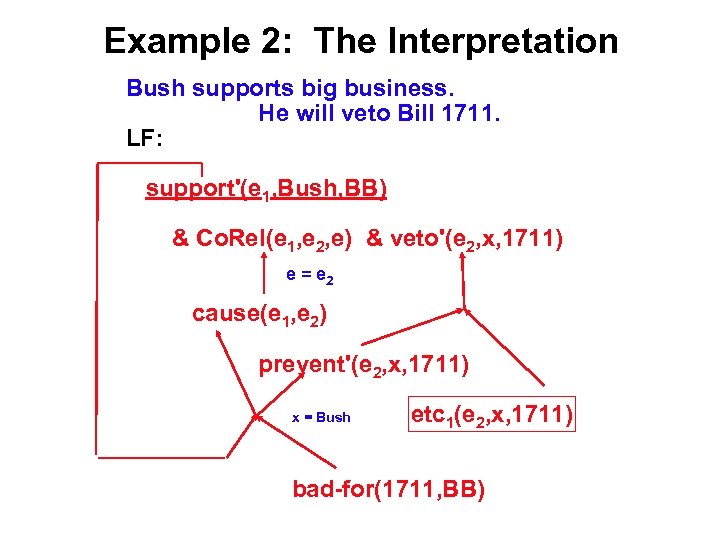 Example 2: The Interpretation Bush supports big business. He will veto Bill 1711. LF: support'(e 1, Bush, BB) & Co. Rel(e 1, e 2, e) & veto'(e 2, x, 1711) e = e 2 cause(e 1, e 2) prevent'(e 2, x, 1711) x = Bush etc 1(e 2, x, 1711) bad-for(1711, BB)
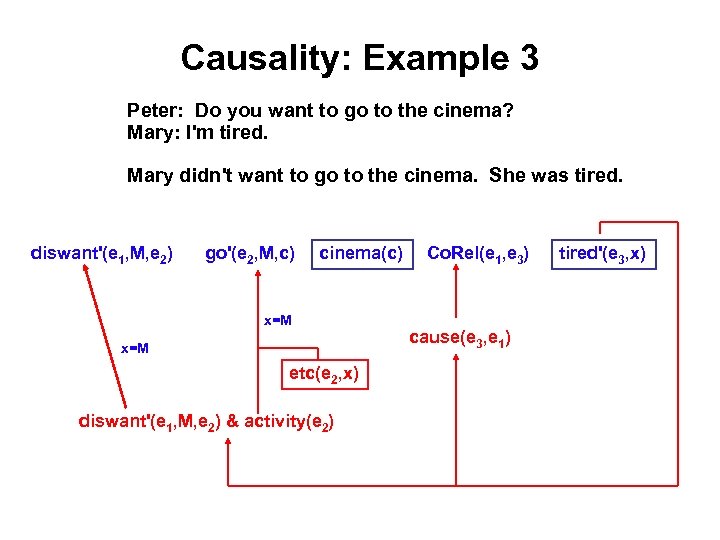 Causality: Example 3 Peter: Do you want to go to the cinema? Mary: I'm tired. Mary didn't want to go to the cinema. She was tired. diswant'(e 1, M, e 2) go'(e 2, M, c) cinema(c) x=M etc(e 2, x) diswant'(e 1, M, e 2) & activity(e 2) Co. Rel(e 1, e 3) cause(e 3, e 1) tired'(e 3, x)
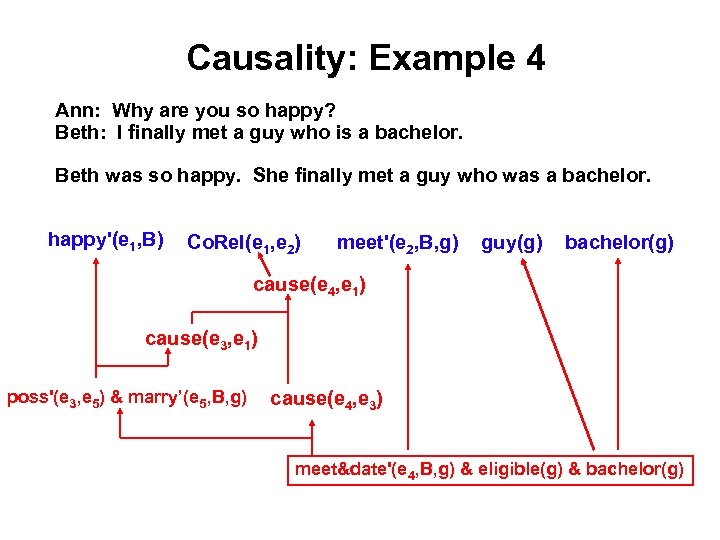 Causality: Example 4 Ann: Why are you so happy? Beth: I finally met a guy who is a bachelor. Beth was so happy. She finally met a guy who was a bachelor. happy'(e 1, B) Co. Rel(e 1, e 2) meet'(e 2, B, g) guy(g) bachelor(g) cause(e 4, e 1) cause(e 3, e 1) poss'(e 3, e 5) & marry’(e 5, B, g) cause(e 4, e 3) meet&date'(e 4, B, g) & eligible(g) & bachelor(g)
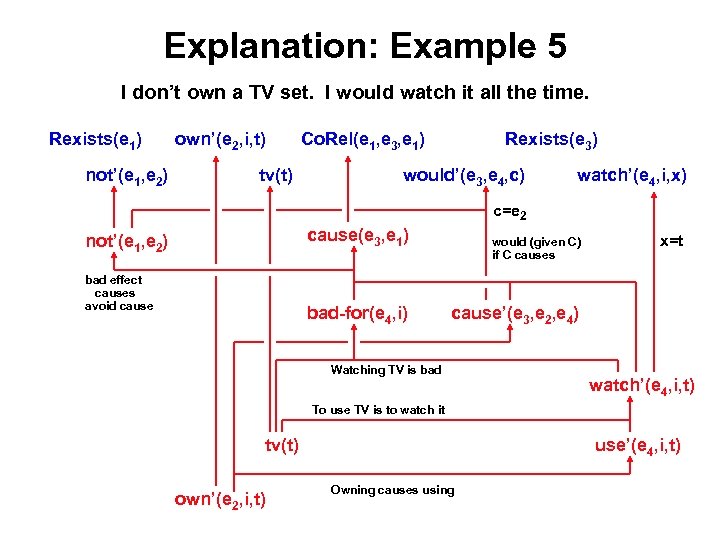 Explanation: Example 5 I don’t own a TV set. I would watch it all the time. Rexists(e 1) not’(e 1, e 2) own’(e 2, i, t) tv(t) Co. Rel(e 1, e 3, e 1) Rexists(e 3) would’(e 3, e 4, c) watch’(e 4, i, x) c=e 2 cause(e 3, e 1) not’(e 1, e 2) bad effect causes avoid cause bad-for(e 4, i) would (given C) if C causes x=t cause’(e 3, e 2, e 4) Watching TV is bad watch’(e 4, i, t) To use TV is to watch it tv(t) own’(e 2, i, t) use’(e 4, i, t) Owning causes using
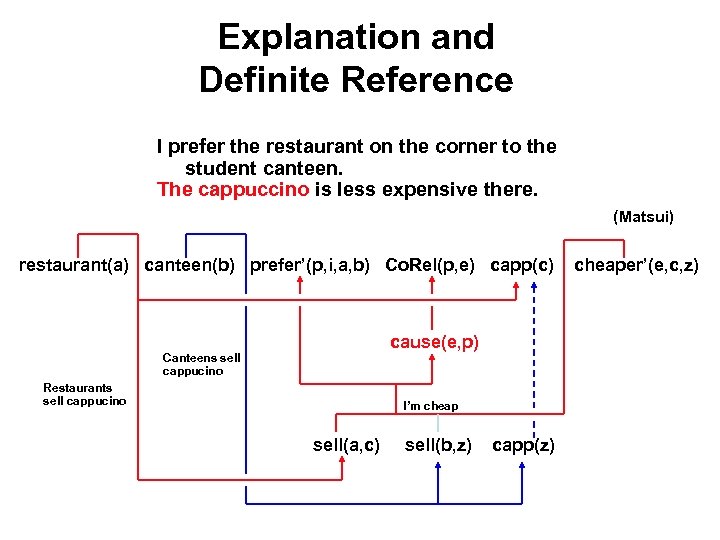 Explanation and Definite Reference I prefer the restaurant on the corner to the student canteen. The cappuccino is less expensive there. (Matsui) restaurant(a) canteen(b) prefer’(p, i, a, b) Co. Rel(p, e) capp(c) cause(e, p) Canteens sell cappucino Restaurants sell cappucino I’m cheap sell(a, c) sell(b, z) capp(z) cheaper’(e, c, z)
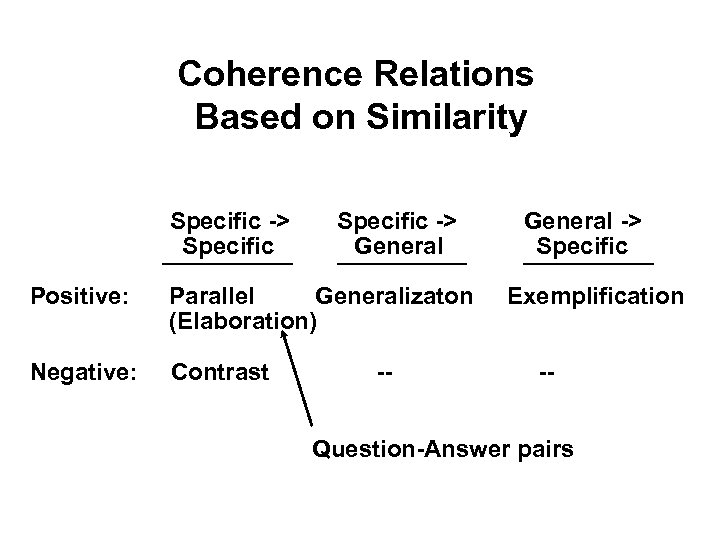 Coherence Relations Based on Similarity Specific -> General Positive: Parallel Generalizaton (Elaboration) Negative: Contrast -- General -> Specific Exemplification -- Question-Answer pairs
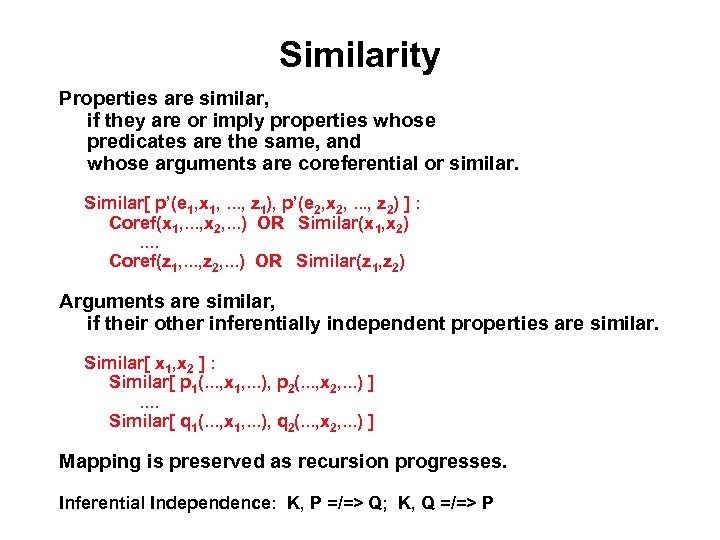 Similarity Properties are similar, if they are or imply properties whose predicates are the same, and whose arguments are coreferential or similar. Similar[ p’(e 1, x 1, . . . , z 1), p’(e 2, x 2, . . . , z 2) ] : Coref(x 1, . . . , x 2, . . . ) OR Similar(x 1, x 2). . Coref(z 1, . . . , z 2, . . . ) OR Similar(z 1, z 2) Arguments are similar, if their other inferentially independent properties are similar. Similar[ x 1, x 2 ] : Similar[ p 1(. . . , x 1, . . . ), p 2(. . . , x 2, . . . ) ]. . Similar[ q 1(. . . , x 1, . . . ), q 2(. . . , x 2, . . . ) ] Mapping is preserved as recursion progresses. Inferential Independence: K, P =/=> Q; K, Q =/=> P
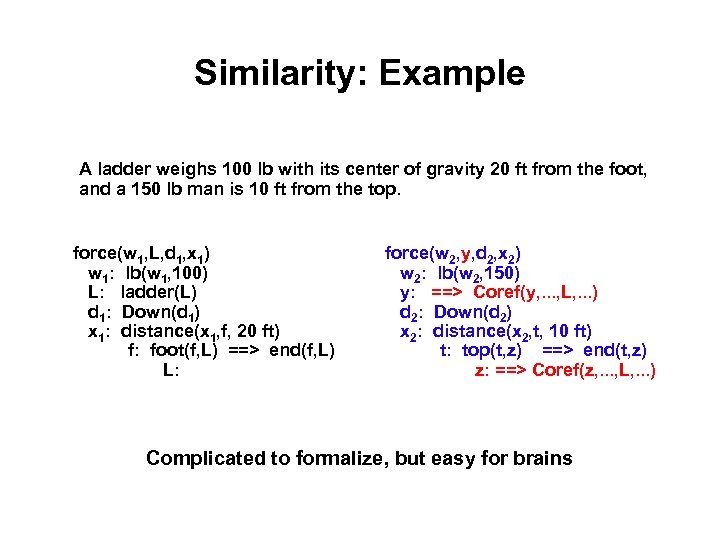 Similarity: Example A ladder weighs 100 lb with its center of gravity 20 ft from the foot, and a 150 lb man is 10 ft from the top. force(w 1, L, d 1, x 1) w 1: lb(w 1, 100) L: ladder(L) d 1: Down(d 1) x 1: distance(x 1, f, 20 ft) f: foot(f, L) ==> end(f, L) L: force(w 2, y, d 2, x 2) w 2: lb(w 2, 150) y: ==> Coref(y, . . . , L, . . . ) d 2: Down(d 2) x 2: distance(x 2, t, 10 ft) t: top(t, z) ==> end(t, z) z: ==> Coref(z, . . . , L, . . . ) Complicated to formalize, but easy for brains
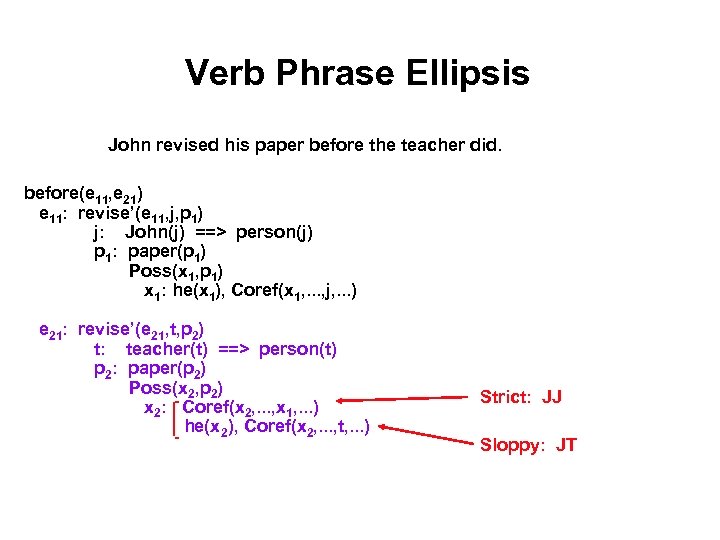 Verb Phrase Ellipsis John revised his paper before the teacher did. before(e 11, e 21) e 11: revise’(e 11, j, p 1) j: John(j) ==> person(j) p 1: paper(p 1) Poss(x 1, p 1) x 1: he(x 1), Coref(x 1, . . . , j, . . . ) e 21: revise’(e 21, t, p 2) t: teacher(t) ==> person(t) p 2: paper(p 2) Poss(x 2, p 2) x 2: Coref(x 2, . . . , x 1, . . . ) he(x 2), Coref(x 2, . . . , t, . . . ) Strict: JJ Sloppy: JT
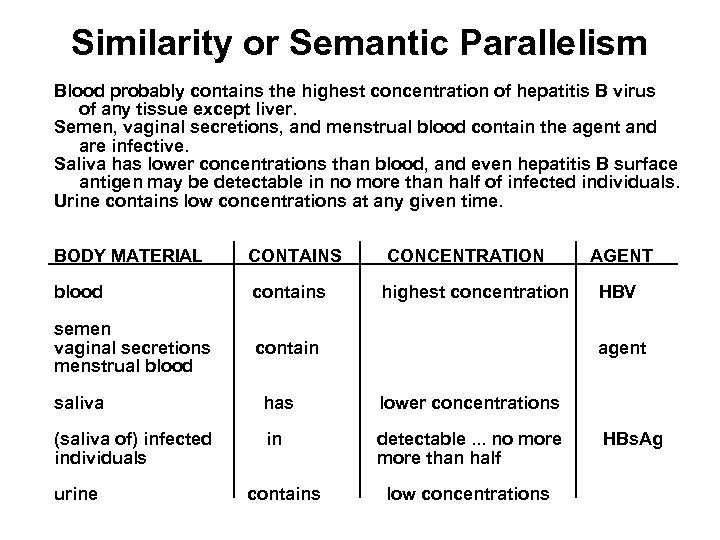 Similarity or Semantic Parallelism Blood probably contains the highest concentration of hepatitis B virus of any tissue except liver. Semen, vaginal secretions, and menstrual blood contain the agent and are infective. Saliva has lower concentrations than blood, and even hepatitis B surface antigen may be detectable in no more than half of infected individuals. Urine contains low concentrations at any given time. BODY MATERIAL CONTAINS blood contains semen vaginal secretions menstrual blood CONCENTRATION contain highest concentration AGENT HBV agent saliva has lower concentrations (saliva of) infected individuals in detectable. . . no more than half urine contains low concentrations HBs. Ag
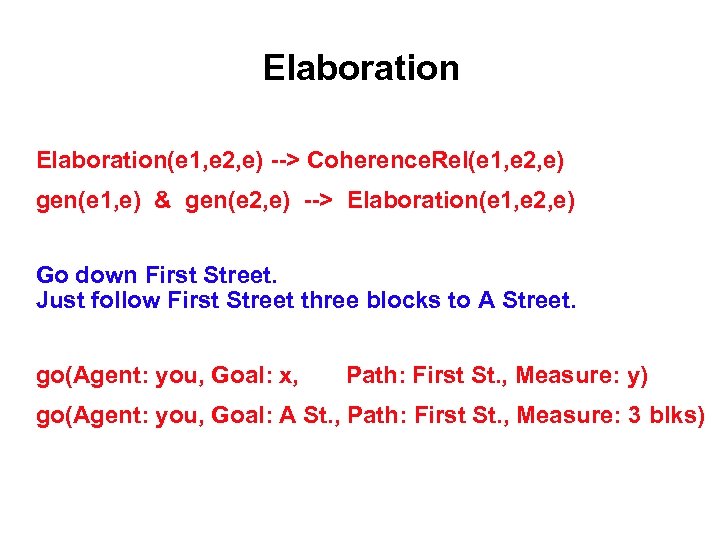 Elaboration(e 1, e 2, e) --> Coherence. Rel(e 1, e 2, e) gen(e 1, e) & gen(e 2, e) --> Elaboration(e 1, e 2, e) Go down First Street. Just follow First Street three blocks to A Street. go(Agent: you, Goal: x, Path: First St. , Measure: y) go(Agent: you, Goal: A St. , Path: First St. , Measure: 3 blks)
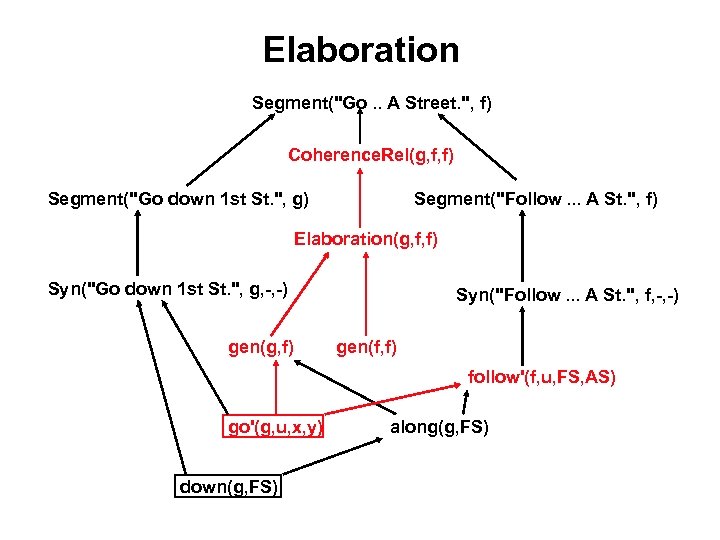 Elaboration Segment("Go. . A Street. ", f) Coherence. Rel(g, f, f) Segment("Go down 1 st St. ", g) Segment("Follow. . . A St. ", f) Elaboration(g, f, f) Syn("Go down 1 st St. ", g, -, -) gen(g, f) Syn("Follow. . . A St. ", f, -, -) gen(f, f) follow'(f, u, FS, AS) go'(g, u, x, y) down(g, FS) along(g, FS)
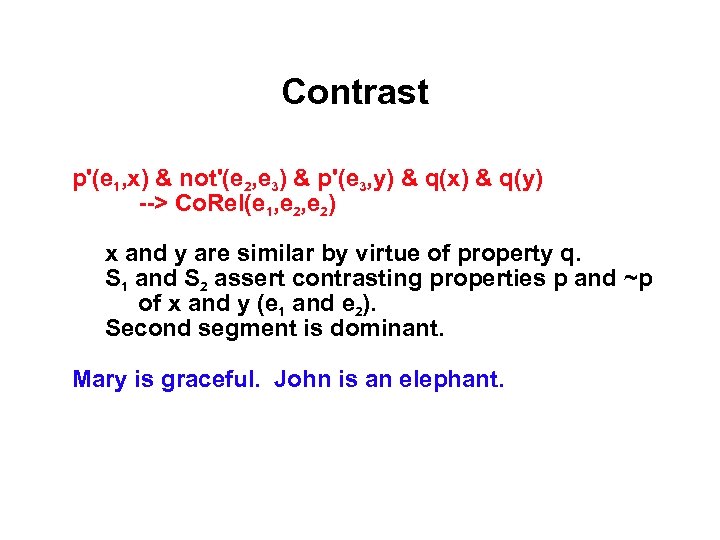 Contrast p'(e 1, x) & not'(e 2, e 3) & p'(e 3, y) & q(x) & q(y) --> Co. Rel(e 1, e 2) x and y are similar by virtue of property q. S 1 and S 2 assert contrasting properties p and ~p of x and y (e 1 and e 2). Second segment is dominant. Mary is graceful. John is an elephant.
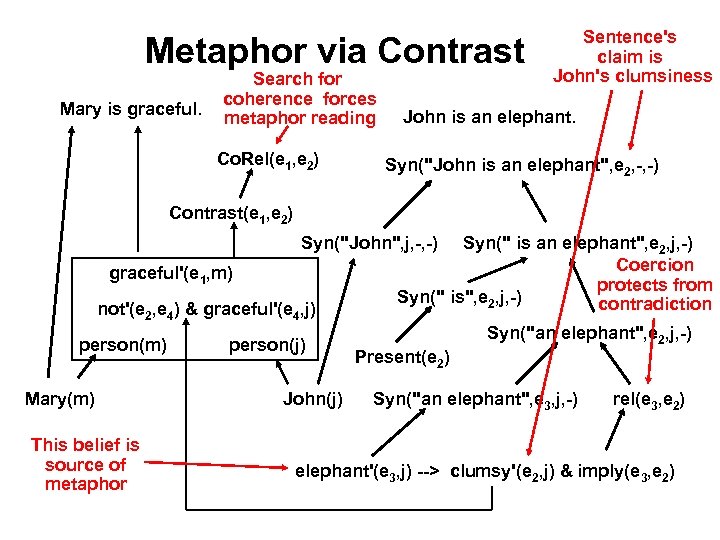 Metaphor via Contrast Mary is graceful. Search for coherence forces metaphor reading Co. Rel(e 1, e 2) Sentence's claim is John's clumsiness John is an elephant. Syn("John is an elephant", e 2, -, -) Contrast(e 1, e 2) Syn("John", j, -, -) graceful'(e 1, m) not'(e 2, e 4) & graceful'(e 4, j) person(m) Mary(m) This belief is source of metaphor person(j) John(j) Syn(" is an elephant", e 2, j, -) Coercion protects from Syn(" is", e 2, j, -) contradiction Syn("an elephant", e 2, j, -) Present(e 2) Syn("an elephant", e 3, j, -) rel(e 3, e 2) elephant'(e 3, j) --> clumsy'(e 2, j) & imply(e 3, e 2)
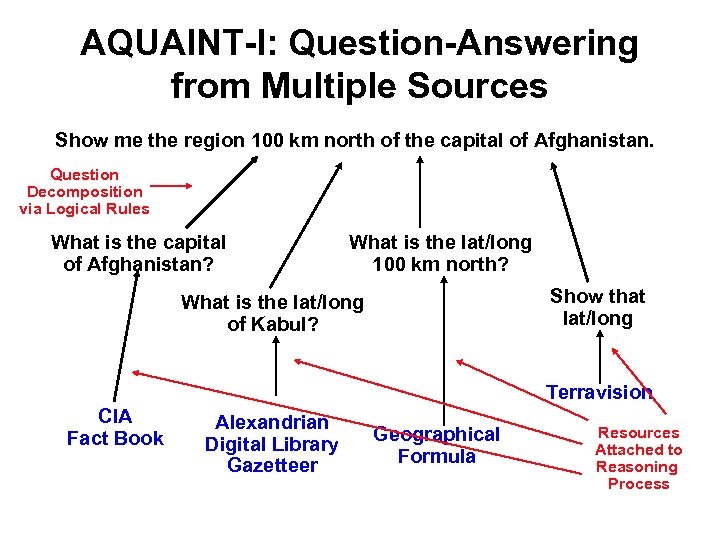 AQUAINT-I: Question-Answering from Multiple Sources Show me the region 100 km north of the capital of Afghanistan. Question Decomposition via Logical Rules What is the capital of Afghanistan? What is the lat/long 100 km north? Show that lat/long What is the lat/long of Kabul? Terravision CIA Fact Book Alexandrian Digital Library Gazetteer Geographical Formula Resources Attached to Reasoning Process
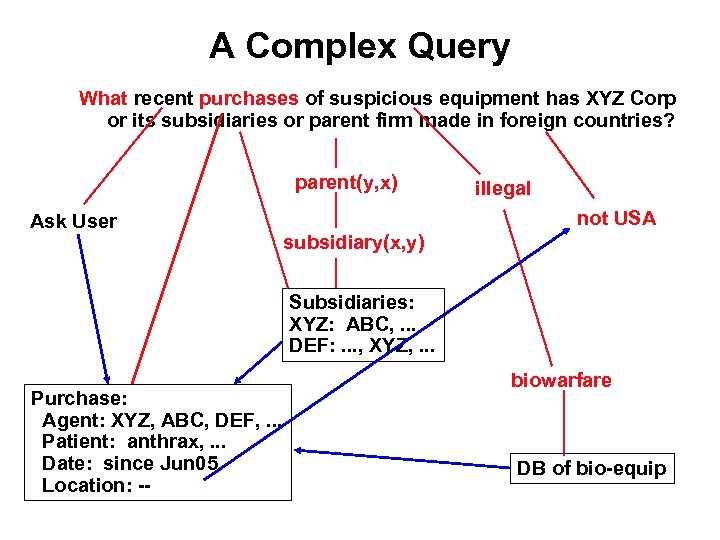 A Complex Query What recent purchases of suspicious equipment has XYZ Corp or its subsidiaries or parent firm made in foreign countries? parent(y, x) Ask User illegal not USA subsidiary(x, y) Subsidiaries: XYZ: ABC, . . . DEF: . . . , XYZ, . . . Purchase: Agent: XYZ, ABC, DEF, . . . Patient: anthrax, . . . Date: since Jun 05 Location: -- biowarfare DB of bio-equip
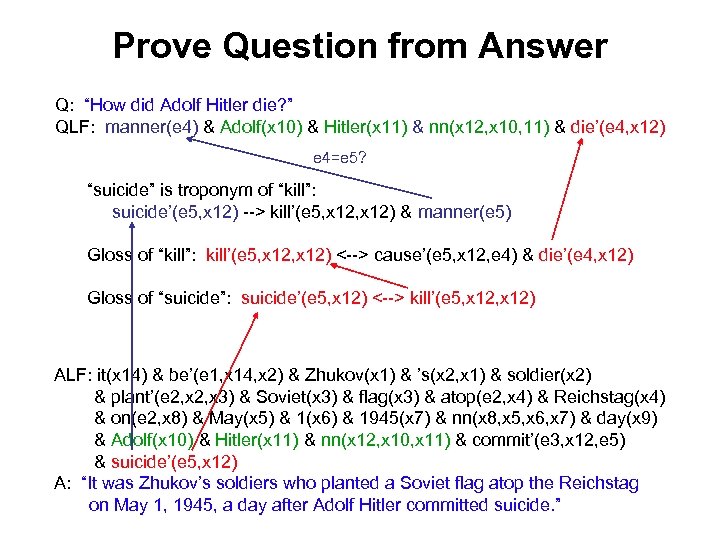 Prove Question from Answer Q: “How did Adolf Hitler die? ” QLF: manner(e 4) & Adolf(x 10) & Hitler(x 11) & nn(x 12, x 10, 11) & die’(e 4, x 12) e 4=e 5? “suicide” is troponym of “kill”: suicide’(e 5, x 12) --> kill’(e 5, x 12) & manner(e 5) Gloss of “kill”: kill’(e 5, x 12) <--> cause’(e 5, x 12, e 4) & die’(e 4, x 12) Gloss of “suicide”: suicide’(e 5, x 12) <--> kill’(e 5, x 12) ALF: it(x 14) & be’(e 1, x 14, x 2) & Zhukov(x 1) & ’s(x 2, x 1) & soldier(x 2) & plant’(e 2, x 3) & Soviet(x 3) & flag(x 3) & atop(e 2, x 4) & Reichstag(x 4) & on(e 2, x 8) & May(x 5) & 1(x 6) & 1945(x 7) & nn(x 8, x 5, x 6, x 7) & day(x 9) & Adolf(x 10) & Hitler(x 11) & nn(x 12, x 10, x 11) & commit’(e 3, x 12, e 5) & suicide’(e 5, x 12) A: “It was Zhukov’s soldiers who planted a Soviet flag atop the Reichstag on May 1, 1945, a day after Adolf Hitler committed suicide. ”
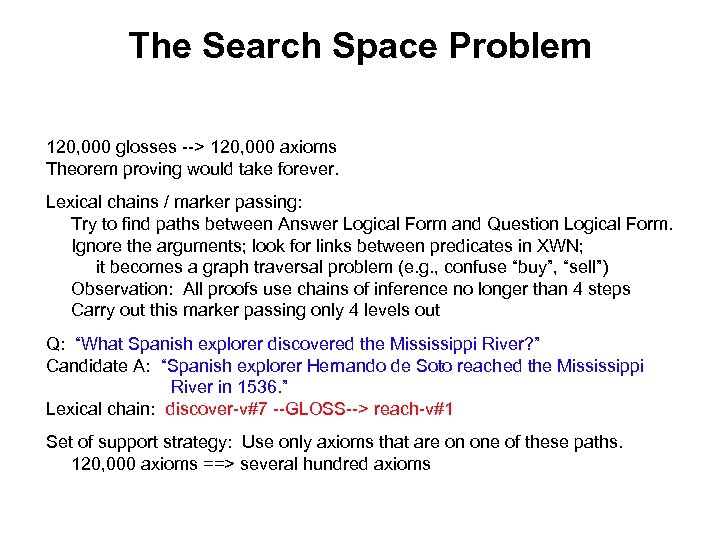 The Search Space Problem 120, 000 glosses --> 120, 000 axioms Theorem proving would take forever. Lexical chains / marker passing: Try to find paths between Answer Logical Form and Question Logical Form. Ignore the arguments; look for links between predicates in XWN; it becomes a graph traversal problem (e. g. , confuse “buy”, “sell”) Observation: All proofs use chains of inference no longer than 4 steps Carry out this marker passing only 4 levels out Q: “What Spanish explorer discovered the Mississippi River? ” Candidate A: “Spanish explorer Hernando de Soto reached the Mississippi River in 1536. ” Lexical chain: discover-v#7 --GLOSS--> reach-v#1 Set of support strategy: Use only axioms that are on one of these paths. 120, 000 axioms ==> several hundred axioms
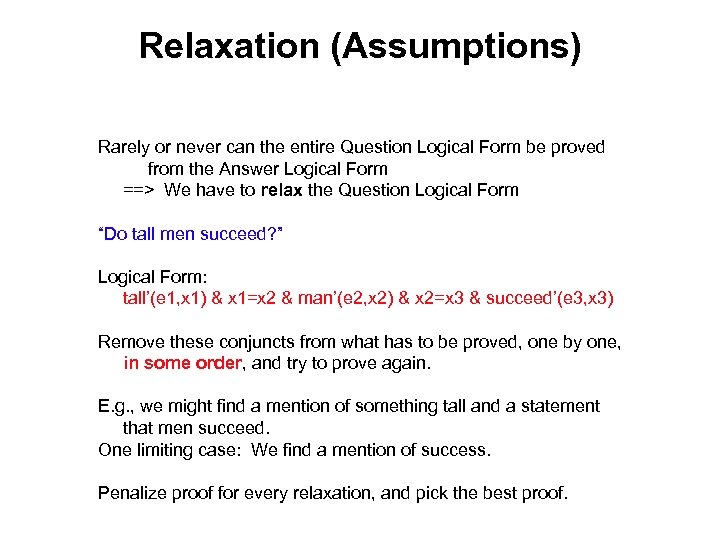 Relaxation (Assumptions) Rarely or never can the entire Question Logical Form be proved from the Answer Logical Form ==> We have to relax the Question Logical Form “Do tall men succeed? ” Logical Form: tall’(e 1, x 1) & x 1=x 2 & man’(e 2, x 2) & x 2=x 3 & succeed’(e 3, x 3) Remove these conjuncts from what has to be proved, one by one, in some order, and try to prove again. E. g. , we might find a mention of something tall and a statement that men succeed. One limiting case: We find a mention of success. Penalize proof for every relaxation, and pick the best proof.
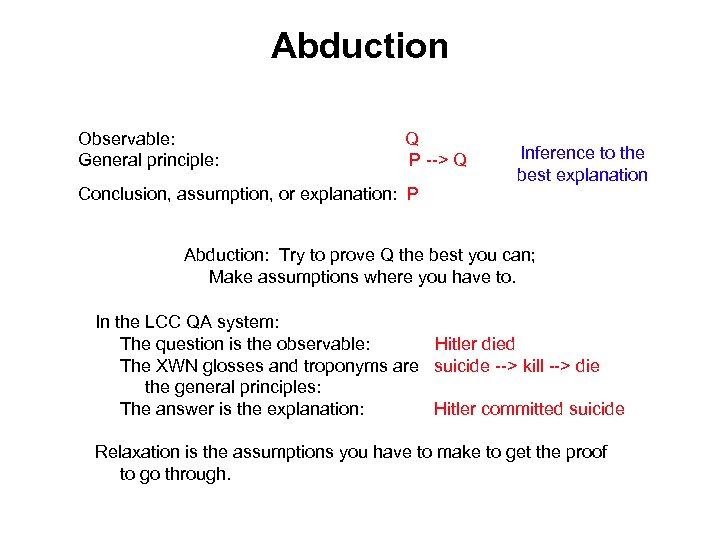 Abduction Observable: General principle: Q P --> Q Conclusion, assumption, or explanation: P Inference to the best explanation Abduction: Try to prove Q the best you can; Make assumptions where you have to. In the LCC QA system: The question is the observable: Hitler died The XWN glosses and troponyms are suicide --> kill --> die the general principles: The answer is the explanation: Hitler committed suicide Relaxation is the assumptions you have to make to get the proof to go through.
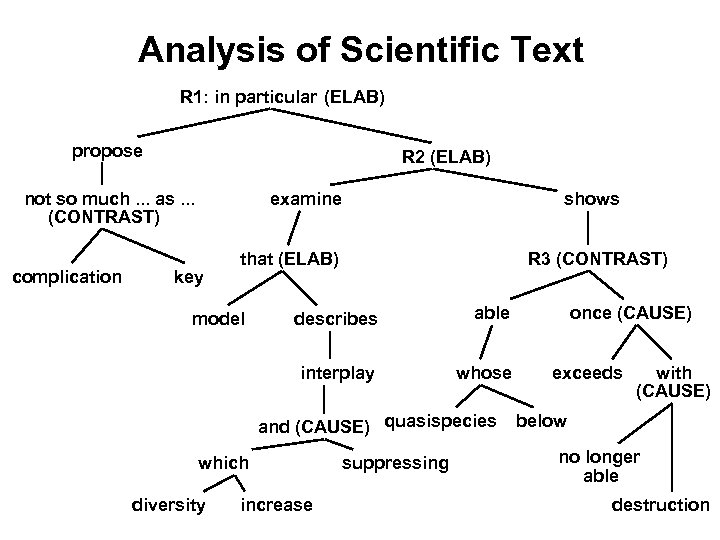
 Coherence Relations between Embeddings The model shows that the human immune system is only able to mount an effective response against HIV quasispecies whose diversity is below some threshold value; The model shows that once the population of viral strains exceeds this "diversity ^ threshold" the immune system is no long able to regulate viral replication.
 Coherence Relations between Coercions I believe John must be at home. ^ I see that His car is in the driveway. ^ CAUSE
 Do We Rally Recognize Coherence Relations? Recognizing coherence relation = recognizing sentences as part of one discourse "We don't recognize coherence relations. We just find the best interpretation of the whole text. " "We don't parse sentences. We just figure out the predicate-argument relations. "
 Outline Interpreting Adjacency What Coherence Relations are there? Definitions and Examples of Specific Coherence Relations Discourse Structure
![Tree Structure from Multiple Adjacencies [Cancer Research] Institute vs. Stanford [Research Institute] John [believes](https://present5.com/presentation/a9f9daa71481e457f2e39a880cd3b958/image-47.jpg "Tree Structure from Multiple Adjacencies [Cancer Research] Institute vs. Stanford [Research Institute] John [believes") Tree Structure from Multiple Adjacencies [Cancer Research] Institute vs. Stanford [Research Institute] John [believes [men work]]
Tree Structure from Multiple Adjacencies [Cancer Research] Institute vs. Stanford [Research Institute] John [believes [men work]]
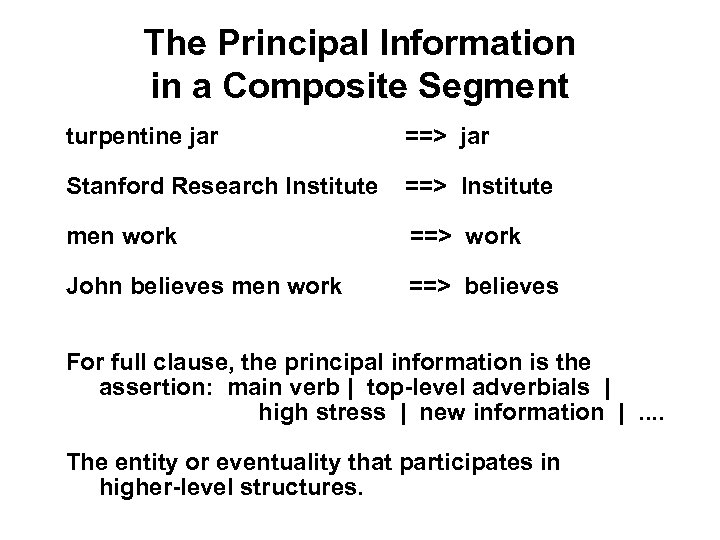 The Principal Information in a Composite Segment turpentine jar ==> jar Stanford Research Institute ==> Institute men work ==> work John believes men work ==> believes For full clause, the principal information is the assertion: main verb | top-level adverbials | high stress | new information |. . The entity or eventuality that participates in higher-level structures.
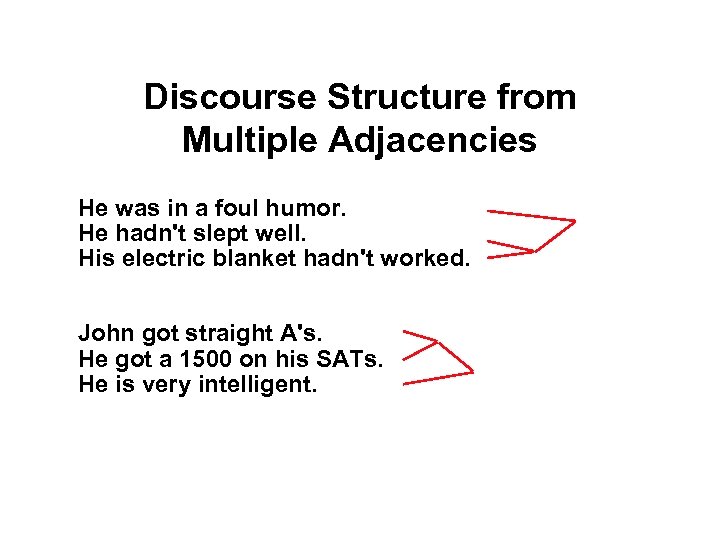 Discourse Structure from Multiple Adjacencies He was in a foul humor. He hadn't slept well. His electric blanket hadn't worked. John got straight A's. He got a 1500 on his SATs. He is very intelligent.
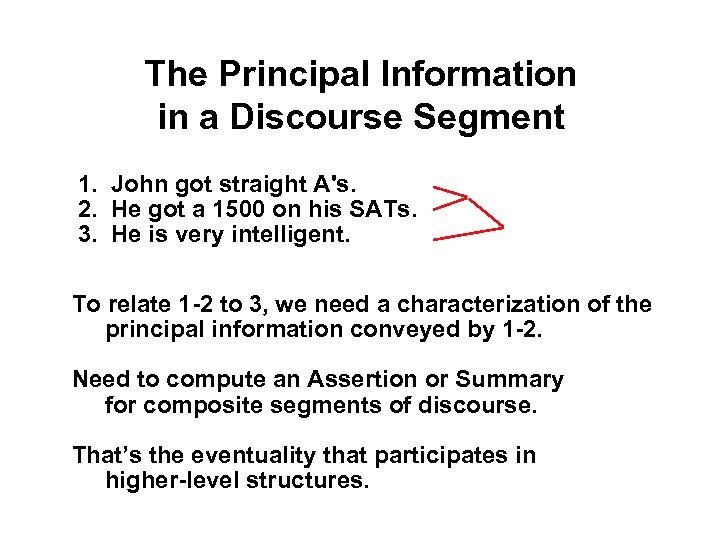 The Principal Information in a Discourse Segment 1. John got straight A's. 2. He got a 1500 on his SATs. 3. He is very intelligent. To relate 1 -2 to 3, we need a characterization of the principal information conveyed by 1 -2. Need to compute an Assertion or Summary for composite segments of discourse. That’s the eventuality that participates in higher-level structures.
 Tasks of a Discourse Theory 1. What are the possible relations between adjacent discourse segments? 2. How are they recognized or characterized? 3. What are the assertions / summaries of the composite segments?
 Formalizing the Tree Structure of Discourse Syn(s, e) --> Segment(s, e) Segment(s 1, e 1) & Segment(s 2, e 2) & Co. Rel(e 1, e 2, e) --> Segment(s 1 s 2, e) Summary Note: Syntactic composition rules are an instance of this rule, where relation is pred-arg. To interpret text, prove: ( e) Segment(text, e)
 Hypotactic and Paratactic Coherence Relations Hypotactic: Co. Rel(e 1, e 2, e 1) Dominant Subordinate Paratactic: Co. Rel(e 1, e 2, e) where e is derived somehow from e 1 and e 2
 Tree Building Coherence Structure: Static, after-the-fact Flow Model: Dynamic, play-by-play NOT A REAL DISTINCTION The Tree-Building Operation: N 1 R(N 1, N 2) ==> R N 1 N 2
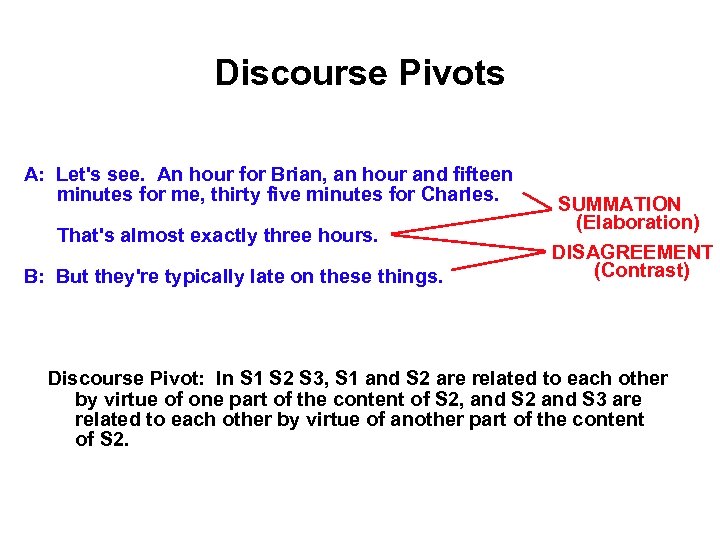 Discourse Pivots A: Let's see. An hour for Brian, an hour and fifteen minutes for me, thirty five minutes for Charles. That's almost exactly three hours. B: But they're typically late on these things. SUMMATION (Elaboration) DISAGREEMENT (Contrast) Discourse Pivot: In S 1 S 2 S 3, S 1 and S 2 are related to each other by virtue of one part of the content of S 2, and S 2 and S 3 are related to each other by virtue of another part of the content of S 2.
 Discourse Coherence cause figure-ground and ground-figure similarity and contrast Relation Segment 1 Segment 2 Interpret each segment, and find the relation between them. R 4 The Structure of Discourse R 3 R 1 S 2 R 2 S 3 S 4 S 5
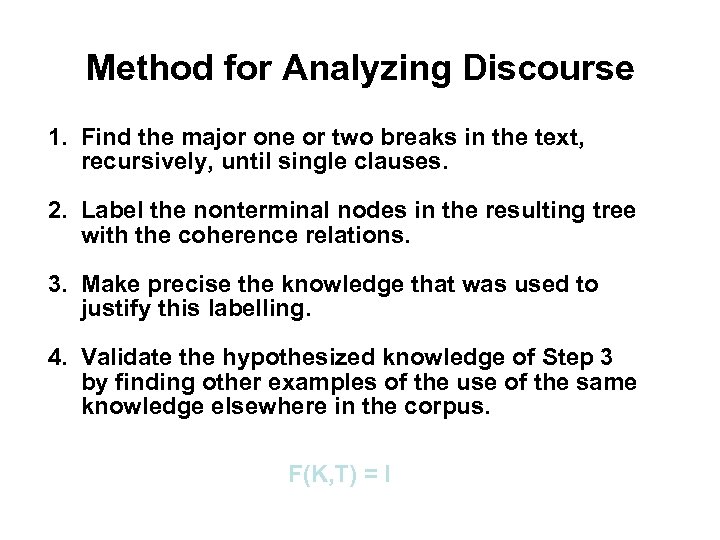 Method for Analyzing Discourse 1. Find the major one or two breaks in the text, recursively, until single clauses. 2. Label the nonterminal nodes in the resulting tree with the coherence relations. 3. Make precise the knowledge that was used to justify this labelling. 4. Validate the hypothesized knowledge of Step 3 by finding other examples of the use of the same knowledge elsewhere in the corpus. F(K, T) = I
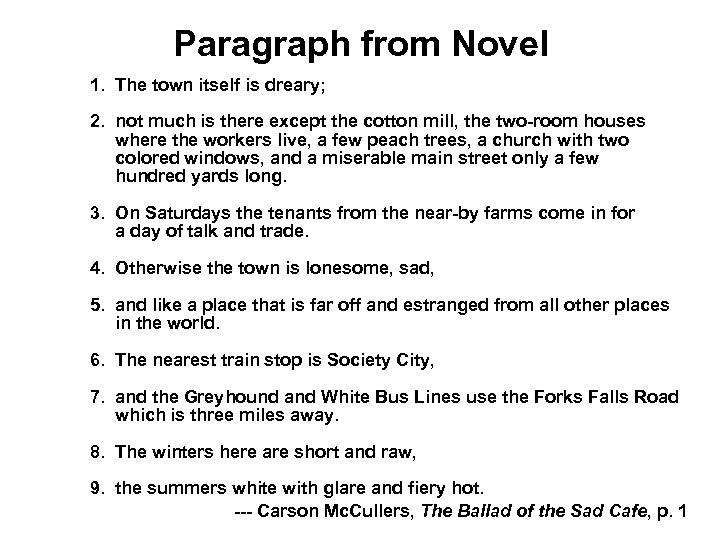 Paragraph from Novel 1. The town itself is dreary; 2. not much is there except the cotton mill, the two-room houses where the workers live, a few peach trees, a church with two colored windows, and a miserable main street only a few hundred yards long. 3. On Saturdays the tenants from the near-by farms come in for a day of talk and trade. 4. Otherwise the town is lonesome, sad, 5. and like a place that is far off and estranged from all other places in the world. 6. The nearest train stop is Society City, 7. and the Greyhound and White Bus Lines use the Forks Falls Road which is three miles away. 8. The winters here are short and raw, 9. the summers white with glare and fiery hot. --- Carson Mc. Cullers, The Ballad of the Sad Cafe, p. 1
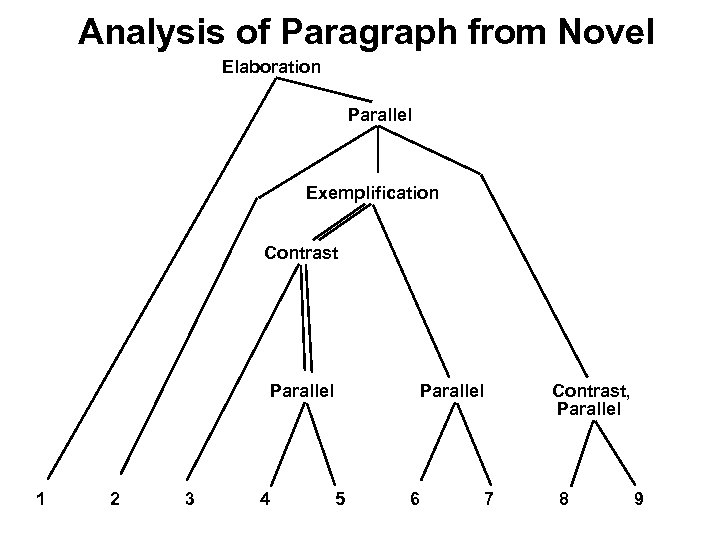 Analysis of Paragraph from Novel Elaboration Parallel Exemplification Contrast Parallel 1 2 3 4 Parallel 5 6 Contrast, Parallel 7 8 9
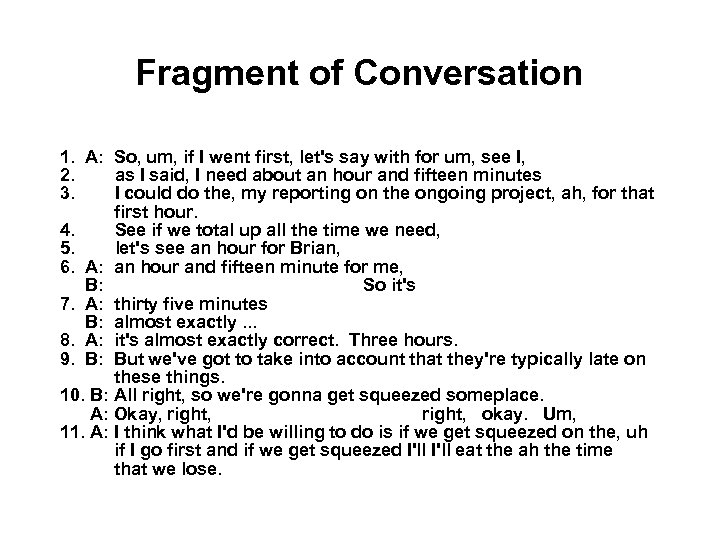 Fragment of Conversation 1. A: So, um, if I went first, let's say with for um, see I, 2. as I said, I need about an hour and fifteen minutes 3. I could do the, my reporting on the ongoing project, ah, for that first hour. 4. See if we total up all the time we need, 5. let's see an hour for Brian, 6. A: an hour and fifteen minute for me, B: So it's 7. A: thirty five minutes B: almost exactly. . . 8. A: it's almost exactly correct. Three hours. 9. B: But we've got to take into account that they're typically late on these things. 10. B: All right, so we're gonna get squeezed someplace. A: Okay, right, okay. Um, 11. A: I think what I'd be willing to do is if we get squeezed on the, uh if I go first and if we get squeezed I'll eat the ah the time that we lose.
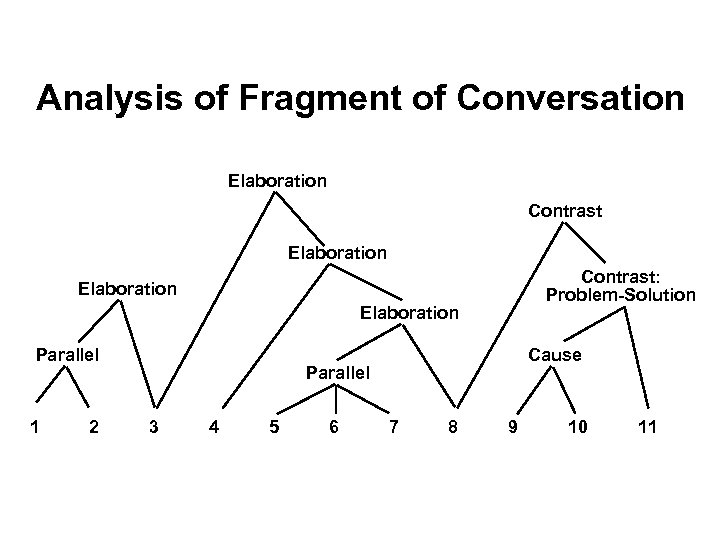 Analysis of Fragment of Conversation Elaboration Contrast: Problem-Solution Elaboration Parallel 1 2 Cause Parallel 3 4 5 6 7 8 9 10 11
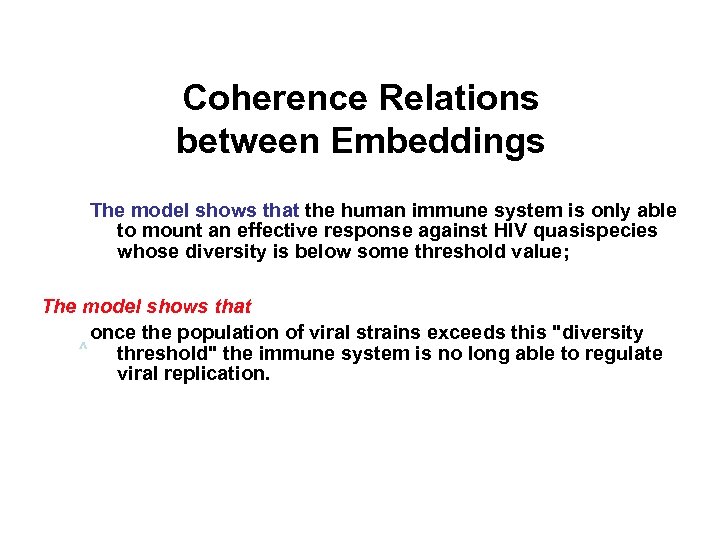
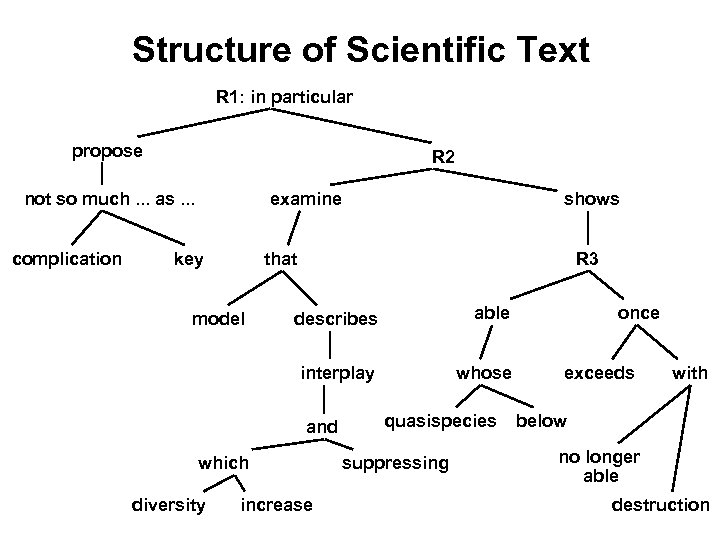
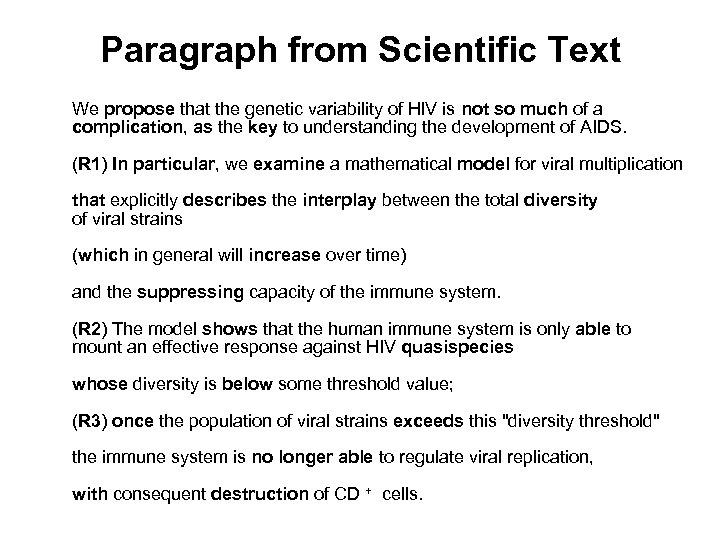 Paragraph from Scientific Text We propose that the genetic variability of HIV is not so much of a complication, as the key to understanding the development of AIDS. (R 1) In particular, we examine a mathematical model for viral multiplication that explicitly describes the interplay between the total diversity of viral strains (which in general will increase over time) and the suppressing capacity of the immune system. (R 2) The model shows that the human immune system is only able to mount an effective response against HIV quasispecies whose diversity is below some threshold value; (R 3) once the population of viral strains exceeds this "diversity threshold" the immune system is no longer able to regulate viral replication, with consequent destruction of CD + cells.
 Structure of Scientific Text R 1: in particular propose R 2 not so much. . . as. . . complication examine key shows that R 3 describes able interplay model whose and which diversity increase quasispecies suppressing once exceeds with below no longer able destruction
 Analysis of Scientific Text R 1: in particular (ELAB) propose R 2 (ELAB) not so much. . . as. . . (CONTRAST) complication examine key shows that (ELAB) R 3 (CONTRAST) describes able interplay model whose and (CAUSE) quasispecies which diversity increase suppressing once (CAUSE) exceeds with (CAUSE) below no longer able destruction
 Summary Discourse structure arises from the use and interpretation of adjacency. Recognition of discourse structure is naturally embedded in the abduction framework. A small number of coherence relations probably suffice, in combination with general interpretive mechanisms.