 Скачать презентацию CS 525 Advanced Distributed Systems Spring 2017 Indranil
87cf3738c69d2fe3b853c6d2e9d37fbd.ppt
- Количество слайдов: 55



CS 525 Advanced Distributed Systems Spring 2017 Indranil Gupta (Indy) Lecture 1 January 17, 2017 https: //courses. engr. illinois. edu/cs 525 1 All Slides © IG
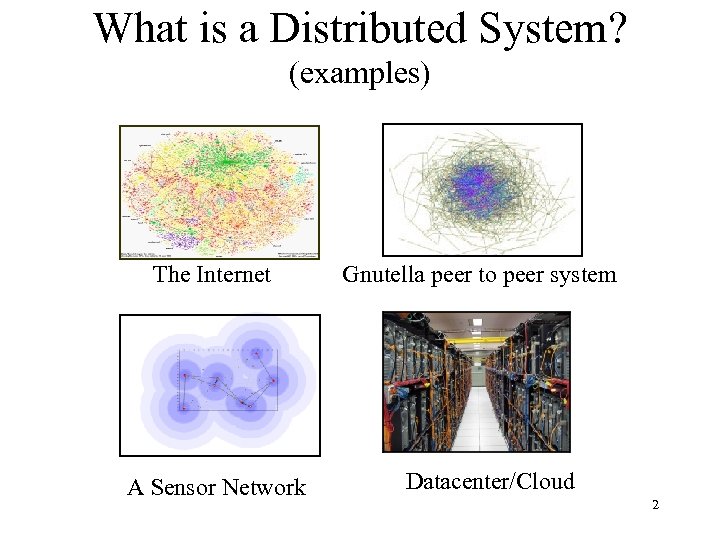
What is a Distributed System? (examples) The Internet A Sensor Network Gnutella peer to peer system Datacenter/Cloud 2
Can you name some examples of Operating Systems? 3
Can you name some examples of Operating Systems? … Linux Windows Unix Free. BSD mac. OS 2 K Aegis Scout Hydra Mach SPIN OS/2 Express Flux Hope Spring Antares. OS EOS LOS SQOS Little. OS TINOS Palm. OS Win. CE Tiny. OS i. OS … 4
What is an Operating System? 5
What is an Operating System? • • • User interface to hardware (device driver) Provides abstractions (processes, file system) Resource manager (scheduler) Means of communication (networking) … 6
FOLDOC definition • • The low-level software which handles the interface to peripheral hardware, schedules tasks, allocates storage, and presents a default interface to the user when no application program is running. The OS may be split into a kernel which is always present and various system programs which use facilities provided by the kernel to perform higher-level house-keeping tasks, often acting as servers in a client-server relationship. Some would include a graphical user interface and window system as part of the OS, others would not. The operating system loader, BIOS, or other firmware required at boot time or when installing the operating system would generally not be considered part of the operating system, though this distinction is unclear in the case of a roamable operating system such as RISC OS. The facilities an operating system provides and its general design philosophy exert an extremely strong influence on programming style and on the technical cultures that grow up around the machines on which it runs. 7
Can you name some examples of Distributed Systems? 8
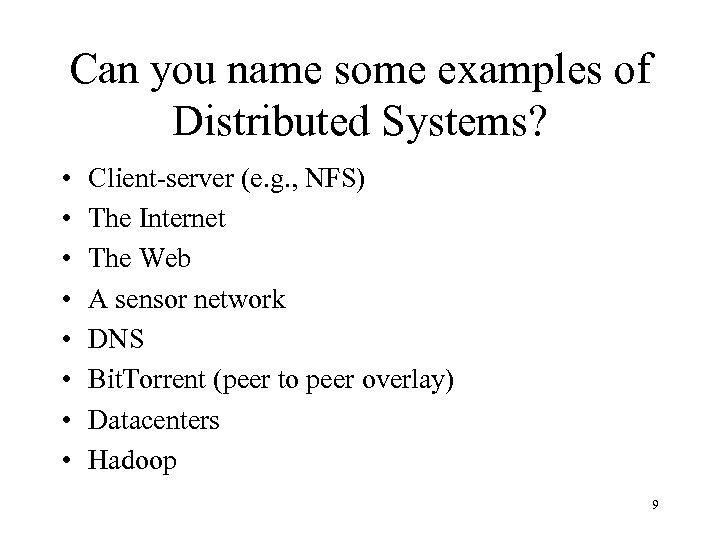
Can you name some examples of Distributed Systems? • • Client-server (e. g. , NFS) The Internet The Web A sensor network DNS Bit. Torrent (peer to peer overlay) Datacenters Hadoop 9
What is a Distributed System? 10
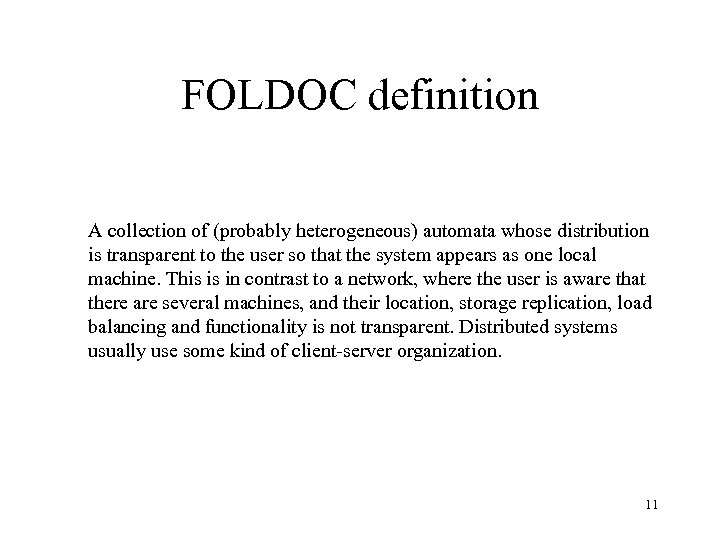
FOLDOC definition A collection of (probably heterogeneous) automata whose distribution is transparent to the user so that the system appears as one local machine. This is in contrast to a network, where the user is aware that there are several machines, and their location, storage replication, load balancing and functionality is not transparent. Distributed systems usually use some kind of client-server organization. 11
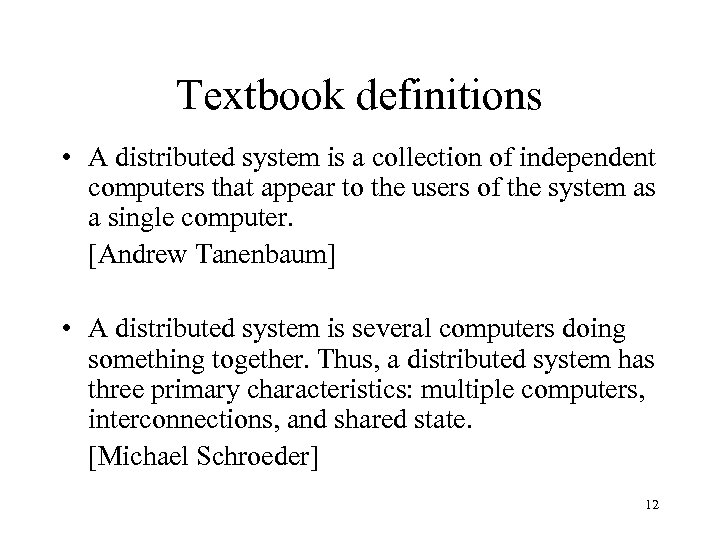
Textbook definitions • A distributed system is a collection of independent computers that appear to the users of the system as a single computer. [Andrew Tanenbaum] • A distributed system is several computers doing something together. Thus, a distributed system has three primary characteristics: multiple computers, interconnections, and shared state. [Michael Schroeder] 12
Unsatisfactory • Why are these definitions short? • Why do these definitions look inadequate to us? • Because we are interested in the insides of a distributed system – – algorithmics design and implementation maintenance study 13
I shall not today attempt further to define the kinds of material I understand to be embraced within that shorthand description; and perhaps I could never succeed in intelligibly doing so. But I know it when I see it… [Potter Stewart, Associate Justice, US Supreme Court (talking about his interpretation of a technical term laid down in the law, case Jacobellis versus Ohio 1964) ] 14
A working definition for us A distributed system is a collection of entities, each of which is autonomous, programmable, asynchronous and failure-prone, and which communicate through an unreliable communication medium. • Our interest in distributed systems involves – algorithmics, design and implementation, maintenance, study • Entity=a process on a device (PC, PDA, mote) • Communication Medium=Wired or wireless network 15
A range of interesting problems for Distributed System designers • • • P 2 P systems [Gnutella, Kazaa, Bit. Torrent] Cloud Infrastructures [AWS, Azure, Google cloud] Cloud Storage [Key-value stores, No. SQL, Big. Table] Cloud Programming [Map. Reduce, Pig, Hive, Storm, Pregel] • Coordination [Paxos] • Routing [Sensor Networks, Internet] • 16
A range of challenges • • Failures: no longer the exception, but rather a norm • Scalability: 1000 s of machines, Terabytes of data • Asynchrony: clock skew and clock drift • Security: of data, users, computations, etc. • 17
Multicast 18
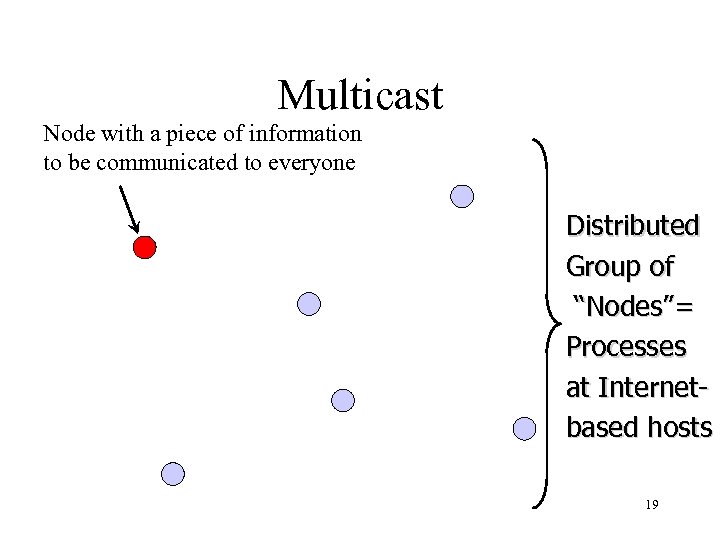
Multicast Node with a piece of information to be communicated to everyone Distributed Group of “Nodes”= Processes at Internetbased hosts 19
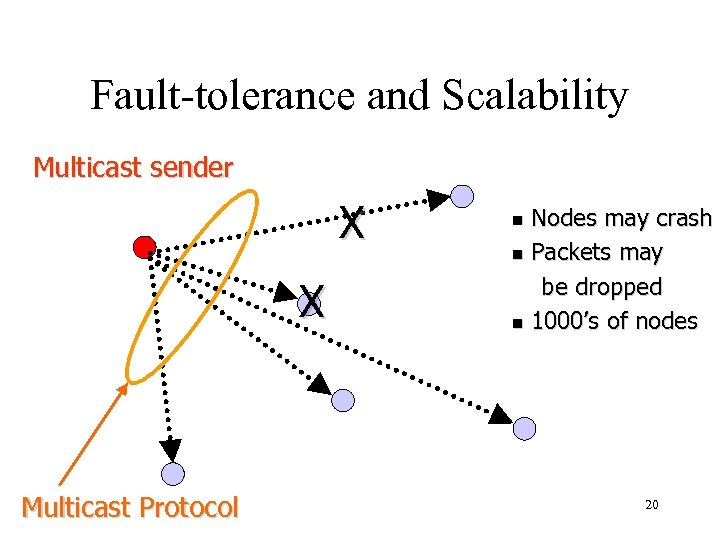
Fault-tolerance and Scalability Multicast sender X X Multicast Protocol Nodes may crash n Packets may be dropped n 1000’s of nodes n 20
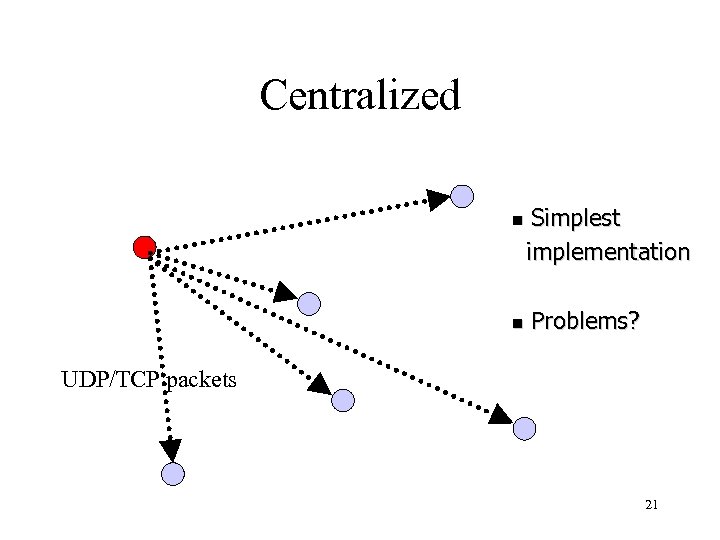
Centralized n n Simplest implementation Problems? UDP/TCP packets 21
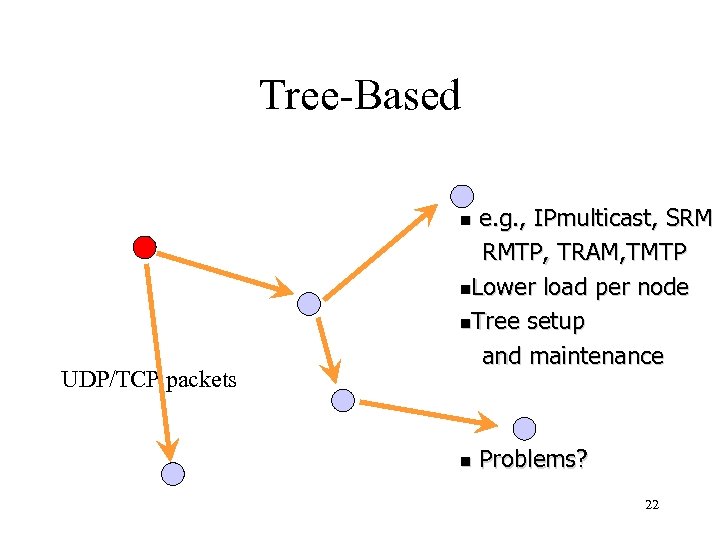
Tree-Based e. g. , IPmulticast, SRM RMTP, TRAM, TMTP n. Lower load per node n. Tree setup and maintenance n UDP/TCP packets n Problems? 22
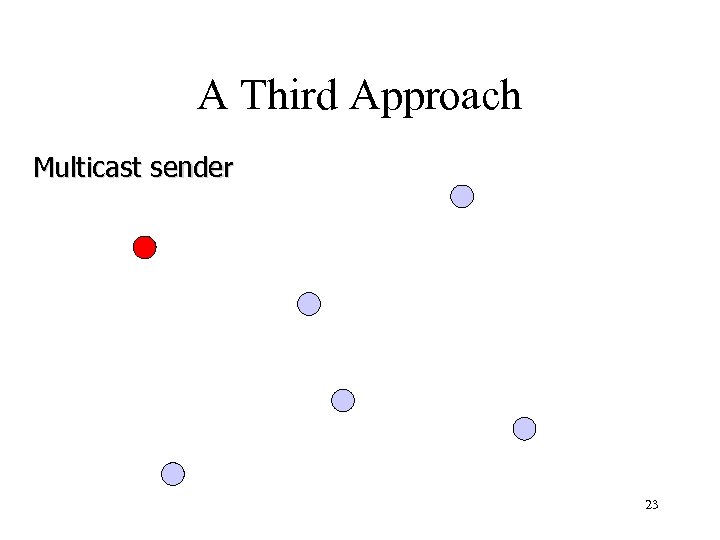
A Third Approach Multicast sender 23
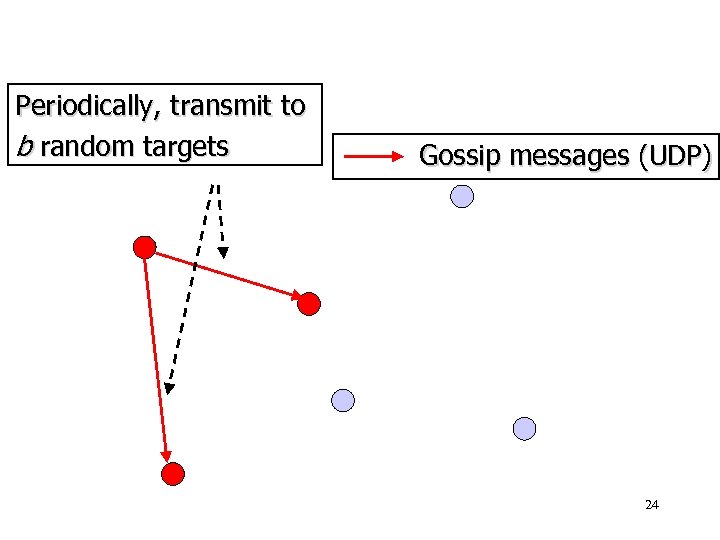
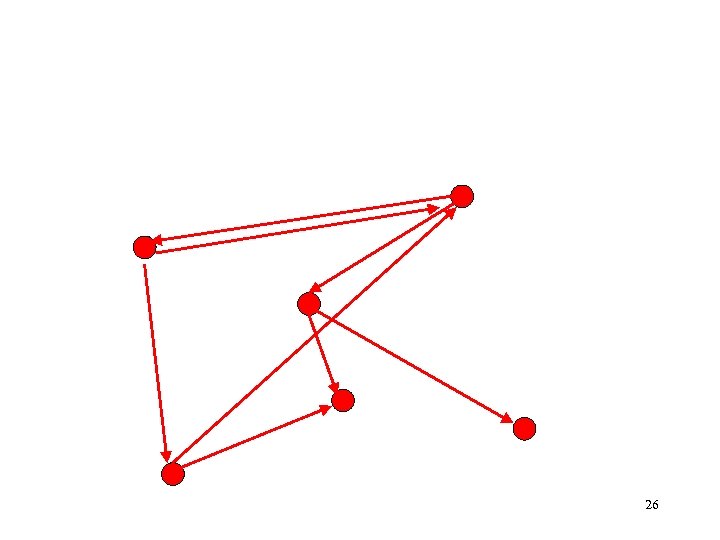
Periodically, transmit to b random targets Gossip messages (UDP) 24
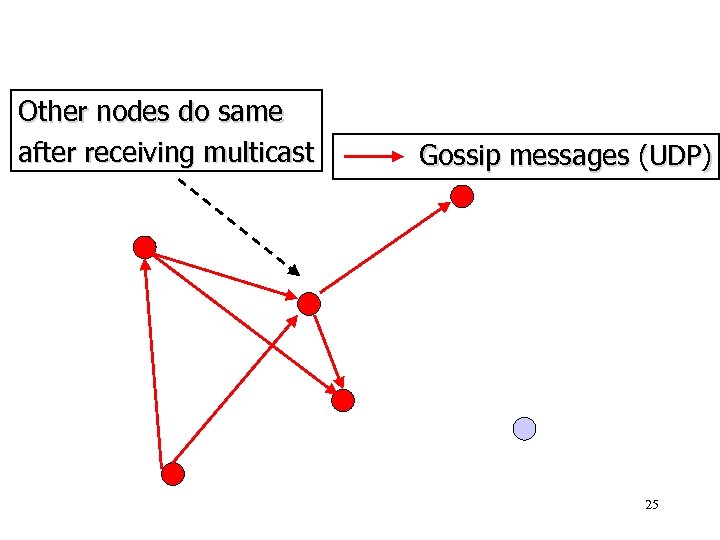
Other nodes do same after receiving multicast Gossip messages (UDP) 25
26
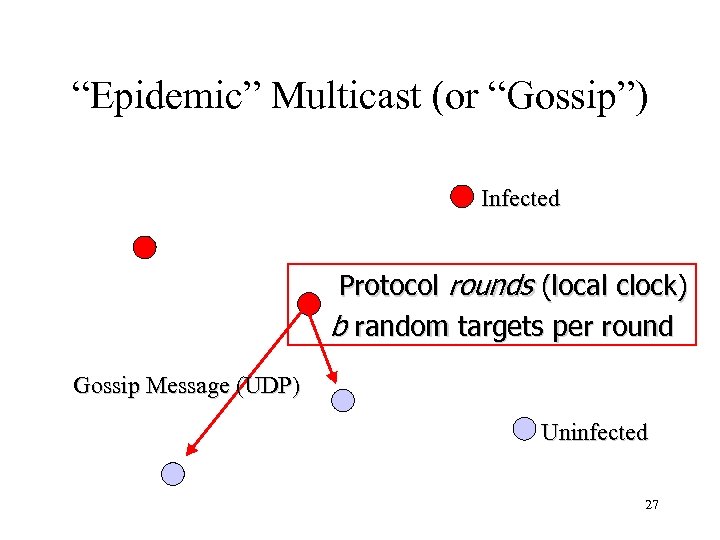
“Epidemic” Multicast (or “Gossip”) Infected Protocol rounds (local clock) b random targets per round Gossip Message (UDP) Uninfected 27
Properties Claim that this simple protocol • Is lightweight in large groups • Spreads a multicast quickly • Is highly fault-tolerant 28
![Analysis From old mathematical branch of Epidemiology [Bailey 75] • Population of (n+1) individuals](https://present5.com/presentation/87cf3738c69d2fe3b853c6d2e9d37fbd/image-29.jpg "Analysis From old mathematical branch of Epidemiology [Bailey 75] • Population of (n+1) individuals")
Analysis From old mathematical branch of Epidemiology [Bailey 75] • Population of (n+1) individuals mixing homogeneously • Contact rate between any individual pair is • At any time, each individual is either uninfected (numbering x) or infected (numbering y) • Then, and at all times • Infected–uninfected contact turns latter infected, and it stays infected 29
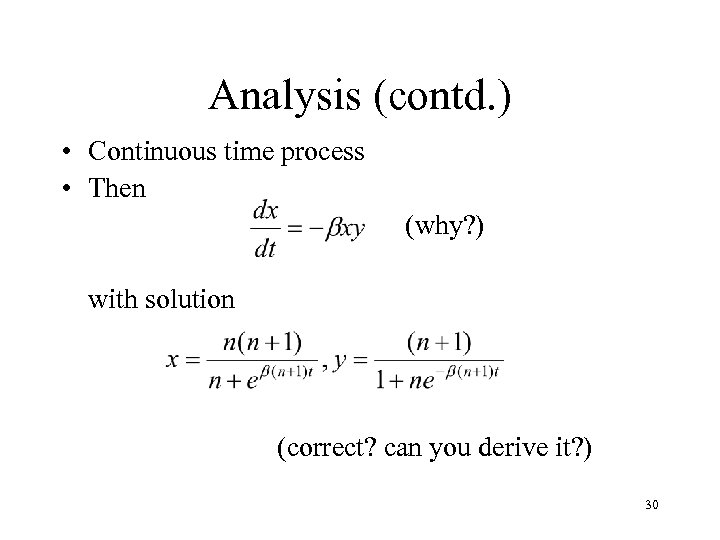
Analysis (contd. ) • Continuous time process • Then (why? ) with solution (correct? can you derive it? ) 30
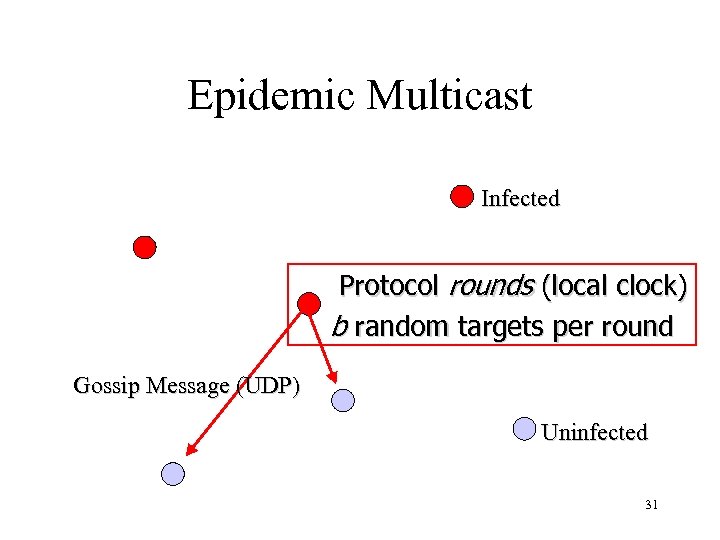
Epidemic Multicast Infected Protocol rounds (local clock) b random targets per round Gossip Message (UDP) Uninfected 31
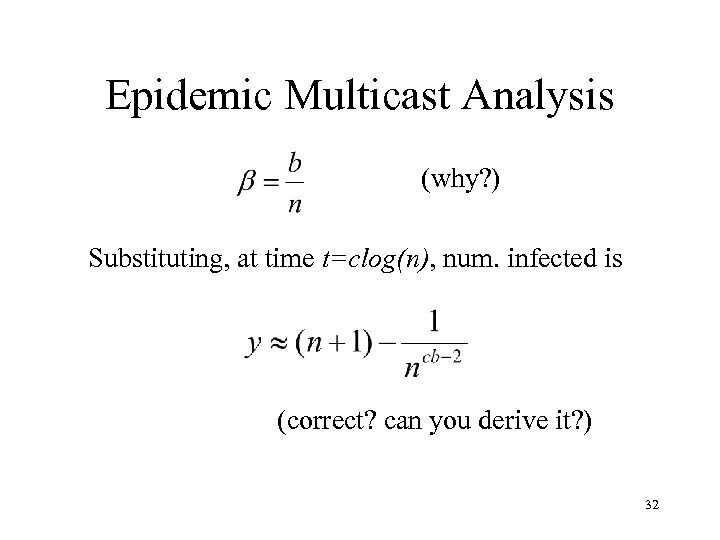
Epidemic Multicast Analysis (why? ) Substituting, at time t=clog(n), num. infected is (correct? can you derive it? ) 32
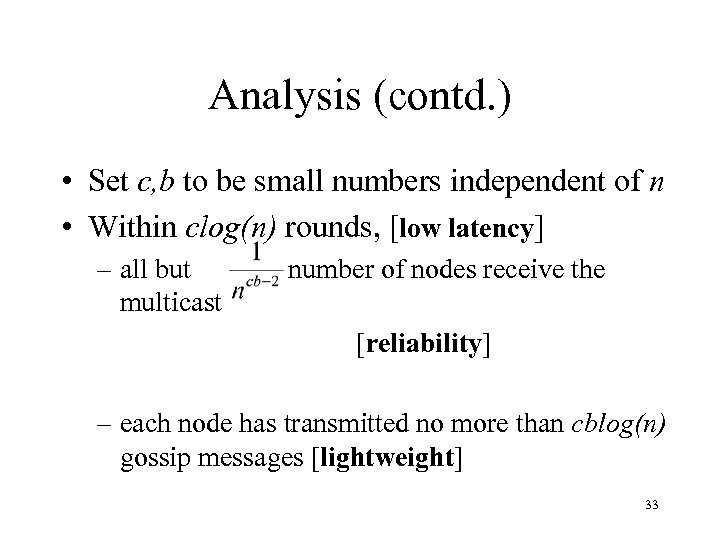
Analysis (contd. ) • Set c, b to be small numbers independent of n • Within clog(n) rounds, [low latency] – all but multicast number of nodes receive the [reliability] – each node has transmitted no more than cblog(n) gossip messages [lightweight] 33
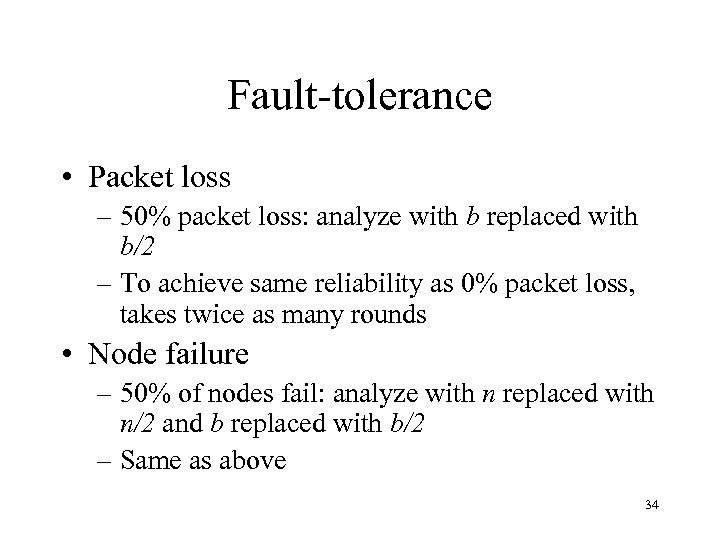
Fault-tolerance • Packet loss – 50% packet loss: analyze with b replaced with b/2 – To achieve same reliability as 0% packet loss, takes twice as many rounds • Node failure – 50% of nodes fail: analyze with n replaced with n/2 and b replaced with b/2 – Same as above 34
Fault-tolerance • With failures, is it possible that the epidemic might die out quickly? • Possible, but improbable: – Once a few nodes are infected, with high probability, the epidemic will not die out – So the analysis we saw in the previous slides is actually behavior with high probability [Galey and Dani 98] • Think: why do rumors spread so fast? why do infectious diseases cascade quickly into epidemics? why does a virus or worm spread rapidly? 35
So, … • Is this all theory and a bunch of equations? • Or are there implementations yet? 36
![Some implementations • Clearinghouse and Bayou projects: email and database transactions [PODC ‘ 87]](https://present5.com/presentation/87cf3738c69d2fe3b853c6d2e9d37fbd/image-37.jpg "Some implementations • Clearinghouse and Bayou projects: email and database transactions [PODC ‘ 87]")
Some implementations • Clearinghouse and Bayou projects: email and database transactions [PODC ‘ 87] • ref. DBMS system [Usenix ‘ 94] • Bimodal Multicast [ACM TOCS ‘ 99] • Sensor networks [Li Li et al, Infocom ’ 02, and PBBF, ICDCS ‘ 05] • Usenet NNTP (Network News Transport Protocol) ! [‘ 79] • AWS EC 2 and S 3 Cloud (rumored). [’ 00 s] 37
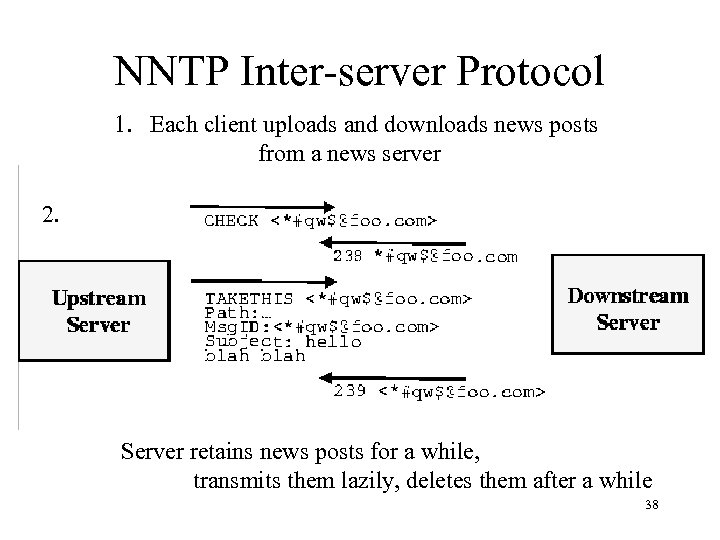
NNTP Inter-server Protocol 1. Each client uploads and downloads news posts from a news server 2. Server retains news posts for a while, transmits them lazily, deletes them after a while 38
We’ll cover some of these other implementations during the course • But let’s dwell on the big picture of the course 39
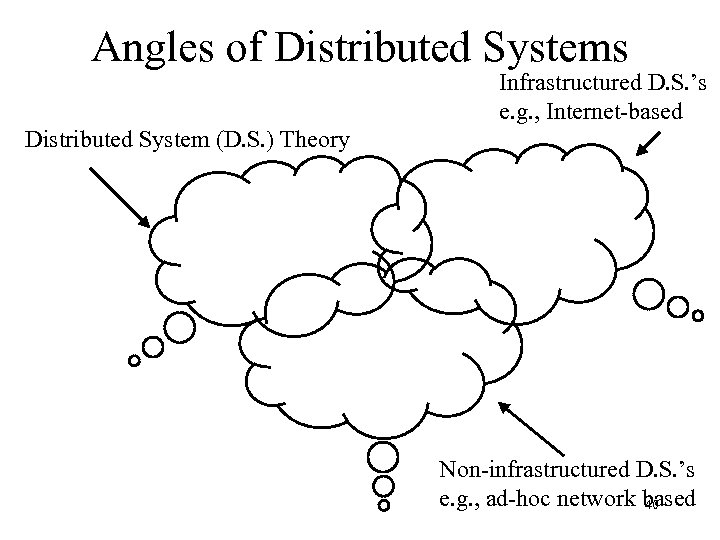
Angles of Distributed Systems Infrastructured D. S. ’s e. g. , Internet-based Distributed System (D. S. ) Theory Non-infrastructured D. S. ’s e. g. , ad-hoc network based 40
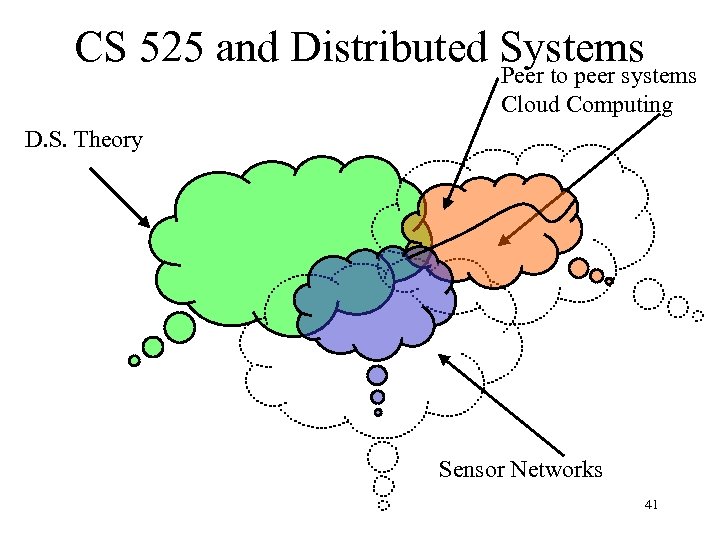
CS 525 and Distributed Systems Peer to peer systems Cloud Computing D. S. Theory Sensor Networks 41
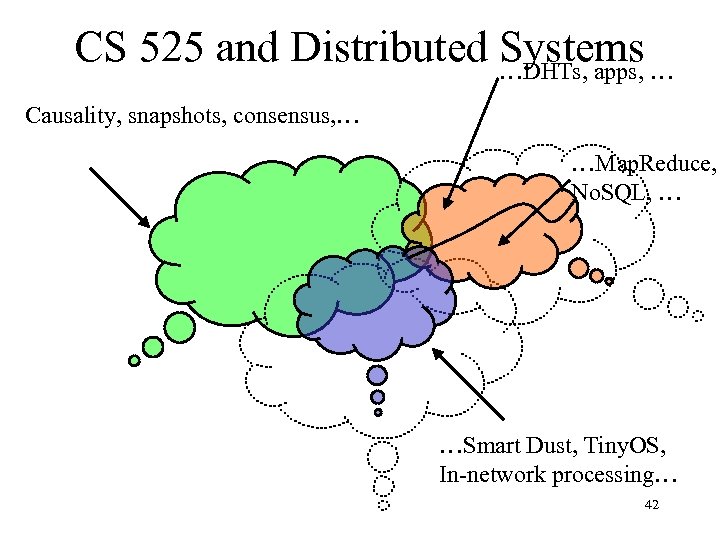
CS 525 and Distributed Systems … …DHTs, apps, Causality, snapshots, consensus, … …Map. Reduce, No. SQL, … …Smart Dust, Tiny. OS, In-network processing… 42
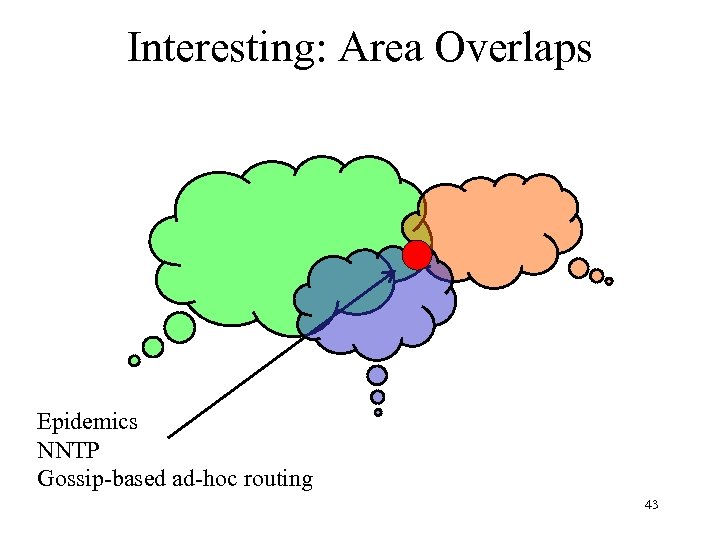
Interesting: Area Overlaps Epidemics NNTP Gossip-based ad-hoc routing 43
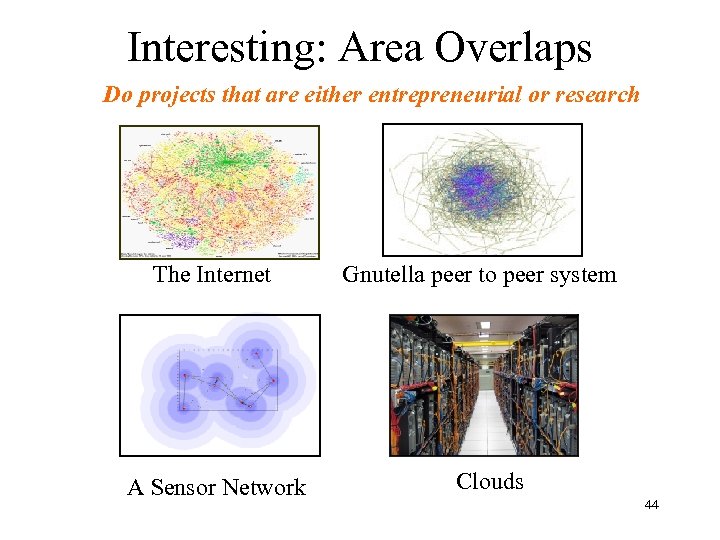
Interesting: Area Overlaps Do projects that are either entrepreneurial or research The Internet A Sensor Network Gnutella peer to peer system Clouds 44
Research Project • Your project has to be related to distributed systems • Must show keen awareness of the current state of the art • Must solve thoroughly at least one practical research problem • Must have innovative ideas and originality (algorithms) • Must build a real system and evaluate it in deployment • You will write a conference-quality research paper as a part of your project • We will submit the best papers from this class to top conferences/workshops in the area of distributed systems – Past versions of CS 525 highly successful in getting papers into conferences and journals, and have won awards (see course website) • To help you get insight into the current and bleeding edge of 45 d. s. research, we will read 2 research papers per class
Entrepreneurial Project • Proposes new ideas that can be accommodated into a (your own!) startup – Company – Or non-profit • Has to be a remarkable and marketable product/services with real users in mind – Need to write reports (similar timeline and guideline as Research Projects) – Need to write a short Business Plan • You need to develop ideas for the company. What you do later with it is solely up to you. • Enterprise. Works incubator at Illinois • Has to use or leverage concepts from the CS 525 class • To help you get leverage the current and bleeding edge of 46 d. s. research, we will read 2 research papers per class
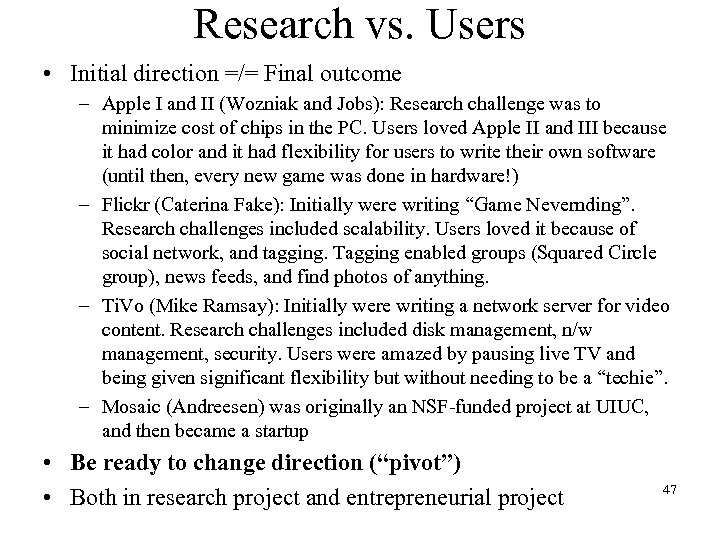
Research vs. Users • Initial direction =/= Final outcome – Apple I and II (Wozniak and Jobs): Research challenge was to minimize cost of chips in the PC. Users loved Apple II and III because it had color and it had flexibility for users to write their own software (until then, every new game was done in hardware!) – Flickr (Caterina Fake): Initially were writing “Game Nevernding”. Research challenges included scalability. Users loved it because of social network, and tagging. Tagging enabled groups (Squared Circle group), news feeds, and find photos of anything. – Ti. Vo (Mike Ramsay): Initially were writing a network server for video content. Research challenges included disk management, n/w management, security. Users were amazed by pausing live TV and being given significant flexibility but without needing to be a “techie”. – Mosaic (Andreesen) was originally an NSF-funded project at UIUC, and then became a startup • Be ready to change direction (“pivot”) • Both in research project and entrepreneurial project 47
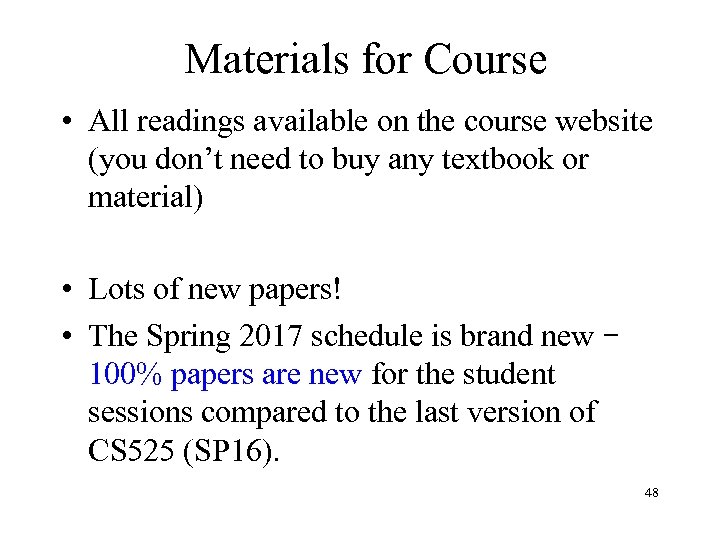
Materials for Course • All readings available on the course website (you don’t need to buy any textbook or material) • Lots of new papers! • The Spring 2017 schedule is brand new – 100% papers are new for the student sessions compared to the last version of CS 525 (SP 16). 48
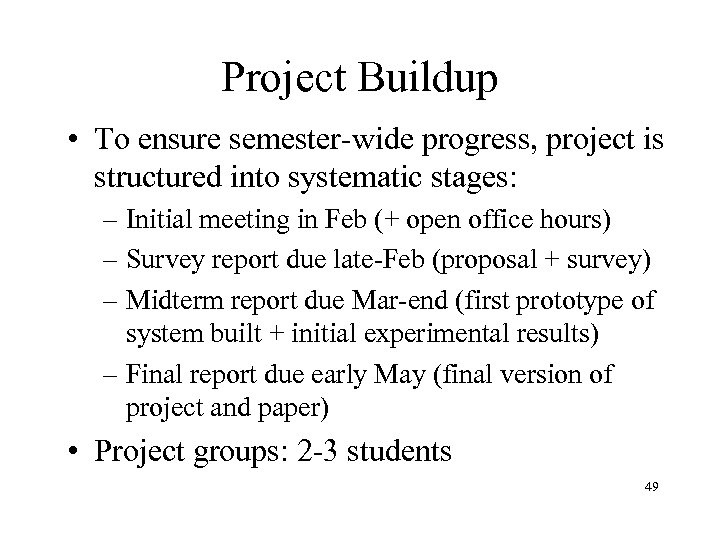
Project Buildup • To ensure semester-wide progress, project is structured into systematic stages: – Initial meeting in Feb (+ open office hours) – Survey report due late-Feb (proposal + survey) – Midterm report due Mar-end (first prototype of system built + initial experimental results) – Final report due early May (final version of project and paper) • Project groups: 2 -3 students 49
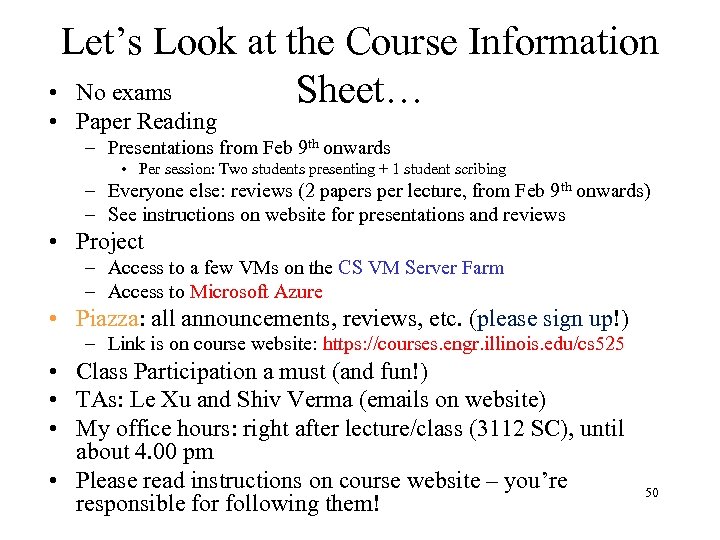
Let’s Look at the Course Information • No exams Sheet… • Paper Reading – Presentations from Feb 9 th onwards • Per session: Two students presenting + 1 student scribing – Everyone else: reviews (2 papers per lecture, from Feb 9 th onwards) – See instructions on website for presentations and reviews • Project – Access to a few VMs on the CS VM Server Farm – Access to Microsoft Azure • Piazza: all announcements, reviews, etc. (please sign up!) – Link is on course website: https: //courses. engr. illinois. edu/cs 525 • Class Participation a must (and fun!) • TAs: Le Xu and Shiv Verma (emails on website) • My office hours: right after lecture/class (3112 SC), until about 4. 00 pm • Please read instructions on course website – you’re responsible for following them! 50
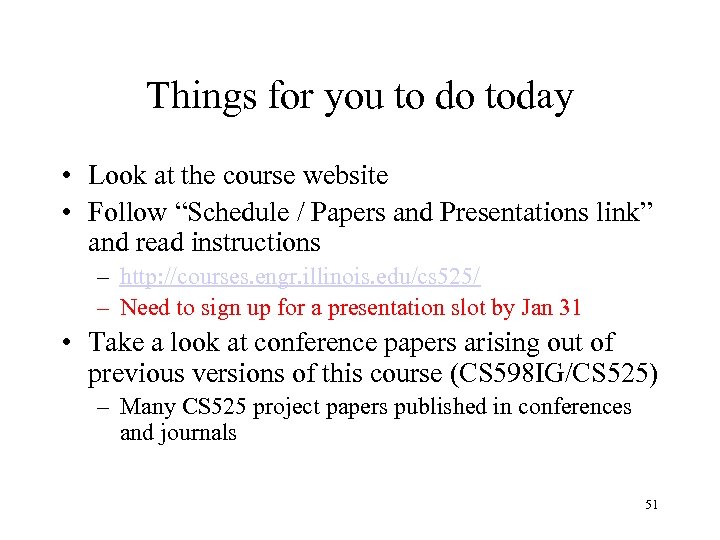
Things for you to do today • Look at the course website • Follow “Schedule / Papers and Presentations link” and read instructions – http: //courses. engr. illinois. edu/cs 525/ – Need to sign up for a presentation slot by Jan 31 • Take a look at conference papers arising out of previous versions of this course (CS 598 IG/CS 525) – Many CS 525 project papers published in conferences and journals 51
Prerequisites • Background in OS’es is required (CS 241/CS 423) • Distributed Systems/Algorithms is recommended – If you haven’t taken CS 425/ECE 428 or ECE 526, then … – … you should highly consider taking the Coursera course on Cloud Computing Concepts (Parts 1 and 2). It’s a free course. 52
Next Lecture • Cloud Computing – Take a look at all papers on website for that session – Read at least one of those papers completely – Try to read all of them completely – (no reviews required yet) 53
Backup Slides 54
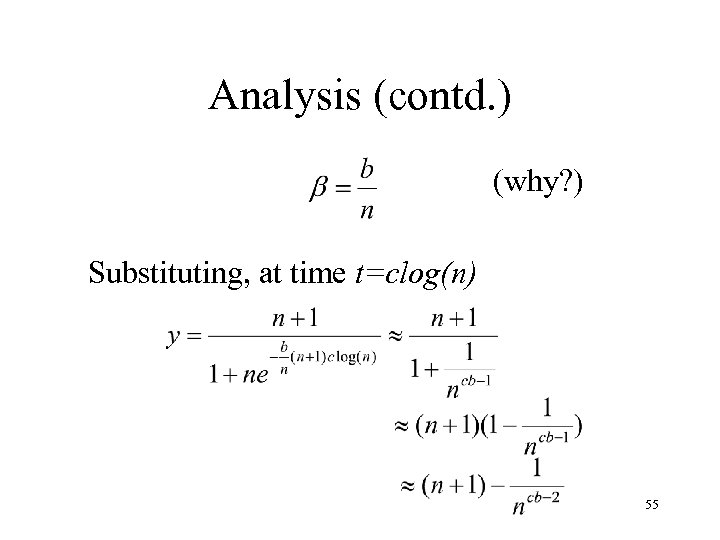
Analysis (contd. ) (why? ) Substituting, at time t=clog(n) 55
Скачать презентацию CS 525 Advanced Distributed Systems Spring 2017 Indranil
87cf3738c69d2fe3b853c6d2e9d37fbd.ppt