 Скачать презентацию CS 525 Advanced Distributed Systems Spring 2011 Indranil
L_member.sp11.ppt
- Количество слайдов: 53



CS 525 Advanced Distributed Systems Spring 2011 Indranil Gupta (Indy) Membership Protocols (and Failure Detectors) March 31, 2011 1 All Slides © IG
Target Settings • Process ‘group’-based systems – Clouds/Datacenters – Replicated servers – Distributed databases • Crash-stop/Fail-stop process failures 2
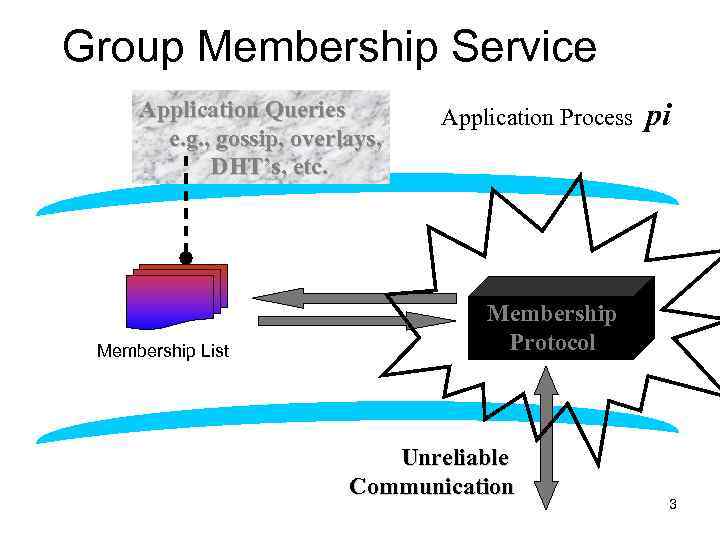
Group Membership Service Application Queries e. g. , gossip, overlays, DHT’s, etc. Application Process pi joins, leaves, failures of members Membership List Group Membership List Membership Protocol Unreliable Communication 3
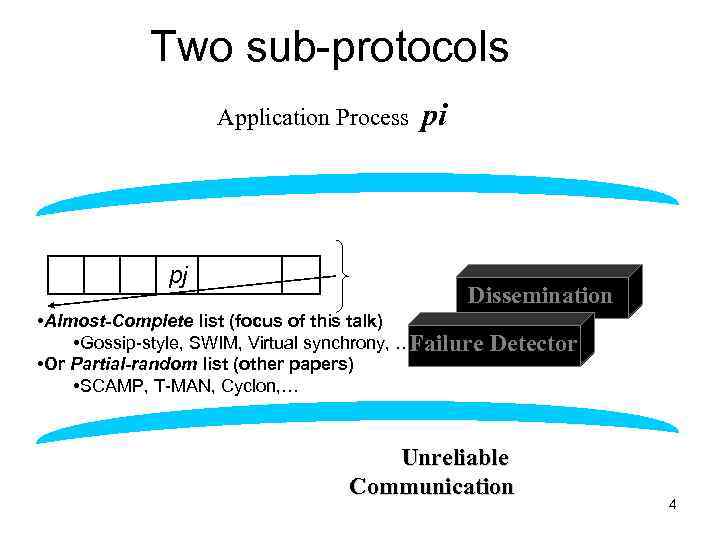
Two sub-protocols Application Process pj pi Dissemination • Almost-Complete list (focus of this talk) • Gossip-style, SWIM, Virtual synchrony, … Failure Group • Or Partial-random list (other papers) • SCAMP, T-MAN, Cyclon, … Membership List Detector Unreliable Communication 4
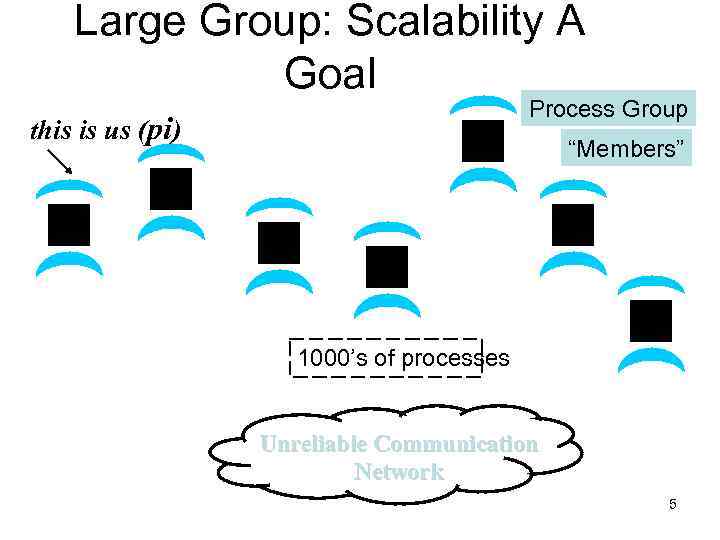
Large Group: Scalability A Goal Process Group this is us (pi) “Members” 1000’s of processes Unreliable Communication Network 5
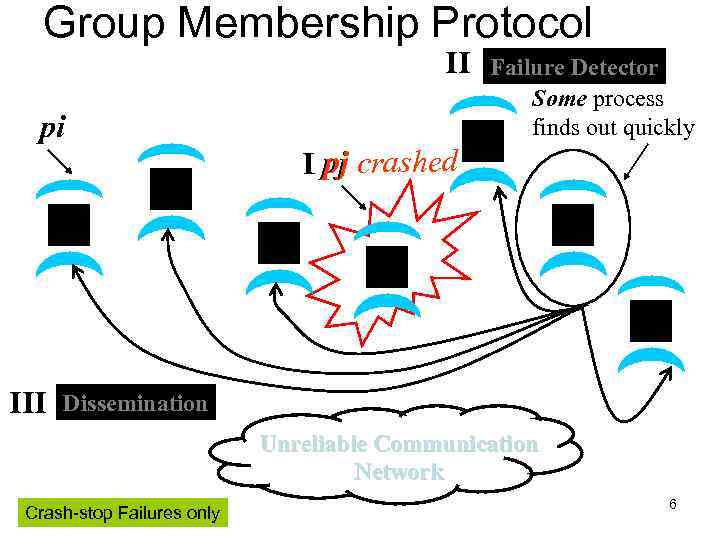
Group Membership Protocol II pi III Failure Detector Some process finds out quickly I pj crashed Dissemination Unreliable Communication Network Crash-stop Failures only 6
I. pj crashes • • Nothing we can do about it! A frequent occurrence Common case rather than exception Frequency goes up at least linearly with size of datacenter 7
II. Distributed Failure Detectors: Desirable Properties • Completeness = each failure is detected • Accuracy = there is no mistaken detection • Speed – Time to first detection of a failure • Scale – Equal Load on each member – Network Message Load 8
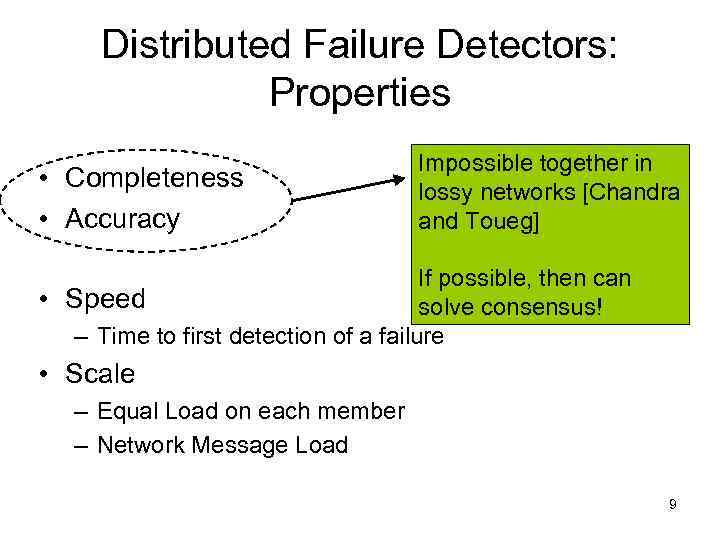
Distributed Failure Detectors: Properties • Completeness • Accuracy Impossible together in lossy networks [Chandra and Toueg] If possible, then can • Speed solve consensus! – Time to first detection of a failure • Scale – Equal Load on each member – Network Message Load 9
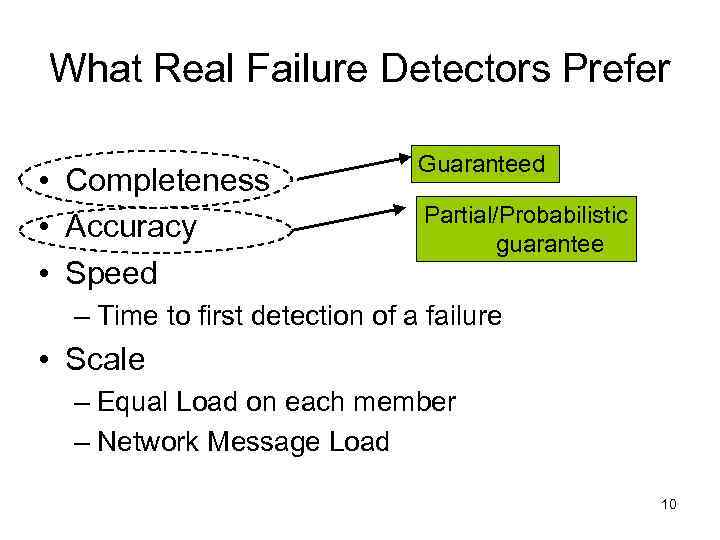
What Real Failure Detectors Prefer • Completeness • Accuracy • Speed Guaranteed Partial/Probabilistic guarantee – Time to first detection of a failure • Scale – Equal Load on each member – Network Message Load 10
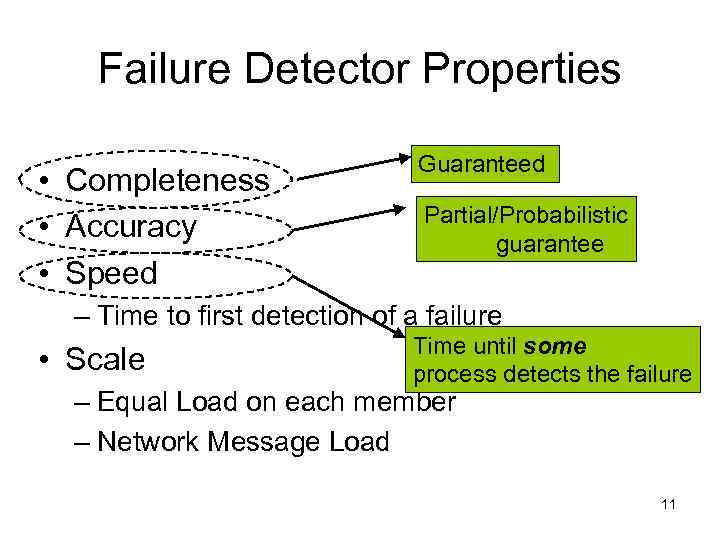
Failure Detector Properties • Completeness • Accuracy • Speed Guaranteed Partial/Probabilistic guarantee – Time to first detection of a failure • Scale Time until some process detects the failure – Equal Load on each member – Network Message Load 11
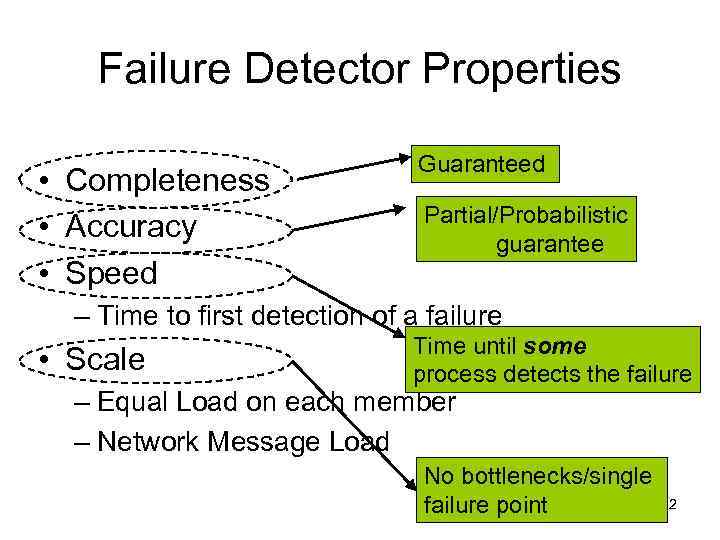
Failure Detector Properties • Completeness • Accuracy • Speed Guaranteed Partial/Probabilistic guarantee – Time to first detection of a failure • Scale Time until some process detects the failure – Equal Load on each member – Network Message Load No bottlenecks/single failure point 12
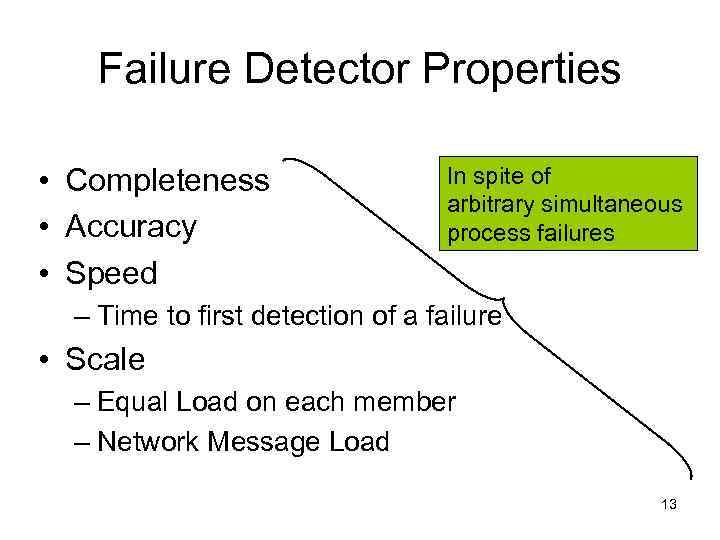
Failure Detector Properties • Completeness • Accuracy • Speed In spite of arbitrary simultaneous process failures – Time to first detection of a failure • Scale – Equal Load on each member – Network Message Load 13
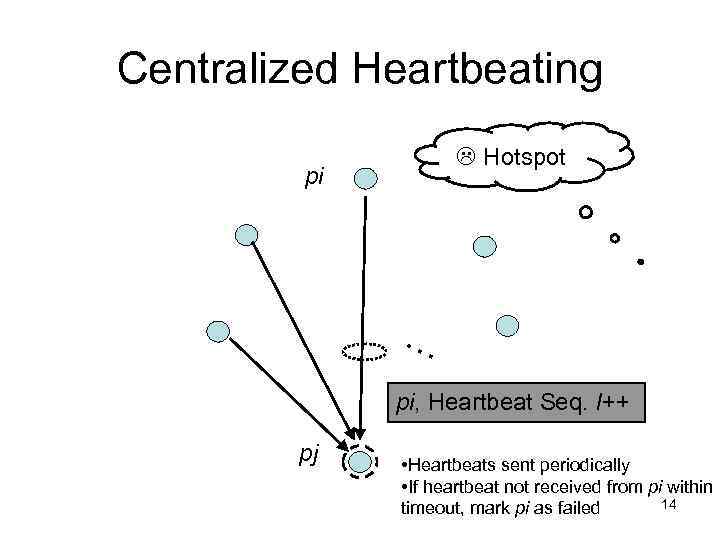
Centralized Heartbeating Hotspot pi … pi, Heartbeat Seq. l++ pj • Heartbeats sent periodically • If heartbeat not received from pi within 14 timeout, mark pi as failed
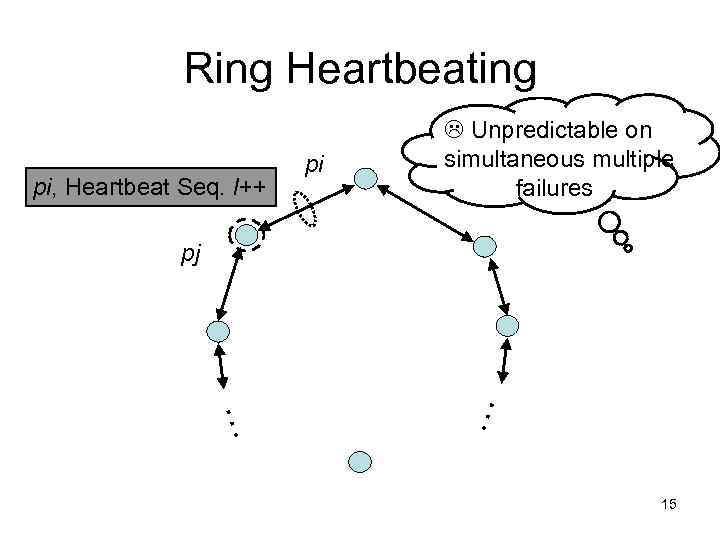
Ring Heartbeating pi, Heartbeat Seq. l++ pi Unpredictable on simultaneous multiple failures pj … … 15
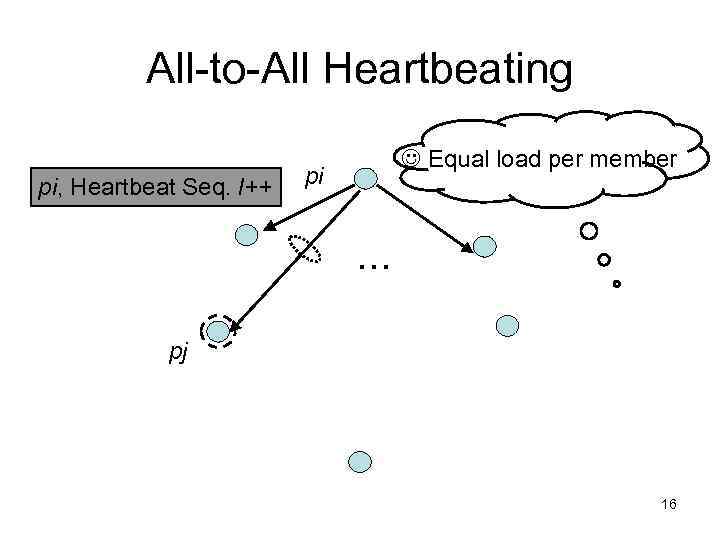
All-to-All Heartbeating pi, Heartbeat Seq. l++ Equal load per member pi … pj 16
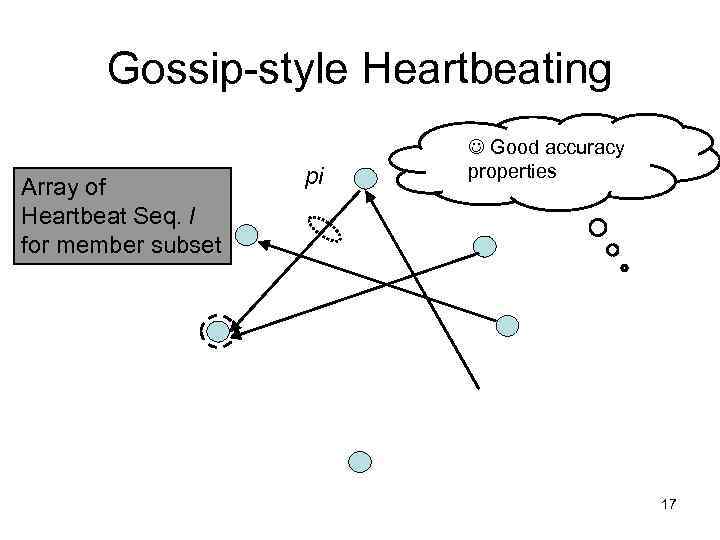
Gossip-style Heartbeating Array of Heartbeat Seq. l for member subset pi Good accuracy properties 17
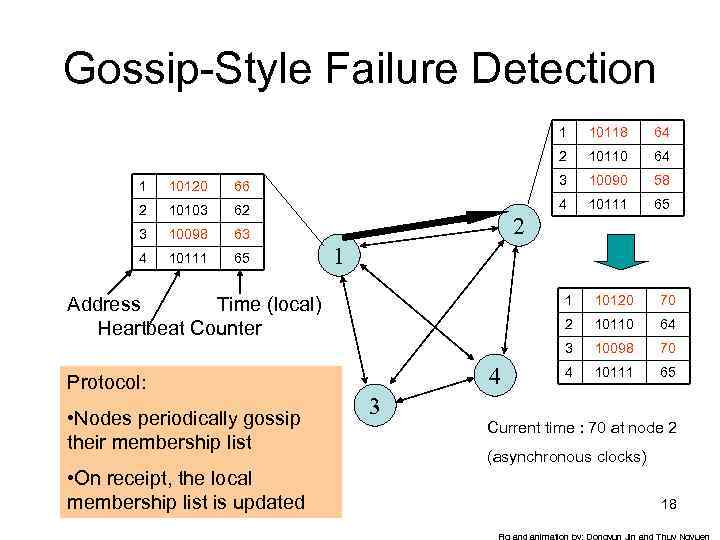
Gossip-Style Failure Detection 1 10118 64 2 10110 64 1 10120 66 3 10090 58 2 10103 62 4 10111 65 3 10098 63 4 10111 65 2 1 1 • Nodes periodically gossip their membership list • On receipt, the local membership list is updated 4 3 70 10110 64 3 Protocol: 10120 2 Address Time (local) Heartbeat Counter 10098 70 4 10111 65 Current time : 70 at node 2 (asynchronous clocks) 18 Fig and animation by: Dongyun Jin and Thuy Ngyuen
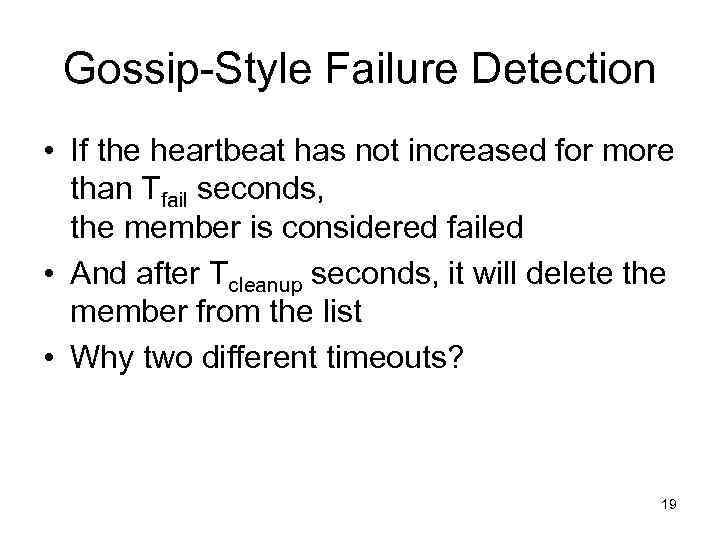
Gossip-Style Failure Detection • If the heartbeat has not increased for more than Tfail seconds, the member is considered failed • And after Tcleanup seconds, it will delete the member from the list • Why two different timeouts? 19
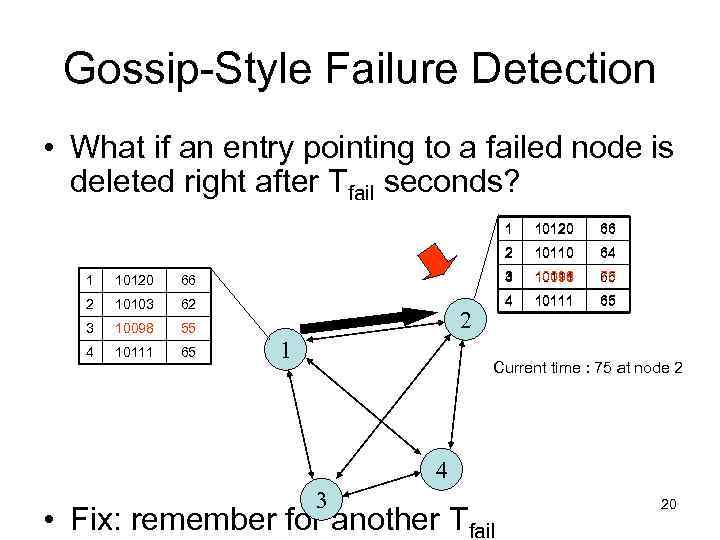
Gossip-Style Failure Detection • What if an entry pointing to a failed node is deleted right after Tfail seconds? 1 10120 66 2 10110 64 1 10120 66 3 4 10098 10111 75 65 50 2 10103 62 4 10111 65 3 10098 55 4 10111 65 2 1 Current time : 75 at node 2 4 3 • Fix: remember for another Tfail 20
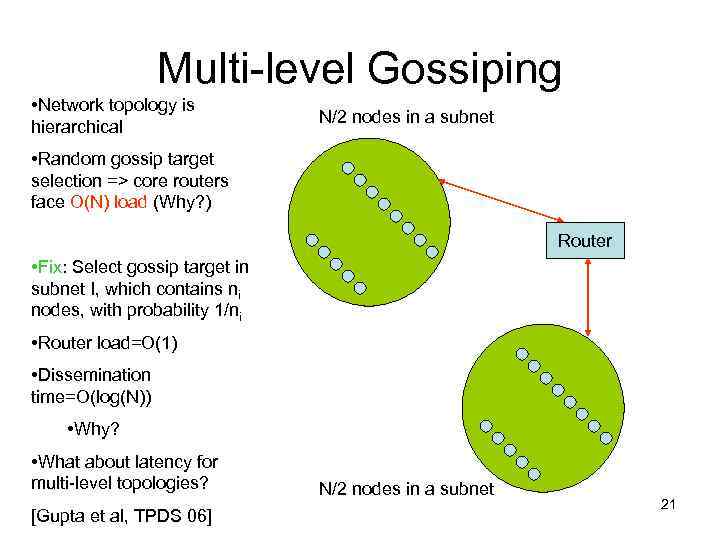
Multi-level Gossiping • Network topology is hierarchical N/2 nodes in a subnet • Random gossip target selection => core routers face O(N) load (Why? ) Router • Fix: Select gossip target in subnet I, which contains ni nodes, with probability 1/ni • Router load=O(1) • Dissemination time=O(log(N)) • Why? • What about latency for multi-level topologies? [Gupta et al, TPDS 06] N/2 nodes in a subnet 21
Analysis/Discussion • What happens if gossip period Tgossip is decreased? • A single heartbeat takes O(log(N)) time to propagate. So: N heartbeats take: – O(log(N)) time to propagate, if bandwidth allowed per node is allowed to be O(N) – O(N. log(N)) time to propagate, if bandwidth allowed per node is only O(1) – What about O(k) bandwidth? • What happens to Pmistake (false positive rate) as Tfail , Tcleanup is increased? • Tradeoff: False positive rate vs. detection time 22
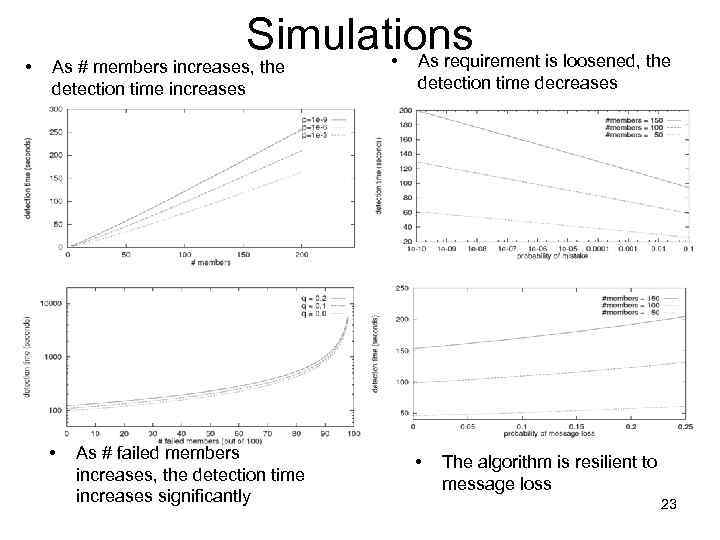
• Simulations • As requirement is loosened, the As # members increases, the detection time increases • As # failed members increases, the detection time increases significantly detection time decreases • The algorithm is resilient to message loss 23
Failure Detector Properties … • Completeness • Accuracy • Speed – Time to first detection of a failure • Scale – Equal Load on each member – Network Message Load 24
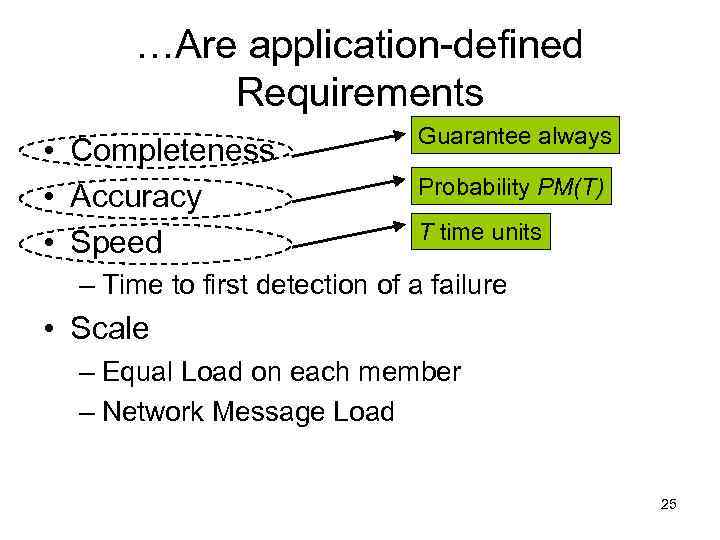
…Are application-defined Requirements • Completeness • Accuracy • Speed Guarantee always Probability PM(T) T time units – Time to first detection of a failure • Scale – Equal Load on each member – Network Message Load 25
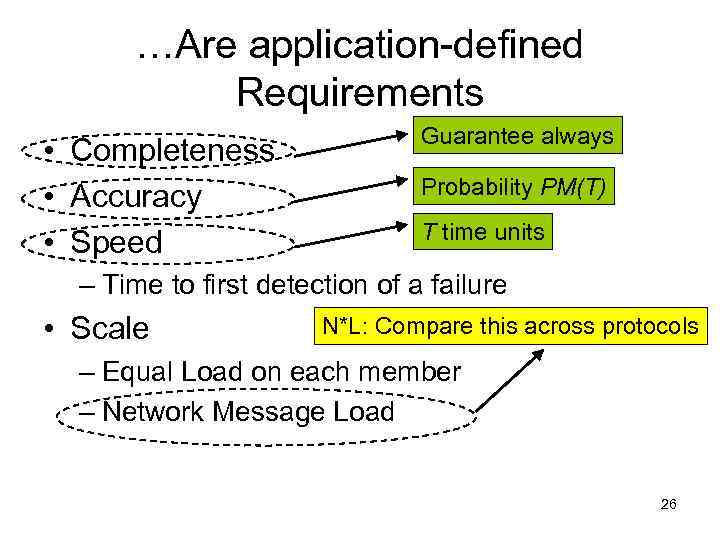
…Are application-defined Requirements • Completeness • Accuracy • Speed Guarantee always Probability PM(T) T time units – Time to first detection of a failure • Scale N*L: Compare this across protocols – Equal Load on each member – Network Message Load 26
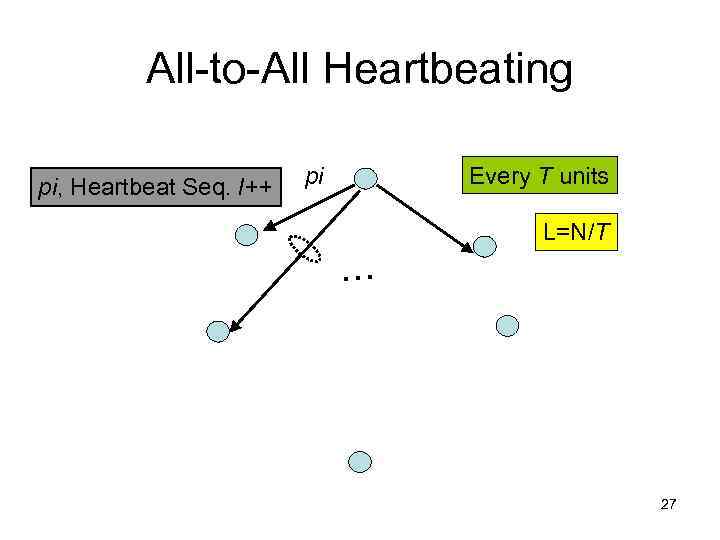
All-to-All Heartbeating pi, Heartbeat Seq. l++ pi Every T units L=N/T … 27
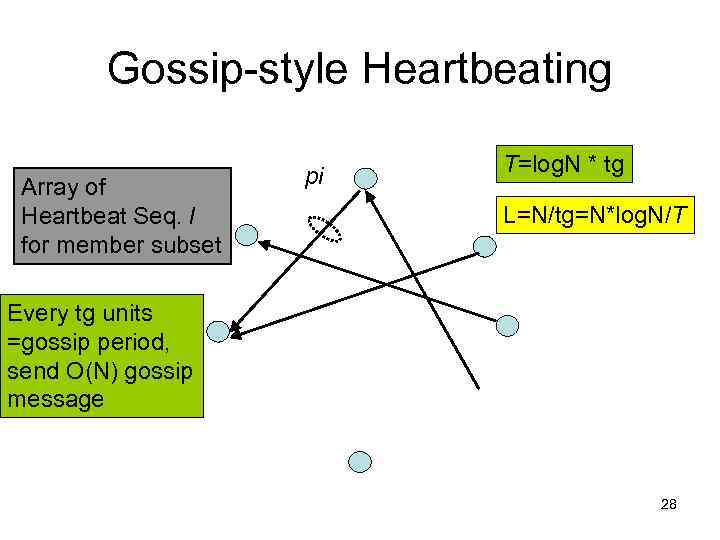
Gossip-style Heartbeating Array of Heartbeat Seq. l for member subset pi T=log. N * tg L=N/tg=N*log. N/T Every tg units =gossip period, send O(N) gossip message 28
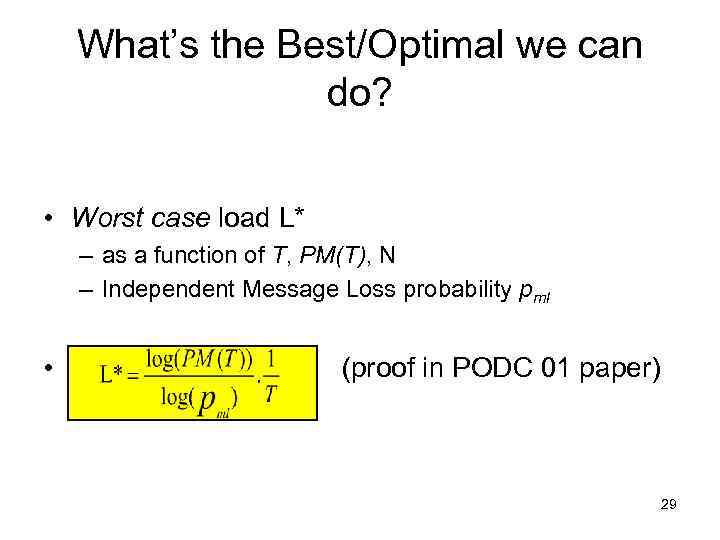
What’s the Best/Optimal we can do? • Worst case load L* – as a function of T, PM(T), N – Independent Message Loss probability pml • (proof in PODC 01 paper) 29
Heartbeating • Optimal L is independent of N (!) • All-to-all and gossip-based: sub-optimal • L=O(N/T) • try to achieve simultaneous detection at all processes • fail to distinguish Failure Detection and Dissemination components ÜKey: Separate the two components Use a non heartbeat-based Failure Detection Compone 30
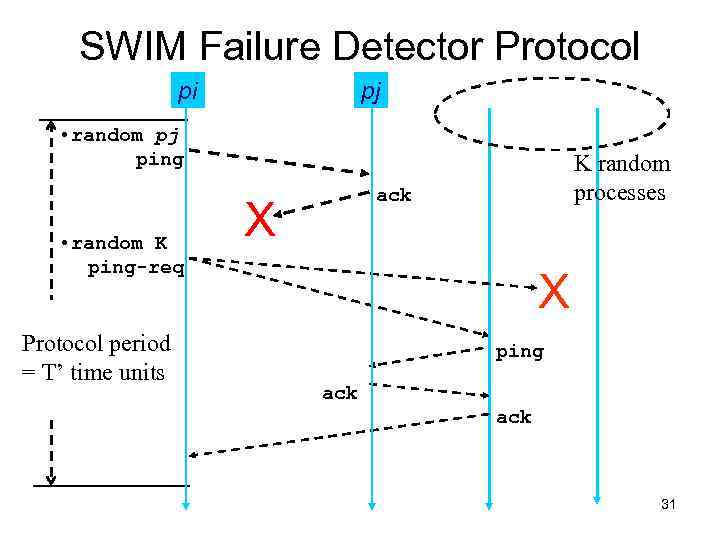
SWIM Failure Detector Protocol pi pj • random pj ping • random K ping-req Protocol period = T’ time units K random processes ack X X ping ack 31
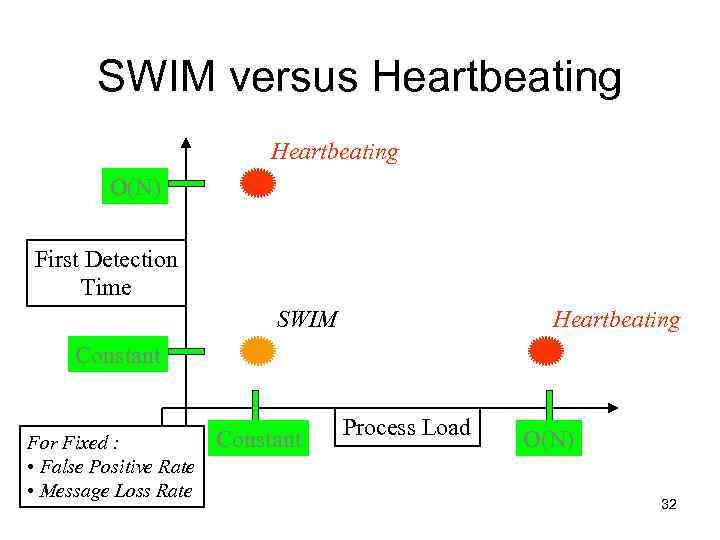
SWIM versus Heartbeating O(N) First Detection Time SWIM Heartbeating Constant For Fixed : • False Positive Rate • Message Loss Rate Constant Process Load O(N) 32
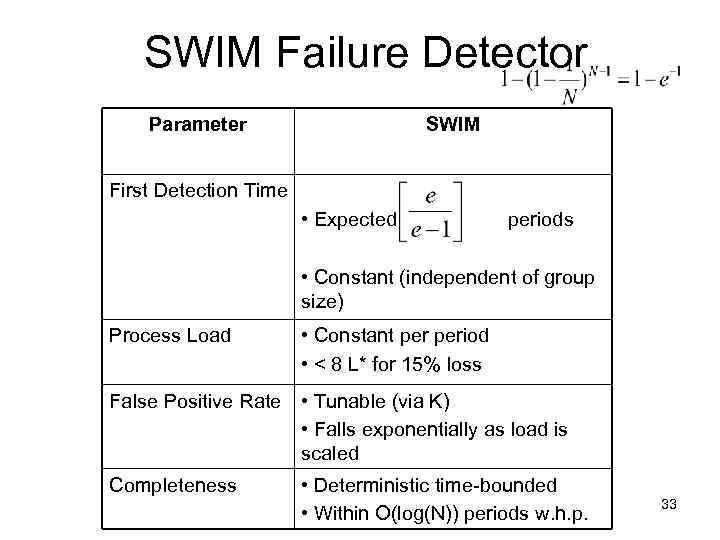
SWIM Failure Detector Parameter SWIM First Detection Time • Expected periods • Constant (independent of group size) Process Load • Constant period • < 8 L* for 15% loss False Positive Rate • Tunable (via K) • Falls exponentially as load is scaled Completeness • Deterministic time-bounded • Within O(log(N)) periods w. h. p. 33
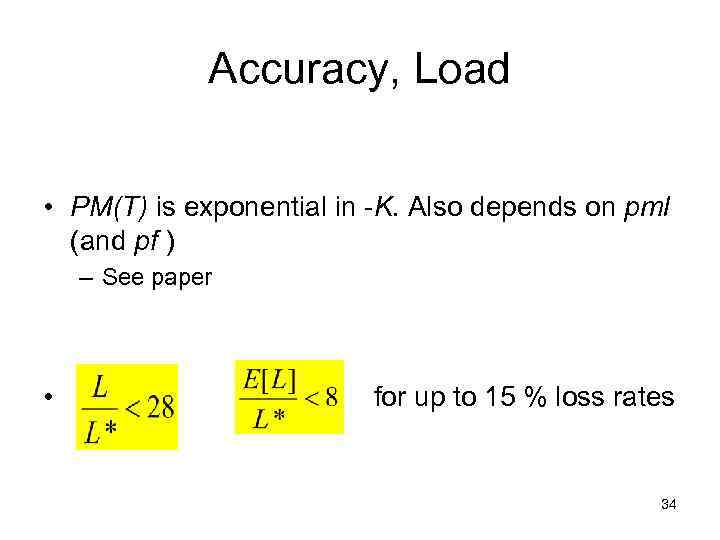
Accuracy, Load • PM(T) is exponential in -K. Also depends on pml (and pf ) – See paper • for up to 15 % loss rates 34
![Detection Time • Prob. of being pinged in T’= • E[T ] = •](https://present5.com/presentation/2735364_365455813/image-35.jpg "Detection Time • Prob. of being pinged in T’= • E[T ] = •")
Detection Time • Prob. of being pinged in T’= • E[T ] = • Completeness: Any alive member detects failure – Eventually – By using a trick: within worst case O(N) protocol periods 35
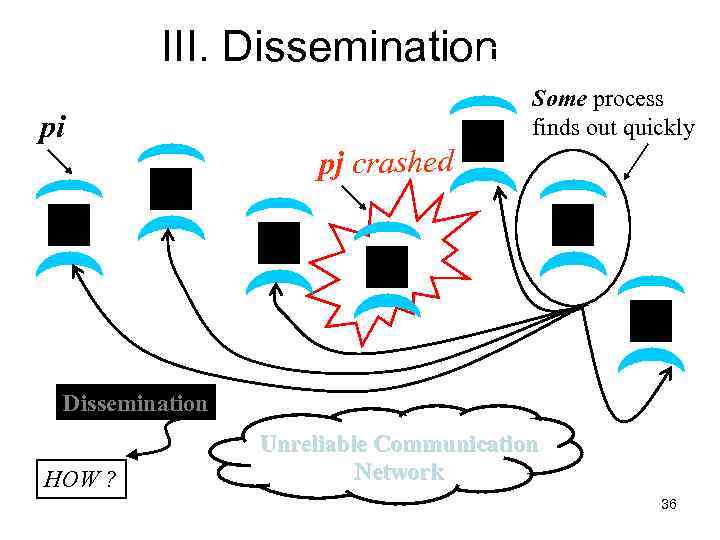
III. Dissemination Failure Detector pi Some process finds out quickly pj crashed Dissemination HOW ? Unreliable Communication Network 36
Dissemination Options • Multicast (Hardware / IP) – unreliable – multiple simultaneous multicasts • Point-to-point (TCP / UDP) – expensive • Zero extra messages: Piggyback on Failure Detector messages – Infection-style Dissemination 37
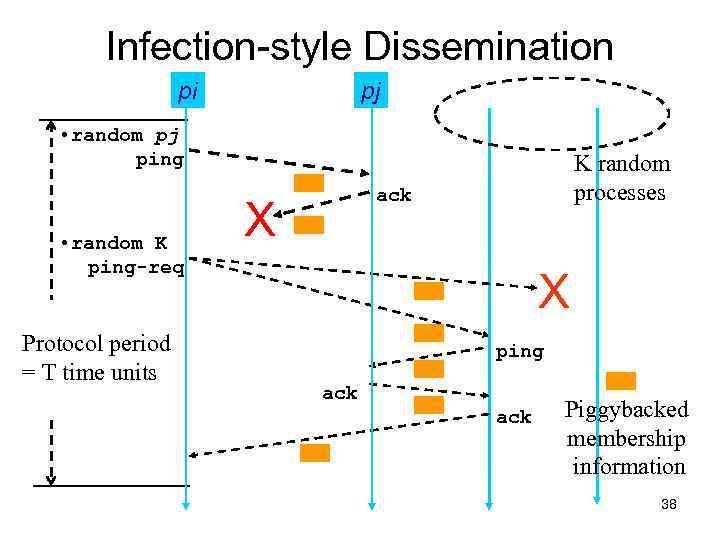
Infection-style Dissemination pi pj • random pj ping • random K ping-req Protocol period = T time units K random processes ack X X ping ack Piggybacked membership information 38
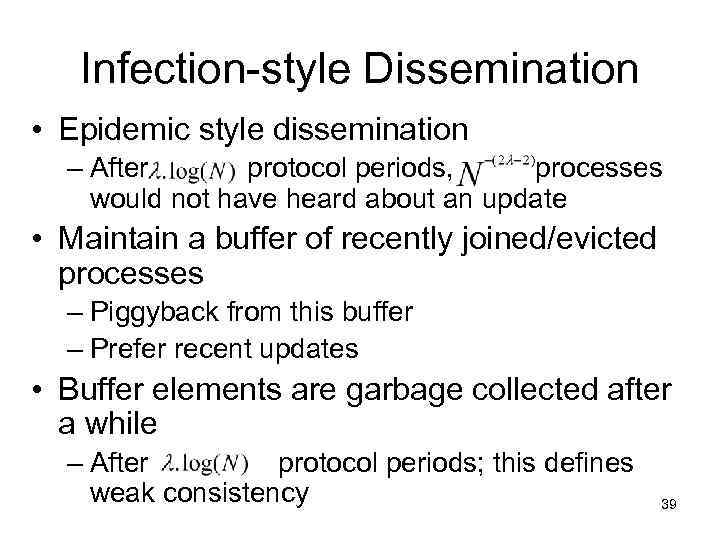
Infection-style Dissemination • Epidemic style dissemination – After protocol periods, processes would not have heard about an update • Maintain a buffer of recently joined/evicted processes – Piggyback from this buffer – Prefer recent updates • Buffer elements are garbage collected after a while – After protocol periods; this defines weak consistency 39
Suspicion Mechanism • False detections, due to – Perturbed processes – Packet losses, e. g. , from congestion • Indirect pinging may not solve the problem – e. g. , correlated message losses near pinged host • Key: suspect a process before declaring it as failed in the group 40
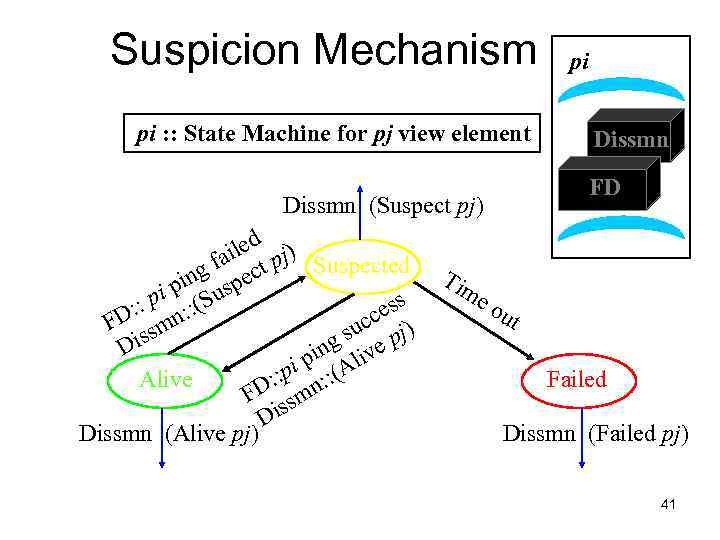
Suspicion Mechanism pi : : State Machine for pj view element Tim eo Dissmn FD Dissmn (Suspect pj) iled pj) a Suspected g f ect in sp p pi : (Su : : n: ess FD sm ucc pj) is g s ve D pin Ali i Alive : : p n: : ( FD ssm Di Dissmn (Alive pj) pi ut Failed Dissmn (Failed pj) 41
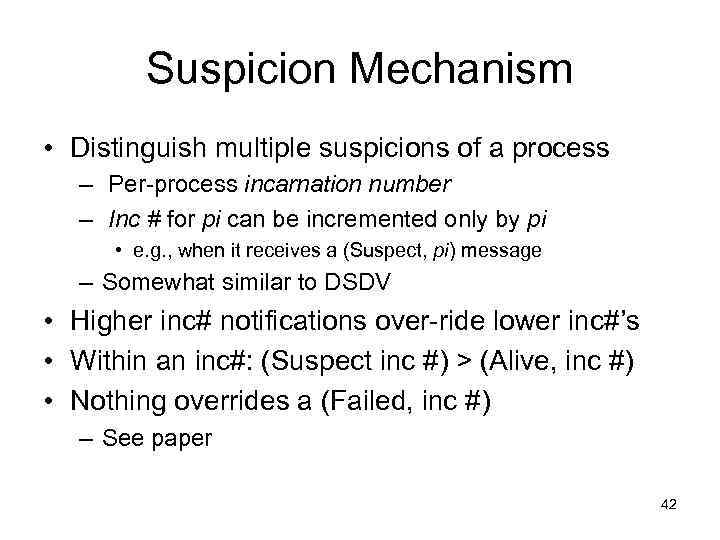
Suspicion Mechanism • Distinguish multiple suspicions of a process – Per-process incarnation number – Inc # for pi can be incremented only by pi • e. g. , when it receives a (Suspect, pi) message – Somewhat similar to DSDV • Higher inc# notifications over-ride lower inc#’s • Within an inc#: (Suspect inc #) > (Alive, inc #) • Nothing overrides a (Failed, inc #) – See paper 42
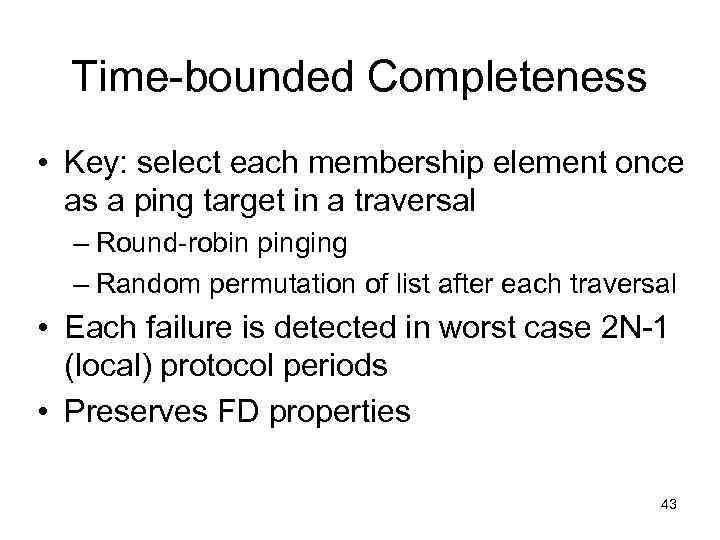
Time-bounded Completeness • Key: select each membership element once as a ping target in a traversal – Round-robin pinging – Random permutation of list after each traversal • Each failure is detected in worst case 2 N-1 (local) protocol periods • Preserves FD properties 43
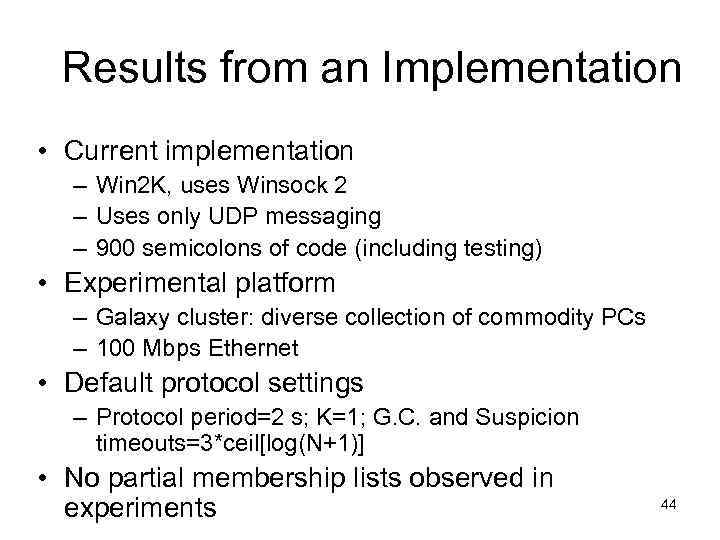
Results from an Implementation • Current implementation – Win 2 K, uses Winsock 2 – Uses only UDP messaging – 900 semicolons of code (including testing) • Experimental platform – Galaxy cluster: diverse collection of commodity PCs – 100 Mbps Ethernet • Default protocol settings – Protocol period=2 s; K=1; G. C. and Suspicion timeouts=3*ceil[log(N+1)] • No partial membership lists observed in experiments 44
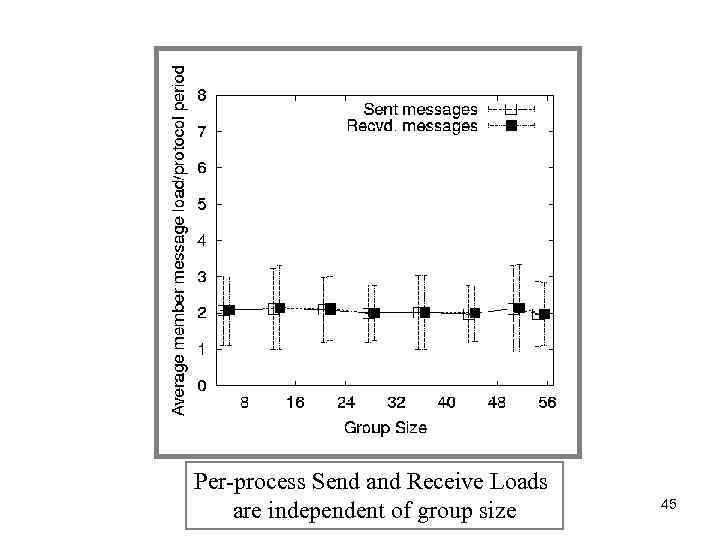
Per-process Send and Receive Loads are independent of group size 45
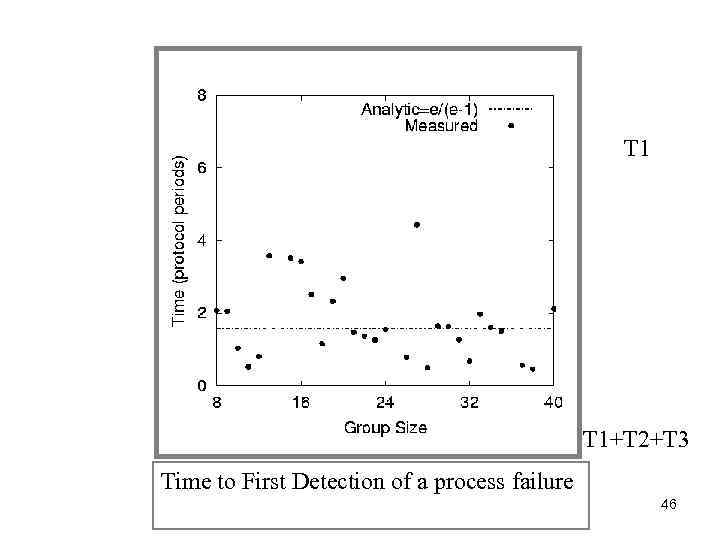
T 1 T 1+T 2+T 3 Time to First Detection of a process failure 46
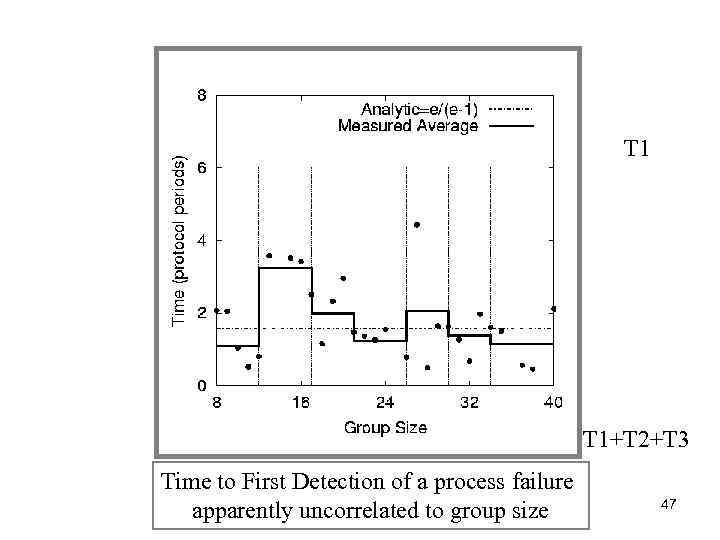
T 1 T 1+T 2+T 3 Time to First Detection of a process failure apparently uncorrelated to group size 47
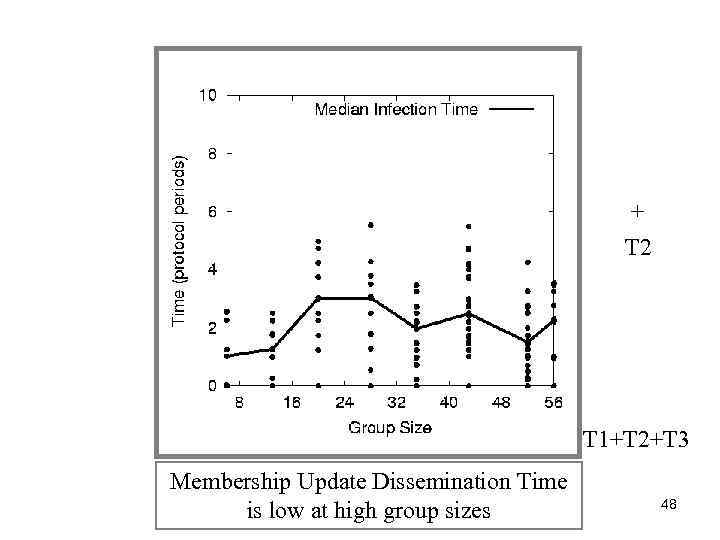
+ T 2 T 1+T 2+T 3 Membership Update Dissemination Time is low at high group sizes 48
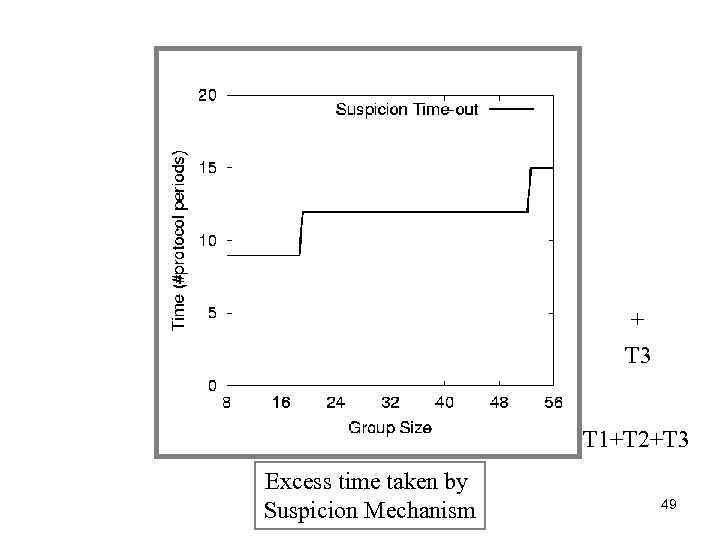
+ T 3 T 1+T 2+T 3 Excess time taken by Suspicion Mechanism 49
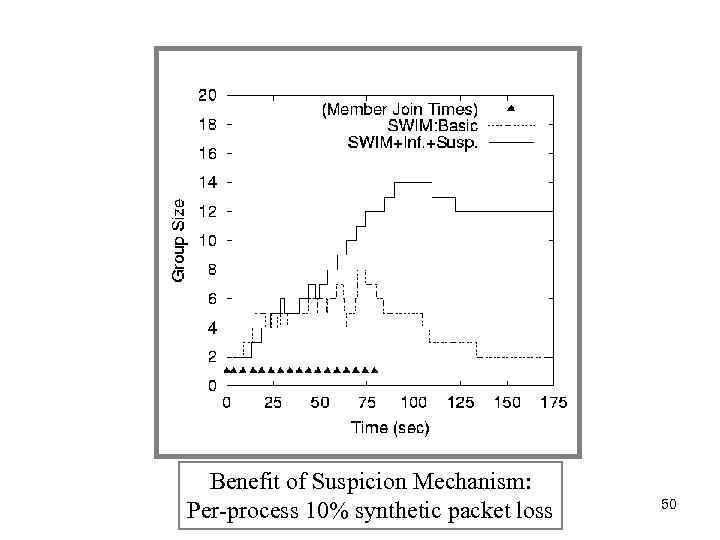
Benefit of Suspicion Mechanism: Per-process 10% synthetic packet loss 50
More discussion points • It turns out that with a partial membership list that is uniformly random, gossiping retains same properties as with complete membership lists – Why? (Think of the equation) – Partial membership protocols • SCAMP, Cyclon, TMAN, … • Gossip-style failure detection underlies – Astrolabe – Amazon EC 2/S 3 (rumored!) • SWIM used in – Coral. CDN/Oasis anycast service: http: //oasis. coralcdn. org – Mike Freedman used suspicion mechanism to blackmark frequently-failing nodes 51

Reminder – Due this Sunday April 3 rd at 11. 59 PM • Project Midterm Report due, 11. 59 pm [12 pt font, single-sided, 8 + 1 page Business Plan max] • Wiki Term Paper - Second Draft Due (Individual) • Reviews – you only have to submit reviews for 15 sessions (any 15 sessions) from 2/10 to 4/28. Keep track of your count! Take a breather!

Questions 53
Скачать презентацию CS 525 Advanced Distributed Systems Spring 2011 Indranil
L_member.sp11.ppt