


 Скачать презентацию CS 501 Software Engineering Lecture 2 Software Processes
3c207a81b59fd82c28f42d22b705bcfe.ppt
- Количество слайдов: 36
 CS 501: Software Engineering Lecture 2 Software Processes 1 CS 501 Spring 2006
 Administration Project teams Any short notices to class? Course team email address When you have formed your team and reached agreement with your client, please send a message to cs 501 -l@lists. cornell. edu with the names of the team, the client's name, and the topic of the project. Letter "l" 2 CS 501 Spring 2006
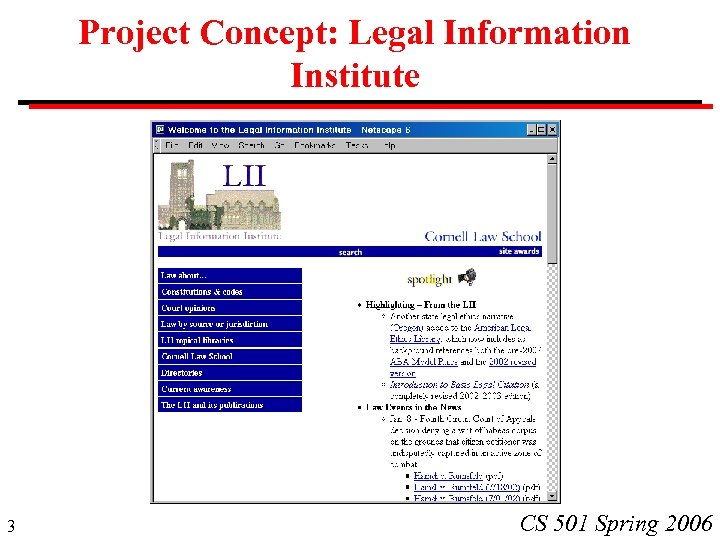 Project Concept: Legal Information Institute 3 CS 501 Spring 2006
 Project Concept: Par. METIS 4 CS 501 Spring 2006
 Project Concept: Public Key Infrastructure 5 CS 501 Spring 2006
 Project Concept: Data Tracking System for the Web Library 6 CS 501 Spring 2006
 Project Concept: Revision Control System 7 CS 501 Spring 2006
 Project Concept: Map & GIS Library 8 CS 501 Spring 2006
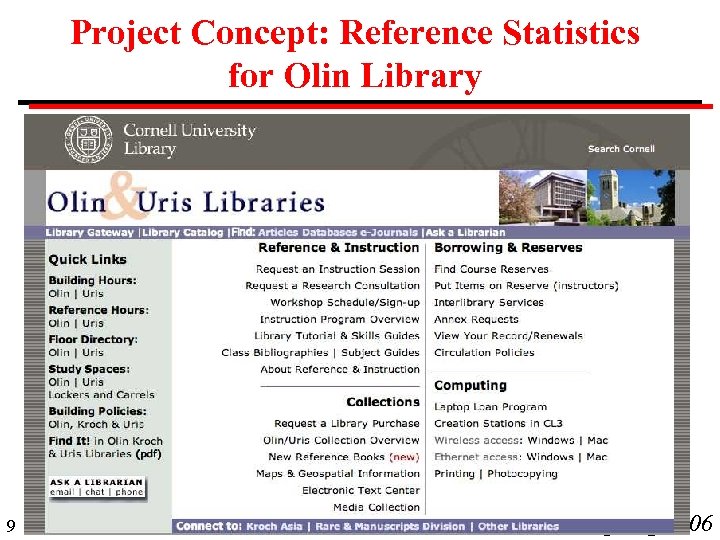 Project Concept: Reference Statistics for Olin Library 9 CS 501 Spring 2006
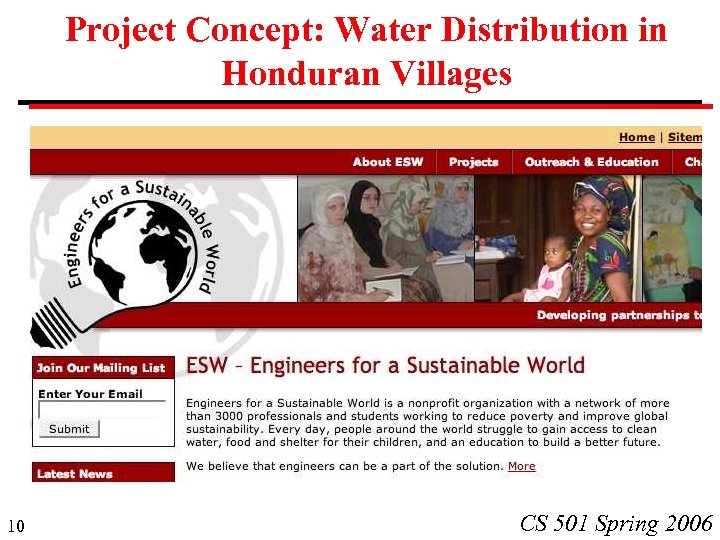 Project Concept: Water Distribution in Honduran Villages 10 CS 501 Spring 2006
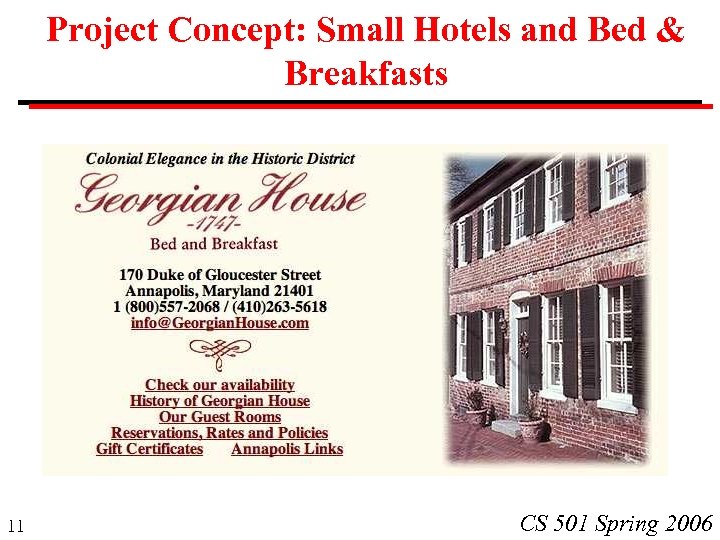 Project Concept: Small Hotels and Bed & Breakfasts 11 CS 501 Spring 2006
 A Classic Book Frederick P. Brooks, Jr. The Mythical Man Month. Addison-Wesley, 1972. 12 CS 501 Spring 2006
 Software Process Fundamental Assumption: Good processes lead to good software Good processes reduce risk Good processes enhance visibility 13 CS 501 Spring 2006
 Variety of Software Processes Software products are very varied. . . Therefore, there is no standard process for all software engineering projects BUT successful software development projects all need to address similar issues. This creates a number of process steps that must be part of all software projects 14 CS 501 Spring 2006
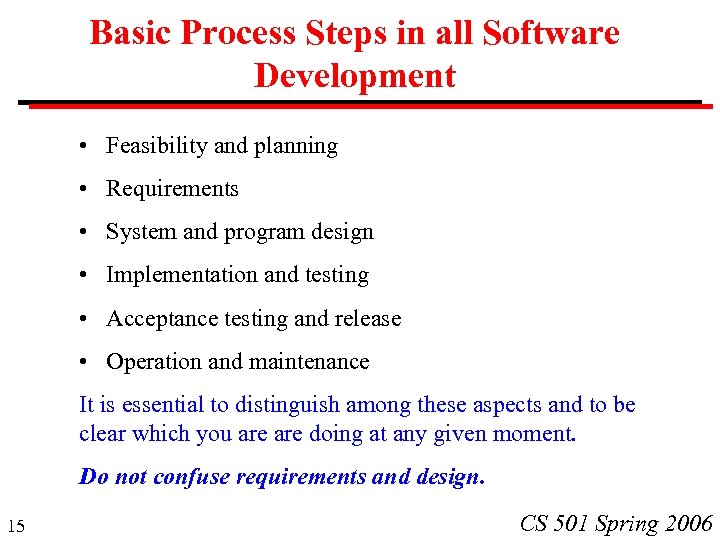 Basic Process Steps in all Software Development • Feasibility and planning • Requirements • System and program design • Implementation and testing • Acceptance testing and release • Operation and maintenance It is essential to distinguish among these aspects and to be clear which you are doing at any given moment. Do not confuse requirements and design. 15 CS 501 Spring 2006
 Feasibility and Planning A feasibility study precedes the decision to begin a project. • What is the scope of the proposed project? • Is the project technically feasible? • What are the projected benefits? • What are the costs, timetable? A feasibility study leads to a decision: go or no-go. 16 CS 501 Spring 2006
 Requirements The requirements define the function of the system FROM THE CLIENT'S VIEWPOINT. The requirements establish the system's functionality, constraints and goals by consultation with the client and users. They are then defined in a manner that is understandable by both the client and the development staff. This phase is sometimes divided into: • Requirements analysis • Requirements definition • Requirements specification 17 CS 501 Spring 2006
 System and Program Design The design describes the system FROM THE SOFTWARE DEVELOPERS' VIEWPOINT System design: Partition the requirements to hardware or software systems. Establishes an overall system architecture Software design: Represent the software system functions in a form that can be transformed into one or more executable programs • Unified Modeling Language (UML) 18 CS 501 Spring 2006
 Implementation and Testing Coding The software design is realized as a set of programs or program units. (Written specifically, acquired from elsewhere, or modified. ) Testing Individual components are tested against specifications. The individual program units are integrated and tested against the design by the development staff as a complete system. 19 CS 501 Spring 2006
 Acceptance Testing and Release Acceptance testing The complete system is tested against the requirements by the client. Delivery and release The complete system is delivered to the client and released into production. 20 CS 501 Spring 2006
 Operation and Maintenance Operation: The system is put into practical use. Maintenance: Errors and problems are identified and fixed. Evolution: The system evolves over time as requirements change, to add new functions or adapt the technical environment. Phase out: The system is withdrawn from service. This is sometimes called the Software Life Cycle 21 CS 501 Spring 2006
 Sequence of Processes Every software project will include these basic processes, in some shape or form, but: • They may be formal or informal • They may be carried out in various sequences Major alternatives • • 22 Sequential: Complete each process step before beginning the next (but see the next few slides). Waterfall model. Iterative: Go quickly through all process steps to create a rough system, then repeat them to improve the system. Iterative refinement. CS 501 Spring 2006
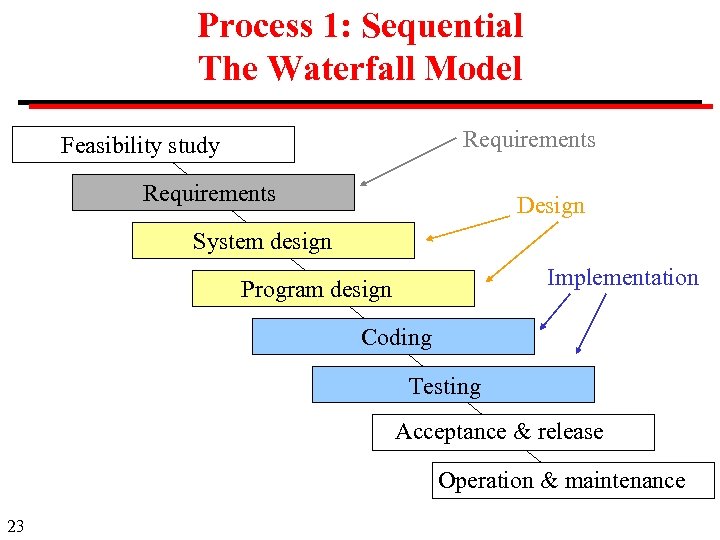 Process 1: Sequential The Waterfall Model Requirements Feasibility study Requirements Design System design Implementation Program design Coding Testing Acceptance & release Operation & maintenance 23 CS 501 Spring 2006
 Sequence of Processes A pure sequential model is impossible Examples: • A feasibility study cannot create a proposed budget and schedule without a preliminary study of the requirements and a tentative design. • Detailed design or implementation usually reveals gaps in the requirements specification. The plan must allow for some form of iteration. 24 CS 501 Spring 2006
 Discussion of the Waterfall Model Advantages: • • Process visibility Separation of tasks Quality control Cost control Disadvantages: Each stage in the process reveals new understanding of the previous stages, that requires the earlier stages to be revised. The Waterfall Model is not enough! 25 CS 501 Spring 2006
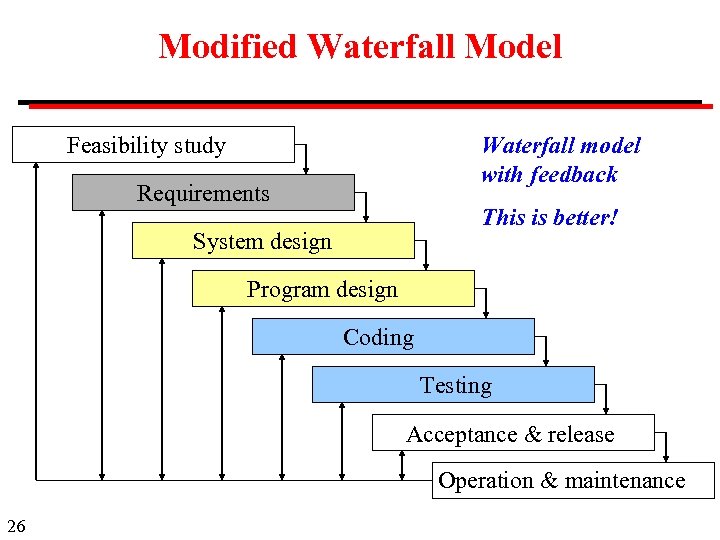 Modified Waterfall Model Feasibility study Waterfall model with feedback Requirements This is better! System design Program design Coding Testing Acceptance & release Operation & maintenance 26 CS 501 Spring 2006
 Process 2: Iterative Refinement (Evolutionary Development) Concept: Initial implementation for client and user comment, followed by refinement until system is complete. • Vaporware: user interface mock-up • Throw-away software components • Dummy modules • Rapid prototyping • Successive refinement Get something working as quickly as possible! 27 CS 501 Spring 2006
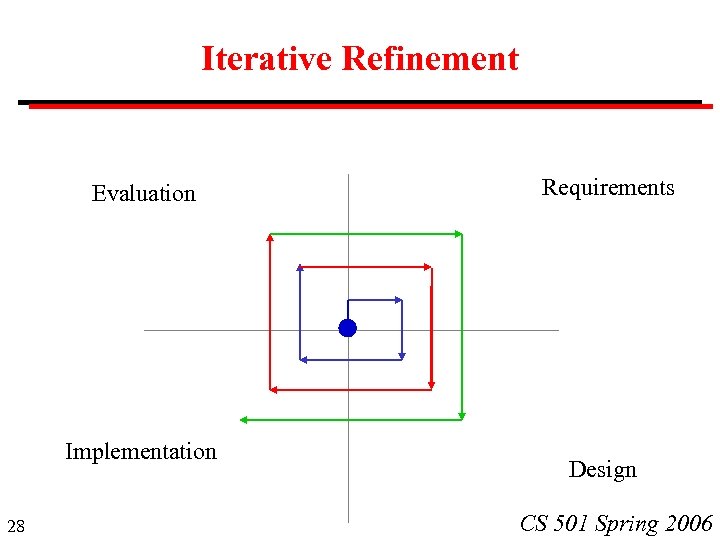 Iterative Refinement Evaluation Implementation 28 Requirements Design CS 501 Spring 2006
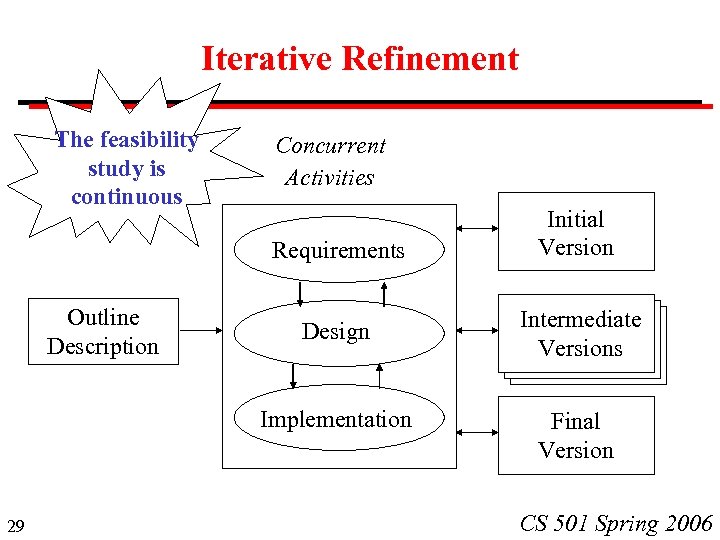 Iterative Refinement The feasibility study is continuous Concurrent Activities Requirements Outline Description Design Implementation 29 Initial Version Intermediate Versions Final Version CS 501 Spring 2006
 Process 3: Phased Development Concept: combines sequential and iterative elements A simple system with basic functionality is brought quickly into production (Phase 1). Subsequent phases are based on experience gained from users of each previous phase. Advantages • Pay-back on investment begins soon. • Requirement are more clearly understood in developing subsequent phases Example: NSDL 30 CS 501 Spring 2006
 Iterative Refinement + Waterfall Model: Graphics for Basic Outline Description: Add vector graphics to Dartmouth Basic. Phase 1: Extend current language with a preprocessor and run-time support package. (1976/77) Phase 2: Write new compiler and run-time system incorporating graphics elements. (1978/80) 31 CS 501 Spring 2006
 Iterative Refinement + Waterfall Model: Graphics for Basic Phase 0: Iterative Refinement Design Issues: • Pictorial subprograms: coordinate systems, window/viewport • User specification of perspective Design Strategy: (Iterative Refinement) • Write a series of prototypes with various proposed semantics • Evaluate with a set of programming tasks 32 CS 501 Spring 2006
 Iterative Refinement + Waterfall Model: Graphics for Basic Phase 1: Implementation • When the final specification was agreed, the entire preprocessor and run-time support were coded from new. • The system was almost entirely bug-free. Phase 2: New compiler (Waterfall) Phase 1 was used as the requirements definition for the final version. 33 CS 501 Spring 2006
 Observations about Software Processes Completed projects should have the basic process steps but. . . the development process is always partly evolutionary. Risk is lowered by: • Prototyping key components • Dividing into phases • Following a visible software process • Making use of reusable components Conclusion It is not possible to complete each step and throw it over the wall. 34 CS 501 Spring 2006
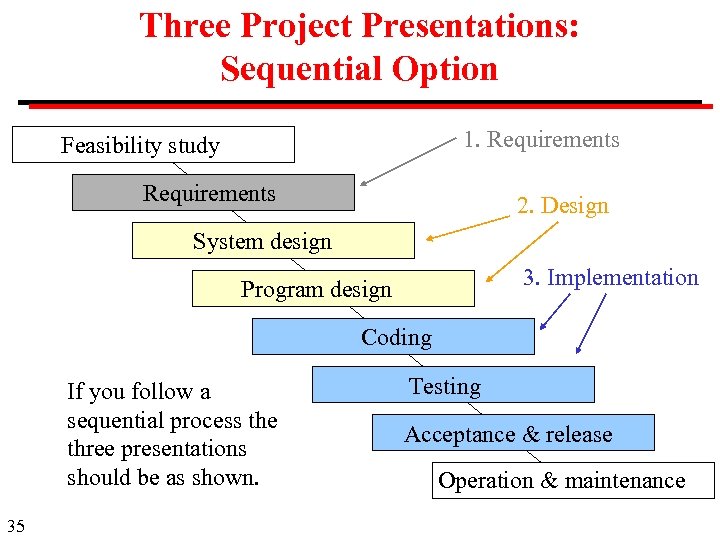 Three Project Presentations: Sequential Option 1. Requirements Feasibility study Requirements 2. Design System design 3. Implementation Program design Coding If you follow a sequential process the three presentations should be as shown. 35 Testing Acceptance & release Operation & maintenance CS 501 Spring 2006
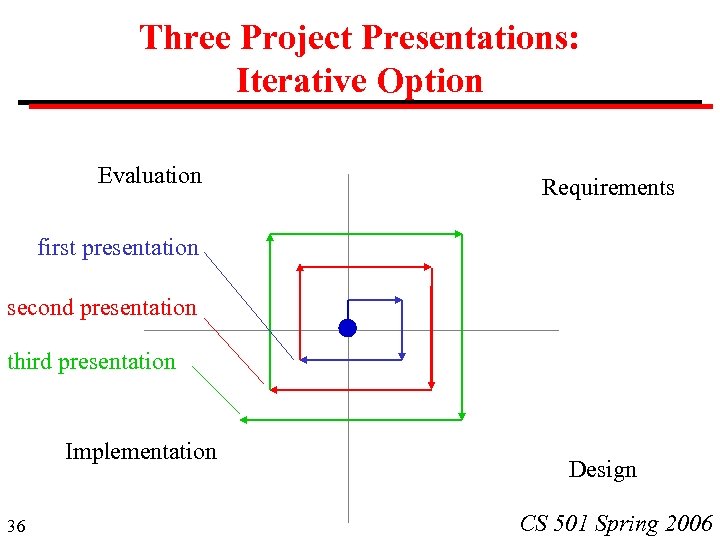 Three Project Presentations: Iterative Option Evaluation Requirements first presentation second presentation third presentation Implementation 36 Design CS 501 Spring 2006