


 Скачать презентацию CS 4705 Natural Language Processing Discourse Structure and
9dcbd1df35a69114328b83e970c3632e.ppt
- Количество слайдов: 40
 CS 4705: Natural Language Processing Discourse: Structure and Coherence Kathy Mc. Keown Thanks to Dan Jurafsky, Diane Litman, Andy Kehler, Jim Martin
 Homework questions? Units for pyramid analysis Summary length
 Finals Questions What areas would you like to review? Semantic interpretation? Probabilistic context free parsing? Earley Algorithm? Learning? Information extraction? Pronoun resolution? Machine translation?
 What is a coherent/cohesive discourse?
 Generation vs. Interpretation? Which are more useful where? Discourse structure: subtopics Discourse coherence: relations between sentences Discourse structure: rhetorical relations
 Outline Discourse Structure ◦ Textiling Coherence ◦ Hobbs coherence relations ◦ Rhetorical Structure Theory
 Part I: Discourse Structure Conventional structures for different genres ◦ Academic articles: Abstract, Introduction, Methodology, Results, Conclusion ◦ Newspaper story: inverted pyramid structure (lead followed by expansion)
 Discourse Segmentation Simpler task ◦ Discourse segmentation Separating document into linear sequence of subtopics
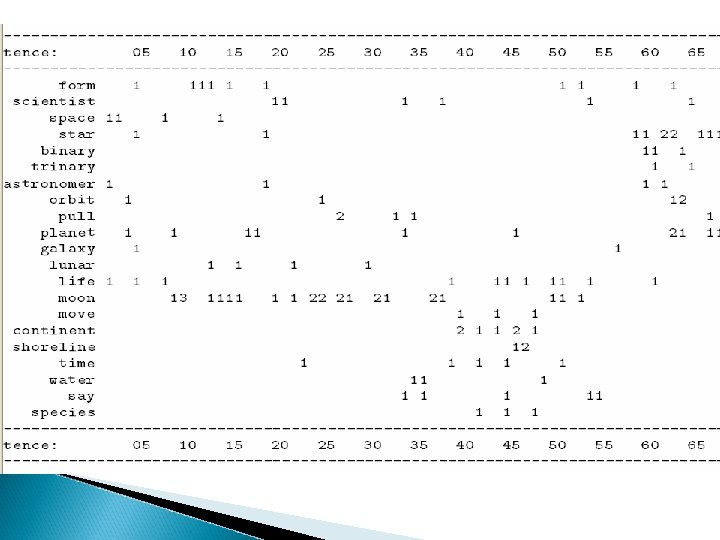
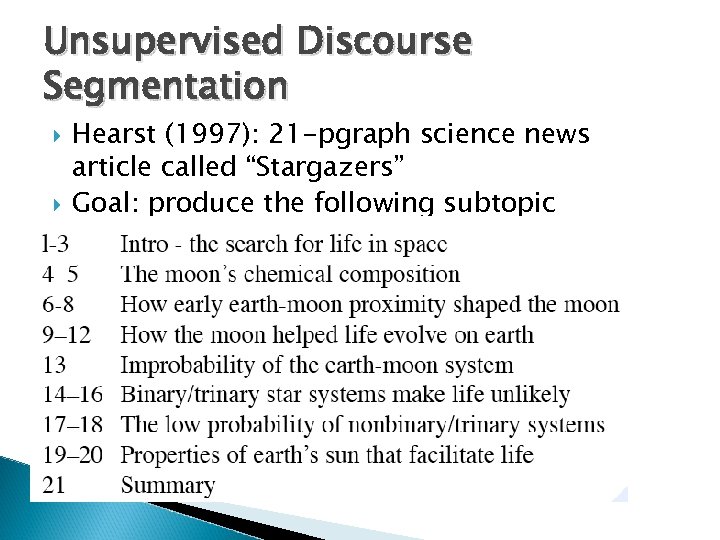 Unsupervised Discourse Segmentation Hearst (1997): 21 -pgraph science news article called “Stargazers” Goal: produce the following subtopic segments:
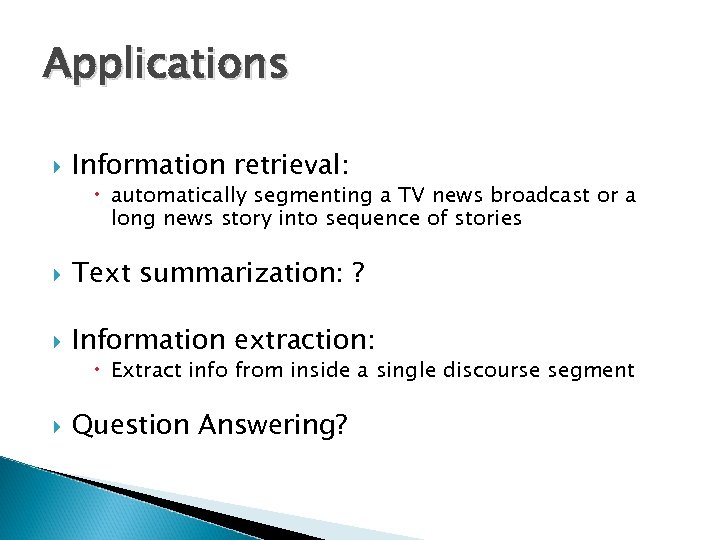 Applications Information retrieval: automatically segmenting a TV news broadcast or a long news story into sequence of stories Text summarization: ? Information extraction: Extract info from inside a single discourse segment Question Answering?
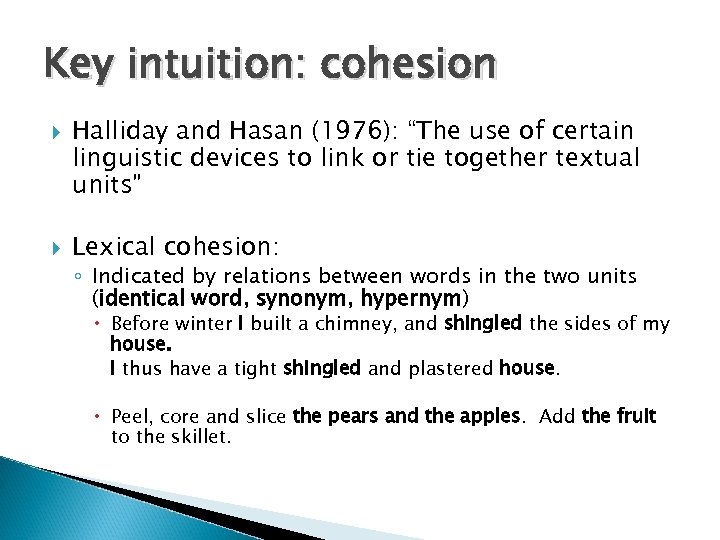 Key intuition: cohesion Halliday and Hasan (1976): “The use of certain linguistic devices to link or tie together textual units” Lexical cohesion: ◦ Indicated by relations between words in the two units (identical word, synonym, hypernym) Before winter I built a chimney, and shingled the sides of my house. I thus have a tight shingled and plastered house. Peel, core and slice the pears and the apples. Add the fruit to the skillet.
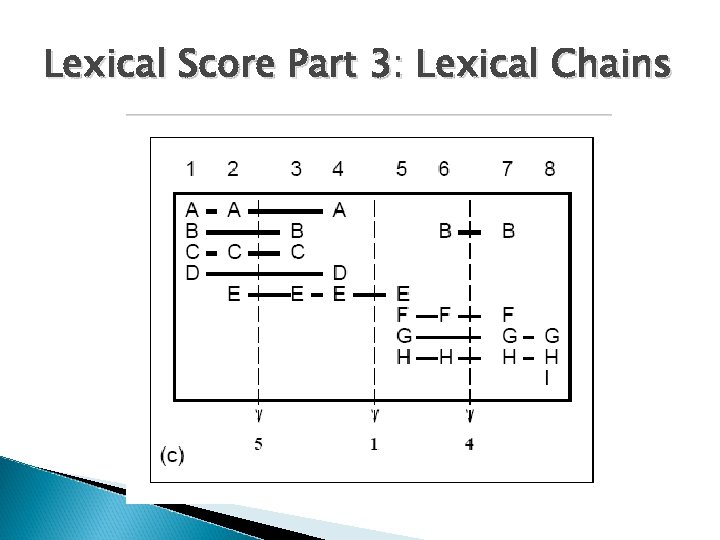
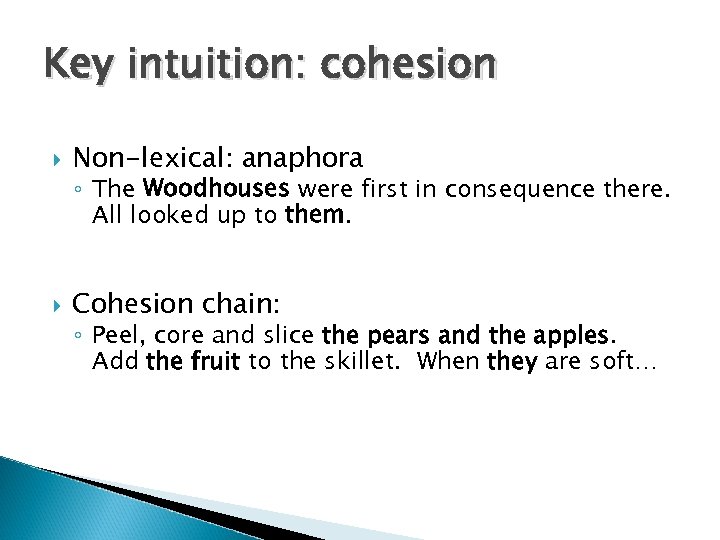 Key intuition: cohesion Non-lexical: anaphora Cohesion chain: ◦ The Woodhouses were first in consequence there. All looked up to them. ◦ Peel, core and slice the pears and the apples. Add the fruit to the skillet. When they are soft…
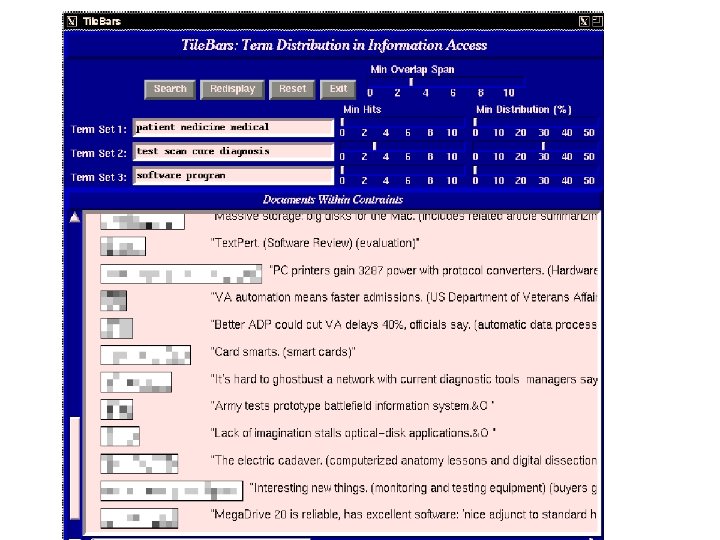
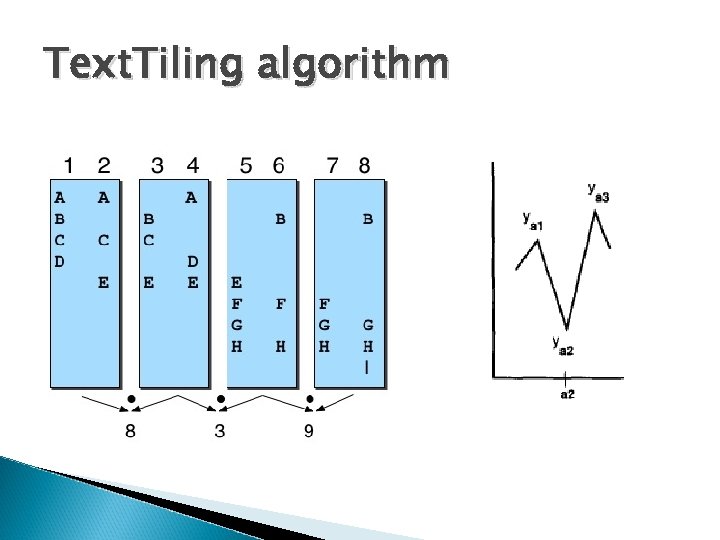
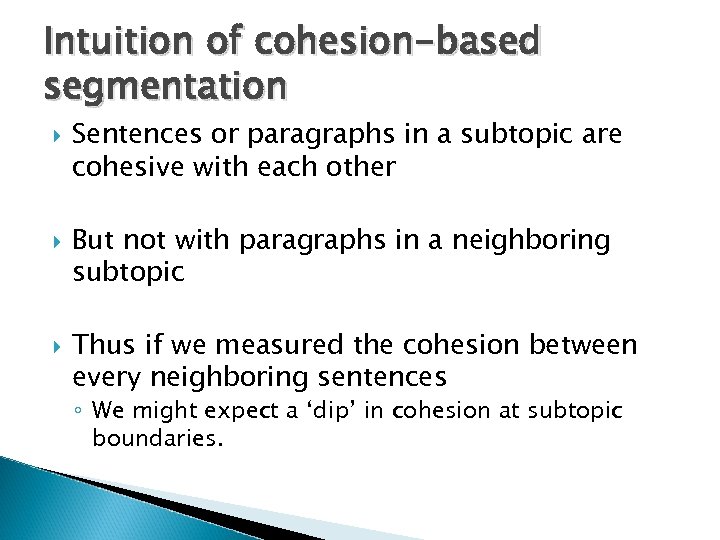 Intuition of cohesion-based segmentation Sentences or paragraphs in a subtopic are cohesive with each other But not with paragraphs in a neighboring subtopic Thus if we measured the cohesion between every neighboring sentences ◦ We might expect a ‘dip’ in cohesion at subtopic boundaries.
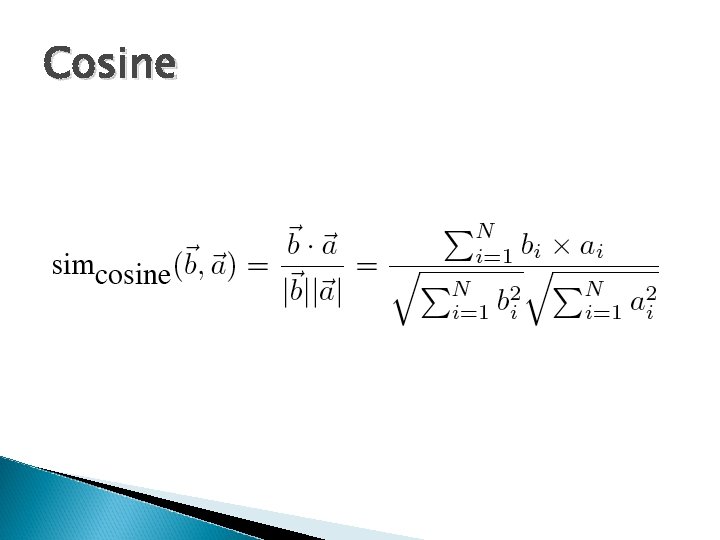
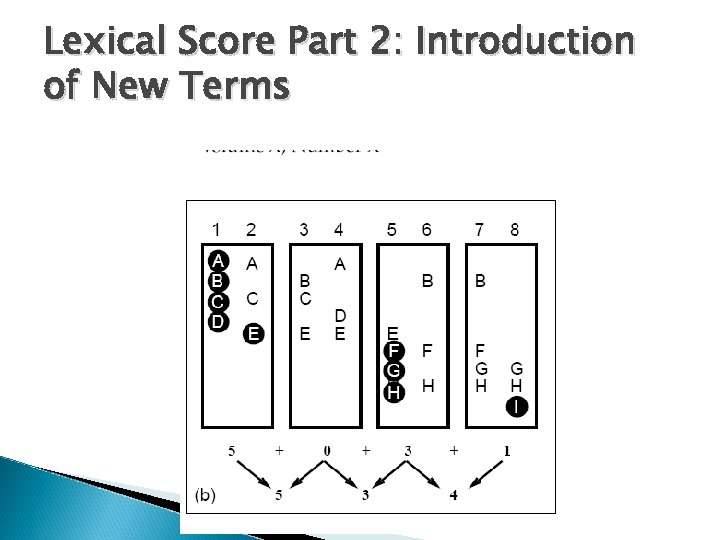
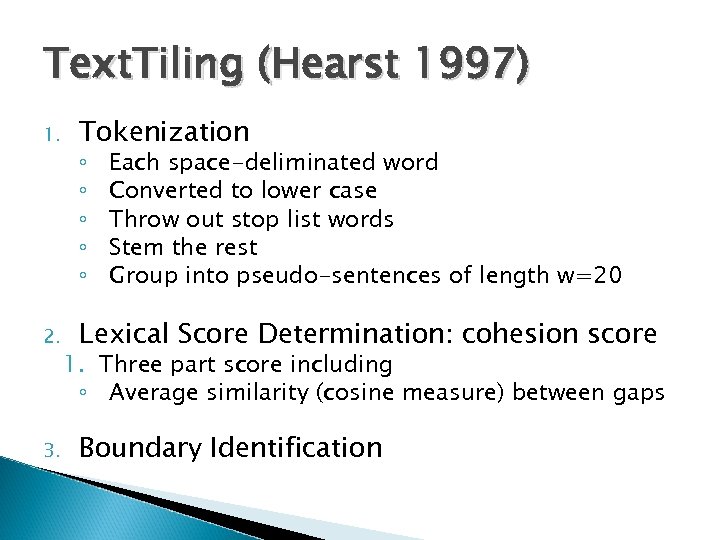 Text. Tiling (Hearst 1997) 1. Tokenization 2. Lexical Score Determination: cohesion score 3. ◦ ◦ ◦ Each space-deliminated word Converted to lower case Throw out stop list words Stem the rest Group into pseudo-sentences of length w=20 1. Three part score including ◦ Average similarity (cosine measure) between gaps Boundary Identification
 Text. Tiling algorithm
 Cosine
 Lexical Score Part 2: Introduction of New Terms
 Lexical Score Part 3: Lexical Chains
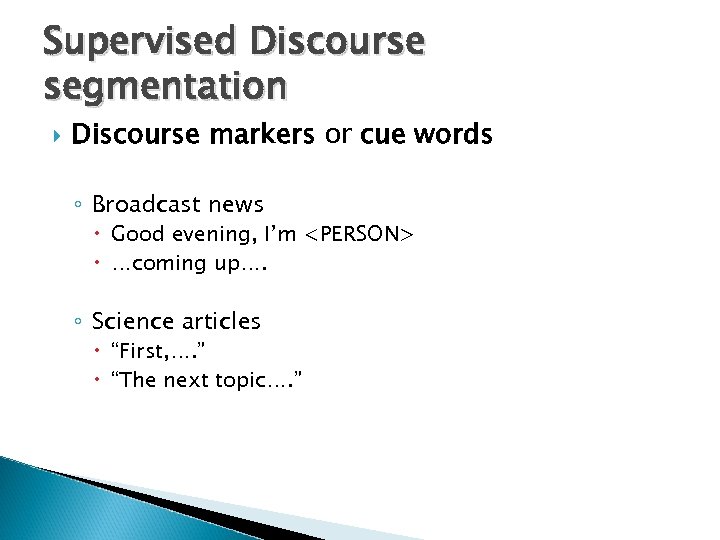 Supervised Discourse segmentation Discourse markers or cue words ◦ Broadcast news Good evening, I’m
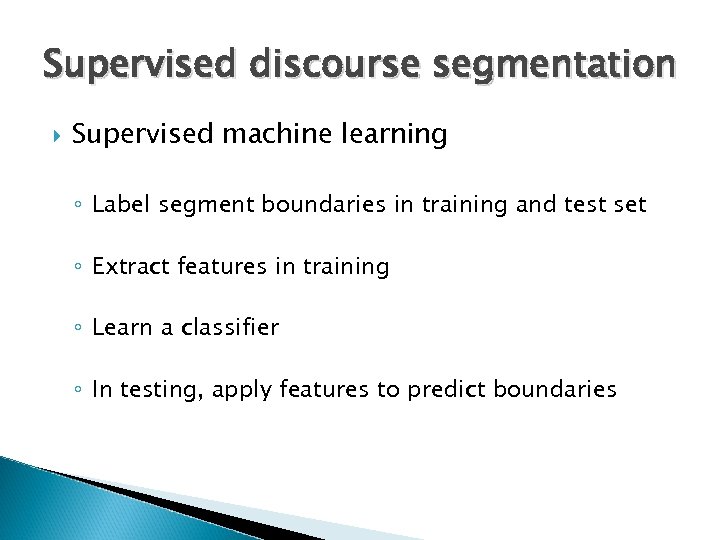 Supervised discourse segmentation Supervised machine learning ◦ Label segment boundaries in training and test set ◦ Extract features in training ◦ Learn a classifier ◦ In testing, apply features to predict boundaries
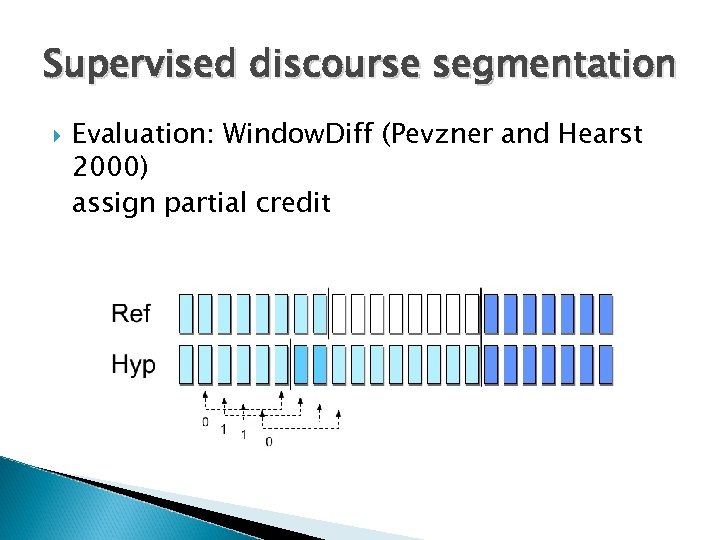 Supervised discourse segmentation Evaluation: Window. Diff (Pevzner and Hearst 2000) assign partial credit
 Generation vs. Interpretation? Which are more useful where? Discourse structure: subtopics Discourse coherence: relations between sentences Discourse structure: rhetorical relations
 Part II: Text Coherence What makes a discourse coherent? The reason is that these utterances, when juxtaposed, will not exhibit coherence. Almost certainly not. Do you have a discourse? Assume that you have collected an arbitrary set of well-formed and independently interpretable utterances, for instance, by randomly selecting one sentence from each of the previous chapters of this book.
 Better? Assume that you have collected an arbitrary set of wellformed and independently interpretable utterances, for instance, by randomly selecting one sentence from each of the previous chapters of this book. Do you have a discourse? Almost certainly not. The reason is that these utterances, when juxtaposed, will not exhibit coherence.
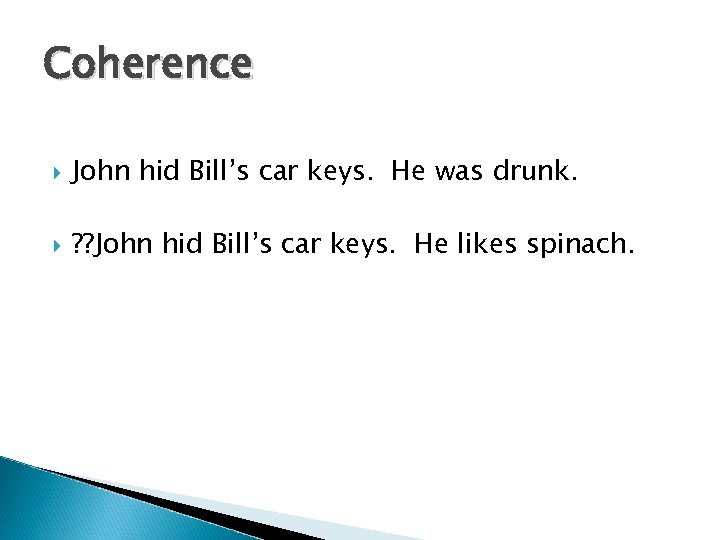 Coherence John hid Bill’s car keys. He was drunk. ? ? John hid Bill’s car keys. He likes spinach.
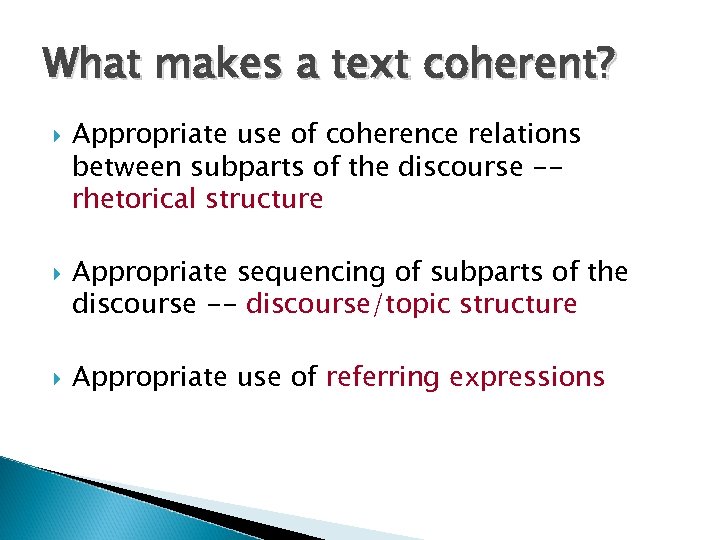 What makes a text coherent? Appropriate use of coherence relations between subparts of the discourse -rhetorical structure Appropriate sequencing of subparts of the discourse -- discourse/topic structure Appropriate use of referring expressions
 Hobbs 1979 Coherence Relations “ Result ” : Infer that the state or event asserted by S 0 causes or could cause the state or event asserted by S 1. ◦ The Tin Woodman was caught in the rain. His joints rusted.
 Hobbs: “Explanation” Infer that the state or event asserted by S 1 causes or could cause the state or event asserted by S 0. ◦ John hid Bill’s car keys. He was drunk.
 Hobbs: “Parallel” Infer p(a 1, a 2. . ) from the assertion of S 0 and p(b 1, b 2…) from the assertion of S 1, where ai and bi are similar, for all I. ◦ The Scarecrow wanted some brains. The Tin Woodman wanted a heart.
 Hobbs “Elaboration” Infer the same proposition P from the assertions of S 0 and S 1. ◦ Dorothy was from Kansas. She lived in the midst of the great Kansas prairies.
 Generation vs. Interpretation? Which are more useful where? Discourse structure: subtopics Discourse coherence: relations between sentences Discourse structure: rhetorical relations
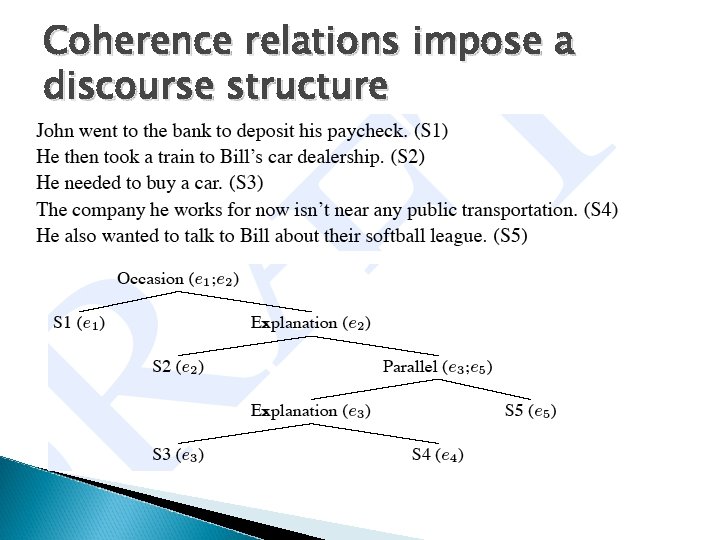 Coherence relations impose a discourse structure
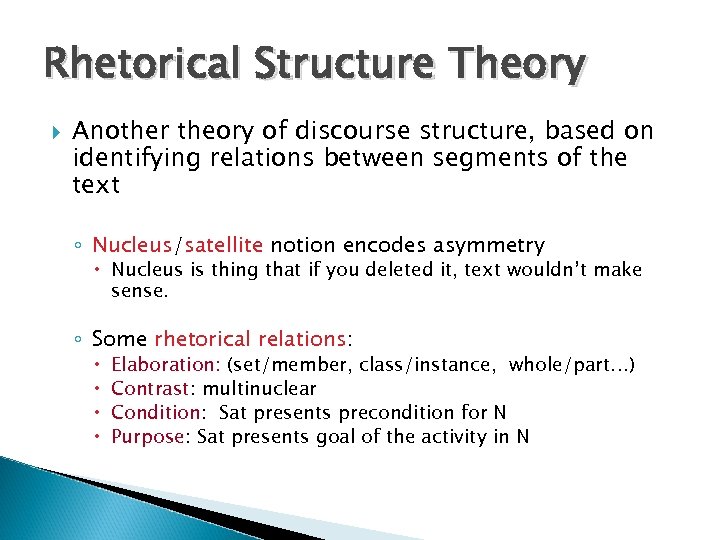 Rhetorical Structure Theory Another theory of discourse structure, based on identifying relations between segments of the text ◦ Nucleus/satellite notion encodes asymmetry Nucleus is thing that if you deleted it, text wouldn’t make sense. ◦ Some rhetorical relations: Elaboration: (set/member, class/instance, whole/part…) Contrast: multinuclear Condition: Sat presents precondition for N Purpose: Sat presents goal of the activity in N
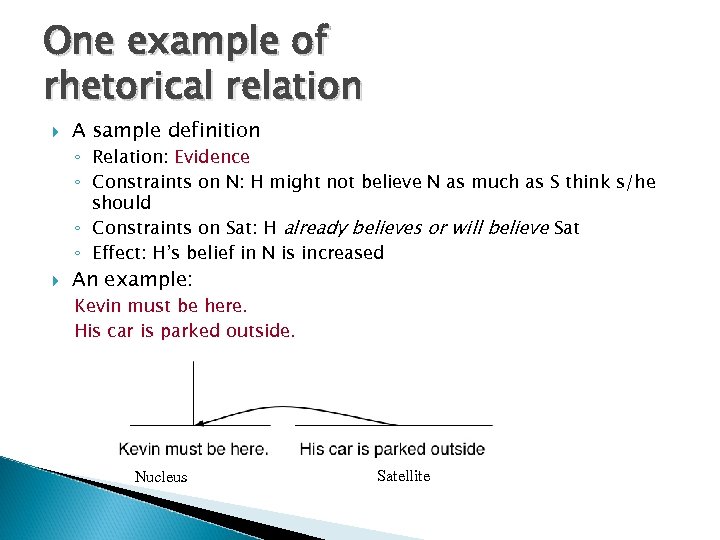 One example of rhetorical relation A sample definition ◦ Relation: Evidence ◦ Constraints on N: H might not believe N as much as S think s/he should ◦ Constraints on Sat: H already believes or will believe Sat ◦ Effect: H’s belief in N is increased An example: Kevin must be here. His car is parked outside. Nucleus Satellite
 Automatic Rhetorical Structure Labeling Supervised machine learning ◦ Get a group of annotators to assign a set of RST relations to a text ◦ Extract a set of surface features from the text that might signal the presence of the rhetorical relations in that text ◦ Train a supervised ML system based on the training set
 Features: cue phrases Explicit markers: because, however, therefore, then, etc. Tendency of certain syntactic structures to signal certain relations: Infinitives are often used to signal purpose relations: Use rm to delete files. Ordering Tense/aspect Intonation
 Some Problems with RST How many Rhetorical Relations are there? How can we use RST in dialogue as well as monologue? RST does not model overall structure of the discourse. Difficult to get annotators to agree on labeling the same texts
 Generation vs. Interpretation? Which are more useful where? Discourse structure: subtopics Discourse coherence: relations between sentences Discourse structure: rhetorical relations