


 Скачать презентацию CS 450 550 Operating Systems Lecture 3 Deadlocks Palden
884d4a7819d2abff0fd4f0a9aaf11cfa.ppt
- Количество слайдов: 39
 CS 450/550 Operating Systems Lecture 3 Deadlocks Palden Lama Department of Computer Science CS 450/550 Deadlocks. 1 UC. Colorado Springs Adapted from MOS 2 E
 Review: Summary of Chapter 2 ° Sequential process model ° Multi-threading: user-space vs. kernel-space ° IPC: semaphores, monitors, messages • • Race conditions Mutual exclusion Critical regions Classic IPC problems ° Scheduling • Process scheduling • Thread scheduling ° More reading: textbook 2. 1 - 2. 7 CS 450/550 Deadlocks. 2 UC. Colorado Springs Adapted from MOS 2 E
 Chapter 3: Deadlocks 3. 1. Resources 3. 2. Introduction to deadlocks 3. 3. The ostrich algorithm 3. 4. Deadlock detection and recovery 3. 5. Deadlock avoidance 3. 6. Deadlock prevention 3. 7. Other issues CS 450/550 Deadlocks. 3 UC. Colorado Springs Adapted from MOS 2 E
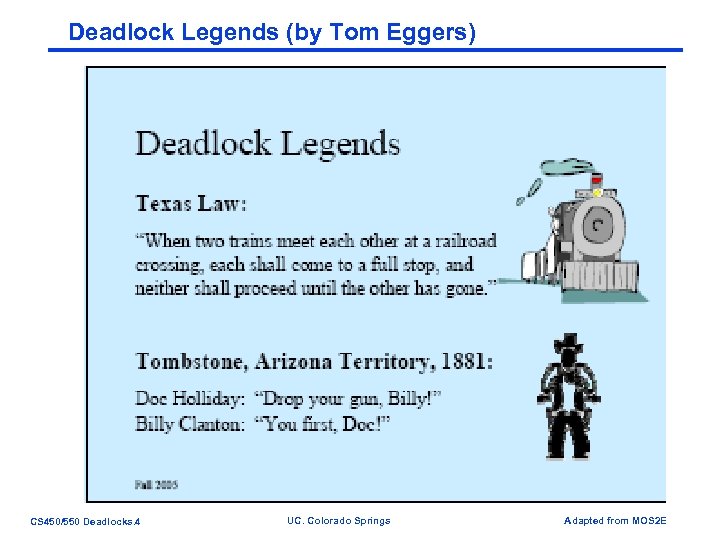 Deadlock Legends (by Tom Eggers) CS 450/550 Deadlocks. 4 UC. Colorado Springs Adapted from MOS 2 E
 Deadlock Definitions ° 1. Two or more processes each blocked and waiting for resources they will never get without drastic actions • Something preempts a resource • A process is killed ° 2. A set of processes is deadlocked if each process in the set is waiting for an event that only another process in the set can cause, thus, no process can • run • release resources • be awakened CS 450/550 Deadlocks. 5 UC. Colorado Springs Adapted from MOS 2 E
 Resources and Deadlocks (1) ° Examples of computer resources • • printers tape drives tables software ° Processes need access to resources in reasonable order ° Suppose a process holds resource A and requests resource B • at same time another process holds B and requests A • both are blocked and remain so, deadlocks! Why is the key problem in the example? Both processes want to have exclusive access to A and B! CS 450/550 Deadlocks. 6 UC. Colorado Springs Adapted from MOS 2 E
 Resources and Deadlocks (2) ° Deadlocks occur when … • processes are granted exclusive access to hardware, e. g. , I/O devices • processes are granted exclusive access to software, e. g. , database records • we refer to these generally as resources ° Preemptable resources • can be taken away from a process with no ill effects, e. g. , Mem ° Nonpreemptable resources • will cause the process to fail if taken away, e. g. , CD burner In general, deadlocks involve non-preemptive and exclusive resources! CS 450/550 Deadlocks. 7 UC. Colorado Springs Adapted from MOS 2 E
 Resources and Deadlocks (3) ° Sequence of events required to use a resource 1. 2. 3. ° request the resource use the resource release the resource Must wait if request is denied • • requesting process may be blocked may fail with error code CS 450/550 Deadlocks. 8 UC. Colorado Springs Adapted from MOS 2 E
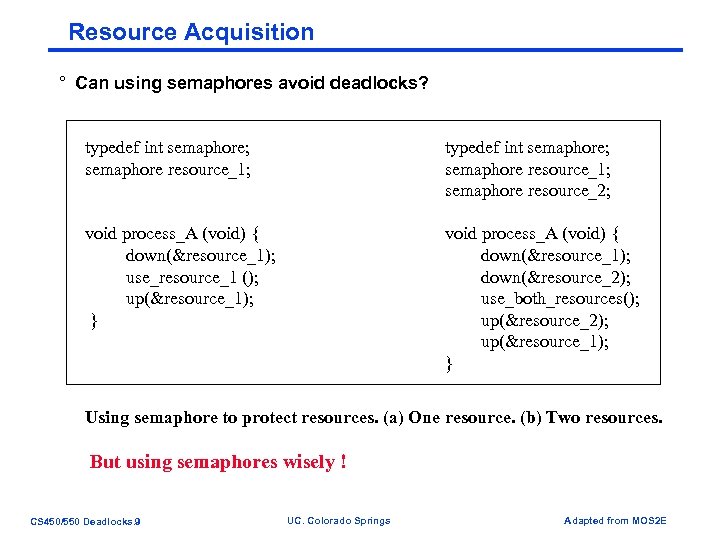 Resource Acquisition ° Can using semaphores avoid deadlocks? typedef int semaphore; semaphore resource_1; semaphore resource_2; void process_A (void) { down(&resource_1); use_resource_1 (); up(&resource_1); } void process_A (void) { down(&resource_1); down(&resource_2); use_both_resources(); up(&resource_2); up(&resource_1); } Using semaphore to protect resources. (a) One resource. (b) Two resources. But using semaphores wisely ! CS 450/550 Deadlocks. 9 UC. Colorado Springs Adapted from MOS 2 E
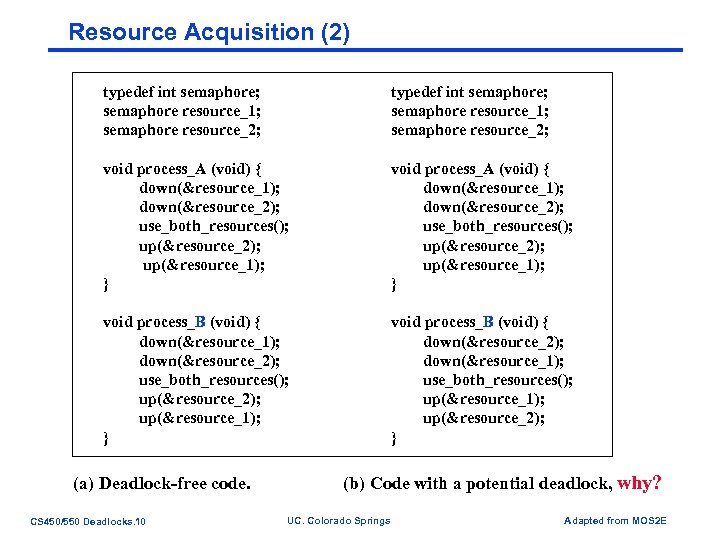 Resource Acquisition (2) typedef int semaphore; semaphore resource_1; semaphore resource_2; void process_A (void) { down(&resource_1); down(&resource_2); use_both_resources(); up(&resource_2); up(&resource_1); } void process_B (void) { down(&resource_2); down(&resource_1); use_both_resources(); up(&resource_1); up(&resource_2); } (a) Deadlock-free code. CS 450/550 Deadlocks. 10 (b) Code with a potential deadlock, why? UC. Colorado Springs Adapted from MOS 2 E
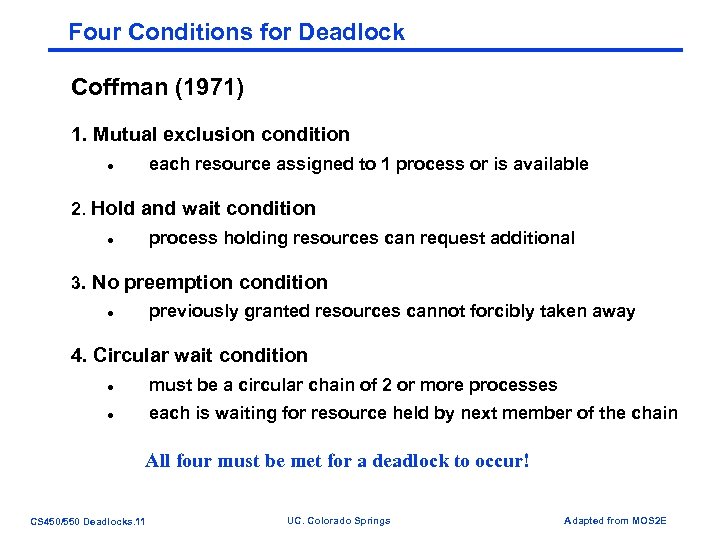 Four Conditions for Deadlock Coffman (1971) 1. Mutual exclusion condition each resource assigned to 1 process or is available l 2. Hold and wait condition process holding resources can request additional l 3. No preemption condition previously granted resources cannot forcibly taken away l 4. Circular wait condition l must be a circular chain of 2 or more processes l each is waiting for resource held by next member of the chain All four must be met for a deadlock to occur! CS 450/550 Deadlocks. 11 UC. Colorado Springs Adapted from MOS 2 E
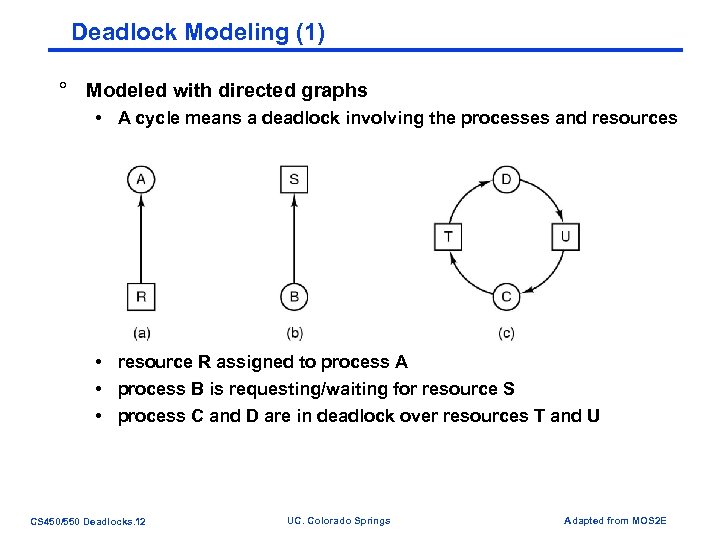 Deadlock Modeling (1) ° Modeled with directed graphs • A cycle means a deadlock involving the processes and resources • resource R assigned to process A • process B is requesting/waiting for resource S • process C and D are in deadlock over resources T and U CS 450/550 Deadlocks. 12 UC. Colorado Springs Adapted from MOS 2 E
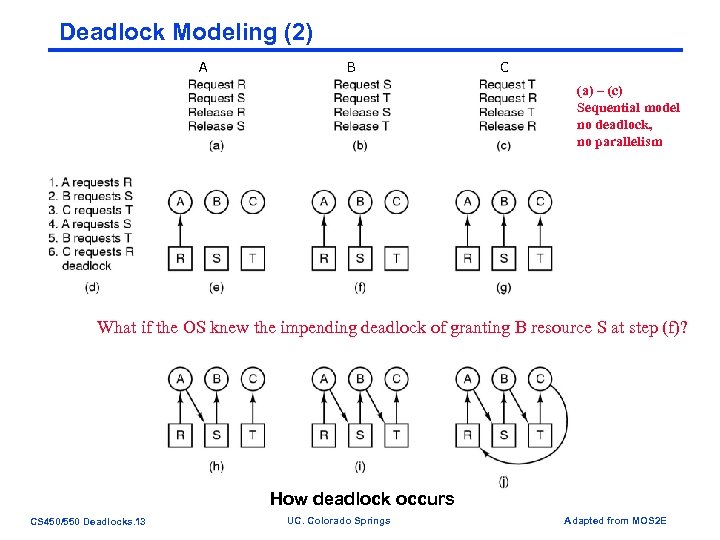 Deadlock Modeling (2) A B C (a) – (c) Sequential model no deadlock, no parallelism What if the OS knew the impending deadlock of granting B resource S at step (f)? How deadlock occurs CS 450/550 Deadlocks. 13 UC. Colorado Springs Adapted from MOS 2 E
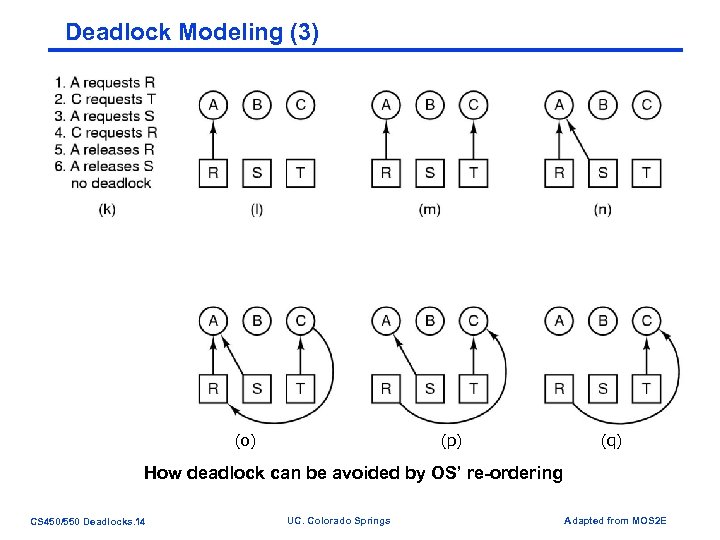 Deadlock Modeling (3) (o) (p) (q) How deadlock can be avoided by OS’ re-ordering CS 450/550 Deadlocks. 14 UC. Colorado Springs Adapted from MOS 2 E
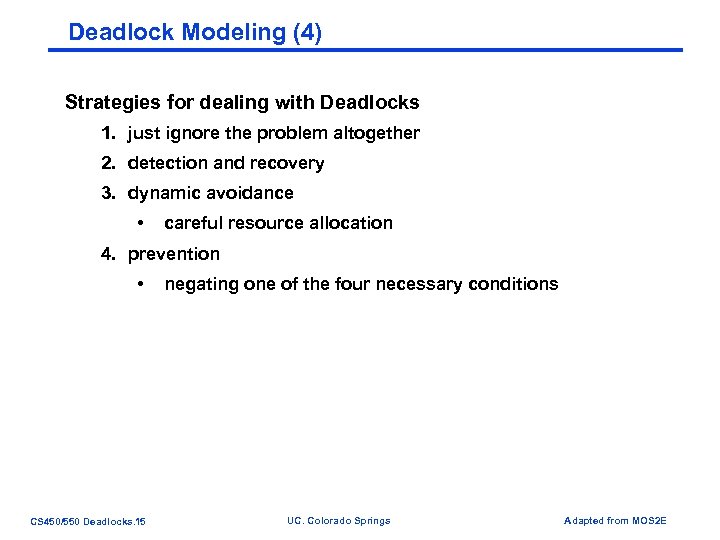 Deadlock Modeling (4) Strategies for dealing with Deadlocks 1. just ignore the problem altogether 2. detection and recovery 3. dynamic avoidance • careful resource allocation 4. prevention • CS 450/550 Deadlocks. 15 negating one of the four necessary conditions UC. Colorado Springs Adapted from MOS 2 E
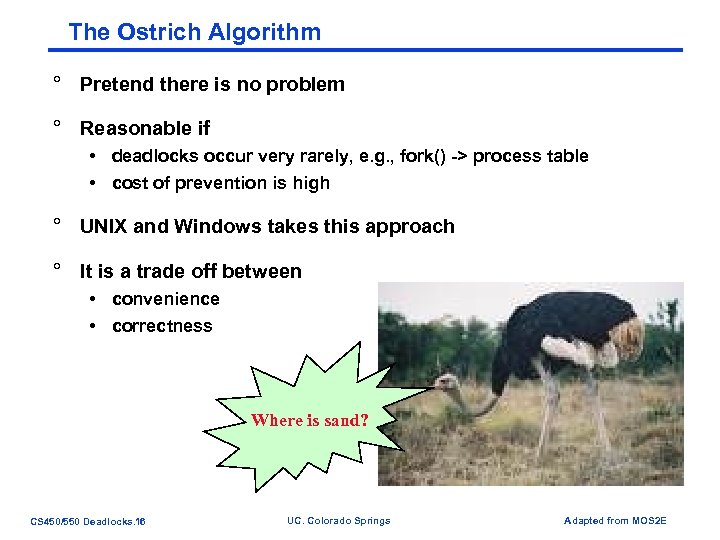 The Ostrich Algorithm ° Pretend there is no problem ° Reasonable if • deadlocks occur very rarely, e. g. , fork() -> process table • cost of prevention is high ° UNIX and Windows takes this approach ° It is a trade off between • convenience • correctness Where is sand? CS 450/550 Deadlocks. 16 UC. Colorado Springs Adapted from MOS 2 E
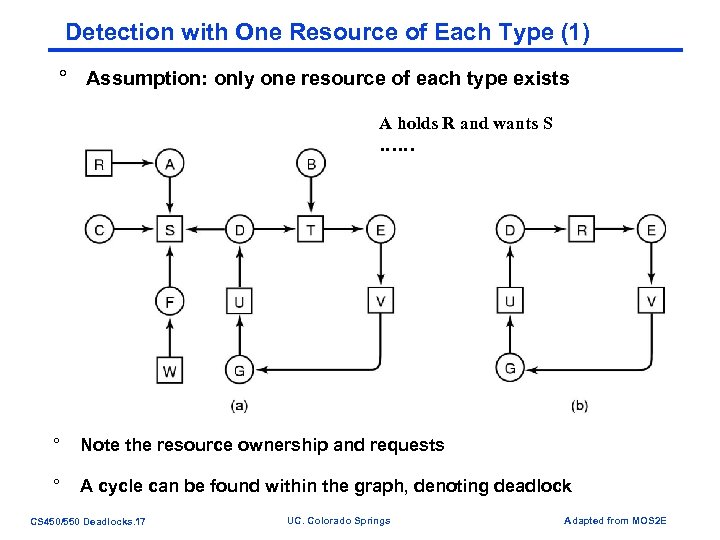 Detection with One Resource of Each Type (1) ° Assumption: only one resource of each type exists A holds R and wants S …… ° Note the resource ownership and requests ° A cycle can be found within the graph, denoting deadlock CS 450/550 Deadlocks. 17 UC. Colorado Springs Adapted from MOS 2 E
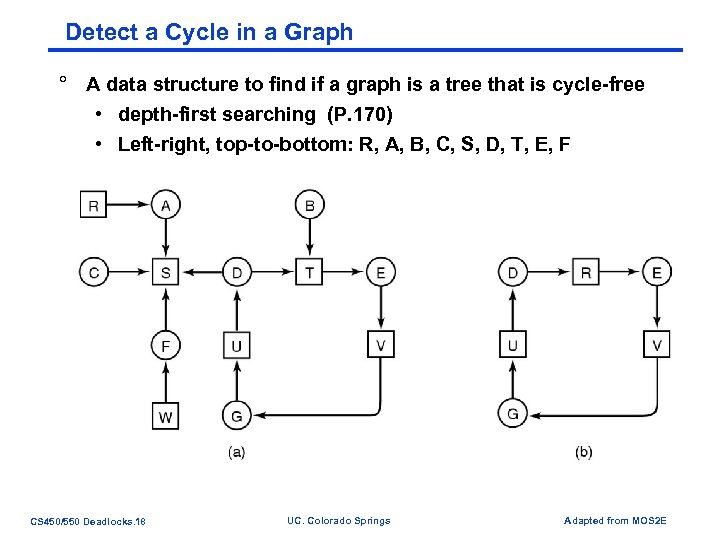 Detect a Cycle in a Graph ° A data structure to find if a graph is a tree that is cycle-free • depth-first searching (P. 170) • Left-right, top-to-bottom: R, A, B, C, S, D, T, E, F CS 450/550 Deadlocks. 18 UC. Colorado Springs Adapted from MOS 2 E
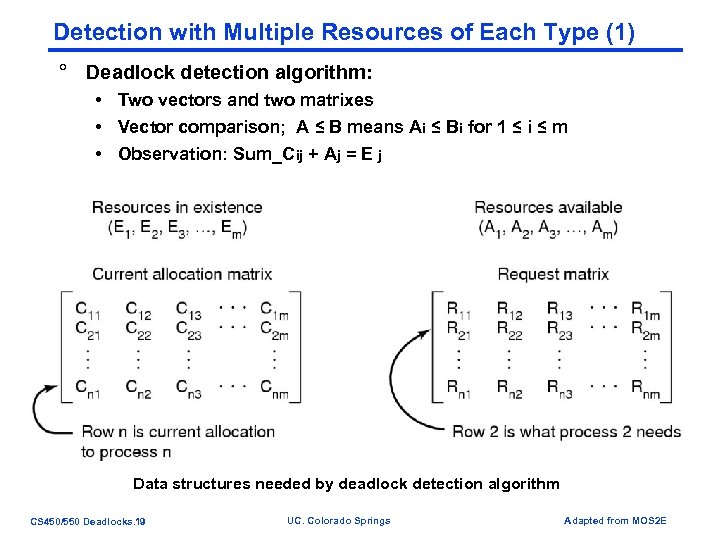 Detection with Multiple Resources of Each Type (1) ° Deadlock detection algorithm: • Two vectors and two matrixes • Vector comparison; A ≤ B means Ai ≤ Bi for 1 ≤ i ≤ m • Observation: Sum_Cij + Aj = E j Data structures needed by deadlock detection algorithm CS 450/550 Deadlocks. 19 UC. Colorado Springs Adapted from MOS 2 E
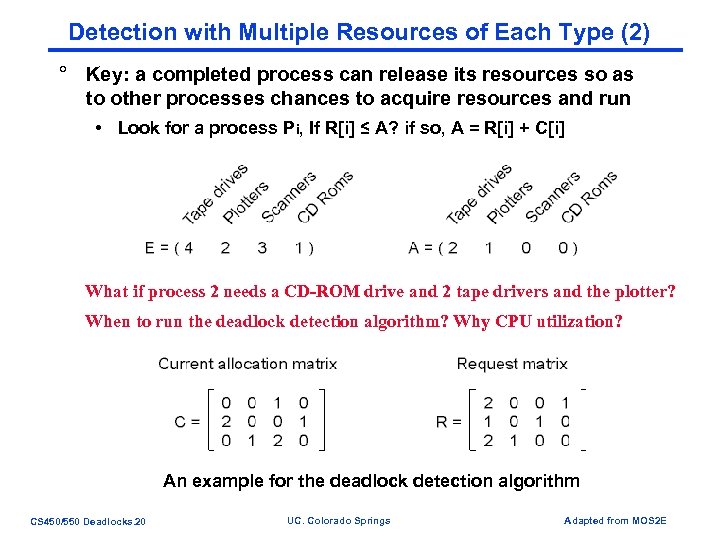 Detection with Multiple Resources of Each Type (2) ° Key: a completed process can release its resources so as to other processes chances to acquire resources and run • Look for a process Pi, If R[i] ≤ A? if so, A = R[i] + C[i] What if process 2 needs a CD-ROM drive and 2 tape drivers and the plotter? When to run the deadlock detection algorithm? Why CPU utilization? An example for the deadlock detection algorithm CS 450/550 Deadlocks. 20 UC. Colorado Springs Adapted from MOS 2 E
 Recovery from Deadlock ° Recovery through preemption • take a resource from some other process • depends on nature of the resource ° Recovery through rollback • checkpoint a process periodically, resulting a sequence of checkpoint files • use this saved state • restart the process if it is found deadlocked • database applications; network services; recoverable? ° Recovery through killing processes • • crudest but simplest way to break a deadlock kill one of the processes in the deadlock cycle the other processes get its resources choose process that can be rerun from the beginning, not easy! CS 450/550 Deadlocks. 21 UC. Colorado Springs Adapted from MOS 2 E
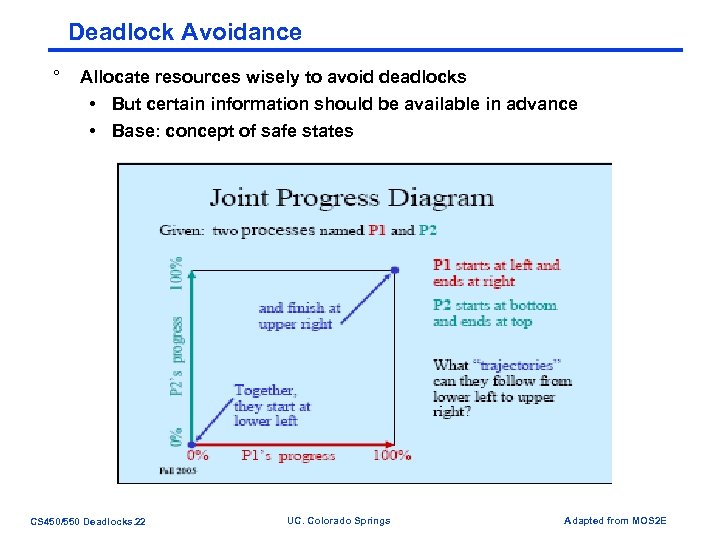 Deadlock Avoidance ° Allocate resources wisely to avoid deadlocks • But certain information should be available in advance • Base: concept of safe states CS 450/550 Deadlocks. 22 UC. Colorado Springs Adapted from MOS 2 E
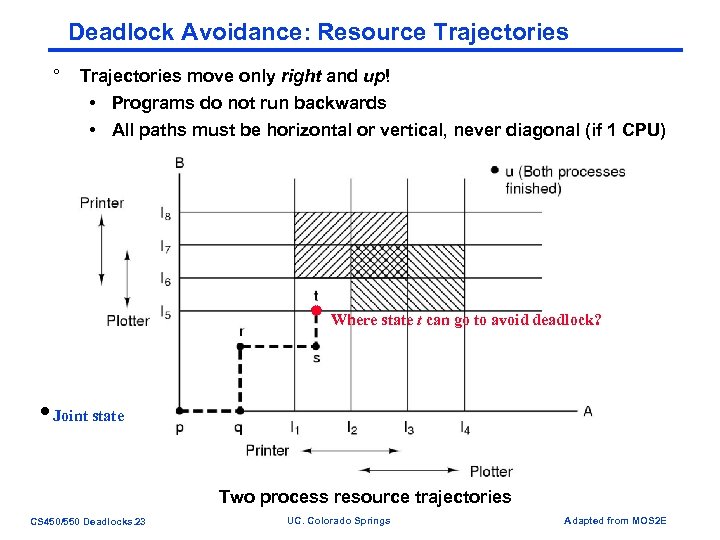 Deadlock Avoidance: Resource Trajectories ° Trajectories move only right and up! • Programs do not run backwards • All paths must be horizontal or vertical, never diagonal (if 1 CPU) Where state t can go to avoid deadlock? Joint state Two process resource trajectories CS 450/550 Deadlocks. 23 UC. Colorado Springs Adapted from MOS 2 E
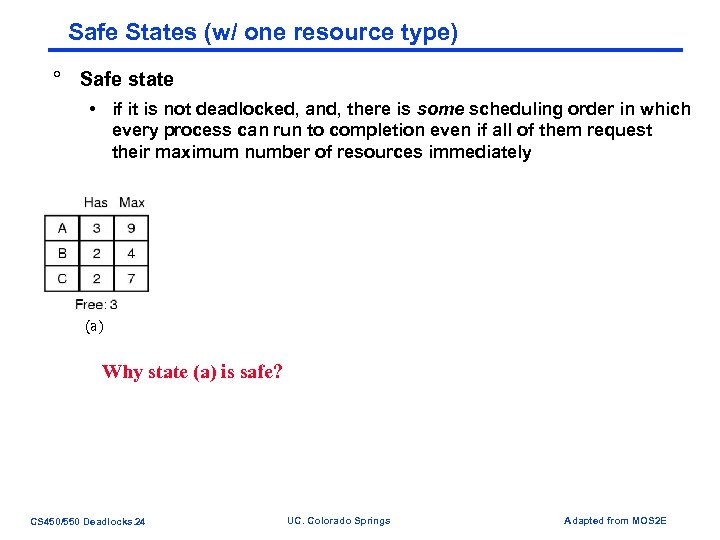 Safe States (w/ one resource type) ° Safe state • if it is not deadlocked, and, there is some scheduling order in which every process can run to completion even if all of them request their maximum number of resources immediately Demonstration that the state in (a) is safe (a) (b) (c) (d) (e) Why state (a) is safe? CS 450/550 Deadlocks. 24 UC. Colorado Springs Adapted from MOS 2 E
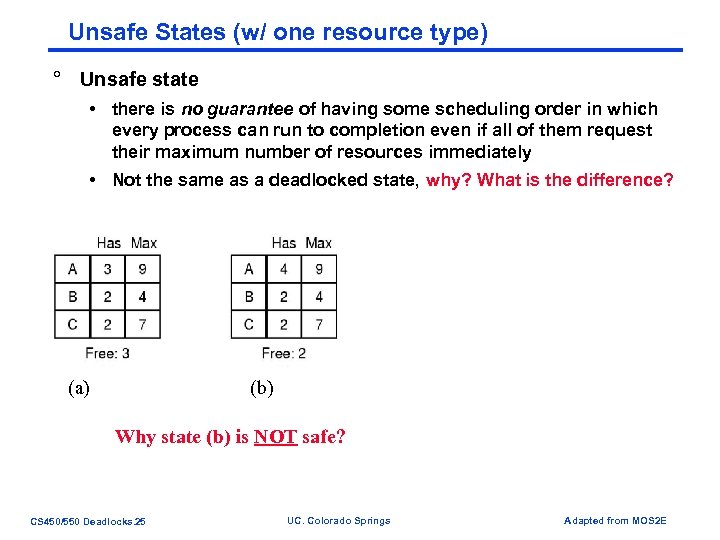 Unsafe States (w/ one resource type) ° Unsafe state • there is no guarantee of having some scheduling order in which every process can run to completion even if all of them request their maximum number of resources immediately • Not the same as a deadlocked state, why? What is the difference? (a) (b) (c) (d) Why state (b) is NOT safe? CS 450/550 Deadlocks. 25 UC. Colorado Springs Adapted from MOS 2 E
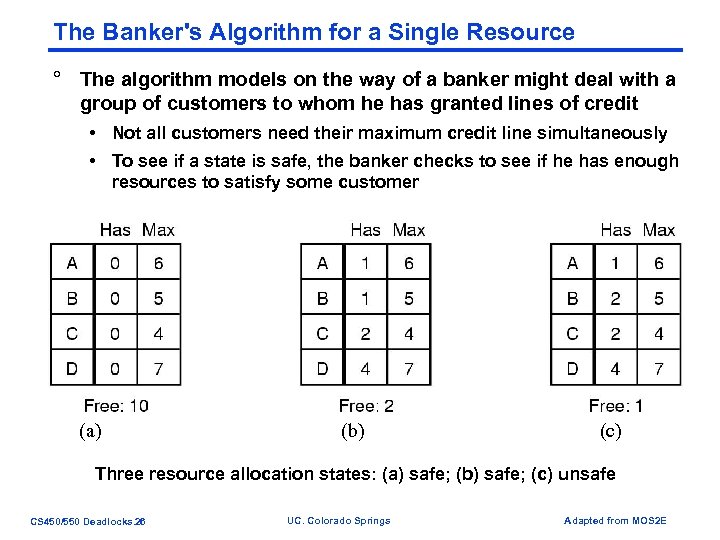 The Banker's Algorithm for a Single Resource ° The algorithm models on the way of a banker might deal with a group of customers to whom he has granted lines of credit • Not all customers need their maximum credit line simultaneously • To see if a state is safe, the banker checks to see if he has enough resources to satisfy some customer (a) (b) (c) Three resource allocation states: (a) safe; (b) safe; (c) unsafe CS 450/550 Deadlocks. 26 UC. Colorado Springs Adapted from MOS 2 E
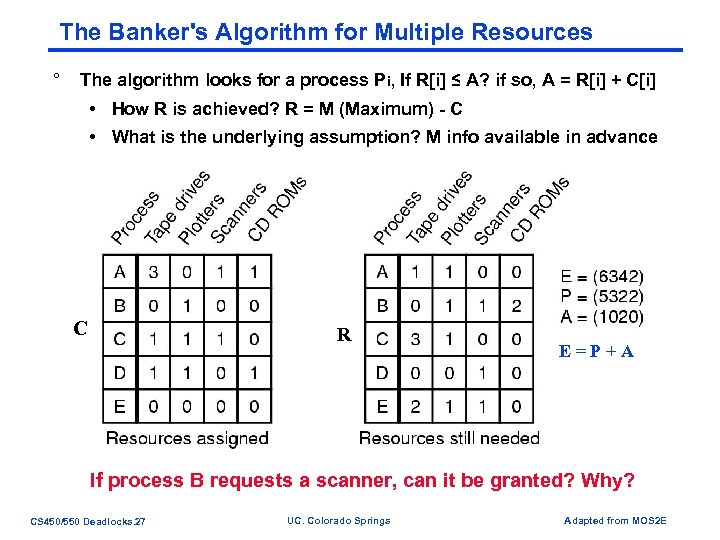 The Banker's Algorithm for Multiple Resources ° The algorithm looks for a process Pi, If R[i] ≤ A? if so, A = R[i] + C[i] • How R is achieved? R = M (Maximum) - C • What is the underlying assumption? M info available in advance C R E=P+A If process B requests a scanner, can it be granted? Why? CS 450/550 Deadlocks. 27 UC. Colorado Springs Adapted from MOS 2 E
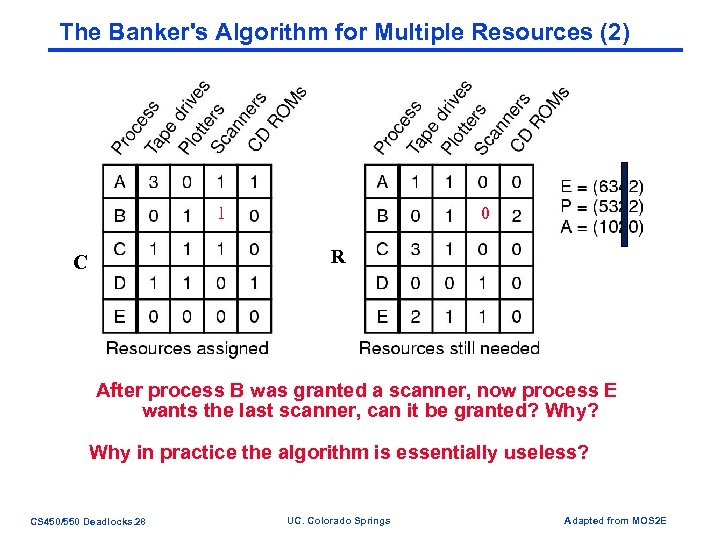 The Banker's Algorithm for Multiple Resources (2) 1 0 R C After process B was granted a scanner, now process E wants the last scanner, can it be granted? Why in practice the algorithm is essentially useless? CS 450/550 Deadlocks. 28 UC. Colorado Springs Adapted from MOS 2 E
 Deadlock Prevention (1) Attack the mutual exclusion condition of Coffman Rules ° Some devices (such as printer) can be spooled • only the printer daemon uses printer resource • thus deadlock for printer eliminated • But the disk could be deadlocked, though more unlikely ° Not all devices can be spooled, e. g. , process table ° Principle: • avoid assigning resource when not absolutely necessary • as few processes as possible actually claim the resource CS 450/550 Deadlocks. 29 UC. Colorado Springs Adapted from MOS 2 E
 Deadlock Prevention (2) Attack the Hold-and-Wait condition of Coffman Rules ° Require processes to request all resources before starting • a process never has to wait for what it needs ° Problems • may not know required resources at start of run • also ties up resources other processes could be using - Less concurrency! ° Variation: • process must temporarily give up all resources • then request all immediately needed CS 450/550 Deadlocks. 30 UC. Colorado Springs Adapted from MOS 2 E
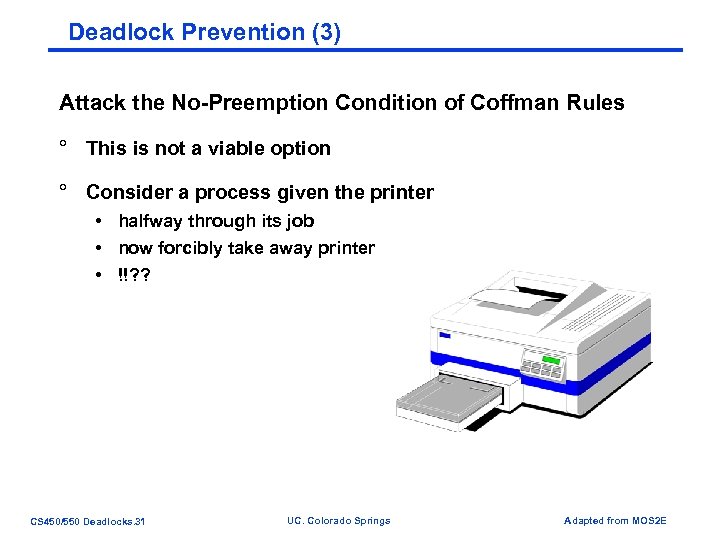 Deadlock Prevention (3) Attack the No-Preemption Condition of Coffman Rules ° This is not a viable option ° Consider a process given the printer • halfway through its job • now forcibly take away printer • !!? ? CS 450/550 Deadlocks. 31 UC. Colorado Springs Adapted from MOS 2 E
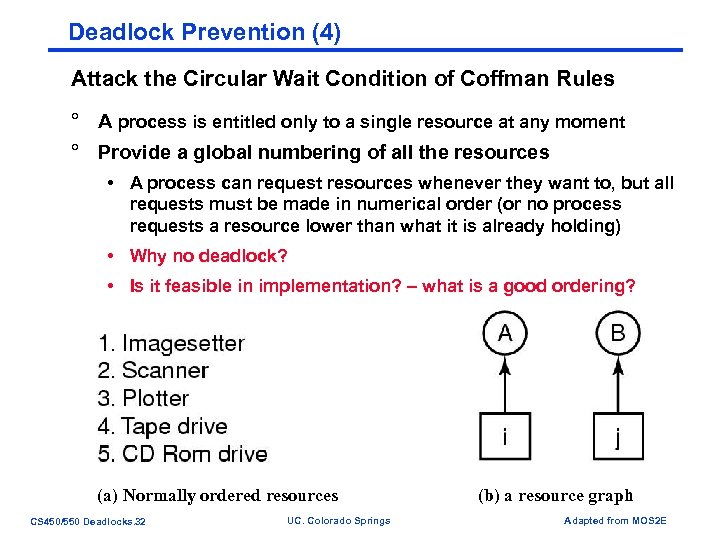 Deadlock Prevention (4) Attack the Circular Wait Condition of Coffman Rules ° A process is entitled only to a single resource at any moment ° Provide a global numbering of all the resources • A process can request resources whenever they want to, but all requests must be made in numerical order (or no process requests a resource lower than what it is already holding) • Why no deadlock? • Is it feasible in implementation? – what is a good ordering? (a) Normally ordered resources CS 450/550 Deadlocks. 32 UC. Colorado Springs (b) a resource graph Adapted from MOS 2 E
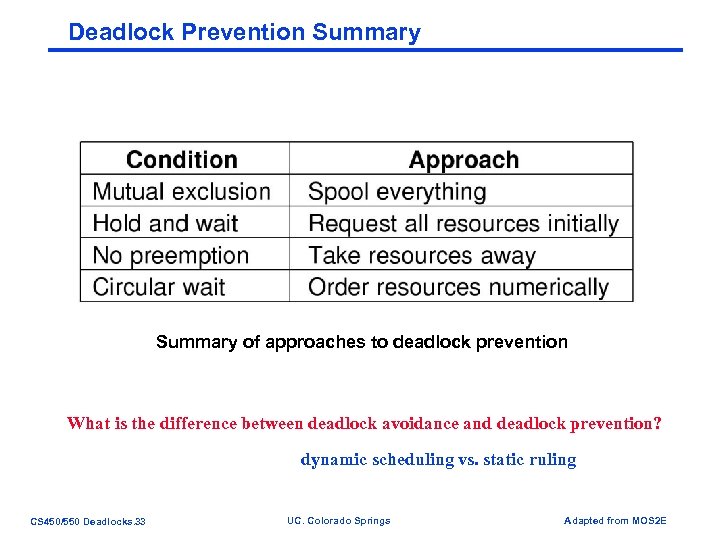 Deadlock Prevention Summary of approaches to deadlock prevention What is the difference between deadlock avoidance and deadlock prevention? dynamic scheduling vs. static ruling CS 450/550 Deadlocks. 33 UC. Colorado Springs Adapted from MOS 2 E
 Two-Phase Locking ° Phase One • process tries to lock all records it needs, one at a time • if needed record found locked, start over • (no real work done in phase one) ° If phase one succeeds, it starts second phase, • performing updates • releasing locks ° Note similarity to requesting all resources at once • Attacking the hold-and-wait condition ° Algorithm works where programmer can arrange • program can be stopped and restarted in the first phase, instead of blocking! CS 450/550 Deadlocks. 34 UC. Colorado Springs Adapted from MOS 2 E
 Non-resource Deadlocks ° Possible for two processes to deadlock • each is waiting for the other to do some task ° Can happen with semaphores • each process required to do a down() on two semaphores (mutex and another) • if done in wrong order, deadlock results CS 450/550 Deadlocks. 35 UC. Colorado Springs Adapted from MOS 2 E
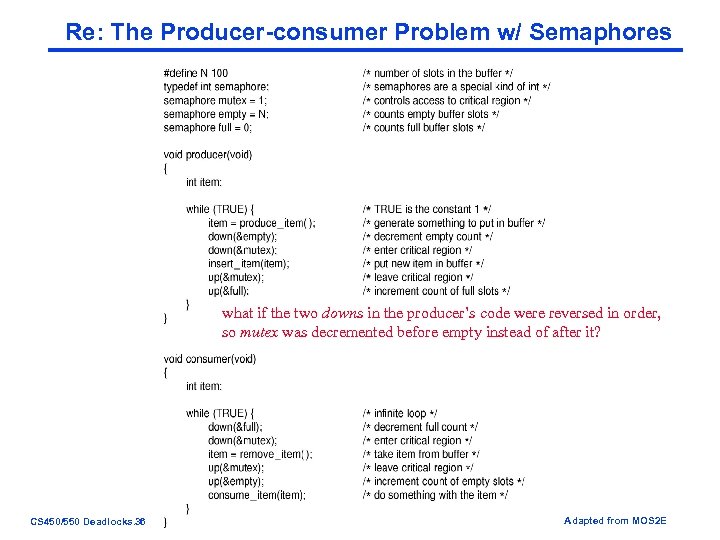 Re: The Producer-consumer Problem w/ Semaphores what if the two downs in the producer’s code were reversed in order, so mutex was decremented before empty instead of after it? CS 450/550 Deadlocks. 36 UC. Colorado Springs Adapted from MOS 2 E
 Starvation ° Algorithm to allocate a resource • may be to give to shortest job first • works great for multiple short jobs in a system ° It may cause long job to be postponed indefinitely • even though not blocked • Strict priority may give trouble! ° Solution: • First-come, first-serve resource allocation policy What is the key difference between deadlock and starvation? CS 450/550 Deadlocks. 37 UC. Colorado Springs Adapted from MOS 2 E
 Summary of Lecture 3 ° Deadlocks and its modeling ° Deadlock detection ° Deadlock recovery ° Deadlock avoidance • Resource trajectories • Safe and unsafe states • The banker’s algorithm ° Two-phase locking ° More reading: Textbook 3. 1 - 3. 9 CS 450/550 Deadlocks. 38 UC. Colorado Springs Adapted from MOS 2 E
 Homework Assignment 3 ° Homework (due one week later): • Chapter 3 problems: CS 450/550 Deadlocks. 39 UC. Colorado Springs Adapted from MOS 2 E