


 Скачать презентацию CS 430 Computer Architecture —Networks-William J Taffe using
5170ad29767245536dd81075b1f5ac7c.ppt
- Количество слайдов: 31
 CS 430 Computer Architecture --Networks-William J. Taffe using the slides of David Patterson 3/18/2018 1
 Today’s Outline ° Buses ° Why Networks? ° A Simple Example: Derive Network Basics ° Administrivia ° Protocol, Ethernet ° Internetworking, Protocol Suites, TCP/IP ° Conclusion 3/18/2018 2
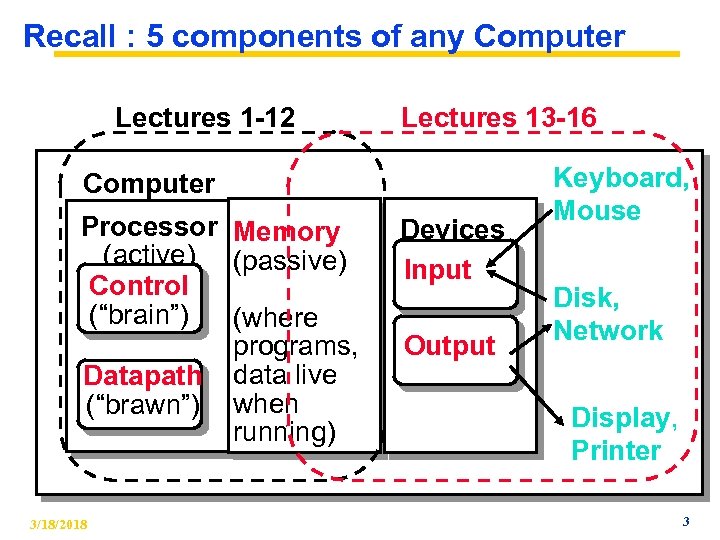 Recall : 5 components of any Computer Lectures 1 -12 Lectures 13 -16 Computer Processor Memory (active) (passive) Control (“brain”) (where programs, Datapath data live (“brawn”) when running) 3/18/2018 Devices Input Output Keyboard, Mouse Disk, Network Display, Printer 3
 Connecting to Networks (and Other I/O) ° Bus - shared medium of communication that can connect to many devices ° Hierarchy of Buses in a PC 3/18/2018 4
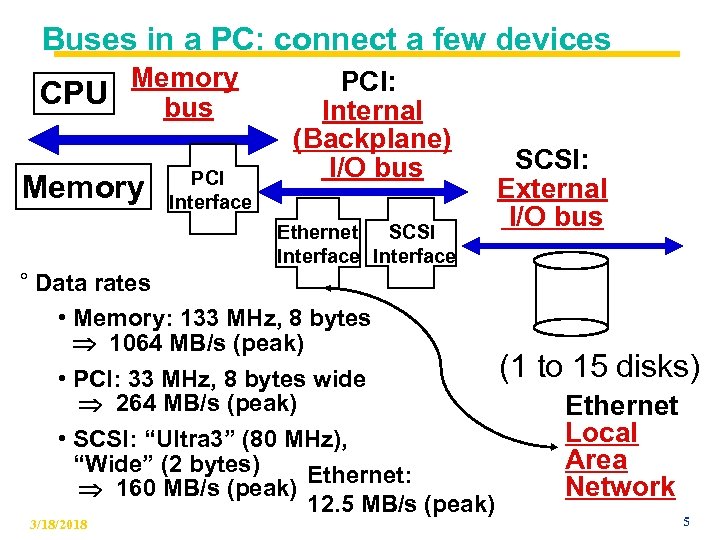 Buses in a PC: connect a few devices Memory CPU bus Memory PCI Interface PCI: Internal (Backplane) I/O bus Ethernet SCSI Interface SCSI: External I/O bus ° Data rates • Memory: 133 MHz, 8 bytes 1064 MB/s (peak) (1 • PCI: 33 MHz, 8 bytes wide 264 MB/s (peak) • SCSI: “Ultra 3” (80 MHz), “Wide” (2 bytes) Ethernet: 160 MB/s (peak) 12. 5 MB/s (peak) 3/18/2018 to 15 disks) Ethernet Local Area Network 5
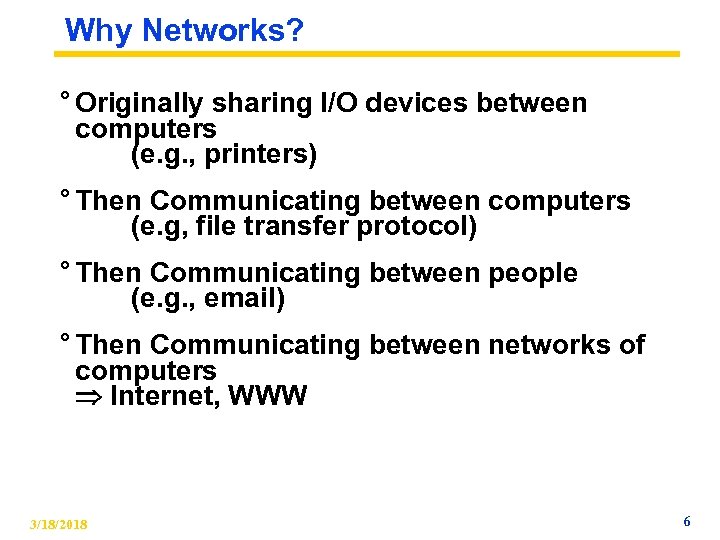 Why Networks? ° Originally sharing I/O devices between computers (e. g. , printers) ° Then Communicating between computers (e. g, file transfer protocol) ° Then Communicating between people (e. g. , email) ° Then Communicating between networks of computers Internet, WWW 3/18/2018 6
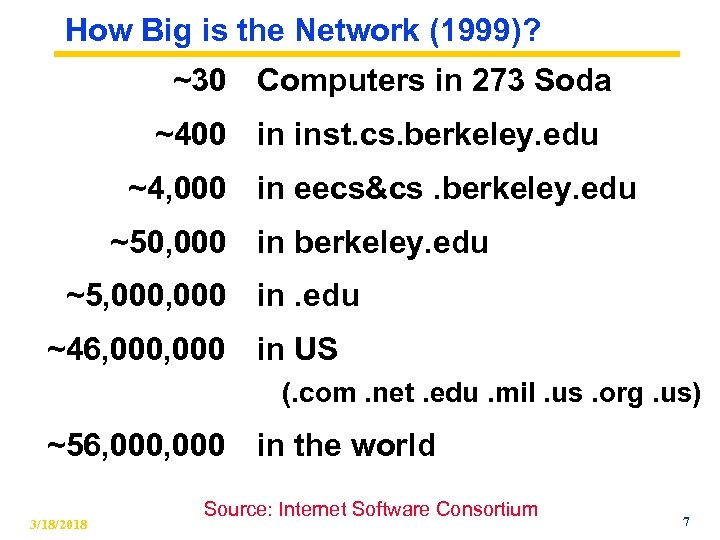 How Big is the Network (1999)? ~30 Computers in 273 Soda ~400 in inst. cs. berkeley. edu ~4, 000 in eecs&cs. berkeley. edu ~50, 000 in berkeley. edu ~5, 000 in. edu ~46, 000 in US (. com. net. edu. mil. us. org. us) ~56, 000 in the world 3/18/2018 Source: Internet Software Consortium 7
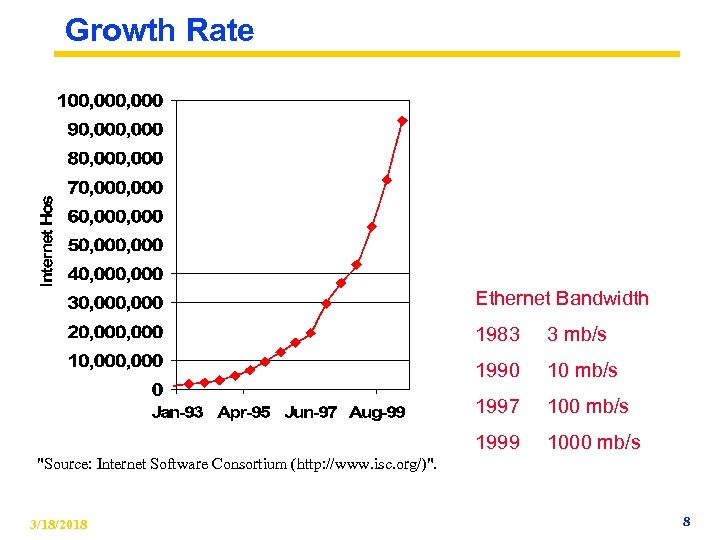 Growth Rate Ethernet Bandwidth 1983 3 mb/s 1990 10 mb/s 1997 100 mb/s 1999 1000 mb/s "Source: Internet Software Consortium (http: //www. isc. org/)". 3/18/2018 8
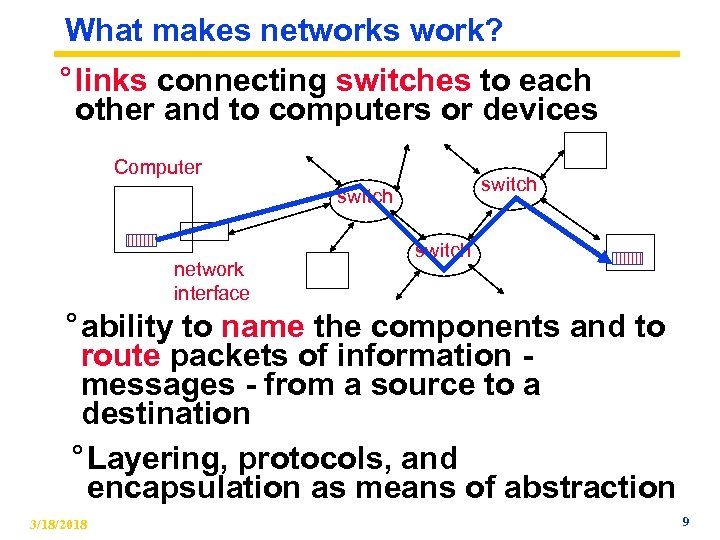 What makes networks work? ° links connecting switches to each other and to computers or devices Computer switch network interface switch ° ability to name the components and to route packets of information messages - from a source to a destination ° Layering, protocols, and encapsulation as means of abstraction 3/18/2018 9
 Typical Types of Networks ° Local Area Network (Ethernet) • Inside a building: Up to 1 km • (peak) Data Rate: 10 Mbits/sec, 100 Mbits /sec, 1000 Mbits/sec (1. 25, 125 MBytes/s) • Run, installed by network administrators ° Wide Area Network • Across a continent (10 km to 10000 km) • (peak) Data Rate: 1. 5 Mbits/sec to 2500 Mbits/sec • Run, installed by telephone companies ° Wireless Networks, . . . 3/18/2018 10
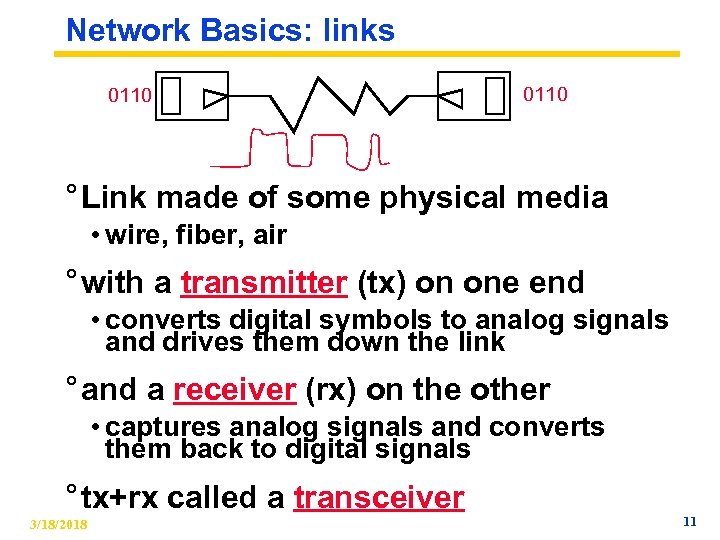 Network Basics: links 0110 ° Link made of some physical media • wire, fiber, air ° with a transmitter (tx) on one end • converts digital symbols to analog signals and drives them down the link ° and a receiver (rx) on the other • captures analog signals and converts them back to digital signals ° tx+rx called a transceiver 3/18/2018 11
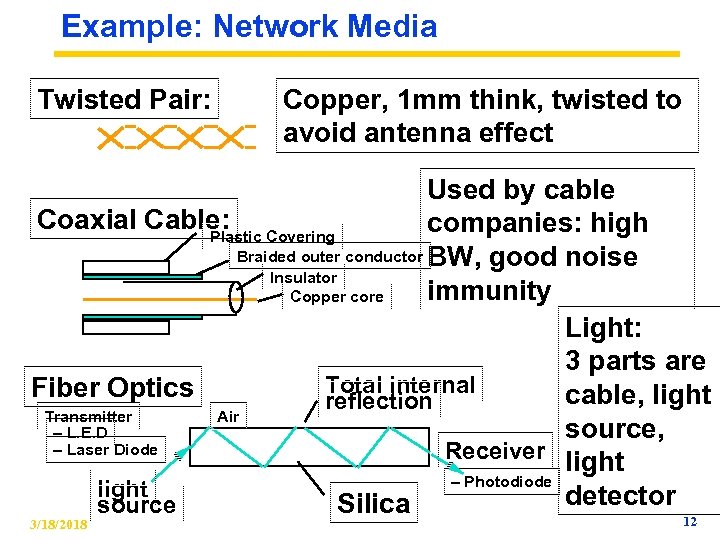 Example: Network Media Twisted Pair: Copper, 1 mm think, twisted to avoid antenna effect Used by cable Coaxial Cable: Covering companies: high Plastic Braided outer conductor BW, good noise Insulator immunity Copper core Light: 3 parts are Total internal Fiber Optics cable, light reflection Transmitter Air source, – L. E. D – Laser Diode Receiver light – Photodiode light detector source Silica 12 3/18/2018
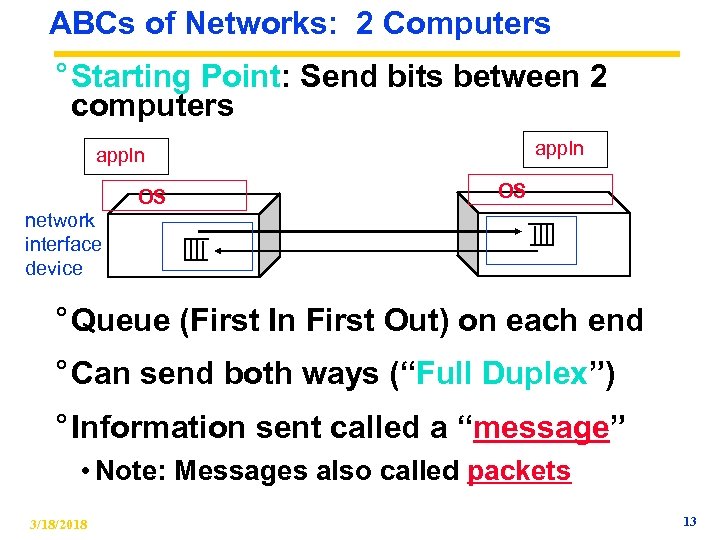 ABCs of Networks: 2 Computers ° Starting Point: Send bits between 2 computers appln OS OS network interface device ° Queue (First In First Out) on each end ° Can send both ways (“Full Duplex”) ° Information sent called a “message” • Note: Messages also called packets 3/18/2018 13
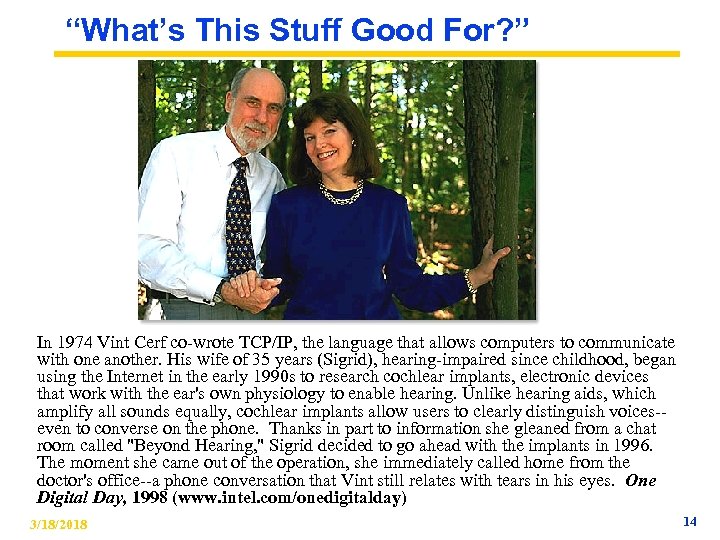 “What’s This Stuff Good For? ” In 1974 Vint Cerf co-wrote TCP/IP, the language that allows computers to communicate with one another. His wife of 35 years (Sigrid), hearing-impaired since childhood, began using the Internet in the early 1990 s to research cochlear implants, electronic devices that work with the ear's own physiology to enable hearing. Unlike hearing aids, which amplify all sounds equally, cochlear implants allow users to clearly distinguish voices-even to converse on the phone. Thanks in part to information she gleaned from a chat room called "Beyond Hearing, " Sigrid decided to go ahead with the implants in 1996. The moment she came out of the operation, she immediately called home from the doctor's office--a phone conversation that Vint still relates with tears in his eyes. One Digital Day, 1998 (www. intel. com/onedigitalday) 3/18/2018 14
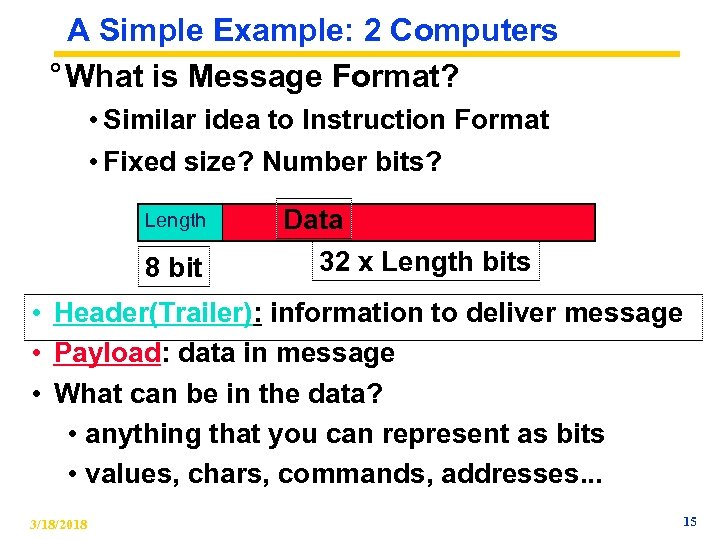 A Simple Example: 2 Computers ° What is Message Format? • Similar idea to Instruction Format • Fixed size? Number bits? Length 8 bit Data 32 x Length bits • Header(Trailer): information to deliver message • Payload: data in message • What can be in the data? • anything that you can represent as bits • values, chars, commands, addresses. . . 3/18/2018 15
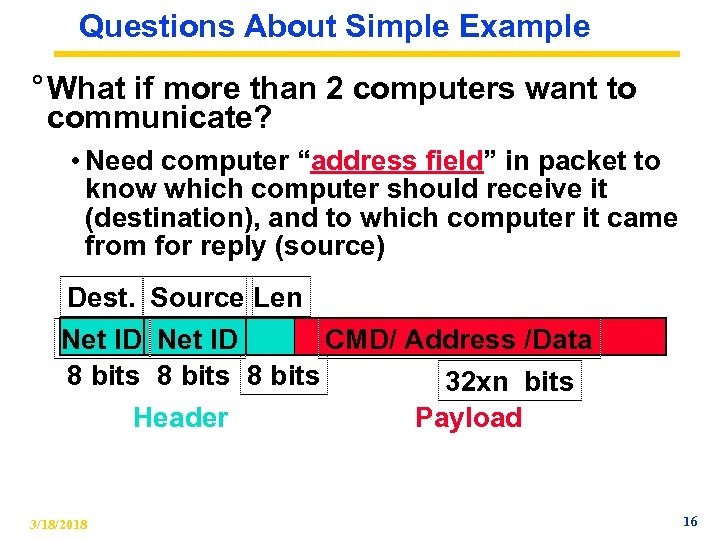 Questions About Simple Example ° What if more than 2 computers want to communicate? • Need computer “address field” in packet to know which computer should receive it (destination), and to which computer it came from for reply (source) Dest. Source Len Net ID CMD/ Address /Data 8 bits 32 xn bits Header 3/18/2018 Payload 16
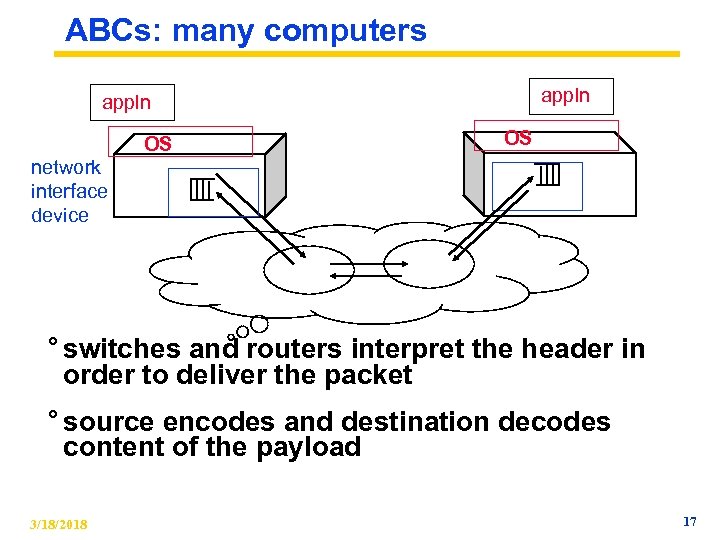 ABCs: many computers appln OS OS network interface device ° switches and routers interpret the header in order to deliver the packet ° source encodes and destination decodes content of the payload 3/18/2018 17
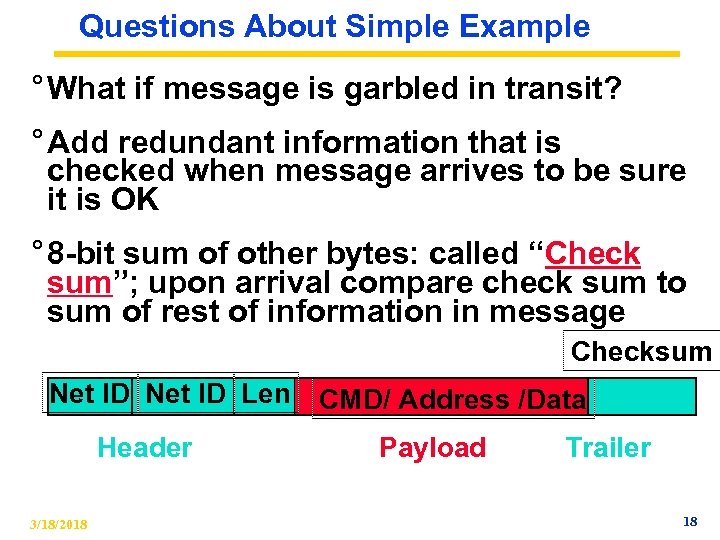 Questions About Simple Example ° What if message is garbled in transit? ° Add redundant information that is checked when message arrives to be sure it is OK ° 8 -bit sum of other bytes: called “Check sum”; upon arrival compare check sum to sum of rest of information in message Checksum Net ID Len Header 3/18/2018 CMD/ Address /Data Payload Trailer 18
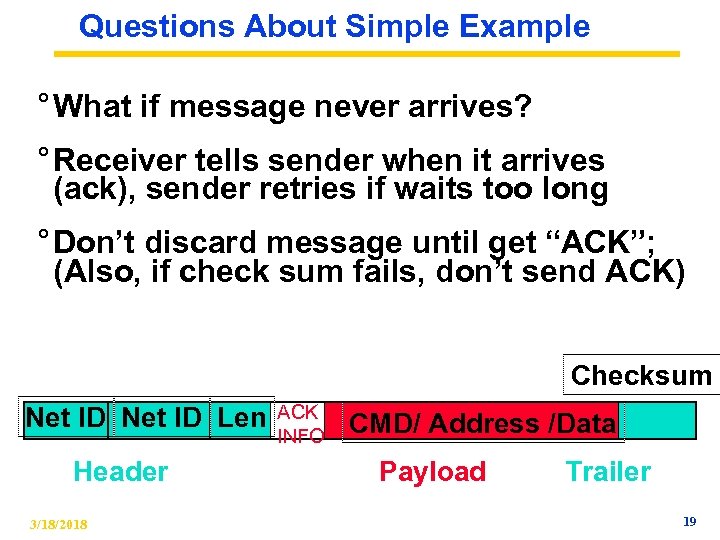 Questions About Simple Example ° What if message never arrives? ° Receiver tells sender when it arrives (ack), sender retries if waits too long ° Don’t discard message until get “ACK”; (Also, if check sum fails, don’t send ACK) Checksum Net ID Len Header 3/18/2018 ACK INFO CMD/ Address /Data Payload Trailer 19
 Observations About Simple Example ° Simple questions such as those above lead to more complex procedures to send/receive message and more complex message formats ° Protocol: algorithm for properly sending and receiving messages (packets) 3/18/2018 20
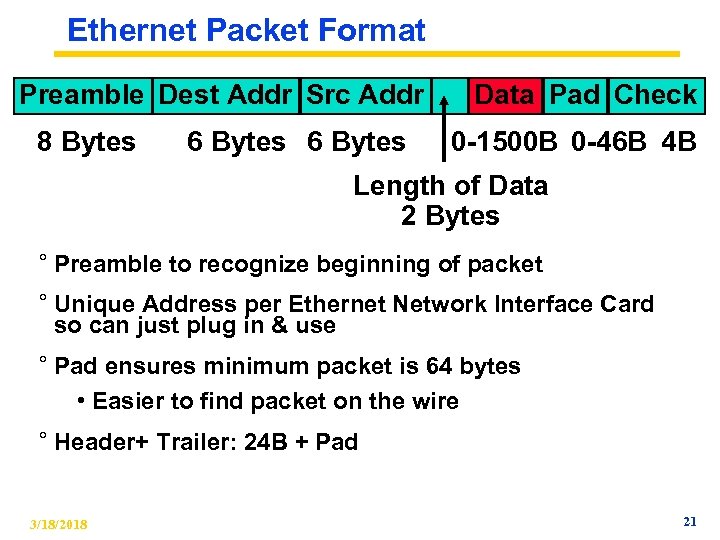 Ethernet Packet Format Preamble Dest Addr Src Addr 8 Bytes 6 Bytes Data Pad Check 0 -1500 B 0 -46 B 4 B Length of Data 2 Bytes ° Preamble to recognize beginning of packet ° Unique Address per Ethernet Network Interface Card so can just plug in & use ° Pad ensures minimum packet is 64 bytes • Easier to find packet on the wire ° Header+ Trailer: 24 B + Pad 3/18/2018 21
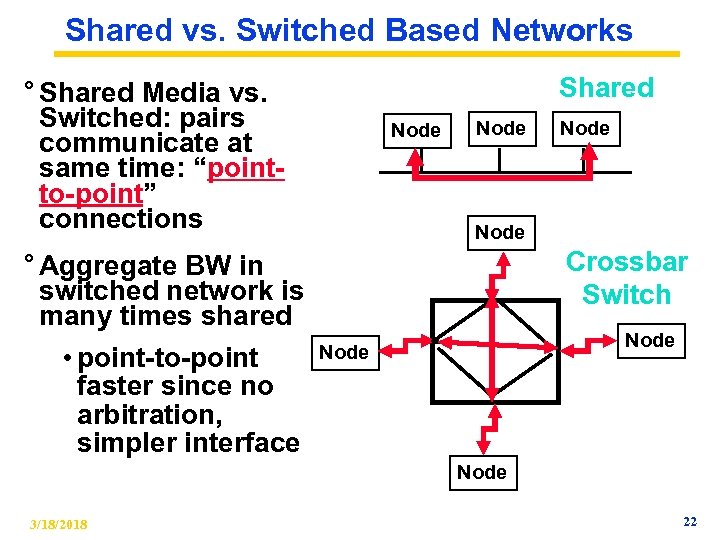 Shared vs. Switched Based Networks Shared ° Shared Media vs. Switched: pairs communicate at same time: “pointto-point” connections ° Aggregate BW in switched network is many times shared • point-to-point faster since no arbitration, simpler interface Node Crossbar Switch Node 3/18/2018 22
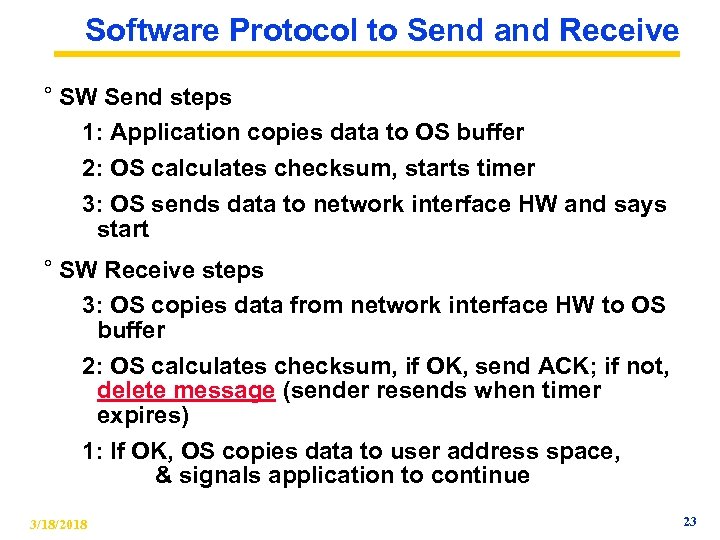 Software Protocol to Send and Receive ° SW Send steps 1: Application copies data to OS buffer 2: OS calculates checksum, starts timer 3: OS sends data to network interface HW and says start ° SW Receive steps 3: OS copies data from network interface HW to OS buffer 2: OS calculates checksum, if OK, send ACK; if not, delete message (sender resends when timer expires) 1: If OK, OS copies data to user address space, & signals application to continue 3/18/2018 23
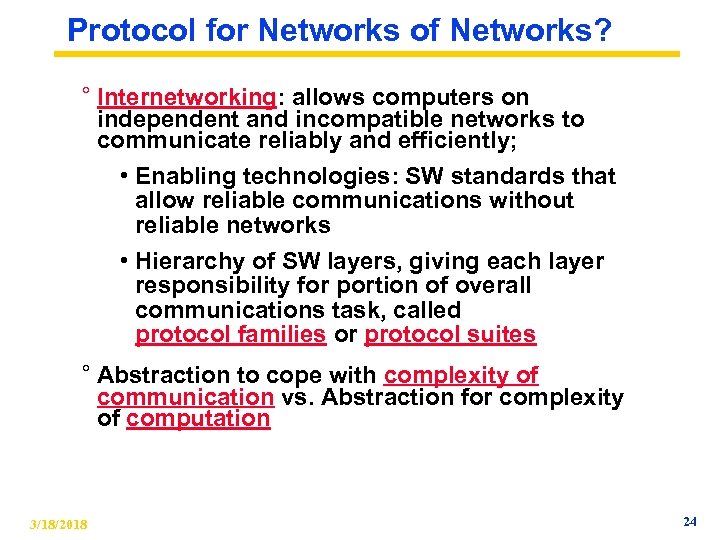 Protocol for Networks of Networks? ° Internetworking: allows computers on independent and incompatible networks to communicate reliably and efficiently; • Enabling technologies: SW standards that allow reliable communications without reliable networks • Hierarchy of SW layers, giving each layer responsibility for portion of overall communications task, called protocol families or protocol suites ° Abstraction to cope with complexity of communication vs. Abstraction for complexity of computation 3/18/2018 24
 Protocol for Network of Networks ° Transmission Control Protocol/Internet Protocol (TCP/IP) • This protocol family is the basis of the Internet, a WAN protocol • IP makes best effort to deliver • TCP guarantees delivery • TCP/IP so popular it is used even when communicating locally: even across homogeneous LAN 3/18/2018 25
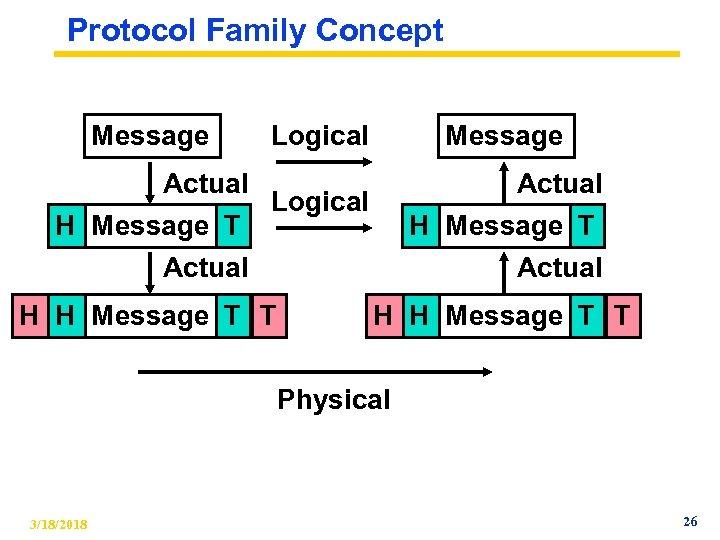 Protocol Family Concept Message Logical Message Actual Logical H Message T Actual H H Message T T Actual H Message T Actual H H Message T T Physical 3/18/2018 26
 Protocol Family Concept ° Key to protocol families is that communication occurs logically at the same level of the protocol, called peer-to -peer, ° but is implemented via services at the next lower level ° Encapsulation: carry higher level information within lower level “envelope” ° Fragmentation: break packet into multiple smaller packets and reassemble 3/18/2018 27
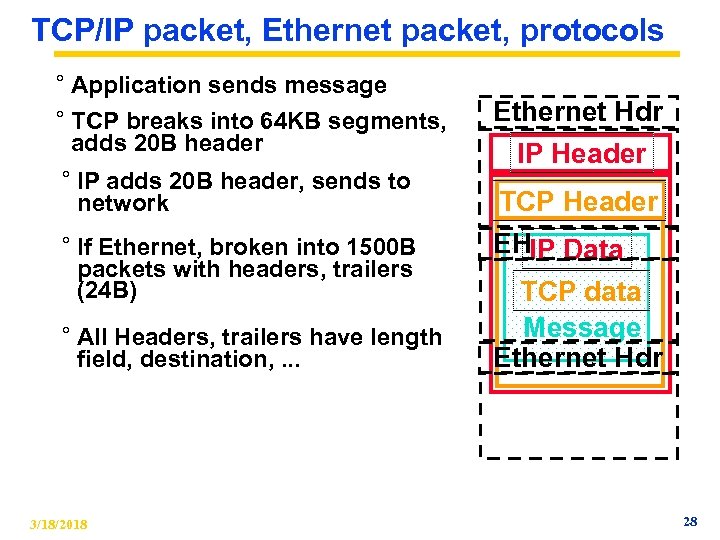 TCP/IP packet, Ethernet packet, protocols ° Application sends message ° TCP breaks into 64 KB segments, adds 20 B header ° IP adds 20 B header, sends to network ° If Ethernet, broken into 1500 B packets with headers, trailers (24 B) ° All Headers, trailers have length field, destination, . . . 3/18/2018 Ethernet Hdr IP Header TCP Header EHIP Data TCP data Message Ethernet Hdr 28
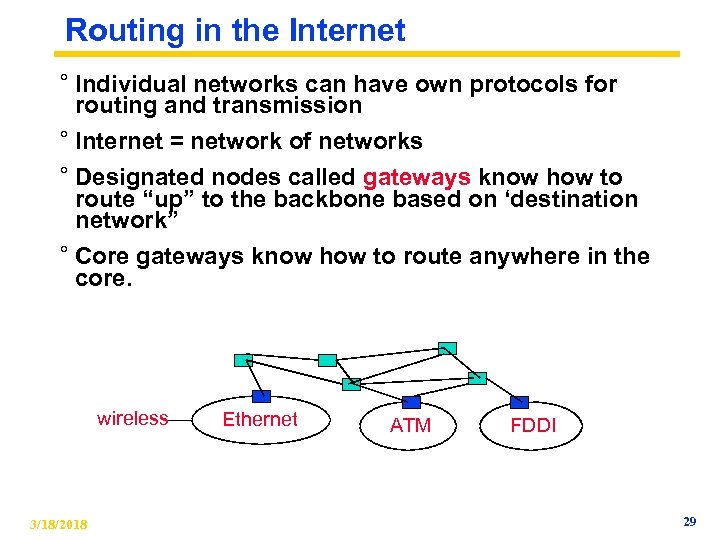 Routing in the Internet ° Individual networks can have own protocols for routing and transmission ° Internet = network of networks ° Designated nodes called gateways know how to route “up” to the backbone based on ‘destination network” ° Core gateways know how to route anywhere in the core. wireless 3/18/2018 Ethernet ATM FDDI 29
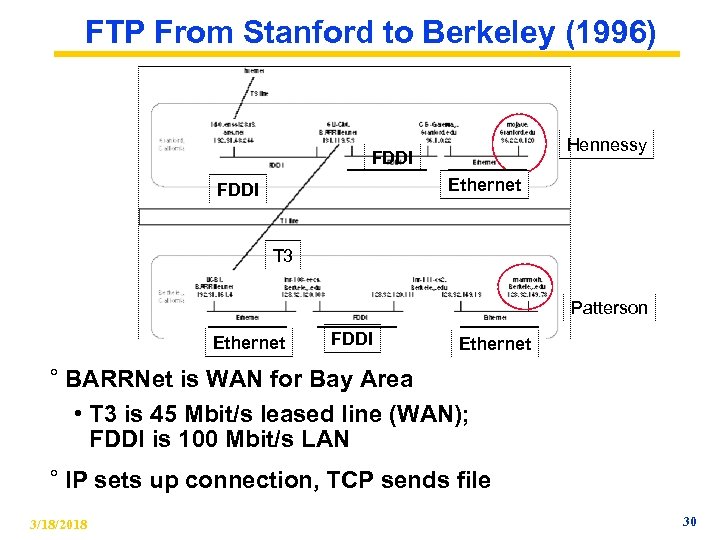 FTP From Stanford to Berkeley (1996) Hennessy FDDI Ethernet FDDI T 3 Patterson Ethernet FDDI Ethernet ° BARRNet is WAN for Bay Area • T 3 is 45 Mbit/s leased line (WAN); FDDI is 100 Mbit/s LAN ° IP sets up connection, TCP sends file 3/18/2018 30
 What to Remember ° Protocol suites allow heterogeneous networking • Another form of principle of abstraction • Protocols operation in presence of failures • Standardization key for LAN, WAN ° Integrated circuit revolutionizing network switches as well as processors • Switch just a specialized computer ° Trend from shared to switched networks to get faster links and scalable bandwidth 3/18/2018 31