


 Скачать презентацию CS 430 536 Computer Graphics I 3 D Viewing
446faa884dc63feaf8940fcbd2041576.ppt
- Количество слайдов: 43
 CS 430/536 Computer Graphics I 3 D Viewing Week 6, Lecture 12 David Breen, William Regli and Maxim Peysakhov Geometric and Intelligent Computing Laboratory Department of Computer Science Drexel University http: //gicl. cs. drexel. edu 1
 Overview • • 3 D Viewing 3 D Projective Geometry Mapping 3 D worlds to 2 D screens Introduction and discussion of homework #4 Lecture Credits: Most pictures are from Foley/Van. Dam; Additional and extensive thanks also goes to those credited on individual slides 2 Pics/Math courtesy of Dave Mount @ UMD-CP 1994 Foley/Van. Dam/Finer/Huges/Phillips ICG
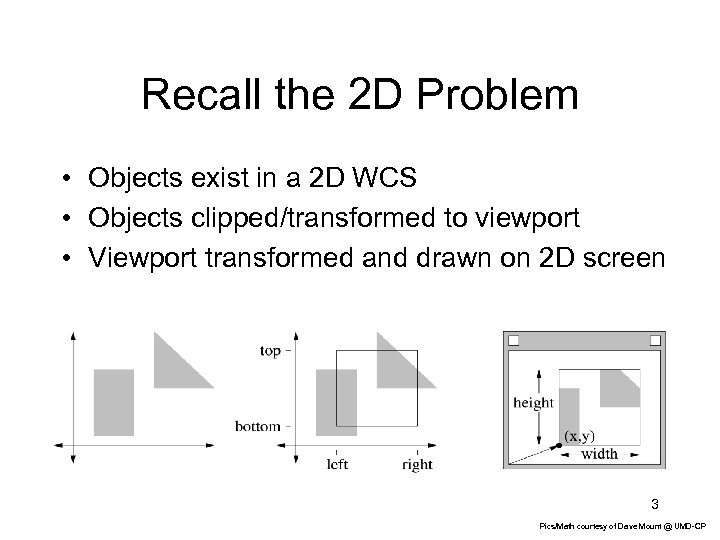 Recall the 2 D Problem • Objects exist in a 2 D WCS • Objects clipped/transformed to viewport • Viewport transformed and drawn on 2 D screen 3 Pics/Math courtesy of Dave Mount @ UMD-CP
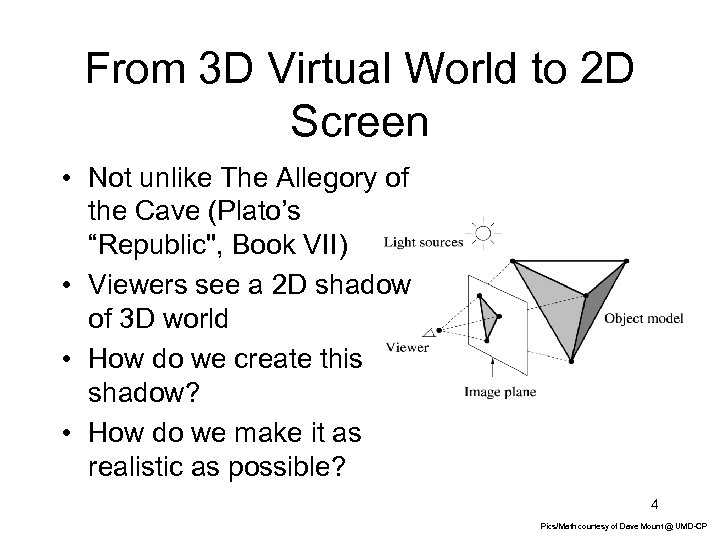 From 3 D Virtual World to 2 D Screen • Not unlike The Allegory of the Cave (Plato’s “Republic", Book VII) • Viewers see a 2 D shadow of 3 D world • How do we create this shadow? • How do we make it as realistic as possible? 4 Pics/Math courtesy of Dave Mount @ UMD-CP
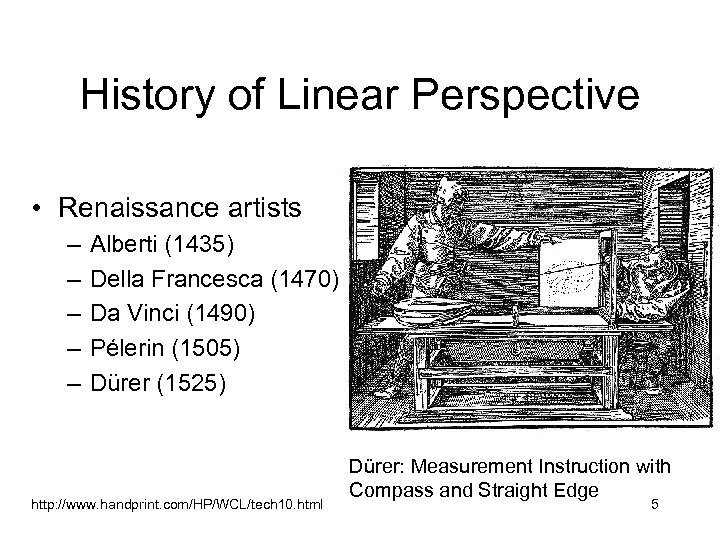 History of Linear Perspective • Renaissance artists – – – Alberti (1435) Della Francesca (1470) Da Vinci (1490) Pélerin (1505) Dürer (1525) http: //www. handprint. com/HP/WCL/tech 10. html Dürer: Measurement Instruction with Compass and Straight Edge 5
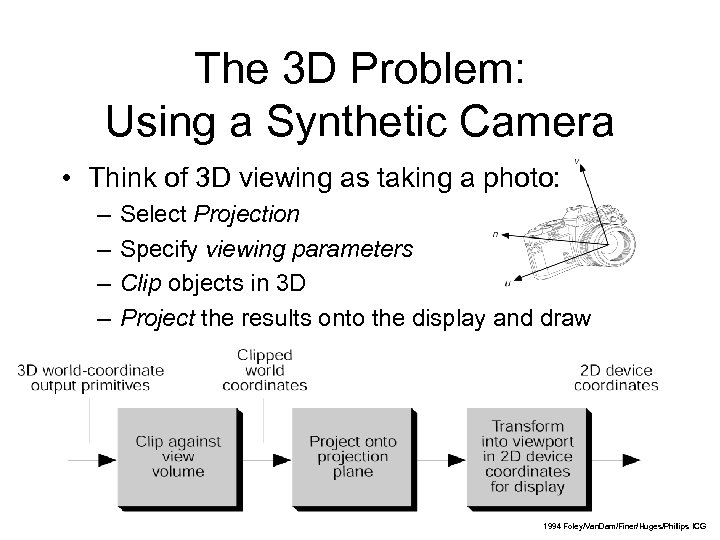 The 3 D Problem: Using a Synthetic Camera • Think of 3 D viewing as taking a photo: – – Select Projection Specify viewing parameters Clip objects in 3 D Project the results onto the display and draw 6 1994 Foley/Van. Dam/Finer/Huges/Phillips ICG
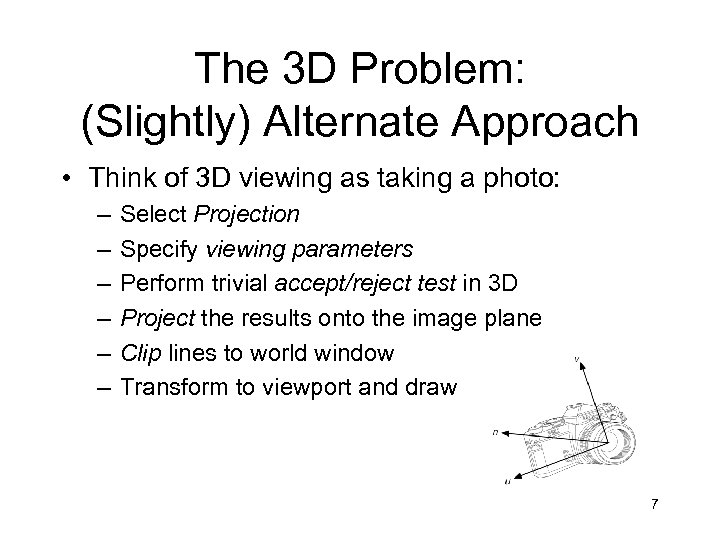 The 3 D Problem: (Slightly) Alternate Approach • Think of 3 D viewing as taking a photo: – – – Select Projection Specify viewing parameters Perform trivial accept/reject test in 3 D Project the results onto the image plane Clip lines to world window Transform to viewport and draw 7
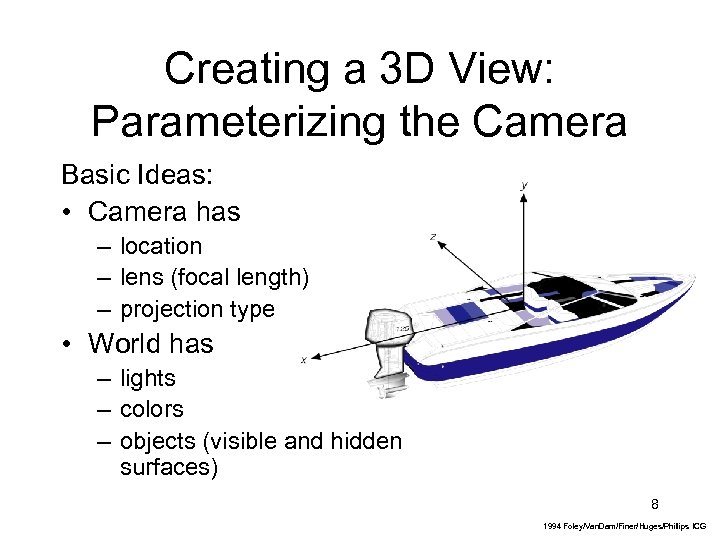 Creating a 3 D View: Parameterizing the Camera Basic Ideas: • Camera has – location – lens (focal length) – projection type • World has – lights – colors – objects (visible and hidden surfaces) 8 1994 Foley/Van. Dam/Finer/Huges/Phillips ICG
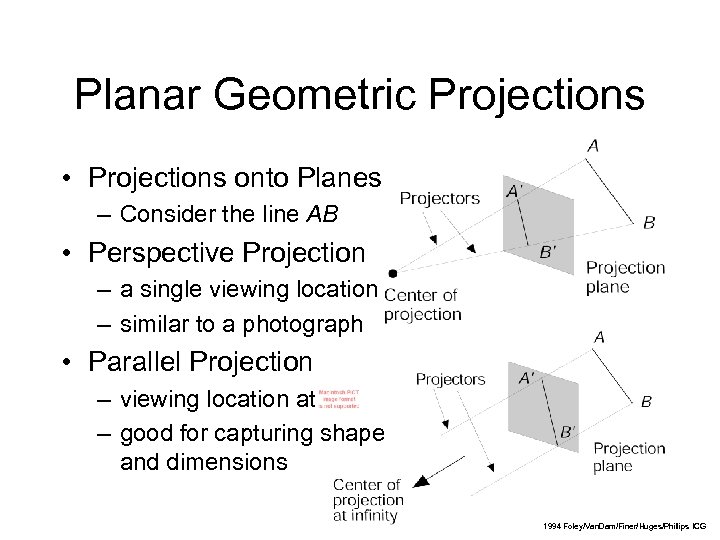 Planar Geometric Projections • Projections onto Planes – Consider the line AB • Perspective Projection – a single viewing location – similar to a photograph • Parallel Projection – viewing location at – good for capturing shape and dimensions 9 1994 Foley/Van. Dam/Finer/Huges/Phillips ICG
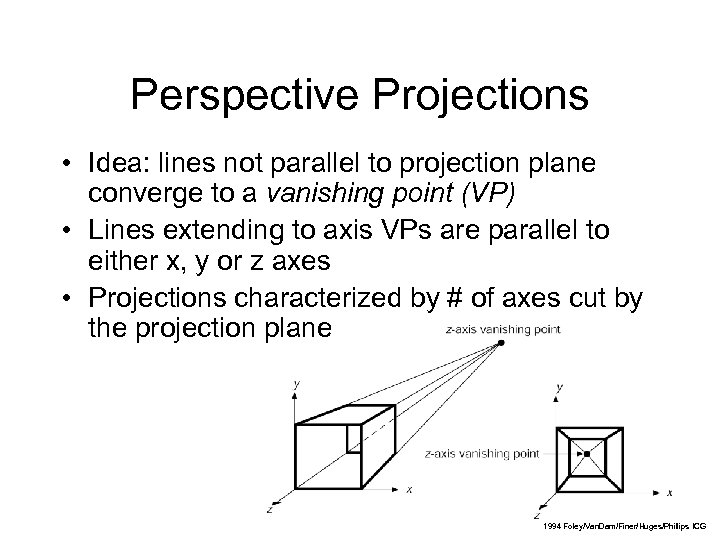 Perspective Projections • Idea: lines not parallel to projection plane converge to a vanishing point (VP) • Lines extending to axis VPs are parallel to either x, y or z axes • Projections characterized by # of axes cut by the projection plane 10 1994 Foley/Van. Dam/Finer/Huges/Phillips ICG
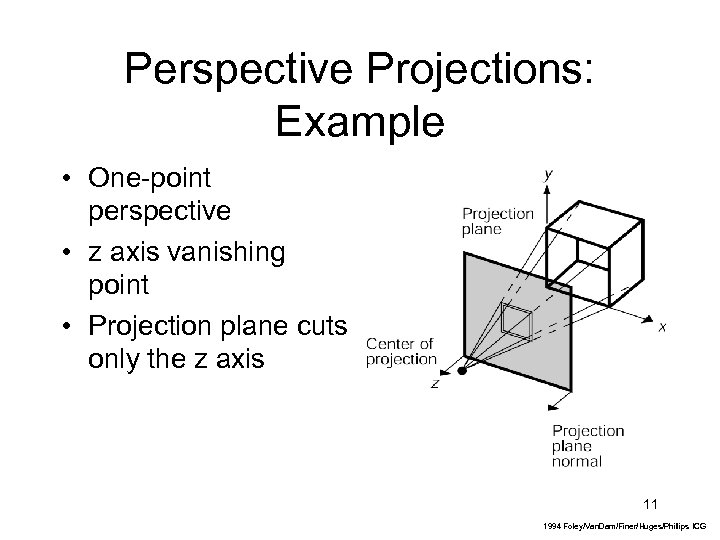 Perspective Projections: Example • One-point perspective • z axis vanishing point • Projection plane cuts only the z axis 11 1994 Foley/Van. Dam/Finer/Huges/Phillips ICG
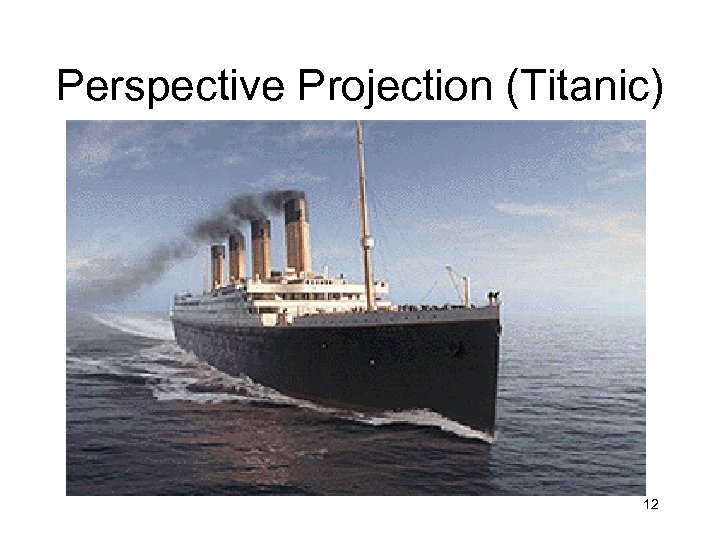 Perspective Projection (Titanic) 12
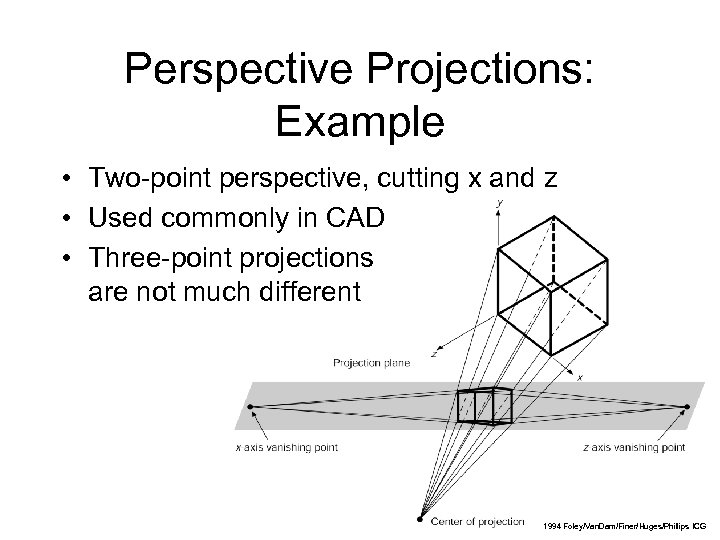 Perspective Projections: Example • Two-point perspective, cutting x and z • Used commonly in CAD • Three-point projections are not much different 13 1994 Foley/Van. Dam/Finer/Huges/Phillips ICG
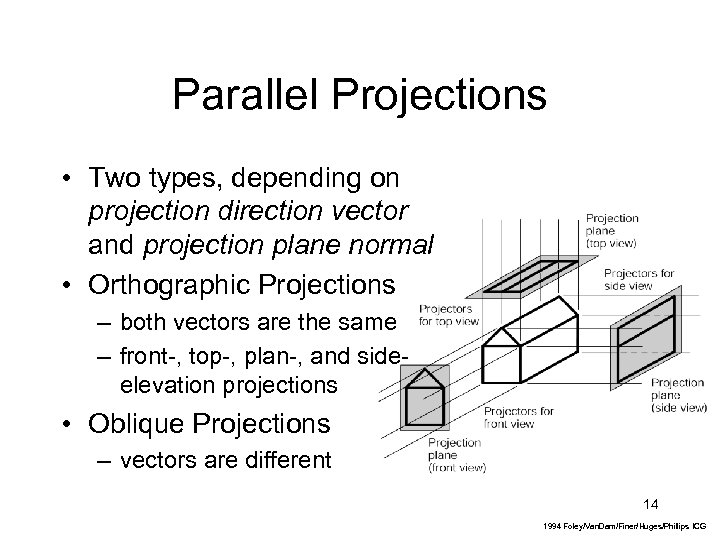 Parallel Projections • Two types, depending on projection direction vector and projection plane normal • Orthographic Projections – both vectors are the same – front-, top-, plan-, and side- elevation projections • Oblique Projections – vectors are different 14 1994 Foley/Van. Dam/Finer/Huges/Phillips ICG
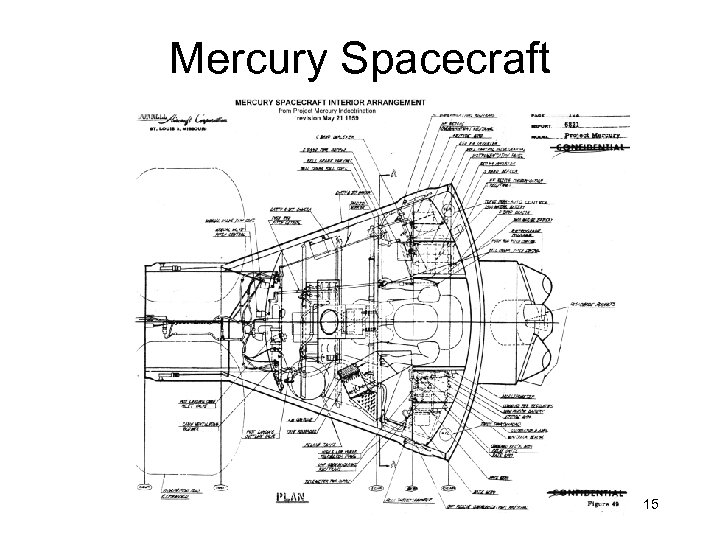 Mercury Spacecraft 15
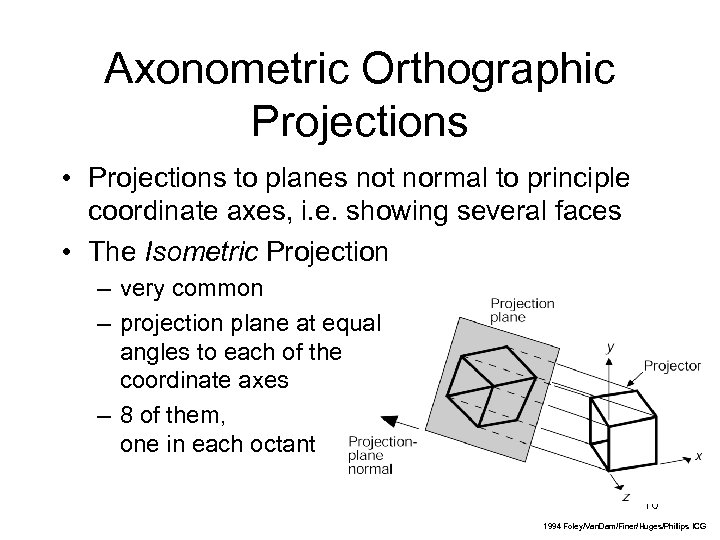 Axonometric Orthographic Projections • Projections to planes not normal to principle coordinate axes, i. e. showing several faces • The Isometric Projection – very common – projection plane at equal angles to each of the coordinate axes – 8 of them, one in each octant 16 1994 Foley/Van. Dam/Finer/Huges/Phillips ICG
 Mercury Spacecraft 17
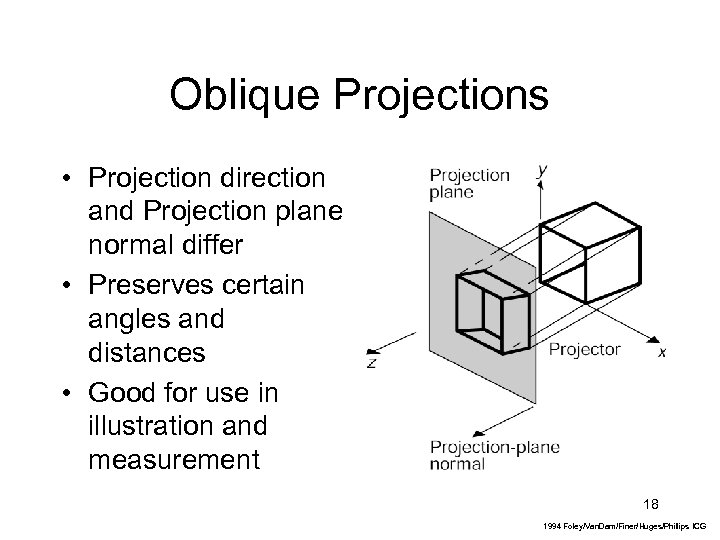 Oblique Projections • Projection direction and Projection plane normal differ • Preserves certain angles and distances • Good for use in illustration and measurement 18 1994 Foley/Van. Dam/Finer/Huges/Phillips ICG
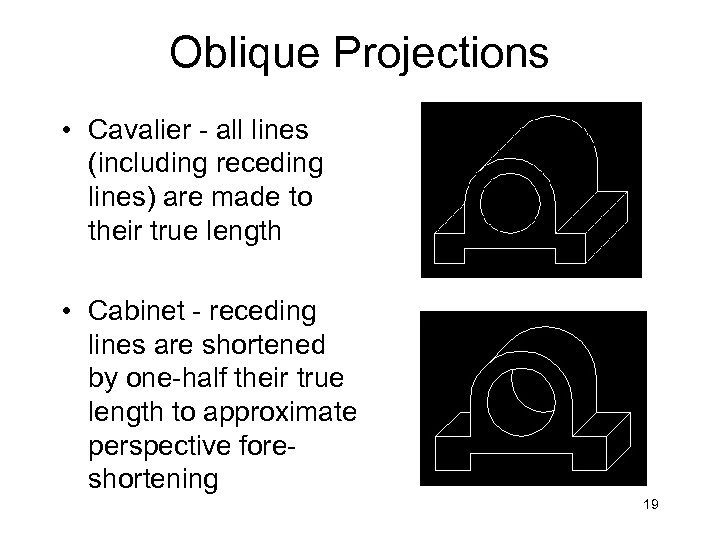 Oblique Projections • Cavalier - all lines (including receding lines) are made to their true length • Cabinet - receding lines are shortened by one-half their true length to approximate perspective foreshortening 19
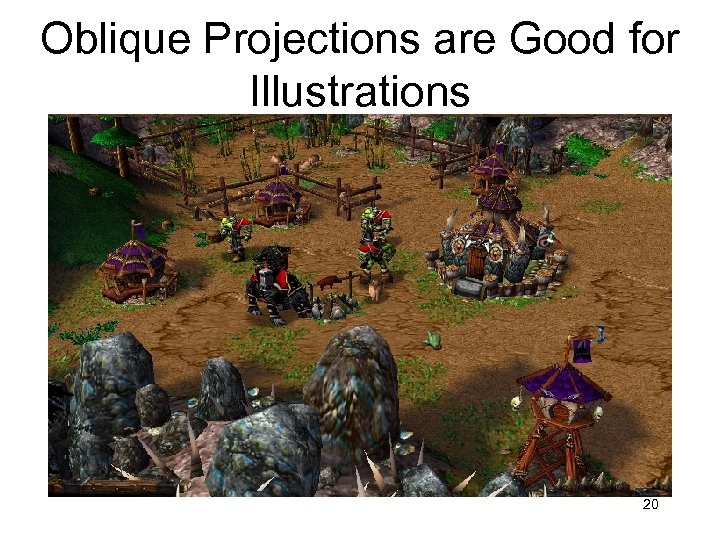 Oblique Projections are Good for Illustrations 20
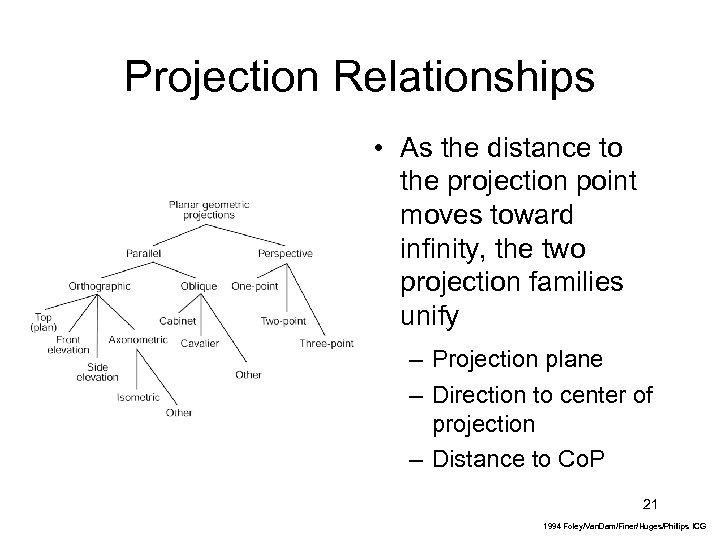 Projection Relationships • As the distance to the projection point moves toward infinity, the two projection families unify – Projection plane – Direction to center of projection – Distance to Co. P 21 1994 Foley/Van. Dam/Finer/Huges/Phillips ICG
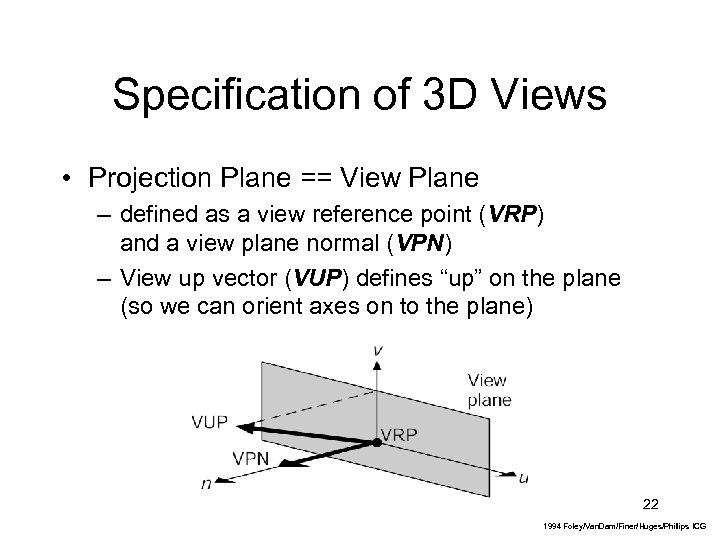 Specification of 3 D Views • Projection Plane == View Plane – defined as a view reference point (VRP) and a view plane normal (VPN) – View up vector (VUP) defines “up” on the plane (so we can orient axes on to the plane) 22 1994 Foley/Van. Dam/Finer/Huges/Phillips ICG
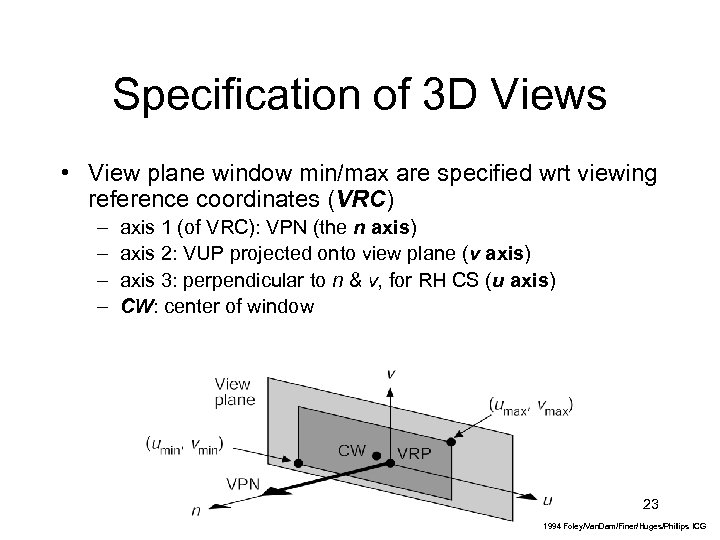 Specification of 3 D Views • View plane window min/max are specified wrt viewing reference coordinates (VRC) – – axis 1 (of VRC): VPN (the n axis) axis 2: VUP projected onto view plane (v axis) axis 3: perpendicular to n & v, for RH CS (u axis) CW: center of window 23 1994 Foley/Van. Dam/Finer/Huges/Phillips ICG
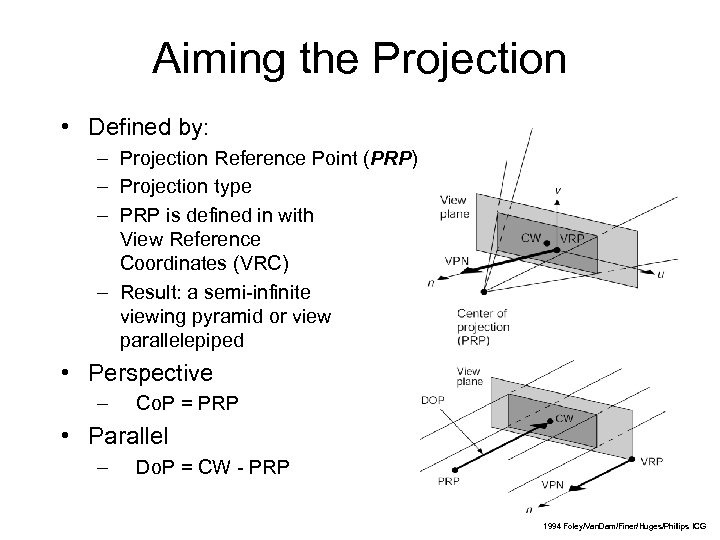 Aiming the Projection • Defined by: – Projection Reference Point (PRP) – Projection type – PRP is defined in with View Reference Coordinates (VRC) – Result: a semi-infinite viewing pyramid or view parallelepiped • Perspective – Co. P = PRP • Parallel – Do. P = CW - PRP 24 1994 Foley/Van. Dam/Finer/Huges/Phillips ICG
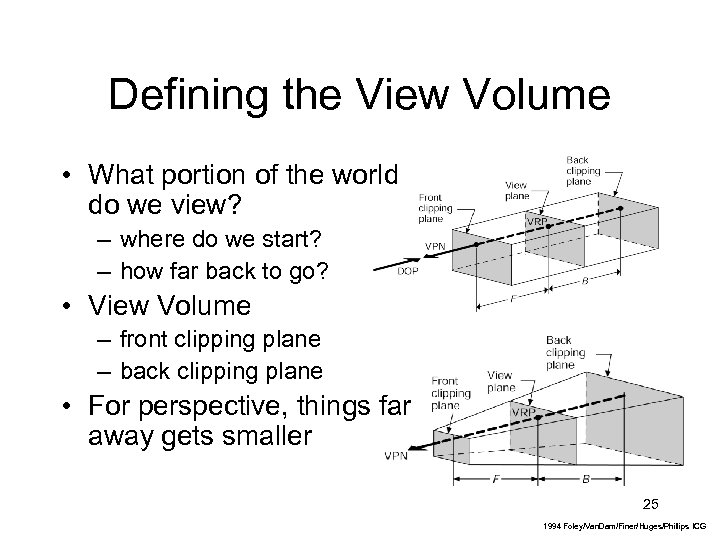 Defining the View Volume • What portion of the world do we view? – where do we start? – how far back to go? • View Volume – front clipping plane – back clipping plane • For perspective, things far away gets smaller 25 1994 Foley/Van. Dam/Finer/Huges/Phillips ICG
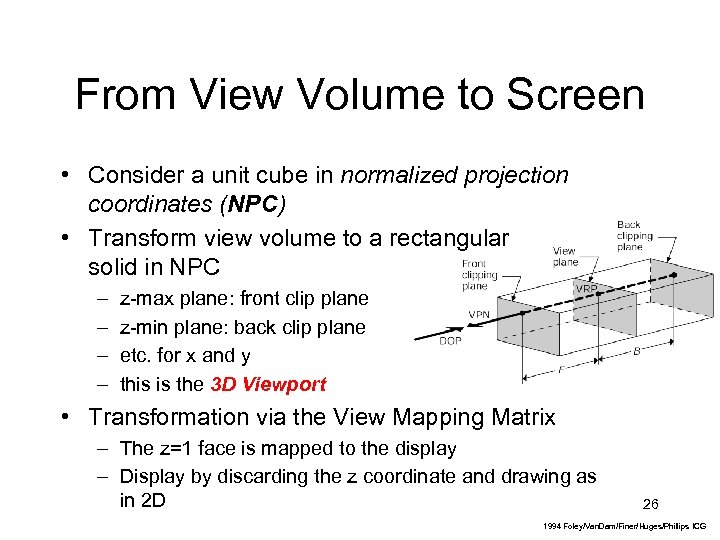 From View Volume to Screen • Consider a unit cube in normalized projection coordinates (NPC) • Transform view volume to a rectangular solid in NPC – – z-max plane: front clip plane z-min plane: back clip plane etc. for x and y this is the 3 D Viewport • Transformation via the View Mapping Matrix – The z=1 face is mapped to the display – Display by discarding the z coordinate and drawing as in 2 D 26 1994 Foley/Van. Dam/Finer/Huges/Phillips ICG
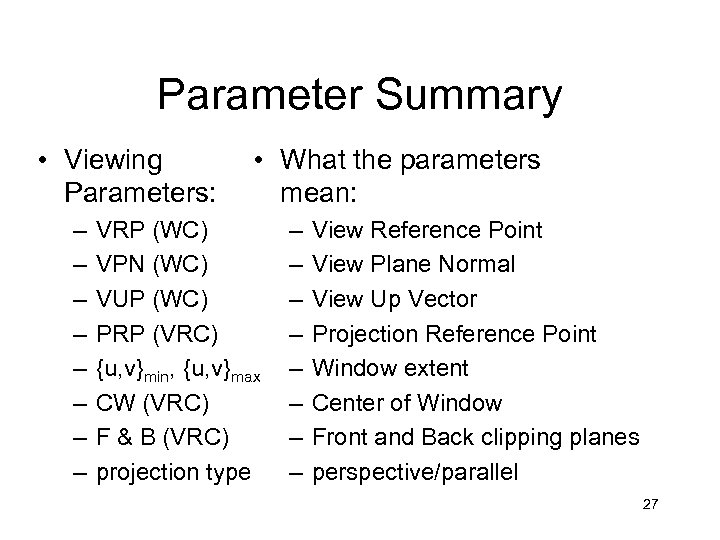 Parameter Summary • Viewing Parameters: – – – – • What the parameters mean: VRP (WC) VPN (WC) VUP (WC) PRP (VRC) {u, v}min, {u, v}max CW (VRC) F & B (VRC) projection type – – – – View Reference Point View Plane Normal View Up Vector Projection Reference Point Window extent Center of Window Front and Back clipping planes perspective/parallel 27
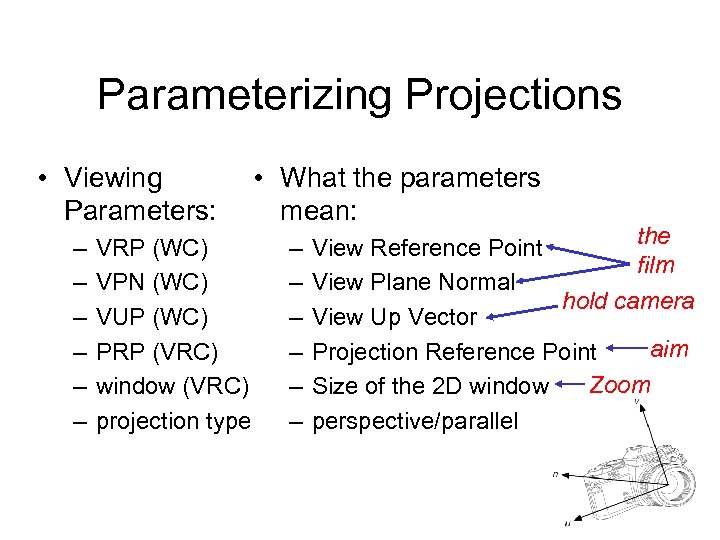 Parameterizing Projections • Viewing Parameters: – – – VRP (WC) VPN (WC) VUP (WC) PRP (VRC) window (VRC) projection type • What the parameters mean: – – – the View Reference Point film View Plane Normal hold camera View Up Vector aim Projection Reference Point Zoom Size of the 2 D window perspective/parallel 28
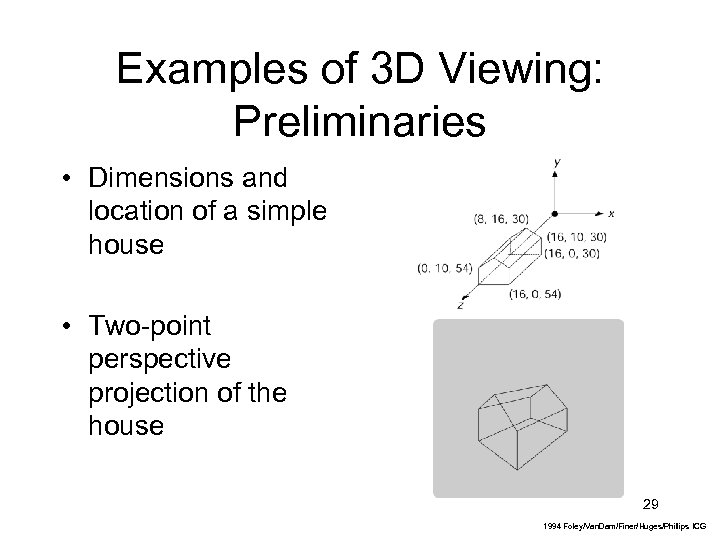 Examples of 3 D Viewing: Preliminaries • Dimensions and location of a simple house • Two-point perspective projection of the house 29 1994 Foley/Van. Dam/Finer/Huges/Phillips ICG
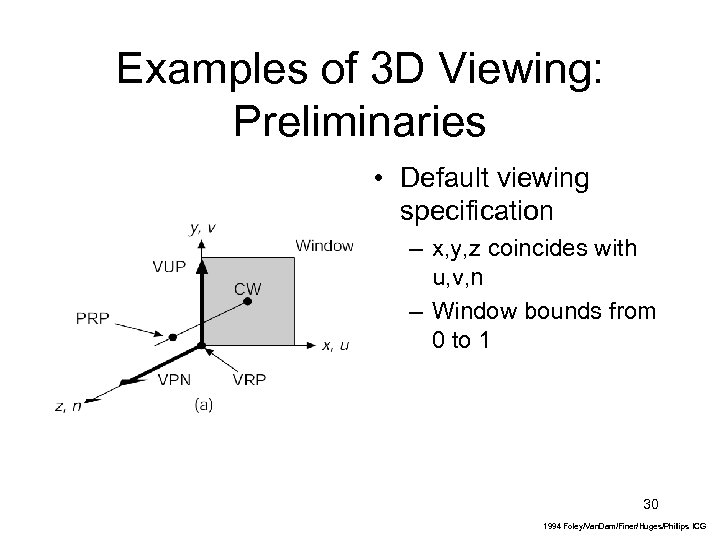 Examples of 3 D Viewing: Preliminaries • Default viewing specification – x, y, z coincides with u, v, n – Window bounds from 0 to 1 30 1994 Foley/Van. Dam/Finer/Huges/Phillips ICG
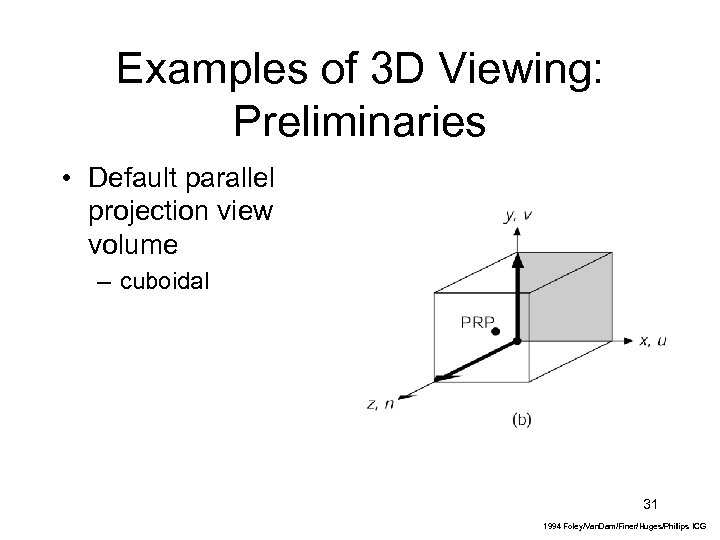 Examples of 3 D Viewing: Preliminaries • Default parallel projection view volume – cuboidal 31 1994 Foley/Van. Dam/Finer/Huges/Phillips ICG
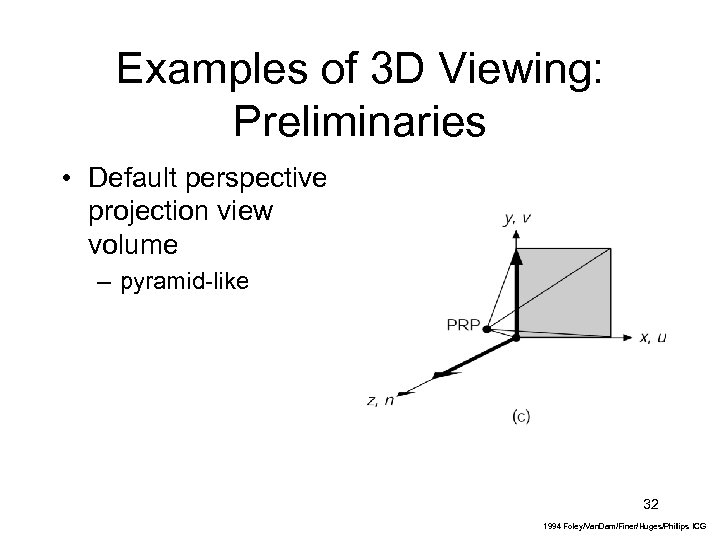 Examples of 3 D Viewing: Preliminaries • Default perspective projection view volume – pyramid-like 32 1994 Foley/Van. Dam/Finer/Huges/Phillips ICG
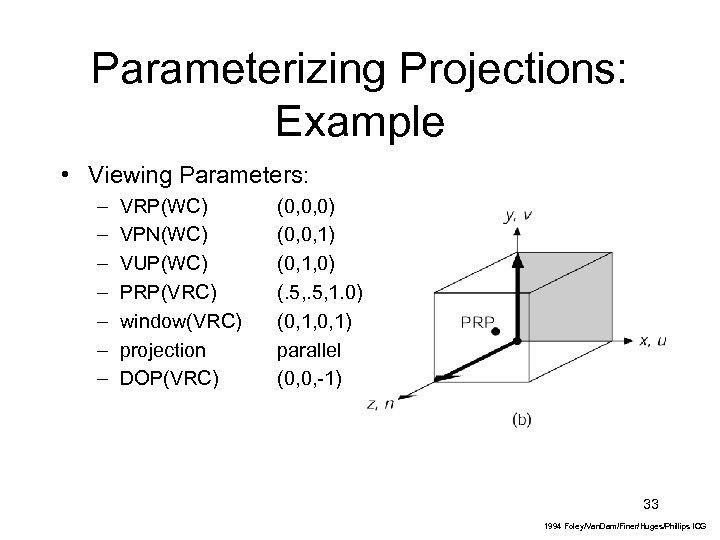 Parameterizing Projections: Example • Viewing Parameters: – – – – VRP(WC) VPN(WC) VUP(WC) PRP(VRC) window(VRC) projection DOP(VRC) (0, 0, 0) (0, 0, 1) (0, 1, 0) (. 5, 1. 0) (0, 1, 0, 1) parallel (0, 0, -1) 33 1994 Foley/Van. Dam/Finer/Huges/Phillips ICG
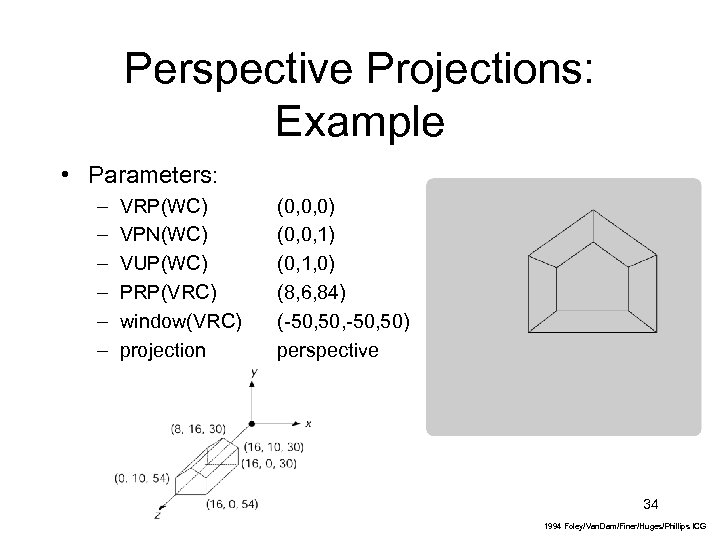 Perspective Projections: Example • Parameters: – – – VRP(WC) VPN(WC) VUP(WC) PRP(VRC) window(VRC) projection (0, 0, 0) (0, 0, 1) (0, 1, 0) (8, 6, 84) (-50, 50) perspective 34 1994 Foley/Van. Dam/Finer/Huges/Phillips ICG
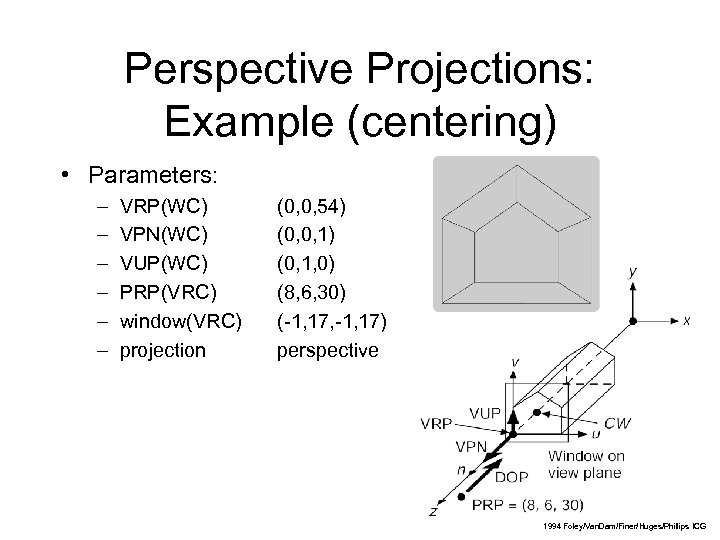 Perspective Projections: Example (centering) • Parameters: – – – VRP(WC) VPN(WC) VUP(WC) PRP(VRC) window(VRC) projection (0, 0, 54) (0, 0, 1) (0, 1, 0) (8, 6, 30) (-1, 17, -1, 17) perspective 35 1994 Foley/Van. Dam/Finer/Huges/Phillips ICG
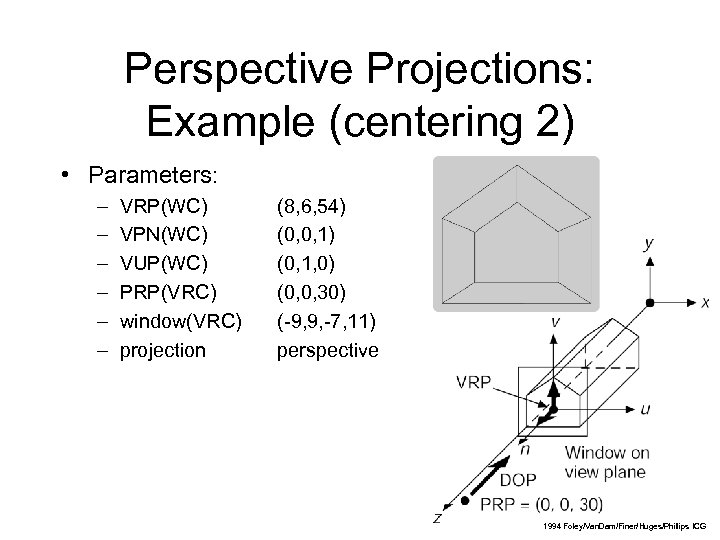 Perspective Projections: Example (centering 2) • Parameters: – – – VRP(WC) VPN(WC) VUP(WC) PRP(VRC) window(VRC) projection (8, 6, 54) (0, 0, 1) (0, 1, 0) (0, 0, 30) (-9, 9, -7, 11) perspective 36 1994 Foley/Van. Dam/Finer/Huges/Phillips ICG
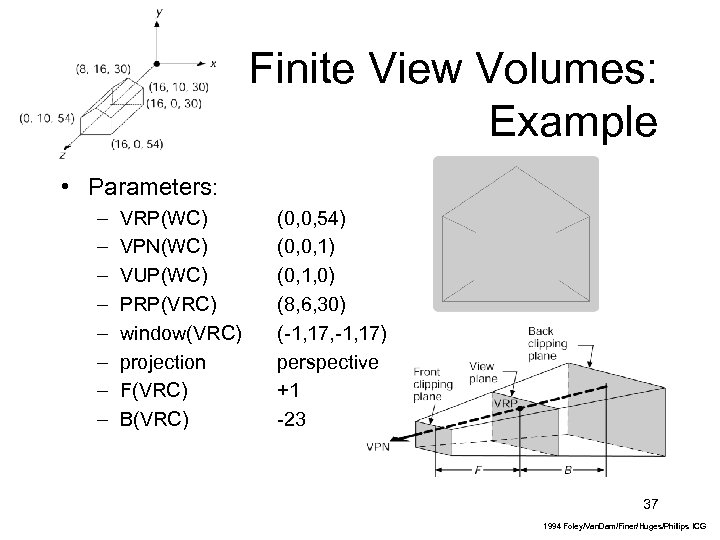 Finite View Volumes: Example • Parameters: – – – – VRP(WC) VPN(WC) VUP(WC) PRP(VRC) window(VRC) projection F(VRC) B(VRC) (0, 0, 54) (0, 0, 1) (0, 1, 0) (8, 6, 30) (-1, 17, -1, 17) perspective +1 -23 37 1994 Foley/Van. Dam/Finer/Huges/Phillips ICG
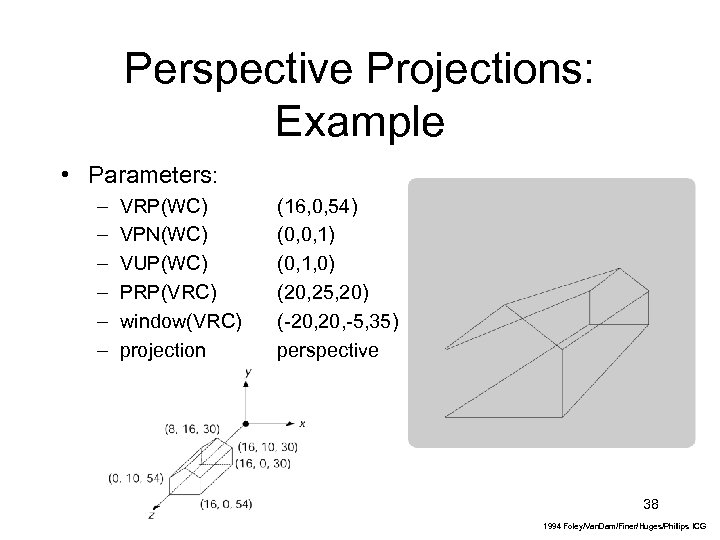 Perspective Projections: Example • Parameters: – – – VRP(WC) VPN(WC) VUP(WC) PRP(VRC) window(VRC) projection (16, 0, 54) (0, 0, 1) (0, 1, 0) (20, 25, 20) (-20, -5, 35) perspective 38 1994 Foley/Van. Dam/Finer/Huges/Phillips ICG
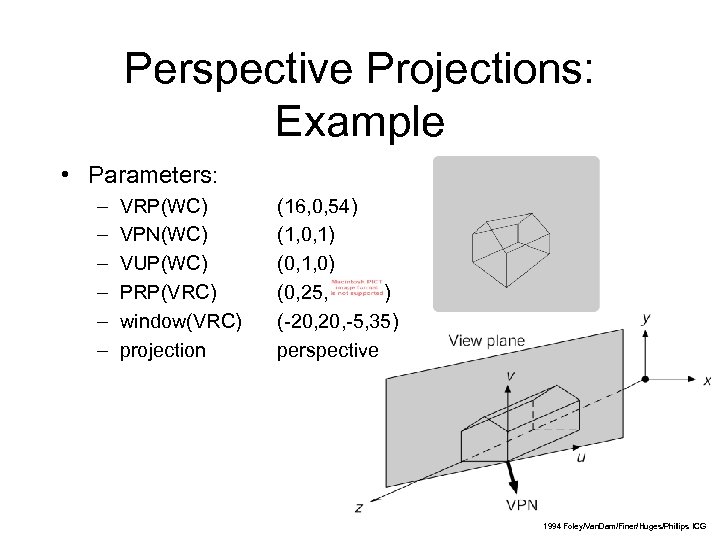 Perspective Projections: Example • Parameters: – – – VRP(WC) VPN(WC) VUP(WC) PRP(VRC) window(VRC) projection (16, 0, 54) (1, 0, 1) (0, 1, 0) (0, 25, ) (-20, -5, 35) perspective 39 1994 Foley/Van. Dam/Finer/Huges/Phillips ICG
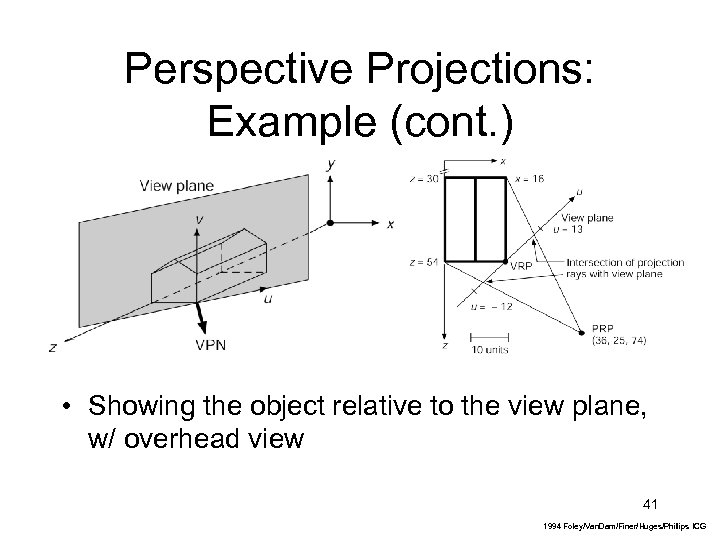 Perspective Projections: Example (cont. ) • Showing the object relative to the view plane, w/ overhead view 41 1994 Foley/Van. Dam/Finer/Huges/Phillips ICG
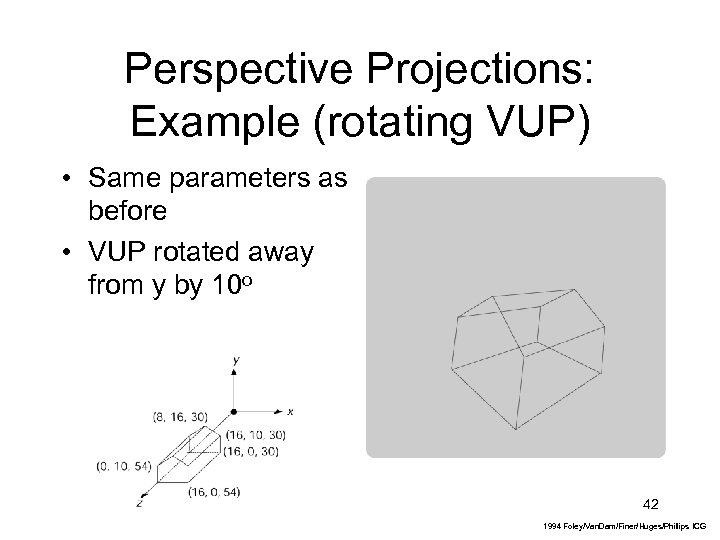 Perspective Projections: Example (rotating VUP) • Same parameters as before • VUP rotated away from y by 10 o 42 1994 Foley/Van. Dam/Finer/Huges/Phillips ICG
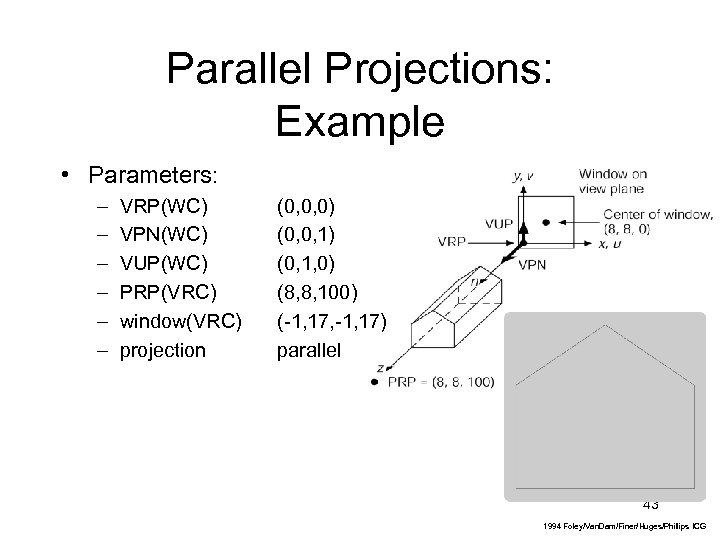 Parallel Projections: Example • Parameters: – – – VRP(WC) VPN(WC) VUP(WC) PRP(VRC) window(VRC) projection (0, 0, 0) (0, 0, 1) (0, 1, 0) (8, 8, 100) (-1, 17, -1, 17) parallel 43 1994 Foley/Van. Dam/Finer/Huges/Phillips ICG
 Programming assignment 4 • • Read SMF file Implement parallel projection Implement perspective projection Output projected and clipped polygon edges 44