


 Скачать презентацию CS 380 S Static Defenses against Memory Corruption
b8a5a19453e66162a30dcc3132b6a7a6.ppt
- Количество слайдов: 42
 CS 380 S Static Defenses against Memory Corruption Vitaly Shmatikov slide 1
 Reading Assignment u. Wagner et al. “A first step towards automated detection of buffer overrun vulnerabilities” (NDSS 2000). u. Ganapathy et al. “Buffer overrun detection using linear programming and static analysis” (CCS 2003). u. Dor, Rodeh, Sagiv. “CSSV: Towards a realistic tool for statically detecting all buffer overflows in C” (PLDI 2003). slide 2
 Static Analysis u. Goal: catch buffer overflow bugs by analyzing the source code of the program • Typically at compile-time, but also binary analysis u. Static analysis is necessarily imprecise • Soundness: finds all instances of buffer overflow – Problem: false positives (good code erroneously flagged) • Completeness: every reported problem is indeed an instance of buffer overflow – Problem: false negatives (misses some buffer overflows) • No technique is both sound and complete (why? ) • Maybe don’t need either… slide 3
 Static vs. Dynamic u. Both static and dynamic approaches have their advantages and disadvantages (what are they? ) u. Hybrid approaches (example: CCured) • Try to verify absence of memory errors statically, then insert runtime checks where static verification failed u. Performance and usability are always important • Does source code need to be modified? • Does source code need to be recompiled? • How is backward compatibility (if any) achieved? – Rewriting binaries vs. special runtime environment slide 4
![BOON [Wagner et al. ] u. Treat C strings as abstract data types •](https://present5.com/presentation/b8a5a19453e66162a30dcc3132b6a7a6/image-5.jpg "BOON [Wagner et al. ] u. Treat C strings as abstract data types •") BOON [Wagner et al. ] u. Treat C strings as abstract data types • Assume that C strings are accessed only through library functions: strcpy, strcat, etc. • Pointer arithmetic is greatly simplified (what does this imply for soundness? ) u. Characterize each buffer by its allocated size and current length (number of bytes in use) u. For each of these values, statically determine acceptable range at each point of the program • Done at compile-time, thus necessarily conservative (what does this imply for completeness? ) slide 5
BOON [Wagner et al. ] u. Treat C strings as abstract data types • Assume that C strings are accessed only through library functions: strcpy, strcat, etc. • Pointer arithmetic is greatly simplified (what does this imply for soundness? ) u. Characterize each buffer by its allocated size and current length (number of bytes in use) u. For each of these values, statically determine acceptable range at each point of the program • Done at compile-time, thus necessarily conservative (what does this imply for completeness? ) slide 5
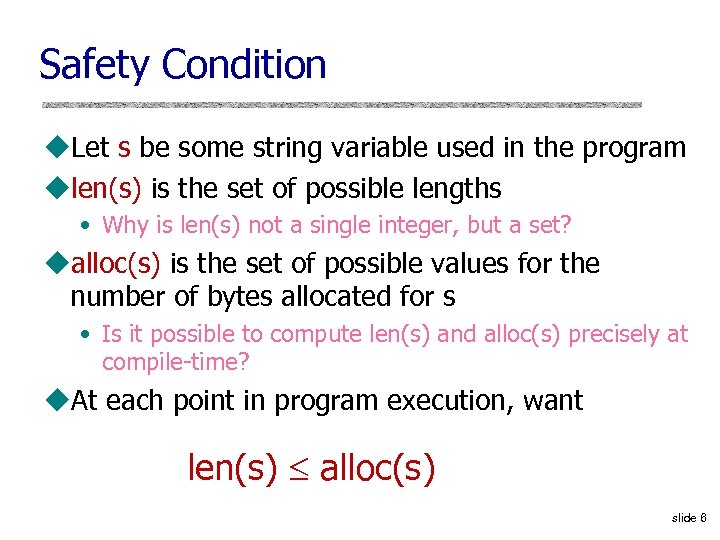 Safety Condition u. Let s be some string variable used in the program ulen(s) is the set of possible lengths • Why is len(s) not a single integer, but a set? ualloc(s) is the set of possible values for the number of bytes allocated for s • Is it possible to compute len(s) and alloc(s) precisely at compile-time? u. At each point in program execution, want len(s) alloc(s) slide 6
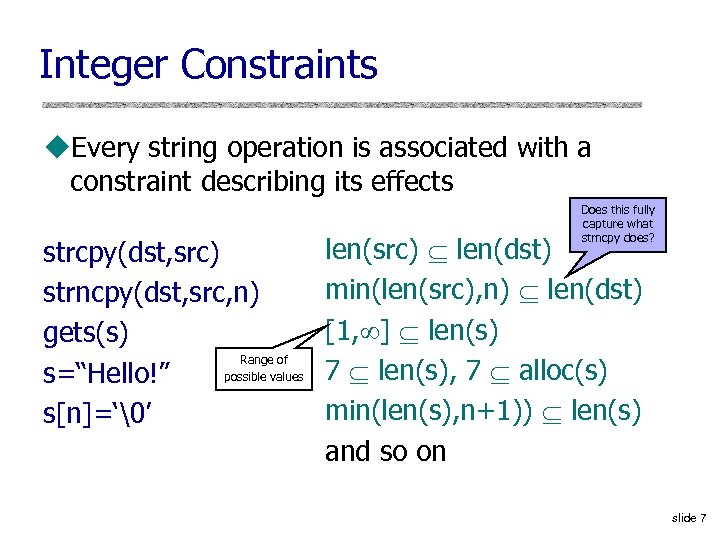 Integer Constraints u. Every string operation is associated with a constraint describing its effects strcpy(dst, src) strncpy(dst, src, n) gets(s) Range of possible values s=“Hello!” s[n]=‘’ Does this fully capture what strncpy does? len(src) len(dst) min(len(src), n) len(dst) [1, ] len(s) 7 len(s), 7 alloc(s) min(len(s), n+1)) len(s) and so on slide 7
![Constraint Generation Example [Wagner] char buf[128]; 128 alloc(buf) while (fgets(buf, 128, stdin)) { [1,](https://present5.com/presentation/b8a5a19453e66162a30dcc3132b6a7a6/image-8.jpg "Constraint Generation Example [Wagner] char buf[128]; 128 alloc(buf) while (fgets(buf, 128, stdin)) { [1,") Constraint Generation Example [Wagner] char buf[128]; 128 alloc(buf) while (fgets(buf, 128, stdin)) { [1, 128] len(buf) if (!strchr(buf, ‘n’)) { char error[128]; 128 alloc(error) sprintf(error, “Line too long: %sn, buf); len(buf)+16 len(error) die(error); } … } slide 8
Constraint Generation Example [Wagner] char buf[128]; 128 alloc(buf) while (fgets(buf, 128, stdin)) { [1, 128] len(buf) if (!strchr(buf, ‘n’)) { char error[128]; 128 alloc(error) sprintf(error, “Line too long: %sn, buf); len(buf)+16 len(error) die(error); } … } slide 8
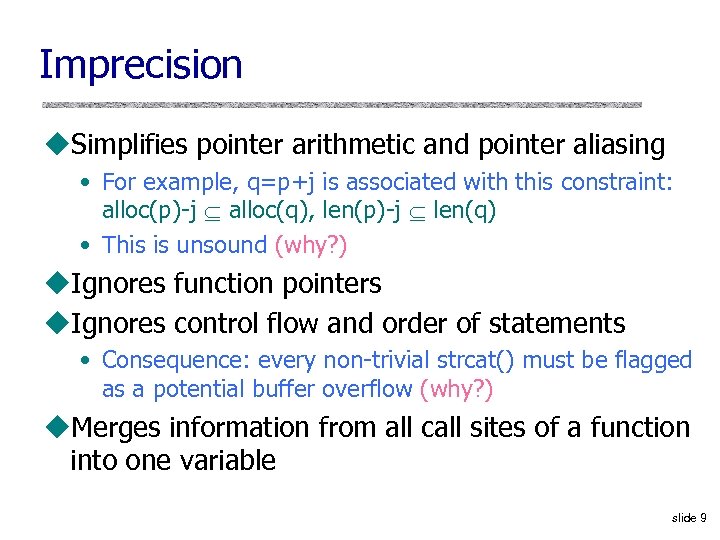 Imprecision u. Simplifies pointer arithmetic and pointer aliasing • For example, q=p+j is associated with this constraint: alloc(p)-j alloc(q), len(p)-j len(q) • This is unsound (why? ) u. Ignores function pointers u. Ignores control flow and order of statements • Consequence: every non-trivial strcat() must be flagged as a potential buffer overflow (why? ) u. Merges information from all call sites of a function into one variable slide 9
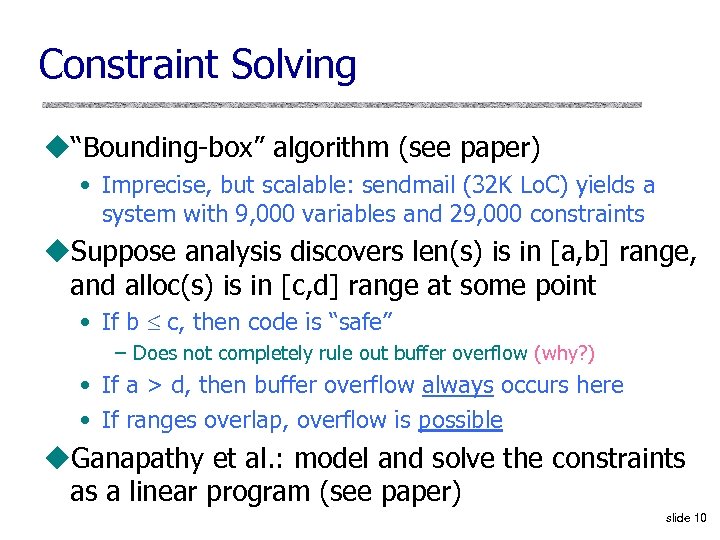 Constraint Solving u“Bounding-box” algorithm (see paper) • Imprecise, but scalable: sendmail (32 K Lo. C) yields a system with 9, 000 variables and 29, 000 constraints u. Suppose analysis discovers len(s) is in [a, b] range, and alloc(s) is in [c, d] range at some point • If b c, then code is “safe” – Does not completely rule out buffer overflow (why? ) • If a > d, then buffer overflow always occurs here • If ranges overlap, overflow is possible u. Ganapathy et al. : model and solve the constraints as a linear program (see paper) slide 10
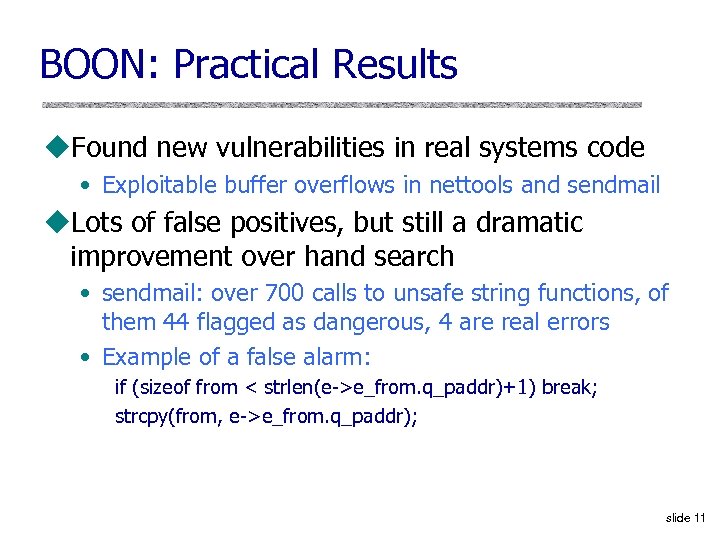 BOON: Practical Results u. Found new vulnerabilities in real systems code • Exploitable buffer overflows in nettools and sendmail u. Lots of false positives, but still a dramatic improvement over hand search • sendmail: over 700 calls to unsafe string functions, of them 44 flagged as dangerous, 4 are real errors • Example of a false alarm: if (sizeof from < strlen(e->e_from. q_paddr)+1) break; strcpy(from, e->e_from. q_paddr); slide 11
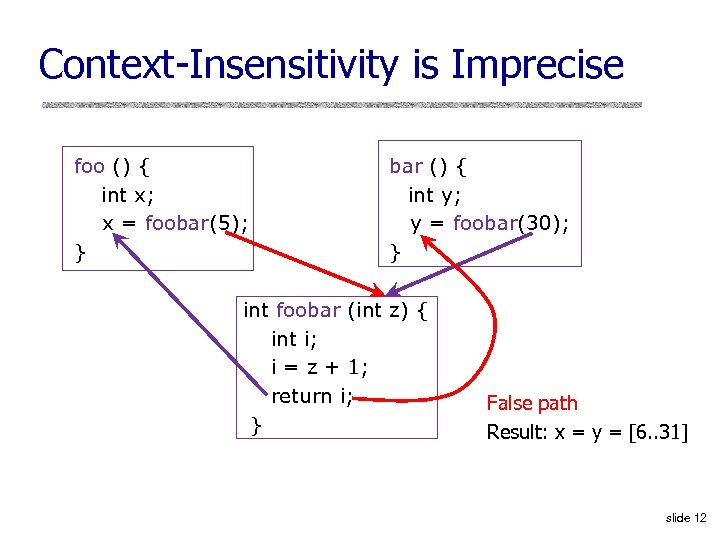 Context-Insensitivity is Imprecise foo () { int x; x = foobar(5); } bar () { int y; y = foobar(30); } int foobar (int z) { int i; i = z + 1; return i; } False path Result: x = y = [6. . 31] slide 12
![Adding Context Sensitivity [Ganapathy et al. ] u. Make user functions context-sensitive • For](https://present5.com/presentation/b8a5a19453e66162a30dcc3132b6a7a6/image-13.jpg "Adding Context Sensitivity [Ganapathy et al. ] u. Make user functions context-sensitive • For") Adding Context Sensitivity [Ganapathy et al. ] u. Make user functions context-sensitive • For example, wrappers around library calls u. Inefficient method: constraint inlining • Can separate calling contexts • Large number of constraint variables • Cannot support recursion u. Efficient method: procedure summaries • Summarize the called procedure • Insert the summary at the callsite in the caller • Remove false paths slide 13
Adding Context Sensitivity [Ganapathy et al. ] u. Make user functions context-sensitive • For example, wrappers around library calls u. Inefficient method: constraint inlining • Can separate calling contexts • Large number of constraint variables • Cannot support recursion u. Efficient method: procedure summaries • Summarize the called procedure • Insert the summary at the callsite in the caller • Remove false paths slide 13
![Context-Sensitive Analysis [Ganapathy et al. ] foo () { int x; x = foobar(5);](https://present5.com/presentation/b8a5a19453e66162a30dcc3132b6a7a6/image-14.jpg "Context-Sensitive Analysis [Ganapathy et al. ] foo () { int x; x = foobar(5);") Context-Sensitive Analysis [Ganapathy et al. ] foo () { int x; x = foobar(5); } x=5+1 bar () { int y; y = foobar(30); } int foobar (int z) { int i; i = z + 1; return i; } y = 30 + 1 Summary: i = z + 1 slide 14
Context-Sensitive Analysis [Ganapathy et al. ] foo () { int x; x = foobar(5); } x=5+1 bar () { int y; y = foobar(30); } int foobar (int z) { int i; i = z + 1; return i; } y = 30 + 1 Summary: i = z + 1 slide 14
![No False Paths [Ganapathy et al. ] foo () { int x; x =](https://present5.com/presentation/b8a5a19453e66162a30dcc3132b6a7a6/image-15.jpg "No False Paths [Ganapathy et al. ] foo () { int x; x =") No False Paths [Ganapathy et al. ] foo () { int x; x = foobar(5); } bar () { int y; y = foobar(30); } int foobar (int z) { int i; i = z + 1; return i; } Jump functions Constraints x = [6. . 6] y = [31. . 31] i = [6. . 31] slide 15
No False Paths [Ganapathy et al. ] foo () { int x; x = foobar(5); } bar () { int y; y = foobar(30); } int foobar (int z) { int i; i = z + 1; return i; } Jump functions Constraints x = [6. . 6] y = [31. . 31] i = [6. . 31] slide 15
![Computing Procedure Summaries [Ganapathy et al. ] u. If function produces only difference constraints,](https://present5.com/presentation/b8a5a19453e66162a30dcc3132b6a7a6/image-16.jpg "Computing Procedure Summaries [Ganapathy et al. ] u. If function produces only difference constraints,") Computing Procedure Summaries [Ganapathy et al. ] u. If function produces only difference constraints, reduces to an all-pairs shortest-path problem u. Otherwise, Fourier-Motzkin variable elimination u. Tradeoff between precision and efficiency • Constraint inlining: rename local variables of the called function at each callsite – Precise, but a huge number of variables and constraints • Procedure summaries: merge variables across callsites – For example, constraint for i in the foobar example slide 16
Computing Procedure Summaries [Ganapathy et al. ] u. If function produces only difference constraints, reduces to an all-pairs shortest-path problem u. Otherwise, Fourier-Motzkin variable elimination u. Tradeoff between precision and efficiency • Constraint inlining: rename local variables of the called function at each callsite – Precise, but a huge number of variables and constraints • Procedure summaries: merge variables across callsites – For example, constraint for i in the foobar example slide 16
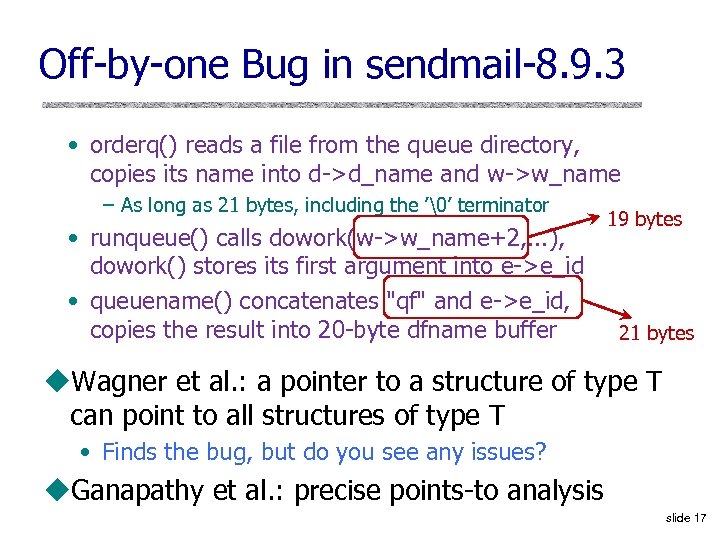 Off-by-one Bug in sendmail-8. 9. 3 • orderq() reads a file from the queue directory, copies its name into d->d_name and w->w_name – As long as 21 bytes, including the ’’ terminator • runqueue() calls dowork(w->w_name+2, . . . ), dowork() stores its first argument into e->e_id • queuename() concatenates "qf" and e->e_id, copies the result into 20 -byte dfname buffer 19 bytes 21 bytes u. Wagner et al. : a pointer to a structure of type T can point to all structures of type T • Finds the bug, but do you see any issues? u. Ganapathy et al. : precise points-to analysis slide 17
![CSSV [Dor, Rodeh, Sagiv] u. Goal: sound static detection of buffer overflows • What](https://present5.com/presentation/b8a5a19453e66162a30dcc3132b6a7a6/image-18.jpg "CSSV [Dor, Rodeh, Sagiv] u. Goal: sound static detection of buffer overflows • What") CSSV [Dor, Rodeh, Sagiv] u. Goal: sound static detection of buffer overflows • What does this mean? u. Separate analysis for each procedure u“Contracts” specify procedure’s pre- and postconditions, potential side effects • Analysis only meaningful if contracts are correct u. Flow-insensitive “points-to” pointer analysis u. Transform C into a procedure over integers, apply integer analysis to find variable constraints • Any potential buffer overflow in the original program violates an “assert” statement in this integer program slide 18
CSSV [Dor, Rodeh, Sagiv] u. Goal: sound static detection of buffer overflows • What does this mean? u. Separate analysis for each procedure u“Contracts” specify procedure’s pre- and postconditions, potential side effects • Analysis only meaningful if contracts are correct u. Flow-insensitive “points-to” pointer analysis u. Transform C into a procedure over integers, apply integer analysis to find variable constraints • Any potential buffer overflow in the original program violates an “assert” statement in this integer program slide 18
![Example: strcpy Contract [Dor, Rodeh, Sagiv] char* strcpy(char* dst, char *src) string(src) requires alloc(dst)](https://present5.com/presentation/b8a5a19453e66162a30dcc3132b6a7a6/image-19.jpg "Example: strcpy Contract [Dor, Rodeh, Sagiv] char* strcpy(char* dst, char *src) string(src) requires alloc(dst)") Example: strcpy Contract [Dor, Rodeh, Sagiv] char* strcpy(char* dst, char *src) string(src) requires alloc(dst) > len(src) modifies ensures dst. strlen, dst. is_nullt len(dst) = = pre@len(src) return = = pre@dst slide 19
Example: strcpy Contract [Dor, Rodeh, Sagiv] char* strcpy(char* dst, char *src) string(src) requires alloc(dst) > len(src) modifies ensures dst. strlen, dst. is_nullt len(dst) = = pre@len(src) return = = pre@dst slide 19
![Example: insert_long() [Dor, Rodeh, Sagiv] #define BUFSIZ 1024 #include](https://present5.com/presentation/b8a5a19453e66162a30dcc3132b6a7a6/image-20.jpg "Example: insert_long() [Dor, Rodeh, Sagiv] #define BUFSIZ 1024 #include") Example: insert_long() [Dor, Rodeh, Sagiv] #define BUFSIZ 1024 #include "insert_long. h" char buf[BUFSIZ]; char * insert_long (char *cp) { char temp[BUFSIZ]; int i; for (i=0; &buf[i] < cp; ++i){ temp[i] = buf[i]; } strcpy (&temp[i], "(long)"); strcpy (&temp[i + 6], cp); strcpy (buf, temp); return cp + 6; } buf cp temp (long) slide 20
Example: insert_long() [Dor, Rodeh, Sagiv] #define BUFSIZ 1024 #include "insert_long. h" char buf[BUFSIZ]; char * insert_long (char *cp) { char temp[BUFSIZ]; int i; for (i=0; &buf[i] < cp; ++i){ temp[i] = buf[i]; } strcpy (&temp[i], "(long)"); strcpy (&temp[i + 6], cp); strcpy (buf, temp); return cp + 6; } buf cp temp (long) slide 20
![insert_long() Contract [Dor, Rodeh, Sagiv] #define BUFSIZ 1024 #include](https://present5.com/presentation/b8a5a19453e66162a30dcc3132b6a7a6/image-21.jpg "insert_long() Contract [Dor, Rodeh, Sagiv] #define BUFSIZ 1024 #include") insert_long() Contract [Dor, Rodeh, Sagiv] #define BUFSIZ 1024 #include "insert_long. h" char buf[BUFSIZ]; char * insert_long (char *cp) { char temp[BUFSIZ]; int i; for (i=0; &buf[i] < cp; ++i){ temp[i] = buf[i]; } strcpy (&temp[i], "(long)"); strcpy (&temp[i + 6], cp); strcpy (buf, temp); return cp + 6; } char * insert_long(char *cp) requires string(cp) buf ≤ cp < buf + BUFSIZ modifies cp. strlen ensures cp. strlen = = pre[cp. strlen] + 6 return_value = = cp + 6 ; slide 21
insert_long() Contract [Dor, Rodeh, Sagiv] #define BUFSIZ 1024 #include "insert_long. h" char buf[BUFSIZ]; char * insert_long (char *cp) { char temp[BUFSIZ]; int i; for (i=0; &buf[i] < cp; ++i){ temp[i] = buf[i]; } strcpy (&temp[i], "(long)"); strcpy (&temp[i + 6], cp); strcpy (buf, temp); return cp + 6; } char * insert_long(char *cp) requires string(cp) buf ≤ cp < buf + BUFSIZ modifies cp. strlen ensures cp. strlen = = pre[cp. strlen] + 6 return_value = = cp + 6 ; slide 21
![Pointer Analysis [Dor, Rodeh, Sagiv] u. Goal: compute points-to relation • This is highly](https://present5.com/presentation/b8a5a19453e66162a30dcc3132b6a7a6/image-22.jpg "Pointer Analysis [Dor, Rodeh, Sagiv] u. Goal: compute points-to relation • This is highly") Pointer Analysis [Dor, Rodeh, Sagiv] u. Goal: compute points-to relation • This is highly nontrivial for C programs (see paper) • Pointer arithmetic, typeless memory locations, etc. u. Abstract interpretation of memory accesses • For each allocation, keep base and size in bytes • Map each variable to their abstract locations • We’ll see something similar in CCured u. Sound approximation of may-point-to • For each pointer, set of abstract locations it can point to • More conservative than actual points-to relation slide 22
Pointer Analysis [Dor, Rodeh, Sagiv] u. Goal: compute points-to relation • This is highly nontrivial for C programs (see paper) • Pointer arithmetic, typeless memory locations, etc. u. Abstract interpretation of memory accesses • For each allocation, keep base and size in bytes • Map each variable to their abstract locations • We’ll see something similar in CCured u. Sound approximation of may-point-to • For each pointer, set of abstract locations it can point to • More conservative than actual points-to relation slide 22
![C 2 IP: C to Integer Program [Dor, Rodeh, Sagiv] u. Integer variables only](https://present5.com/presentation/b8a5a19453e66162a30dcc3132b6a7a6/image-23.jpg "C 2 IP: C to Integer Program [Dor, Rodeh, Sagiv] u. Integer variables only") C 2 IP: C to Integer Program [Dor, Rodeh, Sagiv] u. Integer variables only u. No function calls u. Non-deterministic u. Constraint variables u. Update statements u. Assert statements Based on points-to information • Any string manipulation error in the original C program is guaranteed to violate an assertion in integer program slide 23
C 2 IP: C to Integer Program [Dor, Rodeh, Sagiv] u. Integer variables only u. No function calls u. Non-deterministic u. Constraint variables u. Update statements u. Assert statements Based on points-to information • Any string manipulation error in the original C program is guaranteed to violate an assertion in integer program slide 23
![Transformations for C Statements [Dor, Rodeh, Sagiv] For abstract location l, l. val -](https://present5.com/presentation/b8a5a19453e66162a30dcc3132b6a7a6/image-24.jpg "Transformations for C Statements [Dor, Rodeh, Sagiv] For abstract location l, l. val -") Transformations for C Statements [Dor, Rodeh, Sagiv] For abstract location l, l. val - potential values stored in the locations represented by l l. offset - potential values of the pointers represented by l l. a. Size - allocation size l. is_nullt - null-terminated? l. len - length of the string For pointer p, lp - its location rp - location it points to (if several possibilities, use nondeterministic assignment) slide 24
Transformations for C Statements [Dor, Rodeh, Sagiv] For abstract location l, l. val - potential values stored in the locations represented by l l. offset - potential values of the pointers represented by l l. a. Size - allocation size l. is_nullt - null-terminated? l. len - length of the string For pointer p, lp - its location rp - location it points to (if several possibilities, use nondeterministic assignment) slide 24
![Correctness Assertions [Dor, Rodeh, Sagiv] All dereferenced pointers point to valid locations Results of](https://present5.com/presentation/b8a5a19453e66162a30dcc3132b6a7a6/image-25.jpg "Correctness Assertions [Dor, Rodeh, Sagiv] All dereferenced pointers point to valid locations Results of") Correctness Assertions [Dor, Rodeh, Sagiv] All dereferenced pointers point to valid locations Results of pointer arithmetic are valid slide 25
Correctness Assertions [Dor, Rodeh, Sagiv] All dereferenced pointers point to valid locations Results of pointer arithmetic are valid slide 25
![Example [Dor, Rodeh, Sagiv] Assert statement: assert ( 5 <= q. alloc && (!q.](https://present5.com/presentation/b8a5a19453e66162a30dcc3132b6a7a6/image-26.jpg "Example [Dor, Rodeh, Sagiv] Assert statement: assert ( 5 <= q. alloc && (!q.") Example [Dor, Rodeh, Sagiv] Assert statement: assert ( 5 <= q. alloc && (!q. is_nullt || 5 <= q. len) ) p = q + 5; Update statement: p. offset = q. offset + 5; slide 26
Example [Dor, Rodeh, Sagiv] Assert statement: assert ( 5 <= q. alloc && (!q. is_nullt || 5 <= q. len) ) p = q + 5; Update statement: p. offset = q. offset + 5; slide 26
![Nondeterminism [Dor, Rodeh, Sagiv] p aloc 1 aloc 5 *p = 0; if (…)](https://present5.com/presentation/b8a5a19453e66162a30dcc3132b6a7a6/image-27.jpg "Nondeterminism [Dor, Rodeh, Sagiv] p aloc 1 aloc 5 *p = 0; if (…)") Nondeterminism [Dor, Rodeh, Sagiv] p aloc 1 aloc 5 *p = 0; if (…) { aloc 1. len = p. offset; aloc 1. is_nullt = true; } else { alloc 5. len = p. offset; alloc 5. is_nullt = true; } slide 27
Nondeterminism [Dor, Rodeh, Sagiv] p aloc 1 aloc 5 *p = 0; if (…) { aloc 1. len = p. offset; aloc 1. is_nullt = true; } else { alloc 5. len = p. offset; alloc 5. is_nullt = true; } slide 27
![Integer Analysis [Dor, Rodeh, Sagiv] u. Interval analysis not enough • Loses relationships between](https://present5.com/presentation/b8a5a19453e66162a30dcc3132b6a7a6/image-28.jpg "Integer Analysis [Dor, Rodeh, Sagiv] u. Interval analysis not enough • Loses relationships between") Integer Analysis [Dor, Rodeh, Sagiv] u. Interval analysis not enough • Loses relationships between variables u. Infer variable constraints using abstract domain of polyhedra [Cousot and Halbwachs, 1978] y • a 1* var 1 + a 2* var 2 + … + an* varn ≤ b 2 1 V = <(1, 2) (2, 1)> R = <(1, 0) (1, 1)> 0 y 1 x+y 3 -x + y ≤ 1 3 join 0 1 2 3 x slide 28
Integer Analysis [Dor, Rodeh, Sagiv] u. Interval analysis not enough • Loses relationships between variables u. Infer variable constraints using abstract domain of polyhedra [Cousot and Halbwachs, 1978] y • a 1* var 1 + a 2* var 2 + … + an* varn ≤ b 2 1 V = <(1, 2) (2, 1)> R = <(1, 0) (1, 1)> 0 y 1 x+y 3 -x + y ≤ 1 3 join 0 1 2 3 x slide 28
![insert_long() Redux [Dor, Rodeh, Sagiv] #define BUFSIZ 1024 #include](https://present5.com/presentation/b8a5a19453e66162a30dcc3132b6a7a6/image-29.jpg "insert_long() Redux [Dor, Rodeh, Sagiv] #define BUFSIZ 1024 #include") insert_long() Redux [Dor, Rodeh, Sagiv] #define BUFSIZ 1024 #include "insert_long. h" char buf[BUFSIZ]; char * insert_long (char *cp) { char temp[BUFSIZ]; int i; for (i=0; &buf[i] < cp; ++i){ temp[i] = buf[i]; } strcpy (&temp[i], "(long)"); strcpy (&temp[i + 6], cp); strcpy (buf, temp); return cp + 6; } buf cp temp (long) slide 29
insert_long() Redux [Dor, Rodeh, Sagiv] #define BUFSIZ 1024 #include "insert_long. h" char buf[BUFSIZ]; char * insert_long (char *cp) { char temp[BUFSIZ]; int i; for (i=0; &buf[i] < cp; ++i){ temp[i] = buf[i]; } strcpy (&temp[i], "(long)"); strcpy (&temp[i + 6], cp); strcpy (buf, temp); return cp + 6; } buf cp temp (long) slide 29
![Integer Analysis of insert_long() [Dor, Rodeh, Sagiv] buf. offset = 0 temp. offset =](https://present5.com/presentation/b8a5a19453e66162a30dcc3132b6a7a6/image-30.jpg "Integer Analysis of insert_long() [Dor, Rodeh, Sagiv] buf. offset = 0 temp. offset =") Integer Analysis of insert_long() [Dor, Rodeh, Sagiv] buf. offset = 0 temp. offset = 0 0 cp. offset = i i sbuf. len < s buf. msize sbuf. msize = 1024 stemp. msize= 1024 cp. offset 1018 buf cp temp (long) assert(0 i < stemp. msize - 6); // strcpy(&temp[i], "(long)"); Potential violation when cp. offset 1018 slide 30
Integer Analysis of insert_long() [Dor, Rodeh, Sagiv] buf. offset = 0 temp. offset = 0 0 cp. offset = i i sbuf. len < s buf. msize sbuf. msize = 1024 stemp. msize= 1024 cp. offset 1018 buf cp temp (long) assert(0 i < stemp. msize - 6); // strcpy(&temp[i], "(long)"); Potential violation when cp. offset 1018 slide 30
![CCured [Necula et al. ] u. Goal: make legacy C code type-safe u. Treat](https://present5.com/presentation/b8a5a19453e66162a30dcc3132b6a7a6/image-31.jpg "CCured [Necula et al. ] u. Goal: make legacy C code type-safe u. Treat") CCured [Necula et al. ] u. Goal: make legacy C code type-safe u. Treat C as a mixture of a strongly typed, statically checked language and an “unsafe” language checked at runtime • All values belong either to “safe, ” or “unsafe” world u. Combination of static and dynamic checking • Check type safety at compile-time whenever possible • When compile-time checking fails, compiler inserts run-time checks in the code • Fewer run-time checks better performance slide 31
CCured [Necula et al. ] u. Goal: make legacy C code type-safe u. Treat C as a mixture of a strongly typed, statically checked language and an “unsafe” language checked at runtime • All values belong either to “safe, ” or “unsafe” world u. Combination of static and dynamic checking • Check type safety at compile-time whenever possible • When compile-time checking fails, compiler inserts run-time checks in the code • Fewer run-time checks better performance slide 31
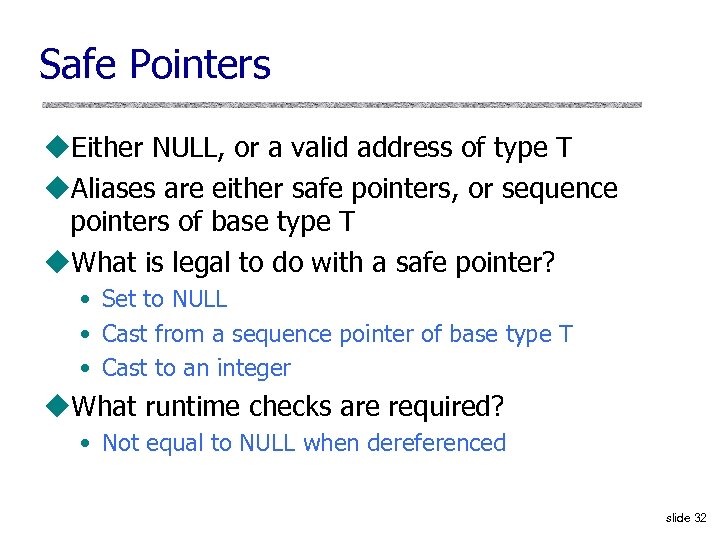 Safe Pointers u. Either NULL, or a valid address of type T u. Aliases are either safe pointers, or sequence pointers of base type T u. What is legal to do with a safe pointer? • Set to NULL • Cast from a sequence pointer of base type T • Cast to an integer u. What runtime checks are required? • Not equal to NULL when dereferenced slide 32
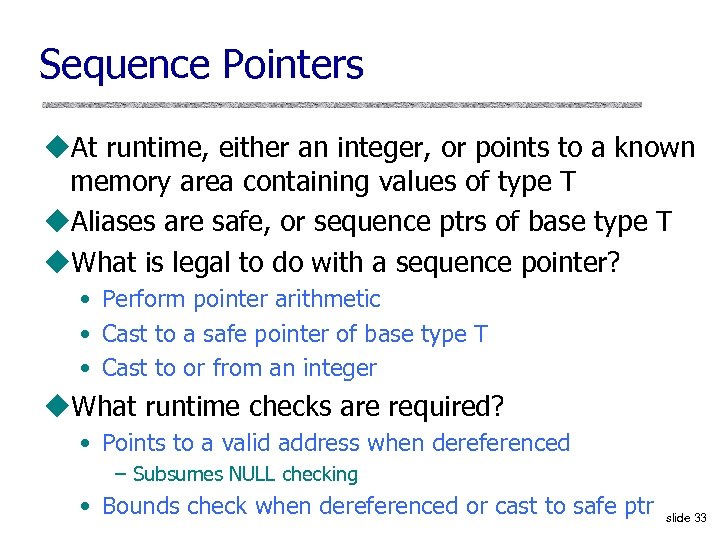 Sequence Pointers u. At runtime, either an integer, or points to a known memory area containing values of type T u. Aliases are safe, or sequence ptrs of base type T u. What is legal to do with a sequence pointer? • Perform pointer arithmetic • Cast to a safe pointer of base type T • Cast to or from an integer u. What runtime checks are required? • Points to a valid address when dereferenced – Subsumes NULL checking • Bounds check when dereferenced or cast to safe ptr slide 33
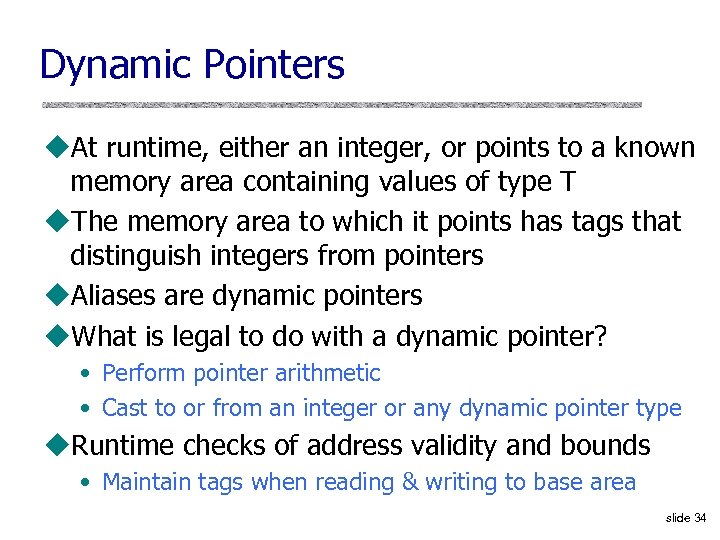 Dynamic Pointers u. At runtime, either an integer, or points to a known memory area containing values of type T u. The memory area to which it points has tags that distinguish integers from pointers u. Aliases are dynamic pointers u. What is legal to do with a dynamic pointer? • Perform pointer arithmetic • Cast to or from an integer or any dynamic pointer type u. Runtime checks of address validity and bounds • Maintain tags when reading & writing to base area slide 34
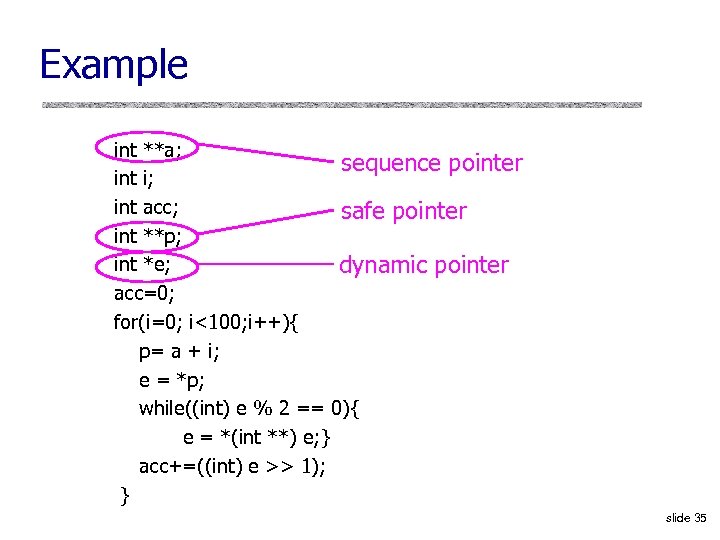 Example int **a; sequence pointer int i; int acc; safe pointer int **p; int *e; dynamic pointer acc=0; for(i=0; i<100; i++){ p= a + i; e = *p; while((int) e % 2 == 0){ e = *(int **) e; } acc+=((int) e >> 1); } slide 35
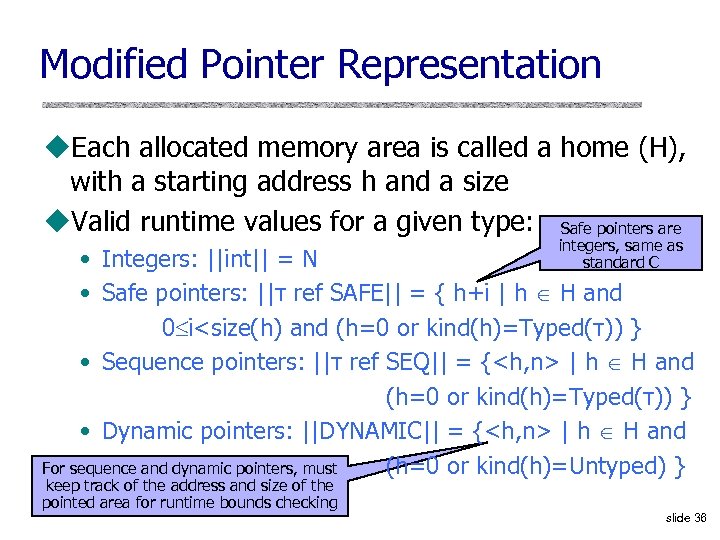 Modified Pointer Representation u. Each allocated memory area is called a home (H), with a starting address h and a size u. Valid runtime values for a given type: Safe pointers are integers, same as standard C • Integers: ||int|| = N • Safe pointers: ||τ ref SAFE|| = { h+i | h H and 0 i
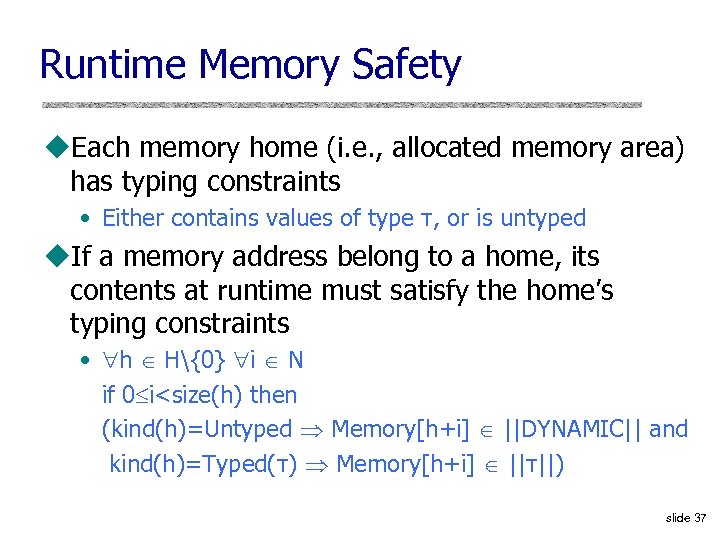 Runtime Memory Safety u. Each memory home (i. e. , allocated memory area) has typing constraints • Either contains values of type τ, or is untyped u. If a memory address belong to a home, its contents at runtime must satisfy the home’s typing constraints • h H{0} i N if 0 i
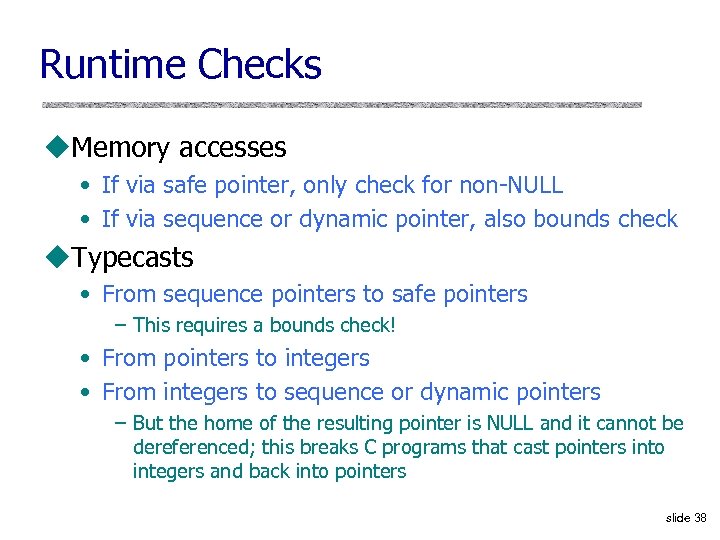 Runtime Checks u. Memory accesses • If via safe pointer, only check for non-NULL • If via sequence or dynamic pointer, also bounds check u. Typecasts • From sequence pointers to safe pointers – This requires a bounds check! • From pointers to integers • From integers to sequence or dynamic pointers – But the home of the resulting pointer is NULL and it cannot be dereferenced; this breaks C programs that cast pointers into integers and back into pointers slide 38
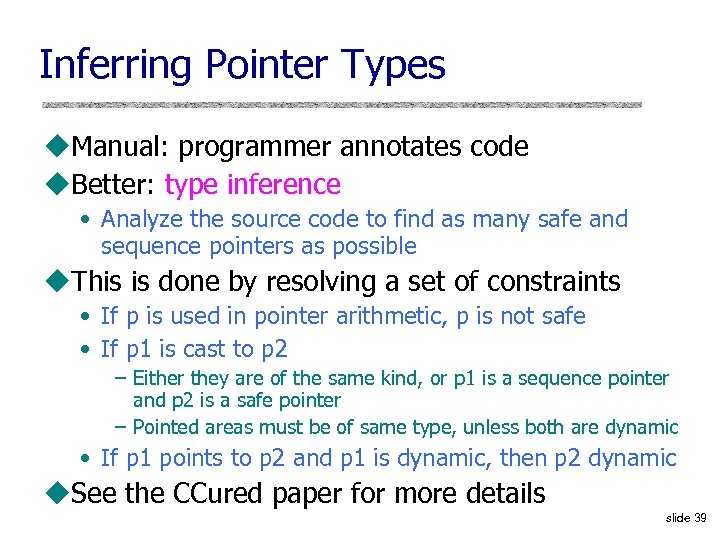 Inferring Pointer Types u. Manual: programmer annotates code u. Better: type inference • Analyze the source code to find as many safe and sequence pointers as possible u. This is done by resolving a set of constraints • If p is used in pointer arithmetic, p is not safe • If p 1 is cast to p 2 – Either they are of the same kind, or p 1 is a sequence pointer and p 2 is a safe pointer – Pointed areas must be of same type, unless both are dynamic • If p 1 points to p 2 and p 1 is dynamic, then p 2 dynamic u. See the CCured paper for more details slide 39
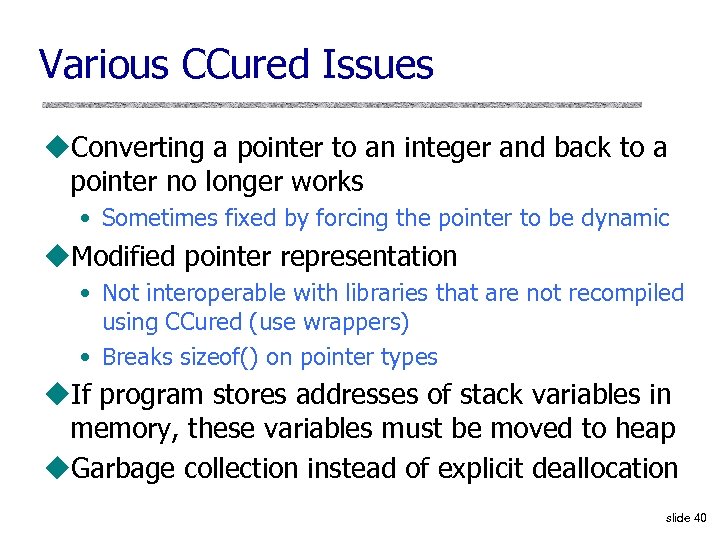 Various CCured Issues u. Converting a pointer to an integer and back to a pointer no longer works • Sometimes fixed by forcing the pointer to be dynamic u. Modified pointer representation • Not interoperable with libraries that are not recompiled using CCured (use wrappers) • Breaks sizeof() on pointer types u. If program stores addresses of stack variables in memory, these variables must be moved to heap u. Garbage collection instead of explicit deallocation slide 40
 Performance u. Most pointers in benchmark programs were inferred safe, performance penalty under 90% • Less than 20% in half the cases • Minimal slowdown on I/O-bound applications – Linux kernel modules, Apache • If all pointers were made dynamic, then 6 to 20 times slower (similar to a pure runtime-checks approach) • On the other hand, pure runtime-checks approach does not require access to source code and recompilation u. Various bugs found in test programs • Array bounds violations, uninitialized array indices slide 41
 Other Static Analysis Tools u. Coverity u. PREfix and PREfast (from Microsoft) u. Poly. Space u. Cyclone dialect of C u. Many, many others • For example, see http: //spinroot. com/static/ slide 42