


 Скачать презентацию CS 380 Artificial Intelligence Lecture 2 William Regli
14e45aac2c18863fda6651a75edab3ca.ppt
- Количество слайдов: 48
 CS 380: Artificial Intelligence Lecture #2 William Regli
 State of the art • Deep Blue defeated the reigning world chess champion Garry Kasparov in 1997 • Proved a mathematical conjecture (Robbins conjecture) unsolved for decades • No hands across America (driving autonomously 98% of the time from Pittsburgh to San Diego) • During the 1991 Gulf War, US forces deployed an AI logistics planning and scheduling program that involved up to 50, 000 vehicles, cargo, and people • NASA's on-board autonomous planning program controlled the scheduling of operations for a spacecraft • Proverb solves crossword puzzles better than most humans
 Thinking rationally: "laws of thought" • • Aristotle: what are correct arguments/thought processes? Several Greek schools developed various forms of logic: notation and rules of derivation for thoughts; may or may not have proceeded to the idea of mechanization Direct line through mathematics and philosophy to modern AI Problems: 1. 2. Not all intelligent behavior is mediated by logical deliberation What is the purpose of thinking? What thoughts should I have?

 Acting rationally: rational agent • Rational behavior: doing the right thing • The right thing: that which is expected to maximize goal achievement, given the available information • Doesn't necessarily involve thinking – e. g. , blinking reflex – but thinking should be in the service of rational action
 Rational agents • An agent is an entity that perceives and acts • This course is about designing rational agents • Abstractly, an agent is a function from percept histories to actions: [f: P* A] • For any given class of environments and tasks, we seek the agent (or class of agents) with the best performance • Caveat: computational limitations make perfect rationality unachievable design best program for given machine resources
 Agents • An agent is anything that can be viewed as perceiving its environment through sensors and acting upon that environment through actuators • Human agent: eyes, ears, and other organs for sensors; hands, • legs, mouth, and other body parts for actuators • Robotic agent: cameras and infrared range finders for sensors; • various motors for actuators
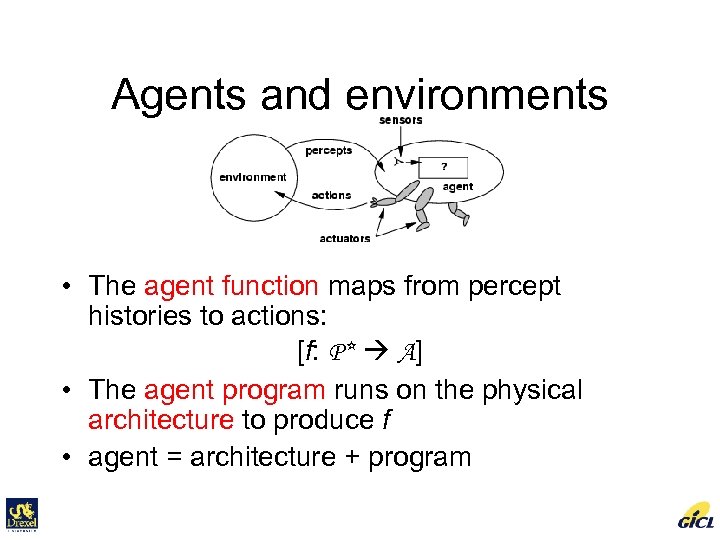 Agents and environments • The agent function maps from percept histories to actions: [f: P* A] • The agent program runs on the physical architecture to produce f • agent = architecture + program
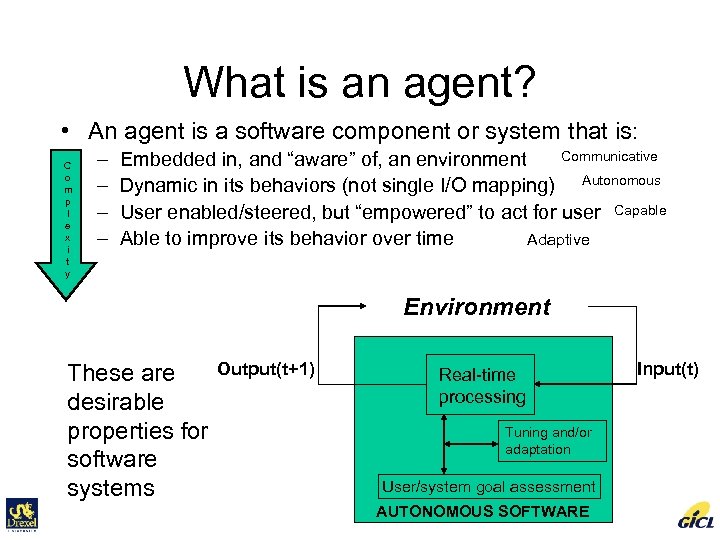 What is an agent? • An agent is a software component or system that is: C o m p l e x i t y – – Communicative Embedded in, and “aware” of, an environment Dynamic in its behaviors (not single I/O mapping) Autonomous User enabled/steered, but “empowered” to act for user Capable Able to improve its behavior over time Adaptive Environment These are desirable properties for software systems Output(t+1) Real-time processing Tuning and/or adaptation User/system goal assessment AUTONOMOUS SOFTWARE Input(t)
![Vacuum-cleaner world • Percepts: location and contents, e. g. , [A, Dirty] • Actions:](https://present5.com/presentation/14e45aac2c18863fda6651a75edab3ca/image-10.jpg "Vacuum-cleaner world • Percepts: location and contents, e. g. , [A, Dirty] • Actions:") Vacuum-cleaner world • Percepts: location and contents, e. g. , [A, Dirty] • Actions: Left, Right, Suck, No. Op
Vacuum-cleaner world • Percepts: location and contents, e. g. , [A, Dirty] • Actions: Left, Right, Suck, No. Op
![The vacuum-cleaner world Percept sequence Action [A, Clean] Right [A, Dirty] Suck [B, Clean]](https://present5.com/presentation/14e45aac2c18863fda6651a75edab3ca/image-11.jpg "The vacuum-cleaner world Percept sequence Action [A, Clean] Right [A, Dirty] Suck [B, Clean]") The vacuum-cleaner world Percept sequence Action [A, Clean] Right [A, Dirty] Suck [B, Clean] Left [B, Dirty] Suck [A, Clean], [A, Clean] Right [A, Clean], [A, Dirty] Suck … …
The vacuum-cleaner world Percept sequence Action [A, Clean] Right [A, Dirty] Suck [B, Clean] Left [B, Dirty] Suck [A, Clean], [A, Clean] Right [A, Clean], [A, Dirty] Suck … …
![The vacuum-cleaner world function REFLEX-VACUUM-AGENT ([location, status]) return an action if status == Dirty](https://present5.com/presentation/14e45aac2c18863fda6651a75edab3ca/image-12.jpg "The vacuum-cleaner world function REFLEX-VACUUM-AGENT ([location, status]) return an action if status == Dirty") The vacuum-cleaner world function REFLEX-VACUUM-AGENT ([location, status]) return an action if status == Dirty then return Suck else if location == A then return Right else if location == B then return Left What is the right function? Can it be implemented in a small agent program?
The vacuum-cleaner world function REFLEX-VACUUM-AGENT ([location, status]) return an action if status == Dirty then return Suck else if location == A then return Right else if location == B then return Left What is the right function? Can it be implemented in a small agent program?
 Rational agents • An agent should strive to "do the right thing", based on what it can perceive and the actions it can perform. The right action is the one that will cause the agent to be most successful • Performance measure: An objective criterion for success of an agent's behavior • E. g. , performance measure of a vacuumcleaner agent could be amount of dirt cleaned up, amount of time taken, amount of electricity consumed, amount of noise generated, etc.
 Rational agents • Rational Agent: For each possible percept sequence, a rational agent should select an action that is expected to maximize its performance measure, given the evidence provided by the percept sequence and whatever built-in knowledge the agent has.
 Rational agents • Rationality is distinct from omniscience (allknowing with infinite knowledge) • Agents can perform actions in order to modify future percepts so as to obtain useful information (information gathering, exploration) • An agent is autonomous if its behavior is determined by its own experience (with ability
 PEAS • PEAS: Performance measure, Environment, Actuators, Sensors • Must first specify the setting for intelligent agent design • Consider, e. g. , the task of designing an automated taxi driver: – – Performance measure Environment Actuators Sensors
 PEAS • Must first specify the setting for intelligent agent design • Consider, e. g. , the task of designing an automated taxi driver: – Performance measure: Safe, fast, legal, comfortable trip, maximize profits – Environment: Roads, other traffic, pedestrians, customers – Actuators: Steering wheel, accelerator, brake, signal, horn – Sensors: Cameras, sonar, speedometer, GPS, odometer, engine sensors, keyboard
 PEAS • Agent: Medical diagnosis system • Performance measure: Healthy patient, minimize costs, lawsuits • Environment: Patient, hospital, staff • Actuators: Screen display (questions, tests, diagnoses, treatments, referrals) • Sensors: Keyboard (entry of symptoms, findings, patient's answers)
 PEAS • Agent: Part-picking robot • Performance measure: Percentage of parts in correct bins • Environment: Conveyor belt with parts, bins • Actuators: Jointed arm and hand • Sensors: Camera, joint angle sensors
 PEAS • Agent: Interactive English tutor • Performance measure: Maximize student's score on test • Environment: Set of students • Actuators: Screen display (exercises, suggestions, corrections) • Sensors: Keyboard
 Environment types • Fully observable (vs. partially observable): An agent's sensors give it access to the complete state of the environment at each point in time. • Deterministic (vs. stochastic): The next state of the environment is completely determined by the current state and the action executed by the agent. (If the environment is deterministic except for the actions of other agents, then the environment is strategic) • Episodic (vs. sequential): The agent's experience is divided into atomic "episodes" (each episode consists of the agent perceiving and then performing a single action), and the choice of action in each episode depends only on the episode itself.
 Environment types • Static (vs. dynamic): The environment is unchanged while an agent is deliberating. (The environment is semidynamic if the environment itself does not change with the passage of time but the agent's performance score does) • Discrete (vs. continuous): A limited number of distinct, clearly defined percepts and actions. • Single agent (vs. multiagent): An agent operating by itself in an environment.
 Environments • To design a rational agent we must specify its task environment. • PEAS description of the environment: – Performance – Environment – Actuators – Sensors
 Environments • E. g. Fully automated taxi: • PEAS description of the environment: – Performance » Safety, destination, profits, legality, comfort – Environment » Streets/freeways, other traffic, pedestrians, weather, , … – Actuators » Steering, accelerating, brake, horn, speaker/display, … – Sensors » Video, sonar, speedometer, engine sensors, keyboard, GPS, …
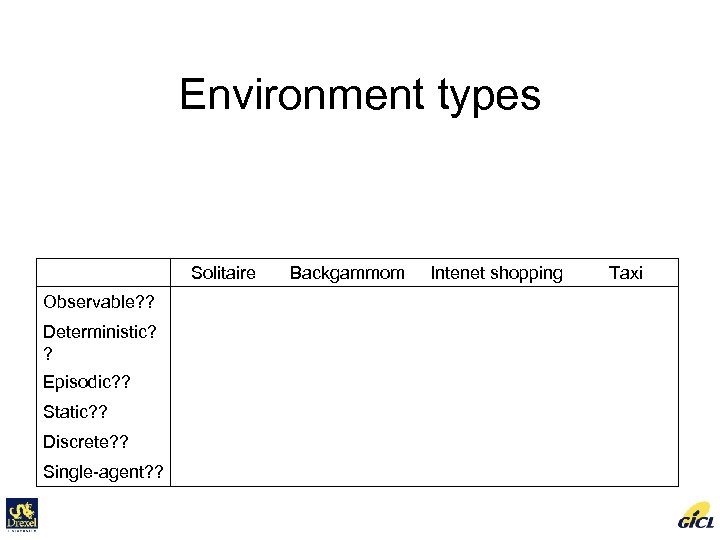 Environment types Solitaire Observable? ? Deterministic? ? Episodic? ? Static? ? Discrete? ? Single-agent? ? Backgammom Intenet shopping Taxi
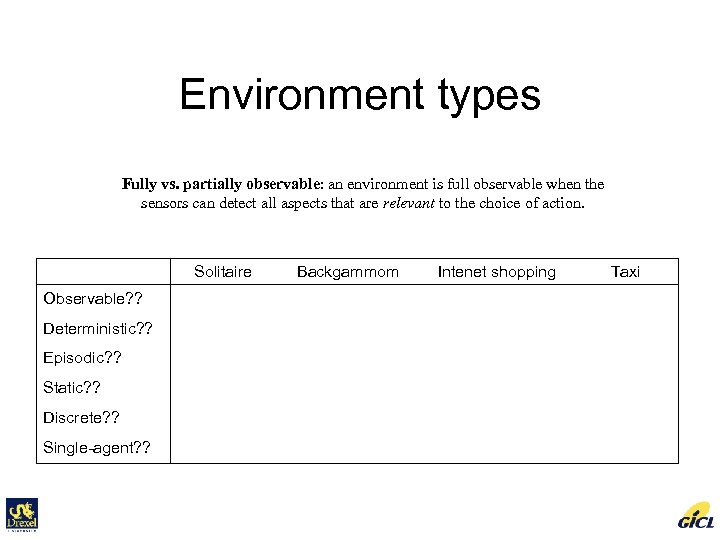 Environment types Fully vs. partially observable: an environment is full observable when the sensors can detect all aspects that are relevant to the choice of action. Solitaire Observable? ? Deterministic? ? Episodic? ? Static? ? Discrete? ? Single-agent? ? Backgammom Intenet shopping Taxi
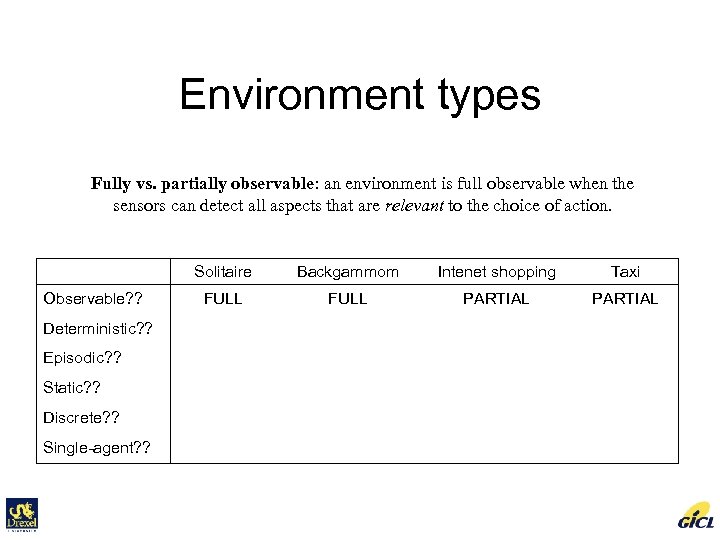 Environment types Fully vs. partially observable: an environment is full observable when the sensors can detect all aspects that are relevant to the choice of action. Solitaire Observable? ? Deterministic? ? Episodic? ? Static? ? Discrete? ? Single-agent? ? Backgammom Intenet shopping Taxi FULL PARTIAL
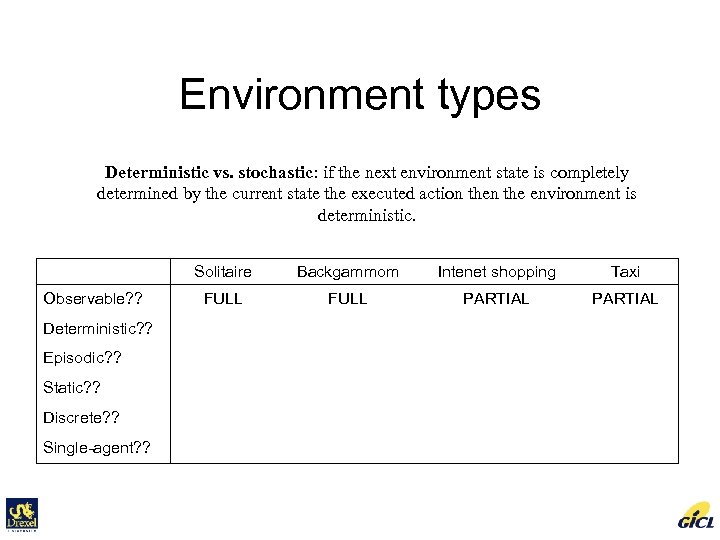 Environment types Deterministic vs. stochastic: if the next environment state is completely determined by the current state the executed action the environment is deterministic. Solitaire Observable? ? Deterministic? ? Episodic? ? Static? ? Discrete? ? Single-agent? ? Backgammom Intenet shopping Taxi FULL PARTIAL
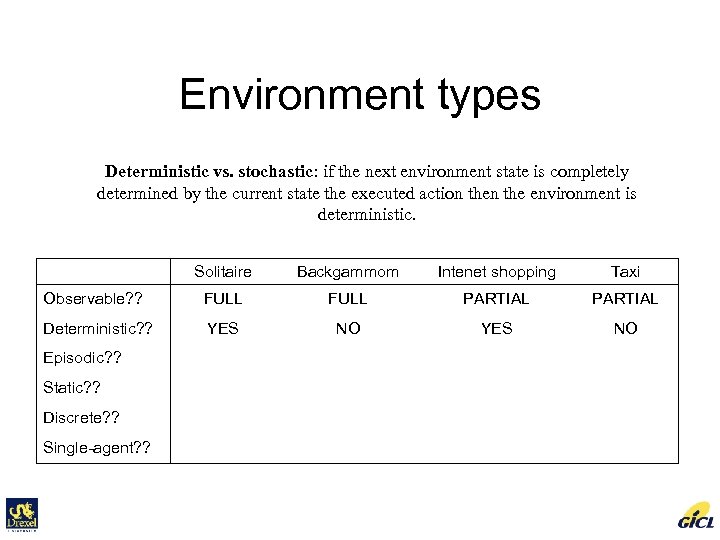 Environment types Deterministic vs. stochastic: if the next environment state is completely determined by the current state the executed action the environment is deterministic. Solitaire Backgammom Intenet shopping Taxi Observable? ? FULL PARTIAL Deterministic? ? YES NO Episodic? ? Static? ? Discrete? ? Single-agent? ?
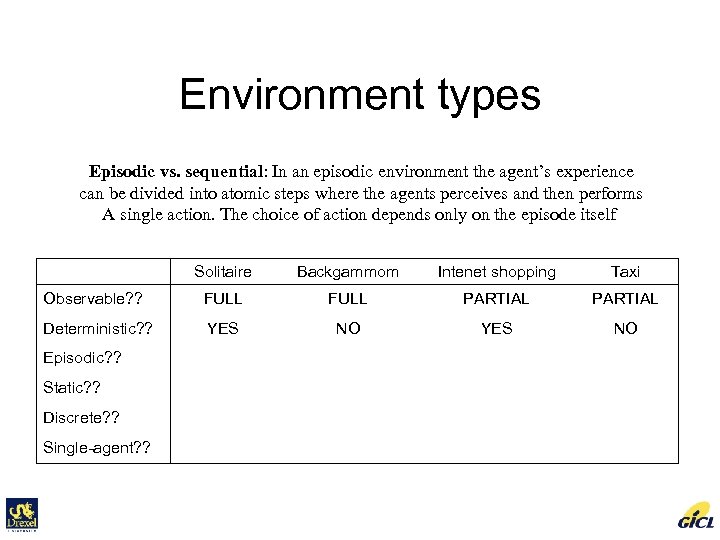 Environment types Episodic vs. sequential: In an episodic environment the agent’s experience can be divided into atomic steps where the agents perceives and then performs A single action. The choice of action depends only on the episode itself Solitaire Backgammom Intenet shopping Taxi Observable? ? FULL PARTIAL Deterministic? ? YES NO Episodic? ? Static? ? Discrete? ? Single-agent? ?
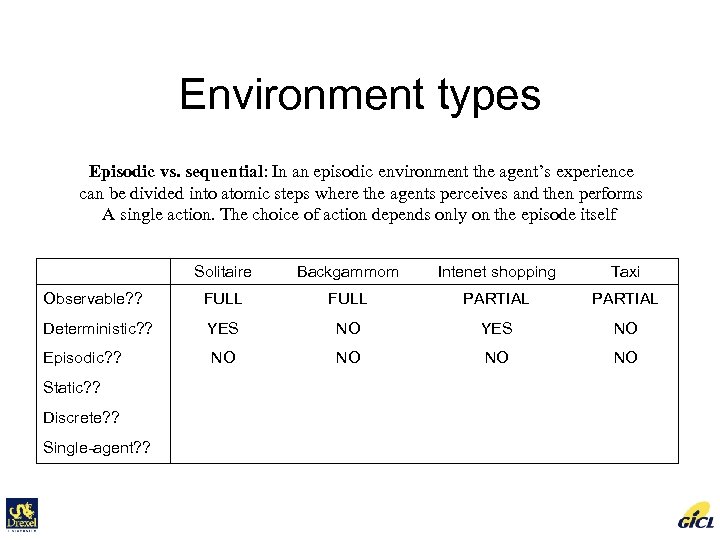 Environment types Episodic vs. sequential: In an episodic environment the agent’s experience can be divided into atomic steps where the agents perceives and then performs A single action. The choice of action depends only on the episode itself Solitaire Backgammom Intenet shopping Taxi Observable? ? FULL PARTIAL Deterministic? ? YES NO Episodic? ? NO NO Static? ? Discrete? ? Single-agent? ?
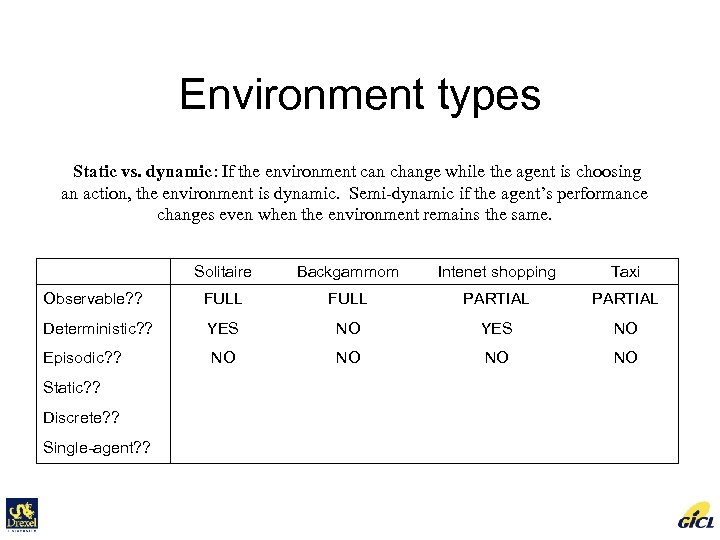 Environment types Static vs. dynamic: If the environment can change while the agent is choosing an action, the environment is dynamic. Semi-dynamic if the agent’s performance changes even when the environment remains the same. Solitaire Backgammom Intenet shopping Taxi Observable? ? FULL PARTIAL Deterministic? ? YES NO Episodic? ? NO NO Static? ? Discrete? ? Single-agent? ?
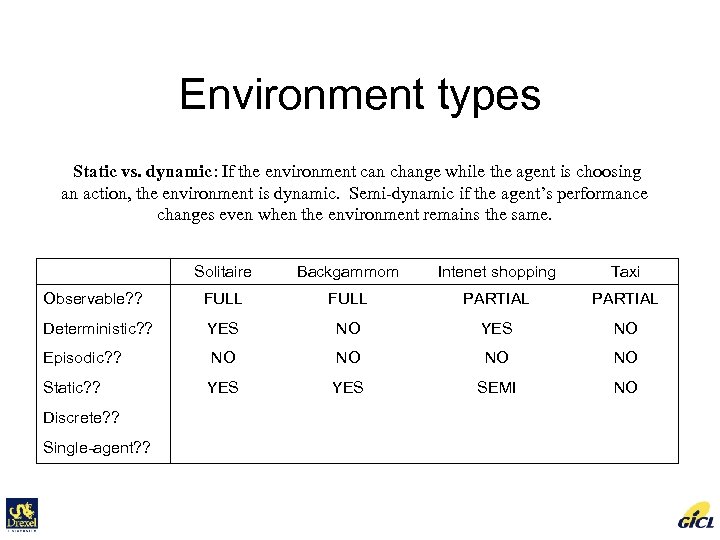 Environment types Static vs. dynamic: If the environment can change while the agent is choosing an action, the environment is dynamic. Semi-dynamic if the agent’s performance changes even when the environment remains the same. Solitaire Backgammom Intenet shopping Taxi Observable? ? FULL PARTIAL Deterministic? ? YES NO Episodic? ? NO NO Static? ? YES SEMI NO Discrete? ? Single-agent? ?
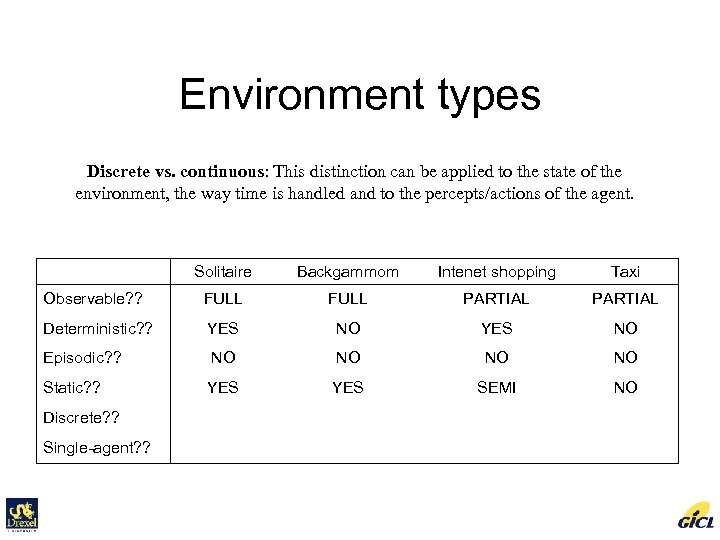 Environment types Discrete vs. continuous: This distinction can be applied to the state of the environment, the way time is handled and to the percepts/actions of the agent. Solitaire Backgammom Intenet shopping Taxi Observable? ? FULL PARTIAL Deterministic? ? YES NO Episodic? ? NO NO Static? ? YES SEMI NO Discrete? ? Single-agent? ?
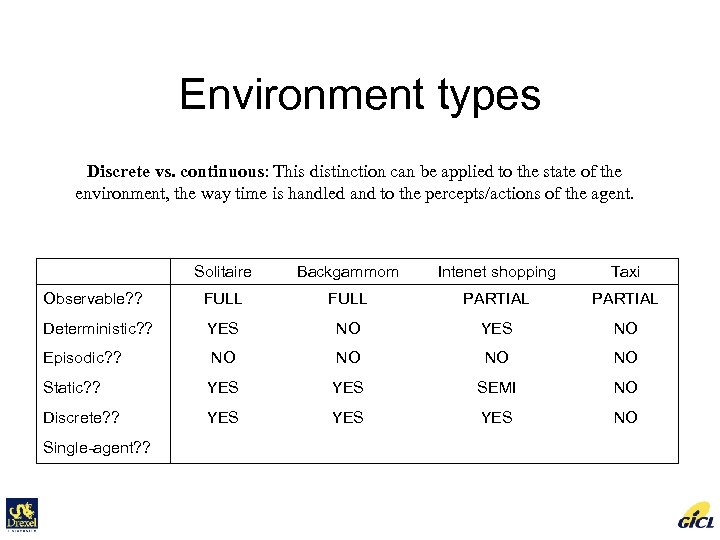 Environment types Discrete vs. continuous: This distinction can be applied to the state of the environment, the way time is handled and to the percepts/actions of the agent. Solitaire Backgammom Intenet shopping Taxi Observable? ? FULL PARTIAL Deterministic? ? YES NO Episodic? ? NO NO Static? ? YES SEMI NO Discrete? ? YES YES NO Single-agent? ?
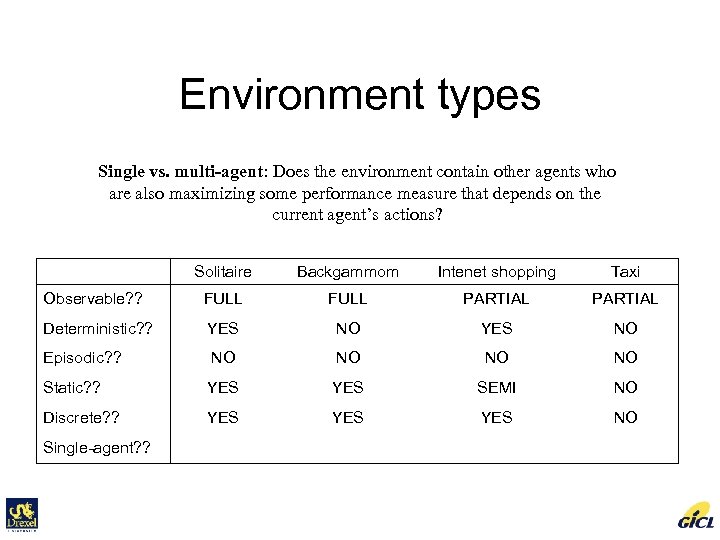 Environment types Single vs. multi-agent: Does the environment contain other agents who are also maximizing some performance measure that depends on the current agent’s actions? Solitaire Backgammom Intenet shopping Taxi Observable? ? FULL PARTIAL Deterministic? ? YES NO Episodic? ? NO NO Static? ? YES SEMI NO Discrete? ? YES YES NO Single-agent? ?
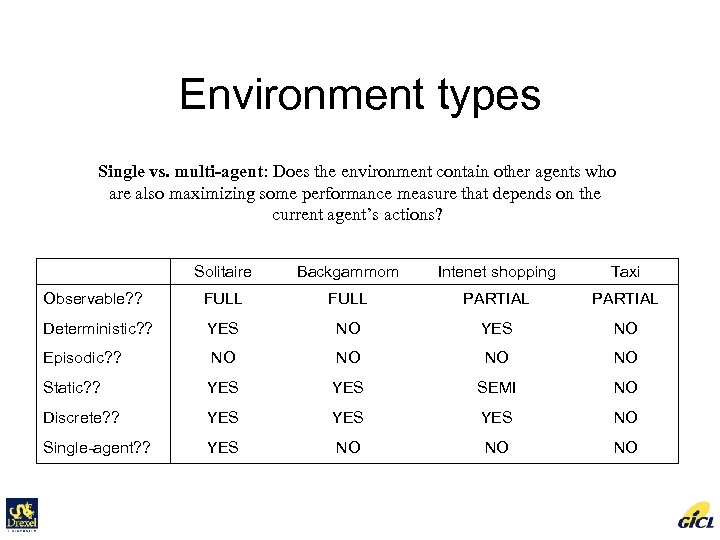 Environment types Single vs. multi-agent: Does the environment contain other agents who are also maximizing some performance measure that depends on the current agent’s actions? Solitaire Backgammom Intenet shopping Taxi Observable? ? FULL PARTIAL Deterministic? ? YES NO Episodic? ? NO NO Static? ? YES SEMI NO Discrete? ? YES YES NO Single-agent? ? YES NO NO NO
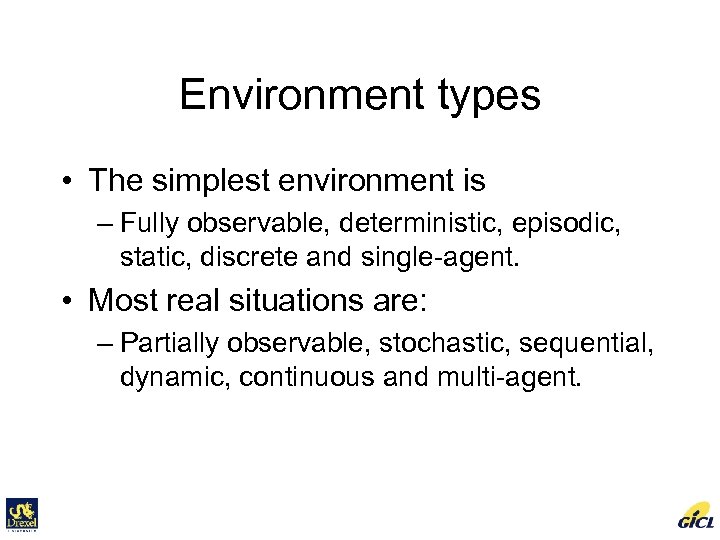 Environment types • The simplest environment is – Fully observable, deterministic, episodic, static, discrete and single-agent. • Most real situations are: – Partially observable, stochastic, sequential, dynamic, continuous and multi-agent.
 Agent functions and programs • An agent is completely specified by the agent function mapping percept sequences to actions • One agent function (or a small equivalence class) is rational • Aim: find a way to implement the rational agent function concisely
 Table-lookup agent • input{algorithms/table-agent-algorithm} • Drawbacks: – Huge table – Take a long time to build the table – No autonomy – Even with learning, need a long time to learn the table entries
 Agent types • Four basic types in order of increasing generality: • Simple reflex agents • Model-based reflex agents • Goal-based agents • Utility-based agents
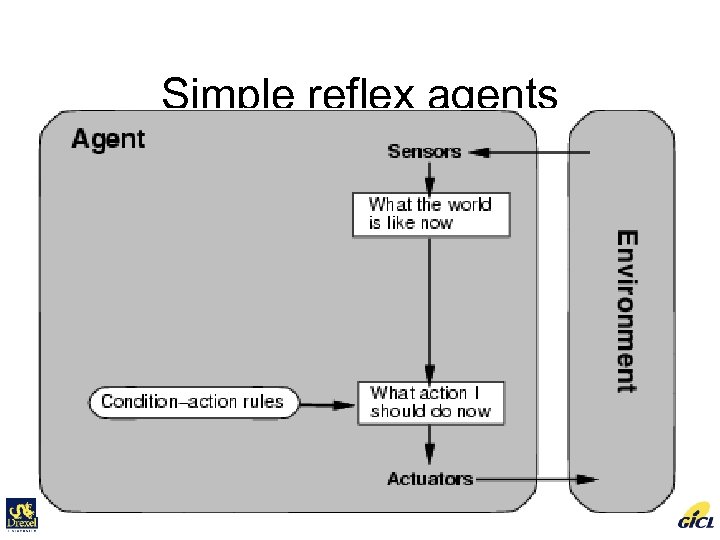 Simple reflex agents
![The vacuum-cleaner world function REFLEX-VACUUM-AGENT ([location, status]) return an action if status == Dirty](https://present5.com/presentation/14e45aac2c18863fda6651a75edab3ca/image-43.jpg "The vacuum-cleaner world function REFLEX-VACUUM-AGENT ([location, status]) return an action if status == Dirty") The vacuum-cleaner world function REFLEX-VACUUM-AGENT ([location, status]) return an action if status == Dirty then return Suck else if location == A then return Right else if location == B then return Left Reduction from 4 T to 4 entries
The vacuum-cleaner world function REFLEX-VACUUM-AGENT ([location, status]) return an action if status == Dirty then return Suck else if location == A then return Right else if location == B then return Left Reduction from 4 T to 4 entries
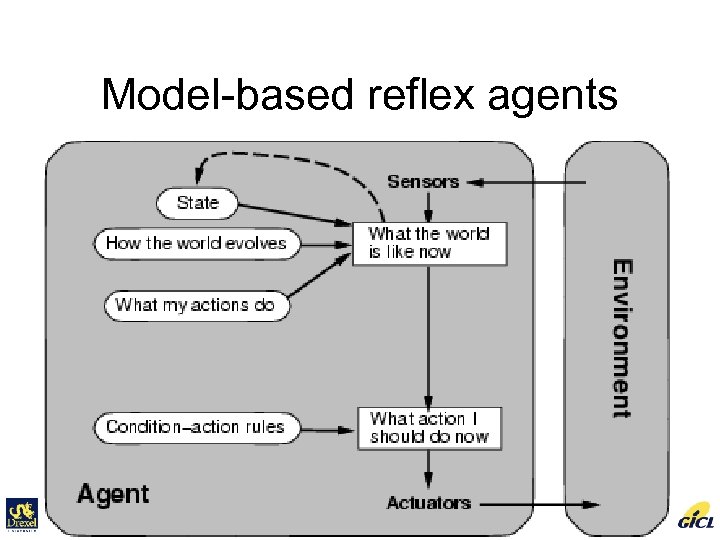 Model-based reflex agents
 Model-based reflex agents • input{algorithms/d+-agent-algorithm}
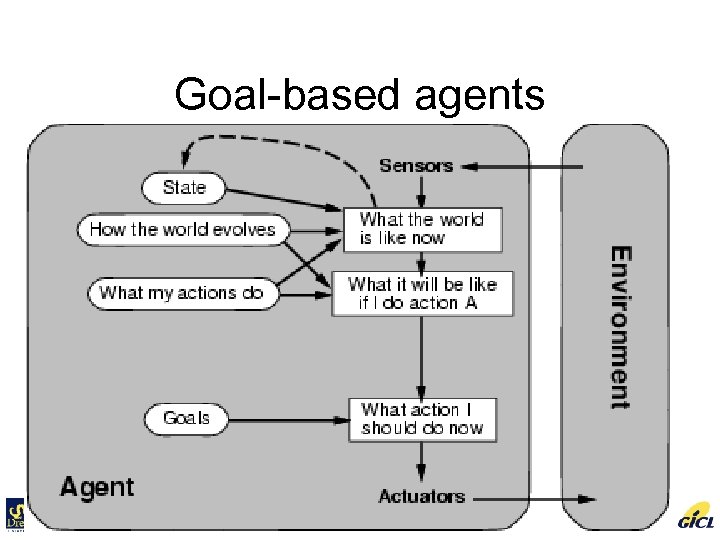 Goal-based agents
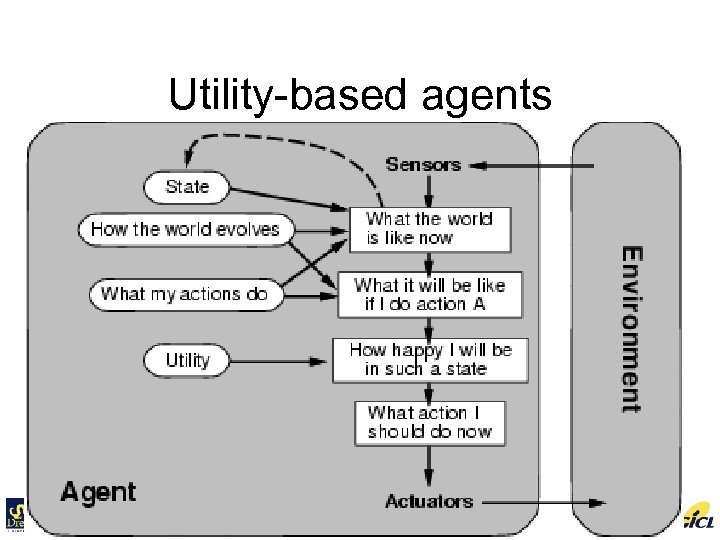 Utility-based agents
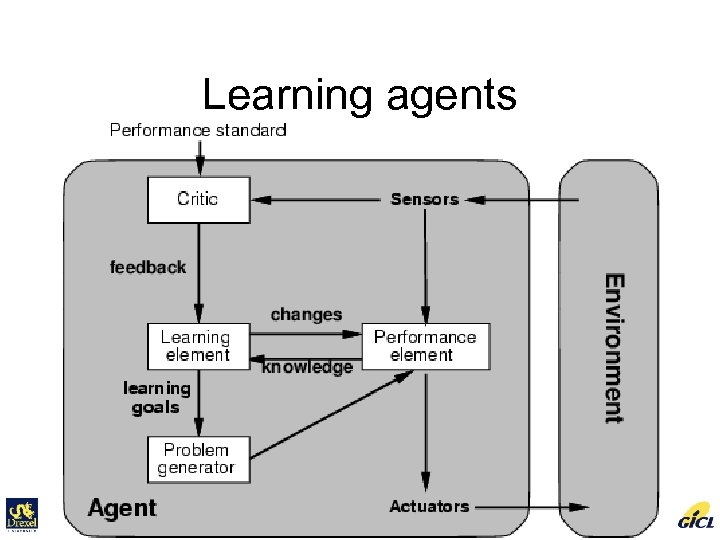 Learning agents