 Скачать презентацию CS 361 S Stuxnet Vitaly Shmatikov based on
7eabb47bb3220edd050c80d6a86b1508.ppt
- Количество слайдов: 32



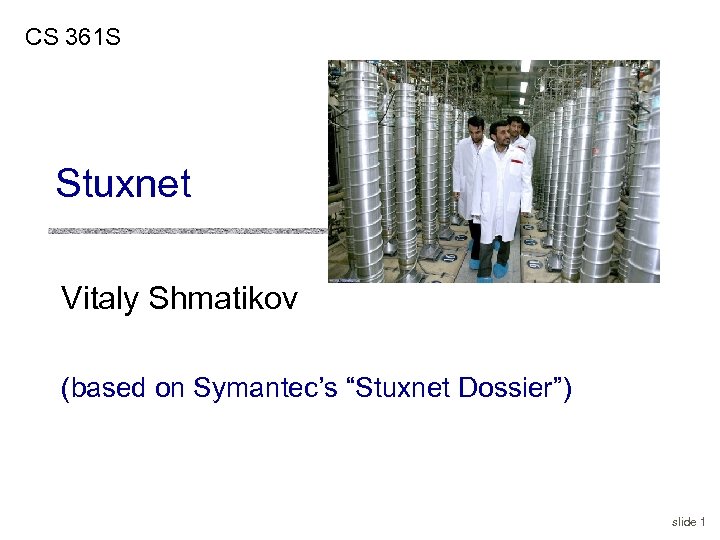
CS 361 S Stuxnet Vitaly Shmatikov (based on Symantec’s “Stuxnet Dossier”) slide 1
CVE-2010 -2772 “Siemens Simatic Win. CC and PCS 7 SCADA system uses a hard-coded password, which allows local users to access a back-end database and gain privileges, as demonstrated in the wild in July 2010 by the Stuxnet worm” slide 2
MS 10 -046 Vulnerability Microsoft Security Bulletin MS 10 -046 Vulnerability in Windows Shell Could Allow Remote Code Execution The vulnerability could allow remote code execution if the icon of a specially crafted shortcut is displayed … This security update is rated Critical for all supported editions of Microsoft Windows. First disclosed in CVE-2010 -2568 (Jun 30, 2010) Windows Shell in Microsoft Windows XP SP 3, Server 2003 SP 2, Vista SP 1 and SP 2, Server 2008 SP 2 and R 2, and Windows 7 allows local users or remote attackers to execute arbitrary code via a crafted (1). LNK or (2). PIF shortcut file, which is not properly handled during icon display in Windows Explorer, as demonstrated in the wild in July 2010, and originally reported for malware that leverages CVE 2010 -2772 in Siemens Win. CC SCADA systems. slide 3
Stuxnet Pre-History u. November 20, 2008: Zlob Trojan exploits an unknown vulnerability in Windows shortcuts (LNK) • Later identified as MS 10 -046 u. April 2009: security magazine Hakin 9 describes a vulnerability in Windows printer spooler service • Later identified as MS 10 -061 u. June 22, 2009: earliest version of Stuxnet seen • Does not use MS 10 -046, driver not signed slide 4
Stuxnet Timeline (2010) u. January 25: signed Stuxnet driver, valid certificate from Realtek Semiconductor u. June 17: Antivirus company from Belarus reports a new USB rootkit Tmp. Hider u. July 16: Microsoft issues MS 10 -046 • Shortcut vulnerability u. July 16: Veri. Sign revokes Realtek certificate u. July 17: Stuxnet driver with valid certificate from JMicron Technology slide 5
Stuxnet Timeline Cont’d (2010) u. July 19: Siemens says they are investigating malware affecting their Win. CC SCADA system • SCADA = control of industrial machinery u. September 14: Microsoft issues MS 10 -061 • Print spooler vulnerability slide 6
Stuxnet Firsts u. First to exploit multiple zero-day vulnerabilities u. First to use stolen signing keys and valid certificates of two companies u. First to target industrial control systems – or not? … and hide the code from the operator … and perform actual sabotage u. First PLC (programmable logic controller) rootkit u. First example of true cyber-warfare? slide 7
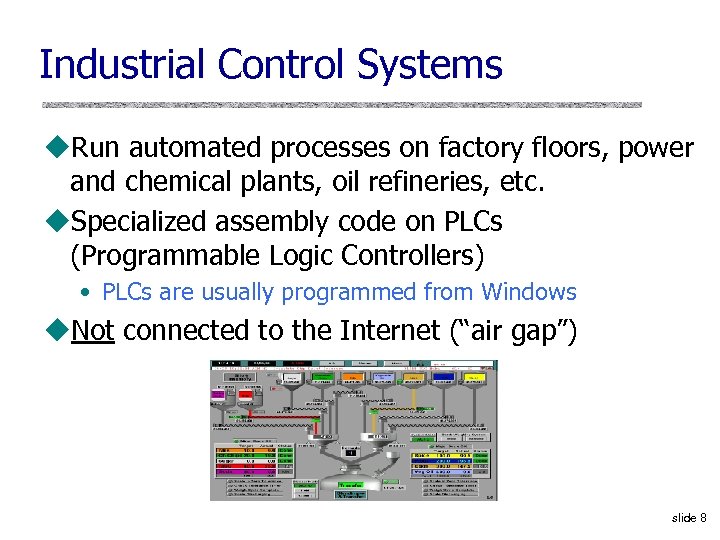
Industrial Control Systems u. Run automated processes on factory floors, power and chemical plants, oil refineries, etc. u. Specialized assembly code on PLCs (Programmable Logic Controllers) • PLCs are usually programmed from Windows u. Not connected to the Internet (“air gap”) slide 8
Target: SCADA u. Each PLC is configured and programmed in a unique manner u. Stuxnet targets a specific PLC control system • SIMATIC PCS 7 Process Control System • Programmed using Win. CC/STEP 7 slide 9
Stuxnet Propagation Methods u. Initial infection via USB drive (jumps “air gap”) • Zero-day MS 10 -046 shortcut exploit + auto-execution u. Several network propagation methods • LAN: zero-day MS 10 -061 print spooler exploit or old MS 08 -67 RPC exploit (remember Conficker? ) • Default password to Siemens Win. CC database server • Network shares • Peer-to-peer communication and update mechanism u. Looks for and infects Windows machines running Step 7 control software slide 10
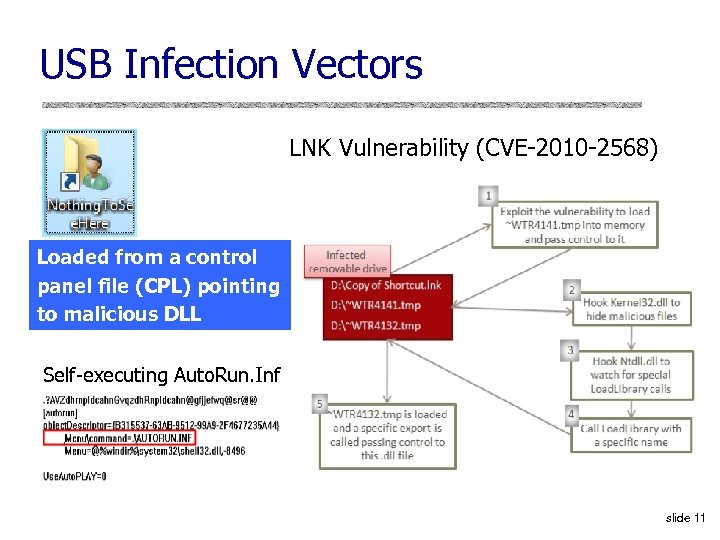
USB Infection Vectors LNK Vulnerability (CVE-2010 -2568) Loaded from a control panel file (CPL) pointing to malicious DLL Self-executing Auto. Run. Inf slide 11
Bypassing Intrusion Detection u. Calls Load. Library with a special file name that does not exist u. Load. Library fails, but Ntdll. dll has been hooked to monitor for the special file names u. These names are mapped to another location where Stuxnet previously decrypted and stored a DLL file slide 12
Gaining Admin Privileges u. If running without administrative privileges, uses zero-day vulnerabilities to become an admin • Win 2000, XP: MS 10 -073 keyboard layout vulnerability • Vista, Windows 7: MS 10 -092 task scheduler vulnerability u. Injects code into a trusted Windows process • LSASS or Winlogon u. Injection method depends on the security product used on the infected host • Kaspersky KAV, Mc. Afee, Anti. Vir, Bit. Defender, Etrust, FSecure, Symantec, ESET NOD 32, PC Cillin slide 13
Exploiting MS 10 -073 u. In Windows XP, a user-level program can load keyboard layout u. Integer in the layout file indexes a global array of function pointers (no bounds checking, natch) • Can use this to call any function… u. Find a pointer to this array, find a pointer into usermodifiable memory, inject attack code there, use bad indexing to call modified function • Attack code will run with admin privileges slide 14
![Exploiting MS 10 -092 [credit: i. SEC Partners] u. Users can create and edit](https://present5.com/presentation/7eabb47bb3220edd050c80d6a86b1508/image-15.jpg "Exploiting MS 10 -092 [credit: i. SEC Partners] u. Users can create and edit")
Exploiting MS 10 -092 [credit: i. SEC Partners] u. Users can create and edit scheduled tasks u. CRC 32 checksum to prevent tampering • “… not suitable for protecting against intentional alteration of data” --- Wikipedia We should use CRC 32 to … NEVER USE CRC 32 FOR ANYTHING u. Modify user definition in the task to Local. System, pad until CRC 32 matches the original slide 15
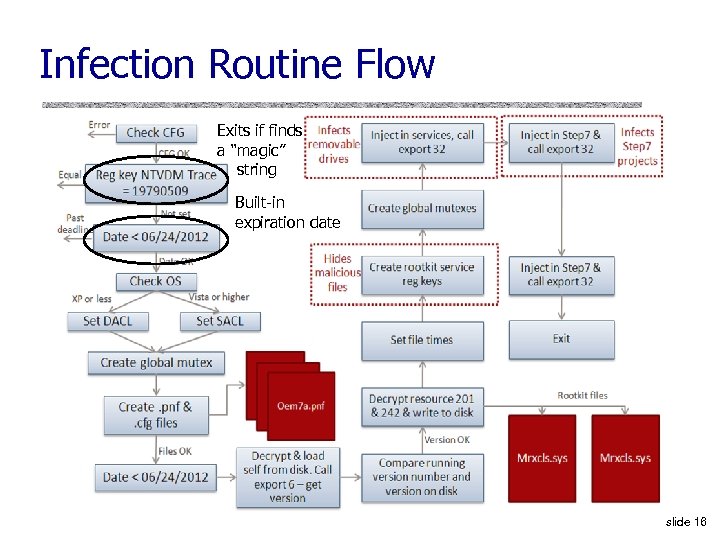
Infection Routine Flow Exits if finds a “magic” string Built-in expiration date slide 16
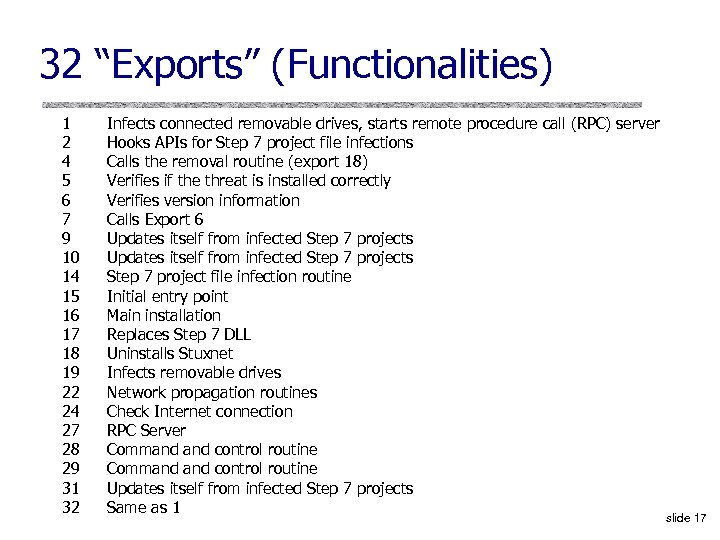
32 “Exports” (Functionalities) 1 2 4 5 6 7 9 10 14 15 16 17 18 19 22 24 27 28 29 31 32 Infects connected removable drives, starts remote procedure call (RPC) server Hooks APIs for Step 7 project file infections Calls the removal routine (export 18) Verifies if the threat is installed correctly Verifies version information Calls Export 6 Updates itself from infected Step 7 projects Step 7 project file infection routine Initial entry point Main installation Replaces Step 7 DLL Uninstalls Stuxnet Infects removable drives Network propagation routines Check Internet connection RPC Server Command and control routine Updates itself from infected Step 7 projects Same as 1 slide 17
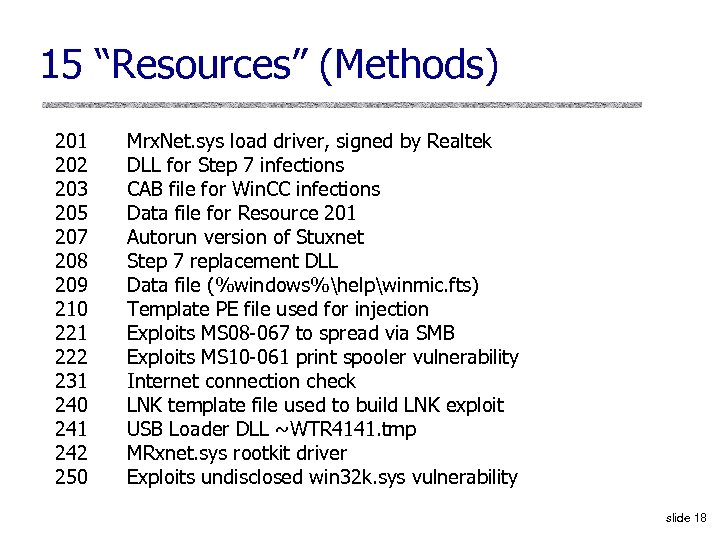
15 “Resources” (Methods) 201 202 203 205 207 208 209 210 221 222 231 240 241 242 250 Mrx. Net. sys load driver, signed by Realtek DLL for Step 7 infections CAB file for Win. CC infections Data file for Resource 201 Autorun version of Stuxnet Step 7 replacement DLL Data file (%windows%helpwinmic. fts) Template PE file used for injection Exploits MS 08 -067 to spread via SMB Exploits MS 10 -061 print spooler vulnerability Internet connection check LNK template file used to build LNK exploit USB Loader DLL ~WTR 4141. tmp MRxnet. sys rootkit driver Exploits undisclosed win 32 k. sys vulnerability slide 18
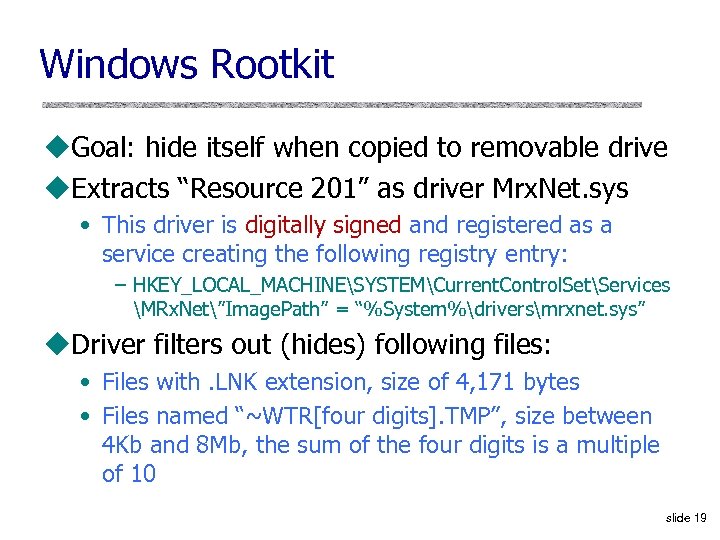
Windows Rootkit u. Goal: hide itself when copied to removable drive u. Extracts “Resource 201” as driver Mrx. Net. sys • This driver is digitally signed and registered as a service creating the following registry entry: – HKEY_LOCAL_MACHINESYSTEMCurrent. Control. SetServices MRx. Net”Image. Path” = “%System%driversmrxnet. sys” u. Driver filters out (hides) following files: • Files with. LNK extension, size of 4, 171 bytes • Files named “~WTR[four digits]. TMP”, size between 4 Kb and 8 Mb, the sum of the four digits is a multiple of 10 slide 19
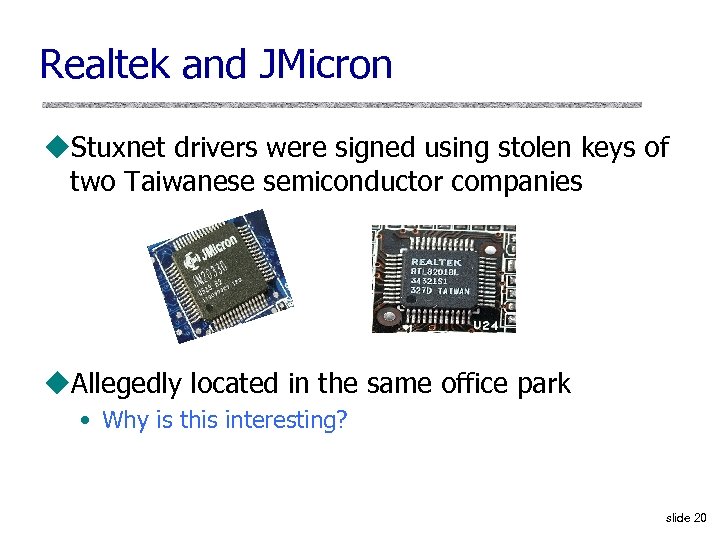
Realtek and JMicron u. Stuxnet drivers were signed using stolen keys of two Taiwanese semiconductor companies u. Allegedly located in the same office park • Why is this interesting? slide 20
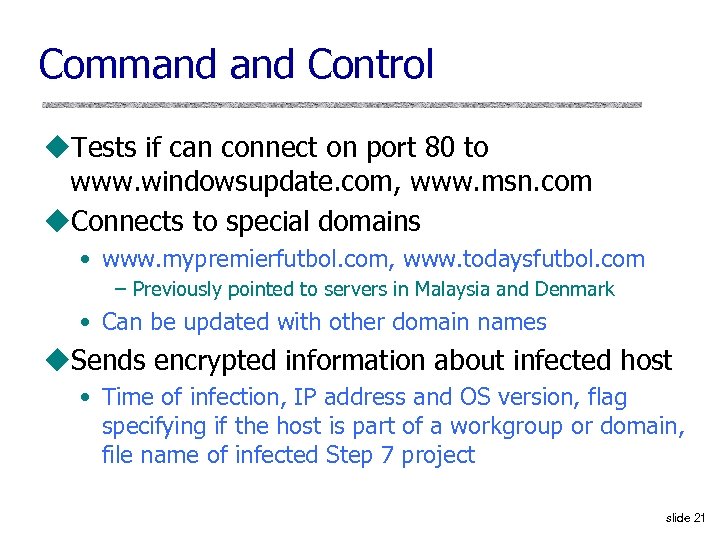
Command Control u. Tests if can connect on port 80 to www. windowsupdate. com, www. msn. com u. Connects to special domains • www. mypremierfutbol. com, www. todaysfutbol. com – Previously pointed to servers in Malaysia and Denmark • Can be updated with other domain names u. Sends encrypted information about infected host • Time of infection, IP address and OS version, flag specifying if the host is part of a workgroup or domain, file name of infected Step 7 project slide 21
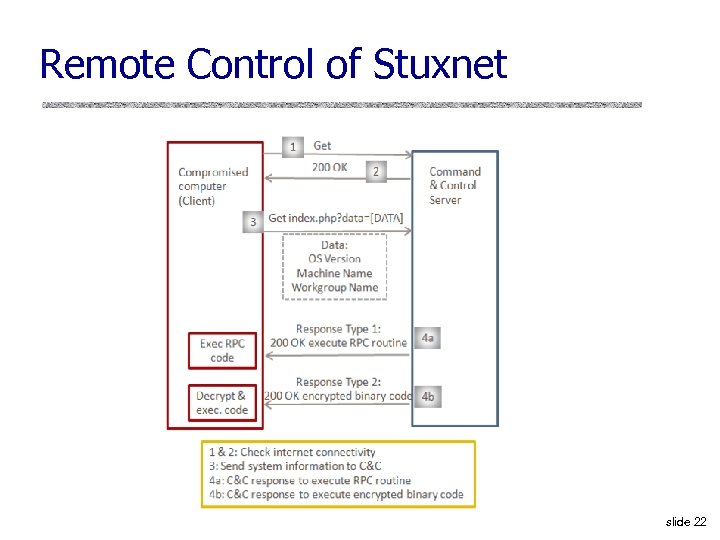
Remote Control of Stuxnet slide 22
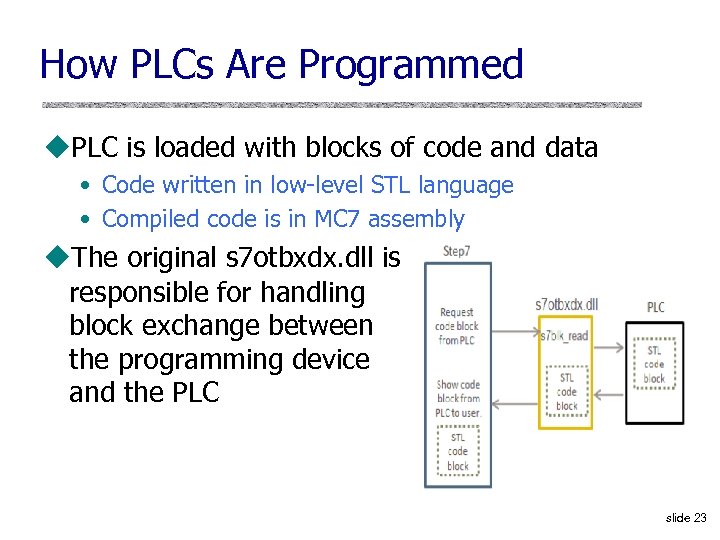
How PLCs Are Programmed u. PLC is loaded with blocks of code and data • Code written in low-level STL language • Compiled code is in MC 7 assembly u. The original s 7 otbxdx. dll is responsible for handling block exchange between the programming device and the PLC slide 23
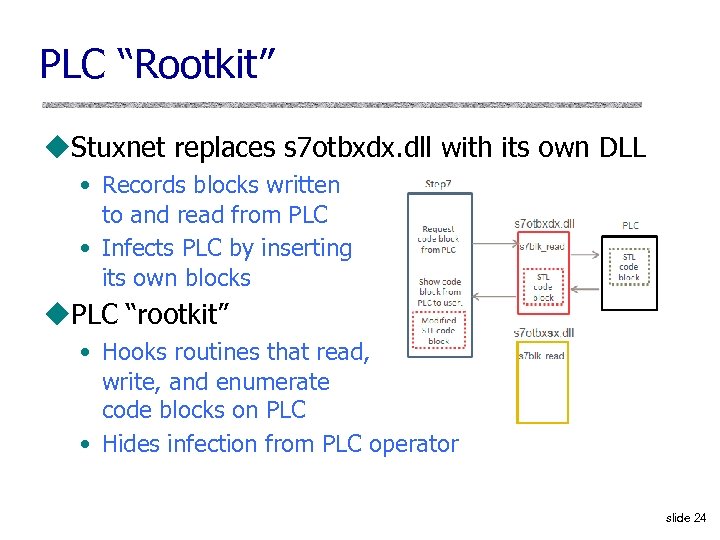
PLC “Rootkit” u. Stuxnet replaces s 7 otbxdx. dll with its own DLL • Records blocks written to and read from PLC • Infects PLC by inserting its own blocks u. PLC “rootkit” • Hooks routines that read, write, and enumerate code blocks on PLC • Hides infection from PLC operator slide 24
Sabotage u. Checks if PLC controls a cascade of at least 33 frequency converter drives manufactured by a specific Iranian or Finnish company • A frequency converter drive controls speed of another device – used in water systems, gas pipelines, etc. u. Records normal behavior of PLC u. Executes sequences of commands that rapidly slow down or speed up motors • Sequence depends on detected manufacturer u… while replaying normal behavior to operator slide 25
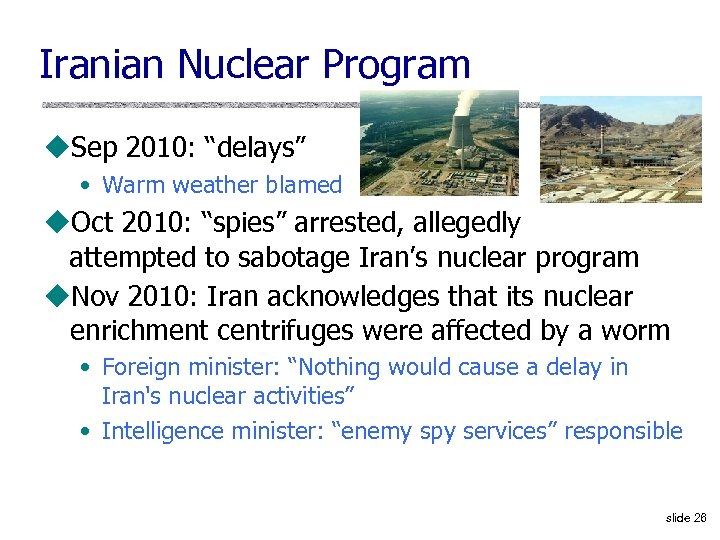
Iranian Nuclear Program u. Sep 2010: “delays” • Warm weather blamed u. Oct 2010: “spies” arrested, allegedly attempted to sabotage Iran’s nuclear program u. Nov 2010: Iran acknowledges that its nuclear enrichment centrifuges were affected by a worm • Foreign minister: “Nothing would cause a delay in Iran's nuclear activities” • Intelligence minister: “enemy spy services” responsible slide 26
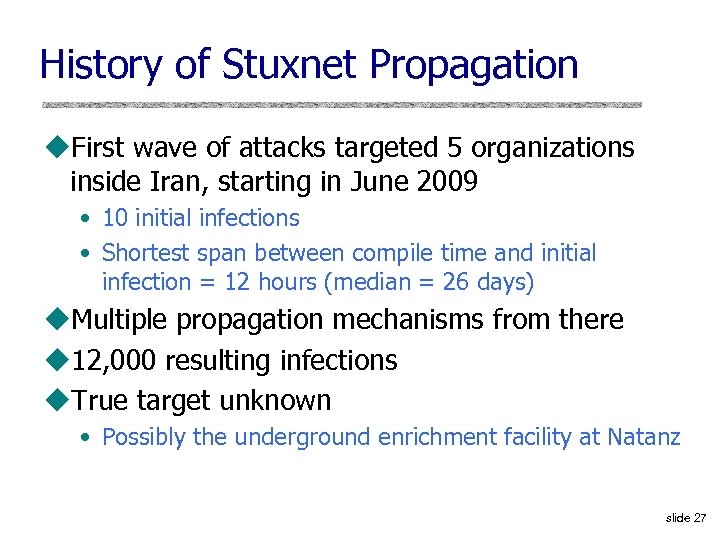
History of Stuxnet Propagation u. First wave of attacks targeted 5 organizations inside Iran, starting in June 2009 • 10 initial infections • Shortest span between compile time and initial infection = 12 hours (median = 26 days) u. Multiple propagation mechanisms from there u 12, 000 resulting infections u. True target unknown • Possibly the underground enrichment facility at Natanz slide 27
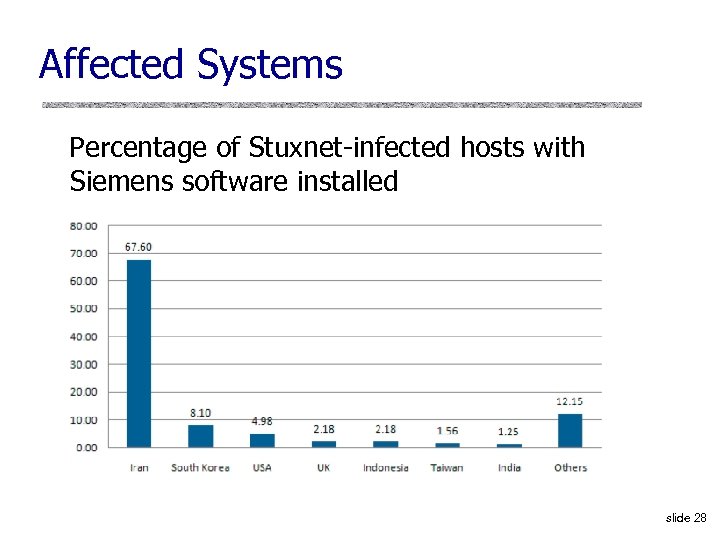
Affected Systems Percentage of Stuxnet-infected hosts with Siemens software installed slide 28
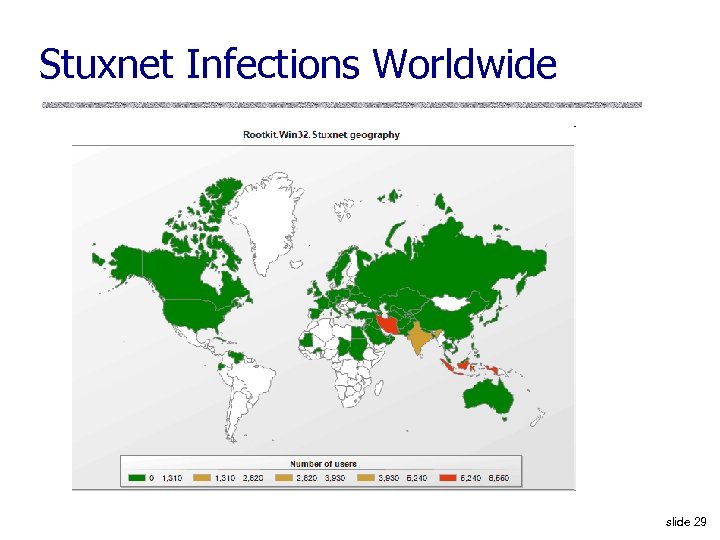
Stuxnet Infections Worldwide slide 29
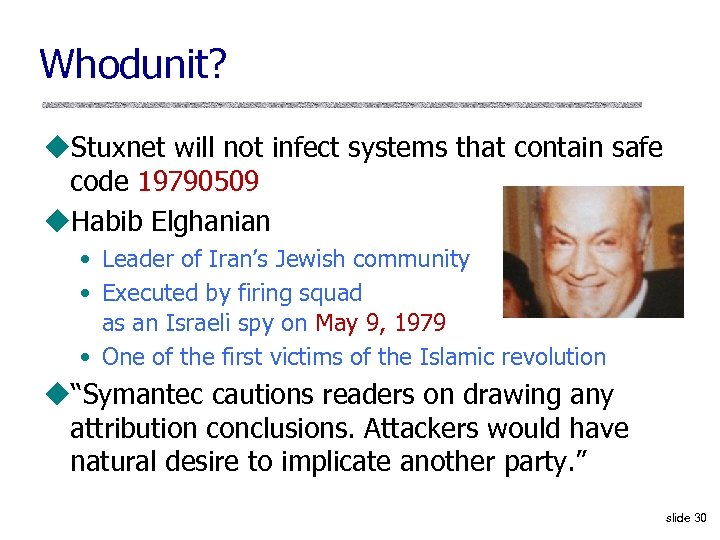
Whodunit? u. Stuxnet will not infect systems that contain safe code 19790509 u. Habib Elghanian • Leader of Iran’s Jewish community • Executed by firing squad as an Israeli spy on May 9, 1979 • One of the first victims of the Islamic revolution u“Symantec cautions readers on drawing any attribution conclusions. Attackers would have natural desire to implicate another party. ” slide 30
Another Clue? “My RTUs” (Remote Terminal Units), similar to PLCs u. Project path in Stuxnet driver: b: myrtussrcobjfire_w 2 k_x 86i 386guava. pdb • Guava is a plant in the myrtle (myrtus) family u. Book of Esther in the Hebrew Bible • Esther (born Hadassah) learns that Haman, Persian prime minister, is planning to exterminate all Jews, but foils his plot and has him impaled • “Hadassah” is “myrtle” in Hebrew u“Symantec cautions readers on drawing any attribution conclusions. Attackers would have natural desire to implicate another party. ” slide 31
Flame u. Possibly related to Stuxnet, much more complex u. Exploits an MD 5 hash collision attack on Microsoft Update code signing certificate • Much more about this later u. Targets mainly in Iran, but also in Lebanon, Syria, Sudan, Israel, and the Palestinian Territories • Purpose: espionage rather than industrial sabotage – Logs keystrokes, records audio, grabs GPS tags from photos. . . • Possibly developed by the NSA, CIA, and Israeli military as part of the “Olympic Games” campaign against Iranian nuclear program -- Washington Post slide 32
Скачать презентацию CS 361 S Stuxnet Vitaly Shmatikov based on
7eabb47bb3220edd050c80d6a86b1508.ppt