 Скачать презентацию CS 319 Theory of Databases Generalities Dr Alexandra
5c8797f16645cd690a61ecf651e3ab5a.ppt
- Количество слайдов: 56



CS 319: Theory of Databases: Generalities Dr. Alexandra I. Cristea http: //www. dcs. warwick. ac. uk/~acristea/
Lecturers • Alexandra I. Cristea • Hugh Darwen: hughdarwen@gmail. com • Other invited talks? : TBA 2
Schedule • See website • Exceptions: – TBA: check website, lectures, forum 3
Slides • Thanks to: – Dr. Paul Goldberg: • http: //www. dcs. warwick. ac. uk/people/academic/Paul. Goldberg/cs 319/ cs 319 index. html – Dr. Meurig Beynon: • http: //www. dcs. warwick. ac. uk/people/staff/Meurig. Beynon/ – Dr. Ad Aerts: • http: //wwwis. win. tue. nl/~aaerts/ – Prof. Dr. Paul De Bra: • http: //wwwis. win. tue. nl/~debra/ – Others: mentioned directly 4
Contact • Forum: http: //forums. warwick. ac. uk/wf/browse/category. jsp? cat=24 • IF (and ONLY IF) a question is personal, you might address it to acristea@dcs. warwick. ac. uk – FORMAT: subject of email should contain ‘CS 319’ and topic of the email (otherwise it will be filtered out) 5
Organisational • Office hours, see website • Per email is also possible – but availability depends on demand • (general questions better to post on forum) 6
Course site(s): • Current: – http: //www. dcs. warwick. ac. uk/~acristea/courses/CS 319/ – Will contain current slides, as taught at the course – Will contain notifications: check BEFORE & AFTER the course • Official: – http: //www. dcs. warwick. ac. uk/undergraduate/modules/cs 319. html • Past: – http: //www. dcs. warwick. ac. uk/people/academic/Paul. Goldberg/cs 31 9/cs 319 index. html 7
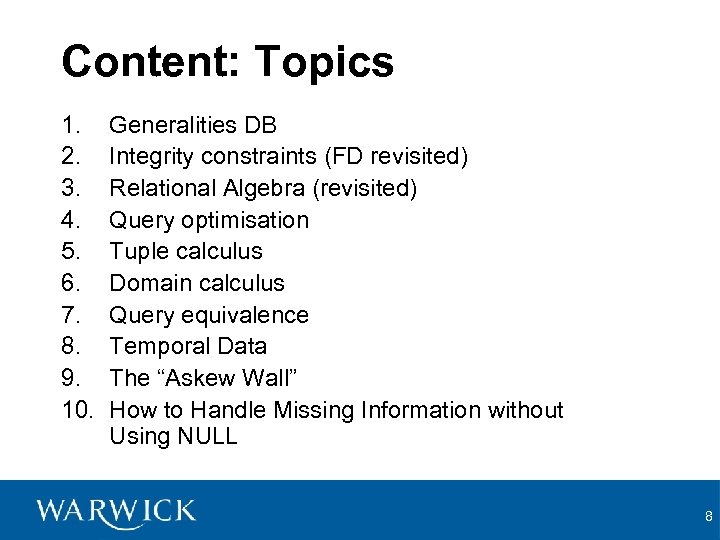
Content: Topics 1. 2. 3. 4. 5. 6. 7. 8. 9. 10. Generalities DB Integrity constraints (FD revisited) Relational Algebra (revisited) Query optimisation Tuple calculus Domain calculus Query equivalence Temporal Data The “Askew Wall” How to Handle Missing Information without Using NULL 8
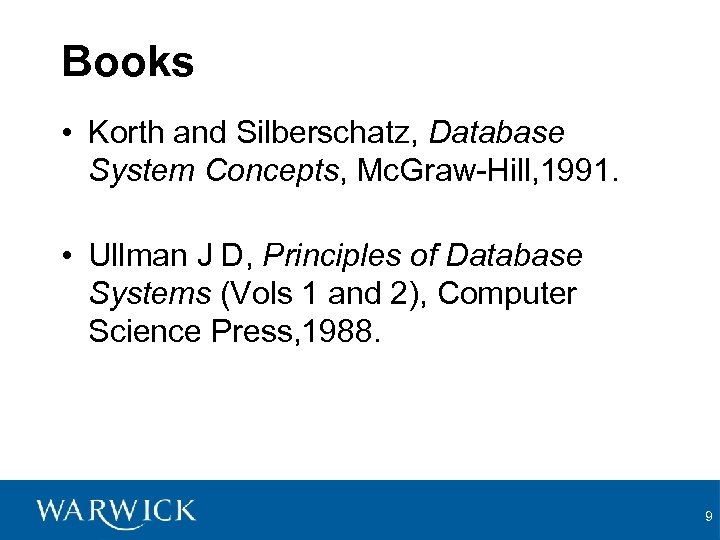
Books • Korth and Silberschatz, Database System Concepts, Mc. Graw-Hill, 1991. • Ullman J D, Principles of Database Systems (Vols 1 and 2), Computer Science Press, 1988. 9
Purpose of this course • More in-depth information on theory of databases • How (some of) the existing db languages fit in theory (and how they don’t) 10
Overlaps and sequencing • Form: optional • Prerequisites – CS 252: Fundamentals of Database Systems – Optional: CS 253: Topics in Database Systems 11
Organization of the course • • • 15 CATS CS, CSE, CBS, Mathematics ~ 30 1 -hour lectures Exam at the end: 3 hours Rules of the game: – Read also comments on the slides. – Presence is optional, but beware: slides-only are NOT ENOUGH to learn from for the exam; you need to participate, take your own notes, so selfstudy! 12
Scope of CS 319 • Expressive power of db query languages • Algorithms for the computational problems • Limitations to classical relational theory • A central contribution of theory is to say what cannot be done, not just what can. • Consider how this observation is relevant to the above topics. 13
A theme of CS 319 • How do theory and computing practice relate to specific reference to databases? • Key ideas: • Theory: based on Codd's relational theory. – There is an excellent correspondence between relational theory and practical database application of a certain kind. • Relational databases can be seen as a precursor of 2 principal kinds of computer application: – environments for end-user programming and – computer-based models of real-world state. 14
1. Database Generalities 15
DB generalities : What is a database? • Chris Date: – Database = computer-based record keeping system • R. W. Engles: "A Tutorial on DB Organisation" (1974) – Db = collection of stored operational data used by the applications system of a particular enterprise – enterprise: hospital, university, bank, company etc – operational data: • • data on products, accounts, patients etc typically persistent cf conventional program IO data 16
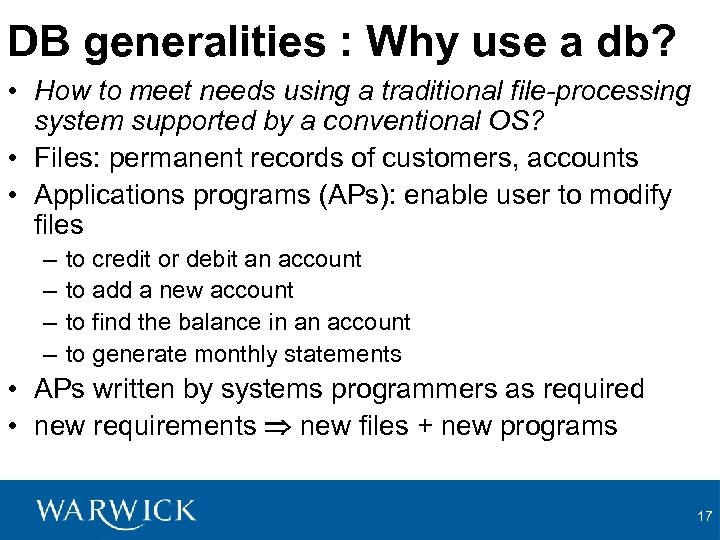
DB generalities : Why use a db? • How to meet needs using a traditional file-processing system supported by a conventional OS? • Files: permanent records of customers, accounts • Applications programs (APs): enable user to modify files – – to credit or debit an account to add a new account to find the balance in an account to generate monthly statements • APs written by systems programmers as required • new requirements new files + new programs 17
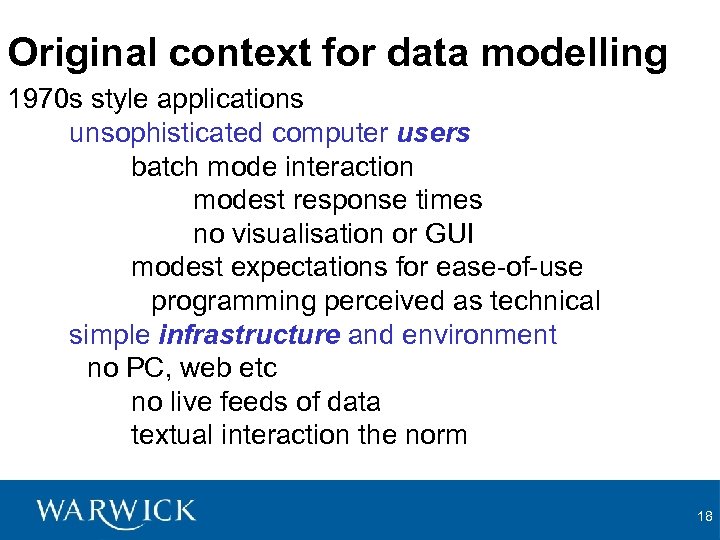
Original context for data modelling 1970 s style applications unsophisticated computer users batch mode interaction modest response times no visualisation or GUI modest expectations for ease-of-use programming perceived as technical simple infrastructure and environment no PC, web etc no live feeds of data textual interaction the norm 18
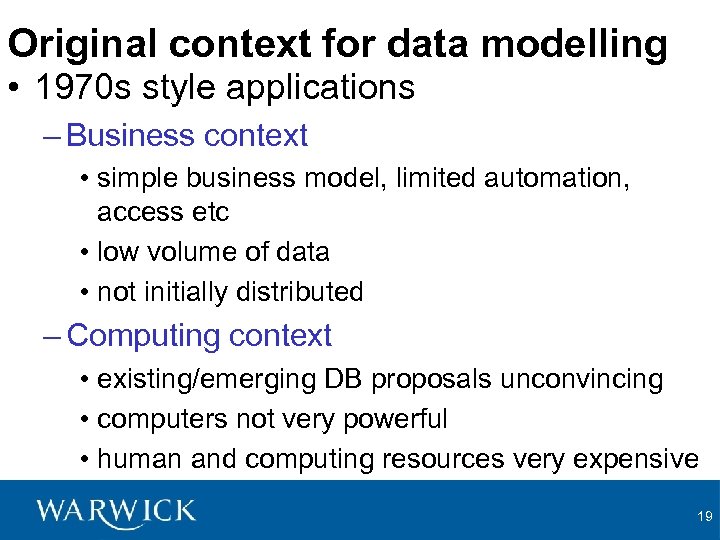
Original context for data modelling • 1970 s style applications – Business context • simple business model, limited automation, access etc • low volume of data • not initially distributed – Computing context • existing/emerging DB proposals unconvincing • computers not very powerful • human and computing resources very expensive 19
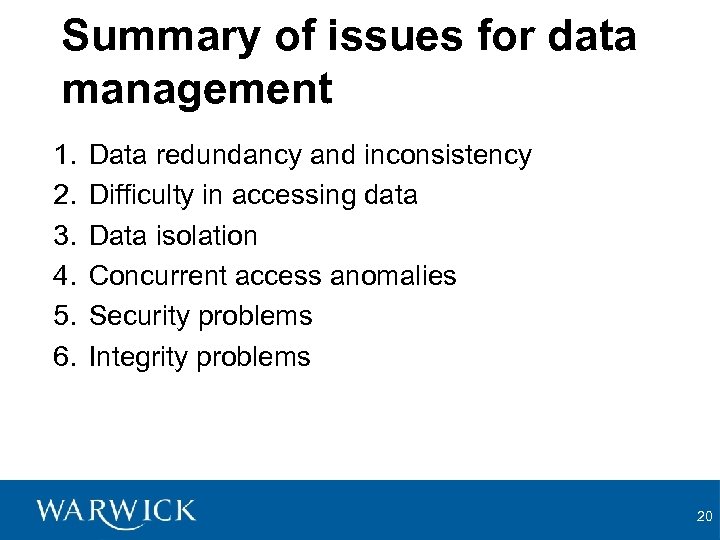
Summary of issues for data management 1. 2. 3. 4. 5. 6. Data redundancy and inconsistency Difficulty in accessing data Data isolation Concurrent access anomalies Security problems Integrity problems 20
Data redundancy & inconsistency • programmer uses ≠ format file, developed at ≠ stage in history of enterprise => data duplicated: + in a DB rationalise and standardise data [rationalise: shared source for data] … rationalise doesn't necessarily mean centralise 21
Data redundancy & inconsistency – compromises are needed • where users suit themselves => efficient results perfect data organisation to suit all users – duplication: insurance against info loss 22
Difficulty in accessing data • unforeseen requests, new functionality • new programs, possibly new data structures + in a DB, simplify access & manipulation by intelligent organisation of data cf. modelling approach to requirements e. g. in use of UML in OOSE 23
Data isolation data to retrieve from many sources in APs + in DB, hide source physical data : higher level of abstraction – automation: less human interaction with data risk of corrupted data 24
Concurrent access anomalies • would like multiple access (efficiency & faster response) e. g. simultaneous withdrawal + concurrency can't be managed without a form of overall control 25
Security problems • to restrict access to (un)authorised users for confidential info + security needs a form of overall control – issues: where should the control be? inside or outside computer system * e. g. , non-trivial problem to determine what can be inferred from responses to queries that aren't explicit 26
Integrity problems • integrity constraints – may arise dynamically: – difficult to modify programs to cope; – hard to guarantee if data stored in ≠ files + automated management demands a form of overall control – automation reduces scope for human intervention / interpretation 27
Conclusions: Issues for data management • For many commercial applications, a good solution is offered by a database management system (DBMS). • A DBMS is an unconventional OS operating over a structured file system. 28
Motivating the DBMS concept • abstract model of corpus of operational data that simplifies data processing activity: – simple queries can be handled without writing new application programs – if APs need => accessing & manipulating operational data consistently and efficiently is simplified 29
The ingredients of a database Data integrated shared (possibly distributed) Hardware storage Software database management system: DBMS protects users from hardware level detail serves the needs of all users 30
DB Users • end-user: – non-specialist accessing data via a query language – naïve user accessing data via a special-purpose interface performs data retrieval and update (extend / modify) • applications programmer: – writes programs that use the DB by embedding queries to the DB in a HLL – develops interfaces for the naïve user 31
DB Users Database Administrator (DBA): responsible for overall control decides what data is to be stored designs the conceptual scheme used to represent the operational data implements authorisation checks decides strategy for backup and recovery monitors performance oversees modification to suit user requirements 32
Data abstraction in a db • addresses issues of design, use, management and implementation • Data model describes (formally) 3 different levels of abstraction: physical level conceptual level view level 33
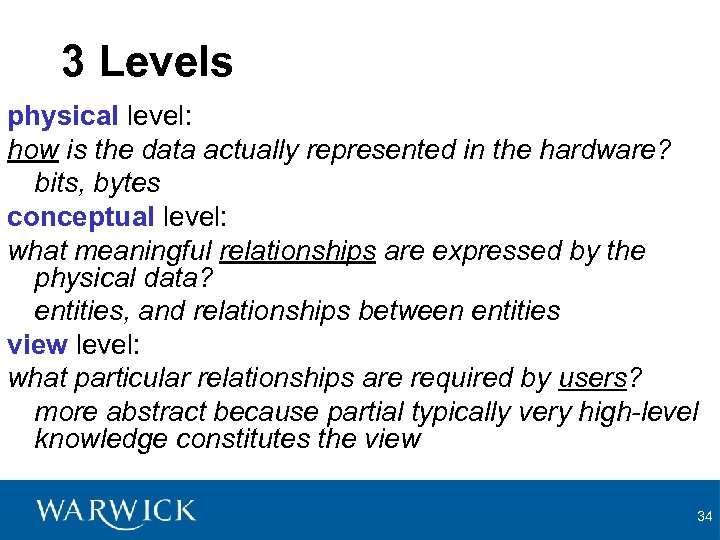
3 Levels physical level: how is the data actually represented in the hardware? bits, bytes conceptual level: what meaningful relationships are expressed by the physical data? entities, and relationships between entities view level: what particular relationships are required by users? more abstract because partial typically very high-level knowledge constitutes the view 34
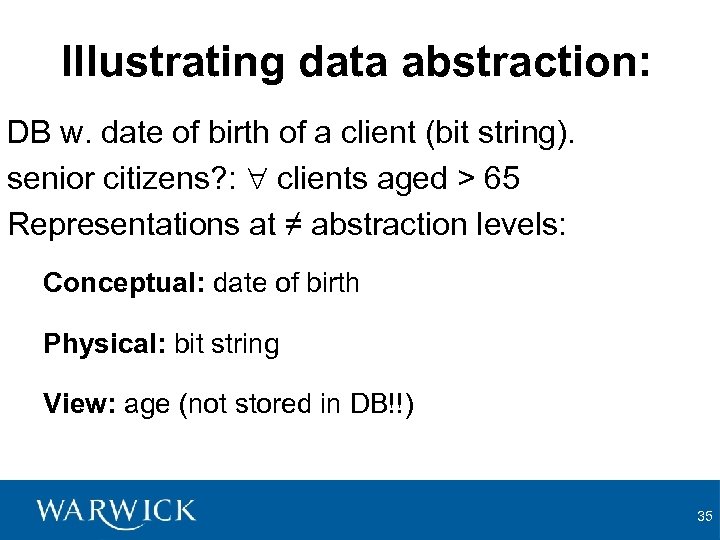
Illustrating data abstraction: DB w. date of birth of a client (bit string). senior citizens? : clients aged > 65 Representations at ≠ abstraction levels: Conceptual: date of birth Physical: bit string View: age (not stored in DB!!) 35
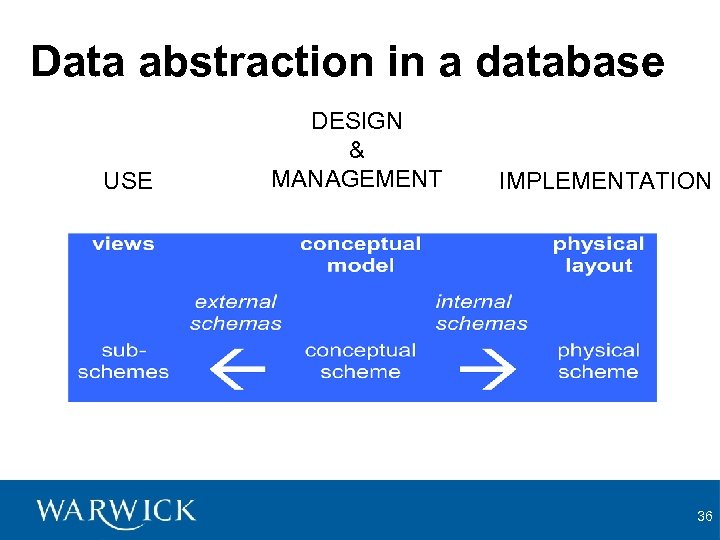
Data abstraction in a database USE DESIGN & MANAGEMENT IMPLEMENTATION 36
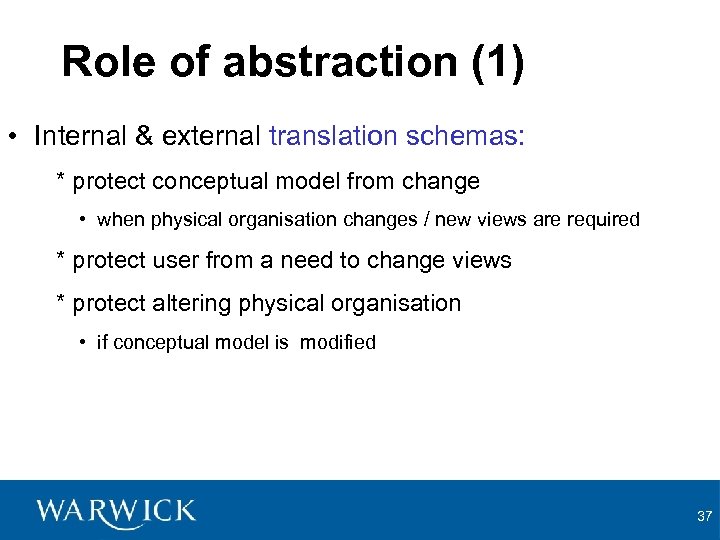
Role of abstraction (1) • Internal & external translation schemas: * protect conceptual model from change • when physical organisation changes / new views are required * protect user from a need to change views * protect altering physical organisation • if conceptual model is modified 37
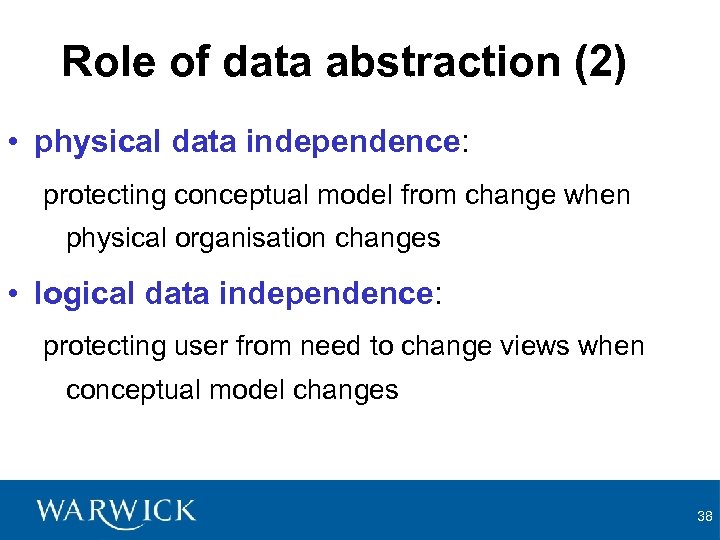
Role of data abstraction (2) • physical data independence: protecting conceptual model from change when physical organisation changes • logical data independence: protecting user from need to change views when conceptual model changes 38
Characteristics of electronic data 1970 • “Abstract model of the entire corpus of operational data” • Demands of the abstract model in 1970 quite low … – small volumes of data, modest performance – limited levels of volatility and automation tolerated • Today different, BUT – (subject to viewing human agency as a metaphor for any agency, ) – key issues of a classical database are still vital • Any DB modelling paradigm must handle 70 s problems 39
db models • 2 principal kinds of abstract data model: – object-based models – record-based models • earliest • reflects file system culture they displaced 40
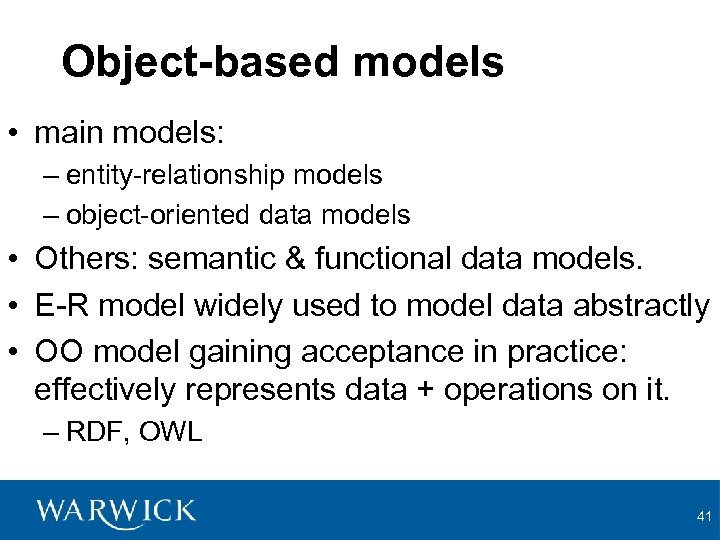
Object-based models • main models: – entity-relationship models – object-oriented data models • Others: semantic & functional data models. • E-R model widely used to model data abstractly • OO model gaining acceptance in practice: effectively represents data + operations on it. – RDF, OWL 41
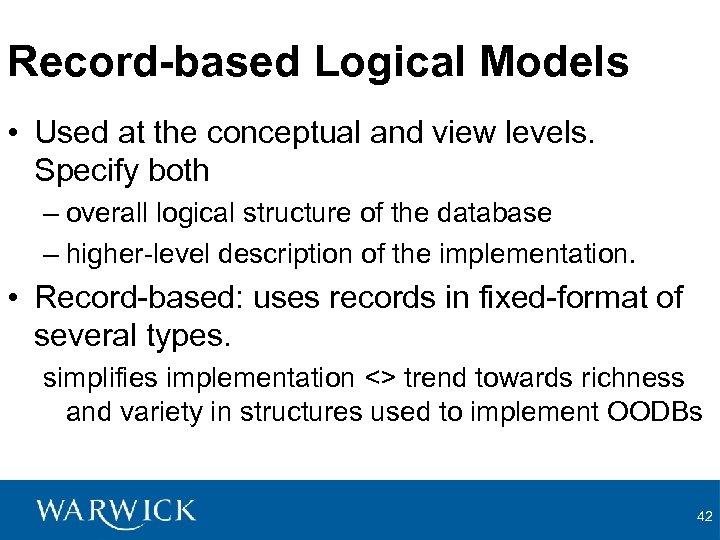
Record-based Logical Models • Used at the conceptual and view levels. Specify both – overall logical structure of the database – higher-level description of the implementation. • Record-based: uses records in fixed-format of several types. simplifies implementation <> trend towards richness and variety in structures used to implement OODBs 42
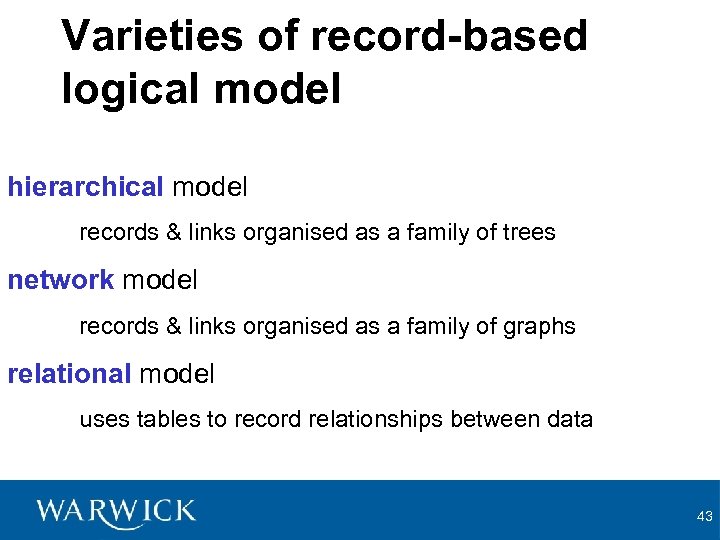
Varieties of record-based logical model hierarchical model records & links organised as a family of trees network model records & links organised as a family of graphs relational model uses tables to record relationships between data 43
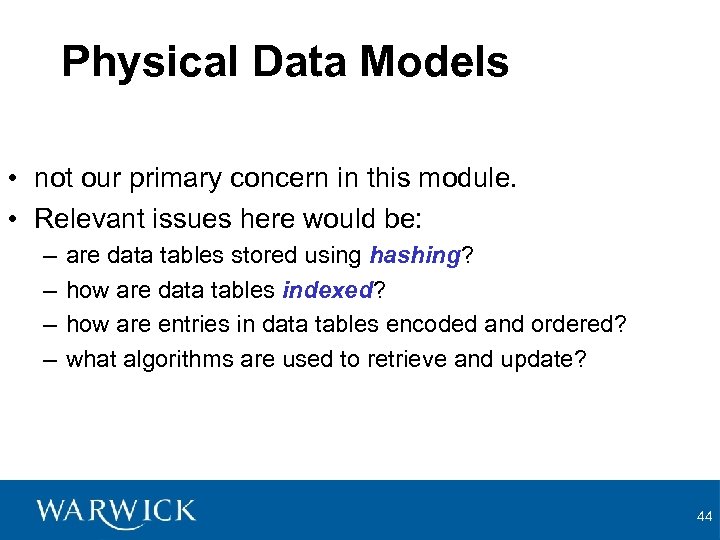
Physical Data Models • not our primary concern in this module. • Relevant issues here would be: – – are data tables stored using hashing? how are data tables indexed? how are entries in data tables encoded and ordered? what algorithms are used to retrieve and update? 44
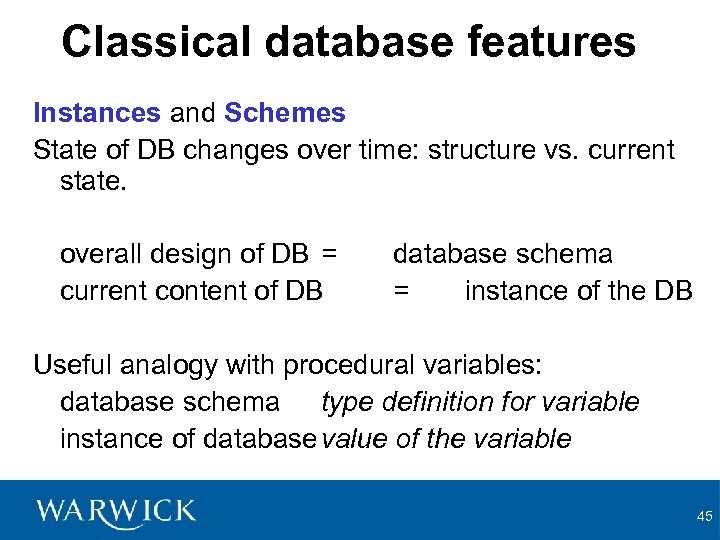
Classical database features Instances and Schemes State of DB changes over time: structure vs. current state. overall design of DB = current content of DB database schema = instance of the DB Useful analogy with procedural variables: database schema type definition for variable instance of databasevalue of the variable 45
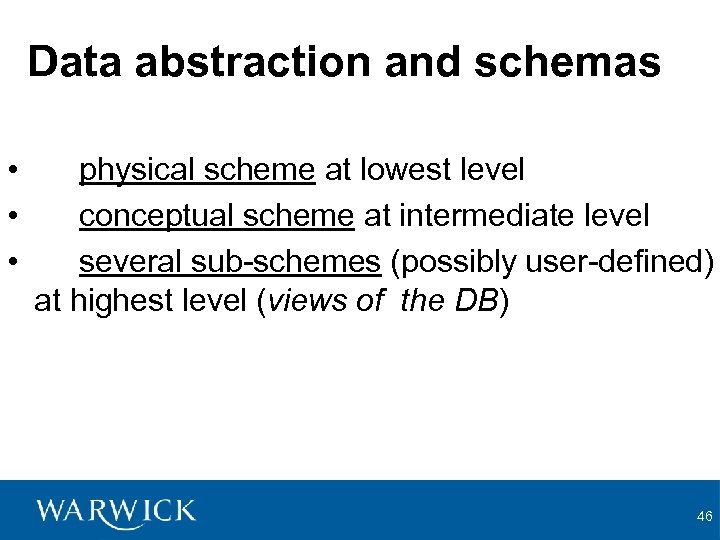
Data abstraction and schemas • • • physical scheme at lowest level conceptual scheme at intermediate level several sub-schemes (possibly user-defined) at highest level (views of the DB) 46
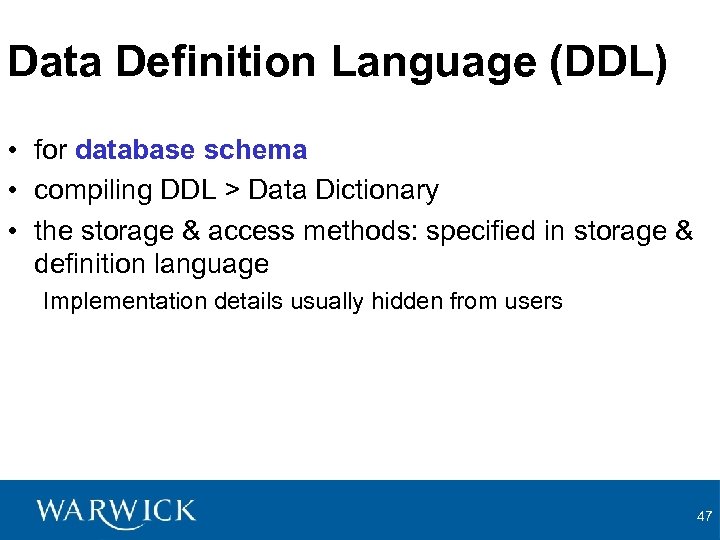
Data Definition Language (DDL) • for database schema • compiling DDL > Data Dictionary • the storage & access methods: specified in storage & definition language Implementation details usually hidden from users 47
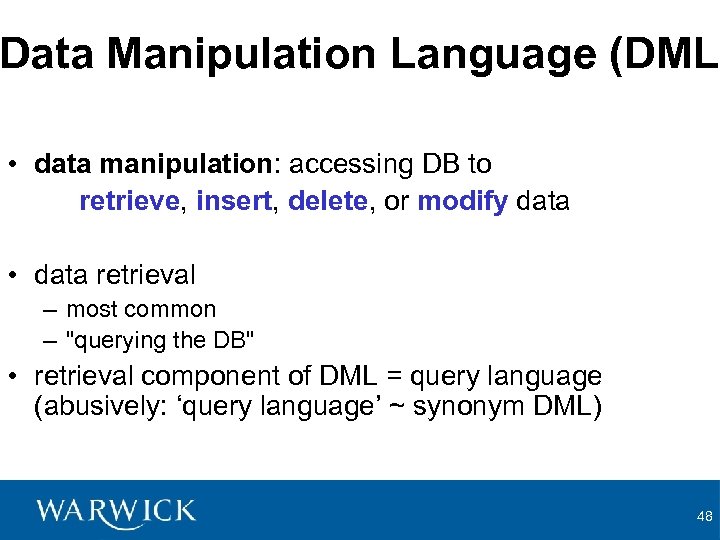
Data Manipulation Language (DML) • data manipulation: accessing DB to retrieve, insert, delete, or modify data • data retrieval – most common – "querying the DB" • retrieval component of DML = query language (abusively: ‘query language’ ~ synonym DML) 48
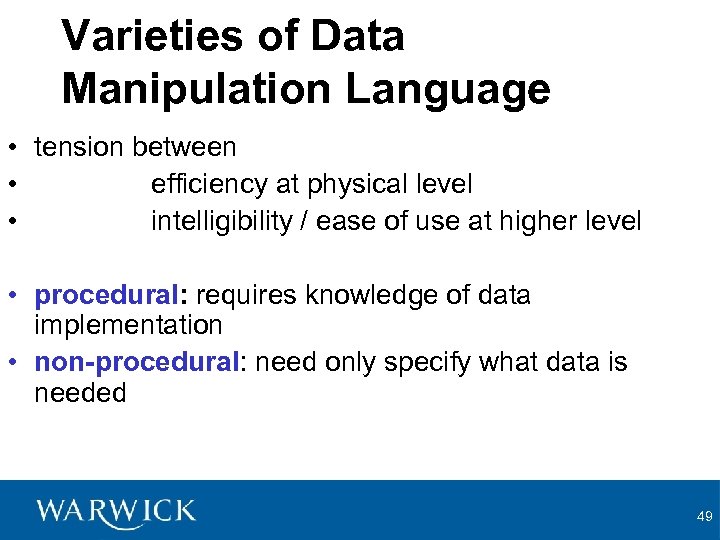
Varieties of Data Manipulation Language • tension between • efficiency at physical level • intelligibility / ease of use at higher level • procedural: requires knowledge of data implementation • non-procedural: need only specify what data is needed 49
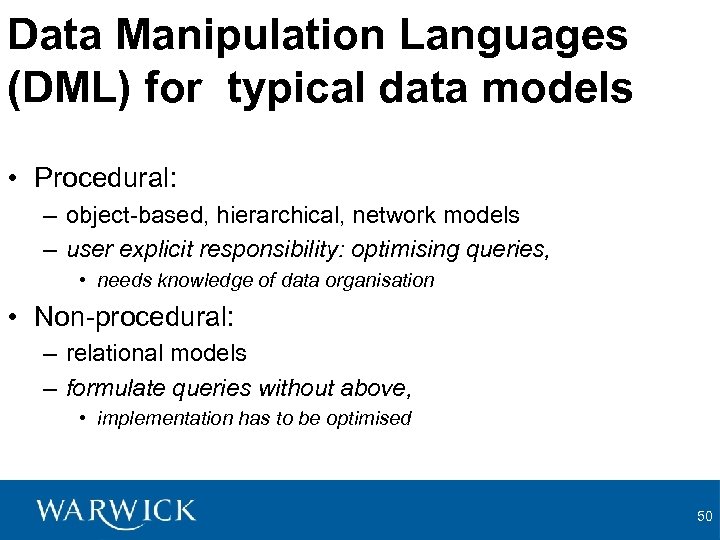
Data Manipulation Languages (DML) for typical data models • Procedural: – object-based, hierarchical, network models – user explicit responsibility: optimising queries, • needs knowledge of data organisation • Non-procedural: – relational models – formulate queries without above, • implementation has to be optimised 50
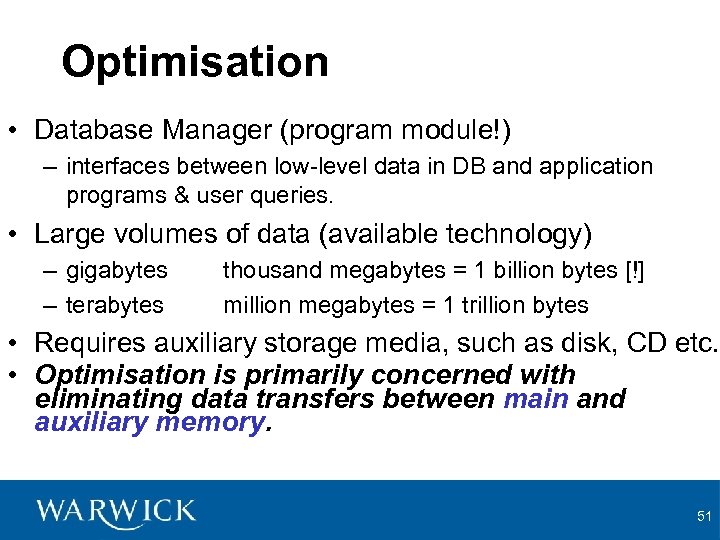
Optimisation • Database Manager (program module!) – interfaces between low-level data in DB and application programs & user queries. • Large volumes of data (available technology) – gigabytes – terabytes thousand megabytes = 1 billion bytes [!] million megabytes = 1 trillion bytes • Requires auxiliary storage media, such as disk, CD etc. • Optimisation is primarily concerned with eliminating data transfers between main and auxiliary memory. 51
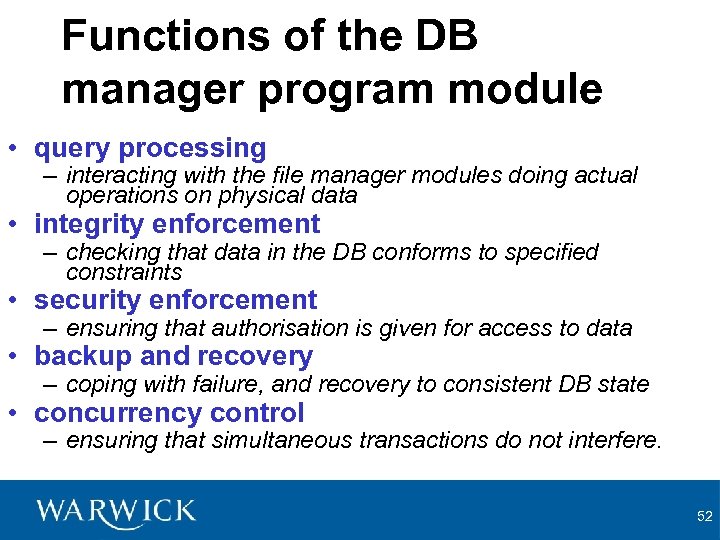
Functions of the DB manager program module • query processing – interacting with the file manager modules doing actual operations on physical data • integrity enforcement – checking that data in the DB conforms to specified constraints • security enforcement – ensuring that authorisation is given for access to data • backup and recovery – coping with failure, and recovery to consistent DB state • concurrency control – ensuring that simultaneous transactions do not interfere. 52
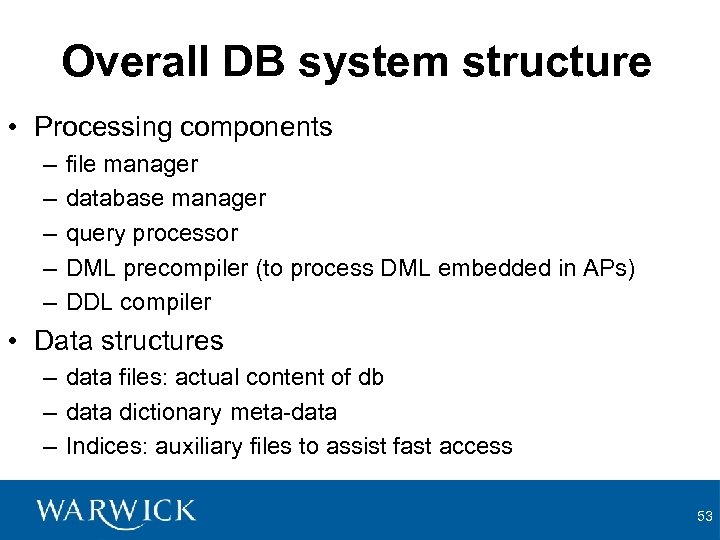
Overall DB system structure • Processing components – – – file manager database manager query processor DML precompiler (to process DML embedded in APs) DDL compiler • Data structures – data files: actual content of db – data dictionary meta-data – Indices: auxiliary files to assist fast access 53
Summary • We have revisited and reconsidered the generalities of database systems – Background of appearance – Main problems they try to solve – Components & languages 54
… to follow How to reason with Integrity Enforcements (Constraints): Functional Dependencies (FDs) applied 55
• Questions? 56
Скачать презентацию CS 319 Theory of Databases Generalities Dr Alexandra
5c8797f16645cd690a61ecf651e3ab5a.ppt