 Скачать презентацию CS 276 B Web Search and Mining Lecture
1a3e1d7e8df09f8b4cbda51628f495c0.ppt
- Количество слайдов: 59




CS 276 B Web Search and Mining Lecture 10 Text Mining I Feb 8, 2005 (includes slides borrowed from Marti Hearst) 1
Text Mining n Today n n Introduction Lexicon construction Topic Detection and Tracking Future n n Two more text mining lectures Question Answering Summarization … and more 2
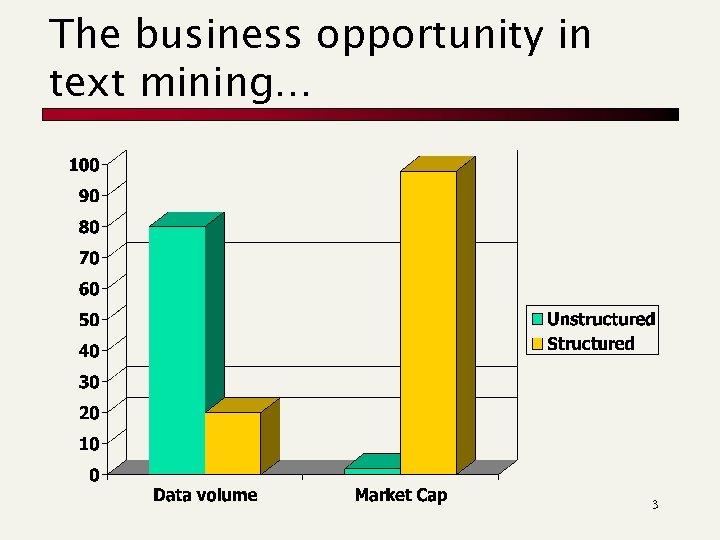
The business opportunity in text mining… 3
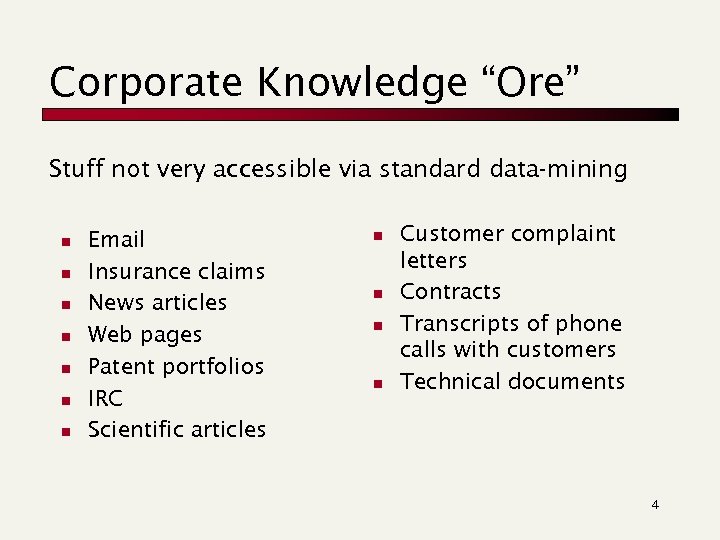
Corporate Knowledge “Ore” Stuff not very accessible via standard data-mining n n n n Email Insurance claims News articles Web pages Patent portfolios IRC Scientific articles n n Customer complaint letters Contracts Transcripts of phone calls with customers Technical documents 4
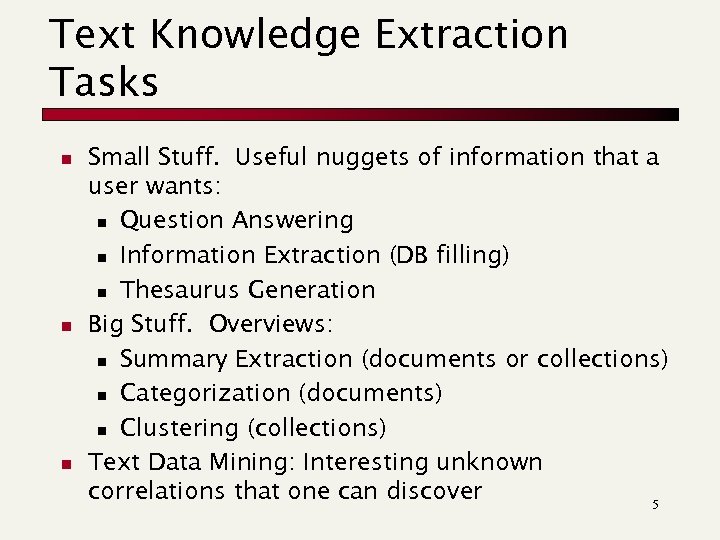
Text Knowledge Extraction Tasks n n n Small Stuff. Useful nuggets of information that a user wants: n Question Answering n Information Extraction (DB filling) n Thesaurus Generation Big Stuff. Overviews: n Summary Extraction (documents or collections) n Categorization (documents) n Clustering (collections) Text Data Mining: Interesting unknown correlations that one can discover 5
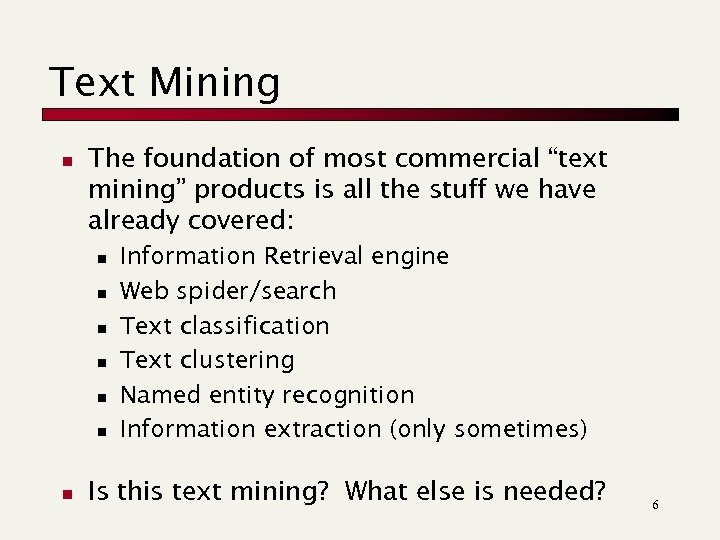
Text Mining n The foundation of most commercial “text mining” products is all the stuff we have already covered: n n n n Information Retrieval engine Web spider/search Text classification Text clustering Named entity recognition Information extraction (only sometimes) Is this text mining? What else is needed? 6
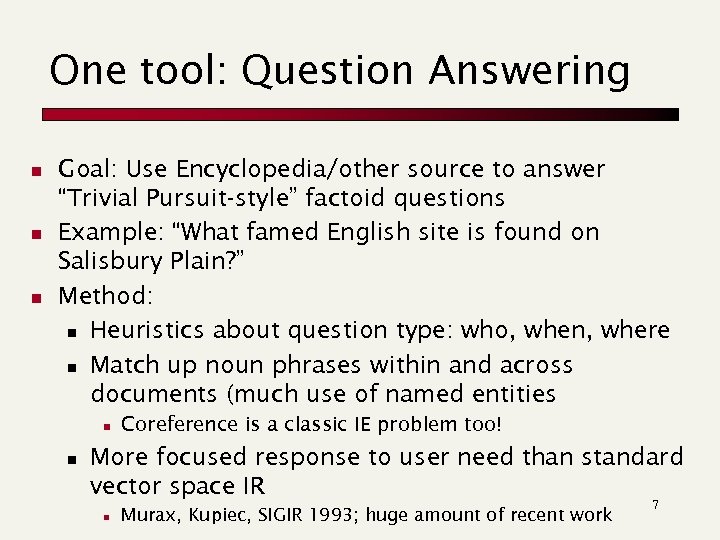
One tool: Question Answering n n n Goal: Use Encyclopedia/other source to answer “Trivial Pursuit-style” factoid questions Example: “What famed English site is found on Salisbury Plain? ” Method: n Heuristics about question type: who, when, where n Match up noun phrases within and across documents (much use of named entities n n Coreference is a classic IE problem too! More focused response to user need than standard vector space IR n Murax, Kupiec, SIGIR 1993; huge amount of recent work 7
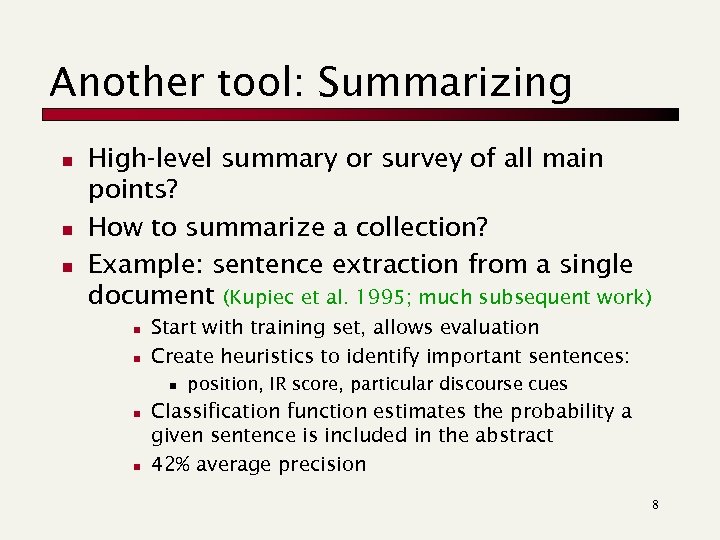
Another tool: Summarizing n n n High-level summary or survey of all main points? How to summarize a collection? Example: sentence extraction from a single document (Kupiec et al. 1995; much subsequent work) n n Start with training set, allows evaluation Create heuristics to identify important sentences: n n n position, IR score, particular discourse cues Classification function estimates the probability a given sentence is included in the abstract 42% average precision 8
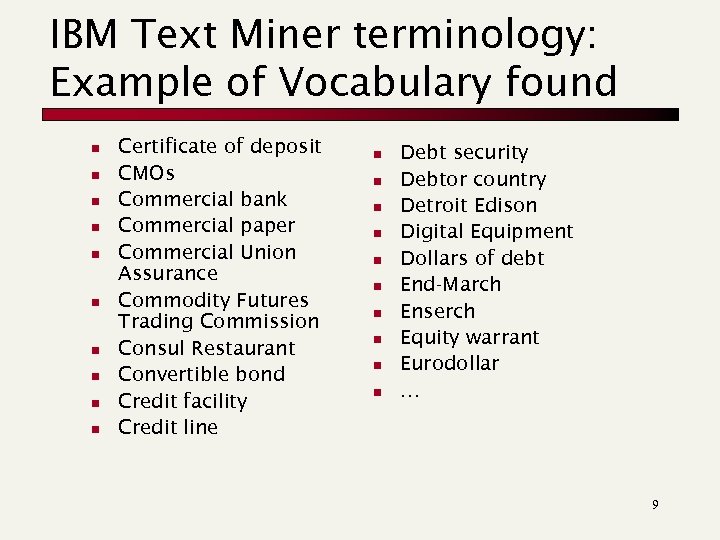
IBM Text Miner terminology: Example of Vocabulary found n n n n n Certificate of deposit CMOs Commercial bank Commercial paper Commercial Union Assurance Commodity Futures Trading Commission Consul Restaurant Convertible bond Credit facility Credit line n n n n n Debt security Debtor country Detroit Edison Digital Equipment Dollars of debt End-March Enserch Equity warrant Eurodollar … 9
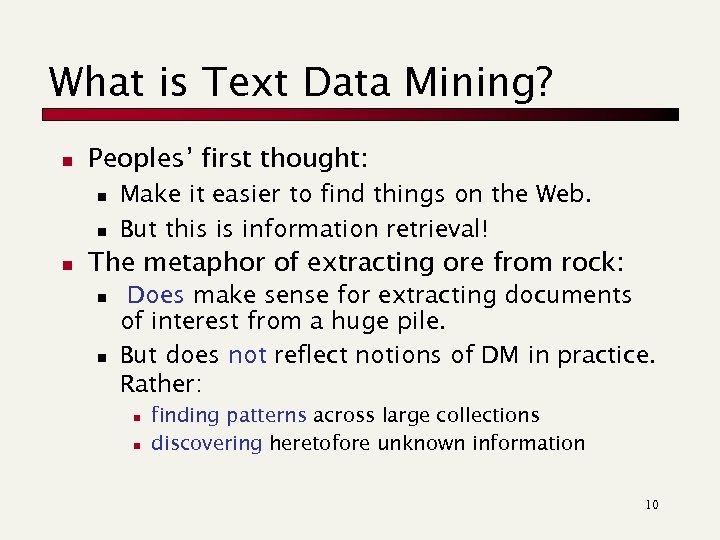
What is Text Data Mining? n Peoples’ first thought: n n n Make it easier to find things on the Web. But this is information retrieval! The metaphor of extracting ore from rock: n n Does make sense for extracting documents of interest from a huge pile. But does not reflect notions of DM in practice. Rather: n n finding patterns across large collections discovering heretofore unknown information 10
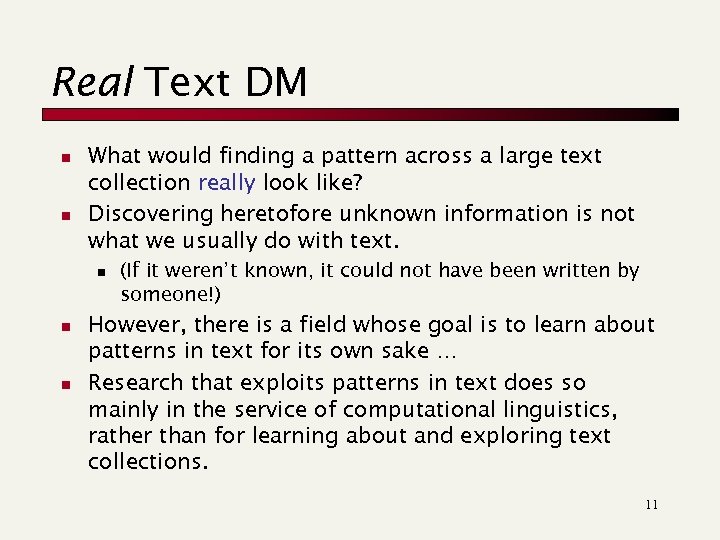
Real Text DM n n What would finding a pattern across a large text collection really look like? Discovering heretofore unknown information is not what we usually do with text. n n n (If it weren’t known, it could not have been written by someone!) However, there is a field whose goal is to learn about patterns in text for its own sake … Research that exploits patterns in text does so mainly in the service of computational linguistics, rather than for learning about and exploring text collections. 11
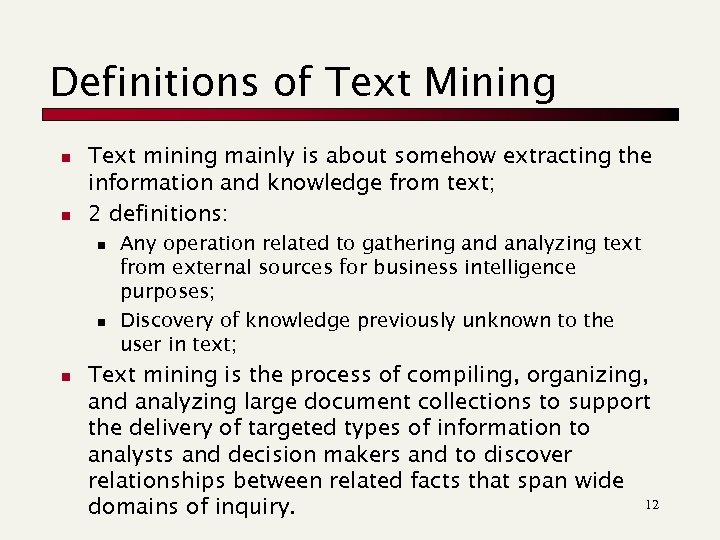
Definitions of Text Mining n n Text mining mainly is about somehow extracting the information and knowledge from text; 2 definitions: n n n Any operation related to gathering and analyzing text from external sources for business intelligence purposes; Discovery of knowledge previously unknown to the user in text; Text mining is the process of compiling, organizing, and analyzing large document collections to support the delivery of targeted types of information to analysts and decision makers and to discover relationships between related facts that span wide 12 domains of inquiry.
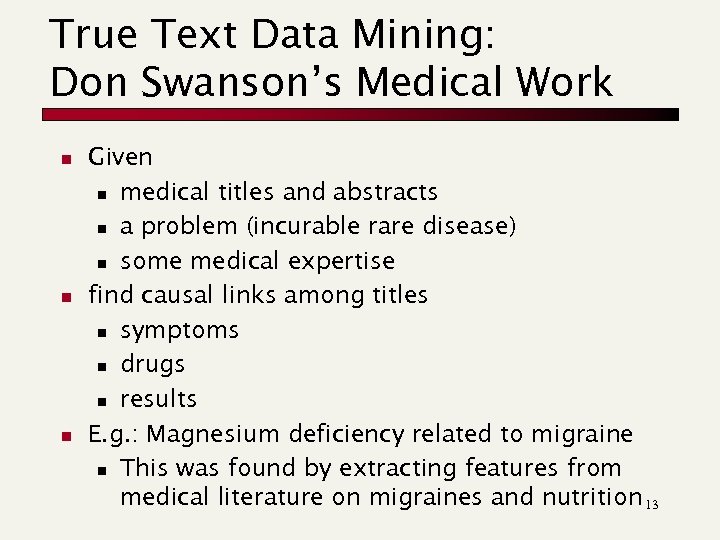
True Text Data Mining: Don Swanson’s Medical Work n n n Given n medical titles and abstracts n a problem (incurable rare disease) n some medical expertise find causal links among titles n symptoms n drugs n results E. g. : Magnesium deficiency related to migraine n This was found by extracting features from medical literature on migraines and nutrition 13
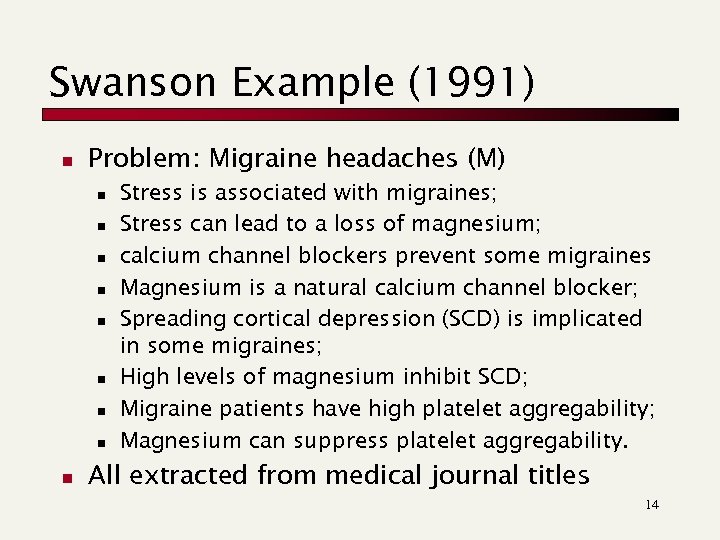
Swanson Example (1991) n Problem: Migraine headaches (M) n n n n n Stress is associated with migraines; Stress can lead to a loss of magnesium; calcium channel blockers prevent some migraines Magnesium is a natural calcium channel blocker; Spreading cortical depression (SCD) is implicated in some migraines; High levels of magnesium inhibit SCD; Migraine patients have high platelet aggregability; Magnesium can suppress platelet aggregability. All extracted from medical journal titles 14
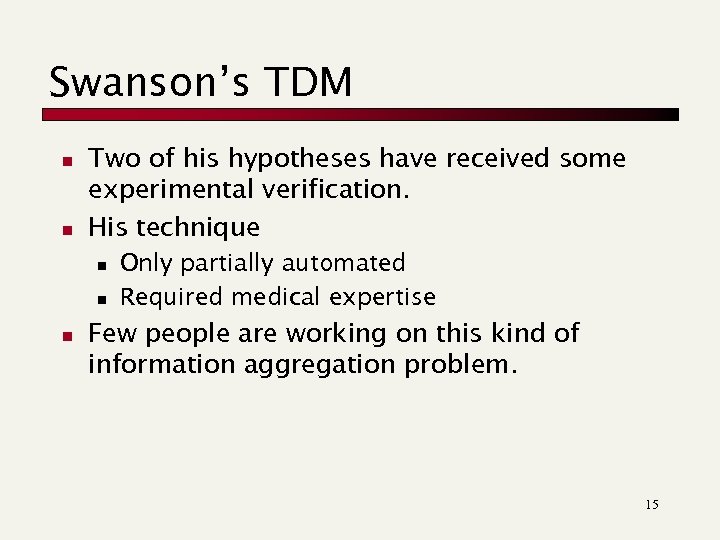
Swanson’s TDM n n Two of his hypotheses have received some experimental verification. His technique n n n Only partially automated Required medical expertise Few people are working on this kind of information aggregation problem. 15
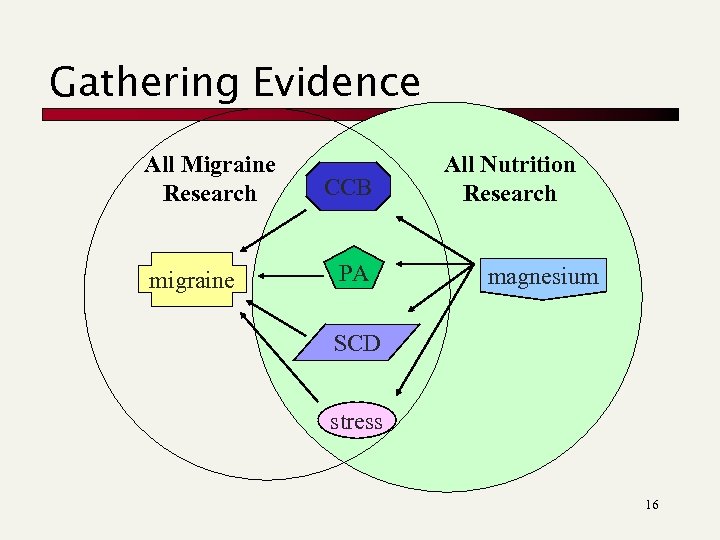
Gathering Evidence All Migraine Research migraine CCB PA All Nutrition Research magnesium SCD stress 16
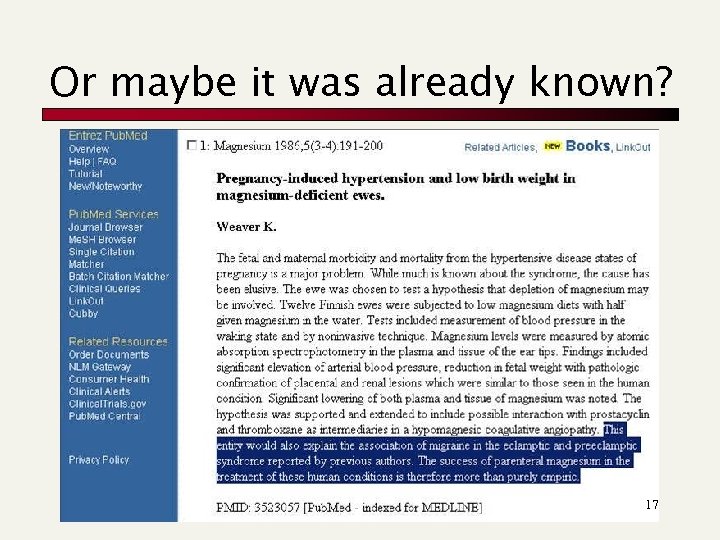
Or maybe it was already known? 17

Lexicon Construction 18
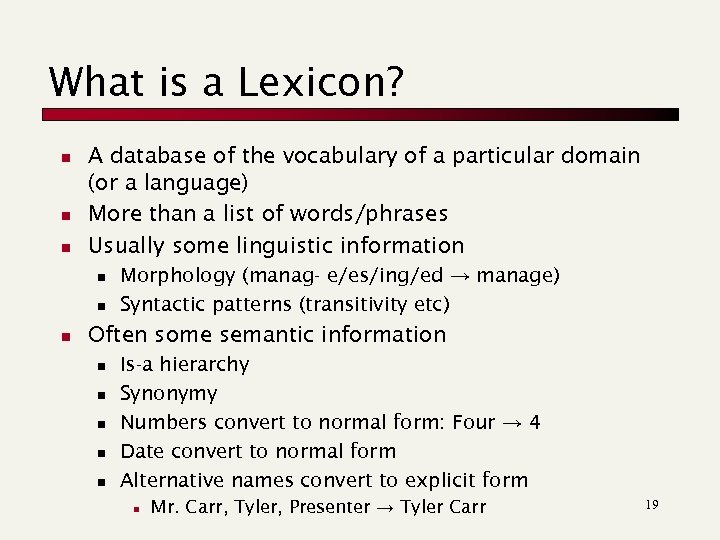
What is a Lexicon? n n n A database of the vocabulary of a particular domain (or a language) More than a list of words/phrases Usually some linguistic information n Morphology (manag- e/es/ing/ed → manage) Syntactic patterns (transitivity etc) Often some semantic information n n Is-a hierarchy Synonymy Numbers convert to normal form: Four → 4 Date convert to normal form Alternative names convert to explicit form n Mr. Carr, Tyler, Presenter → Tyler Carr 19
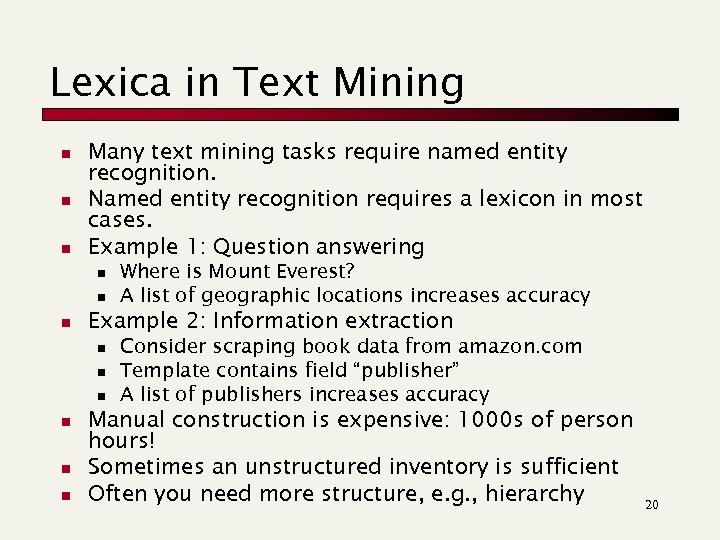
Lexica in Text Mining n n n Many text mining tasks require named entity recognition. Named entity recognition requires a lexicon in most cases. Example 1: Question answering n n n Example 2: Information extraction n n n Where is Mount Everest? A list of geographic locations increases accuracy Consider scraping book data from amazon. com Template contains field “publisher” A list of publishers increases accuracy Manual construction is expensive: 1000 s of person hours! Sometimes an unstructured inventory is sufficient Often you need more structure, e. g. , hierarchy 20
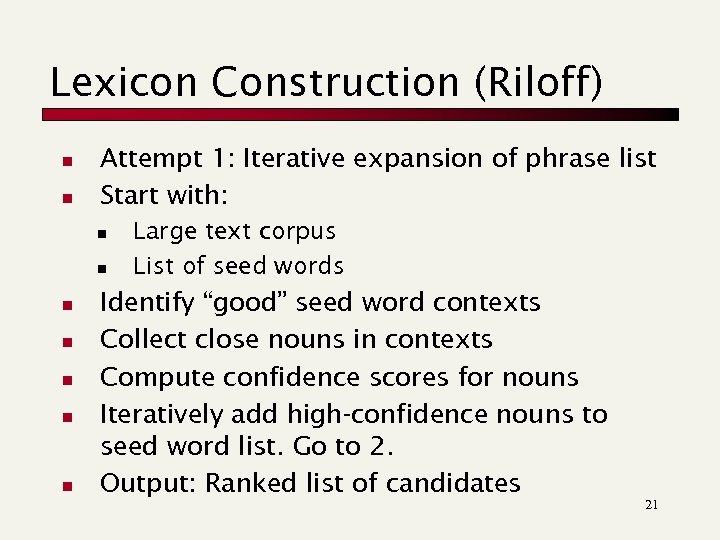
Lexicon Construction (Riloff) n n Attempt 1: Iterative expansion of phrase list Start with: n n n n Large text corpus List of seed words Identify “good” seed word contexts Collect close nouns in contexts Compute confidence scores for nouns Iteratively add high-confidence nouns to seed word list. Go to 2. Output: Ranked list of candidates 21
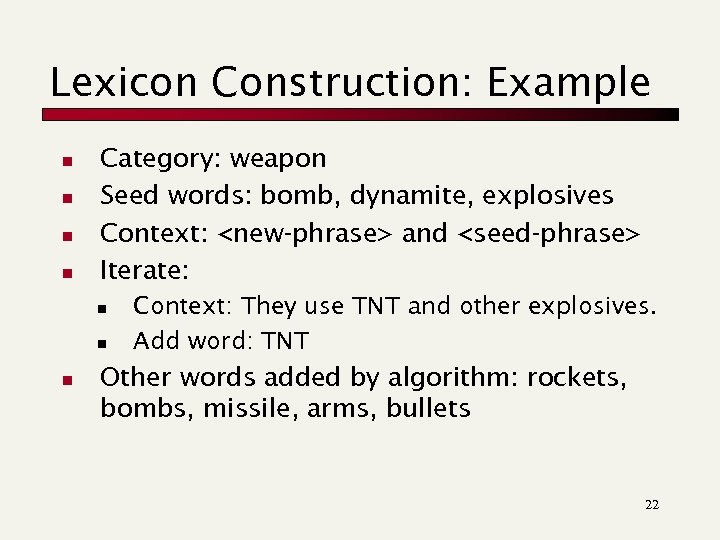
Lexicon Construction: Example n n Category: weapon Seed words: bomb, dynamite, explosives Context: <new-phrase> and <seed-phrase> Iterate: n n n Context: They use TNT and other explosives. Add word: TNT Other words added by algorithm: rockets, bombs, missile, arms, bullets 22
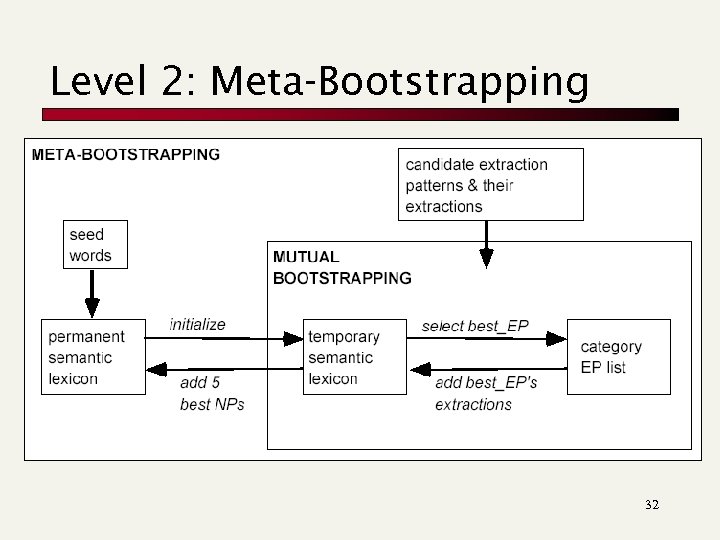
Lexicon Construction: Attempt 2 n n Multilevel bootstrapping (Riloff and Jones 1999) Generate two data structures in parallel n n n The lexicon A list of extraction patterns Input as before n n Corpus (not annotated) List of seed words 23
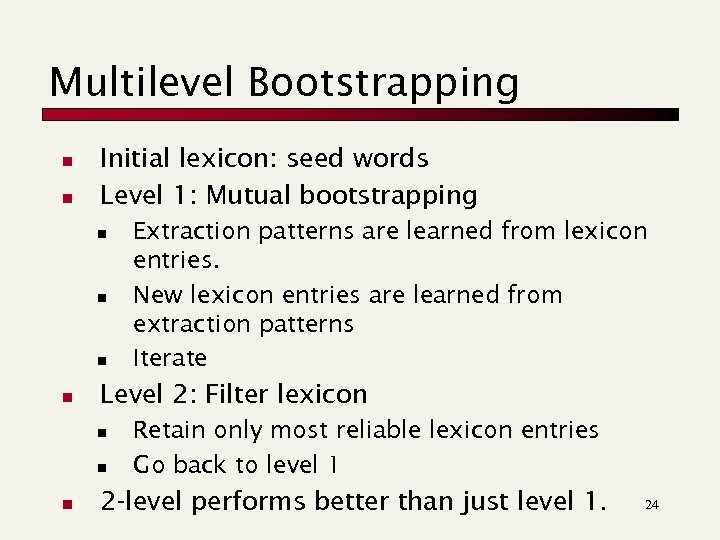
Multilevel Bootstrapping n n Initial lexicon: seed words Level 1: Mutual bootstrapping n n Level 2: Filter lexicon n Extraction patterns are learned from lexicon entries. New lexicon entries are learned from extraction patterns Iterate Retain only most reliable lexicon entries Go back to level 1 2 -level performs better than just level 1. 24
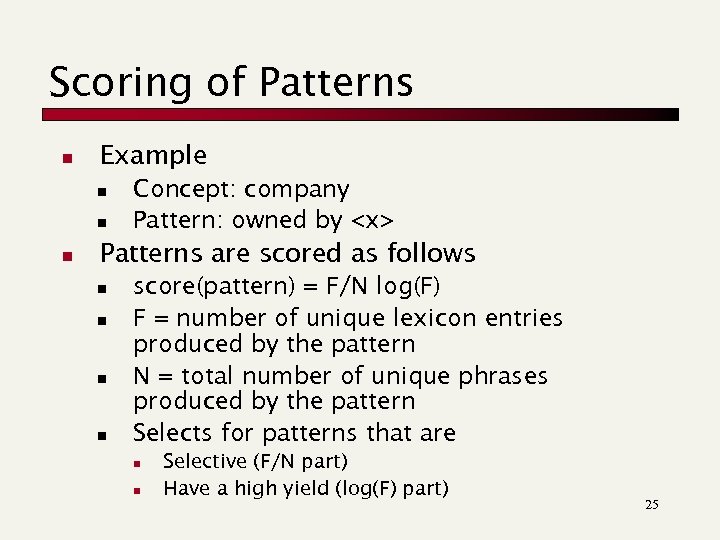
Scoring of Patterns n Example n n n Concept: company Pattern: owned by <x> Patterns are scored as follows n n score(pattern) = F/N log(F) F = number of unique lexicon entries produced by the pattern N = total number of unique phrases produced by the pattern Selects for patterns that are n n Selective (F/N part) Have a high yield (log(F) part) 25
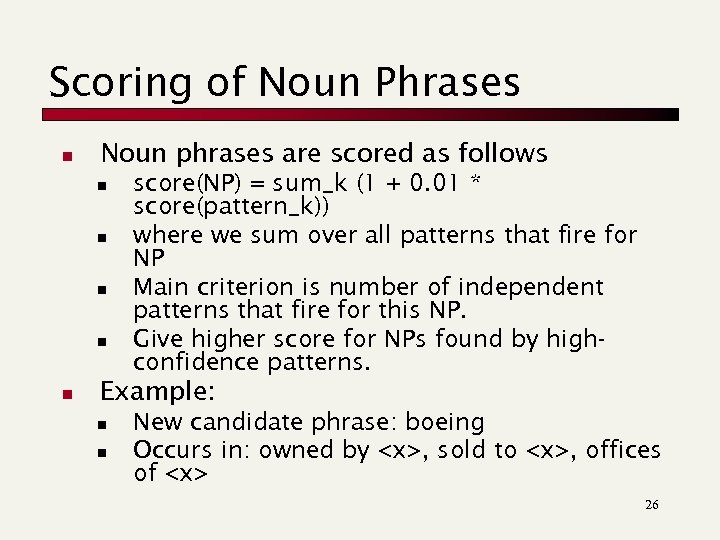
Scoring of Noun Phrases n Noun phrases are scored as follows n n n score(NP) = sum_k (1 + 0. 01 * score(pattern_k)) where we sum over all patterns that fire for NP Main criterion is number of independent patterns that fire for this NP. Give higher score for NPs found by highconfidence patterns. Example: n n New candidate phrase: boeing Occurs in: owned by <x>, sold to <x>, offices of <x> 26
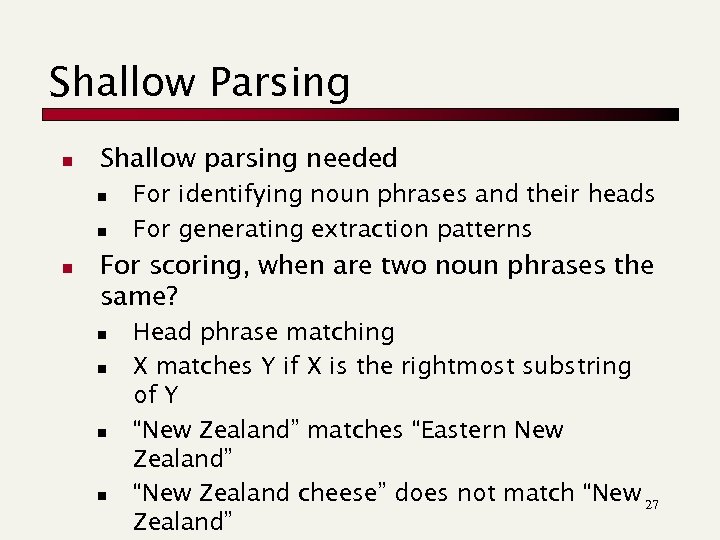
Shallow Parsing n Shallow parsing needed n n n For identifying noun phrases and their heads For generating extraction patterns For scoring, when are two noun phrases the same? n n Head phrase matching X matches Y if X is the rightmost substring of Y “New Zealand” matches “Eastern New Zealand” “New Zealand cheese” does not match “New 27 Zealand”
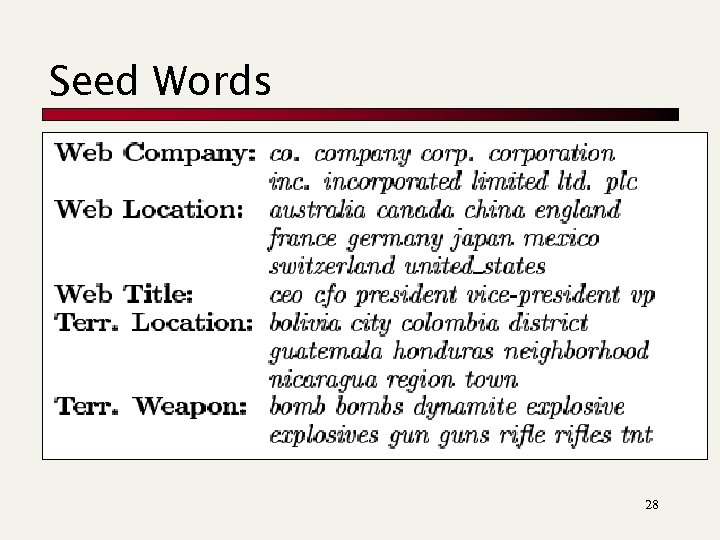
Seed Words 28
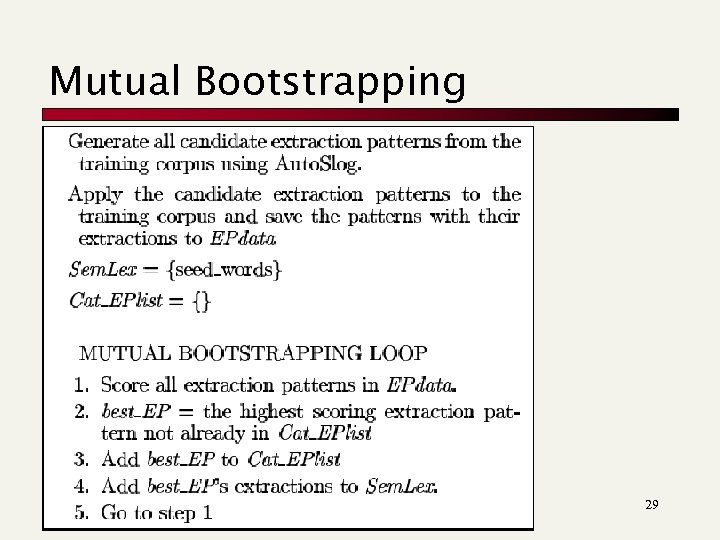
Mutual Bootstrapping 29
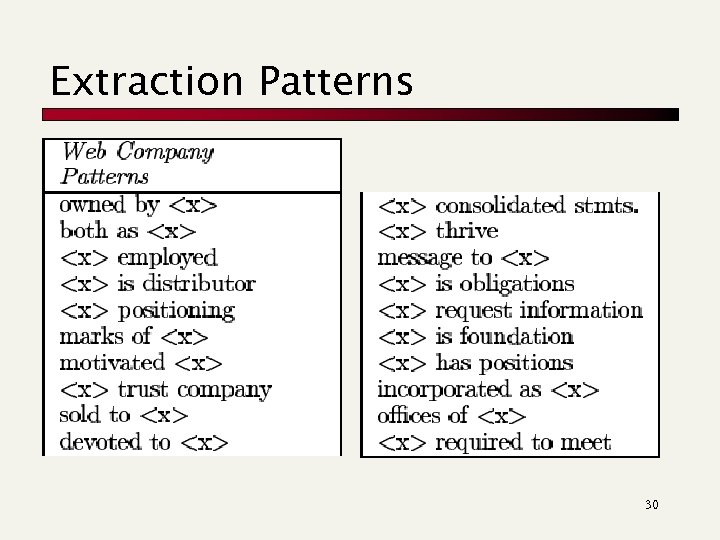
Extraction Patterns 30
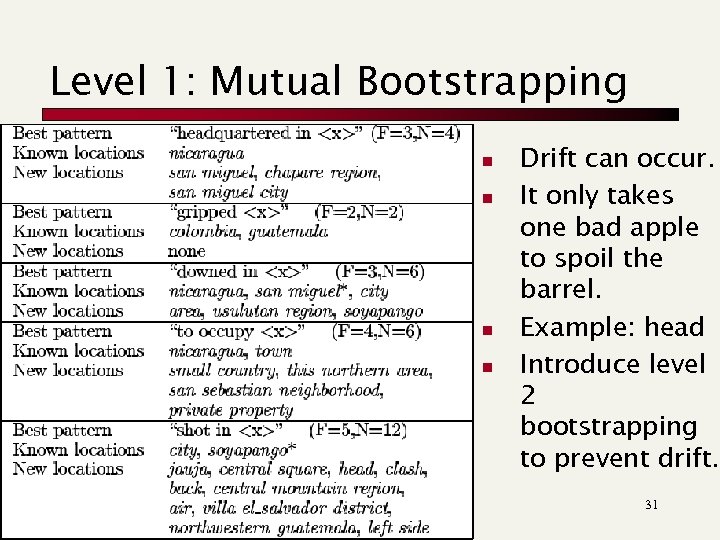
Level 1: Mutual Bootstrapping n n Drift can occur. It only takes one bad apple to spoil the barrel. Example: head Introduce level 2 bootstrapping to prevent drift. 31
Level 2: Meta-Bootstrapping 32
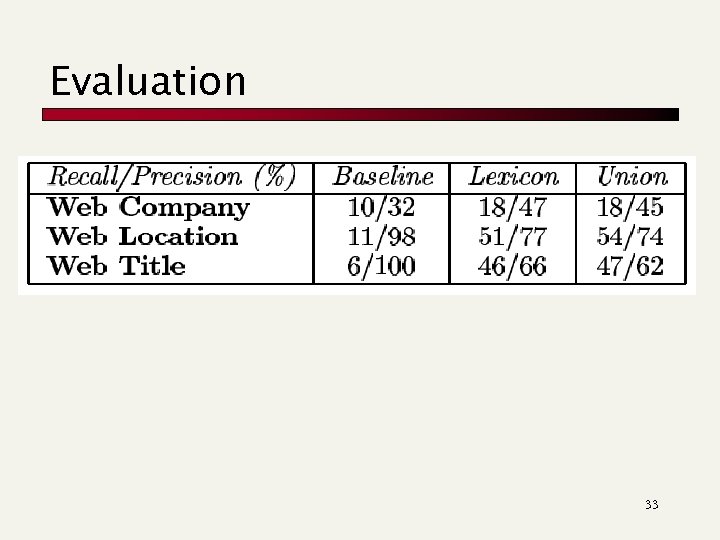
Evaluation 33
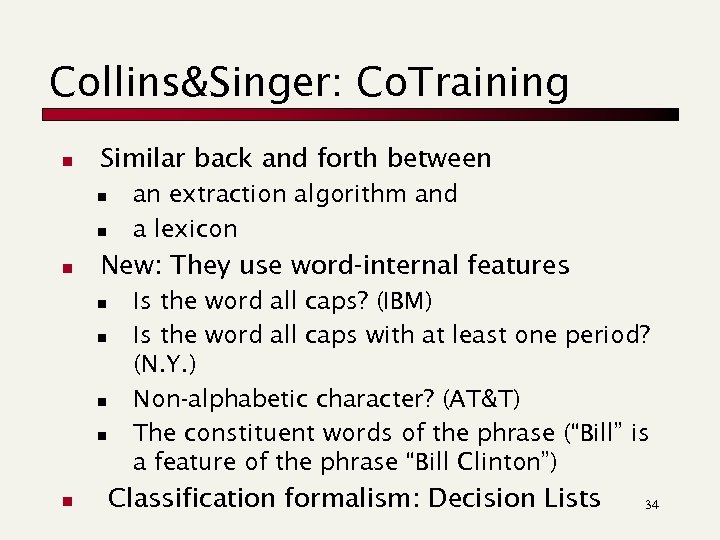
Collins&Singer: Co. Training n Similar back and forth between n New: They use word-internal features n n n an extraction algorithm and a lexicon Is the word all caps? (IBM) Is the word all caps with at least one period? (N. Y. ) Non-alphabetic character? (AT&T) The constituent words of the phrase (“Bill” is a feature of the phrase “Bill Clinton”) Classification formalism: Decision Lists 34
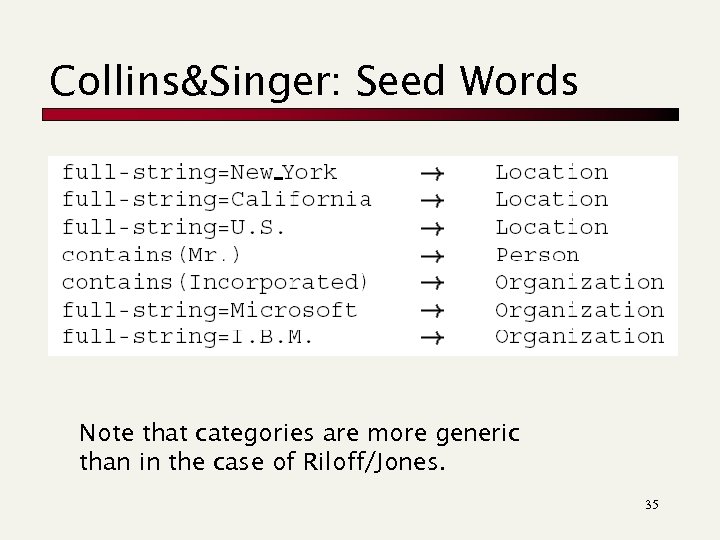
Collins&Singer: Seed Words Note that categories are more generic than in the case of Riloff/Jones. 35
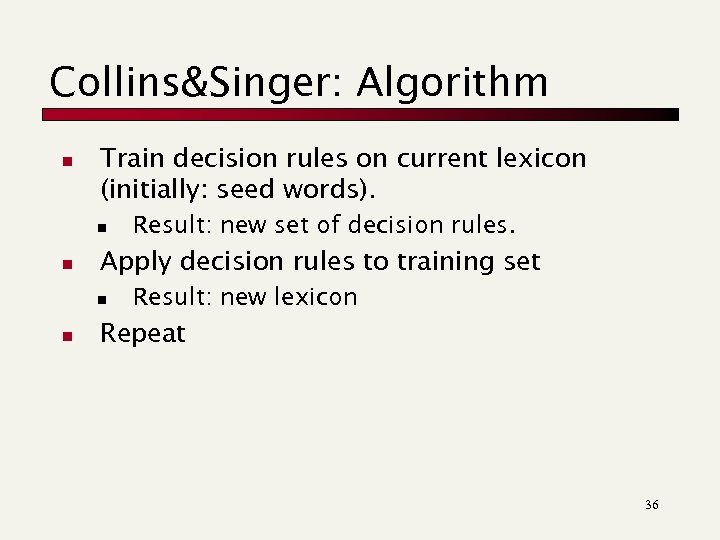
Collins&Singer: Algorithm n Train decision rules on current lexicon (initially: seed words). n n Apply decision rules to training set n n Result: new set of decision rules. Result: new lexicon Repeat 36
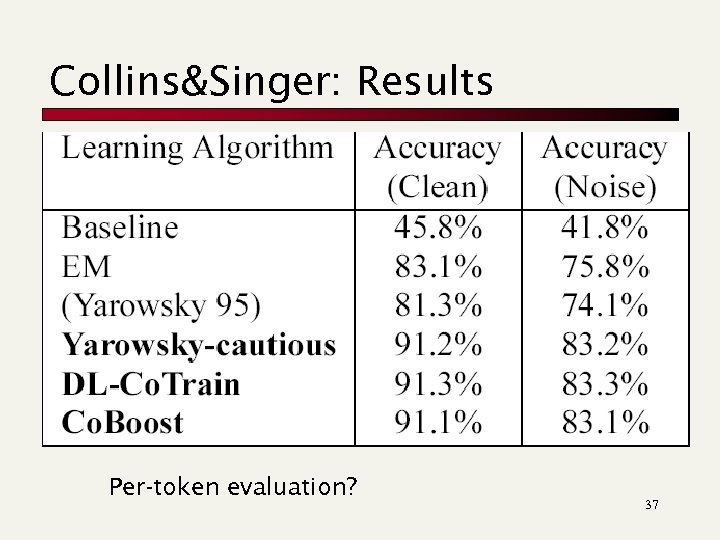
Collins&Singer: Results Per-token evaluation? 37
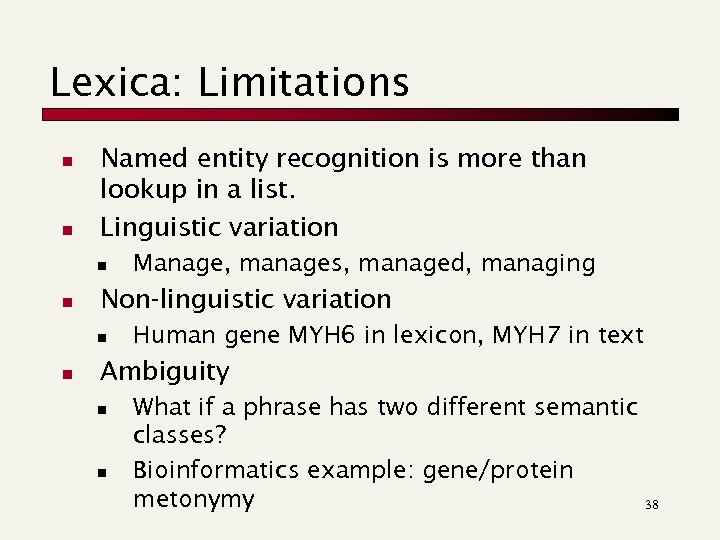
Lexica: Limitations n n Named entity recognition is more than lookup in a list. Linguistic variation n n Non-linguistic variation n n Manage, manages, managed, managing Human gene MYH 6 in lexicon, MYH 7 in text Ambiguity n n What if a phrase has two different semantic classes? Bioinformatics example: gene/protein metonymy 38
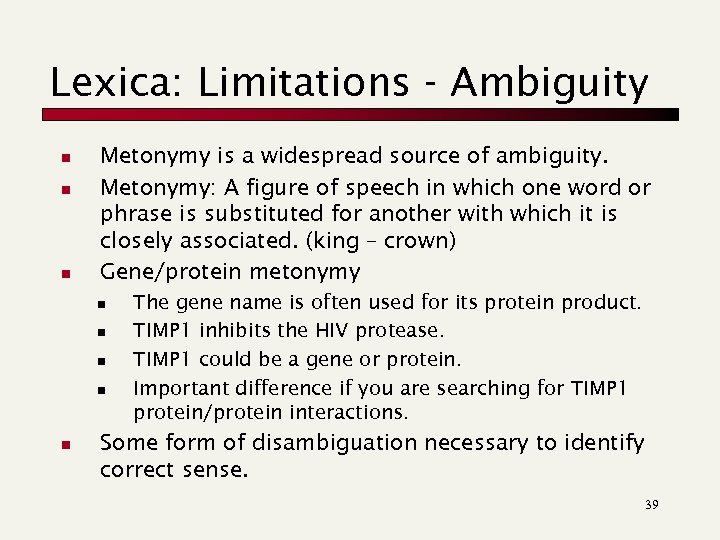
Lexica: Limitations - Ambiguity n n n Metonymy is a widespread source of ambiguity. Metonymy: A figure of speech in which one word or phrase is substituted for another with which it is closely associated. (king – crown) Gene/protein metonymy n n n The gene name is often used for its protein product. TIMP 1 inhibits the HIV protease. TIMP 1 could be a gene or protein. Important difference if you are searching for TIMP 1 protein/protein interactions. Some form of disambiguation necessary to identify correct sense. 39
Discussion Partial resources often available. n n n E. g. , you have a gazetteer, you want to extend it to a new geographic area. Some manual post-editing necessary for high-quality. Semi-automated approaches offer good coverage with much reduced human effort. Drift not a problem in practice if there is a human in the loop anyway. Approach that can deal with diverse evidence preferable. Hand-crafted features (period for “N. Y. ”) help a lot. 40
Terminology Acquisition n n Goal: find heretofore unknown noun phrases in a text corpus (similar to lexicon construction) Lexicon construction n Emphasis on finding noun phrases in a specific semantic class (companies) Application: Information extraction Terminology Acquisition n n Emphasis on term normalization (e. g. , viral and bacterial infections -> viral_infection) Applications: translation dictionaries, information retrieval 41
References n n n n Julian Kupiec Jan Pedersen, and Francine Chen. A trainable , document summarizer. http: //citeseer. nj. nec. com/kupiec 95 trainable. html Julian Kupiec. Murax: A robust linguistic approach for question answering using an on-line encyclopedia. In the Proceedings of 16 th SIGIR Conference, Pittsburgh, PA, 2001. Don R. Swanson: Analysis of Unintended Connections Between Disjoint Science Literatures. SIGIR 1991: 280 -289 Tim Berners Lee on semantic web: http: //www. sciam. com/ 2001/0501 issue/0501 berners-lee. html http: //www. xml. com/pub/a/2001/01/24/rdf. html Learning Dictionaries for Information Extraction by Multi-Level Bootstrapping (1999) Ellen Riloff, Rosie Jones. Proceedings of the Sixteenth National Conference on Artificial Intelligence Unsupervised Models for Named Entity Classification 42 (1999) Michael Collins, Yoram Singer
First Story Detection 43
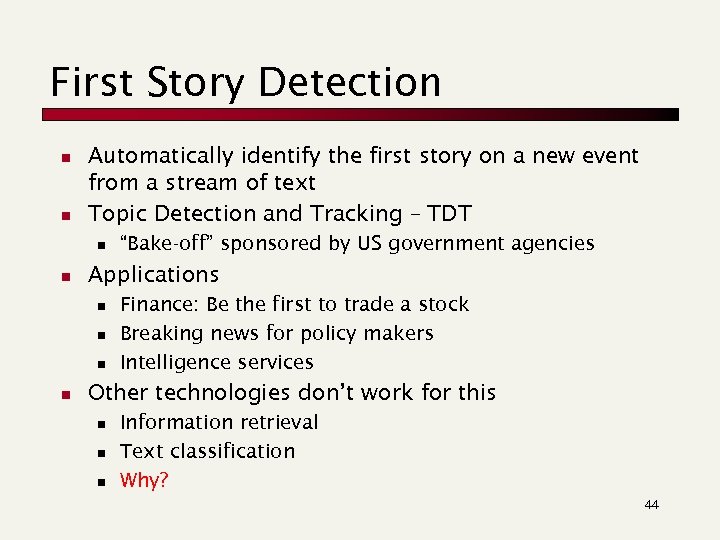
First Story Detection n n Automatically identify the first story on a new event from a stream of text Topic Detection and Tracking – TDT n n Applications n n “Bake-off” sponsored by US government agencies Finance: Be the first to trade a stock Breaking news for policy makers Intelligence services Other technologies don’t work for this n n n Information retrieval Text classification Why? 44
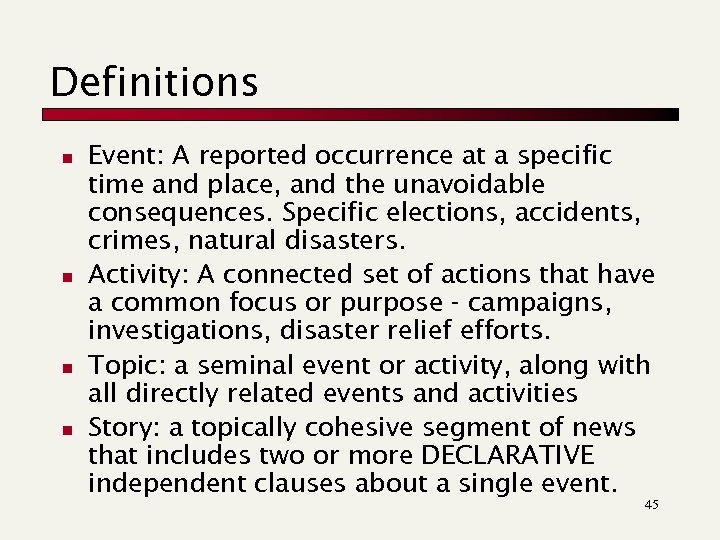
Definitions n n Event: A reported occurrence at a specific time and place, and the unavoidable consequences. Specific elections, accidents, crimes, natural disasters. Activity: A connected set of actions that have a common focus or purpose - campaigns, investigations, disaster relief efforts. Topic: a seminal event or activity, along with all directly related events and activities Story: a topically cohesive segment of news that includes two or more DECLARATIVE independent clauses about a single event. 45
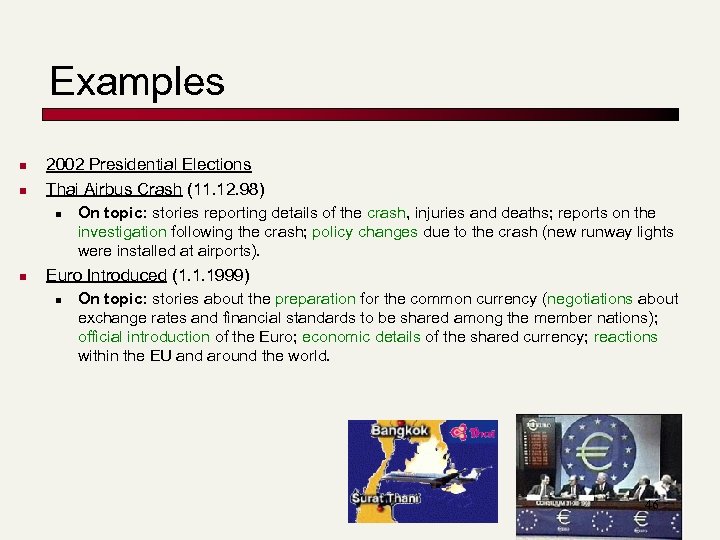
Examples n n 2002 Presidential Elections Thai Airbus Crash (11. 12. 98) n n On topic: stories reporting details of the crash, injuries and deaths; reports on the investigation following the crash; policy changes due to the crash (new runway lights were installed at airports). Euro Introduced (1. 1. 1999) n On topic: stories about the preparation for the common currency (negotiations about exchange rates and financial standards to be shared among the member nations); official introduction of the Euro; economic details of the shared currency; reactions within the EU and around the world. 46
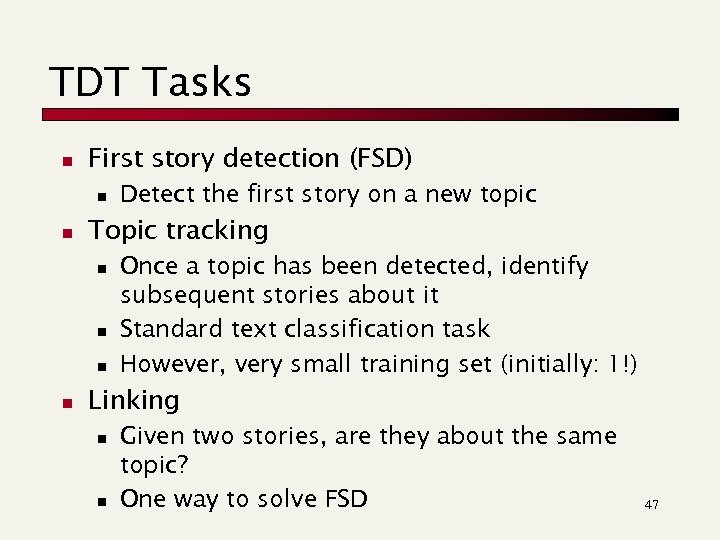
TDT Tasks n First story detection (FSD) n n Topic tracking n n Detect the first story on a new topic Once a topic has been detected, identify subsequent stories about it Standard text classification task However, very small training set (initially: 1!) Linking n n Given two stories, are they about the same topic? One way to solve FSD 47
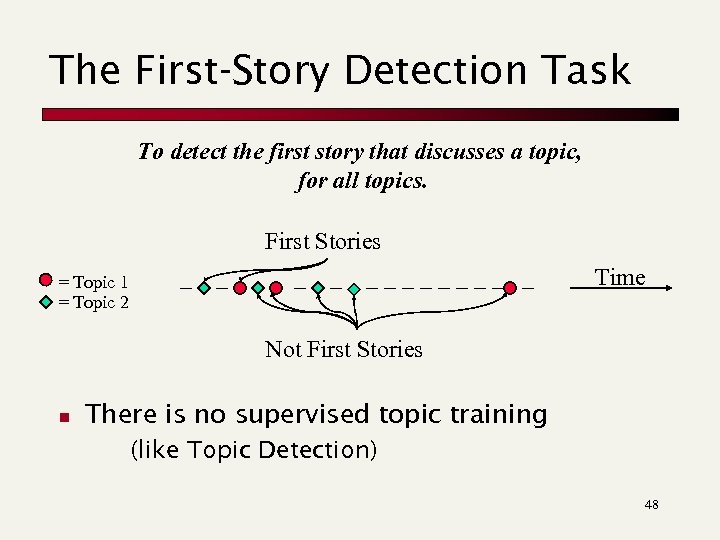
The First-Story Detection Task To detect the first story that discusses a topic, for all topics. First Stories Time = Topic 1 = Topic 2 Not First Stories n There is no supervised topic training (like Topic Detection) 48
First Story Detection n n n New event detection is an unsupervised learning task Detection may consist of discovering previously unidentified events in an accumulated collection – retro Flagging onset of new events from live news feeds in an on-line fashion Lack of advance knowledge of new events, but have access to unlabeled historical data as a contrast set The input to on-line detection is the stream of TDT stories in chronological order simulating real-time incoming documents The output of on-line detection is a YES/NO decision per document 49
Patterns in Event Distributions n n News stories discussing the same event tend to be temporally proximate A time gap between burst of topically similar stories is often an indication of different events n n Different earthquakes Airplane accidents A significant vocabulary shift and rapid changes in term frequency are typical of stories reporting a new event, including previously unseen proper nouns Events are typically reported in a relatively brief time window of 1 - 4 weeks 50
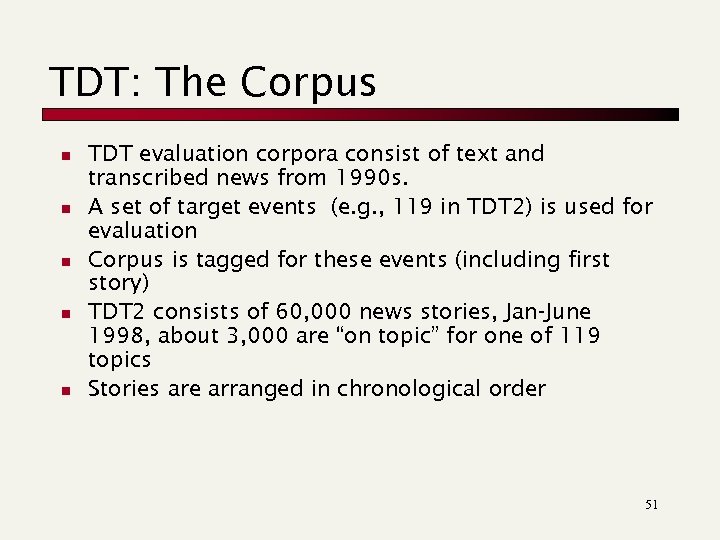
TDT: The Corpus n n n TDT evaluation corpora consist of text and transcribed news from 1990 s. A set of target events (e. g. , 119 in TDT 2) is used for evaluation Corpus is tagged for these events (including first story) TDT 2 consists of 60, 000 news stories, Jan-June 1998, about 3, 000 are “on topic” for one of 119 topics Stories are arranged in chronological order 51
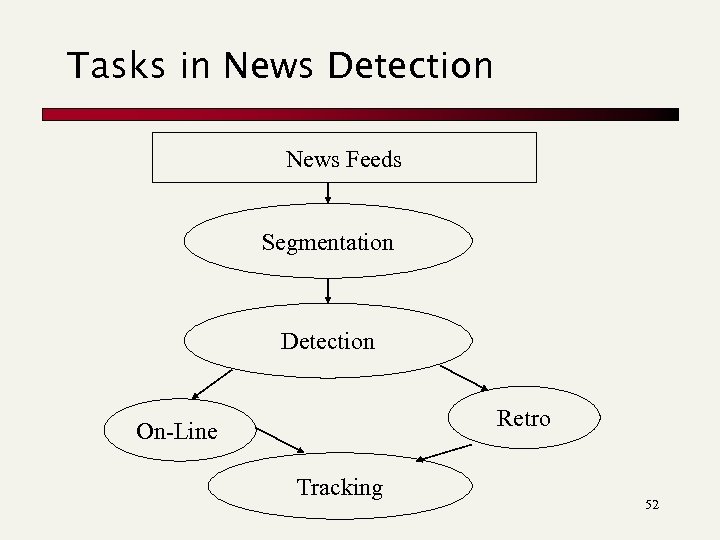
Tasks in News Detection News Feeds Segmentation Detection Retro On-Line Tracking 52
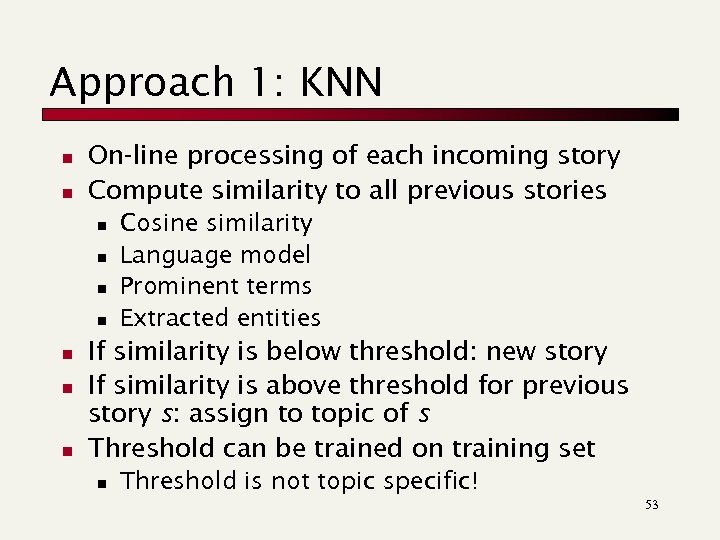
Approach 1: KNN n n On-line processing of each incoming story Compute similarity to all previous stories n n n n Cosine similarity Language model Prominent terms Extracted entities If similarity is below threshold: new story If similarity is above threshold for previous story s: assign to topic of s Threshold can be trained on training set n Threshold is not topic specific! 53
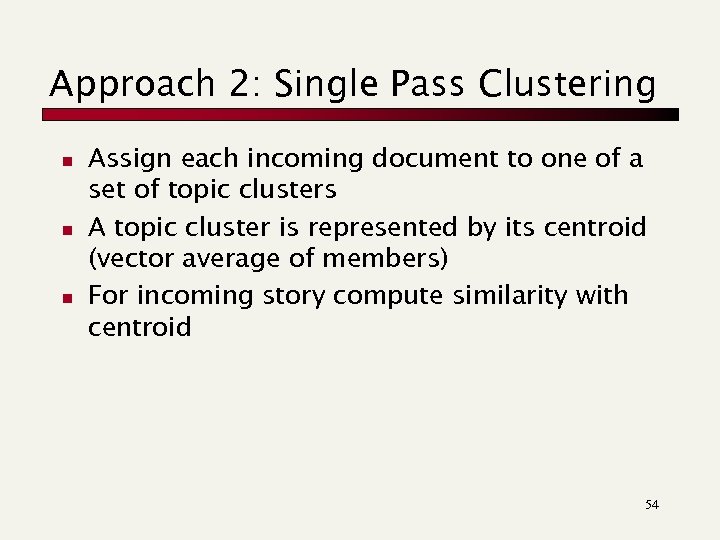
Approach 2: Single Pass Clustering n n n Assign each incoming document to one of a set of topic clusters A topic cluster is represented by its centroid (vector average of members) For incoming story compute similarity with centroid 54
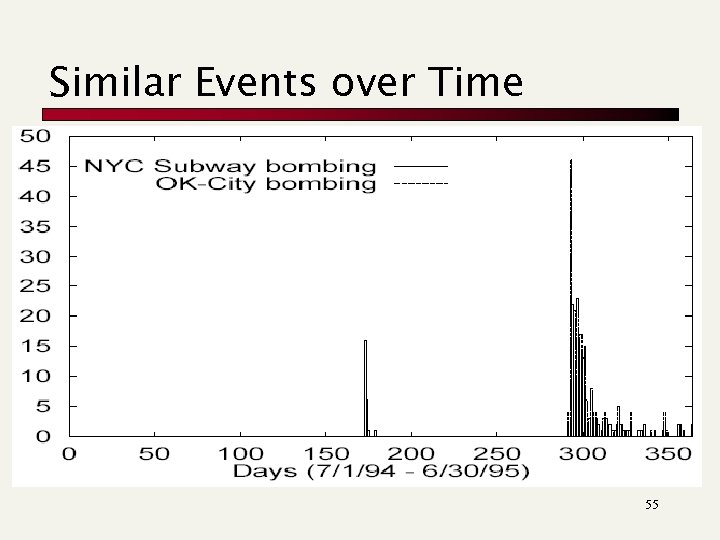
Similar Events over Time 55
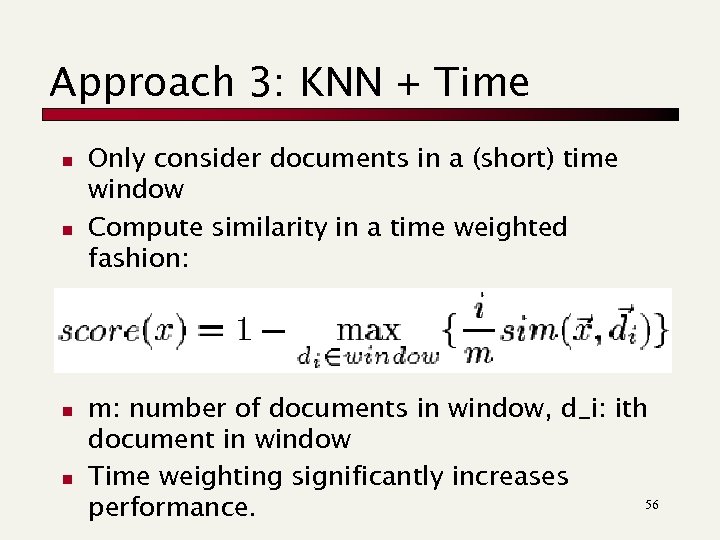
Approach 3: KNN + Time n n Only consider documents in a (short) time window Compute similarity in a time weighted fashion: m: number of documents in window, d_i: ith document in window Time weighting significantly increases 56 performance.
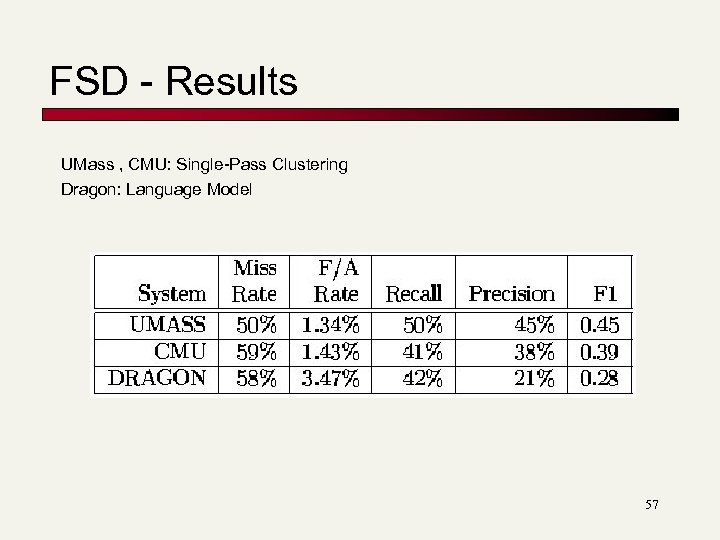
FSD - Results UMass , CMU: Single-Pass Clustering Dragon: Language Model 57
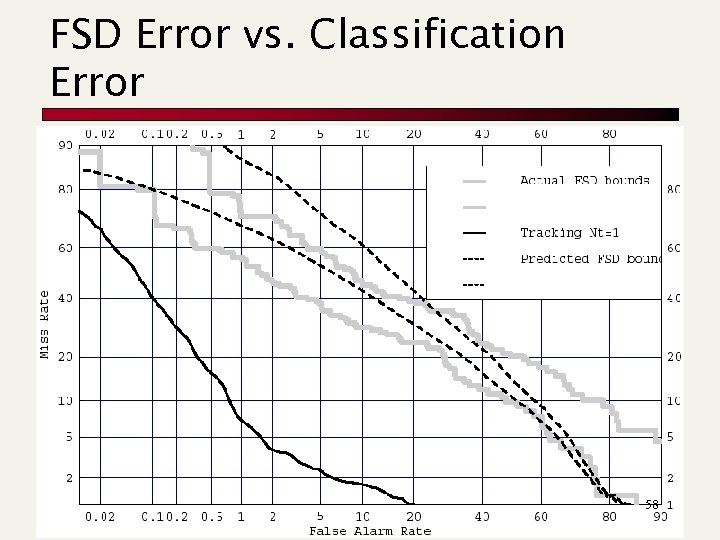
FSD Error vs. Classification Error 58
Discussion n n Hard problem Becomes harder the more topics need to be tracked. Why? Second Story Detection much easier that First Story Detection Example: retrospective detection of first 9/11 story easy, on-line detection hard 59
Скачать презентацию CS 276 B Web Search and Mining Lecture
1a3e1d7e8df09f8b4cbda51628f495c0.ppt