


 Скачать презентацию CS 268 Lecture 19 Malware Ion Stoica Computer
a2972fb499c3003ff7f0ad75dcc3ecd8.ppt
- Количество слайдов: 52
 CS 268: Lecture 19 (Malware) Ion Stoica Computer Science Division Department of Electrical Engineering and Computer Sciences University of California, Berkeley, CA 94720 -1776 (Based on slides from Vern Paxson and Stefan Savage)
 Motivation § Internet currently used for important services - Financial transactions, medical records § Could be used in the future for critical services - 911, surgical operations, energy system control, transportation system control § Networks more open than ever before - Global, ubiquitous Internet, wireless § Malicious Users - Selfish users: want more network resources than you - Malicious users: would hurt you even if it doesn’t get them more network resources 2
 Network Security Problems § Host Compromise - Attacker gains control of a host § Denial-of-Service - Attacker prevents legitimate users from gaining service § Attack can be both - E. g. , host compromise that provides resources for denial-of-service 3
 Host Compromise § One of earliest major Internet security incidents - Internet Worm (1988): compromised almost every BSDderived machine on Internet § § Today: estimated that a single worm could compromise 10 M hosts in < 5 min Attacker gains control of a host - Read data Erase data Compromise another host Launch denial-of-service attacks on another host 4
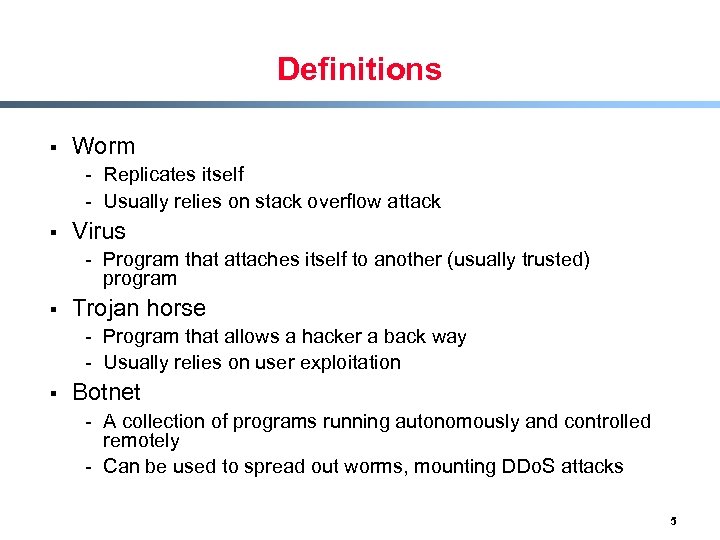 Definitions § Worm - Replicates itself - Usually relies on stack overflow attack § Virus - Program that attaches itself to another (usually trusted) program § Trojan horse - Program that allows a hacker a back way - Usually relies on user exploitation § Botnet - A collection of programs running autonomously and controlled remotely - Can be used to spread out worms, mounting DDo. S attacks 5
 Host Compromise: Stack Overflow § Typical code has many bugs because those bugs are not triggered by common input § Network code is vulnerable because it accepts input from the network § Network code that runs with high privileges (i. e. , as root) is especially dangerous - E. g. , web server 6
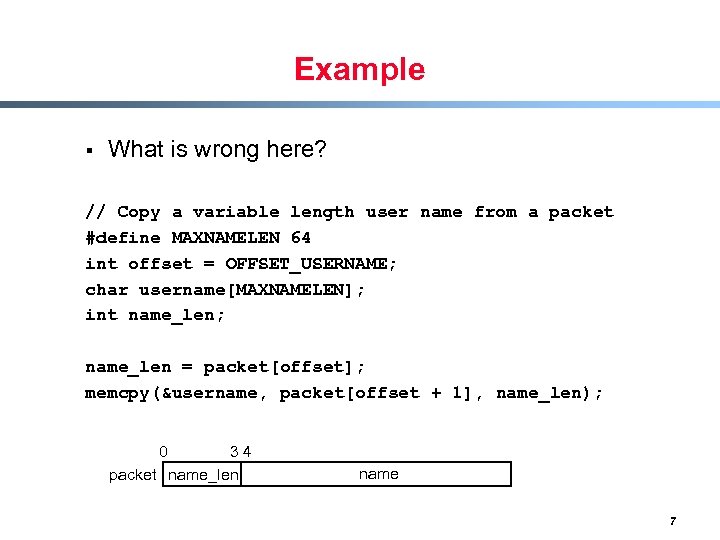 Example § What is wrong here? // Copy a variable length user name from a packet #define MAXNAMELEN 64 int offset = OFFSET_USERNAME; char username[MAXNAMELEN]; int name_len; name_len = packet[offset]; memcpy(&username, packet[offset + 1], name_len); 0 34 packet name_len name 7
![Example Stack void foo(packet) { #define MAXNAMELEN 64 int offset = OFFSET_USERNAME; char username[MAXNAMELEN];](https://present5.com/presentation/a2972fb499c3003ff7f0ad75dcc3ecd8/image-8.jpg "Example Stack void foo(packet) { #define MAXNAMELEN 64 int offset = OFFSET_USERNAME; char username[MAXNAMELEN];") Example Stack void foo(packet) { #define MAXNAMELEN 64 int offset = OFFSET_USERNAME; char username[MAXNAMELEN]; int name_len; name_len = packet[offset]; memcpy(&username, packet[offset + 1], name_len); … } X X-4 X-8 “foo” return address offset username X-72 X-76 name_len 8
Example Stack void foo(packet) { #define MAXNAMELEN 64 int offset = OFFSET_USERNAME; char username[MAXNAMELEN]; int name_len; name_len = packet[offset]; memcpy(&username, packet[offset + 1], name_len); … } X X-4 X-8 “foo” return address offset username X-72 X-76 name_len 8
![Example Stack void foo(packet) { #define MAXNAMELEN 64 int offset = OFFSET_USERNAME; char username[MAXNAMELEN];](https://present5.com/presentation/a2972fb499c3003ff7f0ad75dcc3ecd8/image-9.jpg "Example Stack void foo(packet) { #define MAXNAMELEN 64 int offset = OFFSET_USERNAME; char username[MAXNAMELEN];") Example Stack void foo(packet) { #define MAXNAMELEN 64 int offset = OFFSET_USERNAME; char username[MAXNAMELEN]; int name_len; name_len = packet[offset]; memcpy(&username, packet[offset + 1], name_len); … } X X-4 X-8 “foo” return address offset username X-72 X-76 name_len 9
Example Stack void foo(packet) { #define MAXNAMELEN 64 int offset = OFFSET_USERNAME; char username[MAXNAMELEN]; int name_len; name_len = packet[offset]; memcpy(&username, packet[offset + 1], name_len); … } X X-4 X-8 “foo” return address offset username X-72 X-76 name_len 9
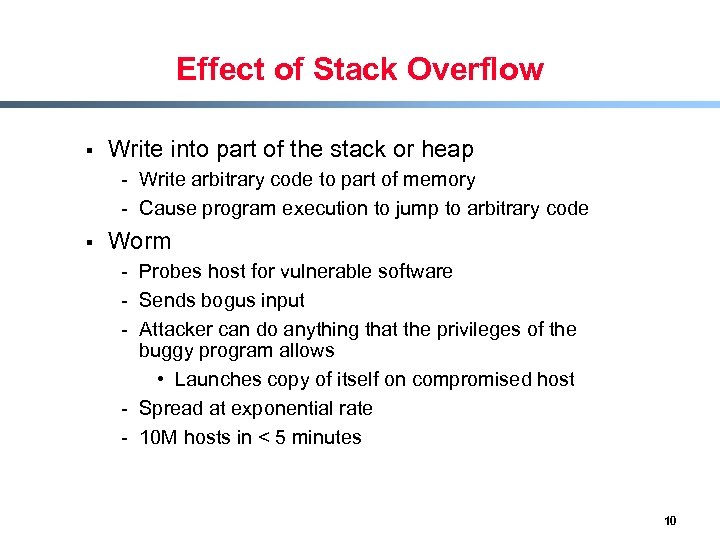 Effect of Stack Overflow § Write into part of the stack or heap - Write arbitrary code to part of memory - Cause program execution to jump to arbitrary code § Worm - Probes host for vulnerable software - Sends bogus input - Attacker can do anything that the privileges of the buggy program allows • Launches copy of itself on compromised host - Spread at exponential rate - 10 M hosts in < 5 minutes 10
 Outline Ø Worm propagation § Threat detection – content sifting 11
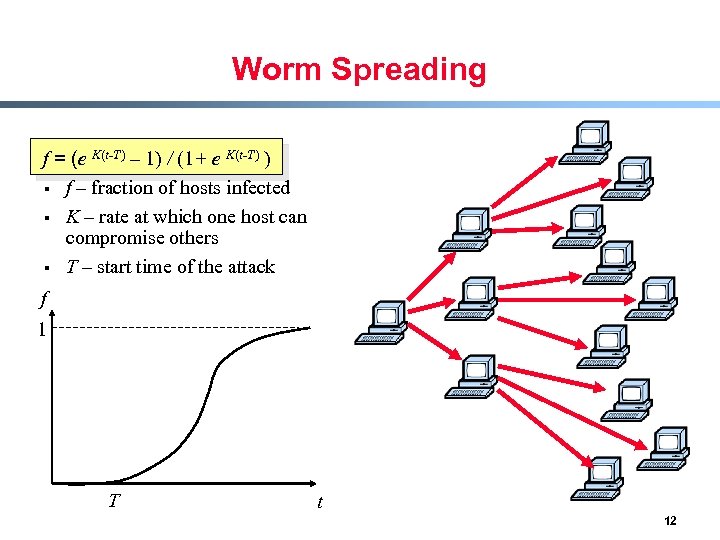 Worm Spreading f = (e K(t-T) – 1) / (1+ e K(t-T) ) § f – fraction of hosts infected § K – rate at which one host can compromise others § T – start time of the attack f 1 T t 12
 Worm Examples § § Morris worm (1988) Code Red (2001) MS Slammer (January 2003) MS Blaster (August 2003) 13
 Morris Worm (1988) § Infect multiple types of machines (Sun 3 and VAX) - Spread using a Sendmail bug § Attack multiple security holes including - Buffer overflow in fingerd - Debugging routines in Sendmail - Password cracking § Intend to be benign but it had a bug - Fixed chance the worm wouldn’t quit when reinfecting a machine number of worm on a host built up rendering the machine unusable 14
 Code Red Worm (2001) § § § Attempts to connect to TCP port 80 on a randomly chosen host If successful, the attacking host sends a crafted HTTP GET request to the victim, attempting to exploit a buffer overflow Worm “bug”: all copies of the worm use the same random generator to scan new hosts - Do. S attack on those hosts - Slow to infect new hosts § 2 nd generation of Code Red fixed the bug! - It spread much faster 15
 MS SQL Slammer (January 2003) § § Uses UDP port 1434 to exploit a buffer overflow in MS SQL server Effect - Generate massive amounts of network packets - Brought down as many as 5 of the 13 internet root name servers § Others - The worm only spreads as an in-memory process: it never writes itself to the hard drive • Solution: close UDP port on fairewall and reboot 16
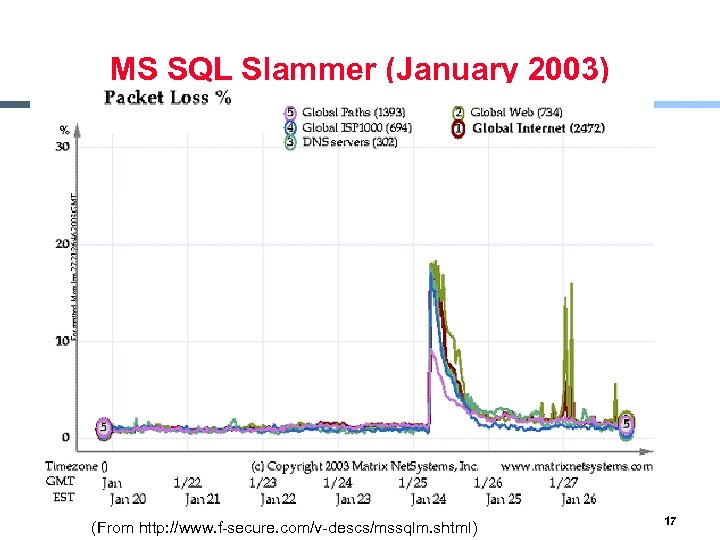 MS SQL Slammer (January 2003) § xx (From http: //www. f-secure. com/v-descs/mssqlm. shtml) 17
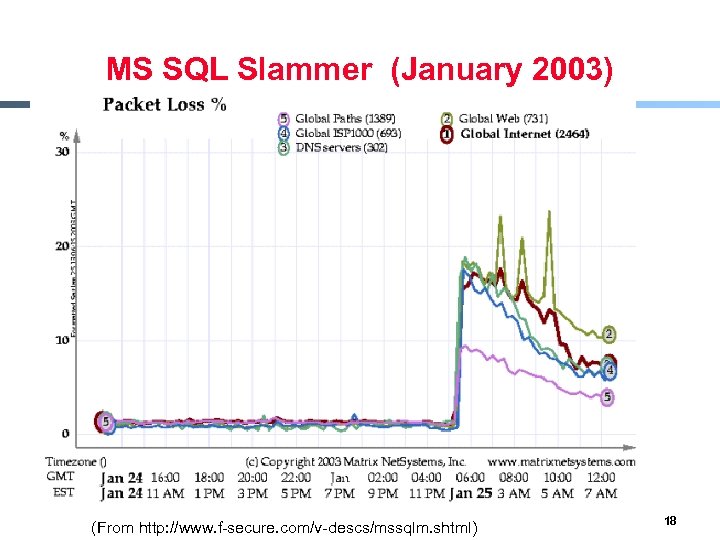 MS SQL Slammer (January 2003) § xx (From http: //www. f-secure. com/v-descs/mssqlm. shtml) 18
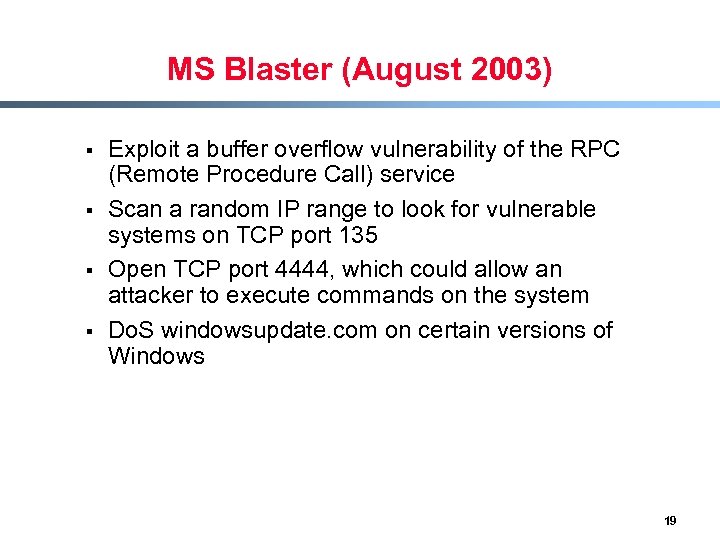 MS Blaster (August 2003) § § Exploit a buffer overflow vulnerability of the RPC (Remote Procedure Call) service Scan a random IP range to look for vulnerable systems on TCP port 135 Open TCP port 4444, which could allow an attacker to execute commands on the system Do. S windowsupdate. com on certain versions of Windows 19
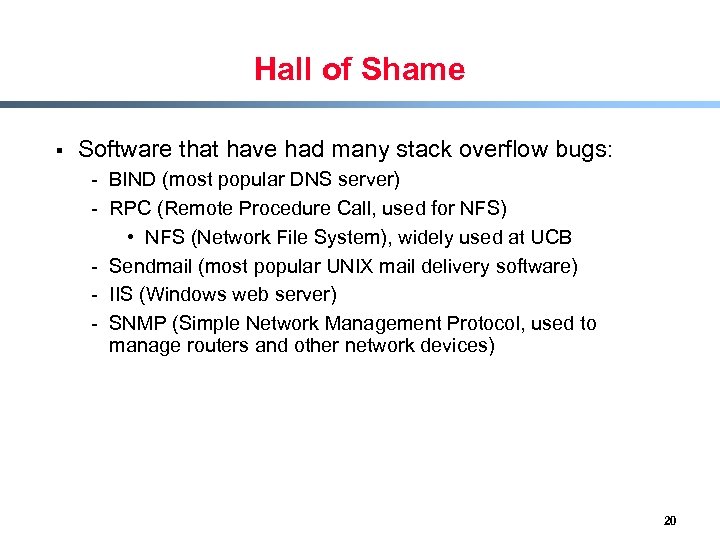 Hall of Shame § Software that have had many stack overflow bugs: - BIND (most popular DNS server) - RPC (Remote Procedure Call, used for NFS) • NFS (Network File System), widely used at UCB - Sendmail (most popular UNIX mail delivery software) - IIS (Windows web server) - SNMP (Simple Network Management Protocol, used to manage routers and other network devices) 20
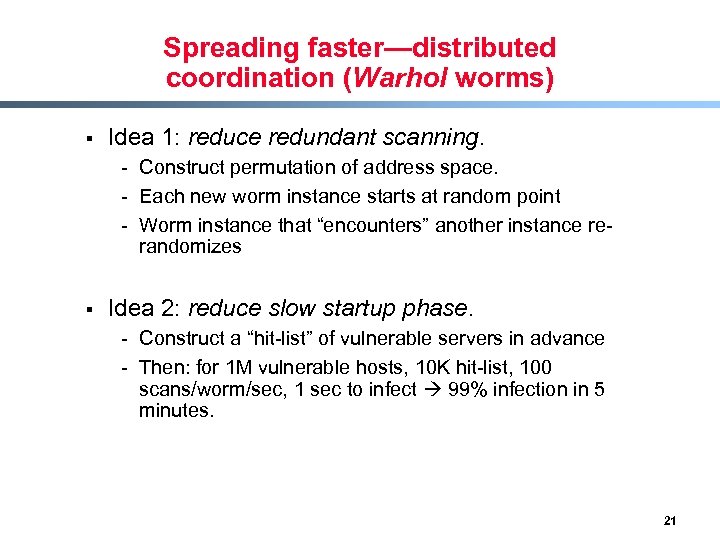 Spreading faster—distributed coordination (Warhol worms) § Idea 1: reduce redundant scanning. - Construct permutation of address space. - Each new worm instance starts at random point - Worm instance that “encounters” another instance rerandomizes § Idea 2: reduce slow startup phase. - Construct a “hit-list” of vulnerable servers in advance - Then: for 1 M vulnerable hosts, 10 K hit-list, 100 scans/worm/sec, 1 sec to infect 99% infection in 5 minutes. 21
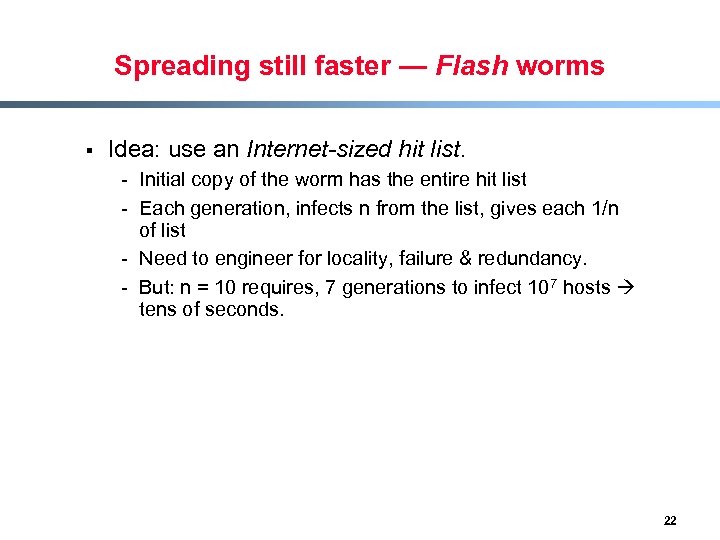 Spreading still faster — Flash worms § Idea: use an Internet-sized hit list. - Initial copy of the worm has the entire hit list - Each generation, infects n from the list, gives each 1/n of list - Need to engineer for locality, failure & redundancy. - But: n = 10 requires, 7 generations to infect 107 hosts tens of seconds. 22
 How can we defend against Internetscale worms? § Time scales rule out human intervention Need automated detectors, response (And perhaps honeypots to confuse scanning? ) § Very hard research question! § And it’s only half of the problem. . . 23
 Contagion worms § Suppose you have two exploits: Es (Web server) and Ec (Web client) § You infect a server (or client) with Es (Ec) § Then you. . . wait (Perhaps you bait, e. g. , host porn) § When vulnerable client arrives, infect it § You send over both Es and Ec § As client happens to visit other vulnerable servers ) infects 24
 Contagion worms (cont’d) § No change in communication patterns, other than slightly larger-than-usual transfers § How do you detect this? § How bad can it be? 25
 Outline § Worm propagation Ø Threat detection – content sifting 26
 Threat Detection § Both defense and deterrence are predicated on getting good intelligence - Need to detect, characterize and analyze new malware threats - Need to be do it quickly across a very large number of events § Classes of monitors - Network-based - Endpoint-based § Monitoring environments - In-situ: real activity as it happens • Network/host IDS - Ex-situ: “canary in the coal mine” • Honey. Nets/Honeypots (Stefan Savage, UCSD *) 27
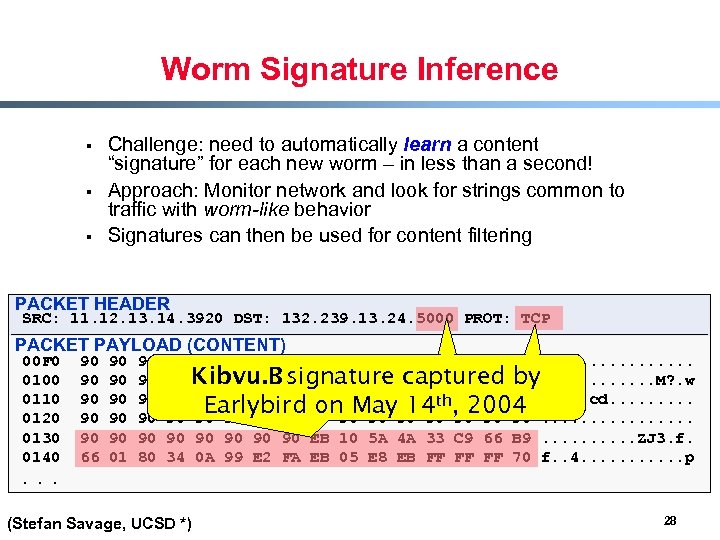 Worm Signature Inference § § § Challenge: need to automatically learn a content “signature” for each new worm – in less than a second! Approach: Monitor network and look for strings common to traffic with worm-like behavior Signatures can then be used for content filtering PACKET HEADER SRC: 11. 12. 13. 14. 3920 DST: 132. 239. 13. 24. 5000 PROT: TCP PACKET PAYLOAD (CONTENT) 00 F 0 0100 0110 0120 0130 0140 90 90 90 66 90 90 90 01 90 90 90 80 90 90 90 34 90 90 90. . . . Kibvu. B 90 90 90 4 D 3 F E 3 77. . . M? . w 90 90 90 signature captured by FF 63 64 90 90 90. . . cd. . Earlybird 90 90 90 , 2004. . . . on May 14 th 90 90 90 EB 10 5 A 4 A 33 C 9 66 B 9. . ZJ 3. f. 0 A 99 E 2 FA EB 05 E 8 EB FF FF FF 70 f. . 4. . . p . . . (Stefan Savage, UCSD *) 28
 Content sifting § Assume there exists some (relatively) unique invariant bitstring W across all instances of a particular worm § Two consequences - Content Prevalence: W will be more common in traffic than other bitstrings of the same length - Address Dispersion: the set of packets containing W will address a disproportionate number of distinct sources and destinations § Content sifting: find W’s with high content prevalence and high address dispersion and drop that traffic (Stefan Savage, UCSD *) 29
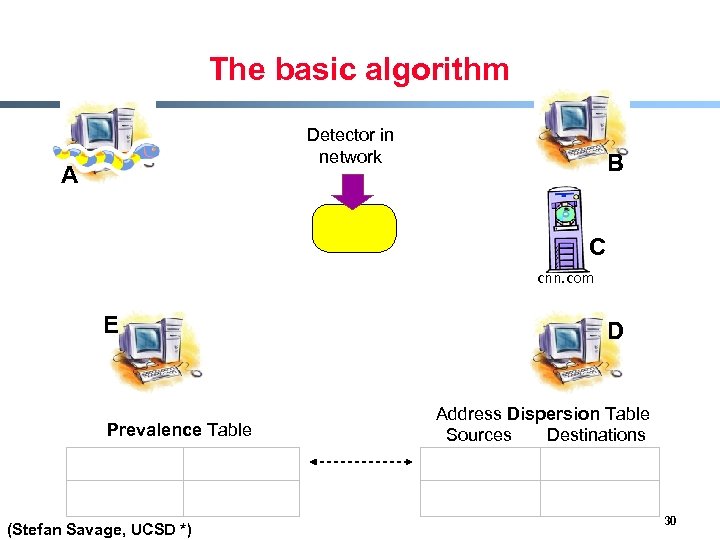 The basic algorithm Detector in network A B C cnn. com E Prevalence Table (Stefan Savage, UCSD *) D Address Dispersion Table Sources Destinations 30
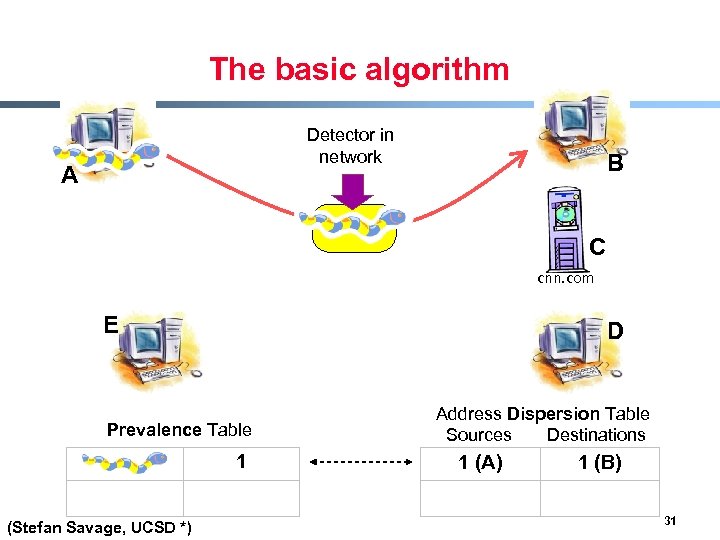 The basic algorithm Detector in network A B C cnn. com E D Prevalence Table 1 (Stefan Savage, UCSD *) Address Dispersion Table Sources Destinations 1 (A) 1 (B) 31
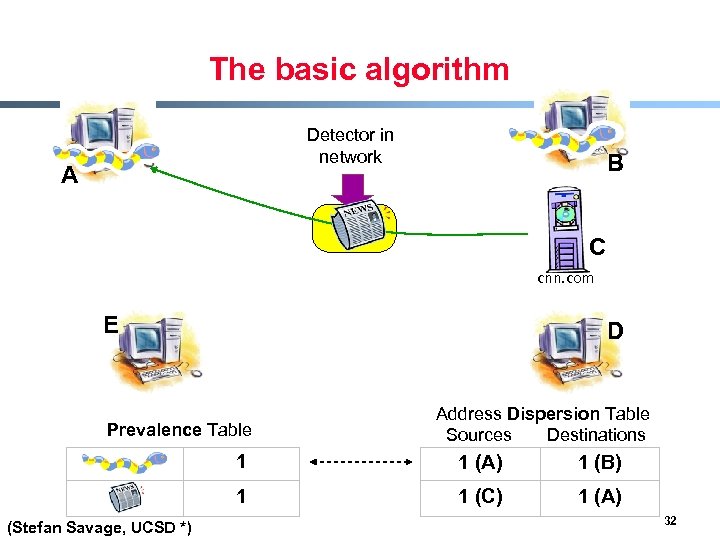 The basic algorithm Detector in network A B C cnn. com E D Prevalence Table Address Dispersion Table Sources Destinations 1 1 (B) 1 (Stefan Savage, UCSD *) 1 (A) 1 (C) 1 (A) 32
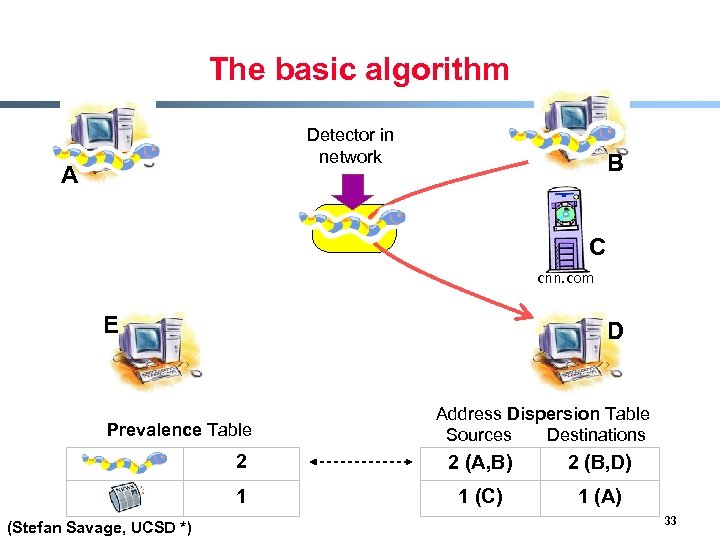 The basic algorithm Detector in network A B C cnn. com E D Prevalence Table Address Dispersion Table Sources Destinations 2 2 (B, D) 1 (Stefan Savage, UCSD *) 2 (A, B) 1 (C) 1 (A) 33
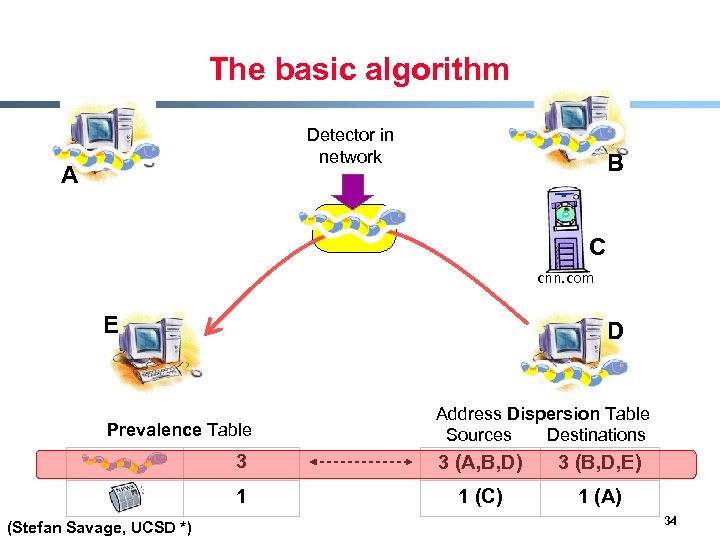 The basic algorithm Detector in network A B C cnn. com E D Prevalence Table Address Dispersion Table Sources Destinations 3 3 (B, D, E) 1 (Stefan Savage, UCSD *) 3 (A, B, D) 1 (C) 1 (A) 34
 Challenges § Computation - To support a 1 Gbps line rate we have 12 us to process each packet, at 10 Gbps 1. 2 us, at 40 Gbps… • Dominated by memory references; state expensive - Content sifting requires looking at every byte in a packet § State - On a fully-loaded 1 Gbps link a naïve implementation can easily consume 100 MB/sec for table - Computation/memory duality: on high-speed (ASIC) implementation, latency requirements may limit state to on-chip SRAM (Stefan Savage, UCSD *) 35
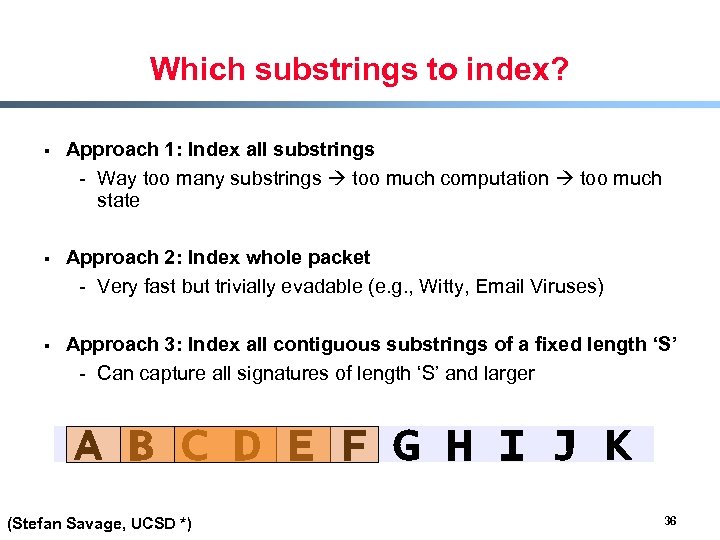 Which substrings to index? § Approach 1: Index all substrings - Way too many substrings too much computation too much state § Approach 2: Index whole packet - Very fast but trivially evadable (e. g. , Witty, Email Viruses) § Approach 3: Index all contiguous substrings of a fixed length ‘S’ - Can capture all signatures of length ‘S’ and larger A B C D E F G H I J K (Stefan Savage, UCSD *) 36
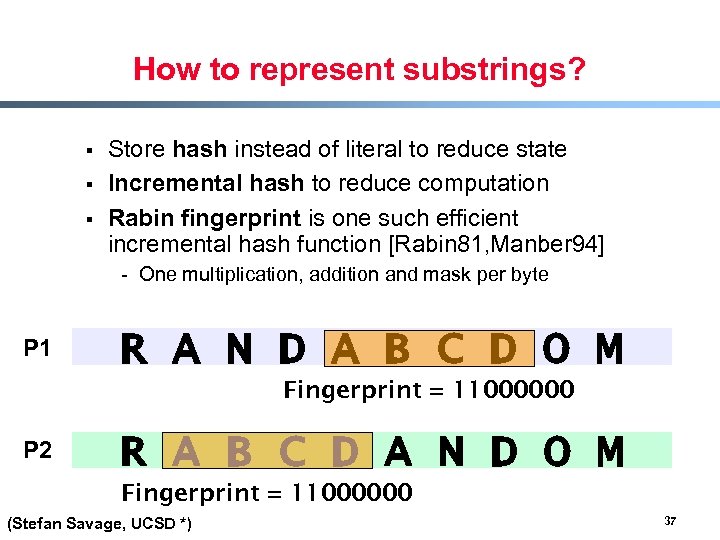 How to represent substrings? § § § Store hash instead of literal to reduce state Incremental hash to reduce computation Rabin fingerprint is one such efficient incremental hash function [Rabin 81, Manber 94] - One multiplication, addition and mask per byte P 1 R A N D A B C D O M Fingerprint = 11000000 P 2 R A B C D A N D O M Fingerprint = 11000000 (Stefan Savage, UCSD *) 37
 How to subsample? § Approach 1: sample packets - If we chose 1 in N, detection will be slowed by N § Approach 2: sample at particular byte offsets - Susceptible to simple evasion attacks - No guarantee that we will sample same sub-string in every packet § Approach 3: sample based on the hash of the substring (Stefan Savage, UCSD *) 38
![Value sampling [Manber ’ 94] § Sample hash if last ‘N’ bits of the](https://present5.com/presentation/a2972fb499c3003ff7f0ad75dcc3ecd8/image-39.jpg "Value sampling [Manber ’ 94] § Sample hash if last ‘N’ bits of the") Value sampling [Manber ’ 94] § Sample hash if last ‘N’ bits of the hash are equal to the value ‘V’ - The number of bits ‘N’ can be dynamically set - The value ‘V’ can be randomized for resiliency A B C D E F G H I J K Fingerprint = 11 = 10 00000010 Fingerprint 000001 Fingerprint 000000 SAMPLE IGNORE SAMPLE § Ptrack Probability of selecting at least one substring of length S in a L byte invariant - For 1/64 sampling (last 6 bits equal to 0), and 40 byte substrings Ptrack = 99. 64% for a 400 byte invariant (Stefan Savage, UCSD *) 39
Value sampling [Manber ’ 94] § Sample hash if last ‘N’ bits of the hash are equal to the value ‘V’ - The number of bits ‘N’ can be dynamically set - The value ‘V’ can be randomized for resiliency A B C D E F G H I J K Fingerprint = 11 = 10 00000010 Fingerprint 000001 Fingerprint 000000 SAMPLE IGNORE SAMPLE § Ptrack Probability of selecting at least one substring of length S in a L byte invariant - For 1/64 sampling (last 6 bits equal to 0), and 40 byte substrings Ptrack = 99. 64% for a 400 byte invariant (Stefan Savage, UCSD *) 39
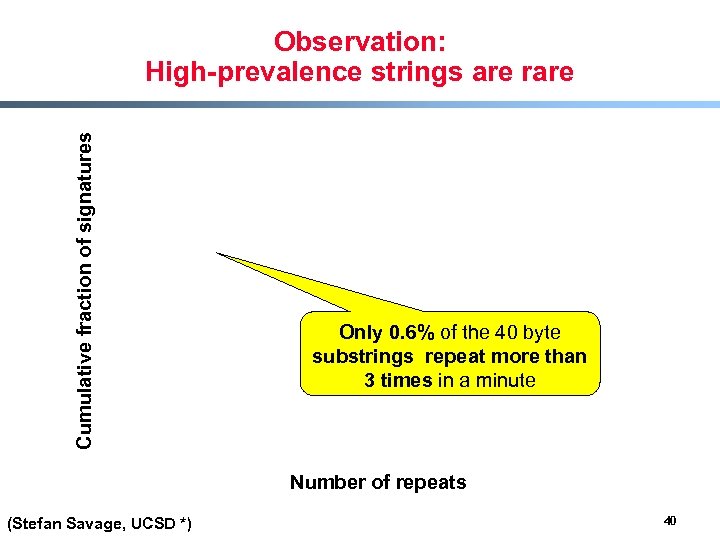 Cumulative fraction of signatures Observation: High-prevalence strings are rare Only 0. 6% of the 40 byte substrings repeat more than 3 times in a minute Number of repeats (Stefan Savage, UCSD *) 40
 Efficient high-pass filters for content § § § Only want to keep state for prevalent substrings Chicken vs egg: how to count strings without maintaining state for them? Multi Stage Filters: randomized technique for counting “heavy hitter” network flows with low state and few false positives [Estan 02] - Instead of using flow id, use content hash • Rabin Fingerprints with Mandber’s Value sampling - Three orders of magnitude memory savings (Stefan Savage, UCSD *) 41
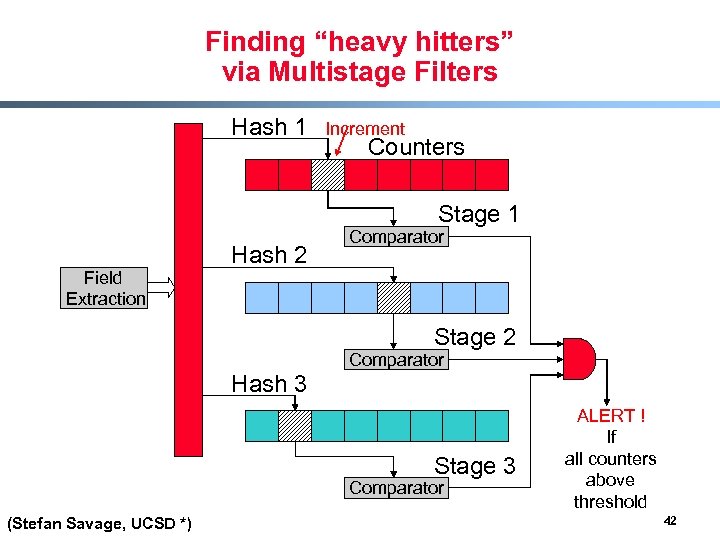 Finding “heavy hitters” via Multistage Filters Hash 1 Increment Counters Stage 1 Field Extraction Hash 2 Comparator Stage 2 Hash 3 Comparator Stage 3 Comparator (Stefan Savage, UCSD *) ALERT ! If all counters above threshold 42
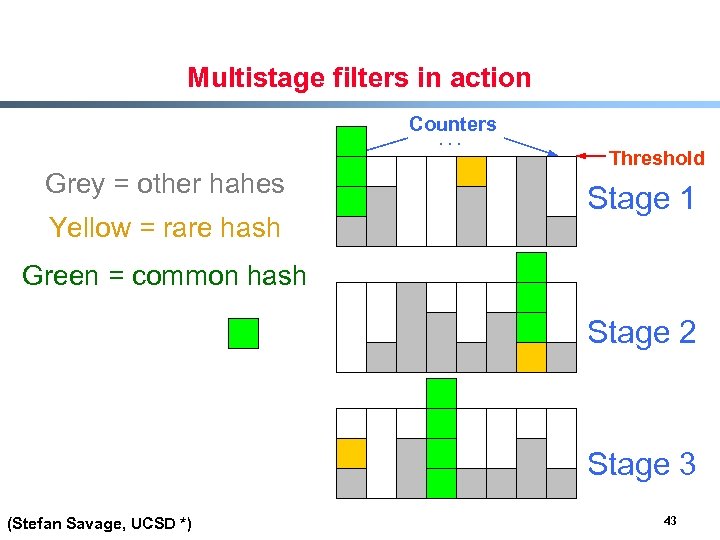 Multistage filters in action Counters. . . Grey = other hahes Yellow = rare hash Threshold Stage 1 Green = common hash Stage 2 Stage 3 (Stefan Savage, UCSD *) 43
 Observation: High address dispersion is rare too § Naïve implementation might maintain a list of sources (or destinations) for each string hash § But dispersion only matters if its over threshold - Approximate counting may suffice - Trades accuracy for state in data structure § Scalable Bitmap Counters - Similar to multi-resolution bitmaps [Estan 03] - Reduce memory by 5 x for modest accuracy error (Stefan Savage, UCSD *) 44
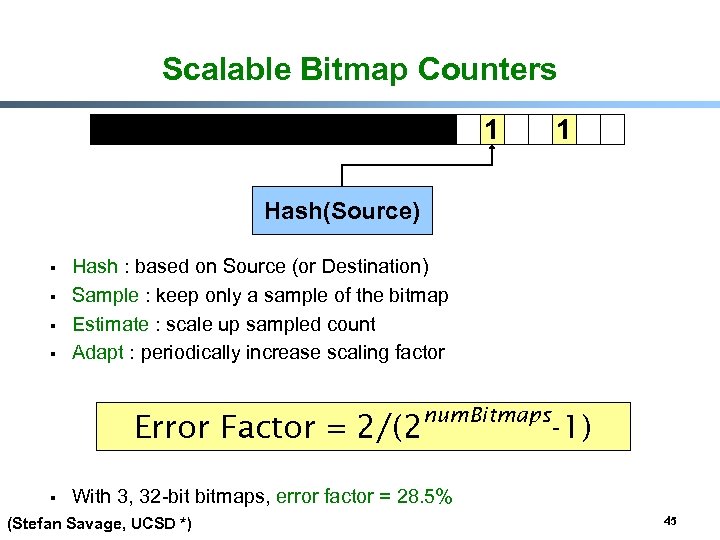 Scalable Bitmap Counters 1 1 Hash(Source) § § Hash : based on Source (or Destination) Sample : keep only a sample of the bitmap Estimate : scale up sampled count Adapt : periodically increase scaling factor Error Factor = 2/(2 § num. Bitmaps -1) With 3, 32 -bit bitmaps, error factor = 28. 5% (Stefan Savage, UCSD *) 45
 Content sifting summary § § § Index fixed-length substrings using incremental hashes Subsample hashes as function of hash value Multi-stage filters to filter out uncommon strings Scalable bitmaps to tell if number of distinct addresses per hash crosses threshold Now its fast enough to implement (Stefan Savage, UCSD *) 46
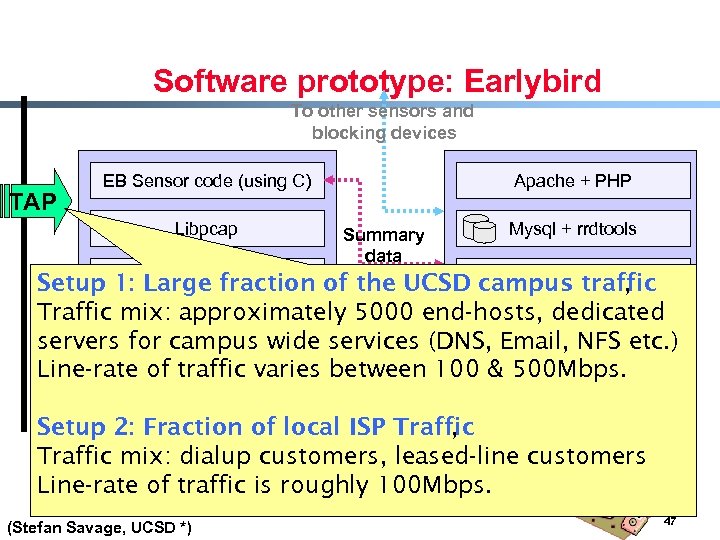 Software prototype: Earlybird To other sensors and blocking devices TAP EB Sensor code (using C) Libpcap Apache + PHP Summary data Mysql + rrdtools Linux fraction of the UCSD EB Aggregator (using C) Setup 1: Large 2. 6 campus traffic , Traffic mix: approximately 5000 end-hosts, dedicated Linux 2. 6 AMD Opteron 242 (1. 6 Ghz) servers for campus wide services (DNS, Email, NFS etc. ) Early. Bird Aggregator Line-rate Early. Bird Sensor between 100 & 500 Mbps. of traffic varies Reporting & Control Setup 2: Fraction of local ISP Traffic , Traffic mix: dialup customers, leased-line customers Line-rate of traffic is roughly 100 Mbps. (Stefan Savage, UCSD *) 47
 Content sifting overhead § Mean per-byte processing cost - 0. 409 microseconds, without value sampling - 0. 042 microseconds, with 1/64 value sampling (~60 microseconds for a 1500 byte packet, can keep up with 200 Mbps) § Additional overhead in per-byte processing cost for flow-state maintenance (if enabled): - 0. 042 microseconds (Stefan Savage, UCSD *) 49
 Experience § Quite good. - Detected and automatically generated signatures for every known worm outbreak over eight months - Can produce a precise signature for a new worm in a fraction of a second - Software implementation keeps up with 200 Mbps § Known worms detected: - Code Red, Nimda, Web. Dav, Slammer, Opaserv, … § Unknown worms (with no public signatures) detected: - Ms. Blaster, Bagle, Sasser, Kibvu, … (Stefan Savage, UCSD *) 50
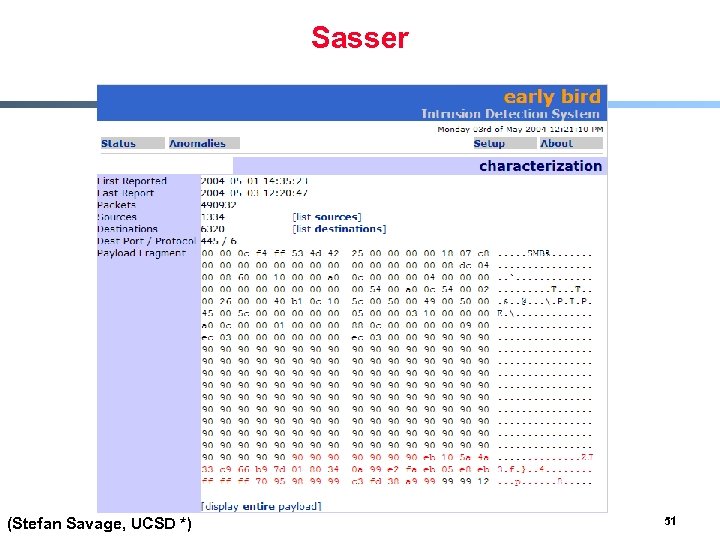 Sasser (Stefan Savage, UCSD *) 51
 False Negatives § Easy to prove presence, impossible to prove absence § Live evaluation: over 8 months detected every worm outbreak reported on popular security mailing lists § Offline evaluation: several traffic traces run against both Earlybird and Snort IDS (w/all worm-related signatures) - Worms not detected by Snort, but detected by Earlybird - The converse never true (Stefan Savage, UCSD *) 52
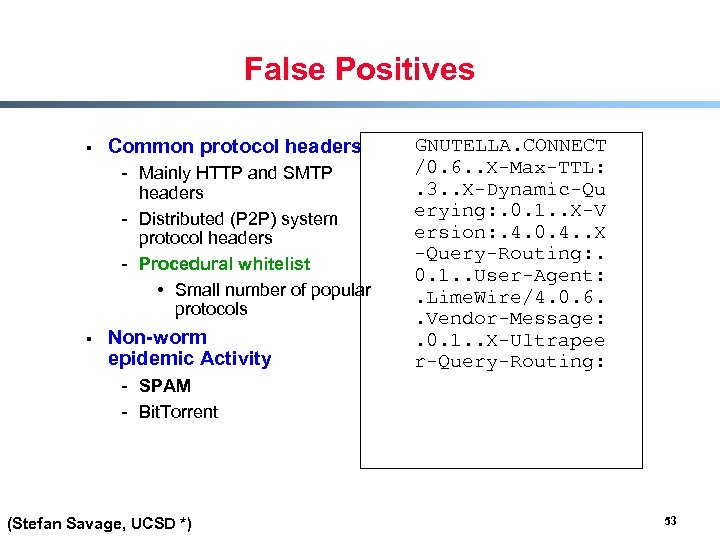 False Positives § § Common protocol headers GNUTELLA. CONNECT /0. 6. . X-Max-TTL: - Mainly HTTP and SMTP . 3. . X-Dynamic-Qu headers erying: . 0. 1. . X-V - Distributed (P 2 P) system ersion: . 4. 0. 4. . X protocol headers -Query-Routing: . - Procedural whitelist 0. 1. . User-Agent: • Small number of popular . Lime. Wire/4. 0. 6. protocols . Vendor-Message: Non-worm . 0. 1. . X-Ultrapee epidemic Activity r-Query-Routing: - SPAM - Bit. Torrent (Stefan Savage, UCSD *) 53