


 Скачать презентацию CS 268 Lecture 18 Measurement Studies on Internet
dbad7801605713e78d57dfbcbbd8c40d.ppt
- Количество слайдов: 35
 CS 268: Lecture 18 Measurement Studies on Internet Routing Ion Stoica Computer Science Division Department of Electrical Engineering and Computer Sciences University of California, Berkeley, CA 94720 -1776 istoica@cs. berkeley. edu
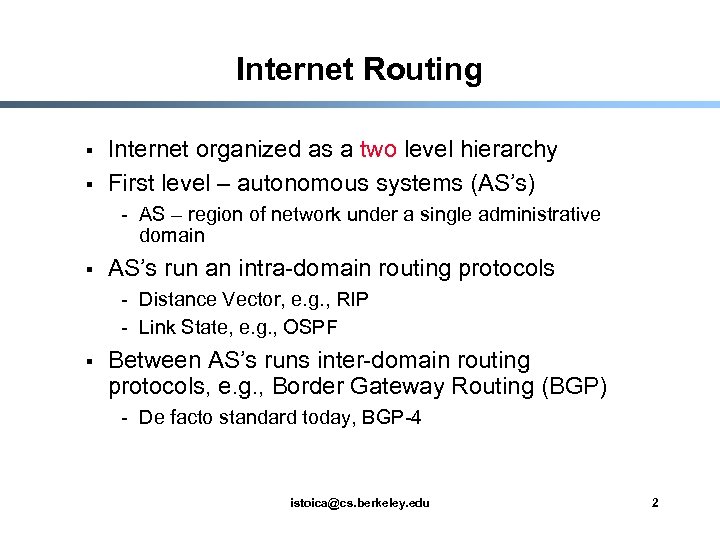 Internet Routing § § Internet organized as a two level hierarchy First level – autonomous systems (AS’s) - AS – region of network under a single administrative domain § AS’s run an intra-domain routing protocols - Distance Vector, e. g. , RIP - Link State, e. g. , OSPF § Between AS’s runs inter-domain routing protocols, e. g. , Border Gateway Routing (BGP) - De facto standard today, BGP-4 istoica@cs. berkeley. edu 2
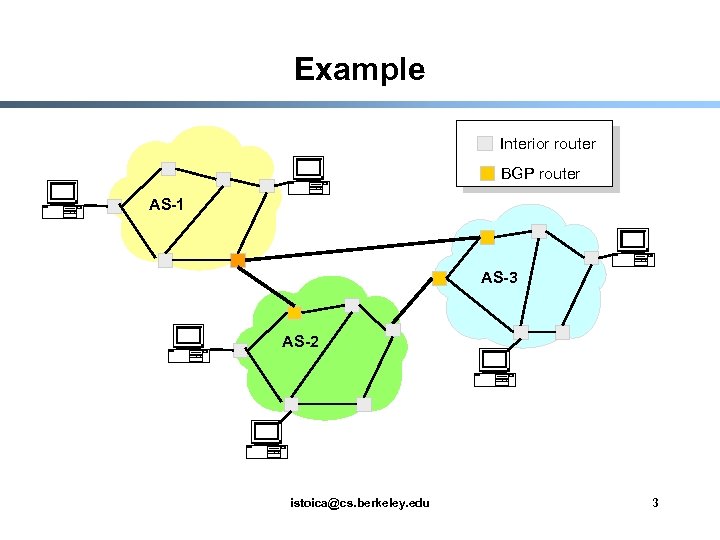 Example Interior router BGP router AS-1 AS-3 AS-2 istoica@cs. berkeley. edu 3
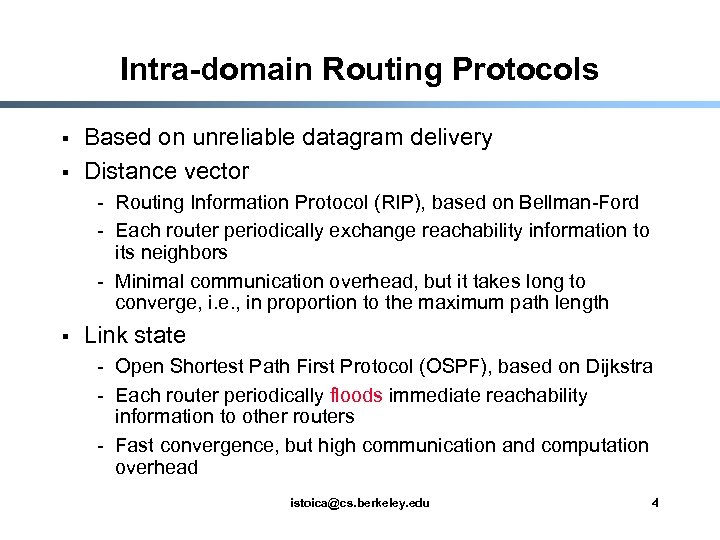 Intra-domain Routing Protocols § § Based on unreliable datagram delivery Distance vector - Routing Information Protocol (RIP), based on Bellman-Ford - Each router periodically exchange reachability information to its neighbors - Minimal communication overhead, but it takes long to converge, i. e. , in proportion to the maximum path length § Link state - Open Shortest Path First Protocol (OSPF), based on Dijkstra - Each router periodically floods immediate reachability information to other routers - Fast convergence, but high communication and computation overhead istoica@cs. berkeley. edu 4
 Inter-domain Routing § § § Use TCP Border Gateway Protocol (BGP), based on Bellman-Ford path vector AS’s exchange reachability information through their BGP routers, only when routes change BGP routing information – a sequence of AS’s indicating the path traversed by a route; next hop General operations of a BGP router: - Learns multiple paths - Picks best path according to its AS policies - Install best pick in IP forwarding tables istoica@cs. berkeley. edu 5
![End-to-End Routing Behavior in the Internet [Paxson ’ 95] § Idea: use end-to-end measurements](https://present5.com/presentation/dbad7801605713e78d57dfbcbbd8c40d/image-6.jpg "End-to-End Routing Behavior in the Internet [Paxson ’ 95] § Idea: use end-to-end measurements") End-to-End Routing Behavior in the Internet [Paxson ’ 95] § Idea: use end-to-end measurements to determine - Route pathologies - Route stability - Route symmetry istoica@cs. berkeley. edu 6
End-to-End Routing Behavior in the Internet [Paxson ’ 95] § Idea: use end-to-end measurements to determine - Route pathologies - Route stability - Route symmetry istoica@cs. berkeley. edu 6
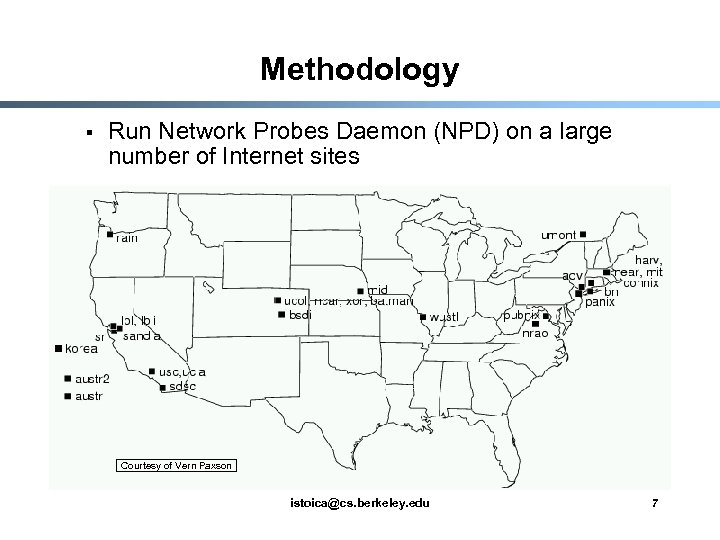 Methodology § Run Network Probes Daemon (NPD) on a large number of Internet sites Courtesy of Vern Paxson istoica@cs. berkeley. edu 7
 Methodology § § Each NPD site periodically measure the route to another NPD site, by using traceroute Two sets of experiments D 1 – measure each virtual path between two NPD’s with a mean interval of 1 -2 days, Nov-Dec 1994 D 2 – measure each virtual path using a bimodal distribution inter-measurement interval, Nov-Dec 1995 - 60% with mean of 2 hours - 40% with mean of 2. 75 days § Measurements in D 2 were paired - Measure A B and then B A istoica@cs. berkeley. edu 8
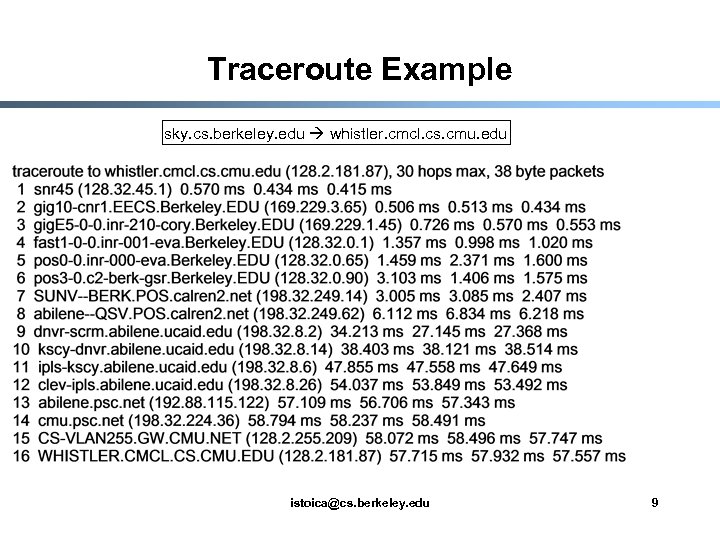 Traceroute Example sky. cs. berkeley. edu whistler. cmcl. cs. cmu. edu istoica@cs. berkeley. edu 9
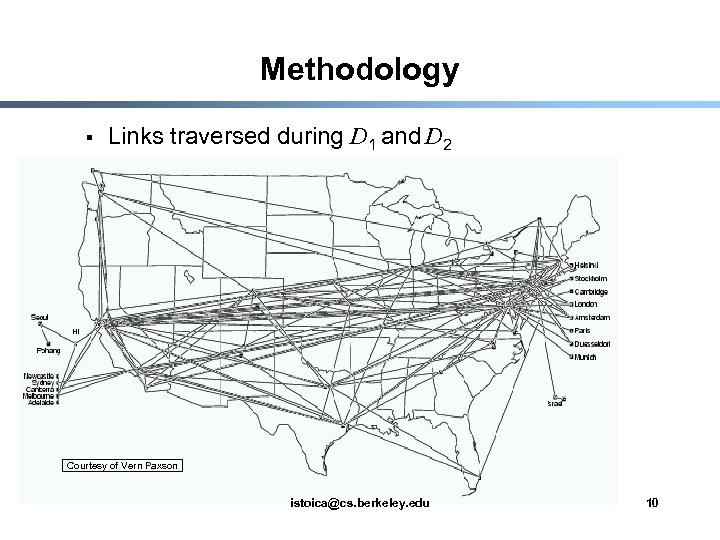 Methodology § Links traversed during D 1 and D 2 Courtesy of Vern Paxson istoica@cs. berkeley. edu 10
 Methodology § Exponential sampling - Unbiased sampling – measures instantaneous signal with equal probability - PASTA principle – Poisson Arrivals See Time Averages § Is data representative? - Argue that sampled AS’s are on half of the Internet routes § Confidence intervals for probability that an event occurs istoica@cs. berkeley. edu 11
 Limitations § § Just a small subset of Internet paths Just two points at a time Difficult to say why something happened 5%-8% of time couldn’t connect to NPD’s Introduces bias toward underestimation of the prevalence of network problems istoica@cs. berkeley. edu 12
 Routing Pathologies § § § Persistent routing loops Temporary routing loops Erroneous routing Connectivity altered mid-stream Temporary outages (> 30 sec) istoica@cs. berkeley. edu 13
 Routing Loops & Erroneous Routing § Persistent routing loops (10 in D 1 and 50 in D 2) - Several hours long (e. g. , > 10 hours) - Largest: 5 routers - All loops intra-domain § Transient routing loops (2 in D 1 and 24 in D 2) - Several seconds - Usually occur after outages § Erroneous routing (one in D 1) - A route UK USA goes through Israel § Question: Why do routing loops occur even today? istoica@cs. berkeley. edu 14
 Route Changes § Connectivity change in mid-stream (10 in D 1 and 155 in D 2) - Route changes during measurements - Recovering bimodal: (1) 100’s msec to seconds; (2) order of minutes § Route fluttering - Rapid route oscillation istoica@cs. berkeley. edu 15
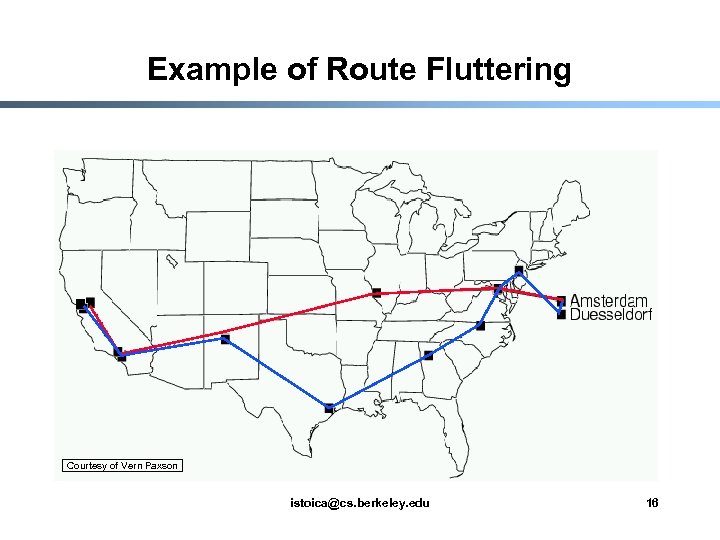 Example of Route Fluttering Courtesy of Vern Paxson istoica@cs. berkeley. edu 16
 Problems with Fluttering § Path properties difficult to predict - This confuses RTT estimation in TCP, may trigger false retransmission timeouts § Packet reordering - TCP receiver generates DUPACK’s, may trigger spurious fast retransmits § These problems are bad only for a large scale flutter; for localized flutter is usually ok istoica@cs. berkeley. edu 17
 Infrastructure Failures § NPD’s unreachable due to many hops (6 in D 2) - Unreachable more than 30 hops - Path length not necessary correlated with distance • 1500 km end-to-end route of 3 hops • 3 km (MIT – Harvard) end-to-end route of 11 hops • Question: Does 3 hops actually mean 3 physical links? § Temporary outages - Multiple probes lost. Most likely due to: • Heavy congestions lasting 10’s of seconds • Temporary lost of connectivity istoica@cs. berkeley. edu 18
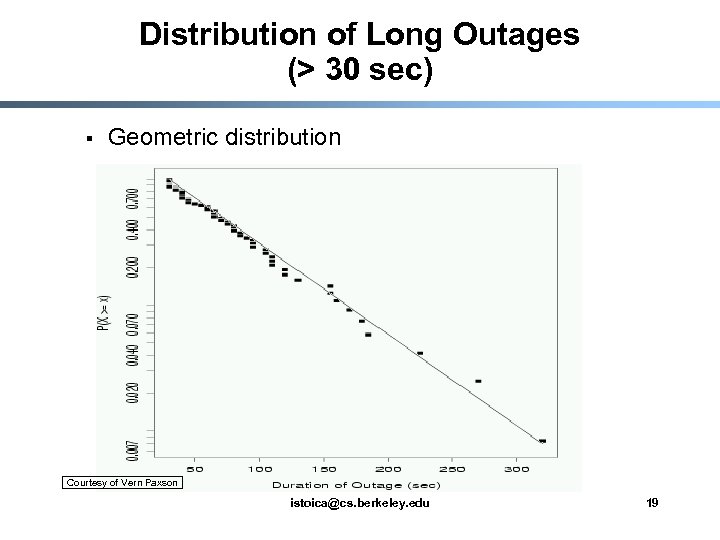 Distribution of Long Outages (> 30 sec) § Geometric distribution Courtesy of Vern Paxson istoica@cs. berkeley. edu 19
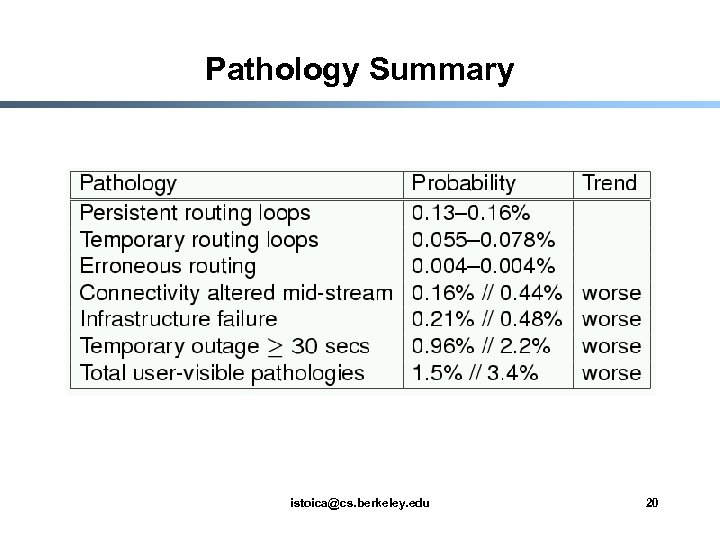 Pathology Summary istoica@cs. berkeley. edu 20
 Routing Stability § Prevalence: likelihood to observe a particular route - Steady state probability that a virtual path at an arbitrary point in time uses a particular route - Conclusion: In general Internet paths are strongly dominated by a single route § Persistence: how long a route remains unchanged - Affects utility of storing state in routers - Conclusion: routing changes occur over a wide range of time scales, i. e. , from minutes to days istoica@cs. berkeley. edu 21
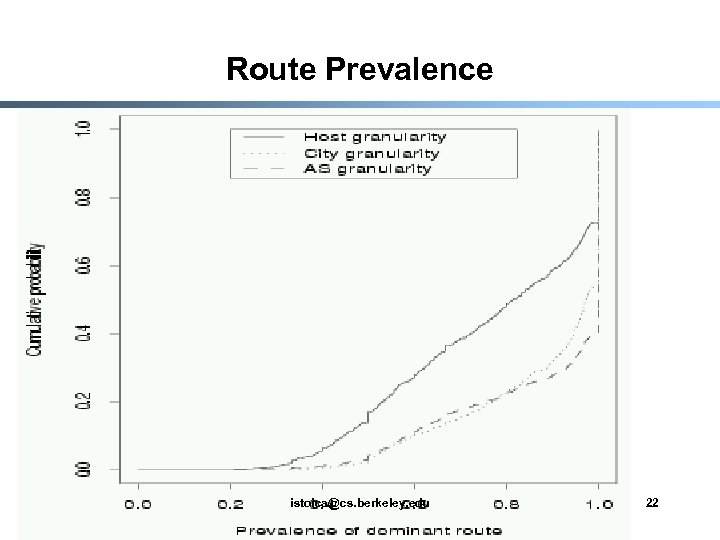 Route Prevalence § I istoica@cs. berkeley. edu 22
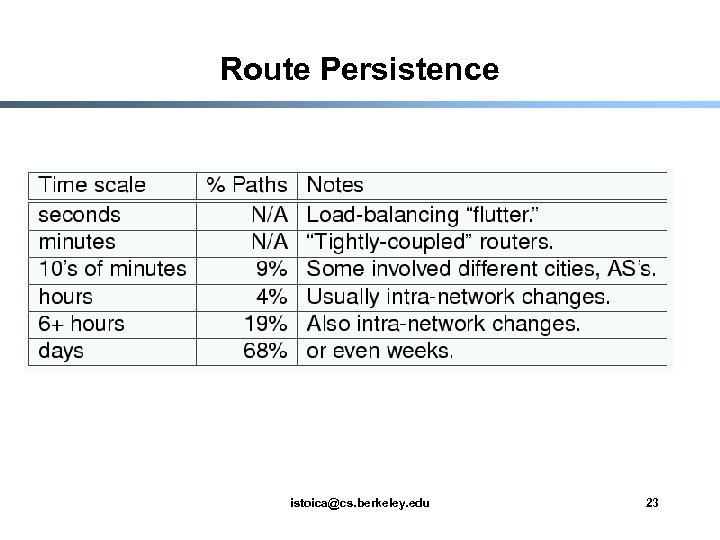 Route Persistence istoica@cs. berkeley. edu 23
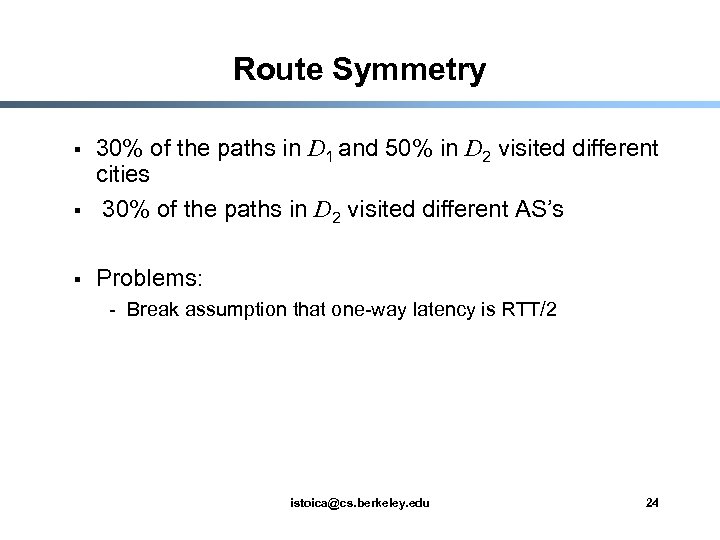 Route Symmetry § 30% of the paths in D 1 and 50% in D 2 visited different cities 30% of the paths in D 2 visited different AS’s § Problems: § - Break assumption that one-way latency is RTT/2 istoica@cs. berkeley. edu 24
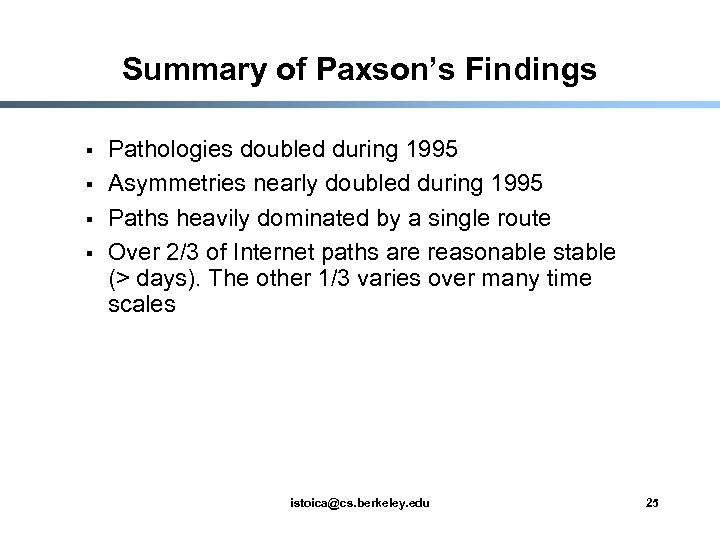 Summary of Paxson’s Findings § § Pathologies doubled during 1995 Asymmetries nearly doubled during 1995 Paths heavily dominated by a single route Over 2/3 of Internet paths are reasonable stable (> days). The other 1/3 varies over many time scales istoica@cs. berkeley. edu 25
 End-to-end effects of Path Selection § § Goal of study: Quantify and understand the impact of path selection on end-to-end performance Basic metric - Let X = performance of default path - Let Y = performance of best path - Y-X = cost of using default path § Technical issues - How to find the best path? - How to measure the best path? istoica@cs. berkeley. edu 26
 Approximating the best path § Key Idea - Use end-to-end measurements to extrapolate potential alternate paths § Rough Approach - Measure paths between pairs of hosts - Generate synthetic topology – full Nx. N mesh - Conservative approximation of best path § Question: Given a selection of N hosts, how crude is this approximation? istoica@cs. berkeley. edu 27
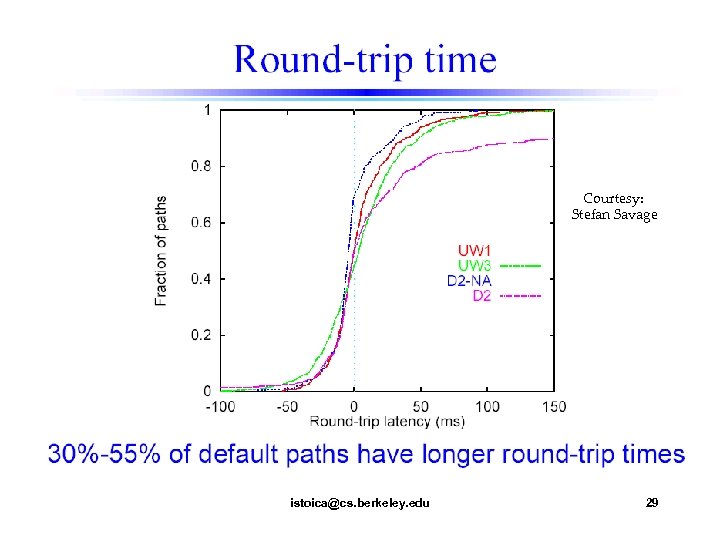
 Methodology § For each pair of end-hosts, calculate: - Average round-trip time - Average loss rate - Average bandwidth § § Generate synthetic alternate paths (based on long-term averages) For each pair of hosts, graph difference between default path and alternate path istoica@cs. berkeley. edu 28
 Courtesy: Stefan Savage istoica@cs. berkeley. edu 29
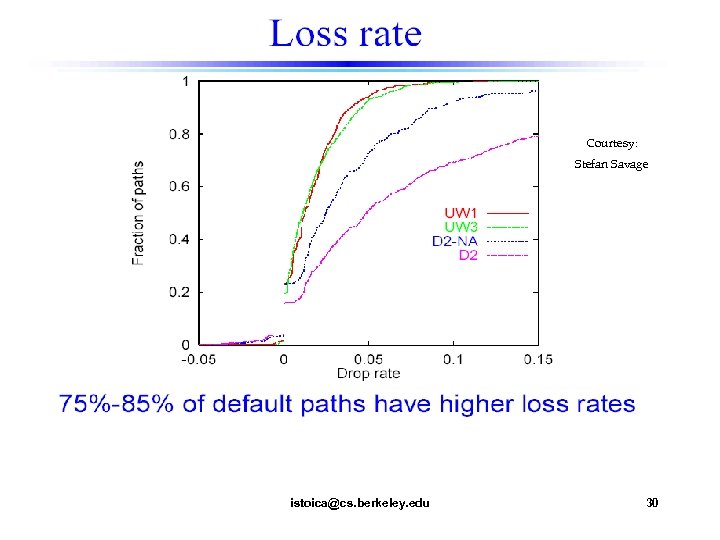 Courtesy: Stefan Savage istoica@cs. berkeley. edu 30
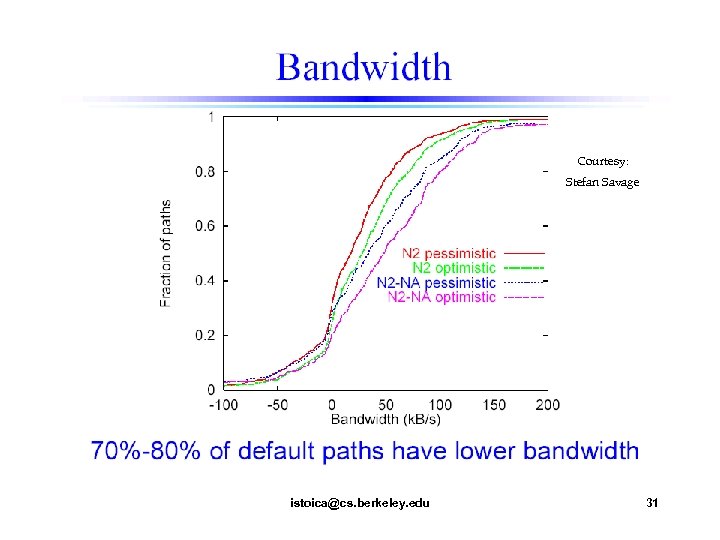 Courtesy: Stefan Savage istoica@cs. berkeley. edu 31
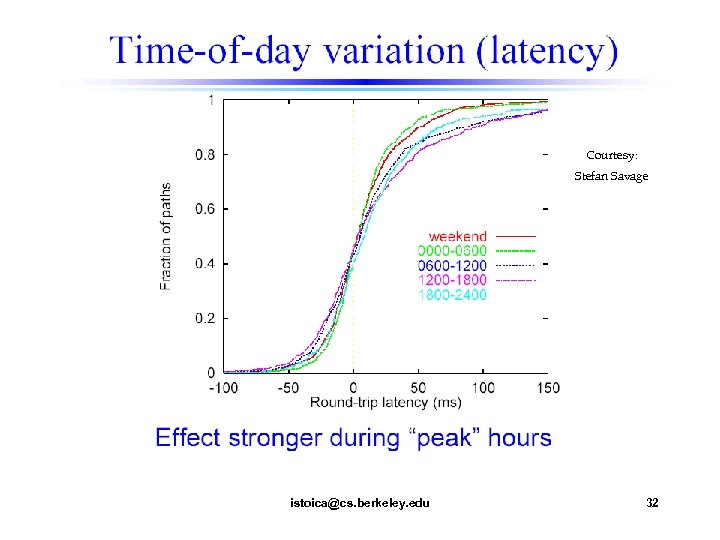 Courtesy: Stefan Savage istoica@cs. berkeley. edu 32
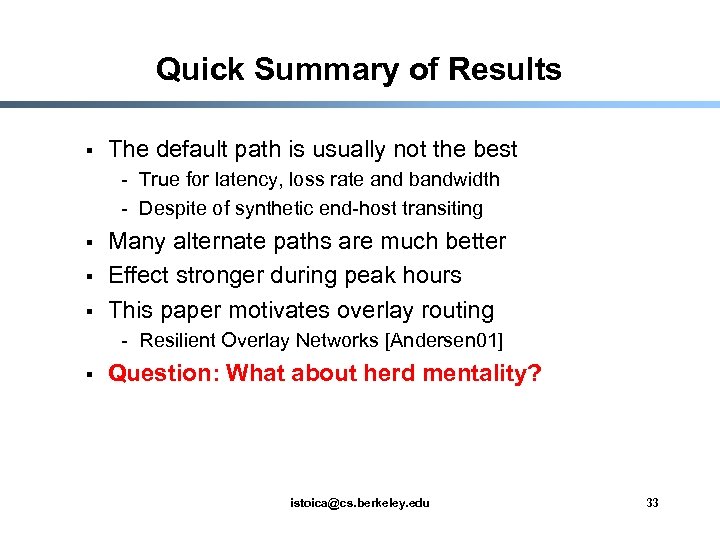 Quick Summary of Results § The default path is usually not the best - True for latency, loss rate and bandwidth - Despite of synthetic end-host transiting § § § Many alternate paths are much better Effect stronger during peak hours This paper motivates overlay routing - Resilient Overlay Networks [Andersen 01] § Question: What about herd mentality? istoica@cs. berkeley. edu 33
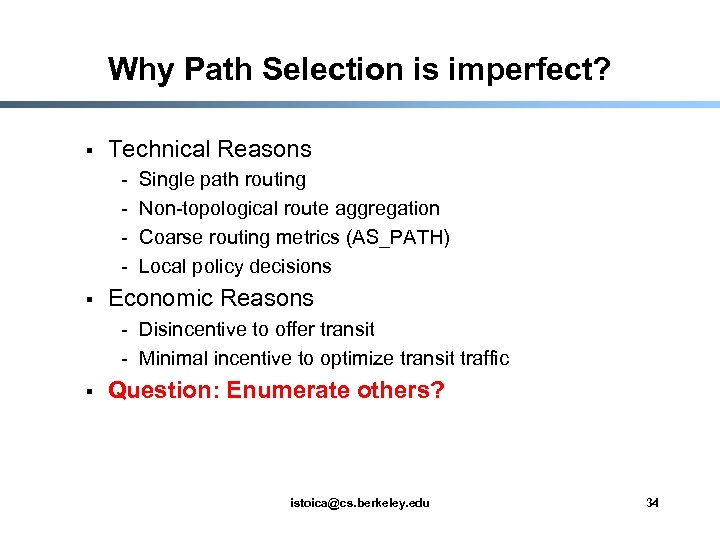 Why Path Selection is imperfect? § Technical Reasons - § Single path routing Non-topological route aggregation Coarse routing metrics (AS_PATH) Local policy decisions Economic Reasons - Disincentive to offer transit - Minimal incentive to optimize transit traffic § Question: Enumerate others? istoica@cs. berkeley. edu 34
![Concluding remarks § § § [Paxson] Internet routing can have several problems due to](https://present5.com/presentation/dbad7801605713e78d57dfbcbbd8c40d/image-35.jpg "Concluding remarks § § § [Paxson] Internet routing can have several problems due to") Concluding remarks § § § [Paxson] Internet routing can have several problems due to loops, route fluttering, long outages. [Savage] Internet routing protocols are not welltuned for choosing performance optimal paths. Where does this lead us to? - Possibility 1: Try to redesign a better protocol to fix the problem • Will such an approach ever work? - Possibility 2: Use overlay networks to route around them [RON] - Possibility 3: Reliability is important, but is optimal performance needed? Probably not. istoica@cs. berkeley. edu 35
Concluding remarks § § § [Paxson] Internet routing can have several problems due to loops, route fluttering, long outages. [Savage] Internet routing protocols are not welltuned for choosing performance optimal paths. Where does this lead us to? - Possibility 1: Try to redesign a better protocol to fix the problem • Will such an approach ever work? - Possibility 2: Use overlay networks to route around them [RON] - Possibility 3: Reliability is important, but is optimal performance needed? Probably not. istoica@cs. berkeley. edu 35