 Скачать презентацию CS 252 Fundamentals of Relational Databases SQL 4
b87cfc050c9666fc3d8ea27c7f17366e.ppt
- Количество слайдов: 37



CS 252: Fundamentals of Relational Databases: SQL 4 Dr. Alexandra I. Cristea http: //www. dcs. warwick. ac. uk/~acristea/
Interim Summary Topics covered: • Mathematical functions, for single values and groups of values. • GROUP BY and HAVING for producing summaries. • Storing dates and times in the database. • Creating views with “CREATE VIEW … AS". • Creating tables from tables with ”CREATE TABLE … AS". CS 252 Fundamentals of Relational Databases 2
This lecture • This session : Indexes, Sequences, Relational Algebra and Advanced Joins CS 252 Fundamentals of Relational Databases 3
Indexes redundant but can improve the performance of a DBMS (look up rows) Updates can take longer not required, do not affect query results automatically added to any column declared as a Primary Key. DB implementations: own specific schemes; in some you can specify what kind to use. CS 252 Fundamentals of Relational Databases 4
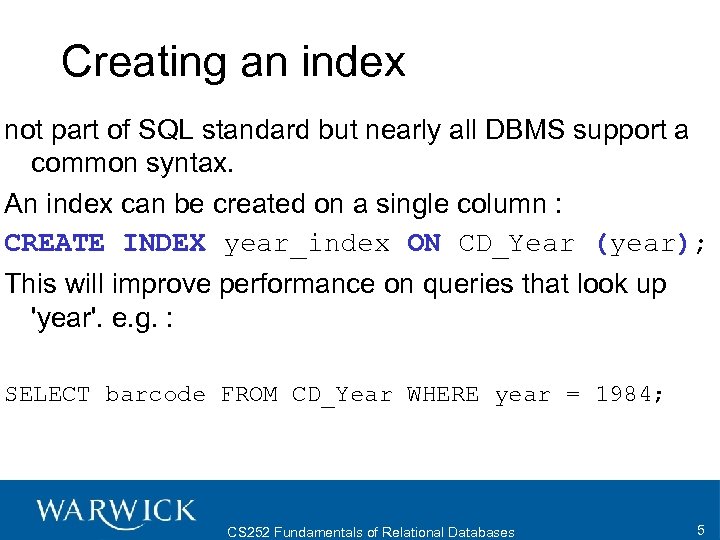
Creating an index not part of SQL standard but nearly all DBMS support a common syntax. An index can be created on a single column : CREATE INDEX year_index ON CD_Year (year); This will improve performance on queries that look up 'year'. e. g. : SELECT barcode FROM CD_Year WHERE year = 1984; CS 252 Fundamentals of Relational Databases 5
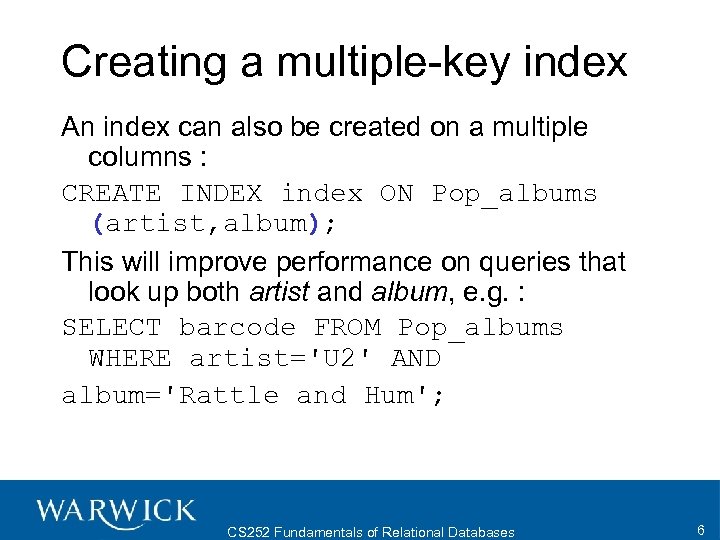
Creating a multiple-key index An index can also be created on a multiple columns : CREATE INDEX index ON Pop_albums (artist, album); This will improve performance on queries that look up both artist and album, e. g. : SELECT barcode FROM Pop_albums WHERE artist='U 2' AND album='Rattle and Hum'; CS 252 Fundamentals of Relational Databases 6
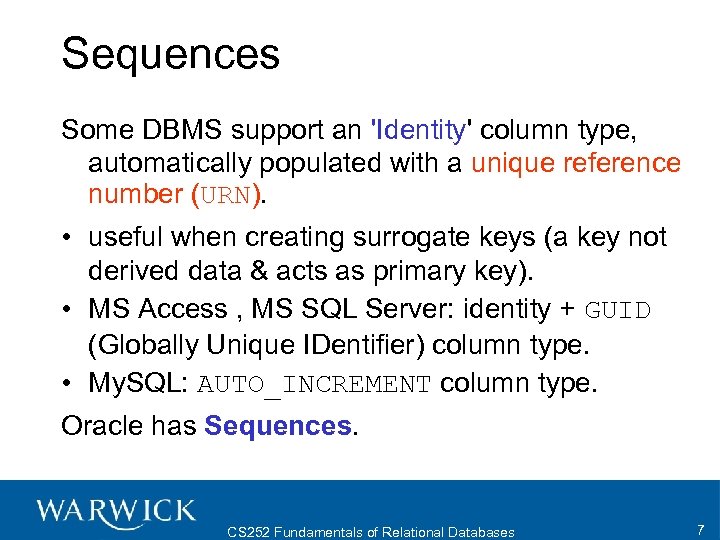
Sequences Some DBMS support an 'Identity' column type, automatically populated with a unique reference number (URN). • useful when creating surrogate keys (a key not derived data & acts as primary key). • MS Access , MS SQL Server: identity + GUID (Globally Unique IDentifier) column type. • My. SQL: AUTO_INCREMENT column type. Oracle has Sequences. CS 252 Fundamentals of Relational Databases 7
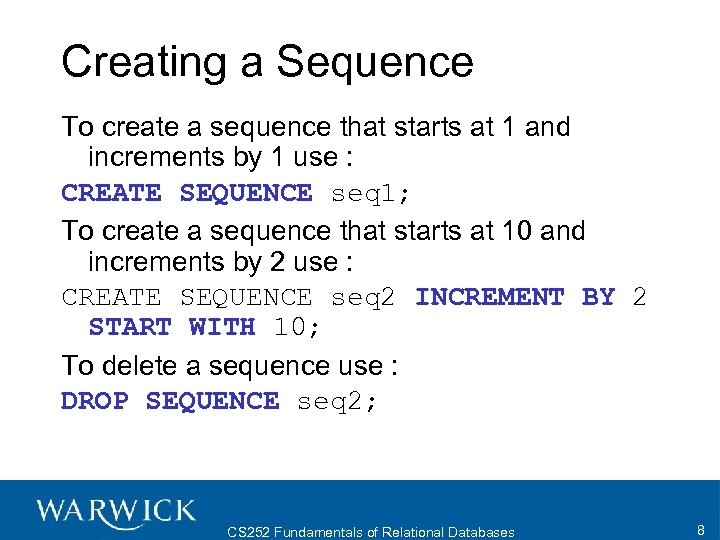
Creating a Sequence To create a sequence that starts at 1 and increments by 1 use : CREATE SEQUENCE seq 1; To create a sequence that starts at 10 and increments by 2 use : CREATE SEQUENCE seq 2 INCREMENT BY 2 START WITH 10; To delete a sequence use : DROP SEQUENCE seq 2; CS 252 Fundamentals of Relational Databases 8
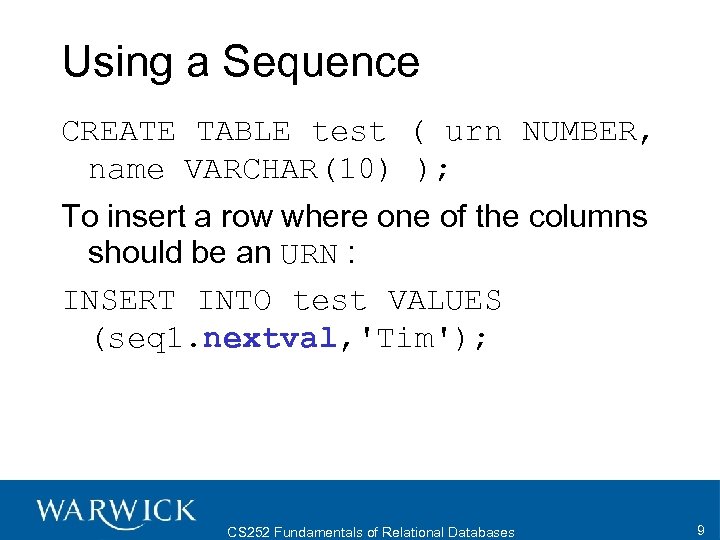
Using a Sequence CREATE TABLE test ( urn NUMBER, name VARCHAR(10) ); To insert a row where one of the columns should be an URN : INSERT INTO test VALUES (seq 1. nextval, 'Tim'); CS 252 Fundamentals of Relational Databases 9
Relational Algebra and SQL manipulates tables. Relational operators are closed over relations, so, if translated into SQL, should be closed over these tables. 6 primitive operators: union, difference, product, projection, selection and renaming. NB The SQL keyword SELECT is associated with projection, not selection! Also: derived operators (cf operators in arithmetic, such as square(x) = x * x). Examples include intersection and join. CS 252 Fundamentals of Relational Databases 10
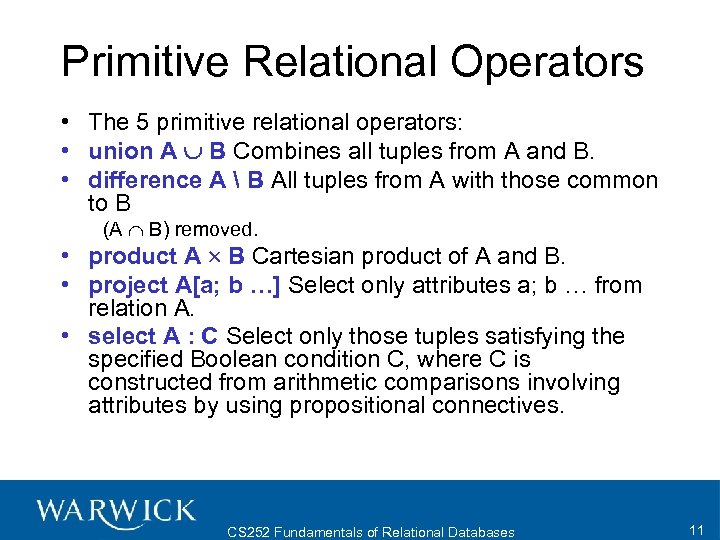
Primitive Relational Operators • The 5 primitive relational operators: • union A B Combines all tuples from A and B. • difference A B All tuples from A with those common to B (A B) removed. • product A B Cartesian product of A and B. • project A[a; b …] Select only attributes a; b … from relation A. • select A : C Select only those tuples satisfying the specified Boolean condition C, where C is constructed from arithmetic comparisons involving attributes by using propositional connectives. CS 252 Fundamentals of Relational Databases 11
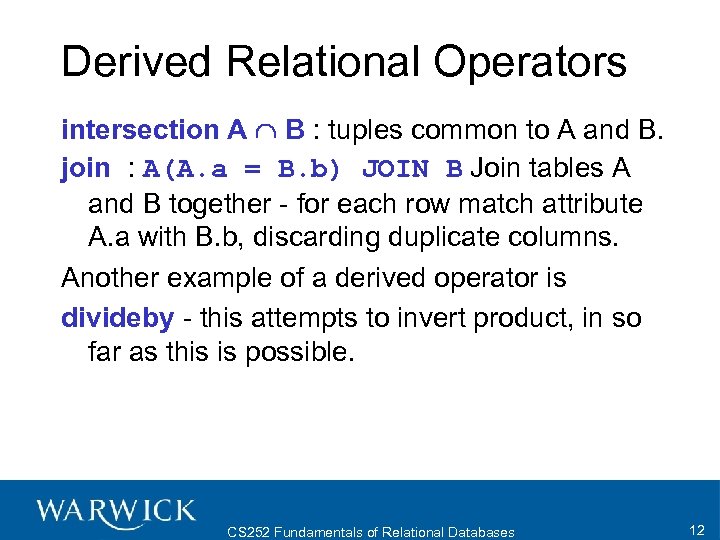
Derived Relational Operators intersection A B : tuples common to A and B. join : A(A. a = B. b) JOIN B Join tables A and B together - for each row match attribute A. a with B. b, discarding duplicate columns. Another example of a derived operator is divideby - this attempts to invert product, in so far as this is possible. CS 252 Fundamentals of Relational Databases 12
Codd's completeness criterion: a query language is complete if it can express each of the five primitive relational operators. CS 252 Fundamentals of Relational Databases 13
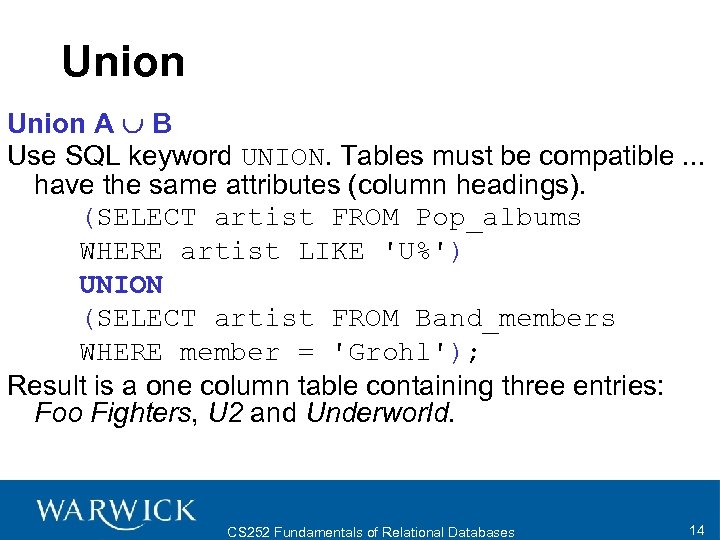
Union A B Use SQL keyword UNION. Tables must be compatible. . . have the same attributes (column headings). (SELECT artist FROM Pop_albums WHERE artist LIKE 'U%') UNION (SELECT artist FROM Band_members WHERE member = 'Grohl'); Result is a one column table containing three entries: Foo Fighters, U 2 and Underworld. CS 252 Fundamentals of Relational Databases 14
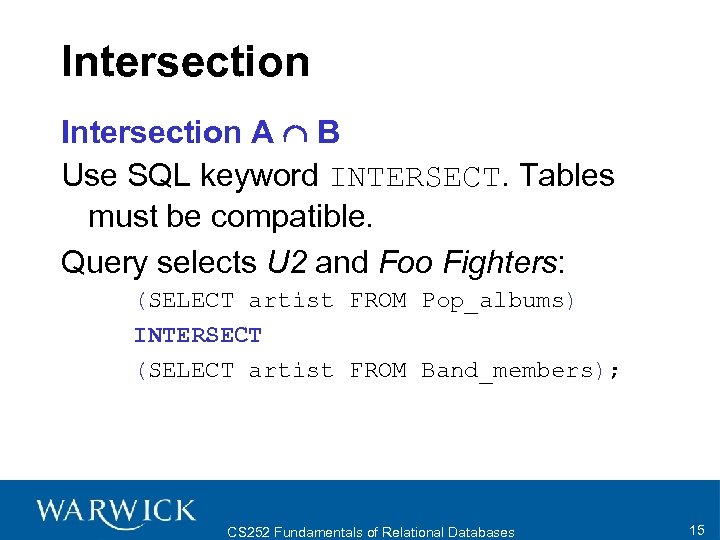
Intersection A B Use SQL keyword INTERSECT. Tables must be compatible. Query selects U 2 and Foo Fighters: (SELECT artist FROM Pop_albums) INTERSECT (SELECT artist FROM Band_members); CS 252 Fundamentals of Relational Databases 15
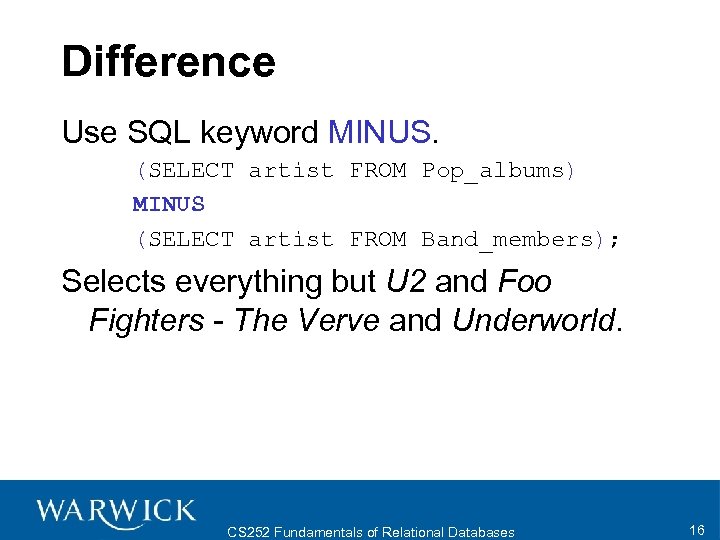
Difference Use SQL keyword MINUS. (SELECT artist FROM Pop_albums) MINUS (SELECT artist FROM Band_members); Selects everything but U 2 and Foo Fighters - The Verve and Underworld. CS 252 Fundamentals of Relational Databases 16
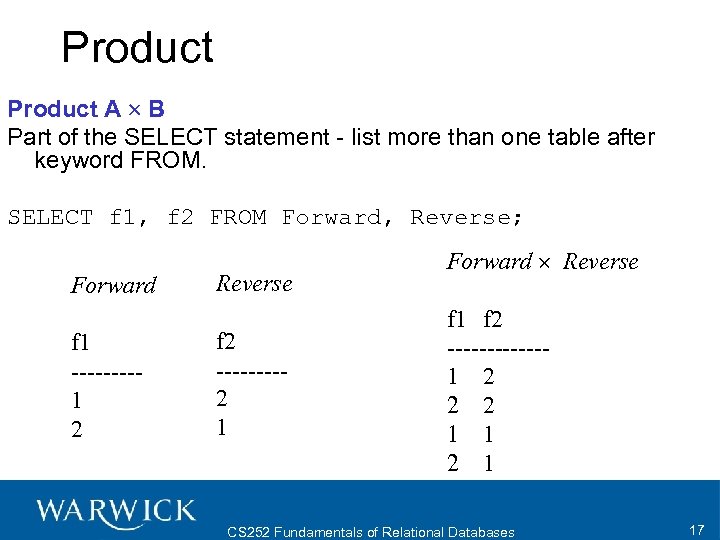
Product A B Part of the SELECT statement - list more than one table after keyword FROM. SELECT f 1, f 2 FROM Forward, Reverse; Forward f 1 ----1 2 Reverse f 2 ----2 1 Forward Reverse f 1 f 2 ------1 2 2 2 1 1 2 1 CS 252 Fundamentals of Relational Databases 17
![Project A[a, b …] Using keyword SELECT as from day 1. SELECT DISTINCT a,](https://present5.com/presentation/b87cfc050c9666fc3d8ea27c7f17366e/image-18.jpg "Project A[a, b …] Using keyword SELECT as from day 1. SELECT DISTINCT a,")
Project A[a, b …] Using keyword SELECT as from day 1. SELECT DISTINCT a, b FROM A; SELECT DISTINCT artist, album FROM Pop_albums; CS 252 Fundamentals of Relational Databases 18
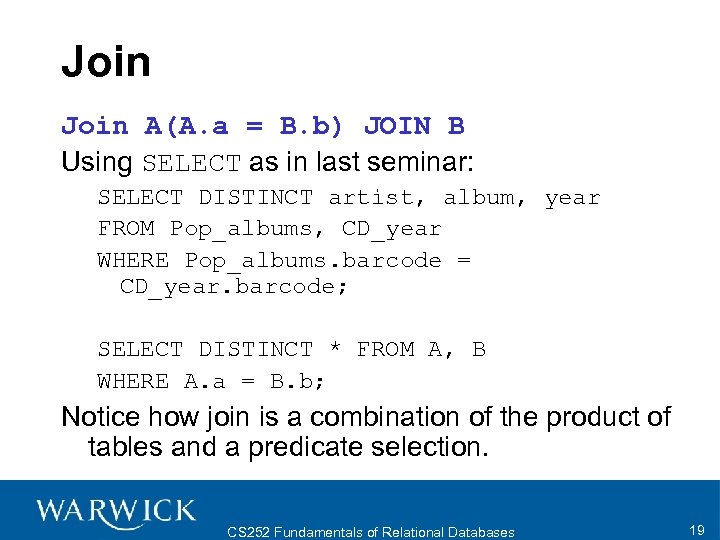
Join A(A. a = B. b) JOIN B Using SELECT as in last seminar: SELECT DISTINCT artist, album, year FROM Pop_albums, CD_year WHERE Pop_albums. barcode = CD_year. barcode; SELECT DISTINCT * FROM A, B WHERE A. a = B. b; Notice how join is a combination of the product of tables and a predicate selection. CS 252 Fundamentals of Relational Databases 19
Advanced Joins We covered a simple (equi-)join between two tables earlier in the module. Joins combine rows from two or more tables to create a single result. Columns are compared with a Join Condition. Pairs of rows each containing one row from each table are combined when the join condition evaluates to TRUE. CS 252 Fundamentals of Relational Databases 20
Join Types (SQL) Joins can be classified into the following categories : • Cartesian Products • Inner Joins (Equijoins) • Self Joins • Outer Joins (Left, Right and Full) CS 252 Fundamentals of Relational Databases 21
Cartesian Products (Cross Join) • join without a Join Condition • generate many rows of data, e. g. , test data. • the base of all the other types of join. CS 252 Fundamentals of Relational Databases 22
Inner Joins (Equijoins) An Inner Join (or Equijoin) is a join with a condition (e. g. , that compares columns for equality =). Rows are combined that have equal values in the specified columns. The order of the tables listed in the FROM clause should have no significance. CS 252 Fundamentals of Relational Databases 23
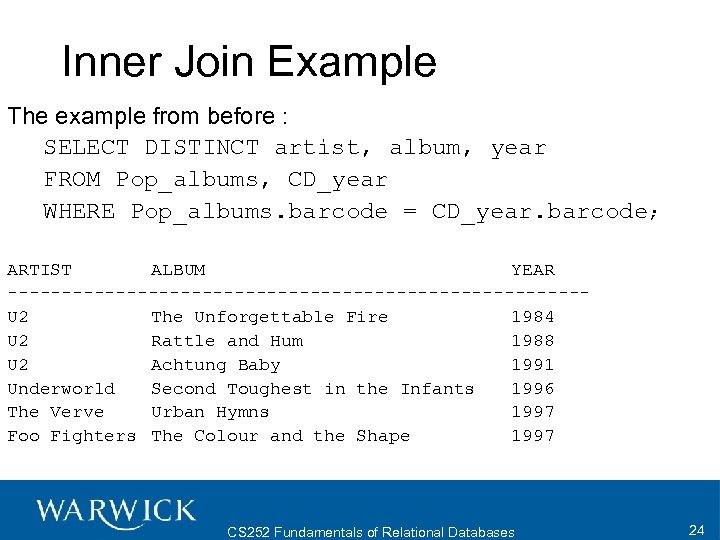
Inner Join Example The example from before : SELECT DISTINCT artist, album, year FROM Pop_albums, CD_year WHERE Pop_albums. barcode = CD_year. barcode; ARTIST ALBUM YEAR ---------------------------U 2 The Unforgettable Fire 1984 U 2 Rattle and Hum 1988 U 2 Achtung Baby 1991 Underworld Second Toughest in the Infants 1996 The Verve Urban Hymns 1997 Foo Fighters The Colour and the Shape 1997 CS 252 Fundamentals of Relational Databases 24
Self Join A Self Join is a join of a table to itself. Put the table in the FROM clause twice. Self joins are very useful. Use aliases to distinguish columns in the WHERE clause. CS 252 Fundamentals of Relational Databases 25
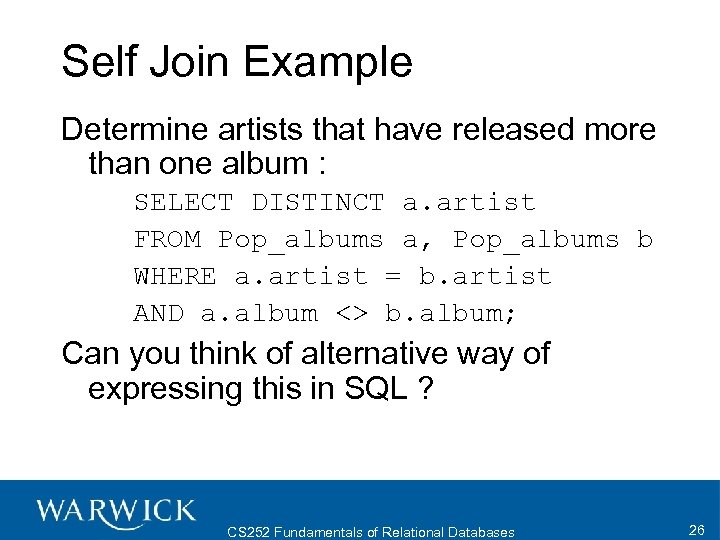
Self Join Example Determine artists that have released more than one album : SELECT DISTINCT a. artist FROM Pop_albums a, Pop_albums b WHERE a. artist = b. artist AND a. album <> b. album; Can you think of alternative way of expressing this in SQL ? CS 252 Fundamentals of Relational Databases 26
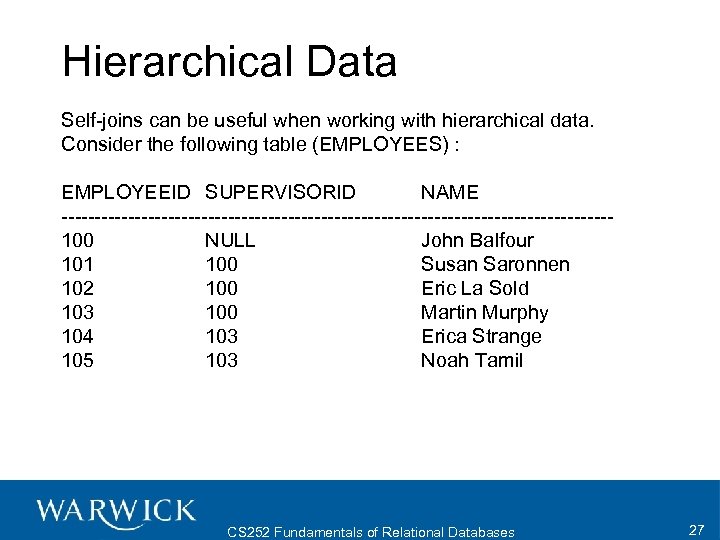
Hierarchical Data Self-joins can be useful when working with hierarchical data. Consider the following table (EMPLOYEES) : EMPLOYEEID SUPERVISORID NAME -----------------------------------------100 NULL John Balfour 101 100 Susan Saronnen 102 100 Eric La Sold 103 100 Martin Murphy 104 103 Erica Strange 105 103 Noah Tamil CS 252 Fundamentals of Relational Databases 27
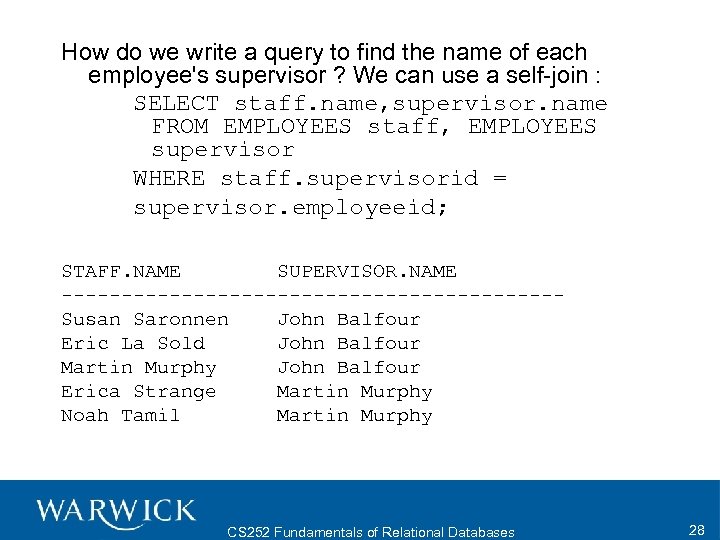
How do we write a query to find the name of each employee's supervisor ? We can use a self-join : SELECT staff. name, supervisor. name FROM EMPLOYEES staff, EMPLOYEES supervisor WHERE staff. supervisorid = supervisor. employeeid; STAFF. NAME SUPERVISOR. NAME ---------------------Susan Saronnen John Balfour Eric La Sold John Balfour Martin Murphy John Balfour Erica Strange Martin Murphy Noah Tamil Martin Murphy CS 252 Fundamentals of Relational Databases 28
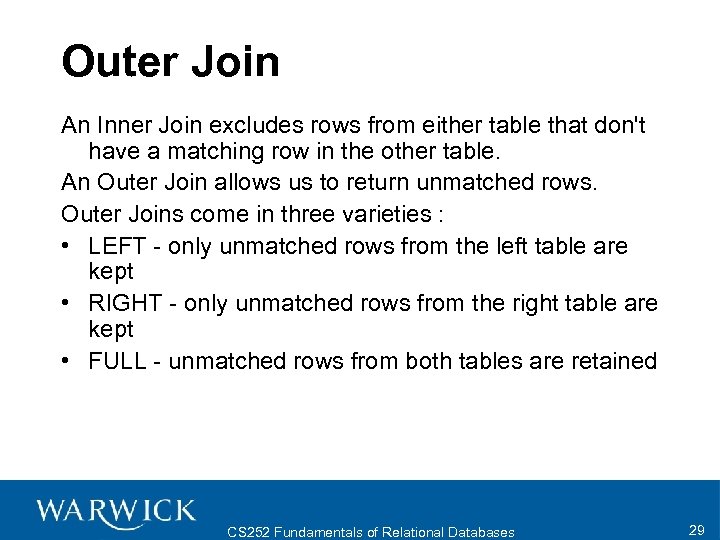
Outer Join An Inner Join excludes rows from either table that don't have a matching row in the other table. An Outer Join allows us to return unmatched rows. Outer Joins come in three varieties : • LEFT - only unmatched rows from the left table are kept • RIGHT - only unmatched rows from the right table are kept • FULL - unmatched rows from both tables are retained CS 252 Fundamentals of Relational Databases 29
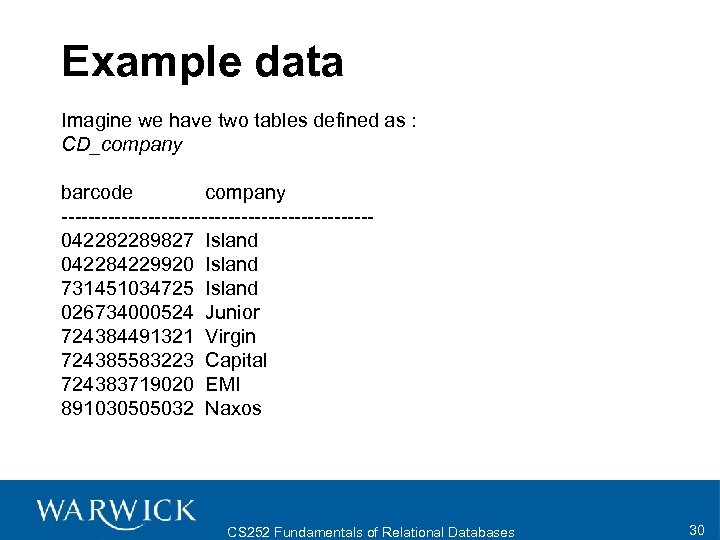
Example data Imagine we have two tables defined as : CD_company barcode company -----------------------042282289827 Island 042284229920 Island 731451034725 Island 026734000524 Junior 724384491321 Virgin 724385583223 Capital 724383719020 EMI 891030505032 Naxos CS 252 Fundamentals of Relational Databases 30
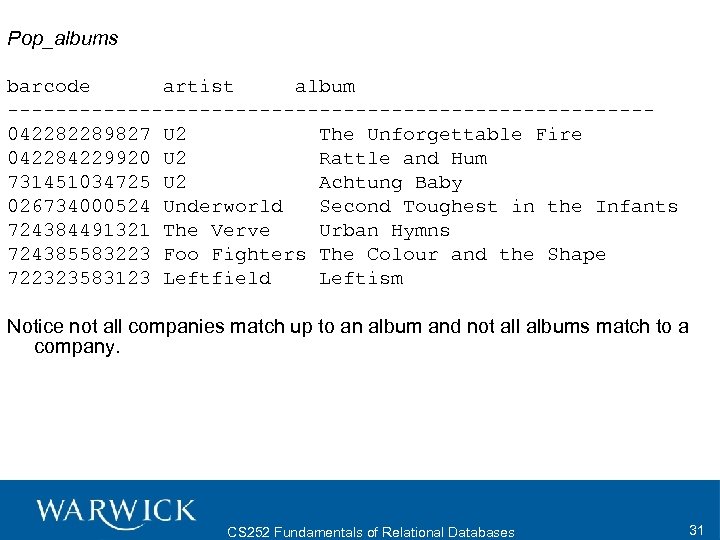
Pop_albums barcode artist album ---------------------------042282289827 U 2 The Unforgettable Fire 042284229920 U 2 Rattle and Hum 731451034725 U 2 Achtung Baby 026734000524 Underworld Second Toughest in the Infants 724384491321 The Verve Urban Hymns 724385583223 Foo Fighters The Colour and the Shape 722323583123 Leftfield Leftism Notice not all companies match up to an album and not all albums match to a company. CS 252 Fundamentals of Relational Databases 31
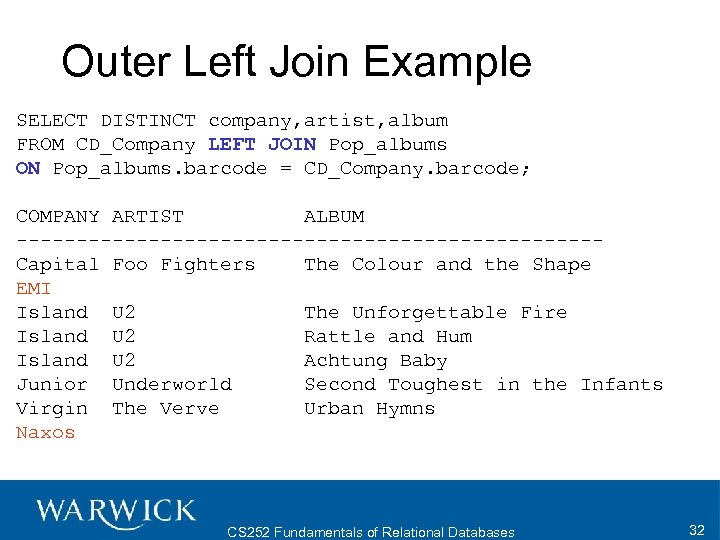
Outer Left Join Example SELECT DISTINCT company, artist, album FROM CD_Company LEFT JOIN Pop_albums ON Pop_albums. barcode = CD_Company. barcode; COMPANY ARTIST ALBUM ------------------------Capital Foo Fighters The Colour and the Shape EMI Island U 2 The Unforgettable Fire Island U 2 Rattle and Hum Island U 2 Achtung Baby Junior Underworld Second Toughest in the Infants Virgin The Verve Urban Hymns Naxos CS 252 Fundamentals of Relational Databases 32
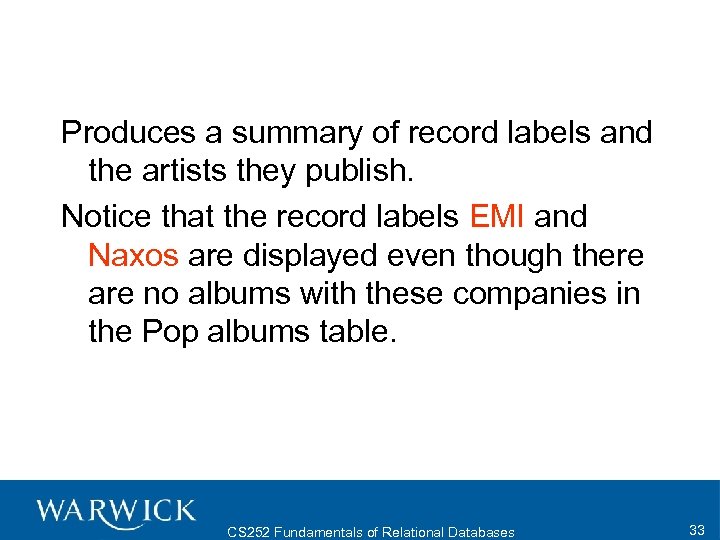
Produces a summary of record labels and the artists they publish. Notice that the record labels EMI and Naxos are displayed even though there are no albums with these companies in the Pop albums table. CS 252 Fundamentals of Relational Databases 33
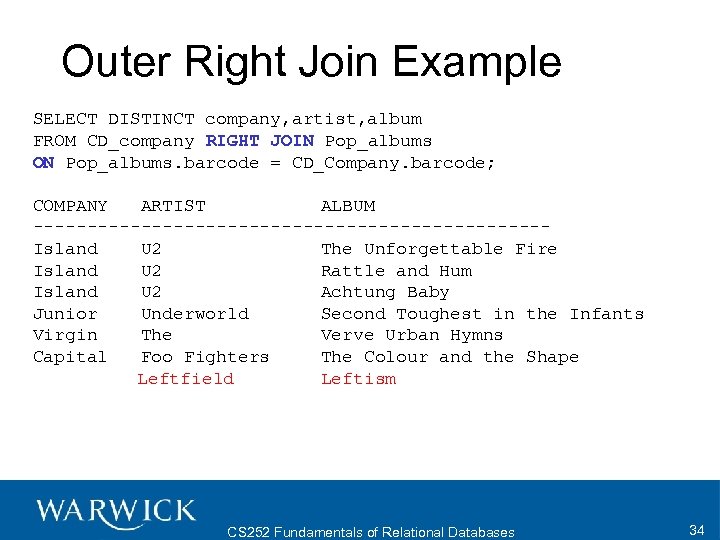
Outer Right Join Example SELECT DISTINCT company, artist, album FROM CD_company RIGHT JOIN Pop_albums ON Pop_albums. barcode = CD_Company. barcode; COMPANY ARTIST ALBUM ------------------------Island U 2 The Unforgettable Fire Island U 2 Rattle and Hum Island U 2 Achtung Baby Junior Underworld Second Toughest in the Infants Virgin The Verve Urban Hymns Capital Foo Fighters The Colour and the Shape Leftfield Leftism CS 252 Fundamentals of Relational Databases 34
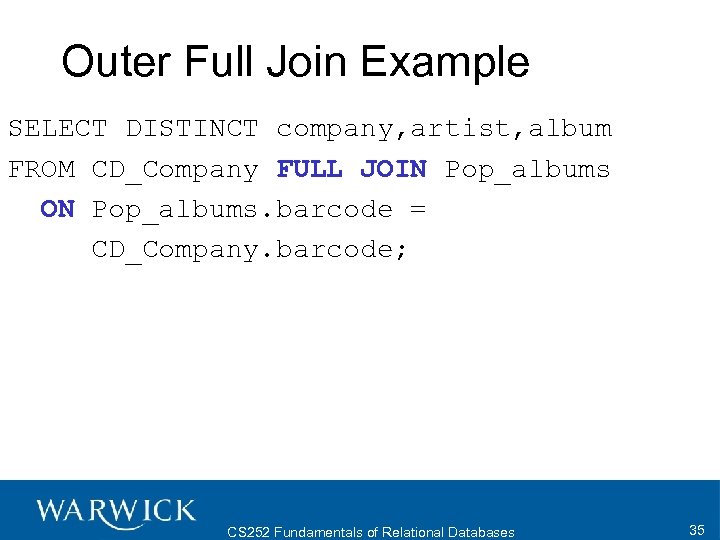
Outer Full Join Example SELECT DISTINCT company, artist, album FROM CD_Company FULL JOIN Pop_albums ON Pop_albums. barcode = CD_Company. barcode; CS 252 Fundamentals of Relational Databases 35
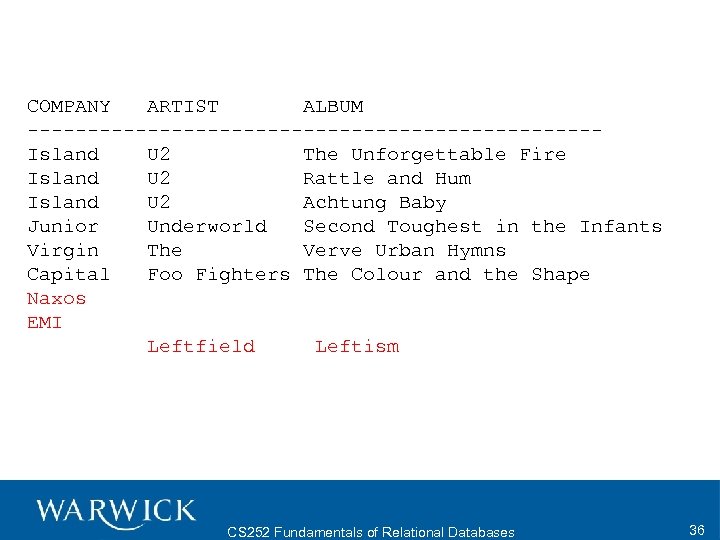
COMPANY ARTIST ALBUM ------------------------Island U 2 The Unforgettable Fire Island U 2 Rattle and Hum Island U 2 Achtung Baby Junior Underworld Second Toughest in the Infants Virgin The Verve Urban Hymns Capital Foo Fighters The Colour and the Shape Naxos EMI Leftfield Leftism CS 252 Fundamentals of Relational Databases 36
Interim Summary • Indexes, Sequences, • Relational Algebra and Advanced Joins CS 252 Fundamentals of Relational Databases 37
Скачать презентацию CS 252 Fundamentals of Relational Databases SQL 4
b87cfc050c9666fc3d8ea27c7f17366e.ppt