 Скачать презентацию CS 245 Database System Principles Notes 03 Disk
735a1b6b4d7a28c51743dc4f1381ce79.ppt
- Количество слайдов: 79



CS 245: Database System Principles Notes 03: Disk Organization Hector Garcia-Molina CS 245 Notes 3 1
Topics for today • How to lay out data on disk • How to move it to memory CS 245 Notes 3 2
What are the data items we want to store? • • CS 245 a a salary name date picture Notes 3 3
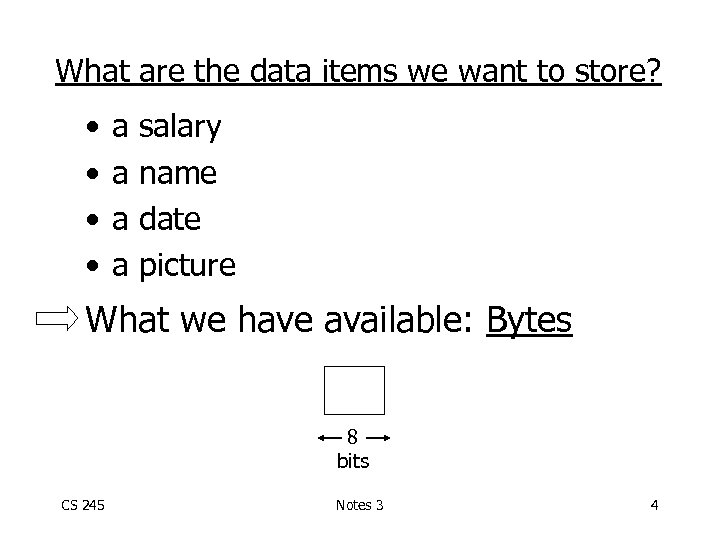
What are the data items we want to store? • • a a salary name date picture What we have available: Bytes 8 bits CS 245 Notes 3 4
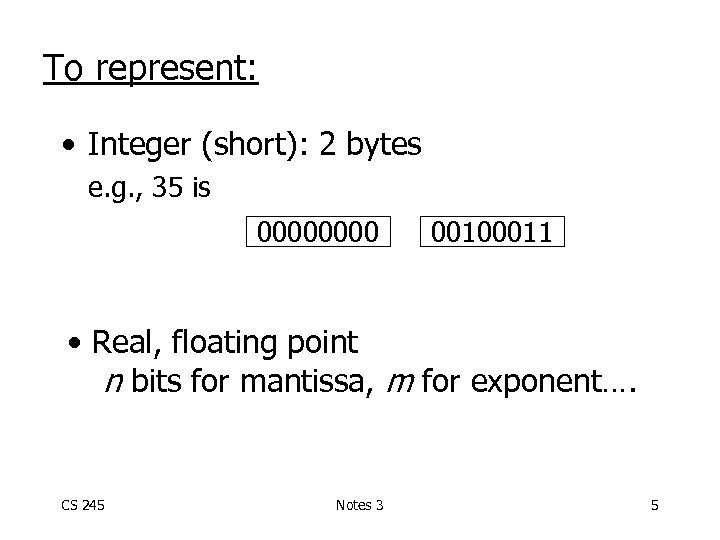
To represent: • Integer (short): 2 bytes e. g. , 35 is 0000 00100011 • Real, floating point n bits for mantissa, m for exponent…. CS 245 Notes 3 5
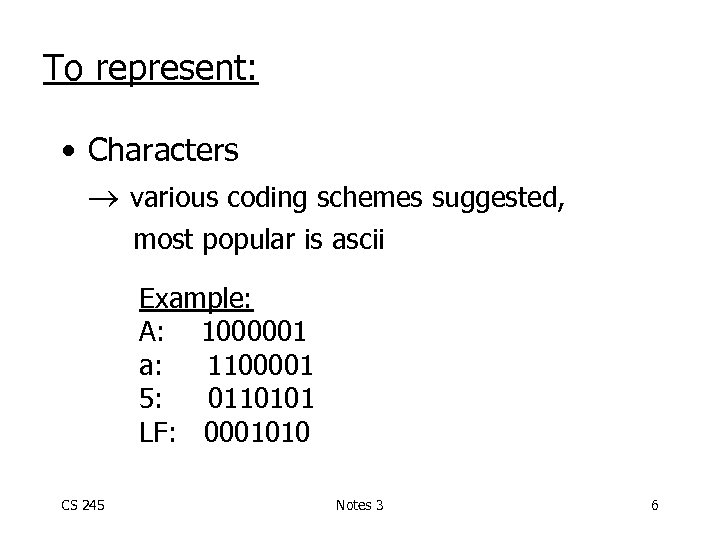
To represent: • Characters various coding schemes suggested, most popular is ascii Example: A: 1000001 a: 1100001 5: 0110101 LF: 0001010 CS 245 Notes 3 6
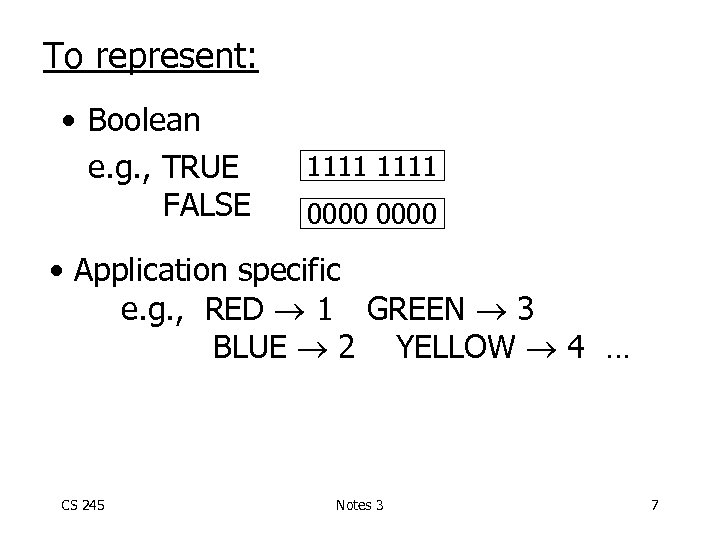
To represent: • Boolean e. g. , TRUE FALSE 1111 0000 • Application specific e. g. , RED 1 GREEN 3 BLUE 2 YELLOW 4 … CS 245 Notes 3 7
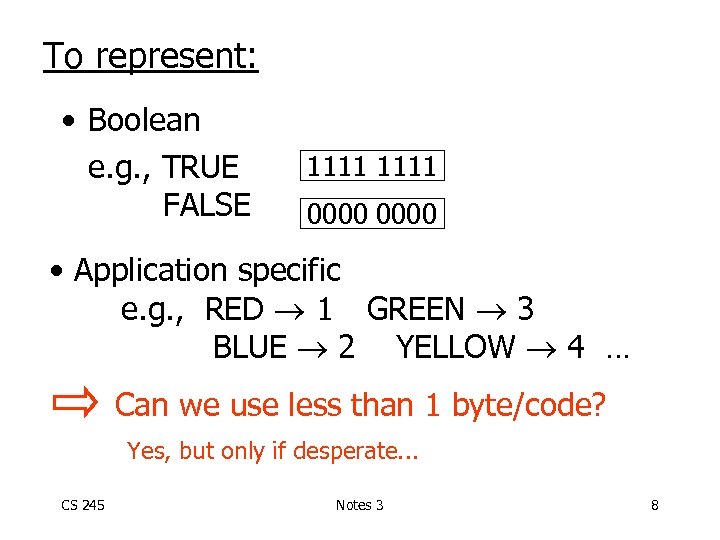
To represent: • Boolean e. g. , TRUE FALSE 1111 0000 • Application specific e. g. , RED 1 GREEN 3 BLUE 2 YELLOW 4 … Can we use less than 1 byte/code? Yes, but only if desperate. . . CS 245 Notes 3 8
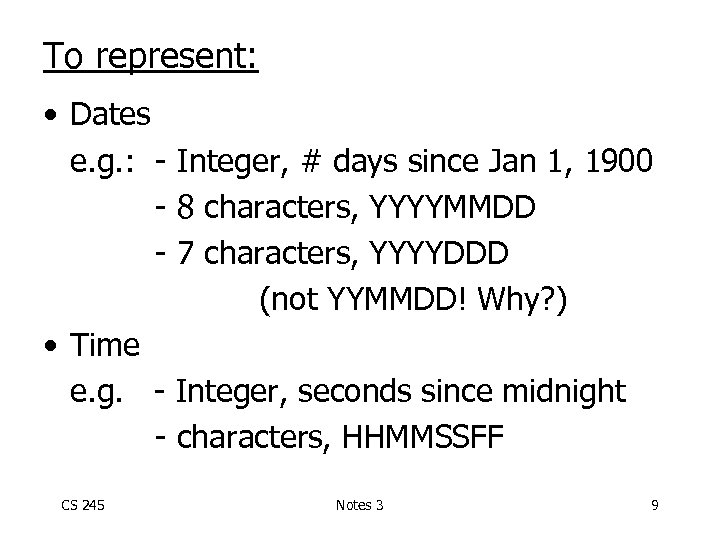
To represent: • Dates e. g. : - Integer, # days since Jan 1, 1900 - 8 characters, YYYYMMDD - 7 characters, YYYYDDD (not YYMMDD! Why? ) • Time e. g. - Integer, seconds since midnight - characters, HHMMSSFF CS 245 Notes 3 9
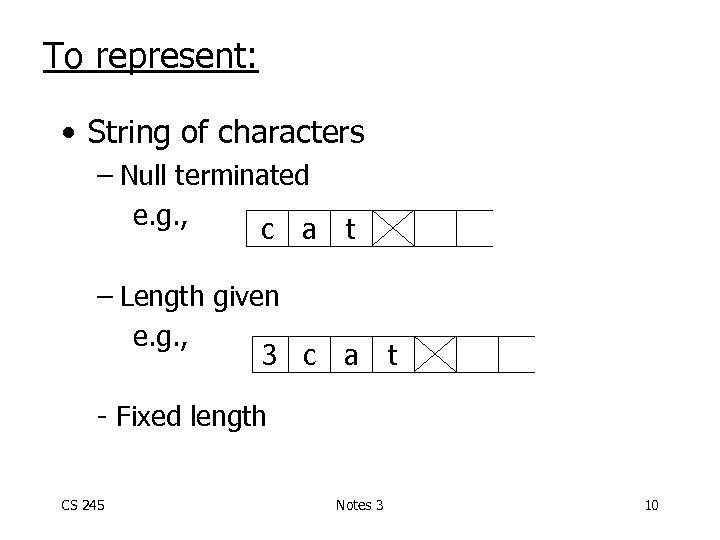
To represent: • String of characters – Null terminated e. g. , c a t – Length given e. g. , 3 c a t - Fixed length CS 245 Notes 3 10
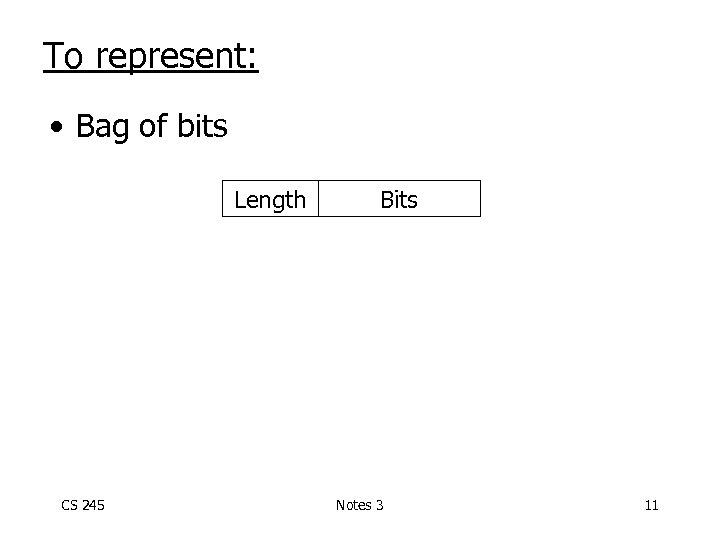
To represent: • Bag of bits Length CS 245 Bits Notes 3 11
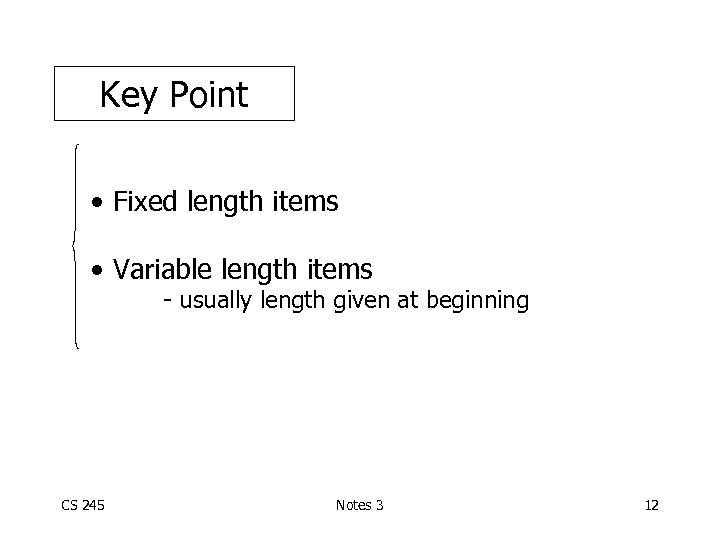
Key Point • Fixed length items • Variable length items - usually length given at beginning CS 245 Notes 3 12
Also • Type of an item: Tells us how to interpret (plus size if fixed) CS 245 Notes 3 13
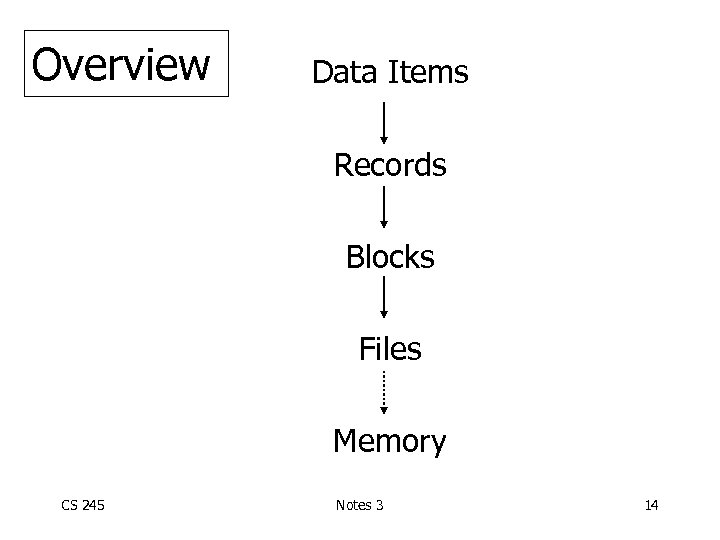
Overview Data Items Records Blocks Files Memory CS 245 Notes 3 14
Record - Collection of related data items (called FIELDS) E. g. : Employee record: name field, salary field, date-of-hire field, . . . CS 245 Notes 3 15
Types of records: • Main choices: – FIXED vs VARIABLE FORMAT – FIXED vs VARIABLE LENGTH CS 245 Notes 3 16
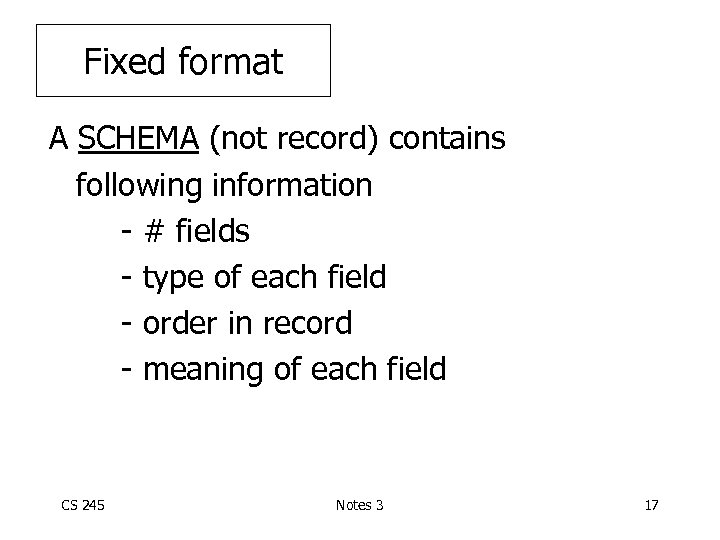
Fixed format A SCHEMA (not record) contains following information - # fields - type of each field - order in record - meaning of each field CS 245 Notes 3 17
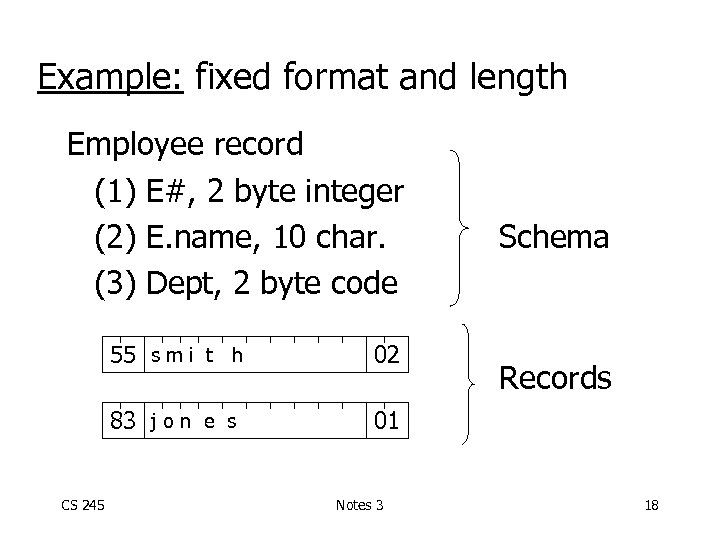
Example: fixed format and length Employee record (1) E#, 2 byte integer (2) E. name, 10 char. (3) Dept, 2 byte code 55 s m i t h 83 j o n e s CS 245 02 Schema 01 Notes 3 Records 18
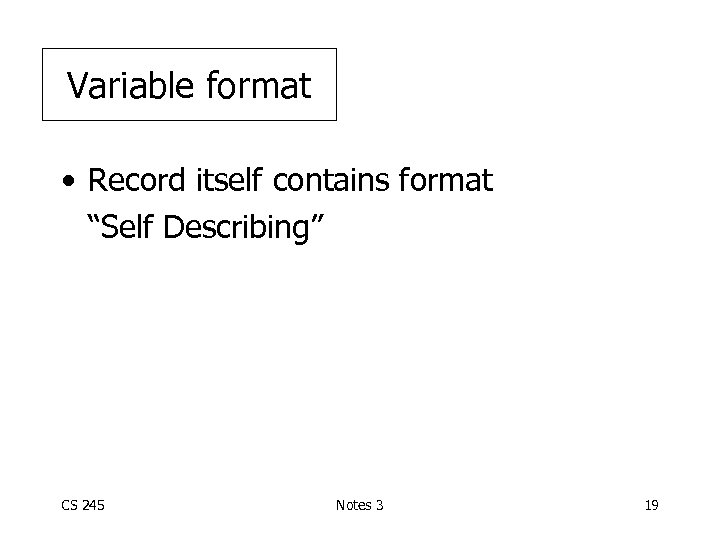
Variable format • Record itself contains format “Self Describing” CS 245 Notes 3 19
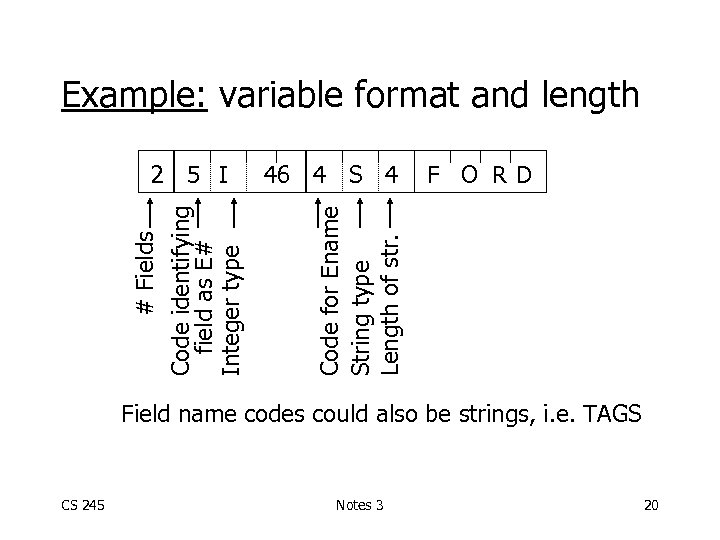
Example: variable format and length 46 4 S 4 F O RD Code for Ename String type Length of str. Code identifying field as E# Integer type # Fields 2 5 I Field name codes could also be strings, i. e. TAGS CS 245 Notes 3 20
Variable format useful for: • “sparse” records • repeating fields • evolving formats But may waste space. . . CS 245 Notes 3 21
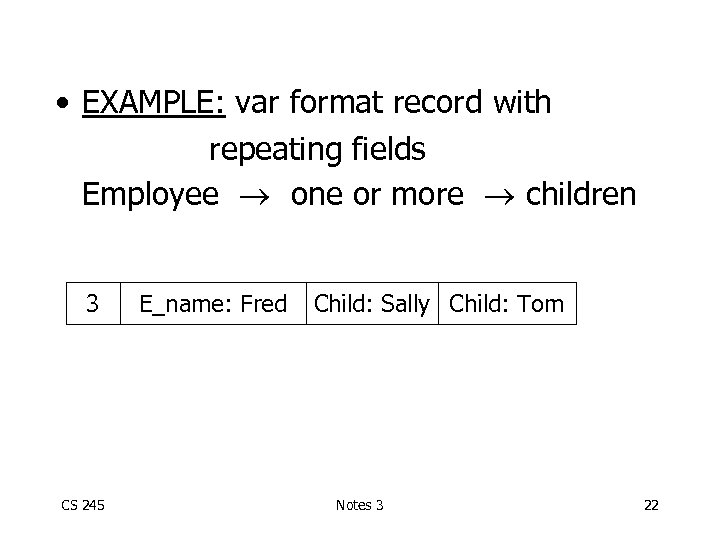
• EXAMPLE: var format record with repeating fields Employee one or more children 3 CS 245 E_name: Fred Child: Sally Child: Tom Notes 3 22
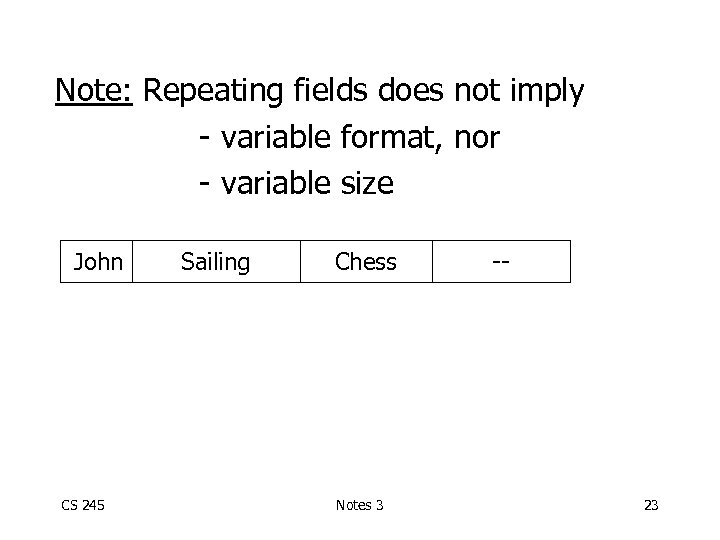
Note: Repeating fields does not imply - variable format, nor - variable size John CS 245 Sailing Chess Notes 3 -- 23
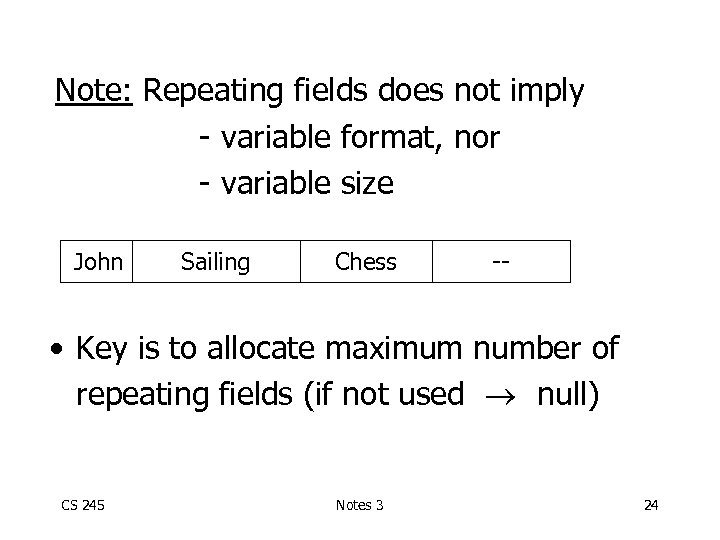
Note: Repeating fields does not imply - variable format, nor - variable size John Sailing Chess -- • Key is to allocate maximum number of repeating fields (if not used null) CS 245 Notes 3 24
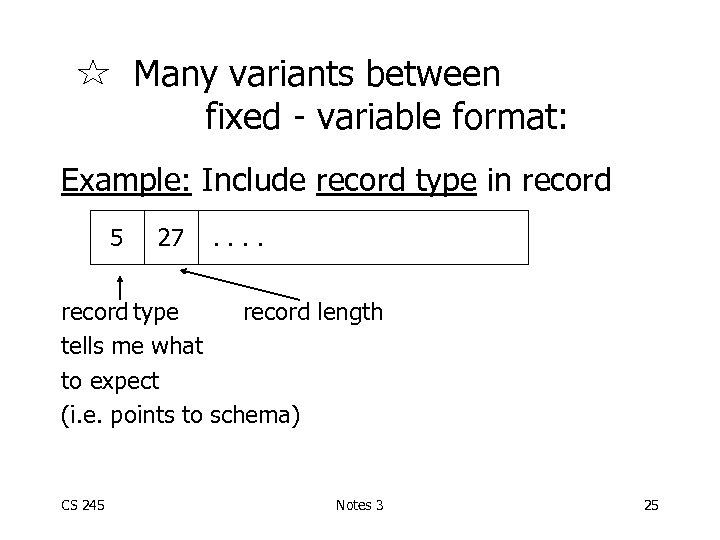
Many variants between fixed - variable format: Example: Include record type in record 5 27 . . record type record length tells me what to expect (i. e. points to schema) CS 245 Notes 3 25
Record header - data at beginning that describes record May contain: - record type - record length - time stamp - other stuff. . . CS 245 Notes 3 26
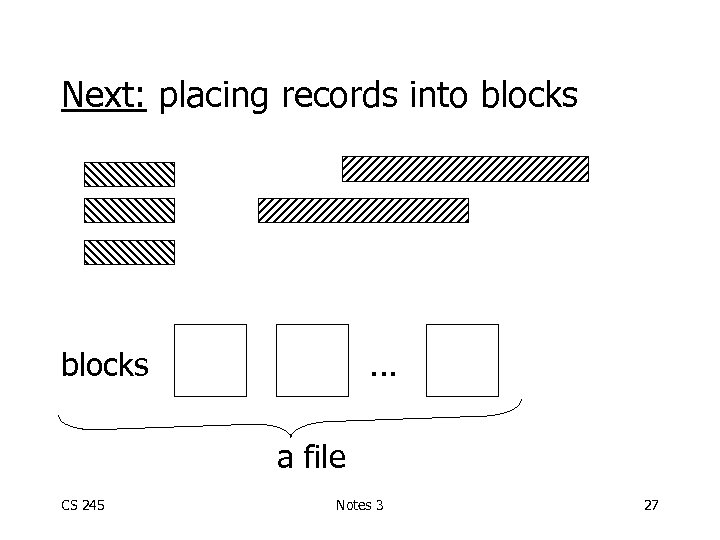
Next: placing records into blocks . . . a file CS 245 Notes 3 27
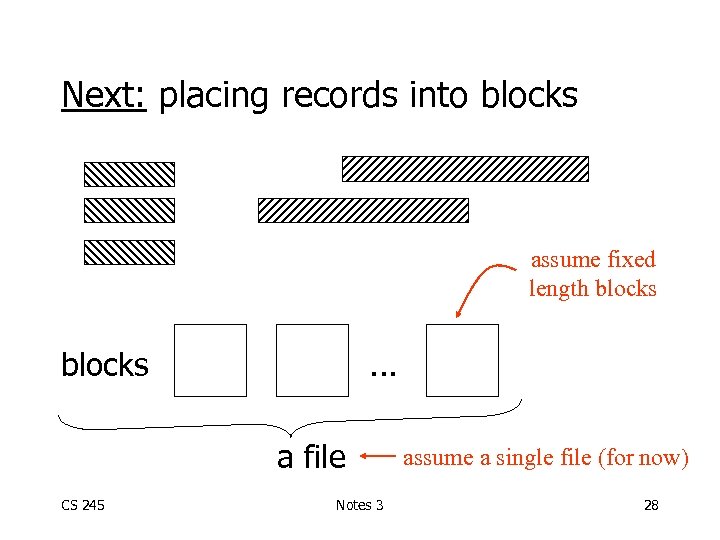
Next: placing records into blocks assume fixed length blocks . . . a file CS 245 Notes 3 assume a single file (for now) 28
Options for storing records in blocks: (1) (2) (3) (4) CS 245 separating records spanned vs. unspanned sequencing indirection Notes 3 29
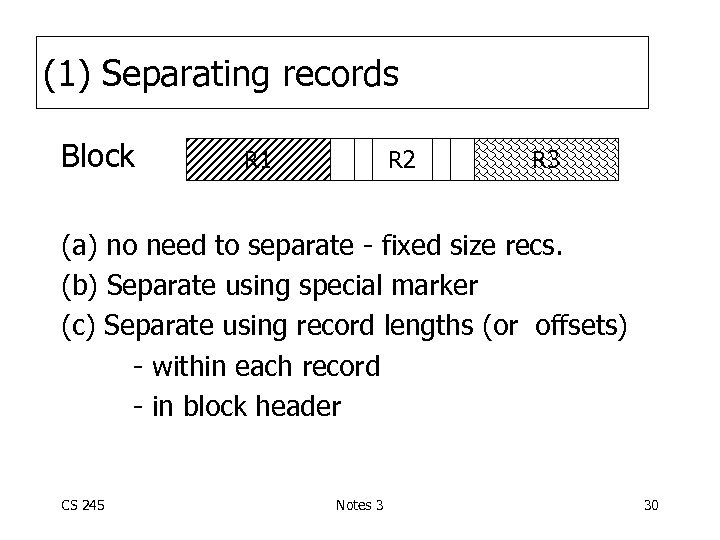
(1) Separating records Block R 1 R 2 R 3 (a) no need to separate - fixed size recs. (b) Separate using special marker (c) Separate using record lengths (or offsets) - within each record - in block header CS 245 Notes 3 30
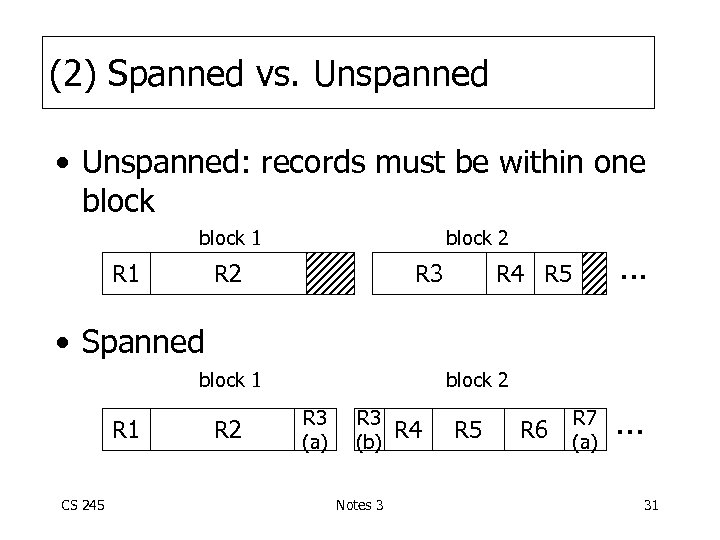
(2) Spanned vs. Unspanned • Unspanned: records must be within one block 1 R 1 block 2 R 3 . . . R 4 R 5 • Spanned block 1 R 1 CS 245 R 2 block 2 R 3 (a) R 3 (b) Notes 3 R 4 R 5 R 6 R 7 (a) . . . 31
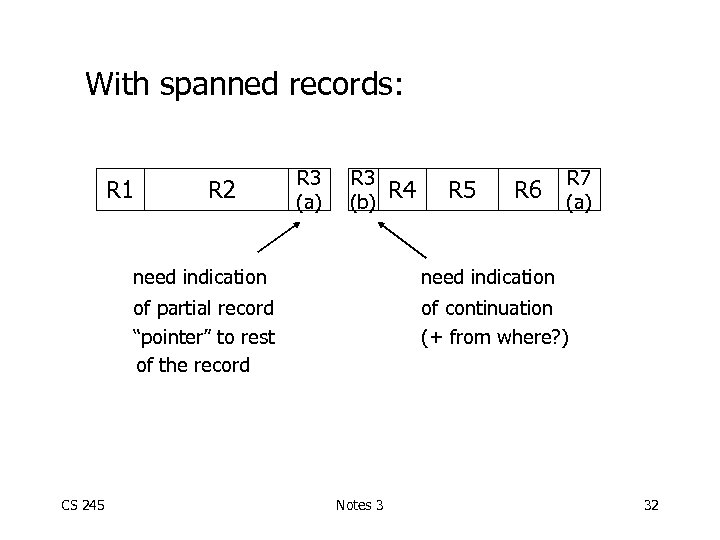
With spanned records: R 1 R 2 R 3 (a) R 3 (b) R 4 R 5 R 6 R 7 (a) need indication of partial record “pointer” to rest of the record CS 245 need indication of continuation (+ from where? ) Notes 3 32
Spanned vs. unspanned: • Unspanned is much simpler, but may waste space… • Spanned essential if record size > block size CS 245 Notes 3 33
(3) Sequencing • Ordering records in file (and block) by some key value Sequential file ( sequenced) CS 245 Notes 3 34
Why sequencing? Typically to make it possible to efficiently read records in order (e. g. , to do a merge-join — discussed later) CS 245 Notes 3 35
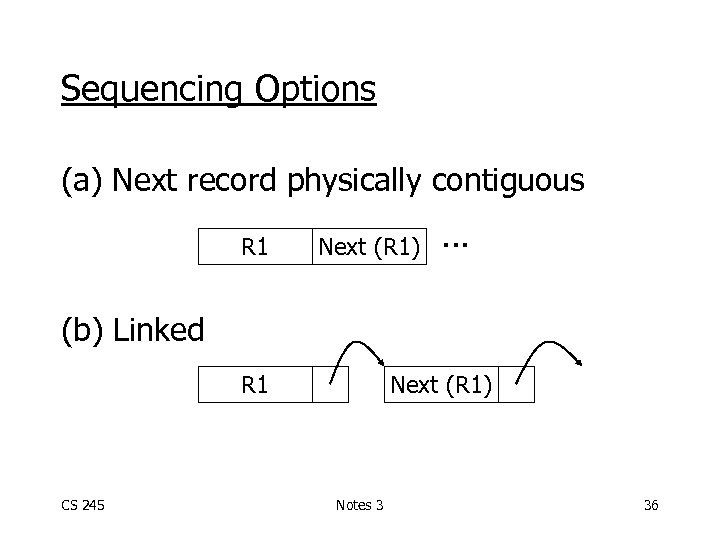
Sequencing Options (a) Next record physically contiguous R 1 Next (R 1) . . . (b) Linked R 1 CS 245 Next (R 1) Notes 3 36
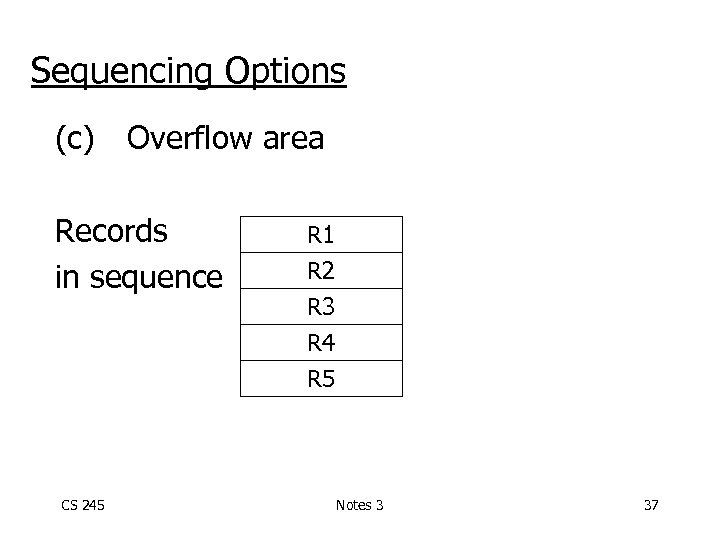
Sequencing Options (c) Overflow area Records in sequence CS 245 R 1 R 2 R 3 R 4 R 5 Notes 3 37
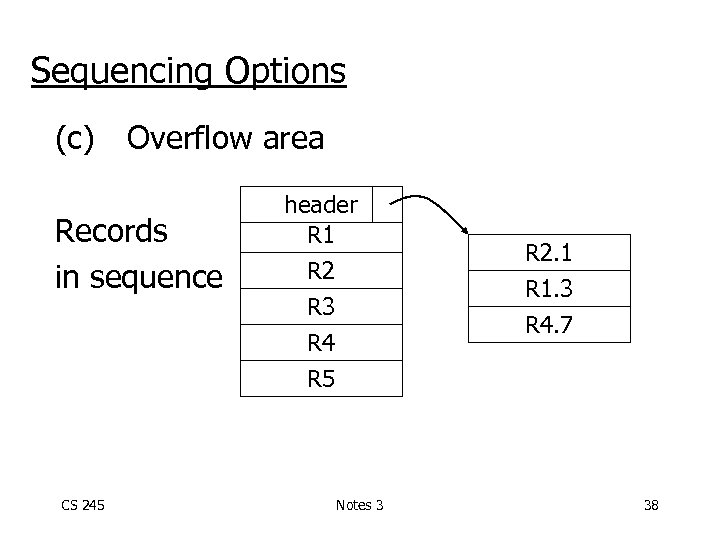
Sequencing Options (c) Overflow area Records in sequence CS 245 header R 1 R 2 R 3 R 4 R 5 Notes 3 R 2. 1 R 1. 3 R 4. 7 38
(4) Indirection • How does one refer to records? Rx CS 245 Notes 3 39
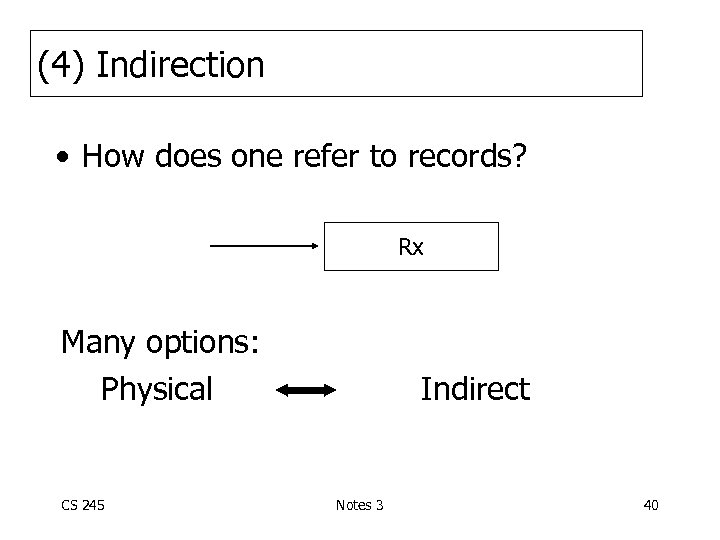
(4) Indirection • How does one refer to records? Rx Many options: Physical CS 245 Indirect Notes 3 40
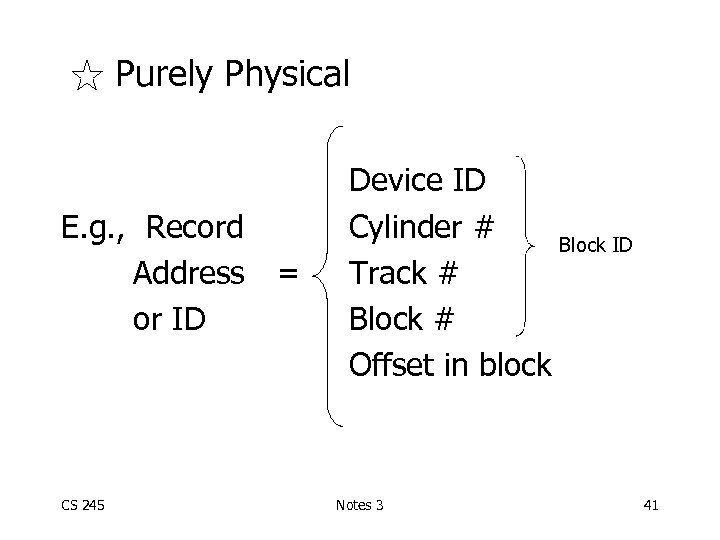
Purely Physical E. g. , Record Address or ID CS 245 = Device ID Cylinder # Block ID Track # Block # Offset in block Notes 3 41
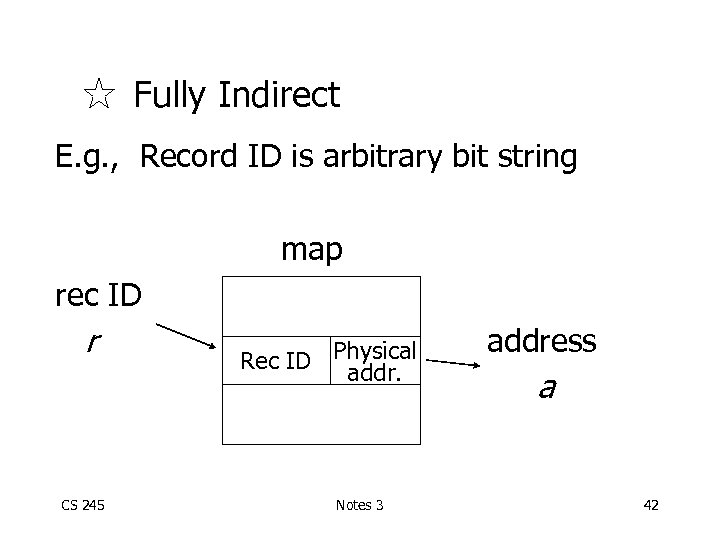
Fully Indirect E. g. , Record ID is arbitrary bit string map rec ID r CS 245 Rec ID Physical addr. Notes 3 address a 42
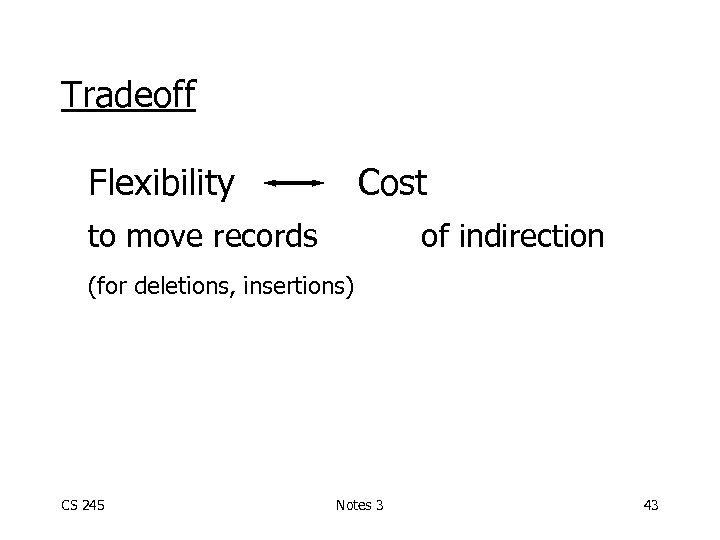
Tradeoff Flexibility Cost to move records of indirection (for deletions, insertions) CS 245 Notes 3 43
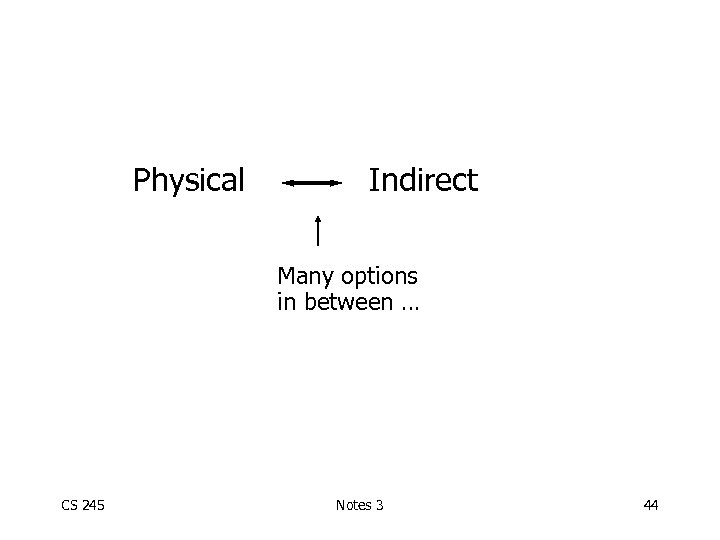
Physical Indirect Many options in between … CS 245 Notes 3 44
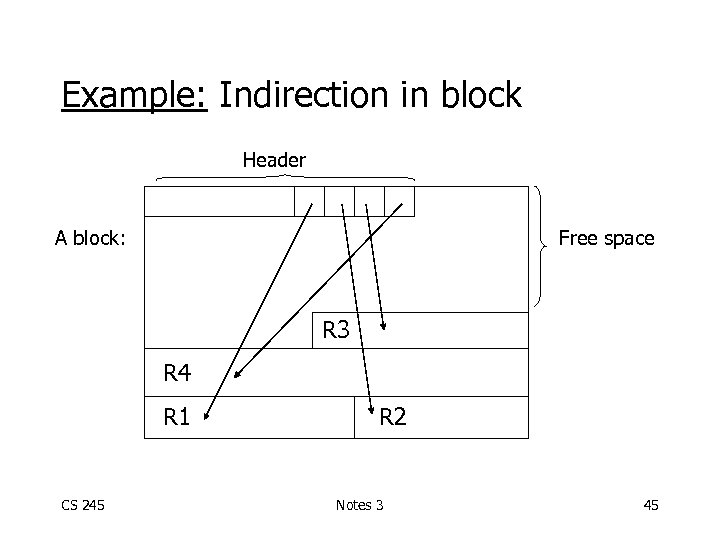
Example: Indirection in block Header A block: Free space R 3 R 4 R 1 CS 245 R 2 Notes 3 45
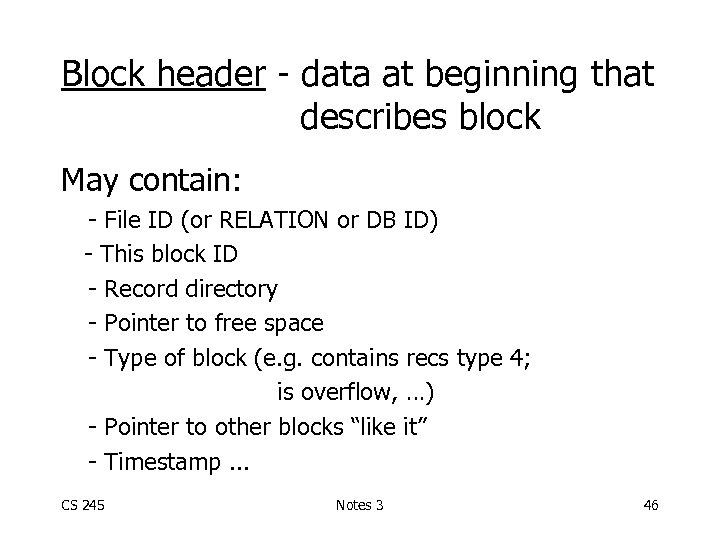
Block header - data at beginning that describes block May contain: - File ID (or RELATION or DB ID) - This block ID - Record directory - Pointer to free space - Type of block (e. g. contains recs type 4; is overflow, …) - Pointer to other blocks “like it” - Timestamp. . . CS 245 Notes 3 46
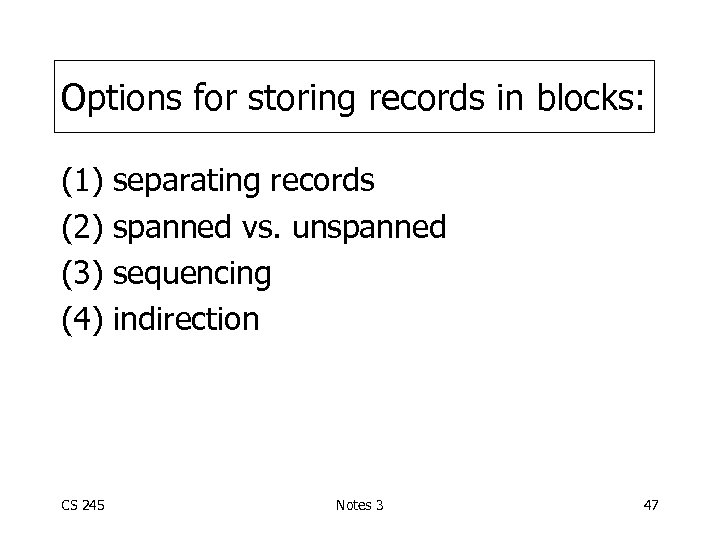
Options for storing records in blocks: (1) (2) (3) (4) CS 245 separating records spanned vs. unspanned sequencing indirection Notes 3 47
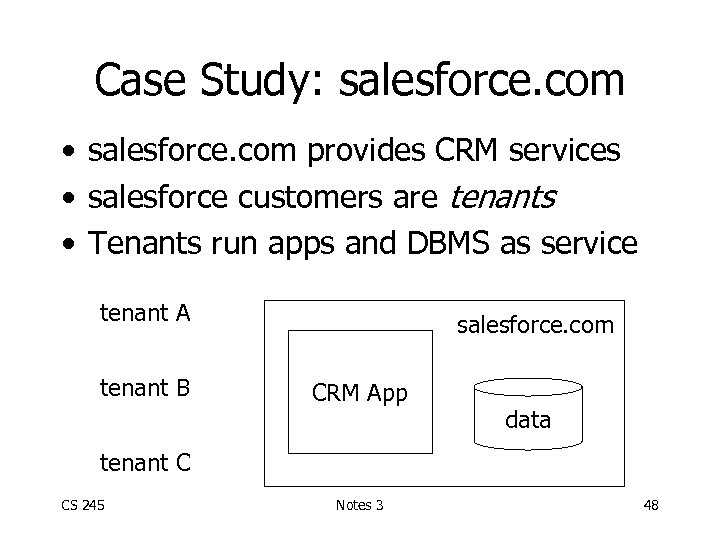
Case Study: salesforce. com • salesforce. com provides CRM services • salesforce customers are tenants • Tenants run apps and DBMS as service tenant A tenant B salesforce. com CRM App data tenant C CS 245 Notes 3 48
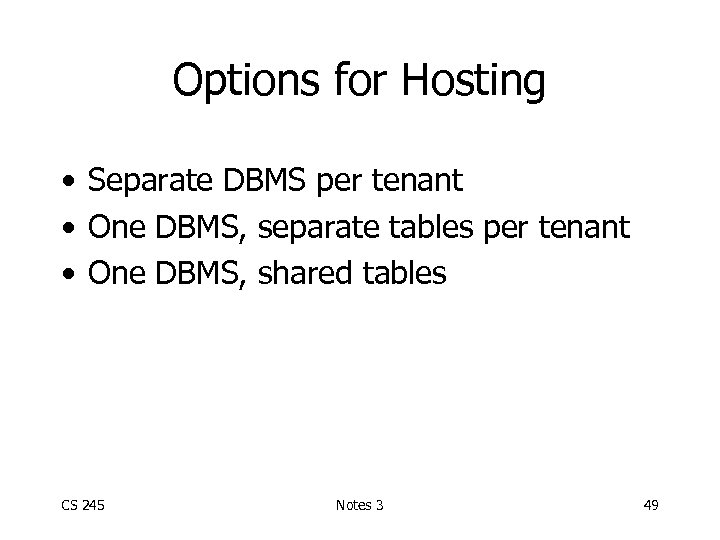
Options for Hosting • Separate DBMS per tenant • One DBMS, separate tables per tenant • One DBMS, shared tables CS 245 Notes 3 49
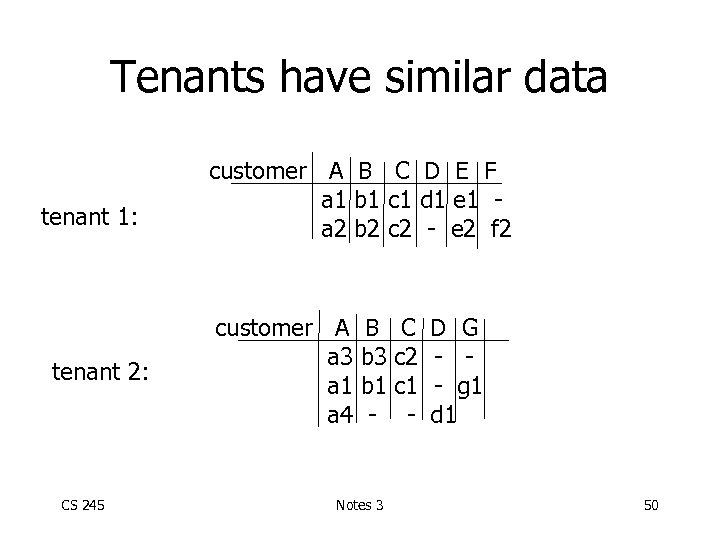
Tenants have similar data tenant 1: tenant 2: CS 245 customer A B C D E F a 1 b 1 c 1 d 1 e 1 a 2 b 2 c 2 - e 2 f 2 customer A a 3 a 1 a 4 B b 3 b 1 - Notes 3 C c 2 c 1 - D G - - g 1 d 1 50
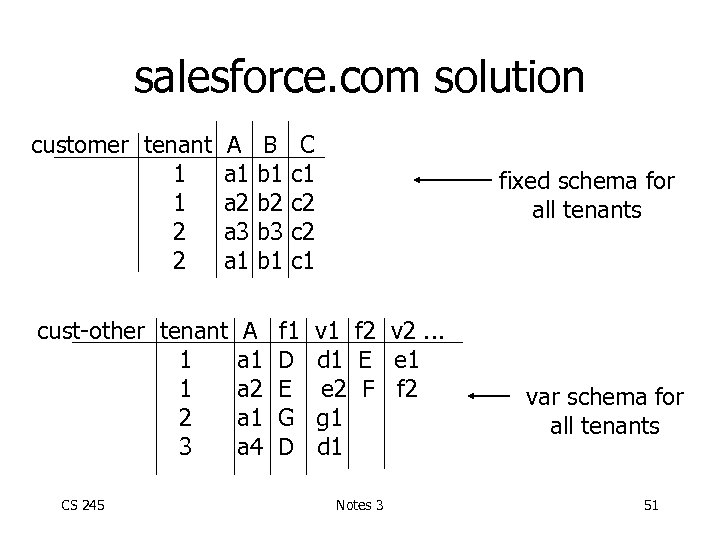
salesforce. com solution customer tenant 1 1 2 2 A a 1 a 2 a 3 a 1 cust-other tenant 1 1 2 3 CS 245 B b 1 b 2 b 3 b 1 A a 1 a 2 a 1 a 4 C c 1 c 2 c 1 f 1 D E G D fixed schema for all tenants v 1 f 2 v 2. . . d 1 E e 1 e 2 F f 2 g 1 d 1 Notes 3 var schema for all tenants 51
Other Topics (1) Insertion/Deletion (2) Buffer Management (3) Comparison of Schemes CS 245 Notes 3 52
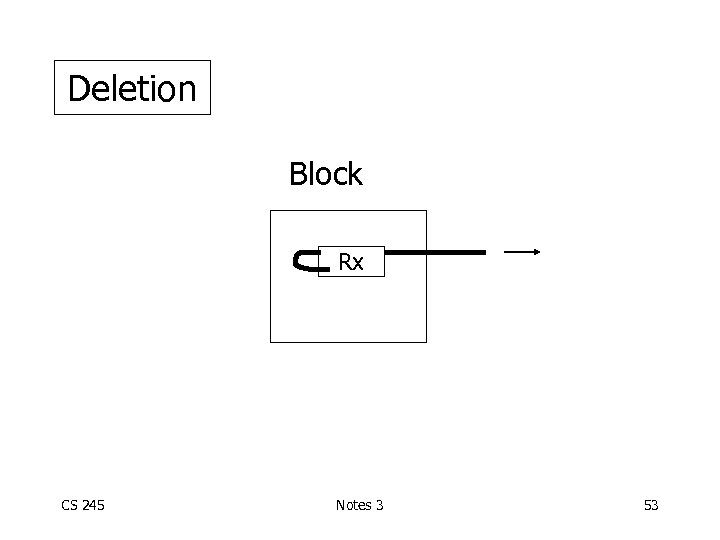
Deletion Block Rx CS 245 Notes 3 53
Options: (a) Immediately reclaim space (b) Mark deleted CS 245 Notes 3 54
Options: (a) Immediately reclaim space (b) Mark deleted – May need chain of deleted records (for re-use) – Need a way to mark: • special characters • delete field • in map CS 245 Notes 3 55
As usual, many tradeoffs. . . • How expensive is to move valid record to free space for immediate reclaim? • How much space is wasted? – e. g. , deleted records, delete fields, free space chains, . . . CS 245 Notes 3 56
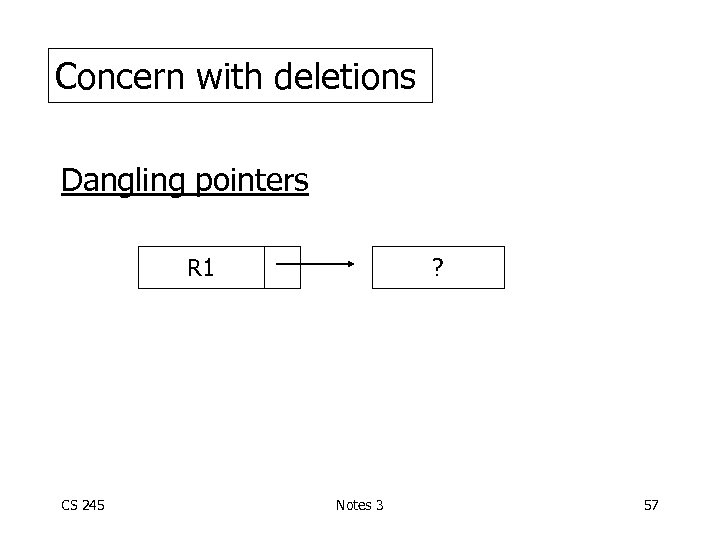
Concern with deletions Dangling pointers R 1 CS 245 ? Notes 3 57
Solution #1: Do not worry CS 245 Notes 3 58
Solution #2: Tombstones E. g. , Leave “MARK” in map or old location CS 245 Notes 3 59
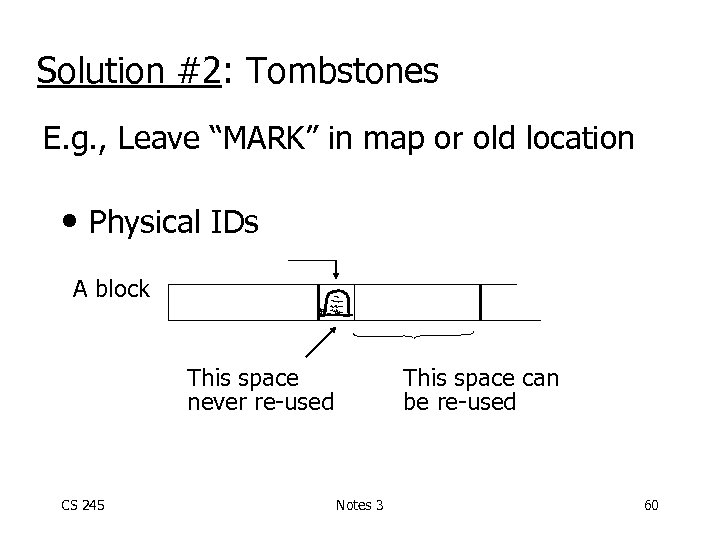
Solution #2: Tombstones E. g. , Leave “MARK” in map or old location • Physical IDs A block This space never re-used CS 245 This space can be re-used Notes 3 60
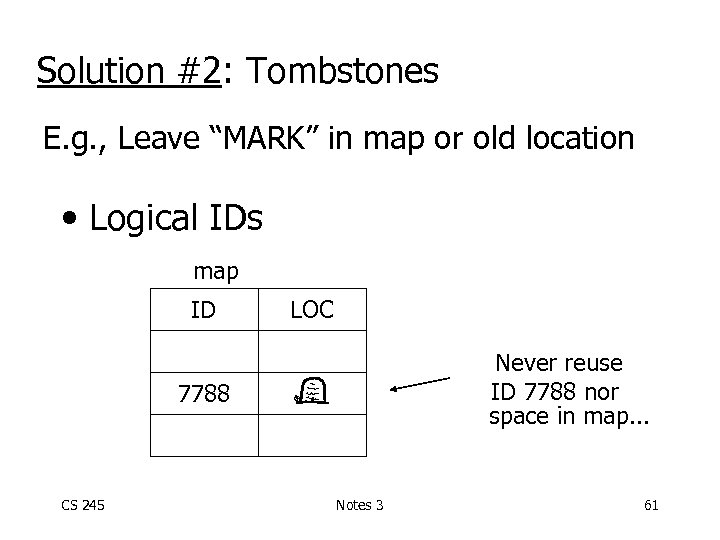
Solution #2: Tombstones E. g. , Leave “MARK” in map or old location • Logical IDs map ID LOC Never reuse ID 7788 nor space in map. . . 7788 CS 245 Notes 3 61
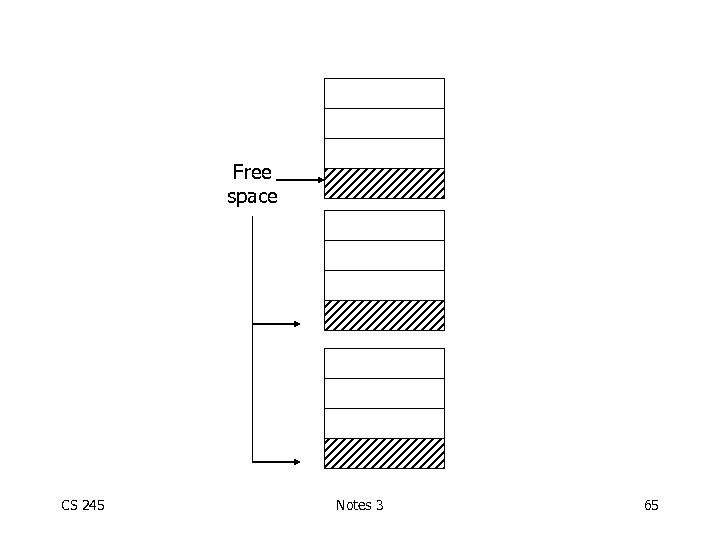
Insert Easy case: records not in sequence Insert new record at end of file or in deleted slot If records are variable size, not as easy. . . CS 245 Notes 3 62
Insert Hard case: records in sequence If free space “close by”, not too bad. . . Or use overflow idea. . . CS 245 Notes 3 63
Interesting problems: • How much free space to leave in each block, track, cylinder? • How often do I reorganize file + overflow? CS 245 Notes 3 64
Free space CS 245 Notes 3 65
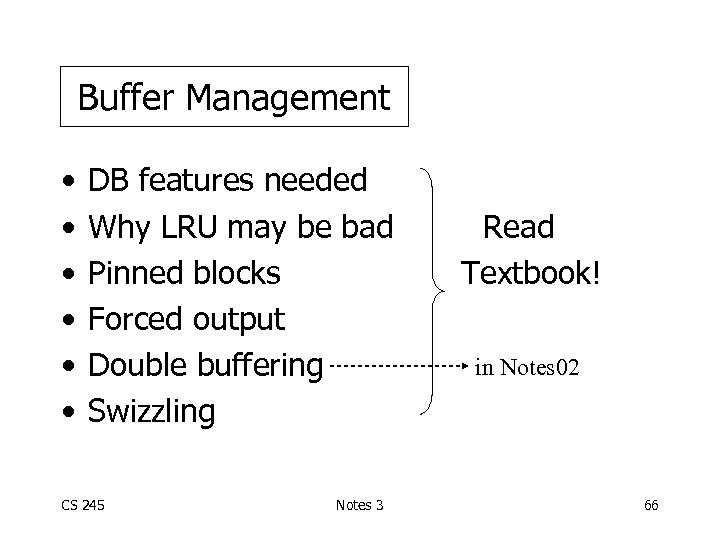
Buffer Management • • • DB features needed Why LRU may be bad Pinned blocks Forced output Double buffering Swizzling CS 245 Notes 3 Read Textbook! in Notes 02 66
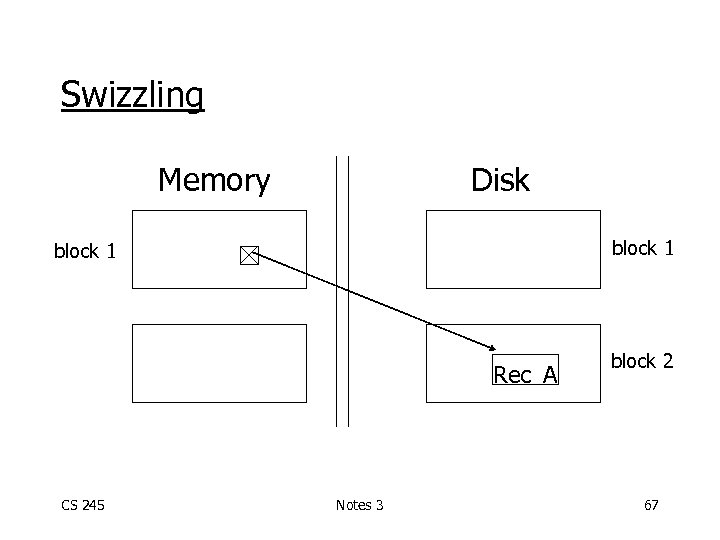
Swizzling Memory Disk block 1 Rec A CS 245 Notes 3 block 2 67
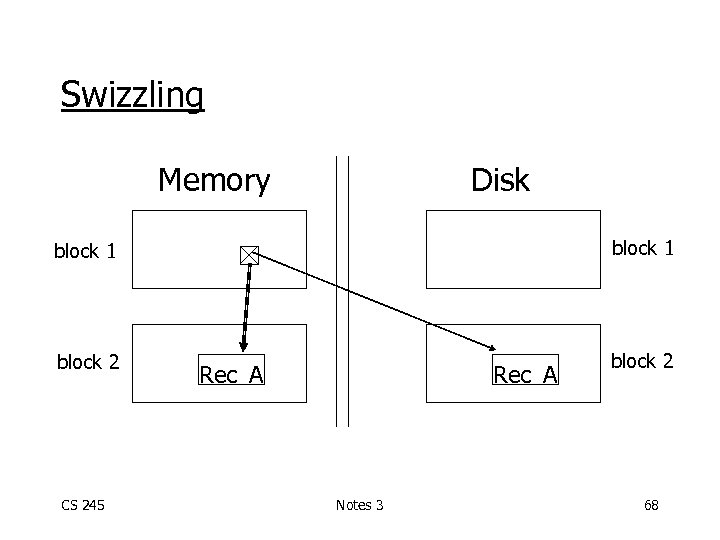
Swizzling Memory Disk block 1 block 2 CS 245 Rec A Notes 3 68
Row vs Column Store • So far we assumed that fields of a record are stored contiguously (row store). . . • Another option is to store like fields together (column store) CS 245 Notes 3 69
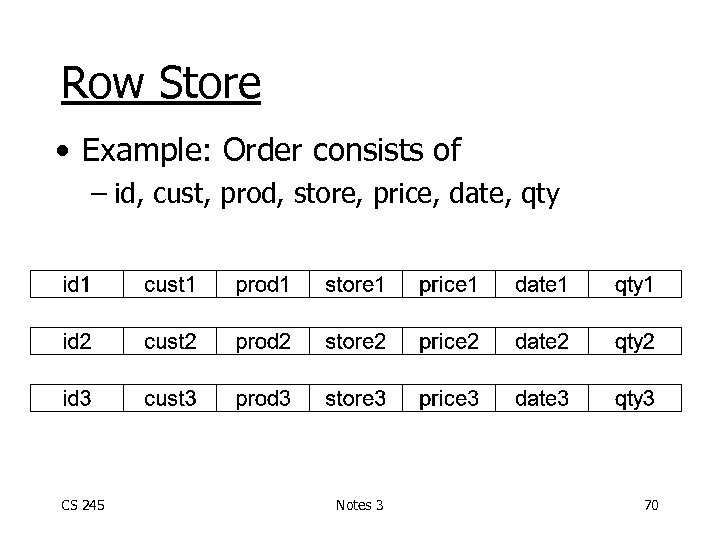
Row Store • Example: Order consists of – id, cust, prod, store, price, date, qty CS 245 Notes 3 70
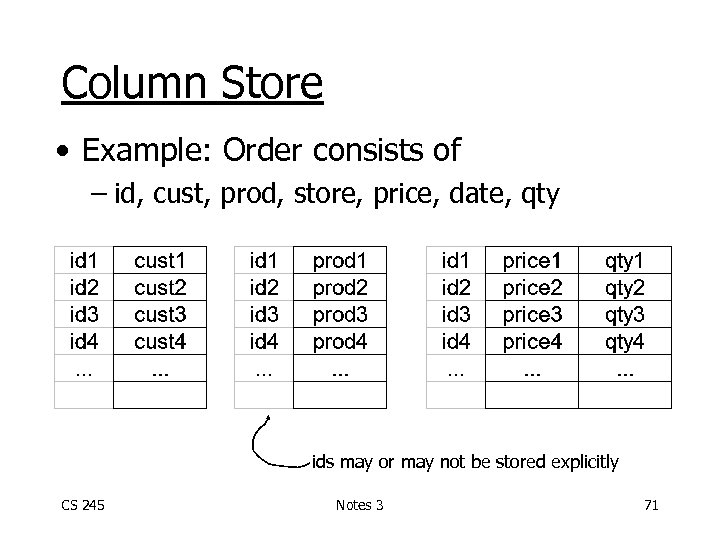
Column Store • Example: Order consists of – id, cust, prod, store, price, date, qty ids may or may not be stored explicitly CS 245 Notes 3 71
Row vs Column Store • Advantages of Column Store – more compact storage (fields need not start at byte boundaries) – efficient reads on data mining operations • Advantages of Row Store – writes (multiple fields of one record)more efficient – efficient reads for record access (OLTP) CS 245 Notes 3 72
Interesting paper to read: • Mike Stonebreaker, Elizabeth (Betty) O'Neil, Pat O’Neil, Xuedong Chen, et al. " C-Store: A Column-oriented DBMS, " Presented at the 31 st VLDB Conference, September 2005. • http: //www. cs. umb. edu/%7 Eponeil/ vldb 05_cstore. pdf CS 245 Notes 3 73
Comparison • There are 10, 000 ways to organize my data on disk… Which is right for me? CS 245 Notes 3 74
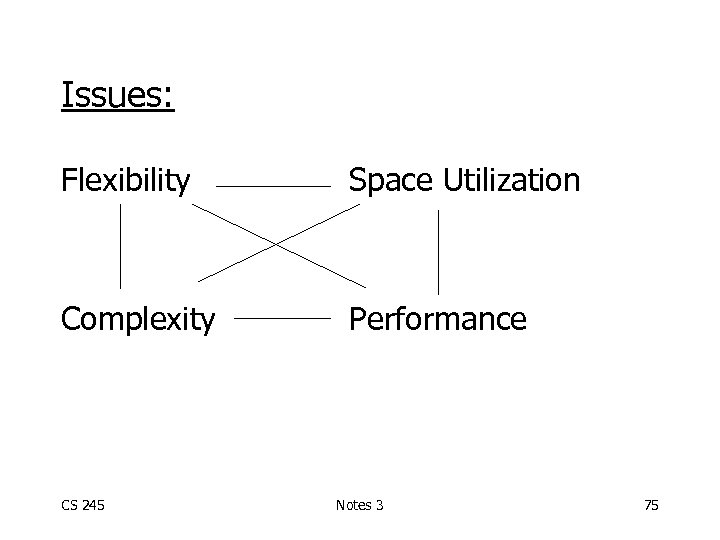
Issues: Flexibility Space Utilization Complexity Performance CS 245 Notes 3 75
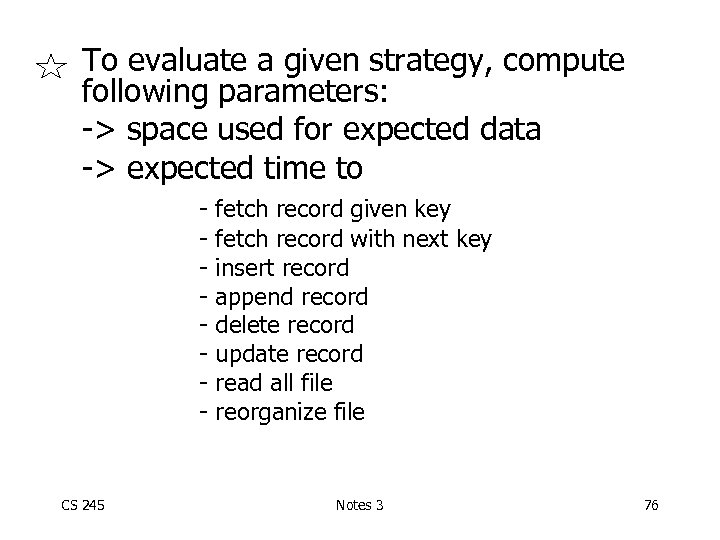
To evaluate a given strategy, compute following parameters: -> space used for expected data -> expected time to - CS 245 fetch record given key fetch record with next key insert record append record delete record update record read all file reorganize file Notes 3 76
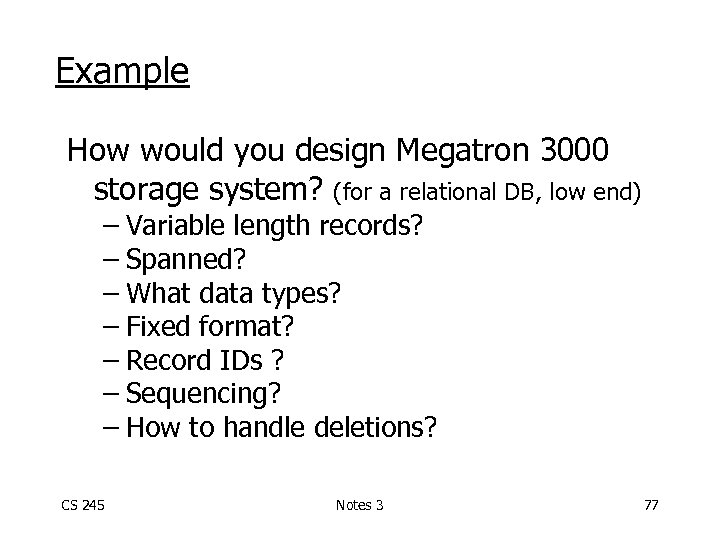
Example How would you design Megatron 3000 storage system? (for a relational DB, low end) – Variable length records? – Spanned? – What data types? – Fixed format? – Record IDs ? – Sequencing? – How to handle deletions? CS 245 Notes 3 77
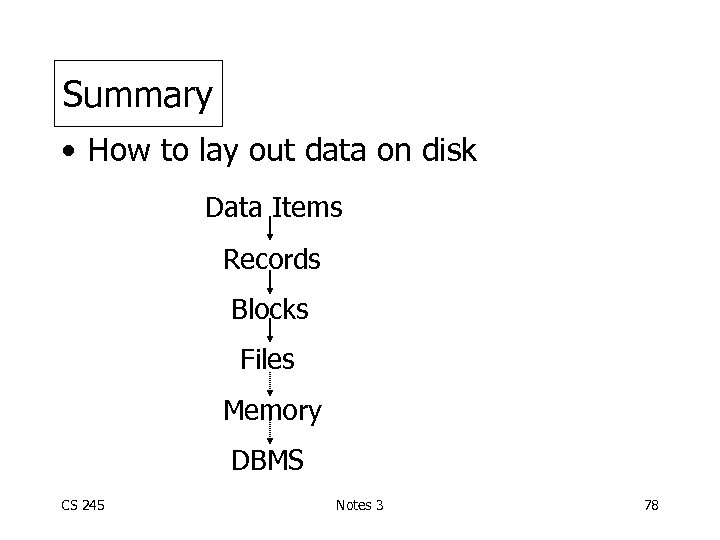
Summary • How to lay out data on disk Data Items Records Blocks Files Memory DBMS CS 245 Notes 3 78
Next How to find a record quickly, given a key CS 245 Notes 3 79
Скачать презентацию CS 245 Database System Principles Notes 03 Disk
735a1b6b4d7a28c51743dc4f1381ce79.ppt