


 Скачать презентацию CS 234 Peer-to-Peer Networking Tuesdays Thursdays 3
e559b85a2809cc5f4dee7b6efae727e7.ppt
- Количество слайдов: 176
 CS 234 – Peer-to-Peer Networking Tuesdays, Thursdays 3: 30 -4: 50 p. m. Prof. Nalini Venkatasubramanian nalini@ics. uci. edu Acknowledgements: Slides modified from Kurose/Ross book slides Sukumar Ghosh, U at IOWA Mark Jelasity, Tutorial at SASO’ 07 Keith Ross, Tutorial at INFOCOM Anwitaman Datta, Tutorial, ICDCN
 P 2 P Systems Use the vast resources of machines at the edge of the Internet to build a network that allows resource sharing without any central authority. More than a system for sharing pirated music/movies
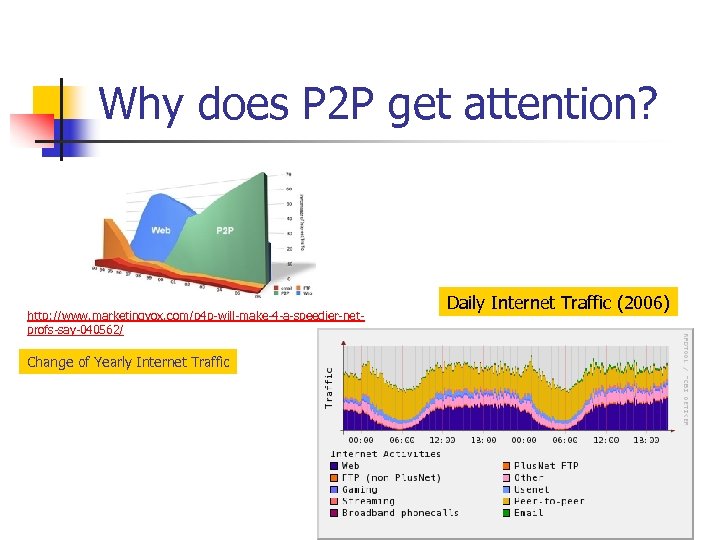 Why does P 2 P get attention? http: //www. marketingvox. com/p 4 p-will-make-4 -a-speedier-netprofs-say-040562/ Change of Yearly Internet Traffic Daily Internet Traffic (2006)
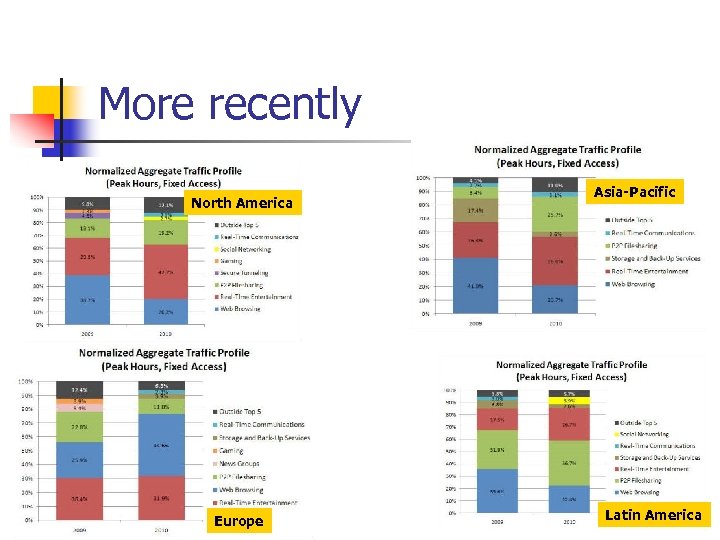 More recently North America Europe Asia-Pacific Latin America
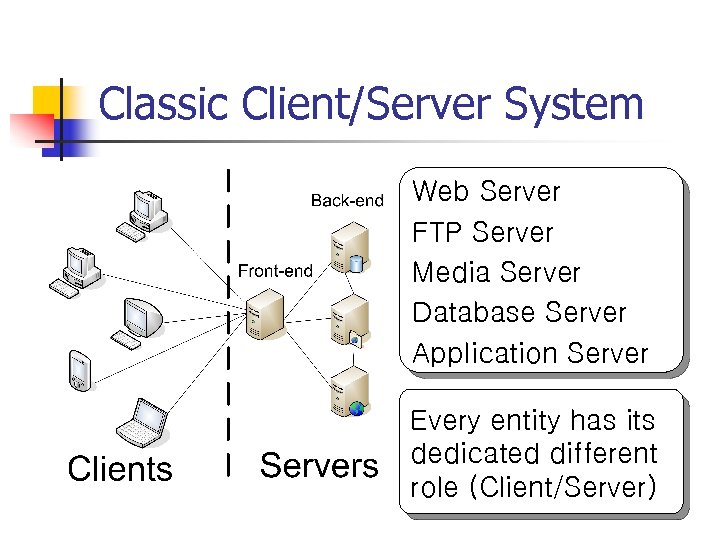 Classic Client/Server System Web Server FTP Server Media Server Database Server Application Server Every entity has its dedicated different role (Client/Server)
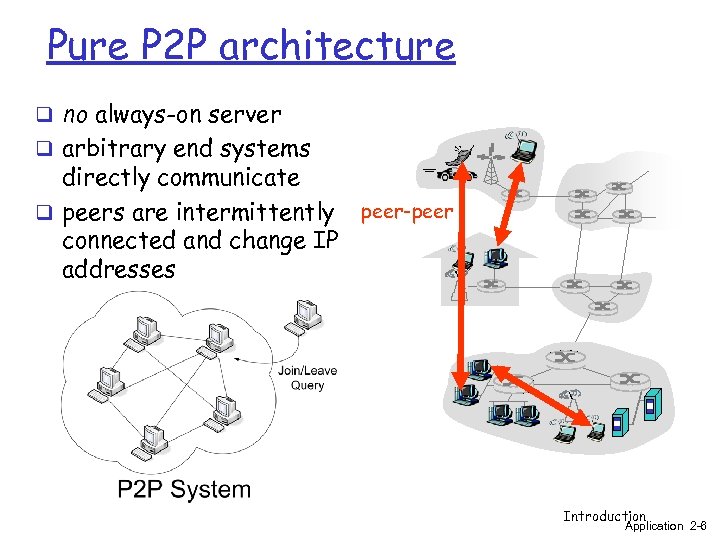 Pure P 2 P architecture q no always-on server q arbitrary end systems directly communicate q peers are intermittently peer-peer connected and change IP addresses Introduction Application 2 -6
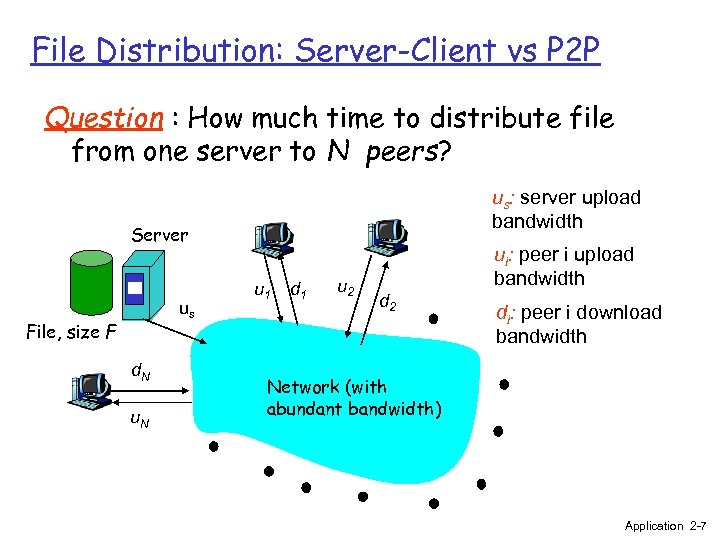 File Distribution: Server-Client vs P 2 P Question : How much time to distribute file from one server to N peers? us: server upload bandwidth Server us File, size F d. N u 1 d 1 u 2 ui: peer i upload bandwidth d 2 di: peer i download bandwidth Network (with abundant bandwidth) Application 2 -7
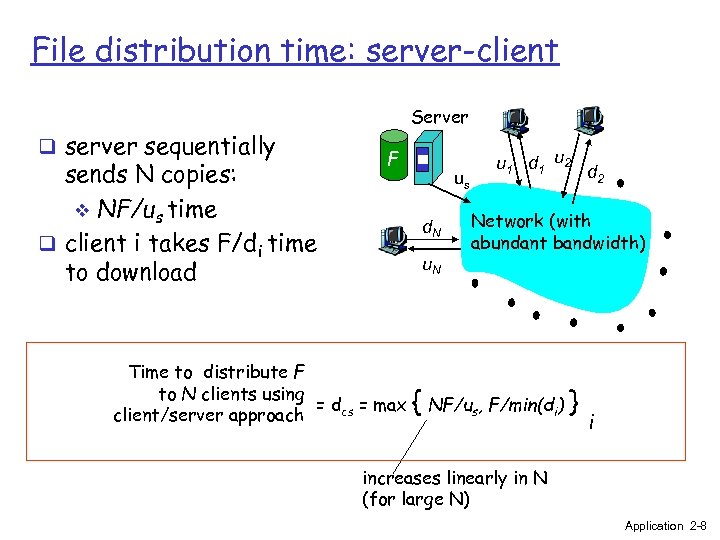 File distribution time: server-client q server sequentially sends N copies: v NF/us time q client i takes F/di time to download Server F us d. N u. N Time to distribute F to N clients using = dcs = max client/server approach u 1 d 1 u 2 d 2 Network (with abundant bandwidth) { NF/us, F/min(di) } i increases linearly in N (for large N) Application 2 -8
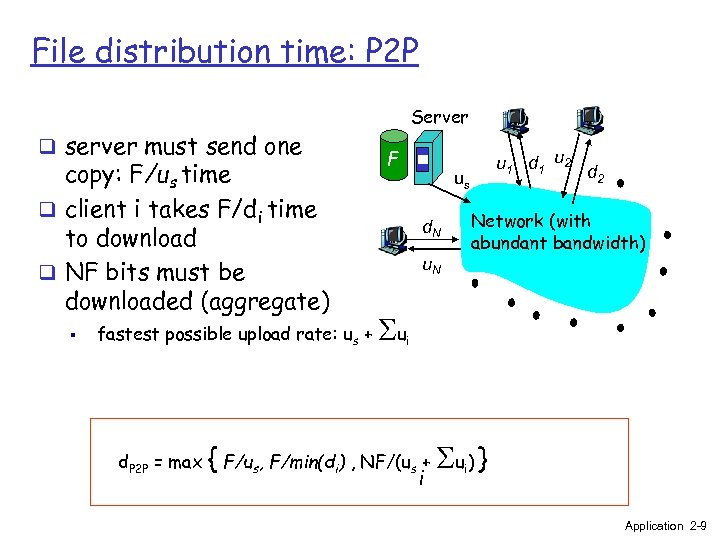 File distribution time: P 2 P q server must send one copy: F/us time q client i takes F/di time to download q NF bits must be downloaded (aggregate) § fastest possible upload rate: us + d. P 2 P = max Server F us d. N u. N Su u 1 d 1 u 2 d 2 Network (with abundant bandwidth) i { F/us, F/min(di) , NF/(us + Sui) } i Application 2 -9
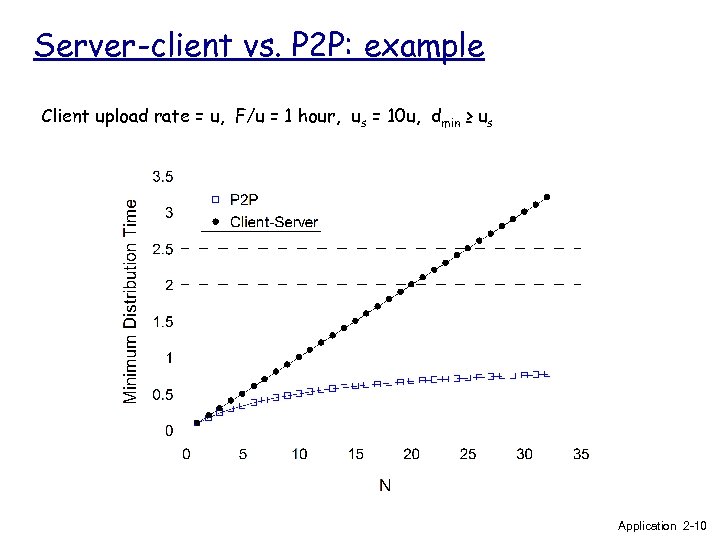 Server-client vs. P 2 P: example Client upload rate = u, F/u = 1 hour, us = 10 u, dmin ≥ us Application 2 -10
 P 2 P Applications
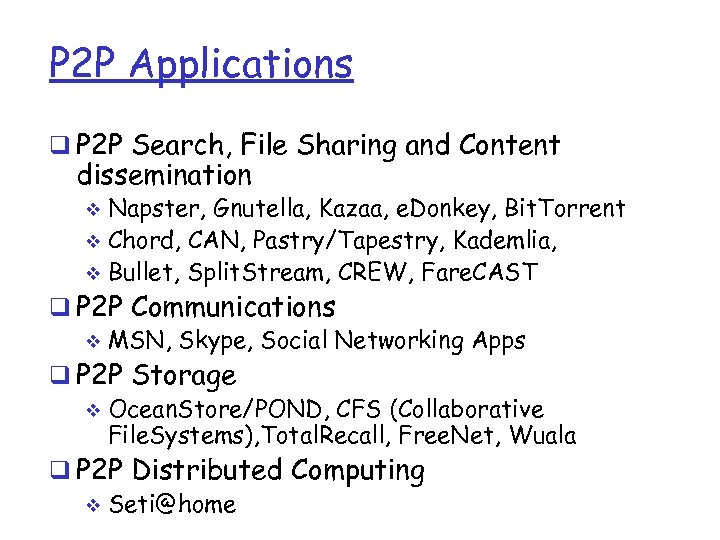 P 2 P Applications q P 2 P Search, File Sharing and Content dissemination Napster, Gnutella, Kazaa, e. Donkey, Bit. Torrent v Chord, CAN, Pastry/Tapestry, Kademlia, v Bullet, Split. Stream, CREW, Fare. CAST v q P 2 P Communications v MSN, Skype, Social Networking Apps q P 2 P Storage v Ocean. Store/POND, CFS (Collaborative File. Systems), Total. Recall, Free. Net, Wuala q P 2 P Distributed Computing v Seti@home
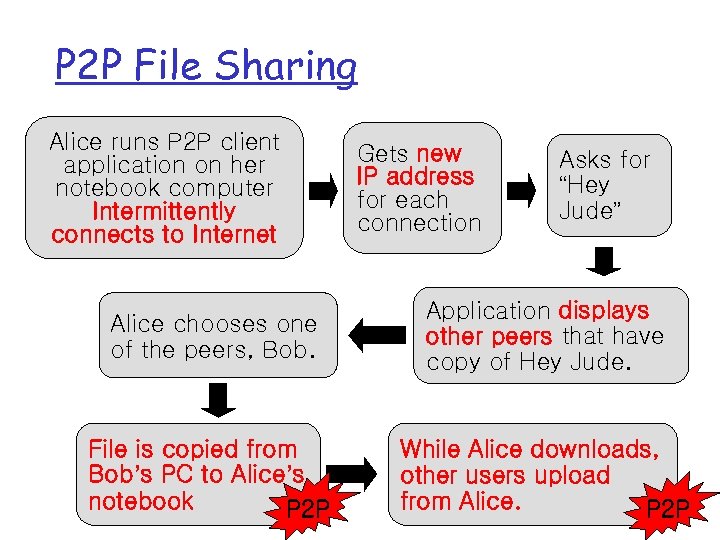 P 2 P File Sharing Alice runs P 2 P client application on her notebook computer Intermittently connects to Internet Gets new IP address for each connection Asks for “Hey Jude” Alice chooses one of the peers, Bob. Application displays other peers that have copy of Hey Jude. File is copied from Bob’s PC to Alice’s notebook P 2 P While Alice downloads, other users upload from Alice. P 2 P
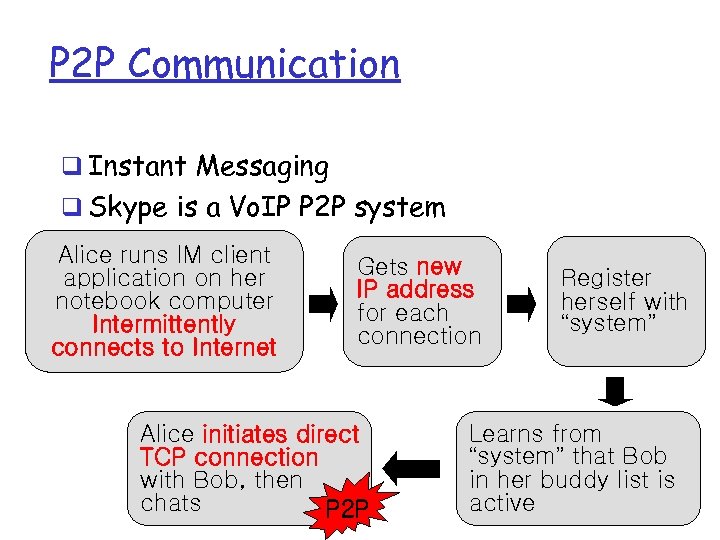 P 2 P Communication q Instant Messaging q Skype is a Vo. IP P 2 P system Alice runs IM client application on her notebook computer Intermittently connects to Internet Gets new IP address for each connection Alice initiates direct TCP connection with Bob, then chats P 2 P Register herself with “system” Learns from “system” that Bob in her buddy list is active
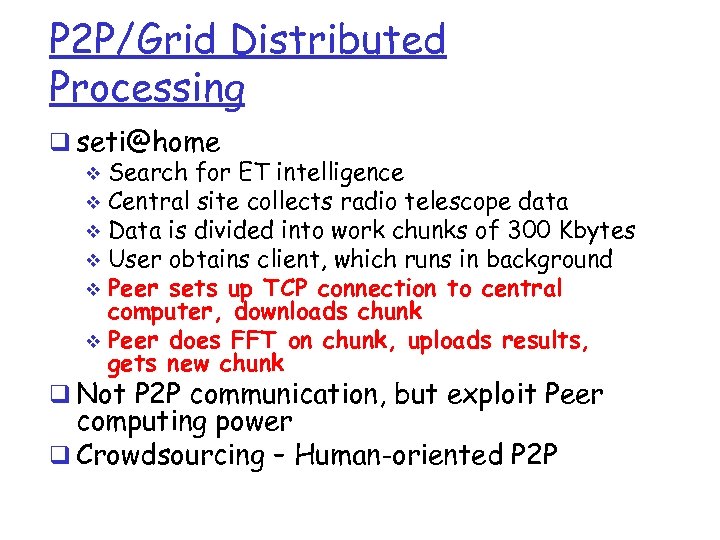 P 2 P/Grid Distributed Processing q seti@home v Search for ET intelligence v Central site collects radio telescope data v Data is divided into work chunks of 300 Kbytes v User obtains client, which runs in background v Peer sets up TCP connection to central computer, downloads chunk v Peer does FFT on chunk, uploads results, gets new chunk q Not P 2 P communication, but exploit Peer computing power q Crowdsourcing – Human-oriented P 2 P
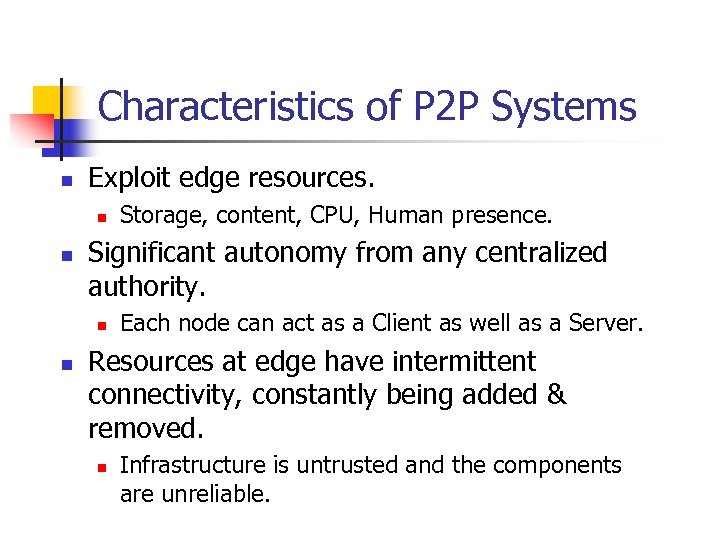 Characteristics of P 2 P Systems n Exploit edge resources. n n Significant autonomy from any centralized authority. n n Storage, content, CPU, Human presence. Each node can act as a Client as well as a Server. Resources at edge have intermittent connectivity, constantly being added & removed. n Infrastructure is untrusted and the components are unreliable.
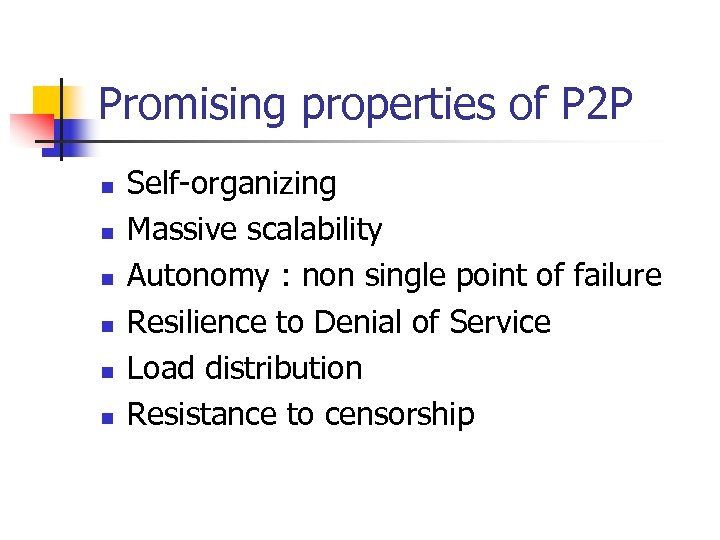 Promising properties of P 2 P n n n Self-organizing Massive scalability Autonomy : non single point of failure Resilience to Denial of Service Load distribution Resistance to censorship
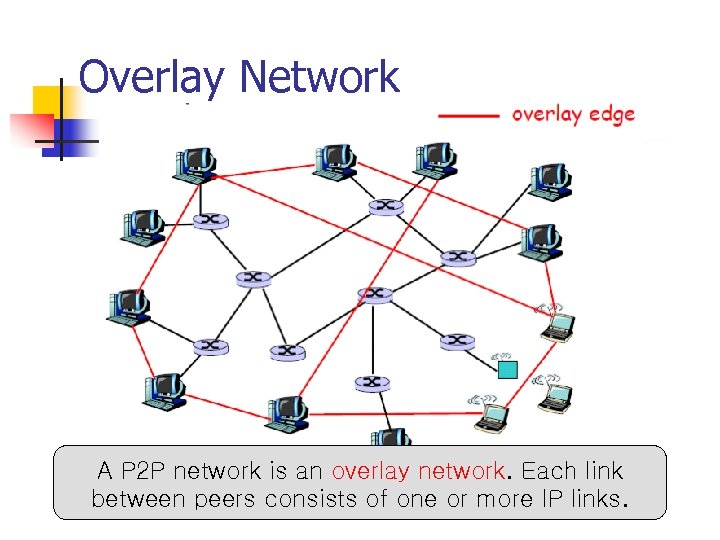 Overlay Network A P 2 P network is an overlay network. Each link between peers consists of one or more IP links.
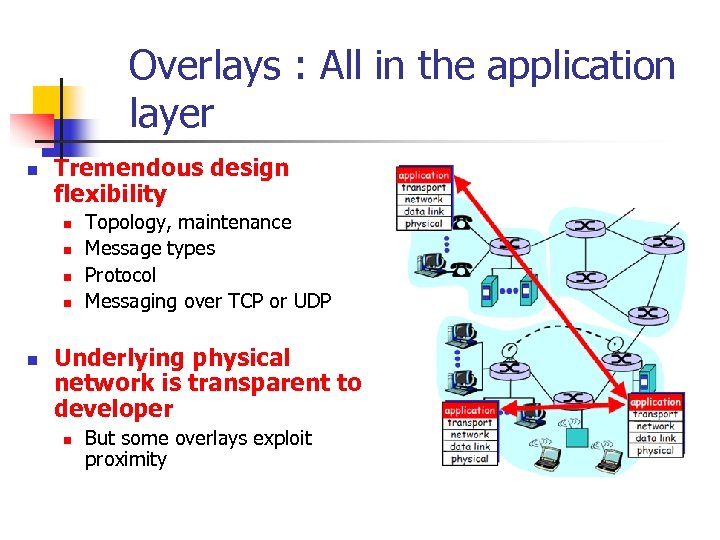 Overlays : All in the application layer n Tremendous design flexibility n n n Topology, maintenance Message types Protocol Messaging over TCP or UDP Underlying physical network is transparent to developer n But some overlays exploit proximity
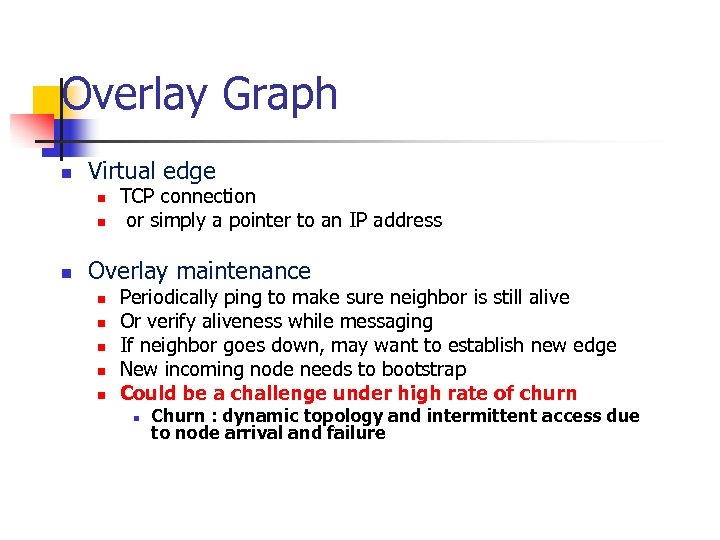 Overlay Graph n Virtual edge n n n TCP connection or simply a pointer to an IP address Overlay maintenance n n n Periodically ping to make sure neighbor is still alive Or verify aliveness while messaging If neighbor goes down, may want to establish new edge New incoming node needs to bootstrap Could be a challenge under high rate of churn n Churn : dynamic topology and intermittent access due to node arrival and failure
 Overlay Graph n Unstructured overlays n e. g. , new node randomly chooses existing nodes as neighbors n Structured overlays n e. g. , edges arranged in restrictive structure Hybrid Overlays n n Combines structured and unstructured overlays n Super. Peer architectures where superpeer nodes are more stable typically n Get metadata information from structured node, communicate in unstructured manner
 Key Issues n Lookup n n Management n n n How to find out the appropriate content/resource that a user wants How to maintain the P 2 P system under high rate of churn efficiently Application reliability is difficult to guarantee Throughput n n Content distribution/dissemination applications How to copy content fast, efficiently, reliably
 Lookup Issue n n n Centralized vs. decentralized How do you locate data/files/objects in a large P 2 P system built around a dynamic set of nodes in a scalable manner without any centralized server or hierarchy? Efficient routing even if the structure of the network is unpredictable. n n Unstructured P 2 P : Napster, Gnutella, Kazaa Structured P 2 P : Chord, CAN, Pastry/Tapestry, Kademlia
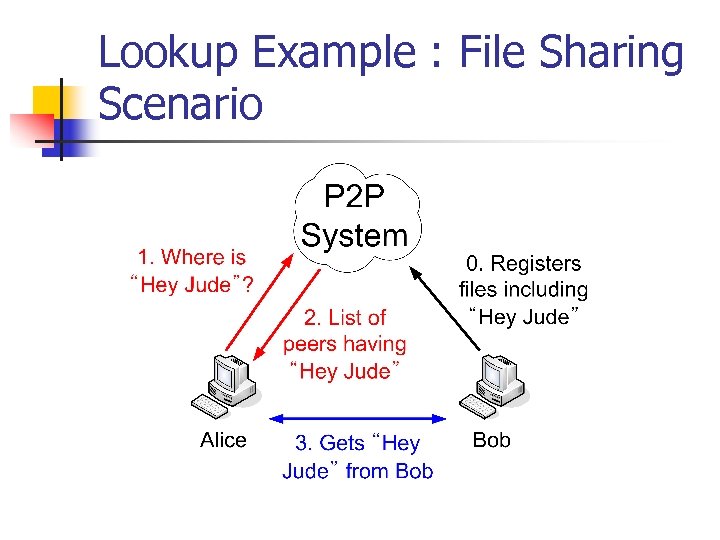 Lookup Example : File Sharing Scenario
 Napster n n n First P 2 P file-sharing application (June 1999) Only MP 3 sharing possible Based on central index server Clients register and give list of files to share Searching based on keywords n Response : List of files with additional information, e. g. peer’s bandwidth, file size
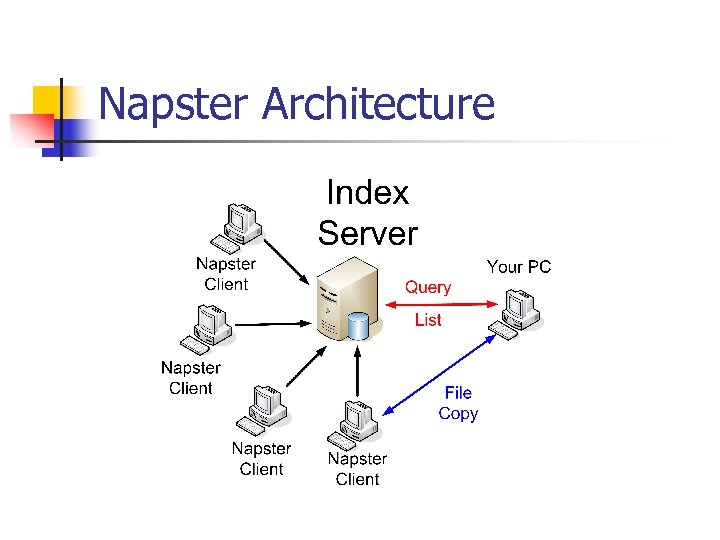 Napster Architecture
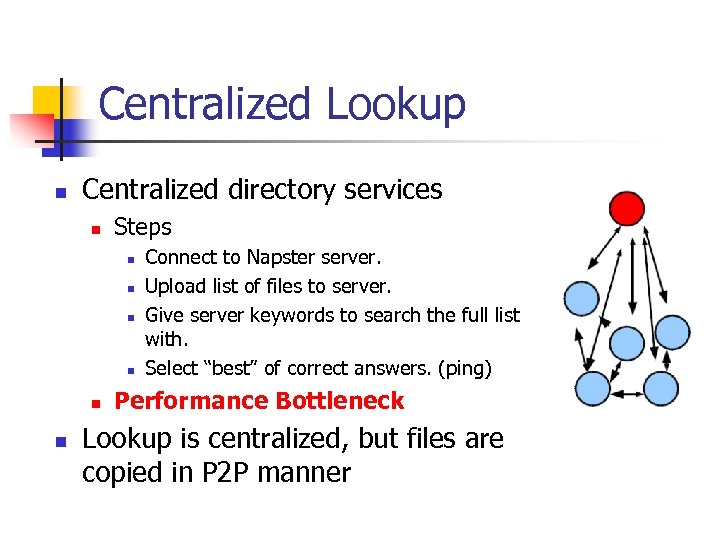 Centralized Lookup n Centralized directory services n Steps n n n Connect to Napster server. Upload list of files to server. Give server keywords to search the full list with. Select “best” of correct answers. (ping) Performance Bottleneck Lookup is centralized, but files are copied in P 2 P manner
 Pros and cons of Napster n Pros n n n Fast, efficient and overall search Consistent view of the network Cons n n n Central server is a single point of failure Expensive to maintain the central server Only sharing mp 3 files (few MBs)
 Gnutella n n Originally developed at Nullsoft (AOL) Fully distributed system n n No index server – address Napster’s weaknesses All peers are fully equal A peer needs to know another peer, that is already in the network, to join – Ping/Pong Flooding based search n n n Variation: Random walk based search Direct download Open protocol specifications
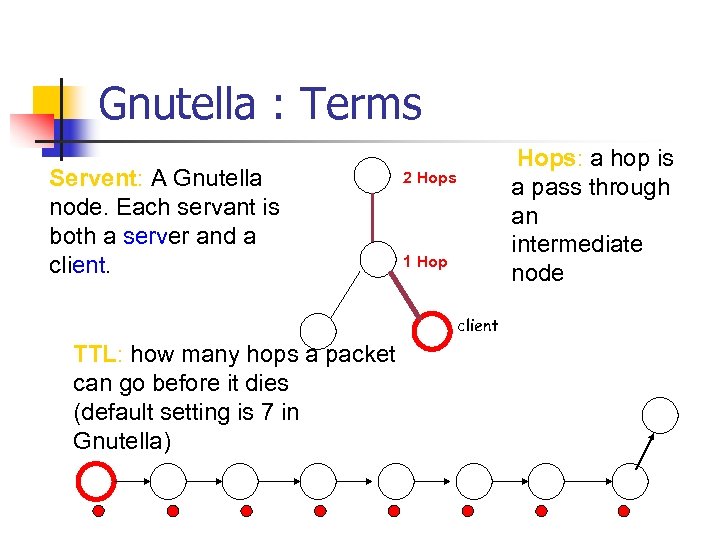 Gnutella : Terms Servent: A Gnutella node. Each servant is both a server and a client. Hops: a hop is a pass through an intermediate node 2 Hops 1 Hop client TTL: how many hops a packet can go before it dies (default setting is 7 in Gnutella)
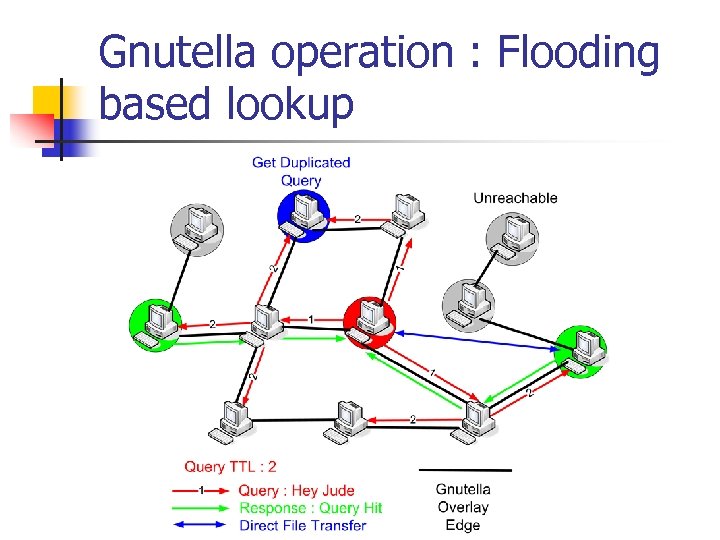 Gnutella operation : Flooding based lookup
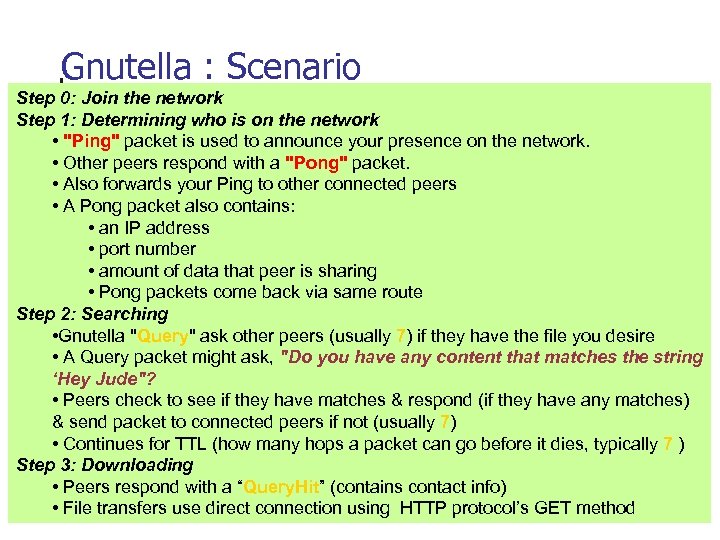 Gnutella : Scenario Step 0: Join the network Step 1: Determining who is on the network • "Ping" packet is used to announce your presence on the network. • Other peers respond with a "Pong" packet. • Also forwards your Ping to other connected peers • A Pong packet also contains: • an IP address • port number • amount of data that peer is sharing • Pong packets come back via same route Step 2: Searching • Gnutella "Query" ask other peers (usually 7) if they have the file you desire • A Query packet might ask, "Do you have any content that matches the string ‘Hey Jude"? • Peers check to see if they have matches & respond (if they have any matches) & send packet to connected peers if not (usually 7) • Continues for TTL (how many hops a packet can go before it dies, typically 7 ) Step 3: Downloading • Peers respond with a “Query. Hit” (contains contact info) • File transfers use direct connection using HTTP protocol’s GET method
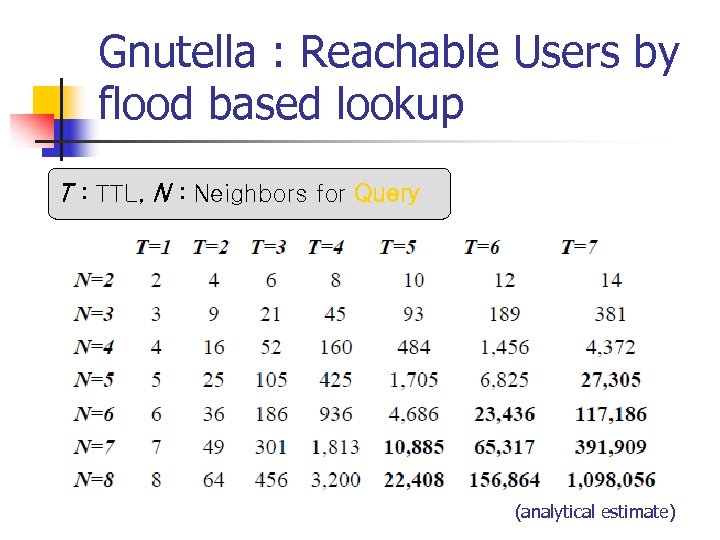 Gnutella : Reachable Users by flood based lookup T : TTL, N : Neighbors for Query (analytical estimate)
 Gnutella : Lookup Issue n Simple, but lack of scalability n n Flooding based lookup is extremely wasteful with bandwidth Enormous number of redundant messages All users do this in parallel: local load grows linearly with size Sometimes, existing objects may not be located due to limited TTL
 Possible extensions to make Gnutella efficient n Controlling topology to allow for better search n n Random walk, Degree-biased Random Walk Controlling placement of objects n Replication (1 hop or 2 hop)
 Gnutella Topology n n The topology is dynamic, I. e. constantly changing. How do we model a constantly changing topology? n n n Usually, we begin with a static topology, and later account for the effect of churn. A Random Graph? A Power Law Graph?
 Random graph: Erdös-Rényi model n n n A random graph G(n, p) is constructed by starting with a set of n vertices, and adding edges between pairs of nodes at random. Every possible edge occurs independently with probability p. Is Gnutella topology a random graph? n NO
 Gnutella : Power law graph n Gnutella topology is actually a powerlaw graph. n n Also called scale-free graph What is a power-law graph? n n n The number of nodes with degree k = ck-r Ex) WWW, Social Network, etc Small world phenomena – low degree of separation (approx. log of size)
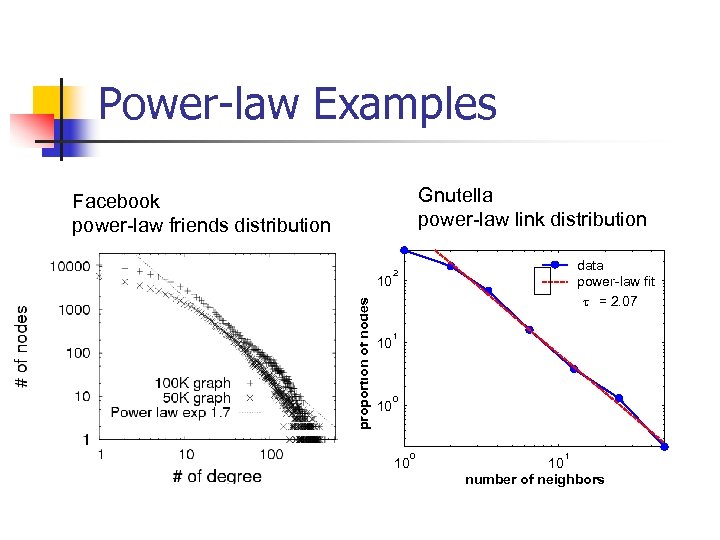 Power-law Examples Gnutella power-law link distribution Facebook power-law friends distribution proportion of nodes 10 10 10 data power-law fit t = 2. 07 2 1 0 10 0 1 10 number of neighbors
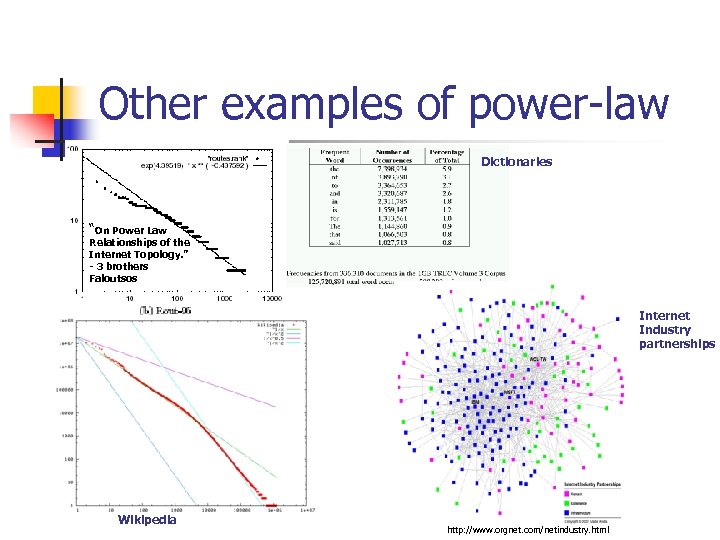 Other examples of power-law Dictionaries “On Power Law Relationships of the Internet Topology. ” - 3 brothers Faloutsos Internet Industry partnerships Wikipedia http: //www. orgnet. com/netindustry. html
 Possible Explanation of Power. Law graph n Continued growth n n Nodes join at different times. Preferential Attachment n The more connections a node has, the more likely it is to acquire new connections (“Rich gets richer”). n n Popular webpages attract new pointers. Popular people attract new followers.
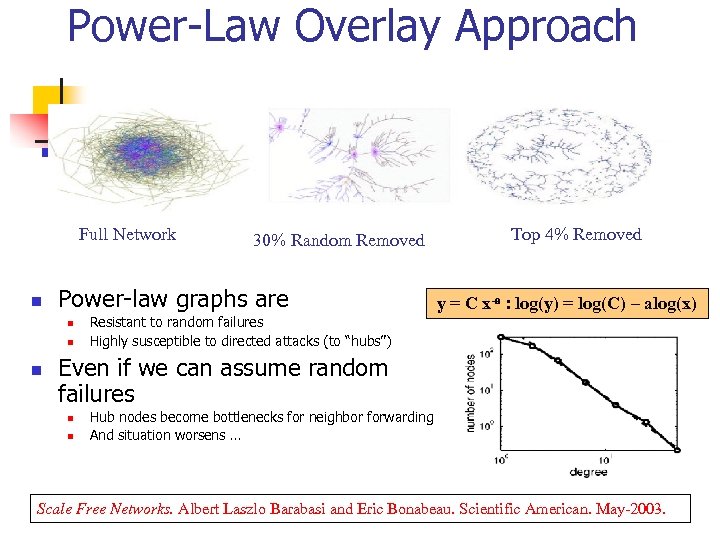 Power-Law Overlay Approach Full Network n Power-law graphs are n n n 30% Random Removed Top 4% Removed y = C x-a : log(y) = log(C) – alog(x) Resistant to random failures Highly susceptible to directed attacks (to “hubs”) Even if we can assume random failures n n Hub nodes become bottlenecks for neighbor forwarding And situation worsens … Scale Free Networks. Albert Laszlo Barabasi and Eric Bonabeau. Scientific American. May-2003.
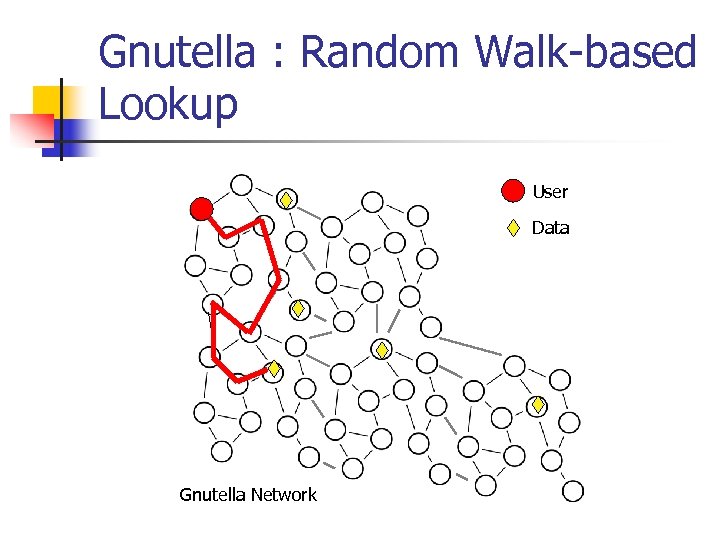 Gnutella : Random Walk-based Lookup User Data Gnutella Network
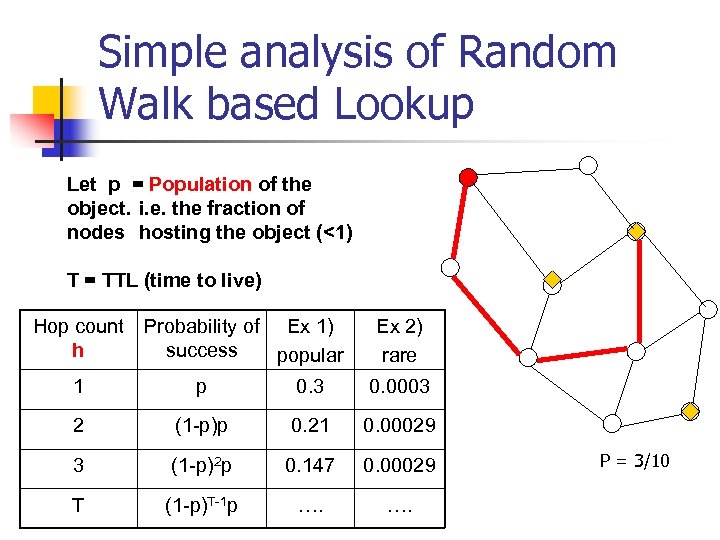 Simple analysis of Random Walk based Lookup Let p = Population of the object. i. e. the fraction of nodes hosting the object (<1) T = TTL (time to live) Hop count Probability of Ex 1) h success popular Ex 2) rare 1 p 0. 3 0. 0003 2 (1 -p)p 0. 21 0. 00029 3 (1 -p)2 p 0. 147 0. 00029 T (1 -p)T-1 p …. P = 3/10
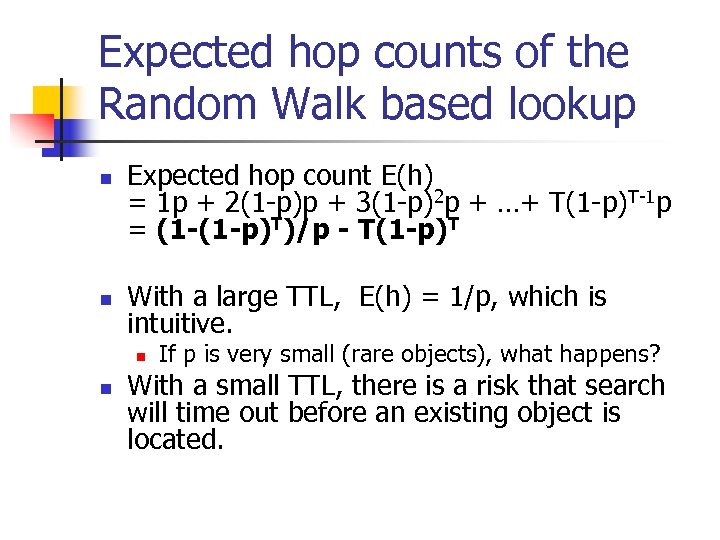 Expected hop counts of the Random Walk based lookup n n Expected hop count E(h) = 1 p + 2(1 -p)p + 3(1 -p)2 p + …+ T(1 -p)T-1 p = (1 -(1 -p)T)/p - T(1 -p)T With a large TTL, E(h) = 1/p, which is intuitive. n n If p is very small (rare objects), what happens? With a small TTL, there is a risk that search will time out before an existing object is located.
 Extension of Random Walk based Lookup n n n Multiple walkers Replication Biased Random Walk
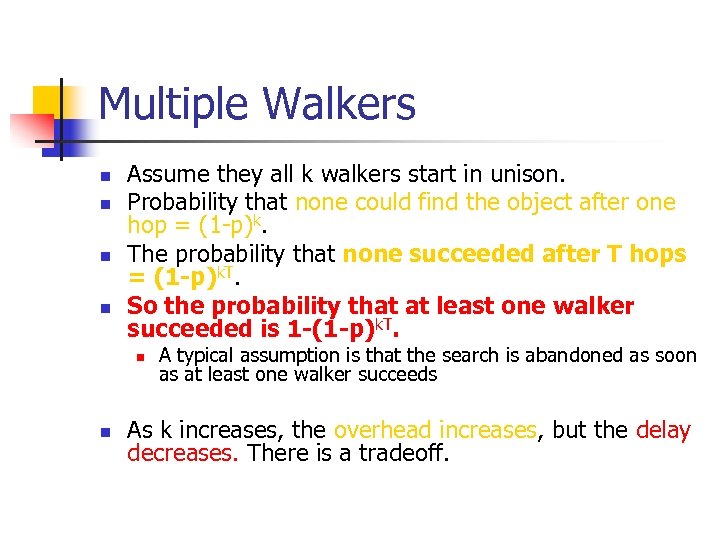 Multiple Walkers n n Assume they all k walkers start in unison. Probability that none could find the object after one hop = (1 -p)k. The probability that none succeeded after T hops = (1 -p)k. T. So the probability that at least one walker succeeded is 1 -(1 -p)k. T. n n A typical assumption is that the search is abandoned as soon as at least one walker succeeds As k increases, the overhead increases, but the delay decreases. There is a tradeoff.
 Replication n One (Two or multiple) hop replication n n Each node keeps track of the indices of the files belonging to its immediate (or multiple hop away) neighbors. As a result, high capacity / high degree nodes can provide useful clues to a large number of search queries.
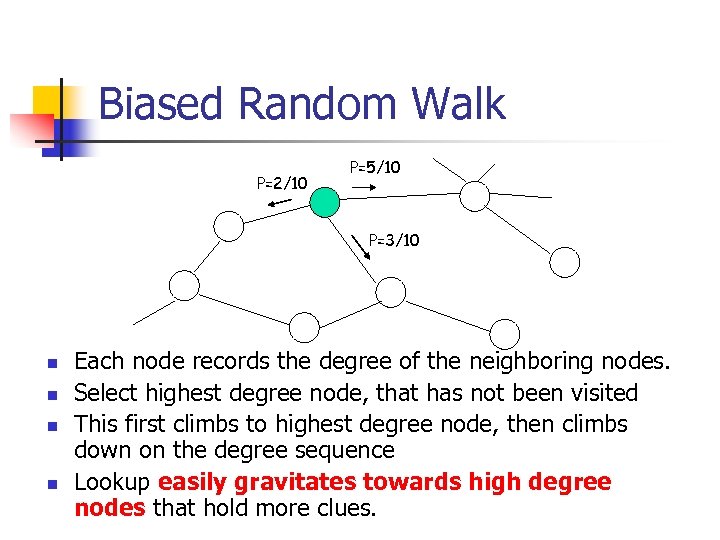 Biased Random Walk P=2/10 P=5/10 P=3/10 n n Each node records the degree of the neighboring nodes. Select highest degree node, that has not been visited This first climbs to highest degree node, then climbs down on the degree sequence Lookup easily gravitates towards high degree nodes that hold more clues.
 GIA : Making Gnutella-like P 2 P Systems Scalable n n GIA is short name of “gianduia” Unstructured, but take node capacity into account n n High-capacity nodes have room for more queries: so, send most queries to them Will work only if high-capacity nodes: n n Have correspondingly more answers, and Are easily reachable from other nodes
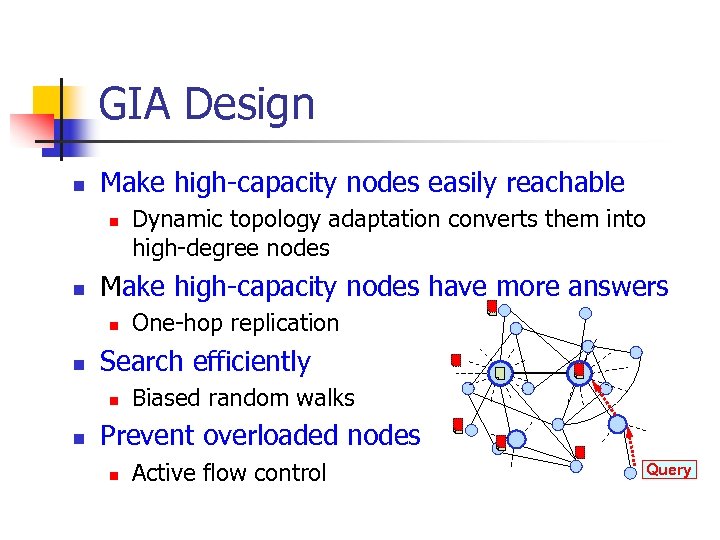 GIA Design n Make high-capacity nodes easily reachable n n Make high-capacity nodes have more answers n n One-hop replication Search efficiently n n Dynamic topology adaptation converts them into high-degree nodes Biased random walks Prevent overloaded nodes n Active flow control Query
 GIA : Active Flow Control n n Accept queries based on capacity n Actively allocation “tokens” to neighbors n Send query to neighbor only if we have received token from it Incentives for advertising true capacity n High capacity neighbors get more tokens to send outgoing queries n Allocate tokens with start-time fair queuing. Nodes not using their tokens are marked inactive and this capacity id redistributed among its neighbors.
 Ka. Za. A n Created in March 2001 n n Combines strengths of Napster and Gnutella Based on “Supernode Architecture” Exploits heterogenity of peers n n n Uses proprietary Fast. Track technology Two kinds of nodes Super Node / Ordinary Node Organize peers into a hierarchy n Two-tier hierarchy
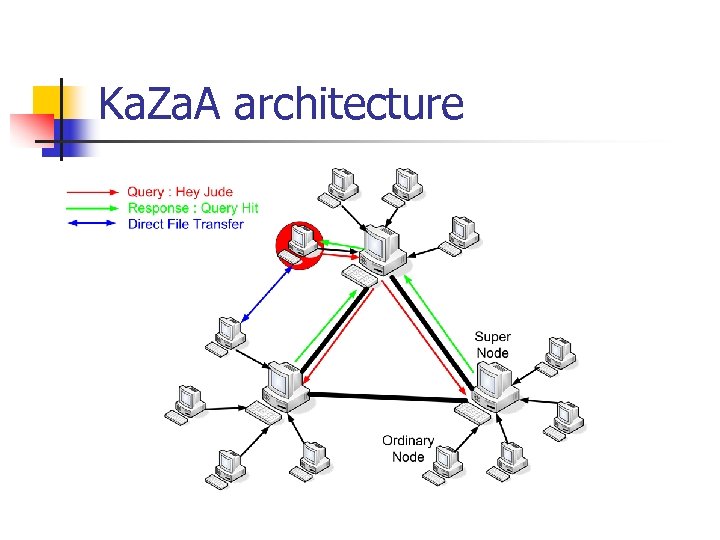 Ka. Za. A architecture
 Ka. Za. A : Super. Node n Nodes that have more connection bandwidth and are more available are designated as supernodes n n Each supernode manages around 100 -150 children Each supernode connects to 30 -50 other supernodes
 Ka. Za. A : Overlay Maintenance n New node goes through list until it finds operational supernode n n Connects, obtains more up-to-date list, with 200 entries. Gets Nodes in list are “close” to the new node. The new node then pings 5 nodes on list and connects with the one If supernode goes down, a node obtains updated list and chooses new supernode
 Ka. Za. A : Metadata n Each supernode acts as a mini-Napster hub, tracking the content (files) and IP addresses of its descendants n n For each file: File name, File size, Content Hash, File descriptors (used for keyword matches during query) Content Hash: n n When peer A selects file at peer B, peer A sends Content. Hash in HTTP request If download for a specific file fails (partially completes), Content. Hash is used to search for new copy of file.
 Ka. Za. A : Operation n Peer obtains address of an SN n n n Peer sends request to SN and uploads metadata for files it is sharing The SN starts tracking this peer n n e. g. via bootstrap server Other SNs are not aware of this new peer Peer sends queries to its own SN SN answers on behalf of all its peers, forwards query to other SNs Other SNs reply for all their peers
 Ka. Za. A : Parallel Downloading and Recovery n If file is found in multiple nodes, user can select parallel downloading n n n Identical copies identified by Content. Hash HTTP byte-range header used to request different portions of the file from different nodes Automatic recovery when server peer stops sending file n Content. Hash
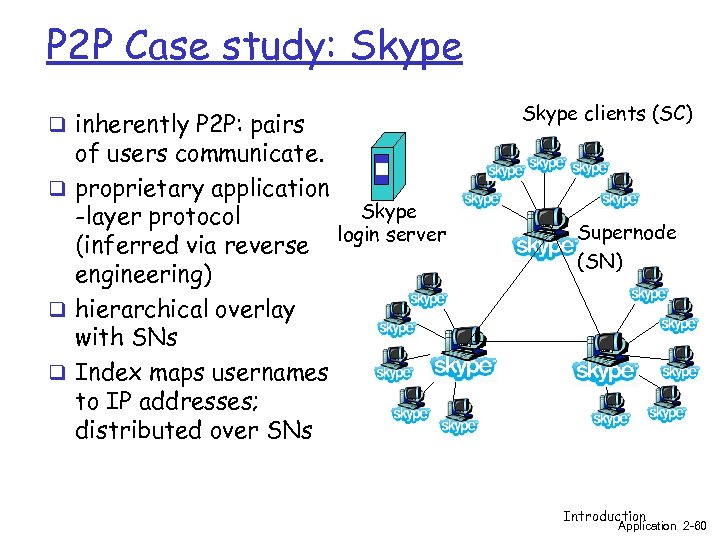 P 2 P Case study: Skype q inherently P 2 P: pairs of users communicate. q proprietary application Skype -layer protocol login server (inferred via reverse engineering) q hierarchical overlay with SNs q Index maps usernames to IP addresses; distributed over SNs Skype clients (SC) Supernode (SN) Introduction Application 2 -60
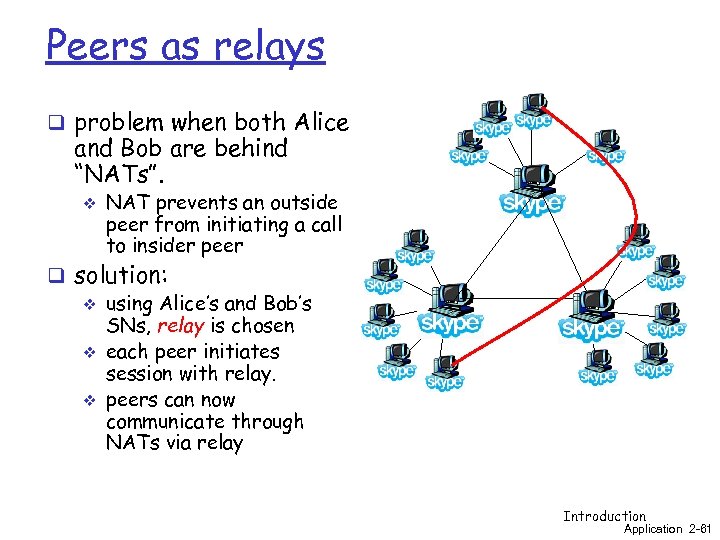 Peers as relays q problem when both Alice and Bob are behind “NATs”. v NAT prevents an outside peer from initiating a call to insider peer q solution: v using Alice’s and Bob’s SNs, relay is chosen v each peer initiates session with relay. v peers can now communicate through NATs via relay Introduction Application 2 -61
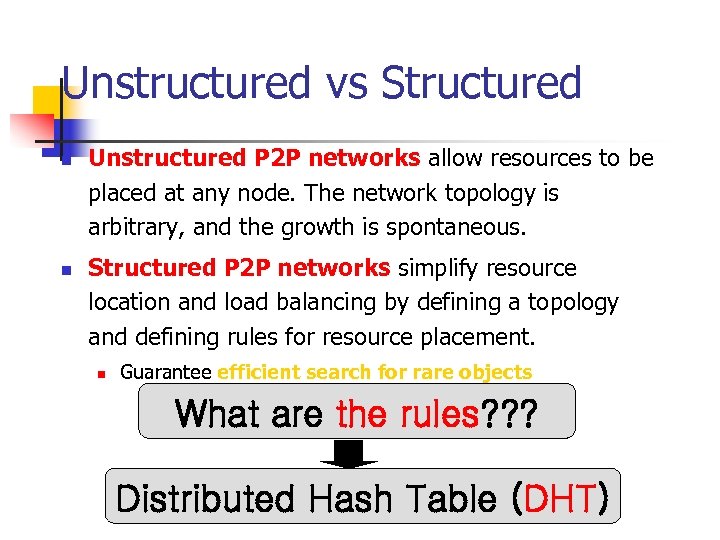 Unstructured vs Structured n n Unstructured P 2 P networks allow resources to be placed at any node. The network topology is arbitrary, and the growth is spontaneous. Structured P 2 P networks simplify resource location and load balancing by defining a topology and defining rules for resource placement. n Guarantee efficient search for rare objects What are the rules? ? ? Distributed Hash Table (DHT)
 DHT overview: Directed Lookup n Idea: n n n assign particular nodes to hold particular content (or pointers to it, like an information booth) when a node wants that content, go to the node that is supposed to have or know about it Challenges: n n Distributed: want to distribute responsibilities among existing nodes in the overlay Adaptive: nodes join and leave the P 2 P overlay n n distribute knowledge responsibility to joining nodes redistribute responsibility knowledge from leaving nodes
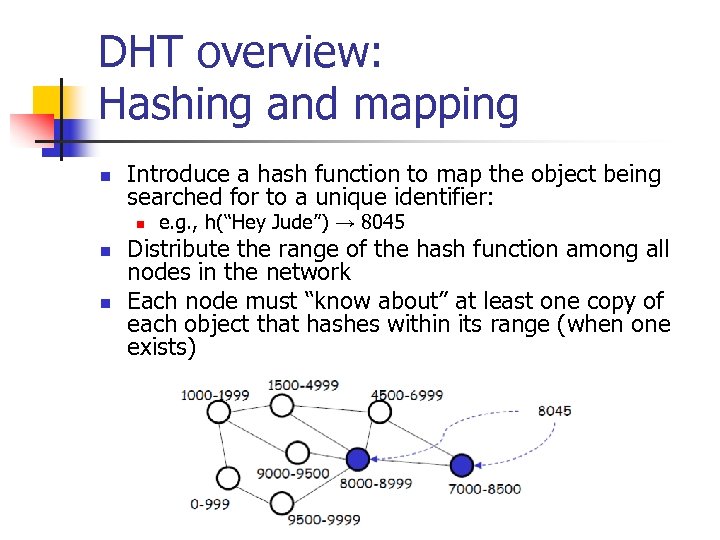 DHT overview: Hashing and mapping n Introduce a hash function to map the object being searched for to a unique identifier: n n n e. g. , h(“Hey Jude”) → 8045 Distribute the range of the hash function among all nodes in the network Each node must “know about” at least one copy of each object that hashes within its range (when one exists)
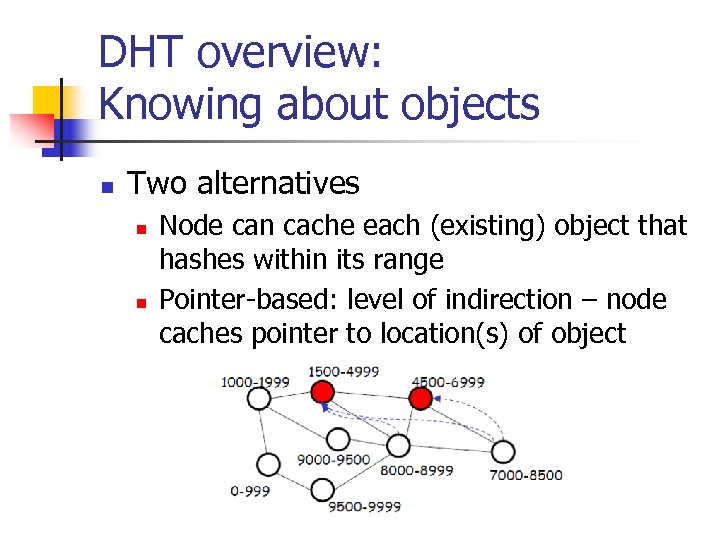 DHT overview: Knowing about objects n Two alternatives n n Node can cache each (existing) object that hashes within its range Pointer-based: level of indirection – node caches pointer to location(s) of object
 DHT overview: Routing n For each object, node(s) whose range(s) cover that object must be reachable via a “short” path n n n by the querier node (assumed can be chosen arbitrarily) by nodes that have copies of the object (when pointer-based approach is used) The different approaches (CAN, Chord, Pastry, Tapestry) differ fundamentally only in the routing approach n any “good” random hash function will suffice
 DHT overview: Other Challenges n n n # neighbors for each node should scale with growth in overlay participation (e. g. , should not be O(N)) DHT mechanism should be fully distributed (no centralized point that bottlenecks throughput or can act as single point of failure) DHT mechanism should gracefully handle nodes joining/leaving the overlay n need to repartition the range space over existing nodes need to reorganize neighbor set need bootstrap mechanism to connect new nodes into the existing DHT infrastructure
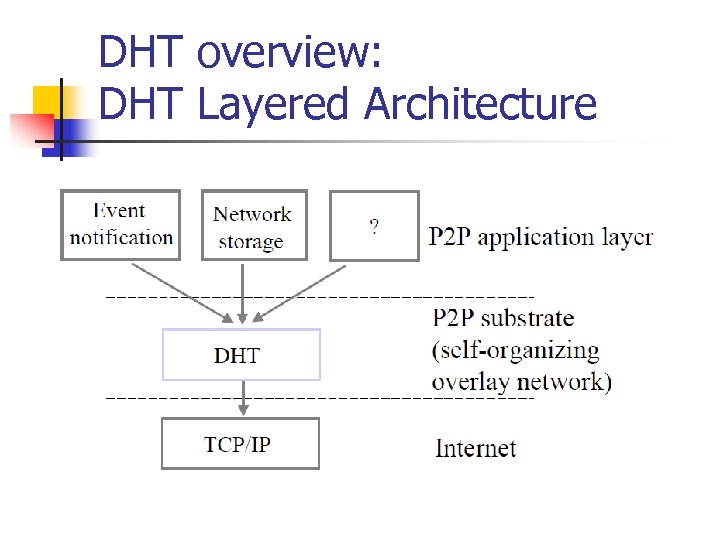 DHT overview: DHT Layered Architecture
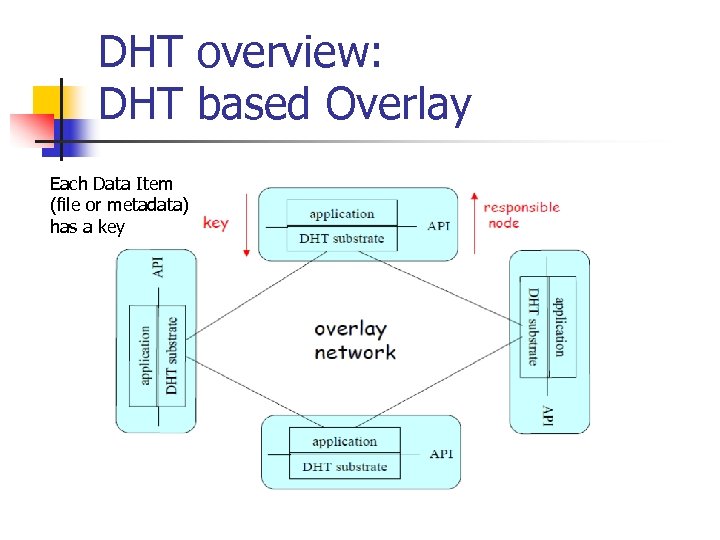 DHT overview: DHT based Overlay Each Data Item (file or metadata) has a key
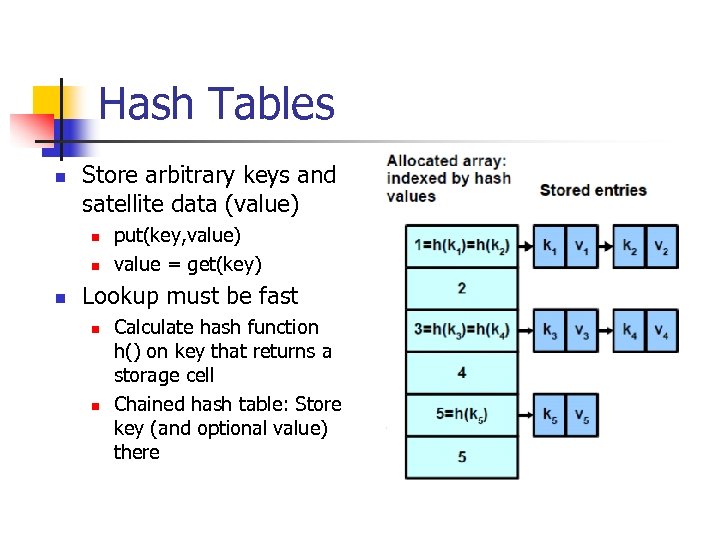 Hash Tables n Store arbitrary keys and satellite data (value) n n n put(key, value) value = get(key) Lookup must be fast n n Calculate hash function h() on key that returns a storage cell Chained hash table: Store key (and optional value) there
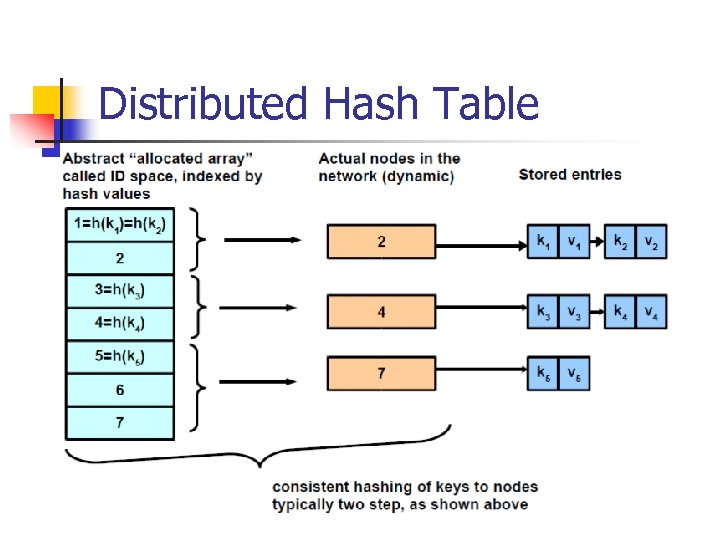
 Distributed Hash Table n Hash table functionality in a P 2 P network : lookup of data indexed by keys n n Distributed P 2 P database has (key, value) pairs; n n n peers query DB with key n n n key: ss number; value: human name key: content type; value: IP address DB returns values that match the key peers can also insert (key, value) peers Key-hash node mapping n n Assign a unique live node to a key Find this node in the overlay network quickly and cheaply
 Distributed Hash Table
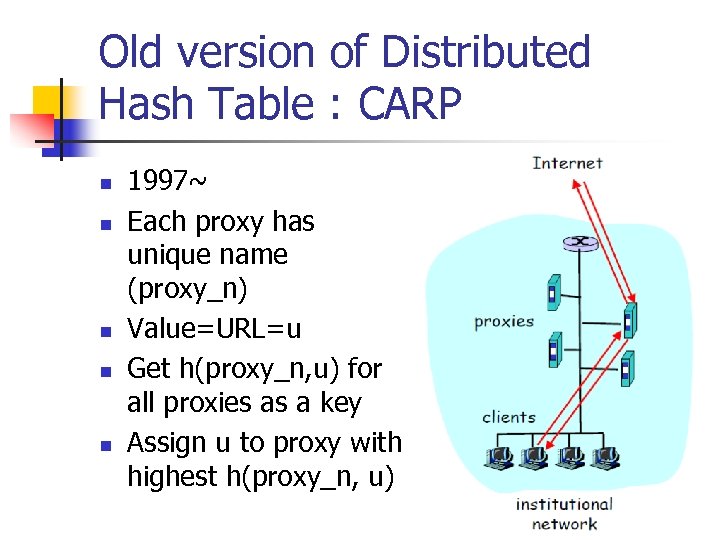 Old version of Distributed Hash Table : CARP n n n 1997~ Each proxy has unique name (proxy_n) Value=URL=u Get h(proxy_n, u) for all proxies as a key Assign u to proxy with highest h(proxy_n, u)
 Problem of CARP n Not good for P 2 P: n Each node needs to know name of all other up nodes n n n i. e. , need to know O(N) neighbors Hard to handle dynamic behavior of nodes (join/leave) But only O(1) hops in lookup
 New concept of DHT: Consistent Hashing n Node Identifier n assign integer identifier to each peer in range [0, 2 n-1]. n n Key : Data Identifier n n require each key to be an integer in same range. to get integer keys, hash original value. n n Each identifier can be represented by n bits. e. g. , key = h(“Hey Jude. mp 3”), Both node and data are placed in a same ID space ranged in [0, 2 n-1].
 Consistent Hashing : How to assign key to node? n central issue: n n rule: assign key to the peer that has the closest ID. n n n assigning (key, value) pairs to peers. E. g. Chord: closest is the immediate successor of the key. E. g. CAN : closest is the node whose responsible dimension includes the key. e. g. , : n=4; peers: 1, 3, 4, 5, 8, 10, 12, 14; n n key = 13, then successor peer = 14 key = 15, then successor peer = 1
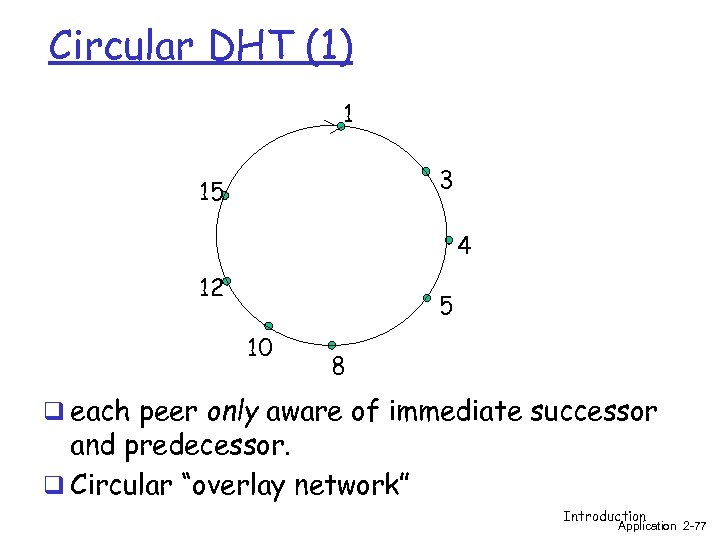 Circular DHT (1) 1 3 15 4 12 5 10 8 q each peer only aware of immediate successor and predecessor. q Circular “overlay network” Introduction Application 2 -77
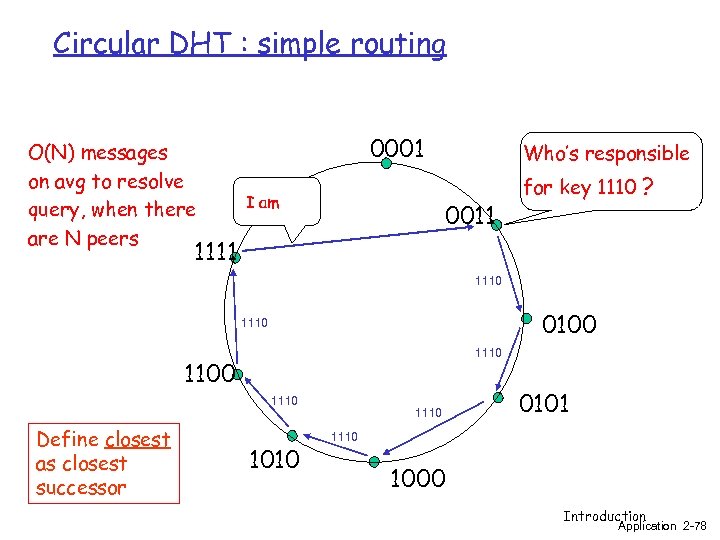 Circular DHT : simple routing O(N) messages on avg to resolve query, when there are N peers 0001 I am Who’s responsible 0011 for key 1110 ? 1111 1110 0100 1110 1100 1110 Define closest as closest successor 1010 1110 0101 1110 1000 Introduction Application 2 -78
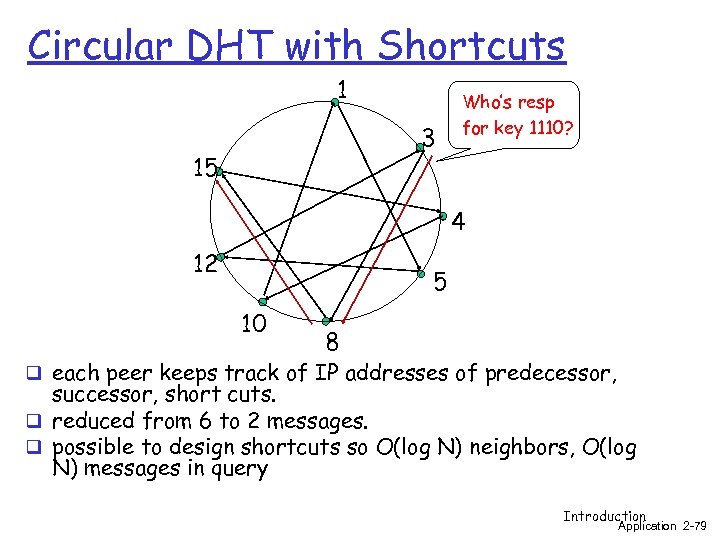 Circular DHT with Shortcuts 1 3 15 Who’s resp for key 1110? 4 12 5 10 8 q each peer keeps track of IP addresses of predecessor, successor, short cuts. q reduced from 6 to 2 messages. q possible to design shortcuts so O(log N) neighbors, O(log N) messages in query Introduction Application 2 -79
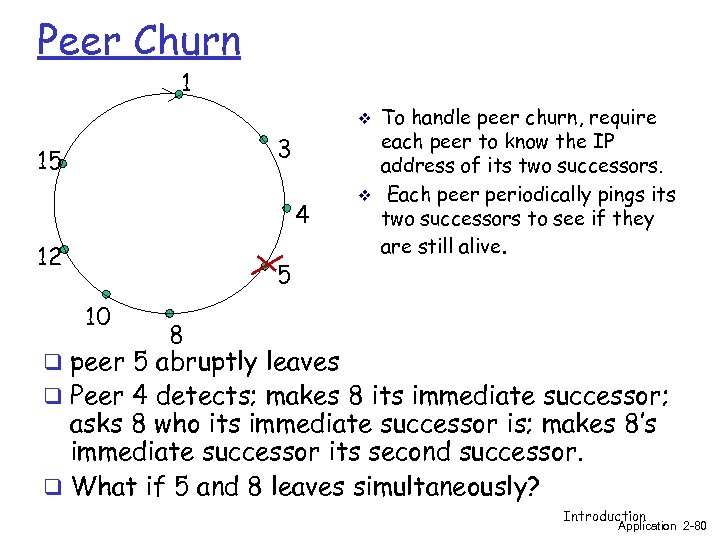 Peer Churn 1 v 3 15 4 12 5 10 v To handle peer churn, require each peer to know the IP address of its two successors. Each peer periodically pings its two successors to see if they are still alive. 8 q peer 5 abruptly leaves q Peer 4 detects; makes 8 its immediate successor; asks 8 who its immediate successor is; makes 8’s immediate successor its second successor. q What if 5 and 8 leaves simultaneously? Introduction Application 2 -80
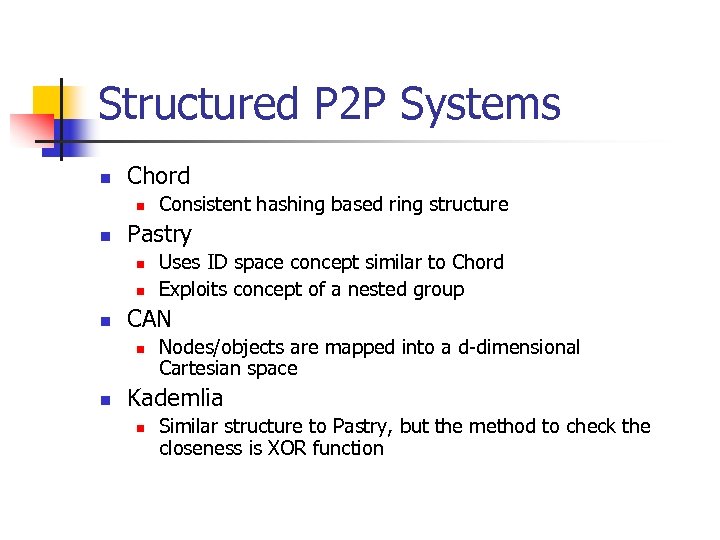 Structured P 2 P Systems n Chord n n Pastry n n n Uses ID space concept similar to Chord Exploits concept of a nested group CAN n n Consistent hashing based ring structure Nodes/objects are mapped into a d-dimensional Cartesian space Kademlia n Similar structure to Pastry, but the method to check the closeness is XOR function
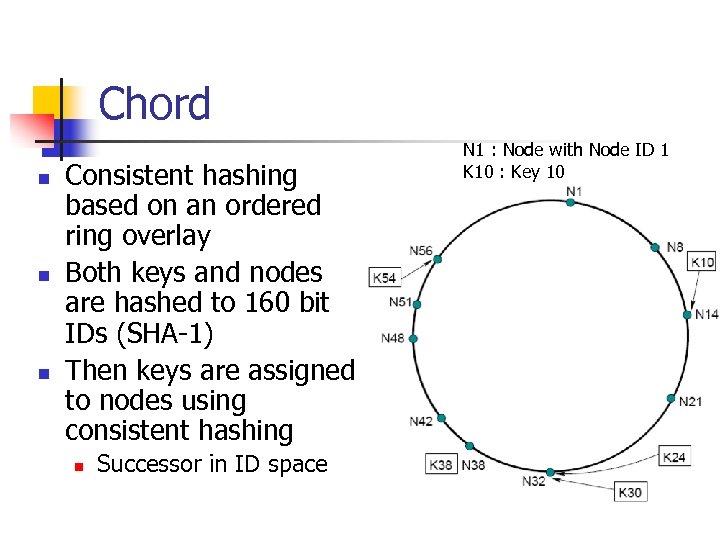 Chord n n n Consistent hashing based on an ordered ring overlay Both keys and nodes are hashed to 160 bit IDs (SHA-1) Then keys are assigned to nodes using consistent hashing n Successor in ID space N 1 : Node with Node ID 1 K 10 : Key 10
 Chord : hashing properties n Uniformly Randomized n n n All nodes receive roughly equal share of load As the number of nodes increases, the share of each node becomes more fair. Local n Adding or removing a node involves an O(1/N) fraction of the keys getting new locations
 Chord : Lookup operation n n Searches the node that stores the key ({key, value} pair) Two protocols n Simple key lookup n n Guaranteed way Scalable key lookup n Efficient way
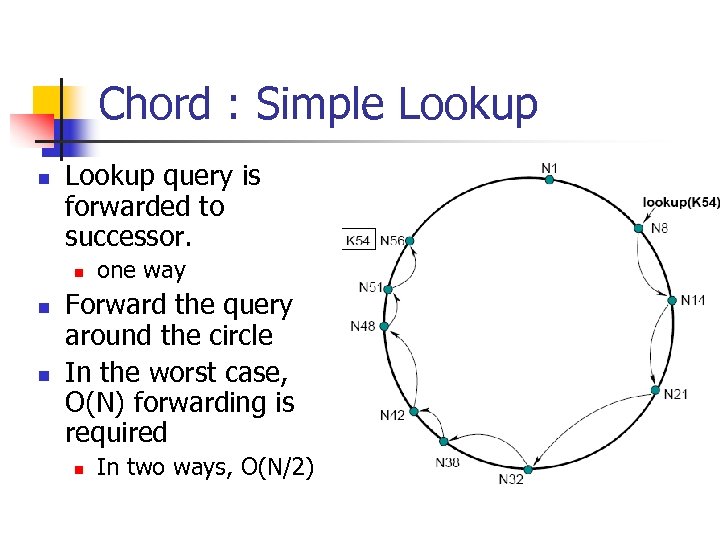 Chord : Simple Lookup n Lookup query is forwarded to successor. n n n one way Forward the query around the circle In the worst case, O(N) forwarding is required n In two ways, O(N/2)
 Chord : Scalable Lookup n n Each node n maintains a routing table with up to m entries (called the finger table) The ith entry in the table is the location of the successor (n +2 i-1) Query for a given identifier (key) is forwarded to the nearest node among m entries at each node. (node that most immediately precedes key) Search cost = O (log N) (m=O(log N))
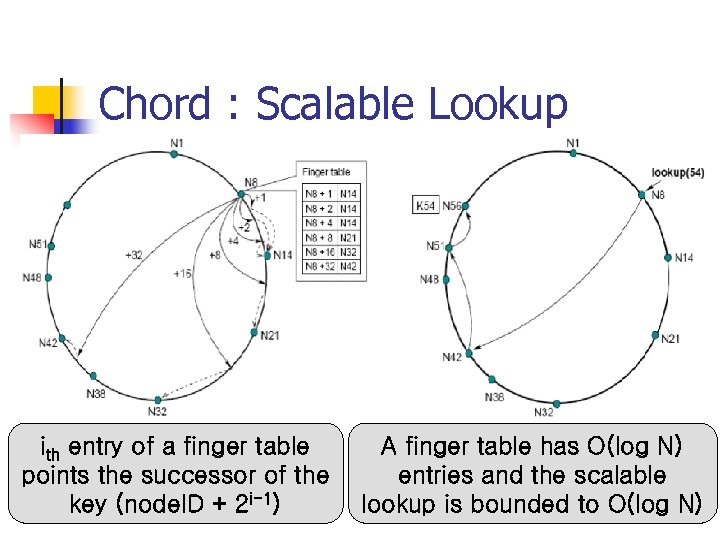 Chord : Scalable Lookup ith entry of a finger table points the successor of the key (node. ID + 2 i-1) A finger table has O(log N) entries and the scalable lookup is bounded to O(log N)
 Chord : Node Join n New node N identifies its successor n n n Takes over all successor’s keys that the new node is responsible for Sets its predecessor to its successor’s former predecessor Sets its successor’s predecessor to itself Newly joining node builds a finger table n n n Performs lookup (N) Performs lookup (N + 2 i-1) (for i=0, 1, 2, …I) I= number of finger print entries Update other nodes’ finger tables
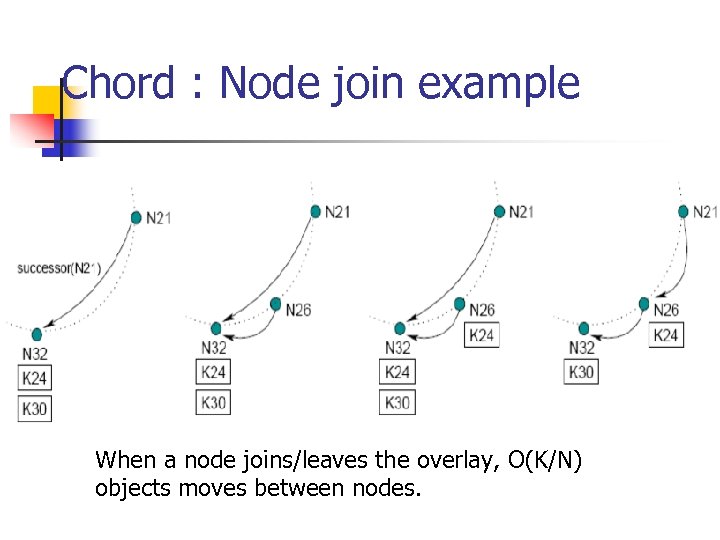 Chord : Node join example When a node joins/leaves the overlay, O(K/N) objects moves between nodes.
 Chord : Node Leave n n Similar to Node Join Moves all keys that the node is responsible for to its successor Sets its successor’s predecessor to its predecessor Sets its predecessor’s successor to its successor n n C. f. management of a linked list Finger Table? ? n There is no explicit way to update others’ finger tables which point the leaving node
 Chord : Stabilization n n If the ring is correct, then routing is correct, fingers are needed for the speed only Stabilization n Each node periodically runs the stabilization routine Each node refreshes all fingers by periodically calling find_successor(n+2 i-1) for a random i Periodic cost is O(log. N) per node due to finger refresh
 Chord : Failure handling n Failed nodes are handled by n Replication: instead of one successor, we keep r successors n n Alternate paths while routing n n More robust to node failure (we can find our new successor if the old one failed) If a finger does not respond, take the previous finger, or the replicas, if close enough At the DHT level, we can replicate keys on the r successor nodes n The stored data becomes equally more robust
 Pastry : Identifiers n Applies a sorted ring in ID space like Chord n n Node. ID (and key) is interpreted as sequences of digit with base 2 b n n Nodes and objects are assigned a 128 -bit identifier In practice, the identifier is viewed in base 16 (b=4). The node that is responsible for a key is numerically closest (not the successor) n Bidirectional and using numerical distance
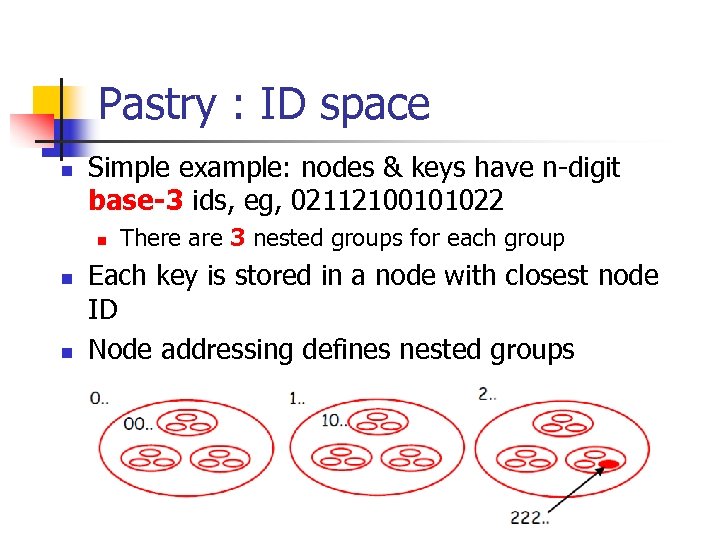 Pastry : ID space n Simple example: nodes & keys have n-digit base-3 ids, eg, 02112100101022 n n n There are 3 nested groups for each group Each key is stored in a node with closest node ID Node addressing defines nested groups
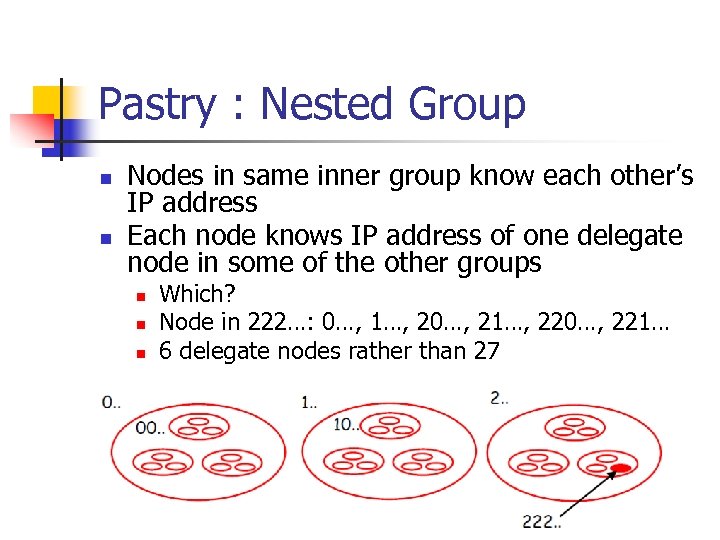 Pastry : Nested Group n n Nodes in same inner group know each other’s IP address Each node knows IP address of one delegate node in some of the other groups n n n Which? Node in 222…: 0…, 1…, 20…, 21…, 220…, 221… 6 delegate nodes rather than 27
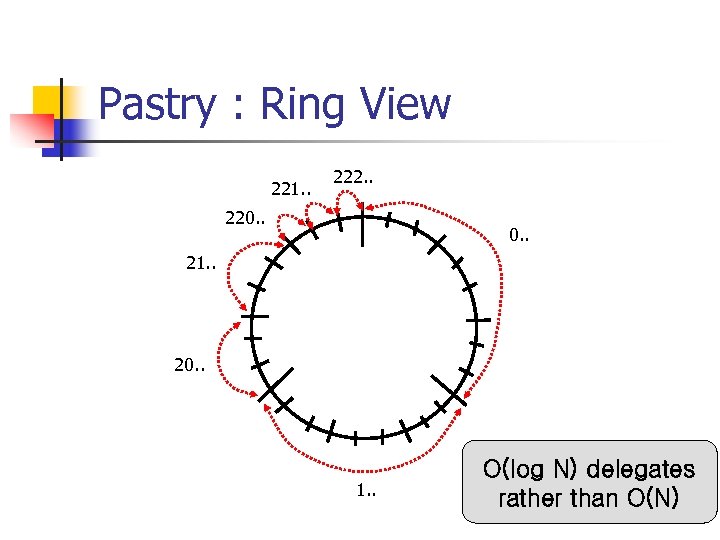 Pastry : Ring View 221. . 222. . 220. . 21. . 20. . 1. . O(log N) delegates rather than O(N)
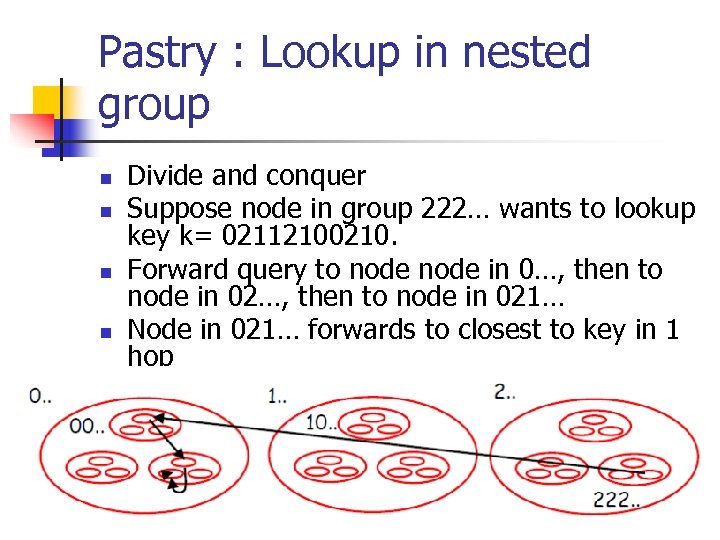 Pastry : Lookup in nested group n n Divide and conquer Suppose node in group 222… wants to lookup key k= 02112100210. Forward query to node in 0…, then to node in 021… Node in 021… forwards to closest to key in 1 hop
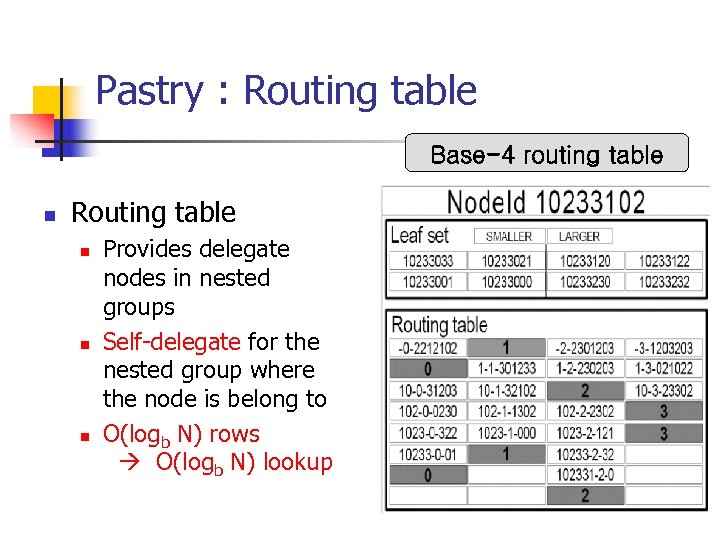 Pastry : Routing table Base-4 routing table n Routing table n n n Provides delegate nodes in nested groups Self-delegate for the nested group where the node is belong to O(logb N) rows O(logb N) lookup
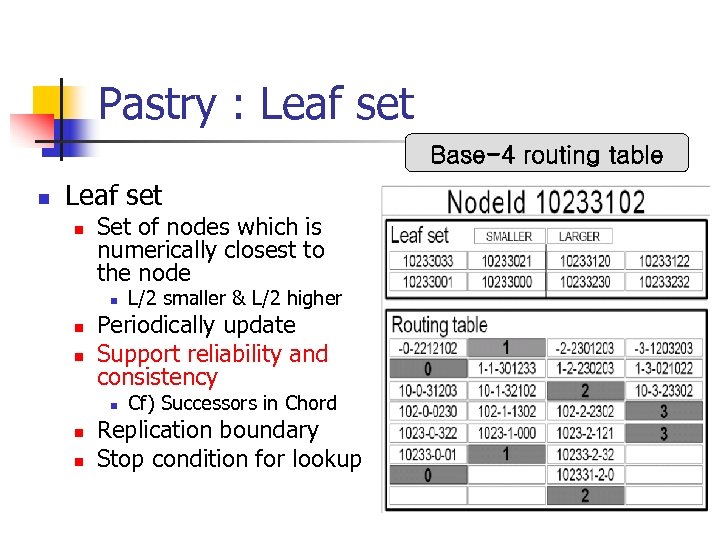 Pastry : Leaf set Base-4 routing table n Leaf set n Set of nodes which is numerically closest to the node n n n Periodically update Support reliability and consistency n n n L/2 smaller & L/2 higher Cf) Successors in Chord Replication boundary Stop condition for lookup
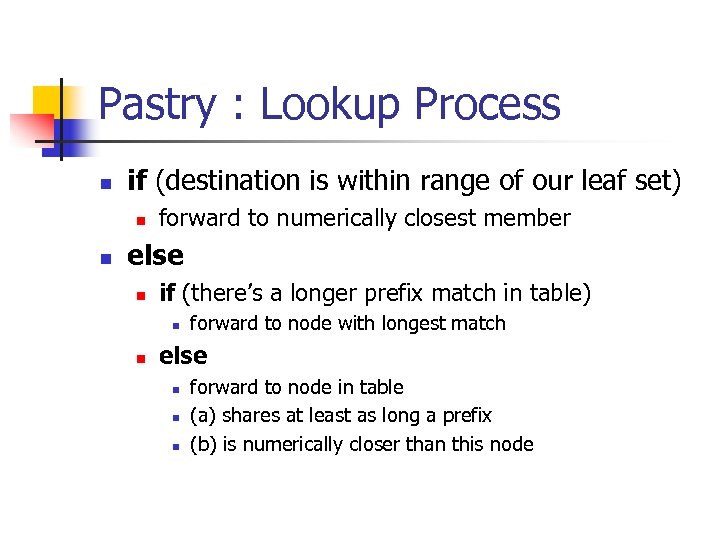 Pastry : Lookup Process n if (destination is within range of our leaf set) n n forward to numerically closest member else n if (there’s a longer prefix match in table) n n forward to node with longest match else n n n forward to node in table (a) shares at least as long a prefix (b) is numerically closer than this node
 Pastry : Proximity routing n Assumption: scalar proximity metric n n n e. g. ping delay, # IP hops a node can probe distance to any other node Proximity invariant: n Each routing table entry refers to a node close to the local node (in the proximity space), among all nodes with the appropriate node. Id prefix.
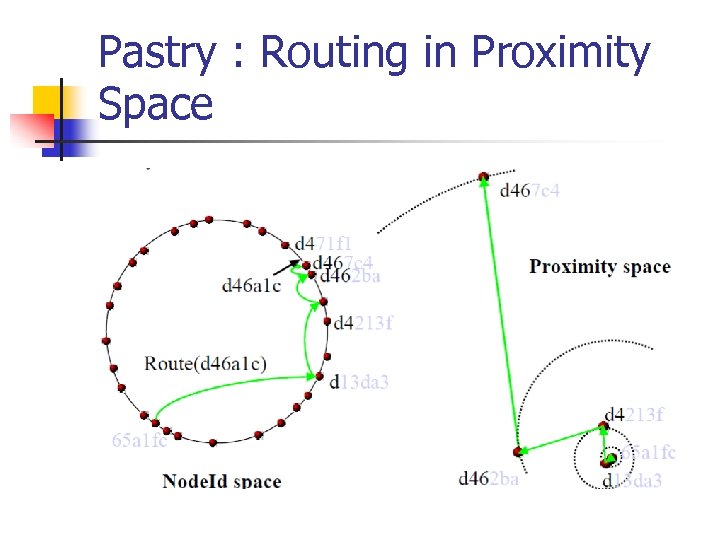 Pastry : Routing in Proximity Space
 Pastry : Join and Failure n Join n n Finds numerically closest node already in network Ask state from all nodes on the route and initialize own state n n Leaf. Set and Routing Table Failure Handling n n Failed leaf node: contact a leaf node on the side of the failed node and add appropriate new neighbor Failed table entry: contact a live entry with same prefix as failed entry until new live entry found, if none found, keep trying with longer prefix table entries
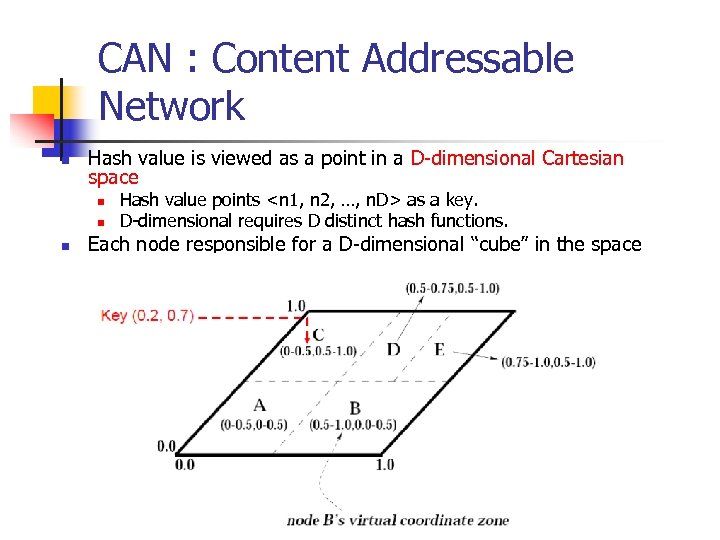 CAN : Content Addressable Network n Hash value is viewed as a point in a D-dimensional Cartesian space n n n Hash value points
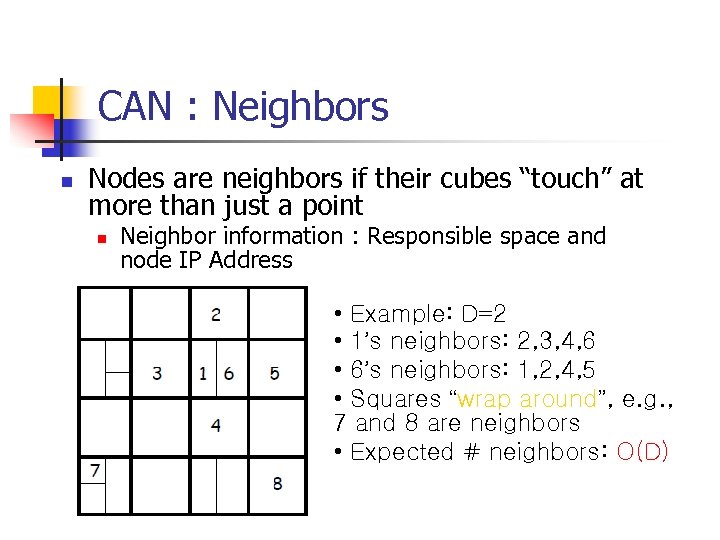 CAN : Neighbors n Nodes are neighbors if their cubes “touch” at more than just a point n Neighbor information : Responsible space and node IP Address • Example: D=2 • 1’s neighbors: 2, 3, 4, 6 • 6’s neighbors: 1, 2, 4, 5 • Squares “wrap around”, e. g. , 7 and 8 are neighbors • Expected # neighbors: O(D)
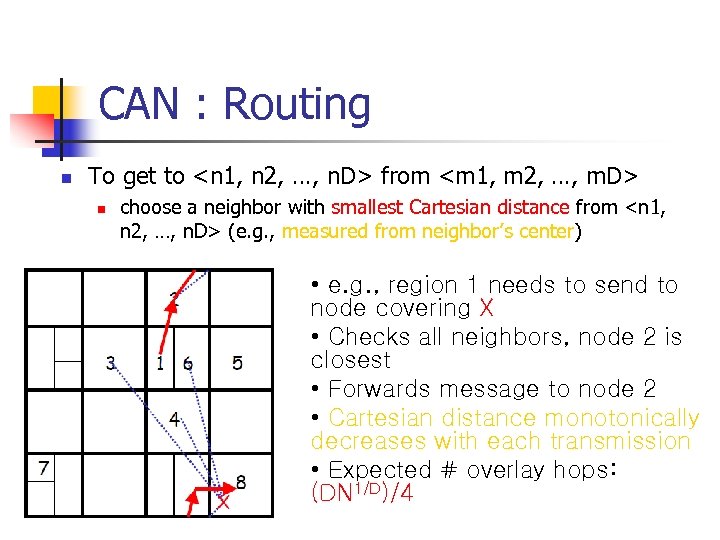 CAN : Routing n To get to
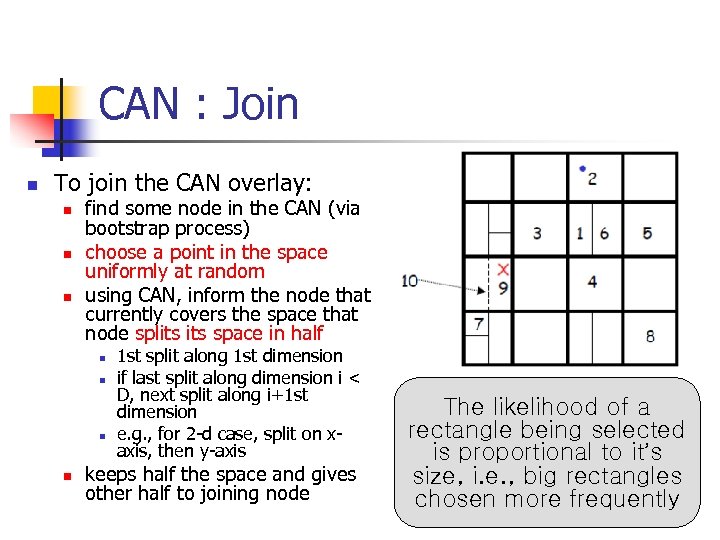 CAN : Join n To join the CAN overlay: n n n find some node in the CAN (via bootstrap process) choose a point in the space uniformly at random using CAN, inform the node that currently covers the space that node splits space in half n n 1 st split along 1 st dimension if last split along dimension i < D, next split along i+1 st dimension e. g. , for 2 -d case, split on xaxis, then y-axis keeps half the space and gives other half to joining node The likelihood of a rectangle being selected is proportional to it’s size, i. e. , big rectangles chosen more frequently
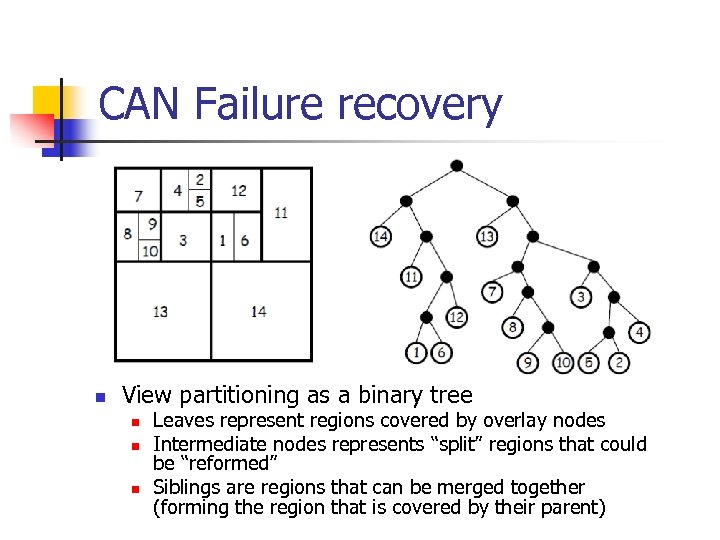 CAN Failure recovery n View partitioning as a binary tree n n n Leaves represent regions covered by overlay nodes Intermediate nodes represents “split” regions that could be “reformed” Siblings are regions that can be merged together (forming the region that is covered by their parent)
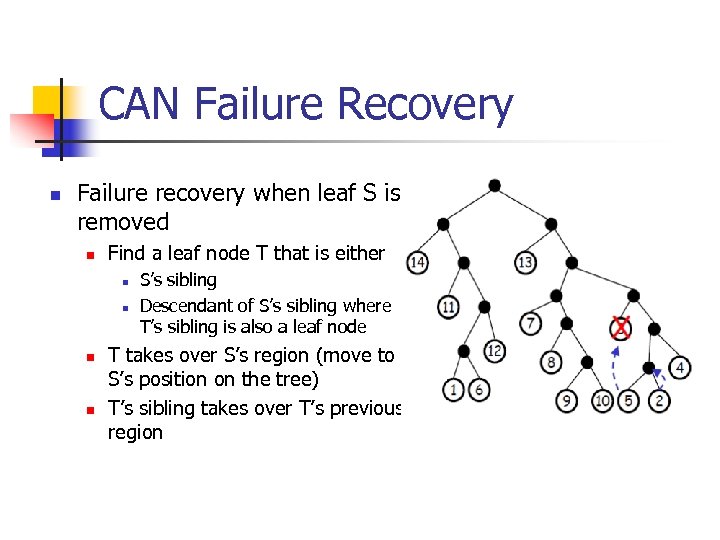 CAN Failure Recovery n Failure recovery when leaf S is removed n Find a leaf node T that is either n n S’s sibling Descendant of S’s sibling where T’s sibling is also a leaf node T takes over S’s region (move to S’s position on the tree) T’s sibling takes over T’s previous region
 CAN : speed up routing n n Basic CAN routing is slower than Chord or Pastry Manage long ranged links n n Probabilistically maintain multi-hop away links ( 2 hop away, 3 hop away. . ) Exploit the nested group routing
 Kademlia : Bit. Torrent DHT n n Developed in 2002 For Distributed Tracker n n trackerless torrent Torrent files are maintained by all users using Bit. Torrent. For each nodes, files, keywords, deploy SHA-1 hash into a 160 bits space. Every node maintains information about files, keywords “close to itself”.
 Kademlia : XOR based closeness n n The closeness between two objects measure as their bitwise XOR interpreted as an integer. D(a, b) = a XOR b n n n d (x, x) = 0 d (x, y) > 0 if x ≠ y d (x, y) = d (y, x) d (x, y) + d (y, z) ≥ d (x, z) For each x and t, there is exactly one node y for which d (x, y) = t
 Kademlia : Binary Tree of ID Space n n n Treat node as leaves in a binary tree. For any given node, dividing the binary tree into a series of successively lower subtree that don’t contain the node. For any given node, it keeps touch at least one node (up to k) of its subtrees. (if there is a node in that tree. ) Each subtree possesses a k-bucket.
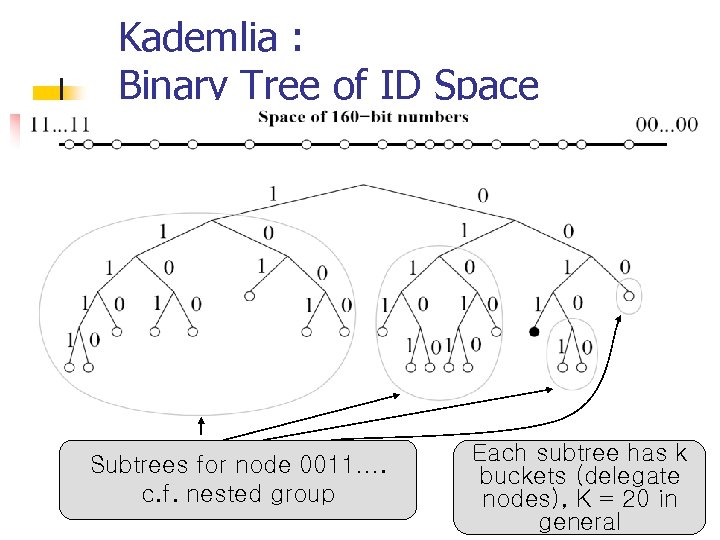 Kademlia : Binary Tree of ID Space Subtrees for node 0011…. c. f. nested group Each subtree has k buckets (delegate nodes), K = 20 in general
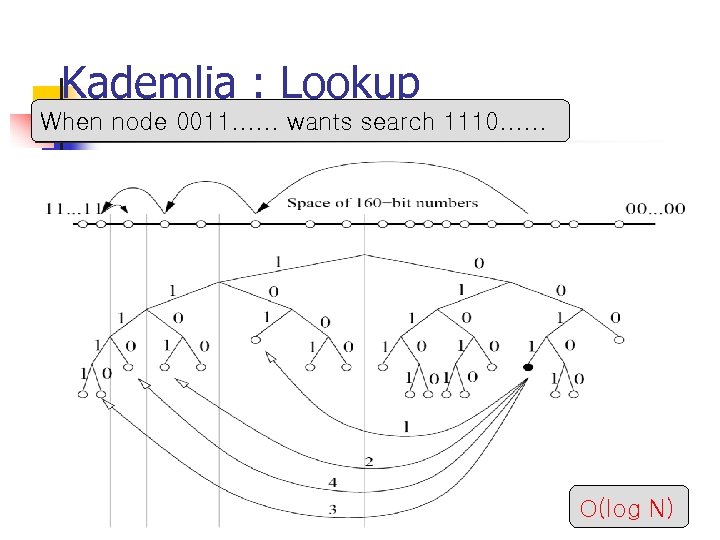 Kademlia : Lookup When node 0011…… wants search 1110…… O(log N)
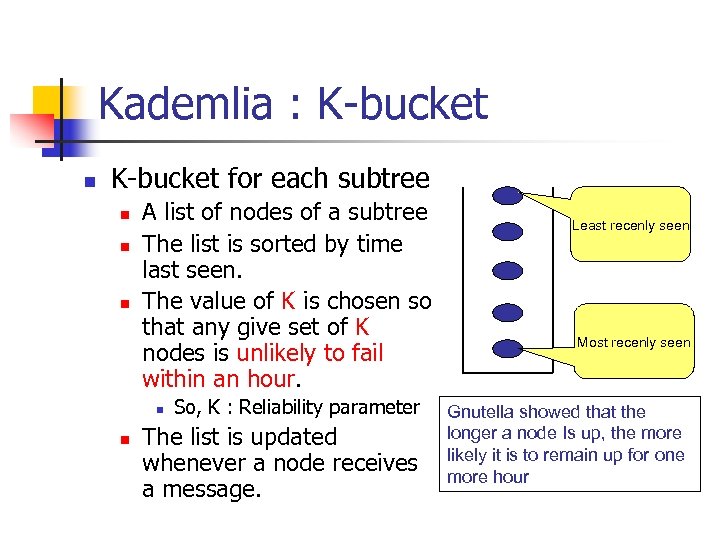 Kademlia : K-bucket n K-bucket for each subtree n n n A list of nodes of a subtree The list is sorted by time last seen. The value of K is chosen so that any give set of K nodes is unlikely to fail within an hour. n n So, K : Reliability parameter The list is updated whenever a node receives a message. Least recenly seen Most recenly seen Gnutella showed that the longer a node Is up, the more likely it is to remain up for one more hour
 Kademlia : K-bucket n n n By relying on the oldest nodes, k-buckets promise the probability that they will remain online. Dos attack is prevented since the new nodes find it difficult to get into the k-bucket If malicious users live long and dominate all the K-bucket, what happens? n n Eclipse attack Sybil attack
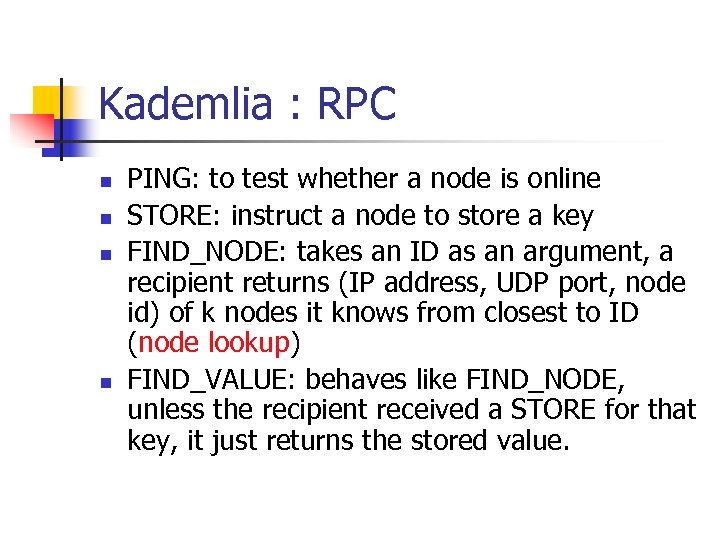 Kademlia : RPC n n PING: to test whether a node is online STORE: instruct a node to store a key FIND_NODE: takes an ID as an argument, a recipient returns (IP address, UDP port, node id) of k nodes it knows from closest to ID (node lookup) FIND_VALUE: behaves like FIND_NODE, unless the recipient received a STORE for that key, it just returns the stored value.
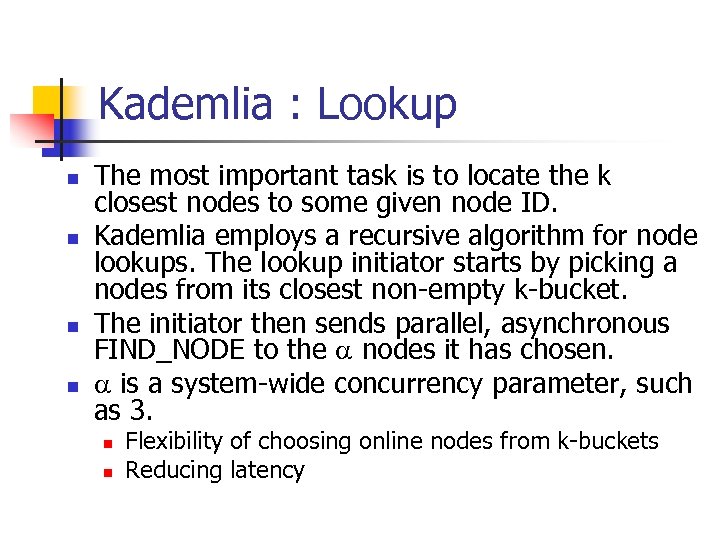 Kademlia : Lookup n n The most important task is to locate the k closest nodes to some given node ID. Kademlia employs a recursive algorithm for node lookups. The lookup initiator starts by picking a nodes from its closest non-empty k-bucket. The initiator then sends parallel, asynchronous FIND_NODE to the nodes it has chosen. is a system-wide concurrency parameter, such as 3. n n Flexibility of choosing online nodes from k-buckets Reducing latency
 Kademlia : Lookup n n n The initiator resends the FIND_NODE to nodes it has learned about from previous RPCs. If a round of FIND_NODES fails to return a node any closer than the closest already seen, the initiator resends the FIND_NODE to all of the k closest nodes it has not already queried. The lookup terminates when the initiator has queried and gotten responses from the k closest nodes it has seen.
 Summary : Structured DHT based P 2 P n Design issues ID (node, key) mapping n Routing (Lookup) method n Maintenance (Join/Leave) method n All functionality should be fully distributed n
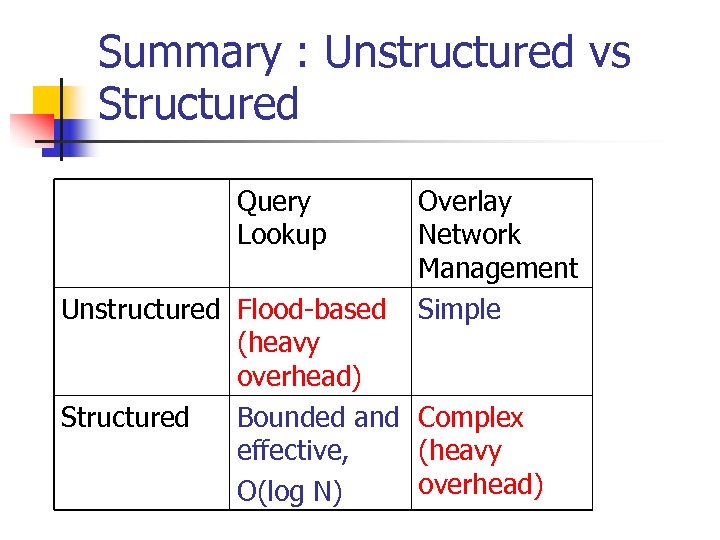 Summary : Unstructured vs Structured Query Lookup Overlay Network Management Unstructured Flood-based Simple (heavy overhead) Structured Bounded and Complex effective, (heavy overhead) O(log N)
 P 2 P Content Dissemination
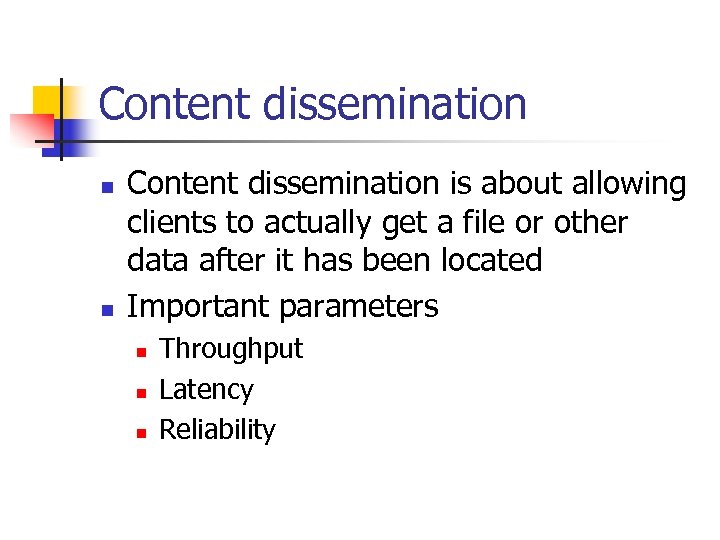 Content dissemination n n Content dissemination is about allowing clients to actually get a file or other data after it has been located Important parameters n n n Throughput Latency Reliability
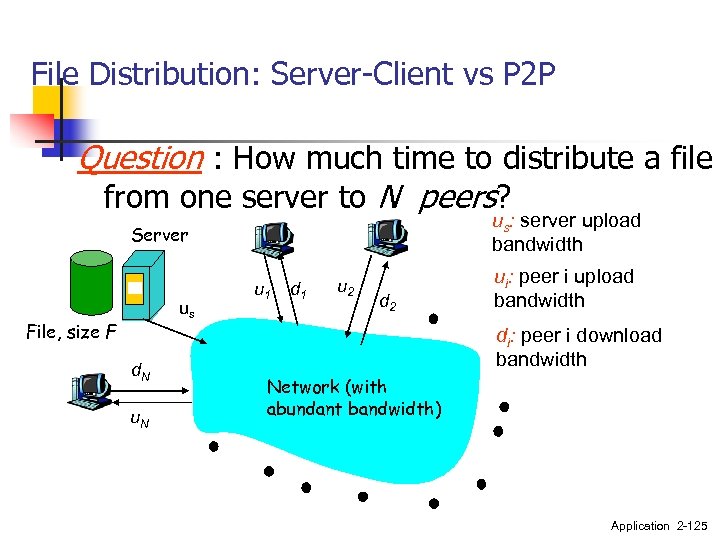 File Distribution: Server-Client vs P 2 P Question : How much time to distribute a file from one server to N peers? us: server upload bandwidth Server us File, size F d. N u 1 d 1 u 2 d 2 ui: peer i upload bandwidth di: peer i download bandwidth Network (with abundant bandwidth) Application 2 -125
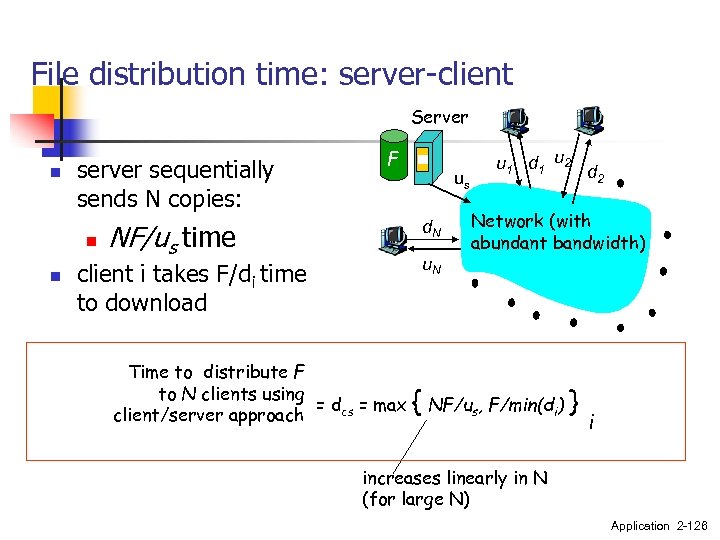 File distribution time: server-client Server n server sequentially sends N copies: n n F us d. N NF/us time u. N client i takes F/di time to download Time to distribute F to N clients using = dcs = max client/server approach u 1 d 1 u 2 d 2 Network (with abundant bandwidth) { NF/us, F/min(di) } i increases linearly in N (for large N) Application 2 -126
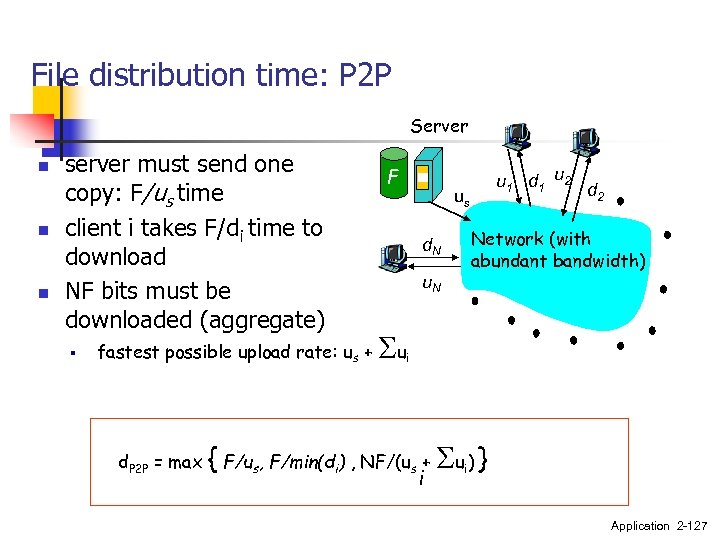 File distribution time: P 2 P Server n n n server must send one copy: F/us time client i takes F/di time to download NF bits must be downloaded (aggregate) § fastest possible upload rate: us + d. P 2 P = max F us d. N u. N Su u 1 d 1 u 2 d 2 Network (with abundant bandwidth) i { F/us, F/min(di) , NF/(us + Sui) } i Application 2 -127
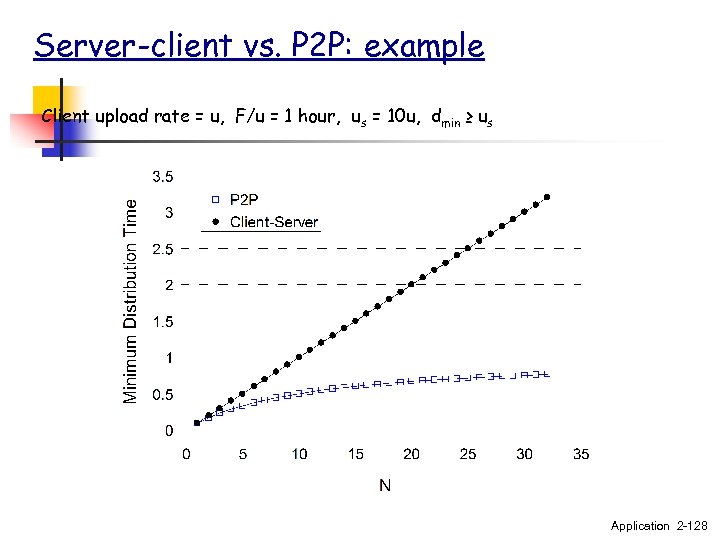 Server-client vs. P 2 P: example Client upload rate = u, F/u = 1 hour, us = 10 u, dmin ≥ us Application 2 -128
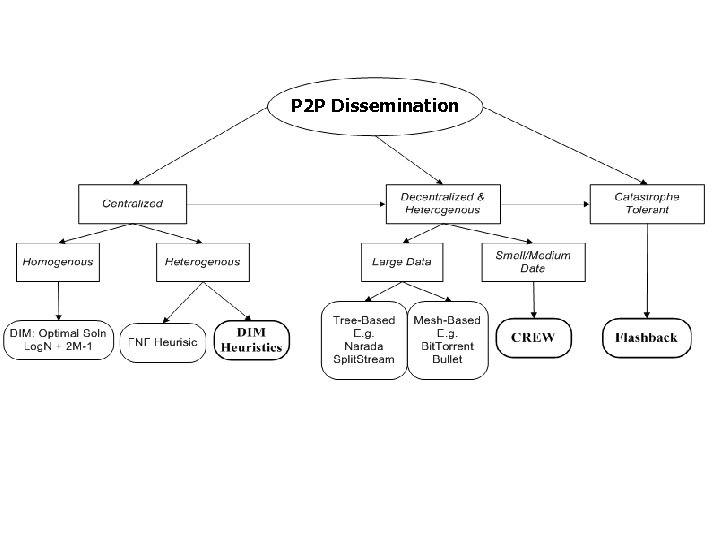 P 2 P Dissemination
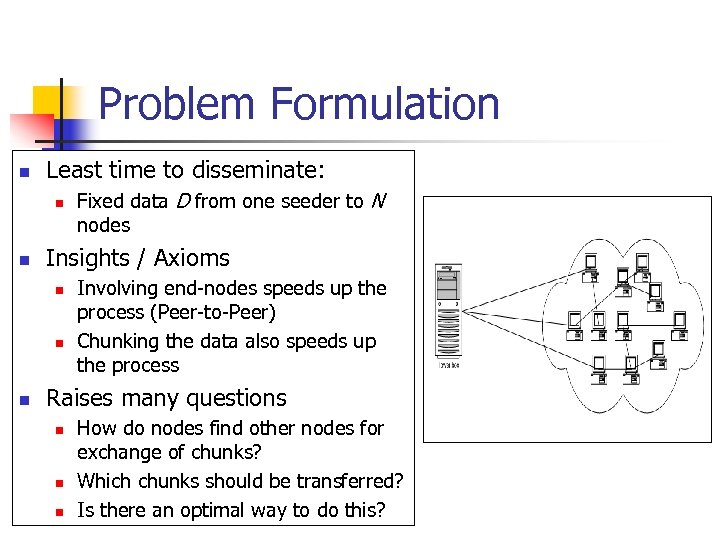 Problem Formulation n Least time to disseminate: n n Insights / Axioms n n n Fixed data D from one seeder to N nodes Involving end-nodes speeds up the process (Peer-to-Peer) Chunking the data also speeds up the process Raises many questions n n n How do nodes find other nodes for exchange of chunks? Which chunks should be transferred? Is there an optimal way to do this?
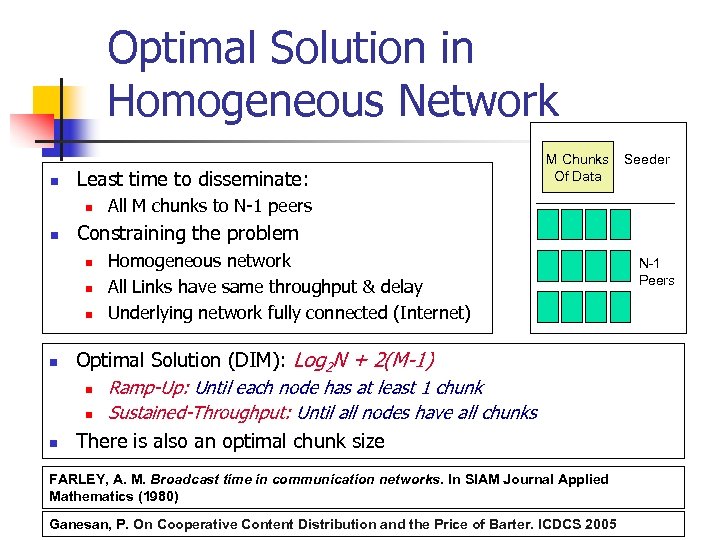 Optimal Solution in Homogeneous Network n Least time to disseminate: n n n Seeder All M chunks to N-1 peers Constraining the problem n n M Chunks Of Data Homogeneous network All Links have same throughput & delay Underlying network fully connected (Internet) Optimal Solution (DIM): Log 2 N + 2(M-1) n Ramp-Up: Until each node has at least 1 chunk n Sustained-Throughput: Until all nodes have all chunks There is also an optimal chunk size FARLEY, A. M. Broadcast time in communication networks. In SIAM Journal Applied Mathematics (1980) Ganesan, P. On Cooperative Content Distribution and the Price of Barter. ICDCS 2005 N-1 Peers
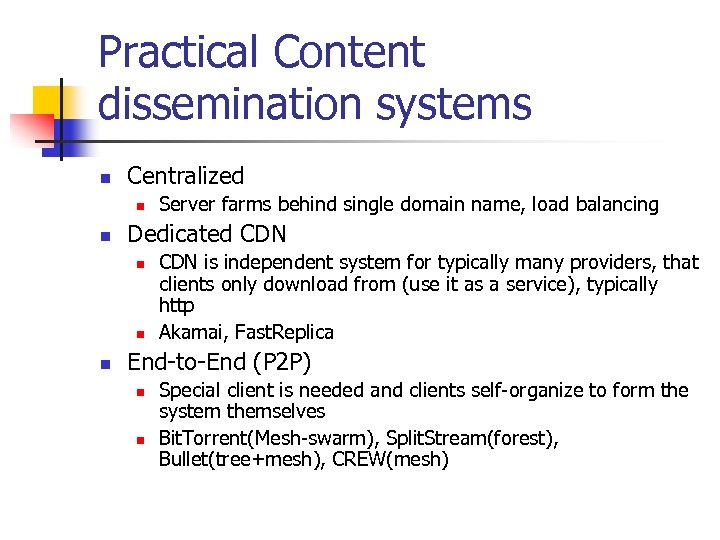 Practical Content dissemination systems n Centralized n n Dedicated CDN n n n Server farms behind single domain name, load balancing CDN is independent system for typically many providers, that clients only download from (use it as a service), typically http Akamai, Fast. Replica End-to-End (P 2 P) n n Special client is needed and clients self-organize to form the system themselves Bit. Torrent(Mesh-swarm), Split. Stream(forest), Bullet(tree+mesh), CREW(mesh)
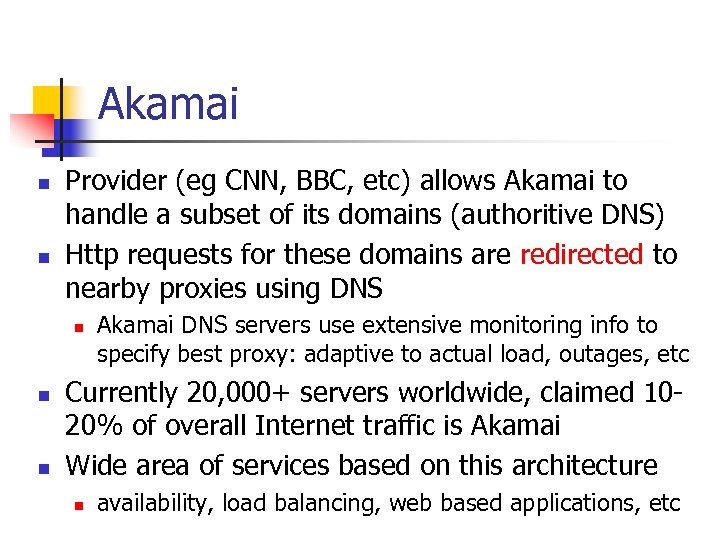 Akamai n n Provider (eg CNN, BBC, etc) allows Akamai to handle a subset of its domains (authoritive DNS) Http requests for these domains are redirected to nearby proxies using DNS n n n Akamai DNS servers use extensive monitoring info to specify best proxy: adaptive to actual load, outages, etc Currently 20, 000+ servers worldwide, claimed 1020% of overall Internet traffic is Akamai Wide area of services based on this architecture n availability, load balancing, web based applications, etc
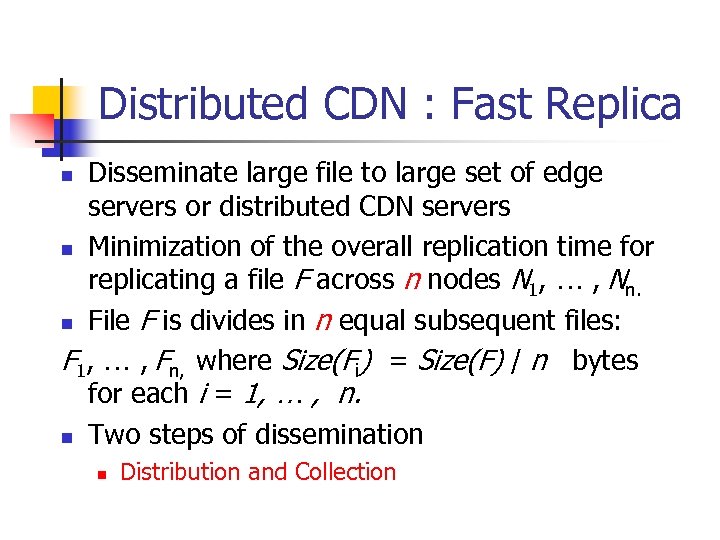 Distributed CDN : Fast Replica Disseminate large file to large set of edge servers or distributed CDN servers n Minimization of the overall replication time for replicating a file F across n nodes N 1, … , Nn. n File F is divides in n equal subsequent files: F 1, … , Fn, where Size(Fi) = Size(F) / n bytes for each i = 1, … , n. n Two steps of dissemination n n Distribution and Collection
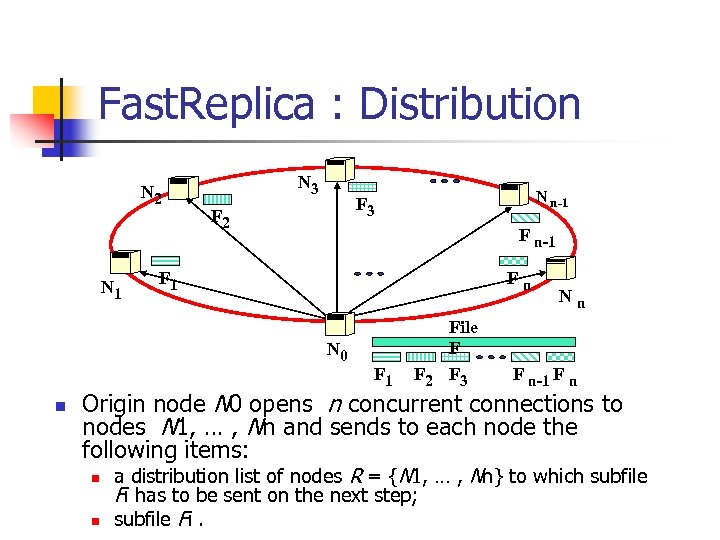 Fast. Replica : Distribution N 2 N 1 N 3 F 2 F n-1 F 1 Fn N 0 n N n-1 F 3 F 1 File F F 2 F 3 Nn F n-1 F n Origin node N 0 opens n concurrent connections to nodes N 1, … , Nn and sends to each node the following items: n n a distribution list of nodes R = {N 1, … , Nn} to which subfile Fi has to be sent on the next step; subfile Fi.
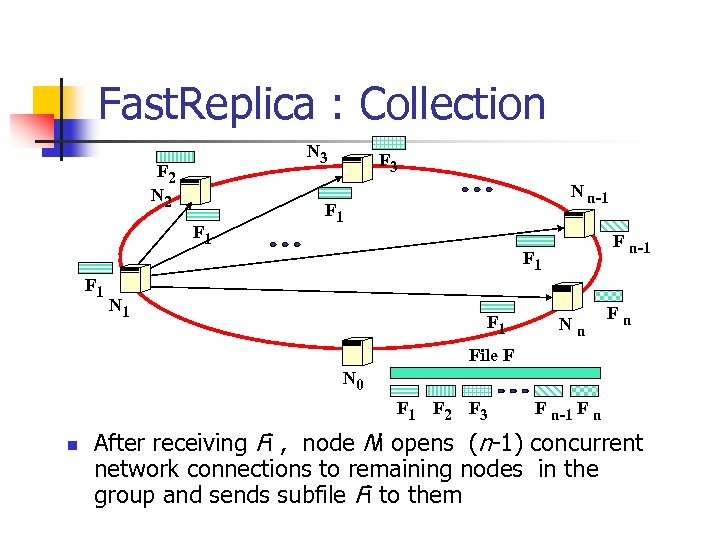 Fast. Replica : Collection N 3 F 2 N 2 F 1 F 3 N n-1 F 1 F 1 Nn Fn File F N 0 F 1 F 2 F 3 n F n-1 F n After receiving Fi , node Ni opens (n-1) concurrent network connections to remaining nodes in the group and sends subfile Fi to them
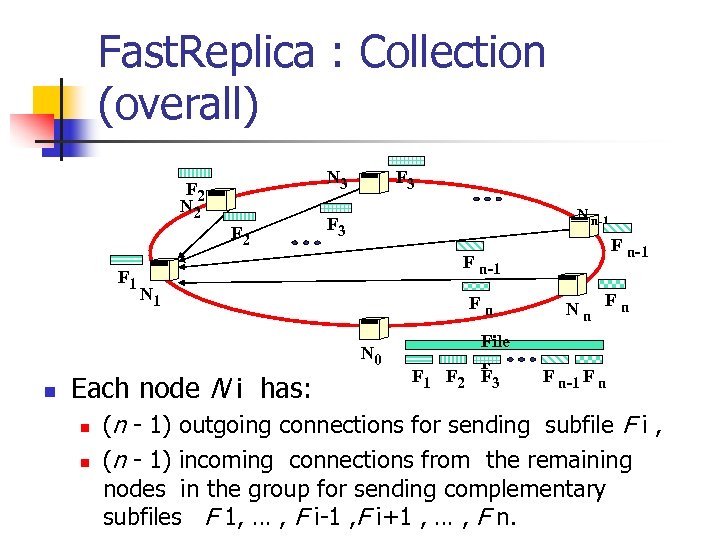 Fast. Replica : Collection (overall) N 3 F 2 N 2 F 1 F 3 N n-1 F 3 F n-1 N 1 Fn N 0 n Each node N i has: n n F n-1 File F F 1 F 2 F 3 Nn Fn F n-1 F n (n - 1) outgoing connections for sending subfile F i , (n - 1) incoming connections from the remaining nodes in the group for sending complementary subfiles F 1, … , F i-1 , F i+1 , … , F n.
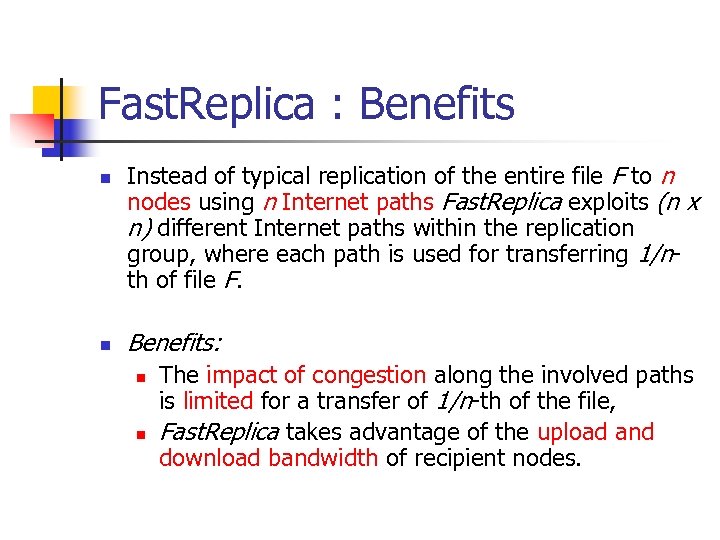 Fast. Replica : Benefits n n Instead of typical replication of the entire file F to n nodes using n Internet paths Fast. Replica exploits (n x n) different Internet paths within the replication group, where each path is used for transferring 1/nth of file F. Benefits: n n The impact of congestion along the involved paths is limited for a transfer of 1/n-th of the file, Fast. Replica takes advantage of the upload and download bandwidth of recipient nodes.
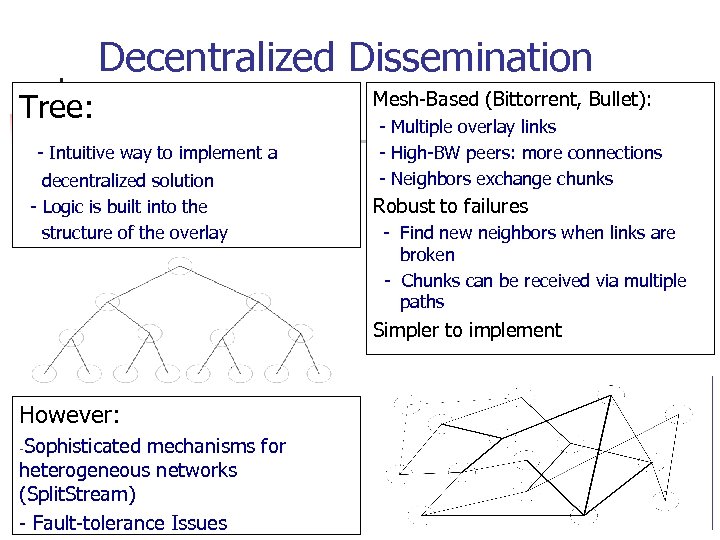 Decentralized Dissemination Tree: - Intuitive way to implement a decentralized solution - Logic is built into the structure of the overlay Mesh-Based (Bittorrent, Bullet): - Multiple overlay links - High-BW peers: more connections - Neighbors exchange chunks Robust to failures - Find new neighbors when links are broken - Chunks can be received via multiple paths Simpler to implement However: Sophisticated mechanisms for heterogeneous networks (Split. Stream) - Fault-tolerance Issues -
 Bit. Torrent n n Currently 20 -50% of internet traffic is Bit. Torrent Special client software is needed n n Bit. Torrent, Bit. Tyrant, μTorrent, Lime. Wire … Basic idea n n Clients that download a file at the same time help each other (ie, also upload chunks to each other) Bit. Torrent clients form a swarm : a random overlay network
 Bit. Torrent : Publish/download n Publishing a file n n Put a “. torrent” file on the web: it contains the address of the tracker, and information about the published file Start a tracker, a server that n n Gives joining downloaders random peers to download from and to Collects statistics about the swarm There are “trackerless” implementations by using Kademlia DHT (e. g. Azureus) Download a file n Install a bittorrent client and click on a “. torrent” file
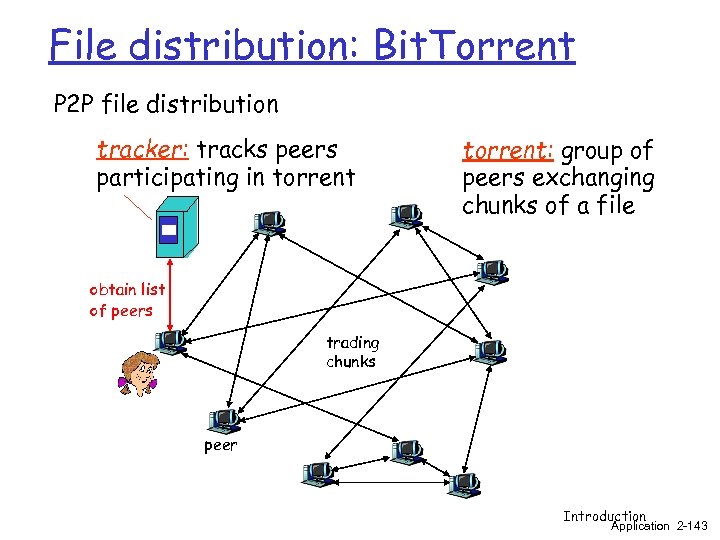 File distribution: Bit. Torrent P 2 P file distribution tracker: tracks peers participating in torrent: group of peers exchanging chunks of a file obtain list of peers trading chunks peer Introduction Application 2 -143
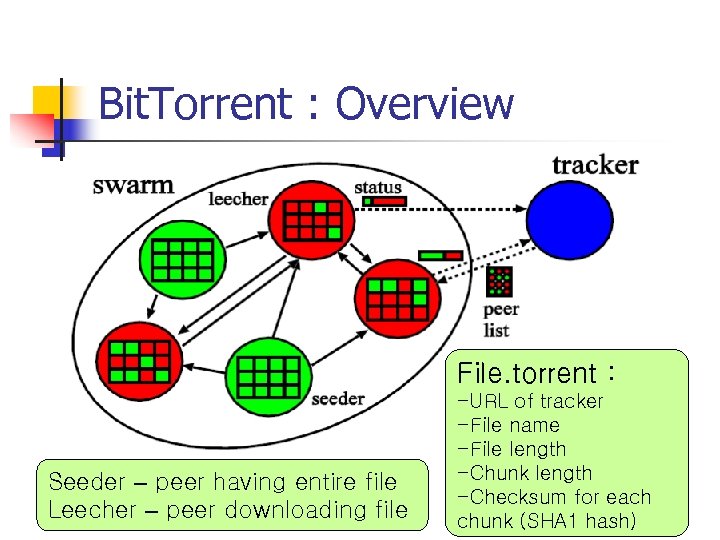 Bit. Torrent : Overview File. torrent : Seeder – peer having entire file Leecher – peer downloading file -URL of tracker -File name -File length -Chunk length -Checksum for each chunk (SHA 1 hash)
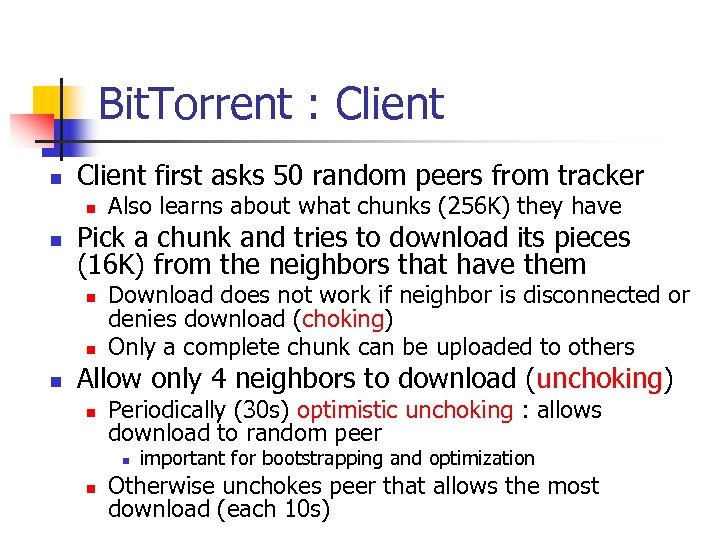 Bit. Torrent : Client n Client first asks 50 random peers from tracker n n Pick a chunk and tries to download its pieces (16 K) from the neighbors that have them n n n Also learns about what chunks (256 K) they have Download does not work if neighbor is disconnected or denies download (choking) Only a complete chunk can be uploaded to others Allow only 4 neighbors to download (unchoking) n Periodically (30 s) optimistic unchoking : allows download to random peer n n important for bootstrapping and optimization Otherwise unchokes peer that allows the most download (each 10 s)
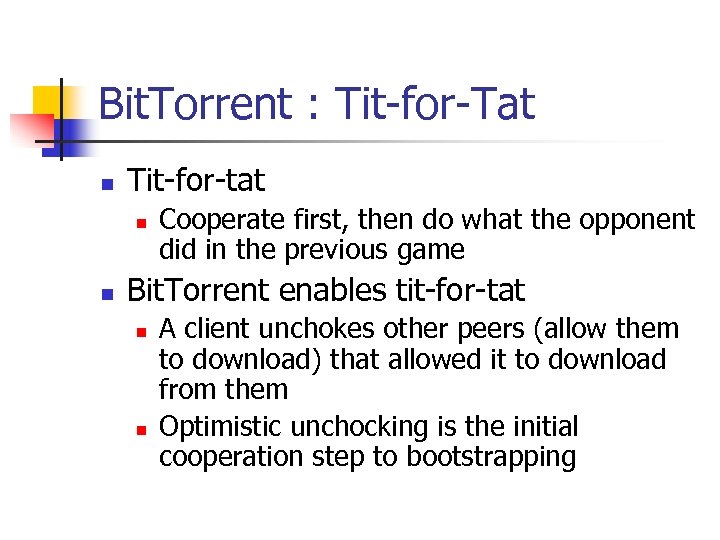 Bit. Torrent : Tit-for-Tat n Tit-for-tat n n Cooperate first, then do what the opponent did in the previous game Bit. Torrent enables tit-for-tat n n A client unchokes other peers (allow them to download) that allowed it to download from them Optimistic unchocking is the initial cooperation step to bootstrapping
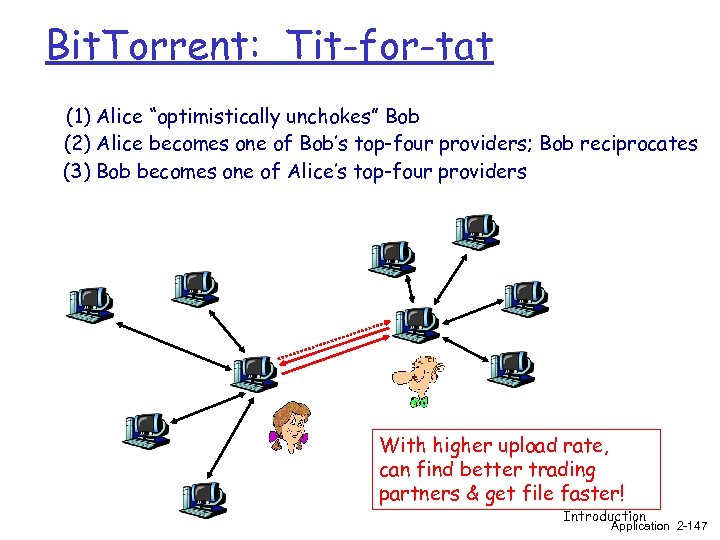 Bit. Torrent: Tit-for-tat (1) Alice “optimistically unchokes” Bob (2) Alice becomes one of Bob’s top-four providers; Bob reciprocates (3) Bob becomes one of Alice’s top-four providers With higher upload rate, can find better trading partners & get file faster! Introduction Application 2 -147
 Bit. Torrent : Chunk selection n n What chunk to select to download? Clients select the chunk that is rarest among the neighbors ( Local decision ) n n n Increases diversity in the pieces downloaded; Increase throughput Increases likelihood all pieces still available even if original seed leaves before any one node has downloaded entire file Except the first chunk n Select a random one (to make it fast: many neighbors must have it)
 Bit. Torrent : Pros/Cons n Pros n n Proficient in utilizing partially downloaded files Encourages diversity through “rarest-first” n n n Extends lifetime of swarm Works well for “hot content” Cons n n Assumes all interested peers active at same time; performance deteriorates if swarm “cools off” Even worse: no trackers for obscure content
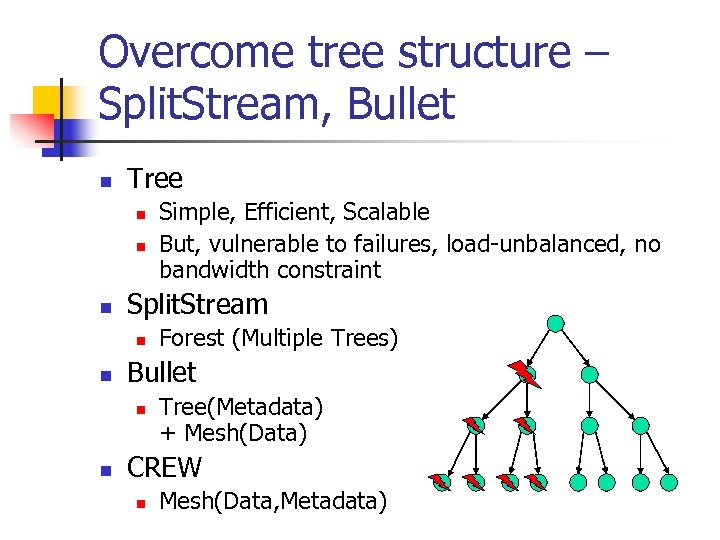 Overcome tree structure – Split. Stream, Bullet n Tree n n n Split. Stream n n Forest (Multiple Trees) Bullet n n Simple, Efficient, Scalable But, vulnerable to failures, load-unbalanced, no bandwidth constraint Tree(Metadata) + Mesh(Data) CREW n Mesh(Data, Metadata)
 Split. Stream n n Forest based dissemination Basic idea n n Split the stream into K stripes (with MDC coding) For each stripe create a multicast tree such that the forest n n Contains interior-node-disjoint trees Respects nodes’ individual bandwidth constraints
 Split. Stream : MDC coding n Multiple Description coding n n n Fragments a single media stream into M substreams (M ≥ 2 ) K packets are enough for decoding (K < M) Less than K packets can be used to approximate content n n Useful for multimedia (video, audio) but not for other data Cf) erasure coding for large data file
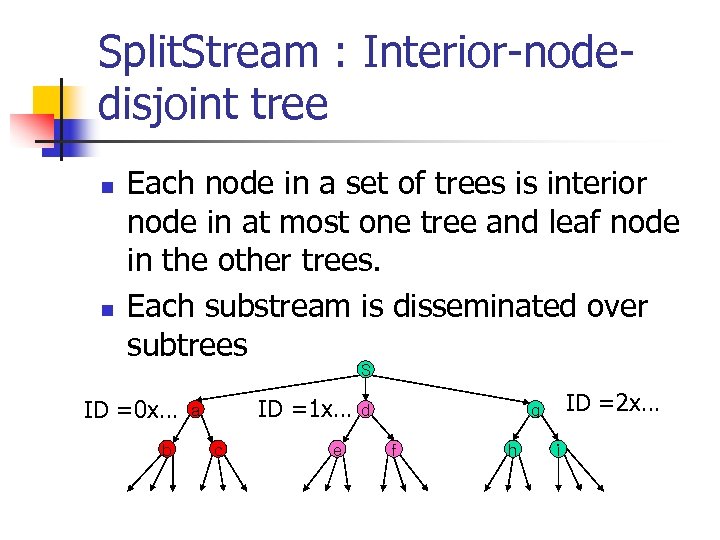 Split. Stream : Interior-nodedisjoint tree n n Each node in a set of trees is interior node in at most one tree and leaf node in the other trees. Each substream is disseminated over subtrees S ID =0 x… b ID =1 x… a c e d ID =2 x… g f h i
 Split. Stream : Constructing the forest n Each stream has its group. ID n n A subtree is formed by the routes from all members to the group. Id n n Each group. ID starts with a different digit The node. Ids of all interior nodes share some number of starting digits with the subtree’s group. Id. All nodes have incoming capacity requirements (number of stripes they need) and outgoing capacity limits
 Bullet n n Layers a mesh on top of an overlay tree to increase overall bandwidth Basic Idea n n n Use a tree as a basis In addition, each node continuously looks for peers to download from In effect, the overlay is a tree combined with a random network (mesh)
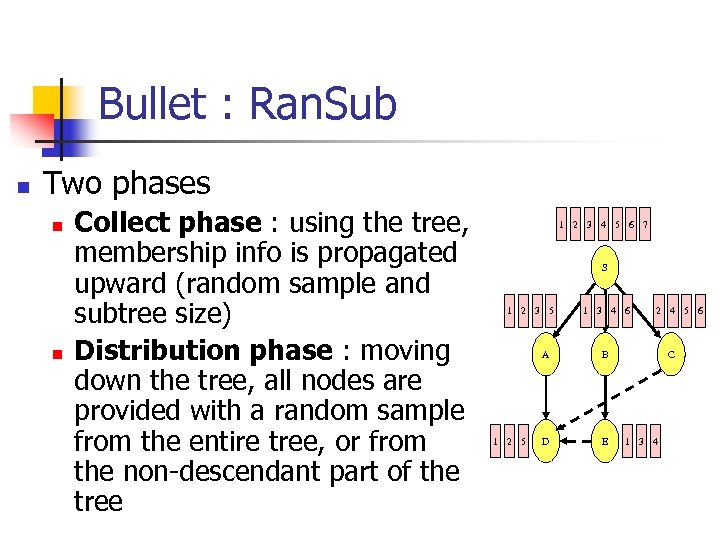 Bullet : Ran. Sub n Two phases n n Collect phase : using the tree, membership info is propagated upward (random sample and subtree size) Distribution phase : moving down the tree, all nodes are provided with a random sample from the entire tree, or from the non-descendant part of the tree 1 2 3 4 5 6 7 S 1 2 3 5 1 3 4 6 A 1 2 5 B D E 2 4 5 6 C 1 3 4
 Bullet : Informed content delivery n When selecting a peer, first a similarity measure is calculated n n Based on summary-sketches Before exchange missing packets need to be identified n n Bloom filter of available packets is exchanged Old packets are removed from the filter n n To keep the size of the set constant Periodically re-evaluate senders n If needed, senders are dropped and new ones are requested
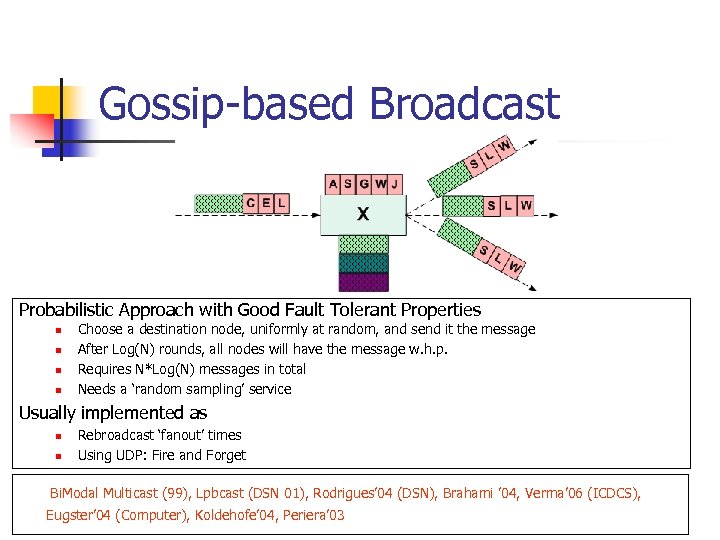 Gossip-based Broadcast Probabilistic Approach with Good Fault Tolerant Properties n n Choose a destination node, uniformly at random, and send it the message After Log(N) rounds, all nodes will have the message w. h. p. Requires N*Log(N) messages in total Needs a ‘random sampling’ service Usually implemented as n n Rebroadcast ‘fanout’ times Using UDP: Fire and Forget Bi. Modal Multicast (99), Lpbcast (DSN 01), Rodrigues’ 04 (DSN), Brahami ’ 04, Verma’ 06 (ICDCS), Eugster’ 04 (Computer), Koldehofe’ 04, Periera’ 03
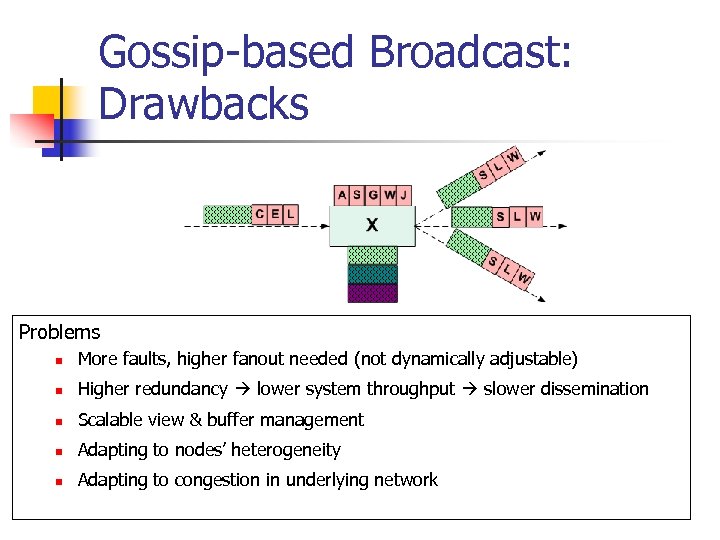 Gossip-based Broadcast: Drawbacks Problems n More faults, higher fanout needed (not dynamically adjustable) n Higher redundancy lower system throughput slower dissemination n Scalable view & buffer management n Adapting to nodes’ heterogeneity n Adapting to congestion in underlying network
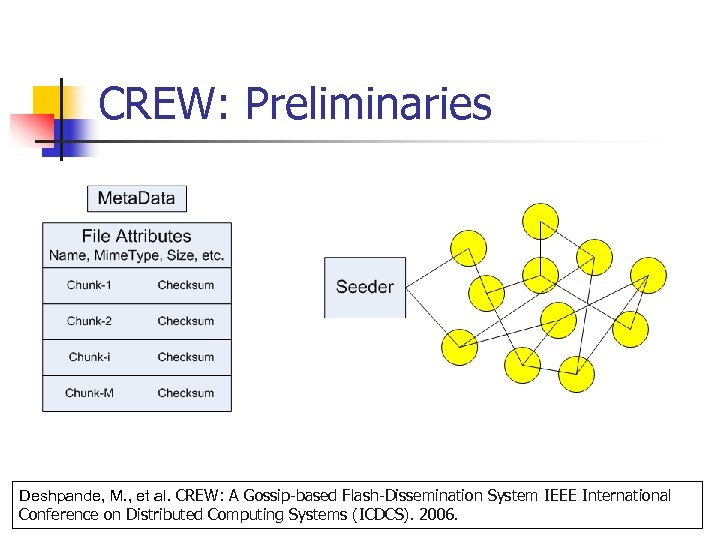 CREW: Preliminaries Deshpande, M. , et al. CREW: A Gossip-based Flash-Dissemination System IEEE International Conference on Distributed Computing Systems (ICDCS). 2006.
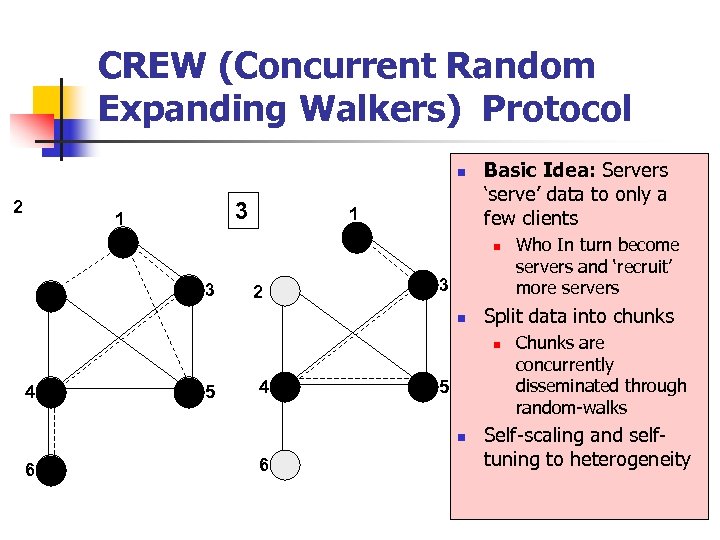 CREW (Concurrent Random Expanding Walkers) Protocol n 2 3 2 1 1 1 Basic Idea: Servers ‘serve’ data to only a few clients n 3 2 3 n Split data into chunks n 4 5 n 6 6 Who In turn become servers and ‘recruit’ more servers Chunks are concurrently disseminated through random-walks Self-scaling and selftuning to heterogeneity
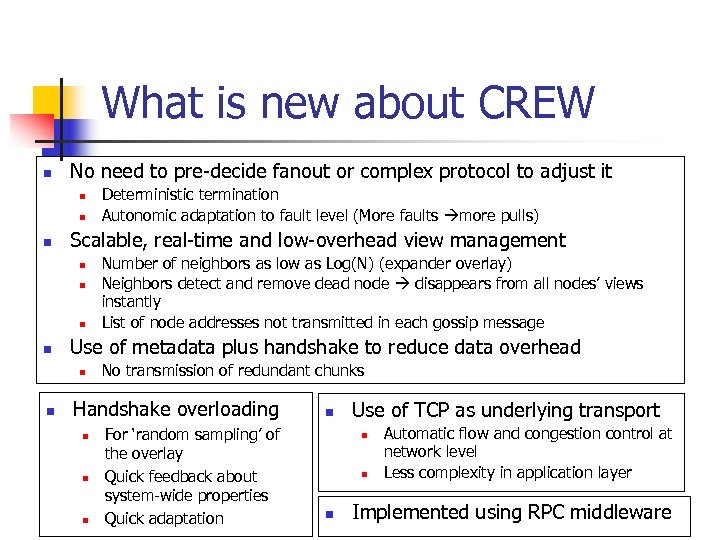 What is new about CREW n No need to pre-decide fanout or complex protocol to adjust it n n n Scalable, real-time and low-overhead view management n n Number of neighbors as low as Log(N) (expander overlay) Neighbors detect and remove dead node disappears from all nodes’ views instantly List of node addresses not transmitted in each gossip message Use of metadata plus handshake to reduce data overhead n n Deterministic termination Autonomic adaptation to fault level (More faults more pulls) No transmission of redundant chunks Handshake overloading n n n For ‘random sampling’ of the overlay Quick feedback about system-wide properties Quick adaptation n Use of TCP as underlying transport n n n Automatic flow and congestion control at network level Less complexity in application layer Implemented using RPC middleware
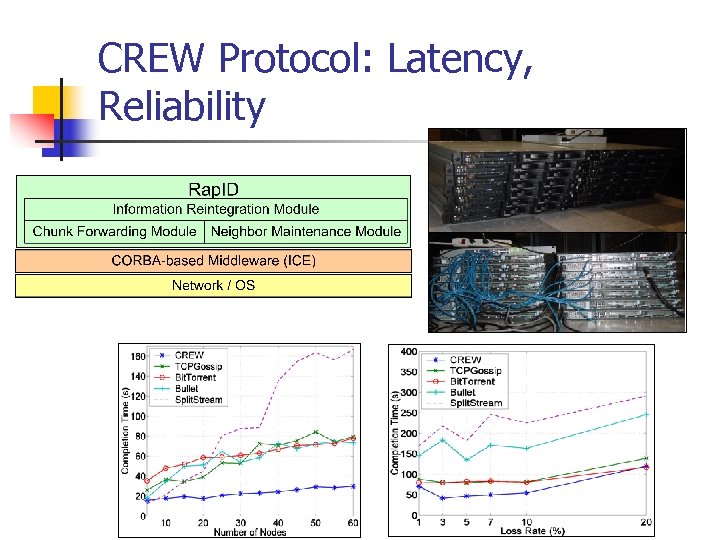 CREW Protocol: Latency, Reliability
 EXTRA SLIDES
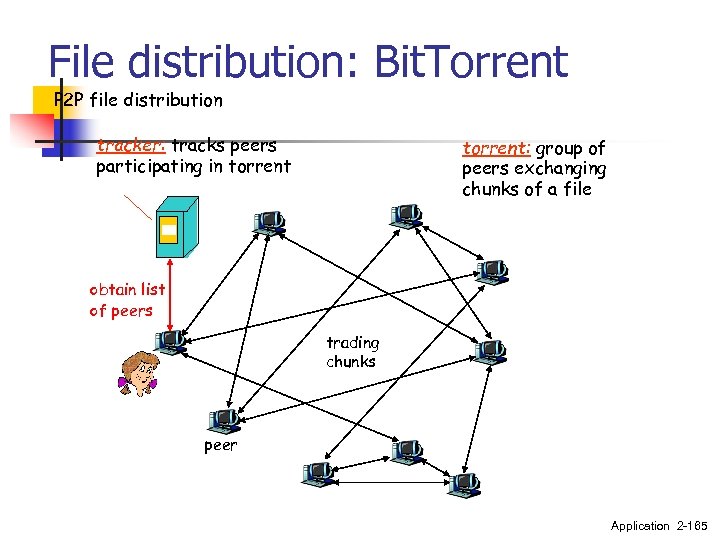 File distribution: Bit. Torrent P 2 P file distribution tracker: tracks peers participating in torrent: group of peers exchanging chunks of a file obtain list of peers trading chunks peer Application 2 -165
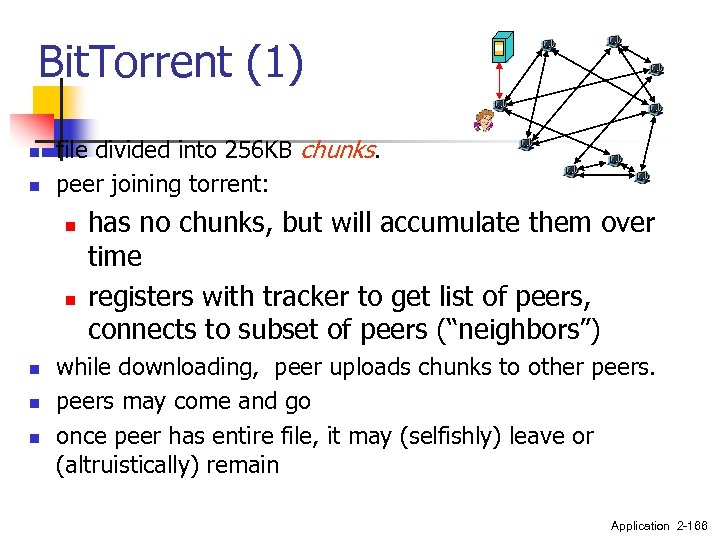 Bit. Torrent (1) n n file divided into 256 KB chunks. peer joining torrent: n n n has no chunks, but will accumulate them over time registers with tracker to get list of peers, connects to subset of peers (“neighbors”) while downloading, peer uploads chunks to other peers may come and go once peer has entire file, it may (selfishly) leave or (altruistically) remain Application 2 -166
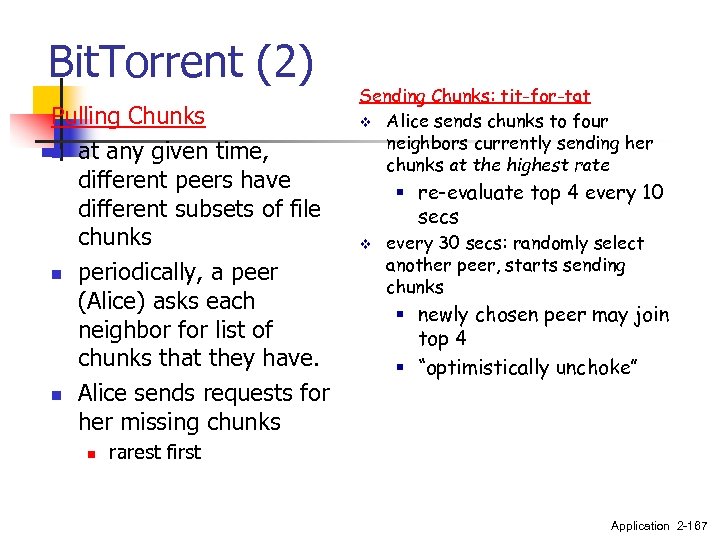 Bit. Torrent (2) Pulling Chunks n at any given time, different peers have different subsets of file chunks n periodically, a peer (Alice) asks each neighbor for list of chunks that they have. n Alice sends requests for her missing chunks n Sending Chunks: tit-for-tat v Alice sends chunks to four neighbors currently sending her chunks at the highest rate § re-evaluate top 4 every 10 secs v every 30 secs: randomly select another peer, starts sending chunks § newly chosen peer may join top 4 § “optimistically unchoke” rarest first Application 2 -167
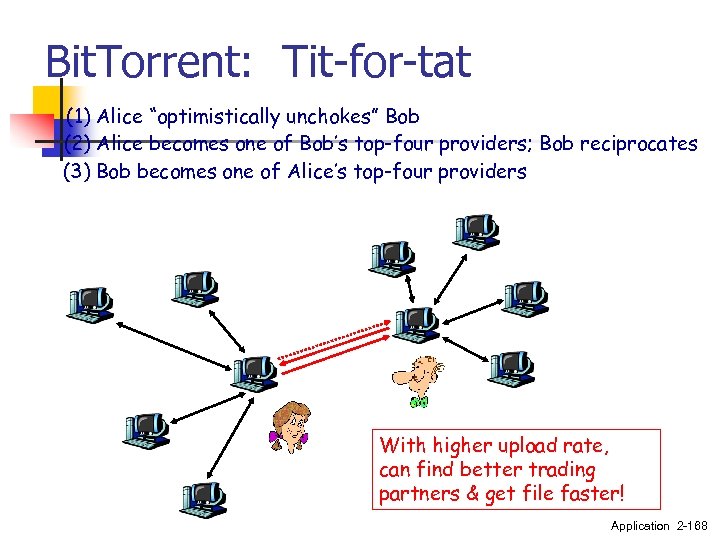 Bit. Torrent: Tit-for-tat (1) Alice “optimistically unchokes” Bob (2) Alice becomes one of Bob’s top-four providers; Bob reciprocates (3) Bob becomes one of Alice’s top-four providers With higher upload rate, can find better trading partners & get file faster! Application 2 -168
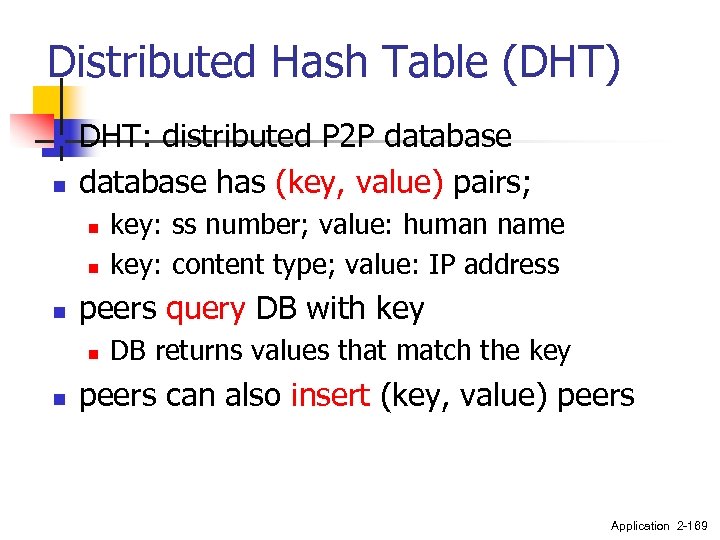 Distributed Hash Table (DHT) n n DHT: distributed P 2 P database has (key, value) pairs; n n n peers query DB with key n n key: ss number; value: human name key: content type; value: IP address DB returns values that match the key peers can also insert (key, value) peers Application 2 -169
![DHT Identifiers n assign integer identifier to each peer in range [0, 2 n-1].](https://present5.com/presentation/e559b85a2809cc5f4dee7b6efae727e7/image-169.jpg "DHT Identifiers n assign integer identifier to each peer in range [0, 2 n-1].") DHT Identifiers n assign integer identifier to each peer in range [0, 2 n-1]. n n n Each identifier can be represented by n bits. require each key to be an integer in same range. to get integer keys, hash original key. n n e. g. , key = h(“Led Zeppelin IV”) this is why they call it a distributed “hash” table Application 2 -170
DHT Identifiers n assign integer identifier to each peer in range [0, 2 n-1]. n n n Each identifier can be represented by n bits. require each key to be an integer in same range. to get integer keys, hash original key. n n e. g. , key = h(“Led Zeppelin IV”) this is why they call it a distributed “hash” table Application 2 -170
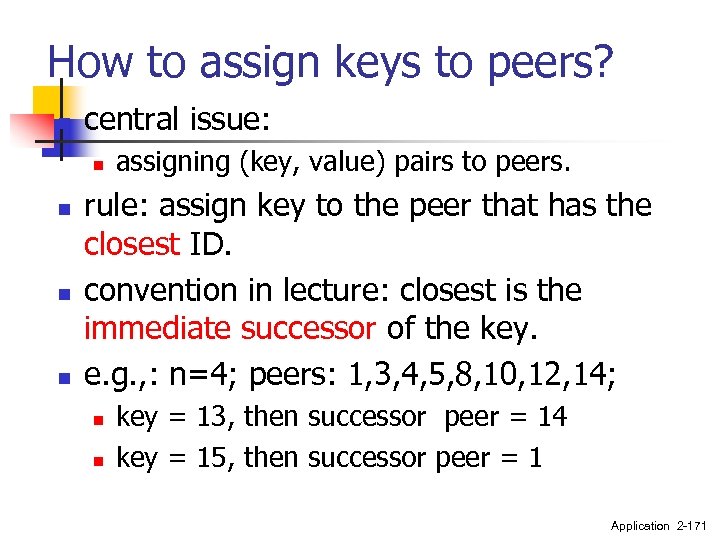 How to assign keys to peers? n central issue: n n assigning (key, value) pairs to peers. rule: assign key to the peer that has the closest ID. convention in lecture: closest is the immediate successor of the key. e. g. , : n=4; peers: 1, 3, 4, 5, 8, 10, 12, 14; n n key = 13, then successor peer = 14 key = 15, then successor peer = 1 Application 2 -171
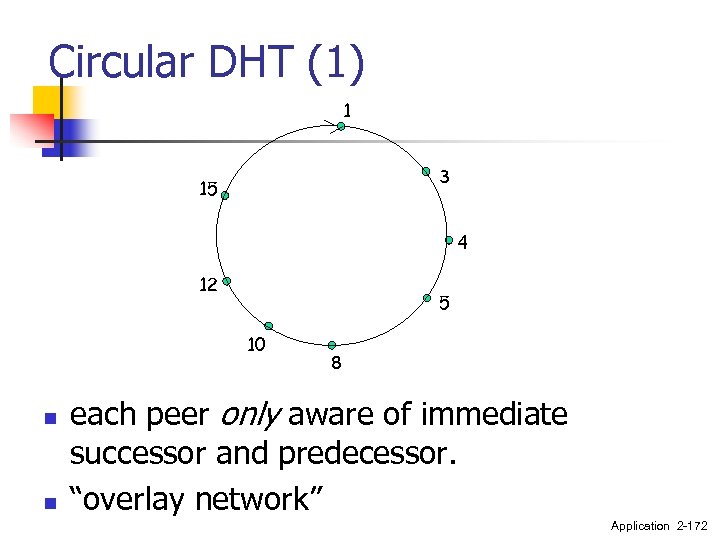 Circular DHT (1) 1 3 15 4 12 5 10 n n 8 each peer only aware of immediate successor and predecessor. “overlay network” Application 2 -172
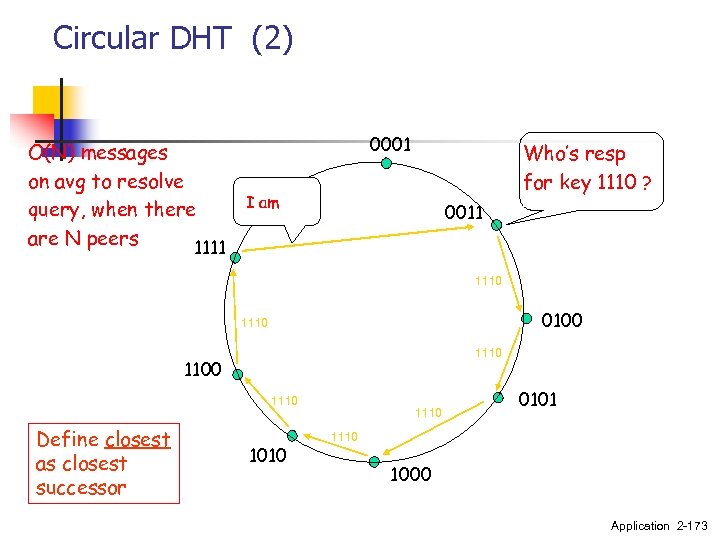 Circular DHT (2) O(N) messages on avg to resolve query, when there are N peers 1111 0001 Who’s resp for key 1110 ? I am 0011 1110 0100 1110 1100 1110 Define closest as closest successor 1010 1110 0101 1110 1000 Application 2 -173
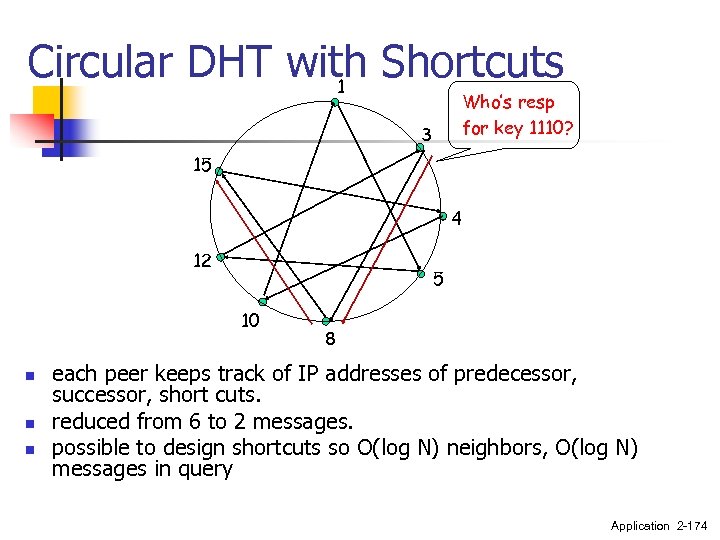 Circular DHT with Shortcuts 1 Who’s resp for key 1110? 3 15 4 12 5 10 n n n 8 each peer keeps track of IP addresses of predecessor, successor, short cuts. reduced from 6 to 2 messages. possible to design shortcuts so O(log N) neighbors, O(log N) messages in query Application 2 -174
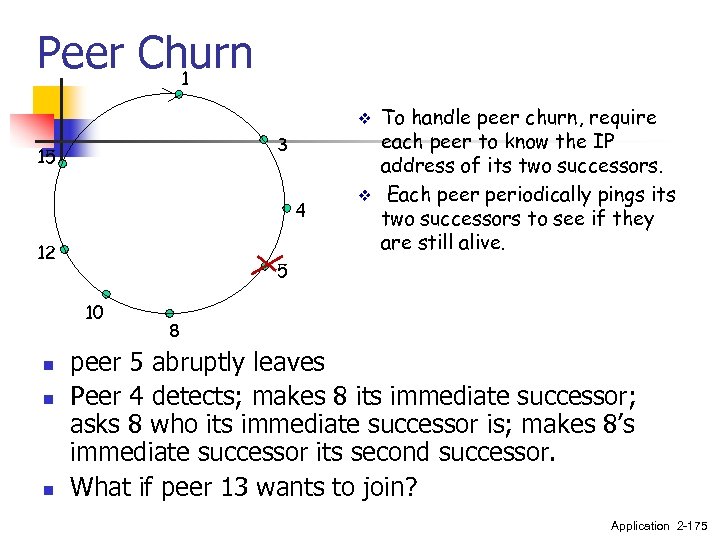 Peer Churn 1 v 3 15 4 12 5 10 n n n v To handle peer churn, require each peer to know the IP address of its two successors. Each peer periodically pings its two successors to see if they are still alive. 8 peer 5 abruptly leaves Peer 4 detects; makes 8 its immediate successor; asks 8 who its immediate successor is; makes 8’s immediate successor its second successor. What if peer 13 wants to join? Application 2 -175
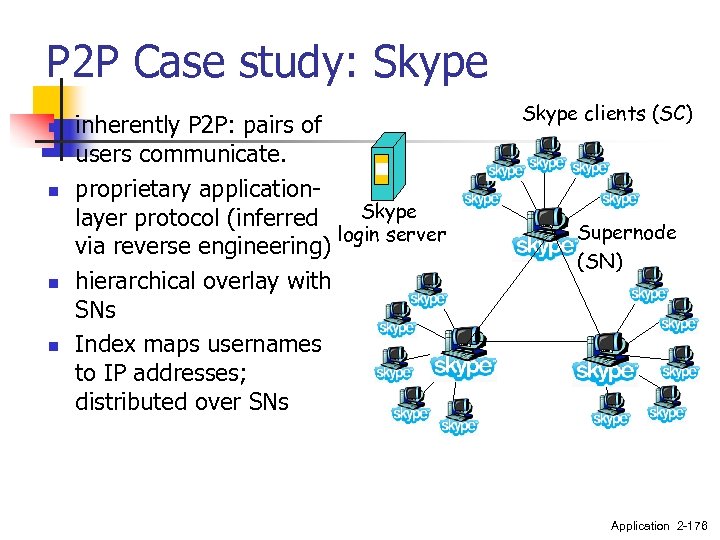 P 2 P Case study: Skype n n inherently P 2 P: pairs of users communicate. proprietary applicationlayer protocol (inferred Skype login server via reverse engineering) hierarchical overlay with SNs Index maps usernames to IP addresses; distributed over SNs Skype clients (SC) Supernode (SN) Application 2 -176
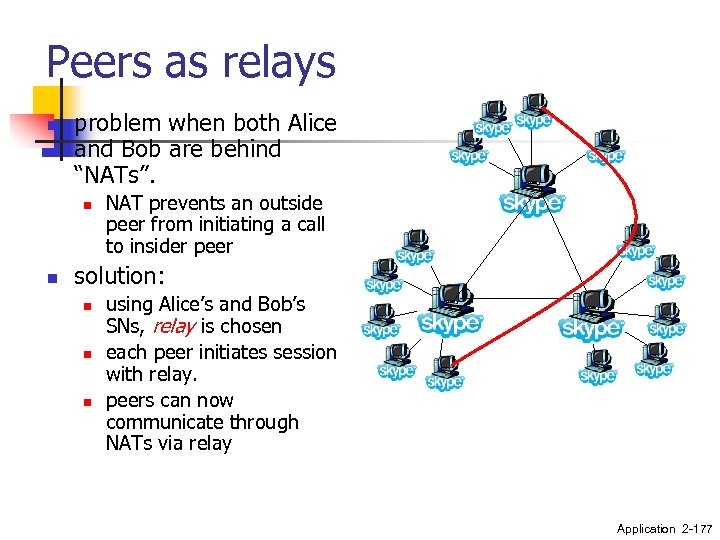 Peers as relays n problem when both Alice and Bob are behind “NATs”. n n NAT prevents an outside peer from initiating a call to insider peer solution: n n n using Alice’s and Bob’s SNs, relay is chosen each peer initiates session with relay. peers can now communicate through NATs via relay Application 2 -177