 Скачать презентацию CS 194 Distributed Systems Final Review Scott Shenker
5d093d95f00b03b63edf3e29157ffe72.ppt
- Количество слайдов: 73



CS 194: Distributed Systems Final Review Scott Shenker and Ion Stoica Computer Science Division Department of Electrical Engineering and Computer Sciences University of California, Berkeley, CA 94720 -1776 1
During this Class… § Learn the basics of distributed systems § Two parts: § First part: traditional distributed system theory - Algorithms and protocols to implement basic services § Second part: examples of distributed systems - Illustrate the context in which classic algorithms/protocols are used - Discuss the non-traditional distributed systems 2
Traditional Distributed Systems Theory § Deal with implementing services required to build such systems - Usually strong assumptions and semantics 3
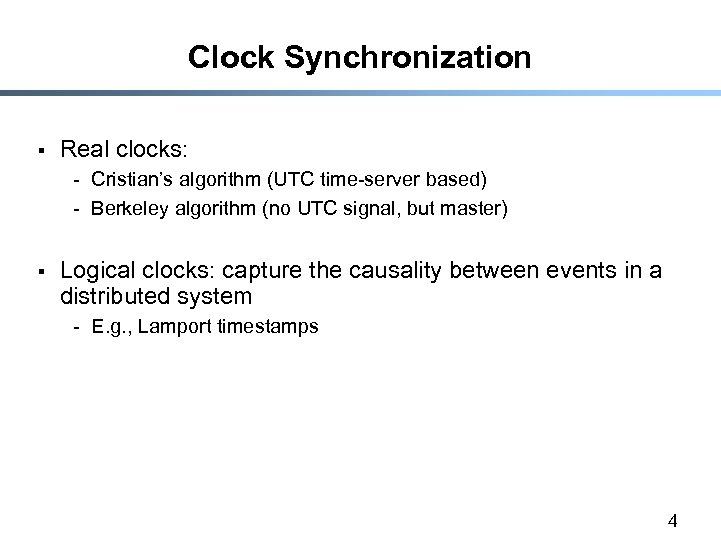
Clock Synchronization § Real clocks: - Cristian’s algorithm (UTC time-server based) - Berkeley algorithm (no UTC signal, but master) § Logical clocks: capture the causality between events in a distributed system - E. g. , Lamport timestamps 4
Elections § Need to select a special node, that all other nodes agree on § Assume all nodes have unique ID § Example methods for picking node with highest ID - Bully algorithm - Gossip method 5
Exclusion § Ensuring that a critical resource is accessed by no more than one process at the same time § Methods: - Centralized coordinator: ask, get permission, release - Distributed coordinator: treat all nodes as coordinator • If two nodes are competing, timestamps resolve conflict - Interlocking permission sets: Every node I asks permission from set P[I], where P[I] and P[J] always have nonempty intersections 6
Concurrency Control § Want to allow several transactions to be in progress § But the result must be the same as some sequential order of transactions § Use locking policies: - § Grab and hold Grab and unlock when not needed Lock when first needed, unlock when done Two-phase locking Which policies can have deadlock? 7
Agreement § How do two or more processes reach agreement? § Two-Army Problem - Assumptions • Processes are correct • Adversary can intercept messages - No solution § Byzantine agreement - Assumptions: • Processes subject to arbitrary failures • Messages delivery is correct, and bounded - Solution: In a system with m faulty processes agreement can be achieved only if there are 2 m+1 functioning correctly 8
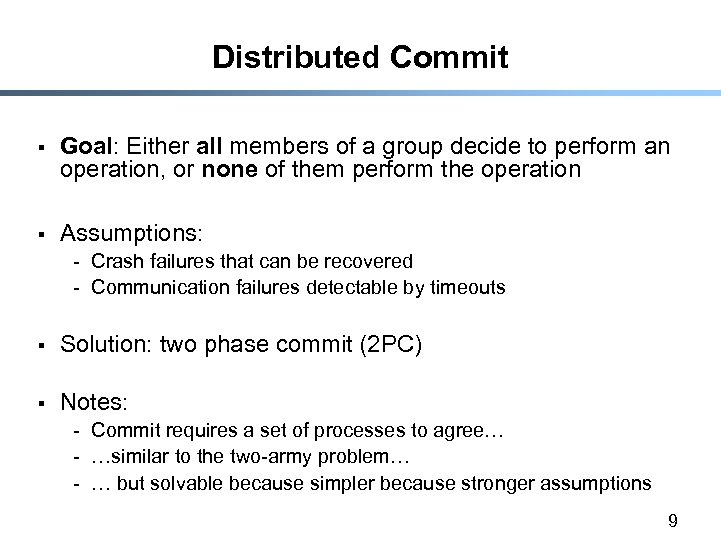
Distributed Commit § Goal: Either all members of a group decide to perform an operation, or none of them perform the operation § Assumptions: - Crash failures that can be recovered - Communication failures detectable by timeouts § Solution: two phase commit (2 PC) § Notes: - Commit requires a set of processes to agree… - …similar to the two-army problem… - … but solvable because simpler because stronger assumptions 9
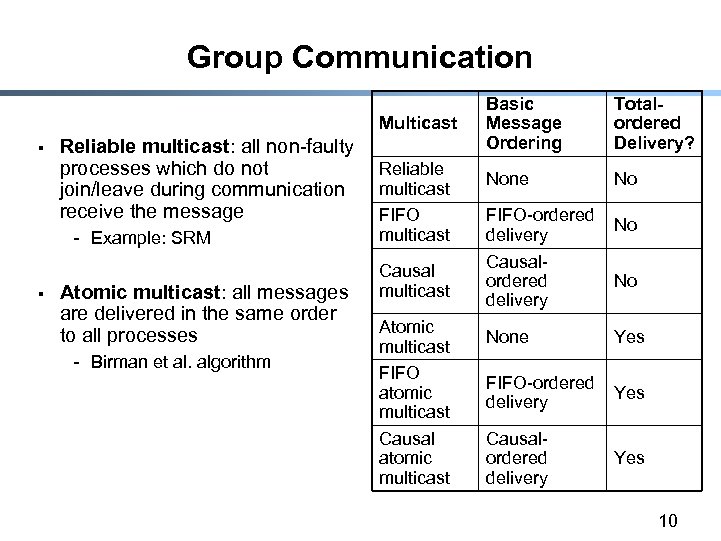
Group Communication Multicast § Reliable multicast: all non-faulty processes which do not join/leave during communication receive the message - Example: SRM § Atomic multicast: all messages are delivered in the same order to all processes - Birman et al. algorithm Reliable multicast FIFO multicast Causal multicast Atomic multicast FIFO atomic multicast Causal atomic multicast Basic Message Ordering Totalordered Delivery? None No FIFO-ordered delivery Causalordered delivery No No None Yes FIFO-ordered delivery Yes Causalordered delivery Yes 10
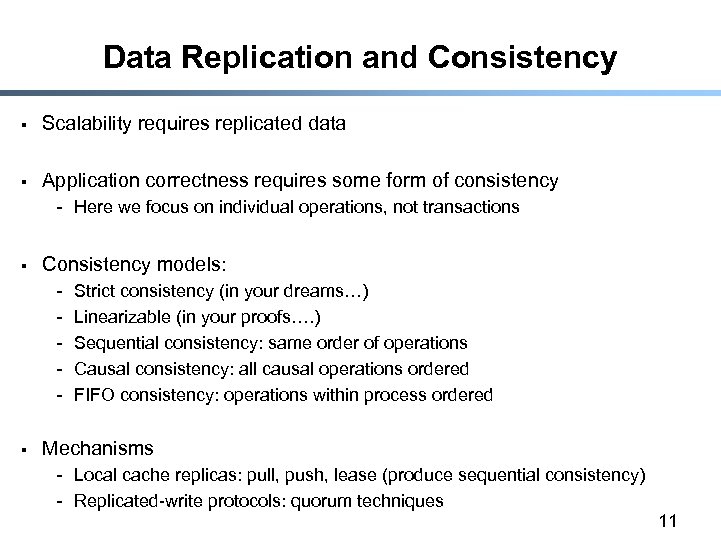
Data Replication and Consistency § Scalability requires replicated data § Application correctness requires some form of consistency - Here we focus on individual operations, not transactions § Consistency models: - § Strict consistency (in your dreams…) Linearizable (in your proofs…. ) Sequential consistency: same order of operations Causal consistency: all causal operations ordered FIFO consistency: operations within process ordered Mechanisms - Local cache replicas: pull, push, lease (produce sequential consistency) - Replicated-write protocols: quorum techniques 11
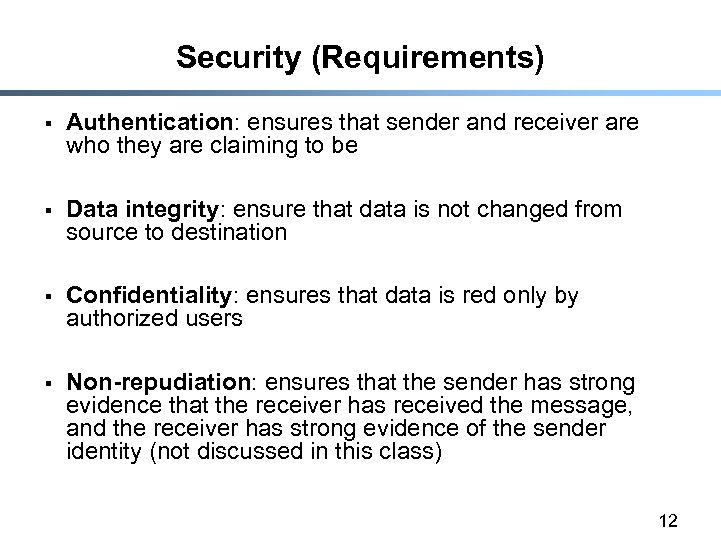
Security (Requirements) § Authentication: ensures that sender and receiver are who they are claiming to be § Data integrity: ensure that data is not changed from source to destination § Confidentiality: ensures that data is red only by authorized users § Non-repudiation: ensures that the sender has strong evidence that the receiver has received the message, and the receiver has strong evidence of the sender identity (not discussed in this class) 12
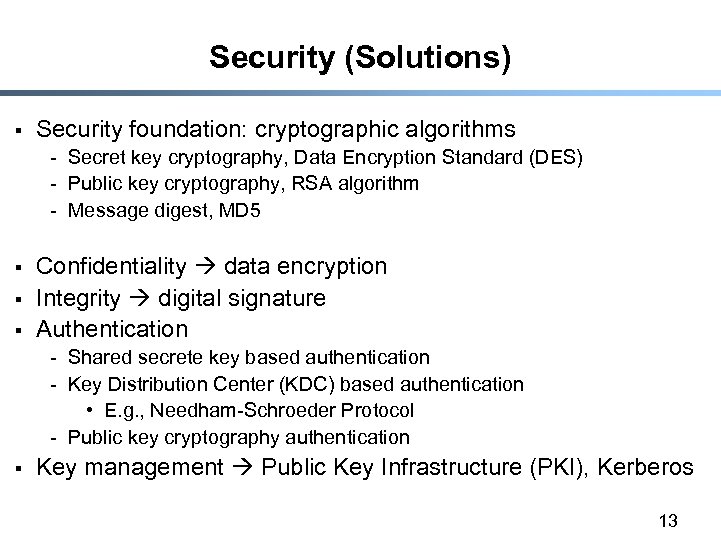
Security (Solutions) § Security foundation: cryptographic algorithms - Secret key cryptography, Data Encryption Standard (DES) - Public key cryptography, RSA algorithm - Message digest, MD 5 § § § Confidentiality data encryption Integrity digital signature Authentication - Shared secrete key based authentication - Key Distribution Center (KDC) based authentication • E. g. , Needham-Schroeder Protocol - Public key cryptography authentication § Key management Public Key Infrastructure (PKI), Kerberos 13
Final Exam Information § Date, time: May 19, 12: 30 -3: 30 pm § Final will include midterm material (1/3), but emphasize on second part (2/3) - This lecture reviews mainly the second part material - See midterm review for first part material! § We’ll post a practice exam by the end of this week § Closed books; 8, 5”x 11” crib sheet (both sides) No calculators, PDAs, cell phones with cameras, etc Please use PENCIL and ERASER § § 14
Outline Ø § § § Distributed File Systems Distributed Object-based Systems Coordination Systems Web 15
Distributed File Systems § Provide a client transparent access to files stored at a remote server § Why would you want to store files remotely? - Sharing files - Reliability - Manageability 16
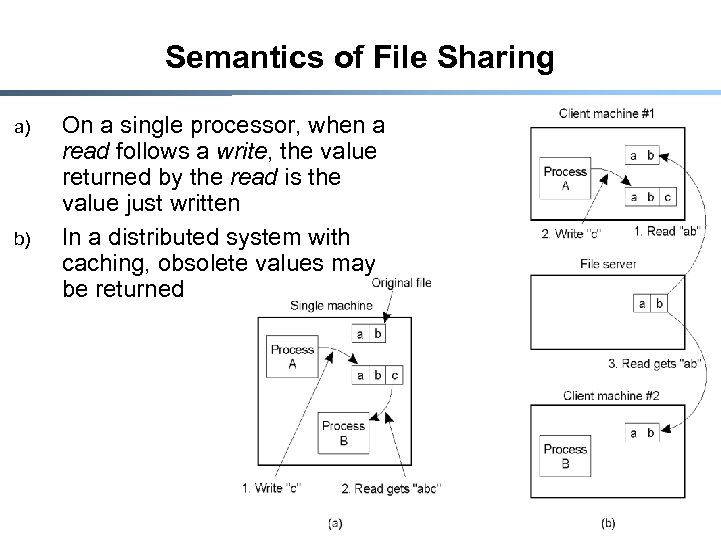
Semantics of File Sharing a) b) On a single processor, when a read follows a write, the value returned by the read is the value just written In a distributed system with caching, obsolete values may be returned 17
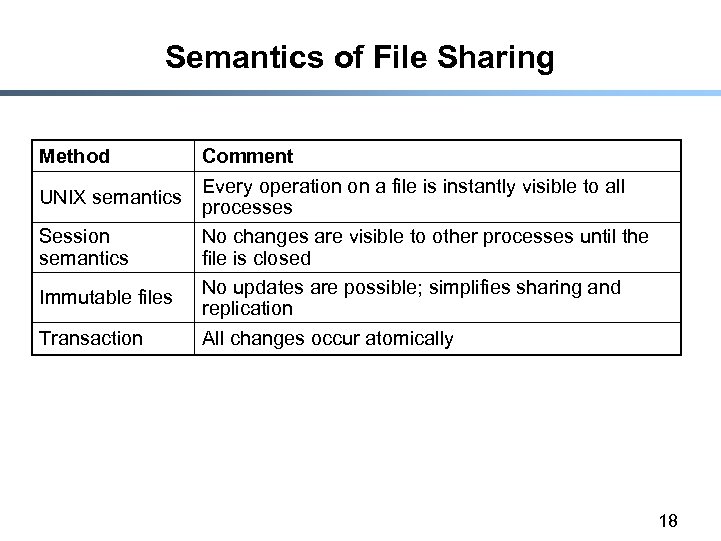
Semantics of File Sharing Method UNIX semantics Session semantics Immutable files Transaction Comment Every operation on a file is instantly visible to all processes No changes are visible to other processes until the file is closed No updates are possible; simplifies sharing and replication All changes occur atomically 18
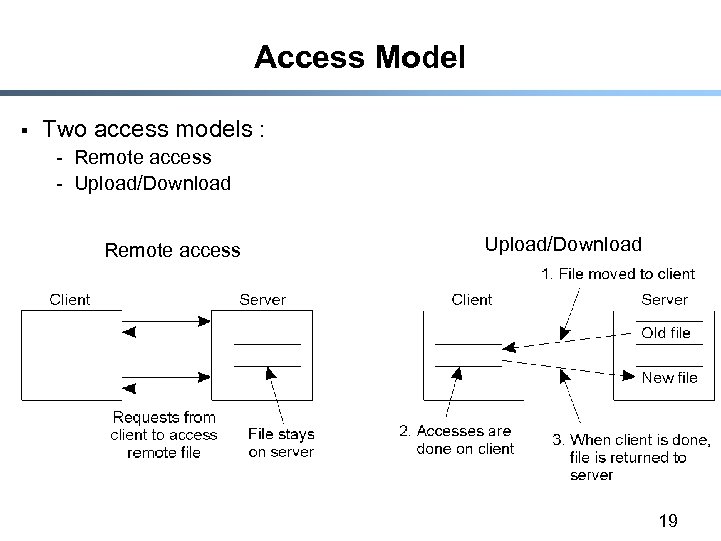
Access Model § Two access models : - Remote access - Upload/Download Remote access Upload/Download 19
Stateful vs. Stateless § Stateless model: each call contains complete information to execute operation § Stateful model: server maintain context (info) shared by consecutive operations § Discussion: compare stateless and stateful design 20
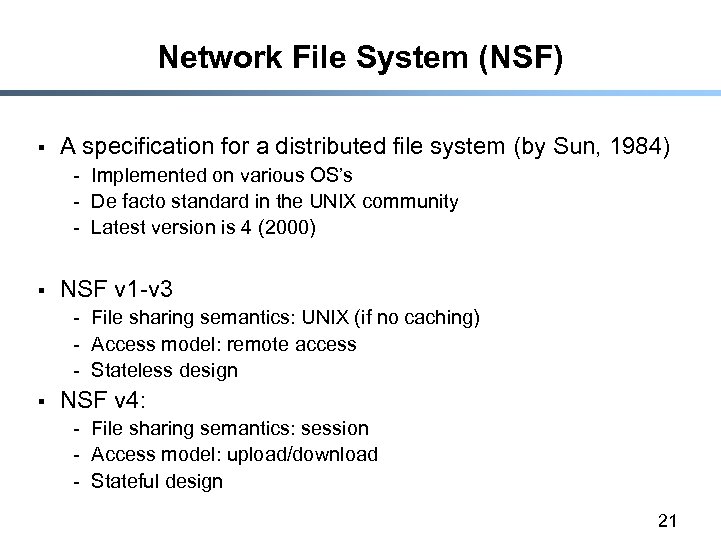
Network File System (NSF) § A specification for a distributed file system (by Sun, 1984) - Implemented on various OS’s - De facto standard in the UNIX community - Latest version is 4 (2000) § NSF v 1 -v 3 - File sharing semantics: UNIX (if no caching) - Access model: remote access - Stateless design § NSF v 4: - File sharing semantics: session - Access model: upload/download - Stateful design 21
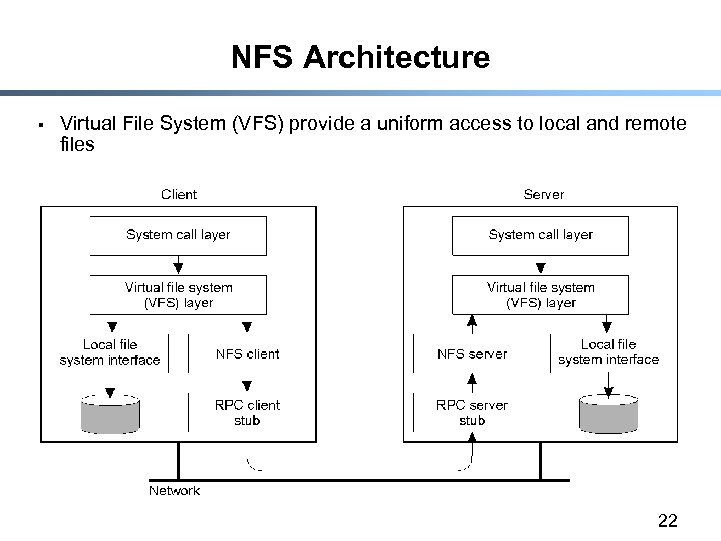
NFS Architecture § Virtual File System (VFS) provide a uniform access to local and remote files 22
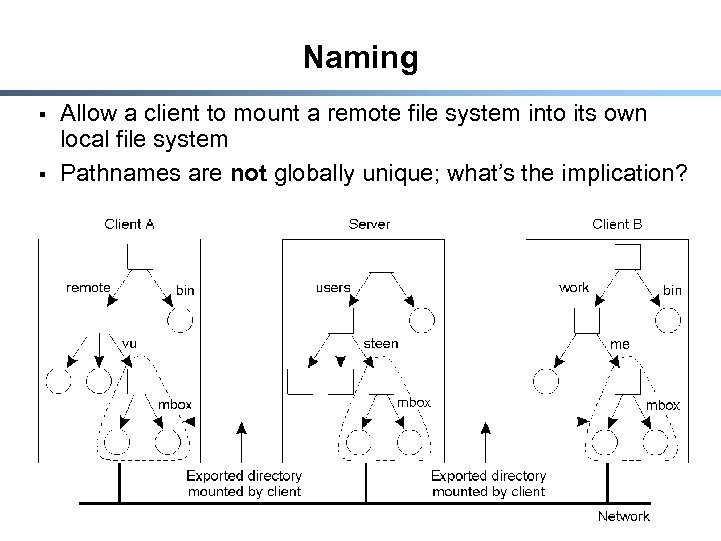
Naming § § Allow a client to mount a remote file system into its own local file system Pathnames are not globally unique; what’s the implication? 23
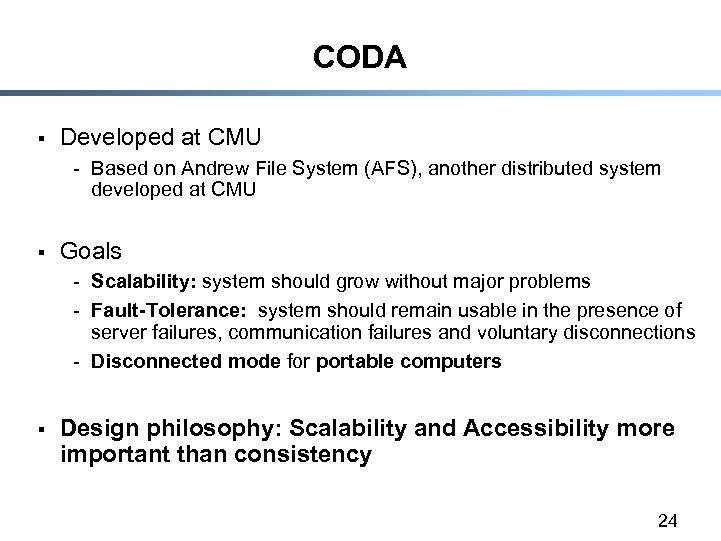
CODA § Developed at CMU - Based on Andrew File System (AFS), another distributed system developed at CMU § Goals - Scalability: system should grow without major problems - Fault-Tolerance: system should remain usable in the presence of server failures, communication failures and voluntary disconnections - Disconnected mode for portable computers § Design philosophy: Scalability and Accessibility more important than consistency 24
CODA § Sharing model: transaction - Session viewed as a transaction § Access model: upload/download 25
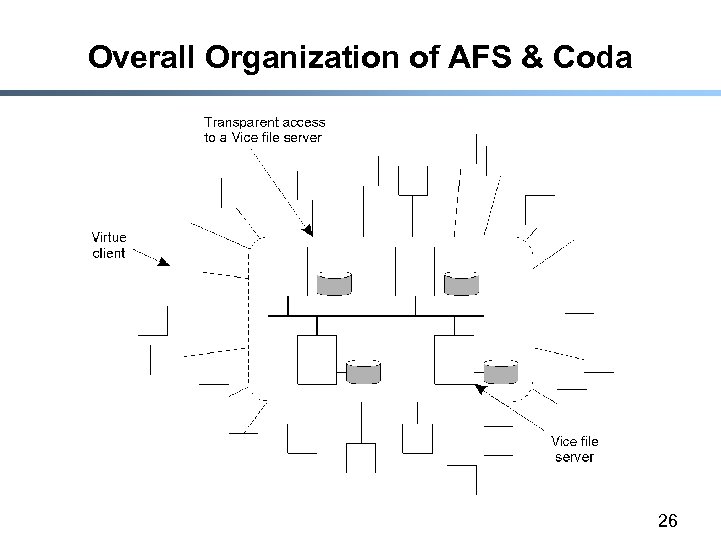
Overall Organization of AFS & Coda 26
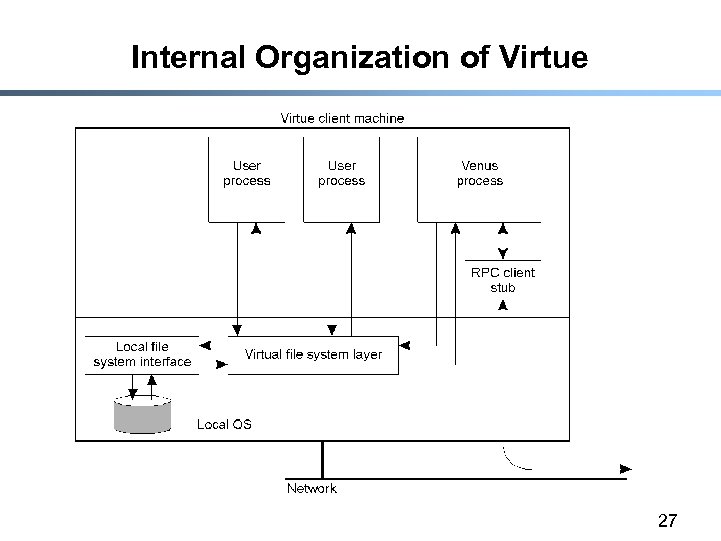
Internal Organization of Virtue 27
Communication § Based on RPC 2: provides reliable transmission on top of UDP § RPC 2 supports side-effects, i. e. , user defined protocols § RPC 2 provides support for multicast - Transparent for the client 28
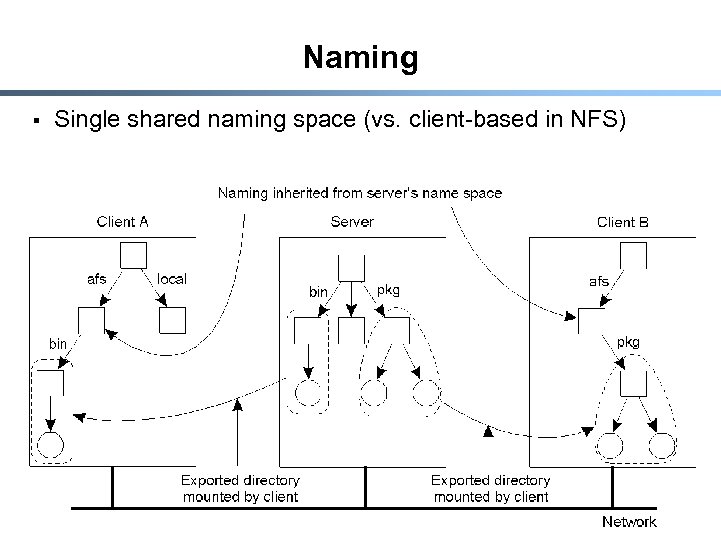
Naming § Single shared naming space (vs. client-based in NFS) 29
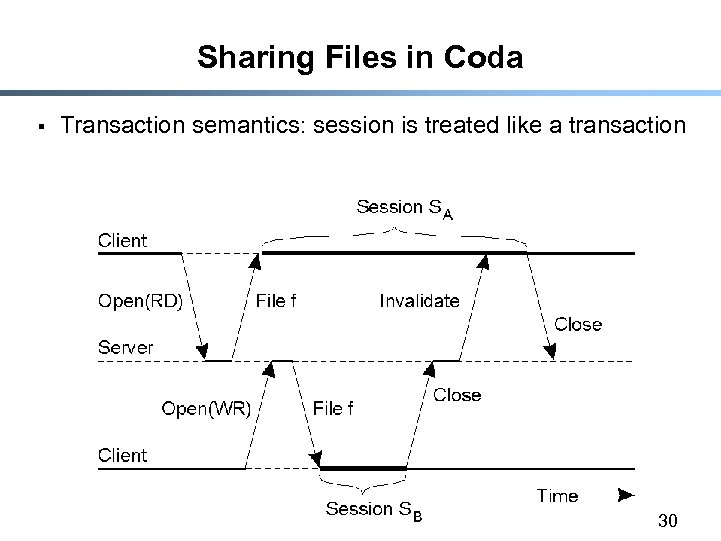
Sharing Files in Coda § Transaction semantics: session is treated like a transaction 30
![Handling Network Partition § § Versioning vector when partition happens: [1, 1, 1] Client](https://present5.com/presentation/5d093d95f00b03b63edf3e29157ffe72/image-31.jpg "Handling Network Partition § § Versioning vector when partition happens: [1, 1, 1] Client")
Handling Network Partition § § Versioning vector when partition happens: [1, 1, 1] Client A updates file versioning vector in its partition: [2, 2, 1] Client B updates file versioning vector in its partition: [1, 1, 2] Partition repaired compare versioning vectors: conflict! 31
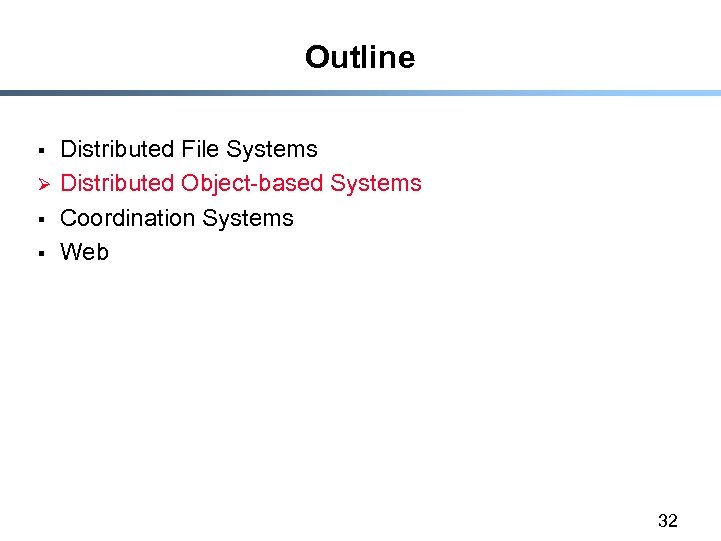
Outline § Ø § § Distributed File Systems Distributed Object-based Systems Coordination Systems Web 32
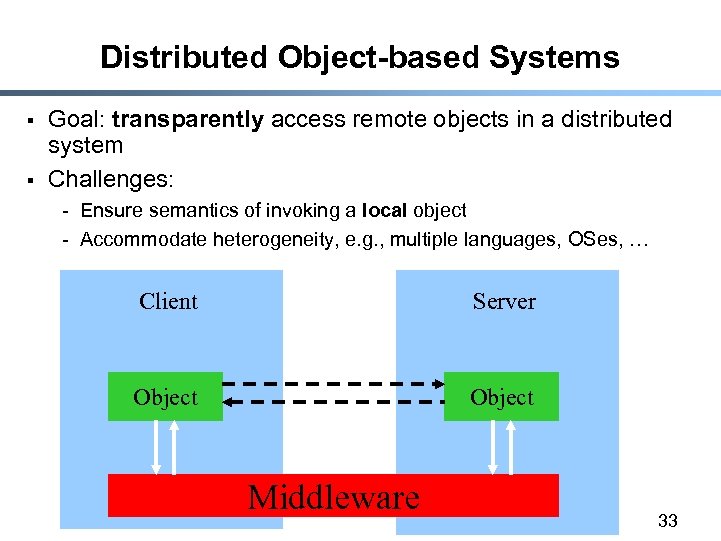
Distributed Object-based Systems § § Goal: transparently access remote objects in a distributed system Challenges: - Ensure semantics of invoking a local object - Accommodate heterogeneity, e. g. , multiple languages, OSes, … Client Server Object Middleware 33
Two Examples § Common Object Request Broker Architecture (CORBA) - International standard: multiple languages, OSes, vendors § Distributed Common Object Model (DCOM) - MS standard: only MS OSes 34
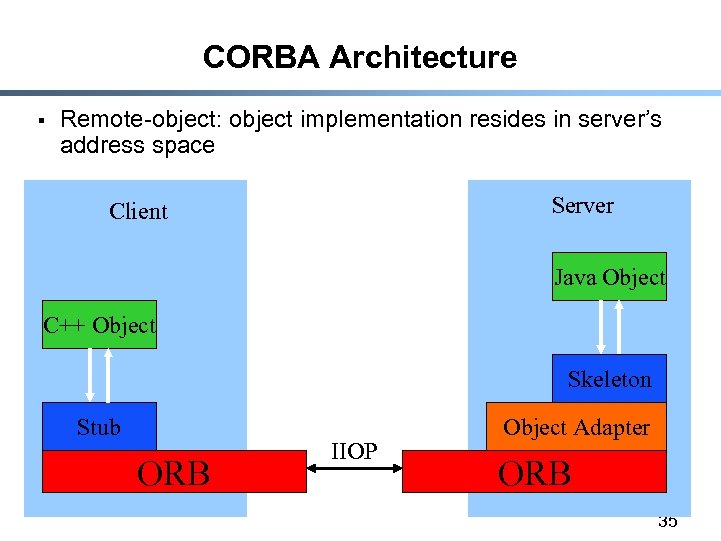
CORBA Architecture § Remote-object: object implementation resides in server’s address space Server Client Java Object C++ Object Skeleton Stub ORB IIOP Object Adapter ORB 35
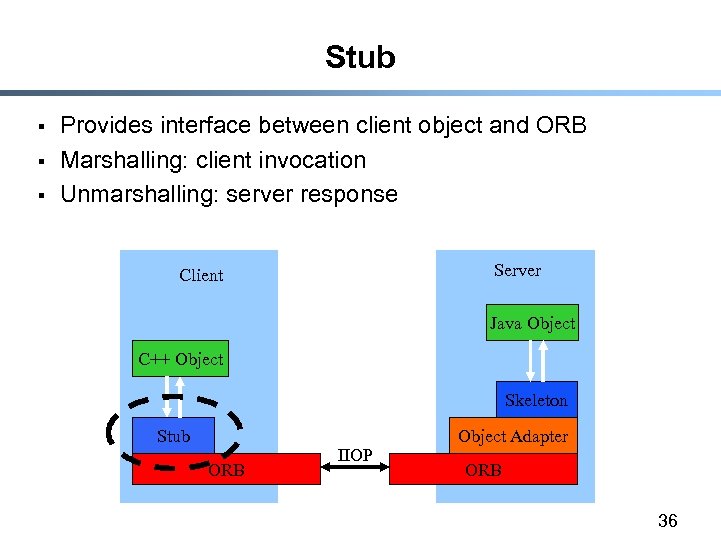
Stub § § § Provides interface between client object and ORB Marshalling: client invocation Unmarshalling: server response Server Client Java Object C++ Object Skeleton Stub ORB IIOP Object Adapter ORB 36
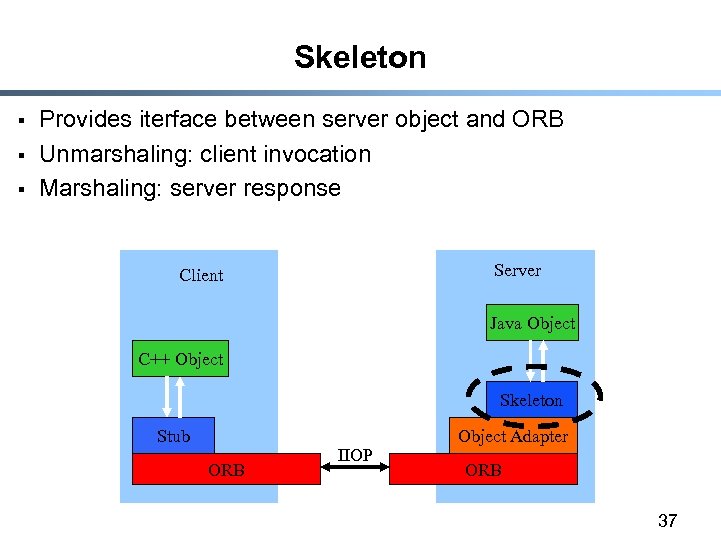
Skeleton § § § Provides iterface between server object and ORB Unmarshaling: client invocation Marshaling: server response Server Client Java Object C++ Object Skeleton Stub ORB IIOP Object Adapter ORB 37
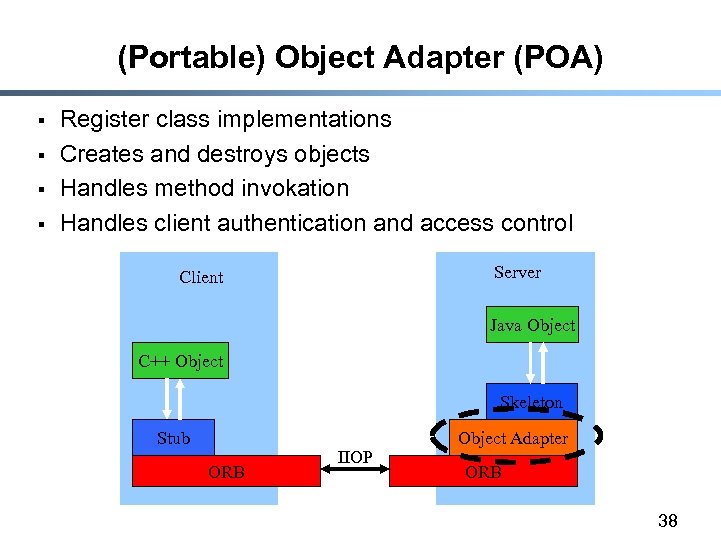
(Portable) Object Adapter (POA) § § Register class implementations Creates and destroys objects Handles method invokation Handles client authentication and access control Server Client Java Object C++ Object Skeleton Stub ORB IIOP Object Adapter ORB 38
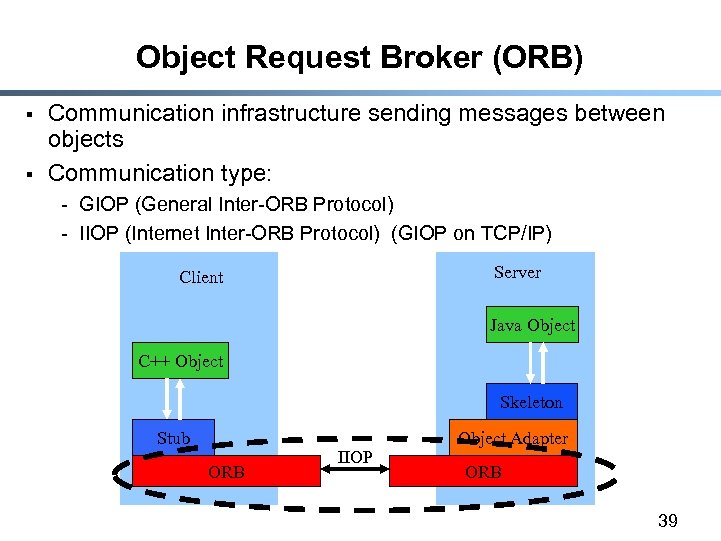
Object Request Broker (ORB) § § Communication infrastructure sending messages between objects Communication type: - GIOP (General Inter-ORB Protocol) - IIOP (Internet Inter-ORB Protocol) (GIOP on TCP/IP) Server Client Java Object C++ Object Skeleton Stub ORB IIOP Object Adapter ORB 39
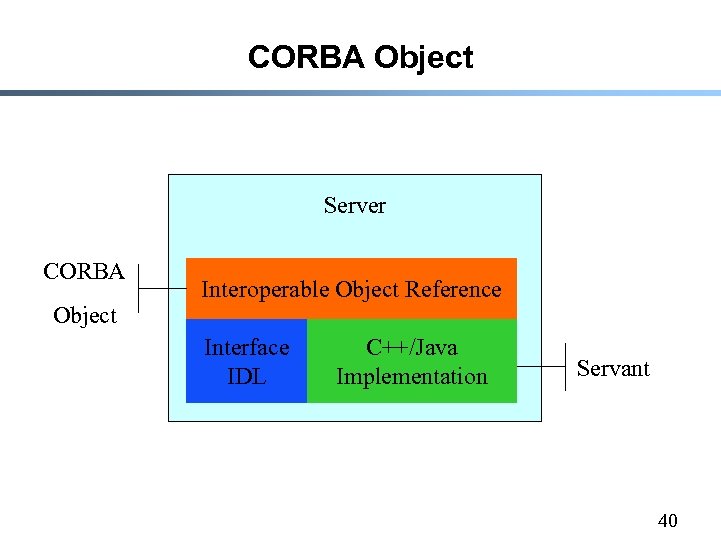
CORBA Object Server CORBA Object Interoperable Object Reference Interface IDL C++/Java Implementation Servant 40
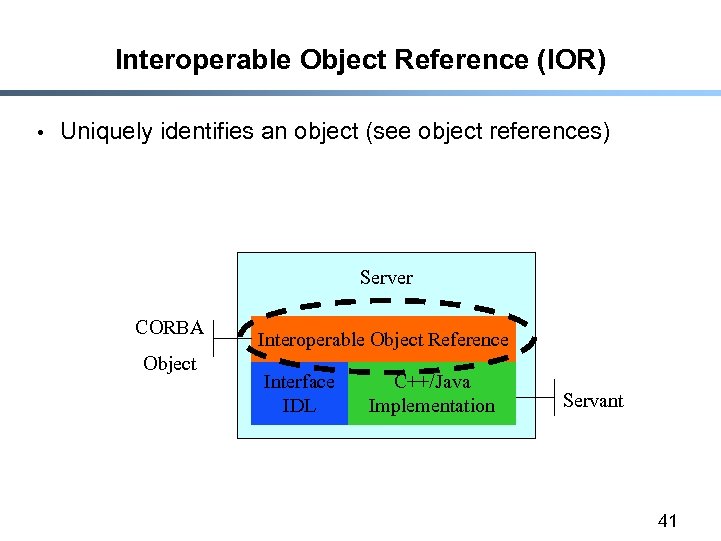
Interoperable Object Reference (IOR) • Uniquely identifies an object (see object references) Server CORBA Object Interoperable Object Reference Interface IDL C++/Java Implementation Servant 41
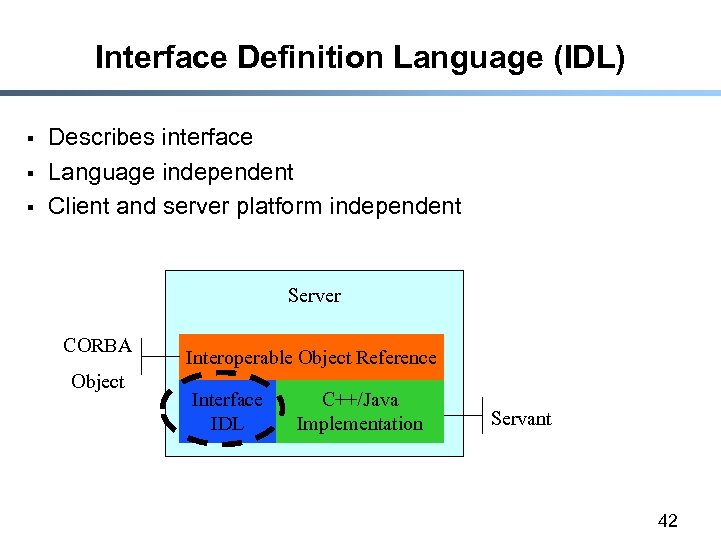
Interface Definition Language (IDL) § § § Describes interface Language independent Client and server platform independent Server CORBA Object Interoperable Object Reference Interface IDL C++/Java Implementation Servant 42
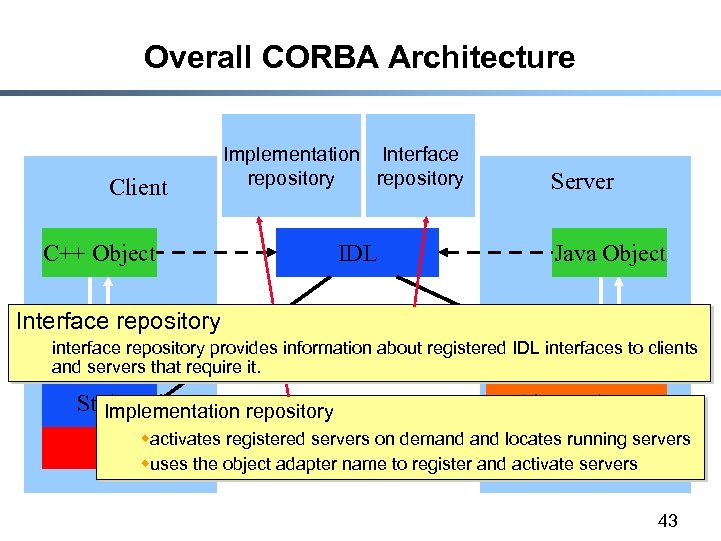
Overall CORBA Architecture Client C++ Object Implementation Interface repository IDL Server Java Object Interface repository interface repository provides information about registered IDL interfaces to clients Skeleton and servers that require it. Stub Object Adapter Implementation repository IIOP wactivates registered servers on demand locates running servers ORB object adapter name to register and activate servers ORB wuses the 43
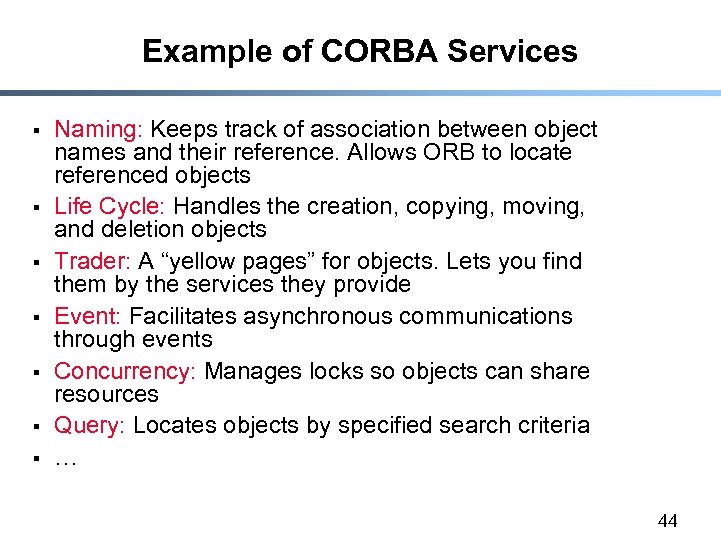
Example of CORBA Services § § § § Naming: Keeps track of association between object names and their reference. Allows ORB to locate referenced objects Life Cycle: Handles the creation, copying, moving, and deletion objects Trader: A “yellow pages” for objects. Lets you find them by the services they provide Event: Facilitates asynchronous communications through events Concurrency: Manages locks so objects can share resources Query: Locates objects by specified search criteria … 44
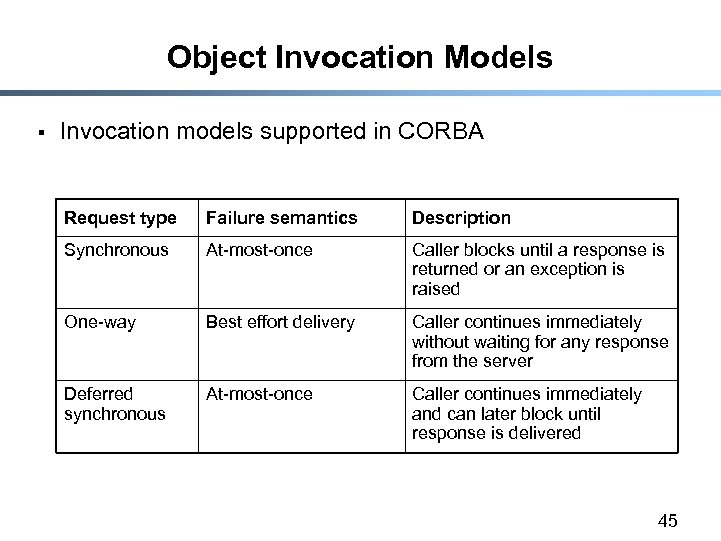
Object Invocation Models § Invocation models supported in CORBA Request type Failure semantics Description Synchronous At-most-once Caller blocks until a response is returned or an exception is raised One-way Best effort delivery Caller continues immediately without waiting for any response from the server Deferred synchronous At-most-once Caller continues immediately and can later block until response is delivered 45
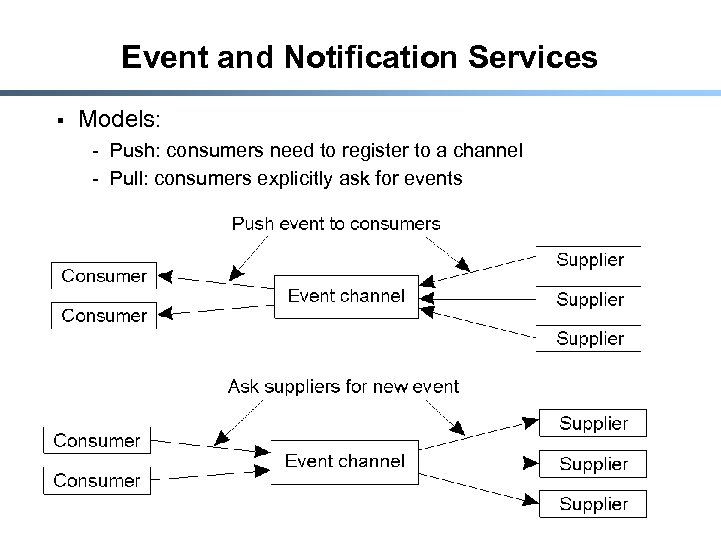
Event and Notification Services § Models: - Push: consumers need to register to a channel - Pull: consumers explicitly ask for events 46
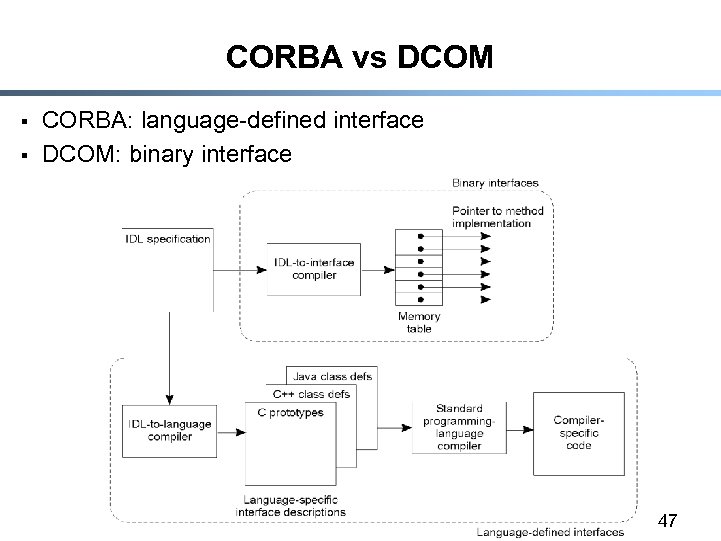
CORBA vs DCOM § § CORBA: language-defined interface DCOM: binary interface 47
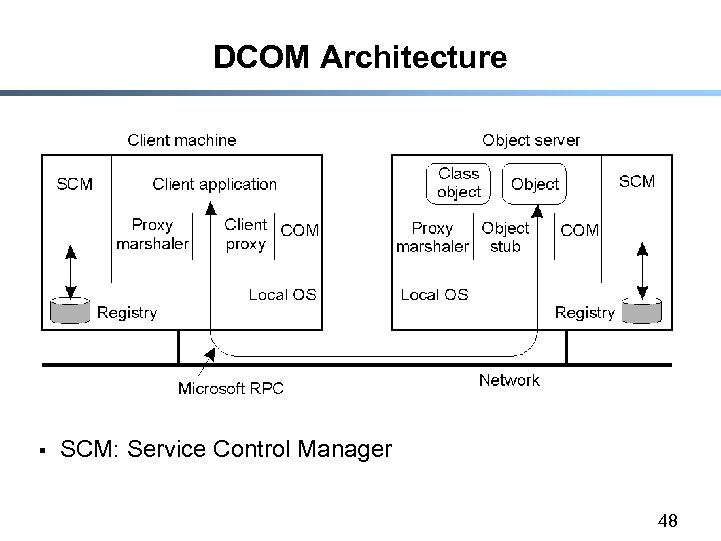
DCOM Architecture § SCM: Service Control Manager 48
Creating objects § Classes of objects have globally unique identifiers (GUIDs) - 128 bit numbers - Also called class ids (CLSID) § DCOM provides functions to create objects given a server name and a class id - The SCM on the client connects to the SCM of the server and requests creation of the object 49
Outline § § Ø § Distributed File Systems Distributed Object-based Systems Coordination Systems Web 50
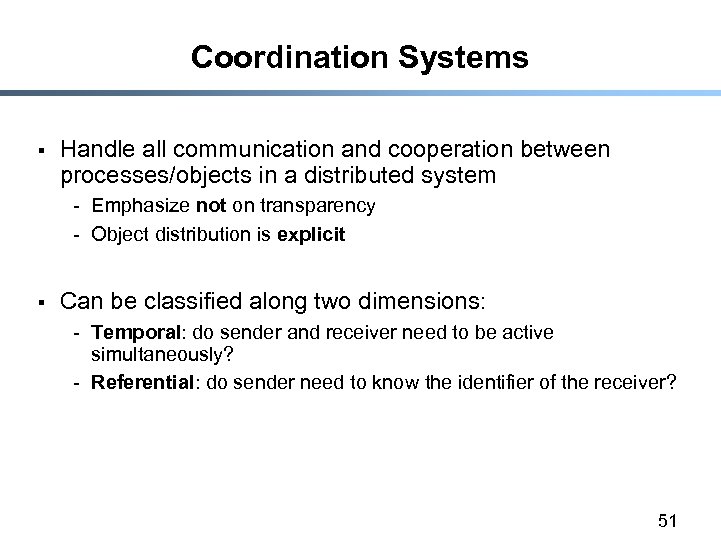
Coordination Systems § Handle all communication and cooperation between processes/objects in a distributed system - Emphasize not on transparency - Object distribution is explicit § Can be classified along two dimensions: - Temporal: do sender and receiver need to be active simultaneously? - Referential: do sender need to know the identifier of the receiver? 51
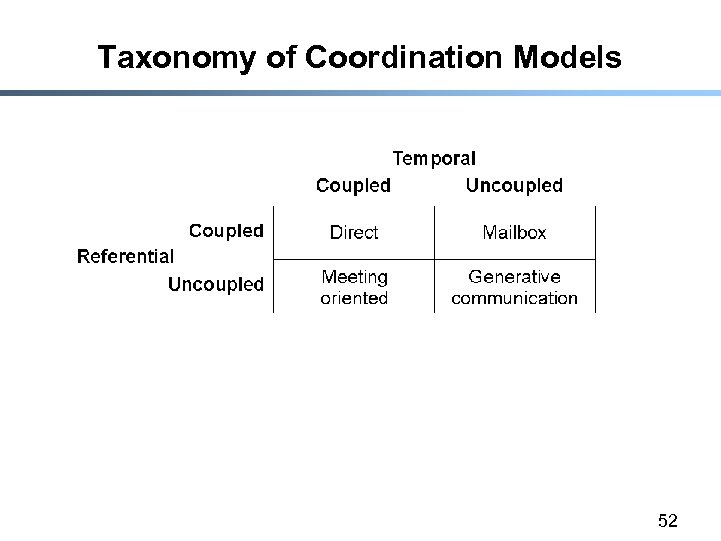
Taxonomy of Coordination Models 52
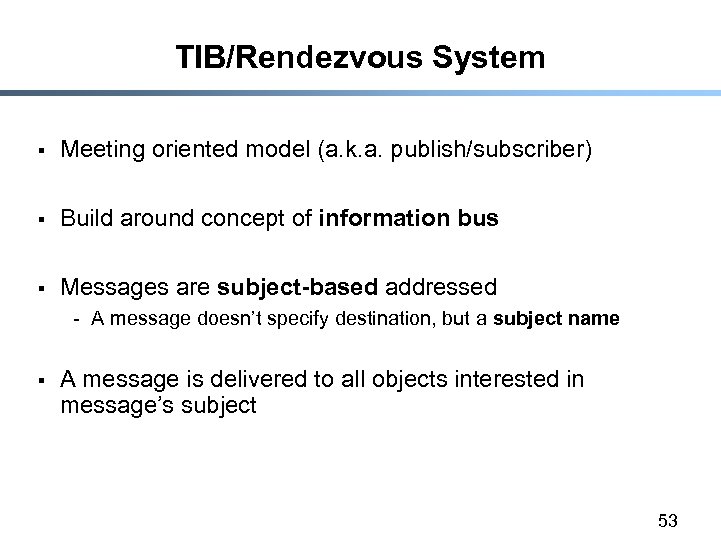
TIB/Rendezvous System § Meeting oriented model (a. k. a. publish/subscriber) § Build around concept of information bus § Messages are subject-based addressed - A message doesn’t specify destination, but a subject name § A message is delivered to all objects interested in message’s subject 53
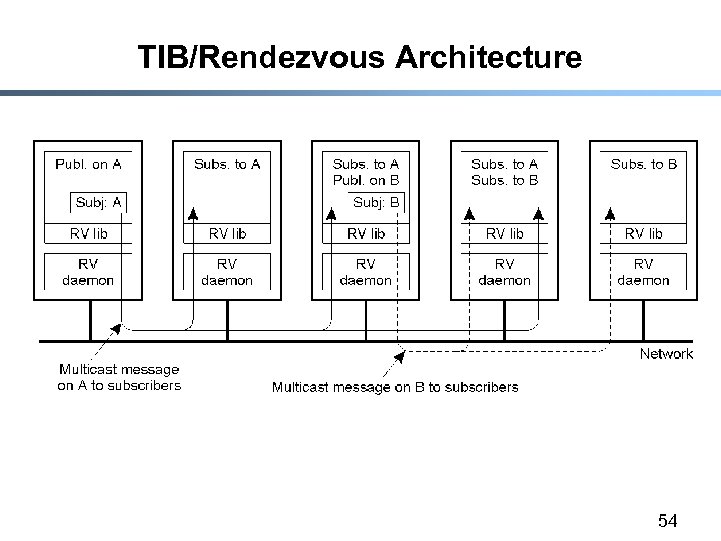
TIB/Rendezvous Architecture 54
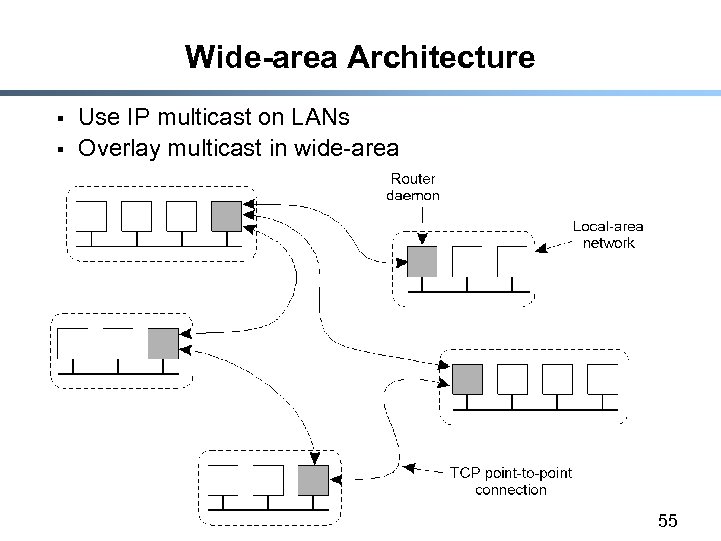
Wide-area Architecture § § Use IP multicast on LANs Overlay multicast in wide-area 55
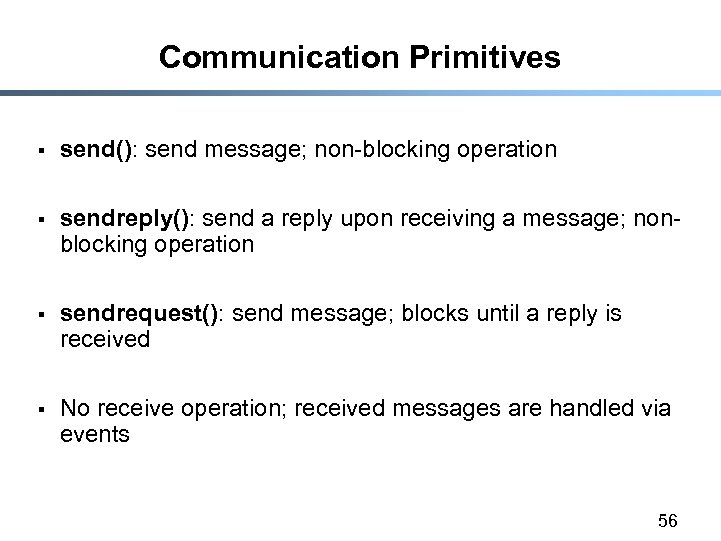
Communication Primitives § send(): send message; non-blocking operation § sendreply(): send a reply upon receiving a message; nonblocking operation § sendrequest(): send message; blocks until a reply is received § No receive operation; received messages are handled via events 56
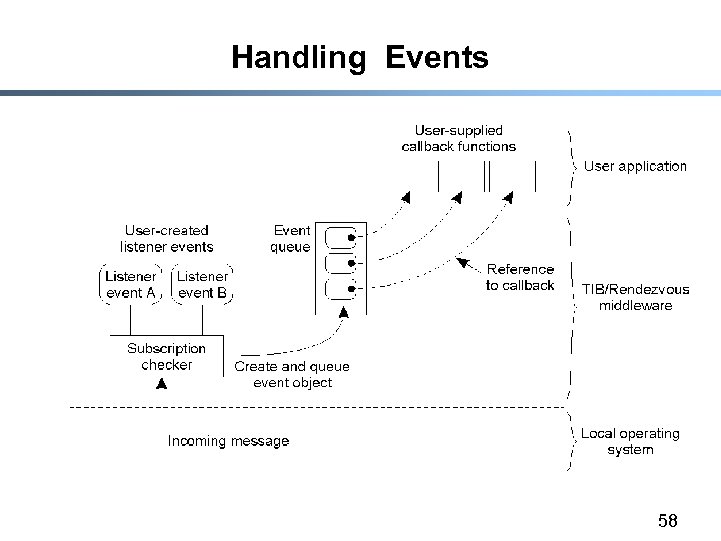
Handling Events 58
Jini § Generative communication model § Built around the concept of tuple space - First proposed by Linda § Tuple space - Distributed associative memory - Instantiated as a Java. Space in Jini § In addition, Jini - Provide distributed event and notification system - Allow clients discover services when become available 59
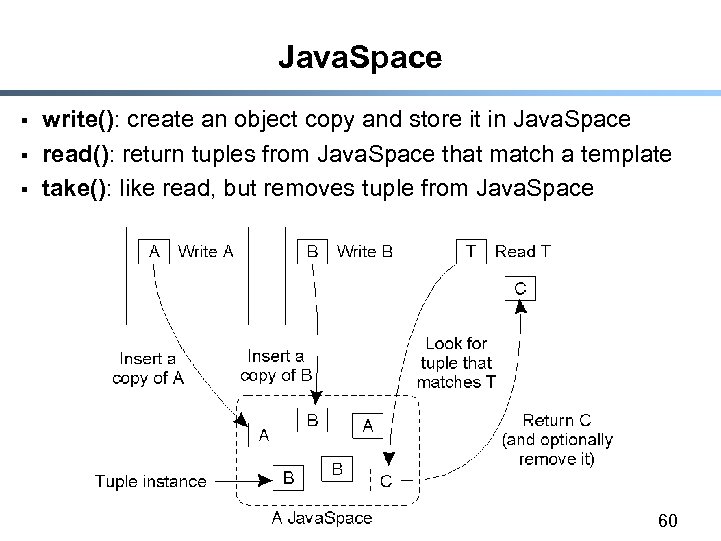
Java. Space § § § write(): create an object copy and store it in Java. Space read(): return tuples from Java. Space that match a template take(): like read, but removes tuple from Java. Space 60
Events § A client can register with an object that has events of interest § A client can tell object to pass event to another process § Notification implemented by remote call 61
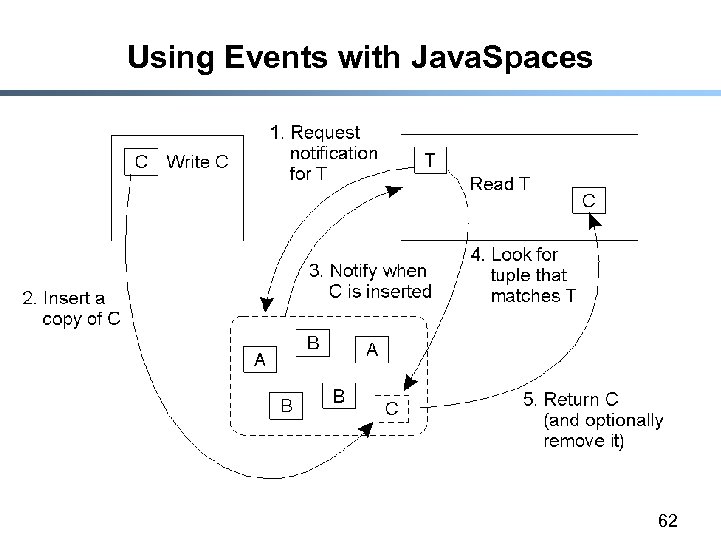
Using Events with Java. Spaces 62
Outline § § § Ø Distributed File Systems Distributed Object-based Systems Coordination Systems Web 63
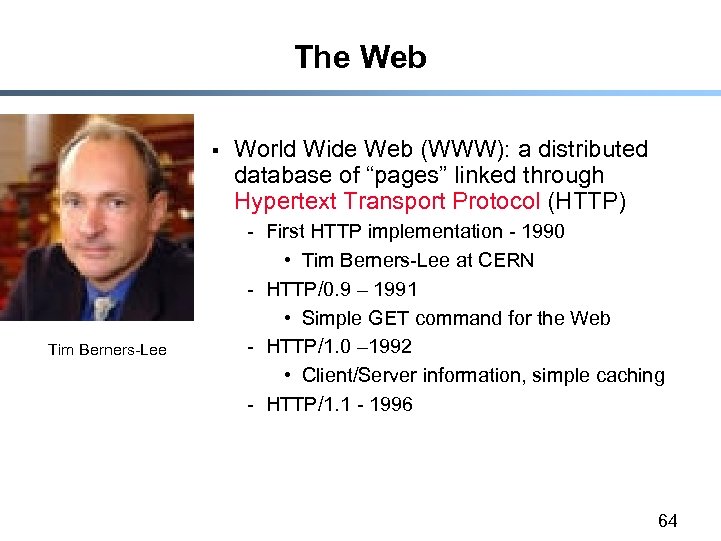
The Web § Tim Berners-Lee World Wide Web (WWW): a distributed database of “pages” linked through Hypertext Transport Protocol (HTTP) - First HTTP implementation - 1990 • Tim Berners-Lee at CERN - HTTP/0. 9 – 1991 • Simple GET command for the Web - HTTP/1. 0 – 1992 • Client/Server information, simple caching - HTTP/1. 1 - 1996 64
Web Architecture § Core components: - Servers: store files and execute remote commands - Browsers: retrieve and display “pages” - Uniform Resource Locators (URLs): way to refer to pages § A protocol to transfer information between clients and servers - HTTP 65
Uniform Record Locator (URL) protocol: //host-name: port/directory-path/resource § Extend the idea of hierarchical namespaces to include anything in a file system - § ftp: //www. cs. berkeley. edu/~istoica/cs 194/05/lecture. ppt Extend to program executions as well… - - http: //us. f 413. mail. yahoo. com/ym/Show. Letter? box=%40 Bulk&M sg. Id=2604_1744106_29699_1123_1261_0_28917_3552_128995710 0&Search=&Nhead=f&YY=31454&order=down&sort=date&pos=0&vie w=a&head=b Server side processing can be incorporated in the name 66
Hyper Text Transfer Protocol (HTTP) § Client-server architecture § Synchronous request/reply protocol - Runs over TCP, Port 80 § Stateless 67
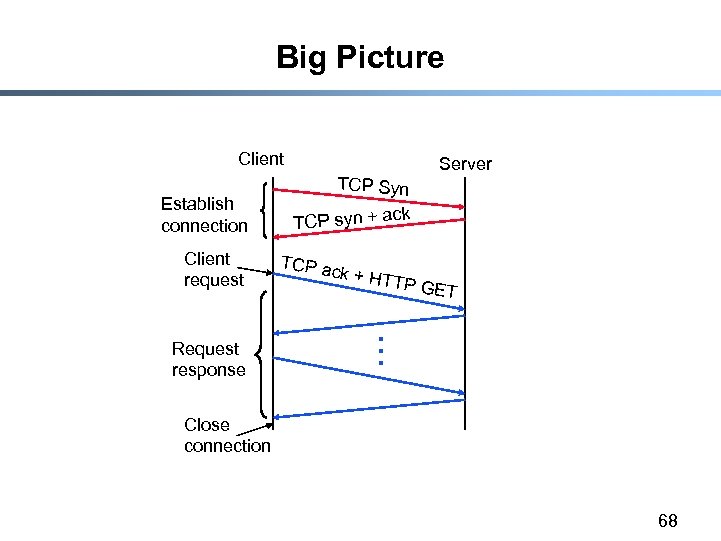
Big Picture Client Establish connection Client request Request response TCP Syn Server k TCP syn + ac TCP ac k + HT TP GE T . . . Close connection 68
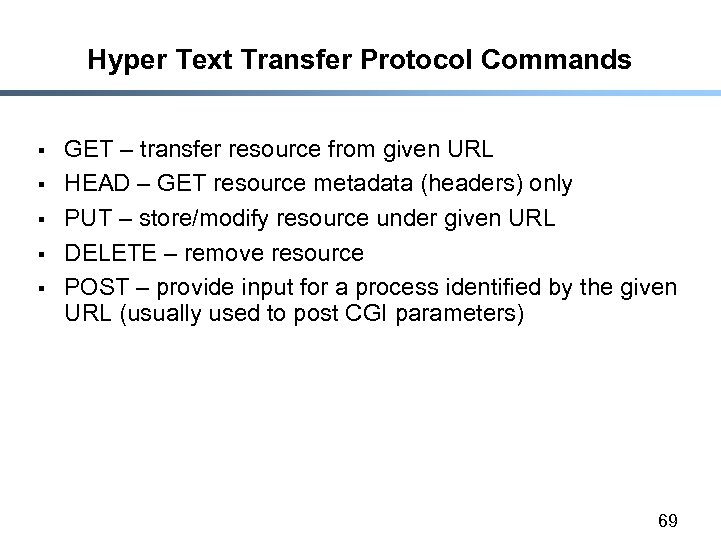
Hyper Text Transfer Protocol Commands § § § GET – transfer resource from given URL HEAD – GET resource metadata (headers) only PUT – store/modify resource under given URL DELETE – remove resource POST – provide input for a process identified by the given URL (usually used to post CGI parameters) 69
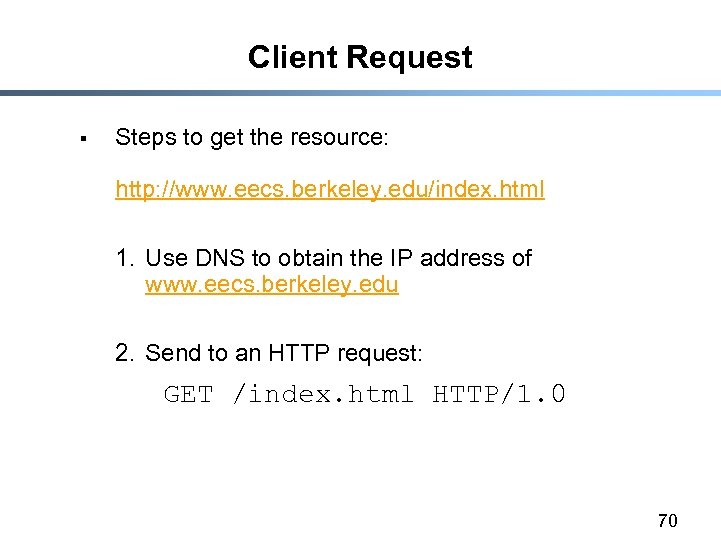
Client Request § Steps to get the resource: http: //www. eecs. berkeley. edu/index. html 1. Use DNS to obtain the IP address of www. eecs. berkeley. edu 2. Send to an HTTP request: GET /index. html HTTP/1. 0 70
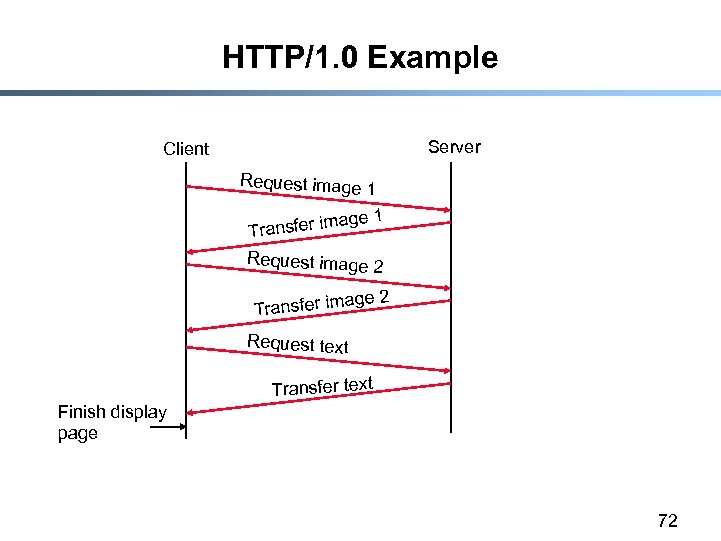
HTTP/1. 0 Example Server Client Request image 1 Transfer im Request image 2 Transfer im Request text Transfer text Finish display page 72
HHTP/1. 0 Performance § Create a new TCP connection for each resource - Large number of embedded objects in a web page - Many short lived connections § TCP transfer - Too slow for small object - May never exit slow-start phase § Connections may be set up in parallel (5 is default in most browsers) 73
HTTP/1. 1 (1996) § Performance: - Persistent connections - Pipelined requests/responses - … § Efficient caching support - Network Cache assumed more explicitly in the design - Gives more control to the server on how it wants data cached § Support for virtual hosting - Allows to run multiple web servers on the same machine 74
Final Exam Information § Date, time: May 19, 12: 30 -3: 30 pm § Final will include midterm material (1/3), but emphasize on second part (2/3) - This lecture reviews mainly the second part material - See midterm review for first part material! § We’ll post a practice exam by the end of this week § Closed books; 8, 5”x 11” crib sheet (both sides) No calculators, PDAs, cell phones with cameras, etc Please use PENCIL and ERASER § § 75
Скачать презентацию CS 194 Distributed Systems Final Review Scott Shenker
5d093d95f00b03b63edf3e29157ffe72.ppt