Скачать презентацию CS 188 Artificial Intelligence Fall 2009 Lecture 1
0071fe4949eef2efd300d19eb1ba8ebf.ppt
- Количество слайдов: 25
 CS 188: Artificial Intelligence Fall 2009 Lecture 1: Introduction 8/27/2009 Dan Klein – UC Berkeley Multiple slides over the course adapted from either Stuart Russell or Andrew Moore
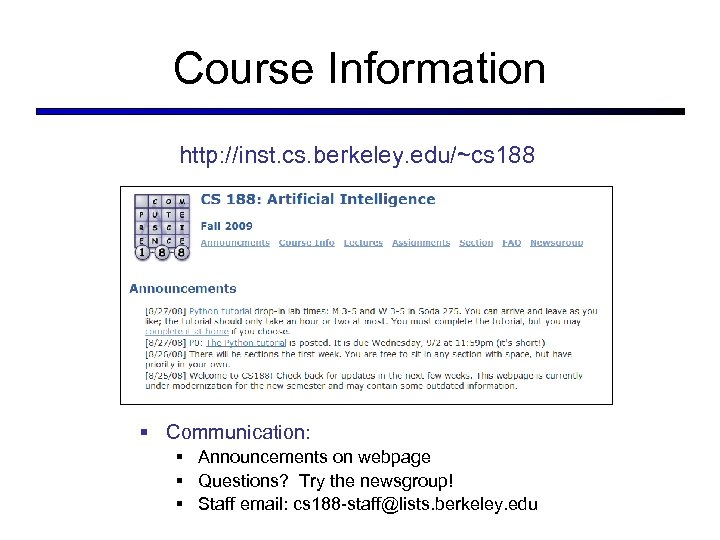 Course Information http: //inst. cs. berkeley. edu/~cs 188 § Communication: § Announcements on webpage § Questions? Try the newsgroup! § Staff email: cs 188 -staff@lists. berkeley. edu
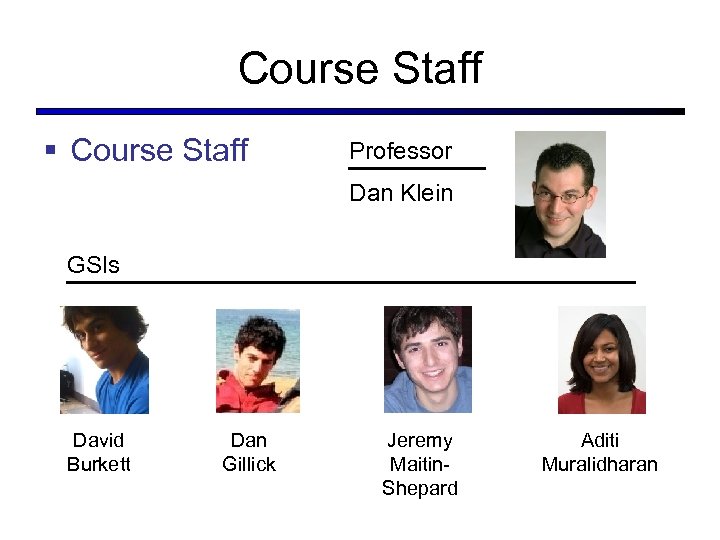 Course Staff § Course Staff Professor Dan Klein GSIs David Burkett Dan Gillick Jeremy Maitin. Shepard Aditi Muralidharan
 Course Information § Book: Russell & Norvig, AI: A Modern Approach, 2 nd Ed. § Prerequisites: § (CS 61 A or B) and (Math 55 or CS 70) § There will be a lot of math and programming § Work and Grading: § 5 programming projects: Python, groups of 1 -2 § 5 late days, 2 per project § § § 4 written projects: solve together, write-up alone Midterm and final Participation Fixed scale Academic integrity policy § Contests!
 Today § What is artificial intelligence? § What can AI do? § What is this course?
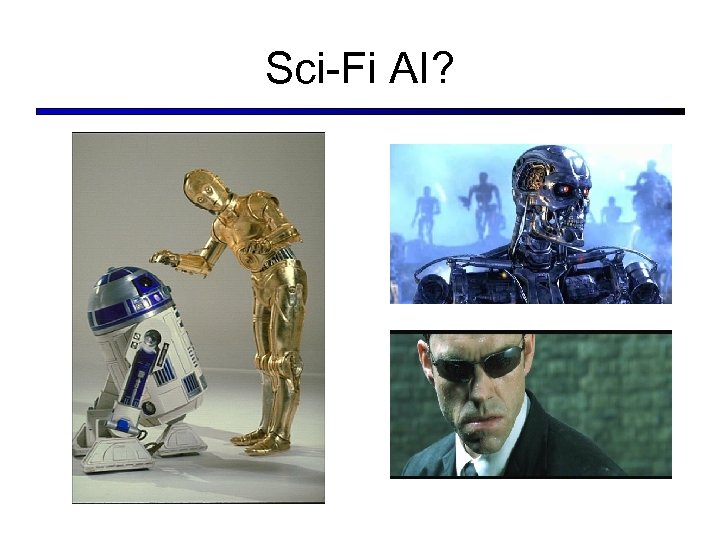 Sci-Fi AI?
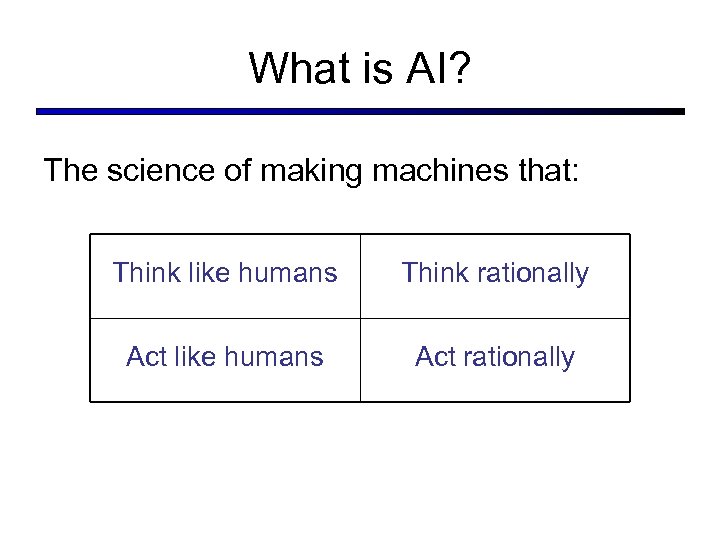 What is AI? The science of making machines that: Think like humans Think rationally Act like humans Act rationally
 Rational Decisions We’ll use the term rational in a particular way: § Rational: maximally achieving pre-defined goals § Rational only concerns what decisions are made (not the thought process behind them) § Goals are expressed in terms of the utility of outcomes § Being rational means maximizing your expected utility A better title for this course would be: Computational Rationality
 Maximize Your Expected Utility
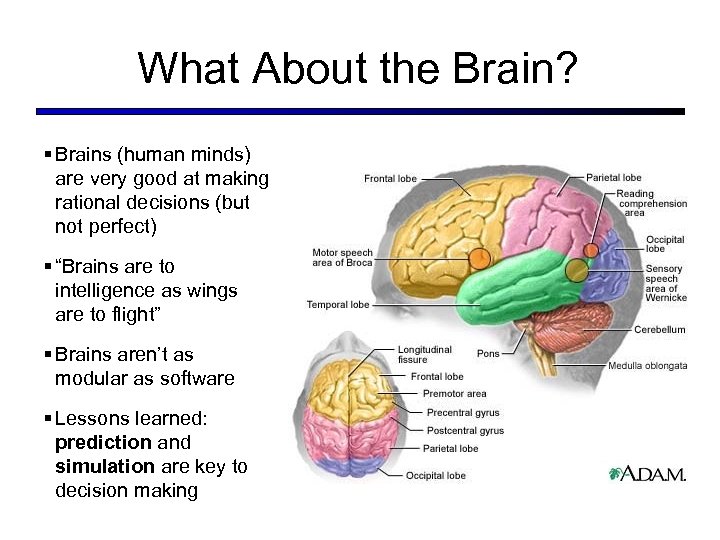 What About the Brain? § Brains (human minds) are very good at making rational decisions (but not perfect) § “Brains are to intelligence as wings are to flight” § Brains aren’t as modular as software § Lessons learned: prediction and simulation are key to decision making
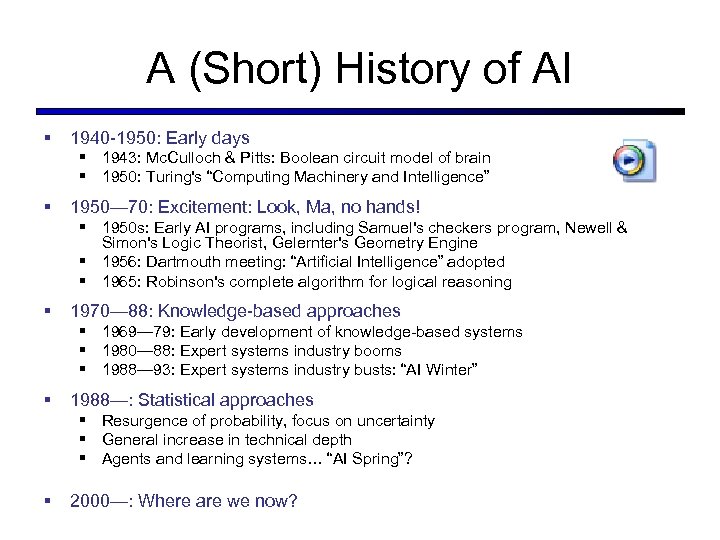 A (Short) History of AI § 1940 -1950: Early days § 1943: Mc. Culloch & Pitts: Boolean circuit model of brain § 1950: Turing's “Computing Machinery and Intelligence” § 1950— 70: Excitement: Look, Ma, no hands! § 1950 s: Early AI programs, including Samuel's checkers program, Newell & Simon's Logic Theorist, Gelernter's Geometry Engine § 1956: Dartmouth meeting: “Artificial Intelligence” adopted § 1965: Robinson's complete algorithm for logical reasoning § 1970— 88: Knowledge-based approaches § 1969— 79: Early development of knowledge-based systems § 1980— 88: Expert systems industry booms § 1988— 93: Expert systems industry busts: “AI Winter” § 1988—: Statistical approaches § Resurgence of probability, focus on uncertainty § General increase in technical depth § Agents and learning systems… “AI Spring”? § 2000—: Where are we now?
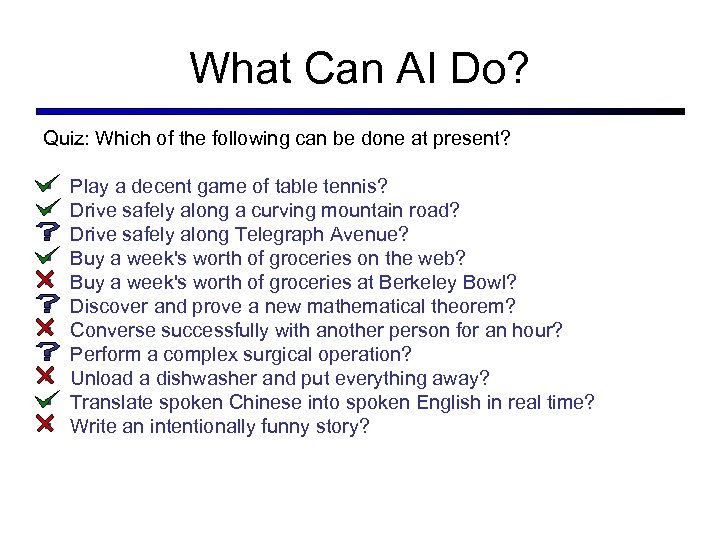 What Can AI Do? Quiz: Which of the following can be done at present? § § § Play a decent game of table tennis? Drive safely along a curving mountain road? Drive safely along Telegraph Avenue? Buy a week's worth of groceries on the web? Buy a week's worth of groceries at Berkeley Bowl? Discover and prove a new mathematical theorem? Converse successfully with another person for an hour? Perform a complex surgical operation? Unload a dishwasher and put everything away? Translate spoken Chinese into spoken English in real time? Write an intentionally funny story?
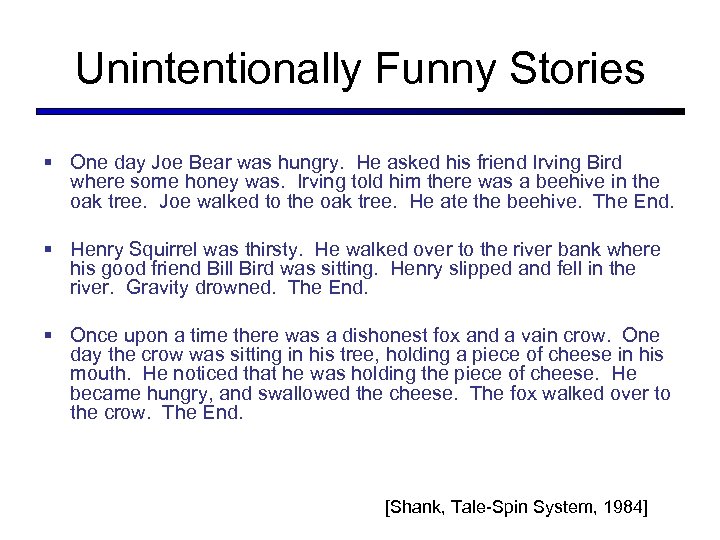 Unintentionally Funny Stories § One day Joe Bear was hungry. He asked his friend Irving Bird where some honey was. Irving told him there was a beehive in the oak tree. Joe walked to the oak tree. He ate the beehive. The End. § Henry Squirrel was thirsty. He walked over to the river bank where his good friend Bill Bird was sitting. Henry slipped and fell in the river. Gravity drowned. The End. § Once upon a time there was a dishonest fox and a vain crow. One day the crow was sitting in his tree, holding a piece of cheese in his mouth. He noticed that he was holding the piece of cheese. He became hungry, and swallowed the cheese. The fox walked over to the crow. The End. [Shank, Tale-Spin System, 1984]
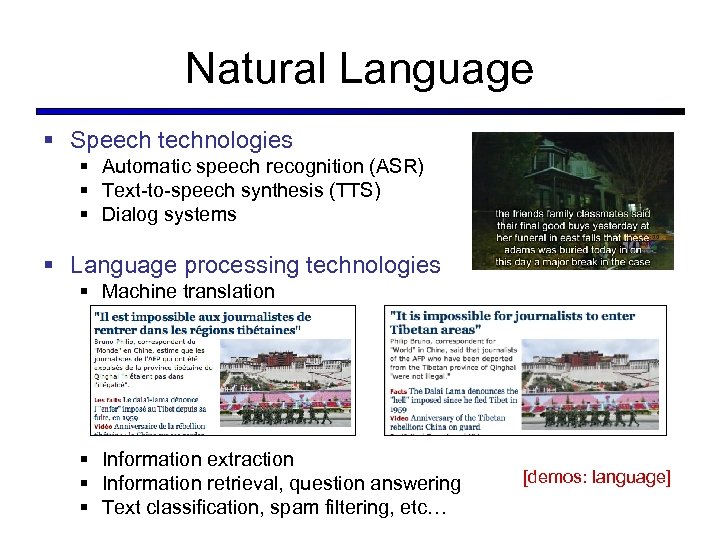 Natural Language § Speech technologies § Automatic speech recognition (ASR) § Text-to-speech synthesis (TTS) § Dialog systems § Language processing technologies § Machine translation § Information extraction § Information retrieval, question answering § Text classification, spam filtering, etc… [demos: language]
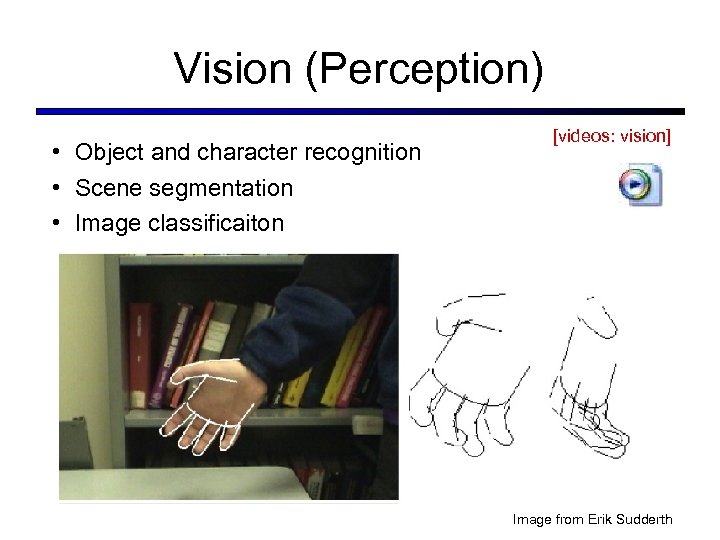 Vision (Perception) • Object and character recognition • Scene segmentation • Image classificaiton [videos: vision] Image from Erik Sudderth
![Robotics [videos: robotics] § Robotics § Part mech. eng. § Part AI § Reality](https://present5.com/presentation/0071fe4949eef2efd300d19eb1ba8ebf/image-16.jpg "Robotics [videos: robotics] § Robotics § Part mech. eng. § Part AI § Reality") Robotics [videos: robotics] § Robotics § Part mech. eng. § Part AI § Reality much harder than simulations! § Technologies § § Vehicles Rescue Soccer! Lots of automation… § In this class: § We ignore mechanical aspects § Methods for planning § Methods for control Images from stanfordracing. org, CMU Robo. Cup, Honda ASIMO sites
Robotics [videos: robotics] § Robotics § Part mech. eng. § Part AI § Reality much harder than simulations! § Technologies § § Vehicles Rescue Soccer! Lots of automation… § In this class: § We ignore mechanical aspects § Methods for planning § Methods for control Images from stanfordracing. org, CMU Robo. Cup, Honda ASIMO sites
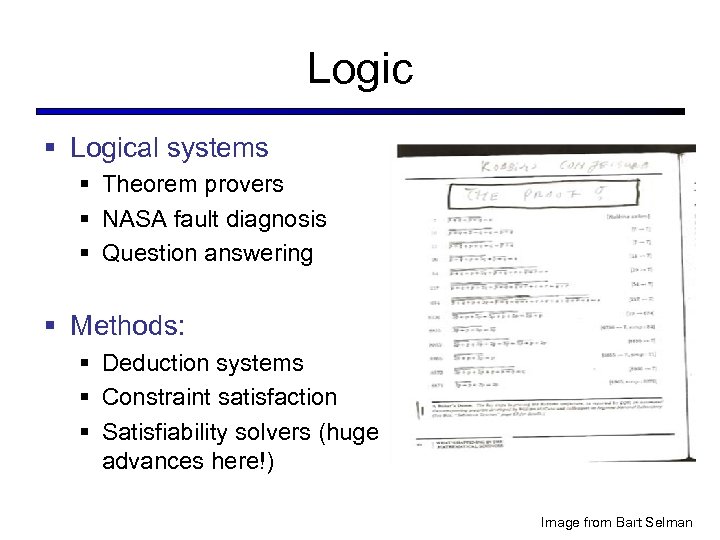 Logic § Logical systems § Theorem provers § NASA fault diagnosis § Question answering § Methods: § Deduction systems § Constraint satisfaction § Satisfiability solvers (huge advances here!) Image from Bart Selman
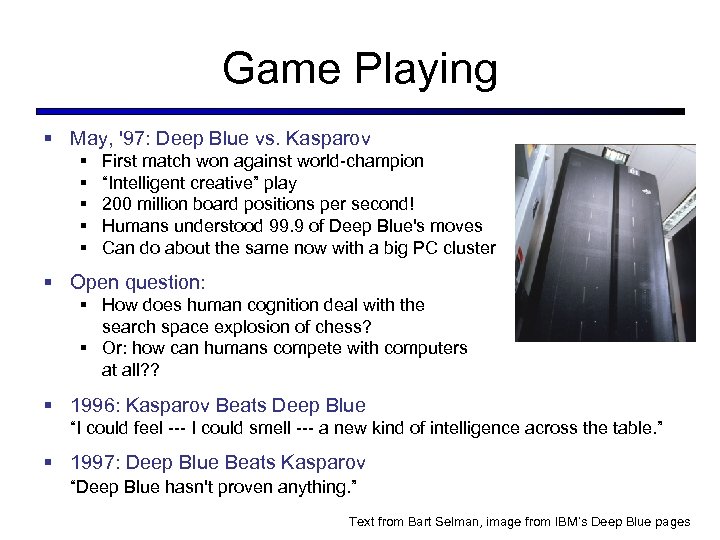 Game Playing § May, '97: Deep Blue vs. Kasparov § § § First match won against world-champion “Intelligent creative” play 200 million board positions per second! Humans understood 99. 9 of Deep Blue's moves Can do about the same now with a big PC cluster § Open question: § How does human cognition deal with the search space explosion of chess? § Or: how can humans compete with computers at all? ? § 1996: Kasparov Beats Deep Blue “I could feel --- I could smell --- a new kind of intelligence across the table. ” § 1997: Deep Blue Beats Kasparov “Deep Blue hasn't proven anything. ” Text from Bart Selman, image from IBM’s Deep Blue pages
 Decision Making • • Scheduling, e. g. airline routing, military Route planning, e. g. mapquest Medical diagnosis Automated help desks Fraud detection Spam classifiers Web search engines • … Lots more!
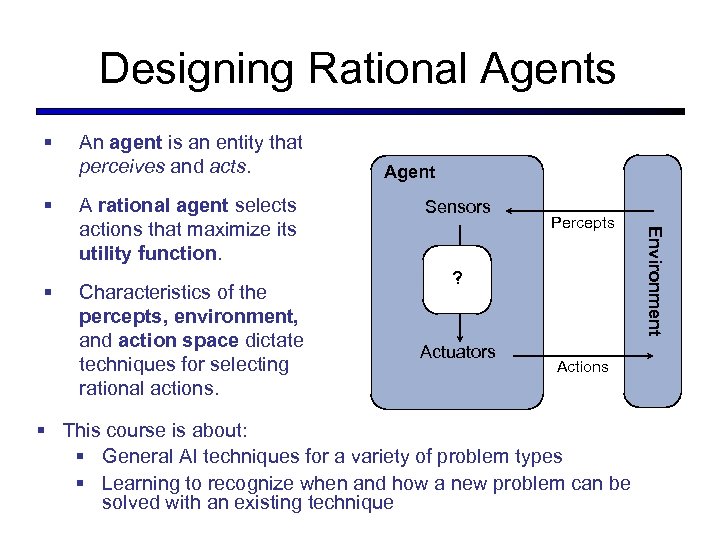 Designing Rational Agents § An agent is an entity that perceives and acts. A rational agent selects actions that maximize its utility function. § Characteristics of the percepts, environment, and action space dictate techniques for selecting rational actions. Sensors Percepts ? Actuators Actions § This course is about: § General AI techniques for a variety of problem types § Learning to recognize when and how a new problem can be solved with an existing technique Environment § Agent
![[demo: pacman] Pacman as an Agent Sensors Percepts ? Actuators Actions Environment](https://present5.com/presentation/0071fe4949eef2efd300d19eb1ba8ebf/image-21.jpg "[demo: pacman] Pacman as an Agent Sensors Percepts ? Actuators Actions Environment") [demo: pacman] Pacman as an Agent Sensors Percepts ? Actuators Actions Environment
[demo: pacman] Pacman as an Agent Sensors Percepts ? Actuators Actions Environment
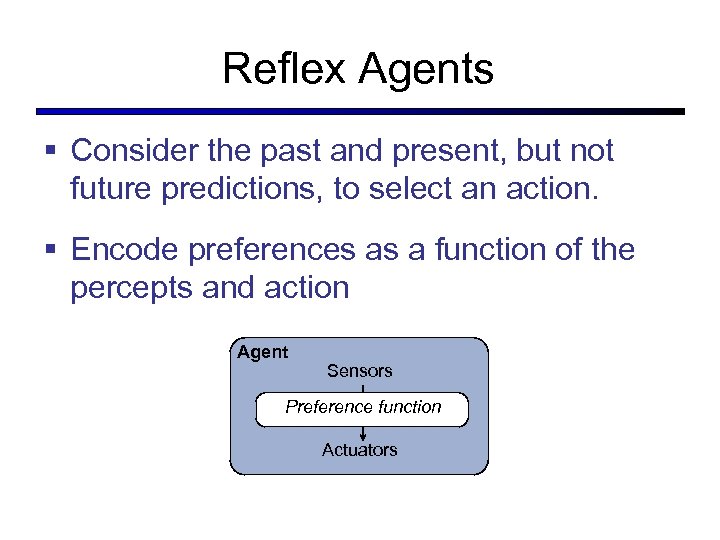 Reflex Agents § Consider the past and present, but not future predictions, to select an action. § Encode preferences as a function of the percepts and action Agent Sensors Preference function Actuators
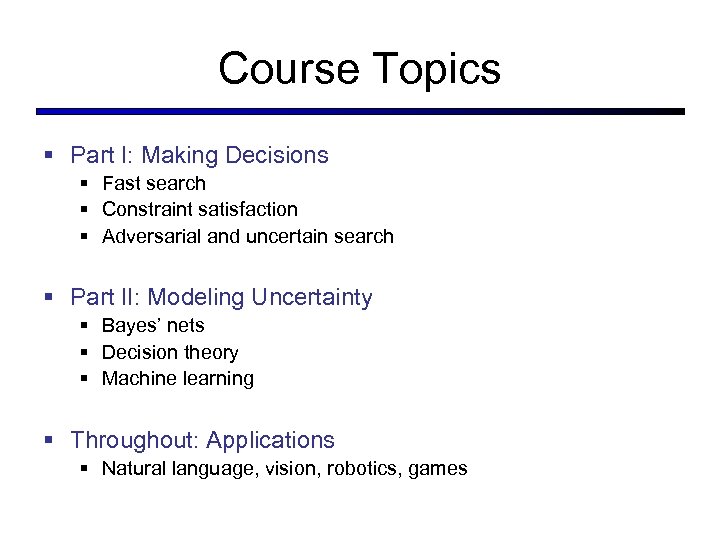 Course Topics § Part I: Making Decisions § Fast search § Constraint satisfaction § Adversarial and uncertain search § Part II: Modeling Uncertainty § Bayes’ nets § Decision theory § Machine learning § Throughout: Applications § Natural language, vision, robotics, games
 Announcements • Important this week: • P 0: Python tutorial is online now (due on Wednesday) • Lab hours Monday and Wednesday 3 pm-5 pm in 275 Soda • Get your account forms in front after class • Also important: • Sections start this week. You may change sections, but you have seating priority where you are registered. New section coming? • The Waiting list will take a while to sort out. We don’t control enrollment. Contact Michael-David Sasson (msasson@cs) with any questions on the process.