


 Скачать презентацию CS 169 Software Engineering Armando Fox David Patterson
slides_01-BigIdeas.ppt
- Количество слайдов: 57
 CS 169 Software Engineering Armando Fox, David Patterson, and Koushik Sen Spring 2012 1
 Engineering Software is Different from Engineering Hardware (Engineering Long Lasting Software § 1. 1 -§ 1. 2) David Patterson 16
 Engineering Software is Different from Hardware • Q: Why so many SW disasters and no HW disasters? – Ariane 5 rocket explosion – Therac-25 lethal radiation overdose – Mars Climate Orbiter disintegration – FBI Virtual Case File project abandonment • A: Nature of 2 media & subsequent cultures 17
 Independent Products vs. Continuous Improvement • Cost of field upgrade • HW ≈ ∞ èHW designs must be finished before manufactured and shipped èBugs: Return HW (lose if many returns) • SW ≈ 0 èExpect SW gets better over time èBugs: Wait for upgrade • HW decays, SW long lasting 18
 Legacy SW vs. Beautiful SW • Legacy code: old SW that continues to meet customers' needs, but difficult to evolve due to design inelegance or antiquated technology – 60% SW maintenance costs adding new functionality to legacy SW – 17% for fixing bugs • Contrasts with beautiful code: meets customers' needs and easy to evolve 20
 Legacy Code: Key but Ignored • Missing from traditional SWE courses and textbooks • Number 1 request from industry experts we asked: What should be in new SWE course? • NEW: assignment to enhance legacy code in 2 nd half of Berkley course 22
 Question: Which type of SW is considered an epic failure? ☐ Beautiful code ☐ Legacy code ☐ Unexpectedly short-lived code ☐ Both legacy code and unexpectedly short lived code 23
 Development processes: Waterfall vs. Agile (Engineering Long Lasting Software § 1. 3) David Patterson 24
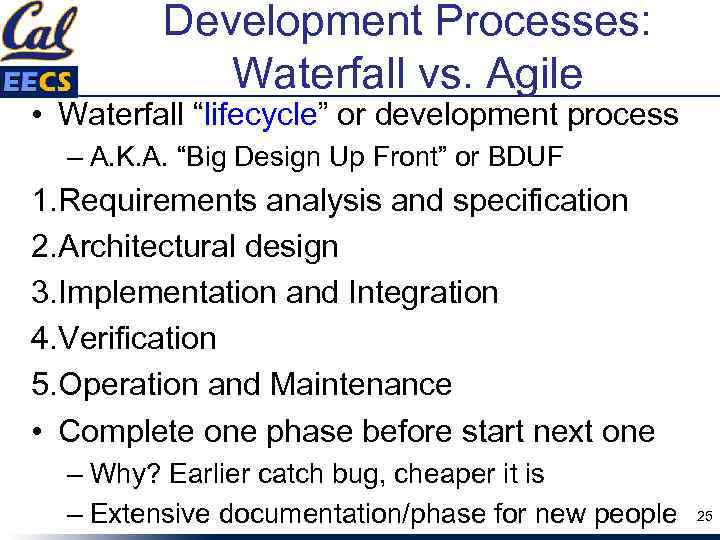 Development Processes: Waterfall vs. Agile • Waterfall “lifecycle” or development process – A. K. A. “Big Design Up Front” or BDUF 1. Requirements analysis and specification 2. Architectural design 3. Implementation and Integration 4. Verification 5. Operation and Maintenance • Complete one phase before start next one – Why? Earlier catch bug, cheaper it is – Extensive documentation/phase for new people 25
 How well does Waterfall work? • Works well for important software with specs that won’t change: NASA spacecraft, aircraft control, … • But often when customer sees result, wants big changes • But often after built first one, developers learn right way they should have built it 26
![How well does Waterfall work? • “Plan to throw one [implementation] away; you will,](https://present5.com/presentation/11728334_57517245/image-11.jpg "How well does Waterfall work? • “Plan to throw one [implementation] away; you will,") How well does Waterfall work? • “Plan to throw one [implementation] away; you will, anyhow. ” - Fred Brooks, Jr. (received 1999 Turing Award for contributions to computer architecture, operating systems, and software engineering) (Photo by Carola Lauber of SD&M www. sdm. de. Used by permission under CC-BY-SA-3. 0. ) 27
How well does Waterfall work? • “Plan to throw one [implementation] away; you will, anyhow. ” - Fred Brooks, Jr. (received 1999 Turing Award for contributions to computer architecture, operating systems, and software engineering) (Photo by Carola Lauber of SD&M www. sdm. de. Used by permission under CC-BY-SA-3. 0. ) 27
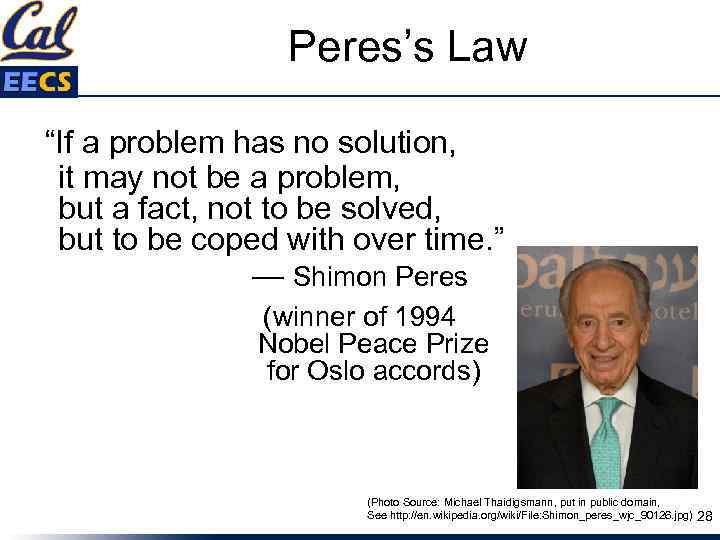 Peres’s Law “If a problem has no solution, it may not be a problem, but a fact, not to be solved, but to be coped with over time. ” — Shimon Peres (winner of 1994 Nobel Peace Prize for Oslo accords) (Photo Source: Michael Thaidigsmann, put in public domain, See http: //en. wikipedia. org/wiki/File: Shimon_peres_wjc_90126. jpg) 28
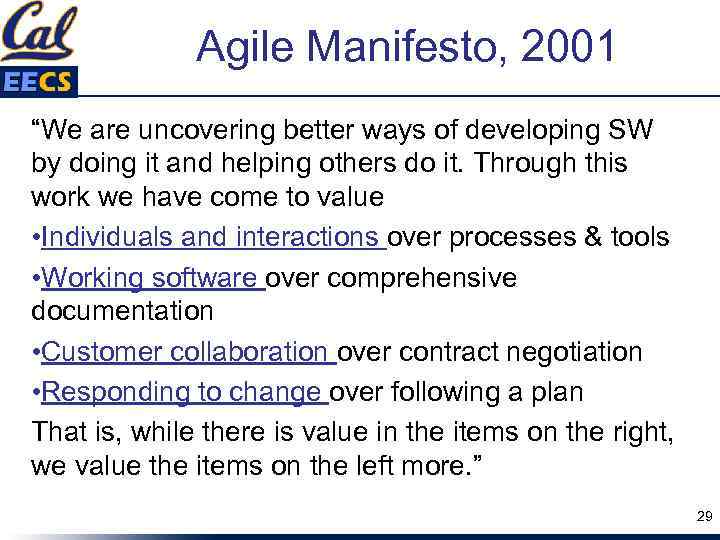 Agile Manifesto, 2001 “We are uncovering better ways of developing SW by doing it and helping others do it. Through this work we have come to value • Individuals and interactions over processes & tools • Working software over comprehensive documentation • Customer collaboration over contract negotiation • Responding to change over following a plan That is, while there is value in the items on the right, we value the items on the left more. ” 29
 Agile lifecycle • Embraces change as a fact of life: continuous improvement vs. phases • Developers continuously refine working but incomplete prototype until customers happy, with customer feedback on each Iteration (every ~2 weeks) • Agile emphasizes Test-Driven Development (TDD) to reduce mistakes, written down User Stories to validate customer requirements, Velocity to measure progress 31
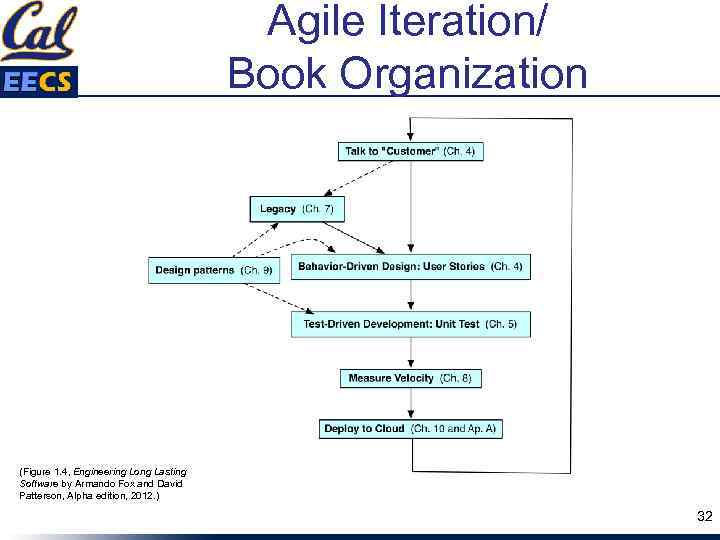 Agile Iteration/ Book Organization (Figure 1. 4, Engineering Long Lasting Software by Armando Fox and David Patterson, Alpha edition, 2012. ) 32
 Question: What is NOT a key difference between Waterfall and Agile lifecycles? ☐ Waterfall uses long sequential phases, Agile uses quick iterations ☐ Waterfall has no working code until end, Agile has working each code iteration ☐ Waterfall uses written requirements, but Agile does not use anything written down ☐ Waterfall has an architectural design phase, but you cannot incorporate SW architecture into the Agile lifecycle 33
 Assurance: Testing and Formal Methods (Engineering Long Lasting Software § 1. 4) David Patterson 34
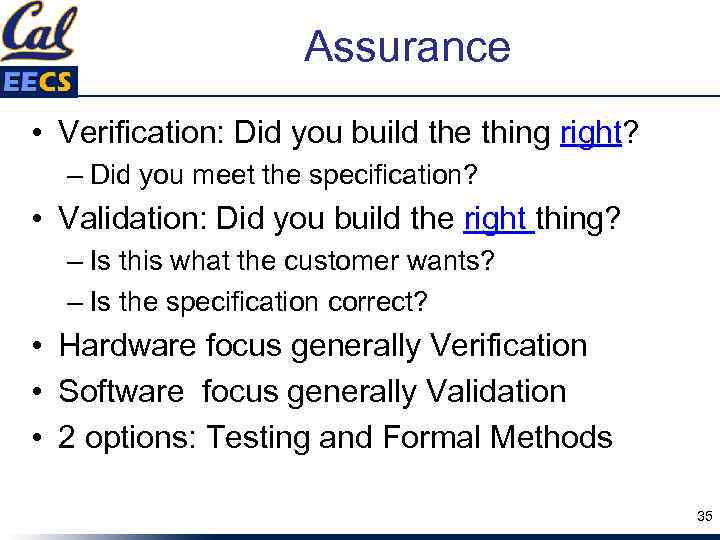 Assurance • Verification: Did you build the thing right? – Did you meet the specification? • Validation: Did you build the right thing? – Is this what the customer wants? – Is the specification correct? • Hardware focus generally Verification • Software focus generally Validation • 2 options: Testing and Formal Methods 35
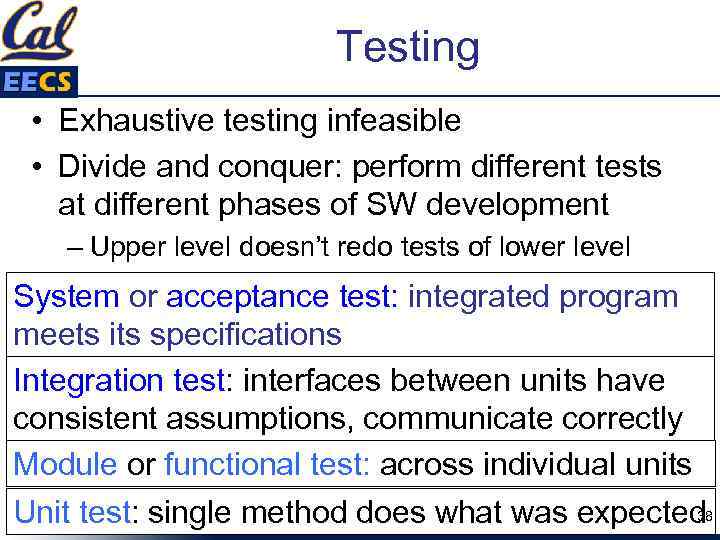 Testing • Exhaustive testing infeasible • Divide and conquer: perform different tests at different phases of SW development – Upper level doesn’t redo tests of lower level System or acceptance test: integrated program meets its specifications Integration test: interfaces between units have consistent assumptions, communicate correctly Module or functional test: across individual units 38 Unit test: single method does what was expected
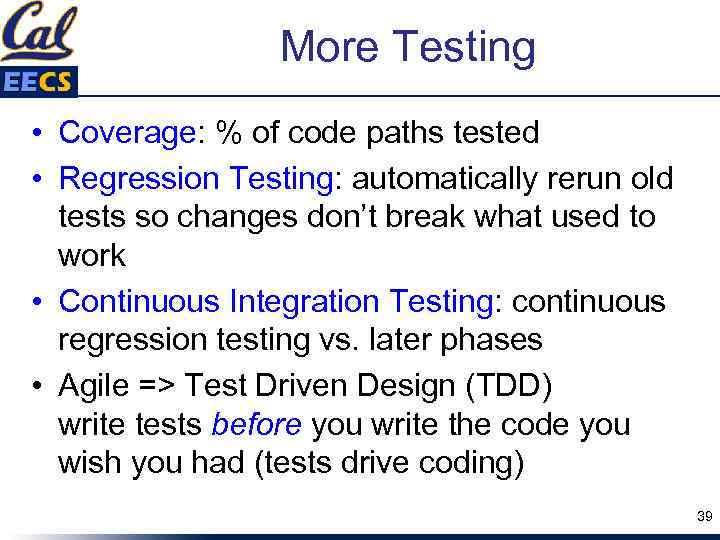 More Testing • Coverage: % of code paths tested • Regression Testing: automatically rerun old tests so changes don’t break what used to work • Continuous Integration Testing: continuous regression testing vs. later phases • Agile => Test Driven Design (TDD) write tests before you write the code you wish you had (tests drive coding) 39
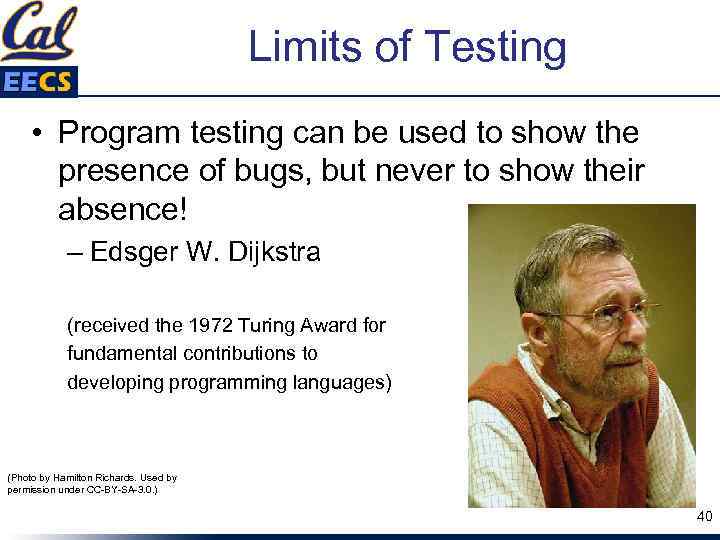 Limits of Testing • Program testing can be used to show the presence of bugs, but never to show their absence! – Edsger W. Dijkstra (received the 1972 Turing Award for fundamental contributions to developing programming languages) (Photo by Hamilton Richards. Used by permission under CC-BY-SA-3. 0. ) 40
 Formal Methods • Start with formal specification & prove program behavior follows spec. Options: 1. Human does proof 2. Computer via automatic theorem proving – Uses inference + logical axioms to produce proofs from scratch 3. Computer via model checking – Verifies selected properties by exhaustive search of all possible states that a system could enter during execution 41
 Formal Methods • Computationally expensive, so use only if – Small, fixed function – Expensive to repair, very hard to test – E. g. , Network protocols, safety critical SW • Biggest: OS kernel 10 K LOC @ $500/LOC – NASA SW $80/LOC • This course: rapidly changing SW, easy to repair, easy to test => no formal methods – Discuss again on future of engineering SW 42
 Question: Which statement is NOT true about testing? ☐ With better test coverage, you are more likely to catch faults ☐ While difficult to achieve, 100% test coverage insures design reliability ☐ Each higher level test delegates more detailed testing to lower levels ☐ Unit testing works within a single class and module testing works across classes 43
 Productivity: Conciseness, Synthesis, Reuse, and Tools (Engineering Long Lasting Software § 1. 5) David Patterson 44
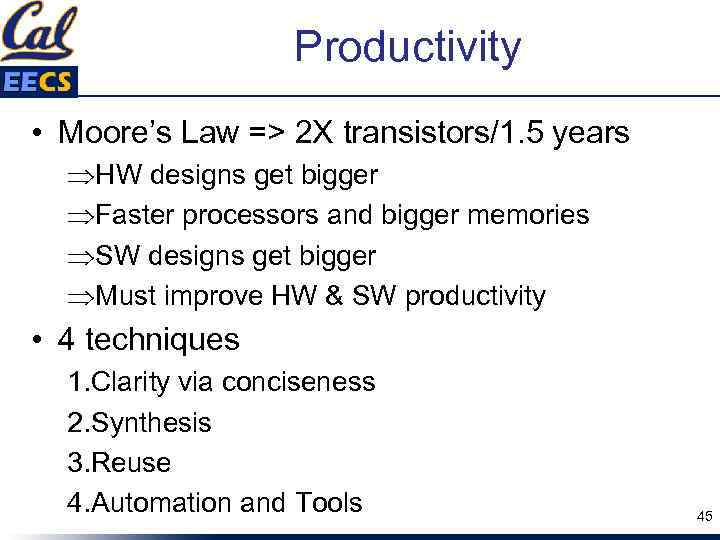 Productivity • Moore’s Law => 2 X transistors/1. 5 years HW designs get bigger Faster processors and bigger memories SW designs get bigger Must improve HW & SW productivity • 4 techniques 1. Clarity via conciseness 2. Synthesis 3. Reuse 4. Automation and Tools 45
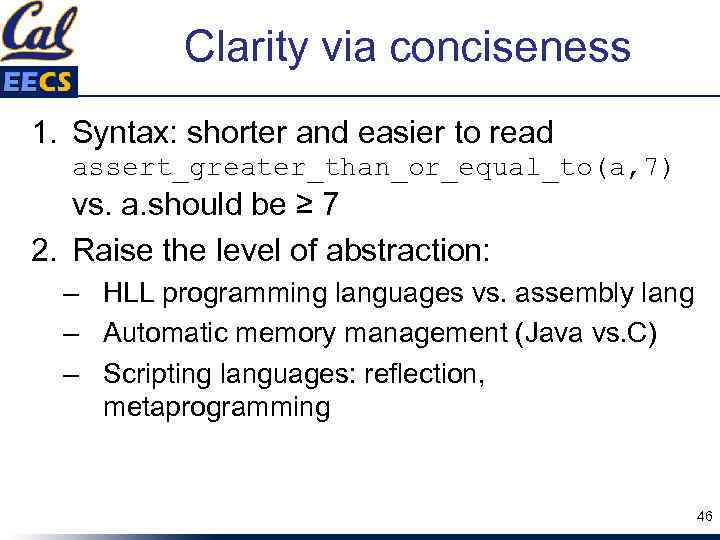 Clarity via conciseness 1. Syntax: shorter and easier to read assert_greater_than_or_equal_to(a, 7) vs. a. should be ≥ 7 2. Raise the level of abstraction: – HLL programming languages vs. assembly lang – Automatic memory management (Java vs. C) – Scripting languages: reflection, metaprogramming 46
 Synthesis • Software synthesis – Bit. Blt: generate code to fit situation & remove conditional test • Future Research: Programming by example 48
 Reuse • Reuse old code vs. write new code • Techniques in historical order: 1. Procedures and functions 2. Standardized libraries (reuse single task) 3. Object oriented programming: reuse and manage collections of tasks 4. Design patterns: reuse a general strategy even if implementation varies 49
 Automation and Tools • Replace tedious manual tasks with automation to save time, improve accuracy – New tool can make lives better (e. g. , make) • Concerns with new tools: Dependability, UI quality, picking which one from several • We think good software developer must repeatedly learn how to use new tools – Lots of chances in this course: Cucumber, RSpec, Pivotal Tracker, … 50
 Question: Which statement is TRUE about productivity? ☐ Copy and pasting code is another good way to get reuse ☐ Metaprogramming helps productivity via program synthesis ☐ Of the 4 productivity reasons, the primary one for HLL is reuse ☐ A concise syntax is more likely to have fewer bugs and be easier to maintain 51
 DRY • “Every piece of knowledge must have a single, unambiguous, authoritative representation within a system. ” – Andy Hunt and Dave Thomas, 1999 • Don't Repeat Yourself (DRY) – Don’t want to find many places have to apply same repair • Don’t copy and paste code! 52
 Software as a Service (Saa. S) (Engineering Long Lasting Software § 1. 6) David Patterson 53
 Software as a Service: Saa. S • Traditional SW: binary code installed and runs wholly on client device • Saa. S delivers SW & data as service over Internet via thin program (e. g. , browser) running on client device – Search, social networking, video • Now also Saa. S version of traditional SW – E. g. , Microsoft Office 365, Turbo. Tax Online 54
 6 Reasons for Saa. S 1. 2. 3. 4. No install worries about HW capability, OS No worries about data loss (at remote site) Easy for groups to interact with same data If data is large or changed frequently, simpler to keep 1 copy at central site 5. 1 copy of SW, controlled HW environment => no compatibility hassles for developers 6. 1 copy => simplifies upgrades for developers and no user upgrade requests 55
 Saa. S Loves Agile & Rails • • Frequent upgrades matches Agile lifecycle Many frameworks for Agile/Saa. S We use Ruby on Rails (“Rails”) Ruby, a modern scripting language: object oriented, functional, automatic memory management, dynamic types, reuse via mixins, synthesis via metaprogramming • Rails popular – e. g. , Twitter 56
 Which is weakest argument for a Google app’s popularity as Saa. S? ☐ Don’t lose data: Gmail ☐ Cooperating group: Documents ☐ Large/Changing Dataset: You. Tube ☐ No field upgrade when improve app: Search 57
 Outline • • Class Organization (AF) Engineering SW is Different from HW (§ 1. 1 -§ 1. 2) Development Processes: Waterfall vs. Agile (§ 1. 3) Assurance (§ 1. 4) Productivity (§ 1. 5) Software as a Service (§ 1. 6) if time permits Service Oriented Architecture (§ 1. 7) if time permits (Next 6 slides) • Cloud Computing (§ 1. 8) if time permits 58
 Service Oriented Architecture(SOA) (Engineering Long Lasting Software § 1. 7) David Patterson 59
 Service Oriented Architecture • SOA: SW architecture where all components are designed to be services • Apps composed of interoperable services – Easy to tailor new version for subset of users – Also easier to recover from mistake in design • Contrast to “SW silo” without internal APIs 60
 CEO: Amazon shall use SOA! 1. “All teams will henceforth expose their data and functionality through service interfaces 2. Teams must communicate with each other through these interfaces 3. There will be no other form of interprocess communication allowed: no direct linking, no direct reads of another team's data store, no shared-memory model, no back-doors whatsoever. The only communication allowed is via service interface calls over the network. 61
![CEO: Amazon shall use SOA! 4. It doesn't matter what [API protocol] technology you](https://present5.com/presentation/11728334_57517245/image-42.jpg "CEO: Amazon shall use SOA! 4. It doesn't matter what [API protocol] technology you") CEO: Amazon shall use SOA! 4. It doesn't matter what [API protocol] technology you use. 5. Service interfaces, without exception, must be designed from the ground up to be externalizable. That is to say, the team must plan and design to be able to expose the interface to developers in the outside world. No exceptions. 6. Anyone who doesn't do this will be fired. 7. Thank you; have a nice day!” 62
CEO: Amazon shall use SOA! 4. It doesn't matter what [API protocol] technology you use. 5. Service interfaces, without exception, must be designed from the ground up to be externalizable. That is to say, the team must plan and design to be able to expose the interface to developers in the outside world. No exceptions. 6. Anyone who doesn't do this will be fired. 7. Thank you; have a nice day!” 62
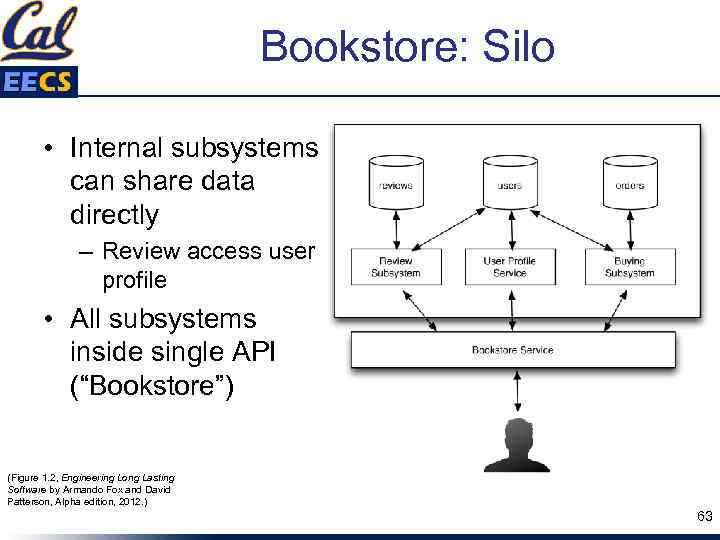 Bookstore: Silo • Internal subsystems can share data directly – Review access user profile • All subsystems inside single API (“Bookstore”) (Figure 1. 2, Engineering Long Lasting Software by Armando Fox and David Patterson, Alpha edition, 2012. ) 63
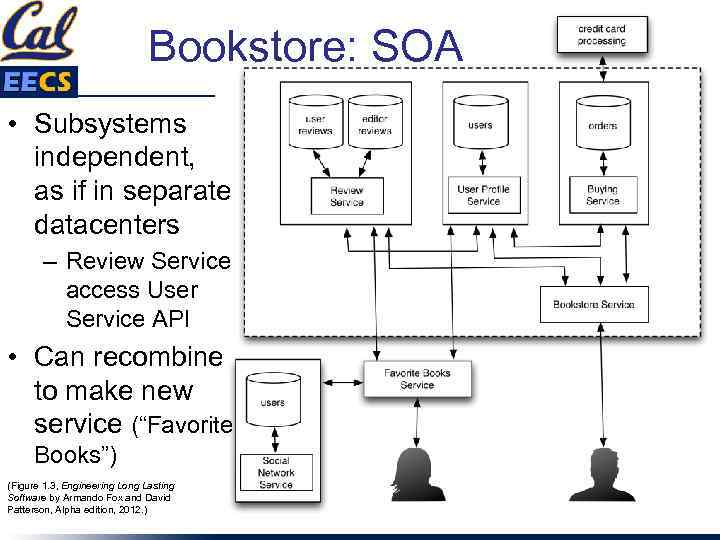 Bookstore: SOA • Subsystems independent, as if in separate datacenters – Review Service access User Service API • Can recombine to make new service (“Favorite Books”) (Figure 1. 3, Engineering Long Lasting Software by Armando Fox and David Patterson, Alpha edition, 2012. ) 64
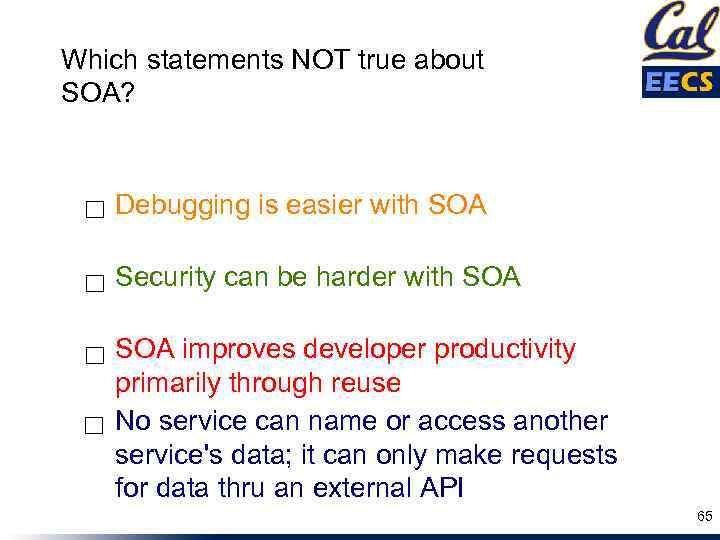 Which statements NOT true about SOA? ☐ Debugging is easier with SOA ☐ Security can be harder with SOA ☐ SOA improves developer productivity primarily through reuse ☐ No service can name or access another service's data; it can only make requests for data thru an external API 65
 Cloud Computing, Fallacies and Pitfalls, and End of Chapter 1 (Engineering Long Lasting Software §§ 1. 8, 1. 9, 1. 12) David Patterson 66
 Saa. S Infrastructure? • Saa. S demands on infrastructure 1. Communication: allow customers to interact with service 2. Scalability: fluctuations in demand during + new services to add users rapidly 3. Dependability: service and communication continuously available 24 x 7 67
 Clusters • Clusters: Commodity computers connected by commodity Ethernet switches 1. More scalable than conventional servers 2. Much cheaper than conventional servers – 20 X for equivalent vs. largest servers 3. Few operators for 1000 s servers – Careful selection of identical HW/SW – Virtual Machine Monitors simplify operation 4. Dependability via extensive redundancy 68
 Warehouse Scale Computers • Economies of scale pushed down cost of largest datacenter by factors 3 X to 8 X – Purchase, house, operate 100 K v. 1 K computers • Traditional datacenters utilized 10% - 20% • Make profit offering pay-as-you-go use at less than your costs for as many computers as you need 69
 Utility Computing / Public Cloud Computing • Offers computing, storage, communication at pennies per hour + • No premium to scale: 1000 computers @ 1 hour = 1 computer @ 1000 hours • Illusion of infinite scalability to cloud user – As many computers as you can afford • Leading examples: Amazon Web Services, Google App Engine, Microsoft Azure 70
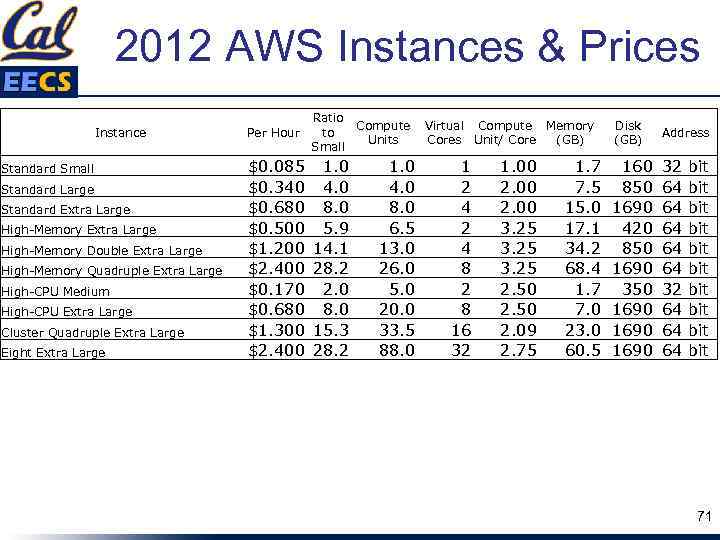 2012 AWS Instances & Prices Instance Standard Small Standard Large Standard Extra Large High-Memory Double Extra Large High-Memory Quadruple Extra Large High-CPU Medium High-CPU Extra Large Cluster Quadruple Extra Large Eight Extra Large Ratio Compute Per Hour to Units Small $0. 085 $0. 340 $0. 680 $0. 500 $1. 200 $2. 400 $0. 170 $0. 680 $1. 300 $2. 400 1. 0 4. 0 8. 0 5. 9 14. 1 28. 2 2. 0 8. 0 15. 3 28. 2 1. 0 4. 0 8. 0 6. 5 13. 0 26. 0 5. 0 20. 0 33. 5 88. 0 Virtual Compute Memory Cores Unit/ Core (GB) 1 2 4 8 2 8 16 32 1. 00 2. 00 3. 25 2. 50 2. 09 2. 75 1. 7 7. 5 15. 0 17. 1 34. 2 68. 4 1. 7 7. 0 23. 0 60. 5 Disk (GB) Address 160 850 1690 420 850 1690 350 1690 32 64 64 64 bit bit bit 71
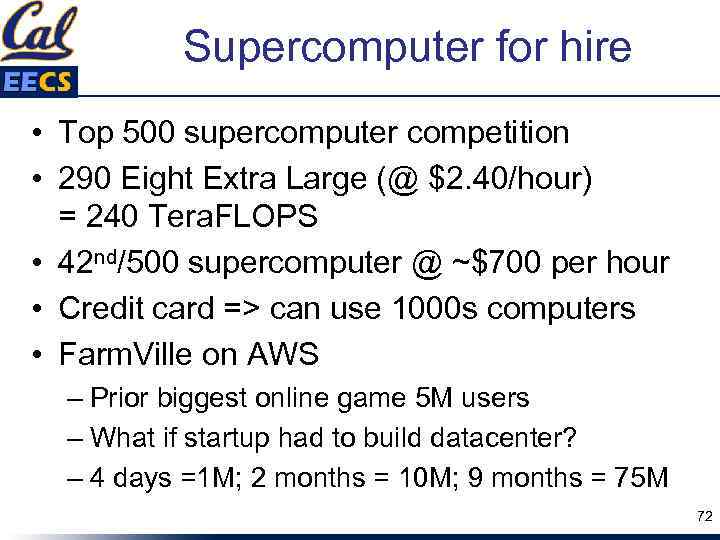 Supercomputer for hire • Top 500 supercomputer competition • 290 Eight Extra Large (@ $2. 40/hour) = 240 Tera. FLOPS • 42 nd/500 supercomputer @ ~$700 per hour • Credit card => can use 1000 s computers • Farm. Ville on AWS – Prior biggest online game 5 M users – What if startup had to build datacenter? – 4 days =1 M; 2 months = 10 M; 9 months = 75 M 72
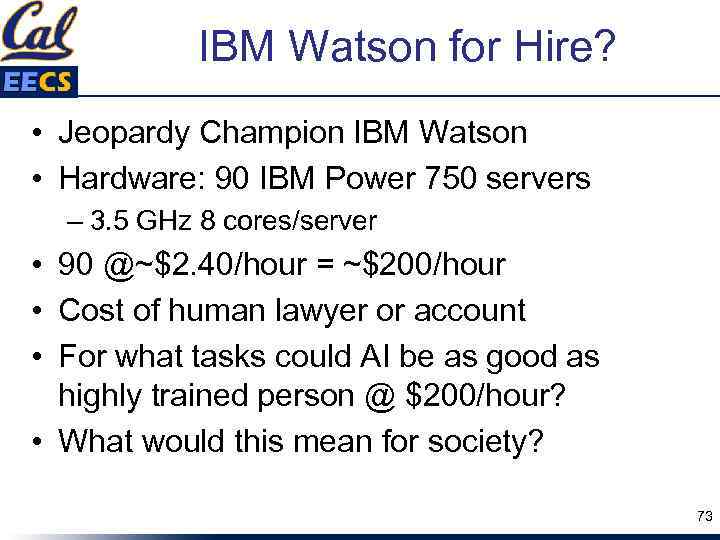 IBM Watson for Hire? • Jeopardy Champion IBM Watson • Hardware: 90 IBM Power 750 servers – 3. 5 GHz 8 cores/server • 90 @~$2. 40/hour = ~$200/hour • Cost of human lawyer or account • For what tasks could AI be as good as highly trained person @ $200/hour? • What would this mean for society? 73
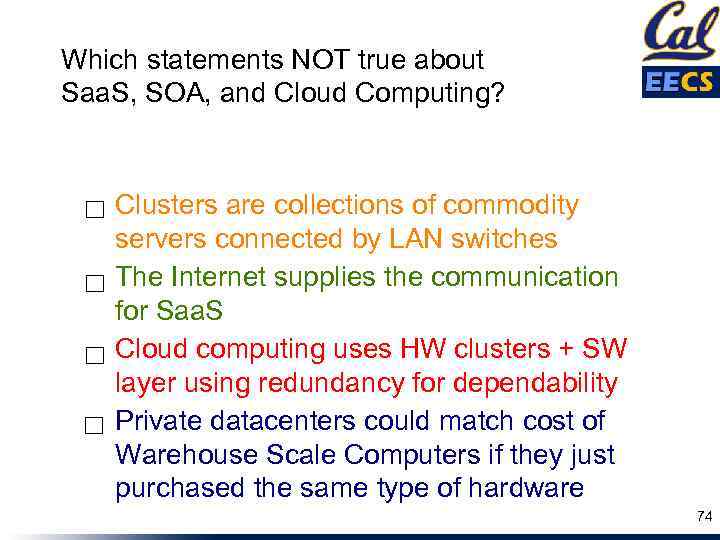 Which statements NOT true about Saa. S, SOA, and Cloud Computing? ☐ Clusters are collections of commodity servers connected by LAN switches ☐ The Internet supplies the communication for Saa. S ☐ Cloud computing uses HW clusters + SW layer using redundancy for dependability ☐ Private datacenters could match cost of Warehouse Scale Computers if they just purchased the same type of hardware 74
 Fallacies and Pitfalls • Fallacy: If a software project is falling behind schedule, catch up by adding people – Adding people actual makes it worse! 1. Time for new people to learn about project 2. Communication increases as project grows, which reduces time available get work done “Adding manpower to a late software project makes it later. ” Fred Brooks, Jr. The Mythical Man Month 75
 Fallacies and Pitfalls • Pitfall: Ignoring the cost of software design – Since ≈0 cost to manufacture software, might believe ≈0 cost to remanufacture the way the customer wants – Ignores the cost of design and test • (Is cost ~no cost of manufacturing software/data same rationale to pirate data? No one should pay for development, just for manufacturing? ) 76
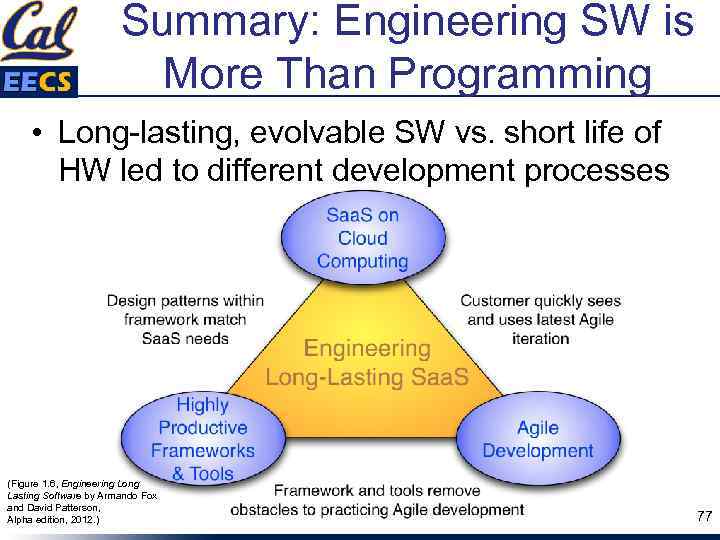 Summary: Engineering SW is More Than Programming • Long-lasting, evolvable SW vs. short life of HW led to different development processes (Figure 1. 6, Engineering Long Lasting Software by Armando Fox and David Patterson, Alpha edition, 2012. ) 77