


 Скачать презентацию CS 162 Operating Systems and Systems Programming Lecture
5105f5163cf51fdefb879550ef99671f.ppt
- Количество слайдов: 45
 CS 162 Operating Systems and Systems Programming Lecture 24 Capstone: Cloud Computing April 29, 2013 Anthony D. Joseph http: //inst. eecs. berkeley. edu/~cs 162
 Goals for Today • Distributed systems • Cloud Computing programming paradigms • Cloud Computing OS Note: Some slides and/or pictures in the following are adapted from slides Ali Ghodsi. 4/29/2013 Anthony D. Joseph CS 162 ©UCB Spring 2013 24. 2
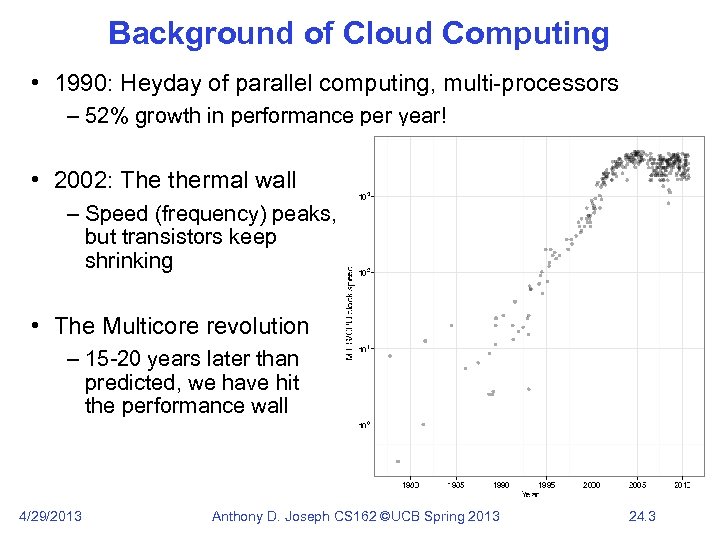 Background of Cloud Computing • 1990: Heyday of parallel computing, multi-processors – 52% growth in performance per year! • 2002: The thermal wall – Speed (frequency) peaks, but transistors keep shrinking • The Multicore revolution – 15 -20 years later than predicted, we have hit the performance wall 4/29/2013 Anthony D. Joseph CS 162 ©UCB Spring 2013 24. 3
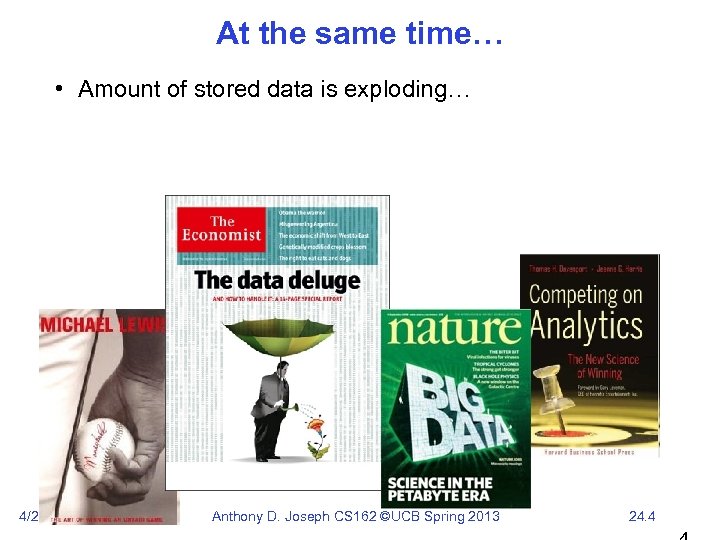 At the same time… • Amount of stored data is exploding… 4/29/2013 Anthony D. Joseph CS 162 ©UCB Spring 2013 24. 4
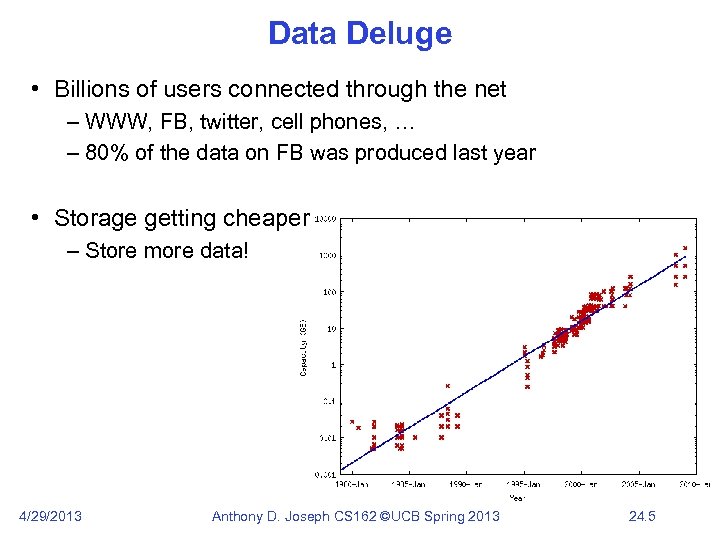 Data Deluge • Billions of users connected through the net – WWW, FB, twitter, cell phones, … – 80% of the data on FB was produced last year • Storage getting cheaper – Store more data! 4/29/2013 Anthony D. Joseph CS 162 ©UCB Spring 2013 24. 5
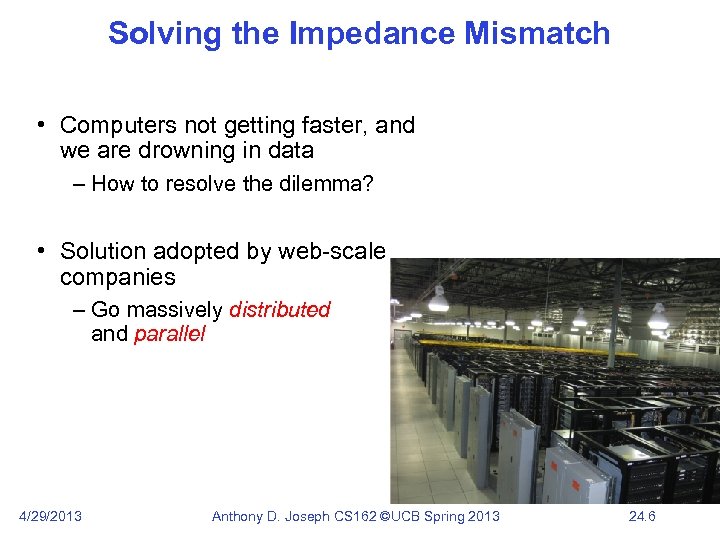 Solving the Impedance Mismatch • Computers not getting faster, and we are drowning in data – How to resolve the dilemma? • Solution adopted by web-scale companies – Go massively distributed and parallel 4/29/2013 Anthony D. Joseph CS 162 ©UCB Spring 2013 24. 6
 Enter the World of Distributed Systems • Distributed Systems/Computing – Loosely coupled set of computers, communicating through message passing, solving a common goal • Distributed computing is challenging – Dealing with partial failures (examples? ) – Dealing with asynchrony (examples? ) • Distributed Computing versus Parallel Computing? – distributed computing=parallel computing + partial failures 4/29/2013 Anthony D. Joseph CS 162 ©UCB Spring 2013 24. 7
 Dealing with Distribution • We have seen several of the tools that help with distributed programming – Message Passing Interface (MPI) – Distributed Shared Memory (DSM) – Remote Procedure Calls (RPC) • But, distributed programming is still very hard – Programming for scale, fault-tolerance, consistency, … 4/29/2013 Anthony D. Joseph CS 162 ©UCB Spring 2013 24. 8
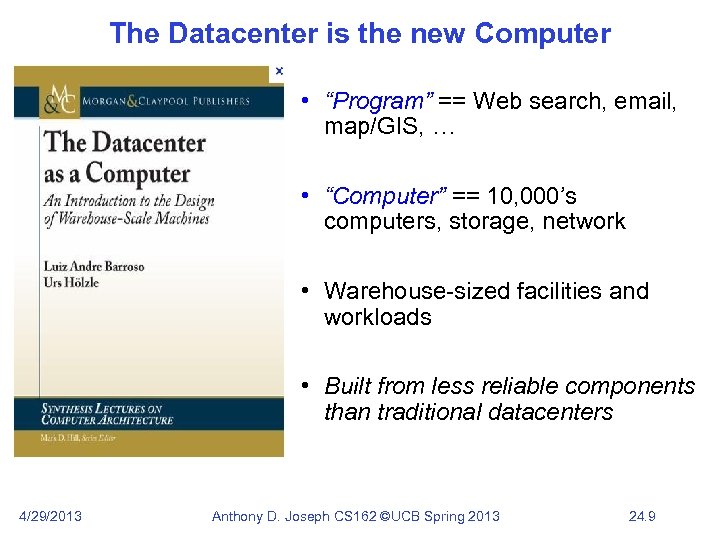 The Datacenter is the new Computer • “Program” == Web search, email, map/GIS, … • “Computer” == 10, 000’s computers, storage, network • Warehouse-sized facilities and workloads • Built from less reliable components than traditional datacenters 4/29/2013 Anthony D. Joseph CS 162 ©UCB Spring 2013 24. 9
 Datacenter/Cloud Computing OS • If the datacenter/cloud is the new computer – What is its Operating System? – Note that we are not talking about a host OS 4/29/2013 Anthony D. Joseph CS 162 ©UCB Spring 2013 24. 10
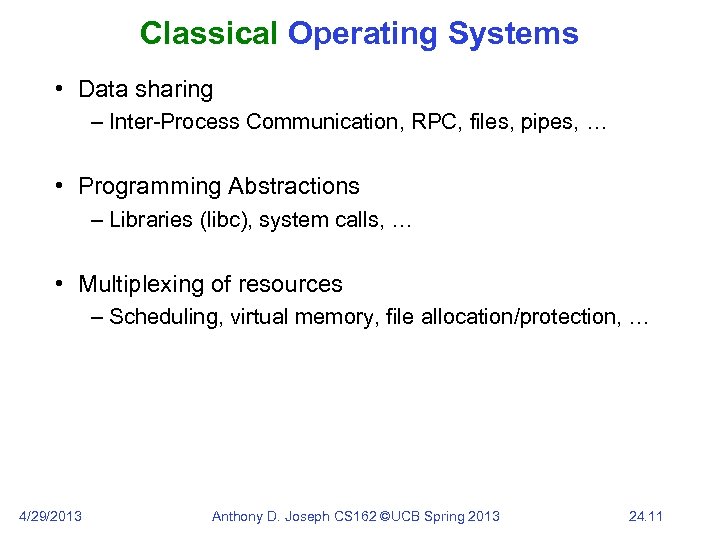 Classical Operating Systems • Data sharing – Inter-Process Communication, RPC, files, pipes, … • Programming Abstractions – Libraries (libc), system calls, … • Multiplexing of resources – Scheduling, virtual memory, file allocation/protection, … 4/29/2013 Anthony D. Joseph CS 162 ©UCB Spring 2013 24. 11
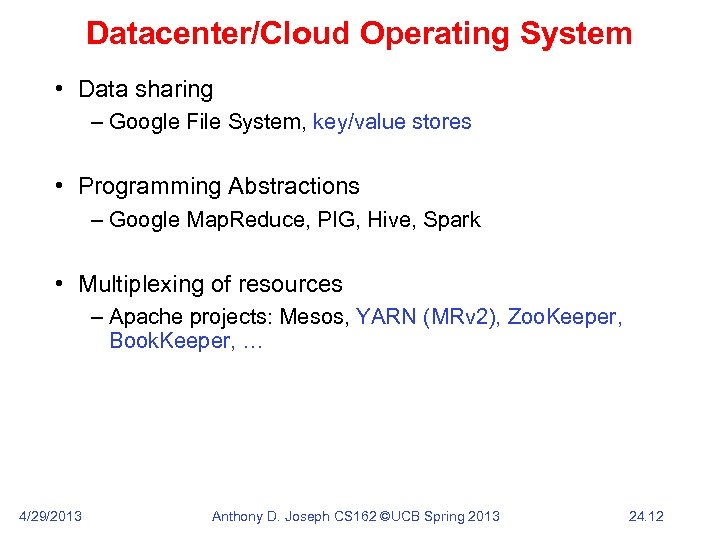 Datacenter/Cloud Operating System • Data sharing – Google File System, key/value stores • Programming Abstractions – Google Map. Reduce, PIG, Hive, Spark • Multiplexing of resources – Apache projects: Mesos, YARN (MRv 2), Zoo. Keeper, Book. Keeper, … 4/29/2013 Anthony D. Joseph CS 162 ©UCB Spring 2013 24. 12
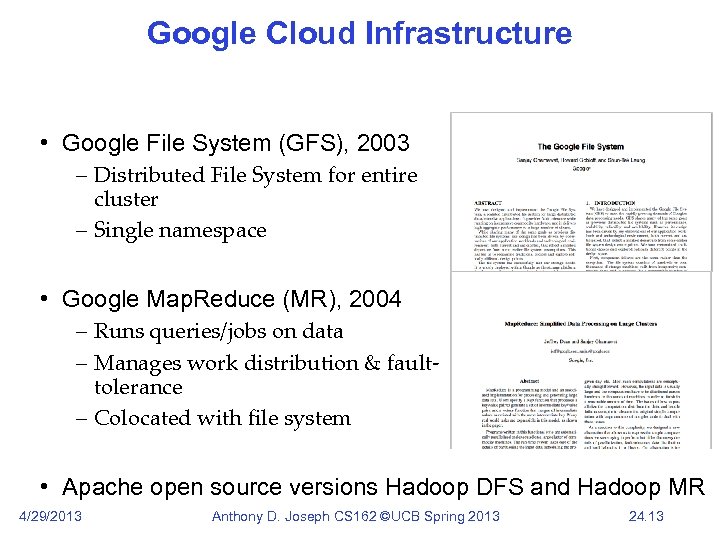 Google Cloud Infrastructure • Google File System (GFS), 2003 – Distributed File System for entire cluster – Single namespace • Google Map. Reduce (MR), 2004 – Runs queries/jobs on data – Manages work distribution & faulttolerance – Colocated with file system • Apache open source versions Hadoop DFS and Hadoop MR 4/29/2013 Anthony D. Joseph CS 162 ©UCB Spring 2013 24. 13
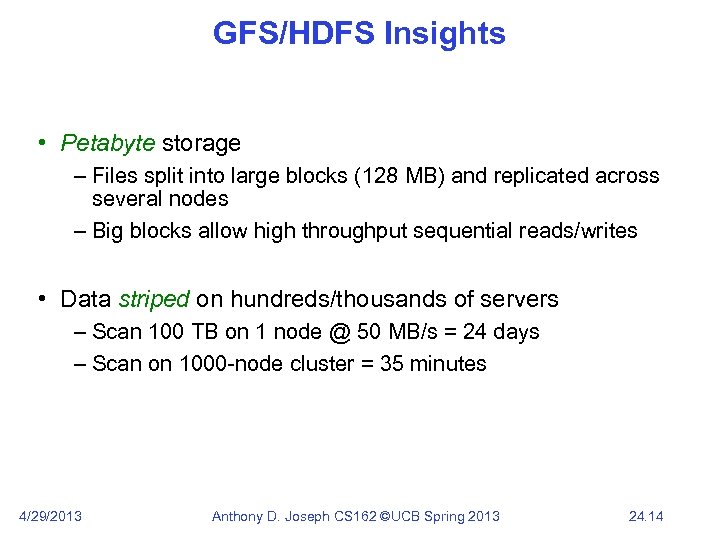 GFS/HDFS Insights • Petabyte storage – Files split into large blocks (128 MB) and replicated across several nodes – Big blocks allow high throughput sequential reads/writes • Data striped on hundreds/thousands of servers – Scan 100 TB on 1 node @ 50 MB/s = 24 days – Scan on 1000 -node cluster = 35 minutes 4/29/2013 Anthony D. Joseph CS 162 ©UCB Spring 2013 24. 14
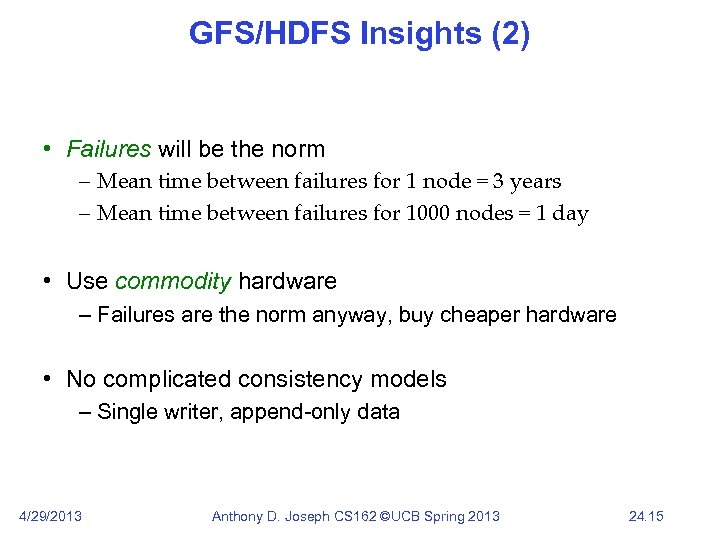 GFS/HDFS Insights (2) • Failures will be the norm – Mean time between failures for 1 node = 3 years – Mean time between failures for 1000 nodes = 1 day • Use commodity hardware – Failures are the norm anyway, buy cheaper hardware • No complicated consistency models – Single writer, append-only data 4/29/2013 Anthony D. Joseph CS 162 ©UCB Spring 2013 24. 15
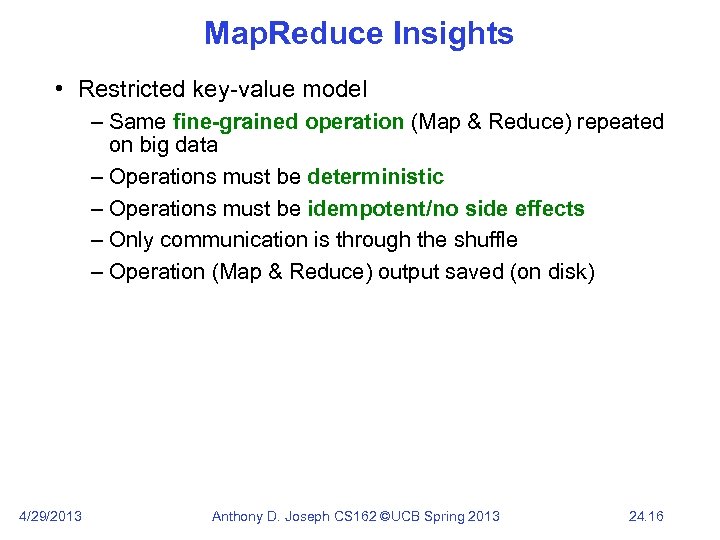 Map. Reduce Insights • Restricted key-value model – Same fine-grained operation (Map & Reduce) repeated on big data – Operations must be deterministic – Operations must be idempotent/no side effects – Only communication is through the shuffle – Operation (Map & Reduce) output saved (on disk) 4/29/2013 Anthony D. Joseph CS 162 ©UCB Spring 2013 24. 16
 What is Map. Reduce Used For? • At Google: – Index building for Google Search – Article clustering for Google News – Statistical machine translation • At Yahoo!: – Index building for Yahoo! Search – Spam detection for Yahoo! Mail • At Facebook: – Data mining – Ad optimization – Spam detection 4/29/2013 Anthony D. Joseph CS 162 ©UCB Spring 2013 24. 17
 Map. Reduce Pros • Distribution is completely transparent – Not a single line of distributed programming (ease, correctness) • Automatic fault-tolerance – Determinism enables running failed tasks somewhere else again – Saved intermediate data enables just re-running failed reducers • Automatic scaling – As operations as side-effect free, they can be distributed to any number of machines dynamically • Automatic load-balancing – Move tasks and speculatively execute duplicate copies of slow tasks (stragglers) 4/29/2013 Anthony D. Joseph CS 162 ©UCB Spring 2013 24. 18
 Map. Reduce Cons • Restricted programming model – Not always natural to express problems in this model – Low-level coding necessary – Little support for iterative jobs (lots of disk access) – High-latency (batch processing) • Addressed by follow-up research – Pig and Hive for high-level coding – Spark for iterative and low-latency jobs 4/29/2013 Anthony D. Joseph CS 162 ©UCB Spring 2013 24. 19
 Pig • High-level language: – Expresses sequences of Map. Reduce jobs – Provides relational (SQL) operators (JOIN, GROUP BY, etc) – Easy to plug in Java functions • Started at Yahoo! Research – Runs about 50% of Yahoo!’s jobs 4/29/2013 Anthony D. Joseph CS 162 ©UCB Spring 2013 24. 20
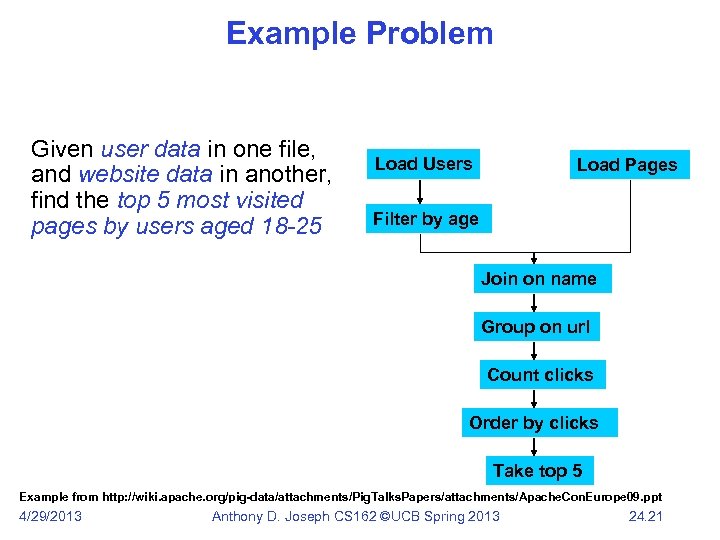 Example Problem Given user data in one file, and website data in another, find the top 5 most visited pages by users aged 18 -25 Load Users Load Pages Filter by age Join on name Group on url Count clicks Order by clicks Take top 5 Example from http: //wiki. apache. org/pig-data/attachments/Pig. Talks. Papers/attachments/Apache. Con. Europe 09. ppt 4/29/2013 Anthony D. Joseph CS 162 ©UCB Spring 2013 24. 21
 In Map. Reduce 4/29/2013 Anthony D. Joseph CS 162 ©UCB Spring 2013 24. 22 Example from http: //wiki. apache. org/pig-data/attachments/Pig. Talks. Papers/attachments/Apache. Con. Europe 09. ppt
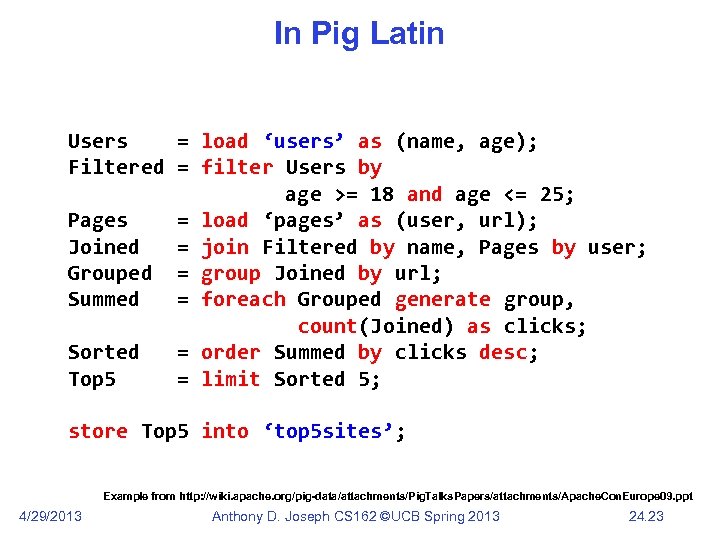 In Pig Latin Users = load ‘users’ as (name, age); Filtered = filter Users by age >= 18 and age <= 25; Pages = load ‘pages’ as (user, url); Joined = join Filtered by name, Pages by user; Grouped = group Joined by url; Summed = foreach Grouped generate group, count(Joined) as clicks; Sorted = order Summed by clicks desc; Top 5 = limit Sorted 5; store Top 5 into ‘top 5 sites’; Example from http: //wiki. apache. org/pig-data/attachments/Pig. Talks. Papers/attachments/Apache. Con. Europe 09. ppt 4/29/2013 Anthony D. Joseph CS 162 ©UCB Spring 2013 24. 23
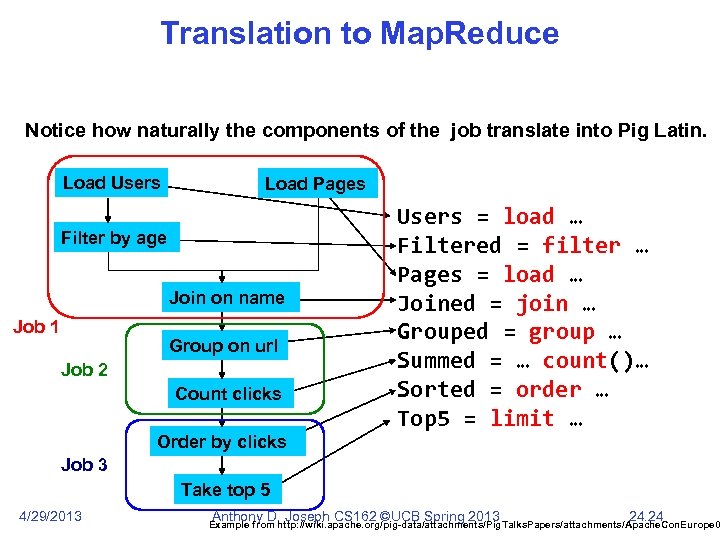 Translation to Map. Reduce Notice how naturally the components of the job translate into Pig Latin. Load Users Load Pages Filter by age Join on name Job 1 Group on url Job 2 Count clicks Order by clicks Users = load … Filtered = filter … Pages = load … Joined = join … Grouped = group … Summed = … count()… Sorted = order … Top 5 = limit … Job 3 Take top 5 4/29/2013 Anthony D. Joseph CS 162 ©UCB Spring 2013 24. 24 Example from http: //wiki. apache. org/pig-data/attachments/Pig. Talks. Papers/attachments/Apache. Con. Europe 0
 Hive • Relational database built on Hadoop – Maintains table schemas – SQL-like query language (which can also call Hadoop Streaming scripts) – Supports table partitioning, complex data types, sampling, some query optimization • Developed at Facebook – Used for many Facebook jobs 4/29/2013 Anthony D. Joseph CS 162 ©UCB Spring 2013 24. 25
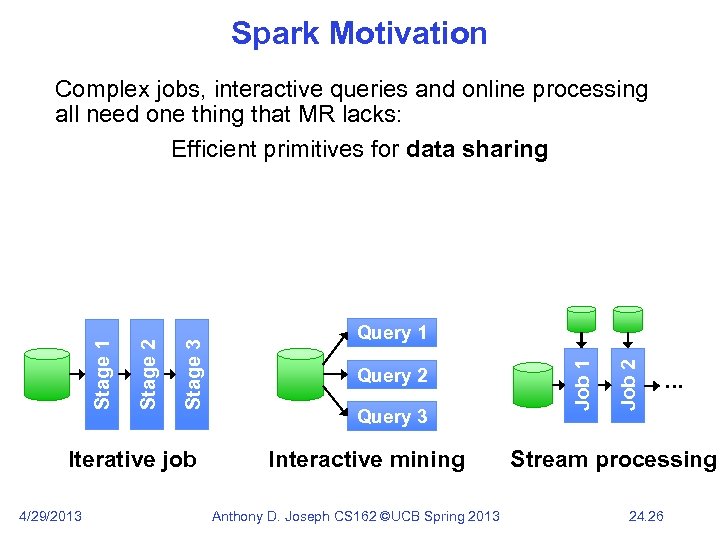 Spark Motivation Iterative job 4/29/2013 Query 2 Query 3 Interactive mining Anthony D. Joseph CS 162 ©UCB Spring 2013 Job 2 Query 1 Job 1 Stage 3 Stage 2 Stage 1 Complex jobs, interactive queries and online processing all need one thing that MR lacks: Efficient primitives for data sharing … Stream processing 24. 26
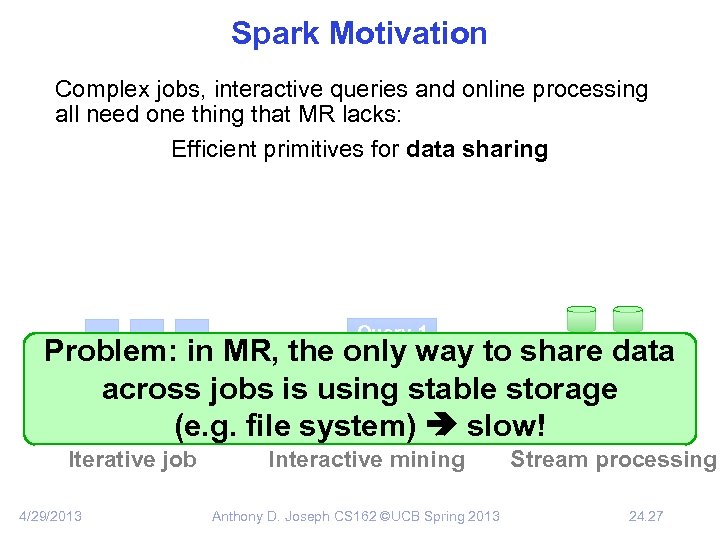 Spark Motivation Complex jobs, interactive queries and online processing all need one thing that MR lacks: Efficient primitives for data sharing Query 1 Iterative job 4/29/2013 Interactive mining Anthony D. Joseph CS 162 ©UCB Spring 2013 Job 2 Job 1 Stage 3 Stage 2 Stage 1 Problem: in MR, the only way to share data Query 2 across jobs is using stable storage … Query (e. g. file system)3 slow! Stream processing 24. 27
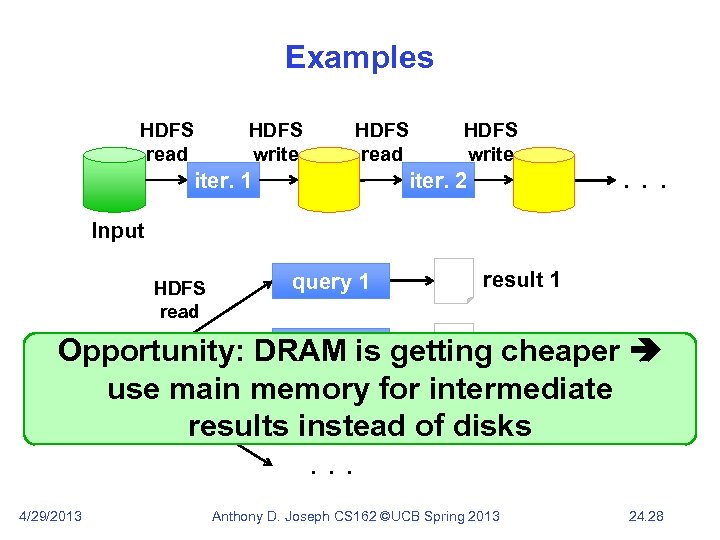 Examples HDFS read HDFS write HDFS read iter. 1 HDFS write . . . iter. 2 Input HDFS read query 1 result 2 query 2 Opportunity: DRAM is getting cheaper use main memory for intermediate result 3 query 3 Input results instead of disks. . . 4/29/2013 Anthony D. Joseph CS 162 ©UCB Spring 2013 24. 28
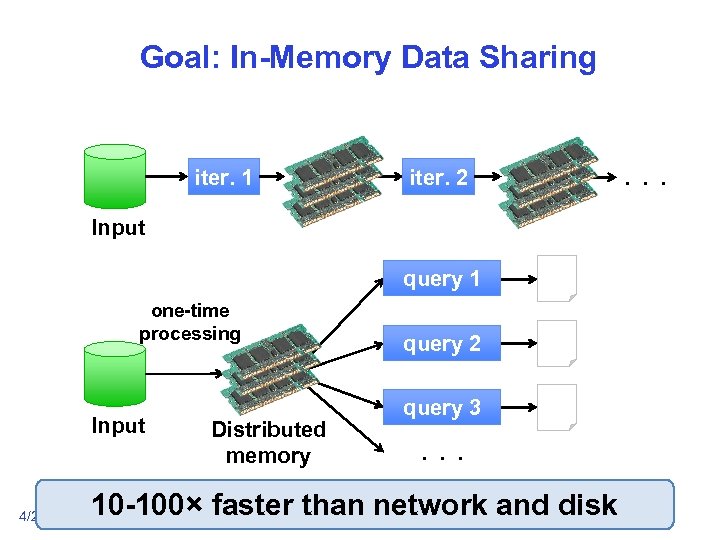 Goal: In-Memory Data Sharing iter. 1 iter. 2 . . . Input query 1 one-time processing Input 4/29/2013 Distributed memory query 2 query 3. . . 10 -100× faster than network and disk Anthony D. Joseph CS 162 ©UCB Spring 2013 24. 29
 Solution: Resilient Distributed Datasets (RDDs) • Partitioned collections of records that can be stored in memory across the cluster • Manipulated through a diverse set of transformations (map, filter, join, etc) • Fault recovery without costly replication – Remember the series of transformations that built an RDD (its lineage) to recompute lost data • http: //www. spark-project. org/ 4/29/2013 Anthony D. Joseph CS 162 ©UCB Spring 2013 24. 30
 Administrivia • Project 4 – Design Doc due tonight (4/29) by 11: 59 pm, reviews Wed-Fri – Code due next week Thu 4/9 by 11: 59 pm • Final Exam Review – Monday 5/6, 2 -5 pm in 100 Lewis Hall • My RRR week office hours – Monday 5/6, 1 -2 pm and Wednesday 5/8, 2 -3 pm • Cyber. Bunker. com 300 Gb/s DDo. S attack against Spamhaus – 35 yr old Dutchman “S. K. ” arrested in Spain on 4/26 – Was using van with “various antennas” as mobile office 4/29/2013 Anthony D. Joseph CS 162 ©UCB Spring 2013 24. 31
 5 min Break 4/29/2013 Anthony D. Joseph CS 162 ©UCB Spring 2013 24. 32
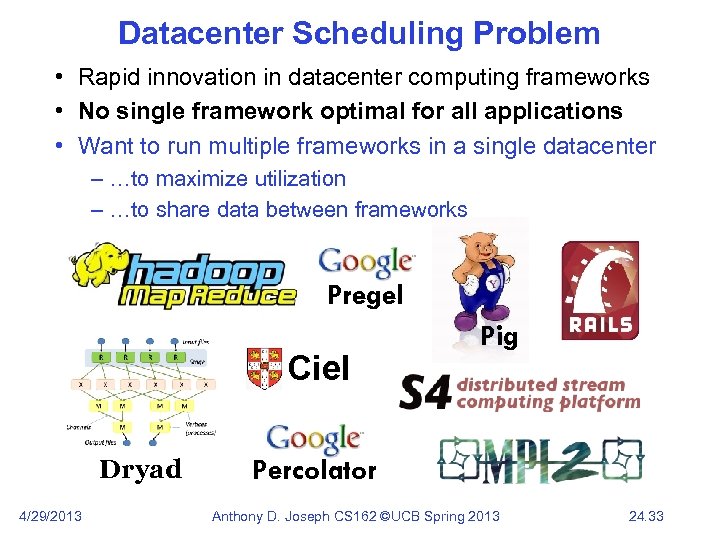 Datacenter Scheduling Problem • Rapid innovation in datacenter computing frameworks • No single framework optimal for all applications • Want to run multiple frameworks in a single datacenter – …to maximize utilization – …to share data between frameworks Pregel Ciel Dryad 4/29/2013 Pig Percolator Anthony D. Joseph CS 162 ©UCB Spring 2013 24. 33
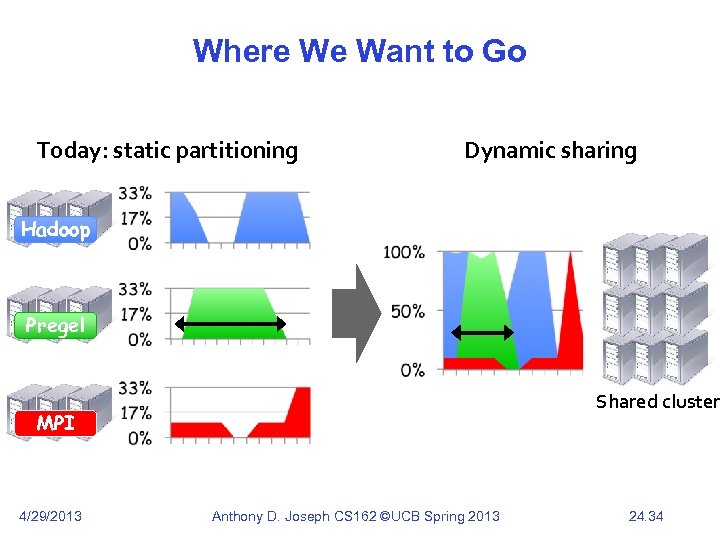 Where We Want to Go Today: static partitioning Dynamic sharing Hadoop Pregel Shared cluster MPI 4/29/2013 Anthony D. Joseph CS 162 ©UCB Spring 2013 24. 34
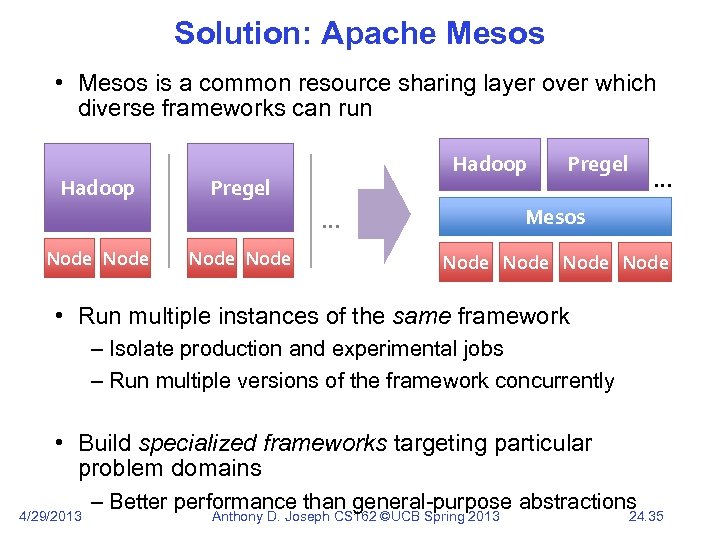 Solution: Apache Mesos • Mesos is a common resource sharing layer over which diverse frameworks can run Hadoop Pregel Node … Mesos … Node Pregel Node • Run multiple instances of the same framework – Isolate production and experimental jobs – Run multiple versions of the framework concurrently • Build specialized frameworks targeting particular problem domains 4/29/2013 – Better performance than general-purpose abstractions Anthony D. Joseph CS 162 ©UCB Spring 2013 24. 35
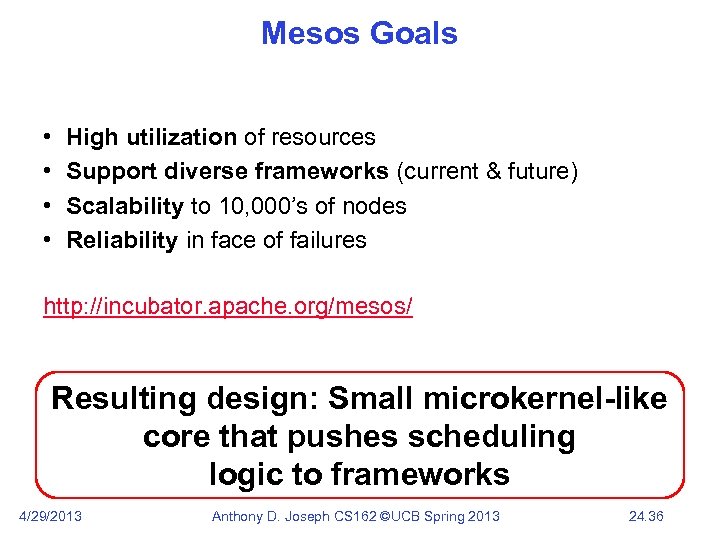 Mesos Goals • • High utilization of resources Support diverse frameworks (current & future) Scalability to 10, 000’s of nodes Reliability in face of failures http: //incubator. apache. org/mesos/ Resulting design: Small microkernel-like core that pushes scheduling logic to frameworks 4/29/2013 Anthony D. Joseph CS 162 ©UCB Spring 2013 24. 36
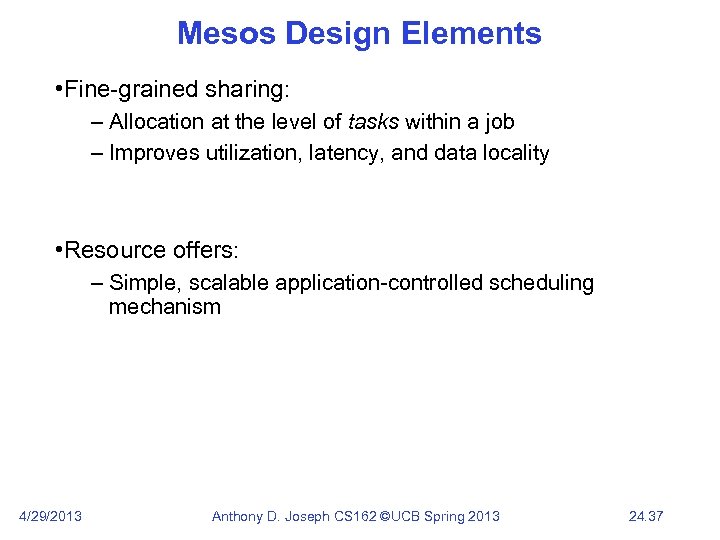 Mesos Design Elements • Fine-grained sharing: – Allocation at the level of tasks within a job – Improves utilization, latency, and data locality • Resource offers: – Simple, scalable application-controlled scheduling mechanism 4/29/2013 Anthony D. Joseph CS 162 ©UCB Spring 2013 24. 37
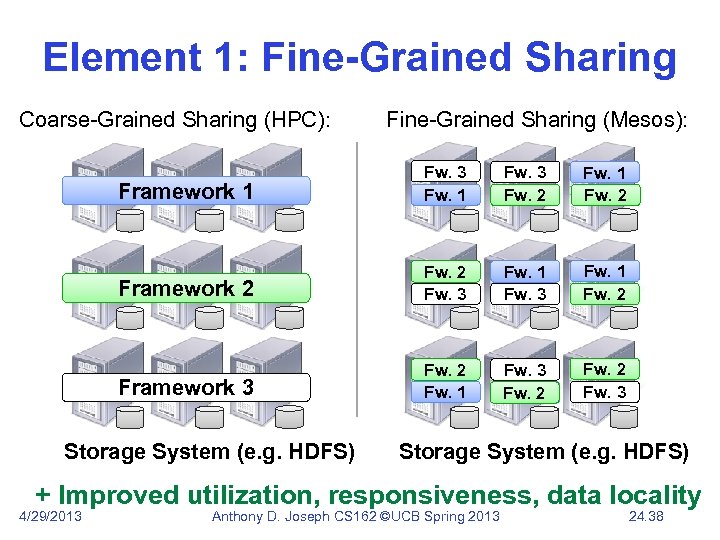 Element 1: Fine-Grained Sharing Coarse-Grained Sharing (HPC): Fine-Grained Sharing (Mesos): Framework 1 Fw. 3 Fw. 1 3 Fw. 2 Fw. 1 Fw. 2 Framework 2 Fw. 3 Fw. 1 Fw. 3 Fw. 2 Framework 3 Fw. 2 Fw. 1 Fw. 3 1 Fw. 2 Fw. 3 Storage System (e. g. HDFS) + Improved utilization, responsiveness, data locality 4/29/2013 Anthony D. Joseph CS 162 ©UCB Spring 2013 24. 38
 Element 2: Resource Offers • Option: Global scheduler – Frameworks express needs in a specification language, global scheduler matches them to resources + Can make optimal decisions – Complex: language must support all framework needs – Difficult to scale and to make robust – Future frameworks may have unanticipated needs 4/29/2013 Anthony D. Joseph CS 162 ©UCB Spring 2013 24. 39
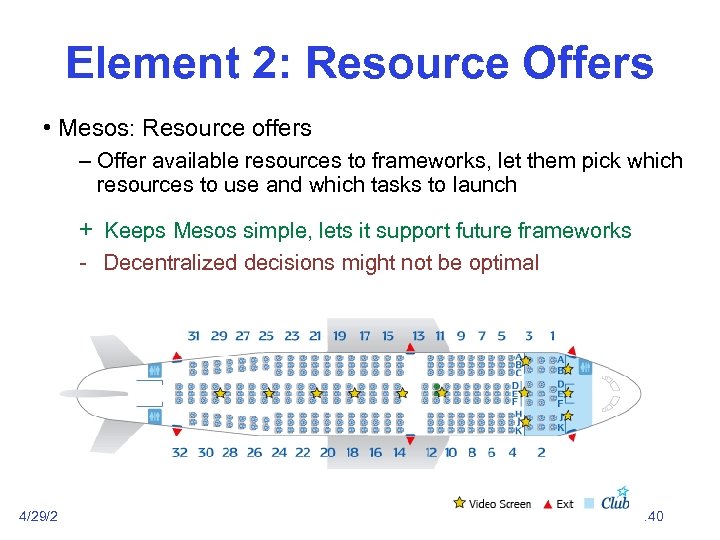 Element 2: Resource Offers • Mesos: Resource offers – Offer available resources to frameworks, let them pick which resources to use and which tasks to launch + Keeps Mesos simple, lets it support future frameworks - Decentralized decisions might not be optimal 4/29/2013 Anthony D. Joseph CS 162 ©UCB Spring 2013 24. 40
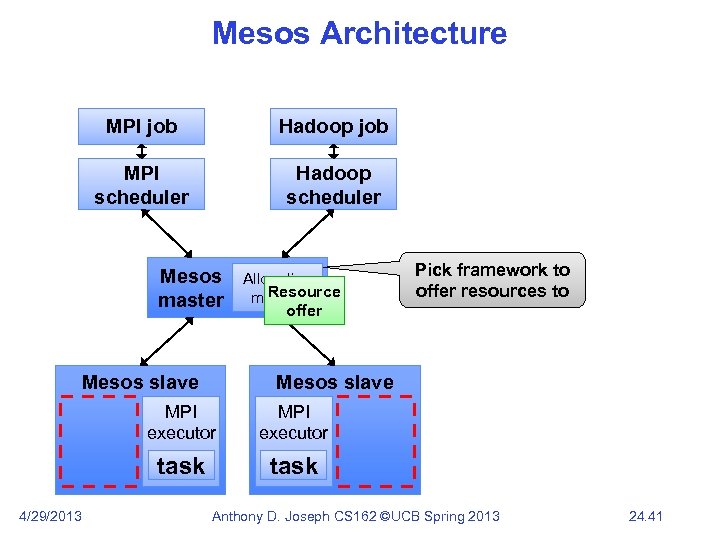 Mesos Architecture MPI job Hadoop job MPI scheduler Hadoop scheduler Mesos master Mesos slave Allocation Resource module offer Mesos slave MPI executor task 4/29/2013 Pick framework to offer resources to task Anthony D. Joseph CS 162 ©UCB Spring 2013 24. 41
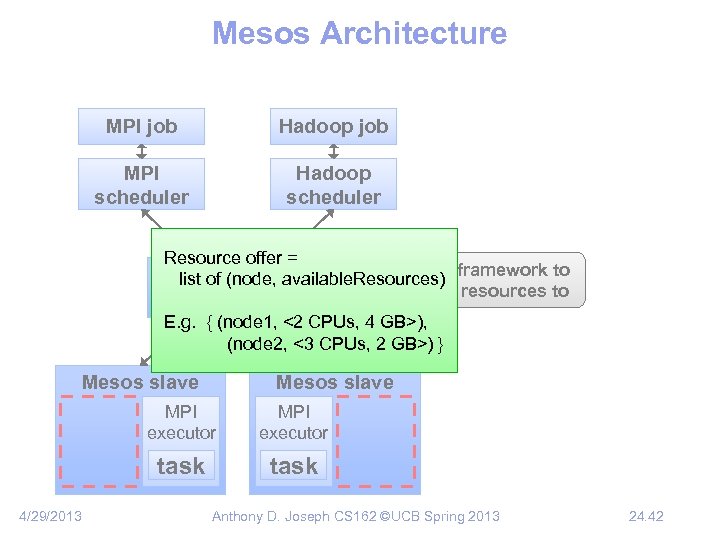 Mesos Architecture MPI job Hadoop job MPI scheduler Hadoop scheduler Resource offer = Pick Mesos (node, available. Resources) framework to list of Allocation Resource offer resources to module master offer E. g. { (node 1, <2 CPUs, 4 GB>), (node 2, <3 CPUs, 2 GB>) } Mesos slave MPI executor task 4/29/2013 MPI executor task Anthony D. Joseph CS 162 ©UCB Spring 2013 24. 42
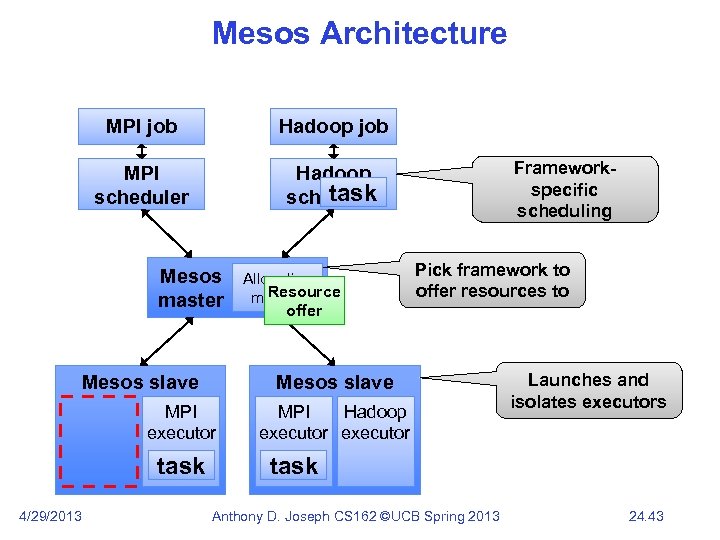 Mesos Architecture MPI job Hadoop job MPI scheduler Hadoop task scheduler Mesos master Mesos slave 4/29/2013 Pick framework to offer resources to Mesos slave MPI executor task Allocation Resource module offer Frameworkspecific scheduling MPI Hadoop executor Launches and isolates executors task Anthony D. Joseph CS 162 ©UCB Spring 2013 24. 43
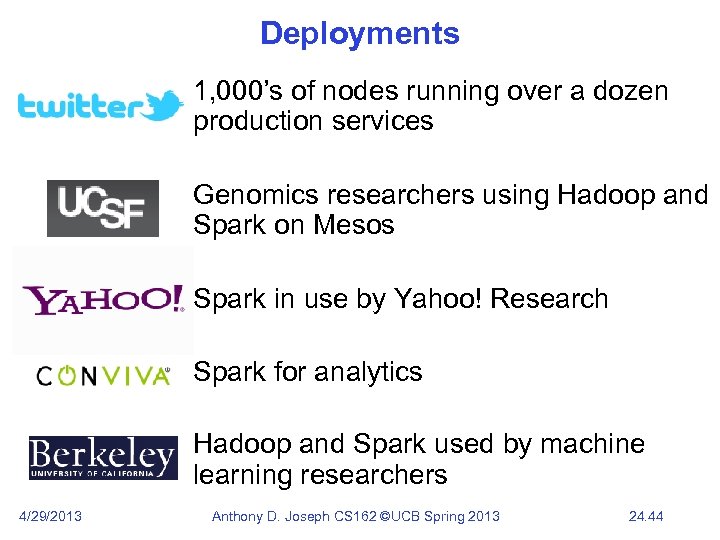 Deployments 1, 000’s of nodes running over a dozen production services Genomics researchers using Hadoop and Spark on Mesos Spark in use by Yahoo! Research Spark for analytics Hadoop and Spark used by machine learning researchers 4/29/2013 Anthony D. Joseph CS 162 ©UCB Spring 2013 24. 44
 Summary • Cloud computing/datacenters are the new computer – Emerging “Datacenter/Cloud Operating System” appearing • Pieces of the DC/Cloud OS – High-throughput filesystems (GFS/HDFS) – Job frameworks (Map. Reduce, Spark, Pregel) – High-level query languages (Pig, Hive) – Cluster scheduling (Apache Mesos) 4/29/2013 Anthony D. Joseph CS 162 ©UCB Spring 2013 24. 45