


 Скачать презентацию CS 162 Operating Systems and Systems Programming Lecture
4f63e16db219aab5ab70af1726e894fb.ppt
- Количество слайдов: 59
 CS 162 Operating Systems and Systems Programming Lecture 21 Security (II) April 13, 2011 Ion Stoica http: //inst. eecs. berkeley. edu/~cs 162
 Recap: Security Requirements in Distributed Systems • Authentication – Ensures that a user is who is claiming to be • Data integrity – Ensure that data is not changed from source to destination or after being written on a storage device • Confidentiality – Ensures that data is read only by authorized users • Non-repudiation – Sender/client can’t later claim didn’t send/write data – Receiver/server can’t claim didn’t receive/write data 4/13 Ion Stoica CS 162 ©UCB Spring 2011 Lec 21. 2
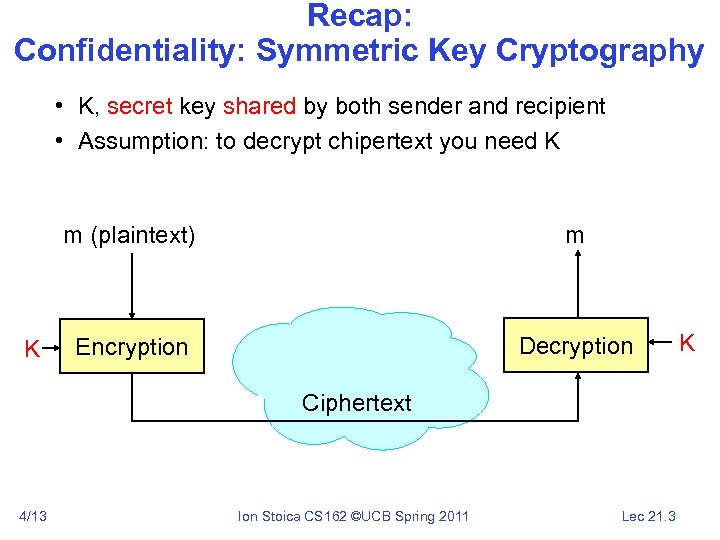 Recap: Confidentiality: Symmetric Key Cryptography • K, secret key shared by both sender and recipient • Assumption: to decrypt chipertext you need K m (plaintext) K m Encryption Decryption Ciphertext 4/13 Ion Stoica CS 162 ©UCB Spring 2011 Lec 21. 3 K
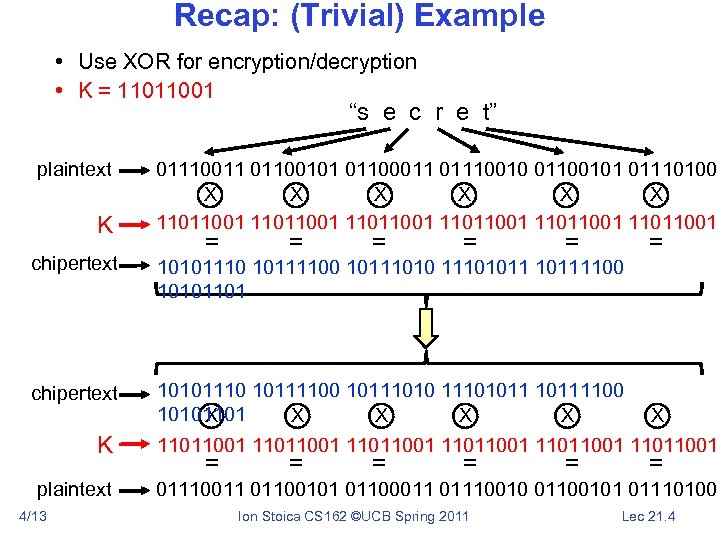 Recap: (Trivial) Example • Use XOR for encryption/decryption • K = 11011001 “s e c r e t” plaintext K 01110011 01100101 01100011 01110010 01100101 01110100 X X X 11011001 11011001 = = = chipertext 10101110 10111100 1011101011 10111100 10101101 chipertext K 10101110 10111100 1011101011 10111100 10101101 X X X 11011001 11011001 plaintext 01110011 01100101 01100011 01110010 01100101 01110100 4/13 = = Ion Stoica CS 162 ©UCB Spring 2011 = = Lec 21. 4
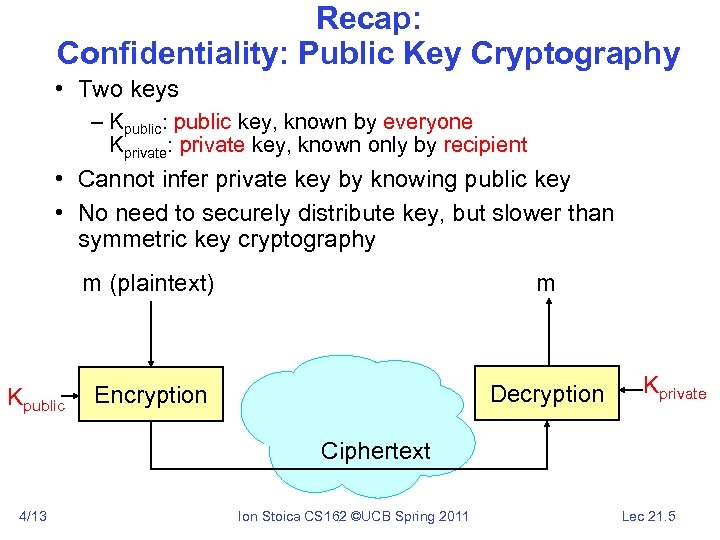 Recap: Confidentiality: Public Key Cryptography • Two keys – Kpublic: public key, known by everyone Kprivate: private key, known only by recipient • Cannot infer private key by knowing public key • No need to securely distribute key, but slower than symmetric key cryptography m (plaintext) Kpublic m Encryption Decryption Kprivate Ciphertext 4/13 Ion Stoica CS 162 ©UCB Spring 2011 Lec 21. 5
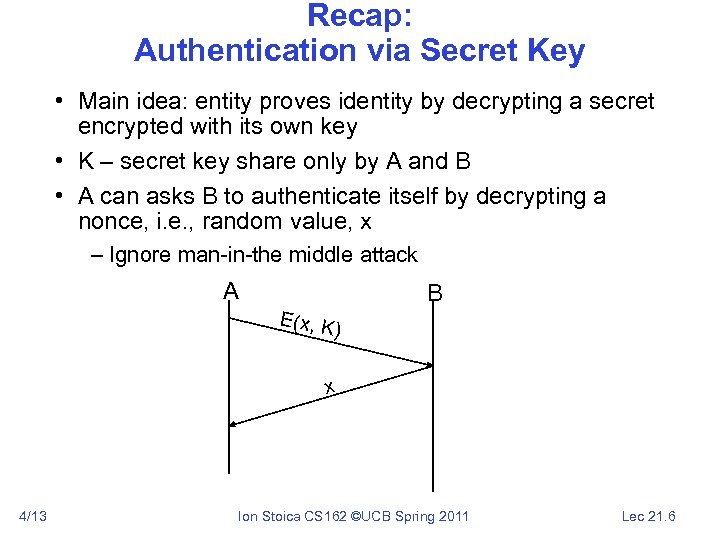 Recap: Authentication via Secret Key • Main idea: entity proves identity by decrypting a secret encrypted with its own key • K – secret key share only by A and B • A can asks B to authenticate itself by decrypting a nonce, i. e. , random value, x – Ignore man-in-the middle attack A B E(x, K ) x 4/13 Ion Stoica CS 162 ©UCB Spring 2011 Lec 21. 6
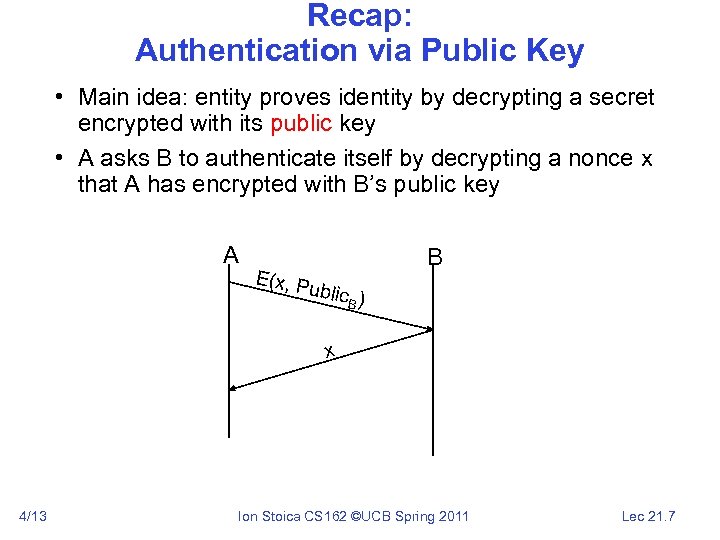 Recap: Authentication via Public Key • Main idea: entity proves identity by decrypting a secret encrypted with its public key • A asks B to authenticate itself by decrypting a nonce x that A has encrypted with B’s public key A B E(x, P ublic B) x 4/13 Ion Stoica CS 162 ©UCB Spring 2011 Lec 21. 7
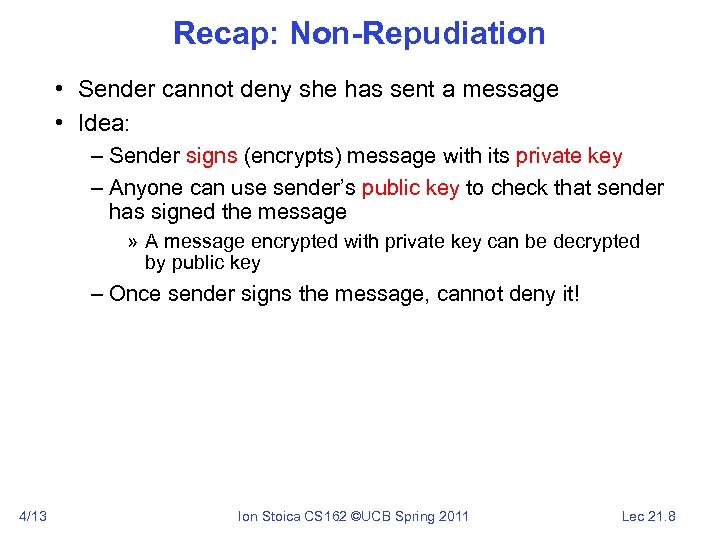 Recap: Non-Repudiation • Sender cannot deny she has sent a message • Idea: – Sender signs (encrypts) message with its private key – Anyone can use sender’s public key to check that sender has signed the message » A message encrypted with private key can be decrypted by public key – Once sender signs the message, cannot deny it! 4/13 Ion Stoica CS 162 ©UCB Spring 2011 Lec 21. 8
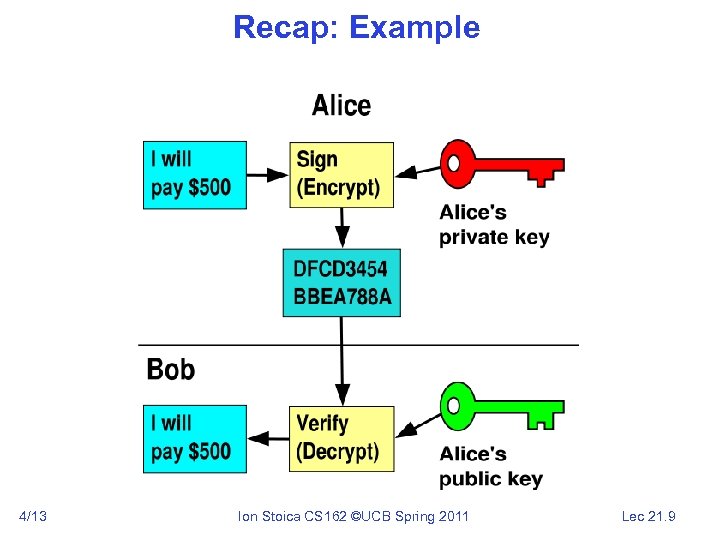 Recap: Example 4/13 Ion Stoica CS 162 ©UCB Spring 2011 Lec 21. 9
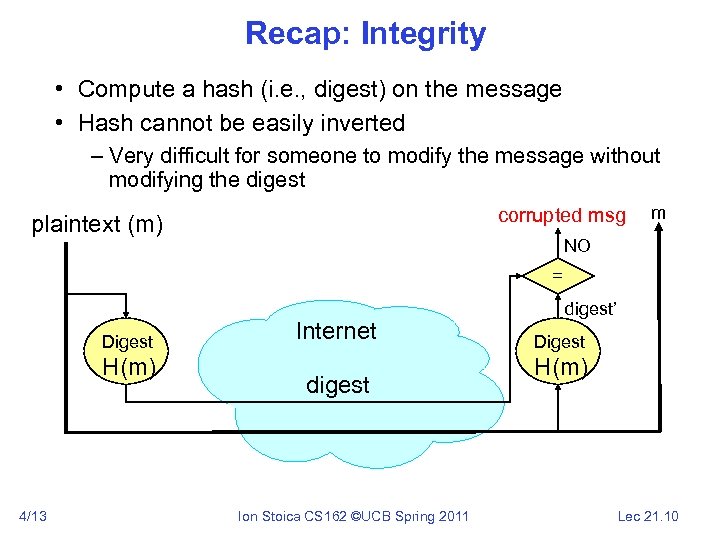 Recap: Integrity • Compute a hash (i. e. , digest) on the message • Hash cannot be easily inverted – Very difficult for someone to modify the message without modifying the digest corrupted msg plaintext (m) m NO = Digest H(m) 4/13 Internet digest Ion Stoica CS 162 ©UCB Spring 2011 digest’ Digest H(m) Lec 21. 10
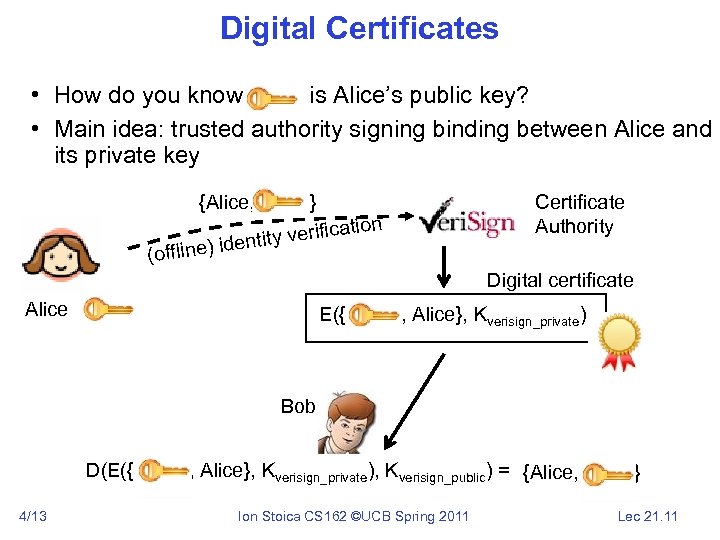 Digital Certificates • How do you know is Alice’s public key? • Main idea: trusted authority signing binding between Alice and its private key Certificate Authority {Alice, } on verificati y e) identit (offlin Digital certificate Alice E({ , Alice}, Kverisign_private) Bob D(E({ 4/13 , Alice}, Kverisign_private), Kverisign_public) = {Alice, Ion Stoica CS 162 ©UCB Spring 2011 } Lec 21. 11
 This Lecture • More authentication • Host Compromise – Attacker gains control of a host • Denial-of-Service – Attacker prevents legitimate users from gaining service • Attack can be both – E. g. , host compromise that provides resources for denialof-service 4/13 Ion Stoica CS 162 ©UCB Spring 2011 Lec 21. 12
 Authentication: Passwords • Shared secret between two parties • Since only user knows password, someone types correct password must be user typing it • Very common technique • System must keep copy of secret to check against passwords – What if malicious user gains access to list of passwords? » Need to obscure information somehow – Mechanism: utilize a transformation that is difficult to reverse without the right key (e. g. encryption) 4/13 Ion Stoica CS 162 ©UCB Spring 2011 Lec 21. 13
 Passwords: Secrecy “eggplant” • Example: UNIX /etc/passwd file – passwd one way transform(hash) encrypted passwd – System stores only encrypted version, so OK even if someone reads the file! – When you type in your password, system compares encrypted version 4/13 Ion Stoica CS 162 ©UCB Spring 2011 Lec 21. 14
 Passwords: How easy to guess? • Ways of Compromising Passwords – Password Guessing: » Often people use obvious information like birthday, favorite color, girlfriend’s name, etc… » Trivia question 1: what is the most popular password? » Trivia question 2: what is the next most popular password? » Answer: http: //www. nytimes. com/2010/01/21/technology/21 password. html – Dictionary Attack: » Work way through dictionary and compare encrypted version of dictionary words with entries in /etc/passwd – Dumpster Diving: » Find pieces of paper with passwords written on them » (Also used to get social-security numbers, etc) 4/13 Ion Stoica CS 162 ©UCB Spring 2011 Lec 21. 15
 Passwords: How easy to guess? (cont’d) • Paradox: – Short passwords are easy to crack – Long ones, people write down! • Technology means we have to use longer passwords – UNIX initially required lowercase, 5 -letter passwords: total of 265=10 million passwords » In 1975, 10 ms to check a password 1 day to crack » In 2005, . 01μs to check a password 0. 1 seconds to crack – Takes less time to check for all words in the dictionary! 4/13 Ion Stoica CS 162 ©UCB Spring 2011 Lec 21. 16
 Passwords: Making harder to crack • How can we make passwords harder to crack? – Can’t make it impossible, but can help • Technique 1: Extend everyone’s password with a unique number (stored in password file) – Called “salt”. UNIX uses 12 -bit “salt”, making dictionary attacks 4096 times harder – Without salt, would be possible to pre-compute all the words in the dictionary hashed with the UNIX algorithm: would make comparing with /etc/passwd easy! • Technique 2: Require more complex passwords – Make people use at least 8 -character passwords with uppercase, lower-case, and numbers » 708=6 x 1014=6 million seconds=69 days@0. 01μs/check – Unfortunately, people still pick common patterns » e. g. Capitalize first letter of common word, add one digit 4/13 Ion Stoica CS 162 ©UCB Spring 2011 Lec 21. 17
 Passwords: Making harder to crack (con’t) • Technique 3: Delay checking of passwords – If attacker doesn’t have access to /etc/passwd, delay every remote login attempt by 1 second – Makes it infeasible for rapid-fire dictionary attack • Technique 4: Assign very long passwords – Long passwords or pass-phrases can have more entropy (randomness harder to crack) – Embed password in a smart card (or ATM card) » Requires physical theft to steal password » Can require PIN from user before authenticates self – Better: have smartcard generate pseudorandom number » Client and server share initial seed » Each second/login attempt advances to next random number • Technique 5: “Zero-Knowledge Proof” – Require a series of challenge-response questions » Distribute secret algorithm to user » Server presents a number, say “ 5”; user computes something from the number and returns answer to server » Server never asks same “question” twice – Often performed by smartcard plugged into system 4/13 Ion Stoica CS 162 ©UCB Spring 2011 Lec 21. 18
 Host Compromise • One of earliest major Internet security incidents – Internet Worm (1988): compromised almost every BSDderived machine on Internet • Today: estimated that a single worm could compromise 10 M hosts in < 5 min • Attacker gains control of a host – Reads data – Erases data – Compromises another host – Launches denial-of-service attack on another host 4/13 Ion Stoica CS 162 ©UCB Spring 2011 Lec 21. 20
 Definitions • Worm – Replicates itself – Usually relies on stack overflow attack • Virus – Program that attaches itself to another (usually trusted) program • Trojan horse – Program that allows a hacker a back door to compromised machine • Botnet – A collection of programs running autonomously and controlled remotely – Can be used to spread out worms, mounting DDo. S attacks 4/13 Ion Stoica CS 162 ©UCB Spring 2011 Lec 21. 21
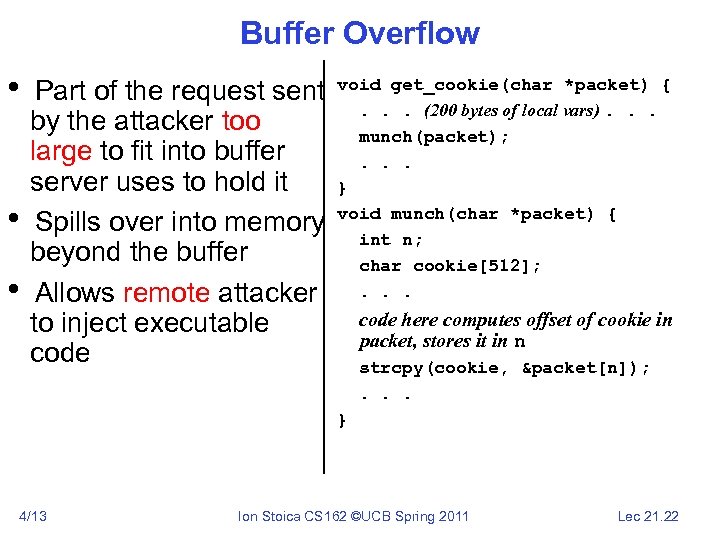 Buffer Overflow • • • Part of the request sent by the attacker too large to fit into buffer server uses to hold it Spills over into memory beyond the buffer Allows remote attacker to inject executable code void get_cookie(char *packet) {. . . (200 bytes of local vars). . . munch(packet); . . . } void munch(char *packet) { int n; char cookie[512]; . . . code here computes offset of cookie in packet, stores it in n strcpy(cookie, &packet[n]); . . . } 4/13 Ion Stoica CS 162 ©UCB Spring 2011 Lec 21. 22
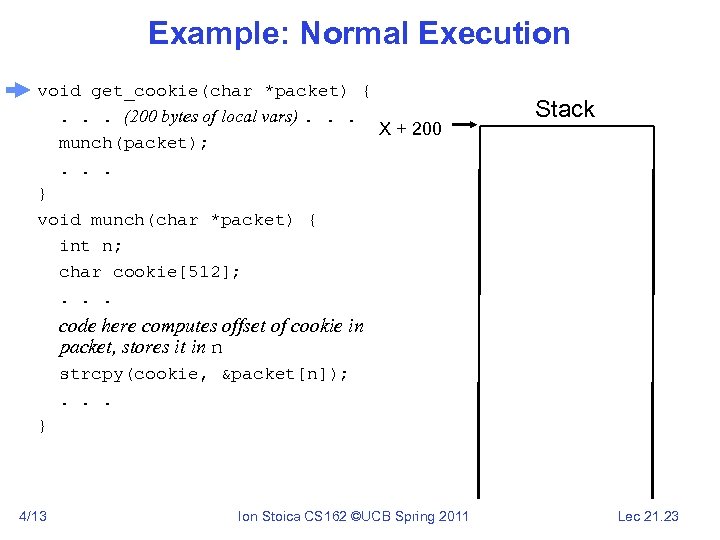 Example: Normal Execution void get_cookie(char *packet) {. . . (200 bytes of local vars). . . X + 200 munch(packet); . . . } void munch(char *packet) { int n; char cookie[512]; . . . Stack code here computes offset of cookie in packet, stores it in n strcpy(cookie, &packet[n]); . . . } 4/13 Ion Stoica CS 162 ©UCB Spring 2011 Lec 21. 23
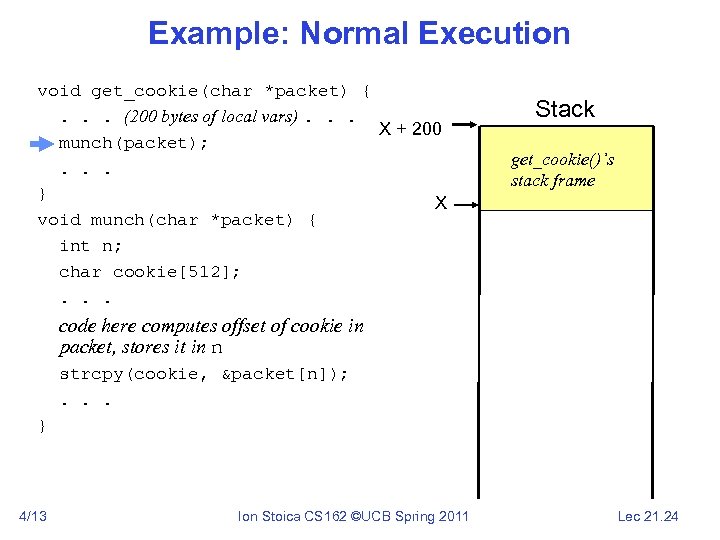 Example: Normal Execution void get_cookie(char *packet) {. . . (200 bytes of local vars). . . X + 200 munch(packet); . . . } X void munch(char *packet) { int n; char cookie[512]; . . . Stack get_cookie()’s stack frame code here computes offset of cookie in packet, stores it in n strcpy(cookie, &packet[n]); . . . } 4/13 Ion Stoica CS 162 ©UCB Spring 2011 Lec 21. 24
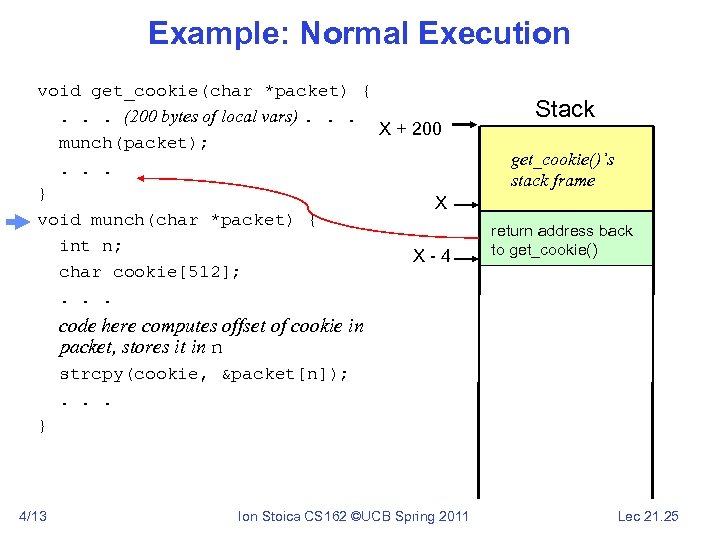 Example: Normal Execution void get_cookie(char *packet) {. . . (200 bytes of local vars). . . X + 200 munch(packet); . . . } X void munch(char *packet) { int n; X-4 char cookie[512]; . . . Stack get_cookie()’s stack frame return address back to get_cookie() code here computes offset of cookie in packet, stores it in n strcpy(cookie, &packet[n]); . . . } 4/13 Ion Stoica CS 162 ©UCB Spring 2011 Lec 21. 25
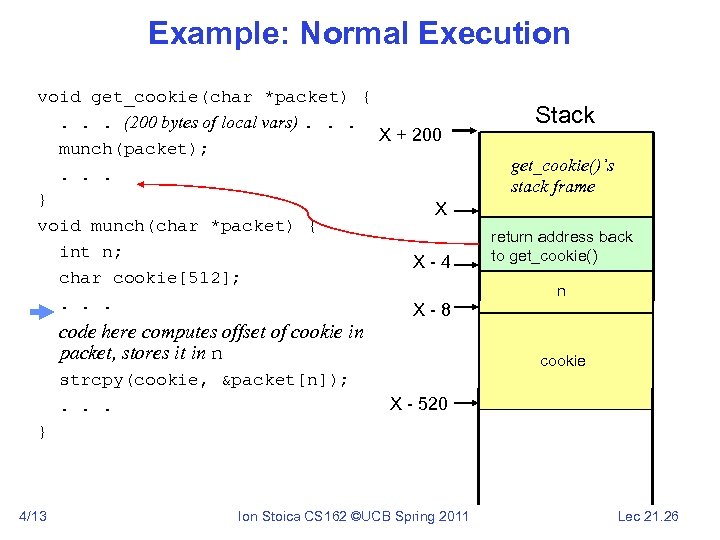 Example: Normal Execution void get_cookie(char *packet) {. . . (200 bytes of local vars). . . X + 200 munch(packet); . . . } X void munch(char *packet) { int n; X-4 char cookie[512]; . . . X-8 code here computes offset of cookie in packet, stores it in n strcpy(cookie, &packet[n]); . . . Stack get_cookie()’s stack frame return address back to get_cookie() n cookie X - 520 } 4/13 Ion Stoica CS 162 ©UCB Spring 2011 Lec 21. 26
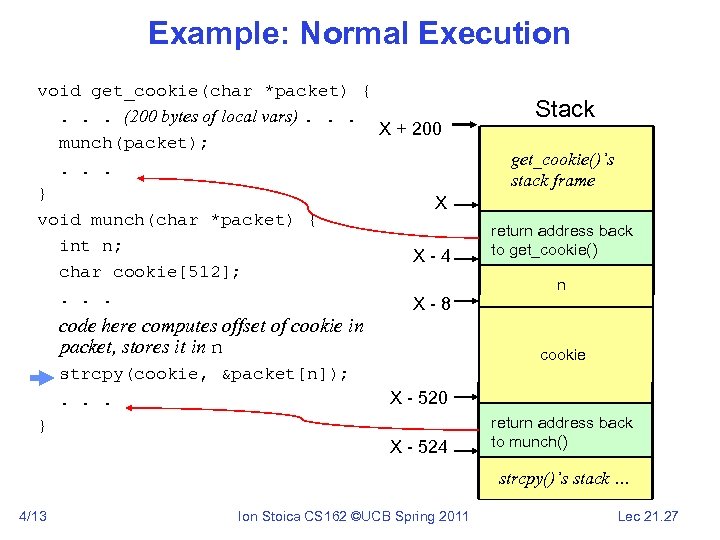 Example: Normal Execution void get_cookie(char *packet) {. . . (200 bytes of local vars). . . X + 200 munch(packet); . . . } X void munch(char *packet) { int n; X-4 char cookie[512]; . . . X-8 code here computes offset of cookie in packet, stores it in n strcpy(cookie, &packet[n]); . . . Stack get_cookie()’s stack frame return address back to get_cookie() n cookie X - 520 } X - 524 return address back to munch() strcpy()’s stack … 4/13 Ion Stoica CS 162 ©UCB Spring 2011 Lec 21. 27
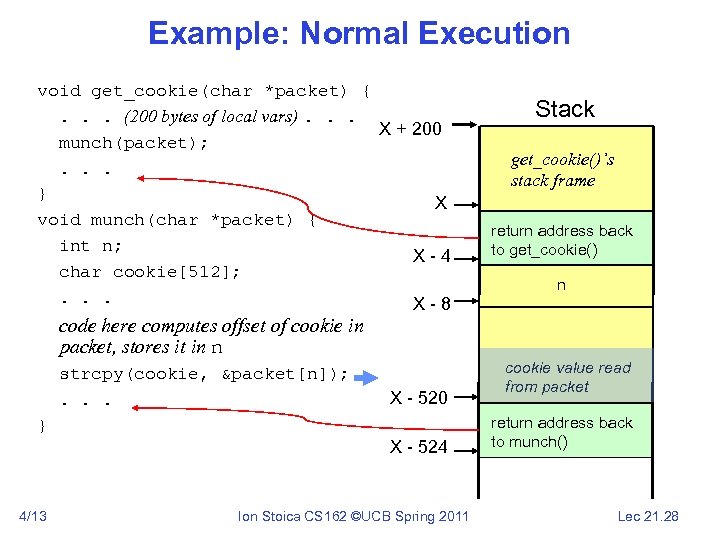 Example: Normal Execution void get_cookie(char *packet) {. . . (200 bytes of local vars). . . X + 200 munch(packet); . . . } X void munch(char *packet) { int n; X-4 char cookie[512]; . . . X-8 code here computes offset of cookie in packet, stores it in n strcpy(cookie, &packet[n]); . . . X - 520 } X - 524 4/13 Ion Stoica CS 162 ©UCB Spring 2011 Stack get_cookie()’s stack frame return address back to get_cookie() n cookie value read from packet return address back to munch() Lec 21. 28
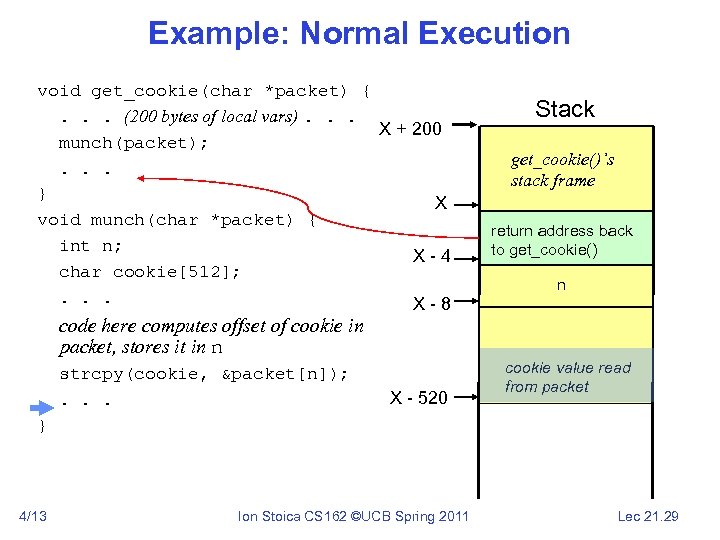 Example: Normal Execution void get_cookie(char *packet) {. . . (200 bytes of local vars). . . X + 200 munch(packet); . . . } X void munch(char *packet) { int n; X-4 char cookie[512]; . . . X-8 code here computes offset of cookie in packet, stores it in n strcpy(cookie, &packet[n]); . . . X - 520 Stack get_cookie()’s stack frame return address back to get_cookie() n cookie value read from packet } 4/13 Ion Stoica CS 162 ©UCB Spring 2011 Lec 21. 29
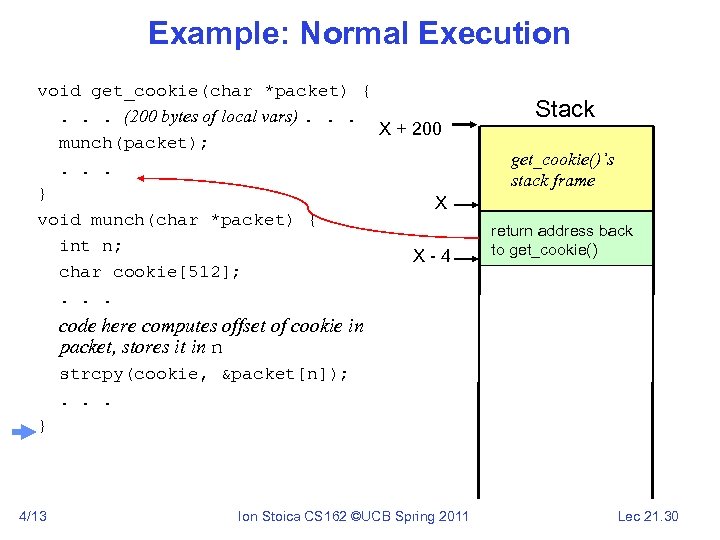 Example: Normal Execution void get_cookie(char *packet) {. . . (200 bytes of local vars). . . X + 200 munch(packet); . . . } X void munch(char *packet) { int n; X-4 char cookie[512]; . . . Stack get_cookie()’s stack frame return address back to get_cookie() code here computes offset of cookie in packet, stores it in n strcpy(cookie, &packet[n]); . . . } 4/13 Ion Stoica CS 162 ©UCB Spring 2011 Lec 21. 30
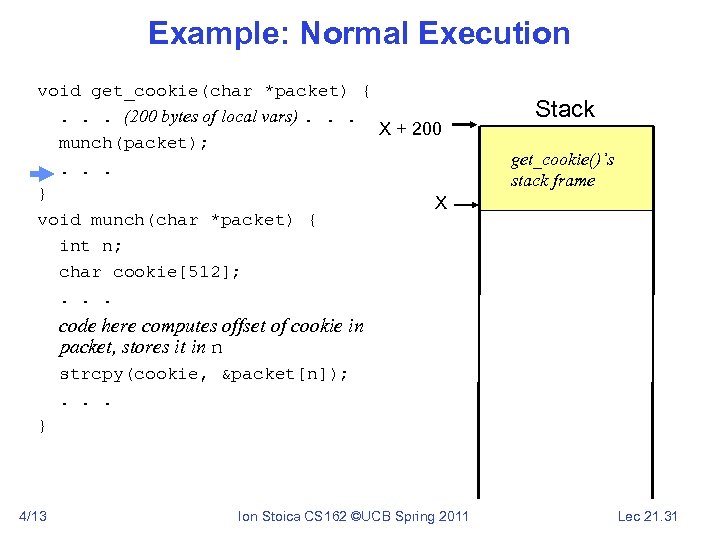 Example: Normal Execution void get_cookie(char *packet) {. . . (200 bytes of local vars). . . X + 200 munch(packet); . . . } X void munch(char *packet) { int n; char cookie[512]; . . . Stack get_cookie()’s stack frame code here computes offset of cookie in packet, stores it in n strcpy(cookie, &packet[n]); . . . } 4/13 Ion Stoica CS 162 ©UCB Spring 2011 Lec 21. 31
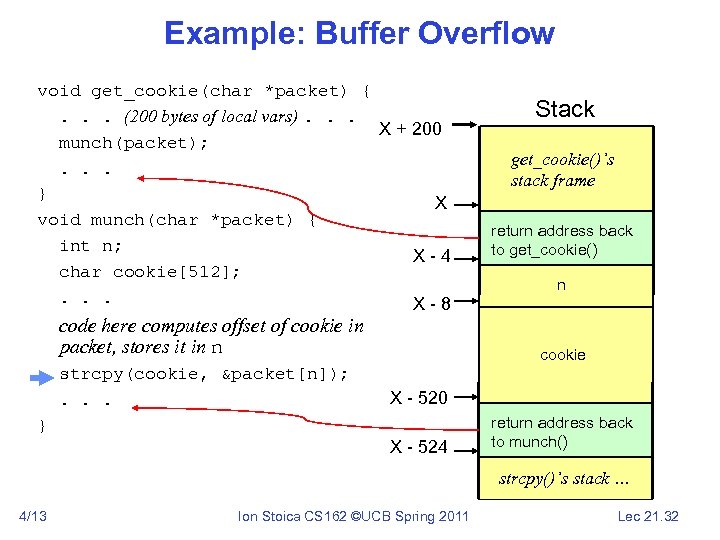 Example: Buffer Overflow void get_cookie(char *packet) {. . . (200 bytes of local vars). . . X + 200 munch(packet); . . . } X void munch(char *packet) { int n; X-4 char cookie[512]; . . . X-8 code here computes offset of cookie in packet, stores it in n strcpy(cookie, &packet[n]); . . . Stack get_cookie()’s stack frame return address back to get_cookie() n cookie X - 520 } X - 524 return address back to munch() strcpy()’s stack … 4/13 Ion Stoica CS 162 ©UCB Spring 2011 Lec 21. 32
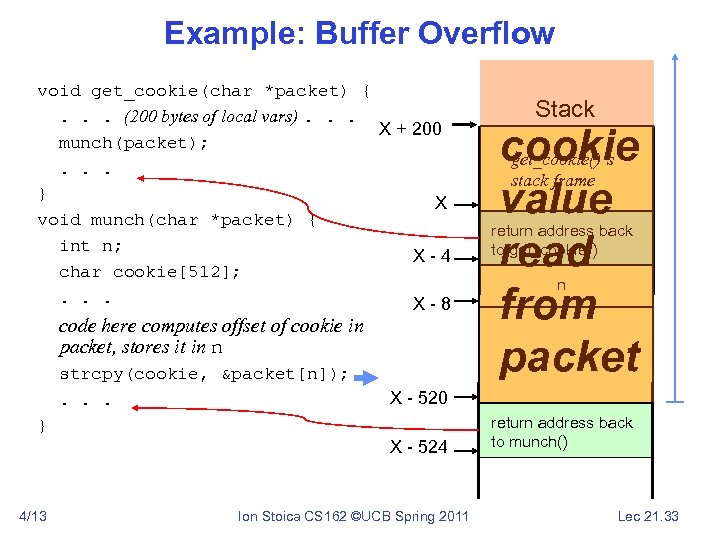 Example: Buffer Overflow void get_cookie(char *packet) {. . . (200 bytes of local vars). . . X + 200 munch(packet); . . . } X void munch(char *packet) { int n; X-4 char cookie[512]; . . . X-8 code here computes offset of cookie in packet, stores it in n strcpy(cookie, &packet[n]); . . . cookie get_cookie()’s stack frame value read from packet return address back to get_cookie() n X - 520 } X - 524 4/13 Stack Ion Stoica CS 162 ©UCB Spring 2011 return address back to munch() Lec 21. 33
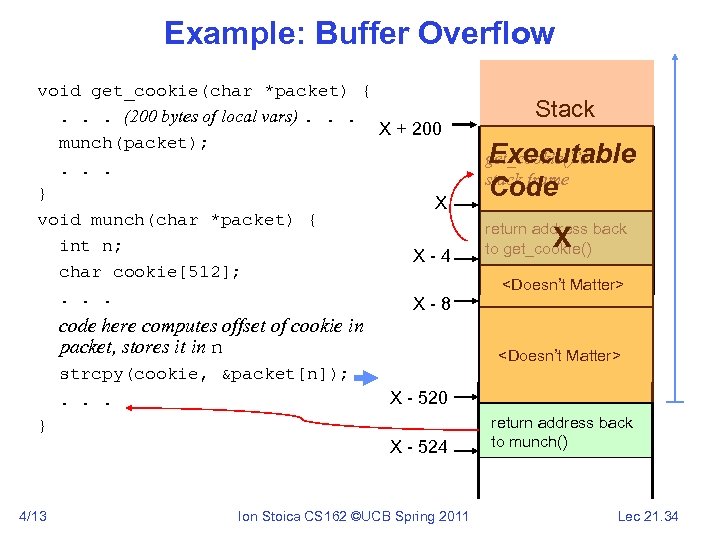 Example: Buffer Overflow void get_cookie(char *packet) {. . . (200 bytes of local vars). . . X + 200 munch(packet); . . . } X void munch(char *packet) { int n; X-4 char cookie[512]; . . . X-8 code here computes offset of cookie in packet, stores it in n strcpy(cookie, &packet[n]); . . . Executable get_cookie()’s stack frame Code return address back to get_cookie() X
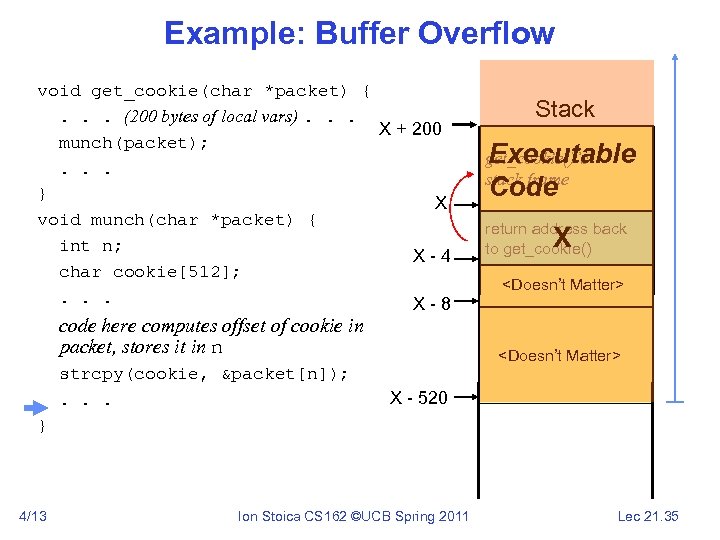 Example: Buffer Overflow void get_cookie(char *packet) {. . . (200 bytes of local vars). . . X + 200 munch(packet); . . . } X void munch(char *packet) { int n; X-4 char cookie[512]; . . . X-8 code here computes offset of cookie in packet, stores it in n strcpy(cookie, &packet[n]); . . . Stack Executable get_cookie()’s stack frame Code return address back to get_cookie() X
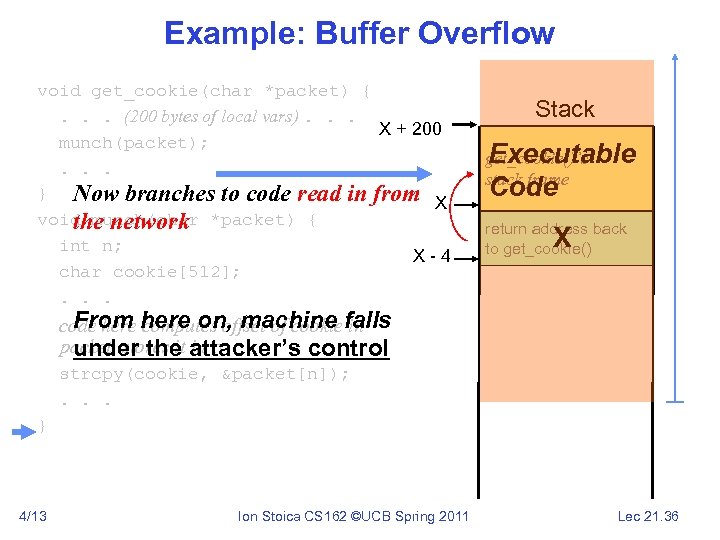 Example: Buffer Overflow void get_cookie(char *packet) {. . . (200 bytes of local vars). . . X + 200 munch(packet); . . . } Now branches to code read in from X void munch(char *packet) { the network int n; X-4 char cookie[512]; . . . Stack Executable get_cookie()’s stack frame Code return address back to get_cookie() X From computes offset of cookie in code here on, machine falls packet, stores it attacker’s control under the in n strcpy(cookie, &packet[n]); . . . } 4/13 Ion Stoica CS 162 ©UCB Spring 2011 Lec 21. 36
 Buffer Overflows: Potential Solutions • Don’t write buggy software – It’s not like people try to write buggy software • Type-safe Languages – Unrestricted memory access of C/C++ contributes to problem – Use Java, Perl, Python instead • OS architecture – Compartmentalize programs better, so one compromise doesn’t compromise the entire system – E. g. , DNS server doesn’t need total system access • Firewalls - restrict remote access to services • Intrusion detection: recognize attack & block it 4/13 Ion Stoica CS 162 ©UCB Spring 2011 Lec 21. 37
 Automated Compromise: Worms • When attacker compromises a host, they can instruct it to do whatever they want • Instructing it to find more vulnerable hosts to repeat the process creates a worm: a program that self-replicates across a network • • • 4/13 Often spread by picking 32 -bit Internet addresses at random to probe … … but this isn’t fundamental As the worm repeatedly replicates, it grows exponentially fast because each copy of the worm works in parallel to find more victims Ion Stoica CS 162 ©UCB Spring 2011 Lec 21. 38
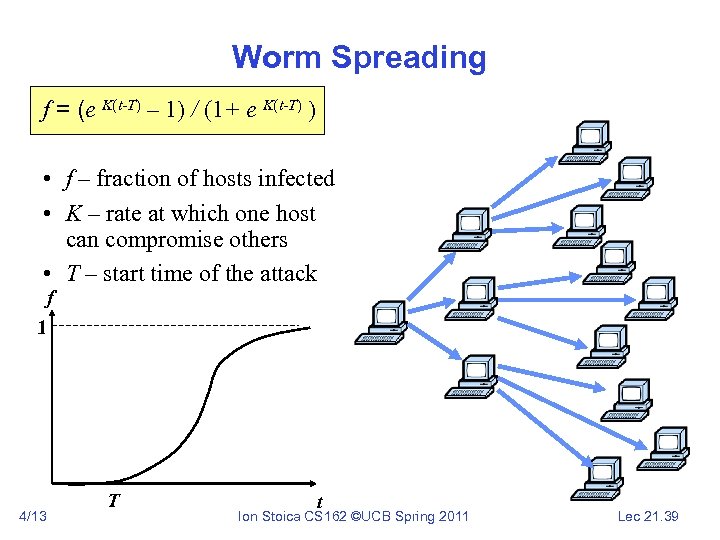 Worm Spreading f = (e K(t-T) – 1) / (1+ e K(t-T) ) • f – fraction of hosts infected • K – rate at which one host can compromise others • T – start time of the attack f 1 4/13 T t Ion Stoica CS 162 ©UCB Spring 2011 Lec 21. 39
 Worm Examples • Morris worm (1988) • Code Red (2001) – 369 K hosts in 10 hours • MS Slammer (January 2003) • Theoretical worms • 1 M hosts in 1. 3 sec • $50 B+ damage 4/13 Ion Stoica CS 162 ©UCB Spring 2011 Lec 21. 40
 Morris Worm (1988) • Infect multiple types of machines (Sun 3 and VAX) – Was supposed to be benign: estimate size of Internet – Spread using a Sendmail bug • Attack multiple security holes including – Buffer overflow in fingerd – Debugging routines in Sendmail – Password cracking • Intend to be benign but it had a bug – Fixed chance the worm wouldn’t quit when reinfecting a machine number of worm on a host built up rendering the machine unusable 4/13 Ion Stoica CS 162 ©UCB Spring 2011 Lec 21. 41
 Code Red Worm (2001) • Attempts to connect to TCP port 80 (i. e. , HTTP port) on a randomly chosen host • If successful, the attacking host sends a crafted HTTP GET request to the victim, attempting to exploit a buffer overflow • Worm “bug”: all copies of the worm use the same random generator to scan new hosts – Do. S attack on those hosts – Slow to infect new hosts • 2 nd generation of Code Red fixed the bug! – It spread much faster 4/13 Ion Stoica CS 162 ©UCB Spring 2011 Lec 21. 42
 MS SQL Slammer (January 2003) • Uses UDP port 1434 to exploit a buffer overflow in MS SQL server • Effect – Generate massive amounts of network packets – Brought down as many as 5 of the 13 internet root name servers • Others – The worm only spreads as an in-memory process: it never writes itself to the hard drive » Solution: close UDP port on fairewall and reboot 4/13 Ion Stoica CS 162 ©UCB Spring 2011 Lec 21. 43
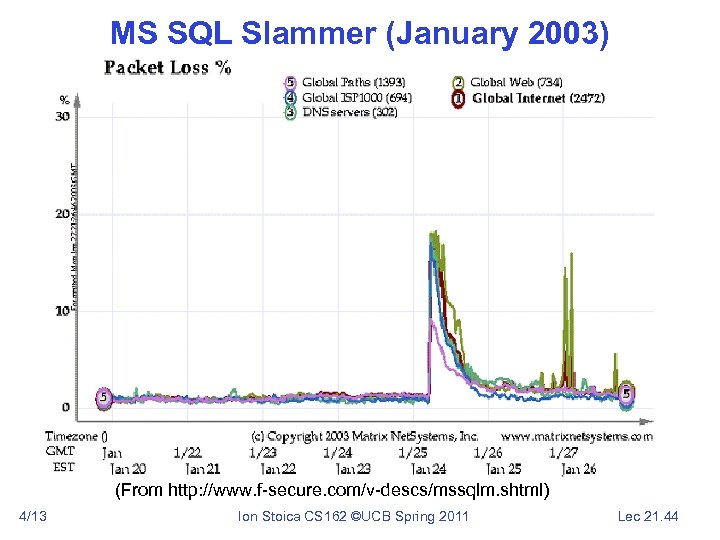 • xx MS SQL Slammer (January 2003) (From http: //www. f-secure. com/v-descs/mssqlm. shtml) 4/13 Ion Stoica CS 162 ©UCB Spring 2011 Lec 21. 44
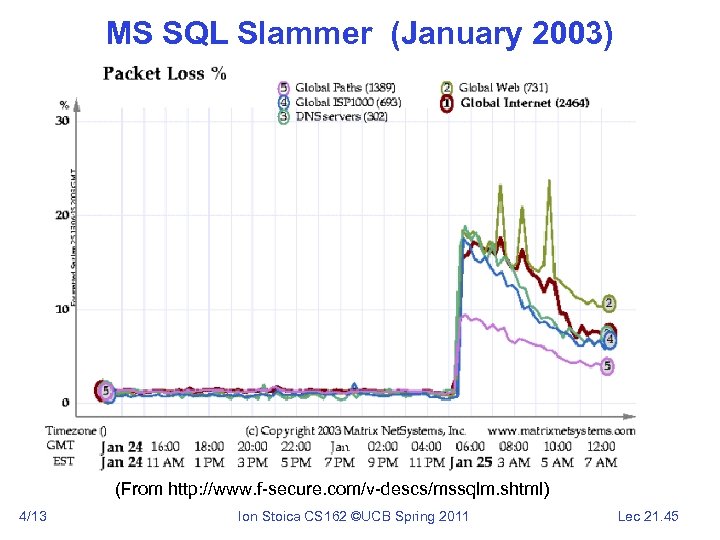 MS SQL Slammer (January 2003) (From http: //www. f-secure. com/v-descs/mssqlm. shtml) 4/13 Ion Stoica CS 162 ©UCB Spring 2011 Lec 21. 45
 Hall of Shame • Software that have had many stack overflow bugs: – BIND (most popular DNS server) – RPC (Remote Procedure Call, used for NFS) » NFS (Network File System), widely used at UCB – Sendmail (most popular UNIX mail delivery software) – IIS (Windows web server) – SNMP (Simple Network Management Protocol, used to manage routers and other network devices) 4/13 Ion Stoica CS 162 ©UCB Spring 2011 Lec 21. 46
 Potential Solutions • Don’t write buggy software – It’s not like people try to write buggy software • Type-safe Languages – Unrestricted memory access of C/C++ contributes to problem – Use Java, Perl, or Python instead • OS architecture – Compartmentalize programs better, so one compromise doesn’t compromise the entire system – E. g. , DNS server doesn’t need total system access • Firewalls 4/13 Ion Stoica CS 162 ©UCB Spring 2011 Lec 21. 47
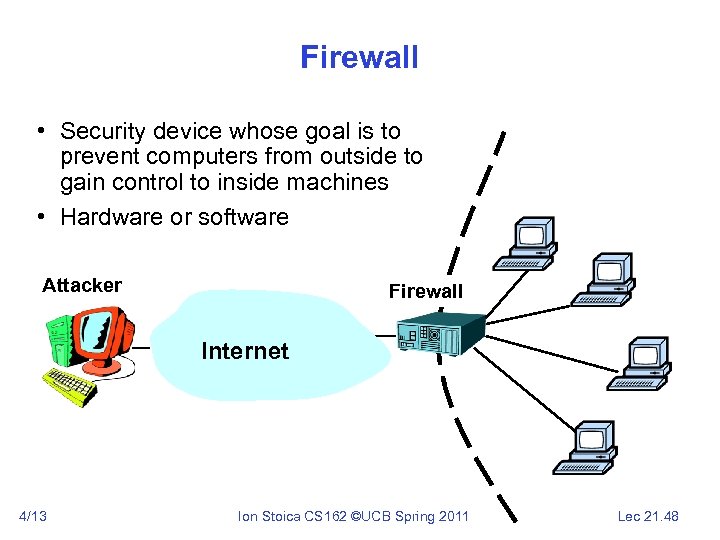 Firewall • Security device whose goal is to prevent computers from outside to gain control to inside machines • Hardware or software Attacker Firewall Internet 4/13 Ion Stoica CS 162 ©UCB Spring 2011 Lec 21. 48
 Firewall (cont’d) • Restrict traffic between Internet and devices (machines) behind it based on – Source address and port number – Payload – Stateful analysis of data • Examples of rules – Block any external packets not for port 80 – Block any email with an attachment – Block any external packets with an internal IP address » Ingress filtering 4/13 Ion Stoica CS 162 ©UCB Spring 2011 Lec 21. 49
 Firewalls: Properties • Easier to deploy firewall than secure all internal hosts • Doesn’t prevent user exploitation • Tradeoff between availability of services (firewall passes more ports on more machines) and security – If firewall is too restrictive, users will find way around it, thus compromising security – E. g. , have all services use port 80 4/13 Ion Stoica CS 162 ©UCB Spring 2011 Lec 21. 50
 Denial of Service • Huge problem in current Internet – Major sites attacked: Yahoo!, Amazon, e. Bay, CNN, Microsoft – 12, 000 attacks on 2, 000 organizations in 3 weeks – Some more that 600, 000 packets/second » More than 192 Mb/s – Almost all attacks launched from compromised hosts • General Form – Prevent legitimate users from gaining service by overloading or crashing a server – E. g. , SYN attack 4/13 Ion Stoica CS 162 ©UCB Spring 2011 Lec 21. 51
 Affect on Victim • Buggy implementations allow unfinished connections to eat all memory, leading to crash • Better implementations limit the number of unfinished connections – Once limit reached, new SYNs are dropped • Affect on victim’s users – Users can’t access the targeted service on the victim because the unfinished connection queue is full Do. S 4/13 Ion Stoica CS 162 ©UCB Spring 2011 Lec 21. 52
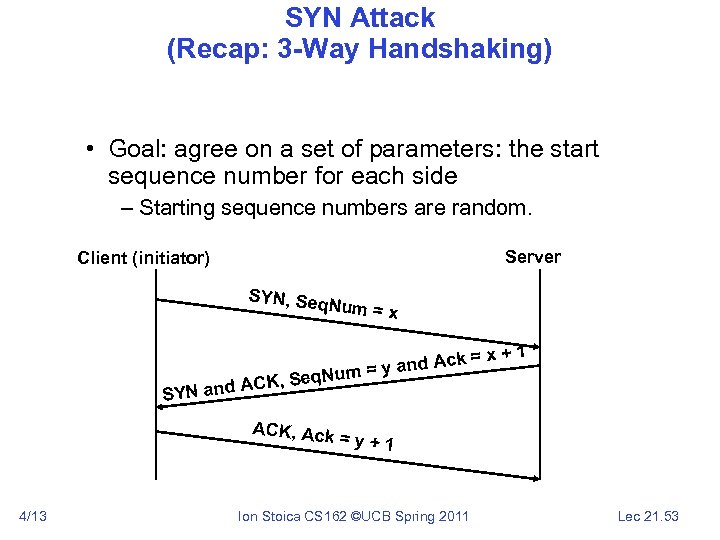 SYN Attack (Recap: 3 -Way Handshaking) • Goal: agree on a set of parameters: the start sequence number for each side – Starting sequence numbers are random. Server Client (initiator) SYN, Seq Num = x k= y and Ac um = x+1 , Seq. N ACK SYN and ACK, Ack 4/13 =y+1 Ion Stoica CS 162 ©UCB Spring 2011 Lec 21. 53
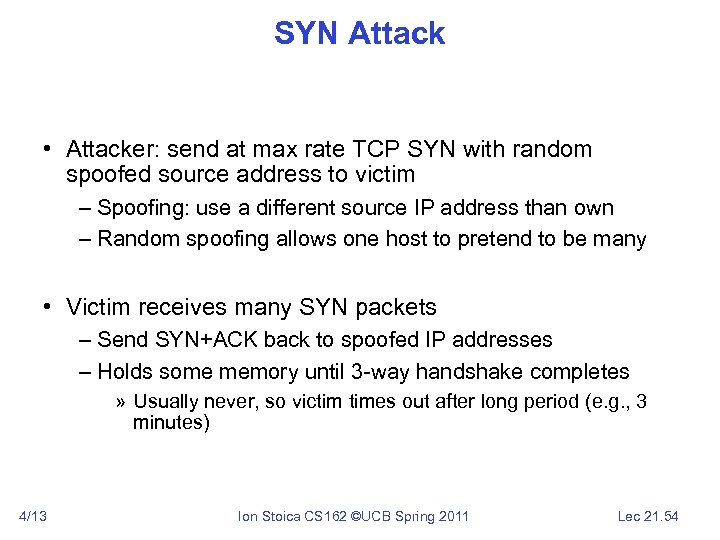 SYN Attack • Attacker: send at max rate TCP SYN with random spoofed source address to victim – Spoofing: use a different source IP address than own – Random spoofing allows one host to pretend to be many • Victim receives many SYN packets – Send SYN+ACK back to spoofed IP addresses – Holds some memory until 3 -way handshake completes » Usually never, so victim times out after long period (e. g. , 3 minutes) 4/13 Ion Stoica CS 162 ©UCB Spring 2011 Lec 21. 54
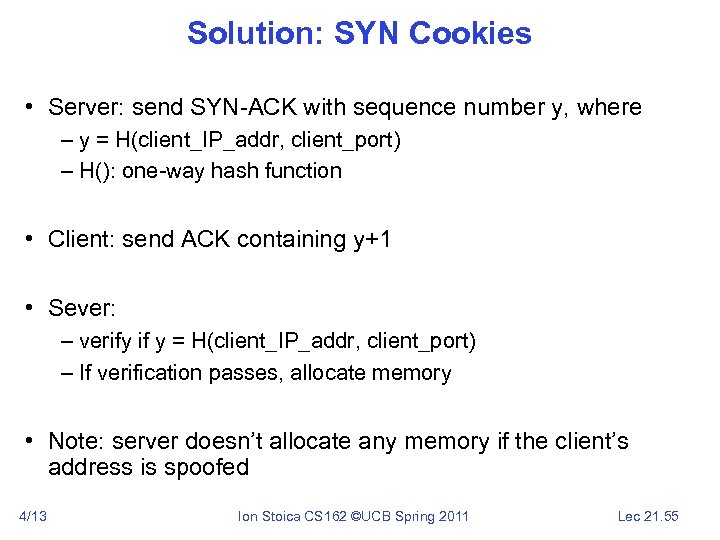 Solution: SYN Cookies • Server: send SYN-ACK with sequence number y, where – y = H(client_IP_addr, client_port) – H(): one-way hash function • Client: send ACK containing y+1 • Sever: – verify if y = H(client_IP_addr, client_port) – If verification passes, allocate memory • Note: server doesn’t allocate any memory if the client’s address is spoofed 4/13 Ion Stoica CS 162 ©UCB Spring 2011 Lec 21. 55
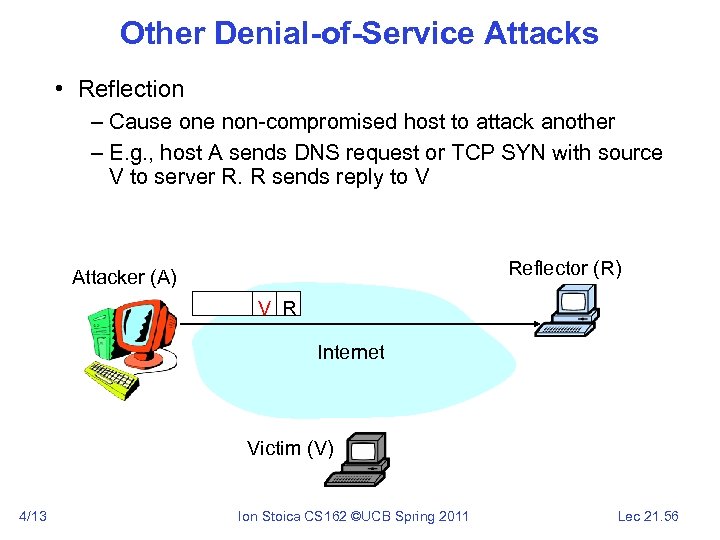 Other Denial-of-Service Attacks • Reflection – Cause one non-compromised host to attack another – E. g. , host A sends DNS request or TCP SYN with source V to server R. R sends reply to V Reflector (R) Attacker (A) V R Internet Victim (V) 4/13 Ion Stoica CS 162 ©UCB Spring 2011 Lec 21. 56
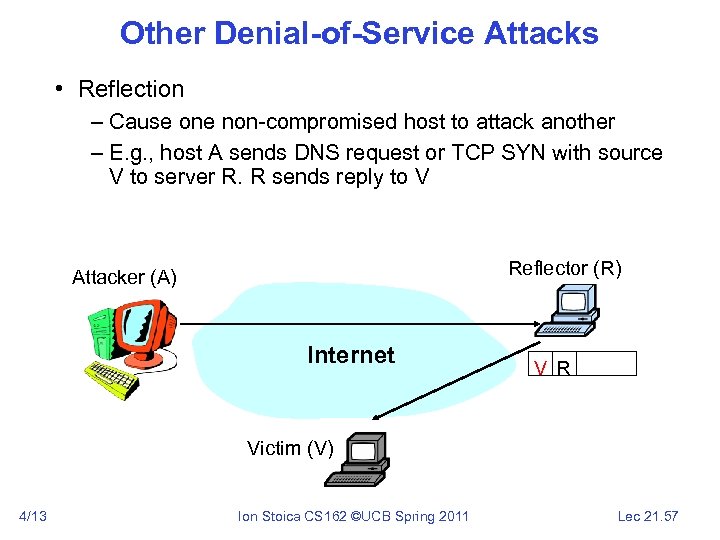 Other Denial-of-Service Attacks • Reflection – Cause one non-compromised host to attack another – E. g. , host A sends DNS request or TCP SYN with source V to server R. R sends reply to V Reflector (R) Attacker (A) Internet V R Victim (V) 4/13 Ion Stoica CS 162 ©UCB Spring 2011 Lec 21. 57
 Other Denial-of-Service Attacks • DNS – Ping flooding attack on DNS root servers (October 2002) – 9 out of 13 root servers brought down – Relatively small impact (why? ) 4/13 Ion Stoica CS 162 ©UCB Spring 2011 Lec 21. 58
 Identifying and Stop Attacking Machines • Defeat spoofed source addresses • Does not stop or slow attack • Egress filtering – A domain’s border router drop outgoing packets which do not have a valid source address for that domain – If universal, could abolish spoofing • IP Traceback – Routers probabilistically tag packets with an identifier – Destination can infer path to true source after receiving enough packets 4/13 Ion Stoica CS 162 ©UCB Spring 2011 Lec 21. 59
 Summary • Security is one of the biggest problem today • Host Compromise – Poorly written software – Partial solutions: better OS security architecture, typesafe languages, firewalls • Denial-of-Service – No easy solution: Do. S can happen at many levels 4/13 Ion Stoica CS 162 ©UCB Spring 2011 Lec 21. 60