 Скачать презентацию CS 155 b E-Commerce Lecture 9 February 6
84afd57294724312962dd5797201bfe7.ppt
- Количество слайдов: 18



CS 155 b: E-Commerce Lecture 9: February 6, 2001 TPSs, Business Models, and the Napster Challenge
Reading Assignment for Feb. 13, 2001: C. Mann, “The Heavenly Jukebox, ” http: ///www. theatlantic. com/issues/2000/09/ mann. htm Appendix G of The Digital Dilemma http: //books. nap. edu/html/digital_dilemma/
Product- or Service-Developer’s Goal • Choose the right ingredients and weave them together into an effective end-to-end technical protection system (TPS). • Ingredients must be “right” w. r. t. business model and legal and social context as well as technical context. Notoriously Difficult! (Shapiro and Varian may be too optimistic. )
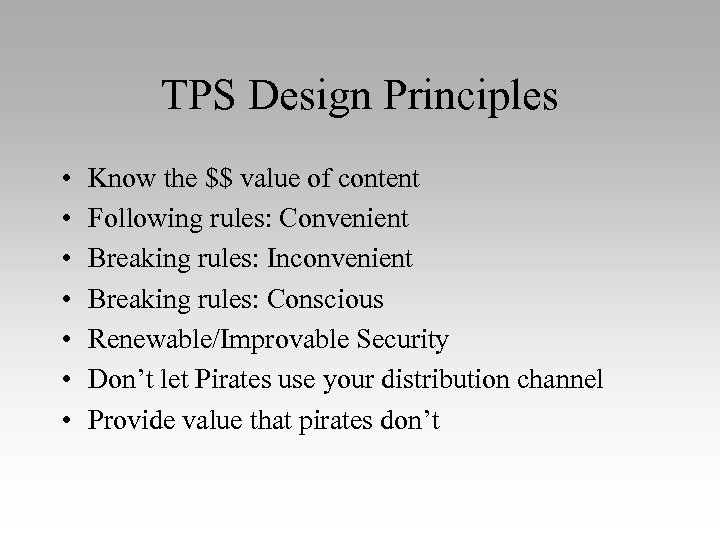
TPS Design Principles • • Know the $$ value of content Following rules: Convenient Breaking rules: Inconvenient Breaking rules: Conscious Renewable/Improvable Security Don’t let Pirates use your distribution channel Provide value that pirates don’t
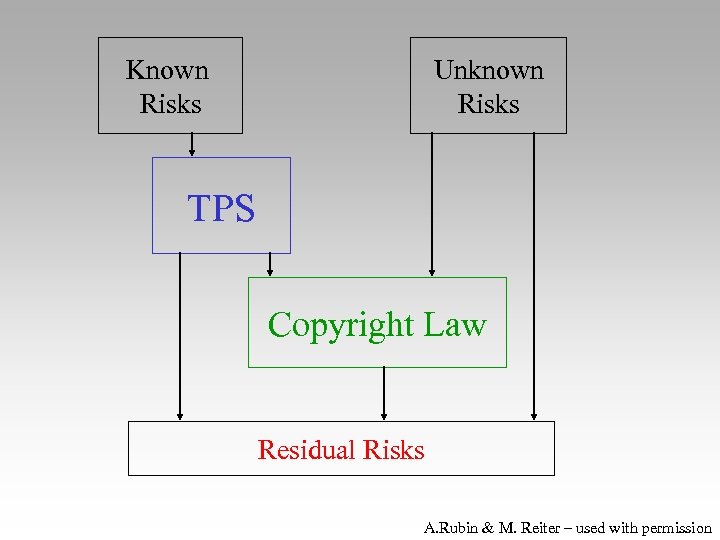
Known Risks Unknown Risks TPS Copyright Law Residual Risks A. Rubin & M. Reiter – used with permission
Dual Doomsday Scenarios Today’s Rights Holders and Distributors: TPSs won’t work. Copying, modification, and distribution will become uncontrollable. Fair-Use Advocates and (Some) Consumers: TPSs will work. Rights holders will have more control than they do in the analog world.
Limitations on Exclusive Rights (“ 4 factors” test for “Fair Use”) • The purpose and character of the use, including whether such use is of a commercial nature or is for non-profit educational purposes • The nature of the copyright work • The amount and substantiality of the portion used in relation to the copyright work as a whole • The effect of the use upon the potential market for or value of the copyrighted work. The fact that a work is unpublished shall not itself bar a finding of fair use if such finding is made upon consideration of all the above factors.
Other Relevant Issues “ Fair Use is a Defense” ? ? (Could a good TPS render it moot? ) • “Private-use copying” may be harder to keep private in the digital world. • “Private-use modification” needs to be considered. For example, do Linux users have the right to view Dv. Ds for which they have paid full price?
Best TPS is a Great Business Model “The first line of defense against pirates is a sensible business model that combines pricing, ease of use, and legal prohibition in a way that minimizes the incentives for consumers to deal with pirates. ” Lacy et al. , IEEE Symposium on Industrial Electronics, 1997.
Holy Grail: A Great Business Model for Internet Music Distribution Hal Varian (quoted in C. Mann’s “Heavenly Jukebox” article): “Maybe Coke will find a way integrate itself directly into the shows. Or they’ll release the music free on the Internet, except that it will be wrapped in a commercial. ” What’s the difference if the Spice Girls are marketed by Coca-Cola or by Virgin Records, soon to be a subdivision of AOLTime Warner? 1999 Sales by RIAA members: $14. 5 B 1999 Coca-Cola Net Operating Income: $20 B
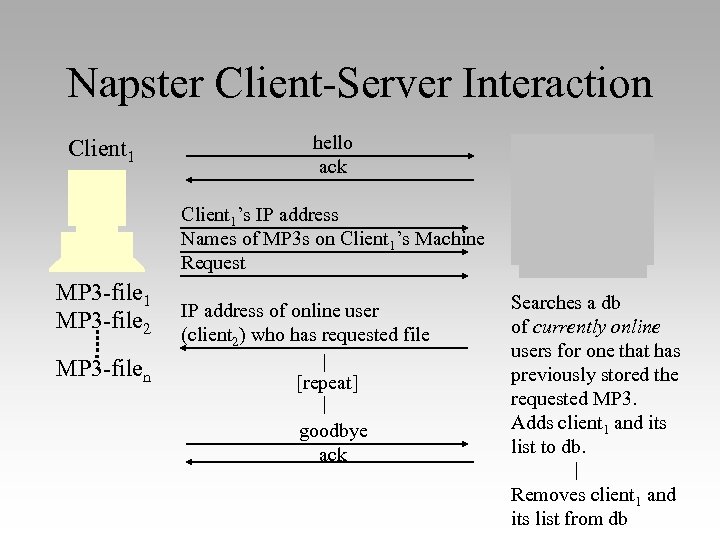
Napster Client-Server Interaction Client 1 hello ack Client 1’s IP address Names of MP 3 s on Client 1’s Machine Request MP 3 -file 1 MP 3 -file 2 MP 3 -filen IP address of online user (client 2) who has requested file [repeat] goodbye ack Searches a db of currently online users for one that has previously stored the requested MP 3. Adds client 1 and its list to db. Removes client 1 and its list from db
Notes on Client-Server Interaction • Proprietary protocol and db search. • No MP 3 files stored on server. • Don’t need usernames. Could have made the service anonymous. • No need to save IP addresses between sessions. Many are assigned dynamically. • Discussion point: Are anonymity and memorylessness threats or opportunities for business?
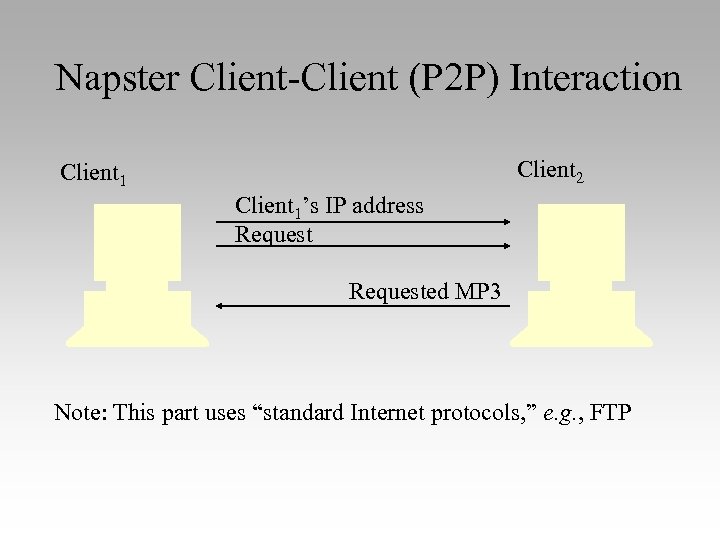
Napster Client-Client (P 2 P) Interaction Client 2 Client 1’s IP address Requested MP 3 Note: This part uses “standard Internet protocols, ” e. g. , FTP
Napster History • 1987: MP 3 format developed by Fraunhofer Gesellschaft. “CD ripping” now feasible. • 1999: Shawn Fanning develops Napster, believing he has “bypassed” copyright law. Napster has >25 M users in its first year. • Dec. , 1999: RIAA sues Napster for “tributary” copyright infringement. • April, 2000: Metallica sues Napster, Yale, Indiana Univ. , and USC. (Yale bans the use of Napster within a week. )
Napster History, continued • July, 2000: US District Judge Patel grants RIAA’s request for an injunction. The injunction is temporarily stayed soon thereafter. • October, 2000: Napster announces partnership with Bertlesmann AG (one of the “major labels” in the industry whose trade association is suing it!). • January, 2001: Napster announces partnership with Edel Music AD (one of the “independent labels”). • January, 2001: Napster and Bertlesmann say that they will roll out a “subscription service” by “early summer” and will use “DRM technology. ”
Existing Business Models for Information Products • Fee models: Subscription purchase, Singletransaction purchase, Single-transaction license, Serial transaction license, Site license, Payment per electronic use • Advertising models: Combined subscription and advertising income, Advertising income only • “Free” distribution models: Free distribution (no hidden motives), Free samples (e. g. , coming attractions), Free first version, Free information when you buy something else (complementary products, bundling).
Less Traditional Business Models for Information Products • Extreme customization: Make the product so personal that few people other than the purchaser would want it • Provide a large product in small pieces, making it easy to browse but difficult to get in its entirety • Give away digital content because it complements (and increases demand for) the traditional product • Give away the product, sell the service contract • Allow free distribution of the product but request payment (Shareware) • Position the product for low-priced, mass market distribution
Discussion Points * What should the Bertelsmann-Napster business model be? *Why does Bertlesmann need P 2 P? ? They could have more control and possibly higher quality by “serving” music themselves. *Are DRM (and, more generally, TPS) and P 2 P (particularly Napster) antithetical? • What does the subscription fee ($15/month? ) entitle the subscriber to? • Are they critically dependent on technical protection? (If so, they may be in trouble…) • Why can’t someone else develop equivalent P 2 P software and steal Napster’s user base? (Recall IE and Netscape. ) Are users concerned about copyright law?
Скачать презентацию CS 155 b E-Commerce Lecture 9 February 6
84afd57294724312962dd5797201bfe7.ppt