 Скачать презентацию CS 155 b E-Commerce Lecture 16 April 10
8532b9365fef391ccaa89bbbaf2a5080.ppt
- Количество слайдов: 15



CS 155 b: E-Commerce Lecture 16: April 10, 2001 WWW Searching and Google
WWW Digraph • More than 1 Billion Nodes (Pages) • Average Degree (links/Page) is 5 -15. (Hard to Compute!) • Massive, Distributed, Explicit Digraph (Not Like Call Graphs)
“Hot” Research Area • • Graph Representation Duplicate Elimination Clustering Ranking Query Results http: //theory. stanford. edu/~focs 98/tutorials. html A. Broder & M. Henzinger
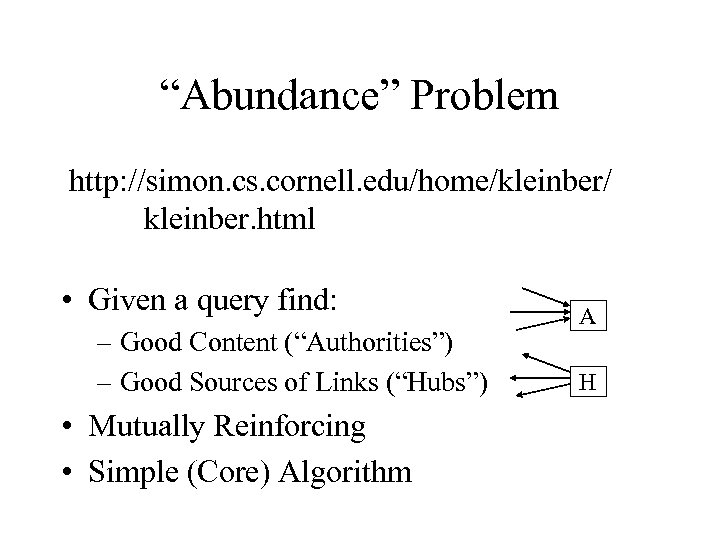
“Abundance” Problem http: //simon. cs. cornell. edu/home/kleinber/ …. . kleinber. html • Given a query find: – Good Content (“Authorities”) – Good Sources of Links (“Hubs”) • Mutually Reinforcing • Simple (Core) Algorithm A H
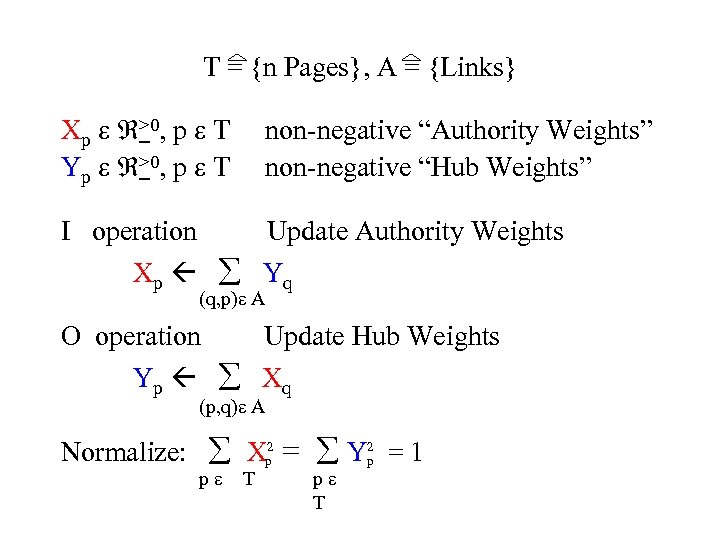
T = {n Pages}, A = {Links} Xp >0, p T non-negative “Authority Weights” Yp >0, p T non-negative “Hub Weights” I operation Update Authority Weights Xp Yq (q, p) A O operation Update Hub Weights Yp Xq (p, q) A Normalize: Xp 2 = Y 2 = 1 p p T
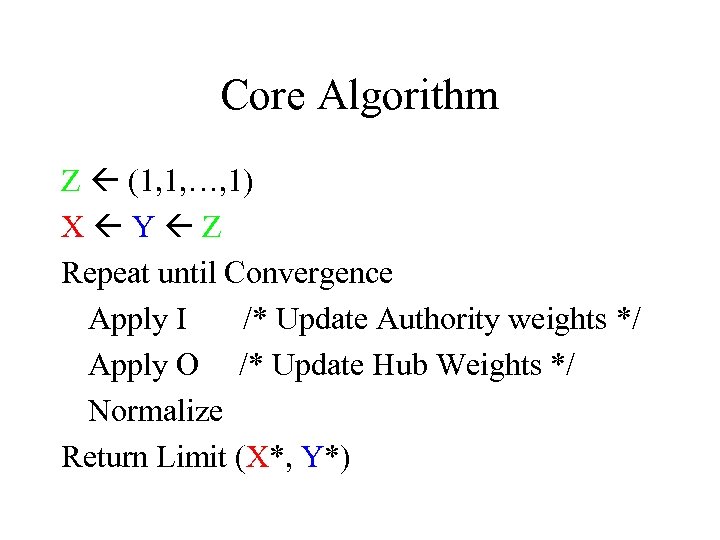
Core Algorithm Z (1, 1, …, 1) X Y Z Repeat until Convergence Apply I /* Update Authority weights */ Apply O /* Update Hub Weights */ Normalize Return Limit (X*, Y*)
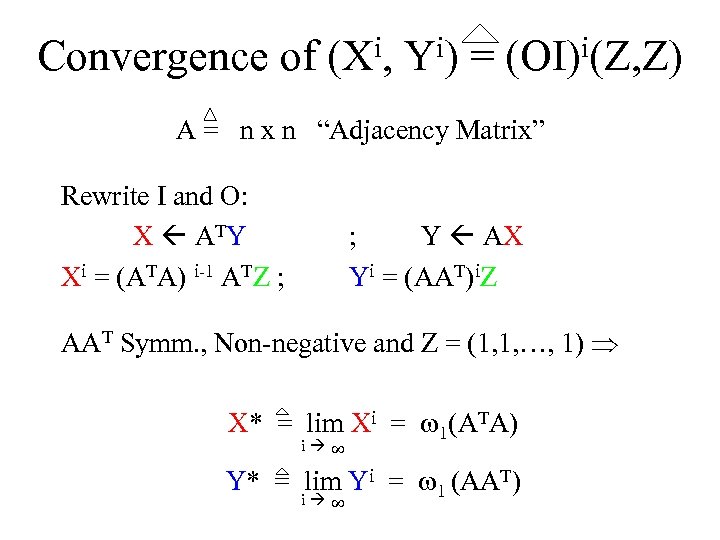
Convergence of (Xi, Yi) = (OI)i(Z, Z) A = n x n “Adjacency Matrix” Rewrite I and O: X ATY Xi = (ATA) i-1 ATZ ; ; Y AX Yi = (AAT)i. Z AAT Symm. , Non-negative and Z = (1, 1, …, 1) X* = lim Xi = 1(ATA) 8 i Y* = lim Yi = 1 (AAT) 8 i
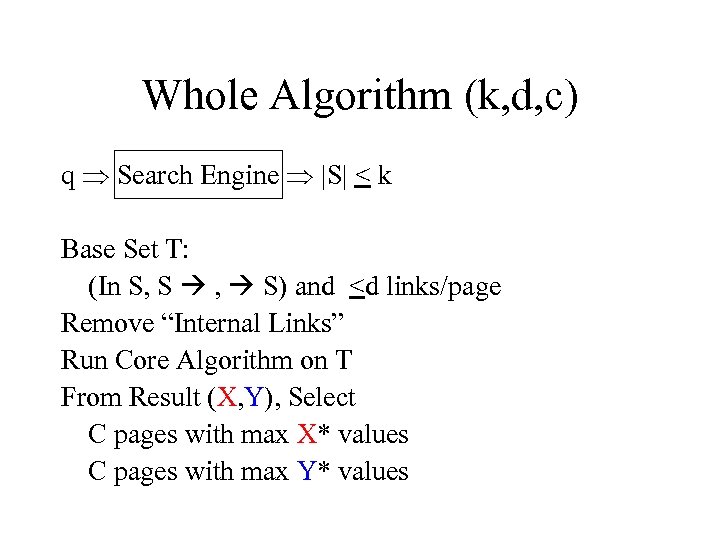
Whole Algorithm (k, d, c) q Search Engine |S| < k Base Set T: (In S, S , S) and <d links/page Remove “Internal Links” Run Core Algorithm on T From Result (X, Y), Select C pages with max X* values C pages with max Y* values
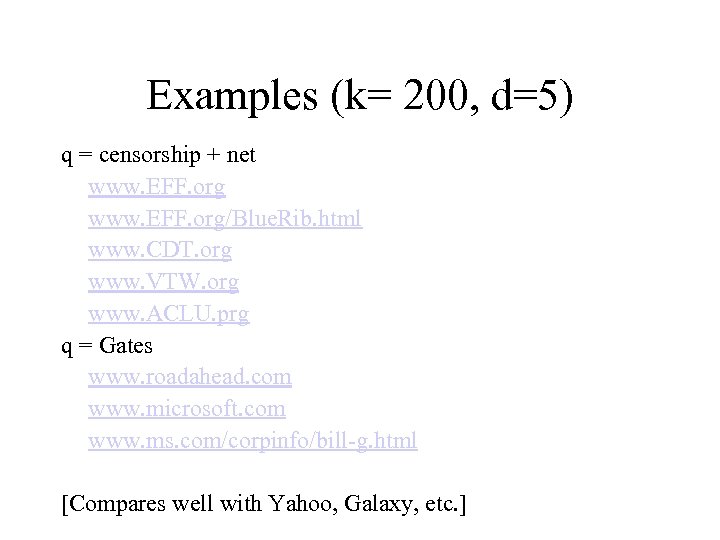
Examples (k= 200, d=5) q = censorship + net www. EFF. org/Blue. Rib. html www. CDT. org www. VTW. org www. ACLU. prg q = Gates www. roadahead. com www. microsoft. com www. ms. com/corpinfo/bill-g. html [Compares well with Yahoo, Galaxy, etc. ]
Approach to “Massiveness”: Throw Out Most of G!! • Non-principal Eigenvectors correspond to “Non-principal Communities” • Open (? ): Objective Performance Criteria Dependence on Search Engine Nondeterministic Choice of S and T
Google History • Founded in 1998 by Larry Page and Sergey Brin, two Stanford Ph. D. candidates. • Privately held company, whose backers include Kleiner Perkins Caufield & Byers and Sequoia Capital. • Continues to win top awards for Search Engines. Computer Scientists love it!!!

Major Partners • • • Yahoo! Palm Nextel Netscape Cisco Systems Virgin Netease. com Red. Hat Virgilio Washingtonpost. com

Business Model • The company delivers services through its own web site at www. google. com and by licensing its search technology to commercial sites • Advertising: – Premium Sponsorship – Purchase a keyword – Ad. Words – Manage your Ad text
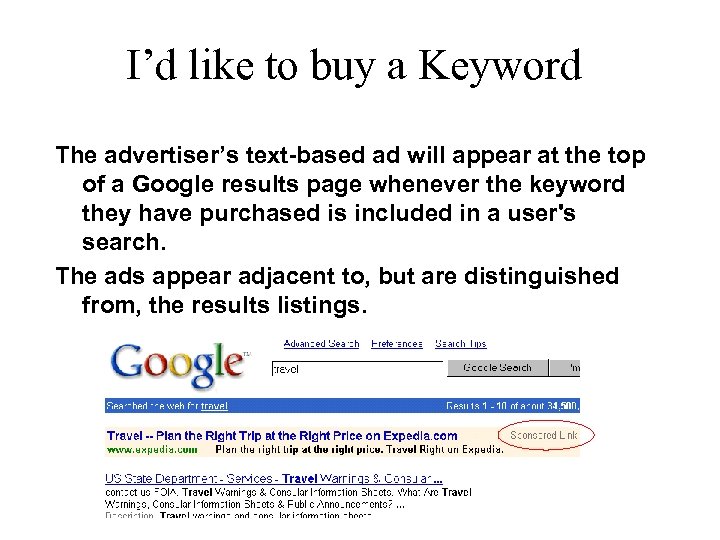
I’d like to buy a Keyword The advertiser’s text-based ad will appear at the top of a Google results page whenever the keyword they have purchased is included in a user's search. The ads appear adjacent to, but are distinguished from, the results listings.
Category purchase • Google uses a classification system to create an ongoing "Virtual Directory" of categories an advertiser can purchase. • Advertisers can select the categories most appropriate to their business and Google will match the most relevant category ads to each user's search. • The advantage of this approach is that it covers a broader audience that might be missed through the purchase of keywords alone.
Скачать презентацию CS 155 b E-Commerce Lecture 16 April 10
8532b9365fef391ccaa89bbbaf2a5080.ppt