


 Скачать презентацию Cryptography Protocols Anita Jones CS 451 Information Security
a039b194f848bc8bf2b063ca4763931c.ppt
- Количество слайдов: 32
 Cryptography Protocols Anita Jones CS 451 Information Security Copyright(C) Anita Jones
 Applications for protocols z. Key distribution z. Confidentiality z. Sign message with digital signature z. Authentication z. Non-repudiation z…. . September, 2006
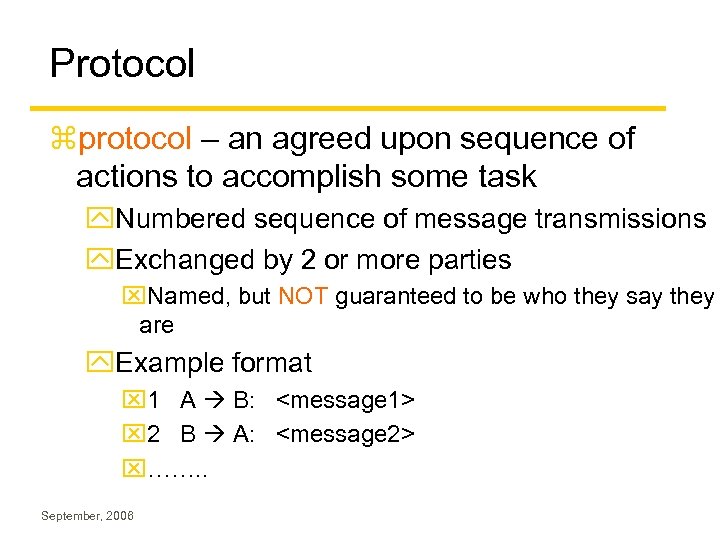 Protocol zprotocol – an agreed upon sequence of actions to accomplish some task y. Numbered sequence of message transmissions y. Exchanged by 2 or more parties x. Named, but NOT guaranteed to be who they say they are y. Example format x 1 A B:
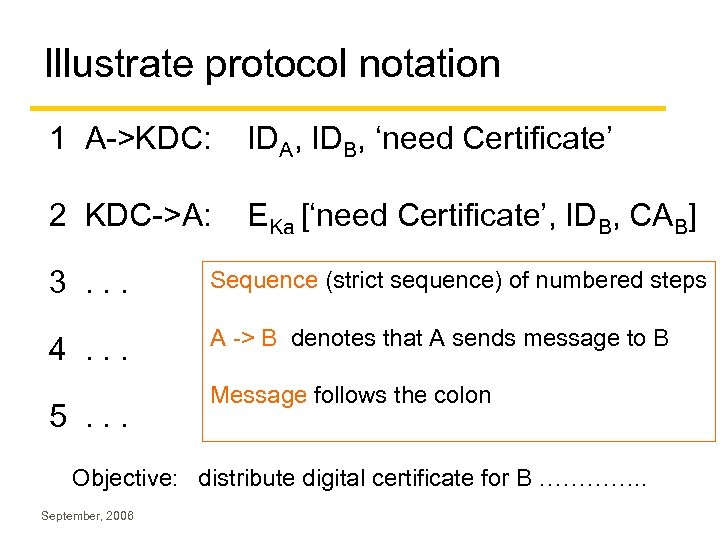 Illustrate protocol notation 1 A->KDC: IDA, IDB, ‘need Certificate’ 2 KDC->A: EKa [‘need Certificate’, IDB, CAB] 3. . . Sequence (strict sequence) of numbered steps 4. . . A -> B denotes that A sends message to B 5. . . Message follows the colon Objective: distribute digital certificate for B …………. . September, 2006
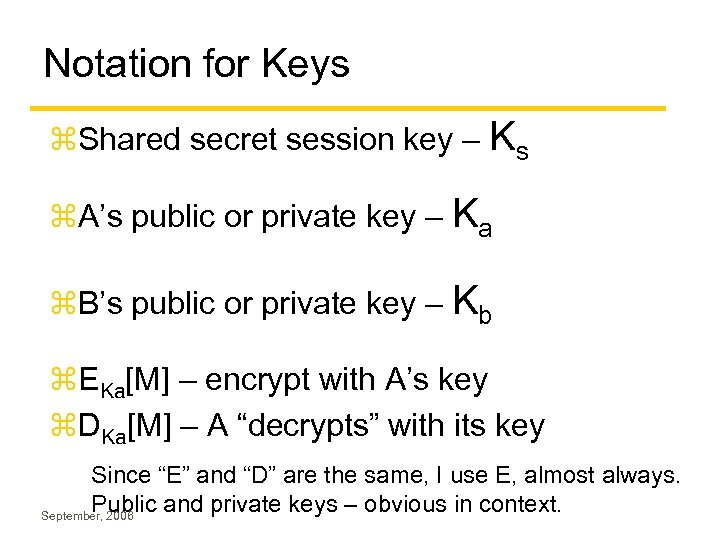 Notation for Keys z. Shared secret session key – Ks z. A’s public or private key – Ka z. B’s public or private key – Kb z. EKa[M] – encrypt with A’s key z. DKa[M] – A “decrypts” with its key Since “E” and “D” are the same, I use E, almost always. Public and private keys – obvious in context. September, 2006
 Key Distribution Distribute public keys Distribute secret (session) keys
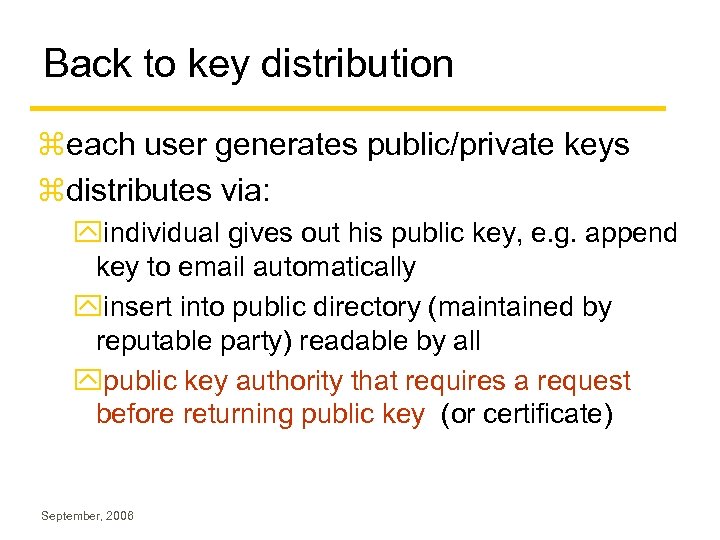 Back to key distribution zeach user generates public/private keys zdistributes via: yindividual gives out his public key, e. g. append key to email automatically yinsert into public directory (maintained by reputable party) readable by all ypublic key authority that requires a request before returning public key (or certificate) September, 2006
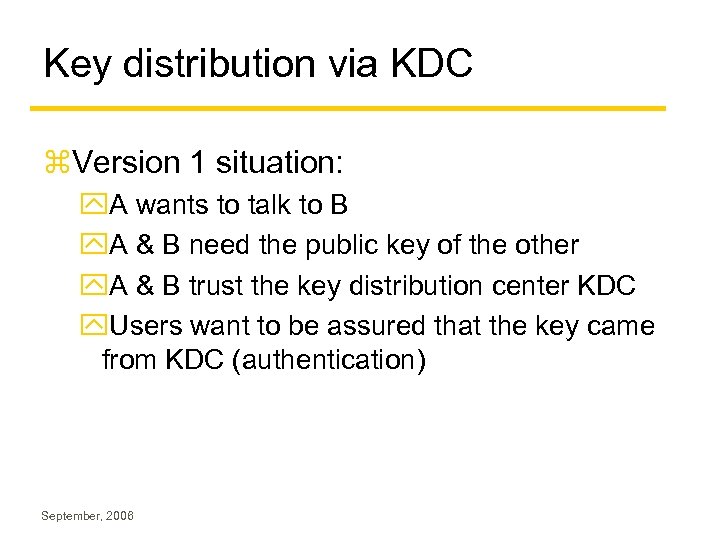 Key distribution via KDC z. Version 1 situation: y. A wants to talk to B y. A & B need the public key of the other y. A & B trust the key distribution center KDC y. Users want to be assured that the key came from KDC (authentication) September, 2006
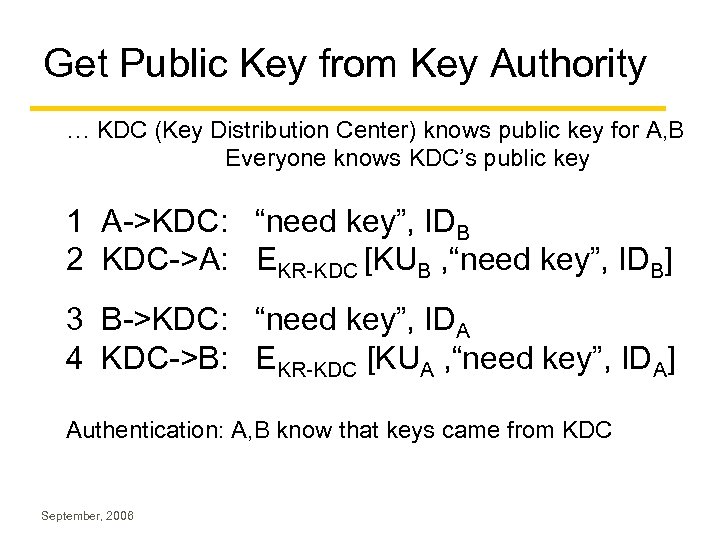 Get Public Key from Key Authority … KDC (Key Distribution Center) knows public key for A, B Everyone knows KDC’s public key 1 A->KDC: “need key”, IDB 2 KDC->A: EKR-KDC [KUB , “need key”, IDB] 3 B->KDC: “need key”, IDA 4 KDC->B: EKR-KDC [KUA , “need key”, IDA] Authentication: A, B know that keys came from KDC September, 2006
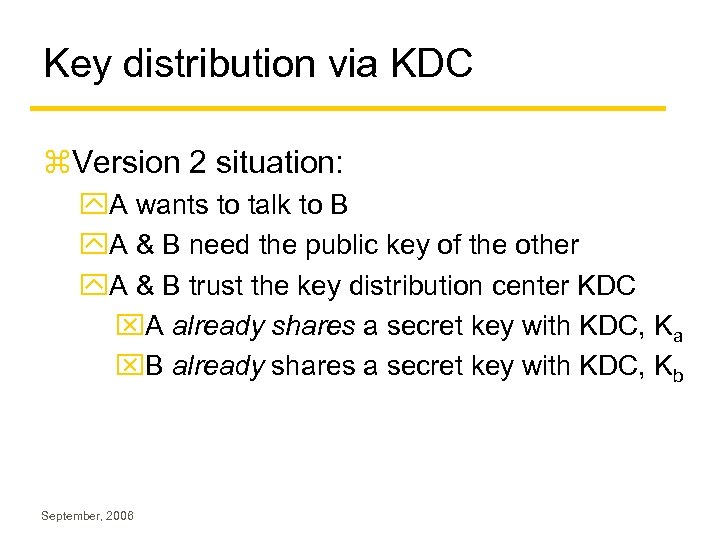 Key distribution via KDC z. Version 2 situation: y. A wants to talk to B y. A & B need the public key of the other y. A & B trust the key distribution center KDC x. A already shares a secret key with KDC, Ka x. B already shares a secret key with KDC, Kb September, 2006
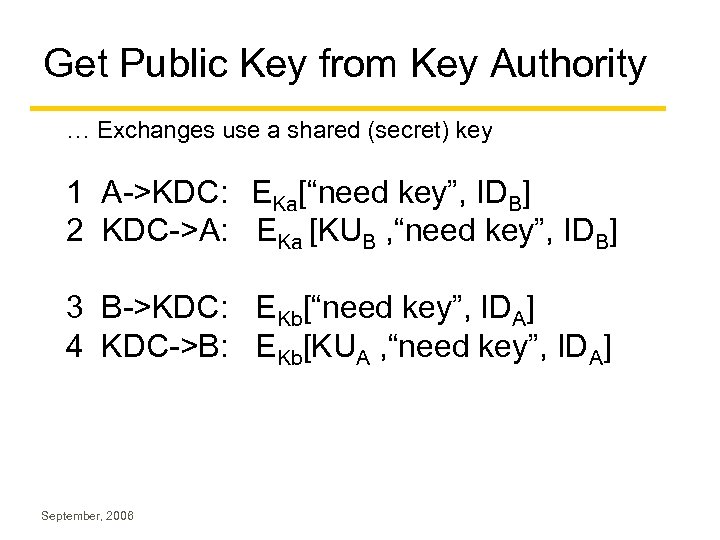 Get Public Key from Key Authority … Exchanges use a shared (secret) key 1 A->KDC: EKa[“need key”, IDB] 2 KDC->A: EKa [KUB , “need key”, IDB] 3 B->KDC: EKb[“need key”, IDA] 4 KDC->B: EKb[KUA , “need key”, IDA] September, 2006
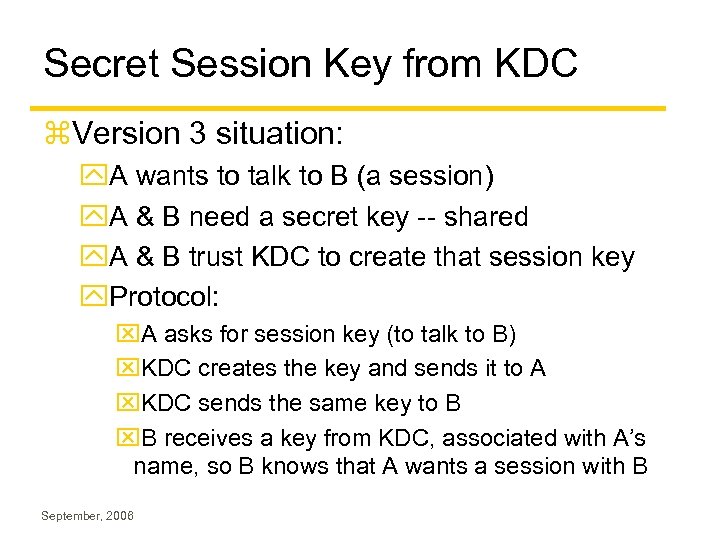 Secret Session Key from KDC z. Version 3 situation: y. A wants to talk to B (a session) y. A & B need a secret key -- shared y. A & B trust KDC to create that session key y. Protocol: x. A asks for session key (to talk to B) x. KDC creates the key and sends it to A x. KDC sends the same key to B x. B receives a key from KDC, associated with A’s name, so B knows that A wants a session with B September, 2006
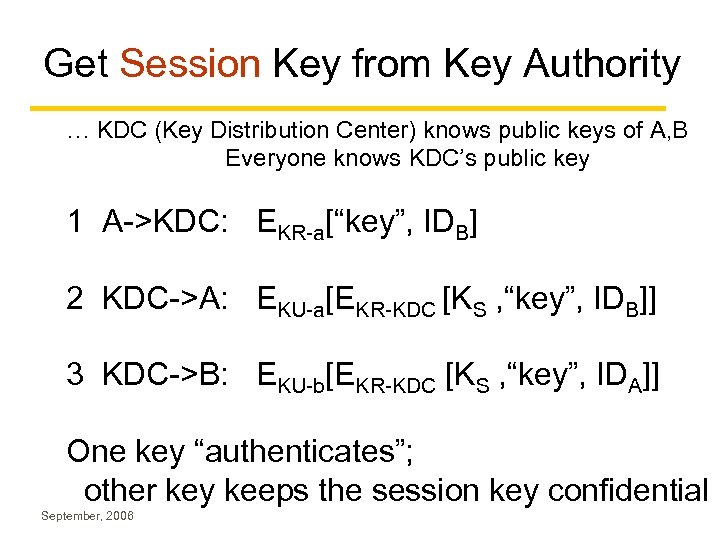 Get Session Key from Key Authority … KDC (Key Distribution Center) knows public keys of A, B Everyone knows KDC’s public key 1 A->KDC: EKR-a[“key”, IDB] 2 KDC->A: EKU-a[EKR-KDC [KS , “key”, IDB]] 3 KDC->B: EKU-b[EKR-KDC [KS , “key”, IDA]] One key “authenticates”; other key keeps the session key confidential September, 2006
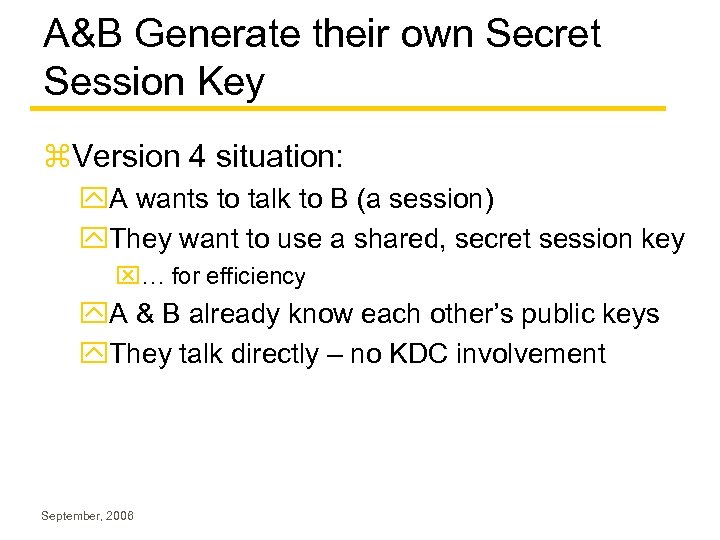 A&B Generate their own Secret Session Key z. Version 4 situation: y. A wants to talk to B (a session) y. They want to use a shared, secret session key x… for efficiency y. A & B already know each other’s public keys y. They talk directly – no KDC involvement September, 2006
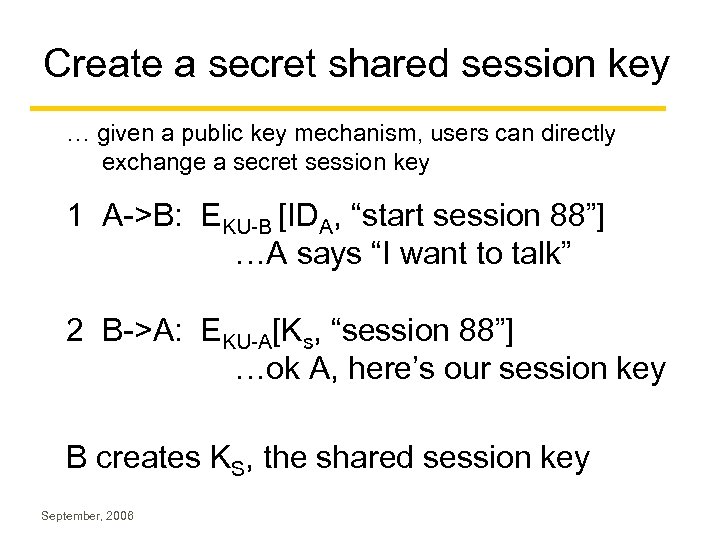 Create a secret shared session key … given a public key mechanism, users can directly exchange a secret session key 1 A->B: EKU-B [IDA, “start session 88”] …A says “I want to talk” 2 B->A: EKU-A[Ks, “session 88”] …ok A, here’s our session key B creates KS, the shared session key September, 2006
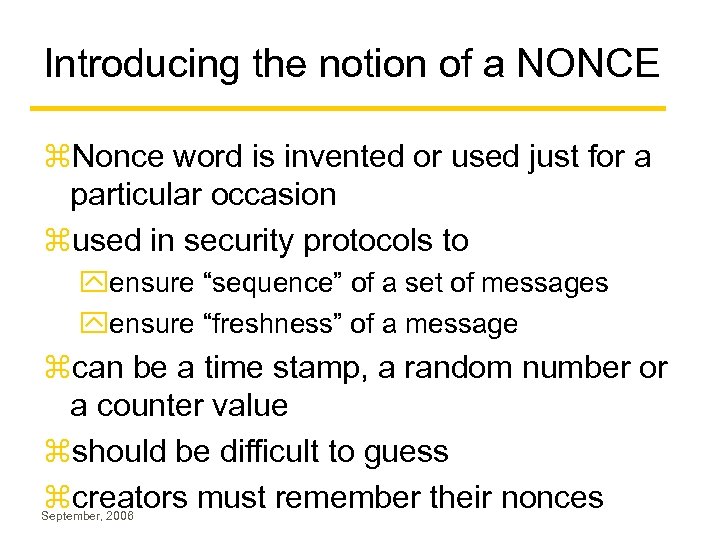 Introducing the notion of a NONCE z. Nonce word is invented or used just for a particular occasion zused in security protocols to yensure “sequence” of a set of messages yensure “freshness” of a message zcan be a time stamp, a random number or a counter value zshould be difficult to guess zcreators must remember their nonces September, 2006
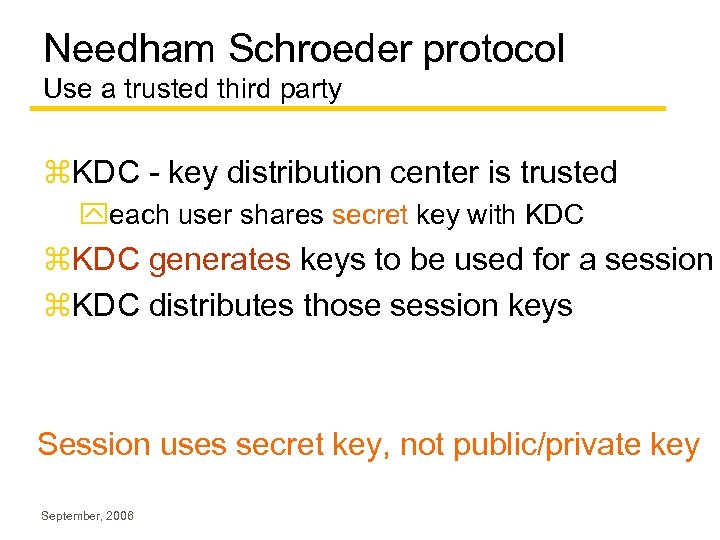 Needham Schroeder protocol Use a trusted third party z. KDC - key distribution center is trusted yeach user shares secret key with KDC z. KDC generates keys to be used for a session z. KDC distributes those session keys Session uses secret key, not public/private key September, 2006
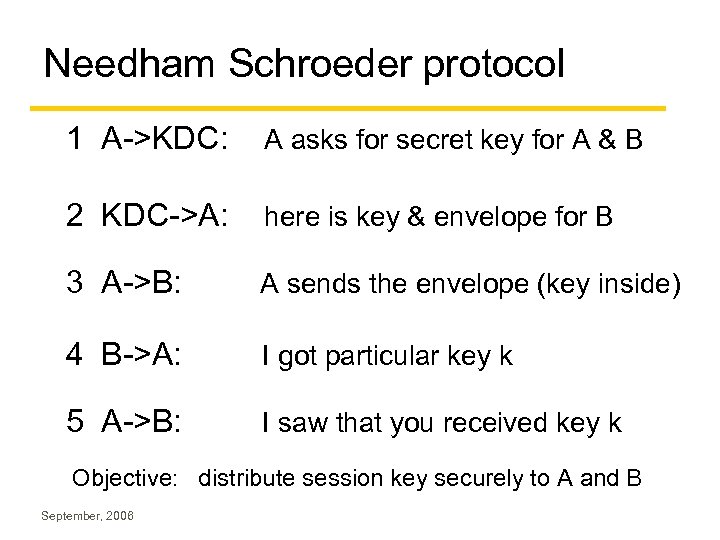 Needham Schroeder protocol 1 A->KDC: A asks for secret key for A & B 2 KDC->A: here is key & envelope for B 3 A->B: A sends the envelope (key inside) 4 B->A: I got particular key k 5 A->B: I saw that you received key k Objective: distribute session key securely to A and B September, 2006
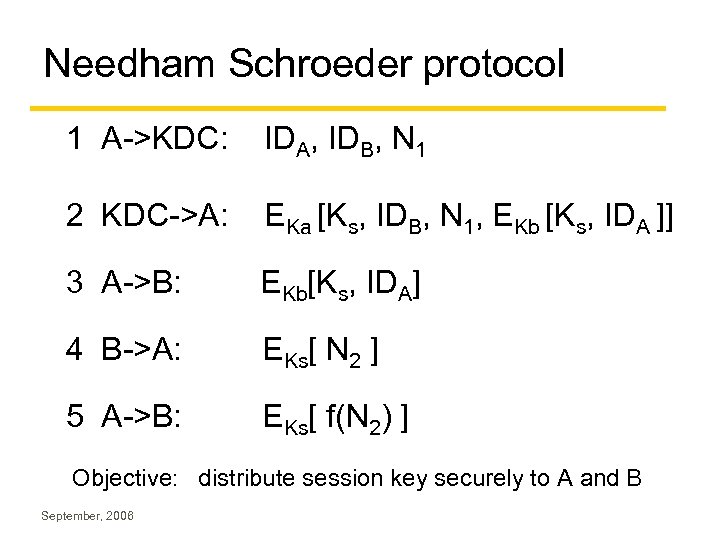 Needham Schroeder protocol 1 A->KDC: IDA, IDB, N 1 2 KDC->A: EKa [Ks, IDB, N 1, EKb [Ks, IDA ]] 3 A->B: EKb[Ks, IDA] 4 B->A: EKs[ N 2 ] 5 A->B: EKs[ f(N 2) ] Objective: distribute session key securely to A and B September, 2006
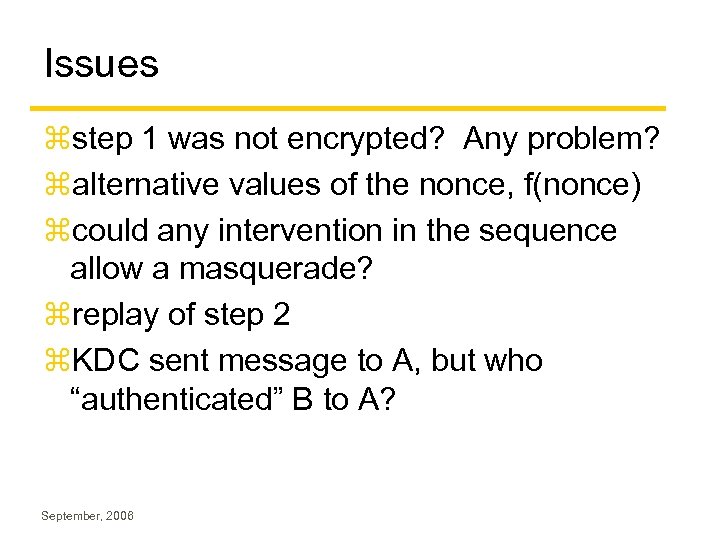 Issues zstep 1 was not encrypted? Any problem? zalternative values of the nonce, f(nonce) zcould any intervention in the sequence allow a masquerade? zreplay of step 2 z. KDC sent message to A, but who “authenticated” B to A? September, 2006
 Why do we need steps 4 & 5 Stop replay attack where adversary captures message in step 3 and replays it, in order to disrupt operations at B September, 2006
 Still a problem …. . . Assume that adversary X compromised an old session key. OK, not likely but … Z impersonates A and tricks B into using the old key by simply replaying step 3 And if Z can intercept the message in step 4, then it can impersonate A’s response and from then on can impersonate A September, 2006
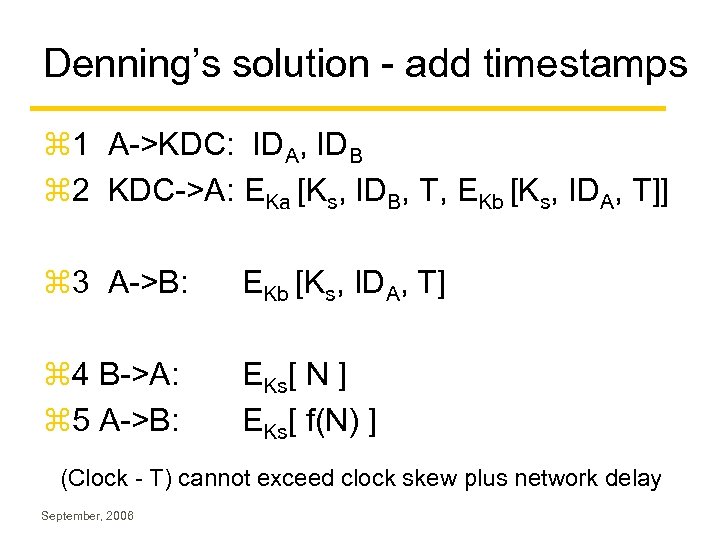 Denning’s solution - add timestamps z 1 A->KDC: IDA, IDB z 2 KDC->A: EKa [Ks, IDB, T, EKb [Ks, IDA, T]] z 3 A->B: EKb [Ks, IDA, T] z 4 B->A: z 5 A->B: EKs[ N ] EKs[ f(N) ] (Clock - T) cannot exceed clock skew plus network delay September, 2006
 Controlling timing zkeeping clocks in synch ytheoretically hard to do yin practice, under normal situations, & with no sabotage, not difficult yrequire synching with KDC’s clock, or GPS zcontrolling network overhead is more difficult zsuppress relay attack - sender clock ahead of receiver’s - replay when receiver catches up September, 2006
 Digital Signature September, 2006
![Digital signature z. Unforgeable: msg M signed by person P: [M, EKp[P, M]] z.](https://present5.com/presentation/a039b194f848bc8bf2b063ca4763931c/image-26.jpg "Digital signature z. Unforgeable: msg M signed by person P: [M, EKp[P, M]] z.") Digital signature z. Unforgeable: msg M signed by person P: [M, EKp[P, M]] z. Authentic: if person R receives [M, EKp[P, M]], R must be able to check that the signature could only have been created by P, and that it is attached to message M September, 2006
Digital signature z. Unforgeable: msg M signed by person P: [M, EKp[P, M]] z. Authentic: if person R receives [M, EKp[P, M]], R must be able to check that the signature could only have been created by P, and that it is attached to message M September, 2006
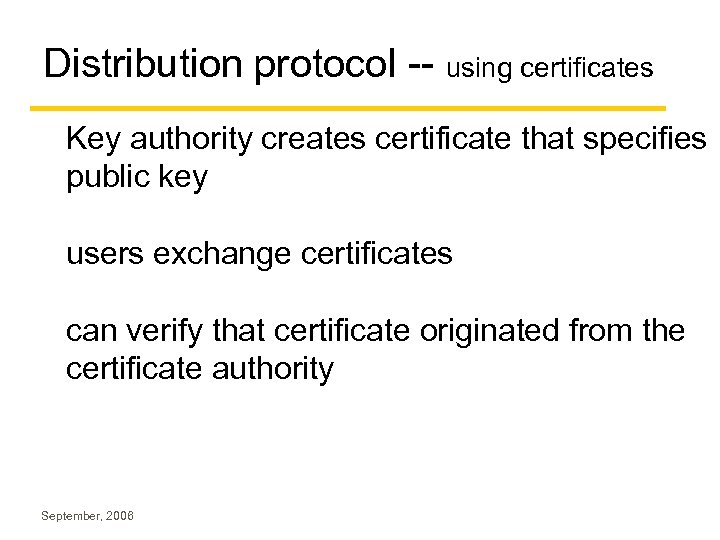 Distribution protocol -- using certificates Key authority creates certificate that specifies public key users exchange certificates can verify that certificate originated from the certificate authority September, 2006
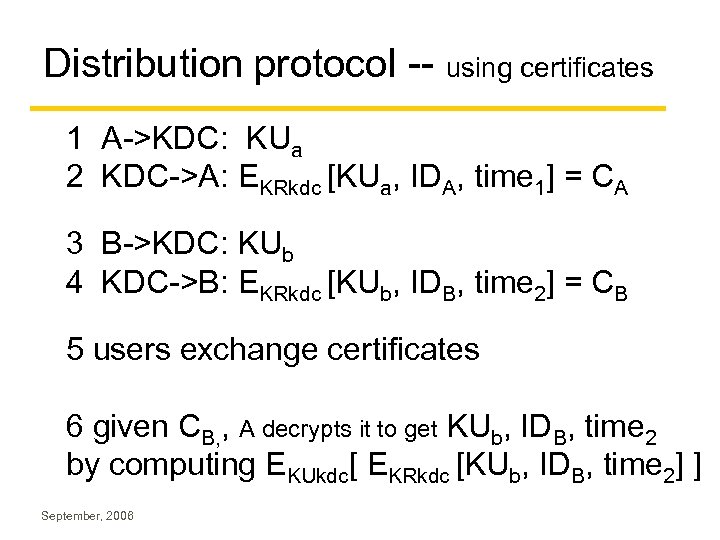 Distribution protocol -- using certificates 1 A->KDC: KUa 2 KDC->A: EKRkdc [KUa, IDA, time 1] = CA 3 B->KDC: KUb 4 KDC->B: EKRkdc [KUb, IDB, time 2] = CB 5 users exchange certificates 6 given CB, , A decrypts it to get KUb, IDB, time 2 by computing EKUkdc[ EKRkdc [KUb, IDB, time 2] ] September, 2006
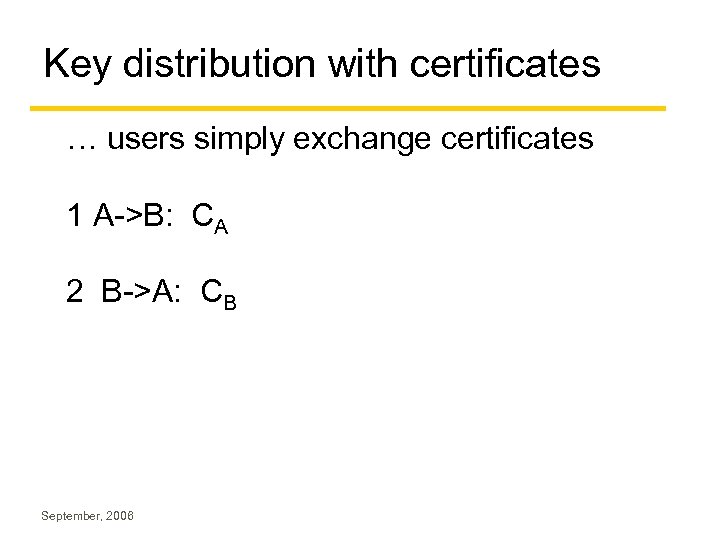 Key distribution with certificates … users simply exchange certificates 1 A->B: CA 2 B->A: CB September, 2006
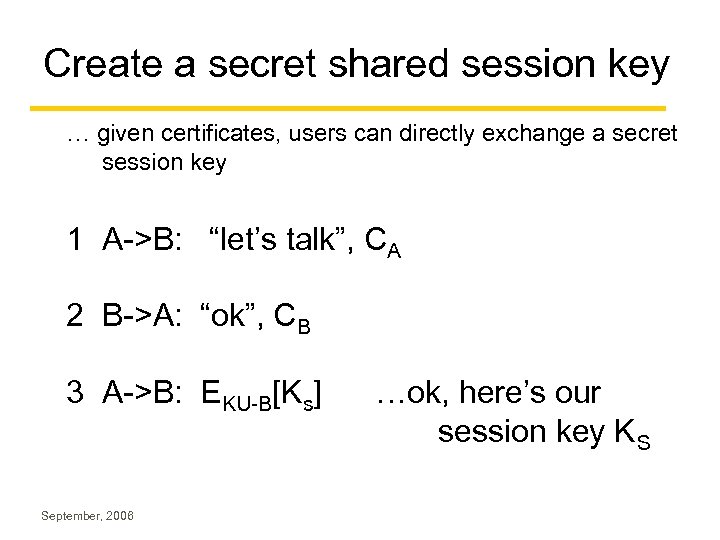 Create a secret shared session key … given certificates, users can directly exchange a secret session key 1 A->B: “let’s talk”, CA 2 B->A: “ok”, CB 3 A->B: EKU-B[Ks] September, 2006 …ok, here’s our session key K S
 Backups September, 2006
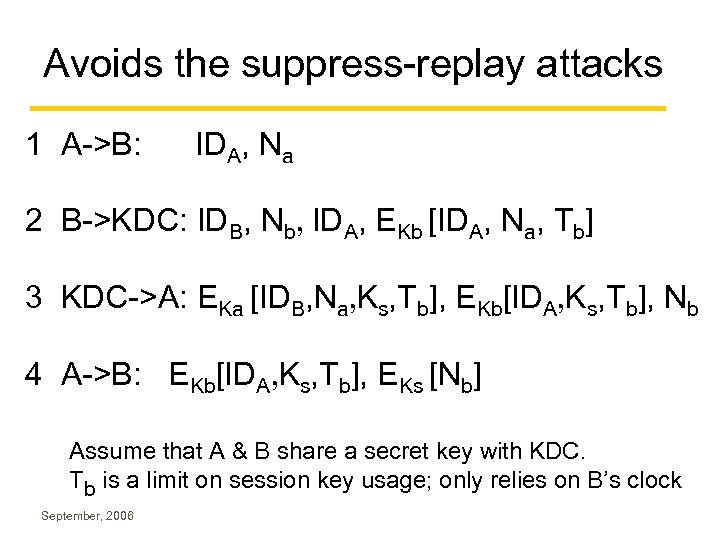 Avoids the suppress-replay attacks 1 A->B: IDA, Na 2 B->KDC: IDB, Nb, IDA, EKb [IDA, Na, Tb] 3 KDC->A: EKa [IDB, Na, Ks, Tb], EKb[IDA, Ks, Tb], Nb 4 A->B: EKb[IDA, Ks, Tb], EKs [Nb] Assume that A & B share a secret key with KDC. Tb is a limit on session key usage; only relies on B’s clock September, 2006