


 Скачать презентацию Cryptography Part 2 Using and Managing Keys cs
6554bf3db4973b1e7120abaa41c451cd.ppt
- Количество слайдов: 36
 Cryptography Part 2 Using and Managing Keys cs 490 ns - cotter
 Cryptographic Key Sharing • Symmetric encryption efficient, but requires using a shared key. • Assymetric or 2 key encryption avoids key sharing problem by allowing distribution of a public key • Problem arrises in verifying the public key. • Public key needs to be authenticated. cs 490 ns - cotter 2
 Digital Certificates • Digital documents that associate an individual with its specific public key • Data structure containing a public key, details about the key owner, and other optional information that is all digitally signed by a trusted third party cs 490 ns - cotter
 Certification Authority (CA) • The owner of the public key listed in the digital certificate can be identified to the CA in different ways – By their e-mail address – By additional information that describes the digital certificate and limits the scope of its use • Revoked digital certificates are listed in a Certificate Revocation List (CRL), which can be accessed to check the certificate status of other users cs 490 ns - cotter
 Certification Authority (CA) • The CA must publish the certificates and CRLs to a directory immediately after a certificate is issued or revoked • Can provide the information in a publicly accessible directory, called a Certificate Repository (CR) • May use a Registration Authority (RA) to handle some CA tasks such as processing certificate requests and authenticating users cs 490 ns - cotter
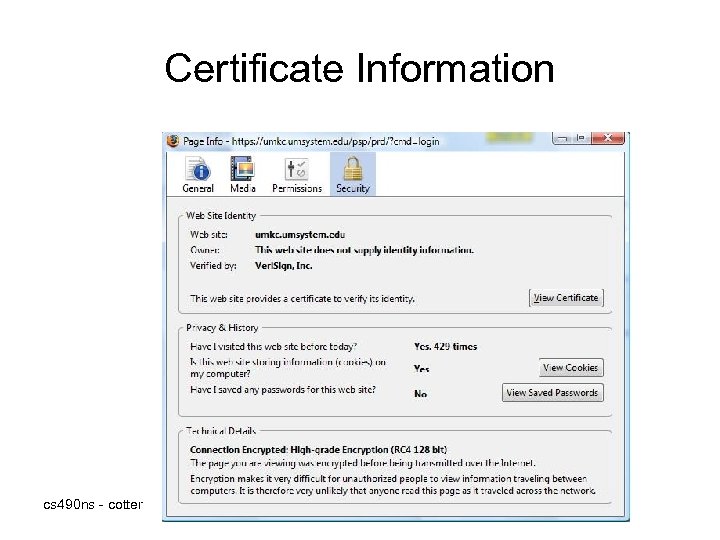 Certificate Information cs 490 ns - cotter
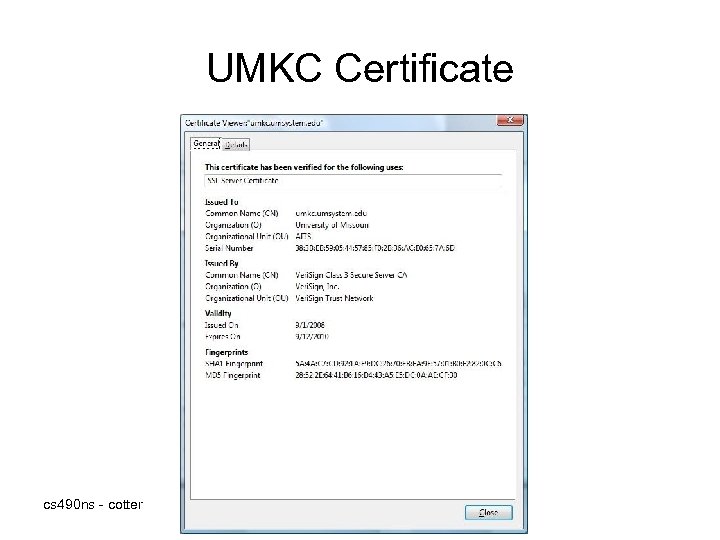 UMKC Certificate cs 490 ns - cotter
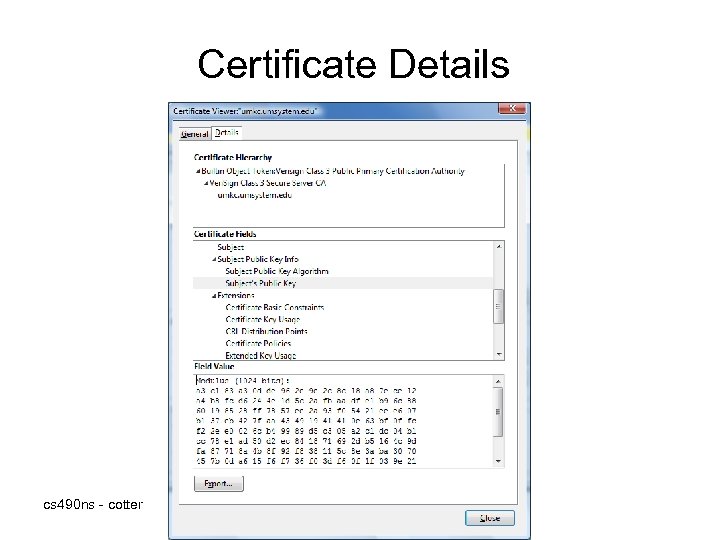 Certificate Details cs 490 ns - cotter
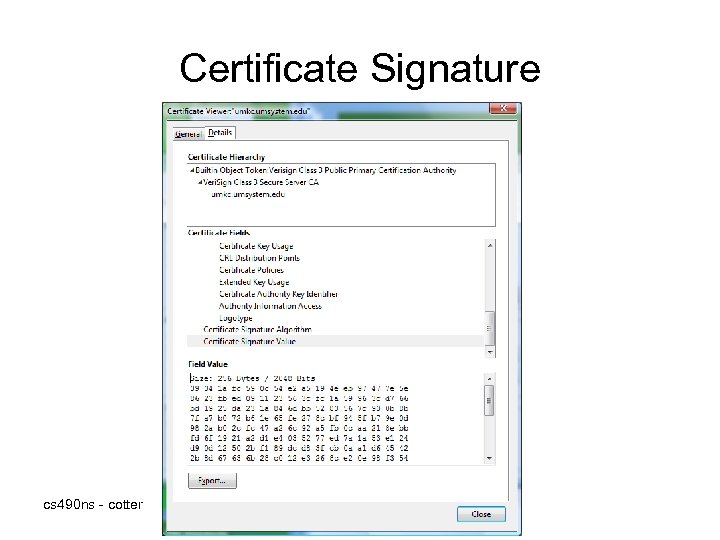 Certificate Signature cs 490 ns - cotter
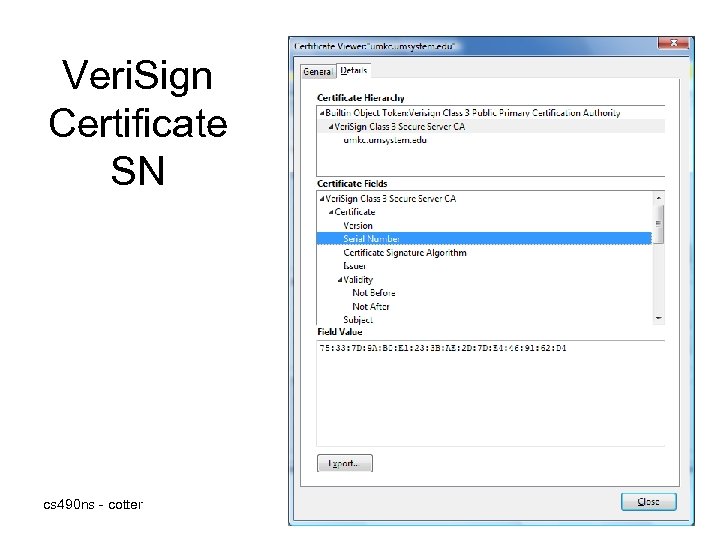 Veri. Sign Certificate SN cs 490 ns - cotter
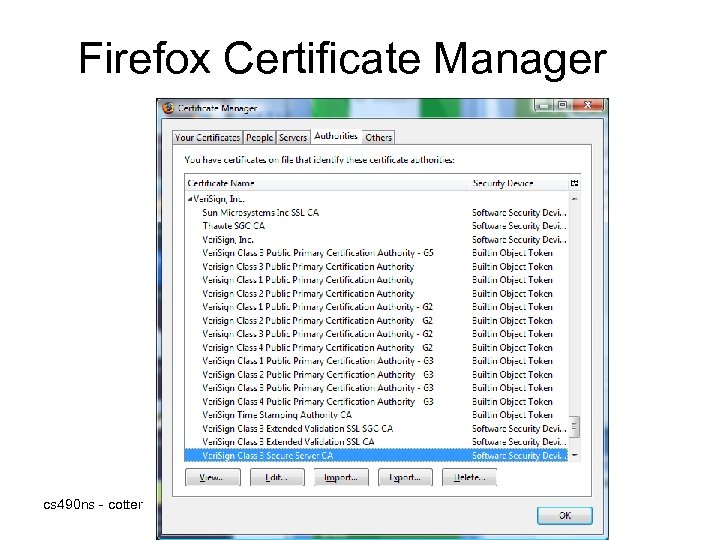 Firefox Certificate Manager cs 490 ns - cotter
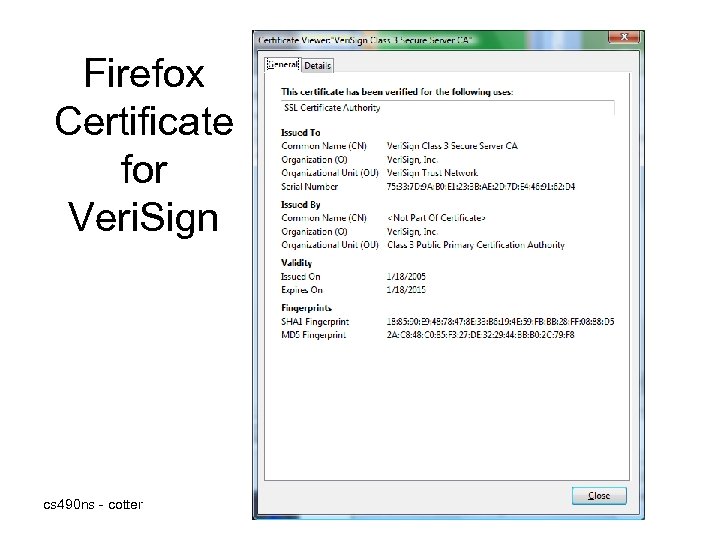 Firefox Certificate for Veri. Sign cs 490 ns - cotter
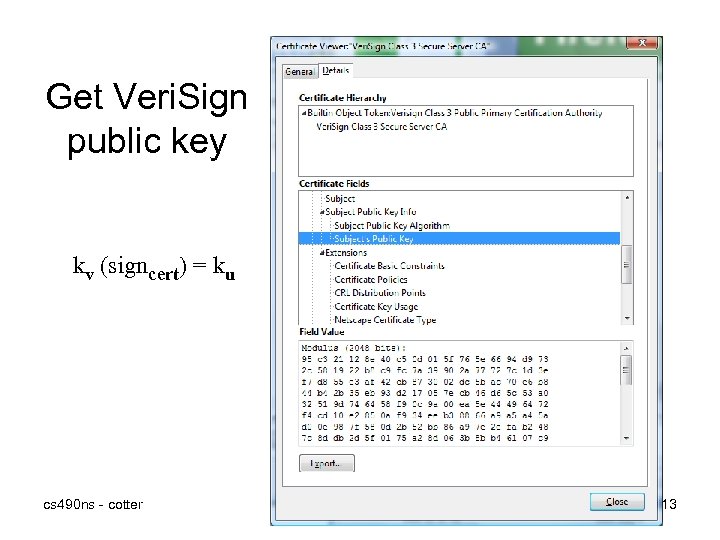 Get Veri. Sign public key kv (signcert) = ku cs 490 ns - cotter 13
 Public Key Infrastructure (PKI) • Manages keys and identity information required for asymmetric cryptography, integrating digital certificates, public key cryptography, and CAs • For a typical enterprise: – – Provides end-user enrollment software Integrates corporate certificate directories Manages, renews, and revokes certificates Provides related network services and security • Consists of one or more CA servers and digital certificates that automate several tasks cs 490 ns - cotter
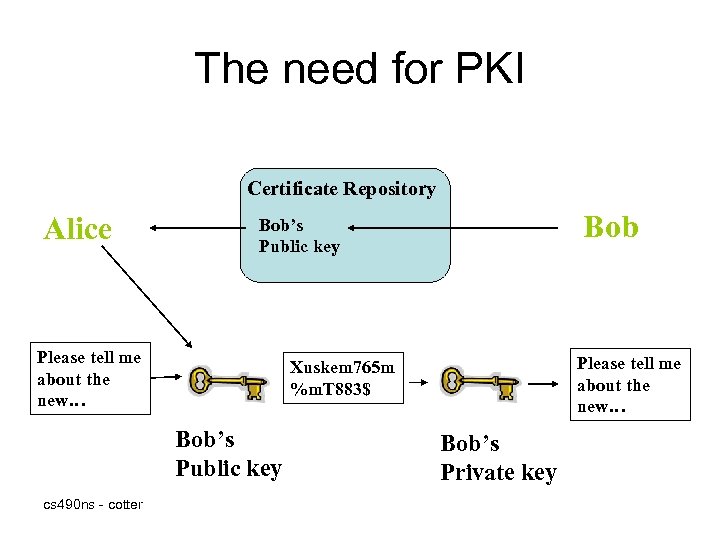 The need for PKI Certificate Repository Alice Please tell me about the new… Xuskem 765 m %m. T 883$ Bob’s Public key cs 490 ns - cotter Bob’s Public key Bob’s Private key
 PKI Standards • A number of standards have been proposed for PKI – Public Key Cryptography Standards (PKCS) – X 509 certificate standards cs 490 ns - cotter
 Public Key Cryptography Standards (PKCS) • Numbered set of standards that have been defined by the RSA Corporation since 1991 • Composed of 15 standards – – – Encryption and digital signature formats Key syntax and attributes Secret Key generation methods Key exchange protocols Message syntax Etc. cs 490 ns - cotter
 X 509 Digital Certificates • X 509 is an international standard defined by the International Telecommunication Union (ITU) that defines the format for the digital certificate • Most widely used certificate format for PKI • X 509 is used by Secure Socket Layers (SSL)/Transport Layer Security (TLS), IP Security (IPSec), and Secure/Multipurpose Internet Mail Extensions (S/MIME) cs 490 ns - cotter
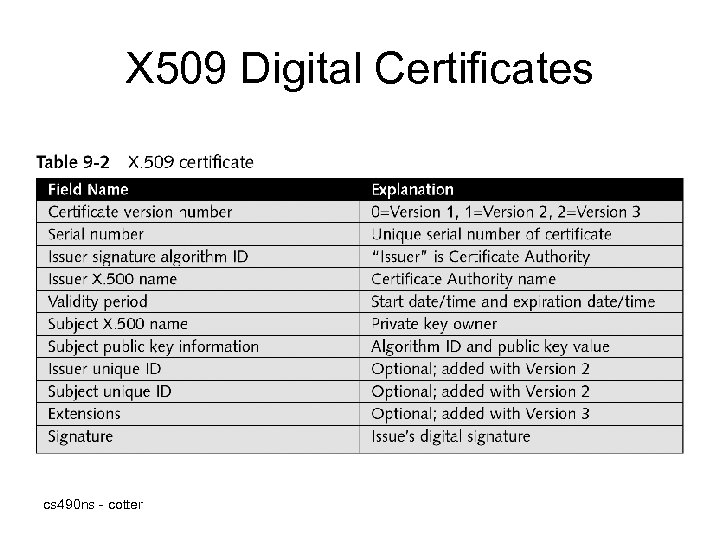 X 509 Digital Certificates cs 490 ns - cotter
 Trust Models • Refers to the type of relationship that can exist between people or organizations • In the direct trust, a personal relationship exists between two individuals • Third-party trust refers to a situation in which two individuals trust each other only because each individually trusts a third party • The three different PKI trust models are based on direct and third-party trust cs 490 ns - cotter
 Trust Models (cont) • Web of Trust model is based on direct trust. • Single-point Trust model is based on third-party trust – A CA directly issues and signs certificates • In an Hierarchical Trust model, the primary or root certificate authority issues and signs the certificates for CAs below it cs 490 ns - cotter
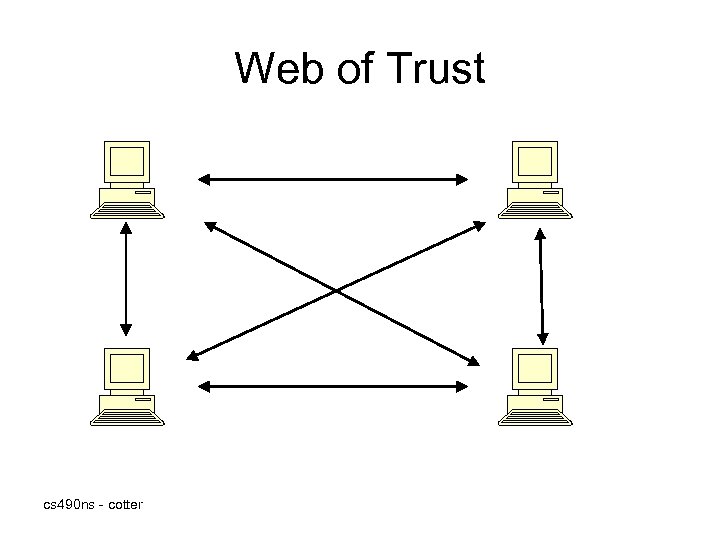 Web of Trust cs 490 ns - cotter
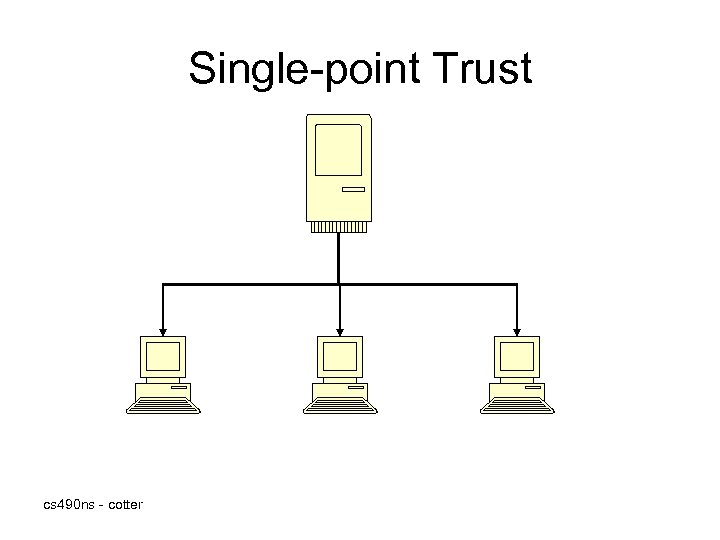 Single-point Trust cs 490 ns - cotter
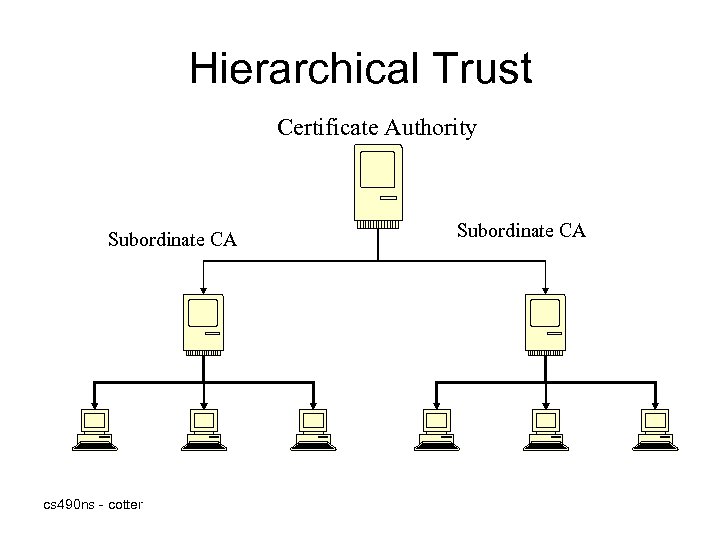 Hierarchical Trust Certificate Authority Subordinate CA cs 490 ns - cotter Subordinate CA
 Managing Digital Certificates • After a user decides to trust a CA, they can download the digital certificate and public key from the CA and store them on their local computer • CA certificates are issued by a CA directly to individuals • Typically used to secure e-mail transmissions through S/MIME and SSL/TLS cs 490 ns - cotter
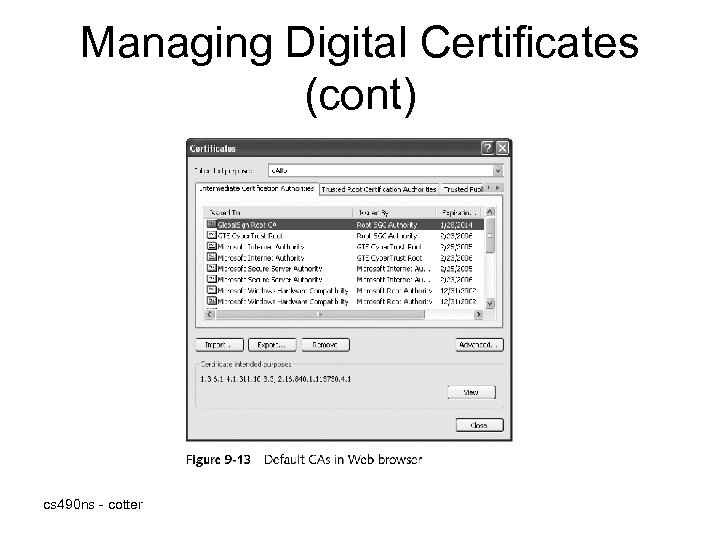 Managing Digital Certificates (cont) cs 490 ns - cotter
 Managing Digital Certificates (cont) • Server certificates can be issued from a Web server, FTP server, or mail server to ensure a secure transmission • Software publisher certificates are provided by software publishers to verify their programs are secure cs 490 ns - cotter
 Certificate Policy (CP) • Published set of rules that govern operation of a PKI • Minimum Topics: – – – Statement of Scope CA Obligations RA Obligations User Obligations Repository Obligations cs 490 ns - cotter Enforcement Compliance Audits Confidentiality Operational Reqmts Training
 Certificate Practice Statement (CPS) • Describes in detail how the CA uses and manages certificates • Topics: – – – – End User Registration Issuing Digital Certificates Revoking Digital Certificates Procedural Controls Key Generation and Use Private Key Protection CRL Profiles cs 490 ns - cotter
 Certificate Life Cycle • Typically divided into four parts: – – Creation Revocation Expiration Suspension cs 490 ns - cotter
 Centralized / Decentralized Management • An example of a decentralized key management system is the PKI web of trust model • Centralized key management is the foundation for single-point trust models and hierarchical trust models, with keys being distributed by the CA cs 490 ns - cotter
 Key Storage • May store public keys by embedding them within digital certificates – A form of software-based storage and doesn’t involve any cryptography hardware • May also store private keys on the user’s local computer – Must ensure that keys are encrypted – “key ring” • Storing keys in hardware is an alternative to software-based keys cs 490 ns - cotter
 Key Usage • If you desire more security than a single set of public and private (single-dual) keys can offer, you can choose to use multiple pairs of dual keys – One pair of keys may be used to encrypt information and the public key could be backed up to another location – The second pair would be used only for digital signatures and the public key in that pair would never be backed up cs 490 ns - cotter
 Key Handling Procedures • Certain procedures can help ensure that keys are properly handled: – – Escrow Renewal Recovery Destruction cs 490 ns - cotter – Expiration – Revocation – Suspension
 Summary • Primary advantage of symmetric cryptography is that encryption and decryption is usually fast and easy to implement • A digital signature solves the problem of authenticating the sender when using asymmetric cryptography • With asymmetric cryptography, an organization can find itself implementing piecemeal solutions for different applications cs 490 ns - cotter
 Summary (cont) • PKCS is a numbered set of standards that have been defined by the RSA Corporation since 1991 • The three PKI trust models are based on direct and third-party trust • Digital certificates are managed through CPs and CPSs cs 490 ns - cotter