


 Скачать презентацию Cryptography and Network Security Chapter 7 Confidentiality
lecture_11_Placement_of_Encryption.pptx
- Количество слайдов: 34
 Cryptography and Network Security Chapter 7
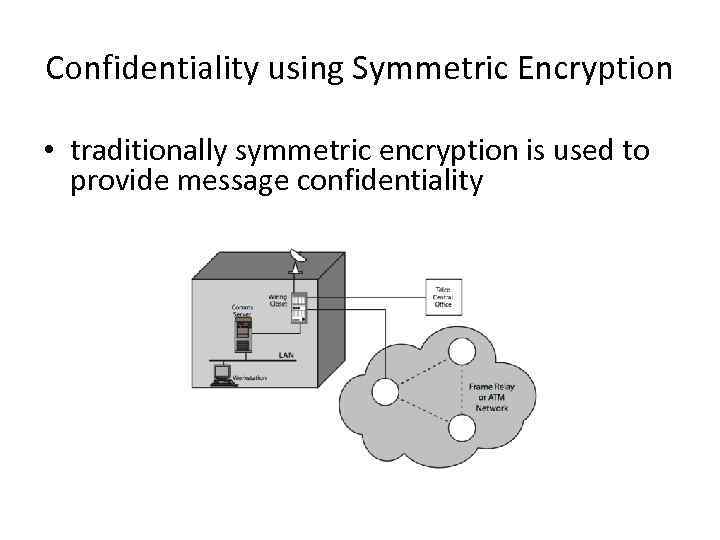 Confidentiality using Symmetric Encryption • traditionally symmetric encryption is used to provide message confidentiality
 Placement of Encryption • have two major placement alternatives • link encryption – encryption occurs independently on every link – implies must decrypt traffic between links – requires many devices, but paired keys • end-to-end encryption – encryption occurs between original source and final destination – need devices at each end with shared keys
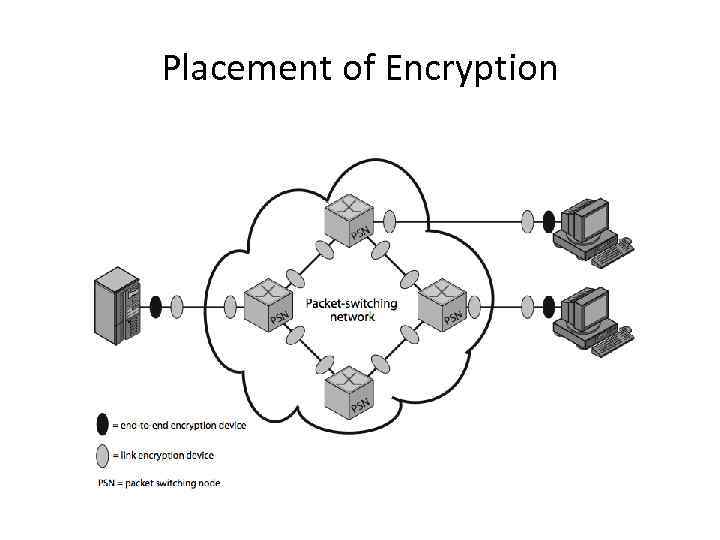 Placement of Encryption
 Placement of Encryption • when using end-to-end encryption must leave headers in clear – so network can correctly route information • hence although contents protected, traffic pattern flows are not • ideally want both at once – end-to-end protects data contents over entire path and provides authentication – link protects traffic flows from monitoring
 Placement of Encryption • can place encryption function at various layers in OSI Reference Model – link encryption occurs at layers 1 or 2 – end-to-end can occur at layers 3, 4, 6, 7 – as move higher less information is encrypted but it is more secure though more complex with more entities and keys
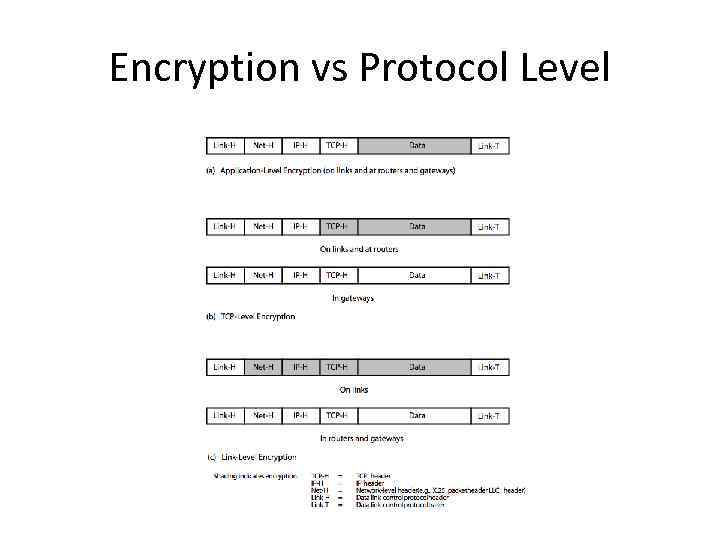 Encryption vs Protocol Level
 Key Distribution • symmetric schemes require both parties to share a common secret key • issue is how to securely distribute this key • often secure system failure due to a break in the key distribution scheme
 Key Distribution • given parties A and B have various key distribution alternatives: 1. A can select key and physically deliver to B 2. third party can select & deliver key to A & B 3. if A & B have communicated previously can use previous key to encrypt a new key 4. if A & B have secure communications with a third party C, C can relay key between A & B
 Key Hierarchy • typically have a hierarchy of keys • session key – temporary key – used for encryption of data between users – for one logical session then discarded • master key – used to encrypt session keys – shared by user & key distribution center
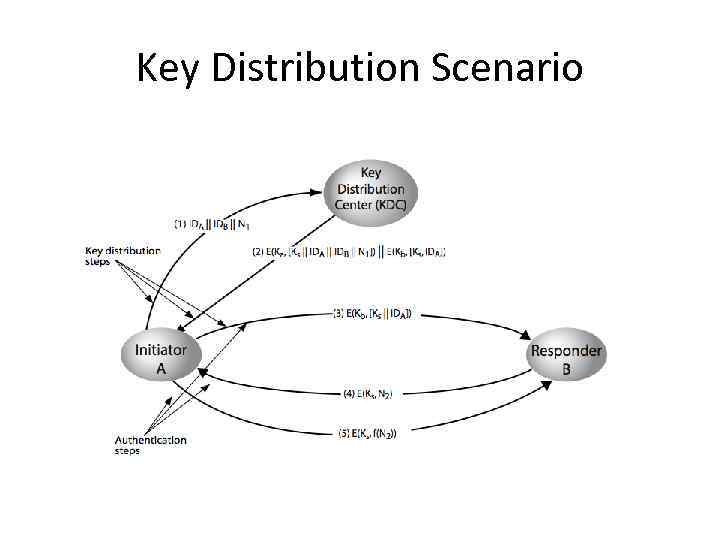 Key Distribution Scenario
 Random Numbers • many uses of random numbers in cryptography – – nonces in authentication protocols to prevent replay session keys public key generation keystream for a one-time pad • in all cases its critical that these values be – statistically random, uniform distribution, independent – unpredictability of future values from previous values
 Pseudorandom Number Generators (PRNGs) • often use deterministic algorithmic techniques to create “random numbers” – although are not truly random – can pass many tests of “randomness” • known as “pseudorandom numbers” • created by “Pseudorandom Number Generators (PRNGs)”
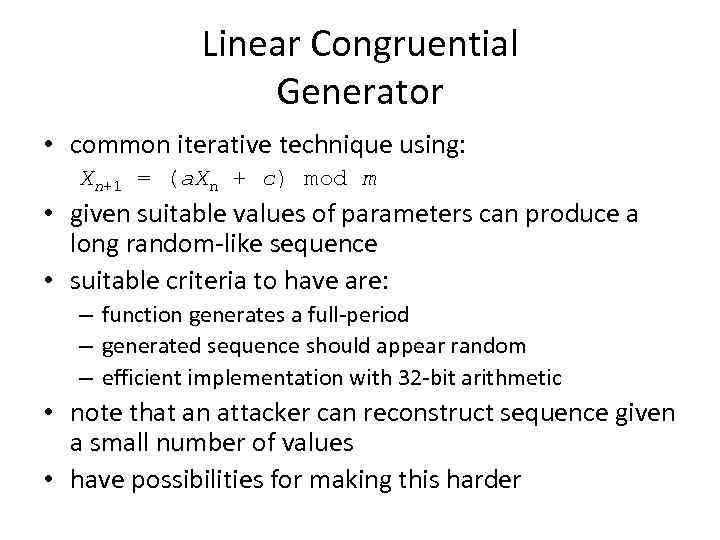 Linear Congruential Generator • common iterative technique using: Xn+1 = (a. Xn + c) mod m • given suitable values of parameters can produce a long random-like sequence • suitable criteria to have are: – function generates a full-period – generated sequence should appear random – efficient implementation with 32 -bit arithmetic • note that an attacker can reconstruct sequence given a small number of values • have possibilities for making this harder
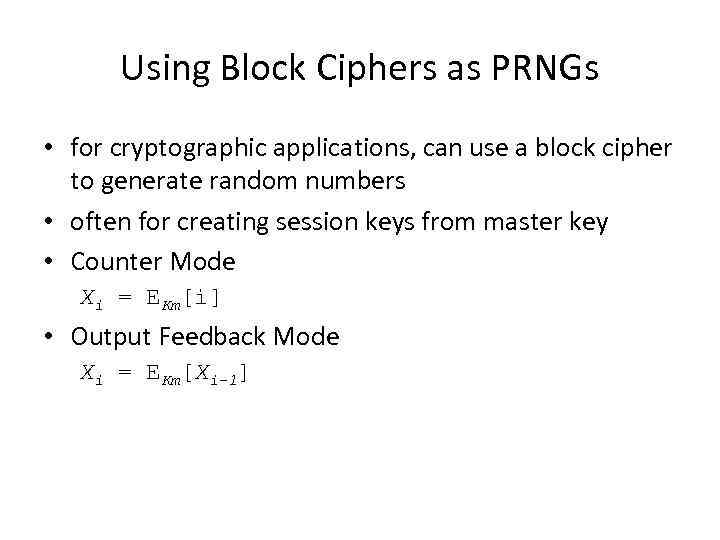 Using Block Ciphers as PRNGs • for cryptographic applications, can use a block cipher to generate random numbers • often for creating session keys from master key • Counter Mode Xi = EKm[i] • Output Feedback Mode Xi = EKm[Xi-1]
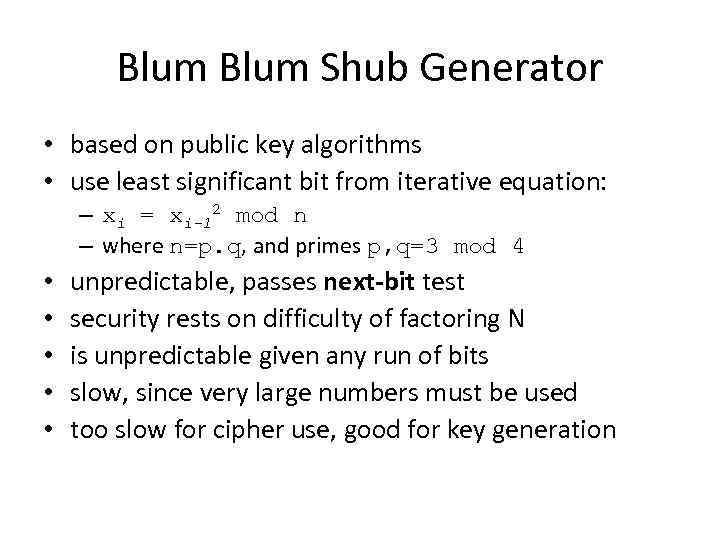 Blum Shub Generator • based on public key algorithms • use least significant bit from iterative equation: – xi = xi-12 mod n – where n=p. q, and primes p, q=3 mod 4 • • • unpredictable, passes next-bit test security rests on difficulty of factoring N is unpredictable given any run of bits slow, since very large numbers must be used too slow for cipher use, good for key generation
 Natural Random Noise • best source is natural randomness in real world • find a regular but random event and monitor • do generally need special h/w to do this – eg. radiation counters, radio noise, audio noise, thermal noise in diodes, leaky capacitors, mercury discharge tubes etc • starting to see such h/w in new CPU's • problems of bias or uneven distribution in signal – have to compensate for this when sample and use – best to only use a few noisiest bits from each sample
 Published Sources • a few published collections of random numbers • Rand Co, in 1955, published 1 million numbers – generated using an electronic roulette wheel – has been used in some cipher designs cf Khafre • earlier Tippett in 1927 published a collection • issues are that: – these are limited – too well-known for most uses
 Cryptography and Network Security Chapter 8
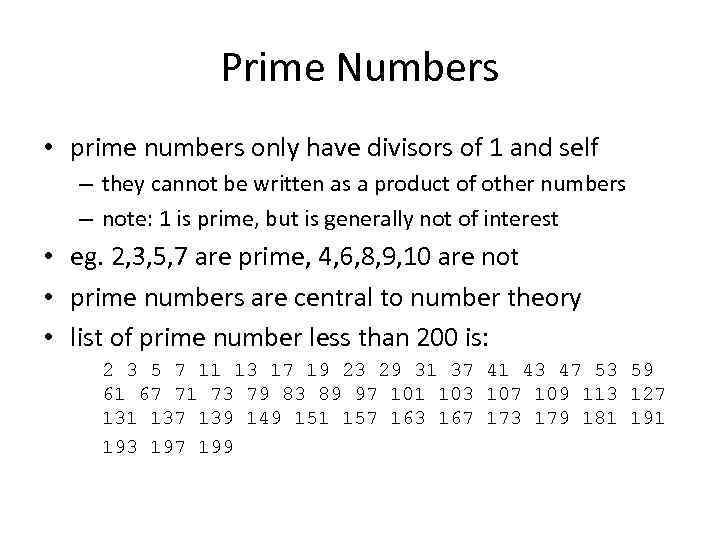 Prime Numbers • prime numbers only have divisors of 1 and self – they cannot be written as a product of other numbers – note: 1 is prime, but is generally not of interest • eg. 2, 3, 5, 7 are prime, 4, 6, 8, 9, 10 are not • prime numbers are central to number theory • list of prime number less than 200 is: 2 3 5 7 11 13 17 19 23 29 31 37 41 43 47 53 59 61 67 71 73 79 83 89 97 101 103 107 109 113 127 131 137 139 149 151 157 163 167 173 179 181 193 197 199
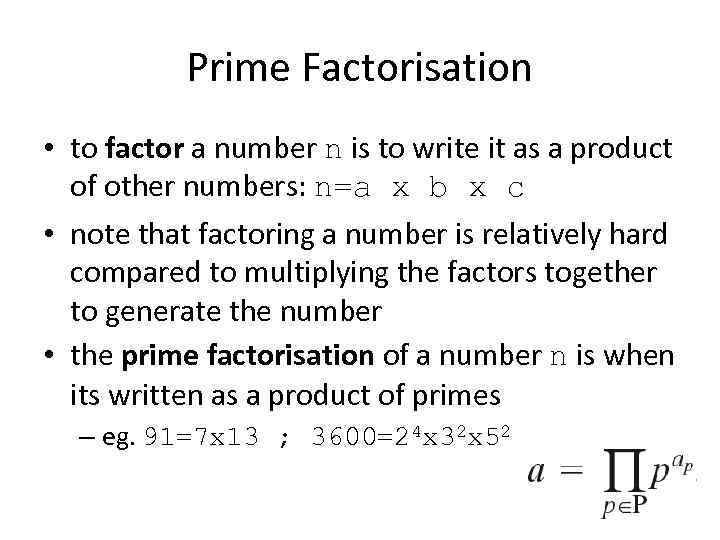 Prime Factorisation • to factor a number n is to write it as a product of other numbers: n=a x b x c • note that factoring a number is relatively hard compared to multiplying the factors together to generate the number • the prime factorisation of a number n is when its written as a product of primes – eg. 91=7 x 13 ; 3600=24 x 32 x 52
 Relatively Prime Numbers & GCD • two numbers a, b are relatively prime if have no common divisors apart from 1 – eg. 8 & 15 are relatively prime since factors of 8 are 1, 2, 4, 8 and of 15 are 1, 3, 5, 15 and 1 is the only common factor • conversely can determine the greatest common divisor by comparing their prime factorizations and using least powers – eg. 300=21 x 31 x 52 18=21 x 32 hence GCD(18, 300)=21 x 31 x 50=6
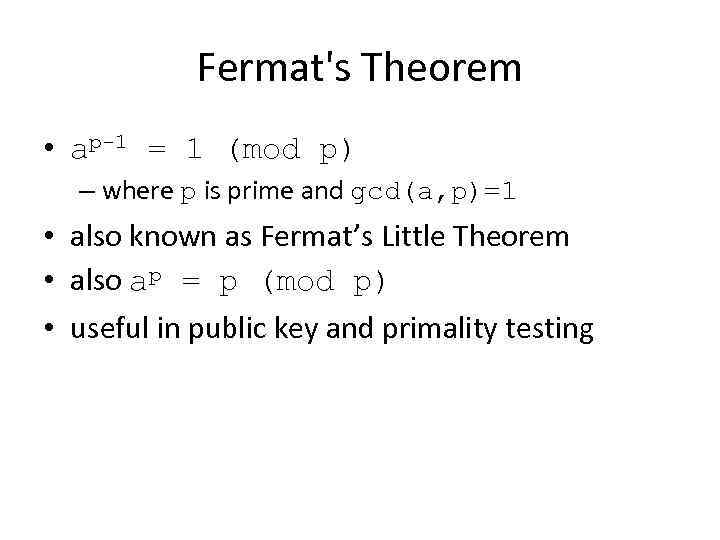 Fermat's Theorem • ap-1 = 1 (mod p) – where p is prime and gcd(a, p)=1 • also known as Fermat’s Little Theorem • also ap = p (mod p) • useful in public key and primality testing
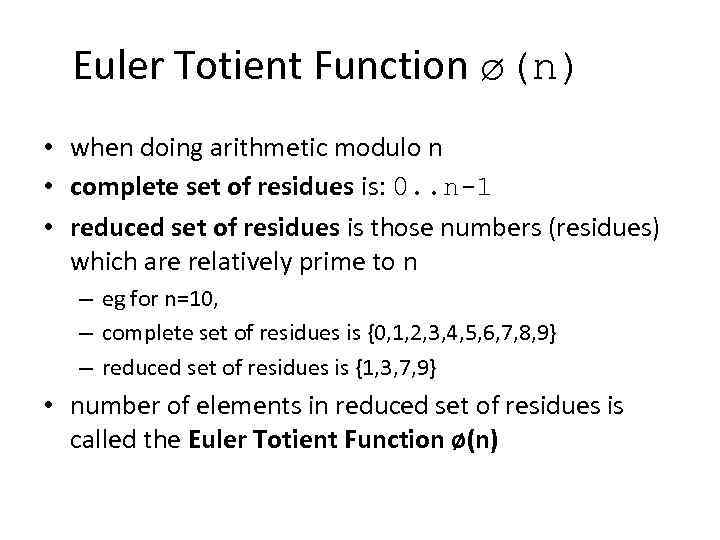 Euler Totient Function ø(n) • when doing arithmetic modulo n • complete set of residues is: 0. . n-1 • reduced set of residues is those numbers (residues) which are relatively prime to n – eg for n=10, – complete set of residues is {0, 1, 2, 3, 4, 5, 6, 7, 8, 9} – reduced set of residues is {1, 3, 7, 9} • number of elements in reduced set of residues is called the Euler Totient Function ø(n)
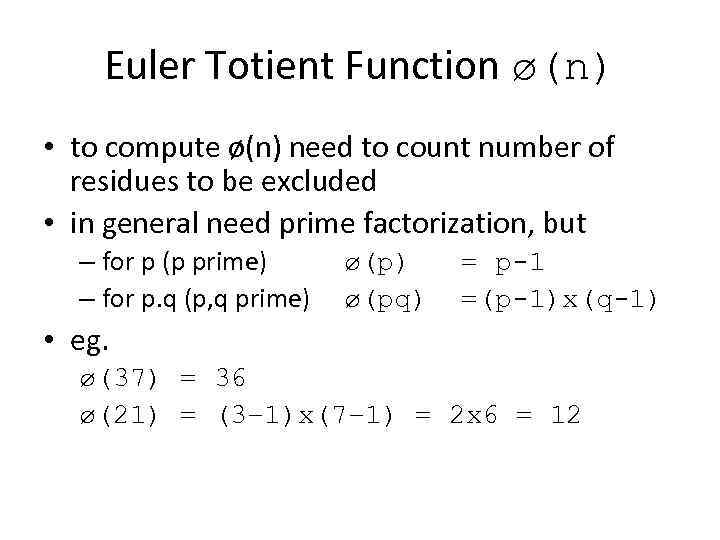 Euler Totient Function ø(n) • to compute ø(n) need to count number of residues to be excluded • in general need prime factorization, but – for p (p prime) – for p. q (p, q prime) ø(pq) = p-1 =(p-1)x(q-1) • eg. ø(37) = 36 ø(21) = (3– 1)x(7– 1) = 2 x 6 = 12
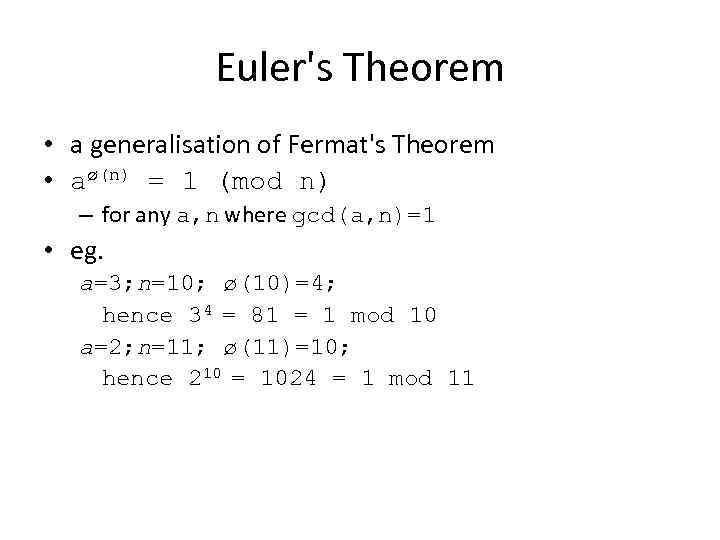 Euler's Theorem • a generalisation of Fermat's Theorem • aø(n) = 1 (mod n) – for any a, n where gcd(a, n)=1 • eg. a=3; n=10; ø(10)=4; hence 34 = 81 = 1 mod 10 a=2; n=11; ø(11)=10; hence 210 = 1024 = 1 mod 11
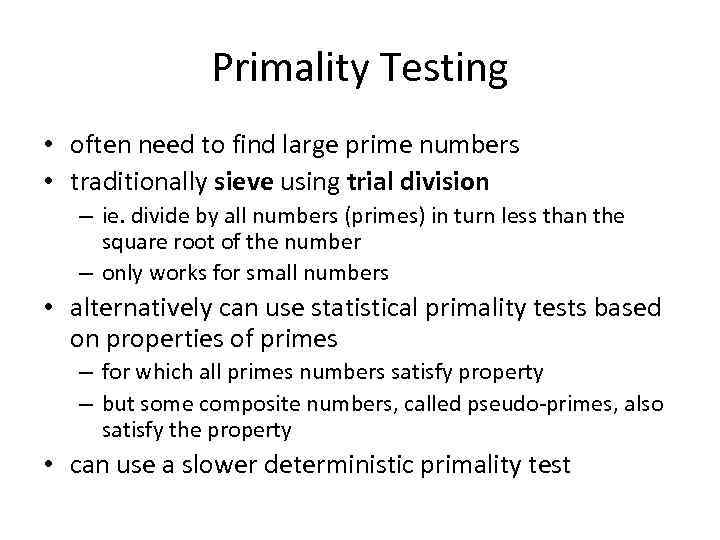 Primality Testing • often need to find large prime numbers • traditionally sieve using trial division – ie. divide by all numbers (primes) in turn less than the square root of the number – only works for small numbers • alternatively can use statistical primality tests based on properties of primes – for which all primes numbers satisfy property – but some composite numbers, called pseudo-primes, also satisfy the property • can use a slower deterministic primality test
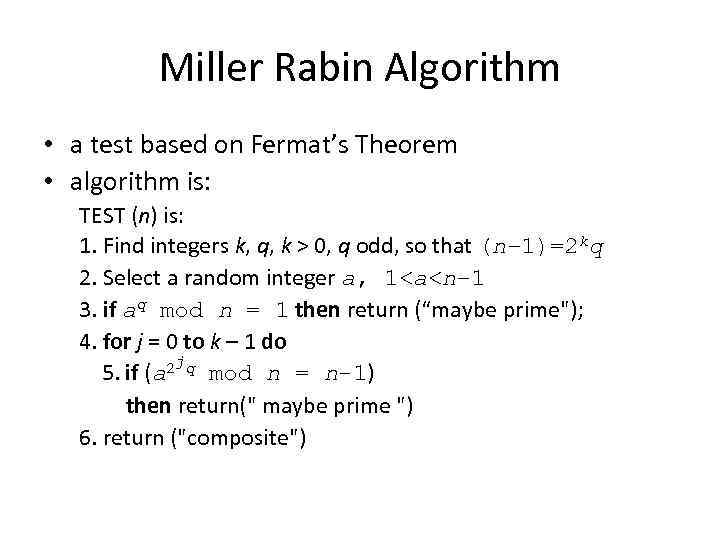 Miller Rabin Algorithm • a test based on Fermat’s Theorem • algorithm is: TEST (n) is: 1. Find integers k, q, k > 0, q odd, so that (n– 1)=2 kq 2. Select a random integer a, 1
 Probabilistic Considerations • if Miller-Rabin returns “composite” the number is definitely not prime • otherwise is a prime or a pseudo-prime • chance it detects a pseudo-prime is < 1/4 • hence if repeat test with different random a then chance n is prime after t tests is: – Pr(n prime after t tests) = 1 -4 -t – eg. for t=10 this probability is > 0. 99999
 Prime Distribution • prime number theorem states that primes occur roughly every (ln n) integers • but can immediately ignore evens • so in practice need only test 0. 5 ln(n) numbers of size n to locate a prime – note this is only the “average” – sometimes primes are close together – other times are quite far apart
 Primitive Roots • from Euler’s theorem have aø(n)mod n=1 • consider am=1 (mod n), GCD(a, n)=1 – must exist for m = ø(n) but may be smaller – once powers reach m, cycle will repeat • if smallest is m = ø(n) then a is called a primitive root • if p is prime, then successive powers of a "generate" the group mod p • these are useful but relatively hard to find
 Discrete Logarithms • the inverse problem to exponentiation is to find the discrete logarithm of a number modulo p • that is to find x such that y = gx (mod p) • this is written as x = logg y (mod p) • if g is a primitive root then it always exists, otherwise it may not, eg. x = log 3 4 mod 13 has no answer x = log 2 3 mod 13 = 4 by trying successive powers • whilst exponentiation is relatively easy, finding discrete logarithms is generally a hard problem
 Summary • have considered: – use and placement of symmetric encryption to protect confidentiality – need for good key distribution – use of trusted third party KDC’s – random number generation issues
 Summary • have considered: – prime numbers – Fermat’s and Euler’s Theorems & ø(n) – Primality Testing – Chinese Remainder Theorem – Discrete Logarithms