


 Скачать презентацию Cryptography and Network Security Chapter 21 Fifth Edition
6b664415cb5d309d87a952dcc95b1aad.ppt
- Количество слайдов: 36
 Cryptography and Network Security Chapter 21 Fifth Edition by William Stallings Lecture slides by Lawrie Brown
 Chapter 21 – Malicious Software What is the concept of defense: The parrying of a blow. What is its characteristic feature: Awaiting the blow. —On War, Carl Von Clausewitz
 Viruses and Other Malicious Content Ø computer viruses have got a lot of publicity Ø one of a family of malicious software Ø effects usually obvious Ø have figured in news reports, fiction, movies (often exaggerated) Ø getting more attention than deserve Ø are a concern though
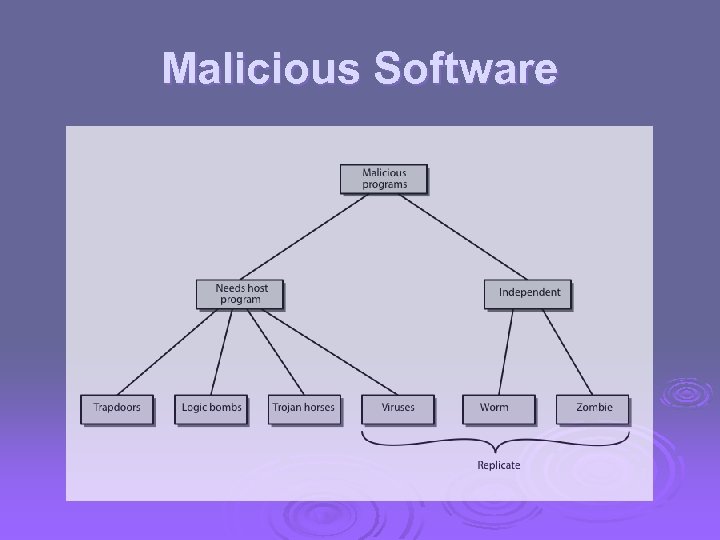 Malicious Software
 Backdoor or Trapdoor Ø secret entry point into a program Ø allows those who know access bypassing usual security procedures Ø have been commonly used by developers Ø a threat when left in production programs allowing exploited by attackers Ø very hard to block in O/S Ø requires good s/w development & update
 Logic Bomb Ø one of oldest types of malicious software Ø code embedded in legitimate program Ø activated when specified conditions met l l l eg presence/absence of some file particular date/time particular user Ø when triggered typically damage system l modify/delete files/disks, halt machine, etc
 Trojan Horse program with hidden side-effects Ø which is usually superficially attractive Ø l Ø eg game, s/w upgrade etc when run performs some additional tasks l allows attacker to indirectly gain access they do not have directly often used to propagate a virus/worm or install a backdoor Ø or simply to destroy data Ø
 Mobile Code Ø program/script/macro that runs unchanged l l on heterogeneous collection of platforms on large homogeneous collection (Windows) Ø transmitted from remote system to local system & then executed on local system Ø often to inject virus, worm, or Trojan horse Ø or to perform own exploits l unauthorized data access, root compromise
 Multiple-Threat Malware Ø malware may operate in multiple ways Ø multipartite virus infects in multiple ways l eg. multiple file types Ø blended attack uses multiple methods of infection or transmission l l to maximize speed of contagion and severity may include multiple types of malware eg. Nimda has worm, virus, mobile code can also use IM & P 2 P
 Viruses Ø piece of software that infects programs l l Ø specific to operating system and hardware l Ø modifying them to include a copy of the virus so it executes secretly when host program is run taking advantage of their details and weaknesses a typical virus goes through phases of: l l dormant propagation triggering execution
 Virus Structure Ø components: l l l infection mechanism - enables replication trigger - event that makes payload activate payload - what it does, malicious or benign Ø prepended / postpended / embedded Ø when infected program invoked, executes virus code then original program code Ø can block initial infection (difficult) Ø or propogation (with access controls)
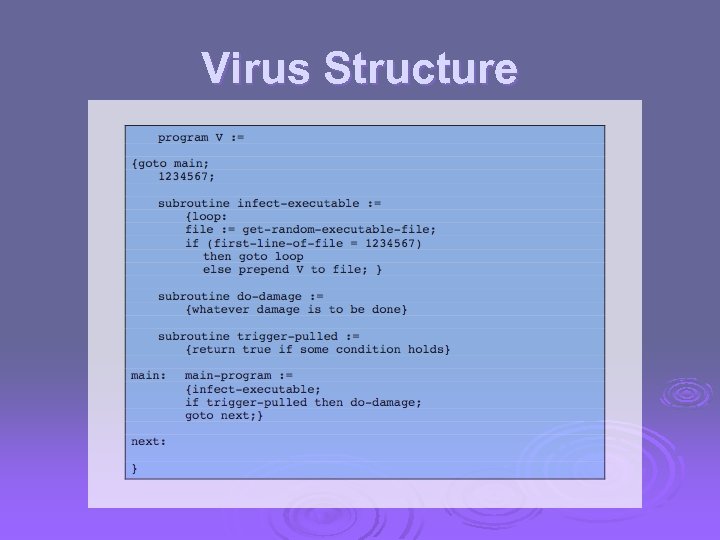 Virus Structure
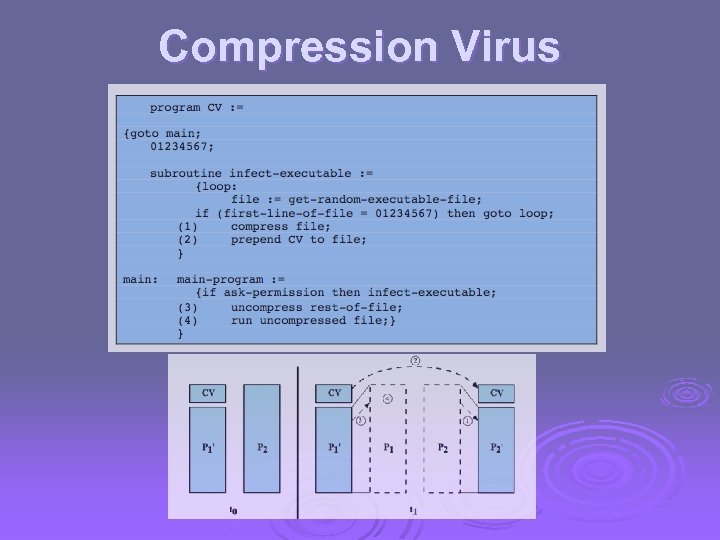 Compression Virus
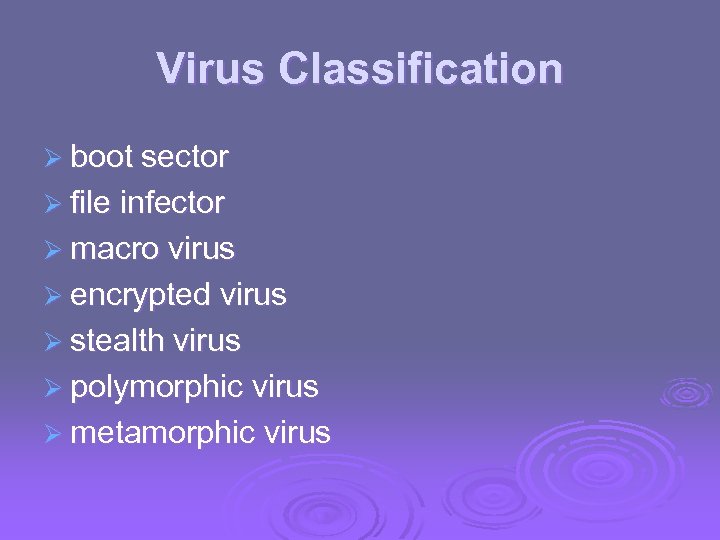 Virus Classification Ø boot sector Ø file infector Ø macro virus Ø encrypted virus Ø stealth virus Ø polymorphic virus Ø metamorphic virus
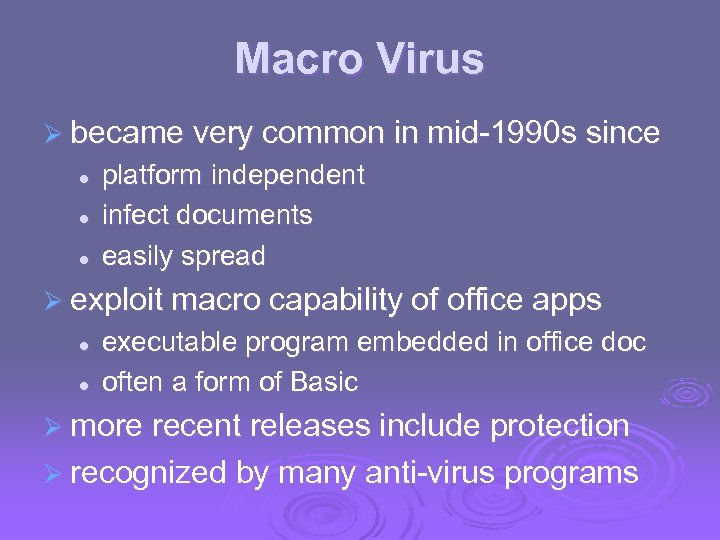 Macro Virus Ø became very common in mid-1990 s since l l l platform independent infect documents easily spread Ø exploit macro capability of office apps l l executable program embedded in office doc often a form of Basic Ø more recent releases include protection Ø recognized by many anti-virus programs
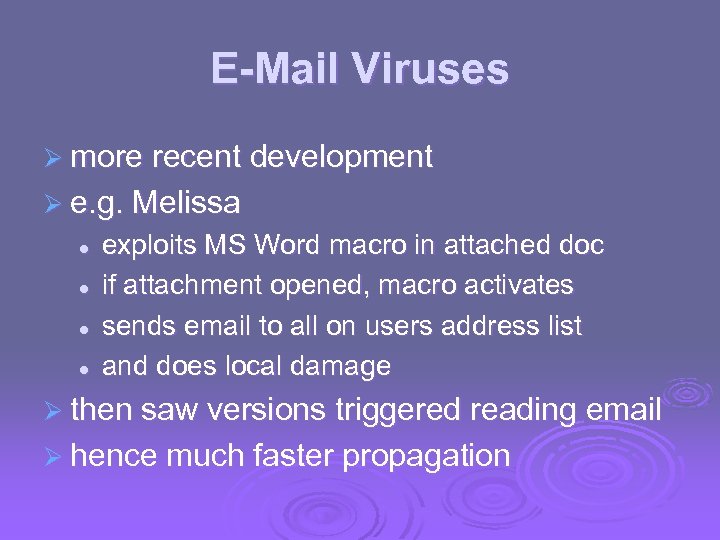 E-Mail Viruses Ø more recent development Ø e. g. Melissa l l exploits MS Word macro in attached doc if attachment opened, macro activates sends email to all on users address list and does local damage Ø then saw versions triggered reading email Ø hence much faster propagation
 Virus Countermeasures Ø prevention - ideal solution but difficult Ø realistically need: l l l detection identification removal Ø if detect but can’t identify or remove, must discard and replace infected program
 Anti-Virus Evolution Ø virus & antivirus tech have both evolved Ø early viruses simple code, easily removed Ø as become more complex, so must the countermeasures Ø generations l l first - signature scanners second - heuristics third - identify actions fourth - combination packages
 Generic Decryption Ø runs executable files through GD scanner: l l l CPU emulator to interpret instructions virus scanner to check known virus signatures emulation control module to manage process Ø lets virus decrypt itself in interpreter Ø periodically scan for virus signatures Ø issue is long to interpret and scan l tradeoff chance of detection vs time delay
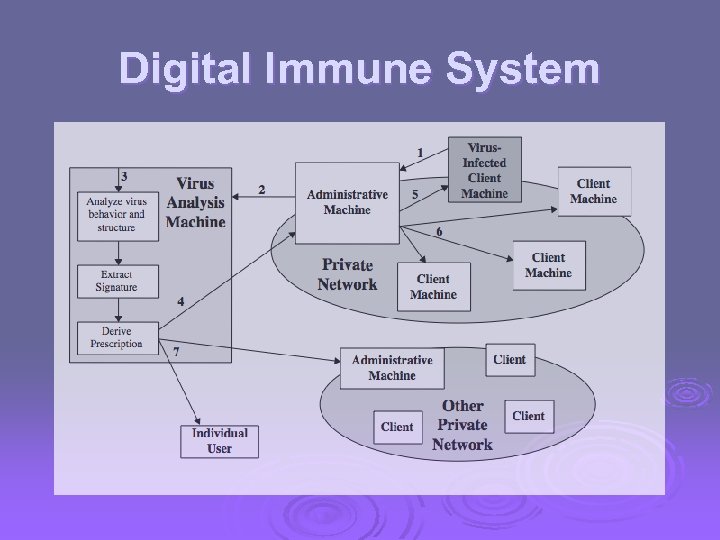 Digital Immune System
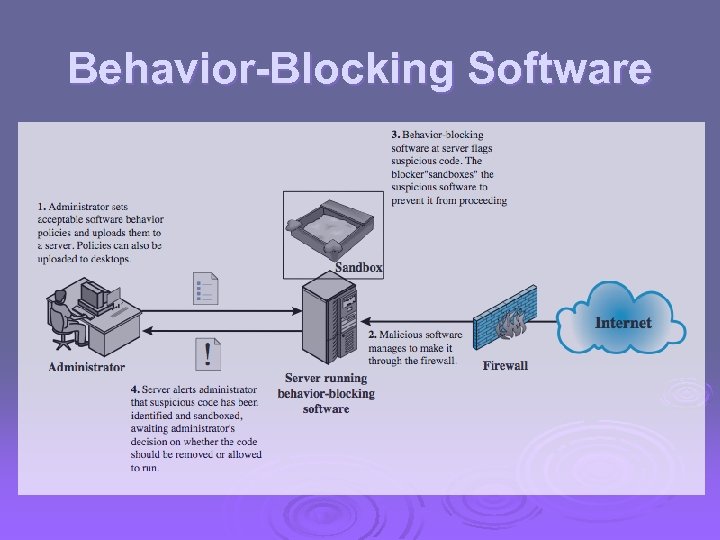 Behavior-Blocking Software
 Worms Ø replicating program that propagates over net l Ø using email, remote exec, remote login has phases like a virus: l l dormant, propagation, triggering, execution propagation phase: searches for other systems, connects to it, copies self to it and runs may disguise itself as a system process Ø concept seen in Brunner’s “Shockwave Rider” Ø implemented by Xerox Palo Alto labs in 1980’s Ø
 Morris Worm Ø one of best know worms Ø released by Robert Morris in 1988 Ø various attacks on UNIX systems l l l cracking password file to use login/password to logon to other systems exploiting a bug in the finger protocol exploiting a bug in sendmail Ø if succeed have remote shell access l sent bootstrap program to copy worm over
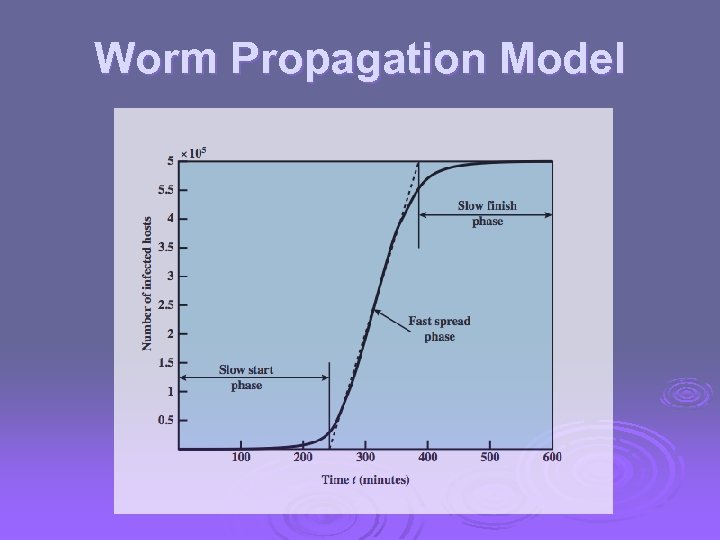 Worm Propagation Model
 Recent Worm Attacks Ø Code Red l l July 2001 exploiting MS IIS bug probes random IP address, does DDo. S attack Code Red II variant includes backdoor Ø SQL Slammer Ø l Ø early 2003, attacks MS SQL Server Mydoom l l mass-mailing e-mail worm that appeared in 2004 installed remote access backdoor in infected systems Ø Warezov family of worms l scan for e-mail addresses, send in attachment
 Worm Technology Ø multiplatform Ø multi-exploit Ø ultrafast spreading Ø polymorphic Ø metamorphic Ø transport vehicles Ø zero-day exploit
 Mobile Phone Worms Ø first appeared on mobile phones in 2004 l target smartphone which can install s/w Ø they communicate via Bluetooth or MMS Ø to disable phone, delete data on phone, or send premium-priced messages Ø Comm. Warrior, launched in 2005 l l replicates using Bluetooth to nearby phones and via MMS using address-book numbers
 Worm Countermeasures Ø overlaps with anti-virus techniques Ø once worm on system A/V can detect Ø worms also cause significant net activity Ø worm defense approaches include: l l l signature-based worm scan filtering filter-based worm containment payload-classification-based worm containment threshold random walk scan detection rate limiting and rate halting
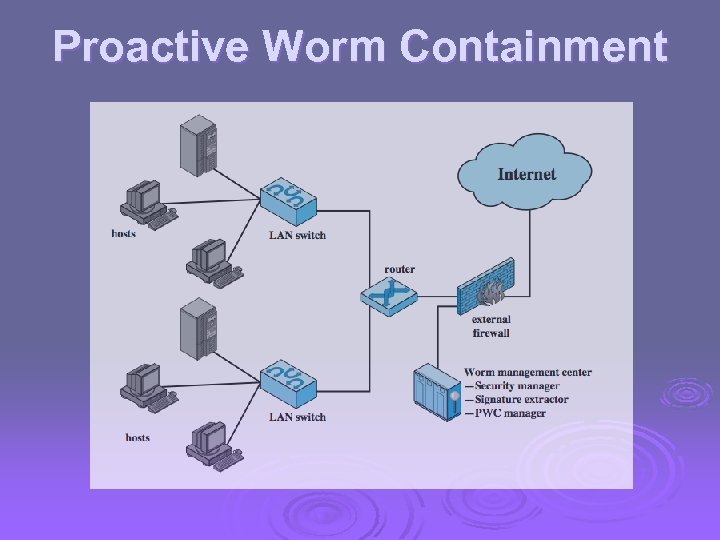 Proactive Worm Containment
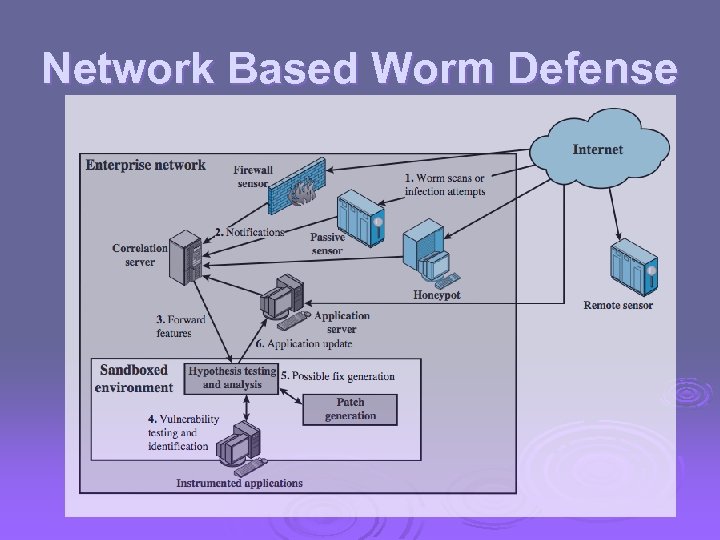 Network Based Worm Defense
 Distributed Denial of Service Attacks (DDo. S) Ø Distributed Denial of Service (DDo. S) attacks form a significant security threat Ø making networked systems unavailable Ø by flooding with useless traffic Ø using large numbers of “zombies” Ø growing sophistication of attacks Ø defense technologies struggling to cope
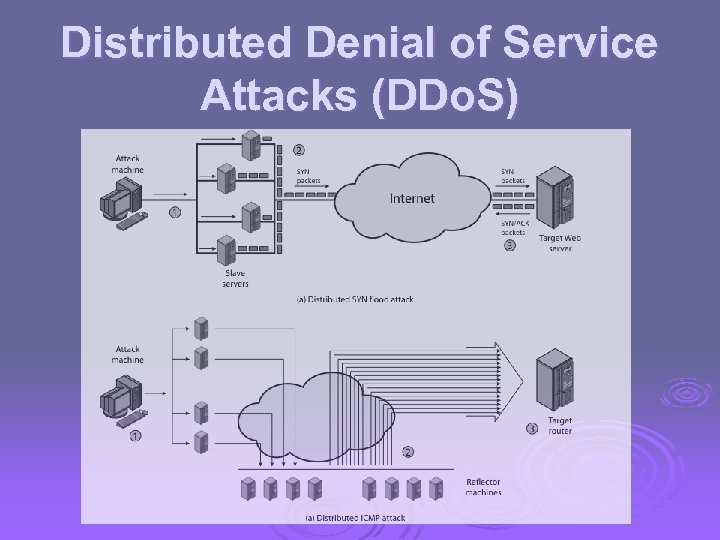 Distributed Denial of Service Attacks (DDo. S)
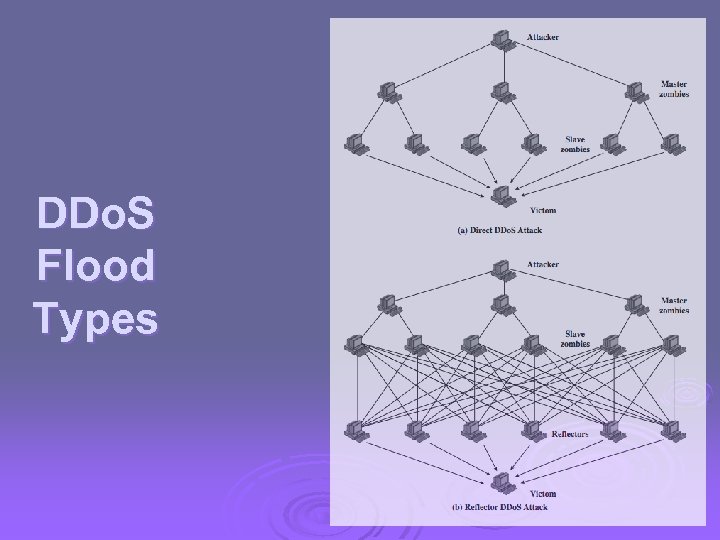 DDo. S Flood Types
 Constructing an Attack Network must infect large number of zombies Ø needs: 1. software to implement the DDo. S attack 2. an unpatched vulnerability on many systems 3. scanning strategy to find vulnerable systems Ø l random, hit-list, topological, local subnet
 DDo. S Countermeasures Ø three broad lines of defense: 1. 2. 3. attack prevention & preemption (before) attack detection & filtering (during) attack source traceback & ident (after) huge range of attack possibilities Ø hence evolving countermeasures Ø
 Summary Ø have considered: l l l various malicious programs trapdoor, logic bomb, trojan horse, zombie viruses worms distributed denial of service attacks