 Скачать презентацию Cryptography and Network Security Chapter 10 By Namratha
3f7334ac631feee8a1abe054df39c37d.ppt
- Количество слайдов: 29



Cryptography and Network Security Chapter 10 By: Namratha K Asst. Prof. Sa. IT
Key Management Ø public-key encryption helps address key distribution problems Ø have two aspects of this: l l distribution of public keys use of public-key encryption to distribute secret keys
Distribution of Public Keys Ø can be considered as using one of: l l public announcement publicly available directory public-key authority public-key certificates
Public Announcement Ø users distribute public keys to recipients or broadcast to community at large l eg. append PGP keys to email messages or post to news groups or email list Ø major weakness is forgery l l anyone can create a key claiming to be someone else and broadcast it until forgery is discovered can masquerade as claimed user
Publicly Available Directory Ø can obtain greater security by registering keys with a public directory Ø directory must be trusted with properties: l l l contains {name, public-key} entries participants register securely with directory participants can replace key at any time directory is periodically published directory can be accessed electronically Ø still vulnerable to tampering or forgery
Public-Key Authority Ø improve security by tightening control over distribution of keys from directory Ø has properties of directory Ø and requires users to know public key for the directory Ø then users interact with directory to obtain any desired public key securely l does require real-time access to directory when keys are needed
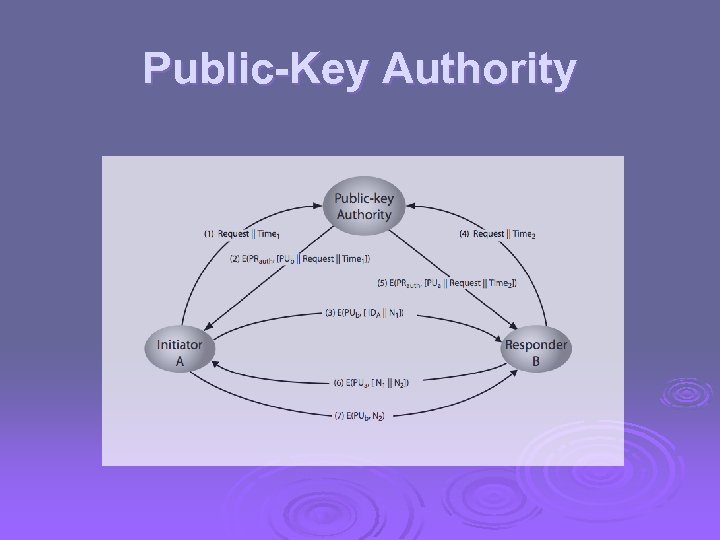
Public-Key Authority
Public-Key Certificates Ø certificates allow key exchange without real-time access to public-key authority Ø a certificate binds identity to public key l usually with other info such as period of validity, rights of use etc Ø with all contents signed by a trusted Public-Key or Certificate Authority (CA) Ø can be verified by anyone who knows the public-key authorities public-key
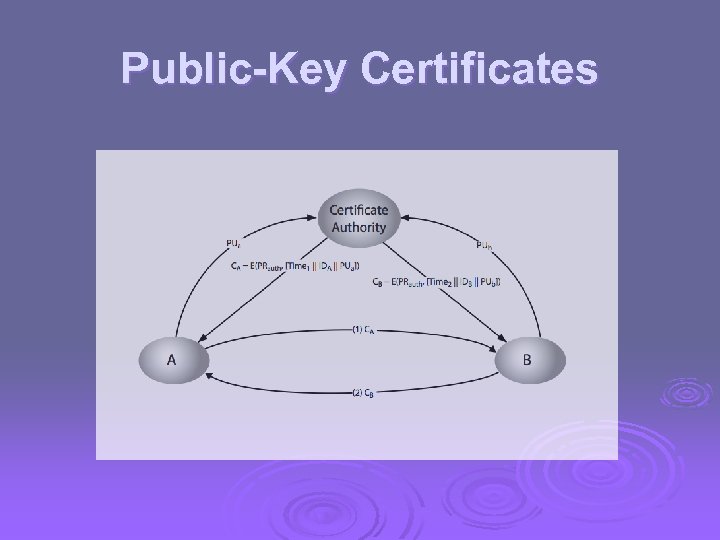
Public-Key Certificates
Public-Key Distribution of Secret Keys Ø use previous methods to obtain public-key Ø can use for secrecy or authentication Ø but public-key algorithms are slow Ø so usually want to use private-key encryption to protect message contents Ø hence need a session key Ø have several alternatives for negotiating a suitable session
Simple Secret Key Distribution Ø proposed by Merkle in 1979 l l A generates a new temporary public key pair A sends B the public key and their identity B generates a session key K sends it to A encrypted using the supplied public key A decrypts the session key and both use Ø problem is that an opponent can intercept and impersonate both halves of protocol
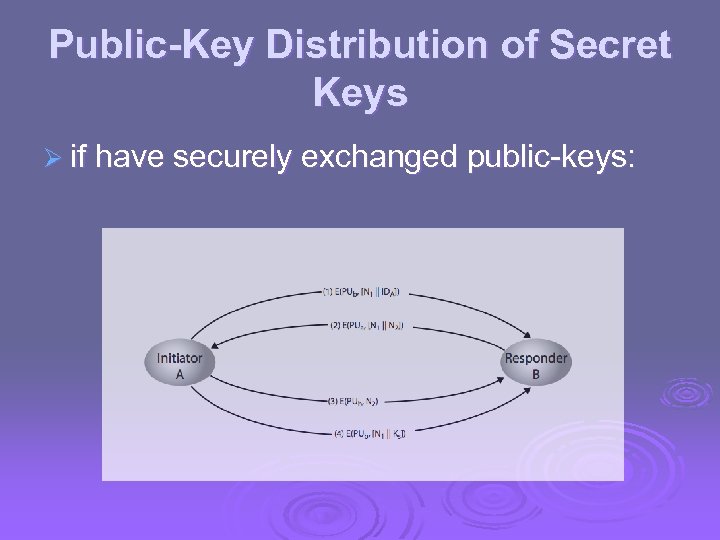
Public-Key Distribution of Secret Keys Ø if have securely exchanged public-keys:
Hybrid Key Distribution Ø retain use of private-key KDC Ø shares secret master key with each user Ø distributes session key using master key Ø public-key used to distribute master keys l especially useful with widely distributed users Ø rationale l l performance backward compatibility
Diffie-Hellman Key Exchange Ø first public-key type scheme proposed Ø by Diffie & Hellman in 1976 along with the exposition of public key concepts l note: now know that Williamson (UK CESG) secretly proposed the concept in 1970 Ø is a practical method for public exchange of a secret key Ø used in a number of commercial products
Diffie-Hellman Key Exchange Ø a public-key distribution scheme l l l cannot be used to exchange an arbitrary message rather it can establish a common key known only to the two participants value of key depends on the participants (and their private and public key information) Ø based on exponentiation in a finite (Galois) field (modulo a prime or a polynomial) - easy Ø security relies on the difficulty of computing discrete logarithms (similar to factoring) – hard Ø
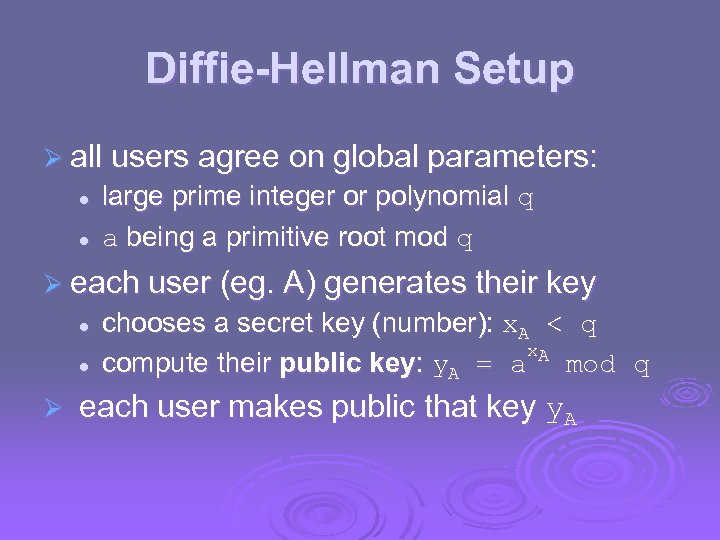
Diffie-Hellman Setup Ø all users agree on global parameters: l l large prime integer or polynomial q a being a primitive root mod q Ø each user (eg. A) generates their key l l Ø chooses a secret key (number): x. A < q x. A compute their public key: y. A = a mod q each user makes public that key y. A
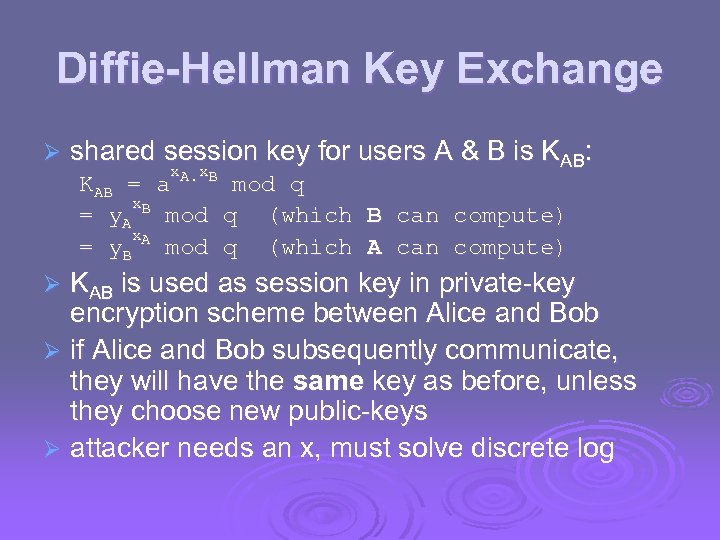
Diffie-Hellman Key Exchange Ø shared session key for users A & B is KAB: x x KAB = a A. B mod q x. B = y. A mod q (which B can compute) x. A = y. B mod q (which A can compute) KAB is used as session key in private-key encryption scheme between Alice and Bob Ø if Alice and Bob subsequently communicate, they will have the same key as before, unless they choose new public-keys Ø attacker needs an x, must solve discrete log Ø
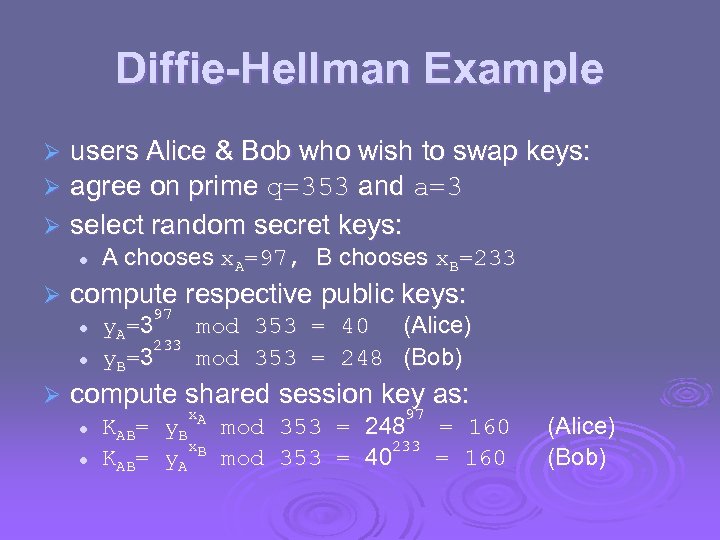
Diffie-Hellman Example users Alice & Bob who wish to swap keys: agree on prime q=353 and a=3 Ø select random secret keys: Ø Ø l Ø compute respective public keys: l l Ø A chooses x. A=97, B chooses x. B=233 97 y A= 3 mod 353 = 40 (Alice) 233 y B= 3 mod 353 = 248 (Bob) compute shared session key as: l l KAB= x. A y. B x. B y. A 97 mod 353 = 248 = 160 233 mod 353 = 40 = 160 (Alice) (Bob)
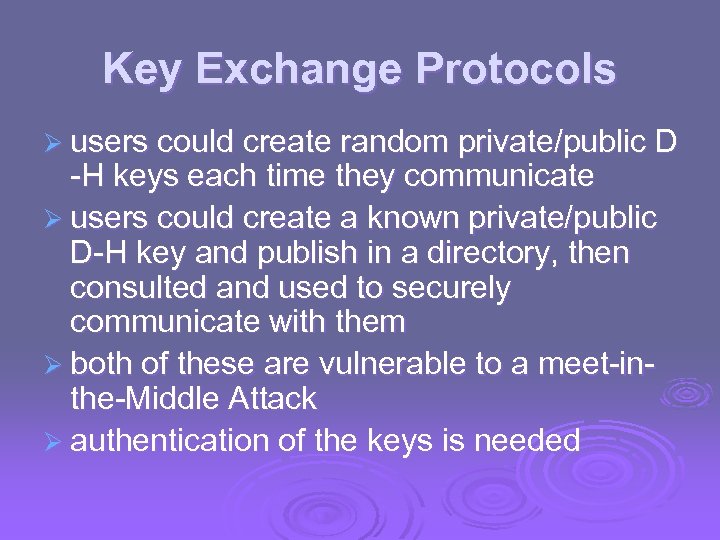
Key Exchange Protocols Ø users could create random private/public D -H keys each time they communicate Ø users could create a known private/public D-H key and publish in a directory, then consulted and used to securely communicate with them Ø both of these are vulnerable to a meet-inthe-Middle Attack Ø authentication of the keys is needed
Elliptic Curve Cryptography Ø majority of public-key crypto (RSA, D-H) use either integer or polynomial arithmetic with very large numbers/polynomials Ø imposes a significant load in storing and processing keys and messages Ø an alternative is to use elliptic curves Ø offers same security with smaller bit sizes Ø newer, but not as well analysed
Real Elliptic Curves Ø an elliptic curve is defined by an equation in two variables x & y, with coefficients Ø consider a cubic elliptic curve of form l l l y 2 = x 3 + ax + b where x, y, a, b are all real numbers also define zero point O Ø have addition operation for elliptic curve l geometrically sum of Q+R is reflection of intersection R
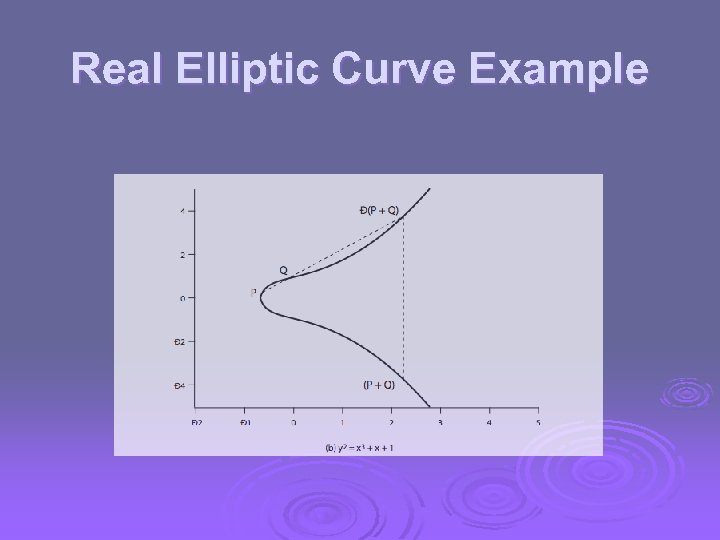
Real Elliptic Curve Example
Finite Elliptic Curves Ø Elliptic curve cryptography uses curves whose variables & coefficients are finite Ø have two families commonly used: l prime curves Ep(a, b) defined over Zp • use integers modulo a prime • best in software l binary curves E 2 m(a, b) defined over GF(2 n) • use polynomials with binary coefficients • best in hardware
Elliptic Curve Cryptography Ø ECC addition is analog of modulo multiply Ø ECC repeated addition is analog of modulo exponentiation Ø need “hard” problem equiv to discrete log l l Q=k. P, where Q, P belong to a prime curve is “easy” to compute Q given k, P but “hard” to find k given Q, P known as the elliptic curve logarithm problem Ø Certicom example: E 23(9, 17)
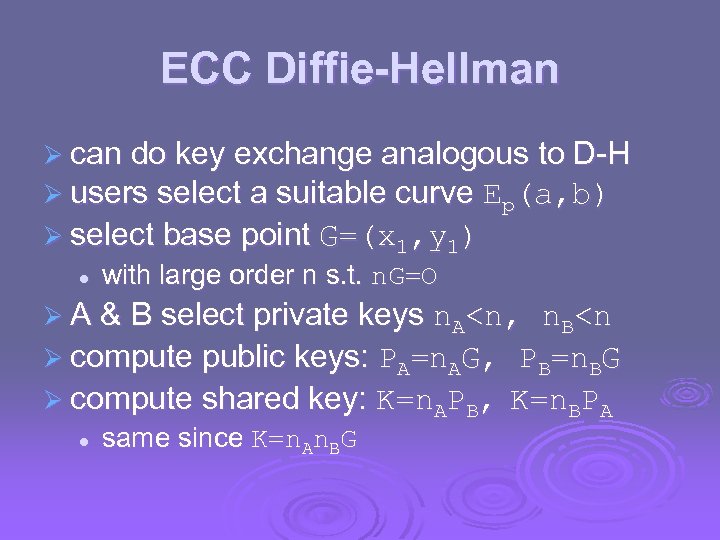
ECC Diffie-Hellman Ø can do key exchange analogous to D-H Ø users select a suitable curve Ep(a, b) Ø select base point G=(x 1, y 1) l with large order n s. t. n. G=O Ø A & B select private keys n. A<n, n. B<n Ø compute public keys: PA=n. AG, PB=n. BG Ø compute shared key: K=n. APB, K=n. BPA l same since K=n. An. BG
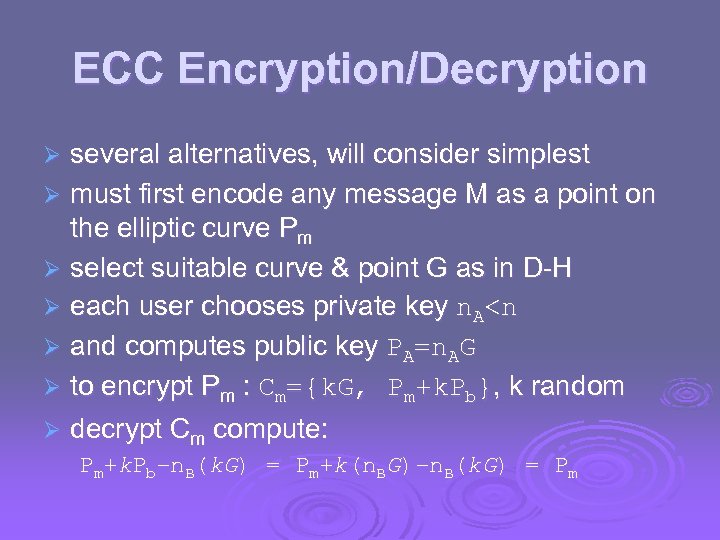
ECC Encryption/Decryption several alternatives, will consider simplest Ø must first encode any message M as a point on the elliptic curve Pm Ø select suitable curve & point G as in D-H Ø each user chooses private key n. A<n Ø and computes public key PA=n. AG Ø to encrypt Pm : Cm={k. G, Pm+k. Pb}, k random Ø decrypt Cm compute: Ø Pm+k. Pb–n. B(k. G) = Pm+k(n. BG)–n. B(k. G) = Pm
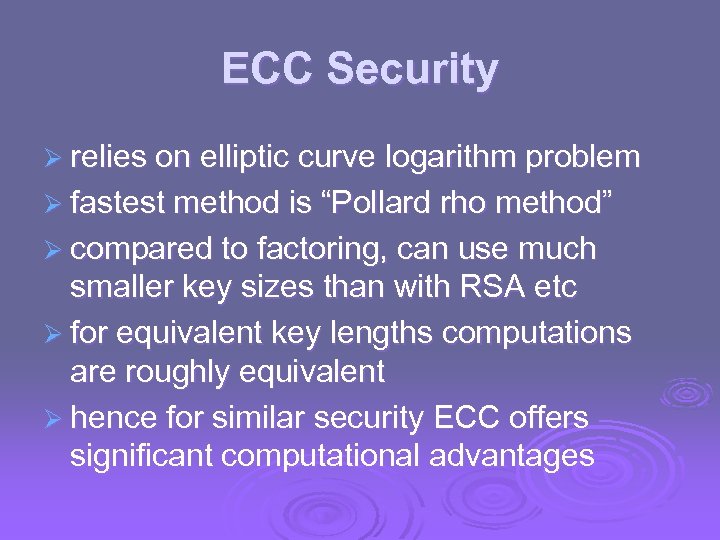
ECC Security Ø relies on elliptic curve logarithm problem Ø fastest method is “Pollard rho method” Ø compared to factoring, can use much smaller key sizes than with RSA etc Ø for equivalent key lengths computations are roughly equivalent Ø hence for similar security ECC offers significant computational advantages
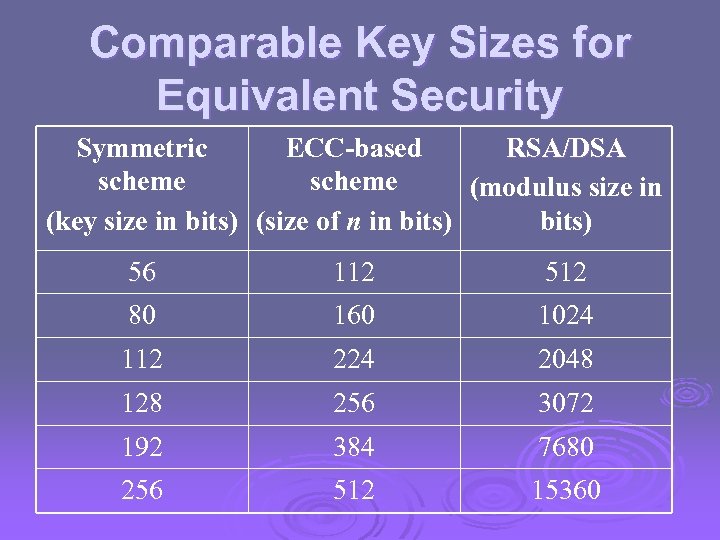
Comparable Key Sizes for Equivalent Security Symmetric ECC-based RSA/DSA scheme (modulus size in (key size in bits) (size of n in bits) 56 112 512 80 160 1024 112 224 2048 128 256 3072 192 384 7680 256 512 15360
Summary Ø have considered: l l distribution of public keys public-key distribution of secret keys Diffie-Hellman key exchange Elliptic Curve cryptography
Скачать презентацию Cryptography and Network Security Chapter 10 By Namratha
3f7334ac631feee8a1abe054df39c37d.ppt