 Скачать презентацию Cryptanalysis Lecture 6 Introduction to Public Key Systems
f9b362bcc1a691c684f5dd8f612042ad.ppt
- Количество слайдов: 88



Cryptanalysis Lecture 6: Introduction to Public Key Systems John Manferdelli jmanfer@microsoft. com John. Manferdelli@hotmail. com © 2004 -2008, John L. Manferdelli. This material is provided without warranty of any kind including, without limitation, warranty of non-infringement or suitability for any purpose. This material is not guaranteed to be error free and is intended for instructional use only. jlm 20090204 1
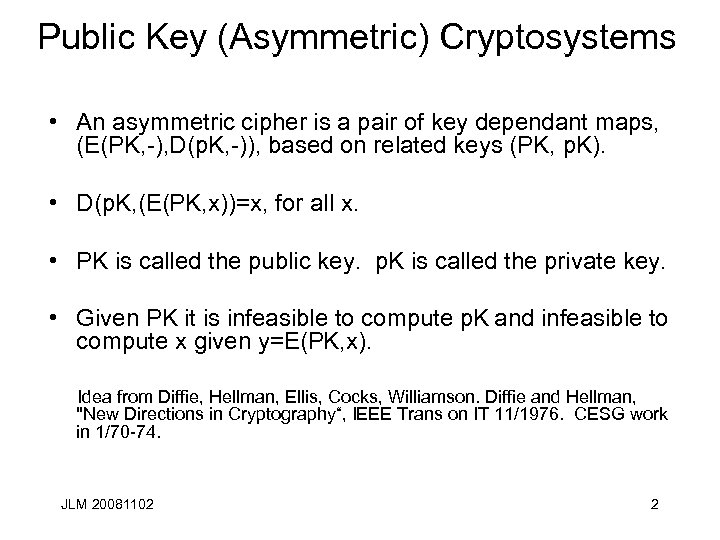
Public Key (Asymmetric) Cryptosystems • An asymmetric cipher is a pair of key dependant maps, (E(PK, -), D(p. K, -)), based on related keys (PK, p. K). • D(p. K, (E(PK, x))=x, for all x. • PK is called the public key. p. K is called the private key. • Given PK it is infeasible to compute p. K and infeasible to compute x given y=E(PK, x). Idea from Diffie, Hellman, Ellis, Cocks, Williamson. Diffie and Hellman, "New Directions in Cryptography“, IEEE Trans on IT 11/1976. CESG work in 1/70 -74. JLM 20081102 2
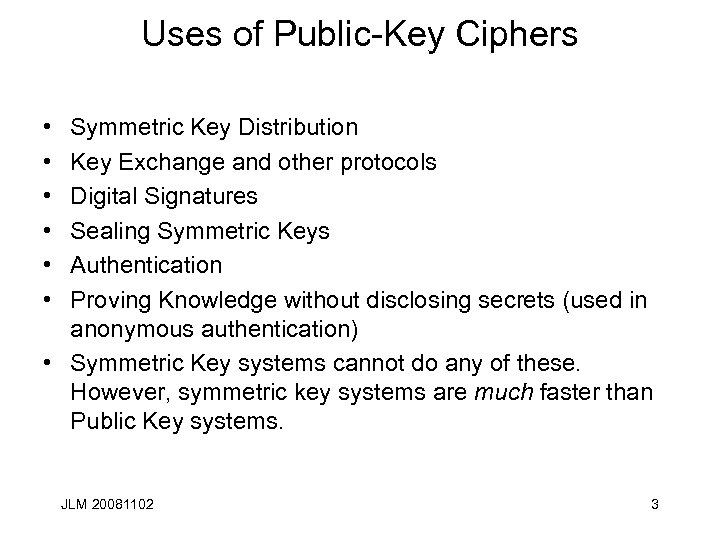
Uses of Public-Key Ciphers • • • Symmetric Key Distribution Key Exchange and other protocols Digital Signatures Sealing Symmetric Keys Authentication Proving Knowledge without disclosing secrets (used in anonymous authentication) • Symmetric Key systems cannot do any of these. However, symmetric key systems are much faster than Public Key systems. JLM 20081102 3
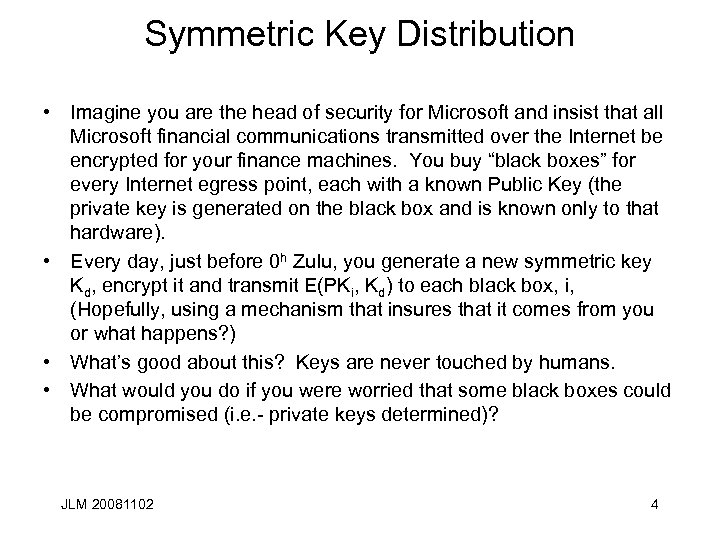
Symmetric Key Distribution • Imagine you are the head of security for Microsoft and insist that all Microsoft financial communications transmitted over the Internet be encrypted for your finance machines. You buy “black boxes” for every Internet egress point, each with a known Public Key (the private key is generated on the black box and is known only to that hardware). • Every day, just before 0 h Zulu, you generate a new symmetric key Kd, encrypt it and transmit E(PKi, Kd) to each black box, i, (Hopefully, using a mechanism that insures that it comes from you or what happens? ) • What’s good about this? Keys are never touched by humans. • What would you do if you were worried that some black boxes could be compromised (i. e. - private keys determined)? JLM 20081102 4
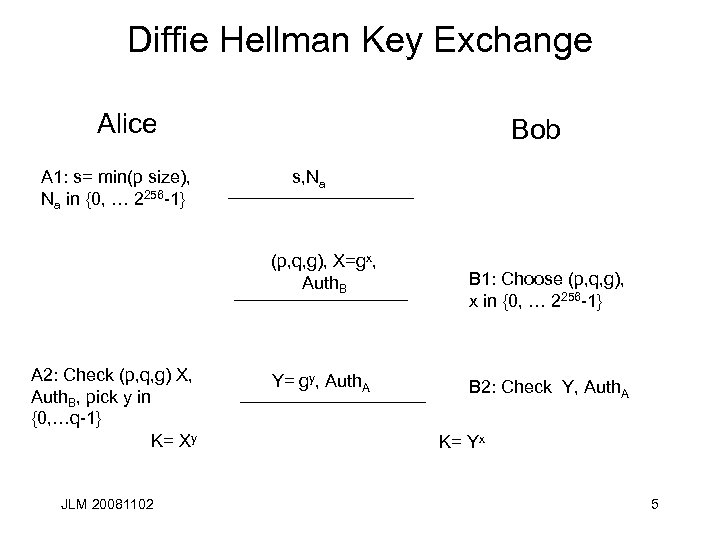
Diffie Hellman Key Exchange Alice A 1: s= min(p size), Na in {0, … 2256 -1} Bob s, Na (p, q, g), X=gx, Auth. B A 2: Check (p, q, g) X, Auth. B, pick y in {0, …q-1} K= Xy JLM 20081102 Y= gy, Auth. A B 1: Choose (p, q, g), x in {0, … 2256 -1} B 2: Check Y, Auth. A K= Yx 5
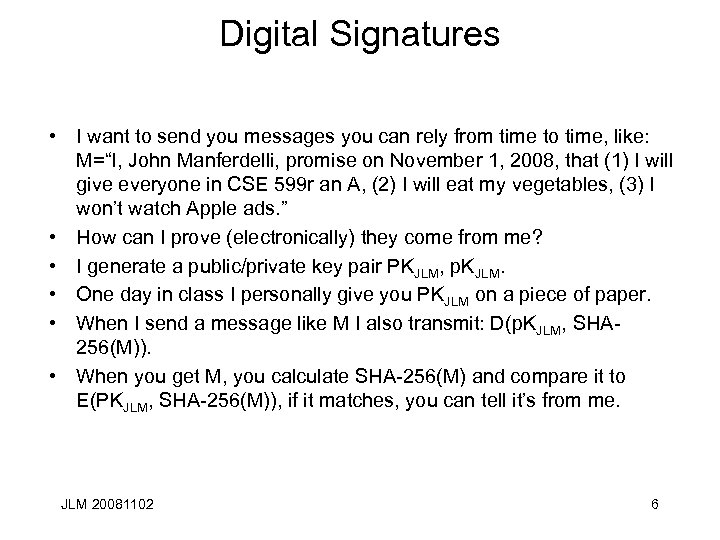
Digital Signatures • I want to send you messages you can rely from time to time, like: M=“I, John Manferdelli, promise on November 1, 2008, that (1) I will give everyone in CSE 599 r an A, (2) I will eat my vegetables, (3) I won’t watch Apple ads. ” • How can I prove (electronically) they come from me? • I generate a public/private key pair PKJLM, p. KJLM. • One day in class I personally give you PKJLM on a piece of paper. • When I send a message like M I also transmit: D(p. KJLM, SHA 256(M)). • When you get M, you calculate SHA-256(M) and compare it to E(PKJLM, SHA-256(M)), if it matches, you can tell it’s from me. JLM 20081102 6
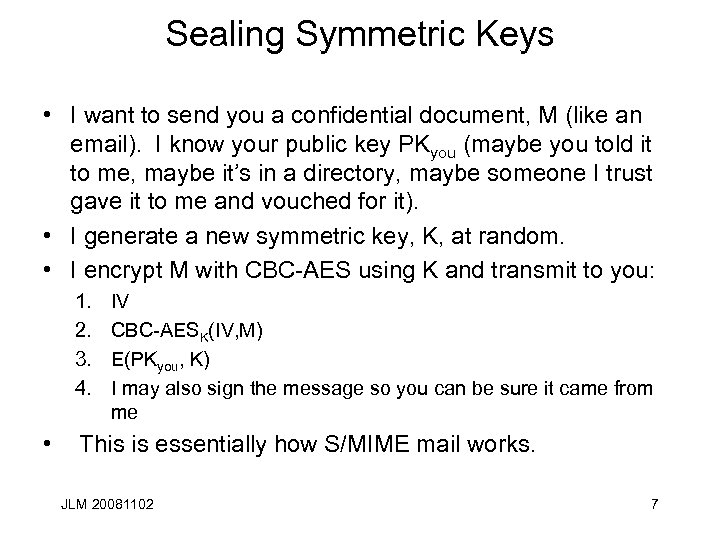
Sealing Symmetric Keys • I want to send you a confidential document, M (like an email). I know your public key PKyou (maybe you told it to me, maybe it’s in a directory, maybe someone I trust gave it to me and vouched for it). • I generate a new symmetric key, K, at random. • I encrypt M with CBC-AES using K and transmit to you: 1. 2. 3. 4. • IV CBC-AESK(IV, M) E(PKyou, K) I may also sign the message so you can be sure it came from me This is essentially how S/MIME mail works. JLM 20081102 7
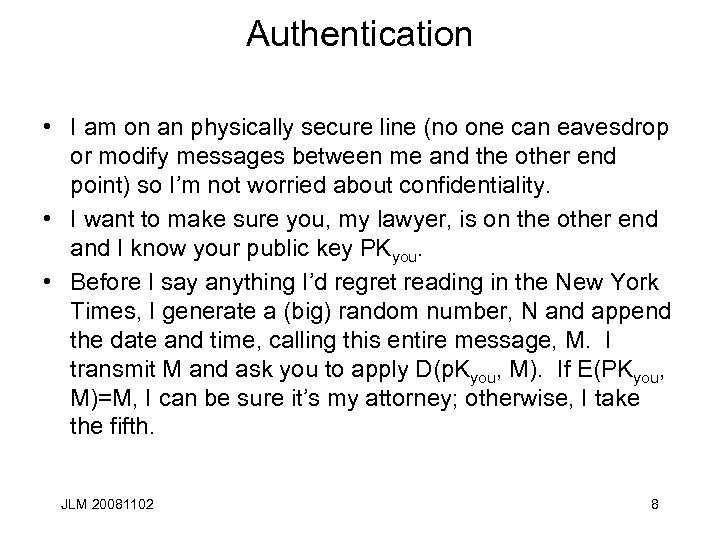
Authentication • I am on an physically secure line (no one can eavesdrop or modify messages between me and the other end point) so I’m not worried about confidentiality. • I want to make sure you, my lawyer, is on the other end and I know your public key PKyou. • Before I say anything I’d regret reading in the New York Times, I generate a (big) random number, N and append the date and time, calling this entire message, M. I transmit M and ask you to apply D(p. Kyou, M). If E(PKyou, M)=M, I can be sure it’s my attorney; otherwise, I take the fifth. JLM 20081102 8
Existing Public-Key Ciphers • Public Key systems are based on “computationally hard” “trap door problems” (Not all NP complete problems are suitable). – Factoring (n= ab, what is a, what is b? ) – Discrete Log (x= ya (mod n), what is a? ) – Elliptic curve discrete log. (Q=n. P, what is n? ) • Rivest Shamir Andelman (1978) – Based on factoring • El Gamal (1984) – Based on discrete log • Elliptic Curve (1985, Miller-Koblitz) – Based on elliptic curve discrete log (over finite fields). JLM 20081102 9
Some Number Theory • • • Fundamental Theorem of Arithmetic Prime Number Theorem Euclidean Algorithm for GCD Solving congruences Chinese Remainder Theorem Continued Fractions Integer arithmetic mod n Fermat’s Theorem Euler’s Theorem Finding square root mod n Quadratic Reciprocity: Legendre and Jacobi symbols. Lattices JLM 20081102 10
Fundamental Theorem of Arithmetic • Let n be any positive integer, n can be written as a product of primes in an essentially unique way (except for units and the order of the primes). • It may be hard to actually carry out this factorization. JLM 20081102 11
Distribution of Primes • Euclid: There are infinitely many primes • Prime Number Theorem: The number of primes, p(n), less than or equal to n is asymptotically equal to n/ln(n). – Spookily accurate even for pretty small n. – First proof using complex analysis sketched by Riemann, finished by Hadamard and de la Vallee-Poussin. “Elementary” proof by Erdos and Selberg • Chebyshev’s Theorem: For x>200, c 1(x/ln(x)<p(x)<c 2(x/ln(x)). c 1=2/3, c 2= 1. 7 – Pretty easy to prove. • Bertrand’s Postulate: For all n>2 there is a prime between n and 2 n JLM 20081102 12
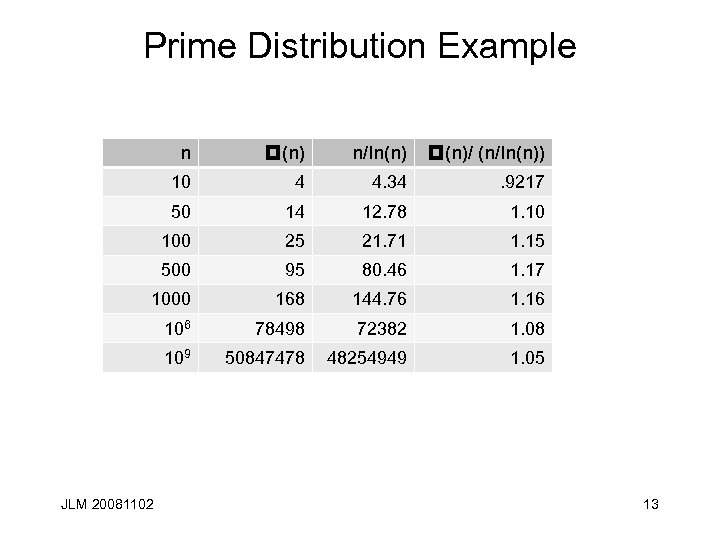
Prime Distribution Example n p(n) n/ln(n) p(n)/ (n/ln(n)) 10 4 4. 34 . 9217 50 14 12. 78 1. 10 100 25 21. 71 1. 15 500 95 80. 46 1. 17 1000 168 144. 76 1. 16 106 78498 72382 1. 08 109 50847478 48254949 1. 05 JLM 20081102 13
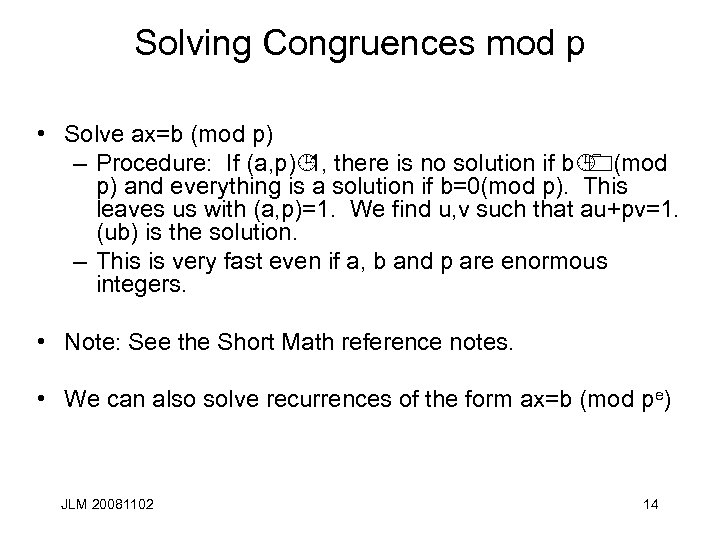
Solving Congruences mod p • Solve ax=b (mod p) – Procedure: If (a, p)¹ 1, there is no solution if b¹ 0(mod p) and everything is a solution if b=0(mod p). This leaves us with (a, p)=1. We find u, v such that au+pv=1. (ub) is the solution. – This is very fast even if a, b and p are enormous integers. • Note: See the Short Math reference notes. • We can also solve recurrences of the form ax=b (mod pe) JLM 20081102 14
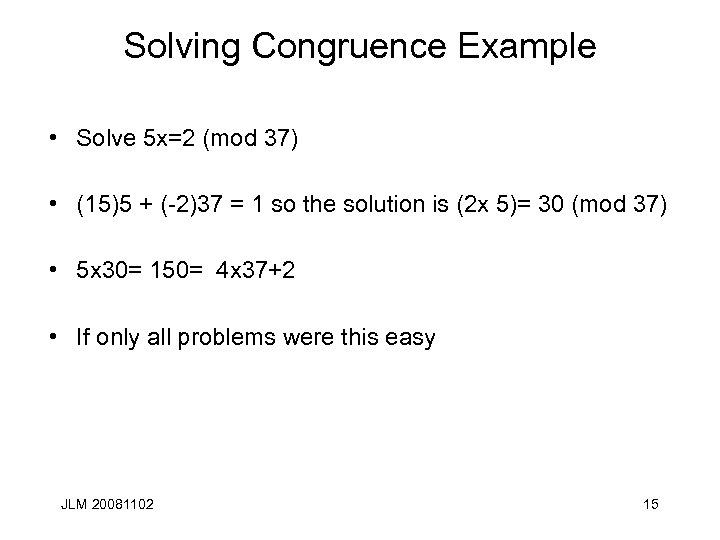
Solving Congruence Example • Solve 5 x=2 (mod 37) • (15)5 + (-2)37 = 1 so the solution is (2 x 5)= 30 (mod 37) • 5 x 30= 150= 4 x 37+2 • If only all problems were this easy JLM 20081102 15
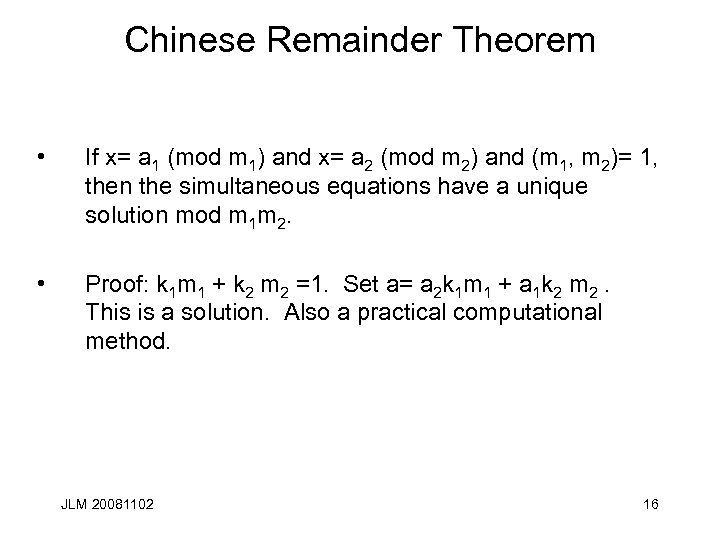
Chinese Remainder Theorem • If x= a 1 (mod m 1) and x= a 2 (mod m 2) and (m 1, m 2)= 1, then the simultaneous equations have a unique solution mod m 1 m 2. • Proof: k 1 m 1 + k 2 m 2 =1. Set a= a 2 k 1 m 1 + a 1 k 2 m 2. This is a solution. Also a practical computational method. JLM 20081102 16
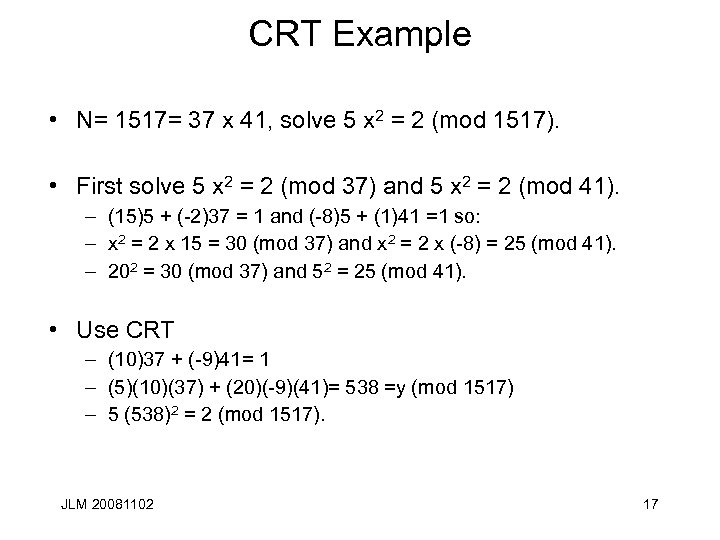
CRT Example • N= 1517= 37 x 41, solve 5 x 2 = 2 (mod 1517). • First solve 5 x 2 = 2 (mod 37) and 5 x 2 = 2 (mod 41). – (15)5 + (-2)37 = 1 and (-8)5 + (1)41 =1 so: – x 2 = 2 x 15 = 30 (mod 37) and x 2 = 2 x (-8) = 25 (mod 41). – 202 = 30 (mod 37) and 52 = 25 (mod 41). • Use CRT – (10)37 + (-9)41= 1 – (5)(10)(37) + (20)(-9)(41)= 538 =y (mod 1517) – 5 (538)2 = 2 (mod 1517). JLM 20081102 17
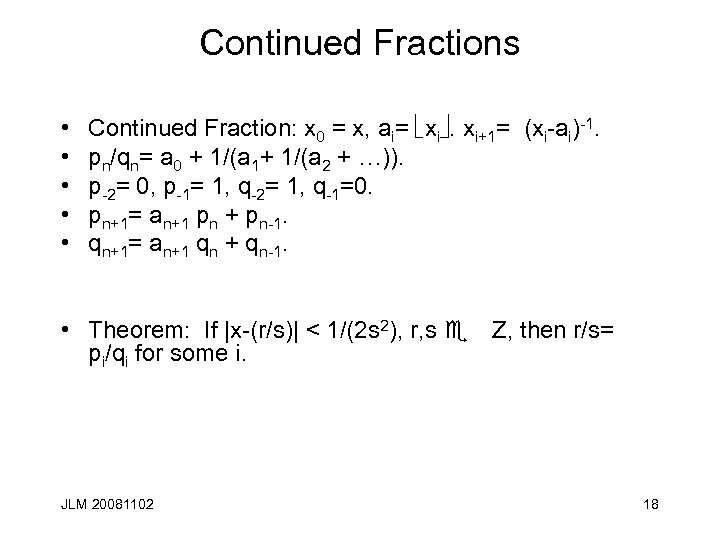
Continued Fractions • • • Continued Fraction: x 0 = x, ai= xi. xi+1= (xi-ai)-1. pn/qn= a 0 + 1/(a 1+ 1/(a 2 + …)). p-2= 0, p-1= 1, q-2= 1, q-1=0. pn+1= an+1 pn + pn-1. qn+1= an+1 qn + qn-1. • Theorem: If |x-(r/s)| < 1/(2 s 2), r, s e Z, then r/s= pi/qi for some i. JLM 20081102 18
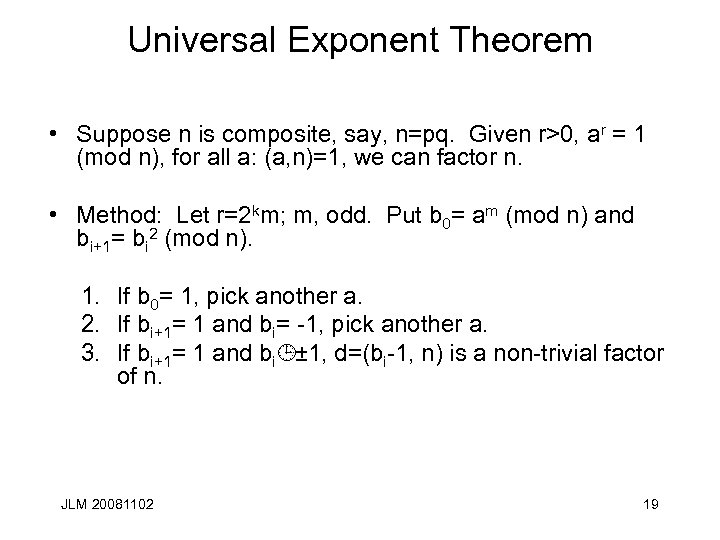
Universal Exponent Theorem • Suppose n is composite, say, n=pq. Given r>0, ar = 1 (mod n), for all a: (a, n)=1, we can factor n. • Method: Let r=2 km; m, odd. Put b 0= am (mod n) and bi+1= bi 2 (mod n). 1. If b 0= 1, pick another a. 2. If bi+1= 1 and bi= -1, pick another a. 3. If bi+1= 1 and bi¹ ± 1, d=(bi-1, n) is a non-trivial factor of n. JLM 20081102 19
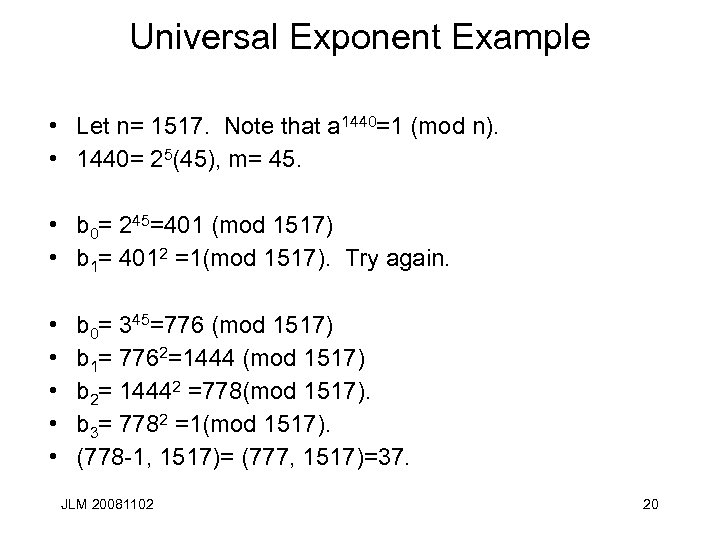
Universal Exponent Example • Let n= 1517. Note that a 1440=1 (mod n). • 1440= 25(45), m= 45. • b 0= 245=401 (mod 1517) • b 1= 4012 =1(mod 1517). Try again. • • • b 0= 345=776 (mod 1517) b 1= 7762=1444 (mod 1517) b 2= 14442 =778(mod 1517). b 3= 7782 =1(mod 1517). (778 -1, 1517)= (777, 1517)=37. JLM 20081102 20
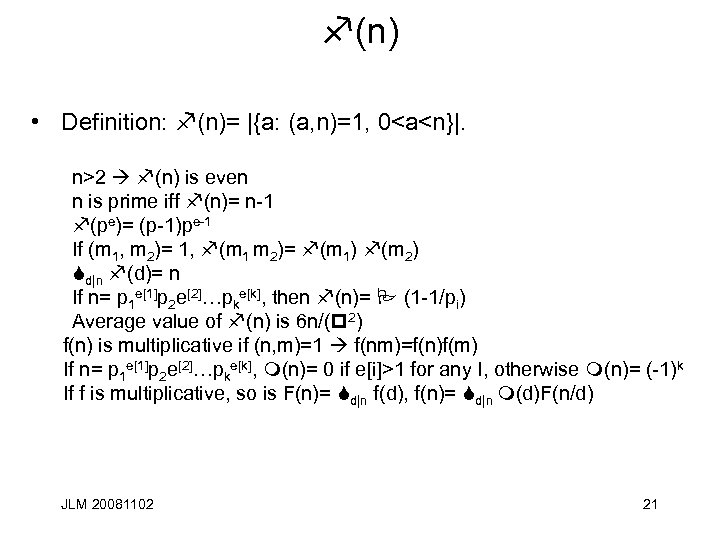
f(n) • Definition: f(n)= |{a: (a, n)=1, 0<a<n}|. n>2 f(n) is even n is prime iff f(n)= n-1 f(pe)= (p-1)pe-1 If (m 1, m 2)= 1, f(m 1 m 2)= f(m 1) f(m 2) Sd|n f(d)= n If n= p 1 e[1]p 2 e[2]…pke[k], then f(n)= P (1 -1/pi) Average value of f(n) is 6 n/(p 2) f(n) is multiplicative if (n, m)=1 f(nm)=f(n)f(m) If n= p 1 e[1]p 2 e[2]…pke[k], m(n)= 0 if e[i]>1 for any I, otherwise m(n)= (-1)k If f is multiplicative, so is F(n)= Sd|n f(d), f(n)= Sd|n m(d)F(n/d) JLM 20081102 21
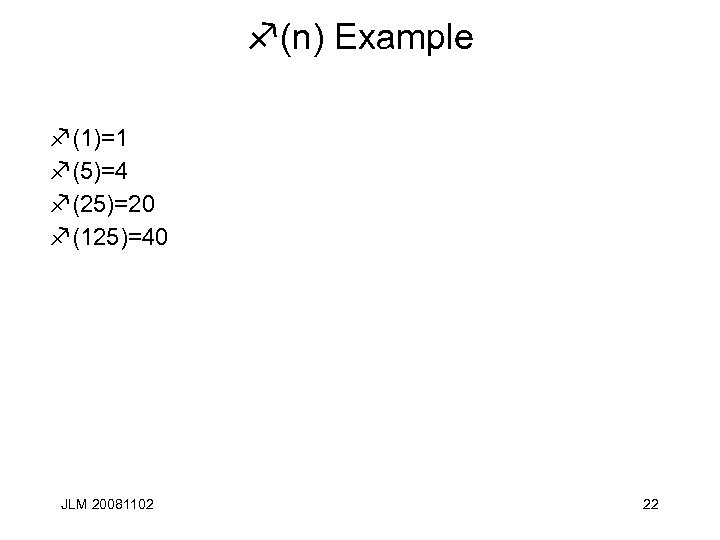
f(n) Example f(1)=1 f(5)=4 f(25)=20 f(125)=40 JLM 20081102 22
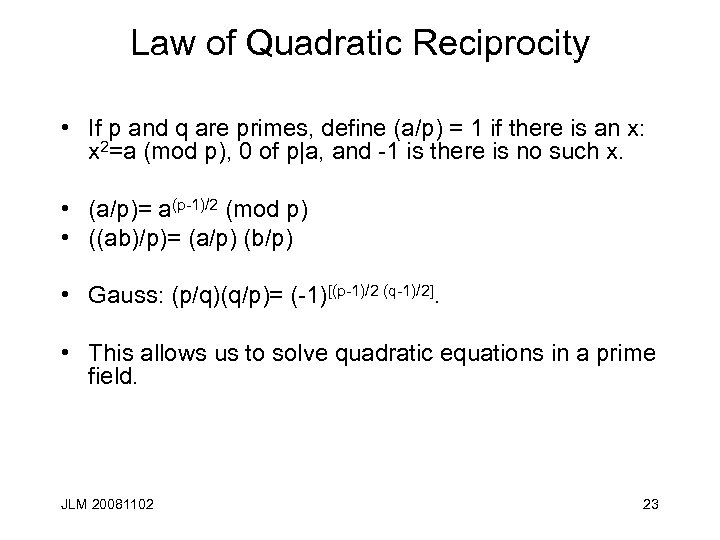
Law of Quadratic Reciprocity • If p and q are primes, define (a/p) = 1 if there is an x: x 2=a (mod p), 0 of p|a, and -1 is there is no such x. • (a/p)= a(p-1)/2 (mod p) • ((ab)/p)= (a/p) (b/p) • Gauss: (p/q)(q/p)= (-1)[(p-1)/2 (q-1)/2]. • This allows us to solve quadratic equations in a prime field. JLM 20081102 23
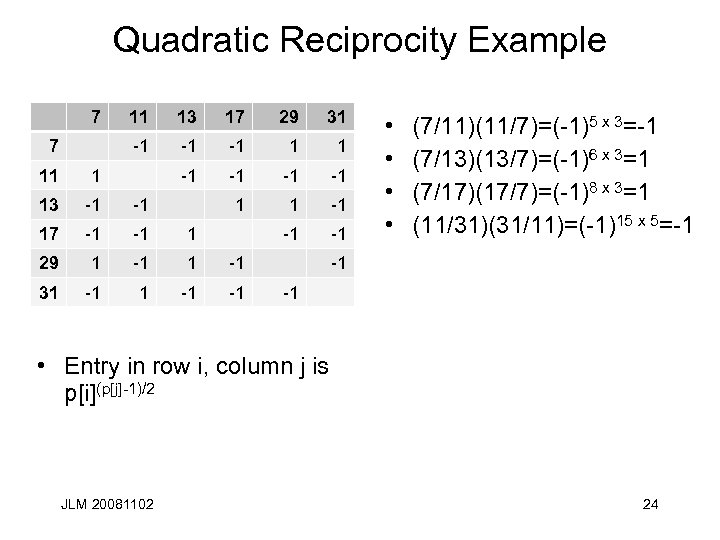
Quadratic Reciprocity Example 7 13 17 29 31 -1 7 11 -1 -1 1 1 -1 -1 -1 11 1 13 -1 -1 17 -1 -1 1 29 1 -1 31 -1 -1 • • (7/11)(11/7)=(-1)5 x 3=-1 (7/13)(13/7)=(-1)6 x 3=1 (7/17)(17/7)=(-1)8 x 3=1 (11/31)(31/11)=(-1)15 x 5=-1 -1 -1 • Entry in row i, column j is p[i](p[j]-1)/2 JLM 20081102 24
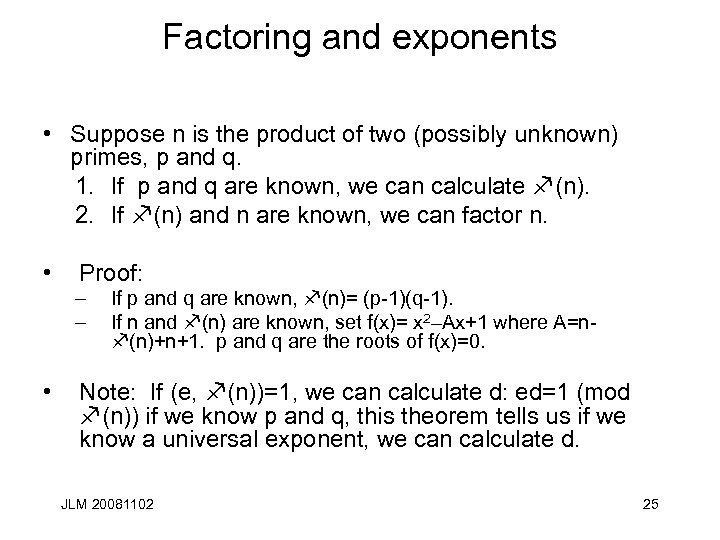
Factoring and exponents • Suppose n is the product of two (possibly unknown) primes, p and q. 1. If p and q are known, we can calculate f(n). 2. If f(n) and n are known, we can factor n. • Proof: – – • If p and q are known, f(n)= (p-1)(q-1). If n and f(n) are known, set f(x)= x 2–Ax+1 where A=nf(n)+n+1. p and q are the roots of f(x)=0. Note: If (e, f(n))=1, we can calculate d: ed=1 (mod f(n)) if we know p and q, this theorem tells us if we know a universal exponent, we can calculate d. JLM 20081102 25
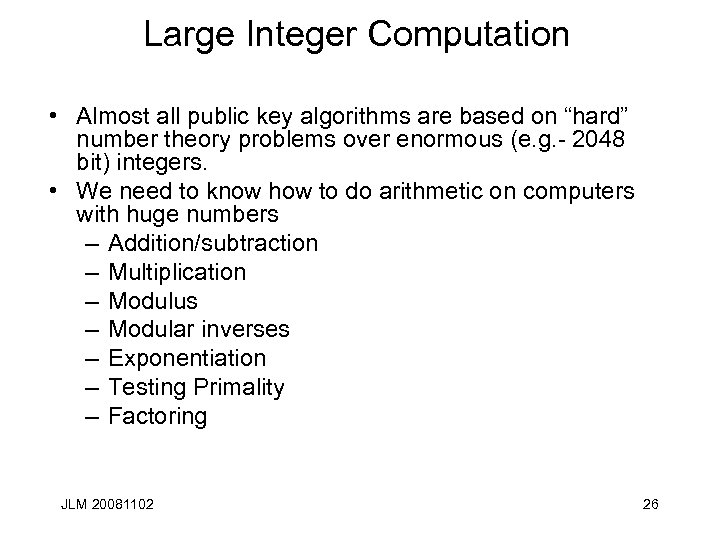
Large Integer Computation • Almost all public key algorithms are based on “hard” number theory problems over enormous (e. g. - 2048 bit) integers. • We need to know how to do arithmetic on computers with huge numbers – Addition/subtraction – Multiplication – Modulus – Modular inverses – Exponentiation – Testing Primality – Factoring JLM 20081102 26
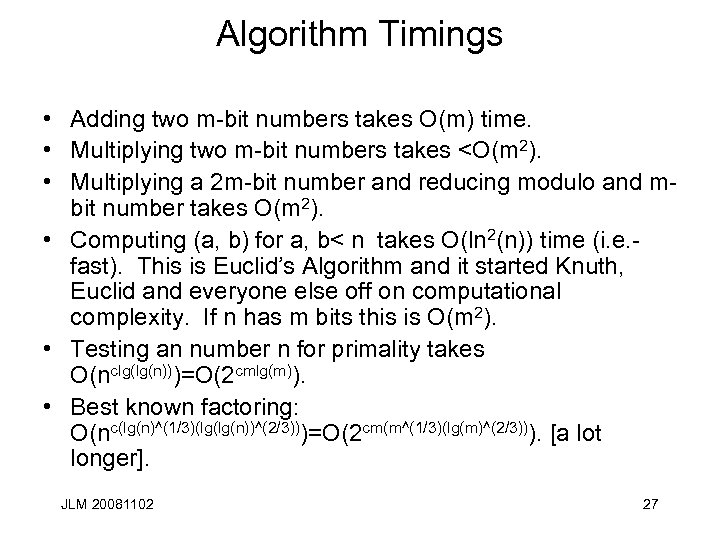
Algorithm Timings • Adding two m-bit numbers takes O(m) time. • Multiplying two m-bit numbers takes <O(m 2). • Multiplying a 2 m-bit number and reducing modulo and mbit number takes O(m 2). • Computing (a, b) for a, b< n takes O(ln 2(n)) time (i. e. - fast). This is Euclid’s Algorithm and it started Knuth, Euclid and everyone else off on computational complexity. If n has m bits this is O(m 2). • Testing an number n for primality takes O(nclg(lg(n)))=O(2 cmlg(m)). • Best known factoring: O(nc(lg(n)^(1/3)(lg(lg(n))^(2/3)))=O(2 cm(m^(1/3)(lg(m)^(2/3))). [a lot longer]. JLM 20081102 27
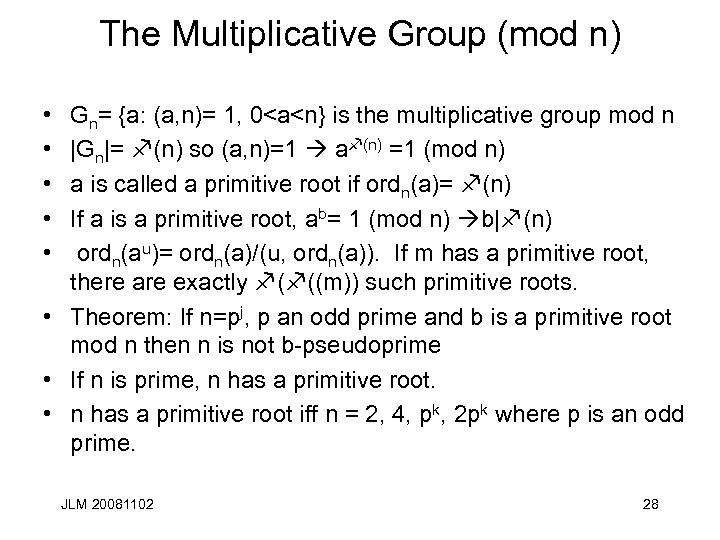
The Multiplicative Group (mod n) • • • Gn= {a: (a, n)= 1, 0<a<n} is the multiplicative group mod n |Gn|= f(n) so (a, n)=1 af(n) =1 (mod n) a is called a primitive root if ordn(a)= f(n) If a is a primitive root, ab= 1 (mod n) b|f(n) ordn(au)= ordn(a)/(u, ordn(a)). If m has a primitive root, there are exactly f(f((m)) such primitive roots. • Theorem: If n=pj, p an odd prime and b is a primitive root mod n then n is not b-pseudoprime • If n is prime, n has a primitive root. • n has a primitive root iff n = 2, 4, pk, 2 pk where p is an odd prime. JLM 20081102 28
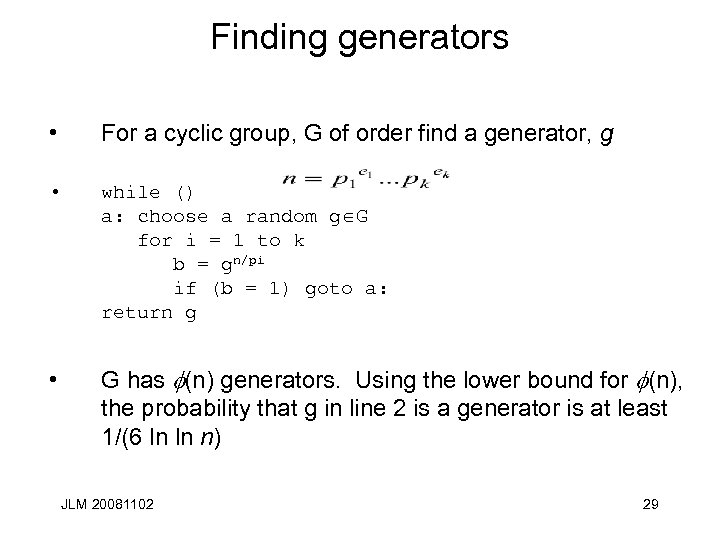
Finding generators • For a cyclic group, G of order find a generator, g • while () a: choose a random g G for i = 1 to k b = gn/pi if (b = 1) goto a: return g • G has (n) generators. Using the lower bound for (n), the probability that g in line 2 is a generator is at least 1/(6 ln ln n) JLM 20081102 29
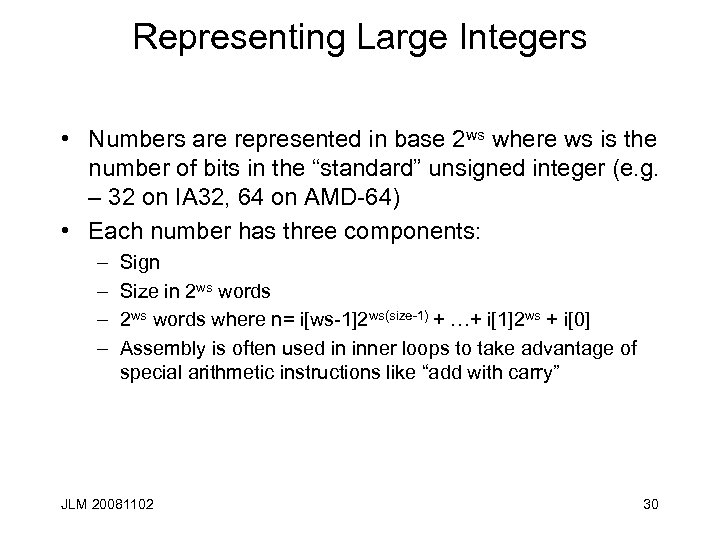
Representing Large Integers • Numbers are represented in base 2 ws where ws is the number of bits in the “standard” unsigned integer (e. g. – 32 on IA 32, 64 on AMD-64) • Each number has three components: – – Sign Size in 2 ws words where n= i[ws-1]2 ws(size-1) + …+ i[1]2 ws + i[0] Assembly is often used in inner loops to take advantage of special arithmetic instructions like “add with carry” JLM 20081102 30
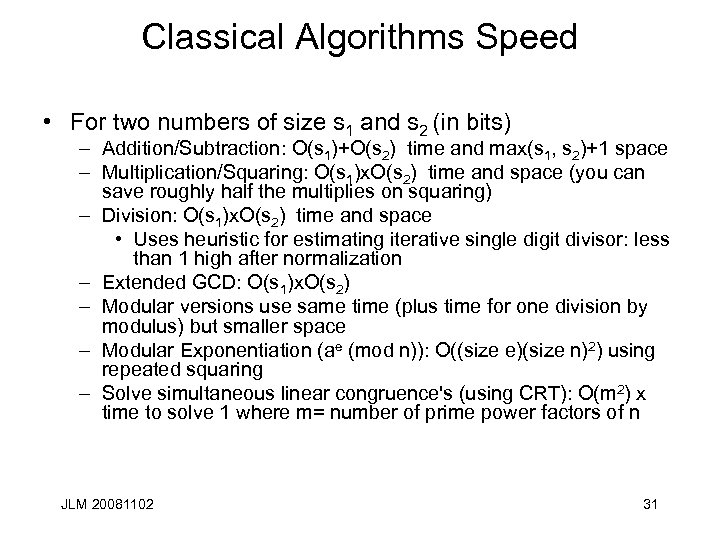
Classical Algorithms Speed • For two numbers of size s 1 and s 2 (in bits) – Addition/Subtraction: O(s 1)+O(s 2) time and max(s 1, s 2)+1 space – Multiplication/Squaring: O(s 1)x. O(s 2) time and space (you can save roughly half the multiplies on squaring) – Division: O(s 1)x. O(s 2) time and space • Uses heuristic for estimating iterative single digit divisor: less than 1 high after normalization – Extended GCD: O(s 1)x. O(s 2) – Modular versions use same time (plus time for one division by modulus) but smaller space – Modular Exponentiation (ae (mod n)): O((size e)(size n)2) using repeated squaring – Solve simultaneous linear congruence's (using CRT): O(m 2) x time to solve 1 where m= number of prime power factors of n JLM 20081102 31
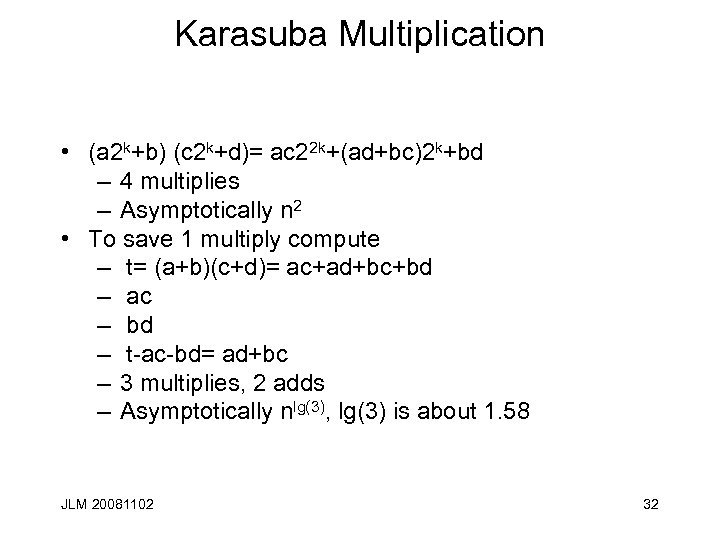
Karasuba Multiplication • (a 2 k+b) (c 2 k+d)= ac 22 k+(ad+bc)2 k+bd – 4 multiplies – Asymptotically n 2 • To save 1 multiply compute – t= (a+b)(c+d)= ac+ad+bc+bd – ac – bd – t-ac-bd= ad+bc – 3 multiplies, 2 adds – Asymptotically nlg(3), lg(3) is about 1. 58 JLM 20081102 32
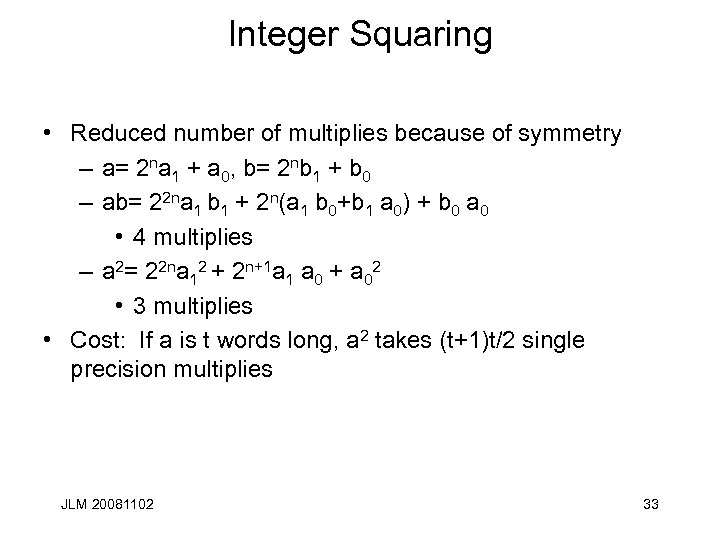
Integer Squaring • Reduced number of multiplies because of symmetry – a= 2 na 1 + a 0, b= 2 nb 1 + b 0 – ab= 22 na 1 b 1 + 2 n(a 1 b 0+b 1 a 0) + b 0 a 0 • 4 multiplies – a 2= 22 na 12 + 2 n+1 a 1 a 0 + a 02 • 3 multiplies • Cost: If a is t words long, a 2 takes (t+1)t/2 single precision multiplies JLM 20081102 33
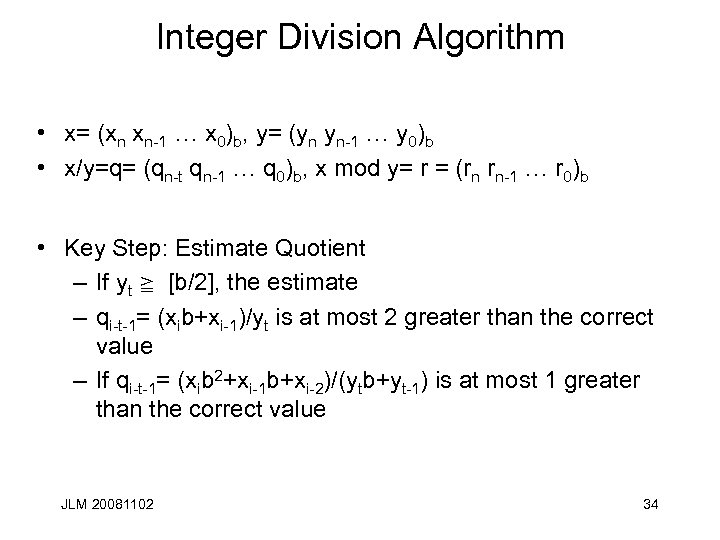
Integer Division Algorithm • x= (xn xn-1 … x 0)b, y= (yn yn-1 … y 0)b • x/y=q= (qn-t qn-1 … q 0)b, x mod y= r = (rn rn-1 … r 0)b • Key Step: Estimate Quotient – If yt s [b/2], the estimate – qi-t-1= (xib+xi-1)/yt is at most 2 greater than the correct value – If qi-t-1= (xib 2+xi-1 b+xi-2)/(ytb+yt-1) is at most 1 greater than the correct value JLM 20081102 34
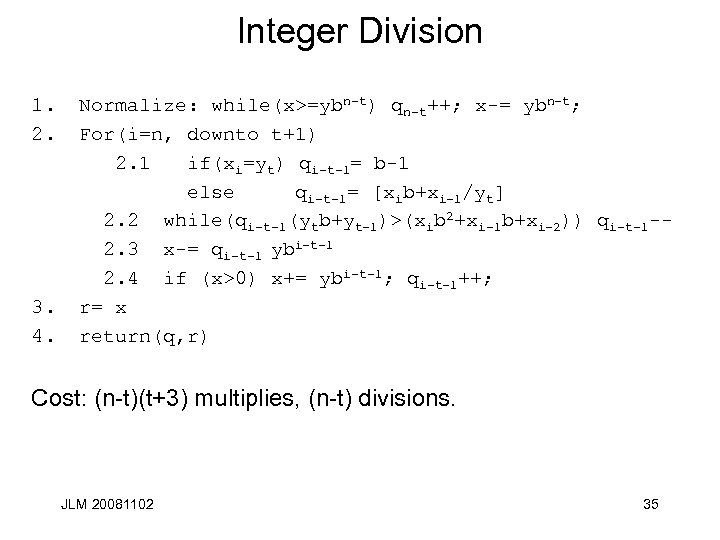
Integer Division 1. 2. 3. 4. Normalize: while(x>=ybn-t) qn-t++; x-= ybn-t; For(i=n, downto t+1) 2. 1 if(xi=yt) qi-t-1= b-1 else qi-t-1= [xib+xi-1/yt] 2. 2 while(qi-t-1(ytb+yt-1)>(xib 2+xi-1 b+xi-2)) qi-t-1 -2. 3 x-= qi-t-1 ybi-t-1 2. 4 if (x>0) x+= ybi-t-1; qi-t-1++; r= x return(q, r) Cost: (n-t)(t+3) multiplies, (n-t) divisions. JLM 20081102 35
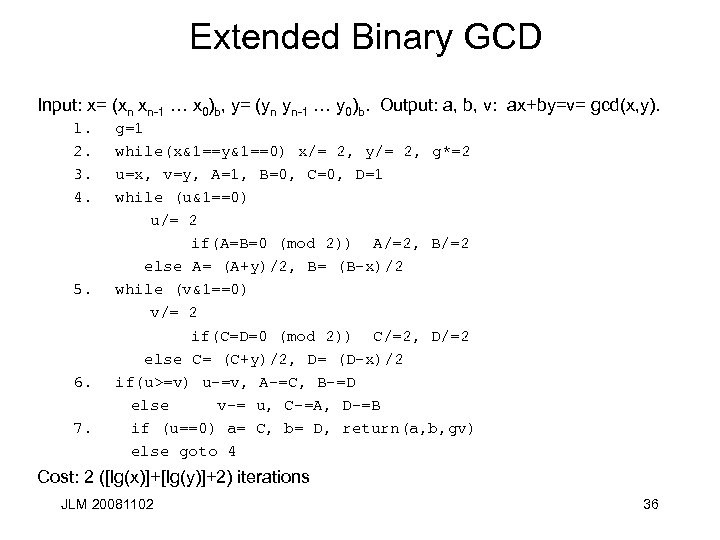
Extended Binary GCD Input: x= (xn xn-1 … x 0)b, y= (yn yn-1 … y 0)b. Output: a, b, v: ax+by=v= gcd(x, y). 1. 2. 3. 4. 5. 6. 7. g=1 while(x&1==y&1==0) x/= 2, y/= 2, g*=2 u=x, v=y, A=1, B=0, C=0, D=1 while (u&1==0) u/= 2 if(A=B=0 (mod 2)) A/=2, B/=2 else A= (A+y)/2, B= (B-x)/2 while (v&1==0) v/= 2 if(C=D=0 (mod 2)) C/=2, D/=2 else C= (C+y)/2, D= (D-x)/2 if(u>=v) u-=v, A-=C, B-=D else v-= u, C-=A, D-=B if (u==0) a= C, b= D, return(a, b, gv) else goto 4 Cost: 2 ([lg(x)]+[lg(y)]+2) iterations JLM 20081102 36
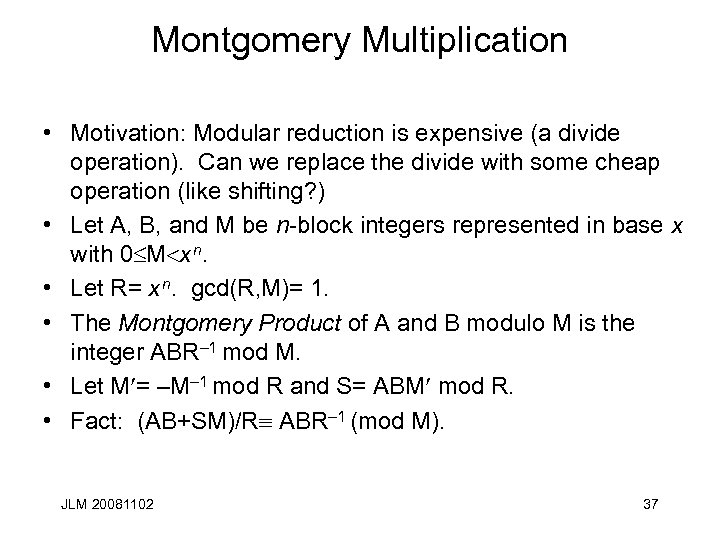
Montgomery Multiplication • Motivation: Modular reduction is expensive (a divide operation). Can we replace the divide with some cheap operation (like shifting? ) • Let A, B, and M be n-block integers represented in base x with 0 M x n. • Let R= x n. gcd(R, M)= 1. • The Montgomery Product of A and B modulo M is the integer ABR– 1 mod M. • Let M = –M– 1 mod R and S= ABM mod R. • Fact: (AB+SM)/R ABR– 1 (mod M). JLM 20081102 37
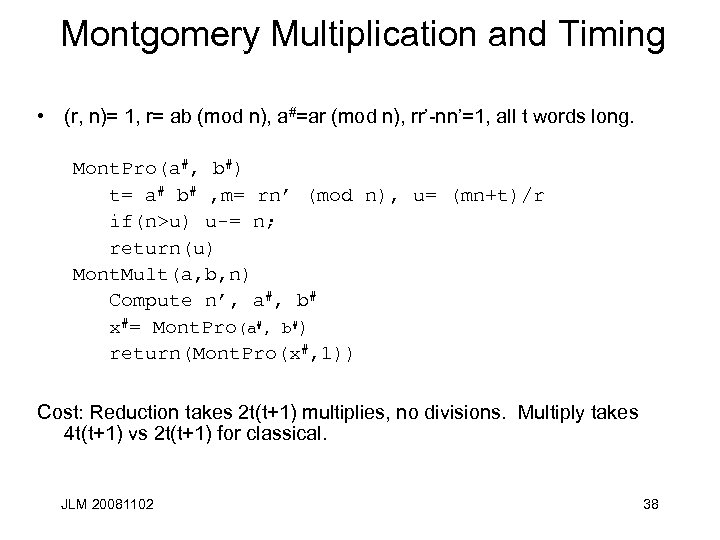
Montgomery Multiplication and Timing • (r, n)= 1, r= ab (mod n), a#=ar (mod n), rr’-nn’=1, all t words long. Mont. Pro(a#, b#) t= a# b# , m= rn’ (mod n), u= (mn+t)/r if(n>u) u-= n; return(u) Mont. Mult(a, b, n) Compute n’, a#, b# x#= Mont. Pro(a#, b#) return(Mont. Pro(x#, 1)) Cost: Reduction takes 2 t(t+1) multiplies, no divisions. Multiply takes 4 t(t+1) vs 2 t(t+1) for classical. JLM 20081102 38
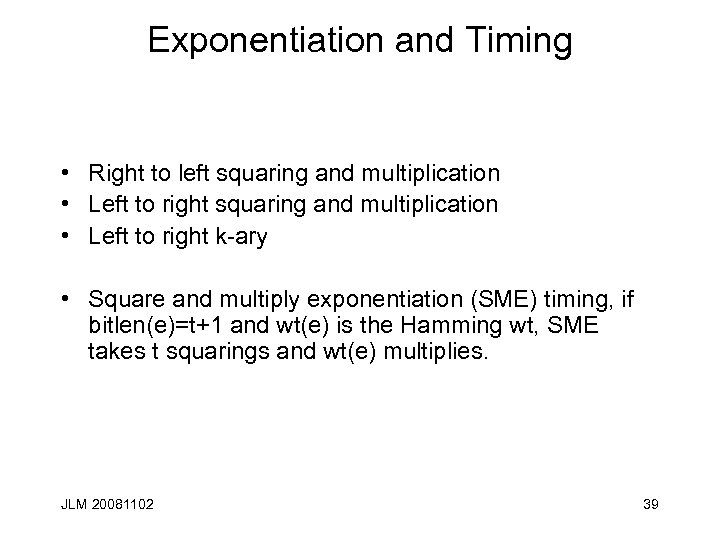
Exponentiation and Timing • Right to left squaring and multiplication • Left to right k-ary • Square and multiply exponentiation (SME) timing, if bitlen(e)=t+1 and wt(e) is the Hamming wt, SME takes t squarings and wt(e) multiplies. JLM 20081102 39
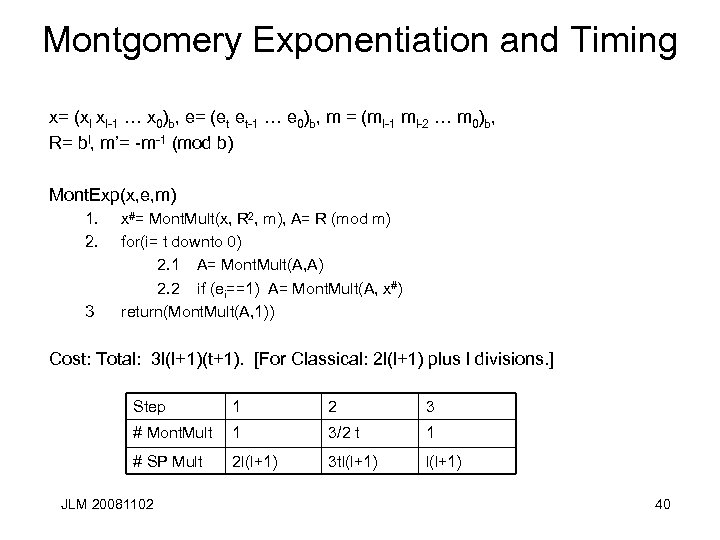
Montgomery Exponentiation and Timing x= (xl xl-1 … x 0)b, e= (et et-1 … e 0)b, m = (ml-1 ml-2 … m 0)b, R= bl, m’= -m-1 (mod b) Mont. Exp(x, e, m) 1. 2. 3 x#= Mont. Mult(x, R 2, m), A= R (mod m) for(i= t downto 0) 2. 1 A= Mont. Mult(A, A) 2. 2 if (ei==1) A= Mont. Mult(A, x#) return(Mont. Mult(A, 1)) Cost: Total: 3 l(l+1)(t+1). [For Classical: 2 l(l+1) plus l divisions. ] Step 1 2 3 # Mont. Mult 1 3/2 t 1 # SP Mult 2 l(l+1) 3 tl(l+1) JLM 20081102 40
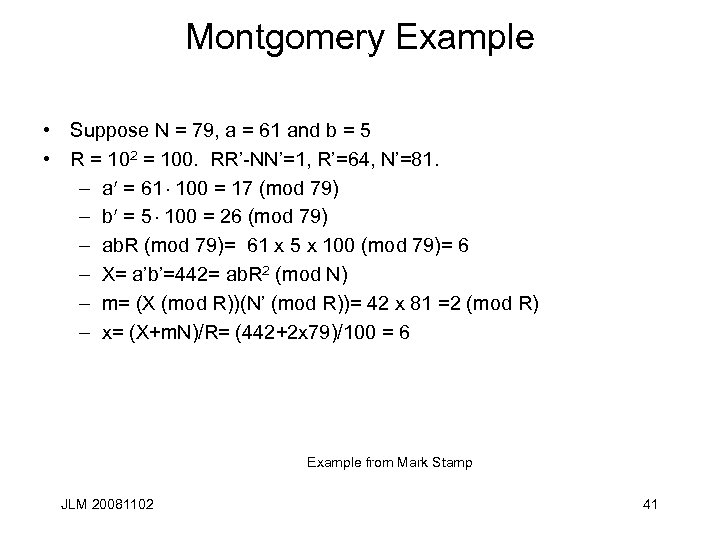
Montgomery Example • Suppose N = 79, a = 61 and b = 5 • R = 102 = 100. RR’-NN’=1, R’=64, N’=81. – a = 61 100 = 17 (mod 79) – b = 5 100 = 26 (mod 79) – ab. R (mod 79)= 61 x 5 x 100 (mod 79)= 6 – X= a’b’=442= ab. R 2 (mod N) – m= (X (mod R))(N’ (mod R))= 42 x 81 =2 (mod R) – x= (X+m. N)/R= (442+2 x 79)/100 = 6 Example from Mark Stamp JLM 20081102 41
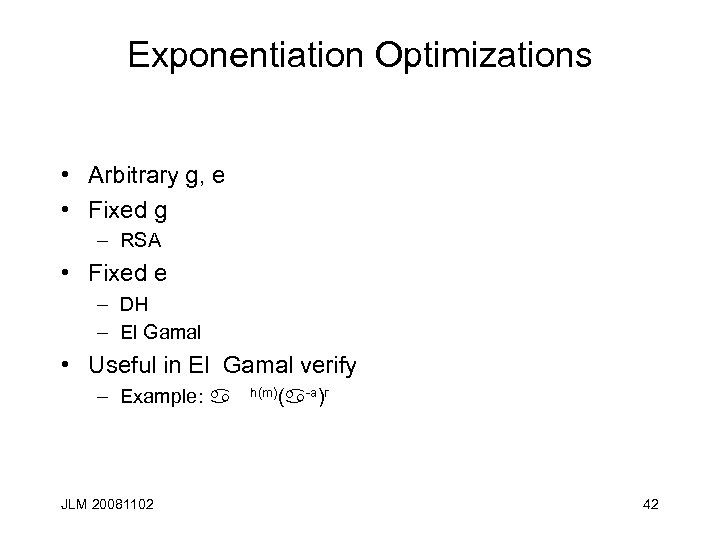
Exponentiation Optimizations • Arbitrary g, e • Fixed g – RSA • Fixed e – DH – El Gamal • Useful in El Gamal verify – Example: a JLM 20081102 h(m)(a-a)r 42
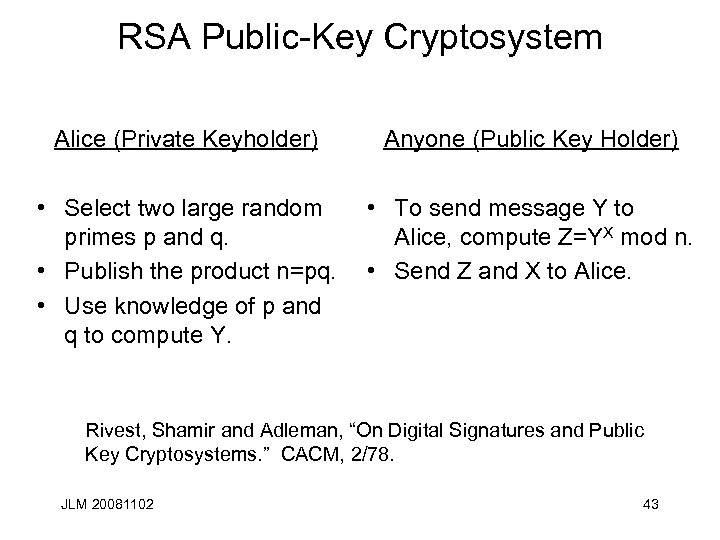
RSA Public-Key Cryptosystem Alice (Private Keyholder) Anyone (Public Key Holder) • Select two large random primes p and q. • Publish the product n=pq. • Use knowledge of p and q to compute Y. • To send message Y to Alice, compute Z=YX mod n. • Send Z and X to Alice. Rivest, Shamir and Adleman, “On Digital Signatures and Public Key Cryptosystems. ” CACM, 2/78. JLM 20081102 43
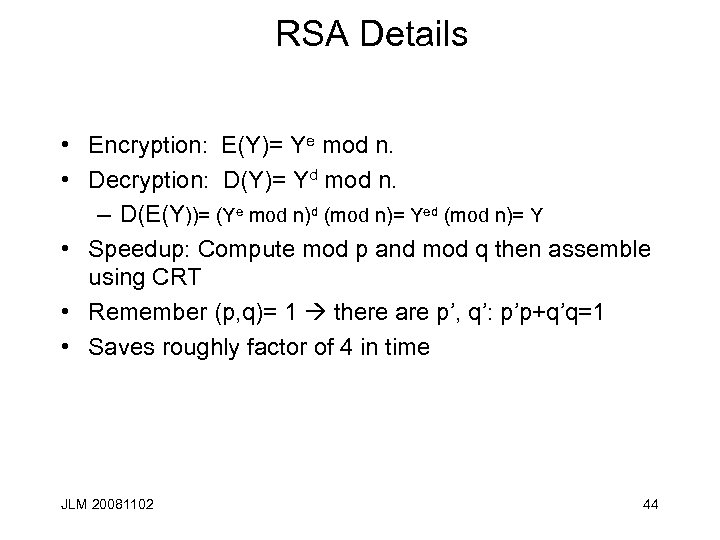
RSA Details • Encryption: E(Y)= Ye mod n. • Decryption: D(Y)= Yd mod n. – D(E(Y))= (Ye mod n)d (mod n)= Yed (mod n)= Y • Speedup: Compute mod p and mod q then assemble using CRT • Remember (p, q)= 1 there are p’, q’: p’p+q’q=1 • Saves roughly factor of 4 in time JLM 20081102 44
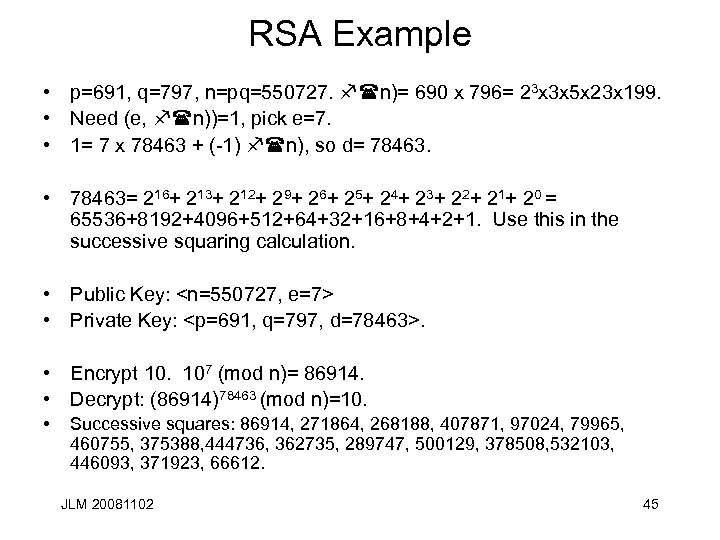
RSA Example • p=691, q=797, n=pq=550727. f(n)= 690 x 796= 23 x 3 x 5 x 23 x 199. • Need (e, f(n))=1, pick e=7. • 1= 7 x 78463 + (-1) f(n), so d= 78463. • 78463= 216+ 213+ 212+ 29+ 26+ 25+ 24+ 23+ 22+ 21+ 20 = 65536+8192+4096+512+64+32+16+8+4+2+1. Use this in the successive squaring calculation. • Public Key: <n=550727, e=7> • Private Key: <p=691, q=797, d=78463>. • Encrypt 10. 107 (mod n)= 86914. • Decrypt: (86914)78463 (mod n)=10. • Successive squares: 86914, 271864, 268188, 407871, 97024, 79965, 460755, 375388, 444736, 362735, 289747, 500129, 378508, 532103, 446093, 371923, 66612. JLM 20081102 45
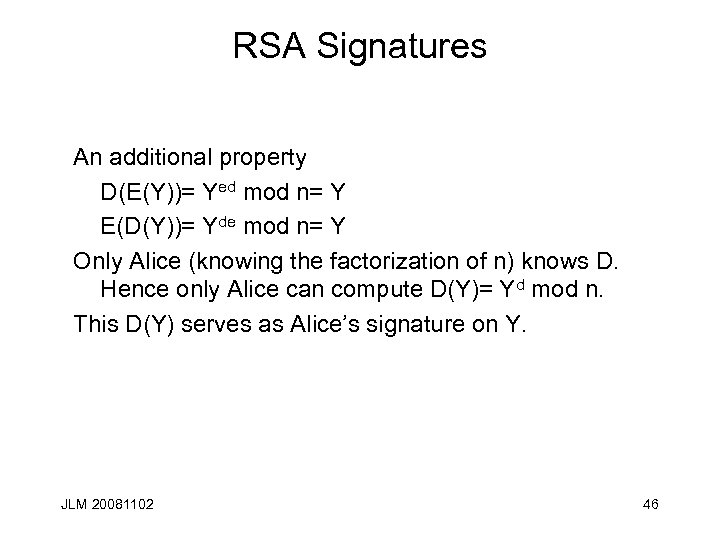
RSA Signatures An additional property D(E(Y))= Yed mod n= Y E(D(Y))= Yde mod n= Y Only Alice (knowing the factorization of n) knows D. Hence only Alice can compute D(Y)= Yd mod n. This D(Y) serves as Alice’s signature on Y. JLM 20081102 46
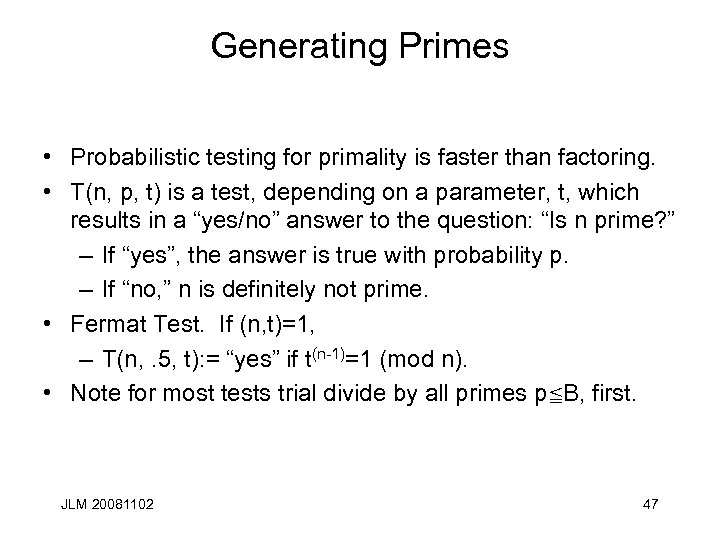
Generating Primes • Probabilistic testing for primality is faster than factoring. • T(n, p, t) is a test, depending on a parameter, t, which results in a “yes/no” answer to the question: “Is n prime? ” – If “yes”, the answer is true with probability p. – If “no, ” n is definitely not prime. • Fermat Test. If (n, t)=1, – T(n, . 5, t): = “yes” if t(n-1)=1 (mod n). • Note for most tests trial divide by all primes pc. B, first. JLM 20081102 47
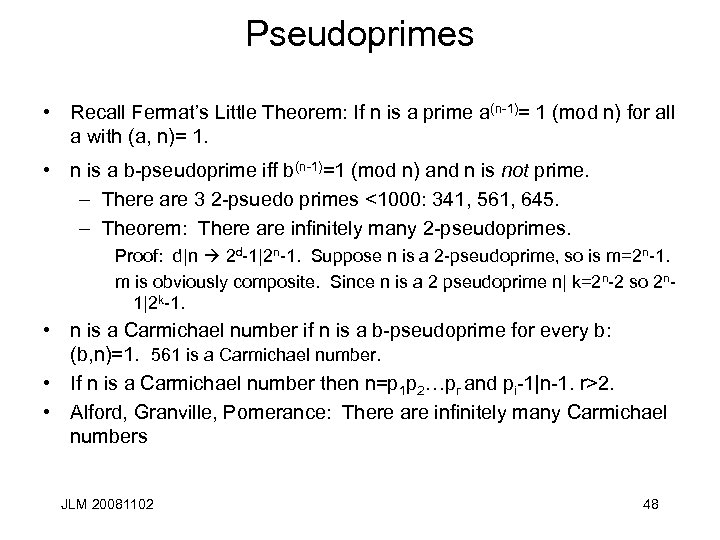
Pseudoprimes • Recall Fermat’s Little Theorem: If n is a prime a(n-1)= 1 (mod n) for all a with (a, n)= 1. • n is a b-pseudoprime iff b(n-1)=1 (mod n) and n is not prime. – There are 3 2 -psuedo primes <1000: 341, 561, 645. – Theorem: There are infinitely many 2 -pseudoprimes. Proof: d|n 2 d-1|2 n-1. Suppose n is a 2 -pseudoprime, so is m=2 n-1. m is obviously composite. Since n is a 2 pseudoprime n| k=2 n-2 so 2 n 1|2 k-1. • n is a Carmichael number if n is a b-pseudoprime for every b: (b, n)=1. 561 is a Carmichael number. • If n is a Carmichael number then n=p 1 p 2…pr and pi-1|n-1. r>2. • Alford, Granville, Pomerance: There are infinitely many Carmichael numbers JLM 20081102 48
Liars, Witnesses and Certificates • n is prime iff f(n)=n-1. So if we find a b such that ordn(b)= n-1. b is a witness to n’s primality. • To show ordn(b)= n-1, we can factor n-1= P pie[i] and check that for each k= n-1/pi , bk¹ 1 (mod n). • If bn-1¹ 1 (mod n) b is said to be a “witness” to n’s compositeness. • If n is a b-pseudoprime b is said to liar for the primality of n. • Given n-1=2 tm, m odd and b. A b-sequence is b 1= bm, bi+1= bi 2, i= 1, 2, . . t, . If a b sequence does not end in 1 or if a terminal 1 is not preceded by a-1, n is composite. Again b is a “witness” as to the compositeness of n. • If n is composite and a b sequence acts like one for a prime, n is called a b-strong pseudoprime. • b is a strong liar for compositeness if n passes the strong pseudoprime test with b JLM 20081102 49
Primality Testing • Deterministic test: n is prime if m does not divide n for all m<Ö n. • Check m= 2 and m odd • Sieve of Eratosthenes • Keep a list of primes – Still to slow • Probabalistic – Fermat – Solovay-Strassen – Miller-Rabin: Try bases b= 2, 3, … pk , if n is a b-sequence “passes” the primality condition, conclude n is prime. – If the extended Riemann Hypothesis is true the Miller-Rabin test is dispositive as to the primality of n if we try all bases up to 2(ln(n))2. JLM 20081102 50
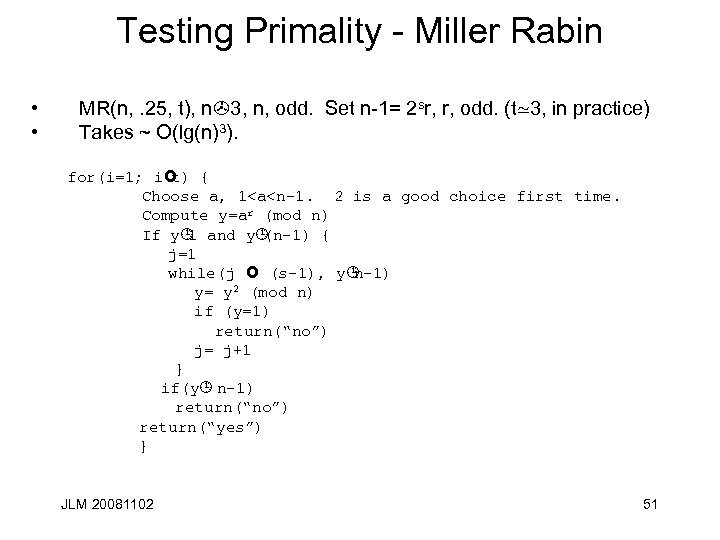
Testing Primality - Miller Rabin • • MR(n, . 25, t), n>3, n, odd. Set n-1= 2 sr, r, odd. (t>3, in practice) Takes ~ O(lg(n)3). for(i=1; i£ { t) Choose a, 1<a<n-1. 2 is a good choice first time. Compute y=ar (mod n) If y¹ and y¹ 1 (n-1) { j=1 while(j £ (s-1), y¹ n-1) y= y 2 (mod n) if (y=1) return(“no”) j= j+1 } if(y¹ n-1) return(“no”) return(“yes”) } JLM 20081102 51
Probability of Success for M-R • Theorem (Strong liars are scarce): If n is composite and odd then at most (n-1)/4 residue classes can be strong liars. – Case 1: n= pe. Let g be a primitive root of n. ordn(g)=(p-1)pe-1. If n is a ga-pseudoprime, (p-1)pe-1|a(pe-1) pe-1|a. So n is a gapseudoprime iff pe-1|a and there are p-1 such a’s. (p-1)/pec 1/4. – Case 2: n= p 1 e[1]p 2 e[2]…pre[r]. n-1=2 st, t odd. Define k to be smallest such that if e=2 k, be= -1 (mod n) be= -1 (mod pi), all i. So 2 k+1 | pi -1, all i so 2 k+1|(n-1) k<s. Set m=2 kt, bm=(-1)t= -1, and L={a: |am|=1, 1 ca<n}. We will show L contains all the strong liars and |L|c (n-1)/4. JLM 20081102 52
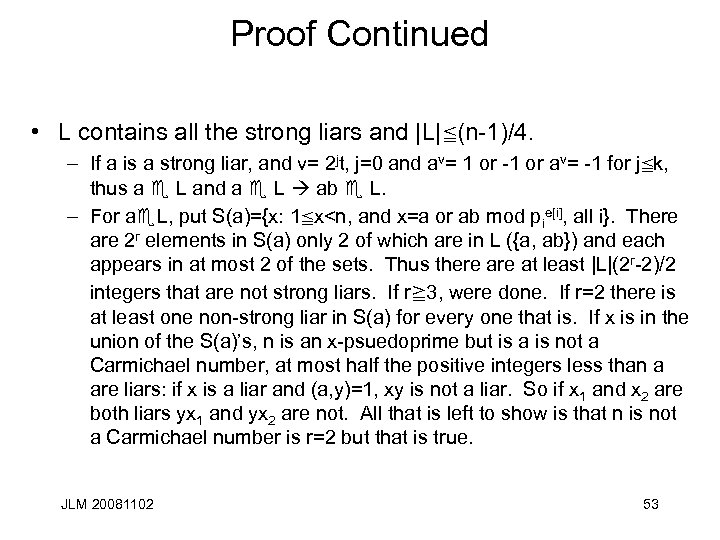
Proof Continued • L contains all the strong liars and |L|c(n-1)/4. – If a is a strong liar, and v= 2 jt, j=0 and av= 1 or -1 or av= -1 for jck, thus a e L and a e L ab e L. – For ae. L, put S(a)={x: 1 cx<n, and x=a or ab mod pie[i], all i}. There are 2 r elements in S(a) only 2 of which are in L ({a, ab}) and each appears in at most 2 of the sets. Thus there at least |L|(2 r-2)/2 integers that are not strong liars. If rs 3, were done. If r=2 there is at least one non-strong liar in S(a) for every one that is. If x is in the union of the S(a)’s, n is an x-psuedoprime but is a is not a Carmichael number, at most half the positive integers less than a are liars: if x is a liar and (a, y)=1, xy is not a liar. So if x 1 and x 2 are both liars yx 1 and yx 2 are not. All that is left to show is that n is not a Carmichael number is r=2 but that is true. JLM 20081102 53
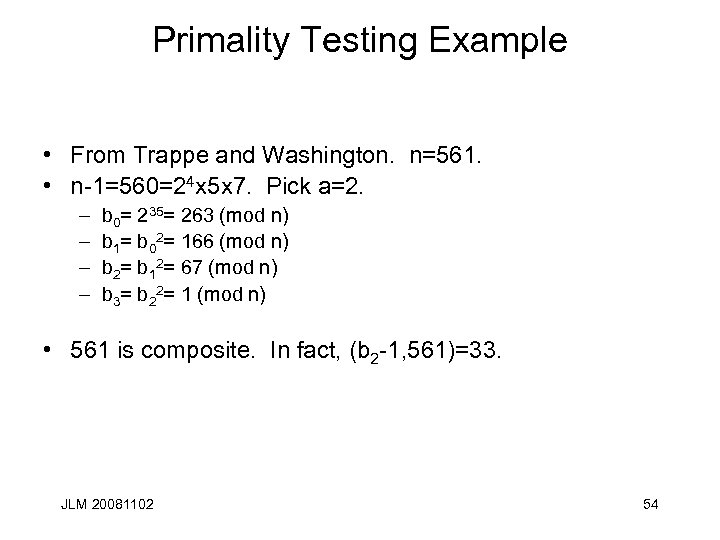
Primality Testing Example • From Trappe and Washington. n=561. • n-1=560=24 x 5 x 7. Pick a=2. – – b 0= 235= 263 (mod n) b 1= b 02= 166 (mod n) b 2= b 12= 67 (mod n) b 3= b 22= 1 (mod n) • 561 is composite. In fact, (b 2 -1, 561)=33. JLM 20081102 54
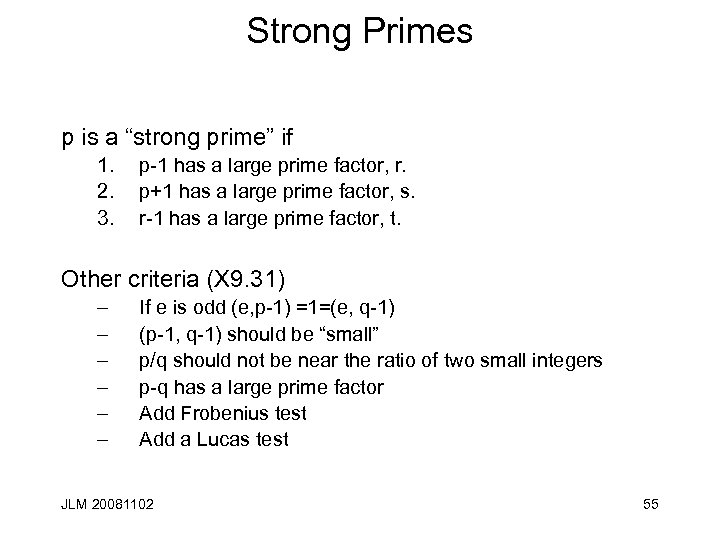
Strong Primes p is a “strong prime” if 1. 2. 3. p-1 has a large prime factor, r. p+1 has a large prime factor, s. r-1 has a large prime factor, t. Other criteria (X 9. 31) – – – If e is odd (e, p-1) =1=(e, q-1) (p-1, q-1) should be “small” p/q should not be near the ratio of two small integers p-q has a large prime factor Add Frobenius test Add a Lucas test JLM 20081102 55
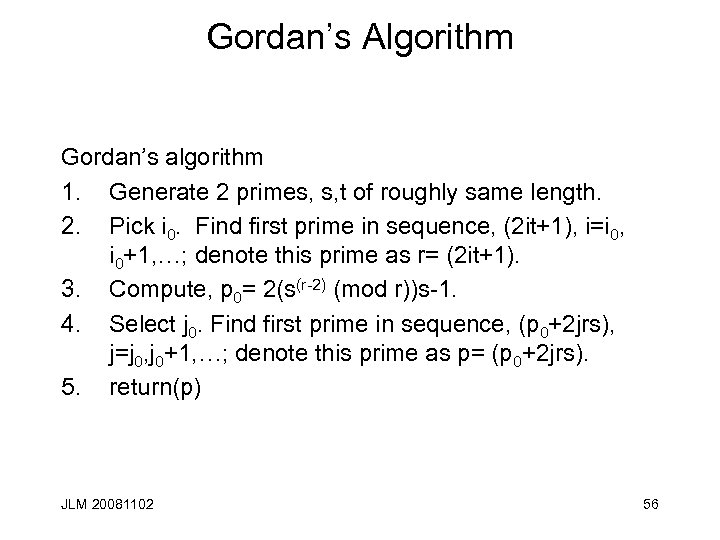
Gordan’s Algorithm Gordan’s algorithm 1. Generate 2 primes, s, t of roughly same length. 2. Pick i 0. Find first prime in sequence, (2 it+1), i=i 0, i 0+1, …; denote this prime as r= (2 it+1). 3. Compute, p 0= 2(s(r-2) (mod r))s-1. 4. Select j 0. Find first prime in sequence, (p 0+2 jrs), j=j 0, j 0+1, …; denote this prime as p= (p 0+2 jrs). 5. return(p) JLM 20081102 56
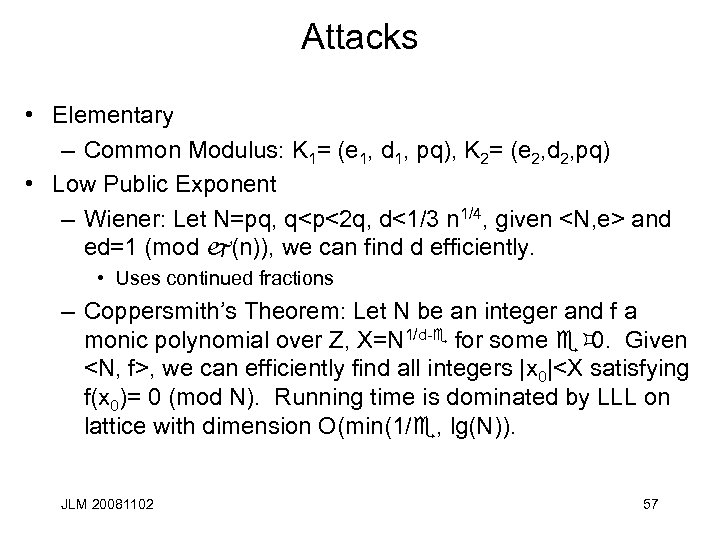
Attacks • Elementary – Common Modulus: K 1= (e 1, d 1, pq), K 2= (e 2, d 2, pq) • Low Public Exponent – Wiener: Let N=pq, q<p<2 q, d<1/3 n 1/4, given <N, e> and ed=1 (mod j(n)), we can find d efficiently. • Uses continued fractions – Coppersmith’s Theorem: Let N be an integer and f a monic polynomial over Z, X=N 1/d-e for some e³ 0. Given <N, f>, we can efficiently find all integers |x 0|<X satisfying f(x 0)= 0 (mod N). Running time is dominated by LLL on lattice with dimension O(min(1/e, lg(N)). JLM 20081102 57
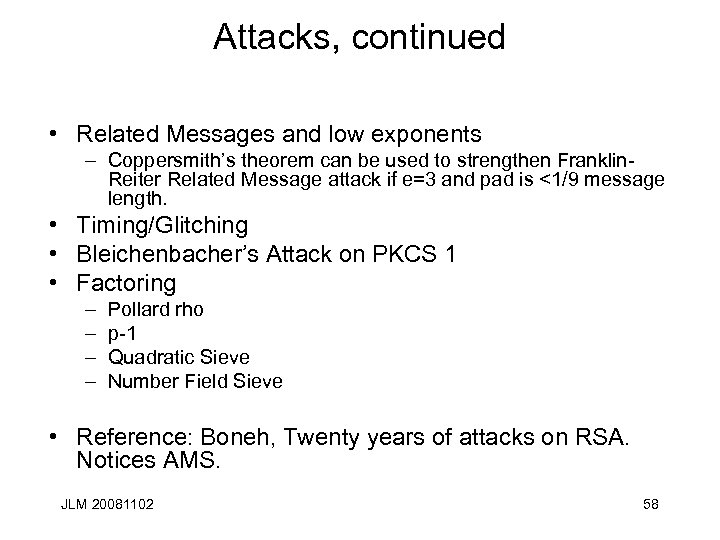
Attacks, continued • Related Messages and low exponents – Coppersmith’s theorem can be used to strengthen Franklin. Reiter Related Message attack if e=3 and pad is <1/9 message length. • Timing/Glitching • Bleichenbacher’s Attack on PKCS 1 • Factoring – – Pollard rho p-1 Quadratic Sieve Number Field Sieve • Reference: Boneh, Twenty years of attacks on RSA. Notices AMS. JLM 20081102 58
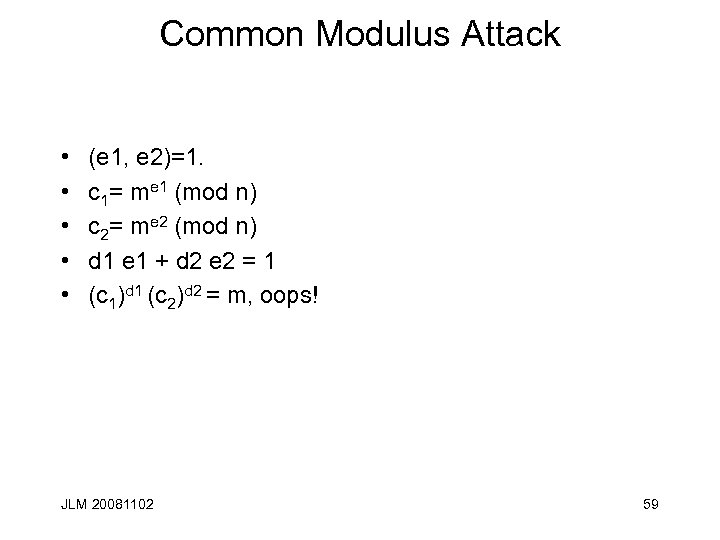
Common Modulus Attack • • • (e 1, e 2)=1. c 1= me 1 (mod n) c 2= me 2 (mod n) d 1 e 1 + d 2 e 2 = 1 (c 1)d 1 (c 2)d 2 = m, oops! JLM 20081102 59
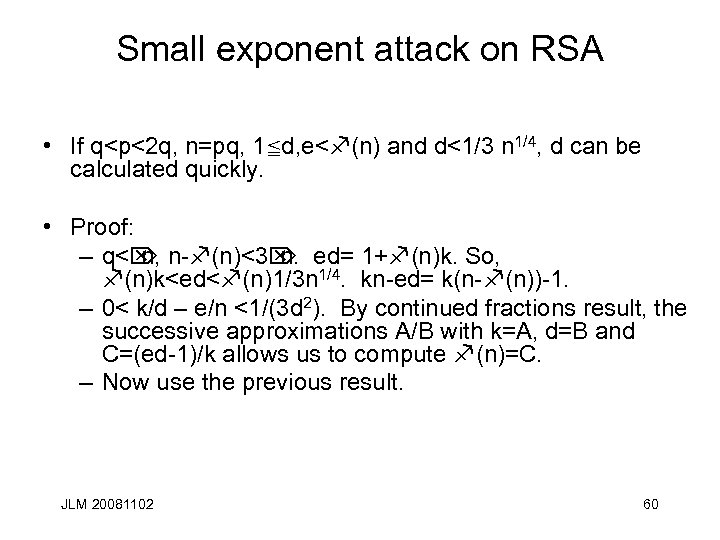
Small exponent attack on RSA • If q<p<2 q, n=pq, 1 cd, e<f(n) and d<1/3 n 1/4, d can be calculated quickly. • Proof: – q<Ö n, n-f(n)<3Ö n. ed= 1+f(n)k. So, f(n)k<ed<f(n)1/3 n 1/4. kn-ed= k(n-f(n))-1. – 0< k/d – e/n <1/(3 d 2). By continued fractions result, the successive approximations A/B with k=A, d=B and C=(ed-1)/k allows us to compute f(n)=C. – Now use the previous result. JLM 20081102 60
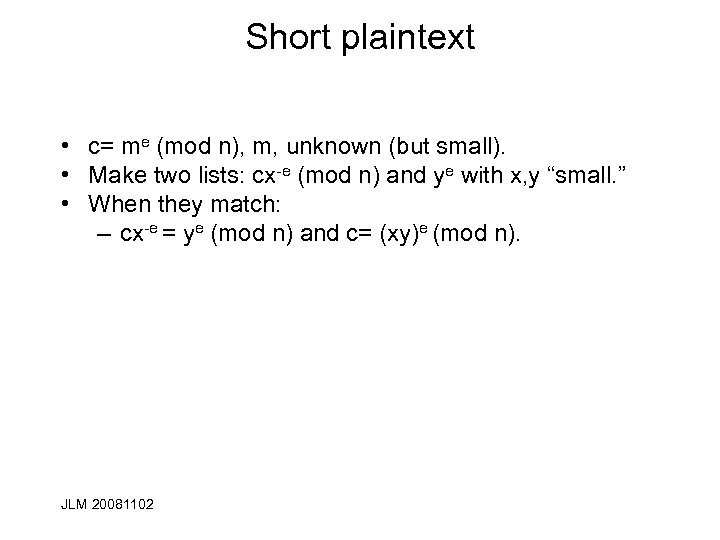
Short plaintext • c= me (mod n), m, unknown (but small). • Make two lists: cx-e (mod n) and ye with x, y “small. ” • When they match: – cx-e = ye (mod n) and c= (xy)e (mod n). JLM 20081102
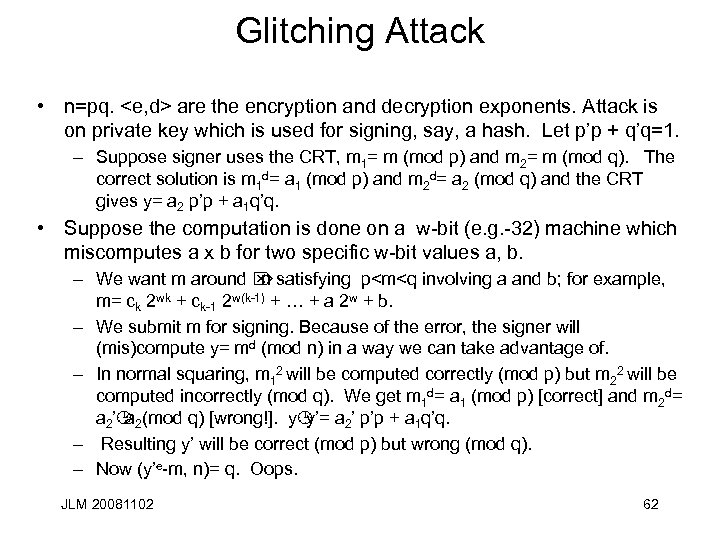
Glitching Attack • n=pq. <e, d> are the encryption and decryption exponents. Attack is on private key which is used for signing, say, a hash. Let p’p + q’q=1. – Suppose signer uses the CRT, m 1= m (mod p) and m 2= m (mod q). The correct solution is m 1 d= a 1 (mod p) and m 2 d= a 2 (mod q) and the CRT gives y= a 2 p’p + a 1 q’q. • Suppose the computation is done on a w-bit (e. g. -32) machine which miscomputes a x b for two specific w-bit values a, b. – We want m around Ö n satisfying p<m<q involving a and b; for example, m= ck 2 wk + ck-1 2 w(k-1) + … + a 2 w + b. – We submit m for signing. Because of the error, the signer will (mis)compute y= md (mod n) in a way we can take advantage of. – In normal squaring, m 12 will be computed correctly (mod p) but m 22 will be computed incorrectly (mod q). We get m 1 d= a 1 (mod p) [correct] and m 2 d= a 2’¹ 2(mod q) [wrong!]. y¹ a y’= a 2’ p’p + a 1 q’q. – Resulting y’ will be correct (mod p) but wrong (mod q). – Now (y’e-m, n)= q. Oops. JLM 20081102 62
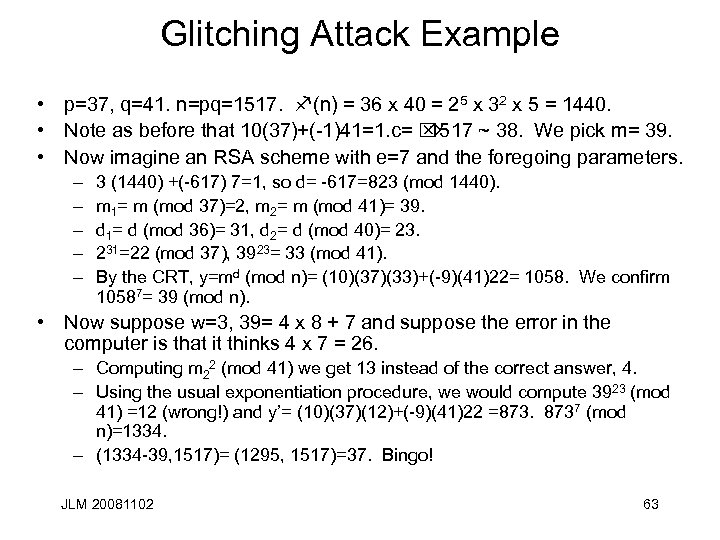
Glitching Attack Example • p=37, q=41. n=pq=1517. f(n) = 36 x 40 = 25 x 32 x 5 = 1440. • Note as before that 10(37)+(-1)41=1. c= Ö 1517 ~ 38. We pick m= 39. • Now imagine an RSA scheme with e=7 and the foregoing parameters. – – – 3 (1440) +(-617) 7=1, so d= -617=823 (mod 1440). m 1= m (mod 37)=2, m 2= m (mod 41)= 39. d 1= d (mod 36)= 31, d 2= d (mod 40)= 23. 231=22 (mod 37), 3923= 33 (mod 41). By the CRT, y=md (mod n)= (10)(37)(33)+(-9)(41)22= 1058. We confirm 10587= 39 (mod n). • Now suppose w=3, 39= 4 x 8 + 7 and suppose the error in the computer is that it thinks 4 x 7 = 26. – Computing m 22 (mod 41) we get 13 instead of the correct answer, 4. – Using the usual exponentiation procedure, we would compute 3923 (mod 41) =12 (wrong!) and y’= (10)(37)(12)+(-9)(41)22 =873. 8737 (mod n)=1334. – (1334 -39, 1517)= (1295, 1517)=37. Bingo! JLM 20081102 63
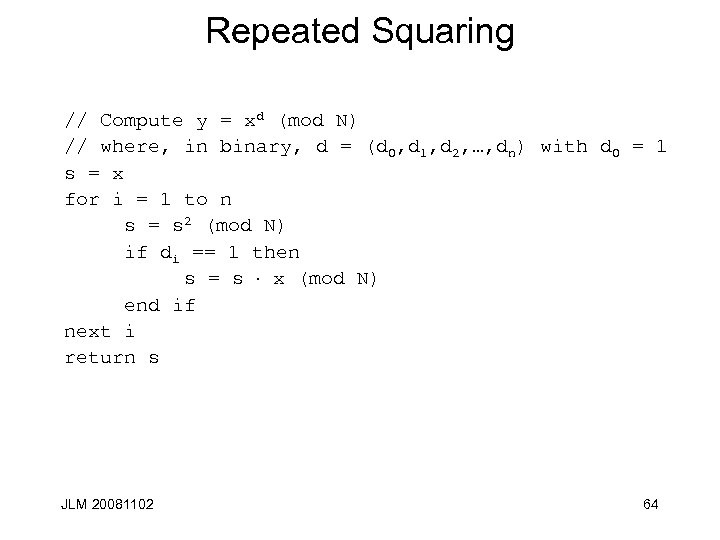
Repeated Squaring // Compute y = xd (mod N) // where, in binary, d = (d 0, d 1, d 2, …, dn) with d 0 = 1 s = x for i = 1 to n s = s 2 (mod N) if di == 1 then s = s x (mod N) end if next i return s JLM 20081102 64
Timing Attack (Kocher) • Attack on repeated squaring – Does not work if CRT or Montgomery used – In most applications, CRT and Montgomery multiplication are used • This attack originally designed for smartcards • Can be generalized (differential power analysis) • Recover private key bits one (or a few) at a time – Private key: d = d 0, d 1, …, dn with d 0 = 1 – Recover bits in order, d 1, d 2, d 3, … Example from Mark Stamp JLM 20081102 65
Kocher’s Attack • Suppose bits d 0, d 1, …, dk 1, are known • We want to determine bit dk • Randomly select Cj for j=0, 1, …, m-1, obtain timings T(Cj) for Cjd (mod N) • For each Cj emulate steps i=1, 2, …, k-1 of repeated squaring • At step k, emulate dk= 0 and dk= 1 • Variance of timing difference will be smaller for correct choice of dk JLM 20081102 Example from Mark Stamp 66
Preventing Timing Attack • RSA Blinding • To decrypt C, generate random r Y = re. C (mod N) • Decrypt Y then multiply by r 1 (mod N): r 1 Yd = r 1(re. C)d = r 1 r. Cd = Cd (mod N) • Since r is random, timing information is hidden JLM 20081102 67
Factoring • Security of RSA algorithm depends on (presumed) difficulty of factoring – Given n = pq, find p or q and RSA is broken • Factoring like “exhaustive search” for RSA • What are best factoring methods? • How does RSA “key size” compare to symmetric cipher key size? JLM 20081102 68
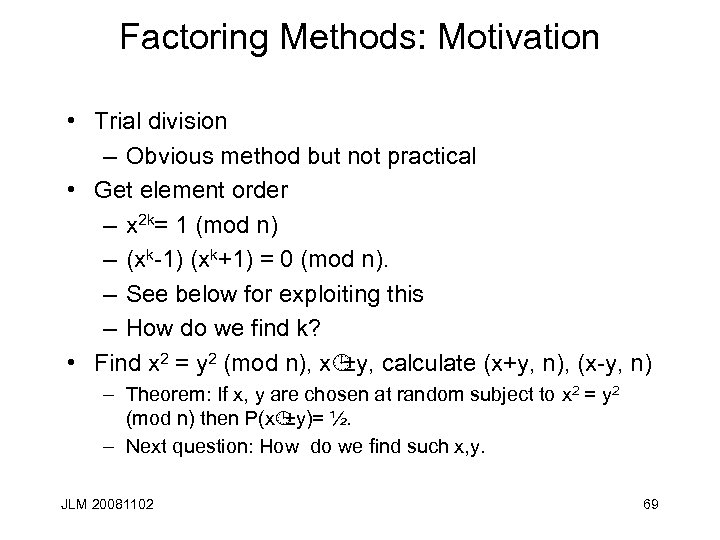
Factoring Methods: Motivation • Trial division – Obvious method but not practical • Get element order – x 2 k= 1 (mod n) – (xk-1) (xk+1) = 0 (mod n). – See below for exploiting this – How do we find k? • Find x 2 = y 2 (mod n), x¹ ±y, calculate (x+y, n), (x-y, n) – Theorem: If x, y are chosen at random subject to x 2 = y 2 (mod n) then P(x¹ ±y)= ½. – Next question: How do we find such x, y. JLM 20081102 69
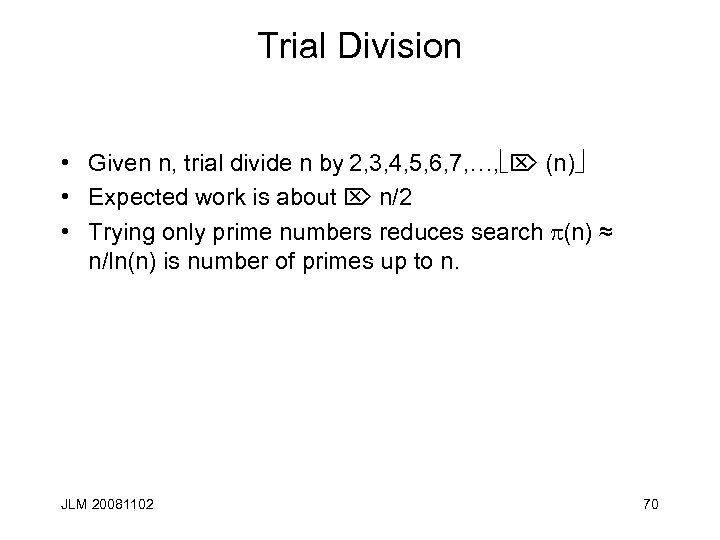
Trial Division • Given n, trial divide n by 2, 3, 4, 5, 6, 7, …, Ö (n) • Expected work is about Ö n/2 • Trying only prime numbers reduces search (n) ≈ n/ln(n) is number of primes up to n. JLM 20081102 70
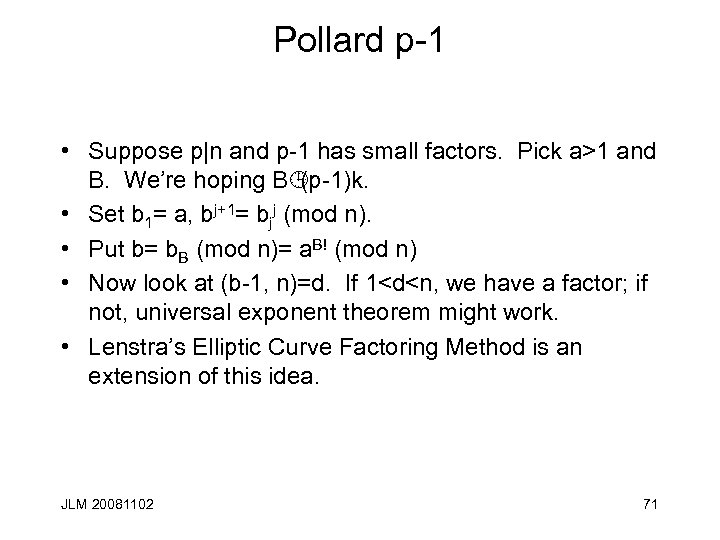
Pollard p-1 • Suppose p|n and p-1 has small factors. Pick a>1 and B. We’re hoping B¹ (p-1)k. • Set b 1= a, bj+1= bjj (mod n). • Put b= b. B (mod n)= a. B! (mod n) • Now look at (b-1, n)=d. If 1<d<n, we have a factor; if not, universal exponent theorem might work. • Lenstra’s Elliptic Curve Factoring Method is an extension of this idea. JLM 20081102 71
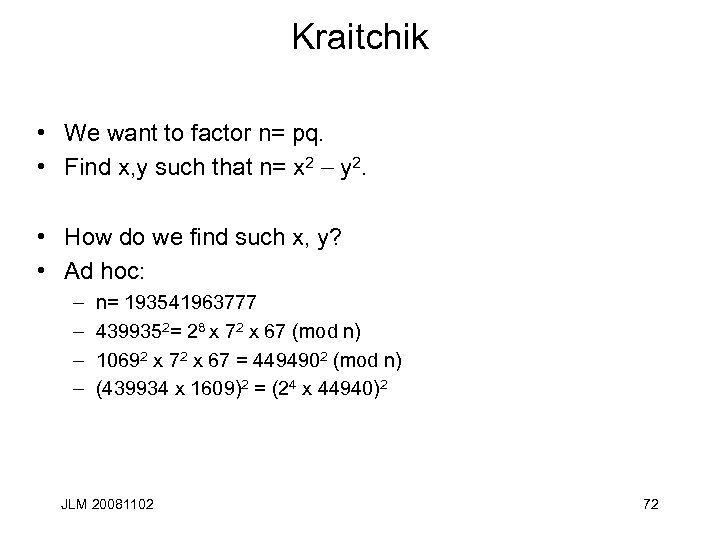
Kraitchik • We want to factor n= pq. • Find x, y such that n= x 2 y 2. • How do we find such x, y? • Ad hoc: – – n= 193541963777 4399352= 28 x 72 x 67 (mod n) 10692 x 72 x 67 = 4494902 (mod n) (439934 x 1609)2 = (24 x 44940)2 JLM 20081102 72
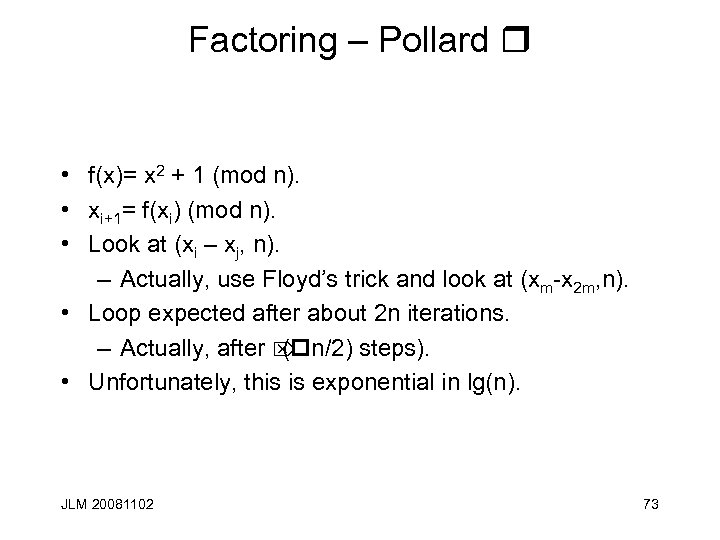
Factoring – Pollard r • f(x)= x 2 + 1 (mod n). • xi+1= f(xi) (mod n). • Look at (xi – xj, n). – Actually, use Floyd’s trick and look at (xm-x 2 m, n). • Loop expected after about 2 n iterations. – Actually, after Ö (pn/2) steps). • Unfortunately, this is exponential in lg(n). JLM 20081102 73
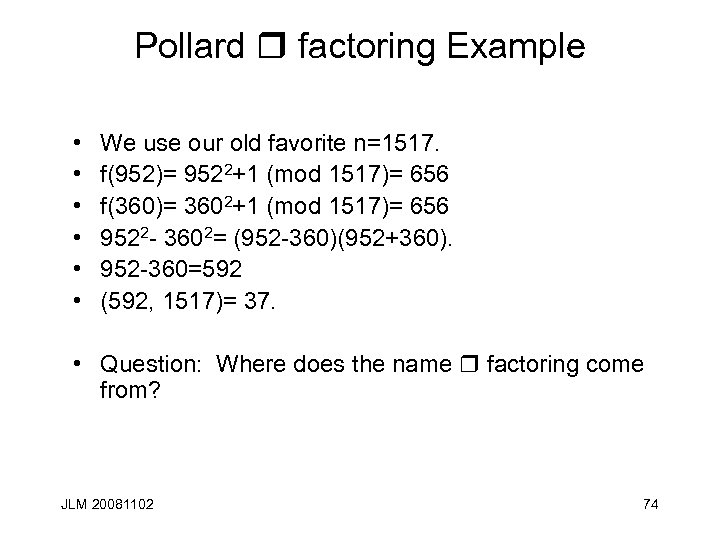
Pollard r factoring Example • • • We use our old favorite n=1517. f(952)= 9522+1 (mod 1517)= 656 f(360)= 3602+1 (mod 1517)= 656 9522 - 3602= (952 -360)(952+360). 952 -360=592 (592, 1517)= 37. • Question: Where does the name r factoring come from? JLM 20081102 74
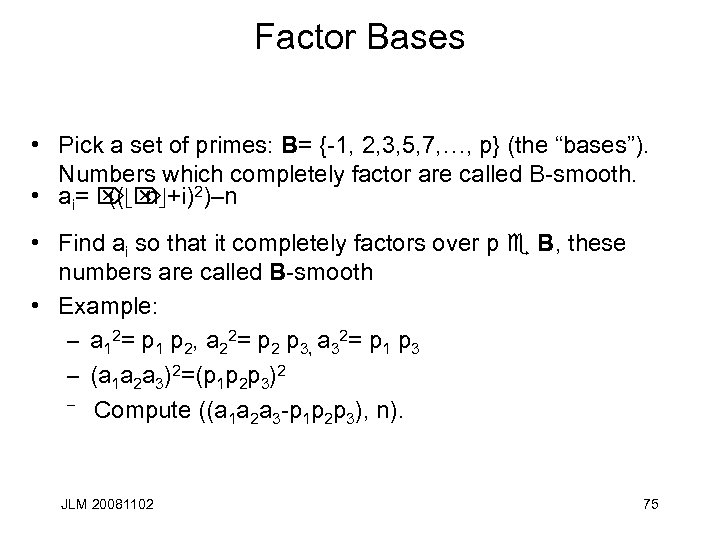
Factor Bases • Pick a set of primes: B= {-1, 2, 3, 5, 7, …, p} (the “bases”). Numbers which completely factor are called B-smooth. • ai= Ö Ö +i)2)–n ((d nt • Find ai so that it completely factors over p e B, these numbers are called B-smooth • Example: – a 12= p 1 p 2, a 22= p 2 p 3, a 32= p 1 p 3 – (a 1 a 2 a 3)2=(p 1 p 2 p 3)2 – Compute ((a a a -p p p ), n). 1 2 3 JLM 20081102 75
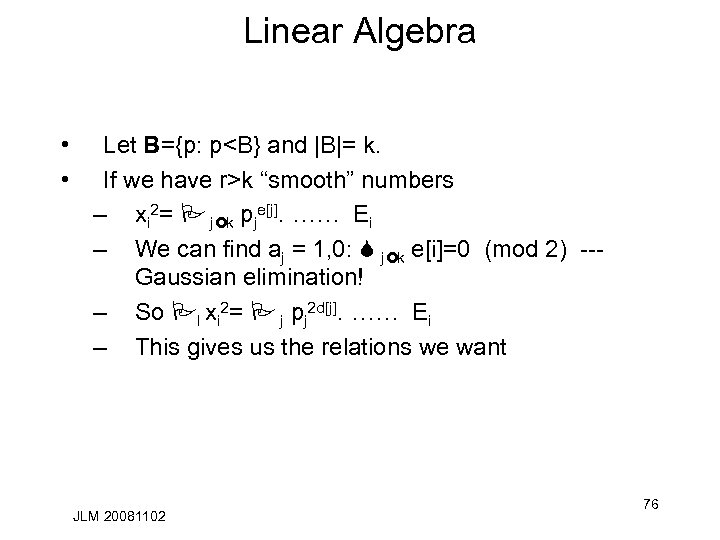
Linear Algebra • • Let B={p: p<B} and |B|= k. If we have r>k “smooth” numbers – xi 2= P j£k pje[j]. …… Ei – We can find aj = 1, 0: S j£k e[i]=0 (mod 2) --- Gaussian elimination! – So Pl xi 2= P j pj 2 d[j]. …… Ei – This gives us the relations we want JLM 20081102 76
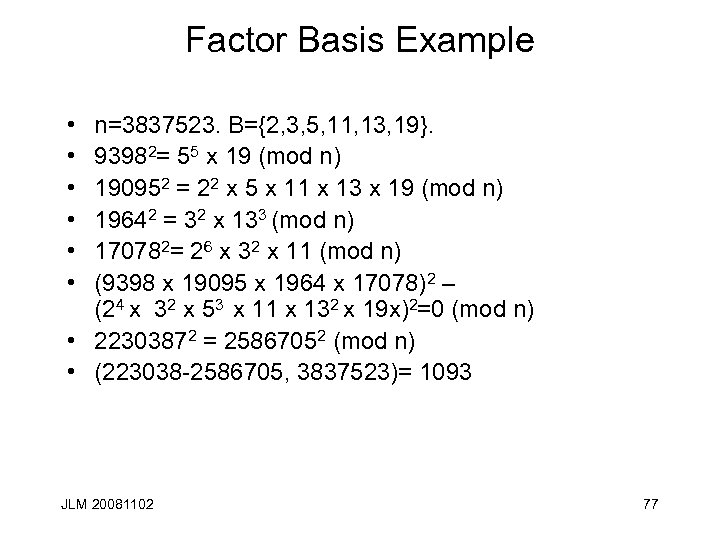
Factor Basis Example • • • n=3837523. B={2, 3, 5, 11, 13, 19}. 93982= 55 x 19 (mod n) 190952 = 22 x 5 x 11 x 13 x 19 (mod n) 19642 = 32 x 133 (mod n) 170782= 26 x 32 x 11 (mod n) (9398 x 19095 x 1964 x 17078)2 – (24 x 32 x 53 x 11 x 132 x 19 x)2=0 (mod n) • 22303872 = 25867052 (mod n) • (223038 -2586705, 3837523)= 1093 JLM 20081102 77
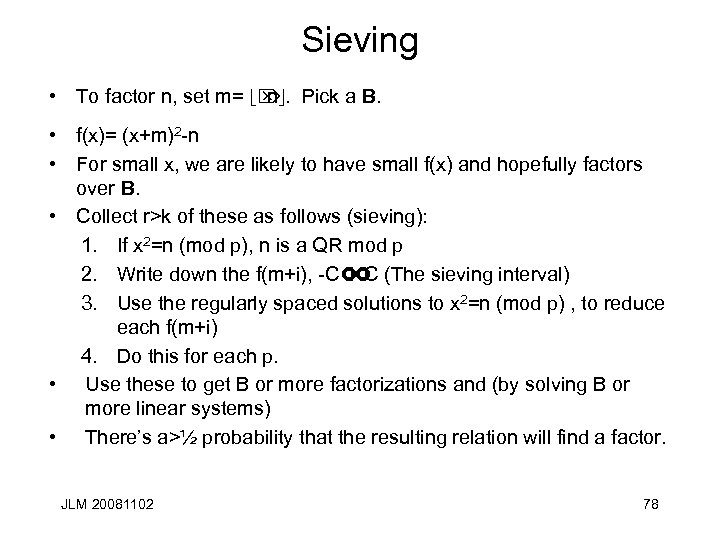
Sieving • To factor n, set m= d Ö. Pick a B. nt • f(x)= (x+m)2 -n • For small x, we are likely to have small f(x) and hopefully factors over B. • Collect r>k of these as follows (sieving): 1. If x 2=n (mod p), n is a QR mod p 2. Write down the f(m+i), -C£ C (The sieving interval) i£ 3. Use the regularly spaced solutions to x 2=n (mod p) , to reduce each f(m+i) 4. Do this for each p. • Use these to get B or more factorizations and (by solving B or more linear systems) • There’s a>½ probability that the resulting relation will find a factor. JLM 20081102 78
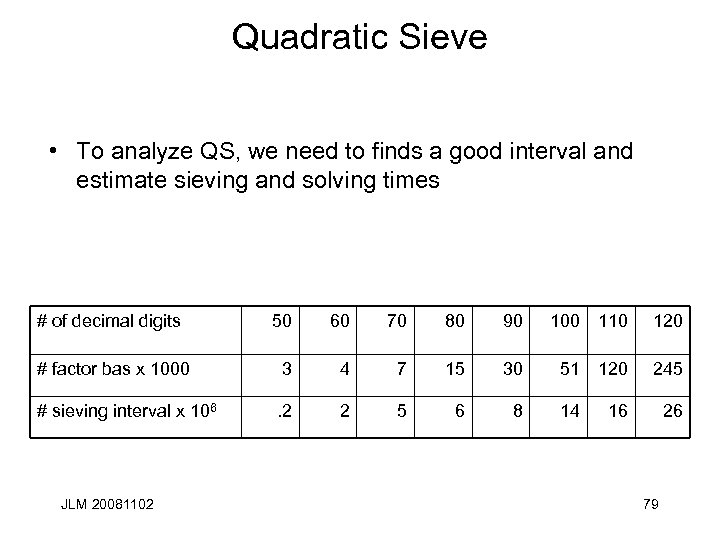
Quadratic Sieve • To analyze QS, we need to finds a good interval and estimate sieving and solving times # of decimal digits 50 60 70 80 90 100 110 120 # factor bas x 1000 3 4 7 15 30 51 120 245 # sieving interval x 106 . 2 2 5 6 8 JLM 20081102 14 16 26 79
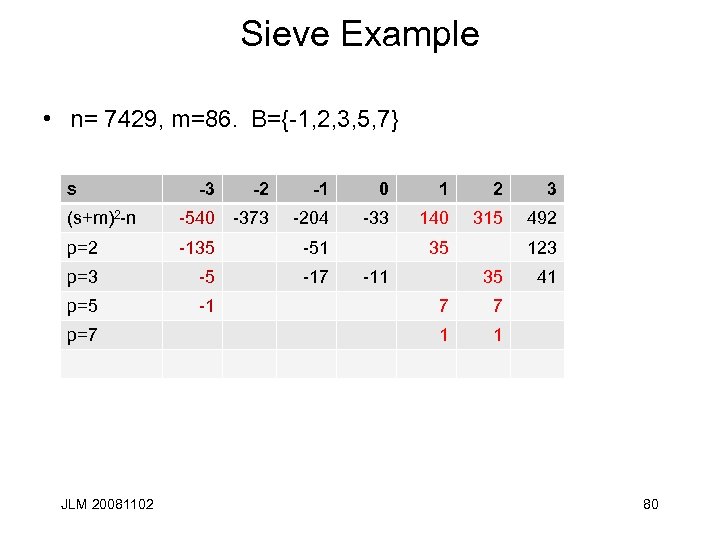
Sieve Example • n= 7429, m=86. B={-1, 2, 3, 5, 7} s -2 -1 0 1 2 3 (s+m)2 -n -540 -373 -204 -33 140 315 492 p=2 -135 -51 p=3 -5 -17 p=5 -1 p=7 JLM 20081102 -3 35 -11 123 35 7 7 1 41 1 80
![Quadratic Sieve Analysis • Define Ln[u, v]= exp(v(lg(n))u(lg(lg(n)(1 -u). • Let y(x, B) =|{y:](https://present5.com/presentation/f9b362bcc1a691c684f5dd8f612042ad/image-81.jpg "Quadratic Sieve Analysis • Define Ln[u, v]= exp(v(lg(n))u(lg(lg(n)(1 -u). • Let y(x, B) =|{y:")
Quadratic Sieve Analysis • Define Ln[u, v]= exp(v(lg(n))u(lg(lg(n)(1 -u). • Let y(x, B) =|{y: ycx and y is B-smooth}|. • Theorem [de. Bruijn, 1966]: Let e >0, then for xs 10, wcln(x)(1 -e), y(x, x(1/w)) = xw(-w+f(x, w)), where f(x, w)/w 0 as w ¥. • Corrollary: If a, u, v >0, then y(na, Ln[u, v])= na. Ln[1 -u, -(a/v)(1 u)+o(1)] as n ¥. • For QS generate numbers f(s)~ Ö n. Set a= ½ in Corollary. Probability of finding one that is Ln[u, v]-smooth one is Ln[1 -u, -1/(2 v)(1 -u)+o(1)] so we must try Ln[1 -u, 1/(2 v)(1 -u)+o(1)] to find one. • Size of factor base is ~ Ln[u, v]. • Choose u= 1/2. Ln[1/2, x] Ln[1/2, y]= Ln[1/2, x+y]. • Size of sieving interval is Ln[1/2, v] Ln[1/2, 1/(4 v)]= Ln[1/2, v+1/(4 v)] • Sieving time is Ln[1/2, v+1/(4 v)], solving sparse equations is Ln[1/2, 2 v+o(1)]. Total time is minimized when v=1/2 and is Ln[1/2, 1+o(1)]. JLM 20081102 81
Three more algorithms • Multiple Polynomial Quadratic Sieve: Use many polynomials (shorter sieve intervals) • Number Field Sieve: Extends QFS by allowing elements to be algebraic integers in algebraic number field. • Elliptic Curve Factoring Method: Does arithmetic over elliptic curve mod n. Q=k x P. Operations project mod p if p|n. If Q is the identity (0: 1: 0) mod p, third coordinate, z, is 0 mod p. Then (z, n)=p. Now check to see if the difference of two points (for different k) have last coordinates: (z 1 -z 2, n)=p. JLM 20081102 82
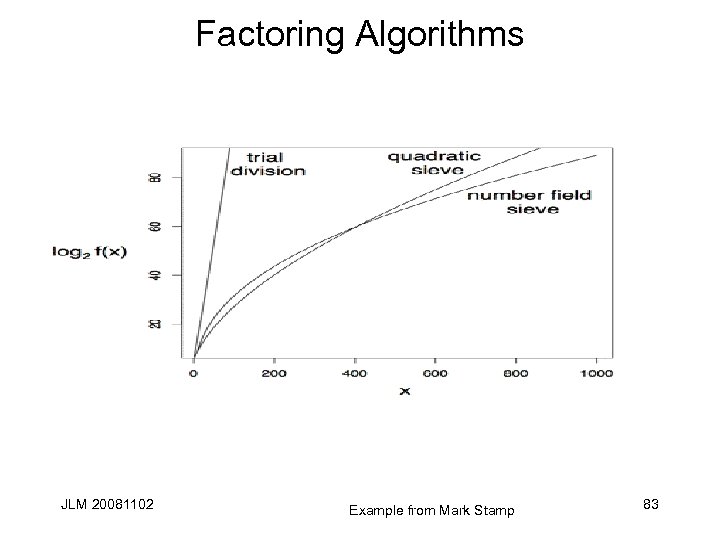
Factoring Algorithms JLM 20081102 Example from Mark Stamp 83
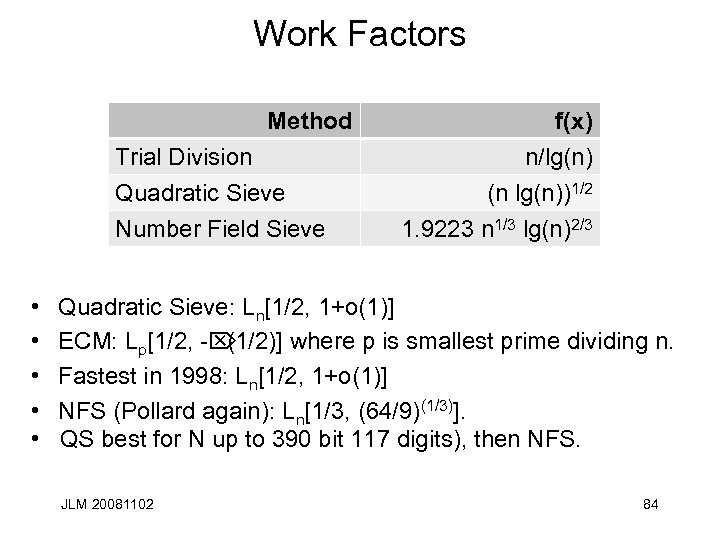
Work Factors Method Trial Division Quadratic Sieve Number Field Sieve f(x) n/lg(n) (n lg(n))1/2 1. 9223 n 1/3 lg(n)2/3 • Quadratic Sieve: Ln[1/2, 1+o(1)] • ECM: Lp[1/2, -Ö (1/2)] where p is smallest prime dividing n. • Fastest in 1998: Ln[1/2, 1+o(1)] • NFS (Pollard again): Ln[1/3, (64/9)(1/3)]. • QS best for N up to 390 bit 117 digits), then NFS. JLM 20081102 84
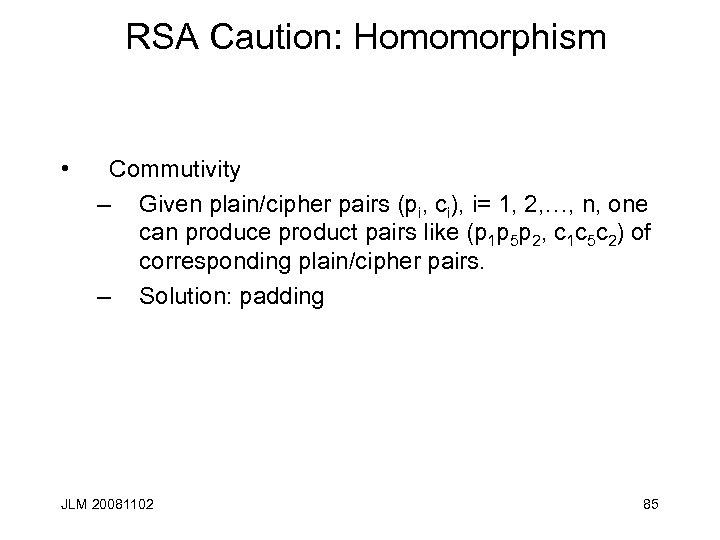
RSA Caution: Homomorphism • Commutivity – Given plain/cipher pairs (pi, ci), i= 1, 2, …, n, one can produce product pairs like (p 1 p 5 p 2, c 1 c 5 c 2) of corresponding plain/cipher pairs. – Solution: padding JLM 20081102 85
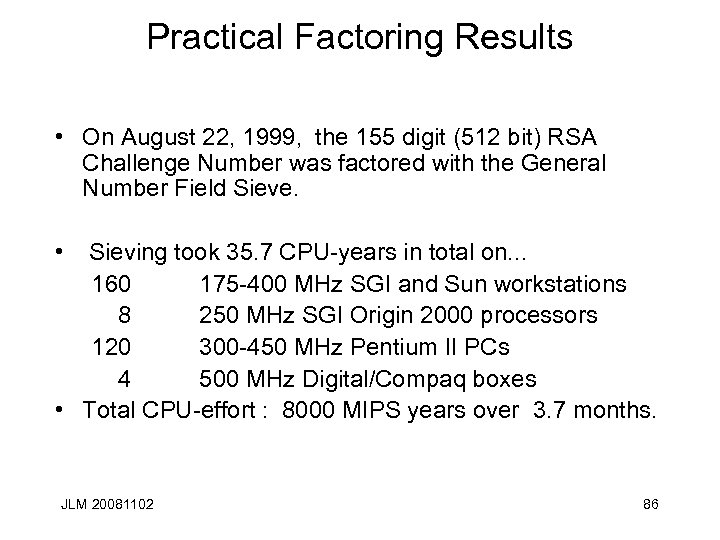
Practical Factoring Results • On August 22, 1999, the 155 digit (512 bit) RSA Challenge Number was factored with the General Number Field Sieve. • Sieving took 35. 7 CPU-years in total on. . . 160 175 -400 MHz SGI and Sun workstations 8 250 MHz SGI Origin 2000 processors 120 300 -450 MHz Pentium II PCs 4 500 MHz Digital/Compaq boxes • Total CPU-effort : 8000 MIPS years over 3. 7 months. JLM 20081102 86
RSA Summary • RSA is a great algorithm. • Just don’t do anything stupid. – Reasonable exponents – Good padding – Good prime generation JLM 20081102 87

End JLM 20081102 88
Скачать презентацию Cryptanalysis Lecture 6 Introduction to Public Key Systems
f9b362bcc1a691c684f5dd8f612042ad.ppt