


 Скачать презентацию Cryosat Data Processing in Near Real Time for
3cca707c14991b50ee6fcb11870b2aa7.ppt
- Количество слайдов: 1
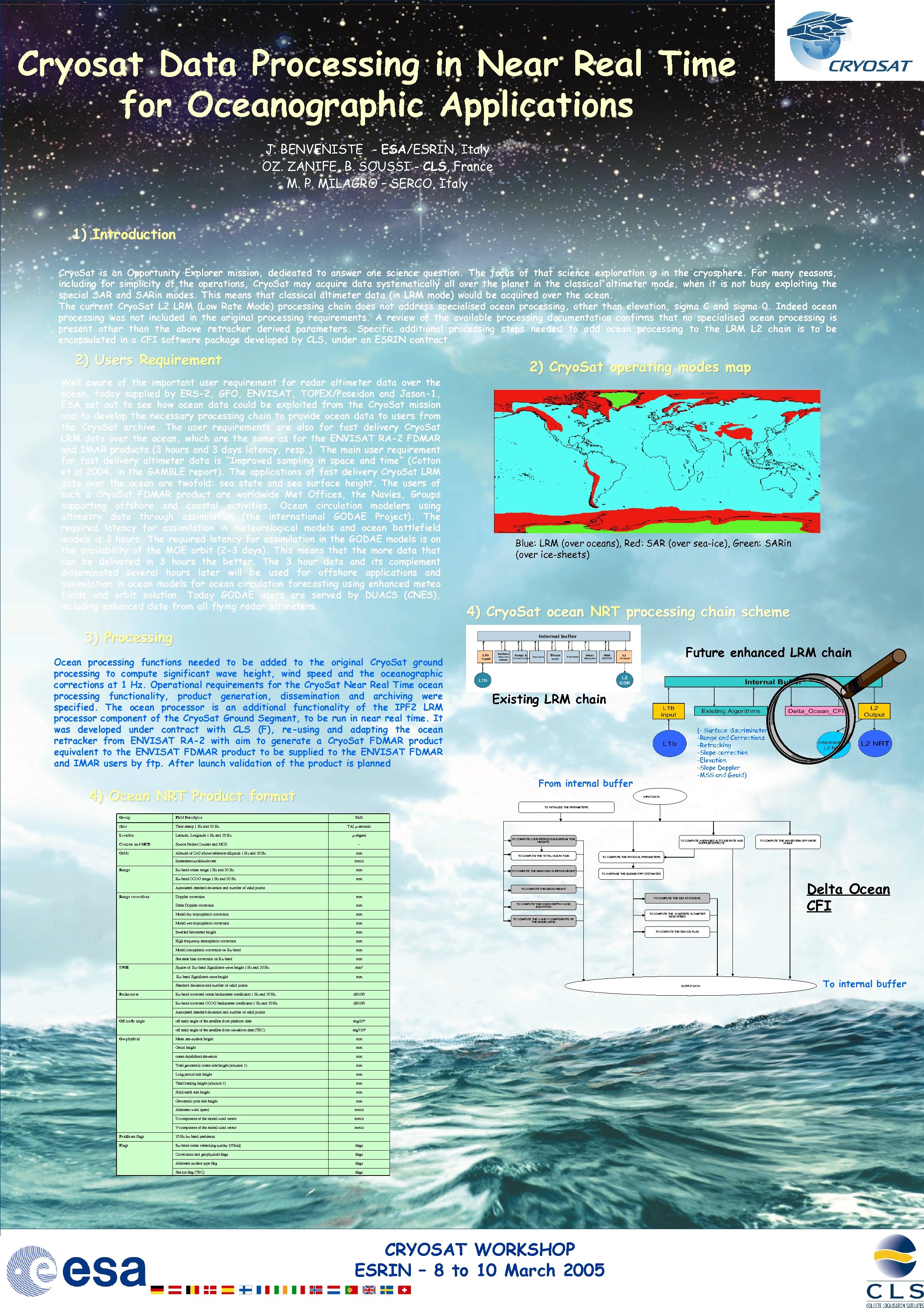 Cryosat Data Processing in Near Real Time for Oceanographic Applications J. BENVENISTE - ESA/ESRIN, Italy OZ. ZANIFE, B. SOUSSI - CLS, France M. P. MILAGRO – SERCO, Italy 1) Introduction Cryo. Sat is an Opportunity Explorer mission, dedicated to answer one science question. The focus of that science exploration is in the cryosphere. For many reasons, including for simplicity of the operations, Cryo. Sat may acquire data systematically all over the planet in the classical altimeter mode, when it is not busy exploiting the special SAR and SARin modes. This means that classical altimeter data (in LRM mode) would be acquired over the ocean. The current Cryo. Sat L 2 LRM (Low Rate Mode) processing chain does not address specialised ocean processing, other than elevation, sigma C and sigma 0. Indeed ocean processing was not included in the original processing requirements. A review of the available processing documentation confirms that no specialised ocean processing is present other than the above retracker derived parameters. Specific additional processing steps needed to add ocean processing to the LRM L 2 chain is to be encapsulated in a CFI software package developed by CLS, under an ESRIN contract. 2) Users Requirement Well aware of the important user requirement for radar altimeter data over the ocean, today supplied by ERS-2, GFO, ENVISAT, TOPEX/Poseidon and Jason-1, ESA set out to see how ocean data could be exploited from the Cryo. Sat mission and to develop the necessary processing chain to provide ocean data to users from the Cryo. Sat archive. The user requirements are also for fast delivery Cryo. Sat LRM data over the ocean, which are the same as for the ENVISAT RA-2 FDMAR and IMAR products (3 hours and 3 days latency, resp. ). The main user requirement for fast delivery altimeter data is “Improved sampling in space and time” (Cotton et al 2004, in the GAMBLE report). The applications of fast delivery Cryo. Sat LRM data over the ocean are twofold: sea state and sea surface height. The users of such a Cryo. Sat FDMAR product are worldwide Met Offices, the Navies, Groups supporting offshore and coastal activities, Ocean circulation modelers using altimetry data through assimilation (the international GODAE Project). The required latency for assimilation in meteorological models and ocean battlefield models is 3 hours. The required latency for assimilation in the GODAE models is on the availability of the MOE orbit (2 -3 days). This means that the more data that can be delivered in 3 hours the better. The 3 hour data and its complement disseminated several hours later will be used for offshore applications and assimilation in ocean models for ocean circulation forecasting using enhanced meteo fields and orbit solution. Today GODAE users are served by DUACS (CNES), including enhanced data from all flying radar altimeters. 2) Cryo. Sat operating modes map Blue: LRM (over oceans), Red: SAR (over sea-ice), Green: SARin (over ice-sheets) 4) Cryo. Sat ocean NRT processing chain scheme 3) Processing Ocean processing functions needed to be added to the original Cryo. Sat ground processing to compute significant wave height, wind speed and the oceanographic corrections at 1 Hz. Operational requirements for the Cryo. Sat Near Real Time ocean processing functionality, product generation, dissemination and archiving were specified. The ocean processor is an additional functionality of the IPF 2 LRM processor component of the Cryo. Sat Ground Segment, to be run in near real time. It was developed under contract with CLS (F), re-using and adapting the ocean retracker from ENVISAT RA-2 with aim to generate a Cryo. Sat FDMAR product equivalent to the ENVISAT FDMAR product to be supplied to the ENVISAT FDMAR and IMAR users by ftp. After launch validation of the product is planned Future enhanced LRM chain Existing LRM chain (- Surface discriminator -Range and Corrections -Retracking -Slope correction -Elevation -Slope Doppler -MSS and Geoid) From internal buffer 4) Ocean NRT Product format INPUT DATA TO INITIALISE THE PARAMETERS Group Field Descriptor time Time stamp 1 Hz and 20 Hz Location Latitude, Longitude 1 Hz and 20 Hz Counter and MCD Source Packet Counter and MCD Orbit Altitude of Co. G above reference ellipsoid 1 Hz and 20 Hz Instantaneous altitude rate Range Ku-band ocean range 1 Hz and 20 Hz Ku-band OCOG range 1 Hz and 20 Hz Associated standard deviation and number of valid points Range corrections Unit TAI µ-seconds µ-degree mm TO COMPUTE THE TOTAL OCEAN TIDE TO COMPUTE AVERAGED ALTITUDE RATE AND DOPPLER EFFECTS mm TO COMPUTE THE PHYSICAL PARAMETERS TO COMPUTE THE MEAN SEA SURFACE HEIGHT TO AVERAGE THE ELEMENTARY ESTIMATES mm Doppler correction mm mm Model wet tropospheric correction mm Inverted barometer height mm High frequency atmospheric correction mm Sea state bias correction on Ku-band mm Square of Ku-band Significant wave height 1 Hz and 20 Hz mm 2 Ku-band Significant wave height mm Standard deviation and number of valid points TO COMPUTE THE SEA STATE BIAS TO COMPUTE THE OCEAN DEPTH / LAND ELEVATION TO COMPUTE THE U AND V COMPONENTS OF THE MODEL WIND Backscatter Ku-band corrected ocean backscatter coefficient 1 Hz and 20 Hz d. B/100 Ku-band corrected OCOG backscatter coefficient 1 Hz and 20 Hz d. B/100 Associated standard deviation and number of valid points off nadir angle of the satellite from platform data deg/104 off nadir angle of the satellite from waveform data (TBC) Geophysical Delta Ocean CFI mm Model ionospheric correction on Ku-band TO COMPUTE THE GEOID HEIGHT mm Model dry tropospheric correction Off nadir angle TO COMPUTE THE WAVEFORM OFF NADIR ANGLE mm/s Delta Doppler correction SWH TO COMPUTE LONG PERIOD EQUILIBRIUM TIDE HEIGHTS deg 2/104 Mean sea-surface height mm Geoid height mm ocean depth/land elevation mm Total geocentric ocean tide height (solution 2) mm Long period tide height mm Tidal loading height (solution 2) mm Solid earth tide height mm Geocentric pole tide height mm Altimeter wind speed mm/s U-component of the model wind vector mm/s V-component of the model wind vector mm/s Peakiness flags 20 Hz ku-band peakiness Flags Ku-band ocean retracking quality [20 bits] flags Corrections and geophysical flags Altimeter surface type flags Sea ice flag (TBC) flags CRYOSAT WORKSHOP ESRIN – 8 to 10 March 2005 TO COMPUTE THE 10 METERS ALTIMETER WIND SPEED TO COMPUTE THE SEA ICE FLAG OUTPUT DATA To internal buffer