



 Cryonics – is it the real way to see the future of human?
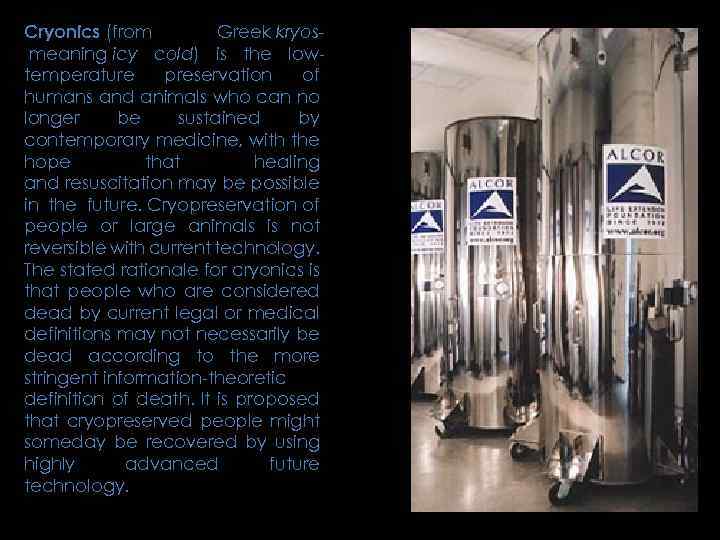 Cryonics (from Greek kryos meaning icy cold) is the lowtemperature preservation of humans and animals who can no longer be sustained by contemporary medicine, with the hope that healing and resuscitation may be possible in the future. Cryopreservation of people or large animals is not reversible with current technology. The stated rationale for cryonics is that people who are considered dead by current legal or medical definitions may not necessarily be dead according to the more stringent information-theoretic definition of death. It is proposed that cryopreserved people might someday be recovered by using highly advanced future technology.
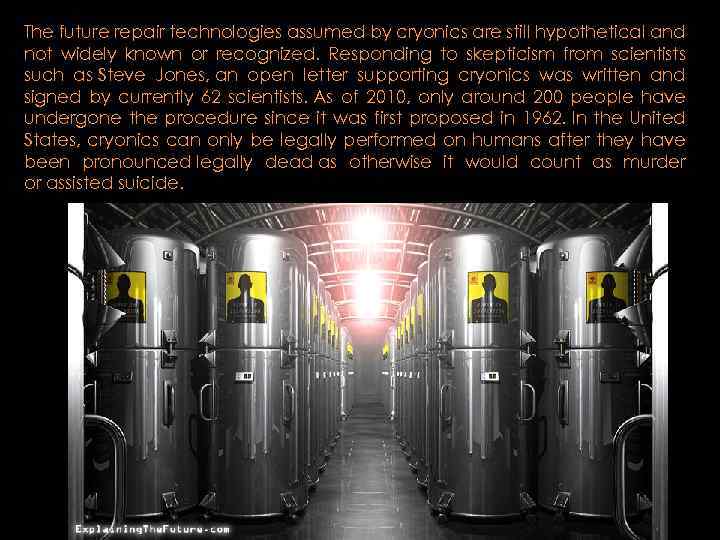 The future repair technologies assumed by cryonics are still hypothetical and not widely known or recognized. Responding to skepticism from scientists such as Steve Jones, an open letter supporting cryonics was written and signed by currently 62 scientists. As of 2010, only around 200 people have undergone the procedure since it was first proposed in 1962. In the United States, cryonics can only be legally performed on humans after they have been pronounced legally dead as otherwise it would count as murder or assisted suicide.
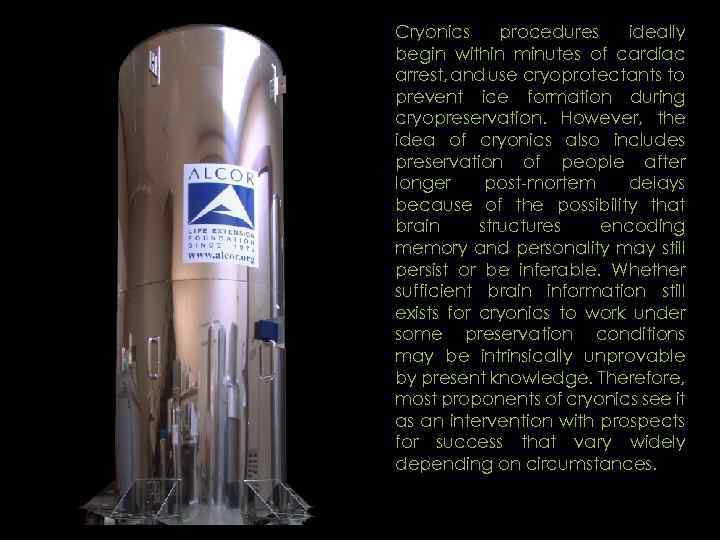 Cryonics procedures ideally begin within minutes of cardiac arrest, and use cryoprotectants to prevent ice formation during cryopreservation. However, the idea of cryonics also includes preservation of people after longer post-mortem delays because of the possibility that brain structures encoding memory and personality may still persist or be inferable. Whether sufficient brain information still exists for cryonics to work under some preservation conditions may be intrinsically unprovable by present knowledge. Therefore, most proponents of cryonics see it as an intervention with prospects for success that vary widely depending on circumstances.
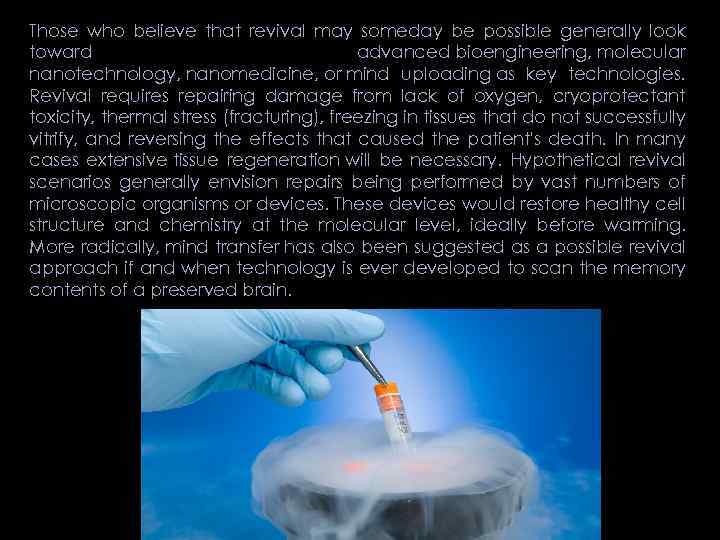 Those who believe that revival may someday be possible generally look toward advanced bioengineering, molecular nanotechnology, nanomedicine, or mind uploading as key technologies. Revival requires repairing damage from lack of oxygen, cryoprotectant toxicity, thermal stress (fracturing), freezing in tissues that do not successfully vitrify, and reversing the effects that caused the patient's death. In many cases extensive tissue regeneration will be necessary. Hypothetical revival scenarios generally envision repairs being performed by vast numbers of microscopic organisms or devices. These devices would restore healthy cell structure and chemistry at the molecular level, ideally before warming. More radically, mind transfer has also been suggested as a possible revival approach if and when technology is ever developed to scan the memory contents of a preserved brain.
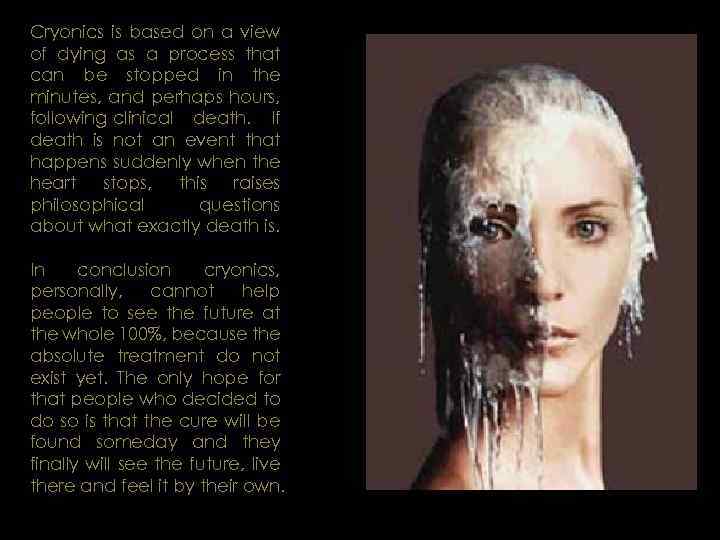 Cryonics is based on a view of dying as a process that can be stopped in the minutes, and perhaps hours, following clinical death. If death is not an event that happens suddenly when the heart stops, this raises philosophical questions about what exactly death is. In conclusion cryonics, personally, cannot help people to see the future at the whole 100%, because the absolute treatment do not exist yet. The only hope for that people who decided to do so is that the cure will be found someday and they finally will see the future, live there and feel it by their own.