 Скачать презентацию CRYOCAR Presented By Kutumov Evgeny 261402 Introduction
Cryocar;Kutumov Evgeny.pptx
- Количество слайдов: 16



CRYOCAR Presented By: Kutumov Evgeny 261402
Introduction: • The importance of automotives is increasing day by day especially in the field of cars. There are various factors that influence the choice of the car which include performance, fuel, pollution etc. • As the prices for fuels are increasing and the availability is decreasing we have to go for alternative choice. ØAt this point of view we have “CRYOCARS” as an alternative choice.
• These cryocars uses cryogens as fuel. • Cryogen is nothing but a liquid, such as liquid nitrogen, that boils at a temperature below about 110 K (-160°C) and is used to obtain very low temperatures. • Uses liquid nitrogen as working fluid and hence it is also called as liquid nitrogen powered vehicle.
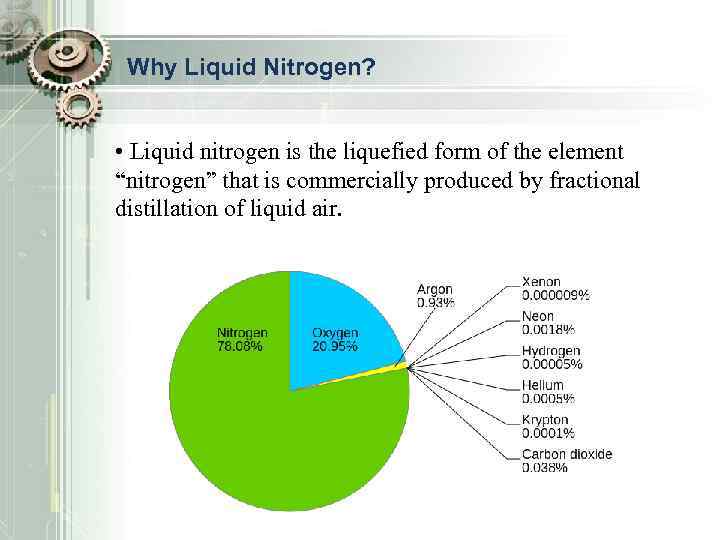
Why Liquid Nitrogen? • Liquid nitrogen is the liquefied form of the element “nitrogen” that is commercially produced by fractional distillation of liquid air.
• Liquid Nitrogen is the cheapest, widely produced and most common cryogen. • It is mass produced in air liquefaction plants. • At normal pressure, liquid nitrogen boils at 77 K (− 195. 8°C or − 320. 4°F). • Easy to Liquefy.
• Liquefaction of gases is physical conversion of a gas into a liquid state. • The conversion of Nitrogen gas to Liquid Nitrogen is done by the process of Fractional Distillation. • This process consists of two steps, the first relies on cooling the air to a very low temperature (i. e. converting it into a liquid), the second involves heating it up thus allowing each gas within the mixture to evaporate at its own boiling point.
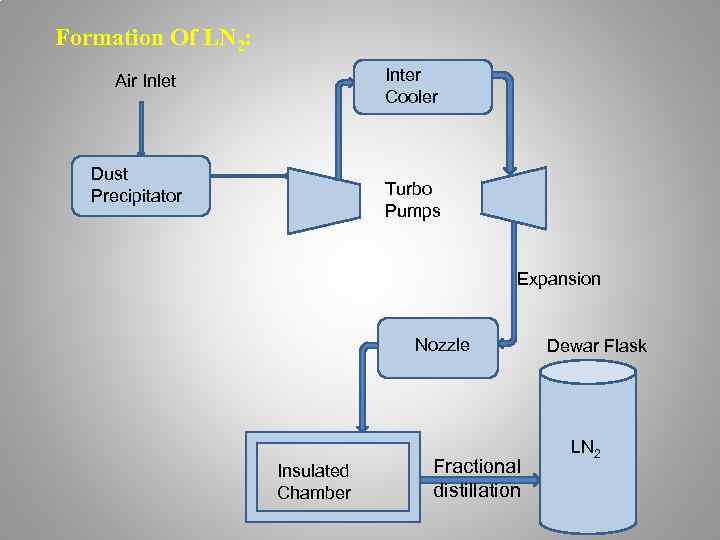
Formation Of LN 2: Inter Cooler Air Inlet Dust Precipitator Turbo Pumps Expansion Nozzle Insulated Chamber Fractional distillation Dewar Flask LN 2
• Atmospheric air is passed through dust precipitator and pre-cooled. • It is then compressed inside large turbo pumps to about 100 atmospheres. • Once the air has been cooled to room temperature it is allowed to expand rapidly through a nozzle into an insulated chamber.
• By running several cycles the temperature of the chamber becomes low enough. The air entering it starts to liquefy. • Liquid nitrogen is removed from the chamber by fractional distillation and is stored inside well-insulated Dewar flasks.
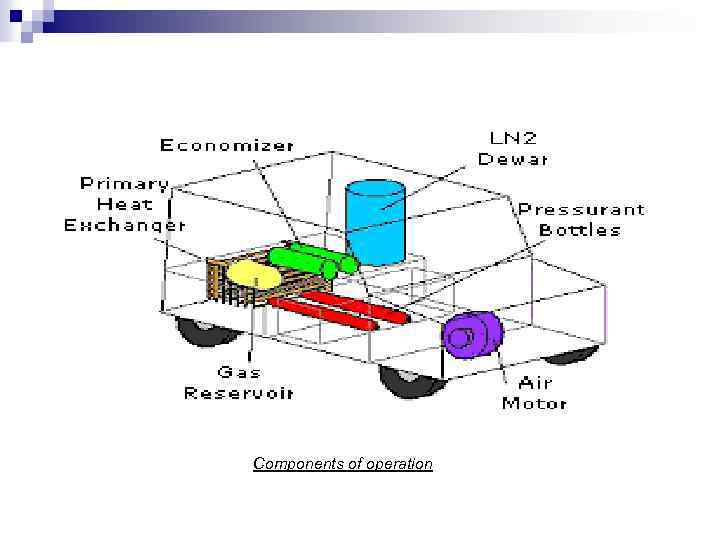
Components of operation
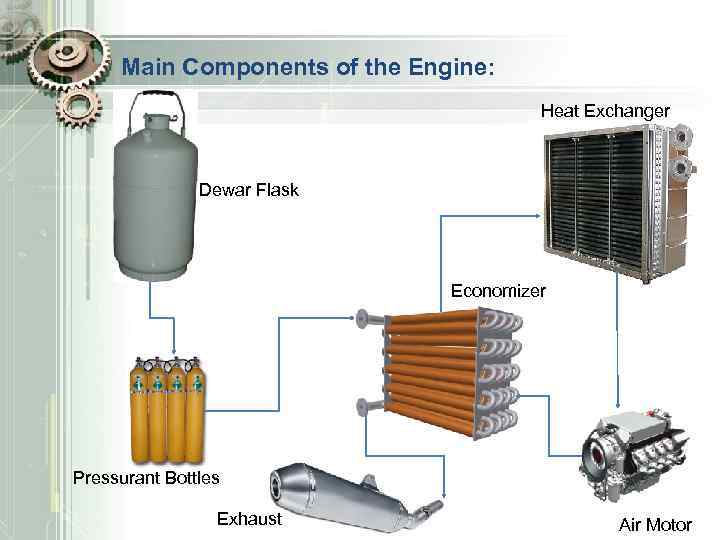
Main Components of the Engine: Heat Exchanger Dewar Flask Economizer Pressurant Bottles Exhaust Air Motor
Working Principle: • LN 2 is pressurized and then vaporized in a heat exchanger by ambient temperature of the surrounding air. • This heat exchanger just like the radiator of a car. • Liquid N 2 passing through the primary heat exchanger quickly reaches its boiling point as it gets vaporized at room temperature.
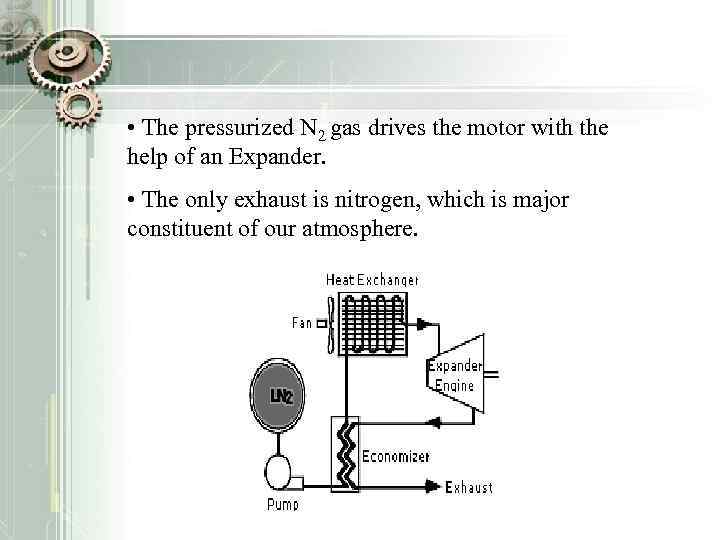
• The pressurized N 2 gas drives the motor with the help of an Expander. • The only exhaust is nitrogen, which is major constituent of our atmosphere.
Advantages: • Car is much lighter in weight • Refilling its tank takes only 15 minutes. • Eco-friendly • Minimal Maintenance Costs
Disadvantages: • Requires a lot of energy • Gas is so cold that the moisture in the surrounding air would condense on the outside of the tubes. • Safety issue • Leakage of N 2 leads to asphyxiation
Conclusion: • In a real sense, the more such vehicles are used, the cleaner the air will become. • In addition to the environmental impact of these vehicles, refueling using current technology can take only a few minutes, which is very similar to current gas refueling times.
Скачать презентацию CRYOCAR Presented By Kutumov Evgeny 261402 Introduction
Cryocar;Kutumov Evgeny.pptx