


 Скачать презентацию CRUS Changing Research Careers University of Zurich 2
c51a4f745e335e641d7e95c249e41339.ppt
- Количество слайдов: 24
 CRUS Changing Research Careers University of Zurich 2 -3 November 2011 Researchers Careers A key Investment for Societies Marja Makarow European Science Foundation www. esf. org 1
 Table of Content • • Place of universities in knowledge society Categories of research - Nobel and Pasteur quadrants How to reach Nobel quadrant Four-stage career structure 1. Ph. D candidate 2. Post-doctoral researcher 3. Independent young researcher 4. Professor Tenure track pilots LERU and ESF recommendations on research careers Pasteur quadrant – excellence and relevance combined Message to decision-makers www. esf. org 2
 Place of research universities in the knowledge society In Europe and beyond, governments have realised • Education, research, innovation are cornerstones of knowledge-based societies/economies • Knowledge is the building block of economic , cultural and societal well-being of humanity, invaluable commodity and raw material for business and economic growth in absence of endless natural resources • Disruptive innovations mostly sparkle from fundamental research > innovation chain starts at universities • This is why university systems under renovation • 3 rd task, benefitting society, added to universities’ legal obligations, ill-defined or clearly economic impact www. esf. org 3
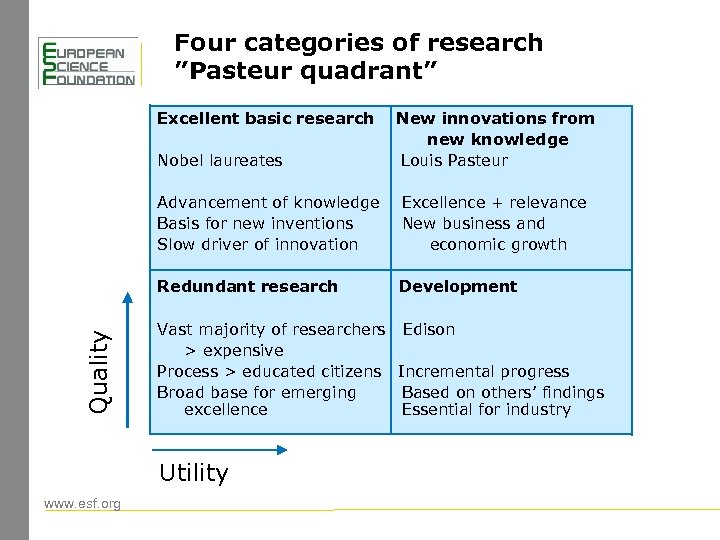 Four categories of research ”Pasteur quadrant” Excellent basic research Nobel laureates New innovations from new knowledge Louis Pasteur Excellence + relevance New business and economic growth Redundant research Quality Advancement of knowledge Basis for new inventions Slow driver of innovation Development Vast majority of researchers Edison > expensive Process > educated citizens Incremental progress Broad base for emerging Based on others’ findings excellence Essential for industry Utility www. esf. org
 Renovation of universities aim at increasing population in Pasteur quadrant • In > half of EU MSs university Acts renovated: To increase autonomy: governance, rector’s powers, finance, structure, buildings, civ serv Coupled with accountability Push to develop long-term strategies Define profile according to strengths, potential Opportunities to update research career structure • New incentives for development of long-term strategy Excellence Initiative DE, doctoral schools attached Governmental loan FR, uni career str under eval Governmental investment into foundations (FI) revision of uni career str recommende • Interaction with other organisations in research system: Research institutes and private sector Works best if career opportunities for mobility in both directions www. esf. org 5
 How to reach the Nobel quadrant first, to increase quality of research • All depends on individuals, excellent individual researchers • To prosper, individual talent needs Supportive environment Thriving university with creative research environments Vision for the future, an attractive transparent career structure www. esf. org 6
 How to reach Nobel quadrant 1. Requirements for universities An excellent res uni has • Clearly defined mission based on international research agenda or national/regional agenda • Capacity to reconfigure in response to novel research challenges • Structures to support research focus and cross-disciplinary research • Autonomy and resources to focus on strengths and promote young researchers’ emerging excellence and attraction to science with attractive career stages • State-of-the-art research infrastructure • International researcher community that imports and exports new knowledge, new ideas, new technologies • Mechanisms to use research strengths to inspire teaching, which again funnels new talent to research www. esf. org 7
 Nobel quadrant remains empty without focus on young researchers careers • Next generation is most important long-term investment • Market for researchers global, competition for the best is global • Four-stage research career structure proposed, in order to meet the new generations needs, by: 1. LERU League of European Research Universities (20 top universities, including University of Zurich and University of Geneva) 2. ESF Member Organisation Forum on Researcher Careers 29 research funding and performing organisation covering 21 countries including SNFS and Swisscore. Report 2009 “Research Careers in Europe - Landscape and Horizons” 3. National bodies www. esf. org 8
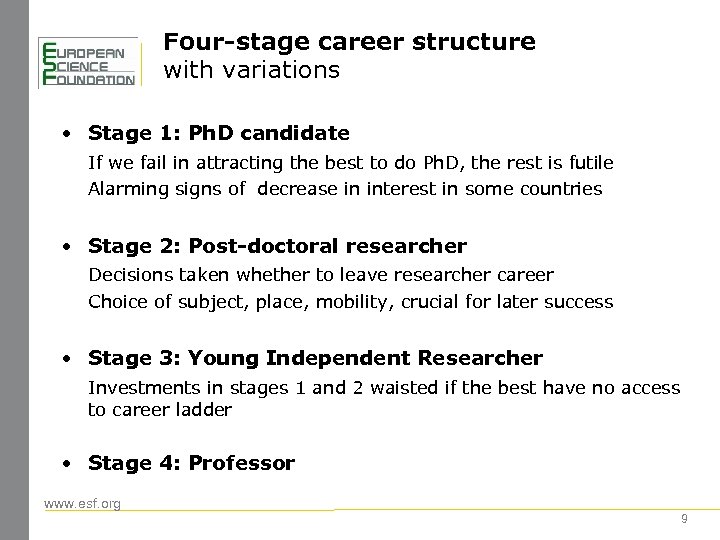 Four-stage career structure with variations • Stage 1: Ph. D candidate If we fail in attracting the best to do Ph. D, the rest is futile Alarming signs of decrease in interest in some countries • Stage 2: Post-doctoral researcher Decisions taken whether to leave researcher career Choice of subject, place, mobility, crucial for later success • Stage 3: Young Independent Researcher Investments in stages 1 and 2 waisted if the best have no access to career ladder • Stage 4: Professor www. esf. org 9
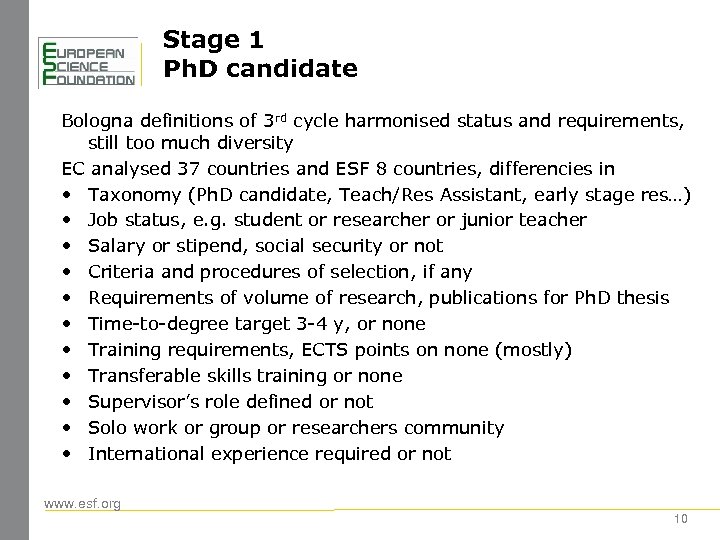 Stage 1 Ph. D candidate Bologna definitions of 3 rd cycle harmonised status and requirements, still too much diversity EC analysed 37 countries and ESF 8 countries, differencies in • Taxonomy (Ph. D candidate, Teach/Res Assistant, early stage res…) • Job status, e. g. student or researcher or junior teacher • Salary or stipend, social security or not • Criteria and procedures of selection, if any • Requirements of volume of research, publications for Ph. D thesis • Time-to-degree target 3 -4 y, or none • Training requirements, ECTS points on none (mostly) • Transferable skills training or none • Supervisor’s role defined or not • Solo work or group or researchers community • International experience required or not www. esf. org 10
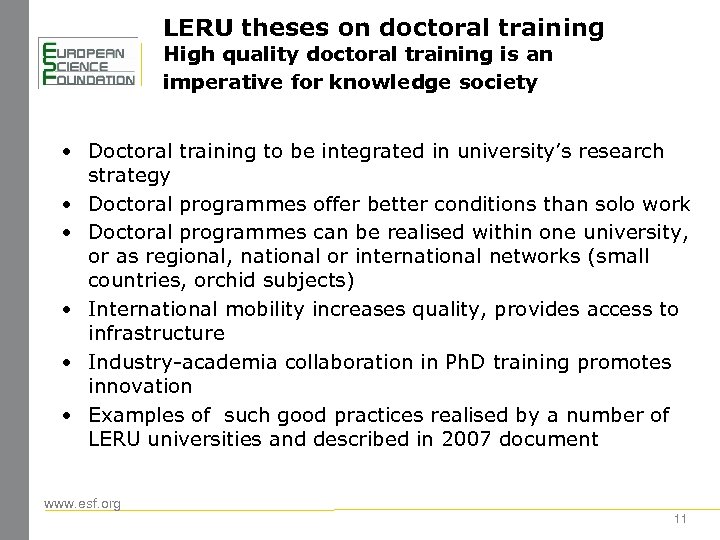 LERU theses on doctoral training High quality doctoral training is an imperative for knowledge society • Doctoral training to be integrated in university’s research strategy • Doctoral programmes offer better conditions than solo work • Doctoral programmes can be realised within one university, or as regional, national or international networks (small countries, orchid subjects) • International mobility increases quality, provides access to infrastructure • Industry-academia collaboration in Ph. D training promotes innovation • Examples of such good practices realised by a number of LERU universities and described in 2007 document www. esf. org 11
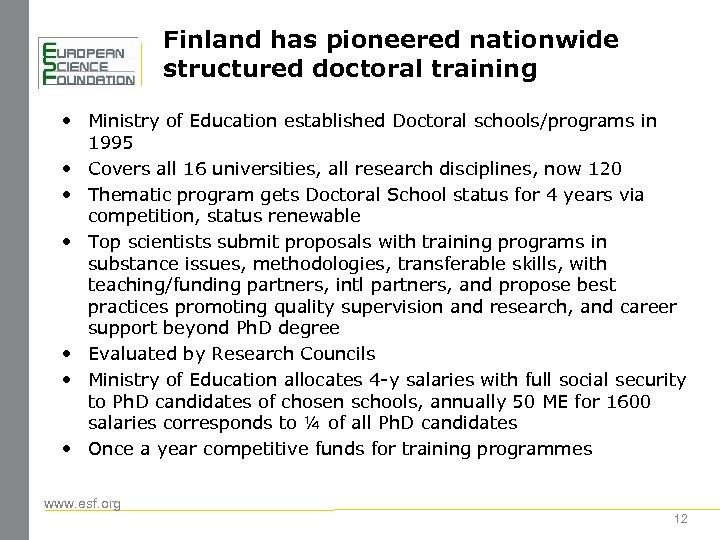 Finland has pioneered nationwide structured doctoral training • Ministry of Education established Doctoral schools/programs in 1995 • Covers all 16 universities, all research disciplines, now 120 • Thematic program gets Doctoral School status for 4 years via competition, status renewable • Top scientists submit proposals with training programs in substance issues, methodologies, transferable skills, with teaching/funding partners, intl partners, and propose best practices promoting quality supervision and research, and career support beyond Ph. D degree • Evaluated by Research Councils • Ministry of Education allocates 4 -y salaries with full social security to Ph. D candidates of chosen schools, annually 50 ME for 1600 salaries corresponds to ¼ of all Ph. D candidates • Once a year competitive funds for training programmes www. esf. org 12
 Successes and challenges of the Finnish Doctoral programme Successes • Proven to be best environment to train professional researchers • Has changes research culture in Humanities from solo research to a research-community environment • Has raised the quality of supervision • Has decreased the time-to-degree and age at dissertation • Best researchers are leading the programs Challenges • Not integrated in most universities’ strategies as funds come outside from the university’s budget • Two classes of Ph. D candidates: A class is in schools and even earns a decent salary B class outside of programmes, no access to quality courses, transferabe skills training, at mercy of supervisor www. esf. org 13
 Stage 2 Post-doctoral researcher • working pretty well, I will not dwell on this stage except for a few comments • Success in post-doc determines your career, choose well • Especially in small countries, post-doc abroad is essential • Changing subject very good and should be encouraged • Ph. DS to be mentored and advised • Natl and intl funding schemes available • Problem when getting to next stage does not succeed • Multiple post-doc periods, over 5 years, and you are lost www. esf. org 14
 Stage 3. Young (career age) independent researcher • Most European universities lack posts for young PIs: researchers careers unclear, not attached to success, not attractive to new generation • Case FI: Academy researcher for 5 years, no positions thereafter unless successful in professorship competition International researchers do not trust the system • ERC portable Starting Grants are shaking the system Universities starting to think of career track after ERC • Young ERC grantees should be taken well care of, mentored, Nobel prizes accumulate - culture of excellence and mentoring www. esf. org 15
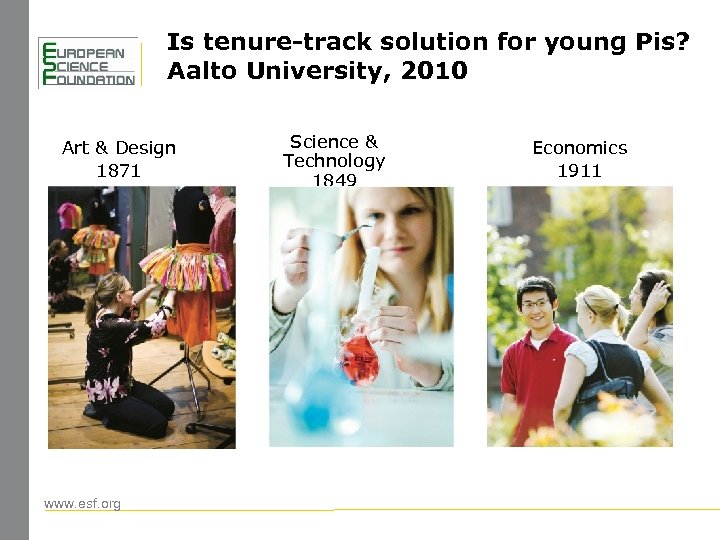 Is tenure-track solution for young Pis? Aalto University, 2010 Art & Design 1871 www. esf. org Science & Technology 1849 Economics 1911 •
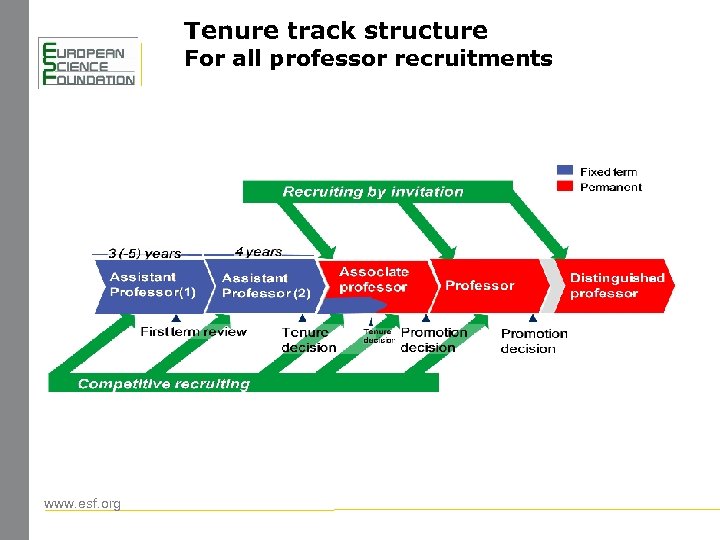 Tenure track structure For all professor recruitments www. esf. org
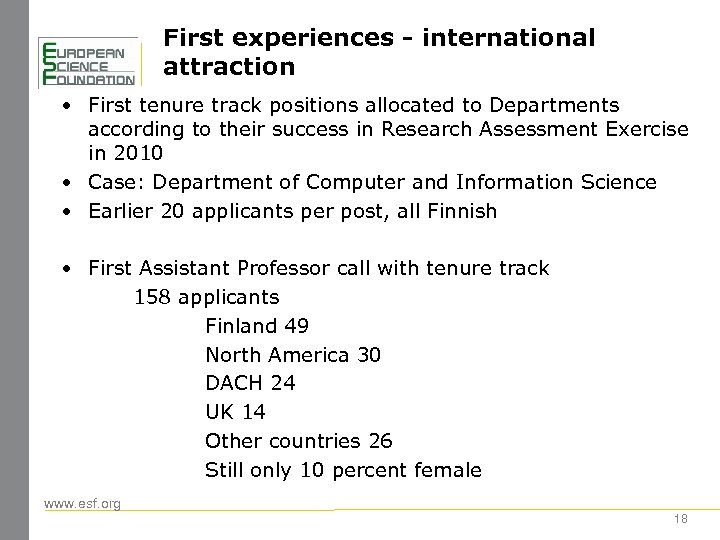 First experiences - international attraction • First tenure track positions allocated to Departments according to their success in Research Assessment Exercise in 2010 • Case: Department of Computer and Information Science • Earlier 20 applicants per post, all Finnish • First Assistant Professor call with tenure track 158 applicants Finland 49 North America 30 DACH 24 UK 14 Other countries 26 Still only 10 percent female www. esf. org 18
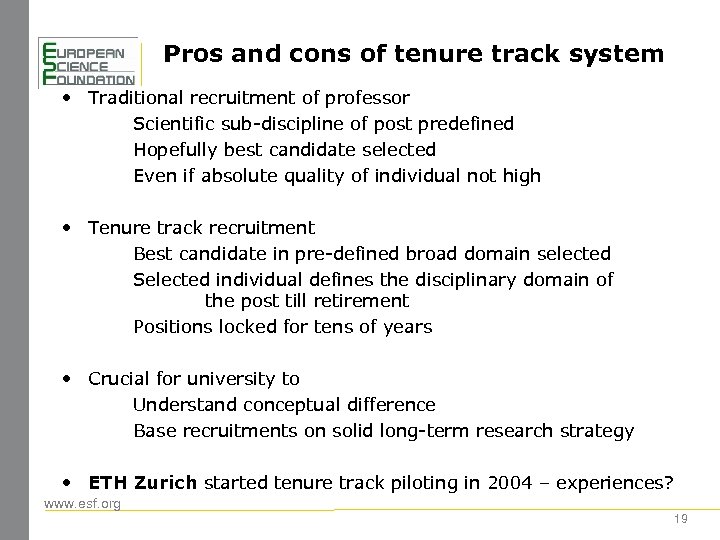 Pros and cons of tenure track system • Traditional recruitment of professor Scientific sub-discipline of post predefined Hopefully best candidate selected Even if absolute quality of individual not high • Tenure track recruitment Best candidate in pre-defined broad domain selected Selected individual defines the disciplinary domain of the post till retirement Positions locked for tens of years • Crucial for university to Understand conceptual difference Base recruitments on solid long-term research strategy • ETH Zurich started tenure track piloting in 2004 – experiences? www. esf. org 19
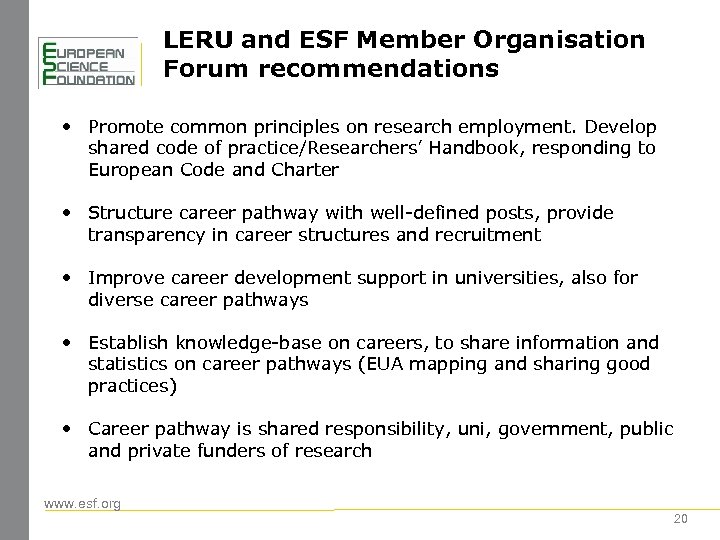 LERU and ESF Member Organisation Forum recommendations • Promote common principles on research employment. Develop shared code of practice/Researchers’ Handbook, responding to European Code and Charter • Structure career pathway with well-defined posts, provide transparency in career structures and recruitment • Improve career development support in universities, also for diverse career pathways • Establish knowledge-base on careers, to share information and statistics on career pathways (EUA mapping and sharing good practices) • Career pathway is shared responsibility, uni, government, public and private funders of research www. esf. org 20
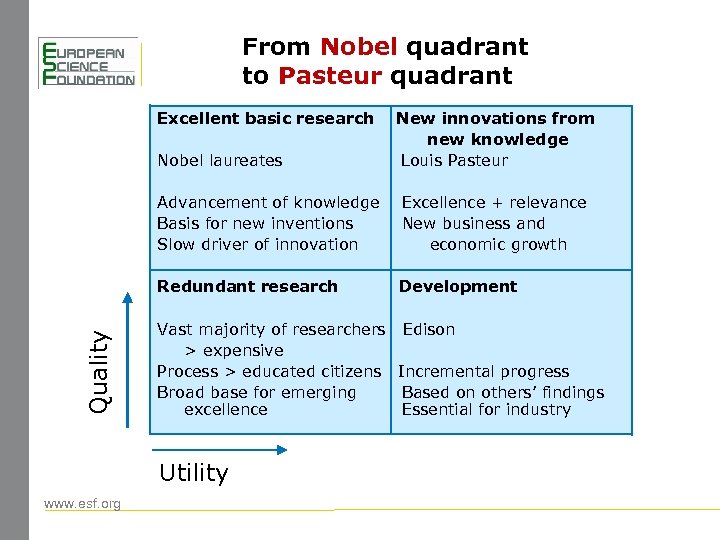 From Nobel quadrant to Pasteur quadrant Excellent basic research Nobel laureates New innovations from new knowledge Louis Pasteur Excellence + relevance New business and economic growth Redundant research Quality Advancement of knowledge Basis for new inventions Slow driver of innovation Development Vast majority of researchers Edison > expensive Process > educated citizens Incremental progress Broad base for emerging Based on others’ findings excellence Essential for industry Utility www. esf. org
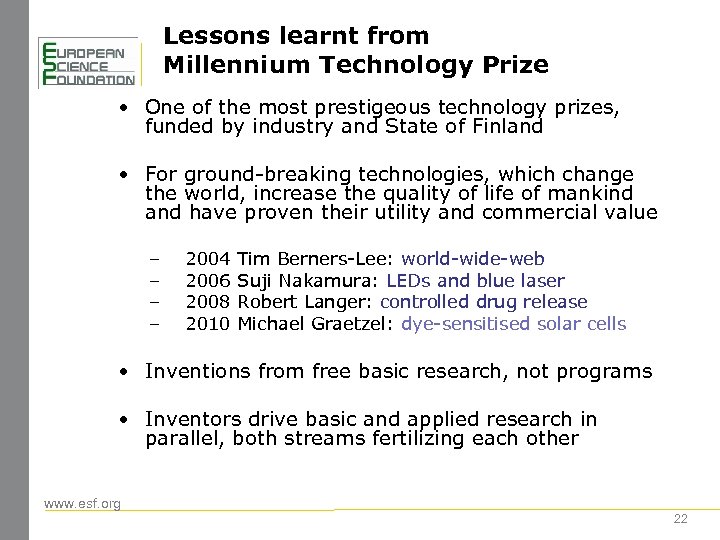 Lessons learnt from Millennium Technology Prize • One of the most prestigeous technology prizes, funded by industry and State of Finland • For ground-breaking technologies, which change the world, increase the quality of life of mankind and have proven their utility and commercial value – – 2004 2006 2008 2010 Tim Berners-Lee: world-wide-web Suji Nakamura: LEDs and blue laser Robert Langer: controlled drug release Michael Graetzel: dye-sensitised solar cells • Inventions from free basic research, not programs • Inventors drive basic and applied research in parallel, both streams fertilizing each other www. esf. org 22
 Support to move to Pasteur Quadrant Open innovation • Joint research agendas for academic and industry researchers, combining curiosity-driven and problemoriented research • Strategic alliences, or flexible institutes between university and industry • Posts for intersectorial mobility needed in academia plus industry, academic and corporate researchers’ merits to be mutually acknowledged • Doctoral training to support career opportunities in industry • Ind-aca culture best learnt in joint doctoral programs www. esf. org 23
 Message to decision-makers: Do not add knowledge crisis to financial crisis • Disruptive innovations that change the world mostly sparkle from blue sky research • Disruptive innovations that have created new business sectors are traceble to discoveries in fundamental science, unpredictable by definition • No free research>no advances in knowledge>no disruptive technologies>no economic growth • Thus, implement science policy that combines researchers’ creativity with broad definition of priorities, foster ind-aca collaboration • Safe-guard resources for free research and provide researchers careers that are attractive to the best www. esf. org 24