 Скачать презентацию Crowd-Out Under SCHIP Looking Back and Moving Forward
d5dbe1a5012b819efd2cc7f3fdc7b27b.ppt
- Количество слайдов: 9



Crowd-Out Under SCHIP: Looking Back and Moving Forward Lisa Dubay, Ph. D. , Sc. M. Associate Professor Johns Hopkins Bloomberg School of Public Health © 2006, Johns Hopkins University. All rights reserved.
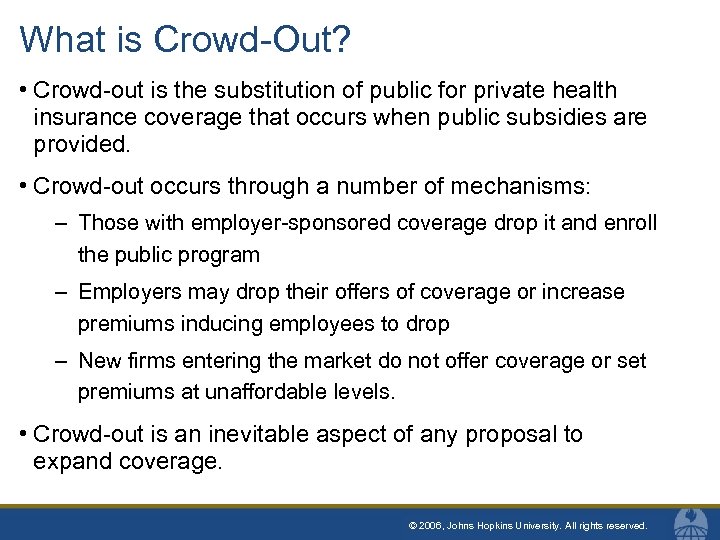
What is Crowd-Out? • Crowd-out is the substitution of public for private health insurance coverage that occurs when public subsidies are provided. • Crowd-out occurs through a number of mechanisms: – Those with employer-sponsored coverage drop it and enroll the public program – Employers may drop their offers of coverage or increase premiums inducing employees to drop – New firms entering the market do not offer coverage or set premiums at unaffordable levels. • Crowd-out is an inevitable aspect of any proposal to expand coverage. © 2006, Johns Hopkins University. All rights reserved.
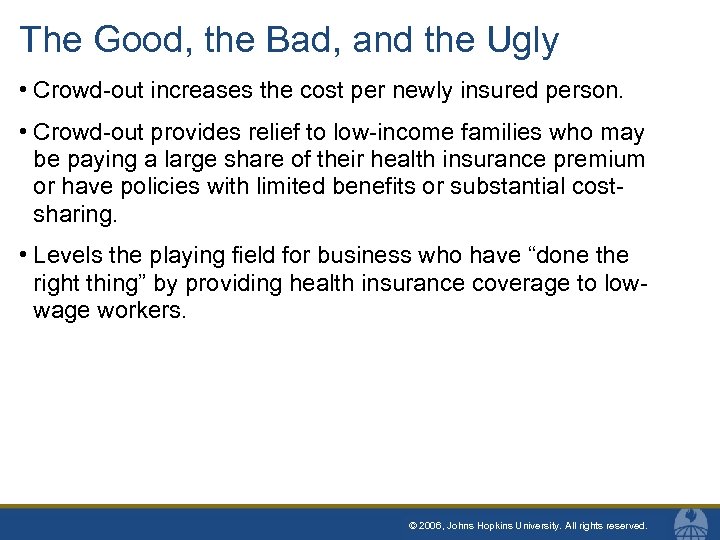
The Good, the Bad, and the Ugly • Crowd-out increases the cost per newly insured person. • Crowd-out provides relief to low-income families who may be paying a large share of their health insurance premium or have policies with limited benefits or substantial costsharing. • Levels the playing field for business who have “done the right thing” by providing health insurance coverage to lowwage workers. © 2006, Johns Hopkins University. All rights reserved.
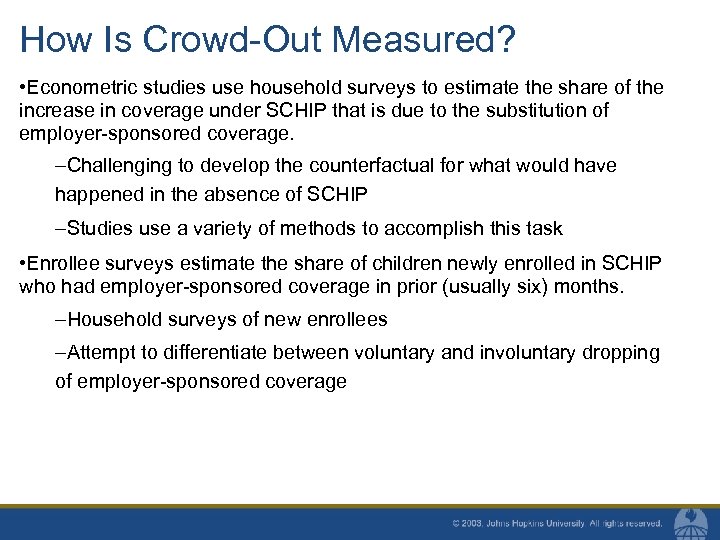
How Is Crowd-Out Measured? • Econometric studies use household surveys to estimate the share of the increase in coverage under SCHIP that is due to the substitution of employer-sponsored coverage. –Challenging to develop the counterfactual for what would have happened in the absence of SCHIP –Studies use a variety of methods to accomplish this task • Enrollee surveys estimate the share of children newly enrolled in SCHIP who had employer-sponsored coverage in prior (usually six) months. –Household surveys of new enrollees –Attempt to differentiate between voluntary and involuntary dropping of employer-sponsored coverage
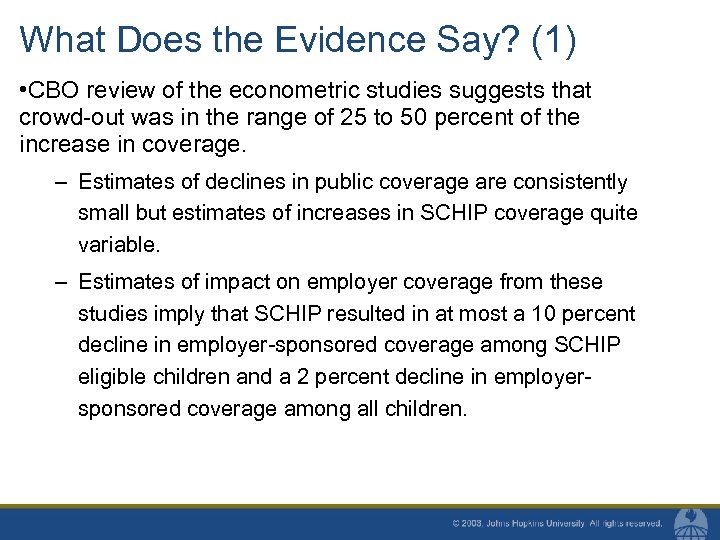
What Does the Evidence Say? (1) • CBO review of the econometric studies suggests that crowd-out was in the range of 25 to 50 percent of the increase in coverage. – Estimates of declines in public coverage are consistently small but estimates of increases in SCHIP coverage quite variable. – Estimates of impact on employer coverage from these studies imply that SCHIP resulted in at most a 10 percent decline in employer-sponsored coverage among SCHIP eligible children and a 2 percent decline in employersponsored coverage among all children.
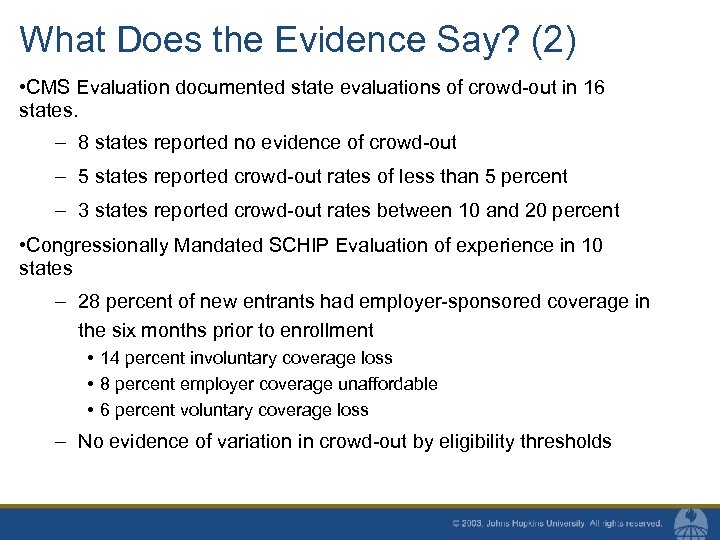
What Does the Evidence Say? (2) • CMS Evaluation documented state evaluations of crowd-out in 16 states. – 8 states reported no evidence of crowd-out – 5 states reported crowd-out rates of less than 5 percent – 3 states reported crowd-out rates between 10 and 20 percent • Congressionally Mandated SCHIP Evaluation of experience in 10 states – 28 percent of new entrants had employer-sponsored coverage in the six months prior to enrollment • 14 percent involuntary coverage loss • 8 percent employer coverage unaffordable • 6 percent voluntary coverage loss – No evidence of variation in crowd-out by eligibility thresholds
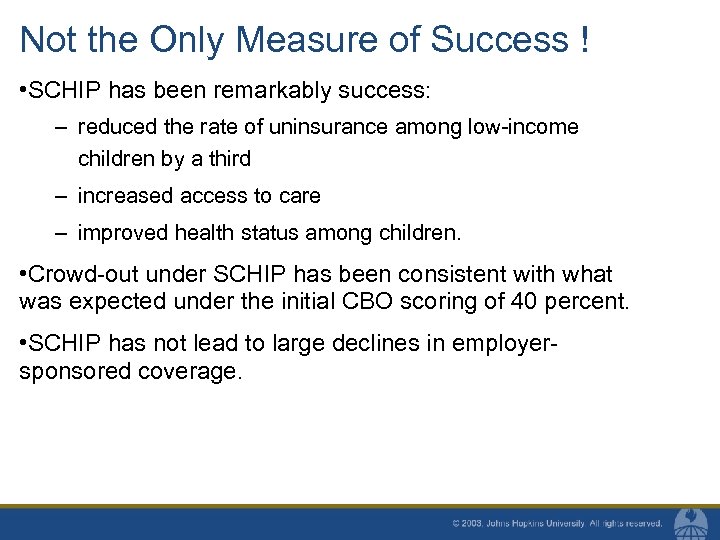
Not the Only Measure of Success ! • SCHIP has been remarkably success: – reduced the rate of uninsurance among low-income children by a third – increased access to care – improved health status among children. • Crowd-out under SCHIP has been consistent with what was expected under the initial CBO scoring of 40 percent. • SCHIP has not lead to large declines in employersponsored coverage.
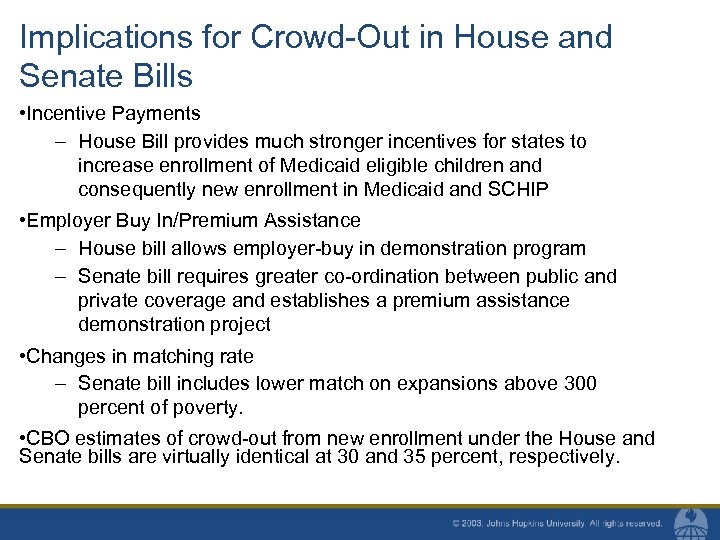
Implications for Crowd-Out in House and Senate Bills • Incentive Payments – House Bill provides much stronger incentives for states to increase enrollment of Medicaid eligible children and consequently new enrollment in Medicaid and SCHIP • Employer Buy In/Premium Assistance – House bill allows employer-buy in demonstration program – Senate bill requires greater co-ordination between public and private coverage and establishes a premium assistance demonstration project • Changes in matching rate – Senate bill includes lower match on expansions above 300 percent of poverty. • CBO estimates of crowd-out from new enrollment under the House and Senate bills are virtually identical at 30 and 35 percent, respectively.
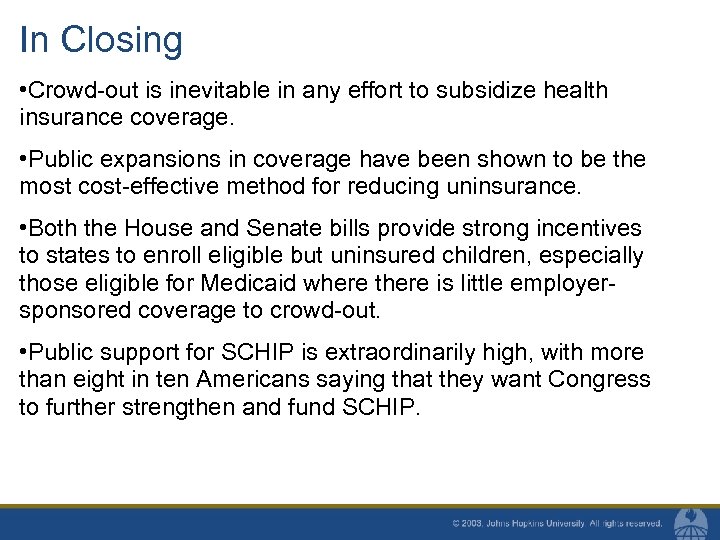
In Closing • Crowd-out is inevitable in any effort to subsidize health insurance coverage. • Public expansions in coverage have been shown to be the most cost-effective method for reducing uninsurance. • Both the House and Senate bills provide strong incentives to states to enroll eligible but uninsured children, especially those eligible for Medicaid where there is little employersponsored coverage to crowd-out. • Public support for SCHIP is extraordinarily high, with more than eight in ten Americans saying that they want Congress to further strengthen and fund SCHIP.
Скачать презентацию Crowd-Out Under SCHIP Looking Back and Moving Forward
d5dbe1a5012b819efd2cc7f3fdc7b27b.ppt