


 Скачать презентацию Cross-sectional assessment of patient outcomes using a systematic
210a4f05e4389df88c780aefb01283bd.ppt
- Количество слайдов: 26
 Cross-sectional assessment of patient outcomes using a systematic file review process: Results from 12, 987 patient files Ambereen Jaffer, Gesine Meyer-Rath, Malebo Maponyane, Ebrahim Variava, Francois Venter
 Current situation - South Africa q 5 million / 45 million – HIV+ q 1 million AIDS/year q 500 000 deaths / year q 60 000 pediatric infections a year Since Antiretroviral Treatment (ART) rollout – Early 2004 q Approx 350 000 people have received ART q BUT… q 1. 8 million South Africans have died of AIDS 2007
 Background q RHRU provides technical assistance with HIV related clinical services and capacity building via training and mentorship to Department of Health antiretroviral (ARV) clinic in 4 provinces in South Africa. q Wellness clinic at Tshepong Hospital is one of the largest partnering treatment sites, providing services to close to 6000 patients requiring HIV related care. q One of the first sites in South Africa to establish a down/up referral model. Referral model is enabling the clinic to continue to initiate large number of patients on ARVs. 2007
 Background q With the increasing number of clients, management of data and loss of patients to the system, has become an area of concern for the clinics. q In June 2006, the Tshepong wellness clinic leadership asked RHRU for assistance. A retrospective review of all patient files since the ART roll out initiated in April 2004 was deemed necessary. q RHRU developed & piloted a one page data collection tool. q Over 70 (clinical & non-clinical) individuals from Do. H, RHRU & Aurum participated in the file review activity in July 2006. 2007
 Background Tshepong Hospital file review was completed in July 2006 q Five additional file reviews have been conducted at: n ARV Clinic at Johannesburg Hospital. n Wellness Clinic at Taung Hospital. n ARV clinic at Potchefstroom Hospital n ARV clinic at Vryburg Hospital n ARV clinic at Schweizer Reneke Hospital 2007
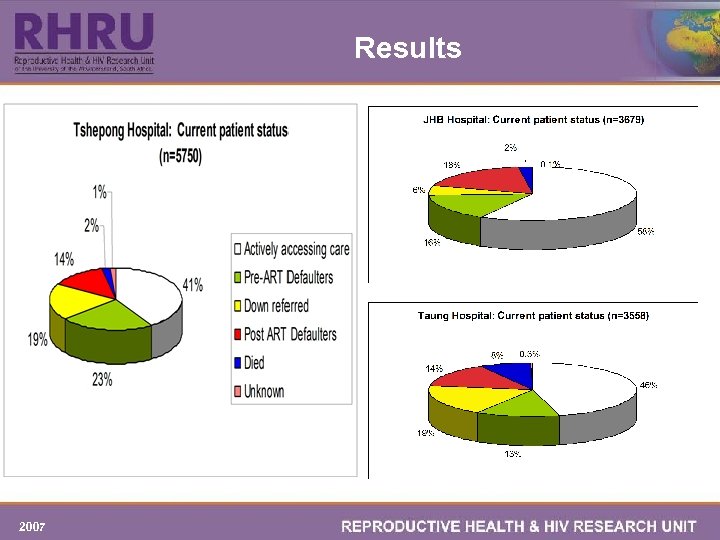
 Background q Total of 12, 987 files were reviewed: n 5, 750 files at Tshepong Hospital – a semi urban facility. n 3, 679 files at Johannesburg Hospital – a tertiary care, urban facility n 3, 558 files at Taung Hospital – a rural facility 2007
 Background q. Interested in finding out : n How many patients are currently on treatment? n How many patients have been down-referred? n How many patients are lost to follow-up? n What regimens are the patients on? n Side effects, treatment changes, information on other illnesses n CD 4 count & viral load development 2007
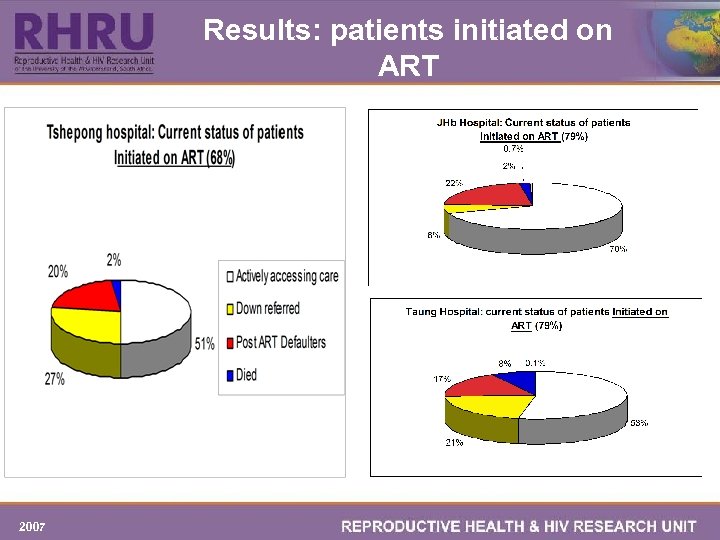
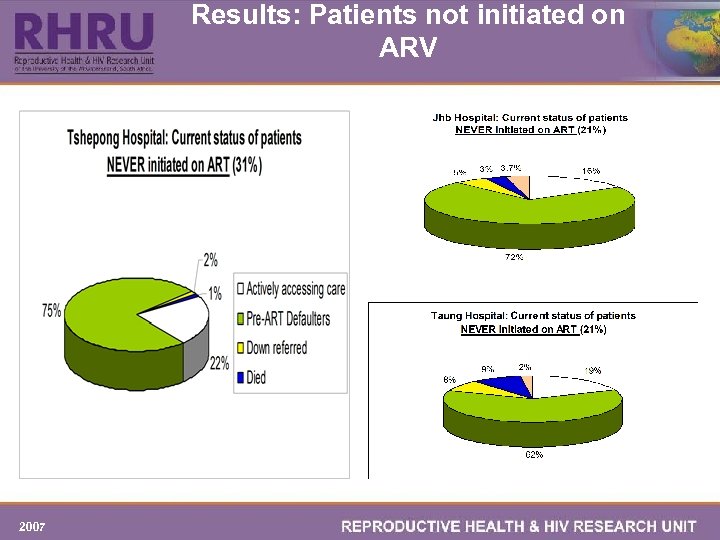
 Results q Approx 2/3 of patients accessing service at the 3 clinics are females & 1/3 are males. q Mean age of patients is 37 yrs q Patients files were classified as follows: n Active Patients n Pre-ART Defaulters (never started on ARVs & did not return after initial visit which was >6 weeks ago) n Post-ART Defaulters (Started on ARVs but have not returned to clinic in > 6 weeks since the last clinic or pharmacy visit). n Down Referred n Deceased 2007
 Results 2007
 Results: patients initiated on ART 2007
 Results: Patients not initiated on ARV 2007
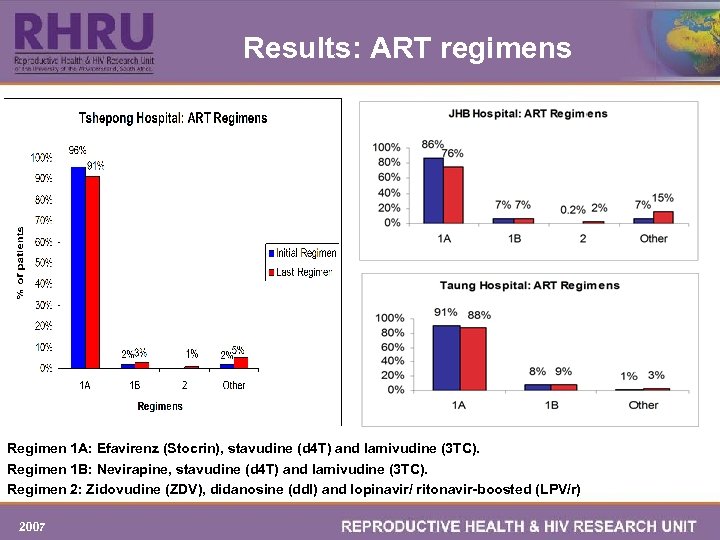 Results: ART regimens Regimen 1 A: Efavirenz (Stocrin), stavudine (d 4 T) and lamivudine (3 TC). Regimen 1 B: Nevirapine, stavudine (d 4 T) and lamivudine (3 TC). Regimen 2: Zidovudine (ZDV), didanosine (dd. I) and lopinavir/ ritonavir-boosted (LPV/r) 2007
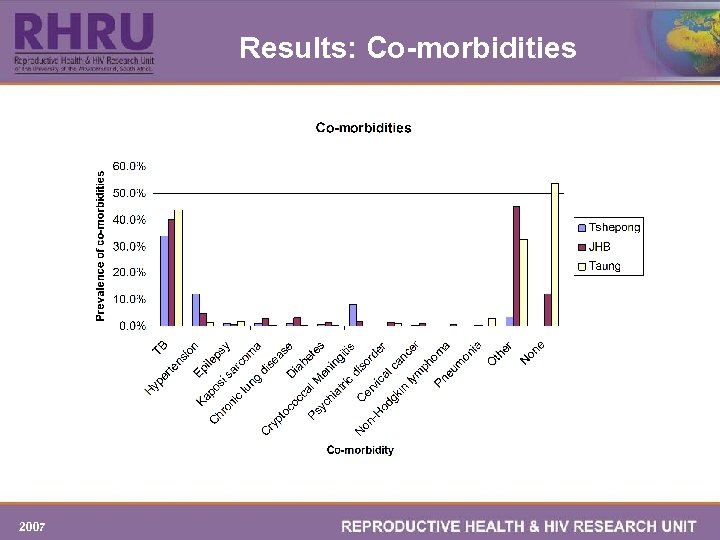 Results: Co-morbidities 2007
 Results: CD 4 Counts (*Tshepong Hospital only) q The median baseline CD 4 count for all patients was 95 cells/mm 3. q The median baseline CD 4 counts for patients Initiated on ART was 96 cells/mm 3. q The median baseline CD 4 counts for patients NOT initiated on ART was and 94 cells/mm 3. 2007
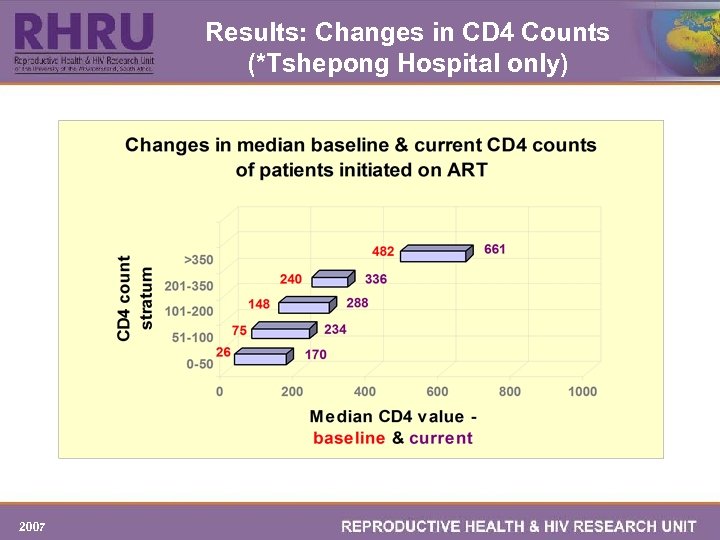 Results: Changes in CD 4 Counts (*Tshepong Hospital only) 2007
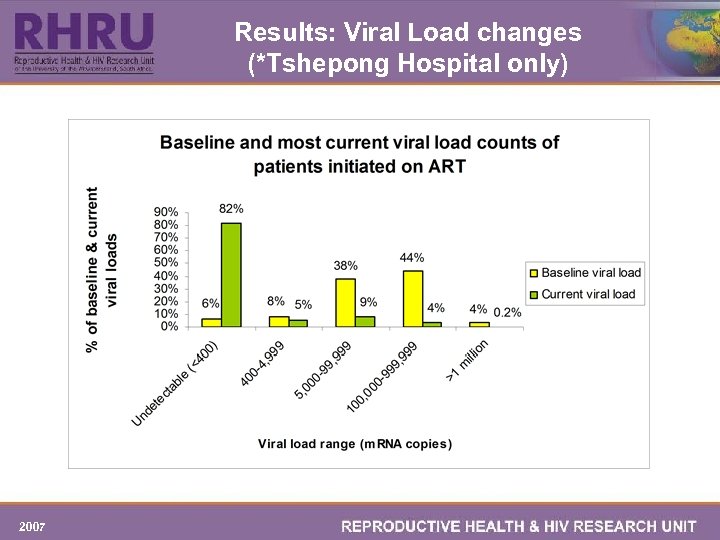 Results: Viral Load changes (*Tshepong Hospital only) 2007
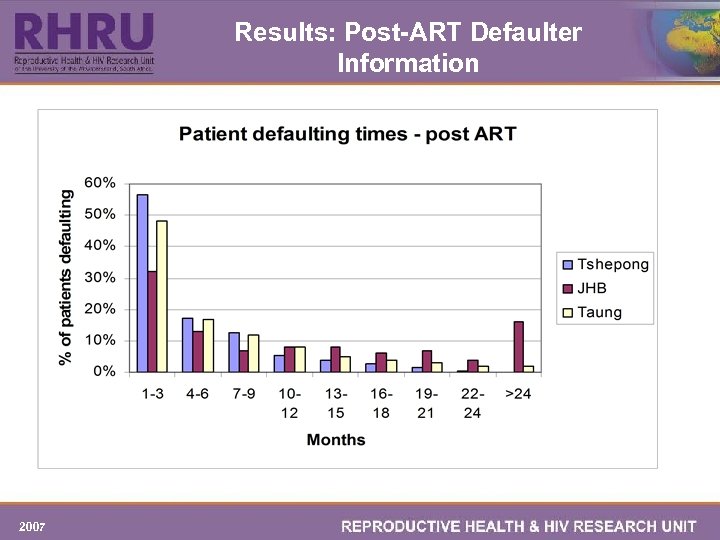 Results: Post-ART Defaulter Information 2007
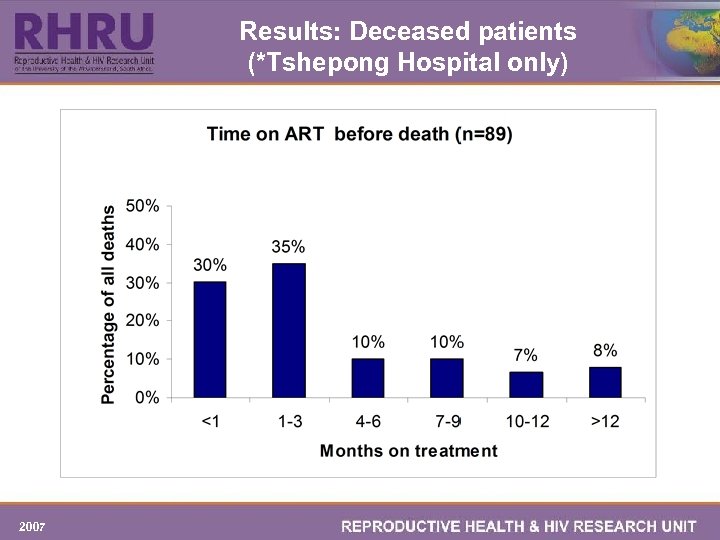 Results: Deceased patients (*Tshepong Hospital only) 2007
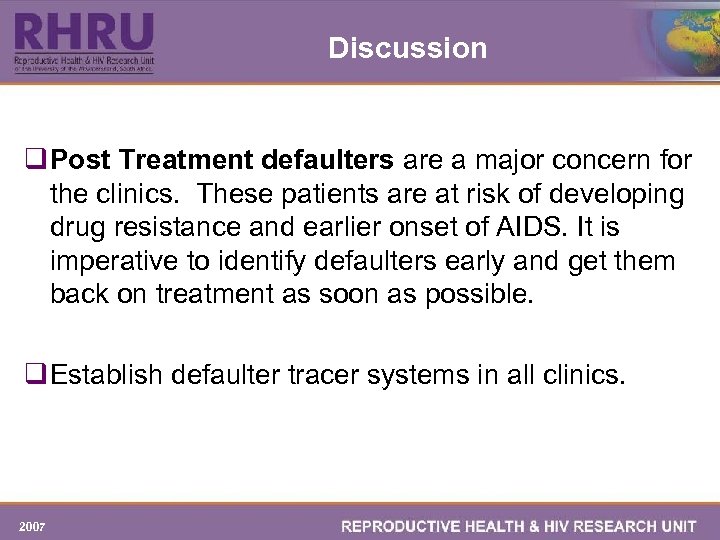 Discussion q Post Treatment defaulters are a major concern for the clinics. These patients are at risk of developing drug resistance and earlier onset of AIDS. It is imperative to identify defaulters early and get them back on treatment as soon as possible. q Establish defaulter tracer systems in all clinics. 2007
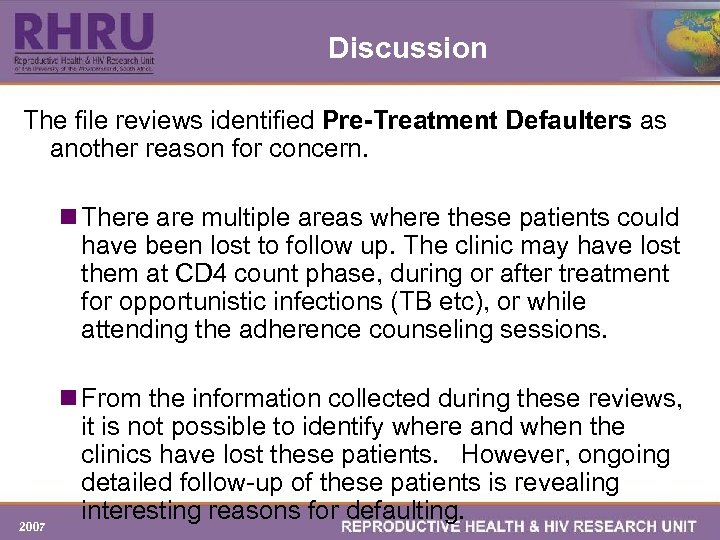 Discussion The file reviews identified Pre-Treatment Defaulters as another reason for concern. n There are multiple areas where these patients could have been lost to follow up. The clinic may have lost them at CD 4 count phase, during or after treatment for opportunistic infections (TB etc), or while attending the adherence counseling sessions. 2007 n From the information collected during these reviews, it is not possible to identify where and when the clinics have lost these patients. However, ongoing detailed follow-up of these patients is revealing interesting reasons for defaulting.
 Discussion q It is important to find out how well the down referral system is working. One way to ascertain this is by reviewing files of the patients at the respective down referral sites. q If the down referral system is found to be effective, it will considerably ease the pressure on the tertiary health care facilities and improve quality of services through out the referral network. q Patients accessing care very late 2007
 Challenges & Benefits of File Reviews Challenges q Resource intensive n Need HR for reviews n Need HR for QA q Buy in from clinic staff & leadership imperative q Need reviewers with minimum understanding of HIV care & treatment 2007 Benefits q Get an accurate picture of the situation q Identify the weak areas and propose appropriate interventions q Building the clinic staff capacity to understand the importance of the information collected and to assist them to continue with such activities
 Activities following from file review (Tshepong Hospital) q Defaulter tracer with high success rates q New filing system q Improved longitudinal data collection system and reporting q Improvement in quality of clinical data q Improved quality of care at first visit to reduce loss to follow-up pre-ART 2007
 Future Plans q Continue with file reviews at partnering Do. H sites q File review package of services (OCAS) q Support clinic staff to conduct periodic file reviews q Implement defaulter tracing programs q Evaluate the file review process 2007
 Acknowledgements This project is funded by PEPFAR Acknowledgements q Department of Health – NW Province q Gauteng Provincial Government q Tshepong Hospital Wellness Clinic Leadership & Staff q Johannesburg Hospital ARV Clinic Leadership & Staff q Taung Hospital Wellness Clinic Leadership & Staff q Aurum q RHRU Team 2007
 THANK YOU